Introduction
Squamous cell carcinomas (SCCs) of the oropharynx account for 10–15 per cent of all head and neck cancers.Reference Moncrieff, Sandilla, Clark, Clifford, Shannon and Gao1 According to ‘GLOBOCAN’ (Global Cancer Incidence, Mortality and Prevalence) estimates, there were 173 495 new cases of pharyngeal cancer in 2018, and the incidence of oropharyngeal SCC has been increasing over the past few decades, particularly in developed countries.Reference Chi, Day and Neville2 While in the past smoking and alcohol abuse have been the most relevant risk factors for oropharyngeal SCC development, more recent evidence highlights the role of human papilloma virus (HPV) infection, in particular genotype 16.Reference La Vecchia, Tavani, Franceschi, Levi, Corrao and Negri3,Reference D'Souza, Kreimer, Viscidi, Pawlita, Fakhry and Koch4 Patients with HPV-positive carcinomas are usually diagnosed at earlier stages, and they tend to be younger, non-smokers and with a higher level of education; even more importantly, they have a significantly better prognosis than HPV-negative patients.Reference Ang, Harris, Wheeler, Weber, Rosenthal and Nguyen-Tân5
Early-stage oropharyngeal SCC (stages I–II) is treated with definitive radiotherapy (RT) or surgery. Surgery followed by chemoradiotherapy or definitive chemoradiotherapy is generally considered for advanced stages (stages III–IV).Reference Díaz-Molina, Rodrigo, Alvarez-Marcos, Llorente, Costales and Suárez6 The benefits of primary surgery include correct pathological staging and the potential avoidance of RT or chemoradiotherapy in selected cases. By contrast, the drawbacks of primary surgery include the morbidity of the intervention, the risk of post-operative dysfunctions and the enhanced toxicity of any subsequent adjuvant therapy.Reference Díaz-Molina, Rodrigo, Alvarez-Marcos, Llorente, Costales and Suárez6
Transmandibular surgery traditionally represented the surgical approach to oropharyngeal SCC because of the limited access to this complex anatomical region. However, open destructive surgery can cause severe dysfunction, as it affects speech, swallowing, breathing and even one's appearance. Moreover, it often requires complex reconstruction of the resection defect with free flaps,Reference Moore, Henstrom, Olsen, Kasperbauer and McGree7 which can hinder pharyngeal movements during swallowing, leading to a slower functional recovery from dysphagia.Reference Lee, Yoon, Choi, Moon, Chung and Son8
Clinical trials carried out in the late 1990s demonstrated higher complication rates after surgery (23 per cent) than after curative chemoradiotherapy (6 per cent) with the same oncological outcome, independently of the cancer stage. Those results led to a gradual shift towards non-surgical approaches.Reference Li and Richmon9 However, over time, clinical studies and meta-analyses demonstrated severe late-onset toxicities associated with chemoradiotherapy and a negative impact on the patients’ quality of life (QoL).Reference Blanchard, Baujat, Holostenco, Bourredjem, Baey and Bourhis10,Reference Tschudi, Stoeckli and Schmid11
Over the last 20 years, the development of transoral surgery has made it possible to approach the oropharynx through the natural opening of the mouth, with minimum disruption of uninvolved musculoskeletal structures, thus arousing interest in oropharyngeal surgery. In particular, transoral laser microsurgery proved able to achieve excellent oncological results and functional outcomes with low morbidity.Reference Steiner, Fierek, Ambrosch, Hommerich and Kron12,Reference Haughey, Hinni, Salassa, Hayden, Grant and Rich13 Nonetheless, transoral exposure and resection of oropharyngeal SCC is not always feasible, and in such cases open surgery could still have a role.Reference Bertolin, Ghirardo, Lionello, Giacomelli, Lucioni and Rizzotto14
The lateral pharyngotomy approach, initially described by Trotter,Reference Trotter15 is an open surgical approach that improves exposure of the pharynx while avoiding mandibulotomy.Reference Laccourreye, Seccia, Ménard, Garcia, Vacher and Holsinger16 In selected cases of early to intermediate oropharyngeal SCC, the lateral pharyngotomy approach is considered a viable alternative to both mandibulotomy and chemoradiotherapy.Reference Laccourreye, Benito, Garcia, Menard, Bonfils and Holsinger17 Given the younger age and the better long-term survival of these ‘new’ oropharyngeal SCC-affected patients, treatment-related toxicity is highly relevant to the therapeutic choice.
This study aimed to compare the post-operative outcomes and morbidity of transoral laser microsurgery, transmandibular surgery and lateral pharyngotomy in a case–control study.
Methods
From 1998 to 2017, 162 patients with oropharyngeal SCC eligible for complete surgical resection were treated at the Head and Neck Department of the University of Trieste, Cattinara Hospital, and at the Otolaryngology Unit of Vittorio Veneto Hospital. Twenty-one patients were treated with transoral laser microsurgery. Each patient in the transoral laser microsurgery cohort was matched with one patient in the transmandibular surgery cohort and one in the lateral pharyngotomy cohort for: tumour (T) stage, oropharyngeal subsite and HPV status. Matching was achieved by creating database queries, which meant there was no need to refer to the patient notes, allowing us to avoid potential selection bias.
Pre-treatment radiology was reviewed in order to re-stage all tumours according to the clinical tumour–node (TN) classification of the American Joint Committee on Cancer (‘AJCC’) Cancer Staging Manual, eighth edition.Reference Amin, Greene, Edge, Compton, Gershenwald and Brookland18 Tumours were then divided into early stages (clinically categorised T1–2) and advanced stages (clinically categorised T3–4). Oropharynx subsites were classified into lateral, including palatine tonsils and tonsillar pillars, and inferior, including base of tongue, glossoepiglottic vallecula or fold, and amygdaloglossal fold. The HPV status was determined by HPV DNA detection and p16INK4a immunohistochemistry.
All patients underwent neck dissection. Selective neck dissection of levels II—IV was carried out for all clinical and radiological node-negative (N0) cases or for clinically limited nodal disease. A radical or modified radical neck dissection was carried out for clinically bulky nodal disease. Bilateral neck dissection was performed for tumours spreading to the contralateral side or for tumours of the tongue base.
Reconstruction with pedicled or free flaps was performed to cover large defects or surgically created communications between the oropharynx and the neck. Post-operative RT or chemoradiotherapy was considered according to the National Comprehensive Cancer Network guidelines.19
All patients signed an informed consent form prior to surgery for data collection and data analysis for scientific purposes. The Ethics Committee on Clinical Investigation of the University of Trieste approved the study protocol.
We compared the three groups in terms of length of hospital stay, tracheostomy rate, time to decannulation, nasogastric feeding tube rate, time to oral feeding, length of surgical procedure, need for pedicled or free flap, complication rate, margin status, need for surgical revision for positive margins, and post-operative RT or chemoradiotherapy. We considered the complications of post-operative bleeding, surgical site infections, salivary fistula and flap-related complications.
To evaluate QoL in oncological patients, we usually administer the University of Washington Quality of Life Questionnaire at 6 and 12 months after surgery. The questionnaire is composed of 12 single-question items, which have between 3 and 6 possible responses scored evenly from 0 to 100. The domains investigate pain, appearance, activity, recreation, swallowing, chewing, speech, shoulder, taste, saliva, mood and anxiety. There are also four global questions about overall QoL, in which patients are asked to consider physical and mental health, and social factors. The final score is expressed as a weighted average, where 0 corresponds to the worst QoL and 100 to the best. As not all patients in the lateral pharyngotomy group completed the questionnaires, we compared only the transmandibular surgery and transoral laser microsurgery groups for QoL outcomes.
Statistical analysis
The collected data underwent statistical analysis using SPSS version 15 software (SPSS, Chicago, Illinois, USA). The datasets of the scalar dependent variables were assessed for normality of the distribution with a Shapiro–Wilk test and for equality of variances with Levene's test. The three surgical approaches were compared with regard to the nominal dependent variables of interest with chi-square tests, applying the Bonferroni correction for the pairwise comparisons. A Kruskal–Wallis test was utilised for the comparison of the three surgical approach groups with regard to the considered scalar dependent variables, and Mann–Whitney tests with Bonferroni correction were performed for the pairwise comparisons. Kaplan–Meier survival curves were employed to estimate disease-free survival for each group, and the log-rank test was used to assess the significance of differences between the survival curves. Transoral and transmandibular approaches were compared in terms of the dependent variables of interest, namely the QoL questionnaire items, by means of a Mann–Whitney test. Values of p < 0.05 were regarded as statistically significant.
Results
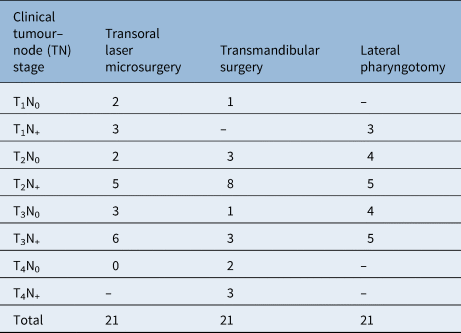
The three groups proved to be perfectly homogeneous in terms of T stage and tumour subsite, but not sex and age. All patients considered in this study were HPV-negative. Each group was composed of 10 patients affected by SCC of the inferior oropharynx and 11 patients with SCC of the lateral oropharynx; 12 patients had early-stage (T1–2) oropharyngeal SCC and 9 had advanced stage (T3–4) disease. The patients’ demographic data and TN staging details are summarised in Tables 1 and 2.
Patient demographics

SD = standard deviation
Clinical tumour–node staging

Data represent numbers of cases
All patients underwent unilateral or bilateral neck dissection: 4 and 17 in the transoral laser microsurgery group, 14 and 7 in the transmandibular surgery group, and 10 and 11 in the lateral pharyngotomy group, respectively.
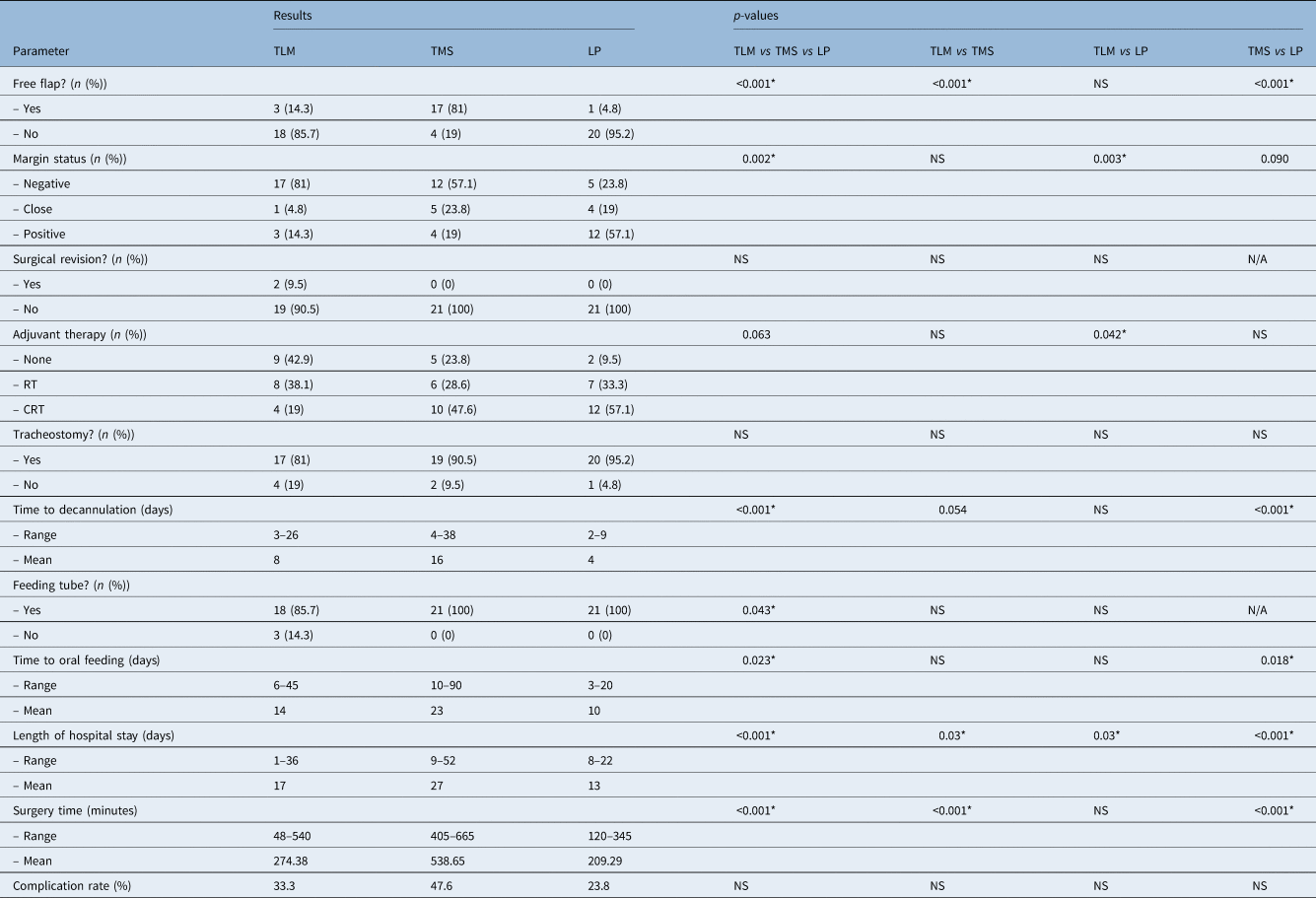
Duration of surgery and length of hospital stay were significantly longer for patients treated with transmandibular surgery (p < 0.001). Duration of surgery and length of hospital stay were 539 minutes and 27 days, respectively, in the transmandibular surgery group, compared with 274 minutes and 17 days in the transoral laser microsurgery group and 209 minutes and 13 days in the lateral pharyngotomy group. Comparing lateral pharyngotomy with transoral laser microsurgery, no statistically significant difference was found in duration of surgery, while the lateral pharyngotomy patients’ hospital stay was significantly shorter (p = 0.03).
Tracheostomy and nasogastric feeding tube rates were similar among the three groups, while time to decannulation and time to oral feeding were longer for patients treated with transmandibular surgery: 16 and 23 days, respectively, compared with 8 and 14 days in the transoral laser microsurgery group and 4 and 10 days in the lateral pharyngotomy group. No significant differences were found between transoral laser microsurgery and lateral pharyngotomy concerning those outcomes. Eighty per cent of transmandibular surgery patients required free or pedicled flap reconstruction compared with 14.8 per cent and 4.8 per cent in the transoral laser microsurgery and lateral pharyngotomy groups, respectively.
The complication rate was greater in patients treated with transmandibular surgery (47.6 per cent) compared with transoral laser microsurgery (33.3 per cent) and lateral pharyngotomy (23.8 per cent) groups, although this difference failed to achieve statistical significance (p = 0.26). Similarly, the adjuvant treatment rate did not differ significantly among the three cohorts (p = 0.06); however, we observed a tendency to avoid adjuvant RT or chemoradiotherapy in the transoral laser microsurgery group (42.9 per cent vs 23.8 per cent of the transmandibular surgery group and 9.5 per cent of the lateral pharyngotomy group). The percentage of negative margins was lower in the lateral pharyngotomy group (23.8 per cent) than in the transoral laser microsurgery (81 per cent) and transmandibular surgery (57.1 per cent) groups (p = 0.002); this difference was statistically significant in the comparison between lateral pharyngotomy and transoral laser microsurgery (p = 0.003). Detailed results and comparisons among the three groups are summarised in Table 3.
Comparisons of transoral laser microsurgery, transmandibular surgery and lateral pharyngotomy

*Indicates statistical significance (p < 0.05). TLM = transoral laser microsurgery; TMS = transmandibular surgery; LP = lateral pharyngotomy; NS = not significant; N/A = not applicable; RT = radiotherapy; CRT = chemoradiotherapy
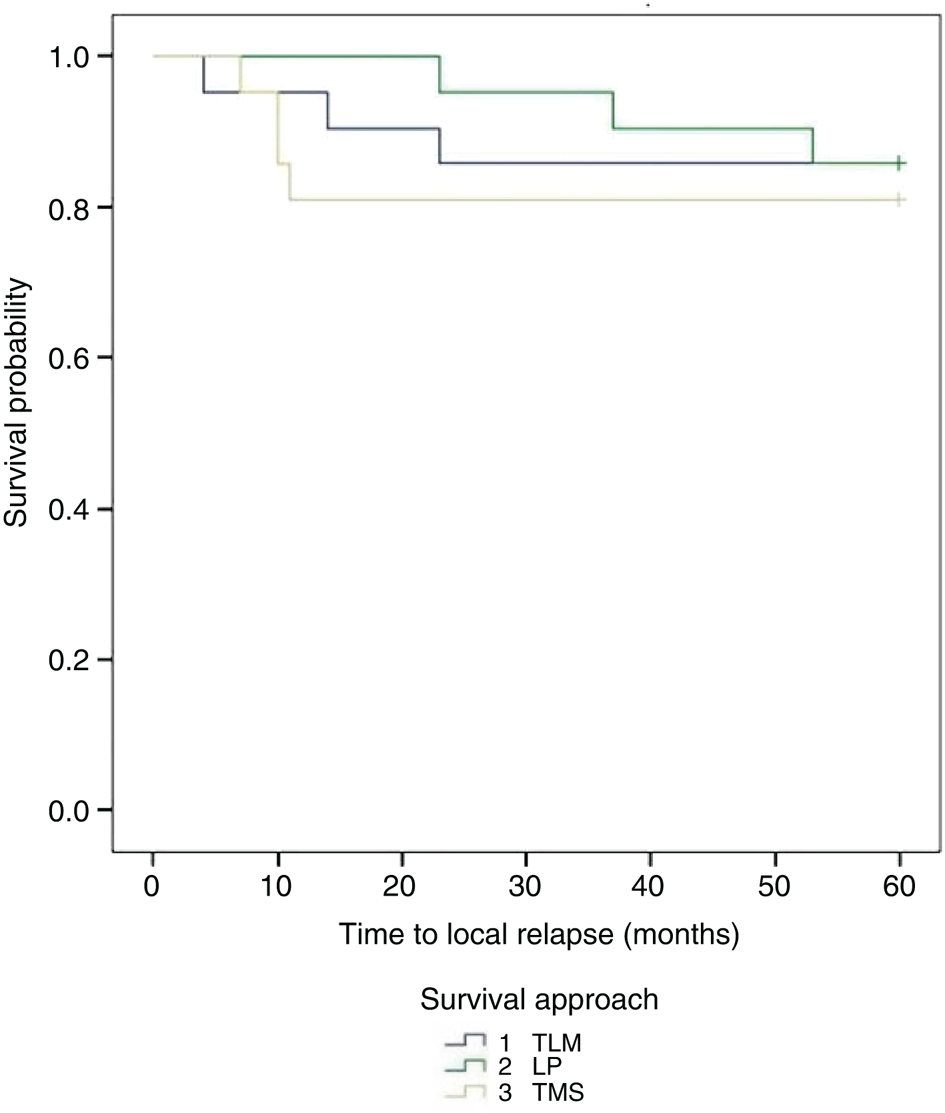
The mean follow-up duration was 93 months (range, 12–211 months). Preliminary disease-free survival rates were 87.5, 87.5 and 81 per cent for transoral laser microsurgery, lateral pharyngotomy and transmandibular surgery, respectively (Figure 1).
Kaplan–Meier plot demonstrating disease-free survival in the three groups. TLM = transoral laser microsurgery; LP = lateral pharyngotomy; TMS = transmandibular surgery

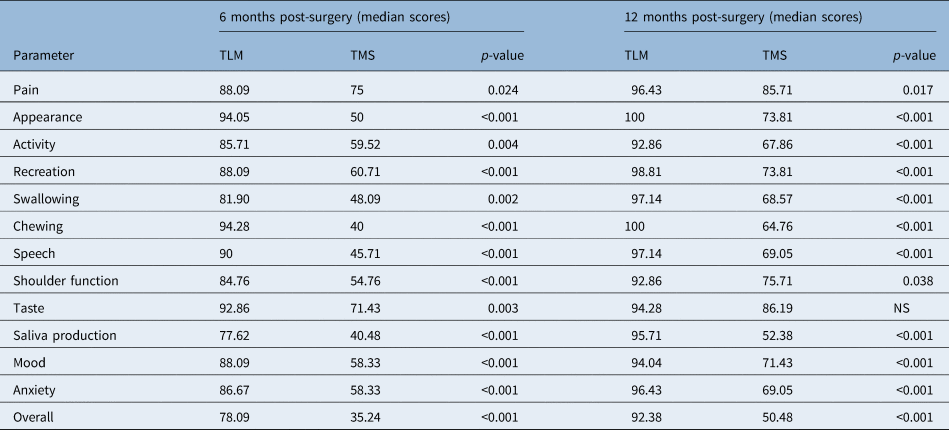
Comparison of the QoL questionnaires showed statistically better scores for transoral laser microsurgery at 6 and 12 months for all evaluated items except for ‘taste’, which was not influenced by the surgical approach (Table 4).
Quality of life questionnaire results

TLM = transoral laser microsurgery; TMS = transmandibular surgery; NS = not significant
Discussion
In modern head and neck surgery, low treatment-related morbidity and good oncological outcomes are the main goals.Reference Golusiński and Golusińska-Kardach20 In this regard, surgical morbidity, and acute and late-onset adverse effects of primary or adjuvant chemoradiotherapy, must be carefully considered when selecting the most adequate treatment. Comparison of the different treatment modalities is difficult because of the lack of randomised, controlled trials. Moreover, different stages, end points, observation periods and statistics make it even harder to compare the impact of one treatment relative to the others.
The present study attempted to compare the post-operative outcomes of the three main surgical approaches to oropharyngeal SCC. We designed it as a case-match study, with the aim of reducing bias related to tumour stage and tumour subsites, given that lateral wall or base of tongue tumours pose very different challenges for the surgeons. It is important to note that although efforts were made to match the groups closely, it was not possible to establish an exact match for age, sex and N-stage parameters (Tables 1 and 2). To our knowledge, no other previous study has directly compared the morbidity and post-operative outcome of the three surgical approaches.
Consistent with the literature, length of hospital stay was considerably longer for patients treated with transmandibular surgery, compared with lateral pharyngotomy and transoral laser microsurgery. This outcome reinforces the previous consideration regarding the higher complication rate and slower functional recovery characterising transmandibular surgery. In 2011, Diaz-Molina et al. reported a retrospective review of 155 patients surgically treated for oropharyngeal SCC. Thirty-nine per cent of the patients who underwent mandibulotomy developed significant complications such as salivary fistula, pneumonia and post-operative haemorrhage. The median duration of hospitalisation was 23 days.Reference Díaz-Molina, Rodrigo, Alvarez-Marcos, Llorente, Costales and Suárez6
Duration of surgical procedure was also significantly longer for transmandibular surgery compared with lateral pharyngotomy and transoral laser microsurgery, as mandibulotomy and mandibular reconstruction are time-consuming, and almost all patients (81 per cent) required a flap reconstruction (compared with 14.3 per cent of the transoral laser microsurgery group and 4.8 per cent of the lateral pharyngotomy group). Rahmati et al. found similar rates of flap reconstruction in a cohort of patients affected by tonsil SCC, 48 per cent of whom were staged T3–4 and treated via a mandibulotomy approach.Reference Rahmati, Dogan, Pyke, Palmer, Awad and Lee21
Conversely, length of hospital stay in our transoral laser microsurgery cohort was longer in comparison with some previous reports. Williams et al. reported an average of 8 days of hospitalisation for patients treated transorally.Reference Williams, Kinshuck, Derbyshire, Upile, Tandon and Roland22 Holsinger et al., reported an average of 9 days to discharge.Reference Holsinger, McWhorter, Ménard, Garcia and Laccourreye23 By contrast, Lee et al. found similar results, with a mean of 14 days and 24.6 days for transoral laser microsurgery and transmandibular surgery, respectively.Reference Lee, Park, Byeon, Choi and Kim24
The difference between our data and reports in the literature regarding length of hospital stay can be explained by the conservative attitude we decided to take towards transoral laser microsurgery patients, who are only discharged when swallowing rehabilitation is complete and the risk for post-operative haemorrhage is minimised. None of our transoral laser microsurgery patients had a nasogastric feeding tube or gastrostomy at the time of hospital discharge, and we recorded no post-operative mortality. In comparison, Williams et al.Reference Williams, Kinshuck, Derbyshire, Upile, Tandon and Roland22 reported that 4 per cent of patients had a gastrostomy at discharge, and Holsinger et al.Reference Holsinger, McWhorter, Ménard, Garcia and Laccourreye23 described a post-operative mortality rate of 2.6 per cent.
A nasogastric feeding tube was positioned in all patients treated with transmandibular surgery and lateral pharyngotomy, while it could be avoided in some cases of early-stage oropharyngeal SCC treated with transoral laser microsurgery. Time to oral feeding had a similar duration in the transoral laser microsurgery and lateral pharyngotomy approaches, while time to a functional swallowing recovery was considerably longer in patients undergoing transmandibular surgery. As stated, this result also affects length of hospital stay. The outcomes emerging from our study are in line with the literature.
In their prospective work on 57 cases of oropharyngeal SCC treated with transoral surgery or open surgery, Lee et al. found oral feeding restoration times of 1–22 days and 13–33 days, respectively.Reference Lee, Park, Byeon, Choi and Kim24 Ninety-three per cent of the patients operated via lateral pharyngotomy in the work by Laccourreye et al. needed nasogastric feeding tube insertion, with a median stay of 11 days.Reference Laccourreye, Benito, Menard, Garcia, Malinvaud and Holsinger25 Canis et al. reported a median duration for nasogastric tube feeding of 10 days in a cohort of 102 patients treated with transoral laser microsurgery for tonsil cancer.Reference Canis, Martin, Kron, Konstantinou, Ihler and Wolff26 In addition, Weiss et al. reported a median duration of 8.5 days (range, 1–131 days) in their study on 368 patients treated with transoral laser microsurgery.Reference Weiss, Ihler, Anczykowski, Bertlich, Kitz and Steiner27 In the latter study, 48 gastrostomy tubes had to be placed because of severe dysphagia and recurrent aspiration after adjuvant chemoradiotherapy. Chemoradiotherapy is a well-known detrimental factor for swallowing rehabilitation,Reference Gross, Townsend, Hong, Miller, Kallogjeri and Zenga28 and the low number of transoral laser microsurgery patients referred for adjuvant chemoradiotherapy may explain our good swallowing outcome.
The number of tracheostomies performed and time to decannulation were in line with the published literature,Reference Díaz-Molina, Rodrigo, Alvarez-Marcos, Llorente, Costales and Suárez6,Reference Bertolin, Ghirardo, Lionello, Giacomelli, Lucioni and Rizzotto14,Reference Laccourreye, Benito, Garcia, Menard, Bonfils and Holsinger17 with the transmandibular surgery group showing a doubled decannulation time compared with the transoral laser microsurgery and lateral pharyngotomy groups. We tend to perform more tracheostomies, with a slightly longer time to decannulation, for transoral resection, in comparison to those reported in some recent studies.Reference Holsinger, McWhorter, Ménard, Garcia and Laccourreye23,Reference Henstrom, Moore, Olsen, Kasperbauer and McGree29 Weiss et al., in the largest cohort of oropharyngeal cancer patients treated with transoral laser microsurgery, reported a 3.8 per cent rate of tracheostomies, most of which were placed when post-operative bleeding occurred, within 30 days after initial surgical treatment.Reference Weiss, Ihler, Anczykowski, Bertlich, Kitz and Steiner27 Post-operative haemorrhage is, in fact, the most common and life-threatening complication of transoral surgery. It can occur in 5.4–11 per cent of patients,Reference Weiss, Ihler, Anczykowski, Bertlich, Kitz and Steiner27,Reference Pollei, Hinni, Moore, Hayden, Olsen and Casler30 even 10–15 days after surgery, as the surgical defect usually heals by secondary intention. For that reason, we prefer to perform a primary tracheostomy, to prevent any massive bleeding that would lead to a high-risk and stressful emergency procedure.
In our experience, the highest percentage of close and positive resection margins at final histological examination was recorded in the lateral pharyngotomy group, and the lowest in the transoral laser microsurgery group. Many factors can explain these results, most of which are related to the transoral laser microsurgery technique itself. Transoral laser microsurgery is a step-by-step resection in which the surgeon can cut through the tumour to inspect the boundary between normal and diseased tissue under microscopic magnification in a more accurate way compared with conventional surgery.Reference Tirelli, Boscolo Nata, Gatto, Bussani, Spinato and Zacchigna31 Furthermore, the transoral laser microsurgery philosophy entails meticulous margin mapping, guided by frozen section,Reference Tirelli, Hinni, Fernández-Fernández, Bussani, Gatto and Bonini32 until complete (‘R0’ microscopically margin-negative) resection is attained. This can be achieved thanks to the low thermal damage of the carbon dioxide laser to tissue,Reference Tirelli, Gardenal, Gatto, Bonini, Tofanelli and Fernández-Fernández33 and the close co-operation between the surgeon and the pathologist, which facilitates reallocation of a positive margin for subsequent intra-operative re-resection.Reference Hinni, Zarka and Hoxworth34 Lastly, transoral pre- and intra-operative narrow-band imaging evaluation improves delimitation of the superficial margins.Reference Tirelli, Piovesana, Marcuzzo, Gatto, Biasotto and Bussani35–Reference Tirelli, Piovesana, Gatto, Tofanelli, Biasotto and Boscolo Nata37
Another advantage of the transoral laser microsurgery approach is that subsequent surgical revision for positive margins can be easily performed with low patient discomfort. On the contrary, where the surgical defect is covered with a flap or direct suture, adjuvant chemoradiotherapy is the most common solution.Reference Zuydam, Rogers, Brown, Vaughan and Magennis38 Our data on adjuvant treatment confirm this statement. Nineteen per cent of transoral laser microsurgery patients were sent for adjuvant chemoradiotherapy, compared with 47.6 per cent and 57.1 per cent of the transmandibular surgery and lateral pharyngotomy patients, respectively. Only two patients in the transoral laser microsurgery group underwent surgical re-resection for positive margins, while all the others underwent a margin enlargement in the same session of the primary tumour resection, thus confirming the reliability of frozen section analysis in our departments.Reference Tirelli, Hinni, Fernández-Fernández, Bussani, Gatto and Bonini32 These observations cannot be divorced from a correct selection of patients for transoral resection.
The most important drawbacks of transoral surgery are related to the difficulty in exposing some tumours, the narrow working field, the need for long unwieldy instruments and the line-of-sight issue of the laser beam from the micromanipulator, which make transoral resection challenging. That is why transoral surgical approaches tend to be centralised to academic or at least larger cancer facilities with a sufficient volume of activity and an adequate learning curve.Reference Gal, Slezak, Kejner, Chen and Huang39 Furthermore, tumours going through the pharyngeal constrictor muscles, affecting the mandible or the prevertebral fascia, are not eligible for transoral surgery. In this sense, a major consideration in patient selection for transoral surgery is whether the transoral approach is likely to achieve complete resection, thus reducing the need for adjuvant chemoradiotherapy and its well-known negative impact on QoL.Reference Blanchard, Baujat, Holostenco, Bourredjem, Baey and Bourhis10,Reference Machtay, Moughan, Trotti, Garden, Weber and Cooper40
If these conditions cannot be met, then other treatment modalities, including open techniques, must be considered.Reference Golusiński and Golusińska-Kardach20 In this context, lateral pharyngotomy represents a valid and safe treatment option, as it ensures reductions in surgery time, length of hospital stay, time to oral feeding and time to decannulation, with far fewer complications than transmandibular surgery. Previous studies demonstrated excellent disease-free survival after lateral pharyngotomy, when coupled with adjuvant chemoradiotherapy, despite the number of positive margins.Reference Bertolin, Ghirardo, Lionello, Giacomelli, Lucioni and Rizzotto14 This trend was confirmed in the preliminary disease-free survival data of our study, even with the limitations of the small sample size and the still inadequate follow-up time. Furthermore, this technique can be combined with a transoral definition of superficial margins, with narrow-band imaging and transoral sampling of superficial margins for frozen section, without increasing the morbidity rate or impairing functional outcomes in terms of breathing, swallowing and speaking.Reference Laccourreye, Benito, Garcia, Menard, Bonfils and Holsinger17
• In the human papilloma virus era, treatment-related morbidity is highly relevant in treatment selection for oropharyngeal cancer patients
• Open transmandibular surgery morbidity and sequelae are widely known, as is the mini-invasive nature of a transoral approach
• Patient selection for transoral laser microsurgery is crucial for good oncological and functional results; many patients are unsuitable
• Lateral pharyngotomy is an open approach with significantly less morbidity than transmandibular surgery
• However, lateral pharyngotomy is associated with more positive margins, increasing referrals for adjuvant chemoradiotherapy
• These factors should be considered when choosing surgical treatment for oropharyngeal squamous cell carcinoma
The main limitations of this study are its retrospective nature and the excessively limited sample size and follow-up period to draw adequate conclusions on survival. On the other hand, the case-matched study design was intended to eliminate strong confounding factors, such as T stage and tumour subsite, in order to gain efficiency in comparing the functional outcomes of the three surgical approaches.
Conclusion
In comparison with transmandibular surgery, transoral laser microsurgery and lateral pharyngotomy approaches to oropharyngeal SCC resulted in fewer complications and faster functional recovery. With equal functional recovery compared with transoral laser microsurgery, the lateral pharyngotomy approach was associated with a higher rate of positive resection margins at final histological evaluation, with consequently more patients being referred for adjuvant chemoradiotherapy. Nonetheless, patient selection for transoral laser microsurgery is of utmost importance to achieve such results, and many patients are not suitable for transoral surgery. Head and neck surgeons should bear all these issues in mind when deciding on the surgical treatment for oropharyngeal SCC.
Acknowledgement
The authors thank Itala Mary Ann Brancaleone, teacher of Medical English at the University of Trieste, for her support in editing the manuscript.
Competing interests
None declared