1. Introduction
Geyer et al.’s (Reference Geyer, Nowicki, Żylińska and Landing2019) comments focus on the taxonomic identification of Cambrian trilobite species in Morocco and Spain based on overlapping mosaics of characters and stratigraphic ranges, as a criticism of the contribution by Álvaro et al. (Reference Álvaro, Esteve and Zamora2018). The latter developed a biometric approach to the study of the earliest paradoxidine trilobites in Morocco and Spain, based on (i) bivariate analyses, useful to quantify relative lengths and widths selected as diagnostic characters for cranidia and pygidia; and (ii) multivariate analyses, focused on landmarks and semilandmarks, useful to quantify curved 2D outlines of any morphological character. According to their results, some species previously proposed by Geyer & Vincent (Reference Geyer and Vincent2015) cannot be separated biometrically into distinct morphotypes, and we ‘suggested their synonymy until 3D statistical analyses are available based on material preserved in carbonate and silica nodules’ (sentence taken from Abstract and Conclusions). Geyer et al.’s (Reference Geyer, Nowicki, Żylińska and Landing2019) contribution sets out to contradict Álvaro et al.’s (Reference Álvaro, Esteve and Zamora2018) bivariate and Principal Components Analyses (PCA) but offers only qualitative descriptions of morphological outlines and bivariate relationships that are not justified by their own illustrated specimens. Their criticism is based on the assumption that biometric results cannot improve qualitative descriptions of what they call ‘mosaics of characters’.
In the following, we will highlight how some of Geyer et al.’s comments are flawed by misconceptions, misinterpretations, use of questionable methods and misuse of personal communications. After comparing the works of Geyer & Vincent (Reference Geyer and Vincent2015) and Geyer et al. (Reference Geyer, Nowicki, Żylińska and Landing2019), it is clear that the authors have modified the taxonomic diagnoses of what are still ‘overlapping characters’. As a result, Geyer et al.’s (Reference Geyer, Nowicki, Żylińska and Landing2019) paper is not only a ‘Comment on Álvaro et al. (Reference Álvaro, Esteve and Zamora2018)’, but also an ‘Erratum for Geyer & Vincent (Reference Geyer and Vincent2015)’.
2. Disagreements that do not really exist
Geyer et al. (Reference Geyer, Nowicki, Żylińska and Landing2019) criticize some statements that do not occur in Álvaro et al. (Reference Álvaro, Esteve and Zamora2018). They state that when reading that ‘several species recently erected in Morocco are suggested as synonyms of A. mureroensis until 3D statistical analyses are available on material preserved on carbonate or silica nodules’, the reader will understand that ‘Álvaro et al. (Reference Álvaro, Esteve and Zamora2018) argued that at least six [sic] species of Acadoparadoxides belong to A. mureroensis’. However, any species delimitation is a hypothesis based on available data. In this case study, the available data do not support the diagnosis of most of the Moroccan species erected by Geyer & Vincent (Reference Geyer and Vincent2015), and thus all their species, except Acadoparadoxides nobilis, should (at least for now) be treated as potential synonyms of A. mureroensis.
Other inaccurate statements in Geyer et al. (Reference Geyer, Nowicki, Żylińska and Landing2019) are that Álvaro et al. (Reference Álvaro, Esteve and Zamora2018) (i) ‘ignored the stratigraphic occurrences of particular morphotypes’, when the latter authors based their analysis on material sampled in the Assemame quarry, where some of Geyer et al.’s (Reference Geyer, Nowicki, Żylińska and Landing2019) morphs co-occur in a single bed; (ii) ‘ignored the deformation-related compaction of individual sclerites’, whereas Álvaro et al. (Reference Álvaro, Esteve and Zamora2018) clearly stated that their morphometrics were based on 2D analyses, claiming the necessity of analysing 3D morphometrics on better-preserved material; and (iii) ‘ignored tectonic deformation’, whereas Álvaro et al. (Reference Álvaro, Esteve and Zamora2018) devoted their section 3a to explaining in detail how retrodeformation techniques were used, a concern that neither Geyer & Vincent (Reference Geyer and Vincent2015) nor Geyer et al. (Reference Geyer, Nowicki, Żylińska and Landing2019) have taken into consideration.
3. Stratigraphic context and putative isochrones
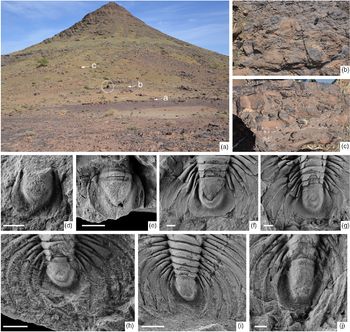
Geyer et al. (Reference Geyer, Nowicki, Żylińska and Landing2019) re-describe the stratigraphic, sedimentary and sequence-stratigraphic features of the Jbel Wawrmast Formation in the surroundings of Taroucht (Fig. 1a), eastern Anti-Atlas. According to the authors, the formation ‘is generally composed of a fairly monotonous succession of greenish-grey, fine-grained sandstones with episodic carbonate beds, layers of carbonate nodules and/or coarse-grained sandstones deposited in shallow-marine environments’. Previous work focused on the ‘Schistes à Paradoxides’ or ‘Jbel Wawrmast Formation’ (e.g. Destombes et al. Reference Destombes, Hollard, Willefert and Holland1985; Geyer, Reference Geyer1989; Geyer & Landing, Reference Geyer and Landing1995) described it as a shale-dominant unit with sandstone and limestone interbeds and an up-section increase in sandstone content. In Geyer et al. (Reference Geyer, Nowicki, Żylińska and Landing2019), it is surprising to read that the delicately preserved trilobites sampled in Taroucht are now found in sandstone (grain size > 0.06 mm) and to see their figure 1 suggesting that the formation is composed of trough cross-stratified sandstone. We disagree with this description: thin-section, X-ray diffraction and chemical tests determined the percentage of clay minerals and carbonate mud in the trilobite-bearing shale, which can be properly named mudstone: a mixture of silt- and clay-sized particles with carbonate content ranging from 5 % to 15 % in volume.
Field aspect of Bou Tiouit section at Taroucht (March 2018) and pygidia samples characterized by a mixture of characters sampled from the Cambropallas telesto acmé level; for scale, note person within circle. (a) Bou Tiouit hill with marked (arrowed) volcano-bioclastic limestone interbeds punctuating the shale-dominant succession; purple shales underlie the volcaniclastic limestone interbeds; pygidia specimens were sampled at the Cambropallas telesto acme level, worked by the fossil hunters of the area. (b) Upper surface of a limestone interbed showing subrounded clasts reworked from lateral limestone strata and cemented with microbial (stromatolitic) crusts. (c) Transverse section of a limestone interbed with breccia fabric. (d) Faintly concave pygidial flanks (pampalius morph) with subhexagonal outline and posterior margin straight (levisettii morph). (e) Ovate outline (ovatopyge morph) with slightly rounded posterior margin (cf. mureroensis morph). (f) Subhexagonal outline and posterior margin straight (levisettii morph). (g) Faintly concave pygidial flanks (pampalius morph), subhexagonal outline and posterior margin straight (levisettii morph). (h) Faintly concave pygidial flanks (pampalius morph). (i) Faintly concave pygidial flanks (pampalius morph). (j) Faintly concave pygidial flanks (pampalius morph) with posterior margin slightly rounded (cf. mureroensis morph); scales to constrain ontogenetic phases: (d–e, j) = 3 mm; (f–i) = 5 mm; material housed in the IGME Museum, Río Rosas 23, Madrid (acronyms MGM-7541X to MGM-7547X, respectively).

Geyer et al. (Reference Geyer, Nowicki, Żylińska and Landing2019) interpret the sedimentary environment of the whole formation as ‘shallow marine’, but no references to bathymetrically controlled environments are offered, such as offshore, shoreface or foreshore settings. They subdivide the formation into ‘parasequences visible as colour cycles that reflect shoaling-upward development in within [sic] an oxygen-stratified marine environment’; in which ‘some of the red-coloured intervals yield volcaniclastic sand grains useful as a lithostratigraphic basis for correlation and which help confirm a chronostratigraphic utility of the colour cycles’, as a result of which ‘the succession of parasequences can be traced over most of the central and eastern Anti-Atlas’. However, no mechanism is provided to explain the upward modification of these ‘parasequences’ (a sequential assignment exclusively based on their thicknesses), arranged in a homogeneous sandstone unit interrupted only by limestone interbeds. According to this subjective interpretation, their ‘parasequences’ can be exclusively recognized based on the colour yielded by the weathering of volcaniclastic debris.
A real siliciclastic parasequence, however, should be characterized by a cycle of sediment either coarsening or fining upward, topped by a flooding surface identifiable by an abrupt and correlatable change in grain size (e.g. Posamentier & Allen, Reference Posamentier and Allen1999; Catuneanu et al. Reference Catuneanu, Galloway, Kendall, Miall, Posamentier, Strasser and Tucker2011). Furthermore, if the putative ‘sandy shallow-water substrate’ developed within an oxygen-stratified marine environment, as the authors claim, the fossil content (rich in benthic trilobites, sponge spicules, chancelloriid sclerites and calcitic and phosphatic brachiopods) should reflect distinct anoxic-to-oxic palaeoecological trends paralleling the ‘parasequences’. Coloured images of trilobites show their pristine preservation both in greenish and purple shales (e.g. see Geyer & Vincent, Reference Geyer and Vincent2015, figs 17, 28) so colour cycles do not affect fossil taphonomic conditions. Colour cycles indeed reflect changes in the Fe2+/Fe3+ ratio, which can be relics of both sedimentary and diagenetic processes, but the authors consider colour cycles as representative of shoaling trends with neither grain size nor faunal/taphonomic modifications. Regarding the time involved in the study log, Geyer et al.’s (Reference Geyer, Nowicki, Żylińska and Landing2019) sentence ‘Although radiometric dates are lacking, sequence stratigraphic analysis suggests that the overall time of the Jbel Wawrmast Formation deposition was not short’ is enigmatic for us.
Geyer et al. (Reference Geyer, Nowicki, Żylińska and Landing2019) have not taken into account the significance of the limestone interbeds, which are incidentally responsible for the presence of variegated-colour interbeds. Facies descriptions of these volcanic–bioclastic limestone interbeds, punctuating the Brèche à Micmacca Member, have been published during the last three decades (e.g. Buggisch et al. Reference Buggisch, Marzela and Hügel1978; Boudda et al. Reference Boudda, Choubert and Faure-Muret1979; Destombes et al. Reference Destombes, Hollard, Willefert and Holland1985; Álvaro & Clausen, Reference Álvaro and Clausen2005, Reference Álvaro and Clausen2006, Reference Álvaro, Clausen, Pratt and Holmden2008; Algouti et al. Reference Algouti, Chabane, Dal Piaz, El Boukhari, Ellero, Feroni, Ghiselli, Kamal, Malusà, Massironi, Musumeci, Ottria, Ouanaimi, Pertusati and Schiavo2007; Álvaro, Reference Álvaro2014; Álvaro et al. Reference Álvaro, Benziane, Thomas, Walsh and Yazidi2014, Reference Álvaro, Ezzouhairi, Clausen, Ribeiro and Solá2015; Clausen et al. Reference Clausen, Álvaro and Zamora2014). These limestone interbeds are rich in volcaniclasts and bioclasts and contain numerous intra-bed microbial crusts indicating preservation of stratigraphic diastems (Fig. 1b, c). Their allochems result from different kinds of diagenetic processes, in some cases including fossils from different biozones. The presence in these limestone interbeds of polyphase clasts containing early Cambrian archaeocyaths has been highlighted by Buggisch et al. (Reference Buggisch, Marzela and Hügel1978) and Álvaro & Clausen (Reference Álvaro, Clausen, Pratt and Holmden2008). These interbeds have been interpreted as episodes involving lateral erosion of older strata due to tectonic perturbations related to syn-rift pulses. They represent the influence of volcanic episodes related to tilting of the blocks that formed the horst-and-graben rift that is preserved in the Anti-Atlas. As a result, they should be considered as condensed levels punctuating the background offshore-dominant environments preserved in part of the Jbel Wawrmast Formation. These volcanically influenced interbeds do not represent sequence boundaries but volcanogenic event-stratigraphic markers, and should not be interpreted as flooding surfaces separating ‘parasequences’, as suggested by Geyer et al. (Reference Geyer, Nowicki, Żylińska and Landing2019). The lateral extent of the volcaniclastic limestone/green-purple shale interbeds is highly variable and ranges from a couple of metres to 10 km (Álvaro & Clausen, Reference Álvaro and Clausen2006, Reference Álvaro, Clausen, Pratt and Holmden2008).
Their proposal of carbonate horizons as isochrones (‘the cycle tops with their carbonate-rich horizon can be taken as isochrones’) is problematic, because the authors will later use these isochronous ‘parasequence’ contacts to recognize laterally their supposed trilobite stratigraphic ranges, despite the fact that real parasequences pinch out both seaward (that is, depositionally down dip) and landward (depositionally up dip). Only along depositional strike, that is, parallel to the coast, is there the potential for parasequences to exhibit largely the same facies composition, although this should be applicable to passive-margin basins, which is not the case in the Anti-Atlas. Geyer et al. (Reference Geyer, Nowicki, Żylińska and Landing2019) describe the Cambrian of the Anti-Atlas as an idealized homoclinal ramp, recording parasequences (exclusively based on colour features) correlatable throughout the whole passive-margin basin. All their sedimentary information is based on an unpublished PhD thesis (W Heldmaier, unpub. PhD thesis, Würzburg Univ., 1998) and another reference (Landing et al. Reference Landing, Geyer and Heldmaier2006) that was focused on the underlying Tazlaft Member (Asrir Formation). However, according to the information published during the two last decades and related to volcanism, hydrothermal activity, carbonate and siliciclastic sedimentology, diagenetic features and biostratigraphic implications, the Cambrian of the Anti-Atlas represents the infill of an active rift, characterized by a horst-and-graben palaeogeography with mapped rifting branches, local and regional unconformities and onlapping patterns, and distinct tholeiitic-to-alkaline volcanic episodes (see recent syntheses in Gasquet et al. Reference Gasquet, Levresse, Cheilletz, Azizi-Samir and Mouttaqi2005; Pouclet et al. Reference Pouclet, Aarab, Fekkak and Benharref2007, Reference Pouclet, Ouazzani and Fekkak2008, Reference Pouclet, El Hadi, Álvaro, Bardintzeff, Benharref and Fekkak2018; Michard et al. Reference Michard, Hoepffner, Soulaimani, Baidder, Michard, Saddiqi, Chalouan and Frizon de Lamotte2008; Álvaro et al. Reference Álvaro, Benziane, Thomas, Walsh and Yazidi2014, Reference Álvaro, Ezzouhairi, Clausen, Ribeiro and Solá2015; Álvaro & Vizcaïno, Reference Álvaro and Vizcaïno2018). This multidisciplinary framework of data and interpretations contradicts Geyer et al.’s (Reference Geyer, Nowicki, Żylińska and Landing2019) idealized image of the Cambrian evolution recorded in the Anti-Atlas.
4. Sampling methods
Intentionally, Álvaro et al. (Reference Álvaro, Esteve and Zamora2018, pp. 1569–72) included a detailed Material and Methods section, where they clearly stated that ‘the material described below has been sampled by the authors’. Neither Geyer & Vincent (Reference Geyer and Vincent2015) nor Geyer et al. (Reference Geyer, Nowicki, Żylińska and Landing2019) explain how their illustrated trilobites were sampled. The Assemame and Taroucht quarries are the target of exploitation by local fossil-hunters who will sell their ‘giant trilobites’ (mainly Cambropallas telesto and Acadoparadoxides briaerius; see Gutiérrez-Marco & García-Bellido, Reference Gutiérrez-Marco and García-Bellidoin press) to any customer. We know the prices paid for the specimens illustrated in Geyer & Vincent (Reference Geyer and Vincent2015), and re-illustrated in Geyer et al. (Reference Geyer, Nowicki, Żylińska and Landing2019), since we have visited the same quarries (Fig. 1), know the same fossil-hunters and read the information sent to us by Mr Anthony Vincent. Having a look at some illustrations included in publications focused on the Cambrian trilobites of Morocco (see Geyer, Reference Geyer1993; Geyer & Landing, Reference Geyer and Landing2004; Geyer & Vincent, Reference Geyer and Vincent2015; Geyer et al., Reference Geyer, Nowicki, Żylińska and Landing2019), many of these specimens show traces of extractions using hammer and nails, and artificial (hand-made) final touches.
Describing new taxa based on material acquired in fossil markets is one thing (Fortey, Reference Fortey2009), but interpolating biostratigraphic, palaeoecological and biodiversity patterns based on this type of material with inherent sampling and taphonomic biases (see criticism in Labandeira & Hughes, Reference Labandeira and Hughes1995; Smith, Reference Smith2001; Lloyd, Reference Lloyd2012; Benton, Reference Benton2015) is risky. Although Geyer et al. (Reference Geyer, Nowicki, Żylińska and Landing2019) claim that the intra-specific variability of their taxa must be taken into account, no variability is documented (neither described nor quantified) in their work. Ontogenetic modifications are ignored by the authors, and their material is mainly composed of adult-to-giant complete specimens and sclerites, i.e. the targets of fossil-hunters. The only ways to avoid sampling biases are: (i) by applying statistical techniques to juvenile-to-adult trilobite populations, as reported by Álvaro et al. (Reference Álvaro, Esteve and Zamora2018); or (ii) by restricting the comparison to similar-sized sclerites and proposing diagnoses only for adult specimens. It is not the same to propose a diagnosis based on three perfectly preserved, adult specimens (holotype + 2 paratypes) as diagnosing a population of 30 specimens (we still assume a low number) including juvenile and adult specimens. Different approaches can yield different results.
5. The fluctuating concept of species
Depending on their purposes, Geyer & Vincent (Reference Geyer and Vincent2015) and Geyer et al. (Reference Geyer, Nowicki, Żylińska and Landing2019) have used three different concepts of species, based on (i) mosaics of characters and (ii) risky ultra-splitting methods, associated with (iii) the stratigraphic ranges of their supposed chronospecies.
5.a. ‘Mosaic of characters’ vs ultra-splitting morphospecies
After accounting for sampling bias, the morphological analysis of a population displaying a mosaic of gradual characters can be made by either (i) selecting morphologically disparate types from a continuous population to erect new taxa, and dramatically restricting the variation of their diagnostic characters (ultra-splitting option); or (ii) checking biometric variables. The former can lead to the selection of slightly variable mosaics of characters to distinguish morphotypes lacking autopomorphic characters. Westrop & Landing (Reference Westrop and Landing2000), among others, criticized the selection of mosaics of characters made by Geyer as a valid systematic method because such a selection may lead to artificial grouping of taxa based on synapomorphies. Geyer & Landing (Reference Geyer and Landing2004) replied that the selection of ‘mosaics of characters’ ‘cannot be simply ignored or labelled as worthless plesiomorphy’, and nobody can criticize this. The problem arises when plesiomorphic characters are used to erect hierarchical taxa, such as genera or families. The same authors considered that ‘a purely morphologic approach to the group’s systematics will not lead to unequivocal results because of a mosaic pattern of character evolution’. But this is circular reasoning because if we select mosaics of characters to propose taxonomic diagnoses, we will deduce phylogenetic trees based on the evolution of mosaics of characters. Worse here is the nihilism offered by Geyer & Landing (Reference Geyer and Landing2004), who consider that purely morphological approaches will not lead to unequivocal results in systematics. So, which other characters different than morphological features can be used for the systematics of trilobite fossils?
Statistics might be helpful, but Geyer & Vincent’s (Reference Geyer and Vincent2015) opinion offers another sceptical reasoning: ‘morphometric measurements ... do not prove that specimens represent a single species even if their values are grouped together in comparative diagrams’. How can we interpret such a declaration? Maybe by reference to Elicki & Geyer (Reference Elicki and Geyer2013, p. 46), where it is stated that, when comparing two morphotypes, ‘how far this disparity in morphology requires a taxonomic separation is a matter of debate and personal opinion’. It is clear that, for the authors, personal opinions are more reliable than biometric analyses.
The problem with Geyer & Vincent’s (Reference Geyer and Vincent2015) taxonomic proposal, where the diagnostic characters are overlapping in different species, is that some specimens share characters of several of their species morphs. Álvaro et al. (Reference Álvaro, Esteve and Zamora2018, pp. 1572–4) documented in detail how some paratypes do not fit the diagnostic characters of their holotypes. The response to their statement that ‘morphological differences [were] described in Geyer & Vincent (Reference Geyer and Vincent2015) in a classic way, but these were not discussed in any detail in Álvaro et al. (Reference Álvaro, Esteve and Zamora2018)’ was already made in Álvaro et al. (Reference Álvaro, Esteve and Zamora2018, pp. 1572–4).
In Systematic Palaeontology, species are identified on proposals written as diagnostic characters. The diagnosis may be based on expression of a unique character state (an autapomorphy), or on expression of a unique combination of (non-unique) character states. In the latter case, the unique combination of states represents the autapomorphy, even though each state taken in isolation does not represent an autapomorphy. After reading these autapomorphies, other colleagues should be able to recognize the species; otherwise, they were not properly defined and the diagnosis must be emended. The problem arises when the diagnoses are based on overlapping diagnostic characters that are unrelated to ontogenetic growth. In this case, only the author that erected the species can ‘recognize’ them. As stated by Álvaro et al. (Reference Álvaro, Esteve and Zamora2018), some Moroccan holotypes and paratypes are incomplete sclerites (e.g. A. nobilis Geyer, Reference Geyer1998), as a result of which some relative lengths and widths of these species were interpolated by the author.
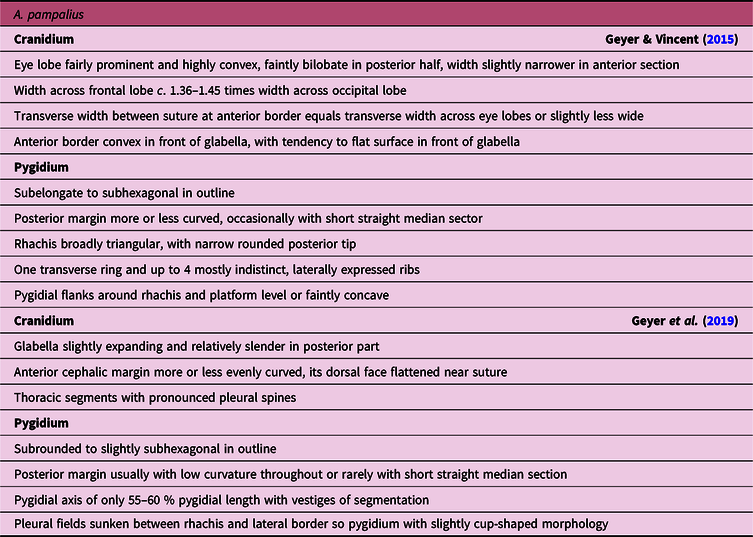
Let us see an example: the diagnostic characters of A. nobilis, and its differentiation from A. mureroensis, have been progressively modified from Geyer (Reference Geyer1998) to Geyer & Vincent (Reference Geyer and Vincent2015) and Geyer et al. (Reference Geyer, Nowicki, Żylińska and Landing2019). These characters implied overlapping biometric ranges and loosely defined descriptive categories of form that partially overlap between the species (such as ‘evenly curved to subarcuate’ vs ‘evenly curved’ features), and characters unseen in the holotype and paratypes, etc. (see details in Álvaro et al. Reference Álvaro, Esteve and Zamora2018, pp. 1572–3). As a result, the biometric relationships between nobilis and mureroensis are overlapping in adult specimens (nothing is said about their ontogenetic biometrics) and the species are based on poorly distinguishable characters. However, Geyer & Vincent (Reference Geyer and Vincent2015) offered a distinct character unshared by both species: the outline of the posterior margin of the pygidium. Hence, the taxonomic distinction of A. nobilis is at least clearly based on one single character, as a result of which the ‘mosaic of [remaining] characters’ is useless for taxonomic purposes. What the authors are doing is complicating the diagnostic characters, which should be stated in a brief and distinct way: one single character. Geyer et al.’s (Reference Geyer, Nowicki, Żylińska and Landing2019) new diagnoses further complicate the issue, adding overlapping characters in lengthy diagnoses, which should be better considered as descriptions and not as diagnoses. Contrary to what can be read in their Abstract, Geyer et al. (Reference Geyer, Nowicki, Żylińska and Landing2019) do not ‘reassert the diagnostic characters’ of Geyer & Vincent (Reference Geyer and Vincent2015), because the diagnoses have been distinctly modified, not reassessed (Table 1).
Modification of the diagnostic characters selected by Geyer & Vincent (Reference Geyer and Vincent2015) and Geyer et al. (Reference Geyer, Nowicki, Żylińska and Landing2019) for Acadoparadoxides pampalius

Álvaro et al. (Reference Álvaro, Esteve and Zamora2018) found five morphs described by Geyer & Vincent (Reference Geyer and Vincent2015) (A. mureroensis, A. cf. mureroensis, A. levisettii, A. ovatopyge and A. pampalius) together in a single level, in fact, the Cambropallas telesto acme level of the Assemame quarry, where the fossil-hunters are especially interested in sampling due to the large size of many trilobite species. Here we present a repetition of the same sampling technique, but now in the Bou Tiouit section at Taroucht (Fig. 1d–j), where we arrived at the same conclusion: these morphs co-occur in a single level showing transitional characters, and cannot be differentiated after statistical analysis.
5.b. Stratigraphic species vs chronospecies
Another misconception developed by Geyer & Vincent (Reference Geyer and Vincent2015) and Geyer et al. (Reference Geyer, Nowicki, Żylińska and Landing2019) is the use of the stratigraphic ranges yielded by the paradoxidine species to recognize the taxa. This is a risky method: should the stratigraphic range of a palaeontological morphotype be used as diagnostic character for its taxonomic identification? The answer is obviously not, because this reflects circular reasoning. The use of chronospecies and stratigraphic species has been ceaselessly discouraged (e.g. Wagner, Reference Wagner1995; Smith, Reference Smith2000; Wheeler & Platnick, Reference Wheeler, Platnick, Wheeler and Meier2000; Forey et al. Reference Forey, Fortey, Kenrick and Smith2004). In contrast, any palaeontological species should be established on unique combinations of diagnostic morphological characters avoiding unnecessary ambiguities in their identification.
Geyer et al. (Reference Geyer, Nowicki, Żylińska and Landing2019) claim that other stratigraphic ranges displayed by the same morphospecies outside Taroucht are necessarily wrong; in fact, they re-adapt the stratigraphic ranges in the Iberian Chains, NE Spain, to obtain the same stratigraphic arrangement as that proposed by them in the eastern Anti-Atlas (Geyer & Vincent, Reference Geyer and Vincent2015, fig 10). However, the order of first and last appearances of species must be checked in the same basin and beyond it, and not blindly interpolated worldwide. These bioevents are not necessarily synchronous worldwide until a control with homotaxic tests is made (Scott, Reference Scott1985). With this procedure, palaeontologists test the occurrence of fossils in other logs as a method to check their order of appearance and demonstrate (or not) their utility as chronostratigraphic markers.
Finally, Geyer et al.’s (Reference Geyer, Nowicki, Żylińska and Landing2019) figure 1 offers some stratigraphic ranges based on ‘uncertain occurrences; specimens not clearly assignable to the horizons’ [sic]. As a result, the first occurrences of their morphospecies do not necessarily mark the base of their homonymous interval subzones.
6. Applicability of morphometrics
A first step in analysing fossil populations is to determine the number of characters and their growth relationships within the sample. Different methods can be employed including bivariate, multivariate and landmarks approaches. Each method has its own applicability: for instance, bivariate analyses are exclusively useful for investigating the growth dynamics of two sclerite dimensions, and their results are key to discriminate non-overlapping diagnostic characters. Geyer et al. (Reference Geyer, Nowicki, Żylińska and Landing2019) criticize the fact that a bivariate analysis is not useful to discriminate results only yielded by semi-landmarks analyses. We agree because the two methods have different applicabilities.
To quantify the relationship between two characters during growth, bivariate analyses are adequate. If we analyse a network of characters, this method becomes inadequate, but other ones, such as Reduced Major Axis (RMA), are optimal. The number of comparisons of paired characters is huge (e.g. character A vs character B, C, D... using both axial and transverse orientations) so we selected those highlighted in the diagnoses. Álvaro et al. (Reference Álvaro, Esteve and Zamora2018) clearly stated that the morphological variation in each character is assessed only with reference to a standard measure for size: the standard measures used were the glabellar length (sag.) and the pygidial length (sag.) because the axial properties in trilobites did not change significantly throughout the ontogeny (Hughes, Reference Hughes1994). Therefore, it makes no sense to assess growth patterns with reference to different standard measures for size.
Discriminating intraspecific variation from interspecific disparity is an important task in palaeontology. Species delimitation can be improved when morphological variation exists among spatially segregated localities (geographic variation). Many studies have demonstrated that a single species shows morphological differences in different areas (e.g. Cisne et al. Reference Cisne, Molenock and Rabe1980, Reference Cisne, Chandlee, Rabe and Cohen1982; Hughes, Reference Hughes1994; Webber & Hunda, Reference Webber and Hunda2007; Hopkins & Webster, Reference Hopkins and Webster2009; Webster, Reference Webster2009; Esteve et al. Reference Esteve, Zhao and Peng2017).
Tectonic deformation can also play an important role in shape variation, but such variation can also be quantified. As our analyses demonstrated, Acadoparadoxides populations throughout the western Mediterranean region are in some cases highly deformed, though we always look for the best suitable specimens to carry out our analysis. Despite Geyer et al.’s (Reference Geyer, Nowicki, Żylińska and Landing2019) statement, deformation does not necessarily preclude morphometric studies. Statistical methods can provide valuable data on biologically determined variation in samples of deformed fossils (e.g. Hughes & Jell, Reference Hughes and Jell1992; Labandeira & Hughes, Reference Labandeira and Hughes1995; Rushton & Hughes, Reference Rushton and Hughes1996), sometimes allowing retrodeformation restorations (e.g. Kim et al., Reference Kim, Sheets and Mitchell2009). Thus, morphometrics can offer insight into both types of variation (i.e. biological vs tectonics).
The bivariate method (RMA) is the first step in the statistical analysis of deformed populations. It is important to separate intraspecific (biologically determined) from deformation variability, although the method is not powerful enough to assess and detect whether all the variation is tectonically induced. For example, two morphs can be identical in all longitudinal proportions, but differ only in their relative widths; in this case, only bivariate analyses involving a length vs width measurement can demonstrate their interspecific difference. Thus, a second step should be the application of multivariate analysis. Multivariate statistical analysis simplifies the interpretation of complex datasets by identifying those common factors that affect all variables. Principal Components Analysis (PCA) is a common multivariate method that can identify orthogonal axes of covariance among original variables. Once these orthogonal axes of covariance are identified, other kinds of variation can be assessed. Our populations from the Tarhoucht and Assemame quarries suffer (independently) a similar strain, so PCA can be used to identify a generalized ‘strain vector’. This vector should correlate with the angle between the longitudinal axis of any sclerite and the principal extension direction (for a discussion of the limits of using PCA to identify and isolate the effects of tectonic deformation, see Angielczyk & Sheets, Reference Angielczyk and Sheets2007). Identification of growth and strain vectors leaves the remnant variation, representing biological variation within the sample, free for further analysis. That is the reason why Álvaro et al. (Reference Álvaro, Esteve and Zamora2018) carried out their analysis with specimens from different stratigraphic levels: they stated, ‘PC2 shows a contrast between length and width variables, suggesting tectonic deformation of the analysed sample (in fact, these specimens come from different Moroccan and Spanish localities). PCAs from separate localities show (i) the same values for lengths and widths in axis 2 for all the Moroccan material, whereas (ii) these values are covarying in the specimens from the Spanish-type section. This fact suggests higher shape-control patterns in the Spanish material due to deformation ... PCAs of separate samples show similar values, which suggest some variation controlled by tectonic deformation.’ This double check analysis was performed for both cranidia and pygidia.
Geometric morphometrics (both landmark-based and outline) is a powerful method because the information regarding the spatial relationship among landmarks is contained within the data. Surprisingly, Nowicki & Żylińska (Reference Nowicki and Żylińska2019) and Geyer et al. (Reference Geyer, Nowicki, Żylińska and Landing2019) claim that deformation cannot be removed to assess the shape variation; of course, we assume that this problem should also apply to their own material, which is also deformed. Retrodeformation is a common topic of discussion in the literature: for Angielczyk & Sheets (Reference Angielczyk and Sheets2007), the restoration methodology proposed by Srivastava & Shah (Reference Srivastava and Shah2006) and followed by Álvaro et al. (Reference Álvaro, Esteve and Zamora2018), re-established the covariance structure of not too deformed specimens.
Using symmetric anatomical elements is the most common way to carry out intraspecific studies. Other studies of symmetry, modularity or morphological integration need both halves of the complete shape, but this is not the case here (see Klingenberg et al. Reference Klingenberg, Barluenga and Meyer2002; Klingenberg, Reference Klingenberg, Pigliucci and Preston2004). Or are Geyer and collaborators suggesting that these paradoxidine sclerites were originally asymmetric? No diagnosis states asymmetric characters.
Differences among populations observed in Álvaro et al. (Reference Álvaro, Esteve and Zamora2018) and this study (see below) can be related to environmental differences between localities, despite apparent similarities in facies and sedimentological features. Examples of similar differences among populations have been observed in Cambrian faunas of USA, China and Siberia (Hopkins & Webster, Reference Hopkins and Webster2009; Esteve et al. Reference Esteve, Zhao and Peng2017, Reference Esteve, Zhao, Maté-González, Gómez Heras and Peng2018). Future works should address this question using Fourier analyses, as recently suggested by Jackson & Budd (Reference Jackson and Budd2017). Science is an everlasting attempt to improve results and Álvaro et al. (Reference Álvaro, Esteve and Zamora2018) attempted to clarify the taxonomy of this iconic Cambrian trilobite family. But we did not reach ‘the truth’: new research should be built over previous data. Species delimitation is always a hypothesis to be tested.
7. Can species be robustly delimited?
Geyer & Vincent (Reference Geyer and Vincent2015) and Geyer et al. (Reference Geyer, Nowicki, Żylińska and Landing2019) propose a selection of cranidial and pygidial relative lengths, widths and ratios as diagnostic characters. Although the ranges of these values are overlapping, they consider this overlapping as a consequence of a supposed evolutionary trend following their ‘mosaics of characters’. As a result, they propose these overlapping data as diagnostic characters, whereas overlapping values should preclude their selection as diagnostic characters: overlapping values are not diagnostic at all. Of course, this raises a complicated issue when a diagnosis is based on biometric data: two samples can significantly differ in mean value for a trait even if the distributions exhibit some overlap in values for that trait. A requirement that two samples show no overlap in trait values in order to be treated as distinct is problematic given the sensitivity of extreme values to sample size (M Webster, pers. comm., 2019).
7.a. Bivariate analyses
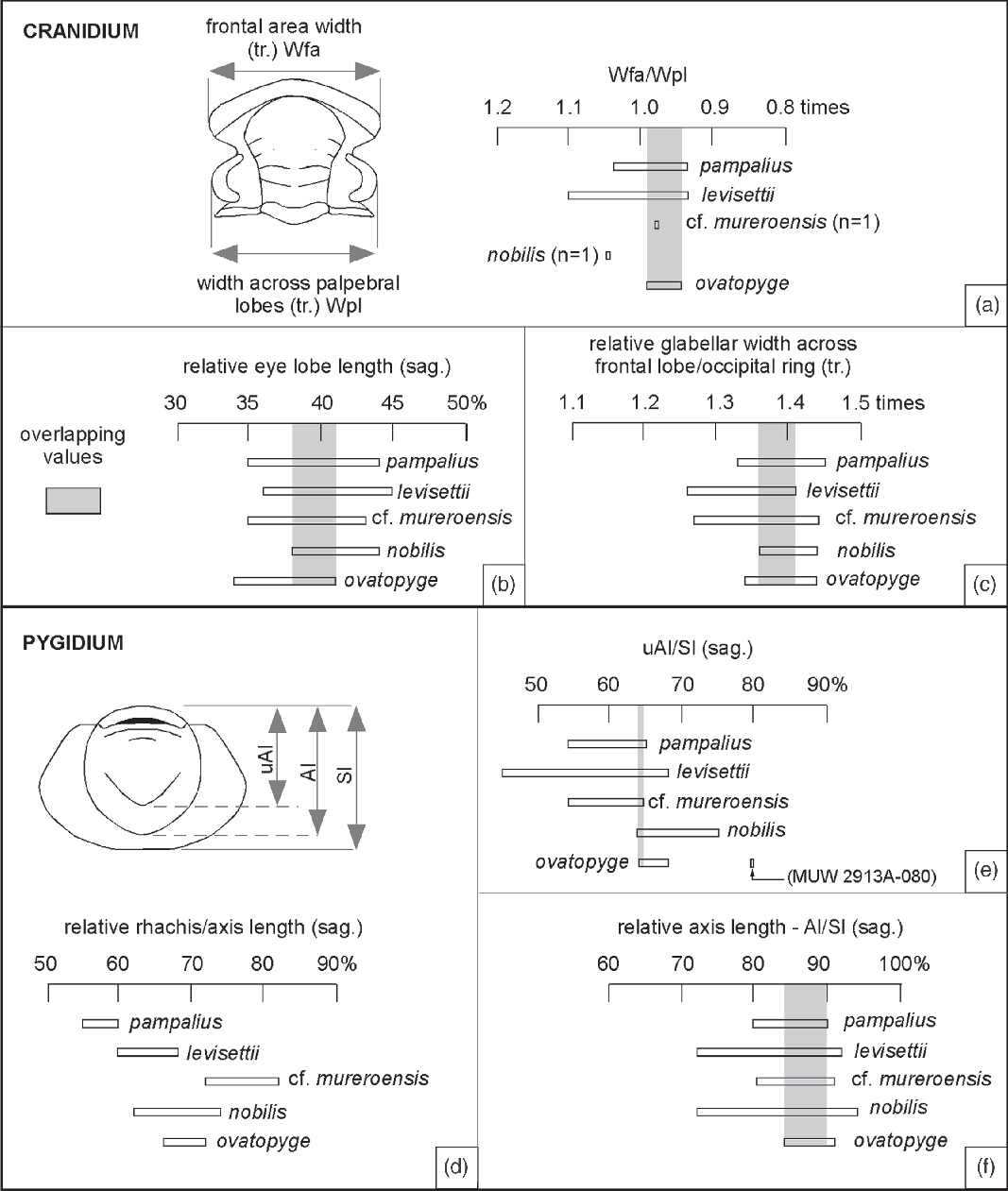
The relative lengths and widths selected by Geyer & Vincent (Reference Geyer and Vincent2015) as diagnostic characters, and reported in our paper as ‘bivariate analysis or plots’, are: (i) the ratio between the frontal area width (Wfa) and the width across the palpebral lobes (Wpl); (ii) the relative eye lobe length (sag.); (iii) the relative glabellar width across the frontal lobe/occipital ring (tr.) for the cranidia; and (iv) the relative rhachis/axis length (sag.) for the pygidium (parameters are defined in Whittington et al., Reference Whittington, Chatterton, Speyer, Fortey, Owens, Chang, Dean, Jell, Laurie, Palmer, Repina, Rushton, Shergold, Clarkson, Wilmot and Kelly1997). All these data were contained in our analyses, but Geyer & Vincent (Reference Geyer and Vincent2015) paid no attention to the implications.
Let us summarize some results (Fig. 2) using the above-reported linear analyses that can be visually interpreted. Figure 2a illustrates the Wfa/Wpl ratio of the cranidia illustrated by Geyer & Vincent (Reference Geyer and Vincent2015): all of them share a range between 0.93 and 0.99, except one single specimen of A. nobilis that falls outside this overlapping value. Figure 2b, c offers the relationships of points highlighted by Geyer & Vincent (Reference Geyer and Vincent2015), and the resulting overlap is marked in grey: both measurements display a distinct overlap (a statistically distinguishable distribution), so both characters should not be used as diagnostic characters. Figure 2d offers a graph of the data selected by Geyer & Vincent (Reference Geyer and Vincent2015, fig. 12 and text) to distinguish the pygidia of their morphotypes: their relative lengths were seemingly not overlapping and the authors proposed this ratio as a diagnostic character. However, a clarification of measurements must be made. The rhachis/axis is described as an uplifted subtriangular platform with down-sloping margins, as a result of which two measurements can be taken: the uplifted axial length (uAl)/sagittal length (Sl) and the axis length (Al)/sagittal length (Sl) ratios. The former is a ratio strongly affected by preservation because the margin of the platform can be erased by flattening (Fig. 2e); see e.g. their specimen MUW 2913A-080 plotting outside the common range of the morph ovatopyge. However, the Al/Sl ratio is easily measurable and better preserved despite deformation. Based on the material illustrated by Geyer & Vincent (Reference Geyer and Vincent2015), this ratio is represented in Figure 2f and the outcome is clearly illustrated there: Figure 2d and f should be the same, but they are not. After measuring the specimens illustrated in Geyer & Vincent (Reference Geyer and Vincent2015), it can be seen that many paratypes fall outside the reported ranges of trait values for the species that they represent (do not fit their own diagnostic characters), and that this ratio also shows overlapping values. In summary, the overlapping values shown by the bivariate analyses made in our previous work, and summarized here in Figure 2, contradict the validity of the diagnostic characters based on length and width ratios proposed by Geyer & Vincent (Reference Geyer and Vincent2015) and partly modified by Geyer et al. (Reference Geyer, Nowicki, Żylińska and Landing2019).
Diagrams illustrating the morphological measurements described in the text. (a) Sketch of a paradoxidine cranidium with measured characters: frontal area width (Wfa) and width across palpebral lobes (Wpl), and Wfa/Wpl ratios measured directly on Geyer & Vincent’s (Reference Geyer and Vincent2015) illustrated specimens. (b) Relative eye lobe length (sag.) based on Geyer & Vincent’s (Reference Geyer and Vincent2015) diagnostic characters (n is number of available specimens). (c) Relative glabellar width across frontal lobe/occipital ring (tr.) based on Geyer & Vincent’s (Reference Geyer and Vincent2015) diagnostic characters. (d) Sketch of a paradoxidine pygidium with measured characters: uAI (uplifted axis length), Al (axis length) and Sl (sagittal length) and relative axis length (sag.), including articulating half-ring, based on Geyer & Vincent’s (Reference Geyer and Vincent2015) diagnoses. (e) Measurements of uAl/Sl (sag.), Geyer & Vincent’s (Reference Geyer and Vincent2015) illustrated specimens. (f) Measurements of Al/Sl (sag.), Geyer & Vincent’s (Reference Geyer and Vincent2015) illustrated specimens.

7.b. Qualitative description of sclerite outlines
If we check the diagnostic characters of the pygidial outline, the diagnostic characters listed by Geyer & Vincent (Reference Geyer and Vincent2015) and redefined by Geyer et al. (Reference Geyer, Nowicki, Żylińska and Landing2019) are difficult to recognize and compare: (i) pampalius shows a ‘subelongate to subhexagonal outline, posterior margin more or less curved, occasionally with short straight median sector’; (ii) levisettii, a ‘subhexagonal to subtriangular outline with posterior margin straight’; (iii) cf. mureroensis, ‘elongate with width/length ratio ca. 0.87–0.90, nearly straight and obliquely laterally directed from axial furrows, curving into gently homogeneously rounded posteromedian and posterior margin’ vs a ‘subtriangular outline with posterior margin slightly rounded to almost straight’; (iv) nobilis, a ‘subtriangular outline with posterior margin indented’, so distinctly differentiated; and (v) ovatopyge, an ‘ovate outline (so subrounded) with occasionally slightly truncated (so straight) posterior margin’. In summary, all these outlines are subrounded to subtriangular to subhexagonal in shape, and all the posterior margins (except in nobilis) are straight to slightly/almost/occasionally straight vs indented. Except the indented character of nobilis (a real diagnostic character that we properly quantified), all the remaining characters are gradational. The final result is a selection of subjective characters that need the stratigraphic position of each specimen, if we follow Geyer et al.’s (Reference Geyer, Nowicki, Żylińska and Landing2019) argumentation, to correctly determine any sclerite.
7.c. Biometric quantification of sclerite outlines
Geyer et al. (Reference Geyer, Nowicki, Żylińska and Landing2019) also claim that some of their species were discriminated by some distinct characters not yet analysed by us. The relative width of the palpebral lobe (e.g. Acadoparadoxides nobilis vs A. levisettii) will not be analysed here as we accept the diagnostic characters of A. nobilis as differentiable enough to indicate a different morphospecies. As a bivariate analysis, the frontal area width vs cranidial width across the palpebral lobes was discarded as a valid character in section 6.a.
Geyer et al. (Reference Geyer, Nowicki, Żylińska and Landing2019) also mention that Álvaro et al. (Reference Álvaro, Esteve and Zamora2018) did not analyse the shape of the anterior branch of the facial suture, and consider that their ‘moderately vs moderately to relatively strongly diverging’ character of the anterior branches is better constrained than any statistical analysis. Álvaro et al. (Reference Álvaro, Esteve and Zamora2018) disagreed and considered such a character as invalid to differentiate morphospecies, but below we include more semilandmarks to characterize the shape of the anterior branch of the facial suture, though this could bring noise to the results (Sheets et al. Reference Sheets, Kim, Mitchell and Elewa2004). Numerous studies cover small morphological structures using a low number of landmarks and their results seem to be satisfactory, when an adequate set of landmarks is available over only half of the anatomical element shape (e.g. Hughes & Chapman, Reference Hughes and Chapman1995; Kim et al. Reference Kim, Sheets, Haney and Mitchell2002, Reference Kim, Sheets and Mitchell2009; Hunda & Hughes, Reference Hunda and Hughes2007; Webster, Reference Webster2007).
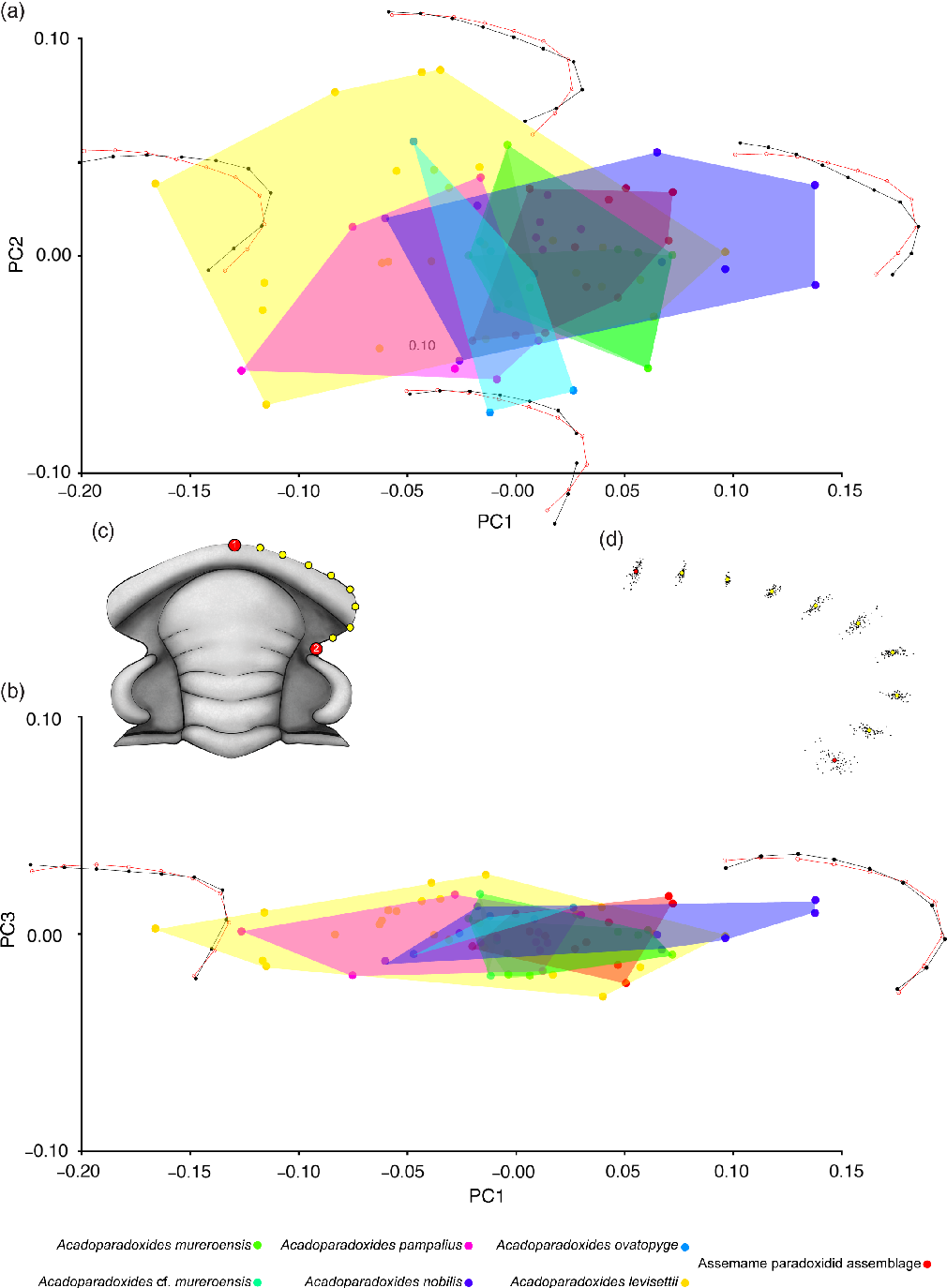
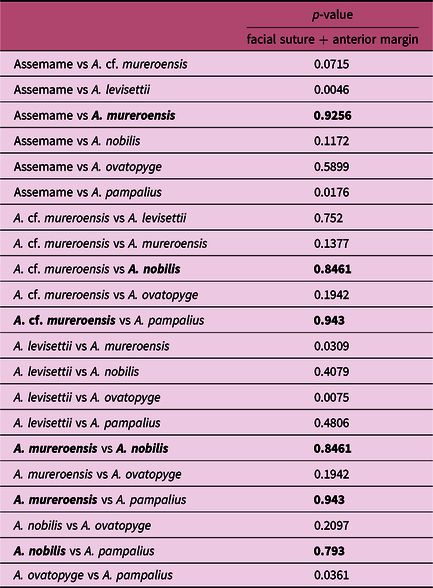
To check this character, we have analysed the outline of the anterior branch of the facial suture plus the anterior margin. Figure 3 shows the results of PCA, where the three first components summarize almost 80 % of the shape variation of the sample. The plots show an overlap between all groups. Distribution in the morphospace of all the specimens is continuous along the three PC axes, suggesting that all shapes (facial suture + anterior margin) belong to the same group. PC1 explains 38 % of total shape variance in the sample and relates to shape of the anterior margin and length of the facial suture. Negative scores point to a relatively straight anterior margin character and a facial suture having a lower angle to the sagittal axis; positive scores show an anterior border characterized by an exsagittal slope and a facial suture shorter with a higher angle to sagittal axis. PC2 accounts for 18.6 % of the total shape variance and relates primarily to the length of the facial suture, shorter in positive scores and longer in negative scores. PC3 accounts for 8 % of the total shape variance and mainly relates to the shape of the anterior border and facial suture: negative scores point to a straighter anterior margin and a very straight facial suture, whereas positive scores point to gently curved anterior margin and facial suture. Therefore, the canonical analysis also supports significant differences among the morphospecies A. mureroensis (or A. cf. mureroensis) and A. nobilis (Table 2).
(a, b) Morphospace defined by the first three principal components of PCA related to the outline of the facial suture and the anterior margin of the studied paradoxidine cranidia, based on the specimens illustrated in Geyer & Vincent (Reference Geyer and Vincent2015) and re-illustrated in Geyer et al. (Reference Geyer, Nowicki, Żylińska and Landing2019) and Álvaro et al. (Reference Álvaro, Esteve and Zamora2018); (c) reconstruction of A. mureroensis showing chosen landmarks and semilandmarks from the anterior edge to γ; (d) superimposition plot of cranidial sclerites.

Pairwise comparison of the facial suture + anterior margin outlines showing Hotelling’s p-values from the species A. mureroensis (including A. cf. mureroensis) and A. nobilis (marked in bold) and other morphs sampled in the Cambropallas telesto acme level of the Brèche à Micmacca Member at the Taroucht quarry, eastern Anti-Atlas

7.d. Three-dimensional quantification
We did not quantify the 3D relief of one character proposed by Geyer & Vincent (Reference Geyer and Vincent2015) to erect another species. We clearly stated it, but the presence of ‘faintly concave pygidial flanks’ is dramatically affected by the preservation of the specimens and is visible in many pygidia of different species: this supposed diagnostic character of pampalius is also present in cf. mureroensis (Geyer & Vincent, Reference Geyer and Vincent2015, figs 21C, E, 23H, two specimens where the relief of the axis controls the uprising of the pygidial flanks). In the figure captions, the authors clearly stated that the material lacking this concave–convex character is ‘slightly distorted and dorsoventrally flattened’. So the 3D relief is a problem both for qualitative and quantitative analyses. We ‘suggested their synonymy until 3D statistical analyses are available based on material preserved on carbonate and silica nodules’. The issue comes down to whether the taphonomic overprint is sufficiently strong to obscure any original interspecific disparity. This is a common problem for any palaeontologist.
Finally, it is surprising to find that the same specimens illustrated in Geyer & Vincent (Reference Geyer and Vincent2015) reoccur in Geyer et al. (Reference Geyer, Nowicki, Żylińska and Landing2019). We do not understand the purpose of repeating the same information twice.
8. Acadoparadoxides mureroensis
Acadoparadoxides mureroensis was defined by Sdzuy (Reference Sdzuy1958) based on material sampled in the Rambla de Valdemiedes, Iberian Chains, NE Spain. A cranidium was selected as holotype by Sdzuy (Reference Sdzuy1958) and a pygidium as syntype from the same section by Álvaro et al. (Reference Álvaro, Esteve and Zamora2018) to avoid uncertainties about pygidial plasticity. Álvaro et al. (Reference Álvaro, Esteve and Zamora2018) emended the diagnosis (in 2D) of the species and disagreed with the synonymies of the species suggested by Gozalo et al. (Reference Gozalo, Dies Álvarez, Gámez Vintaned, Zhuravlev, Bauluz, Subías, Chirivella Martorell, Mayoral, Gursky, Andrés and Liñán2013, p. 147). As a result, the diagnostic characters of A. mureroensis confine its stratigraphic range to the lowermost 2 m of the (regional) Leonian Stage stratotype in the Iberian Peninsula.
Geyer & Vincent (Reference Geyer and Vincent2015) and Geyer et al. (Reference Geyer, Nowicki, Żylińska and Landing2019) consider A. mureroensis an invalid taxon, but they offer detailed diagnoses and descriptions of A. cf. mureroensis, which they consider a valid taxon, an obvious misconception of taxonomic rules. The authors criticize the selection of a deformed cranidium as holotype and state: ‘Both the holotype and the pygidium ... were almost certainly collected from the scree as assumed by K. Sdzuy (pers. comm. to Gerd Geyer, 1981)’. When Geyer et al. (Reference Geyer, Nowicki, Żylińska and Landing2019) arrive at this point, they have used numerous personal communications by Mr Anthony Vincent, who can agree/disagree with them publicly/privately, but now Geyer et al. (Reference Geyer, Nowicki, Żylińska and Landing2019) report a supposed personal communication made 38 years ago by his PhD supervisor, who left us in 2005. Should we consider this free comment as a scientific argument? Any palaeontologist must manage the work done by pioneers. The selection of holotypes is somewhat problematic, but this is part of our task: to manage data yielded decades ago in the light of present-day knowledge.
9. Concluding remarks
Álvaro et al. (Reference Álvaro, Esteve and Zamora2018) stated that the morphospecies Acadoparadoxides pampalius, A. ovatopyge, A. levisettii and A. mureroensis (including A. cf. mureroensis) co-occur within the Cambropallas telesto acme level of the Assemame quarry, eastern Anti-Atlas. After sampling in the Taroucht quarries, the source of Geyer & Vincent’s (Reference Geyer and Vincent2015) fossil collection, we have confirmed that the morphotypes also co-occur in the same level of the Brèche à Micmacca Member. The targeted paradoxidine trilobites were sampled in greenish-to-purple mudstone locally punctuated by volcaniclastic limestone interbeds reflecting the local influence of volcanic episodes associated with tectonically induced perturbations of the substrate. Contrary to the palaeogeographic suggestions made by Geyer & Vincent (Reference Geyer and Vincent2015) and Geyer et al. (Reference Geyer, Nowicki, Żylińska and Landing2019), the information published during the last two decades demonstrates that the Cambrian of the Anti-Atlas represents the infill of an active rift, characterized by a horst-and-graben palaeogeography with mapped rifting branches, local and regional unconformities and onlapping patterns, and distinct tholeiitic-to-alkaline volcanic episodes. The Cambrian of the Anti-Atlas does not represent the onset of a homoclinal ramp with shale / purple sandstone cycles correlatable at the scale of the whole basin.
After re-quantifying some diagnostic characters with new bivariate and PCA analyses, which were not illustrated in Álvaro et al. (Reference Álvaro, Esteve and Zamora2018), our conclusions are maintained: (i) the selection of ‘mosaics of overlapping characters’ as diagnoses for the discussed morphs is a laborious method that cannot be duplicated by us to confirm their validity; (ii) the proposal of accepting the stratigraphic setting of a morph, which cannot be confirmed by sampling, as a diagnostic character should be avoided as a taxonomic method; (iii) bivariate values proposed by Geyer & Vincent (Reference Geyer and Vincent2015) as diagnostic characters for some morphs fall outside the purported ranges of the measures made in several paratype specimens; and (iv) all 2D morphometric analyses incorporating the diagnostic characters of the morphs based on bivariate values and cranidial and pygidial outlines (PCA) are unable to detect interspecific differences. Based on 2D biometric analyses, only A. mureroensis and A. nobilis are distinctive morphotypes. The slight concavity displayed by some pygidia is strongly controlled by preservation, and in need of 3D biometrical analysis to be properly quantified. Our proposal of synonymy is here maintained until 3D statistical analyses are available on material preserved on carbonate or concretions.
Statistical analysis is a useful tool to quantify both intra-specific and tectonic morphological diversity. This approach should not contradict qualitative diagnoses, but can improve them. The determination of a species cannot be based on diagnostic characters controlled by overlapping ‘mosaics of characters’, which must be completed with the stratigraphic level where a sclerite has been sampled. This is circular reasoning.
As explained above, reasoning fails when ‘taxonomic separation is a matter of debate and personal opinion’. When fossil specimens are well preserved and abundant for statistical analyses, it is obvious that the selection of qualitative and quantitative diagnostic characters cannot be guided by personal opinions, but by objective data that allow a distinct differentiation among samples. When paratypes do not fit the qualitative and quantitative diagnostic characters of their holotypes, as documented above, the problem is unresolved. New material, well preserved and constrained stratigraphically is necessary to improve the discussion developed in the Comment and Reply related to these paradoxidid trilobites. However, improvements cannot be achieved if either the authors illustrate and re-illustrate the same specimens or their quantitative bivariate ratios are not correctly measured.
Acknowledgements
The authors are indebted to Mark Webster and Per Ahlberg for constructive comments. This paper is a contribution to project CGL2013-48877-P from the Spanish Ministry of Science, Innovation and Universities, and FAPA Project (id. PR.3.2019.5527) from Andes University, Colombia.
Conflict of interest
None.