Introduction
People with mental health problems often report experiences of discrimination. Results of the World Mental Health Surveys showed that, in developed countries, the mean prevalence estimate of discrimination or unfair treatment experienced in the last 30 days, was 16.3% (Alonso et al. Reference Alonso, Buron, Bruffaerts, He, Posada-Villa, Lepine, Angermeyer, Levinson, de Girolamo, Tachimori, Mneimneh, Medina-Mora, Ormel, Scott, Gureje, Haro, Gluzman, Lee, Vilagut, Kessler and Von Korff2008). A 2010 Canadian population survey of people who had received treatment for a mental health problem in the previous year found that 37.4% of respondents had experienced discrimination during this period in at least one of the following life domains: family relationships, romantic life, school or work life, financial situation and housing situation (Stuart et al. Reference Stuart, Patten, Koller, Modgill and Liinamaa2014).
Whether or not a person has experienced discrimination, anxiety about the possibility of this may lead to the decision to conceal stigmatising characteristics (including mental health problems) in order to avoid adverse outcomes (Lasalvia et al. Reference Lasalvia, Zoppei, Van Bortel, Bonetto, Cristofalo, Wahlbeck, Vasseur Bacle, Van Audenhove, van Weeghel, Reneses, Germanavicius, Economou, Lanfredi, Ando, Sartorius and Lopez-Ibor2012). In many cases, the decision to disclose a mental health problem is a complex one, whether this involves revealing a diagnostic label or the experience of psychiatric symptoms. Disclosure carries the risk of negative outcomes that otherwise might have been avoided, such as social rejection and discrimination (Wahl, Reference Wahl1999; Thornicroft et al. Reference Thornicroft, Brohan, Rose, Sartorius and Leese2009). In the case of mental disorders, the decision to disclose is further complicated by the fact that there may also be benefits of disclosure. For someone with a diagnosis, these may include increased social support and reduced feelings of stress and isolation (Corrigan & Rao, Reference Corrigan and Rao2012), while for someone with as-yet undiagnosed symptoms, labelling the problem as a mental disorder facilitates help seeking, treatment compliance and ultimately, relief from symptoms (Wright et al. Reference Wright, Jorm and Mackinnon2011). In the workplace, benefits include reasonable adjustments that support people to keep performing their work roles (Reavley et al. Reference Reavley, Ross, Killackey and Jorm2012) and, in education settings, mental health problems may be taken into account when making decisions about extensions to assignment deadlines or deferred exams (Reavley et al. Reference Reavley, Ross, Killackey and Jorm2013). A person making a decision may need to weigh up the risks and benefits of disclosure according to the context in which they find themselves. For example, disclosing a diagnosis to a friend or family member is likely to involve different considerations to disclosure to an employer. Moreover, as stigmatising attitudes vary according to disorder, with people with schizophrenia generally seen as more dangerous and unpredictable, the nature of the diagnosis is also likely to impact on the decision to disclose (Silton et al. Reference Silton, Flannelly, Milstein and Vaaler2011; Yap et al. Reference Yap, Mackinnon, Reavley and Jorm2014). Thus, issues around disclosure, both positive and negative, can play a key role in the degree to which a mental disorder impacts on a person's life.
A number of previous studies in clinical populations have explored disclosure in different settings. These include a study involving 500 outpatients with a mix of disorders in a Dutch mental health institute (Bos et al. Reference Bos, Kanner, Muris, Janssen and Mayer2009). Most participants disclosed their mental illness to their partner, mother and father. They were also relatively open towards family and friends and least open towards acquaintances and colleagues. When asked about experiences of support and discrimination, participants perceived the most support and least discrimination from partners and the least support and most discrimination from acquaintances and colleagues. In a US study of people with schizophrenia, disclosure to partners and doctors was the most common and disclosure to neighbours, police and people at a place of worship was the least (Pandya et al. Reference Pandya, Bresee, Duckworth, Gay and Fitzpatrick2011). This study also found that better mental health status was associated with greater openness. A recent US study explored correlates and consequences of disclosure of mental illness in 106 participants involved in psychiatric rehabilitation programmes. Among these, 74.5% had told most of their family, friends and acquaintances that they had a mental illness. Those with major depressive disorder (rather than bipolar disorder or psychotic disorders) were more likely to agree with the benefits of disclosure (Corrigan et al. Reference Corrigan, Michaels, Powell, Bink, Sheehan, Schmidt, Apa and Al-Khouja2016).
Deciding whether to disclose mental health problems in the workplace can be particularly challenging. Brohan et al. (Reference Brohan, Henderson, Wheat, Malcolm, Clement, Barley, Slade and Thornicroft2012) carried out a systematic review of studies assessing beliefs, behaviours and influencing factors associated with disclosure of a mental health problem in the workplace. Their results showed that women were less likely to disclose than men, and people with a diagnosis of mood disorder were less likely to disclose than those with a diagnosis of schizophrenia. Those with less severe symptoms were also less likely to disclose, as were those who were concerned about losing their jobs, felt pressure to fit in or who lacked confidence about their ability to maintain their professional status (Ellison et al. Reference Ellison, Russinova, MacDonald-Wilson and Lyass2003).
However, the majority of studies assessing the proportion of people disclosing mental health problems and the consequences and correlates of disclosure have recruited participants from clinical services or rehabilitation programmes. No population-based studies have systematically assessed the proportions of people disclosing in multiple settings as well as correlates of disclosure. Therefore, the aim of the current study was to carry out a national population-based survey in order to assess whether or not people with high symptom levels or diagnosed disorders disclose their mental health problems in a variety of settings. A further aim was to explore the correlates of the disclosure, including sociodemographic and mental health problem characteristics and experiences of discrimination and positive treatment.
Methods
The survey involved computer-assisted telephone interviews (CATI) with a national sample of 5220 members of the Australian general community aged 18 and over. The primary aim of the survey was to explore experiences of avoidance, discrimination and positive treatment. Further methodological detail is available in Reavley & Jorm (Reference Reavley and Jorm2015). The survey was carried out by the survey company The Social Research Centre. A ‘dual frame’ approach was used, with the sample contacted by random-digit dialling of both landlines and mobile phones. This approach was taken in order to minimise the potential bias of collecting data solely from households with a landline telephone connection, as the latter approach may undersample young people, particularly young men (Hu et al. Reference Hu, Balluz, Battaglia and Frankel2011; Holborn et al. Reference Holborn, Reavley and Jorm2012). Call procedures for the survey featured: (1) Call attempts placed over different days of the week and times of day; (2) Placing up to four calls for mobiles and six calls for landlines to establish contact (with additional calls for hard appointments as necessary); (3) Limited call initiation during business hours except by appointment; and (4) Late shifts dialling to landline numbers identified as Western Australia. Interviews were conducted between October and December 2014. The average interview length was 19.4 min. Ethics approval was obtained from the University of Melbourne Human Research Ethics Committee.
Survey interview
After initial questions covering sociodemographic information (age, gender, marital status, postcode, country of birth, language spoken at home, level of education and Aboriginal and Torres Strait Islander status), respondents were taken through the 12-month version of the Kessler 6 (K6) mental health symptom screening questionnaire (Kessler et al. Reference Kessler, Green, Gruber, Sampson, Bromet, Cuitan, Furukawa, Gureje, Hinkov, Hu, Lara, Lee, Mneimneh, Myer, Oakley-Browne, Posada-Villa, Sagar, Viana and Zaslavsky2010). This questionnaire asks participants to think about 1 month in the last 12 months when they were most depressed, anxious or emotionally stressed. Respondents were also asked whether, over the last 12 months, they had experienced any sort of mental health problem (defined in the preamble to the question in the following way: ‘a period of weeks or more when you are feeling depressed, anxious or emotionally stressed, and these problems are interfering with your life. Mental health problems could include, for example, depression, anxiety disorders, eating disorders, schizophrenia, bipolar disorder or personality disorders’). Those respondents who answered yes to this question were then asked what they thought the problem was. Respondents who specified any of the following mental health problems were considered in scope: depression/major depression, attempted suicide or self-harm, anxiety/anxiety disorder, post-traumatic stress disorder (PTSD), agoraphobia, panic disorder, obsessive–compulsive disorder (OCD), social phobia, generalised anxiety disorder, eating disorder/anorexia/bulimia, schizophrenia/paranoid schizophrenia, schizoaffective disorder, psychosis/psychotic, bipolar/bipolar disorder/manic-depressive disorder, mental illness, personality disorder/borderline personality disorder, attention deficit-hyperactivity disorder (ADHD), Autism/Asperger's and nervous breakdown. At this point, survey respondents were divided into two groups: (1) those who scored in the ‘high’ range on the K6 (equal to or above 19) or who reported an in-scope mental health problem; and (2) those who did not meet these criteria.
Those in the first group were then asked the following questions about their experiences of avoidance, discrimination and positive treatment (with a past 12-month timeframe specified in the introduction to this section of the questionnaire): ‘Have any of your friends avoided you because of the emotional or mental health problems you have told me about?’; ‘Have any of your friends discriminated against you in other ways because of these problems?’; ‘Can you please describe what happened?’; ‘Have any of your friends treated you more positively because of these problems?’; and ‘Can you please describe what happened?’. The same questions were asked for the following people or situations: spouse or intimate partner, other members of the family, people in the workplace, looking for work, people in the place of education, health professionals (with an additional question on type of professional), other people in the community or neighbourhood, other people and other situations. For people or situations in the ‘looking for work’, ‘health professionals’, ‘other people’ and ‘other situations’ categories, the question relating to avoidance was omitted.
Participants in the first group were also asked the following: ‘Have you told the following people about these emotional or mental health problems that you have had in the last 12 months?’ The questions covered the following people: Friends, spouse or intimate partner, other family members, your supervisor or boss at work, other people in your workplace, teachers or lecturers in your place of education, other people in your place of education, health professionals who are not involved in treating these problems and people in your neighbourhood or community’. Other than for intimate partner or supervisor (for which possible responses were ‘Yes’ or ‘No’), possible response categories were: ‘Yes, told everybody’, ‘Yes, told some people’ or ‘No, not told anybody’.
Statistical analysis
Prevalence data were analysed using per cent frequencies and 95% confidence intervals. A pre-weight was applied to adjust for the dual frame design and the respondent chance of selection. The achieved sample was close to the Australian national population in terms of geographic distribution; however, there was an underrepresentation of males and of younger adults, and an overrepresentation of university-educated individuals and people with an English-speaking background. These biases were adjusted for by ‘raking’ (also known as rim weighting or iterative proportional fitting) to account for known population proportions of gender, age, education level, region and telephone status (with age and gender based on Australian Bureau of Statistics (ABS) data of March 2014 (Australian Bureau of Statistics, 2014b), level of education and region based on ABS 2011 census data (Australian Bureau of Statistics, 2014a) and telephone status based on 2011 Australian Communication and Media Authority data (Australian Communication and Media Authority, 2014)).
Multinomial logistic regression was used to model the correlates of disclosure in each setting. Correlates were entered simultaneously in a multivariate model, with ‘no disclosure’ used as the reference category. Sociodemographic correlates were age category, gender, highest level of education and language spoken at home. Clinical correlates were categories of psychological distress according to the K6, depression, anxiety disorder (including PTSD and OCD), bipolar disorder, any other disorder (including attempted suicide or self-harm, eating disorder, schizophrenia, schizoaffective disorder, psychosis/psychotic, personality disorder, ADHD, Autism/Asperger's, nervous breakdown, mental illness), and whether the person had received treatment for their mental health problem in the last 12 months. The experience of avoidance, discrimination, and positive treatment within each setting were also entered as correlates. Given the large number of comparisons, we report relative risk ratios and their 99% confidence intervals. McFadden's R 2 is reported as an indicator of model fit, based on unweighted data. All analyses were performed using Intercooled Stata 13 (StataCorp LP, Texas, USA).
Results
Overall, 5220 interviews were completed, with 2589 on landlines and 2631 on mobiles. The standard response rate for the survey was 37.5%. 1381 (28.8%) respondents were asked the questions about disclosure and personal experiences of avoidance, discrimination, positive treatment. Of these, 732 respondents had K6 scores of 19 or above and 1159 respondents had a mental health problem considered to be in scope. Among the 732 respondents with K6 scores above the cut off, 418 had received treatment. Among the 1159 respondents with an in-scope mental health problem, 783 had received a diagnosis and 771 had received treatment. The most common mental health problem was depression (55.6%), followed by anxiety disorders (including PTSD and OCD; 45.2%), bipolar disorder (4.6%), psychotic disorder (2.7%), eating disorder (2.3%) and personality disorder (1.2%) (multiple diagnoses were possible).
Prevalence estimates of disclosure
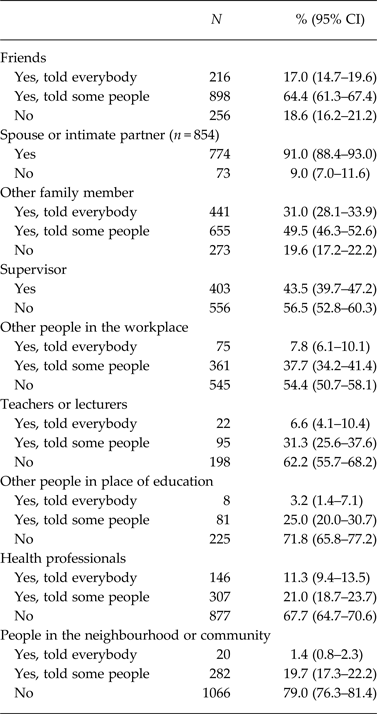
Prevalence estimates of disclosure are given in Table 1. Disclosure to a spouse was most common, with just over 90% of people telling their spouse or intimate partner about their mental health problems. Disclosure to some friends (64%) and some family members (49%) was more common than either telling everyone in these categories or non-disclosure. Non-disclosure to supervisors (55%) and other people in the workplace (54%) was more likely than full or partial disclosure. A similar pattern was seen for education settings. Two-thirds of participants reported non-disclosure to health professionals not directly involved in treatment of mental health problems. Prevalence estimates of non-disclosure to other people in the neighbourhood or community were highest.
Disclosure of mental health problems

Correlates of disclosure
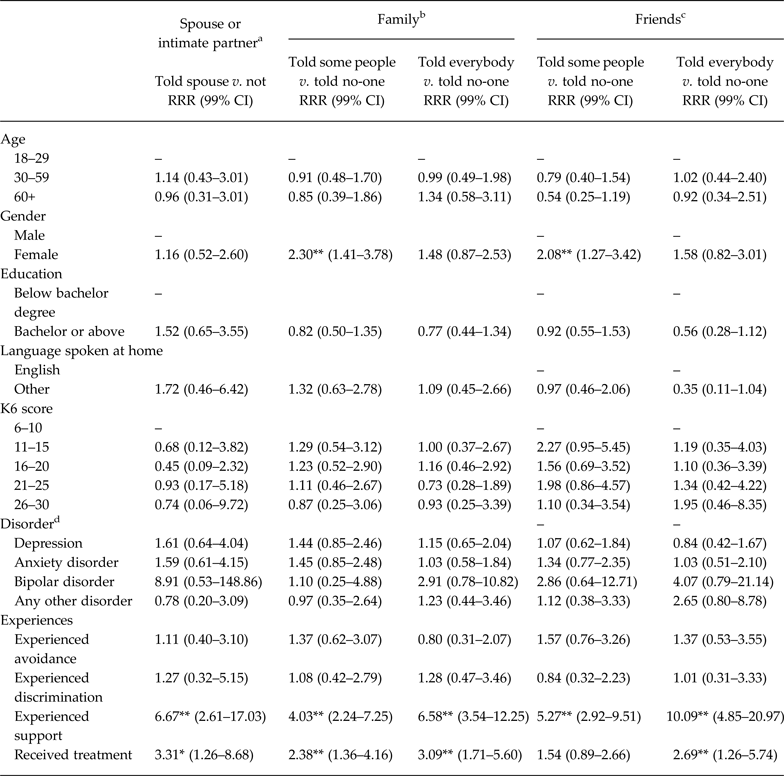
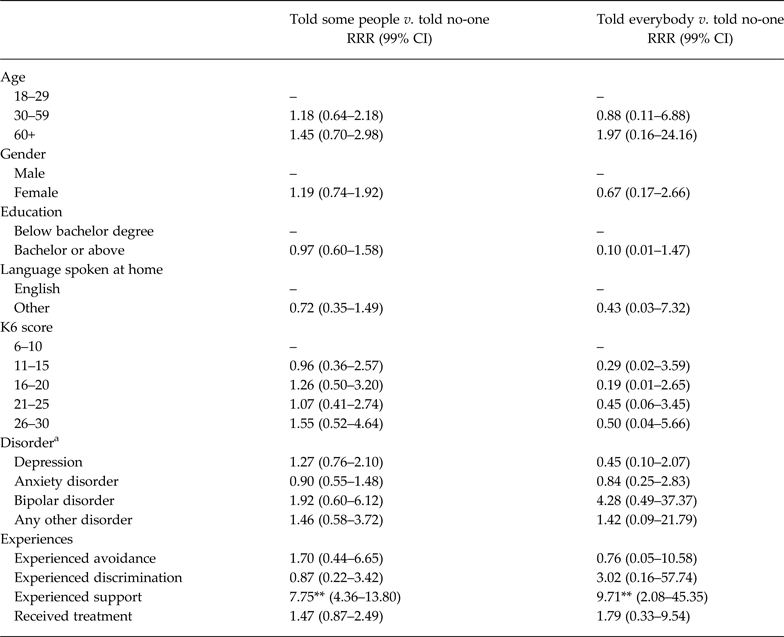
Correlates of disclosure in various settings are given in Tables 2–5. Female gender and being supported by friends were associated with telling some friends, and being supported and receiving treatment were associated with telling everybody. Being supported by an intimate partner and receiving treatment were associated with disclosure to the partner. In the family setting, female gender was associated with disclosing to some family members, and being supported and receiving treatment were associated with disclosure to both some people and disclosure to everybody. Experiencing support from people in the neighbourhood was associated with disclosure to some people and disclosure to everybody.
Multivariate multinomial logistic regression models of the factors associated with disclosure of a mental health problem to friends, spouse or intimate partner, and family

a N = 813, McFadden's R 2 = 0.186.
b N = 1285, McFadden's R 2 = 0.097.
c N = 1278, McFadden's R 2 = 0.119.
d Each disorder coded as present v. absent.
*p < 0.01; **p < 0.001.
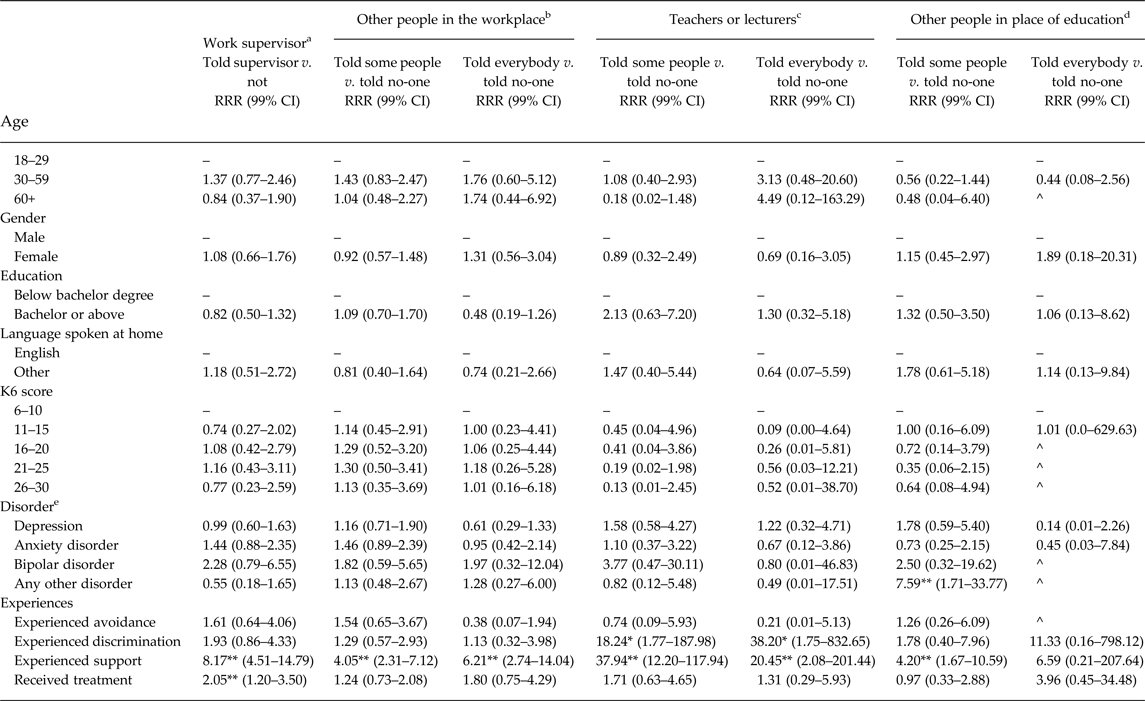
Multivariate multinomial logistic regression models of the factors associated with disclosure of a mental health problem in work and education settings

a N = 908, McFadden's R 2 = 0.182.
b N = 929, McFadden's R 2 = 0.091.
c N = 289, McFadden's R 2 = 0.327.
d N = 288, McFadden's R 2 = 0.188.
e Each disorder coded as present v. absent.
^Not reported due to unreliability of estimates.
*p < 0.01; **p < 0.001.
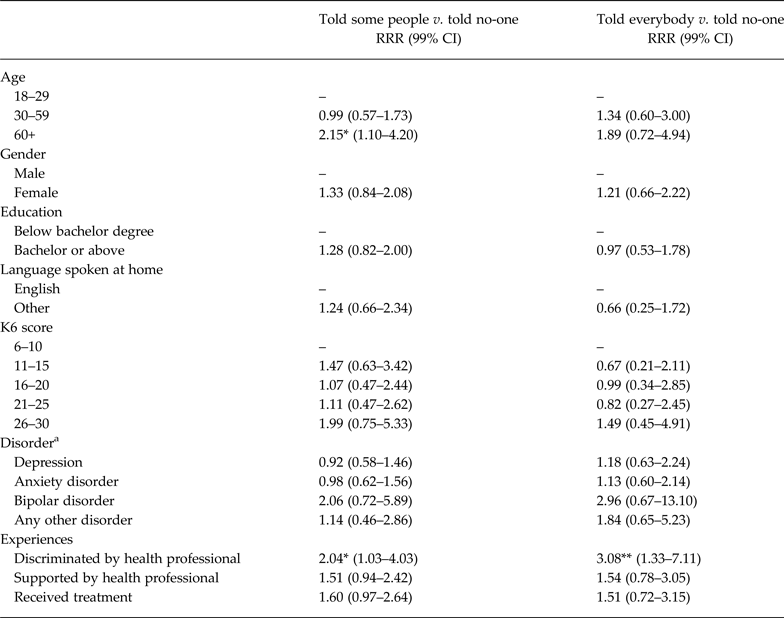
Multivariate multinomial logistic regression model of the factors associated with disclosure of a mental health problem to health professionals not involved in mental health treatment (N = 1272)

a Each disorder coded as present v. absent.
McFadden's R 2 = 0.054.
*p < 0.01; **p < 0.001.
Multivariate multinomial logistic regression model of the factors associated with disclosure of a mental health problem to people in the neighbourhood or community (n = 1274)

a Each disorder coded as present v. absent.
McFadden's R 2 = 0.145.
*p < 0.01- **p < 0.001.
In the workplace, being supported and receiving treatment were associated with disclosure to a supervisor. Being supported was associated with disclosure to some colleagues and to everybody. In education settings, discrimination and support were associated with disclosure to teachers or lecturers. In an education setting, reporting support and having a disorder other than depression, anxiety or bipolar disorder were associated with disclosure to some people.
Being aged 60 years or older was associated with disclosure to some health professionals not involved in treating mental health problems. Being discriminated against by a health professional was also associated with telling some people and everybody.
Discussion
This paper reports results of the first national population-based survey to explore prevalence estimates of disclosure of mental health problems in various settings and the extent to which sociodemographic and mental health problem characteristics and experiences of discrimination and positive treatment are associated with disclosure.
Results showed that disclosure to intimate partners was considerably more likely than non-disclosure, and that people were more likely to tell some friends and some family members rather than telling everyone in these categories or not disclosing at all. As relationship closeness decreased, the likelihood of disclosure decreased. Comparison with the small number of other studies that have compared disclosure prevalence estimates in different settings reveal similar patterns, e.g. in a study of Dutch clients of an outpatient service, 97% of people had told their partners, 89% had told their mothers, 33% had told some of their friends and 37% had told some of their colleagues (Bos et al. Reference Bos, Kanner, Muris, Janssen and Mayer2009).
The most consistent correlates of disclosure in the family and friends settings were experiencing support and receiving treatment. It is possible that receiving treatment is an indicator of having more severe mental health problems, which may therefore be harder to conceal, and may also indicate the greater awareness and openness about symptoms that leads a person to seek professional help as well as to disclose. However, in this study, symptom severity was not associated with disclosure in any setting, unlike a recent US study of people living with schizophrenia (Pandya et al. Reference Pandya, Bresee, Duckworth, Gay and Fitzpatrick2011). We also did not find any independent association with the type of mental health problem, although this may be due to the small numbers of people with schizophrenia or bipolar disorder. The results also showed that discrimination was not associated with disclosure whereas supportive experiences were. The study's cross-sectional design makes it difficult to establish whether experiences of support or discrimination preceded or followed disclosure. However, analysis of the open-ended responses describing discrimination and support is more consistent with a pattern of disclosure preceding positive treatment (unpublished data). Thus, it appears that participants who disclose their mental health problems to others in their close social networks experience more support than discrimination. This finding is line with the Dutch outpatient study reported above (Bos et al. Reference Bos, Kanner, Muris, Janssen and Mayer2009). In their study of people living with schizophrenia, Pandya et al. (Reference Pandya, Bresee, Duckworth, Gay and Fitzpatrick2011) reported that most people were not treated differently by family, partners and friends.
Most employers believe that people with mental health problems should disclose these to their supervisors and, indeed, disclosure allows for the provision of reasonable adjustments that support the person to perform their role (Henderson et al. Reference Henderson, Williams, Little and Thornicroft2013). However, the results of this population study show that non-disclosure is more likely. Nevertheless, receiving support was associated with a greater likelihood of disclosure, adding to the growing body of evidence emphasising the importance of manager attitudes and a supportive workplace culture for minimising the adverse impacts of mental health problems on employees (Brohan et al. Reference Brohan, Henderson, Little and Thornicroft2010, Reference Brohan, Evans-Lacko, Henderson, Murray, Slade and Thornicroft2014). As with disclosure to family and friends, analysis of open-ended responses in the workplace setting also suggests that disclosure precedes experiences of discrimination or support, although this was not completely consistent (Reavley et al. Reference Reavley, Morgan and Jorm2016). In the current study, disclosure to teachers or lecturers was also associated with discrimination, which is of concern in the context of high prevalence rates of mental disorders in the age group most likely to be in education. This points to the importance of policies and procedures to support students with mental health problems (Reavley et al. Reference Reavley, Ross, Killackey and Jorm2013). Anti-stigma interventions, including contact-based interventions tailored to workplace and education settings, may also be useful in reducing discrimination (Corrigan et al. Reference Corrigan, Morris, Michaels, Rafacz and Rusch2012; Griffiths et al. Reference Griffiths, Carron-Arthur, Parsons and Reid2014).
Study results also showed that 65% of participants reported non-disclosure to health professionals not directly involved in treatment of mental health problems. Moreover, disclosure was associated with discrimination in this context. This is in line with surveys of mental health service users that consistently show a significant minority experience discrimination related to getting help for a physical health problem (Corker et al. Reference Corker, Hamilton, Henderson, Weeks, Pinfold, Rose, Williams, Flach, Gill, Lewis-Holmes and Thornicroft2013; Harangozo et al. Reference Harangozo, Reneses, Brohan, Sebes, Csukly, Lopez-Ibor, Sartorius, Rose and Thornicroft2014). Poor physical health in people with severe mental illness is a well-documented problem (Brown et al. Reference Brown, Inskip and Barraclough2000; Walker et al. Reference Walker, McGee and Druss2015) and points to the need for anti-stigma interventions targeted to health professionals (Friedrich et al. Reference Friedrich, Evans-Lacko, London, Rhydderch, Henderson and Thornicroft2013). This may be particularly important for general practitioners, who are typically the first point of contact in Australia's health care system and who, in other findings from the current study, were the most common type of health professional reported by respondents to have discriminated against them (Morgan et al. Reference Morgan, Reavley, Jorm and Beatson2016).
A strength of the study is the population-based sampling, which may have reduced the likelihood of recruiting respondents who wanted to participate due to experiencing particularly bad discrimination or problems with disclosure. However, the relatively low response rate, although not uncommon in recent studies, may limit the generalisability of the results. A further limitation relates to the cross-sectional nature of the study, which does not allow for examining the temporal relationships between disclosure and discrimination and support. Longitudinal studies would assist in assessment of these relationships. Moreover, future research should aim to incorporate other potential predictors of the impact of disclosure, such as closeness of relationship or personality variables.
In conclusion, study results showed that both selective and full disclosure were most consistently associated with experiences of support and with having received treatment. However, it must be acknowledged that selective disclosure implies that people still have to conceal their mental health problems in certain situations, potentially leading to psychological distress and adverse effects on personal relationships, access to appropriate treatment and the ability to achieve educational and vocational goals (Link et al. Reference Link, Struening, Rahav, Phelan and Nuttbrock1997; Corrigan, Reference Corrigan2004). The current study suggests that such issues may be particularly critical in workplaces, education and healthcare settings.
Financial Support
The study was supported by the National Health and Medical Research Council.
Conflict of Interest
None.
Ethical Standard
The authors assert that all procedures contributing to this work comply with the ethical standards of the relevant national and institutional committees on human experimentation and with the Helsinki Declaration of 1975, as revised in 2008.
Availability of Data and Materials
This data are not currently shared as we are still analysing it and writing papers. The questionnaire is available from the authors on request.