Adolescent substance use, particularly the early-onset of use and abuse, is associated with concurrent and future psychological and physical problems, impairments in academic and occupational functioning, and social and familial dysfunction (Hall et al., Reference Hall, Patton, Stockings, Weier, Lynskey, Morley and Degenhardt2016). Given the myriad negative consequences, which are detrimental at both the individual and societal level, preventing substance use and abuse during adolescence is an important public health goal.
The first step in developing effective prevention programs is identification of risk factors associated with problem behavior. Then, profiles based on etiologic factors can be developed to identify youth at increased risk for substance use and abuse for selective prevention programming.
Oftentimes, prevention efforts use the manifestation of early problem behaviors or psychopathologies to deduce “risk” status. For instance, both externalizing behaviors and internalizing behaviors, particularly depression and anxiety, appear to be risk factors to later substance use and abuse (e.g., Hussong, Jones, Stein, Baucom, & Boeding, Reference Hussong, Jones, Stein, Baucom and Boeding2011; Swendsen et al., Reference Swendsen, Burstein, Case, Conway, Dierker, He and Merikangas2012). Notably, though, risk associated with externalizing and internalizing behaviors for substance use typically have been examined at one point in time or have been examined independently. However, these behavioral problems develop over time and often co-occur (e.g., Pesenti-Gritti et al., Reference Pesenti-Gritti, Spatola, Fagnani, Ogliari, Patriarca, Stazi and Battaglia2008). As such, there is a need to better understand the joint development and comorbidity of these problem behaviors as well as how internalizing and externalizing behavioral trajectories may moderate one another to affect the development of substance use and abuse. Furthermore, a joint assessment of internalizing and externalizing behaviors may illuminate patterns of behavior that more accurately classify “risk” status so that resources can be directed to young people most in need.
To further inform this effort, we also consider the role of race/ethnicity as it is unknown whether race/ethnicity gives way to differential development and comorbidity of externalizing and internalizing behaviors and subsequent vulnerability to substance use. After all, racial and ethnic identity are important to a child's self-concept and psychological development (James, Kim, & Armijo, Reference James, Kim and Armijo2000), and the lived experiences of Black and Hispanic children are unique in contrast to non-Hispanic White youth. For instance, systemic racism, discrimination, and questions of cultural identity can take a toll on the emotional and behavioral adjustment of children of color. Furthermore, cultural differences impact a child's perception of acceptable forms of emotion expression, self-regulation, and behavior (Cole, Tamang, & Shrestha, Reference Cole, Tamang and Shrestha2006; Varela et al., Reference Varela, Vernberg, Sanchez-Sosa, Riveros, Mitchell and Mashunkashey2004; Varela, Weems, Berman, Hensley, & de Bernal, Reference Varela, Weems, Berman, Hensley and de Bernal2007). Unfortunately, research has utilized predominantly non-Hispanic White samples of youth to examine the development of externalizing and internalizing behaviors spanning childhood and/or adolescence as well as the risk and protective effects of these behaviors for substance use in adolescence, thereby ignoring the applicability of prior findings to minority youth more specifically. As a result, the literature that informs prevention and intervention practices may be biased toward what works for non-Hispanic White youth. Thus, it is imperative to identify the developmental trajectories of externalizing and internalizing behaviors, address their comorbidity in manifestation, and clarify their joint role in the development of substance use in adolescence for Black and Hispanic youth in order to generate pattern profiles that can be used to address child and adolescent psychopathology as well as the prevention of adolescent substance use among these minority youth.
Externalizing Behaviors and Substance Use
Childhood externalizing problems are characterized by aggression, defiance, and hostility. They appear to stem from deficits in behavioral inhibition, poor impulse control, and hyperactivity (Liu, Reference Liu2004). In general, externalizing behaviors tend to decrease from childhood to mid-adolescence (e.g., age 5–17; Leve, Kim, & Pears, Reference Leve, Kim and Pears2005). However, some youth display chronic, stable externalizing behaviors, while others display low levels of externalizing behaviors that decrease over time. Still, others see a higher initial level of externalizing behaviors followed by a sharp decrease in behavior through the end of childhood (e.g., Fanti & Henrich, Reference Fanti and Henrich2010). The majority of studies documenting the development of externalizing behaviors, though, have relied upon predominantly White samples of youth to examine these patterns (~88% White, Leve et al., Reference Leve, Kim and Pears2005; p. 76% Miner & Clarke-Stewart, Reference Miner and Clarke-Stewart2008, p. 76% White, Fanti & Henrich, Reference Fanti and Henrich2010).
Given the general drive for immediate rewards and search for arousal during adolescence (Dahl & Spear, Reference Dahl and Spear2004), the likelihood of substance use – which provides immediate gratification and/or sensation – appears to be amplified among those who display deficits in behavioral control, a distinguishing factor of externalizing behavior (Dahl & Spear, Reference Dahl and Spear2004; Squeglia, Jacobus, Nguyen-Louie, & Tapert, Reference Squeglia, Jacobus, Nguyen-Louie and Tapert2014). In fact, there is a robust link between externalizing problem behaviors in childhood and the initiation of substance use in late childhood and early adolescence (King, Iacono, & McGue, Reference King, Iacono and McGue2004; Thompson et al., Reference Thompson, Tabone, Litrownik, Briggs, Hussey, English and Dubowitz2011). Moreover, higher levels of childhood externalizing behaviors increase the risk of an alcohol use disorder (a more severe clinical presentation of substance use) by estimates of up to 62% (Meque, Dachew, Maravilla, Salom, & Alati, Reference Meque, Dachew, Maravilla, Salom and Alati2019). Further confirming this relationship, Chan, Dennis, and Funk (Reference Chan, Dennis and Funk2008) found that nearly 80% of adolescents with past-year substance dependence also displayed elevated levels of externalizing problem behaviors.
The majority of research that demonstrates a link between elevated externalizing behaviors and adolescent substance use (both early age of onset [by age 15] and substance abuse) has been conducted among predominantly White youth. Taking a more critical approach to examine the link between externalizing behaviors and substance use and abuse during adolescence, Gonzales et al. (Reference Gonzales, Liu, Jensen, Tein, White and Deardorff2017) demonstrated that higher levels of externalizing behaviors were associated with a greater likelihood of problem alcohol and drug use among Mexican American youth. Notably, though, this relationship was moderated by cultural identity as the relationship was only observed among those who held stronger Mexican-American cultural values, suggesting the importance of culture in this commonly observed relationship.
Internalizing Behaviors and Substance Use
Individual differences and the notion of equifinality (Cicchetti & Rogosch, Reference Cicchetti and Rogosch1996) highlight the importance of considering multiple risk factors that lead to the same adverse outcomes. Internalizing behaviors are behavioral manifestations of affective states such as depression, anxiety, and fearfulness and also include somatic complaints. While some extant work has demonstrated an initial increase throughout childhood, followed by varying degrees of decline through adolescence (Leve et al., Reference Leve, Kim and Pears2005), other work indicated remarkable stability in internalizing behaviors across childhood and adolescence with differences in level only between individuals (Fanti & Henrich, Reference Fanti and Henrich2010). Importantly, these patterns have been observed among predominantly White samples (e.g., Fanti & Henrich, Reference Fanti and Henrich2010; Leve et al., Reference Leve, Kim and Pears2005), and the extent to which they translate to other racial and ethnic groups is not well established, although Keiley, Bates, Dodge, and Pettit (Reference Keiley, Bates, Dodge and Pettit2000) noted that internalizing behaviors displayed a greater degree of stability among low socioeconomic status (SES) and Black children.
Given the well-established comorbidity of externalizing and internalizing behaviors (e.g., Angold, Costello, & Erkanli, Reference Angold, Costello and Erkanli1999), scholars have attempted to examine the relationship between internalizing behaviors and substance use as well. For instance, it may be that for a subset of youth, internalizing behaviors, particularly depression and anxiety, explain the likelihood of substance use and/or problem substance use due to underlying issues with coping/emotion regulation that leads to social isolation and/or self-medication. In fact, extant work suggests that youth who display elevated internalizing symptoms, such as anxiety and/or depression in particular, are at a heightened risk of substance use (e.g., Gonzales et al., Reference Gonzales, Liu, Jensen, Tein, White and Deardorff2017; Hussong et al., Reference Hussong, Jones, Stein, Baucom and Boeding2011; McCarty et al., Reference McCarty, Wymbs, King, Mason, Stoep, McCauley and Baer2012; for a review see Hussong, Ennett, Cox, & Haroon, Reference Hussong, Ennett, Cox and Haroon2017). Among Mexican-American youth, Gonzales et al. (Reference Gonzales, Liu, Jensen, Tein, White and Deardorff2017) found that self-reported internalizing problems during middle school were associated with problem substance use in high school. Alternatively, other studies have demonstrated a protective or inhibiting effect of internalizing behaviors on substance use (e.g., Colder et al., Reference Colder, Scalco, Trucco, Read, Lengua, Wieczorek and Hawk2013). In this vein, internalizing behaviors may serve as a protective factor for substance use as a result of isolation from delinquent peers and excessive fear of consequences associated with risk taking (Achenbach & Rescorla, Reference Achenbach and Rescorla2001; Boivin & Hymel, Reference Boivin and Hymel1995; Hussong et al., Reference Hussong, Jones, Stein, Baucom and Boeding2011). Notably, Gonzales et al. (Reference Gonzales, Liu, Jensen, Tein, White and Deardorff2017) suggested that this protective function may appear among some subgroups such as immigrant or Black communities, given cultural pressures to avoid substance use and other problem behaviors that may result in unwanted attention or familial complication. As a result, research is equivocal regarding an internalizing pathway to substance use (Dyer, Easey, Heron, Hickman, & Munafò, Reference Dyer, Easey, Heron, Hickman and Munafò2019; Groenman, Janssen, & Oosterlaan, Reference Groenman, Janssen and Oosterlaan2017).
Unfortunately, efforts to improve clarity regarding this pathway to substance use are limited given the robust empirical linkage between externalizing behaviors and substance use and the comorbidity between the two behaviors (e.g., King et al., Reference King, Iacono and McGue2004) that obscures the unique effects of internalizing symptoms on adolescent substance use (see also Colder et al., Reference Colder, Frndak, Lengua, Read, Hawk and Wieczorek2018; Foster, Hicks, & Zucker, Reference Foster, Hicks and Zucker2018). Furthermore, early findings that challenge the notion of an internalizing pathway to problem substance use (e.g., Hussong, Curran, & Chassin, Reference Hussong, Curran and Chassin1998) have dampened the focus on this potential pathway to substance use (Farmer et al., Reference Farmer, Gau, Seeley, Kosty, Sher and Lewinsohn2016). However, overlooking internalizing behaviors as a risk factor for substance use is problematic because it (a) neglects comorbid psychosocial concerns (e.g., Nivard et al., Reference Nivard, Lubke, Dolan, Evans, St Pourcain, Munafò and Middeldorp2017), and (b) ignores a subset of youth (and adults) with substance use disorders that have distinct symptomatology and trajectories of use. Indeed, a review of research examining the relationship between internalizing behaviors in the form of clinical levels of anxiety or depression and youth substance use clearly demonstrates that depression and anxiety often precede problematic substance use and dependence (Loeber, Stouthamer-Loeber, & White, Reference Loeber, Stouthamer-Loeber and White1999; O'Neil, Conner, & Kendall, Reference O'Neil, Conner and Kendall2011).
Comorbidity between externalizing and internalizing behavior and risk for substance use
Broadly, comorbid problem behaviors are known to influence each other, which can lead to differences in the course and likelihood of later maladaptive outcomes (e.g., Duprey, Oshri, & Liu, Reference Duprey, Oshri and Liu2019). For instance, when elevated externalizing and internalizing behaviors co-occur, youth are at increased risk for poor peer and family relationships and delinquency (Fanti & Henrich, Reference Fanti and Henrich2010). Notably, each of these developmental consequences is associated with adolescent substance use (Moore et al., Reference Moore, Cox, Evans, Hallingberg, Hawkins, Littlecott and Murphy2018). As such, some research has attempted to examine the joint development of externalizing and internalizing behaviors. Focusing primarily on the development of each behavior during childhood (through age 12), these studies indicate that children with higher levels of externalizing behavior are more likely to have higher levels of internalizing behavior and vice versa. Extending this line of inquiry through adolescence, Nivard et al. (Reference Nivard, Lubke, Dolan, Evans, St Pourcain, Munafò and Middeldorp2017) similarly relied on a population-based sample (although from the United Kingdom) and found that even during adolescence, similar patterns (by level and course through childhood and adolescence) were associated with each other (e.g., high internalizing and high externalizing, very low internalizing and very low externalizing). However, late-onset internalizing behaviors (defined by the lowest levels of internalizing behavior that then began to increase around age 13–14) were independent from the highest pattern of externalizing behavior. It is unknown, though, how this comorbidity manifests itself among Black and Hispanic youth in particular.
Acknowledging the comorbidity between externalizing and internalizing behaviors, a small body of literature has attempted to examine how the co-occurrence of externalizing and internalizing behaviors, in general, may be related to substance use in adolescence (e.g., Colder et al., Reference Colder, Scalco, Trucco, Read, Lengua, Wieczorek and Hawk2013, Reference Colder, Frndak, Lengua, Read, Hawk and Wieczorek2018). Scalco et al. (Reference Scalco, Colder, Hawk, Read, Wieczorek and Lengua2014) examined whether externalizing behaviors moderated the pathway from internalizing behaviors to early adolescent substance use (measured from ages 12–14). Whereas externalizing behaviors predicted elevated levels of alcohol use and drug use, internalizing behaviors were associated with less frequent alcohol use and drug use. Although Scalco et al. (Reference Scalco, Colder, Hawk, Read, Wieczorek and Lengua2014) did not find any direct synergistic or protective effects of comorbid externalizing and internalizing behaviors on the risk of either type of early adolescent substance use, they did find indirect evidence of synergistic and protective effects of internalizing and externalizing behaviors on substance use. Internalizing behaviors exerted a positive, indirect effect on substance use through peer delinquency (which was positively associated with alcohol use) but only when externalizing behaviors were elevated. Alternatively, elevated internalizing behaviors in tandem with low levels of externalizing behaviors were associated with fewer delinquent peers; thus, internalizing behaviors exerted a negative indirect effect on the likelihood of substance use in the presence of low levels of externalizing behaviors (see also Mason, Hitchings, & Spoth, Reference Mason, Hitchings and Spoth2008).
Examining whether self-reported externalizing behaviors and internalizing behaviors measured at approximately age 11 were related to self-reported tobacco, alcohol, and marijuana use at the approximate age of 13, Colder et al. (Reference Colder, Scalco, Trucco, Read, Lengua, Wieczorek and Hawk2013) found that elevated levels of externalizing problems predicted each form of substance use and higher levels of both externalizing and internalizing behaviors predicted alcohol and tobacco use at age 13. Extending upon their previous work, Colder et al. (Reference Colder, Frndak, Lengua, Read, Hawk and Wieczorek2018) examined the interrelationship between externalizing and internalizing behaviors on substance use (alcohol and marijuana use) and frequency of use spanning ages 12–18 and demonstrated that externalizing behaviors predicted the likelihood of alcohol and marijuana use by age 14 and subsequent growth in use over time (ages 15–18), net of internalizing behaviors. Conversely, elevated levels of internalizing behaviors were associated with a decreased likelihood of alcohol use by age 14 and slower growth in alcohol use through adolescence (ages 15–18), net of externalizing behaviors. With respect to comorbidity and potential synergistic effects, high internalizing behaviors buffered the ill effect of externalizing behavior on substance use, but only among those in the top and bottom 25% of externalizing behaviors.
In contrast to the work by Colder et al. (Reference Colder, Scalco, Trucco, Read, Lengua, Wieczorek and Hawk2013, Reference Colder, Frndak, Lengua, Read, Hawk and Wieczorek2018) and Scalco et al. (Reference Scalco, Colder, Hawk, Read, Wieczorek and Lengua2014), Rowe, Liddle, and Dakof (Reference Rowe, Liddle and Dakof2001) applied a person-centered approach (instead of a variable-centered approach) to consider the joint role of internalizing and externalizing behaviors on substance use. They argued that substance abuse can be distinguished based on the presence or absence of internalizing and/or externalizing behaviors which they used to generate profiles of substance abusers. The authors identified three types: those with elevated levels of externalizing behaviors only, those without elevated externalizing or internalizing behaviors, and those who displayed elevated externalizing and internalizing behaviors. Notably, the authors failed to identify a group that abused substances who displayed elevated internalizing behaviors only among their predominantly Black sample.
Current Study
Despite the advances in methodology (e.g., Foster et al., Reference Foster, Hicks and Zucker2018), there remains a dearth of research dedicated to understanding comorbidity in internalizing and externalizing behaviors, particularly within minority racial/ethnic groups. Recall, most of the work conducted has been done using predominantly non-Hispanic White samples. This is problematic in terms of generalizability. After all, a sizable body of literature suggests that social status, including racial/ethnic minority status, may play a role in the development (via environment) and manifestation of externalizing and internalizing behaviors (e.g., Keiley et al., Reference Keiley, Bates, Dodge and Pettit2000), presumably impacted by cultural understandings of psychological and behavioral distress and lived experiences of discrimination (Anderson & Mayes, Reference Anderson and Mayes2010).
Furthermore, there is a paucity of research dedicated to understanding how co-occurring externalizing and internalizing behaviors are related to substance use and abuse using either a variable-centered (e.g., Colder et al., Reference Colder, Scalco, Trucco, Read, Lengua, Wieczorek and Hawk2013, Reference Colder, Frndak, Lengua, Read, Hawk and Wieczorek2018; Scalco et al., Reference Scalco, Colder, Hawk, Read, Wieczorek and Lengua2014) or a person-centered approach within minority racial/ethnic groups as well. Given that patterns of externalizing and internalizing behaviors vary from childhood to mid-adolescence and these patterns and their consequences can vary across racial/ethnic group (e.g., Keiley et al., Reference Keiley, Bates, Dodge and Pettit2000), it is not surprising that some ambiguity exists regarding whether internalizing behaviors exert an independent effect on adolescent substance use or potentially exacerbate (see Maslowsky & Schulenberg, Reference Maslowsky and Schulenberg2013) or ameliorate (see Colder et al., Reference Colder, Frndak, Lengua, Read, Hawk and Wieczorek2018) the risk of youth substance use imparted by externalizing behavior (and vice versa). This is further complicated by the fact that it is generally depressive and anxious symptomology that is related to substance use and not internalizing behaviors more globally (e.g., somatic complaints).
Adding further nuance to the relationships between externalizing and internalizing behaviors and adolescent substance use among Black and Hispanic youth is that the prevalence of substance use tends to be lower for racial and ethnic minorities (including Black and Hispanic youth) during adolescence (Banks & Zapolski, Reference Banks and Zapolski2018; Johnston et al., Reference Johnston, Miech, O'Malley, Bachman, Schulenberg and Patrick2019), but levels of both externalizing and internalizing behaviors tend to be higher for these groups (e.g., Austin & Chorpita, Reference Austin and Chorpita2004). For example, there is evidence that Hispanic children demonstrate more depressive and anxious symptoms between sixth and eighth grade compared to White youth. Additionally, Black youth reported higher levels of anxiety and aggressive behavior relative to White youth between grades 6 and 8 (McLaughlin, Hilt, & Nolen-Hoeksema, Reference McLaughlin, Hilt and Nolen-Hoeksema2007). Therefore, the elevated and potentially unique patterns of externalizing and internalizing behaviors as well as lower average levels but high prevalence of problems associated with substance use among Black and Hispanic youth seem to implicate a nuanced risk for substance use and abuse resulting from the joint development of externalizing and internalizing behavior among these groups.
As such, the goal of this study is twofold. First, we seek to better understand patterns of externalizing and internalizing behaviors, in the form of depressive/anxious symptomology, spanning childhood and adolescence and their comorbidity among a sample of Black and Hispanic youth (as well as mixed-race youth who jointly identified as Black and Hispanic) originating from one urban locale in the United States. This study builds on the person-centered approach adopted by Rowe et al. (Reference Rowe, Liddle and Dakof2001) and models externalizing and the internalizing behaviors of depressive and anxious symptoms spanning childhood to adolescence. In doing so, we generate pattern profiles representing the joint development of externalizing behaviors and internalizing symptoms. These profiles will further define the nature of comorbidity of these two problem behaviors among Black and Hispanic youth and can more readily translate to parents and practitioners to assess risk. Then, we seek to examine whether these profiles based on the co-occurrence of these patterns of problem behavior are predictive of substance use and abuse spanning mid to late adolescence. More specifically, we seek to determine whether it is high externalizing behaviors alone that increase the likelihood of substance use and its development from mid to late adolescence among minority youth. We also query whether high internalizing behaviors alone decrease the risk for substance use and its development from mid to late adolescence among minority youth. Finally, we seek to assess whether elevated levels of internalizing behaviors serve as a protective factor, reducing the likelihood of substance use and its development during mid to late adolescence, or whether elevated levels of internalizing behaviors serve as an exacerbating factor, increasing the risk of substance use and its development during mid to late adolescence among Black and Hispanic youth.
Method
Data
The data for this analysis were drawn from the Rochester Intergenerational Study (RIGS), the intergenerational extension of the Rochester Youth Development Study (RYDS). A brief summary of each of these studies is provided, and more detailed information regarding the two companion studies is presented by Thornberry, Henry, Krohn, Lizotte, and Nadel (Reference Thornberry, Henry, Krohn, Lizotte, Nadel, Eichelsheim and van de Weijer2018). RYDS was a multiwave panel study designed to examine the development of delinquency and drug use. The RYDS data comprised a birth cohort of 1,000 adolescents who were representative of the seventh- and eighth-grade public school population in Rochester, New York in 1988. Notably, males (ratio of 3:1) and adolescents living in census tracts with a high resident arrest rate based on police records from 1987 were oversampled to produce a sample of adolescents at higher risk for delinquency and substance use (sampling weights can be applied to achieve representativeness of initial sampling frame). Data collection began in 1988 when adolescents were in seventh or eighth grade (average age 13.6 years, 73% were male, 68% were Black, 17% were Hispanic, and 15% were non-Hispanic White). A total of 14 waves of data were collected from the focal participants (Generation 2/G2). Data collection began in 1988 (Wave 1) and ended in 2005 (Wave 14).
RIGS began in 1999. The focal participant of RIGS is the oldest biological child of the RYDS participant (Generation 3/G3; average child age among the G3s was 6 in Year 1 of RIGS). Each subsequent year, new firstborns of RYDS participants were added as they turned 2 years old. Interviews were collected annually from G2 participants through child age 17. If G2 was male, interviews were also collected annually from the other primary caregiver (OCG). Offspring completed annual interviews beginning at age 8. Over the course of RIGS, data have been collected on 539 parent–child dyads. Notably, there is a large amount of heterogeneity in the age of RIGS G3 children at any given year of the study. Therefore, analysis with the RIGS data is typically oriented around G3's age rather than the study year. A series of attrition analyses revealed that across 45 characteristics (for measurement see Thornberry, Krohn, Lizotte, Tobin, & Smith, Reference Thornberry, Krohn, Lizotte, Tobin and Smith2003), G2 RIGS participants (parents of RIGS children) adequately represented the initial population of seventh and eighth graders in Rochester public schools in 1988. Data collection procedures for both studies were approved by the University at Albany's Institutional Review Board.
Participants
This analysis uses data through the RIGS Year 20 (2018). Although data were collected from 539 G3s during the course of RIGS, this analysis focuses on racial minority youth. As such, the sample for this analysis consists of 390 children of RYDS participants, or 84% of the 467 Black, Hispanic, or mixed-race (self-reported being both Black and Hispanic) firstborn children of G2 participants who participated in RIGS.Footnote 1 Among the 77 youth who were not included in the final sample, 38 were excluded from analyses given that we were unable to estimate latent classes of externalizing and internalizing behaviors spanning age 6 to 14 for 38 G3 children due to the inclusion criteria that required having data from at least three of the nine years of the observation period (spanning ages 6 to 14).Footnote 2 Additionally, 28 G3s did not have any data for any of our outcomes of interest (substance use at each age from 15 to 19) as these participants were not yet 15 in the last year of data collection. Finally, we lost an additional 11 G3s because we did not have information on maternal history of a substance use disorder (a key control variable). Attrition analyses revealed that our final analytic sample of Black and Hispanic youth did not significantly vary from the full sample of Black and Hispanic youth across the demographic factors of G3 sex, G2 poverty level in Wave 2 of RYDS, and G2 community arrest rate. However, youth in the final analytic sample were more likely to be Black and less likely to be mixed race/ethnicity (p < .05) than the initial sample of Black and Hispanic youth. The final analytic sample was also born earlier, which is expected given the nature of the RIGS research design. Across our other covariates of interest, including the average level of externalizing and internalizing behaviors at each age and maternal history of substance abuse/disorder, we failed to find any significant differences between the available sample of Black and Hispanic youth and the final analytic sample (p > .05), with the exception of the mean level of externalizing behaviors and internalizing behaviors at age 9, which were significantly higher among retained youth (p < .05).
Measures
Externalizing and internalizing behaviors
Externalizing and internalizing behaviors were assessed using an adapted version of the Child Behavior Checklist (CBCL; Achenbach, Reference Achenbach1991). The CBCL is a commonly used instrument that documents observed child functioning (e.g., Hill, Coie, Lochman, & Greenberg, Reference Hill, Coie, Lochman and Greenberg2004). The original CBCL contains 118 items. Eleven subscales are included in the CBCL, including an externalizing behavior subscale and an internalizing behavior subscale, as well as subscales within the umbrella of externalizing and internalizing behaviors. The Rochester studies (RYDS and RIGS) included 64 items (of the original 118). Analyses by Lizotte, Chard-Wierschem, Loeber, and Stern (Reference Lizotte, Chard-Wierschem, Loeber and Stern1992) revealed that the trimmed versions of the subscales maintained reliability and predictability in line with the original work of Achenbach and Edelbrock (Reference Achenbach and Edelbrock1978). Also, other research has similarly used trimmed versions of the CBCL and computed means of items in subscales to describe behavior, assess risk, and predict future maladaptation (e.g., Hill et al., Reference Hill, Coie, Lochman and Greenberg2004).
In each yearly interview in RIGS spanning child ages four to 17, G2 and the child's other primary caregiver (if G2 was a male) responded to 64 questions regarding the observed frequency of the focal child's behavior (measured 0 = never; 1 = sometimes; and 2 = often). Because CBCL behavioral information is not available from two caregivers for all G3s, we used information from the biological mother or the other primary caregiver for children of G2 male participants.Footnote 3 The externalizing behavior subscale in RIGS consisted of 33 items. The average score of responses to the 33 items form the externalizing behavior measure for each age from 6 to 14 (α = .89-.91 across years).Footnote 4 Given the documented relationship between depression and anxiety and substance use (e.g. Deas & Brown, Reference Deas and Brown2006; Loeber et al., Reference Loeber, Stouthamer-Loeber and White1999; O'Neil et al., Reference O'Neil, Conner and Kendall2011), we used the depressive/anxious behavior subscale of the CBCL,Footnote 5 which consisted of 14 items, as our measure of internalizing behaviors. The average score of the responses to the 14 items form the internalizing symptom measure for each age from 6 to 14 (α = .83–.89).
Substance use
Substance use was assessed yearly spanning ages 15–19. At each age, participants were asked whether they drank alcohol (beer, wine, wine coolers or liquor) since the date of the last interview. Participants were also asked whether they had used marijuana since the date of the last interview. Among those who responded that they drank alcohol or used marijuana, respectively, participants were then asked if they drank alcohol at least monthly since the date of the last interview or if they had used marijuana at least monthly since the date of the last interview. If the participants responded affirmatively, then they were asked nine follow-up questions regarding problem alcohol use or marijuana use (i.e., gotten in trouble at school, gotten in trouble with police, found need to use more to get the same effect, woke up and not been able to remember what happened, tried to cut down but could not, gotten into physical fights because of use, had problems with health because of use, had problems with family because of use, had problems with friends because of use).Footnote 6 This information was then used to create an ordinal measure of alcohol and marijuana use, respectively, where 0 represents no use since the date of the last interview (past year), 1 represents that the individual used the substance but did so less than monthly, 2 represents a minimum of monthly use, and 3 represents problematic use (used at least monthly and responded affirmatively to at least one problem associated with use).Footnote 7 By the age of 15, approximately 14% of our analytic sample had used either alcohol or marijuana.
To create a singular measure of substance use for each age, we took the maximum of the ordinal measure of alcohol use and marijuana use. The combination of alcohol and marijuana use is common in extant research due to the comorbidity of the behaviors during adolescence and the general desire to understand the etiology of any problem substance use in adolescence, which is problematic for subsequent development, for prevention and intervention efforts (e.g., Chassin et al., Reference Chassin, Haller, Lee, Handley, Bountress, Beltran and Sher2016; Elam et al., Reference Elam, Wang, Bountress, Chassin, Pandika and Lemery-Chalfant2016; Kerr, Tiberio, Capaldi, & Owen, Reference Kerr, Tiberio, Capaldi and Owen2020).
Additional covariates
In order to isolate the effect of externalizing and internalizing behaviors on substance use in mid to late adolescence, the following control variables, which occurred temporally prior to the observed externalizing and internalizing behaviors, were included. G2s and other primary caregivers completed the Computerized Diagnostic Interview Schedule Version IV (CDIS-IV Robins et al., Reference Robins, Cottler, Bucholz, Compton, North and Rourke2000) between 2004 and 2007 (RIGS Years 6–9). The CDIS-IV is based on the Diagnostic and Statistical Manual, fourth edition, DSM-IV (American Psychiatric Association (APA), 2000) criteria for lifetime substance use, abuse, and dependence. Participants who met criteria for either lifetime abuse or dependence (referred to subsequently as a disorder) for alcohol, marijuana, or another hard drug (amphetamines, cocaine/crack, or LSD) were assigned a 1; those who did not meet criteria for either abuse or dependence were assigned a 0. Youth sex is represented through a binary variable where 1 represents male (female is the reference or 0), and youth race/ethnicity is also accounted for with a series of binary variables, including Hispanic and mixed-race representing the youth identifies as both Black and Hispanic (non-Hispanic Black is the reference). We also control for G3's year of birth as well as the community arrest rate of G2 at the start of RYDS (a sampling parameter used to draw the initial sample).
Analytic plan
The analysis proceeded in stages. First, we fit latent class trajectories of externalizing and internalizing behaviors, separately, spanning ages 6–14 using group-based trajectory modeling (GBTM; Nagin, Reference Nagin2005).Footnote 8 Each outcome was modeled using a censored normal distribution. Model selection included the assessment of higher order terms, optimization of the Bayesian information criterion (BIC) and additional parameters recommended by Nagin (Reference Nagin2005), including the average posterior probability of each group and the odds of correct classification. Given the average posterior probability of group membership was over .9 for each class, we were able to hard-classify each individual into their most likely class for externalizing and internalizing behavior, respectively (Roeder, Lynch, & Nagin, Reference Roeder, Lynch and Nagin1999). We then jointly classified individuals by class of externalizing and internalizing behavior to represent the joint development of externalizing and internalizing behavior to represent a profiling pattern. Analyses were performed in Stata 16.1 (StataCorp, 2019).
Next, we modeled the development of substance use from age 15 to 19 using latent growth curves (LGC, Muthén, Reference Muthén, Collins and Sayer2001). Substance use was modeled as an ordered categorical outcome and a weighted least square mean and variance adjusted estimator (WLSMV) was used to estimate the growth curves. We examined whether the growth in substance use was null (intercept-only model), linear, or quadratic in nature and used significant estimates of the means and variances of the intercept, linear slope, and quadratic slope and a likelihood ratio test of nested models to identify the best fitting model (Wickrama, Lee, O'Neal, & Lorenz, Reference Wickrama, Lee, O'Neal and Lorenz2016). We also used additional model diagnostics of goodness of fit, including the root mean square error of approximation (RMSEA), the comparative fit index (CFI), the Tucker–Lewis index (TLI), and the standardized root mean square residual (SRMR; Hu & Bentler, Reference Hu and Bentler1999). Additionally, LGC models with ordinal outcomes are based on the assumption of threshold invariance (i.e., the thresholds defining the relationship between the latent response variable and the observed ordered categories remain the same across assessment periods, Mehta, Neale, & Flay, Reference Mehta, Neale and Flay2004; Richmond-Rakerd, Slutske, & Wood, Reference Richmond-Rakerd, Slutske and Wood2017). Therefore, we next tested if the assumption of threshold invariance was appropriate by comparing the relative fits of models freeing thresholds at each age (Masyn, Petras, & Liu, Reference Masyn, Petras, Liu, Bruinsma and Weisburd2014; Richmond-Rakerd et al., Reference Richmond-Rakerd, Slutske and Wood2017).
After identifying the appropriate specification for the development of substance use from age 15 to 19, we included the pattern profile representing joint classification by one's externalizing and internalizing behaviors and our other covariates as predictors of the intercept and growth terms. The low externalizing and low internalizing symptom group served as the reference category and nonbinary covariates were grand-mean centered in the model for ease in interpretation. Additionally, we rotated the intercept for each age 15–19 to further explore potential moderating effects of each behavior on the level of substance use at each age. All growth curve analyses were performed in MPlus v.8.2 (Muthén & Muthén, Reference Muthén and Muthén2017).
Results
Joint development of externalizing and internalizing behaviors
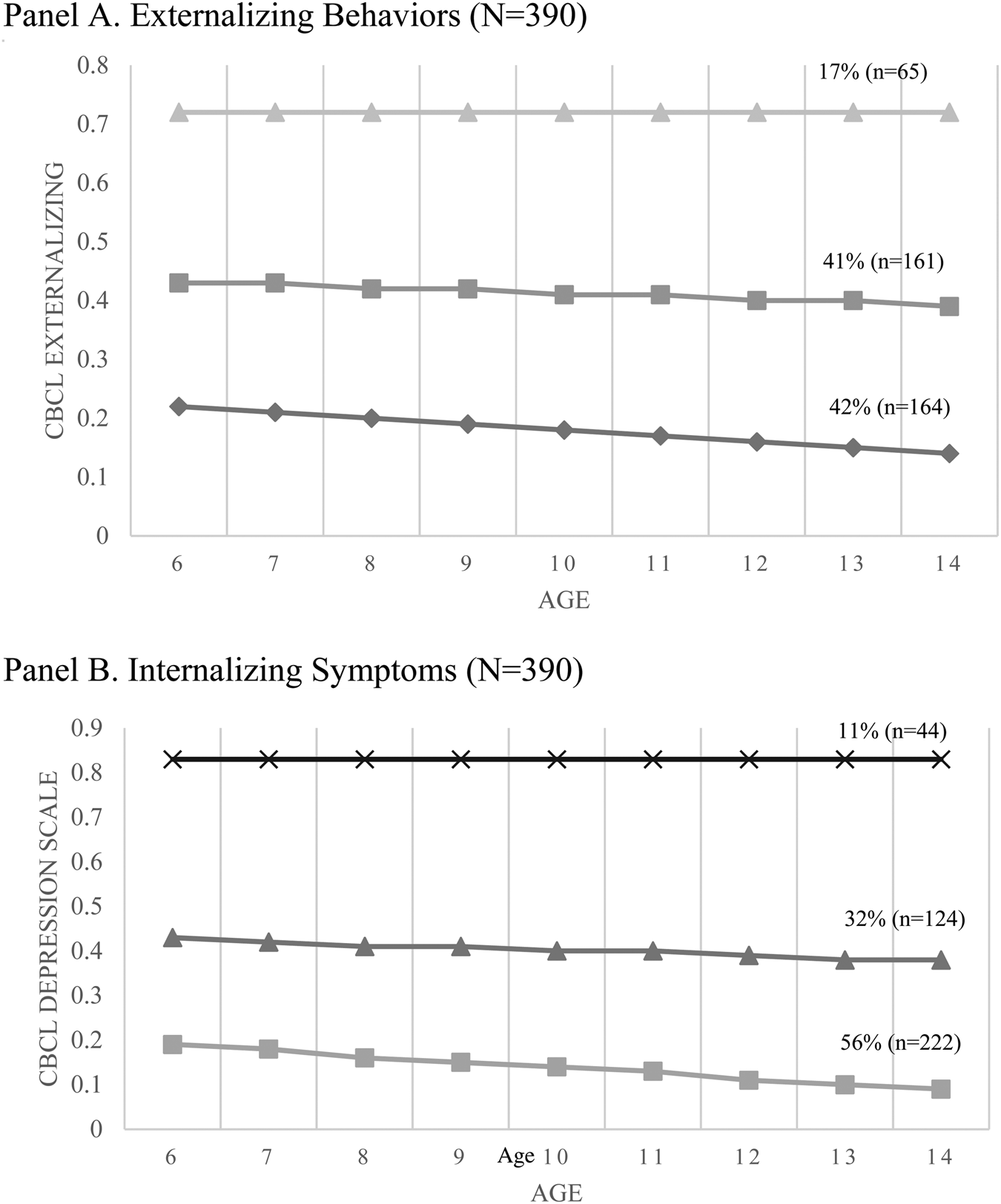
Figure 1 presents the optimal class solutions based on the mean CBCL score for externalizing behaviors (Panel A) and internalizing symptoms (Panel B) spanning ages 6 to 14. For externalizing behaviors, the optimal solution was a three-group model. Approximately 42% of youths belong to the “low externalizing behavior” group, which displayed declining externalizing behavior from age 6 to 14. Another 41% of the sample, which we refer to as “moderate externalizing behavior”, displayed a higher level of externalizing behavior that also appeared to decline slightly from age 6 to 14. Finally, approximately 17% of youth in our sample displayed what we refer to as “high externalizing behavior”, exhibiting stability in manifestation during this period of childhood and early adolescence.
Externalizing behavior and internalizing symptom class solutions.

We similarly found that a three-group solution best summarized internalizing behaviors in the form of depressive/anxious symptoms in our sample of Black and Hispanic youth. We refer to these groups as “high”, “moderate,” and “low”. Again, the high group (11%) displayed stability in symptom level spanning ages 6–14, whereas the moderate (32%) and the modal low group (56%) exhibited decreasing symptoms from age 6 through 14.
The Appendices include the model adequacy checks recommended by Nagin (Reference Nagin2005) for our externalizing and internalizing trajectory group solutions. For each of the externalizing behaviors and internalizing symptom classes, the average posterior probability of group membership was above 0.93. Given the high degree of certainty in class membership, we hard-classified our youth into classes of externalizing and internalizing behaviors (Roeder et al., Reference Roeder, Lynch and Nagin1999). Table 1 presents a cross-tabulation of our sample of Black and Hispanic youth by hard-classified externalizing behavior and internalizing symptom classes. Approximately 37% of the sample (145 of 390) were classified as having low levels of externalizing behavior and low levels of internalizing symptoms relative to their peers. Approximately 19% of the sample (75 of 390) were classified as displaying moderate levels of both problem behaviors and 7% (28 of 390) were classified as displaying high levels of both problem behaviors. Overall, Table 1 suggests substantial comorbidity in the relative level of externalizing behaviors and internalizing symptoms among our sample. Furthermore, of the 44 individuals who displayed high levels of internalizing symptoms, 36% displayed moderate levels of externalizing behaviors (16 of 44), and 64% displayed high levels of externalizing behavior (28 of 44). None of the individuals who displayed high levels of internalizing symptoms were classified as displaying low levels of externalizing behaviors. With respect to individuals who displayed the highest levels of externalizing behaviors, 49% displayed moderate levels of internalizing symptoms and 41% displayed high levels of internalizing symptoms (28 of 68). In contrast, only 10% displayed low levels of internalizing symptoms (7 of 68), which is less than 2% of the overall sample.
Cross-tabulation of hard-classified externalizing behaviors and internalizing symptoms

Joint distribution of externalizing behaviors and internalizing symptoms and adolescent substance use
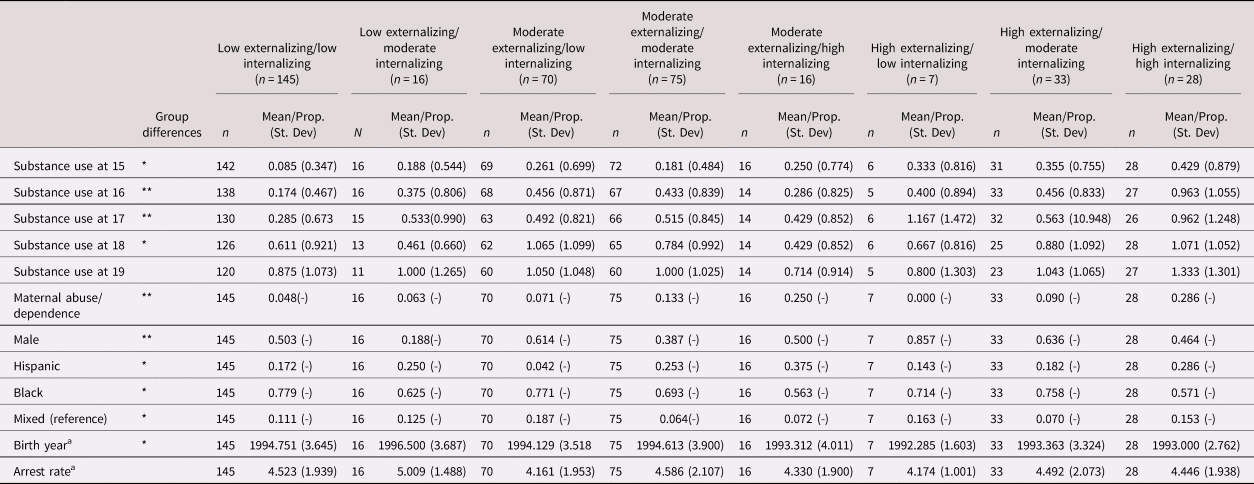
Based on the classifications of externalizing behaviors and internalizing behaviors in the form of depressive/anxious symptoms, we created the joint distribution of the development for these two problem behaviors, which serve as our pattern profiles and predictors of adolescent substance use. Table 2 presents descriptive information for the sample by pattern profile, including sample sizes for each profile by age and the mean level of substance use at each age. Recall from Table 1 that there were no individuals who could be jointly classified as low in externalizing behaviors and high in internalizing symptoms. One-way analysis of variance (ANOVA) revealed significant differences (p < .05) in the mean level of substance use across these pattern profiles at ages 15–18 but not at age 19. Significant differences (p < .05) in maternal history of substance abuse/dependence, sex, race/ethnicity, and birth year (but not community arrest rate) also emerged across groups
Descriptive statistics (N = 390)

Note: Significance denotes if there is a significant difference in means/proportions between classification by externalizing and Internalizing behavior classifications.
Prop. = proportion; St. Dev. = standard deviation; (-) No standard deviation due to the binary nature of the variable.
a Covariate is centered at 0 in analyses.
* p < .05 (two-tailed test); **p < .01 (two-tailed test)
The development of substance use in mid to late adolescence
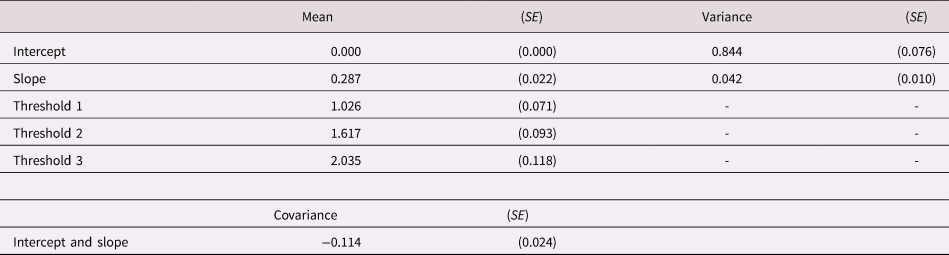
To assess the relationship between the joint development of externalizing and internalizing behaviors and substance use, net of controls, we first modeled the change in substance use from age 15 to age 19. Analyses revealed that linear, positive growth best represents change in substance use from age 15 to 19 (see Table 3; quadratic term M = −0.28, SE = 0.017, p = −0.109) and displayed good fit based on diagnostics (RMSEA = 0.057; CFI = 0.983; TLI = 0.988; SRMR=0.030; Hu & Bentler, Reference Hu and Bentler1999). In addition to significant variation in the intercept and slope across individuals, Table 3 also indicates that higher initial levels of substance use at age 15 were associated with slower growth in substance use over time (covariance = −0.114, SE = 0.024).
Estimated growth factor means and variances for substance use from age 15 to 19 (N = 390)

Note: χ2 = 31.562 (df = 14); root mean square error of approximation (RMSEA) = 0.057; comparative fit index (CFI) = 0.983; Tucker–Lewis index (TLI) = 0.988; standardized root mean square residual (SRMR) = 0.030.
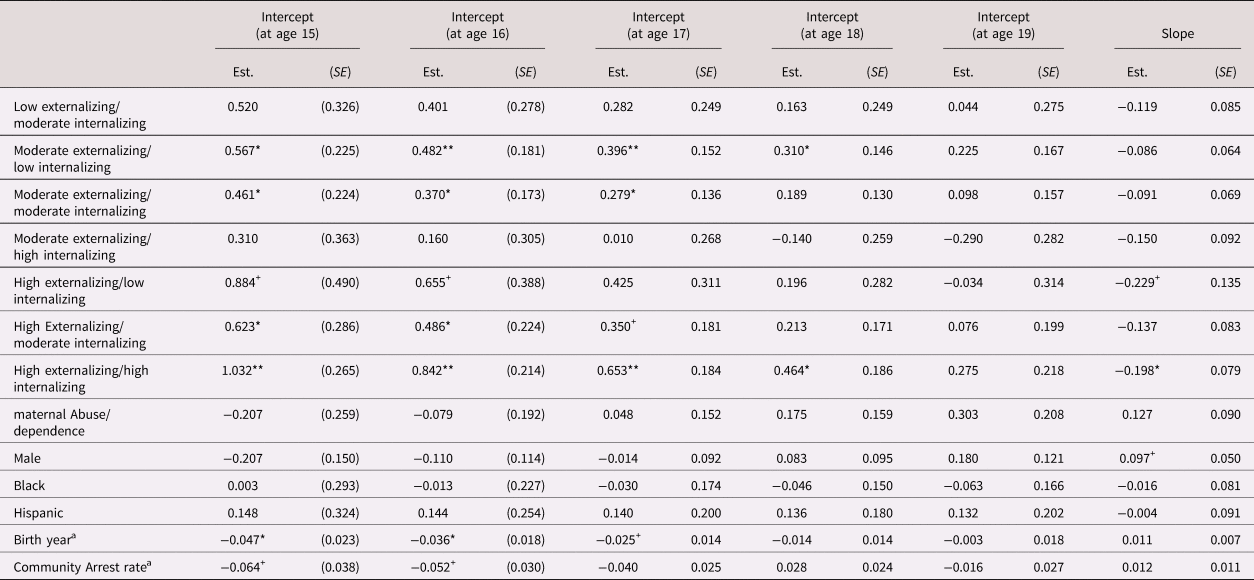
Before including our profiles representing the joint development of externalizing and internalizing behaviors in the form of depressive/anxious symptoms as predictors of growth in substance use from 15 to 19, we note that the high externalizing behavior and low internalizing group only included 5 or 6 individuals at each age from 15 to 19. Given concerns for statistical power, we collapsed this group with the high externalizing behavior and moderate internalizing symptom group to form a group called high externalizing and lower internalizing symptoms (hereafter “high/lower”). Additional models retaining this group can be found in the Appendices.
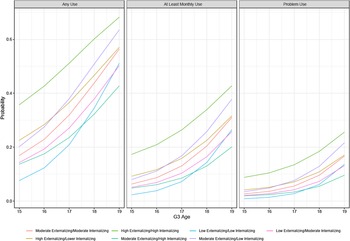
Figure 2 presents the unadjusted growth in substance use across pattern profiles defined by the joint development of externalizing behaviors and internalizing behaviors in the form of depressive/anxious symptoms. More specifically, it presents the unadjusted growth curves for the probability of any substance use, monthly substance use, and problem substance use for each profile. For each level of substance use, the high externalizing and high internalizing group (hereafter “high/high”) displayed the highest probability of the level of use across adolescence. At age 15 and 16, the probability of each level of substance use was next highest among individuals classified as high/lower followed by individuals in the moderate externalizing and low internalizing behavior group (hereafter “moderate/low”). However, at age 17 through 19, the probability of increased use was higher among the moderate/low group than the high/lower group, seemingly due to slower growth in substance use among the latter group. Individuals classified as low externalizing and low internalizing (hereafter “low/low”) had the lowest probability of experiencing each level of substance use through age 17. Beginning at age 18, though, individuals in the moderate externalizing and high internalizing group (hereafter “moderate/high”) displayed the lowest probability of any level of use, also a result of apparent slower growth in substance use for this group relative to the low/low group.
Unadjusted predicted probabilities of substance use across age by joint distribution of externalizing behavior and internalizing symptom classes.

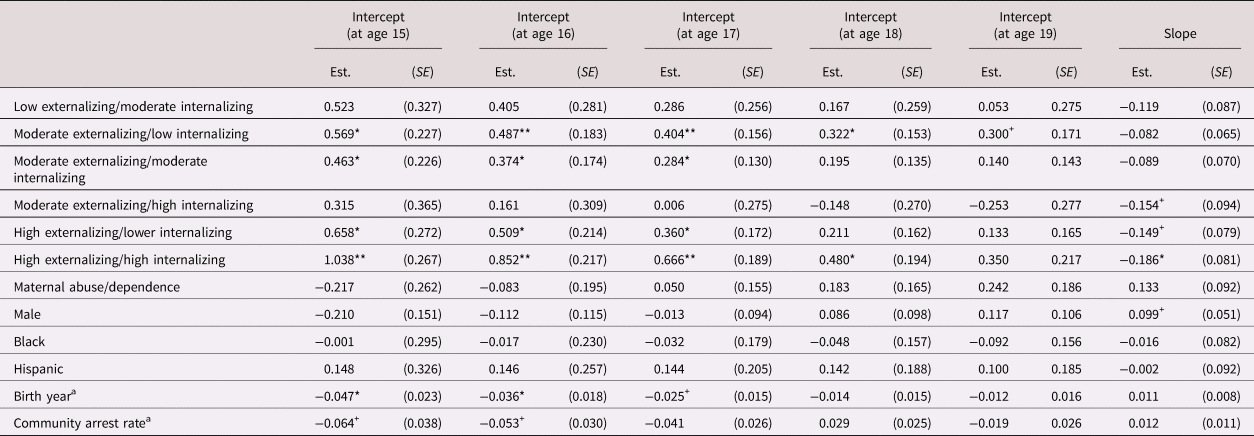
Table 3 presents the relationship between the profiles representing the joint development of externalizing behaviors and internalizing behaviors in the form of depressive/anxious symptoms and the development of substance use from mid to late adolescence net of controls. The reference category for the classification of the joint development of externalizing behaviors and internalizing symptoms in the latent growth curve model is the low/low group. Consistent with Figure 2, individuals classified as high/high were more likely to display elevated levels of substance use relative to individuals classified as low/low. Similarly, individuals in the moderate/low internalizing group, moderate externalizing and moderate internalizing group (hereafter “moderate/moderate”), and high/lower group were also more likely to display higher initial levels of substance use (at age 15) relative to individuals classified as low/low. No significant differences in initial levels of substance use (at age 15) were observed between individuals in the low/low group, the low externalizing and moderate internalizing group (hereafter “low/moderate”), and the moderate/high group.
With respect to the growth in substance use over time (age 15–19), Table 4 indicates that individuals in the high/high group demonstrated slower growth in substance use from age 15 to 19 relative to individuals in the low/low group. This is not unexpected given that the high/high group displayed the highest initial levels of substance use and the covariance between the intercept of substance use and slope (or growth) in substance use was negative (see Table 3). Similarly, individuals in the high/lower group also displayed slower growth relative to individuals in the low/low group, although this difference was only marginally significant (p < .10). Interestingly, individuals in the moderate/high group also demonstrated slower growth (p < .10) than individuals in the low/low group.
Regression coefficients from latent growth models predicting intercept and slope factors for substance use

Note: Behavioral classification reference group is the low externalizing and low internalizing classification; high externalizing/lower internalizing includes high externalizing/low internalizing and high externalizing/moderate internalizing; model fit diagnostics: χ2 = 46.843 (df = 53); root mean square error of approximation (RMSEA) = 0.000; comparative fit index (CFI) = 1.000; Tucker–Lewis index (TLI) = 1.000; standardized root mean square residual (SRMR) = 0.032.
Abbreviations: Est. = estimate, SE = standard error.
a Covariate is centered at the mean in the models.
+ p < .10 (two-tailed test); * p < .05 (two-tailed test); **p < .01 (two-tailed test)
Given the varying rates of growth in substance use across profiles of the joint development of externalizing behavior and internalizing symptoms, Table 4 also indicates the differences in the intercept or level of substance use at each age from 16 to 19 relative to individuals in the low/low group. Most notably, at age 18, only individuals in the moderate/low group as well as the individuals in the high/high group were more likely to engage in higher levels of substance use relative to the low/low group. At age 19, though, the likelihood of substance use did not vary between individuals in the low/low group and any of the other profiles representing the joint development of externalizing behaviors and internalizing symptoms.
The last step in our analyses involved rotating the reference category for the joint development of externalizing and internalizing behaviors in order to further probe whether differences in the development of substance use emerge across the varying profiles of externalizing behaviors and internalizing symptoms. Specifically, we sought to address whether higher levels of internalizing behaviors in the form of depressive/anxious symptoms moderate the effect externalizing behaviors on the development of substance use. For instance, if the effect of high externalizing behaviors on substance use was exacerbated by high levels of internalizing behaviors in the form of depressive/anxious symptoms, then we would expect to see significant differences in the intercept and slope of substance use between individuals the high/high group and the high/lower group. Therefore, we first allowed the high/high group to serve as the reference group. Whereas differences in the intercept (initial level of substance use at age 15) existed between individuals in the high/high group and individuals in the moderate/low group (b = −0.455, SE = 0.248, p < .07), the moderate/moderate (b = −0.585, SE = 0.250, p < .05), and the moderate/high group (b = −0.704, SE = 0.369, p < .06), there were no significant or marginally significant differences in the initial level of substance use between individuals in the high/high group, the high/lower, or the low/moderate group. Furthermore, no differences in the growth of substance use emerged between individuals in the high/high group and any other profile pattern with the exception of the low/low group (see Table 4).
Additionally, we set individuals from the high/lower group as the reference category to further probe profile differences. No notable differences in the initial level of substance use or slope (growth in substance use) were observed between this group and any other profile representing the joint development of both problem behaviors with the exception of the low/low group (see Table 2), further suggesting a lack of moderating effect of internalizing symptoms among individuals who displayed high levels of externalizing behaviors.
Additional rotation the reference category resulted in only one noteworthy difference: the intercept (level) of substance use at age 19 was higher among individuals in the moderate/low depressive symptom group relative to individuals in the moderate/high depressive symptom group (b = 0.531, SE = 0.312, p < .09). Consistent with Figure 2, it appears that there is a protective effect of internalizing symptoms in late adolescence among individuals who displayed moderate levels of externalizing behaviors.
Discussion
In the present study, we focused on a sample of Black and Hispanic youth and examined the joint development of externalizing and internalizing behaviors in the form of depressive/anxious symptoms from childhood to early adolescence. After taking note of the patterns of comorbidity in manifestation among these understudied populations, we then examined how these observable profiles are related to substance use in mid to late adolescence. In particular, we queried whether either problem behavior served as a salient moderator of the risk or promotive effects evinced by externalizing and internalizing behaviors for substance use. Our results indicated the following: first, among our sample of Black and Hispanic adolescents, three classes of externalizing behavior patterns and three classes of internalizing behavior in the form of depressive/anxious symptoms emerged spanning ages 6 to 14. Importantly, comorbidity of these behaviors (similar levels of externalizing and internalizing behaviors relative to one's peers) was the hallmark of this sample, and elevated levels of either problem behavior were almost always accompanied by at least moderate levels of the other problem behavior. Second, the results indicated that elevated levels of externalizing behaviors increased the risk for adolescent substance use, including the early onset of substance use, which is often defined as use by the age of 15 (e.g., Crouse et al., Reference Crouse, Chitty, Iorfino, White, Nichles, Zmicerevska and Hickie2019; Otten, Mun, Shaw, Wilson, & Dishion, Reference Otten, Mun, Shaw, Wilson and Dishion2019). Interestingly, we did not find that elevated levels of internalizing behaviors similarly elevated the risk of substance use during adolescence. Alternatively, the importance of internalizing behaviors in the form of depressive/anxious symptoms appeared to be limited to those who displayed moderate levels of externalizing behaviors, where they served as a protective factor. Third, the results suggested that profiles representing the joint development of externalizing and internalizing behaviors largely fail to account for differences in levels of substance use at the end of adolescence (age 19). Finally, our analyses indicated variation in growth in substance use spanning mid to late adolescence with those who displayed the highest levels of externalizing behaviors and those who jointly exhibited moderate levels of externalizing behaviors and high levels of internalizing symptoms demonstrating slower growth in substance use from mid to late adolescence, although likely a result of different mechanisms. We now follow with a more detailed discussion of these findings and their potential implications.
First, we observed remarkable stability in observable measures of both externalizing behaviors and internalizing behaviors in the form of depressive/anxious symptoms among our sample of Black and Hispanic youth. The relative level of problem behavior in relation to one's age mates did not change across time. Furthermore, stability was the norm of those who displayed the highest levels of both externalizing behaviors and internalizing symptoms. This is similar to research conducted among predominantly White samples that identified a class of youth who display stable, elevated levels of externalizing and internalizing behaviors spanning childhood and adolescence (e.g., Comeau & Boyle, Reference Comeau and Boyle2018; Leve et al., Reference Leve, Kim and Pears2005; Sterba, Prinstein, & Cox, Reference Sterba, Prinstein and Cox2007). The pattern of stable, elevated externalizing behaviors and internalizing symptoms among a subgroup of Black and Hispanic youth may be indicative of an underlying deficit that manifests itself similarly across age. In conjunction, lived experiences, which for some youths may include discrimination and/or a lack of social and economic resources, may contribute to the etiological underpinnings and promote stability in these problem behaviors.
Conversely, youth classified as displaying low or moderate levels of externalizing behaviors and internalizing symptoms tended decrease in the presentation of behavior with age. The downward trajectory of these behaviors for most Black and Hispanic youth is notable given that lived experiences of discrimination, economic and/or educational hardship in association with peer social pressures are unlikely to decrease (but instead increase) with age among these youth (e.g., Brody et al., Reference Brody, Chen, Murry, Simons, Ge, Gibbons and Cutrona2006; Schneider, Martinez, & Owens, Reference Schneider, Martinez, Owens, Mitchell and Tienda2006). It is promising, then, that in the face of these sources of adversity and strain, the presentation of both problem behaviors decreased, likely as a result of increased maturity, situational awareness, and/or learned coping mechanisms. Future research should attempt to replicate these patterns of externalizing and internalizing behaviors among Black and Hispanic youth to confirm their developmental manifestation and address the etiological underpinnings of these patterns of manifestation, particularly among minority youth.
When examining the joint development of both problem behaviors, it is noteworthy that high internalizing symptomatology was exclusively found in the context of comorbid elevated externalizing behaviors. Perhaps this is an artifact of our parent-reported measures of internalizing behaviors, as mothers and other maternal caregivers may be unlikely to perceive high levels of depressive/anxious symptoms without co-occurring externalizing behaviors. Additionally, high externalizing behaviors were almost exclusively found in the context of elevated internalizing behaviors among our sample of Black and Hispanic youth. As such, these findings reinforce the notion of comorbidity in the presentation of externalizing and internalizing behaviors among Black and Hispanic youth (see also Liu, Mustanski, Dick, Bolland, & Kertesm, Reference Liu, Mustanski, Dick, Bolland and Kertesm2017). They are also in line with the work of Caspi and colleagues (Reference Caspi, Houts, Belsky, Goldman-Mellor, Harrington, Israel and Moffitt2014) who suggested that an underlying dimension of psychopathology can account for the comorbidity in externalizing and internalizing behaviors because both stem from an underlying psychopathology or predisposition (see also Foster et al., Reference Foster, Hicks and Zucker2018; Hatoum, Rhee, Corley, Hewitt, & Friedman, Reference Hatoum, Rhee, Corley, Hewitt and Friedman2018). Unfortunately, in our data, we were computationally unable to fit a model based on this underlying trait (see Caspi et al., Reference Caspi, Houts, Belsky, Goldman-Mellor, Harrington, Israel and Moffitt2014). Regardless of reason for presentation and etiologic underpinnings, the strategy and generation of profile patterns based on the observable development of externalizing and internalizing behaviors relative to one's peers as an indicator of risk is noteworthy as this strategy can be used by practitioners and parents alike to assess potential psychopathology without formal measurement Furthermore, a majority of clinicians across medical, psychological, and school-based services rely on observable scales such as CBCL to assess potential psychopathology and, importantly, ascertain risk for future maladaptation, including early onset and problem substance use. As such, our analytic approach utilizing internalizing, externalizing, and joint presentations of these concerns is in line with current clinical tools.
With respect to risk for substance use, we observed that profile patterns based on the joint development of externalizing and internalizing behaviors indicated that elevated levels of externalizing behaviors evince an increased risk in substance use among Black and Hispanic youth similar to extant work conducted with predominantly or all White samples. Alternatively, this work fails to suggest a uniform effect of internalizing behaviors on substance use in mid to late adolescence that has previously been identified among predominantly White adolescents (Scalco et al., Reference Scalco, Colder, Hawk, Read, Wieczorek and Lengua2014). For instance, higher levels of internalizing behavior in the form of depressive/anxious symptoms failed to exacerbate the risk for substance use alone. Alternatively, internalizing behaviors in the form of depressive/anxious symptoms appeared to serve as a protective factor among Black and Hispanic youth who displayed moderate levels of externalizing behaviors, although we note the small number of individuals in this group tempers a strong conclusion with respect to this moderating effect. Still, this potential protective effect is in direct contrast to the work of Colder et al. (Reference Colder, Frndak, Lengua, Read, Hawk and Wieczorek2018) who found a protective effect of internalizing behaviors at only low or high levels of externalizing behaviors among a predominantly White sample of youth. Perhaps the lack of protective effect of internalizing behaviors among Black and Hispanic youth who display low levels of externalizing behavior is a result of the lower, on average, prevalence of substance use among these populations (Banks & Zapolski, Reference Banks and Zapolski2018; Johnston et al., Reference Johnston, Miech, O'Malley, Bachman, Schulenberg and Patrick2019) and cultural norms that are less approving of substance use or include more negative expectancies associated with use (Shih, Miles, Tucker, Zhou, & D'Amico, Reference Shih, Miles, Tucker, Zhou and Amico2010). As such, the risk for substance use among Black and Hispanic youth who exhibit low levels of externalizing behaviors is so low that there is little room for internalizing behaviors to serve as a protective factor. Similarly, an increased proclivity to engage in externalizing behaviors may evince such a risk for substance use that internalizing behaviors are largely unimportant. For instance, elevated levels of externalizing behaviors may offset the protective factors associated with increased internalizing behaviors among Black and Hispanic youth, as youth with elevated levels of externalizing behaviors are more likely to associate with delinquent peers who are more prevalent in low income and urban locales, have little supervision and monitoring as a result of economic hardship, and withdraw from prosocial institutions where they experience discrimination in punishment (Jarvis & Okonofua, Reference Jarvis and Okonofua2020). Furthermore, it could be an artifact of measurement, as this study focused specifically on depressive/anxious symptoms as our measure of internalizing behaviors given their relationship to substance use in extant literature instead of a more global measure of internalizing behaviors that also includes somatic complaints. Given this potential difference, in addition to the small sample size for this group of youth, we urge replication to demonstrate the robustness of this protective effect among Black and Hispanic youth.
With respect to the development of substance use from mid to late adolescence, we observed slower growth in substance use for those who displayed high levels of externalizing behavior, regardless of the level of internalizing behaviors in the form of depressive/anxious symptoms, and among individuals who displayed moderate levels of externalizing behavior and high levels of internalizing symptoms. With respect to individuals who displayed elevated levels of externalizing behavior, the slower growth in substance use is likely intertwined with the higher initial levels of substance use at age 15. After all, our growth curves indicate those who displayed high levels of externalizing behaviors had the highest probability of any substance use, monthly substance use, and problem substance use at each age. Additional increases in substance use with age may also be limited among these groups based on our measurement (no use, less than monthly use, monthly use, weekly use, and problem use).Footnote 9 Alternatively, the slower growth in substance use among our sample of Black and Hispanic youth who exhibited moderate levels of externalizing behaviors and high levels of internalizing symptoms may reflect the less favorable views about substance use among minorities, particularly in response to mental health issues (Wallace & Fisher, Reference Wallace and Fisher2007).
Finally, we note that all observed differences in risk between profiles representing the joint development of externalizing and internalizing behaviors in the form of depressive/anxious symptoms weakened in magnitude with age. Furthermore, at age 19, there were no longer any significant differences in risk for substance use between the low externalizing and low internalizing group and the other profiles of externalizing and internalizing behaviors. This finding is in line with the general notion that, by age 19, substance use is relatively normative, a finding commonly observed among predominantly White college samples (e.g. Johnston et al., Reference Johnston, Miech, O'Malley, Bachman, Schulenberg and Patrick2019; Lipari & Jean-Francois, Reference Lipari and Jean-Francois2016) After all, this is a period in the life course where peer disapproval of substance use decreases (Mrug & McCay, Reference Mrug and McCay2013) and discussions about substance use tend to be more positive (Hammond et al., Reference Hammond, Paul, Hobelmann, Koratana, Dredze and Chisolm2018). It is also possible that early development of externalizing and internalizing behaviors, which were measured some five years prior, are no longer relevant; it is only contemporaneous measures of both behaviors that are relevant to substance use at this age. Likewise, as Black and Hispanic youth progress through late adolescence and emerging adulthood, substance use and abuse may be attributable to a variety of different factors including earlier social and/or academic disruptions, stress, and/or learned maladaptive coping. More work is needed to shed light on the mechanisms promoting substance use and abuse as young people transition across stages of development and into subsequent life roles, particularly in the context of race/ethnicity and unique cultural experiences and expectations.
From a policy perspective, the generation of pattern profiles based on the joint development of externalizing and internalizing behaviors can be useful for prevention and intervention programs that seek to identify racial and ethnic minority youth for programming. Further, the variable risk associated with these pattern profiles based on the joint development of externalizing behavior and internalizing behaviors in the form of depressive/anxious symptoms should be used to inform programming application given their practical utility. For instance, substance use prevention programming offered to youth who display high levels of internalizing behaviors will likely not be uniform or even effective, given that those who display moderate levels of externalizing behaviors and high internalizing behaviors are at a decreased risk for substance use. As such, there is potential for a backfire effect. Consequently, programming should be aware of the typological patterns of behaviors and seek to tailor treatment modality and dosage across joint behavioral patterns in a manner that is most likely to lead to effective outcomes (delayed-onset or reduced substance use).
The vast majority of research that informs this body of work, and its subsequent implications for policy, prevention, and education, draws its conclusions from analyses performed using samples of predominantly White participants. This study contributes to the body of research that highlights the importance of racial and ethnic minority status as we assess behavioral trends and their relationship with subsequent substance use. Nevertheless, more work is needed. Although Black and Hispanic populations may have similarities in terms of under-privilege resulting from systemic racism in the United States, we acknowledge that there are likely distinctions between their experiences as well as for those who hold combined racial and ethnic identities. Due to limited sample size and analytical power, we were unable to evaluate the joint development of externalizing and internalizing behaviors and its relationship to adolescent substance use and growth over time across each of these identities. However, this limitation only highlights the need for greater sampling of these diverse populations that are growing in prevalence in the United States. To be sure, this increased sampling effort will assist researchers and practitioners alike and avoid the unintentional masking of differences between racial and ethnic groups (King et al., Reference King, Iacono and McGue2004).
While this work improves upon prior literature, it is not without its own limitations. First, the size of our sample limited power and precluded us from pursuing an intersectional approach that would allow for the examination of differences across sex as well as race/ethnicity. Second, the sample originated from one urban locale in the United States, which may limit the generalizability of our results. Also, substance use was assessed with self-report information. Considering the sensitive nature of this type of information, self-report bias may have affected accuracy. Further, our ordinal measure of substance use was created to reflect frequency and consequences of adolescent substance use, and it does not capture clinical diagnostic presentations of addiction (i.e., DSM-V diagnoses of substance abuse and/or dependence). Finally, we did not account for potential mechanisms that may link externalizing and internalizing behaviors to adolescent substance use, including associations with delinquent peers, aspects of parent–child relationships, school engagement, and the timing of onset of substance use. Future work should shed light on how the joint development of externalizing and internalizing behaviors gives way to potential mechanisms that may promote substance use and abuse in adolescence.
Overall, this study provides novel quantitative information regarding the development of externalizing and internalizing behaviors among Black and Hispanic youth in childhood and early adolescence. Additionally, it explores how profile patterns based on the joint development of both behaviors are related to subsequent adolescent substance. In doing so, we hope that our findings inform programming by directing service providers to Black and Hispanic youth most in need to prevention programming based on observable behaviors in childhood and early adolescence. As a result, this work is one small step meant to inform prevention efforts in order to yield health and prosperity among all youth in the United States.
Acknowledgments
We thank Rebekah Chu, PhD and Adrienne Freeman-Gallant, PhD, for their assistance in compiling the dataset for the analyses presented in this manuscript.
Funding Statement
Support for the Rochester Youth Development Study has been provided by the National Institute on Drug Abuse (R01DA020195, R01DA005512), the Office of Juvenile Justice and Delinquency Prevention (86-JN-CX-0007, 96-MU-FX-0014, 2004-MU-FX-0062), the National Science Foundation (SBR-9123299), and the National Institute of Mental Health (R01MH56486, R01MH63386). Technical assistance for this project was also provided by an NICHD grant (R24HD044943) to The Center for Social and Demographic Analysis at the University at Albany. Points of view or opinions in this document are those of the authors and do not necessarily represent the official position or policies of the funding agencies.
Conflicts of Interest
None.
Appendix A. Rochester intergenerational study sample sizes (Black and Hispanic youth) at each child age by year of data collection (N = 390)

Appendix B. Diagnostics of externalizing behavior and internalizing symptom trajectory solutions

Appendix C. Regression coefficients from latent growth models predicting intercept and slope factors for substance use including all joint classifications of externalizing behavior and internalizing symptoms in the form of depressive/anxiety symptoms