INTRODUCTION
Effective end-of-life care frequently requires attention to a broad spectrum of needs and often includes interventions at the boundaries of traditional medicine. Aside from the interdisciplinary approach (Grumbach & Bodenheimer, Reference Grumbach and Bodenheimer2004), sensitivity to individual beliefs and values has been recognized as a key factor in drawing the attention of physicians to patients' needs (Yedidia, Reference Yedidia2007). In order to successfully discern needs, which may differ from person to person and between patients and families, physicians should have an extensive knowledge of the patient's views on the meaning and purpose of life. Access to this knowledge is a function of the physician–patient relationship. Although the issue of palliative care has been traditionally neglected in undergraduate medical curricula (Lloyd-Williams & MacLeod, Reference Lloyd-Williams and MacLeod2004; Eyigor, Reference Eyigor2013), the time devoted to teaching this subject has gradually increased in recent years (Ross et al., Reference Ross, Shpritz and Hull2005; Morrison et al., Reference Morrison, Thompson and Gill2012; von Gunten et al., Reference von Gunten, Mullan and Nelesen2012). However, there is still much debate about whether current palliative care training is adequate to equip tomorrow's physicians with the necessary skills to care for dying patients.
Recent studies have found that many newly qualified physicians feel unprepared to care for the terminally ill (Billings et al., Reference Billings, Curtis and Engelberg2009; Gibbins et al., Reference Gibbins, McCuobrie and Forbes2011). There are several possible explanations for this. First, the effect of training may differ from student to student (e.g., abilities to express and be attuned to emotions or to relate to the dying depend on personality characteristics that predate medical school). Second, the emotional demand of palliative care may lead to professional dissatisfaction, especially for students with personal anxieties about death (Merrill et al., Reference Merrill, Lorimor and Thornby1998). In this scenario, the assessment of personal dispositions (i.e., attitudes) toward care of the dying represents an interesting research area, as it could be helpful in screening individuals (i.e., distinguish between individuals more or less prone to provide such care), to develop tailored programs, and to evaluate their effectiveness.
However, this field is not devoid of methodological difficulties (Merrill et al., Reference Merrill, Lorimor and Thornby1998), starting with a lack of uniformity of the key constructs underlying the measurement process. Personal disposition toward caring for the dying has been investigated from different perspectives. Some authors have studied thanatophobia in medical students using the Thanatophobia Scale (Merrill et al., Reference Merrill, Lorimor and Thornby1998), while some have employed the Self-Efficacy in Palliative Care Scale (Barrington & Murrie, Reference Barrington and Murrie1999), and others the Approach to Death and Dying Patients Attitude Scale (Kavas & Oztuna, Reference Kavas and Oztuna2011). Studies on nursing education have used the Death Attitude Profile (Wong et al., Reference Wong, Reker, Gesser and Neimeyer2014), the Palliative Care Survey (Thompson et al., Reference Thompson, Bott and Boyle2011), the Concern about Dying instrument (Mazor et al., Reference Mazor, Schwartz and Rogers2004), and the Multidimensional Orientation Toward Dying and Death Inventory (Wittkowski, Reference Wittkowski2001).
Apart from the aforementioned tools, one of the most interesting proposals in the field is the Frommelt Attitude Toward the Care of the Dying scale (FATCOD) (Frommelt, Reference Frommelt1991). Focusing on attitudes about the relationship with a dying patient and the family rather than on death and dying as concepts, or even on know-how, the FATCOD seems properly built to assess the level of comfort/discomfort related to caring for the terminally ill and their families. It also appears suitable for career counseling, as it provides information about the disposition to establish and maintain a therapeutic approach in palliative care. However, despite its potential, the FATCOD seems to have rarely been used in medical education (Leombruni et al., Reference Leombruni, Miniotti and Bovero2012; Reference Leombruni, Miniotti and Torta2013; Reference Leombruni, Miniotti and Zizzi2015b ), and its psychometric properties have not been fully ascertained.
This instrument was designed by Frommelt to assess nurses' attitudes about providing care to the terminally ill and their families and to evaluate the effects of educational programs on these attitudes (Frommelt, Reference Frommelt1991). It was subsequently modified slightly by the same author to be applicable to health profession students, and the acronym was changed to the FATCOD–B (Frommelt, Reference Frommelt2003). The validity and reliability of both versions were established through computation of a content validity index and a test–retest procedure on very small samples of nurses (Frommelt, Reference Frommelt1991) and medical undergraduates (Frommelt, Reference Frommelt2003). The empirical evidence about its psychometric properties provided by these studies is too limited and weak to meet the requirements of the validation process (which also applies to the Italian version) (Mastroianni et al., Reference Mastroianni, Piredda and Frommelt2009). The FATCOD–B seems to implicitly conceptualize a single dimension (as the author's studies did not yield information on factor structure and the scale did not foresee scores on different subscales). However, previous studies have found evidence of the several independent dimensions that underlie the scale. Different factorial structures have been proposed, including two (Henoch et al., Reference Henoch, Browall and Melin-Johansson2014), four (Leombruni et al., Reference Leombruni, Miniotti and Bovero2014), six (Mastroianni et al., Reference Mastroianni, Piredda and Taboga2015), seven (Wang et al., Reference Wang, Li and Yan2016), or eight (Nakai et al., Reference Nakai, Miyashita and Sasahara2006) dimensions.
Although based on exploratory analyses, these conflicting results suggest poor scale validity. Moreover, even after a first fast read-through, the FATCOD–B seems to consist of a heterogeneous set of items, both in terms of content domains and the types of mental properties investigated (i.e., emotions, cognitions, perceptions, and behaviors). Some items refer to the emotional burden involved in caring for the dying, some address beliefs about caring for the dying, and others concern care of families. The most frequently proposed factorial solution seems to involve a two-dimensional structure (Nakai et al., Reference Nakai, Miyashita and Sasahara2006; Henoch et al., Reference Henoch, Browall and Melin-Johansson2014; Leombruni et al., Reference Leombruni, Loera and Miniotti2015a ). This conceptualization was originally proposed by Nakai and colleagues (Nakai et al., Reference Nakai, Miyashita and Sasahara2006), who defined the first dimension as a “positive attitude about caring for the dying patient” and the second as “perception of patient- and family-centered care.”
In a previous study, the present authors tested the efficiency of the two-dimensional model using confirmatory factor analysis (CFA), and we also tested the functionality of the items (Leombruni et al., Reference Leombruni, Loera and Miniotti2015a ). We found that the scale construct is two-dimensional, but also that its structure is quite weak due to items with poor validity (i.e., high levels of item measurement error). The scale items were neither homogeneous nor related to each other, so that the structure of the scale construct turned out to be inconsistent. We concluded that the scale could benefit from a refinement to distinguish between items related to emotions and those concerning beliefs in order to avoid ambiguity and lexical noise (Leombruni et al., Reference Leombruni, Loera and Miniotti2015a ).
The present study was designed to investigate the metric properties of a refined version of the FATCOD–B through CFA and use of the Rasch model. CFA is more informative in assessing associations between latent constructs because it evaluates the relationships among factors taking into account the measurement error associated with the observed variables. The Rasch model is more informative at the item level because it provides an estimation of the difficulty involved in endorsing each item. As recently suggested, both methods should be integrated to access the unique information available from each analysis (Golia & Simonetto. Reference Golia and Simonetto2015). In our present study, CFA was employed to determine the dimensionality of the FATCOD–B by imposing three specifications that might reflect the structure of the underlying construct measured by the scale: a one-factor model (M1), as originally suggested by the author of the scale; a two-factor model (M2), based on the results of previous research (Nakai et al., Reference Nakai, Miyashita and Sasahara2006; Henoch et al., Reference Henoch, Browall and Melin-Johansson2014; Leombruni et al., Reference Leombruni, Loera and Miniotti2015a ); and a three-factor model (M3), which might distinguish between emotions related to care of the dying, beliefs regarding treatment of the dying, and beliefs about treatment of families. The Rasch model was applied to the data to test the functionality of the items in terms of difficulties (i.e., their capability to discriminate between individuals with different levels of attitude).
METHODS
Participants
Our participants were 200 Italian students at the University of Turin Medical School. They were informed about the study's purposes and methods, and they voluntarily agreed to participate. Ethical approval was obtained from the University of Turin Ethical Review Committee (protocol no. 190231, 5 July 2014). The study was conducted in accordance with the principles of the Declaration of Helsinki.
Instruments and Procedures
The FATCOD–B (Frommelt, Reference Frommelt2003) has been found to contain some ambiguous items (i.e., statements with a misspecified or omitted subject) that may undermine the scale's validity (Leombruni et al., Reference Leombruni, Loera and Miniotti2015a ). Before administering the instrument to participants, we revised the wording of the items we considered ambiguous so as to improve their clarity and make them refer unequivocally to the same subject (i.e., the dying person). We tested the functionality of this refined version in a preliminary pilot study conducted with 60 students who first completed the original and then the refined version one month later. With the intention of controlling order or the effect of familiarization on the answering process, half of our students first completed the original version and in the second administration completed the revised one. In contrast, the other half started with the revised version and concluded by completing the original version.
The minimal refinement we proposed did not affect either the face or the content validity of the FATCOD–B, as proved by our preliminary analyses. There was no evidence of significant differences between the two versions of the scale, and so the refined version of the instrument was employed in our study. No modifications were made to the response scale format, and the scale continued to include 30 randomly ordered items scored on a 5-point Likert-type scale.
Statistical Analyses
Analyses were performed using IBM SPSS software, v. 20.0, Lisrel 8.72 (IBM, Armonk, New York), and WINSTEPS® 3.72.3 (Beaverton, Oregon).
The equivalence between the original and revised versions of the scale was tested in a pilot study using paired t tests and intraclass correlation coefficients (ICCs) (Shrout & Fleiss, Reference Shrout and Fleiss1979). Confirmatory factor analysis and the Rasch model were utilized to assess the dimensionality and metric properties of the FATCOD–B. Scale reliability was assessed using Cronbach's α coefficient, while the contribution to internal consistency at the item level was evaluated by item–total correlations.
FATCOD–B dimensionality was first investigated through CFA, as it allows testing of whether the empirical data fit the assumed structure (Floyd & Widaman, Reference Floyd and Widaman1995). The models were considered acceptable if the following criteria were satisfied: root-mean-square error of approximation RMSEA < 0.08, comparative fit index score CFI > 0.90, and standardized root-mean-square residual SRMR < 0.08 (Hu & Bentler, Reference Hu and Bentler1999).
The Rasch model represents a more comprehensive framework compared to the classical factor analytic approach (Ewing et al., Reference Ewing, Thomas and Sinkovics2005). When the data fit, the underlying latent variable is then quantitative and the measurement has been obtained. We employed Rasch measurement (partial credit model), using a joint maximum likelihood estimator, in order to assess the construct validity and item scalability of each dimension of the FATCOD–B. The models assume unidimensionality (i.e., all items on a Rasch measure assess the same construct of interest) and local independence (i.e., no correlation between any items when the latent trait has been controlled for) of each subscale. We evaluated the adequacy of fit of each item using information-weighted (INFIT) and outlier-sensitive (OUTFIT) statistics, which measure information about responses given by people with an “ability” level close to (INFIT) or distant from (OUTFIT) the item difficulty level. Values of both of these in the 0.7–1.3 range are considered satisfactory (Wright & Linacre, Reference Wright and Linacre1994). We used point-measure correlation (i.e., a measure of the correlation between single-item scores and the Rasch measure) to determine item discrimination. Finally, in order to evaluate the adequacy of fit of the data with the Rasch partial credit model, we considered the post-hoc principal component analysis (PCA) of residuals, the correlation between item residuals, the Person Separation Index (PSI), and the Reliability Index (RI). For post-hoc PCA of residuals, a dimensionality score ≤ 2 was taken to indicate scale unidimensionality (i.e., the underlying hypothesis of only one dimension was respected and residuals did not contain other significant dimensions). If the PSI score was >1.5 and the RI score was ≥0.70, the differences across measurements were considered to be due to actual differences in respondents' “ability” rather than measurement error.
RESULTS
Pilot Study and Sample Demographics
For the pilot study, 60 undergraduate medical students (aged 20.4 years on average, 50% males) completed the original and revised versions of the FATCOD–B. The proposed wording refinement did not affect item meaning or formal properties. Paired t tests and ICCs revealed that there were no significant differences in terms of mean responses for the majority (27 of 30) of items, and that the original and revised wordings of items were sufficiently correlated. In other words, they were coherent and reliable measures of the same content. (See Appendix 1 for a detailed comparison of the two versions). Paired t tests were significant for three items (6, 8, and 17), which means that the two versions were heterogeneous. This result was not surprising because we extensively modified the wording of these items in an attempt to more clearly express the core concepts they were dealing with (i.e., difficulty to talk about death and dying, professional responsibility, ethics, and distance). On the basis of this preliminary evidence, we decided to use the revised version for the present study.
The sample of undergraduate medical students enrolled in our study included 200 participants, was composed of both genders (38% males), and had a mean age of 20.5 years (SD = 1.1).
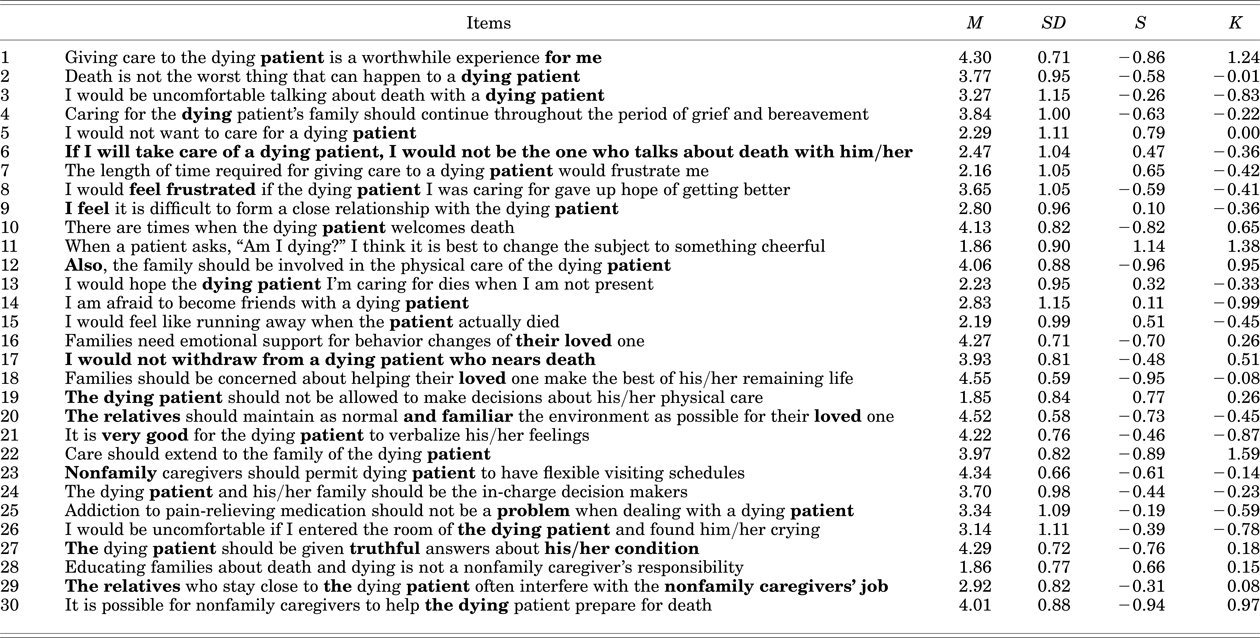
Table 1 presents the refined version of the FATCOD–B and its distributional properties.
FATCOD–B items refined: Distributional properties

Bold type indicates a refinement of an item made by the authors.
M = mean; SD = standard deviation; S = skewness; K = kurtosis.
Confirmatory Factor Analysis
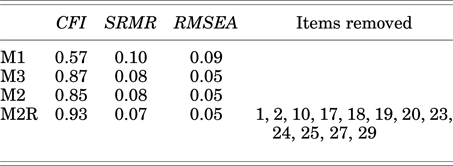
As can be seen in Table 2, the first estimated one-factor model (M1) demonstrated a very poor fit. M3 and M2 had similar features and yielded some benefits, but the SRMR and CFI score did not reach the cutoff value. For both models, evaluation of the estimated parameters suggested that many items (12) should be removed because of nonsignificant loadings or an explained variance (R 2) of <0.10.
Confirmatory factor analysis models

M1 = unidimensional model; M3 = three-factor model; M2 = two-factor model; M2R = two-factor model with items removed; CFI = Comparative Fit Index score; SRMR = standardized root-mean-square residuals; RMSEA = root-mean-square error of approximation.
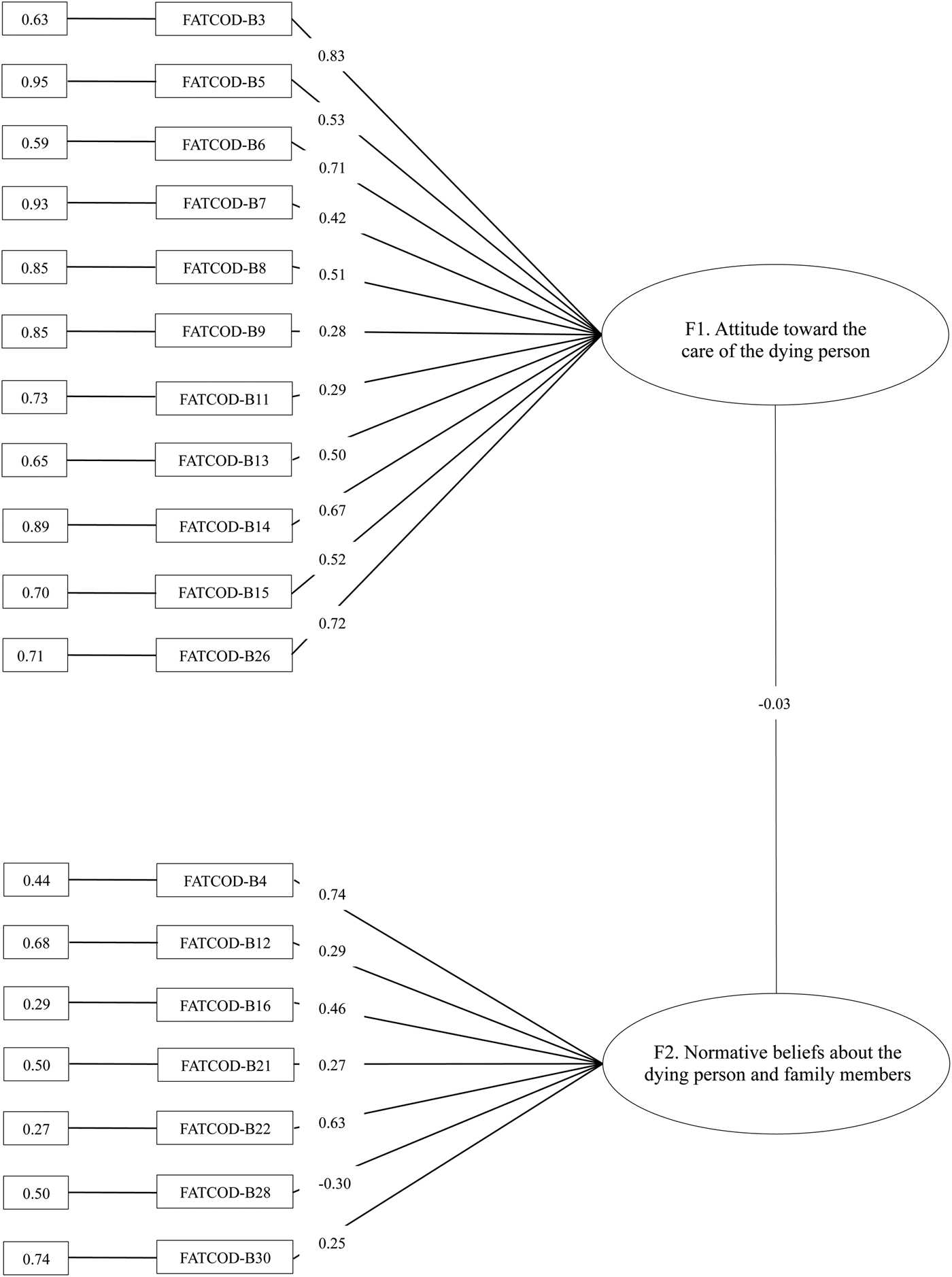
Considering the strong correlation (r = 0.49) between the last two factors in M3, we found that the two-dimensional solution improved its measurement ability by eliminating items with unacceptable loadings (<0.2). M2R also demonstrated good fit indices. As depicted in Figure 1, item saturations were all positive, except for one (FATCOD–B28), and all of them were significant (p < 0.05), while the factor correlations were ~0 and not significant (r = –0.03).
Confirmatory factor analysis of the FATCOD–B: 18-item assessment.

Considering their contents, we defined the two dimensions as “attitude about care of the dying person” and “normative beliefs about the dying person and family members” (see Figure 1). The value of Cronbach's α was 0.80 for the first and 0.53 for the second scale. The following values were determined for the mean corrected total item–scale correlations: 0.46 for the first and 0.38 for the second.
The data for each of the two dimensions (18 items) were fitted to the Rasch partial credit model. For each scale, post-hoc PCA of residuals yielded a value ≤2, so that the unidimensional assumption was satisfied (PSI = 1.97 and RI = 0.98 for the first and PSI = 0.99 and RI = 0.99 for the second scale). Although the second scale demonstrated good reliability, it was not able to differentiate participants into at least two levels of “ability.”
Item Functioning
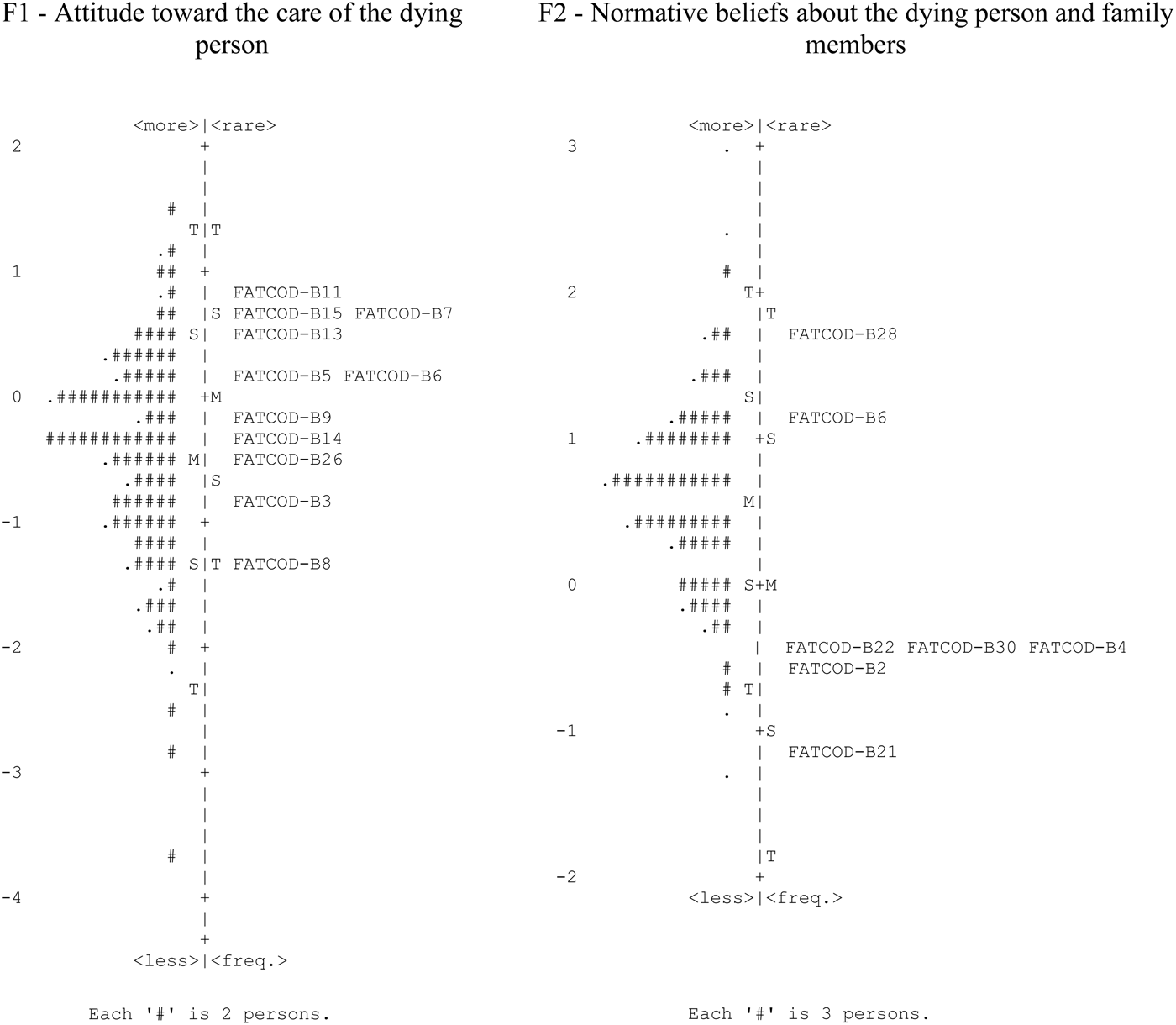
For each dimension, the person–item maps are depicted in Figure 2 and show the relative location of the item and person parameter estimates on a common logit scale.
Person–item map for the two subscales of the FATCOD–B.
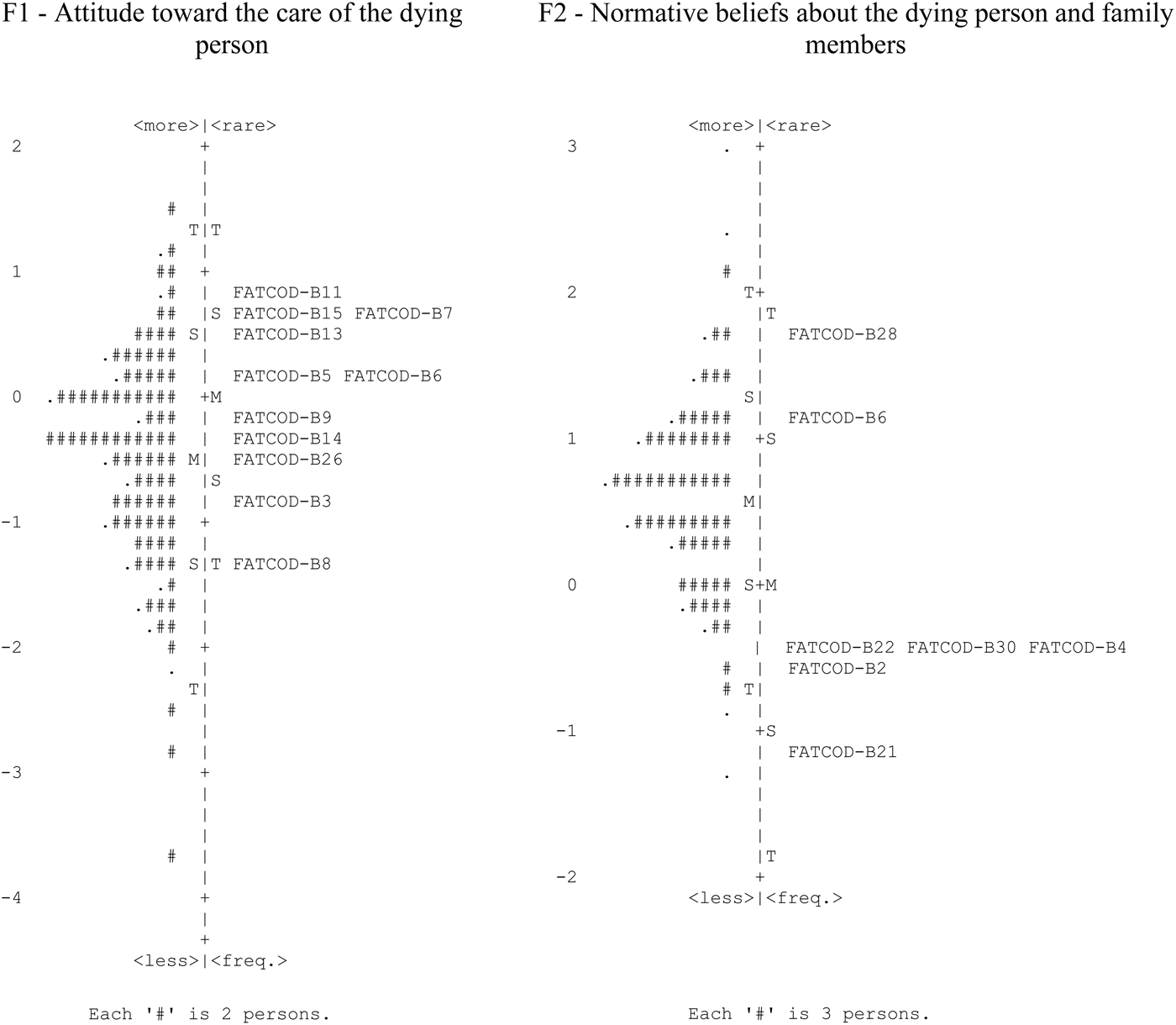
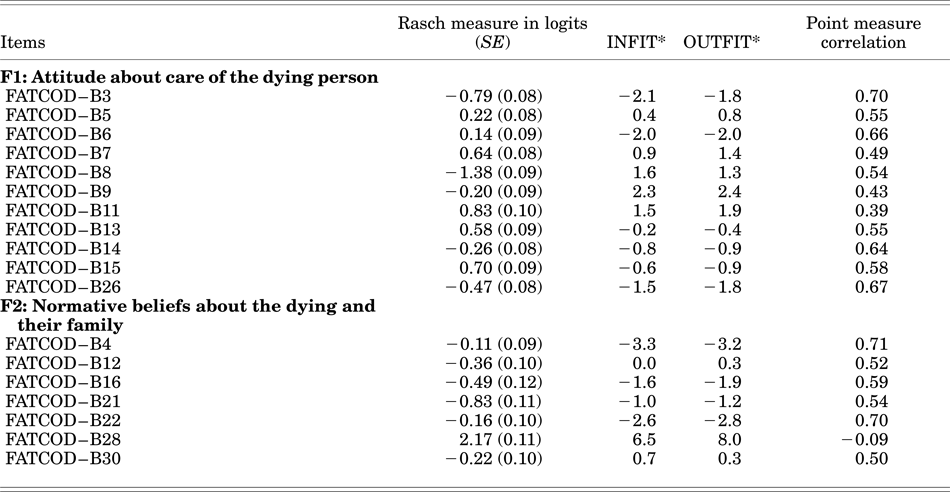
Table 3 provides the measurement properties of the two scales. All 11 items on the first scale (“attitude toward the care of the dying person”) reported fit statistics within the acceptable range of 1.4–0.6. Three (FATCOD–B8, FATCOD–B13, FATCOD–B14) of the 11 items had disordered thresholds.
Attitude Toward Care of the Dying Person Subscale: Item statistics

SE = standard error.
* Values in the range 0.7–1.3 indicate a good fit.
One item (FATCOD–B28) on the second scale (“normative beliefs about the dying person and family members”) showed a violation on both the INFIT and OUTFIT indices, while four items (FATCOD–B16, FATCOD–B21, FATCOD–B22, FATCOD–B28) revealed disordered thresholds.
DISCUSSION
In a previous study (Leombruni et al., Reference Leombruni, Loera and Miniotti2015a ), we showed that several items of the FATCOD–B had poor validity, as they contained ambiguities in wording and lexical noise and seemed quite confounding with respect to the subject to which they related, leading us to consider the scale construct as quite weak. In the present study, we tried to make small changes to the way in which they were phrased in order to overcome the aforementioned issues, without deleting any items (so as to maintain content coverage) or adding new ones (so as to avoid changes to the constructs that the original scale intended to measure). Overall, the results of our study showed that our minimal refinements of item wording did not improve item functionality or model clarity, as such parameters remained similar to those we had observed in our previous study (Leombruni et al., Reference Leombruni, Loera and Miniotti2015a ) using the original version of the scale. However, the differences that emerged with respect to the two distinct dimensions of the scale were interesting, especially with respect to their implications for medical education. Many items pertaining to the second dimension (“Normative beliefs about the dying person and family members”) continued to have low validity and failed to distinguish between individuals with different levels of disposition toward the object they considered as the target. The substantial equivalence between the original and the refined versions of the scale that we observed in the pilot study, together with the results that emerged in our previous study (Leombruni et al., Reference Leombruni, Loera and Miniotti2015a ), allow us to reasonably exclude the possibility that these findings might be solely due or even inflated by the wording revisions we made.
The items of the second dimension intend to explore beliefs about the norms of practice in palliative care and consider two different areas (i.e., beliefs about norms concerning the care of patients and beliefs about norms concerning the care of families). Several of these items are written in the third person and use the conditional tense. Our findings suggest that the system of beliefs referenced by the subset of items of the second dimension seems to be psychometrically inconsistent in a sample of undergraduate medical students. After all, asking an undergraduate student (without adequate clinical experience) to offer a personal evaluation of standards in end-of-life care may force him/her to respond in a random fashion. If so, the malfunction in the second dimension of the FATCOD–B we observed might not be attributable to the poor reliability of the scale itself, but rather to its use, as it is, with undergraduate students. Future studies should investigate the functionality of this dimension in different samples of health professionals and/or students.
As regards the first dimension (“Attitude toward the care of the dying person”), in contrast, in line with previous research (Nakai et al., Reference Nakai, Miyashita and Sasahara2006; Henoch et al., Reference Henoch, Browall and Melin-Johansson2014; Leombruni et al., Reference Leombruni, Loera and Miniotti2015a ), this was represented by roughly the same pool of items, at most with a few minor exceptions. Different from those belonging to the second dimension, the items in this dimension demonstrated adequate measurement and discriminant capability in distinguishing between individuals with different levels of disposition toward the object they considered as the target. These items explore emotional responses and behavioral reactions related to caring for the dying by presenting emotionally distressing situations and the basic emotional states associated with them. Many of these items are worded in the first person, and this makes it easier for respondents to express an evaluation in terms of comfort/discomfort. Our findings suggest that this dimension is stable and valid, as its subset of items was meaningful and perfectly scalable, even if the Rasch model estimation suggested the possibility of removing several items at the same level of difficulty. Three items of this dimension showed disordered thresholds—that is, respondents did not use the expected modes in answering them via the response scale. This means that the response scale was not uniformly utilized for all items and that this dimension did not hold a stricter specification, such as that imposed by the rating scale model.
The tripartite model of attitude may facilitate interpretation of these results as a whole. This theory defines an attitude as a complex response of an individual to a stimulus that has three components: affect, behavior, and cognition (Rosenberg et al., Reference Rosenberg, Hovland and McGuire1960). These three components have been found to be empirically distinct, as each resides in a different subsystem and has a different developmental root (Breckler, Reference Breckler1984). However, less independence between components could be expected when the responses are assessed through a unique response system, as in the case we studied, where the exclusive use of paper-and-pencil measures (i.e., verbal reports in the absence of the physical attitude object) put the responses under the control of the verbal knowledge system. In an attitude domain such as the one examined by the FATCOD–B, the subject can only respond to a cognitive representation of the stimulus. Even when the focus is the affective component, the subject is forced to respond on the basis of how he/she imagines he/she would feel. Therefore, as long as students are required to respond about how they might feel, they will answer with a certain degree of accuracy. When they are required to respond about beliefs that cannot be based on experience but on representation and imagination processes alone, they no longer seem to be able to respond adequately.
With regard to the implications for medical education, our findings demonstrate that only the first dimension of the scale can be recommended for administration to students, especially those in the preclinical stage of their education. In hindsight, our attempt to make suitable for use with students a scale built for use with professionals by making minor changes (i.e., slight modifications) in item wording proved to be unsuccessful. Understandably, it is unlikely to successfully detect beliefs about palliative care in students who have not yet had any experience in caring for the terminally ill. Nevertheless, the subset of items pertaining to the first dimension of the scale seems to represent a robust measure. Such a measure may be particularly suitable for identifying the population at risk and for helping medical educators ensure appropriately tailored support in order to optimize learning, development, and career choices.
However, the findings of our study do not allow us to draw firm conclusions about the dimensionality and validity of this scale, since the second dimension requires respondents to have a body of experience upon which to rely, something the students who took part in our study did not have. In our opinion, this represents the main a posteriori limitation of the study. Further research is needed to strengthen our results and to evaluate the functionality of the two dimensions of the FATCOD–B in samples of healthcare professionals and students with different curricula.
CONCLUSIONS
The findings of our study provide further knowledge concerning the psychometric properties of the FATCOD–B and its use in medical education. The growing number of patients who require palliative care means that there is an increasing need for healthcare professionals to be able to practice palliative care effectively and comfortably. Thus, the assessment of medical students' attitudes about the care of the dying as well as evaluation of the effectiveness of palliative care education in promoting such attitudes are pertinent. The findings presented herein suggest that the FATCOD–B includes two different dimensions and that only the first may be appropriately employed in medical education, as it has proved to be a robust measure in a sample of undergraduate medical students. Now that the robust qualities of this measure have been demonstrated, the possibility of transforming the original scale to a shorter version to be used in medical education will be addressed in subsequent studies.
SUPPLEMENTARY MATERIALS
To view the supplementary materials for this article, please visit https://doi.org/10.1017/S147895151700030X.