Interest in the scientific study of school violence started in the 1980s with the pioneering work of psychologist Dan Olweus in Norway. Increases in the frequency and seriousness of violent behavior in European and American schools (Olweus, Reference Olweus2001; Skiba, Reference Skiba2000; Smith, Reference Smith2003) provide justification for the concern of educators and researchers and their efforts to more deeply understand this complex and important social problem. The final goal of these studies has been to contribute to a detailed understanding of the problem and of the key players (attackers and victims) in order to help the planning of effective psychoeducational programs both for prevention and intervention of these maladjusted behaviors.
It is important to start by identifying the specific type of behavior to be analyzed in the present study, namely school violence. The term school violence has been used in numerous studies to refer to various types of behavior: aggression toward peers, aggression towards school staff, property damage, vandalism on campus, and bullying (Astor, Pitner, Benbenishty, & Meyer, Reference Astor, Pitner, Benbenishty, Meyer, Rapp-Paglicci, Roberts and Wodarski2002; Herrero, Estévez, & Musitu, Reference Herrero, Estévez and Musitu2006). Among all acts involving school violence, the current study focused on violence against peers, that is, on violence that entails the submission and victimization of one person by another one or group of people (i.e. other students).
Whereas most previous studies on peer violence have focused almost exclusively on aggression of a physical nature (sometimes including verbal aggression), the present work also examined relational violence. Relational violence has been defined as those actions aimed at causing damage within an individual’s circle of friends, and those damaging an individual’s perception of belonging to a group; this involves behaviors such as social exclusion and spreading of false rumors about the victim (Little, Henrich, Jones, & Hawley, Reference Little, Brauner, Jones, Nock and Hawley2003). Recent studies have shown that this more covert, subtle and indirect form of violence may be as harmful to emotional adjustment of children and adolescents as more overt and direct forms of violence (Moreno, Estévez, Murgui, & Musitu, Reference Moreno, Estévez, Murgui and Musitu2009; Underwood, Reference Underwood2003). Given the importance of relational violence and the paucity of papers analyzing this variable in adolescence, the present study included a measure of violent behavior which provided information not only about physical and verbal victimization, but also about violence that is relational in nature.
Antecedents of violent behavior
The primary social contexts for adolescent’s socialization play an essential role in behavioral adjustment in adolescence. Thus, exposure to family, school, and community violence has been linked to negative psychosocial adjustment and to the development of violent behaviors (Estévez, Musitu, & Herrero, Reference Estévez, Musitu and Herrero2005; Murray & Murray, Reference Murray and Murray2004). For example, it has been observed that the quality of adolescent-parent and adolescent-teacher interactions influences and may determine the way adolescents perceive themselves in relation to others, their attitudes, and their behaviors (Jessor, Reference Jessor1991; Lila, Buelga, & Musitu, Reference Lila, Buelga and Musitu2006). Prior studies have shown that a negative family environment, characterized by high levels of family conflict (Cummings, Goeke-Morey, & Papp, Reference Cummings, Goeke-Morey and Papp2003), poor or negative communication with parents (Dekovic, Wissink, & Mejier, Reference Dekovic, Wissink and Meijer2004; Stevens, De Bourdeaudhuij, & van Oost, Reference Stevens, De Bourdeaudhuij and van Oost2002), and lack of perceived parental support (Sheeber, Hops, Alpert, Davis, & Andrews, Reference Sheeber, Hops, Alpert, Davis and Andrews1997), have a substantial and negative effect on the development of particular social skills in children, such as the capacity to identify non-aggressive solutions to interpersonal problems (Demaray & Malecki, Reference Demaray and Malecki2002; Lambert & Cashwell, Reference Lambert and Cashwell2003).
Regarding the school context, being academically successful, perceiving peers in the classroom as friends or colleagues, and having positive interactions with teachers have been shown as important for the adolescent’s psychosocial adjustment (Blankemeyer, Flannery, & Vazsonyi, Reference Blankemeyer, Flannery and Vazsonyi2002; Reinke & Herman, Reference Reinke and Herman2002). Students sharing these characteristics are likely to perceive school as a useful learning context that will help them construct a successful future as workers and citizens. Therefore, such students will not normally exhibit behavioral problems and will express positive attitudes towards teachers and school (Jack et al., Reference Jack, Shores, Denny, Gunter, DeBriere and DePaepe1996; Molpeceres, Lucas, & Pons, Reference Molpeceres, Lucas and Pons2000; Samdal, Reference Samdal1998). Conversely, having a negative attitude towards school staff and institution, as well as a negative social reputation among peers, have been consistently associated with antisocial and violent behavior in educational centres (Buelga, Musitu, Murgui, & Pons, Reference Buelga, Musitu, Murgui and Pons2008; Emler & Reicher, Reference Emler and Reicher1995, Reference Emler, Reicher, Abrams, Hogg and Marques2005; Musitu, Estévez, & Emler, Reference Musitu, Estévez and Emler2007).
Consistent with these findings, previous studies have observed a close relationship between attitude to police and the law, compliance with or rejection of the mainstream social norms, and subsequent antisocial and violent behavior in adolescence (Estévez, Murgui, Moreno, & Musitu, Reference Estévez, Murgui, Moreno and Musitu2007; Estévez & Rachitskiy, Reference Estévez, Rachitskiy, Ramsay and Morrison2009; Tarry & Emler, Reference Tarry and Emler2007). A strong association between attitude to these authorities and victimization has also been reported, as suggested by Emler and Reicher (Reference Emler and Reicher1987, Reference Emler and Reicher1995, Reference Emler, Reicher, Abrams, Hogg and Marques2005) in their explanation of the processes by which victimization may lead to violent behavior.
The victimization-aggression link
It has been observed that all types of violence have subsequent negative effects on victims. In fact, the importance of examining adolescents who are victimized by their peers is justified by the numerous studies that have noted a close relationship between victimization and psychosocial adjustment problems in victims (Juvonen, Nishina, & Graham, Reference Juvonen, Nishina and Graham2000; Kupersmidt, Coie, & Dodge, Reference Kupersmidt, Coie, Dodge, Asher and Coie1990). Some studies found an association between being a victim of school violence and low self-esteem (Austin & Joseph, Reference Austin and Joseph1996; Cava, Musitu, & Murgui, Reference Cava, Musitu and Murgui2007; Guterman, Hahm, & Cameron, Reference Guterman, Hahm and Cameron2002). Other studies reveal that feelings of loneliness (Boivin, Hymel, & Bukowski, Reference Boivin, Hymel and Bukowski1995; Storch & Masia-Warner, Reference Storch and Masia-Warner2004), low satisfaction with life (Martin, Huebner, & Valois, Reference Martin, Huebner and Valois2008), depressive symptoms and perceived stress are common among victimized adolescents (Herrero et al., Reference Herrero, Estévez and Musitu2006; Hunter, Mora-Merchán, & Ortega, Reference Hunter, Mora-Merchán and Ortega2004; Sweeting, Young, West, & Der, Reference Sweeting, Young, West and Der2006; Kumpulainen, Räsänen, & Puur, Reference Kumpulainen, Räsänen and Puura2001). There are, therefore, numerous studies in the scientific literature showing a strong link between peer victimization and internalizing problems (see Hawker & Boulton, Reference Hawker and Boulton2000, for a meta-analysis), whilst only few works have considered victimization as a risk factor for the development of externalizing problems such as violence. In some longitudinal studies, it is concluded that physical and verbal victimization predicts aggressive and delinquent behavior (e.g., Hodges, Boivin, Vitaro, & Bukowski, Reference Hodges, Boivin, Vitaro and Bukowski1999; Paul & Cillesen, Reference Paul and Cillessen2003), and similar results have been observed in a recent cross-sectional research conducted by Sullivan, Farrel, and Kliewer (Reference Sullivan, Farrell and Kliewer2006), who included relational victimization among the studied variables. Nevertheless, none of these studies gives a plausible or hypothetical explanation of the association between adolescent victimization and violence at school.
Previous research using samples of adolescent offenders may offer an explanation that could be transferable to the school setting. Prior studies on the relationship between victimization, attitudes towards authority, and antisocial and criminal behavior served as the theoretical basis for our work. In this context, the studies carried out by Emler and Reicher over the past two decades have been particularly influential (1987, 1995, 2005, 2009). These authors argue broadly that when a teenager is a victim of harassment or abuse or perceives themselves at risk or threatened by others, they rely on the protection of adult figures and institutions of authority. However, adults do not always provide perfect protection, which can result in the subsequent disappointment of the adolescent with these agents, and their search for an informal alternative to protect themselves from peer victimization. A possible initial solution, following the theory proposed by Emler and Reicher, is that the individual seeks a reputation based on a social image that conveys a non-conformist, rebellious and antisocial personality. This reputation includes the implicit idea that the person is strong, brave and ready to pursue violent revenge if attacked again. Finally, the authors conclude that the most effective strategy to develop this type of reputation is precisely the involvement in violent behaviors that exemplify what the teenager wants to convey about themselves. Thus, from this perspective, violence can be understood as a means to achieve the desired antisocial reputation, based on the idea that offenders cannot be victimized.
As such, it is reasonable to argue that experiencing peer victimization without the expected adult protection in the family or school contexts, can lead to negative attitudes towards the authority figures and the desire for a non-conforming reputation which would be associated with higher non-compliance with the established social norms.
The current study
The current study was based on the theoretical explanation given by Emler and Reicher and argued extensively in Emler’s Reference Emler, Butera and Levine2009 work with adolescent delinquents, suggesting that peer victimization drives youth to act antisocially as a way to protect themselves when the authority figures fall short of that role. In the present research the focus fell on behavior at school. We considered these authors’ hypothesis to be an appropriate starting point for the study of the processes involved in the relationship between victimization and violence in secondary schools and, ultimately, in the educational setting. In particular, the purpose of the present study was to analyze associations between school victimization and the development of violent behavior against peers. Moreover, the study was aimed to determine the role played by other possible intermediate variables in the understanding of the victimization-violence link. These variables were related to perception of the main adult protection figures and institutions for the adolescent, and in particular, to the family, school, and social justice systems. More concretely, we analyzed participants’ perceptions of their parents and family environment (expressiveness-family communication, parent-child conflicts, and affective cohesion), their teachers and school institution (attitude towards school and teachers), and the police and legal institutions (attitude towards the police, laws and mainstream social norms). A measure of antisocial reputation among peers was also included in order to assess the degree of desirability of being perceived as a non-conformist, rebellious, violent person.
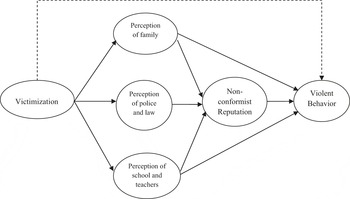
Figure 1 depicts the structural model proposed in the present study and based on Emler and Reicher’s findings. The following relationships were expected to be found: an indirect association between victimization and violence, explained by (a) the victim’s perception of adult authority figures and institutions represented in the family (parent), school (teachers) and general legal system (police and law), and (b) the relationship between attitude towards these authorities and the pursuit of an antisocial reputation.
Structural model proposed based on Emler and Reicher’s work.

Methods
Participants
A total of 1319 adolescents (47% male, 53% female), between 12 and 16 years of age (M age 13.7, SD = 1.6) participated in the study. At the time this study, all adolescents were enrolled in rural and urban state secondary schools located in the provinces of Valencia and Alicante in Spain. Comparative analyses did not show any statistically significant difference between rural and urban schools in the variables included in the present study.
Instruments
Peer Victimization Scale (based on the Social Experience Questionnaire Self-Report from Crick & Grotpeter, Reference Crick and Grotpeter1996; and the Multidimensional Peer-Victimization Scale from Mynard & Joseph, Reference Mynard and Joseph2000). This scale consisted of 20 items, each of which was rated on a four-point scale from 1 ( never) to 4 ( many times), and referred to direct and indirect victimization at school. The scale has a three-factor structure: Overt physical victimization (composed of 7 items, e.g. “Some classmates have hit me”); Overt verbal victimization (composed of 7 items, e.g. “Some classmates have insulted me”); and Relational victimization (composed of 6 items, e.g., “Some classmates have spread rumors about me so that nobody associates with me”). This instrument has been used in previous studies with adolescent population, showing an adequate reliability and significant correlations with other indicators of psychosocial adjustment, such as perceived stress, depressive symptomatology, and feeling of loneliness (Cava et al., Reference Cava, Musitu and Murgui2007; Cava, Musitu, Buelga, & Murgui, Reference Cava, Musitu, Buelga and Murgui2010; Estévez. Murgui, & Musitu, Reference Estévez, Murgui and Musitu2009; Jiménez, Musitu, Ramos, & Murgui, Reference Jiménez, Musitu, Ramos and Murgui2009). Cronbach’s alphas for the subscales in the current sample were .89 for overt physical victimization, .71 for overt verbal victimization, and .70 for relational victimization.
Relationship dimension of the Family Environment Scale (FES; Moos, Moos, & Trickett, 1989). This scale consisted of 27 true-false items comprised of three subscales: (a) Cohesion (9 items referring to the degree of commitment and support that members of the own family provide for one another, e.g., “Family members really help and support one another”); (b) Expressiveness (9 items regarding the extent to which members of the own family are encouraged to express their feelings directly, e.g., “Family members often keep their feelings to themselves,” reverse coded); (c) Conflict (9 items referring to the amount of openly expressed anger and conflict among family members, e.g., “We fight a lot in our family”). This scale has been widely used with adolescent population, showing an adequate internal consistency (Boyd, Gullone, Needleman, & Burt, Reference Boyd, Gullone, Needleman and Burt1997; Chipuer & Villegas, Reference Chipuer and Villegas2001). Alpha reliabilities for these subscales in this study were .85 for cohesion, .80 for expressiveness, and .86 for conflict. Regarding validity of the instrument, the cohesion and expressiveness subscales have shown positive correlations with measures of self-esteem, self-concept, empathic ability, and satisfaction with life (Escriva, García, & Pérez-Delgado, Reference Escriva, García and Pérez-Delgado2001; Estévez, Murgui, Musitu, & Moreno, Reference Estévez, Murgui, Musitu and Moreno2008a, 2008b), and the conflict subscale has been related with measures of depression, anxiety, loneliness, and violent behavior in adolescence (Cava et al., Reference Cava, Musitu, Buelga and Murgui2010; Peleg-Popko, & Klingman, Reference Peleg-Popko and Klingman2002).
Attitude to Institutional Authority Scale (Reicher & Emler, Reference Reicher and Emler1985). This scale consisted of 20 items, each of which was rated on a four-point scale from 1( I totally disagree) to 4 ( I totally agree), and referred to attitudes towards figures and institutions representing formal authority. This scale has a two-factor structure: Attitude towards teachers and school (composed of 10 items, e.g. “School rules are there to help the pupils”, “A lot of teachers like bossing pupils around just to show they are in charge”); and Attitude towards the police and the law (composed of 10 items, e.g. “Most policemen are honest;” “The law is loaded against people like me”). The scale has shown adequate psychometric properties in previous studies (Emler, Reference Emler, Jackson and Rodriguez Tome1994; Emler & Reicher, Reference Emler and Reicher1995, Reference Emler, Reicher, Abrams, Hogg and Marques2005; Tarry & Emler, Reference Tarry and Emler2007). Cronbach’s alphas for these subscales in the current sample were .76 and .65, respectively. As regards validity of the instrument, a positive attitude to institutional authority significantly correlates with measures of social integration at school, academic achievement, and self-esteem (Musitu et al., Reference Musitu, Estévez and Emler2007). A negative attitude to authority has been significantly related to involvement in violent and delinquent behaviors in the school context (Estévez & Emler, Reference Estévez, Emler and Larson2009).
Social Reputation Scale (Carroll, Hattie, Durkin, & Houghton, Reference Carroll, Hattie, Durkin and Houghton1999). This instrument consisted of seven items rated on a four-point scale from 1(never) to 4 (always) that assess the extent to which the respondent wants to convey a social image to peers as an antisocial and non-conformist person. All items begin with the phrase “I would like my classmates to believe that I…” (e.g., “get into trouble with the police,” “am a bully,” “do things against the law,” “am rebellious”). This scale has been widely used in numerous studies with samples of adolescents, showing an adequate reliability (Carroll, Reference Carroll2002; Carroll, Hattie, Durkin, & Houghton , 2001; Moreno et al., Reference Moreno, Estévez, Murgui and Musitu2009). Cronbach’s alpha obtained for the total score in this sample was .78. With respect to validity, significant positive correlations have been observed with violent and delinquent behavior and drugs consumption (Buelga, Musitu, & Murgui, Reference Buelga, Musitu and Murgui2009; Carroll, Green, Houghton, & Wood, Reference Carroll, Green, Houghton and Wood2003; Houghton, Odgers, & Carroll, Reference Houghton, Odgers and Carroll1998), and negative correlations with indexes of self-esteem and life satisfaction (Buelga et al., Reference Buelga, Musitu, Murgui and Pons2008; Moreno et al., Reference Moreno, Estévez, Murgui and Musitu2009).
School Aggression Scale (Little et al., Reference Little, Brauner, Jones, Nock and Hawley2003). This instrument assessed the frequency with which participants had engaged in 24 deviant and aggressive behaviors at school over the last 12 months, on a five-point scale where 0 means (I don’t want to share this information), 1 ( never), and 4 ( many times). Approximately 7% of respondents chose the “0” response for some items; these were removed from the analysis. The scale has a three factor structure: Overt Aggression (composed of 10 items, e.g., “I’m the type of person who hits, kicks, or punches others”); Relational Aggression (composed of 7 items, e.g., “If others have hurt me, I often try to keep them from being in my group of friends”); and Instrumental Aggression (composed of 7 items, e.g., “I often start fights to get what I want”). This instrument has been widely used in adolescent population, presenting excellent psychometric properties (Buelga et al., Reference Buelga, Musitu, Murgui and Pons2008; Little, Brauner, Jones, Nock, & Hawley, Reference Little, Brauner, Jones, Nock and Hawley2003). Cronbach’s alphas for these subscales in the current sample were .82 for overt aggression, .73 for relational aggression, and .78 for instrumental aggression. As regards validity, the three dimensions have shown significant correlations with measures of negative attitudes towards institutional authority, transgression of social norms, antisocial reputation, perceived stress, and dissatisfaction with life (Buelga et al., Reference Buelga, Musitu and Murgui2009; Estévez et al., Reference Estévez, Murgui, Musitu and Moreno2008a; Jiménez, Moreno, Murgui, & Musitu, Reference Jiménez, Moreno, Murgui and Musitu2008).
Procedure
Data for this research were collected as part of a larger study on adjustment problems in adolescence. After initial contacts were made with a large number of public schools, seven schools were selected as study sites. The selection was based primarily on the availability and willingness of school staff to collaborate in the investigation. Following initial contact with the principals, the entire teaching staff was informed of the study’s objectives via a 2-hour presentation. A letter describing the study was then sent to the parents requesting that they indicate in writing if they did not want their child to participate in the study (only 1% of parents did so). Both the teachers and parents expressed a desire to be informed of the main results of the study in a meeting with the research team; and this occurred after data analyses were completed. Participants anonymously and voluntarily filled out the scales during a regular class period at the end of the academic year. All measures in English were translated to Spanish using bidirectional translation.
Results
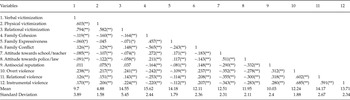
Pearson correlations were calculated between all study variables, as a preliminary analysis of associations among dimensions of the selected instruments. These dimensions were considered as the observable variables for the latent factors included in the proposed structural model. Table 1 shows bivariate correlations with Bonferroni’s corrections, as well as means and standard deviations for all variables. As significant correlations in the expected direction were observed, all variables were retained in subsequent analysis.
Bivariate correlations with Bonferroni’s correction, statistical significance, means and standard deviations of the variables of the study

Note:
*p < .05; **p< .01.
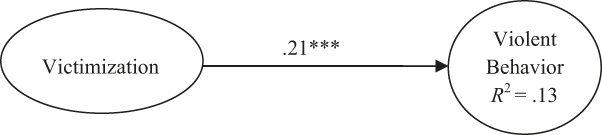
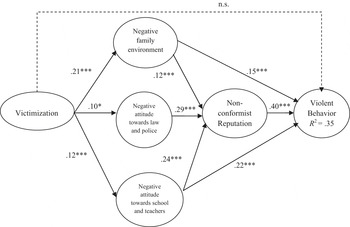
Using the Structural Equations statistical program (EQS), version 6.0 (Bentler, Reference Bentler1995), a structural equation model was calculated to deepen our comprehension of the interactions between the variables of interest, and to achieve a greater understanding of the processes involved in the development of hostile and aggressive behavior in victims of school violence. First, we calculated a structural model of the direct association between peer victimization and violent behavior at school. Figure 2 represents the model of direct effects which revealed a significant positive influence of victimization on violence, β = .21, p < .001. Next, a second model was estimated in order to analyze the association between victimization and violent behavior at school, while considering the perceived quality of family environment, attitude toward the school and teachers, attitude toward the police and laws, and non-conformist reputation among peers as influential intermediate variables. Figure 3 represents this structural model with the relationship coefficients and their statistical significance.
Model of direct effects of victimization on violent behavior ***p < .001.

Final structural model including the relationship coefficients and their statistical significance values. *p < .05; **p < .01; ***p < .001; n.s.= non significant.

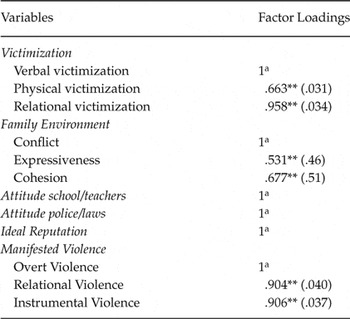
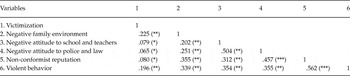
As presented earlier, the proposed structural model consisted of six factors, each of which was derived from several observable indicators or variables. The indicators correspond to the dimensions of the instruments used for data collection and described in the methods section. Latent factors included in the model were: (a) Victimization, composed of three indicators: physical victimization, verbal victimization and relational victimization, (b) Violent Behavior, composed of three indicators: overt violence, relational violence and instrumental violence; (c) Family Environment, composed of three indicators: conflict, expressiveness and cohesion, (d) Attitude toward school / teachers, consisting of a single indicator, (e) Attitude toward the police / law, consisting of a single indicator, and (6) Non-conformist Reputation, consisting of a single indicator. These last three factors, which consist of a single observable variable, were set to have a saturation factor of 1 and an error equal to 0. Table 2 shows the factor loading of each variable on their corresponding latent factor. Factors relating to the perception of family, school and the legal system were calculated so that higher scores indicate negative perceptions by the adolescent. Table 3 gives correlations among the six latent factors.
Factor Loadings, Standard Errors and Associated Probability.

Note:
a Fixed at 1.00 during the estimation. Significance: **p < .01.
Bivariate correlations among latent factors included in the structural model

Note:
*p < .05; **p < .01; ***p < .001.
To determine the goodness of fit of the model and the statistical significance of the coefficients and because of the deviation from normality of the data (normalized Mardia coefficient: 6.38), robust estimators and several indexes were used. For the chi-square likelihood-ratio statistics, a non-significant value indicates that the model is well adjusted to the data. However, since this fit index is very sensitive to the sample size, other fit indexes must be considered when testing goodness of fit. Comparative Fit Index (CFI), Incremental Fit Index (IFI), Non-Normed Fit Index (NNFI), and Root Mean Square Error of Approximation (RMSEA) are widely used. For the CFI, IFI and NNFI indexes, values above 0.90 are considered acceptable (Marsh & Hau, Reference Marsh and Hau1996; Medsker, Williams, & Holahan, Reference Medsker, Williams and Holahan1994), although other authors argue that only more stringent values -above 0.95- are indicative of a good fit (Batista & Coenders, Reference Batista and Coenders2000). For the RMSEA index, although values below .08 are accepted in some manuals, there is consensus that a ratio below .05 indicates good model fit (Browne & Cudeck, Reference Browne and Cudeck1992). The structural model calculated fitted the data well, as suggested by the following indexes: χ2(55, N = 1319) = 164.18 (p < .01), CFI = .97, IFI = .97, NNFI = .96, and RMSEA = .47. In all cases, rates obtained in the present study were indicative of a good fit of the structural model depicted in Figure 2. This figure shows the standardized coefficients of relation and their associated probability.
This model explained 35% of the variance of the final variable, Violent Behavior. The results of the model showed an indirect relationship between victimization and violent behavior. The direct association between these two variables was not significant when the other latent factors were introduced into the equation.
Regarding interactions between variables that explain the indirect relationship between victimization and violence, we observed a significant and positive relationship between the experience of being victimized and each of the following: the adolescent’s perception of a negative family environment, β = .21, p < .001, their negative attitude toward the police and the law, β = .10, p < .05, and their negative attitude towards the school and teachers, β = .12, p < .001. In turn, these last three factors showed a direct and positive relationship with the adolescent’s non-conformist reputation among peers, β = .12, p < .001; β = .29, p < .001, and β = .24, p < .001, respectively. That is to say, the results indicated that the negative perception of authority figures and institutions such as family, school and police, was positively associated with the adolescent’s intention to set up and maintain an antisocial and non-conformist reputation among peers.
Finally, there was a strong positive relationship between non-conformist reputation and violent behavior at school, β = .40, p < .001. Furthermore, the model also showed the existence of significant direct relationships between the perception of a negative family environment, on the one hand, and negative attitudes toward school and teachers, on the other hand, with violent behavior, β = .15, p < .001, and β = .22, p < .001, respectively.
To further check the robustness of this model we tested it using structural invariance across gender and age groups (early adolescence: 12-14; middle adolescence: 15-16) through multigroup analyses (Bentler & Wu, Reference Bentler and Wu2002). Two models were tested in each case. In the unrestricted model, parameter estimates (factor loadings and structural paths) were freely estimated across groups; in the restricted model, we constrained each of the factor loadings as well as the structural paths to be invariant across groups. If the χ2 of the restricted model was significantly larger than the χ2 of the unrestricted model, the assumption of invariance would not be tenable. Results indicated non-significant differences between these models for boys and girls: χ2(20, N = 1319) = 31.48, ns; and for age groups: χ2(12, N = 1319) = 19.99, ns; this result supported, therefore, invariance of the general model across gender and age groups.
Discussion
The present study aimed to analyze the role played by particular variables associated with adolescent psychosocial adjustment in explaining the process that may trigger a victim of school violence to respond aggressively toward peers. Following the theory proposed by Emler (Reference Emler, Butera and Levine2009), we expected to find an indirect relationship between victimization and violence, once certain intermediate variables related to the adolescent’s perception of authority figures and institutions (such as the family, school and police) were included in the model. Our results with a sample of Spanish students in relation to peer victimization and violence among peers were consistent with the conclusions drawn by Emler and Reicher from their studies with young offenders in the UK.
In particular, our results stressed the importance of the victims’ evaluation of their immediate social contexts and their principal authority figures and institutions, such as family, school and the legal system; these are the authority agents required to perform a protective role and to propose solutions to the situation of victimization. The observed relationships in the model suggest that when the victim does not rely on receiving support and comfort from parents, teachers and other authority figures as police, they are more likely to opt for self-protection through the configuration of an antisocial and non-conformist reputation. This self-representation eventually results in violent behaviors that reinforce such social image.
Recent studies provide data that are consistent with this idea. Leadbeater, Boone, Sangster, and Mathieson (Reference Leadbeater, Boone, Sangster and Mathieson2006) found that although most of victims in their sample presented higher levels of social rejection compared with average and aggressive adolescent groups, only the more submissive victims showed statistically significant differences in popularity compared to victims who were also aggressive, that is, violent victims were as popular as aggressors or non-involved adolescents. This fact suggests that victims who decide to behave aggressively have a clearly defined reputational project among their peers, that is to say, they search for a particular social image at school, which is reflected in their degree of popularity. In addition, Estévez, Martínez, and Musitu (Reference Estévez, Martínez and Musitu2006) found that victims who are also violent reported higher levels of social self-esteem and fewer feelings of loneliness than withdrawn victims. These results indicate that some victims feel more supported by their social network of friends, a network that probably contributes to maintaining the individual’s reputation and the adolescent’s behavioral style at school.
Previous research has highlighted the close association between the fact of having been victimized and criminal behavior (Shafer & Ruback, Reference Shaffer and Ruback2002; Wiebush, Freitag, & Baird, Reference Wiebush, Freitag and Baird2001). However, these studies have been conducted exclusively in a delinquent population and in very specific contexts, mainly in the United Kingdom and the United States. Research in other European countries is in its infancy, especially if we consider the school-aged population that jointly presents both victimization and aggression problems, and therefore, are at high risk of psychosocial maladjustment. We feel that it is imperative that future research continues to examine the particular situation of some victims of school violence, both in their individual characteristics and in the particularities of the immediate social contexts for the teenager, since the victim’s perception of adult authority and protection figures is a key determinant of this phenomenon, as our results have indicated.
Parents and teachers seem to be the most influential adult figures in this sense. In fact, our findings revealed that when peer victimization negatively affects adolescent’s attitudes towards family and school, those negative perceptions and attitudes may directly affect the student’s behavior. Taking into consideration Emler’s (Reference Emler, Butera and Levine2009) argument followed in the present work, children and adolescents obey the socially established norms and rules because they rely on adults –parents, teachers…–, but in exchange for this obedience and trust, they expect that the those adults will advocate for their respectful treatment and will respond with the support and protection required in such situations, since they represent agents of authority and power. Suggestions for future school intervention programs would also include to help young people in situations of victimization to feel supported instead of frustrated, helpless and unprotected. Along this line, a positive family environment based on empathy and emotional communication between parents and children has been identified in the scientific literature as a major protective factor against the development of aggressive behavior in adolescence (Estévez et al., 2008; Stevens et al., Reference Stevens, De Bourdeaudhuij and van Oost2002). Similarly, the perception of a positive school climate in which the adolescent values the relationship with peers and teachers from whom he receives care and support, has been linked with the presence of less aggression problems at school (Blankemeyer et al., Reference Blankemeyer, Flannery and Vazsonyi2002; Jiménez et al., Reference Jiménez, Moreno, Murgui and Musitu2008). Therefore, research along these lines continues to be fundamental in order to give more appropriate responses for the victims and perpetrators, and ultimately help prevent victimization in schools.
Finally, the authors acknowledge several limitations of the present study. First, all data collection instruments used in this work were self-report measures. These self-report measures may be more susceptible to response biases that could undermine the validity and generalizability of the data. They also have, however, many advantages: they allow for the gathering of significant information in a short amount of time and facilitate the interpretation of results without inferences. Although it would have been advisable to gather information from other informants (e.g., teachers) to contrast the data self-reported by adolescents, the main objective of this study was to examine the subject’s perception of their social status in the school context and of the authority figures and institutions. In addition, some comparative studies of deviant behavior measures using different informants (e.g., teenagers and parents) have demonstrated validity of self-report instruments, regardless of the source of information (Flisher, Evans, Muller, & Lombard, Reference Flisher, Evans, Muller and Lombard2004; Kamphaus & Frick, Reference Kamphaus and Frick2005; Ritakallio, Kaltiala- Heino, Kivivuori, & Rimpelä, 2005). Kamphaus & Frick (Reference Kamphaus and Frick2005) suggest that adolescents are much more accurate in their reports of many acts, as parents may not be aware of the frequency or extent of their child’s deviant behavior.
In a recent study carried out by Barry, Frick, and Grafeman (Reference Barry, Frick and Grafeman2008) using a sample of adolescents with problem behavior, the authors highlight that parent’s reports of police contacts, which were used as a comparative measure with self-reports, did not provide the breadth of information included in their child’s reports. Other recent studies point out that both self-reports and official reports are essential to a more complete understanding of which adolescents are in greatest danger of the most serious forms of violence (USDHHS, 2001; Snyder & Sickmund, Reference Snyder and Sickmund1999). To sum up, authors of the present study, taking into consideration the studies mentioned, believe that the use of self-report measures may be a limitation, but that it is also a great opportunity for data collection and interpretation of findings.
A second limitation of this study is that not all values obtained for the reliability measure Cronbach’s alpha in the scales and subscales used, are as high as recommended. Most statistical manuals, books and journal articles indicate that a value of .7 or .8 is acceptable for Cronbach’s alpha; values substantially lower indicate an unreliable scale or subscale (Field, Reference Field2005; Kline, Reference Kline1999). One of the subscale used in the current study obtained a value lower than .7 (attitude towards the police and the law, α= .65).
Finally, this study is based on a cross-sectional design, which forces us to be cautious about the causal inferences drawn from the results. Due to the correlational nature of the statistical analysis, including the estimated structural equation model, we cannot establish direct causal relationships between the variables presented. With the data available it is also plausible that variables relate in the opposite direction, so that violent behavior could lead to a non-conformist reputation and a negative family environment. In order to clarify and sustain with more reliability the direction of these associations, it would be necessary to conduct a more complete study that comprises measures across time. Thus, future research should incorporate a longitudinal design in order to achieve a more comprehensive understanding of the processes involved in the development of violent behavior in victimized adolescents. Definitively, with the data obtained in the present study, we must consider the possibility of bidirectional links between the constructs analyzed.
In fact, although there are no previous studies in the school context regarding the relations discussed herein, research on samples of delinquent adolescents suggests the existence of bidirectional links between victimization and deviant behavior. For example, adolescents involved in antisocial acts have been found to be three times more likely to be victims (Deadman & MackDonald, Reference Deadman and MacDonald2004; Lauritsen, Sampson, & Laub, Reference Lauritsen, Sampson and Laub1991). This result follows with the assumptions of the Lifestyle Exposure Theory (Hinderlang, Gottfredson, & Galofalo, Reference Hinderlang, Gottfredson and Garofalo1978) and the Routine Activities Theory (Cohen & Felson, Reference Cohen and Felson1979). According to these criminological theories, being a victim of crime is usually linked to exposure or proximity to offender populations on the one hand, and offenders are also more likely to become victims of crime because their lifestyles frequently bring them to interact with other offenders, on the other hand (Sampson & Lauritsen, Reference Sampson and Lauritsen1990). From our point of view, it would be highly recommended for future research in schools to consider these arguments derived from juvenile delinquent studies.