


1. The Question
In April 2017, the United States dropped the world's most powerful non-nuclear bomb near Tangi Assadkhel in Afghanistan (Schmitt, Cooper, and Chivers Reference Schmitt, Cooper and Chivers2017). The bomb has a 1,000-mile radius, making it very likely to harm civilians. President Donald Trump ordered the drop. It caused harm to civilians. Who did the harm?
A tempting answer is ‘the president’. Yet the order was encouraged, enabled, and enacted by other members of the executive and military. And the president's power to give orders is granted by the US constitution, which chartered, and gave jurisdiction to, the US state itself (Ciepley Reference Ciepley2017). Indeed, there is a natural sense in which the executive's actions are the state's actions: we naturally say ‘Australia waged war in Iraq’, ‘India signed the Paris climate treaty’, or ‘the United States bombed Afghanistan’. This extends to the legislature and judiciary: we might say ‘the United Kingdom passed a law permitting exit from the European Union’, or ‘in 1988, Canada removed abortion from the Criminal Code’. This treatment of the state as an actor—and as the actor of executive, legislative, and judicial actions of international concern—is reflected by the International Court of Justice, which treats states as (potentially criminal) agents. Research in social ontology and international relations theory also supports the idea of states as agents (List and Pettit Reference List and Pettit2011; Gilbert Reference Gilbert2006; Wendt Reference Wendt2004; Erskine Reference Erskine2001; Erskine Reference Erskine2003).
Suppose, then, that the United States is the agent that did harm. Who is included in that agent? Specifically, are ordinary citizens included? Is it literally true that ‘we the (American) people’ did harm? We approach this by asking the following question: When we consider a liberal democratic state as a collective agent, is that agent the polity?
Why is this question worth asking? Others have argued that polity members are implicated in their state's harms—and can justly suffer reparative costs—because they authorize the state (Parrish Reference Parrish2009; Stilz Reference Stilz2011), intend to participate in the state's acts (Pasternak Reference Pasternak2011; Beerbohm Reference Beerbohm2012), intend the state's acts as a plural subject (Gilbert Reference Gilbert2006), or act jointly to uphold the state (Stilz Reference Stilz2009: ch. 7).
If we are interested in justifying individuals’ reparative burdens, then why not use one of these arguments? Because being the agent that performed a harmful action is a stronger basis for reparative responsibilities than merely authorizing, intending, allowing, facilitating, or upholding the harms of another agent. Being the agent of a harm—or, as we say, authoring it—is different from bearing a forward-looking responsibility to repair that harm (Young Reference Young2012). We are interested not just in the moral question of whether polity members should take responsibility for repairing the harms their states do; we are interested in the ontological question of whether polity members are part of the very agent that did the harm. Authoring a harm is necessary for being culpable for that harm (rather than just for permitting, or facilitating, it).
That said, to establish culpability, we need authorship plus an absence of excusing factors. It is possible that the polity is the state, and therefore each polity member partially authors the state's acts, while each member is excused for her partial authorship. Authorship without culpability is familiar from moral philosophy: consider the title character in the novel Sophie's Choice, who authors the act of giving one of her children to a Nazi guard while being excused for this authorship (because the choice was forced upon her) and therefore is not culpable. Likewise, our concern is whether the polity authors the state's actions, implying each polity member partially authors those actions; this is consistent with many polity members’ being excused. But authorship is of crucial moral importance: authorship is necessary for culpability; authorship without excuse is sufficient for culpability. If polity members are partial authors of their states’ acts, that would be a big step toward their being culpable for their states’ acts. This differs from merely being liable for reparative burdens.
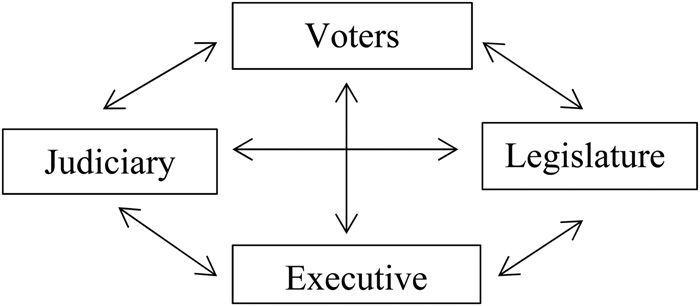
By polity members we mean something technical. A structure is a collection of nodes (roles) that stand in relations (which can be either symmetric or asymmetric). We take ‘the polity’ to be a realized structure, following Katherine Ritchie's (Reference Ritchie2013) argument that groups are realizations of structures. A structure is realized when its nodes are occupied. The nodes of the polity are occupied by all (and only) those who are (1) eligible to (register to) vote (at not disproportionate cost) and (2) enjoy other basic civil and political liberties. The nodes of the structure include judiciary, legislature, executive, and—crucially—voters (where voters meet the minimal enfranchisement-plus-liberties condition and where occupants of other nodes have roles layered atop this minimal one). Individuals can occupy more than one node (hold more than one role), and multiple individuals can occupy one node (as in the voter node) (Ritchie Reference Ritchie2013). Unlike Ritchie, however, we assume that realized structures (groups) can survive some changes to the relations (as when the cabinet is reshuffled) and the nodes (as when a government department is shut down or when an occupant quits abruptly and the role is temporarily unfilled).
The polity is represented in figure 1. This kind of structure becomes realized when enough—as specified by the constitution—people occupy each node. In many states, the polity excludes some people who the law considers citizens (such as prisoners, children, expatriates) and includes some people who the law considers noncitizens (such as long-term residents).
Figure 1 uses a coarse-grained level of description. We could have added subcategories, such as the civil service (in the executive), the military (in the executive), and the government (often straddling other nodes). In states with large public sectors, there are questions about where to include teachers, doctors, and so on. We could also describe a realized structure that is as fine-grained as an organizational chart, describing all the roles, responsibilities, and reporting relationships in a single branch of the state, such as the army. Indeed, a node at one level of description may be a whole structure at another level of description. We remain at this coarse level to maximize the generality of our argument. Any terminology is likely to be contentious; we believe our use of polity does not stray too far from ordinary usage. We assume the state is a realized structure. Our question is this: Is that structure the whole polity, or is it some substructure of the polity? (It would be the latter if it were only the judiciary, legislature, and executive nodes and their relations, for example.)
The polity.

Perhaps it would be more convincing that the polity is the state if we had characterized the polity differently. For example, we could have characterized the polity so as to include only those who actually vote (excluding those merely eligible), or we could have added those who cannot vote but who engage in advocacy groups, or we could have excluded those who feel politically alienated yet vote to make the best of a bad situation, or we could have required polity members to have the goal of governing their lives together.Footnote 1
We characterize the polity as we do for three reasons. First, roughly this group is targeted by contemporary democratic theory and the venerable social contract tradition in political philosophy. Social contract theory has largely been concerned with the question of whether the state reflects the will of the people, and whether the people have an obligation to submit to the state's authority. The polity is the best candidate for the people at issue in these questions. Second, we believe a sustained argument can be given that our version of the polity is the state (we explain our manner of assessing that argument below). Third, our inclusively defined polity renders the question more provocative, and therefore more interesting, than narrower definitions would. Moreover, one aim of this article is to ignite a new debate—one about who is included in the state's agency. To light the spark, we consider just one possible stance within that debate: the stance that all polity members (as defined above) are included. We welcome contributions arguing that a different version of the polity is the state.
To clarify, our question is not whether the state is the aggregate of all currently existing node-occupiers. Instead, our question is whether the state (at a time) is identical with the collection of occupied nodes (at that time), plus the relations between the nodes, where the relations are specified by the structure. If it is, we have an explanation of how the state is both ‘one’ and ‘many,’ resolving a long-standing challenge for the metaphysics of groups (Ritchie Reference Ritchie2013). It is ‘one’ because it is a realized structure—a single thing. It is ‘many’ because it is the plurality of individuals who occupy its roles. This is how the node-occupiers at a time can be the state. The usual questions about persistence over time arise, but these are the same questions as for individual persons, or ordinary objects like tables (see Parfit Reference Parfit1984: 351–79; Wasserman Reference Wasserman2016). On the two most prominent theories of persistence, endurantism and perdurantism, change over time is possible (Wasserman Reference Wasserman2016; Lewis Reference Lewis1986). Similarly, who the node-occupiers are can change over time, compatible with the group remaining the same.
The polity is a structure made up of the four nodes and the relations between them. For example, the voters node relates to the legislature node by the elects relation in one direction, and the is accountable to relation in the other direction. So the polity, understood as a realized structure, is ‘over and above,’ and yet partly composed of, the aggregate of individuals that happen to realize the structure's nodes at a time. There is something over and above the aggregate because (1) the relations among those node-occupiers are also part of the polity and (2) the polity is robust across changes in its realizers (node-occupiers). The polity is thus a holistic entity with causal-explanatory reality (List and Spiekermann Reference List and Spiekermann2013; Kincaid Reference Kincaid1986). We assume the polity is a realized structure. But we do not assume the polity is an agent. Our question is whether that realized structure is identical with something that we do assume is an agent, namely, the state.
We assume the state is an agent in virtue of possessing its own rational decision-making procedure (French Reference French1984; List and Pettit Reference List and Pettit2011), which it uses to generate its distinctive rational point of view—its own bundle of beliefs and desires, from which it acts and which it seeks to maintain (Rovane Reference Rovane1998). This characterization of collective agents is common currency within debates on social ontology, group agency, and collective responsibility. But those literatures have not answered our question directly. Early theorists of collective agency examined small, more or less egalitarian, groups (Bratman Reference Bratman1992; Gilbert Reference Gilbert1990). Some have argued their accounts ‘scale up’ to larger, not necessarily egalitarian, groups (Gilbert Reference Gilbert2006; Tuomela Reference Tuomela2013). Others have explicitly bracketed such groups (Bratman Reference Bratman2014: 7). More recent theories have been designed to accommodate large-scale hierarchical groups like states, but have not addressed the state per se (such as List and Pettit Reference List and Pettit2011; Tollefsen Reference Tollefsen2015). While some international relations theorists have argued that the state is a collective agent (Erskine Reference Erskine2001; Erskine Reference Erskine2003; Wendt Reference Wendt2004), they have not commented on whether all voters are included within that agent. Others have simply presumed voters are included, on the way toward arguing for some other conclusion (for example Michael Walzer (Reference Walzer1980: 212), who uses this to argue for the state's right against intervention).
We assume that three nodes—executive, legislature, and judiciary—fill crucial functions in the state and have the right interrelations, such that their occupiers are included in the state. So those nodes are not our concern. We focus on the more controversial voter node, and whether its occupants are properly included—along with the other three nodes in the four-node model—in the collective agent that is the state. So our arguments focus on the relations between the voter node and the other nodes and on the powers held by occupants of the voter node.
The relation between voters and the state has traditionally been taken up in political philosophy, such as in the social contract theories of Hobbes, Locke, Kant, and Rousseau. More recently, it has been addressed by normative political theorists such as Anna Stilz (Reference Stilz2009) and Eric Beerbohm (Reference Beerbohm2012). We seek to cast a new and different light on the issue. For example, Stilz applies Michael Bratman's (Reference Bratman1999) account of joint action to democracy. Unlike Stilz, we focus on the state as a collective agent rather than citizens as joint actors, and we draw upon general features of collective agency (rather than taking up a specific theory such as Bratman's). Meanwhile, Beerbohm (Reference Beerbohm2012) argues citizens’ contributions implicate them in their states’ injustice, but without addressing whether citizens partially constitute the collective agent that is the state. His focus is the ethics of individual political engagement (Beerbohm Reference Beerbohm2012: 7)—not the ontology of states as collective agents.
Our question is metaphysical: Is the state the polity? We suggest three desiderata, the first two about the interrelations between the voter node and the other nodes, the third about individual occupants of the voter node. Each desideratum is scalar: it can be satisfied to a greater or lesser extent. If a particular polity exhibits a higher number of these features and to a greater extent, then the case for the polity being the state is stronger for that polity. The three desiderata are as follows:
1. Group-level control: There is an explanatory link between the polity's decisions and the state's actions.
2. Group-level unity: All polity members have core goals in common, where these match the core goals of the state.
3. Individual-level influence: Each voter has influence, licensed by the state's decision-making procedure, over what the state does.
We use these desiderata (rather than applying an existing account of collective agency to the polity) so our discussion does not alienate readers who disagree with the account chosen. We have selected desiderata that matter on many prominent accounts of collective agency. These desiderata also arise regularly in discussions of the state. For example, unity arises in debates about whether we owe compatriots more than non-compatriots (Miller Reference Miller1995; Blake Reference Blake2001). Control and influence arise in recent debates over the wrong of colonialism (Ypi Reference Ypi2013; Valentini Reference Valentini2015). We motivate the desiderata as we proceed.
Our question is not whether all occupiers of the voter node act jointly in pursuit of certain ends—like electing a parliament—which they might do, episodically, every few years (Pasternak Reference Pasternak2011; Stilz Reference Stilz2009: ch. 7) or during a less frequent constitutional moment (Ackerman Reference Ackerman1993). A ‘yes’ answer to that would not imply that the voters constitute a collective agent, since acting jointly is weaker than constituting a collective agent. Still less would it imply that joint actions of the polity are the actions of the state, because the state persists between such episodic joint actions. Additionally, any joint actions that involve all or most voters (such as ‘electing a parliament’) are not obviously actions of states. We take international actions—waging wars, signing treaties, and the like—as paradigm state actions. Since international actions do not directly involve most voters, these actions are not the joint actions of voters—even if electing a parliament is. Instead, voters partially author international actions only if voters are part of a persisting collective agent that performs those actions.
We do not define the terms state or state action, as any definition would beg the question of whether the polity is the state. Instead, we rely on the common-sense claim that wars are waged by states. Our question is who is included in the entity that performs such actions. Our target claim, then, is this:
Target claim: The polity is the state.
There is much to be said, and no easy conclusion. So, to lay our cards on the table and to explain a novelty in our approach: one of us is convinced the target claim is usually false; the other is convinced the target claim is usually true. Below, we present each argument side by side, just as a more conventionally-authored philosophy essay might offer an argument, objections, and a balanced conclusion. We work through each of the desiderata in turn, motivating them and explaining how they can be used to argue for and against the target claim. Note that if the target claim is false, that does not entail that the state is not a collective agent. It merely implies that if it is, not all polity members are part of it.
Despite our disagreement, we have reached one firm conclusion: whether the target claim is true in a particular state depends upon (1) the amount of discretion held by those in the non-voter (that is, officeholding) nodes; and (2) the extent to which the democratic culture and procedure is deliberative rather than aggregative.
Our aim is to motivate and explain the desiderata and discuss to what extent they are satisfied by liberal democracies in general. In our conclusion, we explain that applying our two-part conclusion to a particular state is partly a conceptual task, and partly an empirical one. We demonstrate that task by briefly applying our two-part conclusion to Switzerland, which is one state about which we agree that the polity is the state.
2. Desideratum 1: Group-Level Control
Control is a matter of the explanatory link between mental states such as desires, beliefs, and decisions (or functional equivalents in collective agents) and actions. This is the common-sense type of control that is evoked in saying ‘You can't control whether it rains, but you can control whether you bring an umbrella’ (Adams Reference Adams1985: 8–10). A group has control over an action just in case its choice (or decision, or intention) explains the action's being undertaken. Many philosophers emphasize the importance of group-level control for attributing agency to collectives (French Reference French1984; Pettit Reference Pettit2007; Shockley Reference Shockley2007; List and Pettit Reference List and Pettit2011; Szigeti Reference Szigeti, Zahle and Finn2014) and the importance of individual-level control for attributing responsibility to individuals (Fischer and Ravizza Reference Fischer and Ravizza1998). We are neutral between various understandings of group-level control (for example, whether the explanation is causal or not), though we assume group-level control is possible.
To illustrate group-level control—and motivate its importance for authorship—consider a typical academic reading group. This is a paradigm case of group-level control. The group controls which options to consider (such as which texts to consider reading, which meeting times to discuss, which meeting formats to choose among); and the whole group chooses from among these options, rather than a dictator or subgroup. Metaphorically, the whole group writes a menu of options, and the whole group selects from that menu. (Below, in section 4, we consider the influence an individual needs for inclusion in the group with control.)
Of course, even an organized reading group lacks control over some options. It cannot add to the menu a choice like meeting at university when the university is shut. If all members move to different cities, then the group cannot select the option to meet in person. But these are marginal options and marginal possible circumstances. Even individual agents do not have control over all their options and circumstances, so these are not important for agential control. What matters is that, for the most part, the whole group's decision is the explanation of which options are on its deliberative menu, and the whole group selects amongst those options. The group then has the control necessary for being the author of its choice of readings, meeting times, and so on.
We apply control to the polity using the following two questions:
1. Wide control: Does the whole polity choose which options the state deliberates over?
2. Narrow control: Does the whole polity select from amongst the options the state deliberates over?
It is not enough that some node of the polity has wide and narrow control. For example, if the legislature or the executive had such control, that would not suffice for the whole polity having control. As mentioned above, our primary concern is whether voters are included in the entity with wide and narrow control. Hence, our questions concern the whole polity. Both the wide and narrow questions admit answers like ‘more or less’ or ‘more often than not’; the more they are answered ‘more’, the better the polity does on the control desideratum. At one extreme is a Hobbesian monarch, whose control is wide and narrow. At the other extreme sit that monarch's subjects, who lack control entirely. Where on this spectrum is the liberal democratic polity, when the menu options are actions typically attributed to the state, like waging a war or signing a treaty?
2.1. Wide Control
Wide control might seem far-fetched if we focus on a single election cycle. While part of the polity (the executive and legislature) chooses which options the state deliberates over, the whole does not. Attributing control to the whole polity would be disproportionate (on proportional explanations, see Yablo Reference Yablo1992). Those occupying the voter node can publicly support or oppose options, which the executive writes onto the menu. They do not partake in control over which options are considered, such as which treaties the state considers signing or which wars the state considers waging. Roughly, an option is on the menu when it is debated in the legislature—not something the whole polity controls.
However, even within a single election time frame, this is overly pessimistic. Pressure groups and contentious politics shift, expand, or change the menu (McAdam, Tarrow, and Tilly Reference McAdam, Tarrow and Tilly2001). More generally: why constrain ourselves to a single election cycle? The whole polity—including voters—exerts long-term wide control (and the structure persists throughout). The whole polity pushes the center of the party system to the left or right, for example, over years or decades (see Philip Pettit's (Reference Pettit2012: 269–75) reading of both Oliver MacDonagh (Reference MacDonagh1961) and William Eskridge and John Ferejohn (Reference Eskridge and Ferejohn2010)). This affects which positions are mainstream and, therefore, which options are considered. To see this, we need only witness the recent rise of far-right and far-left politics in Western democracies. There are new movements—the Tea Party and Our Revolution, for example—whose platforms are now contenders for state deliberation. These options did not come just from officeholders.
Does long-term wide control make the polity the author of the state's deliberative menu? We think so. Consider the analogy to an individual agent. When you woke up this morning, you could not have chosen to work for a different organization than the one you work for. You could not choose to be in different relationships or even have substantially different values than the ones you woke up with. You were unable to put these options on the menu for yourself, in the short term. But this lack of short-term wide control does not imply you lack agency over your deliberative menu, because you have long-term control over that menu: in the long run, you can make working somewhere different or being in different relationships an option for yourself. This long-term time frame is the relevant time frame at the individual level. We should not hold groups to a higher bar. Long-term wide control is sufficient wide control.
But the matter is not settled. In the polity, short-term and long-term wide control tends to come from, or at least begin with, subgroups, not the whole group. The whole polity does not create the Tea Party. It is not even the whole voter node. It is groups of voter-node occupants, such as Tea Party supporters. Perhaps only subgroups of the voter node have long-term wide control. These subgroups, one might think, are collective agents that push the state from the outside—where the state is a separate collective agent, constituted by the officeholding nodes and their relations. There is one collective agent controlling another, with no reason to view these two collective agents—plus all other voters—as constituting a further collective agent that exercises such control in general. We call this view external wide control, as it views pressure groups as external to the state.
The alternative is internal wide control. This views pressure groups as acting within, and because of, the role specified by their node in the polity, to alter the state's deliberative menu. When node occupiers act like this, they act as polity members. Their pressure is an operationalization of the polity's agency. Thus, when a pressure group puts an option on a state's agenda, this is done by the polity. The reading group illustrates the idea. Suppose one member uses his role to push the group to consider a reading list that accords with his moral convictions. Such pressure is (ex hypothesi) licensed by the group's procedures and his role in the structure. He is not acting upon the group from the outside. The group itself has brought those readings into its deliberative purview.
Perhaps the same applies to pressure groups in the polity. If internal wide control is correct, that would explain why pressure groups are perceived as more legitimate when made of voters rather than resident foreigners. The explanation would be that voter pressure groups act as the polity, controlling the state's deliberative menu. The more the polity controls the state's deliberative menu, the more reason we have to view exercises of the state's agency as exercises of the polity's agency and vice versa: the stronger the argument for the target claim.
A question remains for this argument: Why consider voters not engaged with pressure groups as part of the state, and therefore consider the whole polity the state, rather than viewing the state as a subset of the polity, including pressure group members but excluding other voters? The argument for the target claim responds that the opportunity to belong to pressure groups is enough for a voter to count as sharing in control of the state. The idea is that inactive voters partake in wide control, by choosing not to get actively involved in the writing of the deliberative menu. They could be involved if they wanted to. Indeed, many inactive citizens are inactive because pressure groups already act for their preferred causes—or at least because citizens do not object to pressure groups’ existence. At the extreme, consider the Effective Altruism movement, whose politically disengaged members often claim political activism is insufficiently neglected—meaning activism is swamped with well-meaning pressure groups, so altruists can make a bigger marginal difference elsewhere (Effective Altruism n.d.). Precisely via their disengagement, such altruists share in editorial control, a concept we discuss below. The more citizens there are whose inactivity is due to contentedness with the status quo, the stronger the case for the target claim. This applies not just to inactivity in pressure groups but also to inactivity at the ballot box.
Yet this argument for the target claim requires that each voter has the genuine choice of easily being involved in effective pressure group(s), where those pressure groups reflect her values and have a good chance of getting those values on the state's deliberative menu. This requires that officeholders do not exercise discretion over the ease, effectiveness, variety, number, and values of pressure groups. This supports the first half of our conclusion: whether the target claim is true in a state depends upon the amount of discretion held by officeholders.
2.2. Narrow Control
Does the whole polity choose from off the state's deliberative menu? Again, when we look at day-to-day policy and implementation, choices are made by officeholders. Indeed, voters often defer to officeholders’ choices of policy (Broockman and Butler Reference Broockman and Butler2017). What officeholders choose might seem to have no causal input from voters. Even when it does—for example, when choices are selected via voter polling—officeholders might change their minds for various reasons, overriding the voters’ selection. If correct, this is bad news for the target claim.
But officeholders generally will not change their minds for just any old reason. Instead, they do so in a manner sensitive to officeholders’ beliefs about what voters want (Stimson, MacKuen, and Erikson Reference Stimson, MacKuen and Erikson1995; Soroka and Wlezien Reference Soroka and Wlezien2010; Kogan Reference Kogan2016), even if voters are easily swayed and forgetful (Diermeier and Li Reference Diermeier and Li2017). Thus the whole polity exercises ‘editorial’ control over the state's decisions (Pettit Reference Pettit2004): just as a newspaper editor does not usually intervene in the writing of articles, the voters do not usually intervene in the choices of the state. But the specter of such intervention keeps the enactors (the journalists in the newspaper; the officeholders in the state) in check. This threat amounts to control, even when the editor is inactive. The polity's threat is made credible by regular elections (as emphasized in Barro's (Reference Barro1973) and Ferejohn's (Reference Ferejohn1986) ‘electoral control’ models), alongside ombudsmen and the like. If such editorial narrow control affects enactors’ behavior (as when the government thinks ‘if we choose this, we'll face revolt!’), then perhaps editorial narrow control is enough for this desideratum to be met.
Moreover, even if enactors pay zero attention to the prospect of voter intervention—and so do not change their actions accordingly—the wider polity can exercise narrow control in the medium term, by removing nonresponsive officeholders from office (Epstein Reference Epstein2015: 229–33). The whole polity has what Margaret Canovan (Reference Canovan2005: 20, 21, 91) calls ‘authority in reserve’: control waiting in the wings, ready to swoop in during moments of crisis.
Finally, even if officerholders exercise final choice over (many of) the state's decisions, it does not mean voters are not included within that agent. Consider a small-group analogy: some neighbors can plan a statement for the next town meeting, together being the agents of the statement even if only one member reads it out. The implementer chooses the tone with which to read the statement, but the fact that a subgroup (here, one person) chooses the manner of implementation does not mean the whole group did not choose the option ‘read the statement.’
All of this constitutes a sustained argument for the target claim, vis-à-vis the control desideratum. Yet the opponent can insist editorial control is insufficient. Perhaps editorial control is too indirect, and too dependent on officeholders’ flawed perceptions of what voters want, to be true control. Moreover, editorial control concedes that the polity's decisions are not enacted by the whole polity, and that the steps from the polity's decision to the state's enactment are numerous. This is no problem in principle: there could be a division of labor within a collective agent between members who make decisions and members who implement decisions. But if only some are involved in decision making and only some in implementation, it is not clear why the whole polity is one agent, rather than each of the nodes involved in those functions. And if there are intervening steps—for example, a clear majority of voters support a policy that is not implemented in any form by officeholders—then it is not clear why we should characterize the whole polity as involved in decision making at all, rather than just officeholders. That is, while some subset of occupants of the realized structure may be decision makers, the whole set is not. This speaks against the target claim.
These two opposing arguments again support the first half of our conclusion: the target claim depends on the amount of discretion held by officeholders. The more discretion they have to choose whatever they like off the deliberative menu, or to implement that choice however they like, the weaker the case for thinking the whole polity is choosing off that menu. If they have discretion only over the precise manner of implementation (like the neighborhood spokesperson), the case for the target claim is stronger.
3. Desideratum 2: Unity
The polity contains numerous fault lines, which inform members’ preferences over their state's acts. Is this a problem for the target claim? Perhaps. In many collective agents, members are united around a common end. Take the reading group: members each aim to read and discuss certain topics with the others. The goal of each is mutually supportive of the others: if each aims to achieve her goal, this will help the others achieve theirs. Likewise, they have beliefs in common: each believes the cooperation of the others is essential to achieving her end, so is willing to work with them to ensure meetings happen. This is why they formed the group at all, and it maintains the group's rational point of view across time. It is tempting, then, to see unified goals and beliefs as a condition on the group being an agent (Rovane Reference Rovane1998; Gilbert Reference Gilbert2006; Tuomela Reference Tuomela2013; Bratman Reference Bratman2014). However, not all models of collective agency assign importance to such unity (List and Pettit Reference List and Pettit2011). Until this is resolved, the argument for the target claim is stronger if the polity is more unified. Hence our second desideratum:
Group-level unity: All polity members have core goals in common, where these match the core goals of the state.
We follow Christian List (Reference List2014) in assuming a goal is held in ‘common’ when every member holds the goal, every member believes every other member holds it, every member believes every other member believes every other member holds it, and so on.
One natural starting place is common culture, as emphasized by liberal nationalists (Tamir Reference Tamir1993; Miller Reference Miller1995). A common culture consists of features like a common language, common history, shared customs and traditions, and a shared awareness of the group as a distinct ‘people.’ Minimally, this might include nothing more than common attachment to thin values such as equality of opportunity (strongly embodied in the American Dream) or equality of material conditions. Perhaps it is not even necessary to have one common interpretation of the values, but simply family resemblance between different citizens’ different interpretations of the values. This may appear straightforward, boosting the argument for the target claim.
However, it is highly unlikely that all (or even most) polity members will share a substantive goal in common. The more substantive a goal is, the fewer polity members will share it. And even if all polity members do share some goal—for example, the goal ‘that our country not be annihilated’—such a goal is not regularly operative in their agency. If a tacitly held goal unifies the polity, then (by parity of reasoning) the goal ‘that Earth not be annihilated’ unifies humanity. But the latter goal does not give humanity the unity of a singular agent. So, if a shared substantive value is necessary, it had better not be general and dormant in this way.
Accordingly, several theorists believe a shared substantive value cannot be necessary for voters’ unity. Instead, perhaps a shared procedural value is enough. For example, Anna Stilz (Reference Stilz2009: 195) argues that in democratic legal states, each citizen has committed to the goal of formulating, with all and only her fellow citizens, ‘just and nondominating laws that take everyone's interests into account and to which each citizen has the chance to contribute’. She calls this ‘the Rousseauian goal’ (2009: 195). Likewise, according to Avia Pasternak, citizens ‘share the common goal of living in a self-ruling political community’ (2011: 199). Similar is John Rawls's (Reference Rawls1993) requirement of overlapping consensus on a democratic culture. If the unifying features are commitments to procedures (including the rights and obligations those procedures bestow upon members), where those procedures encompass all and only polity-members, then voters are more likely to have the relevant unifying features (compared to if we insist on them each having substantively value-laden goals). But even this route hinges on a contestable empirical premise: that all voters in liberal democracies are supportive of these procedures. (For an empirical survey of weakening global support for democracy, see Foa and Mounk Reference Foa and Mounk2016; cf. Inglehart Reference Inglehart2016). The argument for the target claim is in trouble.
What if such procedures are not endorsed by all, but are imposed from above? Is imposed procedural unity the kind of unity that is relevant to agency? Consider the individual agent again. My internal conflicts over substantive aims do not undermine my status as a unified agent. The important point for my agency is that I resolve these conflicts when deciding what I will do. Likewise for groups. If a procedure is implemented from the top downwards—where that procedure considers members’ disparate views and produces a rational group-level decision—then the group is unified in a ‘procedural’ sense, even if members do not actively endorse the procedure.
More generally, many collective agents contain warring subgroups, who compete for control over how the collective's ends are pursued (where those ends are only tacitly, if at all, endorsed by members): consider warring members of university governing bodies, for example. In this way, the target claim is no enemy of pluralism, contestation, and contentious politics. The target claim is not making the populist claim that there exists some fully unified people that stands in opposition to both elites and marginal groups (Müller Reference Müller2011). The target claim's advocate can envisage a strong role for loyal opposition among the polity, including opposition to the officeholders of the day. Such contestation arises not just within the ‘voter’ node, but also among officeholders. To summarize the unity-related argument for the target claim: substantive pluralism exists in all agents—individual and collective—and does not undermine the target claim, if a procedure imposes unity. The argument for the target claim appears back on firm footing.
However, unity imposed from above does not get us much beyond Thomas Hobbes's grim assessment of citizens as a crowd: ‘being distracted in opinions concerning the best use and application of their strength, they do not help, but hinder one another, and reduce their strength by mutual opposition to nothing’ (Reference Hobbes and Oakeshott2006: 94). That is, if the imposed procedure simply pits members against one another, tots up their votes, and imposes the resulting decision, then citizens’ views have not been blended in a cohesive way. We do not get unity simply by adding and between several opposed positions and choosing whichever position has the most support.
Which of the arguments—for or against—is ahead at this point? We think that the upshot is this: if an imposed procedure is to glue voters together, it should do more than link their views by conjunction. It should bring those views—and the voters that bear them—into conversation and consideration with one another. That is, the procedure should be deliberative, not aggregative. By deliberative we mean that the polity members provide and hear reasons amongst each other (Mansbridge et al. Reference Mansbridge, Bohman, Chambers, Christiano, Fung, Parkinson, Thompson, Warren, Parkinson and Mansbridge2012; Dryzek Reference Dryzek2002). If they do this, then the relations the procedure imposes on voters are more than mere counterbalance, as in Hobbes's vision. Instead, the deliberative procedure imposes a relation of consensus building and mutual reason giving. Such an imposed procedure is still imposed—the unity it produces is not as thick as if members shared a substantive goal—but such thick unity is a chimera even within an individual agent, and the imposed procedure creates relations between members that are more substantive than mere addition. This supports the second half of our conclusion: that the case for the target claim is stronger if a polity is more deliberative (rather than aggregative) in its decision making.
4. Desideratum 3: Individual-Level Influence
We now move from arguments about the whole polity to arguments about individual occupants of the voter node. The issue is whether any voter influences what the state does. Influence does not require that the individual wholeheartedly endorses what the state does. It simply requires that she holds some sway in the decision making. Here we view the polity ‘from the inside’, from the perspective of one individual member, rather than ‘from the outside,’ as with control and unity:
Individual-level influence: Each voter has influence, licensed by the state's decision making procedure, over what the state does.
Before we discuss this, a quick explanation: we include ‘licensed by the state's decision making procedure’ to ensure that foreign media do not meet the influence desideratum: their influence is not licensed. Of course, there is a tricky issue about which forms of influence are ‘licensed.’ We assume voting, petitioning, protesting, and engaging in deliberation among citizens are all licensed—but we are otherwise neutral.
Again, the reading group looks like an example where individual-level influence is met. If a member is not happy with the readings chosen, she can intervene. The more such influence she has, the stronger the case that she partially authors the reading group's decisions. There are two relevant kinds of influence. First, she can be a difference maker for the group's decision (as in the counterfactual theory of causation (Menzies Reference Menzies2014)). Second, she can have her views considered by the group's procedure. We consider these in turn.
First, are polity members difference makers for state decisions? As is well-known from the literature on voting, each citizen makes a minimal difference—in expectation—to a state's action in, say, a war (Downs Reference Downs1957). Of course, this is false for the leaders—but that is an argument in favor of leaders being the state, not in favor of the whole polity being the state. Ordinary citizens can protest, sign petitions, write letters, and publicly threaten to vote against the government at the next election. Some can get others to do these things too, via, for example, social networks and blogs. Each citizen has a miniscule—though not zero—chance of making a difference to the state's action. The question is whether this miniscule expected difference making is sufficient to establish that each citizen makes a difference to what the state does. This looks unlikely.
To restore the argument for the target claim, we might go fine-grained in characterizing the state's decisions. When a state wages a war, we can describe it in a more or less detailed way. We can say ‘the state waged war’ or ‘the state waged war by way of this legislator voting in this way and that legislator making that argument and . . .’ That is, we can describe the more detailed decisions that constitute that collective decision. At the finest level of detail, we describe the decisions of individual polity members, alongside the structure into which those decisions are inserted. If the decisions of individual voters are included as constituent components of the polity's decision, then each individual's decision makes a difference to the group decision. This is true even if that individual's decision does not make a difference to the coarse-grained description of the group's decision.
The question, though, is whether the influence at issue in the desideratum is difference making over this fine-grained outcome (‘waging war via thus-and-so . . .’), or difference making over the coarse-grained outcome (simply, ‘waging war’). An analogy to climate change might help. Individual polluters make a difference to the atmospheric concentration of greenhouse gases (if we were measure them precisely), yet arguably do not make a difference to the harms of climate change. The former is fine-grained, the latter coarse-grained. Likewise in the voter case: a voter might make a difference to the way the decision is made without making a difference to the decision. The argument against the target claim insists we are interested in a citizen's influence over the decision. After all, the normatively significant outcomes are the coarse-grained ones.
The argument on behalf of the target claim has a reply. We are concerned not only with normatively significant outcomes, but with all sorts of outcomes: our question is about the metaphysics of state action (who is included in the agent of state actions?), not only about the morality of state action (who is included in the agent of morally significant state actions?). From the perspective of metaphysics, there is no nonarbitrary way to draw a cut-off point at which an action-description is too fine-grained. So all influence should be included, even influence at the most miniscule level of grain. Moreover, normative significance is not always a coarse-grained matter. Following Alexander Guerrero (Reference Guerrero2010), one might think the precise level of support an electoral candidate receives is normatively significant: the more support she gets, the more justified she is in acting as a ‘trustee’ rather than a ‘delegate’, that is, using her judgement about how to act for her constituents, rather than merely doing as they have directed.
How to pick between these opposed arguments? Again, the second half of our conclusion becomes relevant: in more deliberative polities, voters have a higher chance of making a difference, at both the coarse- and fine-grained levels (though, we should reiterate, her chance of difference making at the coarse-grained level is still extremely small). This is because, in deliberative polities, individuals’ potential difference making is not confined to a one-vote difference in the margin by which a given candidate wins or loses, ultimately leading to a particular state action. Instead, individuals can also make a difference to public debates over officeholder elections and to public debates over policies once the officeholders are elected. There are more opportunities to make a difference to coarse-grained outcomes, as well as fine-grained outcomes. So an individual's chance of making a difference is higher in a more deliberative polity.
The second sense of influence involves not difference making, but consideration. The thought here is the following: even if we are concerned only with the coarse-grained description of the state's action, an individual can have influence over that action if her views on that action are considered, that is, heard. Imagine two friends deciding where to go for lunch. If the preferences of one friend prevail (so the second friend makes no difference), it does not mean the other had no influence. If there was respectful and collaborative discussion in the build-up to the decision, we would say the second friend influenced the decision—not by making a difference, but by having her views on that decision genuinely heard. The second friend's views are ‘heard,’ in that she would have made a difference to the (coarse-grained) decision if her reasons were compelling. Influence-as-consideration is a kind of nearby counterfactual difference making: ‘you were carefully listened to, so if you'd had the best argument, then you would have made a difference’. Again, this makes the argument for the target claim stronger in deliberative polities. When we consider the procedures of deliberative democracy—for example, deliberative assemblies, focus groups, and deliberative polling—then it looks like voters’ views are genuinely considered.
Whether this appearance reflects actually existing polities is an empirical claim (which we discuss briefly below, in the conclusion). Often, expressing one's views in a deliberative forum feels more like shouting into the void than engaging in respectful discussion. Others are not necessarily responsive to one's argument, even if that argument is compelling. This provides a helpful diagnosis of actual democracies, capturing intractable disagreement between different parties (such as those who are for or against government regulation of abortion), and persistently ignored minorities. In states characterized by intractable disagreement, or by persistently ignored minorities, the individuals who dissent from the majority view are unlikely to exercise any influence as consideration: their views are not heard by their opponents, in the sense that their opponents would not be swayed even if good arguments were given. The diagnosis, then, is that the more persistently ignored minorities there are in a state, the weaker the argument for the target claim's truth in that state. By contrast, some minorities are genuinely heard and have their views seriously considered—these minorities’ views would have held sway, if they had had compelling arguments. These ‘non-ignored but persistently losing’ minorities do wield influence as consideration (as cold a comfort as that may be).
The result is this. In groups with a more deliberative culture, and whose members are more reasonable (in the sense of listening to and hearing each other, being open to persuasion by compelling arguments, and amenable to considerations of fairness), any randomly selected member will have greater influence in both the ‘(expected) difference making’ and ‘consideration’ senses. For groups whose decisions are taken in an aggregative way and whose members are less reasonable, any randomly selected member will have less influence in these two senses. So, deliberative procedures bear upon the target claim, by providing individual citizens with more opportunities for more significant influence.
Conclusion
Is the polity the state, in liberal democracies? We provided two parallel arguments: one in favor, one against. We presented these arguments using three desiderata prominent amongst contemporary theories of collective agency. It is nearly impossible to quantify the gradations of our desiderata. Our argument and counterargument have revealed that the answer depends on two underlying factors.
The first factor is the amount of discretion held by those in the nonvoter (officeholding) nodes, that is, the extent to which they can ride roughshod over the wishes of the voters. The less they can, the stronger the case for whole-group control. The more the officeholders can ride roughshod, the stronger the argument for the officeholder nodes alone (plus the connections between them) constituting the state as a collective agent. This is obviously something that varies between existing liberal democracies.
The second underlying consideration is the extent to which a polity's culture and procedure is deliberative rather than aggregative. Deliberation implies serious consideration of opposing views, from which comes a collective decision. Furthermore, the more deliberative the culture, the stronger the influence any one individual voter can hope to have over the decisions reached. Deliberative cultures afford numerous methods of influence—from speeches in town-hall meetings, to letter writing, to blogging, to (the method held in common between deliberation and aggregation) voting. Again, different actual states are variously deliberative (and no real-world democratic state contains zero deliberation).
To summarize: our disagreement over the target claim is largely conceptual, rather than empirical. One of us argues that if a polity has editorial control over what the state does, if that polity is united under a procedure, and if its members each have fine-grained influence over the state's actions or their views are given some consideration, then the target claim is true of that polity; these conditions are easy to meet, so are met by many real-world liberal democracies. The other of us argues that for the target claim to be true of a given polity, its control must be direct (not editorial), its unity must amount to widespread endorsement of a goal or procedure, and individuals must make a morally significant expected difference or be heard (meaning, compelling reasons would be taken up); these conditions are difficult to meet, so are met by few real-world liberal democracies. Despite giving different arguments, we agree that two factors—discretion and deliberation—are the heart of the issue.
These two factors—like our three desiderata—are scalar. To what extent must a polity exemplify them, for the target claim to be true of it? Precise thresholds would be arbitrary, but we will give an example. Despite our disagreement about the target claim's widespread truth, we agree the target claim is true in Switzerland. First, Swiss officeholders do not hold much discretion: Switzerland has a strong tradition of semidirect democracy, with referenda and elections every three months and a voter node that plays the role of a constitutional court; it also has a form of federalism in which there is much devolution to the lower levels (the 26 cantons and 2,300 communes—which, with a voter population of 6.2 million, amounts to small jurisdictions), at which levels voters have much opportunity for direct engagement with (and editorial control of) officeholders. Second, Switzerland has a deliberative culture: twelve parties have members in the federal lower legislative house (ensuring a range of views are discussed), and there are permanent deliberative democratic fora that give citizens decision making power, with inclusive debate cultures (Gundelach, Buser, and Kübler Reference Gundelach, Buser and Kübler2017). In these fora, citizens’ arguments regularly have their intended effect, particularly if their arguments are sophisticated: as noted in one study of Glarus canton's legislative assembly, ‘a single very good citizen speech substantially increases the chances of success when challenging authorities’ (Gerber and Mueller Reference Gerber and Mueller2018: 384, emphasis original).
There remains the question of whether we should we try to make the target claim true—and, if so, how. Our discussion has answered the ‘how’ question in a general way: (1) ensure that officeholders are accountable to voters and (2) make democratic institutions more deliberative. For advocates of citizens’ agency, figuring out exactly how to do this—in a way that retains group-level control, group-level unity, and individual-level influence—is the important next step for institutional design.