INTRODUCTION
Deciphering the chronology of Native American occupation has been an important component of archaeological research in the midcontinental United States for more than a century. Evidence of human presence in the region spans approximately 15,000 years, and at many sites, multiple discrete occupations complicate our ability to resolve occupational chronologies. Stratigraphic relationships between diagnostic artifacts and site features associated with multiple occupations provide a relative framework for ordering the sequence of events that occurred at a site. However, archaeologists working in the midcontinental United States have long struggled with accurately and precisely deciphering the timing of ancient activity at settlements that span the Late Woodland and Mississippi Period boundaries (AD 250–1000 and AD 1000–1500, respectively).
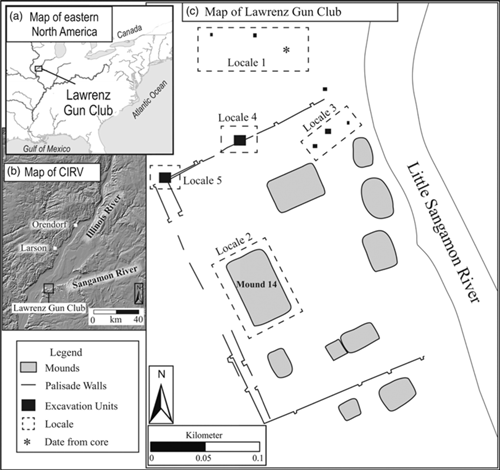
In this paper, we report the results of radiocarbon (14C) dating and Bayesian chronological modeling from Lawrenz Gun Club (11CS4), a major fortified village located in the central Illinois River valley (CIRV) in west-central Illinois that was occupied during the Late Woodland and Mississippi Periods (Figure 1). Bayesian chronological modeling is increasingly applied to provide probabilistic chronological frameworks that help decipher the timing and duration of occupations at individual archaeological sites (Bayliss Reference Bayliss2015; Hamilton and Krus Reference Hamilton and Krus2018). Likewise, Bayesian techniques can also provide high-precision chronologies at robustly dated midcontinental United States archaeological sites with multiple episodes of occupation (e.g., Krus et al. Reference Krus, Cook and Hamilton2015; Thompson and Krus Reference Thompson and Krus2018).
Map of Lawrenz Gun Club Village.

A relative chronology for late pre-Columbian occupation in the CIRV was established by Harn (Reference Harn1975, Reference Harn1994) and Conrad (Reference Conrad, Emerson and Lewis1991) using artifact typologies and stratigraphic associations at dozens of sites and calibrated 14C dates from five sites. Most archaeological work in the CIRV has primarily relied upon relative dating techniques (e.g., ceramic seriation) as a means of defining temporal relationships between sites. While 14C dates from mounds and habitations in the CIRV have indicated that mound building began during the Woodland Period and that larger settlements were present along the banks of the Illinois River by the Late Woodland Period (Esarey Reference Esarey, Emerson, McElrath and Fortier2000; Green and Nolan Reference Green, Nolan, Emerson, McElrath and Fortier2000; Hart et al. Reference Hart, Asch, Scarry and Crawford2002; Holt and Feathers Reference Holt and Feathers2003; Holt Reference Holt2005; Conner Reference Conner2016), archaeological chronologies have traditionally been interpreted as a series of discrete Woodland and Mississippi Period cultural phases (Conrad and Harn Reference Conrad and Harn1972; Conrad Reference Conrad, Emerson and Lewis1991; Esarey and Conrad Reference Esarey and Conrad1998). Relatively few 14C dates have been obtained and Wilson (Reference Wilson2010:51) recently noted that the paucity of 14C dates from the CIRV has resulted in “insufficient knowledge” about Woodland/Mississippi transitional period sites. More recently, Wilson et al. (Reference Wilson, Melton and VanDerwarker2018) analyze 24 new 14C dates from Mississippian CIRV occupations with exploratory Bayesian models for ceramic chronologies, but do not fully consider sample taphonomy in their modeling, nor derive definitive conclusions from the Bayesian models in part due to the paucity of 14C data.
Lawrenz Gun Club is the largest Mississippi Period village in the CIRV, abutting the Little Sangamon River approximately 7 km south-southeast of its confluence with the Illinois River. Archaeological, geophysical, and geoarchaeological investigations between 2010 and 2016 focused on the site’s chronology, internal organization, and fortifications. Lawrenz has a minimum of 10 mounds, a central plaza, and dozens of structures enclosed within a stout ca. 10 hectare palisade with bastions (Figure 1; Wilson and Pike Reference Wilson and Pike2015). Dozens of additional structures have been detected through magnetic gradiometry and structures exist outside the village’s walls to the north and south. This includes a series of smaller, wall-trench structures associated with the establishment of the community in the late 11th century AD. Although only a small portion of the site (less than 0.5%) has been excavated, we have recovered enough evidence from palisade construction episodes, one mound, a paleochannel, and structures both inside and outside the palisade to provide a chronology for the main period of site occupation.
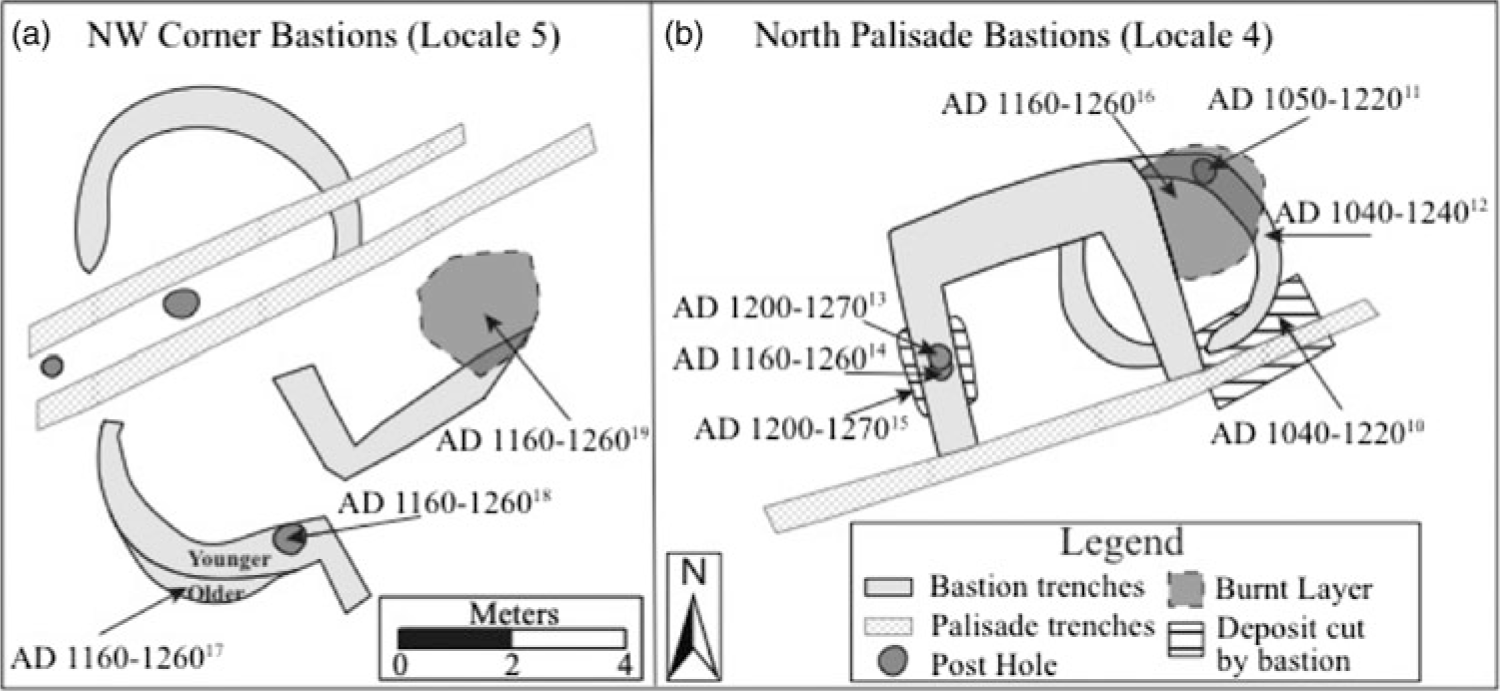
Research at Lawrenz has been part of a National Science Foundation Research Experience for Undergraduates (SMA 1262530) program concentrating on chronological and stratigraphic relationships of remotely sensed and sampled archaeological features. We initially identified near surface (30–130 cm deep) features associated with the main ceremonial mound complex and plaza area using a Bartington Grad601-2 magnetic gradiometer (Wilson and Pike Reference Wilson and Pike2015). This survey revealed that the main portion of the site was enclosed by multiple iterations of a wall-trench, palisade fortification, as well as numerous domestic and special-purpose structures with wall-trench foundations and interior basins both inside and outside the palisade. Using the gradiometer map and signal strength to guide our research (Figure 1), we chose to excavate apparent structures located inside and outside the palisade, and portions of the palisade itself. Because the palisade’s west wall exhibits three different major construction episodes, we excavated the northwest corner of the inner palisade where the palisade trenches crosscut one another to decipher stratigraphic relationships, recognizing the potential to utilize a Bayesian framework in conjunction with the 14C measurements from sequential deposits (Figure 2). A second series of test units were placed along the palisade’s north wall where two major construction episodes were revealed during remote sensing, including a rectangular bastion that superimposes a previously constructed circular bastion (Figure 2). The mounds, structures, and other features within the fortified village were all associated with Mississippian artifacts believed to date to the mid-12th to early 14th centuries AD. Low quantities of Woodland artifacts recovered during pedestrian survey allude to the existence of a small Woodland component prior to Mississippi Period village formation.
Map of Locales 4 and 5 in Figure 1 showing the crosscutting relationships between the archaeological contexts and the locations of the 14C samples. Calibrated ranges and superscript sample numbers are provided for each 14C date.

Advances in the statistical modeling of 14C dates and archaeological data within Bayesian frameworks allow researchers to understand site chronologies better and even produce 14C estimates accurate to the level of a human generation (Bayliss et al. Reference Bayliss, Bronk Ramsey, van der Plicht and Whittle2007, Reference Bayliss, van der Plicht, Bronk Ramsey, McCormac, Healy, Whittle, Whittle, Healy and Bayliss2011; Bayliss Reference Bayliss2009, Reference Bayliss2015). At Lawrenz, questions of site establishment, use, and abandonment are at the forefront of archaeological investigations. Probabilistic estimates derived from Bayesian modeling for the timing of activity at Lawrenz can be used to address these seminal research questions directly. Such modeling not only uses the absolute dating provided by the 14C measurements, but also the relative relationships provided by stratigraphy and feature groupings.
RADIOCARBON SAMPLING
Samples from archaeological and geological contexts were submitted for accelerator mass spectrometry (AMS) 14C dating to Beta Analytic and the W.M. Keck Carbon Cycle Accelerator Mass Spectrometer facility (KCCAMS) at the University of California, Irvine. Eighteen single-entity (Ashmore Reference Ashmore1999) samples of animal bone, short-lived plants, nutshell, thatch, and wood charcoal were submitted to KCCAMS. A single-entity sample of thatch was submitted to Beta Analytic.
The pretreatment protocols for these samples can be found on the Beta Analytic and KCCAMS websites (Beta Analytic 2019; KCCAMS 2019). Both labs maintain rigorous internal quality assurance procedures, and participation in international inter-comparisons (Scott et al. Reference Scott, Bryant, Cook and Naysmith2003, Reference Scott, Cook, Naysmith, Bryant and O’Donnell2007, Reference Scott, Cook and Naysmith2010) indicates no laboratory offsets; thus, validating the measurement precision quoted for the 14C ages.
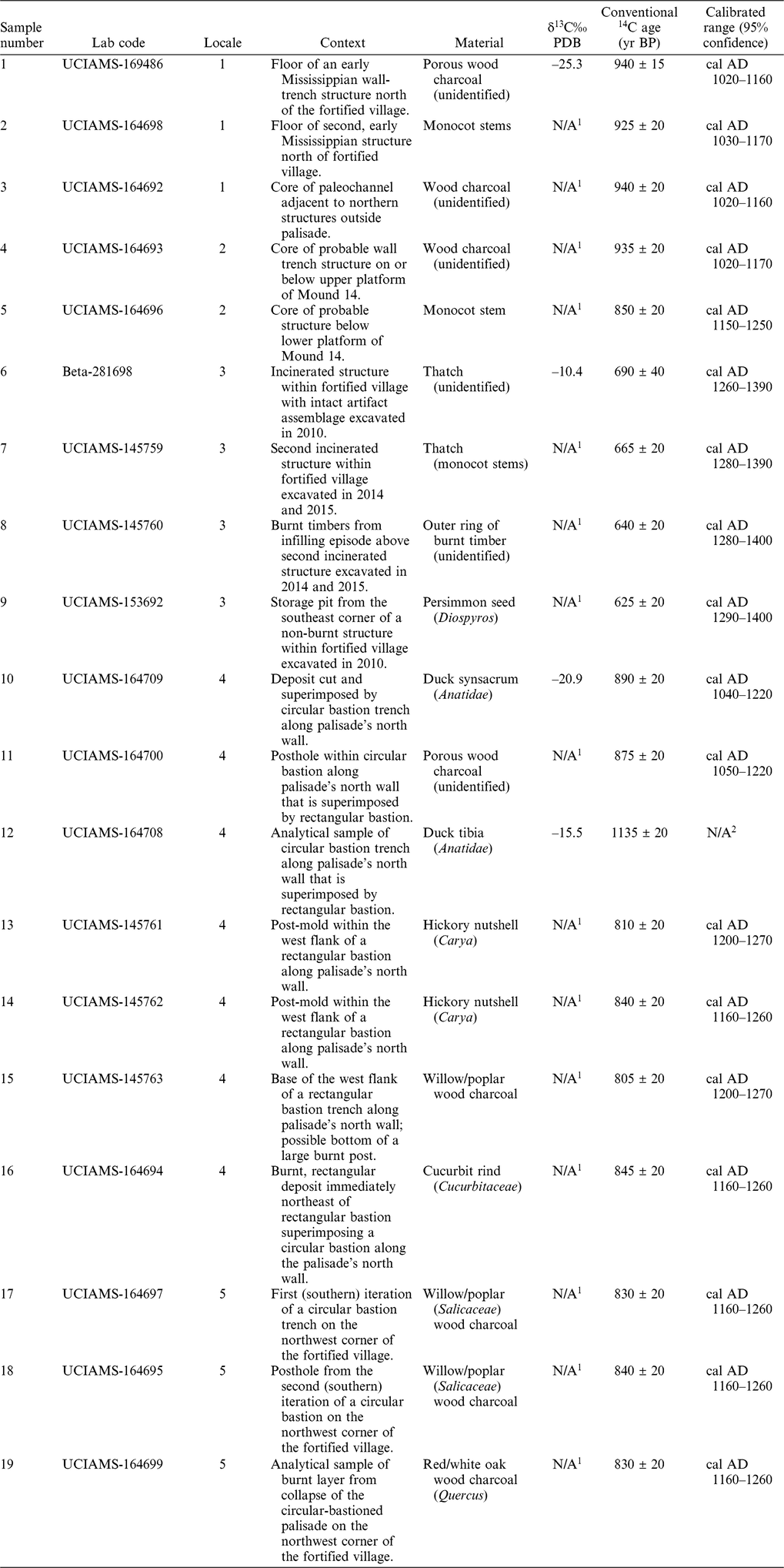
The results of the 14C determinations are presented in Table 1, where they are quoted in accordance with the Trondheim Convention (Stuiver and Kra Reference Stuiver and Kra1986) as conventional 14C ages (Stuiver and Polach Reference Stuiver and Polach1977). Calibrated date ranges were calculated using the IntCal13 calibration curve of Reimer et al. (Reference Reimer, Bard, Bayliss, Beck, Blackwell, Bronk Ramsey, Grootes, Guilderson, Haflidason, Hajdas, Hatte, Heaton, Hoffmann, Hogg, Hughen, Kaiser, Kromer, Manning, Niu, Reimer, Richards, Scott, Southon, Staff, Turney and van der Plicht2013) and OxCal v4.3. Calibrations are cited in the text as 95% confidence intervals, with the end points rounded outwards to 10 years.
14C data for the Lawrenz Gun Club.

1 δ13C was not measured on 15 of the UCIAMS dates.
2 The δ13C value (–15.5‰) derived from AMS for UCIAMS-164708 suggests the presence of an unknown marine component in the diet of this sample. A δ13C value derived from a subsample of the pretreated bone would further allow for the estimation of the percentage of diet from terrestrial/marine resources, but this is not available. Therefore, this sample has not been subjected to 14C calibration or Bayesian chronological modeling.
METHODOLOGY
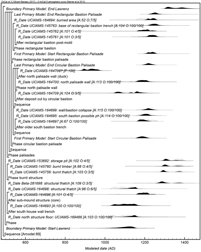
The technique used for Bayesian chronological modeling is a form of Markov Chain Monte Carlo sampling (Buck et al. Reference Buck, Kenworthy, Litton and Smith1991, Reference Buck, Cavanagh and Litton1996) and has been applied using the program OxCal v4.3 (OxCal 2019a). Details of the algorithms employed by OxCal v4.3 are available in Bronk Ramsey (Reference Bronk Ramsey1995, Reference Bronk Ramsey1998, Reference Bronk Ramsey2001, Reference Bronk Ramsey2009a) or from the online manual (OxCal 2019b). The fit between the OxCal model and data is gauged with the Amodel agreement index and values higher than 60 indicate good agreement between the model parameters and the dates (Bronk Ramsey Reference Bronk Ramsey1995). Resulting posterior density estimates from OxCal are calendar years and presented in italics as probability ranges with end points rounded to the nearest five years. The algorithms used in the models can be derived from the OxCal keywords and bracket structure shown in the probability distribution plots (Figures 3–5). The posterior density estimates produced by modeling are not absolute and are interpretative estimates that may change as further data become available or as other researchers choose to model the existing data from different perspectives.
Results and structure of the primary model. The brackets and keywords define the model structure. The outlined distribution is the result of 14C calibration and the solid distributions are the chronological model results. The large square “brackets” along with the OxCal keywords define the overall model exactly.

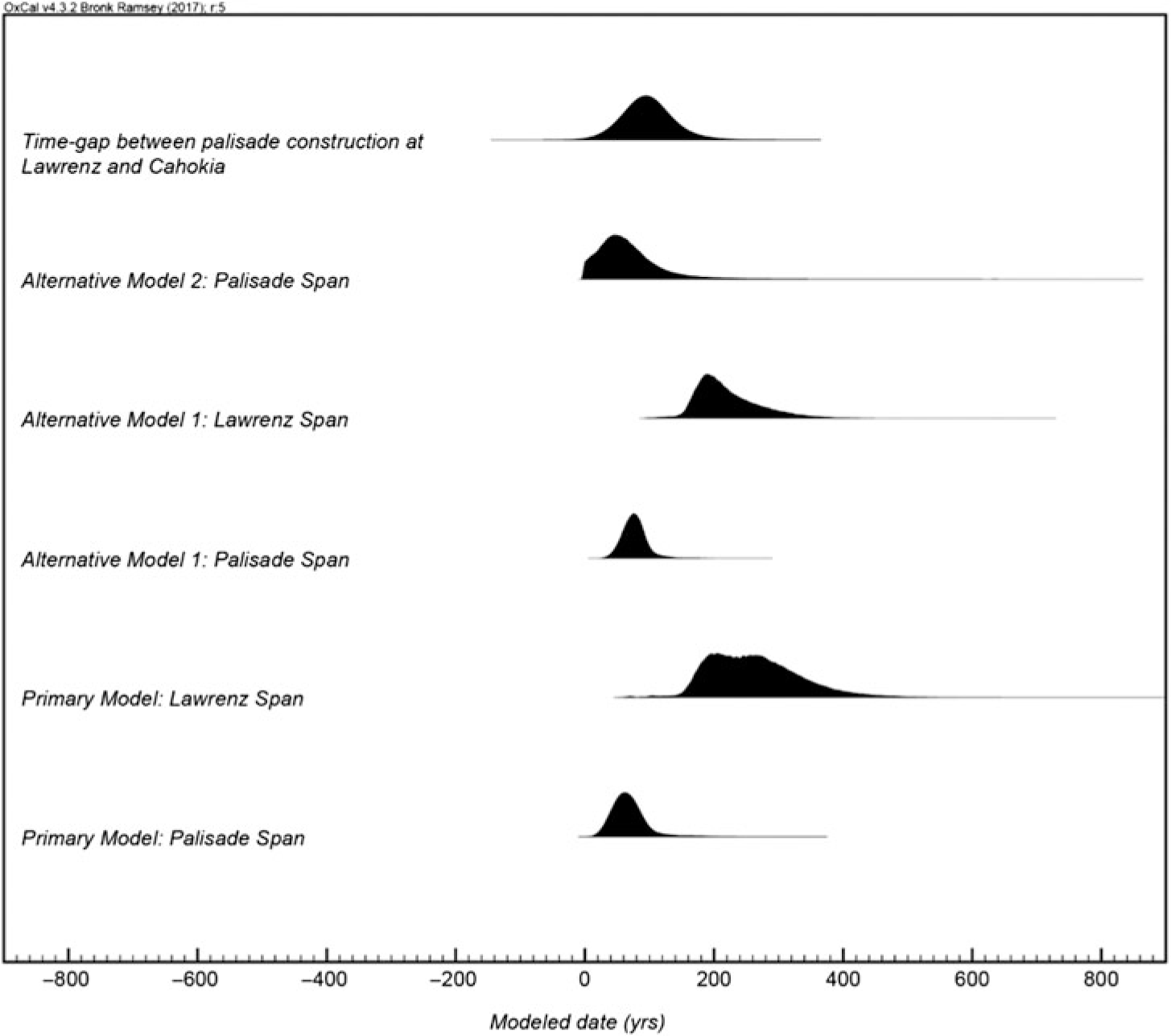
Posterior probabilities for estimated spans in the Bayesian models. The time-gap between palisade construction at Lawrenz and Cahokia was calculated by subtracting the posterior probability for palisade construction at Cahokia presented in the primary model of Krus (Reference Krus2016) from the posterior probability for palisade construction at Lawrenz presented in this study.

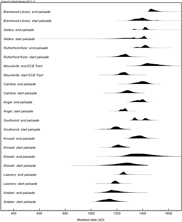
Posterior probability densities for the construction and use of Mississippian bastioned palisades subjected to scientific dating and Bayesian chronological modeling. Posterior probabilities for Lawrenz derive from the primary model presented in this study and the other posterior probabilities derive from the primary Bayesian models presented in Krus (Reference Krus2016) and Krus and Cobb (Reference Krus and Cobb2018).

THE SAMPLES AND MODEL
Geophysical and archaeological evidence suggests that the palisade at Lawrenz was subjected to extensive modification throughout the settlement’s history, including a shift from circular to rectangular bastions. Nine contexts associated with different sections of the palisade and individual bastions were sampled for 14C dating (Wilson and Pike Reference Wilson and Pike2015). Ten 14C samples are from palisade contexts and nine are from contexts associated with residential structures and a large, two-tiered platform mound (Mound 14). These samples are informative for the creation of Bayesian models focused on understanding the foundation of the settlement, timing of palisade construction, and iterative modifications.
Wood charcoal (Salicaceae) from a circular bastion trench in the northwest corner of the village was sampled for 14C dating (UCIAMS-164697). This charcoal is interpreted as providing a terminus post quem (TPQ) for the context because it may be residual material from a context predating the palisade. This palisade section is superimposed by a bastion rebuild trench (Figure 2a) and wood charcoal (Salicaceae) from a probable posthole in this circular bastion trench was sampled for 14C dating (UCIAMS-164695). The dated charcoal for UCIAMS-164695 is interpreted as a fragment of a removed palisade post that was burnt before insertion into the trench. These contexts are superimposed by a collapse layer (Figure 2a) and wood charcoal (Quercus) from this layer was sampled for 14C dating (UCIAMS-164699). The dated charcoal for UCIAMS-164699 is interpreted as burnt palisade construction material that provides a date for the circular bastion.
A disarticulated duck synsacrum (Anatidae) sample from an amorphous deposit cut by a different circular bastion along the palisade’s north wall (Figure 2b) was sampled for 14C dating (UCIAMS-164709). No other suitable samples for 14C dating were found in this amorphous deposit. This deposit is interpreted as part of a structure pre-dating this palisade section. The δ13C value (–20.9‰) for this sample suggests a predominantly terrestrial diet for this duck and the 14C measurement from this sample was calibrated using the terrestrial calibration curve only (Richards and Hedges Reference Richards and Hedges1999). The dated disarticulated bone sample is interpreted as a TPQ for the context because it may be residual and may date a time before the creation of the deposit. A porous wood (species unidentified) charcoal sample from a posthole within this circular bastion along the north palisade wall was also sampled for 14C dating (UCIAMS-164700) and is interpreted as a fragment of a removed burned palisade post.
A disarticulated duck tibia (Anatidae) sample from this circular bastion trench along palisade’s north wall was further sampled for 14C dating (UCIAMS-164708). No other suitable samples for 14C dating were found in this bastion trench context. The disarticulated duck bone sample is interpreted as providing a TPQ for the context because it may be residual and may date a time before the creation of the wall trench. The δ13C value (–15.5‰) derived from AMS for this sample suggests a marine component in the diet, which is not surprising because migratory patterns of ducks often include warm coastal areas (Chisholm et al. Reference Chisholm, Nelson and Schwarcz1982; Schoeninger et al. Reference Schoeninger, Deniro and Tauber1983). A δ13C value derived from a subsample of the pretreated bone would further allow for the estimation of the percentage of diet from terrestrial/marine resources, but this is not available. Therefore, this sample has not been subjected to 14C calibration or Bayesian chronological modeling.
A circular bastion along the north palisade wall is superimposed by a rectangular bastion (Figure 2b). Wood (willow/poplar) charcoal from the base of the west flank of this rectangular bastion was sampled for 14C dating (UCIAMS-145763). This dated charcoal is interpreted as a fragment from the base of a removed burned bastion post. Two hickory nutshell (Carya) samples from post-molds in the west flank of the same rectangular bastion were sampled for 14C dating (UCIAMS-145761, UCIAMS-145762) and are interpreted as a TPQ for the context because durable nutshell samples often have high-potential to be redeposited as residual material. A cucurbit rind (Cucurbitaceae) from a burned context near this rectangular bastion was also sampled for dating (UCIAMS-164694) and is interpreted as providing a date that approximates the time this area burned. This burned area is adjacent to, and of same orientation as the palisade wall; therefore, the sample is interpreted as providing a date for a time when the palisade was present. Further, the sampled burned context superimposes the circular bastion in this area (Figure 2b), suggesting that UCIAMS-164694 provides a date for the rectangular bastion.
Porous wood (species unidentified) charcoal from the floor of a wall-trench structure north of the fortified village was sampled for 14C dating (UCIAMS-169486). This context contained a mix of grit- and shell-tempered pottery sherds likely related to the domestic use of this structure. Thatched monocot stems from the floor of a second structure with Lohmann Phase (AD 1050–1100) pottery in this area were also sampled for 14C dating (UCIAMS-164698). These two samples are interpreted as domestic materials left behind in their respective structures and as providing dates for the earliest Mississippi-era village occupation; although, it is also feasible that either or both may be residual and could serve as a TPQ for these contexts. A 14C measurement from a nearby sample of unidentified wood charcoal acquired from a solid-earth core of a paleochannel adjacent to these structures (UCIAMS-164692) was excluded from Bayesian modeling because it is unclear how this sample relates to the village occupation.
We used solid-earth coring methods to obtain an unidentified wood charcoal sample for 14C dating (UCIAMS-164693) from a structure on or below the upper platform of Mound 14. Similarly, we recovered a monocot stem (UCIAMS-164696) from a core of a structure below Mound 14’s lower platform. Both samples are modeled as TPQ because precise contextual data are not available from the solid-earth core data. Further, both samples may be residual and may date a time before the creation of their respected contexts.
Thatched unidentified plant material residing atop the roof and wall elements of a burned structure in the northeastern corner of the village was sampled for 14C dating (Beta-281698). The sample is interpreted as construction material and provides a date for the construction or modification of the structure. The elevated δ13C value (–10.4‰) of this sample strongly suggests that the dated material is a C4 plant (Cerling et al. Reference Cerling, Ehleringer and Harris1998: Figure 4), possibly a maize plant incorporated into the thatching (Bender Reference Bender1968, Reference Bender1971; Lowdon Reference Lowdon1969). Alternatively, if the sample is from discarded food remnants, then it likely provides a date for the use of the structure. Thatched monocot stems from immediately above the floor of a second burnt structure in the same area were sampled for 14C dating (UCIAMS-145759). A series of burnt timbers were found immediately above the burnt thatch, within an infilling episode, and the outer ring (species unidentified) of one of these burnt timbers was sampled for 14C dating (UCIAMS-145760). Both samples (UCIAMS-145759, UCIAMS-145760) are interpreted as construction materials that provide dates for the construction and/or modification of this structure, which was rebuilt and expanded on a minimum of three occasions. This interpretation of the 14C samples is strengthened because it is likely that these two samples are the same age, as the measurements pass a chi-square test (T=0.8; df=1; T’(0.05)=3.8) (Ward and Wilson Reference Ward and Wilson1978). A persimmon seed (Diospyros) from a pit located in the southeast corner of a nearby non-burnt structure was sampled for 14C dating (UCIAMS-153692). This seed is interpreted as material stored within the pit and should provide a date for the pit’s use. Although, it is also feasible that the seed may be residual and could serve as a TPQ for this context.
The 14C dates were modeled with the prior assumption that they are representative of a single, relatively uniform phase of activity. Boundaries were placed around this sequence in OxCal to estimate a start and end date. Sequences were created in this phase to reflect the stratigraphic ordering of the 14C samples (Figures 2–3). A Charcoal Outlier Model (Bronk Ramsey Reference Bronk Ramsey2009b) was adopted as a strategy for accounting for the unknown in-built age offset in wood charcoal samples to create a more accurate and robust model (Hamilton and Kenney Reference Hamilton and Kenney2015). The model assumes an exponential distribution, with an exponential constant τ of 1 taken over the range—10 to 0, of the charcoal dates (Bronk Ramsey Reference Bronk Ramsey2009b). The shifts are then scaled by a common scaling factor that can lie anywhere between 100 and 103 years. Non-charcoal 14C measurements were given a prior probability of 5% of being statistical outliers, using the General Outlier Model.
It should be noted that the Charcoal Outlier Model algorithm iteratively downweighs the impact of wayward results until the model runs freely and consistently, irrespective of the overlap integral between the posterior results and standardized likelihoods (i.e., the agreement) (Bronk Ramsey Reference Bronk Ramsey2009b; Dee and Bronk Ramsey Reference Dee and Bronk Ramsey2014). Following best practice (Bayliss Reference Bayliss2015), the Amodel agreement value is still reported to evaluate the agreement between the model parameters and the 14C dates; however, there is no clear position about what the final agreement means when running the Charcoal Outlier Model, which makes the models with this outlier algorithm difficult to evaluate. Despite these issues, the Charcoal Outlier Model is still used because seven of the 19 14C measurements are potentially old wood charcoal, hence, modeling these as Charcoal Outliers effectively deals with potential old wood effects. Additionally, the results of the primary model do not meaningfully change when the Charcoal Outlier Model is not employed and produce an Amodel value with good overall agreement (Amodel=91.6).
The algorithm used for the primary model with the Charcoal Outlier Model algorithm can be directly derived from the model structure shown in Figure 3. The primary model shows good overall agreement (Amodel=88.5) between the 14C dates and the model assumptions. The model estimates that the earliest activity on the site began in cal AD 990–1165 (95% probability; Figure 3; Primary Model: Start Lawrenz), and probably in cal AD 1075–1150 (68% probability), when initial Mississippi settlements were founded further upstream (Wilson et al. Reference Wilson, Melton and VanDerwarker2018). The model estimates that palisade construction with circular bastions began in cal AD 1150–1230 (95% probability; Figure 3; Primary Model: Start Circular Bastion Palisade), and probably in cal AD 1165–1205 (68% probability). Palisade modifications and repair are estimated to have continued for the next 15–125 yr (95% probability; Figure 4; Primary Model: Palisade Span), and probably for 40–85 yr (68% probability). The model estimates construction of the palisade with rectangular bastions began in cal AD 1200–1260 (95% probability; Figure 3; Primary Model: Start Rectangular Bastion Palisade), and probably in cal AD 1210–1250 (68% probability). Palisade modifications and repair are estimated to have ended in cal AD 1215–1305 (95% probability; Figure 3; Primary Model: End Rectangular Bastion Palisade), and probably in cal AD 1230–1265 (68% probability). Activity on the site is estimated to have ended in cal AD 1295–1450 (95% probability; Figure 3; Primary Model: End Lawrenz), probably in cal AD 1300–1405 (68% probability), spanning 150–420 yr (95% probability; Figure 4; Primary Model: Lawrenz Span), probably for 175–310 yr (68% probability).
SENSITIVITY ANALYSIS
Two additional Bayesian models were created as a sensitivity analysis to explore reaonably alternate ways to model this data. Full details and results of these alternate models are provided in the online supplementary materials.
DISCUSSION
The Lawrenz settlement chronology is of intrinsic interest for understanding the pre-Columbian history of the CIRV, as it is the largest and longest inhabited Mississippian village in this area and the only CIRV settlement with a robust trench-built palisade and evolving forms of bastions. The Bayesian models for the settlement chronology produced very similar results and suggest that the occupation spanned much of the Mississippi Period. The primary model is preferred for interpretation because it offers a more conservative treatment of the 14C data than the alternative models. While the primary model is preferred, the results of the alternative models are parsimonious, especially at 68% probability (see online supplement). At 68% probability, the primary model estimates that the dated activity at Lawrenz began in either the late 11th century or early–mid 12th century AD and that the first palisade with circular bastions was constructed in the late 12th century. Activity at the site is estimated to have ended in the 14th century at 68% probability.
Importantly, the palisade was maintained with repairs and rebuilds until the mid–late 13th century, including a major rebuild with rectangular bastions in the early 13th century. The estimated use life of the palisade (40–85 yr; 68% probability; Figure 4; Primary Model: Palisade Span) suggests that the structure was standing for at least several decades and, potentially, a century. These results are similar to other Bayesian estimates for the use lives of Mississippian bastioned palisades (Krus Reference Krus2016; Krus and Cobb Reference Krus and Cobb2018), but contrast with previous shorter-use life estimates based on wood decay rates (Iseminger et al. Reference Iseminger, Pauketat, Koldehoff, Kelly and Blake1990; Scarry Reference Scarry, Knight and Steponaitis1998; Bigman et al. Reference Bigman, King and Walker2011). The longer use-life of the Lawrenz palisades suggest that the true use-life of a palisade may only be partially contingent on the durability of its construction materials. The magnetometry and excavation results at Lawrenz indicate that the palisade had numerous repair trenches and substantial rebuilds (Wilson and Pike Reference Wilson and Pike2015), suggesting that maintaining Lawrenz’s bastioned palisade was a multigenerational effort and that inhabitants repaired and rebuilt the palisade walls when and where needed.
The longevity of palisades at Lawrenz are important because bastioned palisades have long been interpreted as evidence for the militarization of Mississippian settlements. At Lawrenz, bastions are regularly spaced at 21–44 m, which correlates globally with the use of the bow and arrow as projectile weapons (Milner Reference Milner and Tracy2000:58; Keeley et al. Reference Keeley, Fontana and Quick2007:70–72), and are large enough to hold defenders who could concentrate fire onto closely approaching attackers (Milner Reference Milner1999, Reference Milner and Tracy2000, Reference Milner, Chacon and Mendoza2007; Keeley et al. Reference Keeley, Fontana and Quick2007). Bastions likely increased the line of sight for defending archers, while shielding their visibility (Keeley Reference Keeley1996:56). The presence of bastioned palisades provides evidence for coordinated defending and attacking Mississippian forces. Regardless of whether real or perceived, the anticipation of attack must have served as a strong incentive for the inhabitants of Lawrenz to maintain their palisades.
Orendorf, another major Mississippian center in the CIRV, was also fortified with a single-post palisade containing bastions. Loose interpretations for Orendorf’s fortification chronology, which are based on associated diagnostic ceramics, suggest that it was present from AD 1200–1250 (Santure Reference Santure, Esarey and Conrad1981; Harn Reference Harn1994:24; Wilson Reference Wilson and Pauketat2012, Reference Wilson, Pauketat and Alt2015), so may have been contemporaneous with the fortification at Lawrenz.
The only Mississippian bastioned palisade clearly constructed earlier than Lawrenz was at Aztalan (located 350 km north in southern Wisconsin). Bayesian estimates for palisade construction at Aztalan are cal AD 1080–1180 at (68% probability; Figure 5; Aztalan: start palisade; Krus Reference Krus2016). In contrast, estimates for construction of Cahokia’s palisade are cal AD 1245–1315 (68% probability; Figure 5, Cahokia: start palisade; Krus Reference Krus2016), which is 55–135 yr (68% probability) after Lawrenz (Figure 4; Time-gap between palisade construction at Lawrenz and Cahokia), suggesting a more militarized way of Mississippian life existed at Lawrenz and other northern Mississippian territories and outposts before Cahokia. Krus (Reference Krus2016) shows that the remainder of the 14C dated bastioned palisades in the midcontinental United States were first constructed in the AD 1200s (Figure 5). This coincides with the end of the Medieval Climate Anomaly, which brought decreased summer precipitation (i.e., droughty conditions) that is believed to have caused declines in crop production, increased food scarcity, socio-political instability, and a need for enhanced security (Milner Reference Milner, Chacon and Mendoza2007; Milner et al. Reference Milner, Chaplin and Zavodny2013; Bird et al. Reference Bird, Wilson, Gilhooly, Steinman and Stamps2017). In this socio-environmental context, the Bold Counselor Oneota spread across the upper midcontinental United States and into the CIRV around AD 1300 (Santure et al. Reference Santure, Harn and Esarey1990; Esarey and Conrad Reference Esarey and Conrad1998; Steadman Reference Steadman1998; Lieto and O’Gorman Reference Lieto and O’Gorman2014), although only limited artifactual evidence at Lawrenz (i.e., surface-collected Bold Counselor jar, pipestone pieces, and small galena fragments) supports direct interaction with Oneota groups. Robust 14C dating and chronological modeling of villages with distinct Oneota components will help clarify these relationships.
CONCLUSION
Cultural diversity reflected by an array of architectural styles, mound use, placement, structure, and ceramic typologies associated with village communities (Green Reference Green1993; Wilson Reference Wilson2010) have complicated our ability to tease apart sociopolitical affiliations through time at Late Woodland and Mississippian sites in the CIRV. In the case of Lawrenz, diagnostic pottery and calibrated dates (Table 1) from samples of disarticulated animal bone, short-lived plants, nutshell, thatch, and wood charcoal suggested that activity took place primarily in the Mississippi Period (Wilson and Pike Reference Wilson and Pike2015). The long occupational span at Lawrenz starkly contrasts with the notion that communities (e.g., Orendorf) located to the north in the CIRV were shorter-lived, representing a generation or two. While the unmodeled 14C data proved to be informative for a range-finder assessment of the site chronology, when taken alone the calibrated dates do not provide good evidence to precisely assess the settlement history. Further, interpreting the 14C calibrations proved to be complicated due to a marine component in the diet of one of the 14C measurements from a duck bone.
Bayesian chronological models of these data provide high-resolution probabilistic estimates for the occupation chronology and the analysis presented in this paper provides another example of the type of social histories that can be inferred from modeling Mississippi Period activity. In the case of Lawrenz, the Bayesian modeling suggests that the village was established in the late 11th century or early–mid 12th century AD and that continuous occupation of the village lasted for two–three centuries.
Previous studies have suggested that the periodicity of warfare was at chronic levels in many Mississippian areas from AD 1200–1400 (Milner Reference Milner1999, Reference Milner and Tracy2000, Reference Milner, Chacon and Mendoza2007; Emerson Reference Emerson, Chacon and Mendoza2007; Dye Reference Dye2008; Cobb and Giles Reference Cobb, Giles, Nielsen and Walker2009; Wilson Reference Wilson and Pauketat2012; Milner et al. Reference Milner, Chaplin and Zavodny2013; Krus Reference Krus2016). In contrast, the palisade at Lawrenz was likely constructed before AD 1200 (Figure 5). Bayesian estimates for palisade chronologies for sites north of Cahokia (Lawrenz and Aztalan, Figure 5) suggest potential episodes of militarization earlier than AD 1200, specifically sometime in the late AD 1000s to mid-AD 1150s. Future fine-grain analyses and comparisons are still needed to understand the historical nuances of how these past conflicts unfolded and the different pulses and levels of inter-group violence that played out in different parts of the late pre-Columbian midcontinental United States
To better understand the dynamic social history of the CIRV at a higher precision and accuracy, Lawrenz and other archaeological settlements in the area require a more robust AMS 14C dataset using single-entities of articulated bone or short-lived material that are strongly related to the function of the context from which they were recovered. At Lawrenz, all excavated organic samples that contain secure taphonomic links to their corresponding context have been dated. Consequently, the chronology presented here is can only be improved by future excavations that retrieve taphonomically suitable 14C samples.
SUPPLEMENTARY MATERIAL
To view supplementary material for this article, please visit https://doi.org/10.1017/RDC.2019.19
ACKNOWLEDGMENTS
We would like to thank the Hardwick and Robertson families for granting us permission to conduct research on their properties and serving as excellent stewards of the site. Our gratitude must also be extended to our 2010–2016 field crews, Erica Ausel, John Flood, Nicole Geske, Kathryn Parker, Derek Hamilton, and Mark Schurr. The Glenn A. Black Laboratory of Archaeology at Indiana University provided the Bartington Grad 601-2 dual gradiometer and GeoProbe coring rig. Portions of this research have been funded by the National Science Foundation (SMA 1262530) and IUPUI’s Center for Research and Learning.