There is strong evidence for an association between stress and depression (Hammen, Reference Hammen2005). Stressful life events exert a modest causal effect on the risk for major depressive disorder even when accounting for person effects on the environment (Kendler & Gardner, Reference Kendler and Gardner2010). Stress appears to have a more important role in precipitating first episodes rather than recurrent episodes of depression (Kendler, Thornton, & Gardner, Reference Kendler, Thornton and Gardner2000; Monroe & Harkness, Reference Monroe and Harkness2005; National Institute for Health and Care Excellence, 2005). Adolescence is a period of vulnerability for depression, with first episodes often emerging at this time and the prevalence of depressive symptoms increasing markedly, particularly among girls. The role of stress as a predictor of depression may therefore be of particular importance during this period. It has been suggested that stress experienced during adolescence can have long-lasting effects on the development of brain areas involved in the regulation of stress via glucocorticoid exposure (Lupien, McEwen, Gunnar, & Heim, Reference Lupien, McEwen, Gunnar and Heim2009). Adolescent depressive disorder and symptoms are associated with a range of contemporaneous and long-term difficulties, including suicide attempts, hospitalization, and impaired social, occupational, and interpersonal functioning (e.g., Angold, Costello, Farmer, Burns, & Erkanli, Reference Angold, Costello, Farmer, Burns and Erkanli1999; Weissman et al., Reference Weissman, Wolk, Goldstein, Moreau, Adams and Greenwald1999). Taken together, these observations suggest that adolescence is an important period during which to assess the relationship between stress and depression.
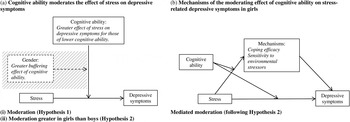
Despite the strong associations between stress and depression, resilience work highlights that not all adolescents show negative outcomes following adversity. In particular, various authors suggest that higher cognitive ability (i.e., intelligence or executive processes) is associated with more positive social, academic, and mental health outcomes following a range of stressors, including adverse life events (Masten et al., Reference Masten, Hubbard, Gest, Tellegen, Garmezy and Ramirez1999) and recurrent depression in a parent (Pargas, Brennan, Hammen, & Le Brocque, Reference Pargas, Brennan, Hammen and Le Brocque2010; Tiet et al., Reference Tiet, Bird, Davies, Hoven, Cohen and Jensen1998). Cognitive ability tests include tasks that assess verbal comprehension, abstract reasoning, working memory, and processing speed (e.g., Wechsler Intelligence Scale for Children—Fourth Edition [WISC-IV]; Wechsler, Reference Wechsler2003) and thus index a wide range of cognitive resources and processes including semantic memory, working memory, and executive functioning. Individuals with higher cognitive ability may have resources such as greater cognitive reserve which serve to protect them against some of the adverse effects of stress while individuals with lower cognitive ability may be more vulnerable to depression following stressful life events because they are less equipped to cope with them (Barnett, Salmond, Jones, & Sahakian, Reference Barnett, Salmond, Jones and Sahakian2006; Koenen et al., Reference Koenen, Moffitt, Roberts, Martin, Kubzansky and Harrington2009). Thus, cognitive ability may moderate the association between stress and depression; higher cognitive ability may buffer (reduce) the association between stressful life events and depression (Figure 1a). Stress exerts a modest causal effect on depression and has also been shown to impair memory for neutral material, executive processing, and neuronal processes that subserve cognition such as dendritic arborization in the hippocampus (Goodyer, Reference Goodyer2008; Klein & Boals, Reference Klein and Boals2001; Liston, McEwen, & Casey, Reference Liston, McEwen and Casey2009; Lupien et al., Reference Lupien, McEwen, Gunnar and Heim2009). Potential explanations of a possible interaction between cognitive ability and stress in predicting depression include that there is greater capacity and efficiency of the cognitive system in more able individuals that serves to protect them from some of the adverse effects of stress. Another is that more cognitively able individuals have greater capacity to profit from information acquired as a result of stressful situations, find meaning in them, and positively reframing them, tendencies that have been associated with stress resilient outcomes (Southwick, Vythilingam, & Charney, Reference Southwick, Vythilingam and Charney2005).
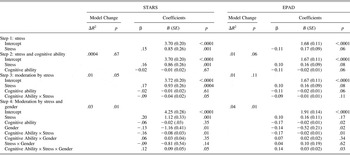
Conceptual figure of the tested models: (a) cognitive ability moderates the effect of stress on depressive symptoms, and (b) mechanisms of the moderating effect of cognitive ability on stress-related depressive symptoms in girls.

Studies generally report an inverse association between cognitive ability and depression both in childhood and adulthood (e.g., Collishaw, Maughan, & Pickles, Reference Collishaw, Maughan and Pickles2004; Franz et al., Reference Franz, Lyons, O'Brien, Panizzon, Kim and Bhat2011; Hartlage, Alloy, Vazquez, & Dykman, Reference Hartlage, Alloy, Vazquez and Dykman1993), which is consistent with higher cognitive ability being a resilience factor against depression. Some research suggests that this association may be stronger in girls than in boys (Glaser et al., Reference Glaser, Gunnell, Timpson, Joinson, Zammit and Smith2011; Hatch et al., Reference Hatch, Jones, Kuh, Hardy, Wadsworth and Richards2007). Regarding gender differences in depression, higher prevalence rates in girls compared with boys are well documented from midpuberty onward (Angold, Costello, & Worthman, Reference Angold, Costello and Worthman1998; Costello, Erkanli, & Angold, Reference Costello, Erkanli and Angold2006; Green, Reference Green2005). Two explanations for the development of these gender differences are that girls experience more negative life events than do boys (Thapar, Collishaw, Pine, & Thapar, Reference Thapar, Collishaw, Pine and Thapar2012) and that girls are more likely than boys to experience depression following these stressors (Hankin & Abramson, Reference Hankin and Abramson2001). The buffering effect of higher cognitive ability proposed here may therefore be greater in girls than in boys (Figure 1a). There is also some animal evidence that acute stress may impair learning in females while enhancing learning in males (Oldehinkel & Bouma, Reference Oldehinkel and Bouma2011). Cognitive ability has been suggested to play an important role in protecting against the damaging effects of stress (Boyce & Ellis, Reference Boyce and Ellis2005), and girls appear to be more vulnerable to stress-related depressive symptoms (Hankin & Abramson, Reference Hankin and Abramson2001). Thus, girls with higher cognitive ability may benefit from a greater ability to process information under stress without impairing functioning because of greater capacity and efficiency of the cognitive system.
Potential mechanisms through which higher cognitive ability in girls may buffer stress-related depressive symptoms include greater coping efficacy and lower sensitivity to environmental stressors (i.e., these mechanisms may mediate the moderating effect of cognitive ability on stress-related depressive symptoms in girls: mediated moderation; Figure 1b). Cognitive processes such as active coping have been suggested to decrease the likelihood of developing disorders following stress, for example by preventing fear conditioning (Southwick et al., Reference Southwick, Vythilingam and Charney2005). This is consistent with the elaborated cognitive vulnerability-transactional stress theory (Hankin & Abramson, Reference Hankin and Abramson2001), which proposes that the likelihood of stress leading to depression is moderated by generic cognitive vulnerabilities. This theory also suggests that these cognitive vulnerabilities are greater in girls, making them more vulnerable to depression following stress. Therefore, coping efficacy may mediate the moderating effect of cognitive ability on stress-related depressive symptoms in girls. Another potential mechanism is environmental sensitivity. The biological sensitivity to context theory (Boyce & Ellis, Reference Boyce and Ellis2005) suggests that individuals differ in their biological sensitivity to the environment, with those of higher sensitivity (e.g., those showing elevated cortisol response to stress) more likely to suffer negative outcomes following stress (Feder, Nestler, & Charney, Reference Feder, Nestler and Charney2009). Evidence from both animal and human studies suggests that females may perceive social stress as more stressful (Juster et al., Reference Juster, Bizik, Picard, Arsenault-Lapierre, Sindi and Trepanier2011) and be more vulnerable to depression following social stress than males (McCormick & Mathews, Reference McCormick and Mathews2007; Stroud, Salovey, & Epel, Reference Stroud, Salovey and Epel2002). Thus, sensitivity to environmental stressors may be another mechanism through which cognitive ability buffers stress-related depressive symptoms in girls.
The aim of this study was to test the potential moderating effects of cognitive ability on the association between stress and depressive symptoms. Following some evidence that associations between cognitive ability and depressive symptoms may differ between high- and low-risk samples (Pargas et al., Reference Pargas, Brennan, Hammen and Le Brocque2010), we included both types of sample in our study. Two data sets were analyzed to assess this question: a representative community-based sample of 11- to 12-year-olds, The School Transition & Adjustment Research Study (STARS), and a sample of the adolescent offspring of depressed parents aged 9–17, The Early Prediction of Adolescent Depression Study (EPAD). Our main research hypotheses were (a) cognitive ability would moderate the effect of stress on depressive symptoms, and (b) the moderating effect of cognitive ability would be stronger in girls than in boys. We also explored whether coping efficacy and sensitivity to environmental stressors were mediators of the predicted moderating effect of cognitive ability on the association between stress and depressive symptoms (i.e., mediated moderation).
Method
Samples
The STARS sample consists of data collected from pupils in Year 7 (age 11–12) attending 10 mixed, nonselective secondary schools in southeast England. The schools were selected because their intake was representative of the English and Welsh populations in terms of the proportion of pupils who were from economically disadvantaged households (indexed by eligibility for free school meals) and who had special educational needs. The proportion of pupils from black and minority ethnic backgrounds and who did not have English as a first language was slightly higher than the general population, reflecting the inclusion of London schools. The study protocol was reviewed and approved by the university ethics committee. At each assessment, parents were given the opportunity to opt their children out of the study, and informed pupil consent was obtained. Questionnaire data were collected at two stages: a postal survey during May 2012 (N = 750, overall response rate = 35%) and an in-school assessment during November 2012 (N = 1,712, overall response rate = 87%). Cognitive ability data were collected in September of that year for 6 of the participating schools (N = 1,159). Of the 750 pupils for whom postal survey data was available, 663 (88%) completed the in-school assessments (reasons for noncompletion were pupil left the school or parent, pupil, or school withdrew from the study). Cognitive ability data were available for 460 (61% of those with baseline data), which formed our analyzed sample (228 boys). The analyzed subsample with complete data did not differ from the rest of the sample in terms of depressive symptoms, t (1646) = 1.73, p = .08, or negative life events, t (743) = –0.36, p = .72, but had higher cognitive ability scores, t (1157) = –4.37, p < .001.
The EPAD data consists of 337 children aged 9–17 years of parents with a history of recurrent unipolar depression. Parents were recruited from general practices in South Wales (78%), from a previous database of adults with recurrent unipolar depression (19%), and from advertisements in primary care (3%). Families were excluded if parents had a previous bipolar or psychotic diagnosis, were not biologically related to the child, or the adolescent had an IQ of less than 50. A full description of the sample is given by Mars et al. (Reference Mars, Collishaw, Smith, Thapar, Potter and Sellers2012). Two families were later excluded because the affected parent was rediagnosed with bipolar disorder. Data analyzed in this report came from the first stage of the study. The analyzed sample consisted of 335 offspring (139 boys). Mean age was 12.39 (SD = 2.02).
As expected, the two data sets differed on a number of family stressors, as shown in Table 1. Specifically, the EPAD sample included higher proportions of participants who came from single-parent households, had mothers with no formal educational qualifications, and had an annual family income of below £10,000. In addition, the EPAD sample included a wider age and pubertal range (although modal pubertal status was the same; Petersen, Crockett, & Richards, Reference Petersen, Crockett and Richards1988).
Sample characteristics

Note: STARS, School Transition & Adjustment Research Study; EPAD, The Early Prediction of Adolescent Depression Study.
Measures
Depression
Depressive symptoms in the STARS data were measured by self-report using the Short Mood and Feeling Questionnaire (Angold, Costello, Messer, & Pickles, Reference Angold, Costello, Messer and Pickles1995). The scale consists of 13 items designed to cover core symptoms of DSM-III-R depression for children and adolescents. Items ask about symptoms during the prior 3 months on a 3-point scale (2 = true, 1 = sometimes true, 0 = not true). Items are summed to produce a total score (possible range = 0–26). A clinical cut point of 11 has been proposed for this measure (Angold, Erkanli, Silberg, Eaves, & Costello, Reference Angold, Erkanli, Silberg, Eaves and Costello2002). Internal reliability was α = 0.89, comparable to that reported by Angold et al. (Reference Angold, Costello, Messer and Pickles1995) of α = 0.85.
Depressive symptoms in the EPAD data were measured by parent and child ratings using the Child and Adolescent Psychiatric Assessment (Angold & Costello, Reference Angold and Costello2000), a semistructured diagnostic interview used to assess depressive disorders, as well as other psychiatric disorders. The total number of DSM-IV major depressive symptoms (possible range = 0–9) was based on combined scores, whereby a symptom was coded as present if endorsed by either child or parent. For analyses focusing on major depressive disorder (MDD), adolescents were classified as affected if this diagnosis was present at any of the three assessment stages (follow-up period 29 months, SD = 5.39) of the EPAD study (7 boys; 30 girls met these criteria).
Cognitive ability
Cognitive ability in the STARS data was measured by the Cognitive Abilities Test (Lohman et al., Reference Lohman, Thorndike, Hagen, Smith, Fernandes and Strand2001), a standardized assessment that measures verbal reasoning, quantitative reasoning, and nonverbal reasoning. The three scores were averaged to produce a cognitive ability score with higher scores indicating higher ability. Cognitive Abilities Test scores have been found to be highly reliable in terms of test–retest correlations and internal consistency estimates and to have strong predictive validity with later school performance (Strand, Reference Strand2006). Cognitive ability in the EPAD data was analyzed using the 10 subscales of WISC-IV, which has also shown high reliability and validity (Wechsler, Reference Wechsler2003).
Stress
Stress was measured by negative life events for both the data sets using a version of the Life Events Checklist (Johnson & McCutcheon, Reference Johnson and McCutcheon1980), listed in Appendix A. The checklist for each consisted of 19 binary items (e.g., parents nagging/picking on you more, losing a close friend through arguments, doing badly in school work), which may have happened in the past year, summed to give a total score (possible range = 0–19, higher scores indicating more negative life events). Life events were measured using child report for STARS and parent and child reports (coded as present if endorsed by either rater) for EPAD. Life events that could not be the result of characteristics of the participant (e.g., death of a grandparent) were coded as behavior independent (Appendix A).
Additional measures for mediated moderation analysis
Coping efficacy
Coping efficacy was measured in STARS using the Pearlin Mastery Scale (Pearlin & Schooler, Reference Pearlin and Schooler1978). Participants were asked to what extent seven statements describe themselves (e.g., There is really no way I can solve some of the problems I have; I have little control over the things that happen to me; I often feel helpless in dealing with the problems of life) on a 5-point scale ranging from 1 (strongly disagree) to 5 (strongly agree). Items were reverse scored and summed to produce a total score (possible range = 7–35, higher scores indicating greater coping efficacy, Cronbach α = 0.60).
Coping efficacy was measured in EPAD using the General Self-Efficacy Scale (Schwarzer & Jerusalem, Reference Schwarzer, Jerusalem, Weinman, Wright and Johnston1995). Participants were asked to what extent 10 statements describe themselves (e.g., I can always manage to solve difficult problems if I try hard enough; I am confident that I could deal efficiently with unexpected events; I can remain calm when facing difficulties because I can rely on my coping abilities) on a 4-point scale ranging from 1 (not at all true) to 4 (exactly true). Items were summed to produce a total score (possible range = 10–40, higher scores indicating greater coping efficacy, Cronbach α = 0.85).
Sensitivity to environmental stressors
Sensitivity to environmental stressors was measured by sensitivity to the environment in STARS and stress sensitivity in EPAD. Sensitivity was measured in STARS using a self-report version of the Highly Sensitive Child Questionnaire, Short Form (Aron & Aron, Reference Aron and Aron1997). The scale contained eight items (e.g., I am annoyed when people try to get me to do too many things at once; I don't like it when things change in my life; I don't like loud noises) on a 7-point scale: not at all (1), moderately (4), and extremely (7). Items were summed to produce a total score (possible range = 8–56, higher scores indicating greater sensitivity to the environment, Cronbach α = 0.63).
Stress sensitivity was measured in EPAD using a version of the Life Events Checklist (Johnson & McCutcheon, Reference Johnson and McCutcheon1980). Participants were asked to rate the severity of each event that they stated having occurred on a 5-point scale from 1 (very unpleasant) to 5 (very pleasant). Scores were reversed so that a higher score indicates greater perceived severity and a score of 0 was allocated if the event was not experienced. Items were summed to produce a total score (possible range = 0–95, higher scores indicating greater stress sensitivity).
Statistical analysis
The association between cognitive ability and depressive symptoms was analyzed using a series of multiple regression analyses with centered independent variables (Cohen, Cohen, Stephen, & Leona, Reference Cohen, Cohen, Stephen and Leona2003). The dependent variable was depressive symptoms. The first step entered stress as a single predictor variable, followed by cognitive ability in the second step. The interaction of Cognitive Ability × Stress was added in the third step. The fourth step tested for moderation by stress and gender, which included gender, all possible additional two-way interaction terms, and the interaction of Cognitive Ability × Stress × Gender. Gender was coded girls = 0, boys = 1. Significant interactions were followed with simple slopes analyses (Dawson & Richter, Reference Dawson and Richter2006) where low and high cognitive ability and stress were plotted as the sample mean ± 1 SD. A final set of analyses exploring potential mediators of the hypothesized moderation was carried out with mediated moderation using Process, model 8, in SPSS (Hayes, Reference Hayes2013). Specifically, these analyses estimated the indirect effect of the Cognitive Ability × Stress interaction term (XW) on depressive symptoms (Y) though the mediator (coping efficacy or sensitivity to environmental stressors; M). This is quantified as the effect of XW on M and of M on Y, keeping X and W (and XW) constant (Hayes, Reference Hayes2013). A 95% confidence interval (CI) was generated using N = 5,000 bootstrap samples. This tested the extent to which the hypothesized moderation of the association between stress and depressive symptoms by cognitive ability was attributable to coping efficacy or sensitivity to environmental stressors.
Results
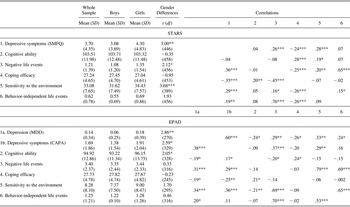
Table 2 presents descriptive data with gender differences and correlations by gender. Mean levels of negative life events were higher in EPAD than STARS (3.40 and 1.21, respectively). The proportion of participants meeting either the clinical cutpoint for depression (STARS) or diagnostic criteria for depressive disorder (EPAD) was also higher in EPAD, reflecting the fact that EPAD was selected on the basis of elevated familial risk for depression (13.6% in EPAD; 7.6% in STARS, based on the suggested clinical cutpoint, Angold et al., Reference Angold, Erkanli, Silberg, Eaves and Costello2002). Mean cognitive ability scores were 104 in STARS and 95 in EPAD. Independent-sample t tests showed girls had higher levels of depressive symptoms than boys in both data sets, higher cognitive ability than boys in the EPAD data, and more negative life events and sensitivity than boys in the STARS data. There were no gender differences for coping efficacy or independent life events. Bivariate correlations for each sample showed that depressive symptoms were associated with negative life events in both data sets (r = .34, p < .0001; r = .32, p < .0001) and with cognitive ability in the EPAD data (r = –.13, p = .02) but not the STARS data (r = –.01, p = .88). Negative life events were also associated with cognitive ability in the EPAD data (r = –.16, p = .004) but not the STARS data (r = .04, p = .37).
Descriptive statistics and correlations: Depressive symptoms, cognitive ability, negative life events, coping efficacy and sensitivity to environmental stressors

Note: Correlations for boys are above the diagonal, and correlations for girls are below the diagonal. STARS, School Transition & Adjustment Research Study; SMFQ, Short Mood and Feeling Questionnaire; EPAD, The Early Prediction of Adolescent Depression Study; MDD, major depressive disorder; CAPA, Child and Adolescent Psychiatric Assessment.
*p < .05. **p < .01. ***p < .001.
Cognitive ability moderating the effect of stress on depressive symptoms and disorder
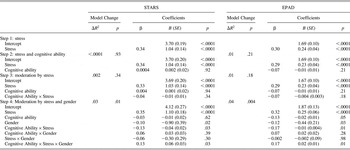
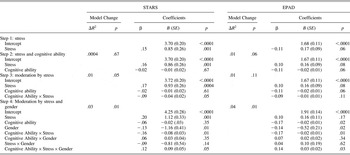
Findings testing the hypothesized moderating effects of cognitive ability on the association between stress and depressive symptoms are presented in Table 3. The first step of the analyses showed an association between stress and depressive symptoms (STARS β = 0.34, p < .0001; EPAD β = 0.30, p < .0001). The second step showed that this association remained when cognitive ability was entered into the model (STARS β = 0.34, p < .0001; EPAD β = 0.29, p < .0001) with no main effect of cognitive ability on depressive symptoms (STARS β = 0.0004, p = .92; EPAD β = –0.07, p = .21). The third step showed no evidence of cognitive ability moderating the effects of stress on depressive symptoms (interaction terms: STARS β = –0.04, p = .34; EPAD β = –0.07, p = .18) with a main effect of stress (STARS β = 0.33, p < .0001; EPAD β = 0.29, p < .0001) but not cognitive ability (STARS β = 0.004, p = .94; EPAD β = –0.07, p = .21) on depressive symptoms. Further analyses revealed a three-way interaction among stress, cognitive ability, and gender (Model 4; three-way-interaction terms: STARS β = 0.13, p = .03; EPAD β = 0.17, p = .01). When the samples were split by gender, two-way interactions of stress and cognitive ability were present in girls (STARS β = –0.12, p = .05; EPAD β = –0.17, p = .02) but not in boys (STARS β = 0.08, p = .21; EPAD β = 0.10, p = .27).
Associations between cognitive ability and depressive symptoms: Total negative life events

Note: STARS, School Transition & Adjustment Research Study; EPAD, The Early Prediction of Adolescent Depression Study.
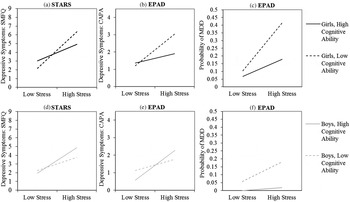
Simple slopes analyses were used to follow-up the three-way interaction and revealed a buffering effect of higher cognitive ability for girls (Figure 2a, b) with a significantly stronger association between stress and depressive symptoms for girls of lower cognitive ability compared to girls of higher cognitive ability (STARS t = –2.18, p = .03; EPAD t = –2.86, p = .01). For boys, there was no significant difference between lower and higher cognitive ability in the association between stress and depressive symptoms (Figure 1d, e; STARS t = 1.10, p = .27; EPAD t = 1.23, p = .22). Associations between stress and depression were stronger for girls with lower cognitive ability compared with boys of lower cognitive ability (STARS t = –2.38, p = .02; EPAD t = –1.96, p = .05). In contrast, there was some indication that associations between stress and depression were marginally stronger for boys of higher cognitive ability compared with girls of higher cognitive ability in the high-risk sample only (STARS t = –0.88, p = .38; EPAD t = 1.88, p = .06). There was no difference between slopes comparing boys of high cognitive ability and girls of low cognitive ability (STARS t = –0.31, p = .76; EPAD t = 0.58, p = .56) or comparing boys of low cognitive ability and girls of high cognitive ability (STARS t = –1.16, p = .25; EPAD t = –0.52, p = .61). In summary, higher cognitive ability was found to buffer the association between stress and depressive symptoms in girls but not in boys.
Simple slopes analysis: associations between cognitive ability and depressive symptoms/major depressive disorder for girls and boys. Low and high stress and cognitive ability and are plotted as the mean ± 1 SD for the two data sets. All predictor variables are centered. STARS, School Transition and Adjustment Research Study; EPAD, Early Prediction of Adolescent Depression Study.

Logistic regression analyses (EPAD only) showed that the three-way Cognitive Ability × Stress × Gender interaction replicated when a diagnosis of MDD was the outcome variable, exp(B) = 1.04, p = .04, along with main effects of stress, exp(B) = 1.36, p = .002, and gender, exp(B) = 0.06, p = .02, but not cognitive ability, exp(B) = 0.97, p = .09, and no significant two-way interactions: Cognitive Ability × Stress: exp(B) = 0.99, p = .38; Cognitive Ability × Gender: exp(B) = 0.86, p = .05; stress x gender: exp(B) = 1.55, p = .14. The results for girls are shown in Figure 1c and for boys in Figure 1f. When the sample was split by gender, two-way interactions of stress and cognitive ability were not significant, although these showed the same direction of associations as was found for depressive symptoms in EPAD, girls: exp(B) = 0.99, p = .38; boys: exp(B) = 1.04, p = .06.
Behavior-independent life events
Restricting the analysis to independent life events outside the control of the individual (Appendix A) allowed us to test the possibility that the interaction was driven by cognitive ability influencing levels of stress exposure. Tests of the moderating effect of cognitive ability on the association between stress and depressive symptoms replicated when restricting the measurement of stress to behavior-independent life events (Table 4).
Associations between cognitive ability and depressive symptoms: Behavior-independent negative life events
Note: STARS, School Transition & Adjustment Research Study; EPAD, The Early Prediction of Adolescent Depression Study.
Mediated moderation analyses
Follow-up mediated moderation analyses were conducted to test whether the observed moderating effect of cognitive ability on the association between stress and depressive symptoms for girls was accounted for by coping efficacy or sensitivity to environmental stressors. There was no evidence of mediated moderation for coping efficacy in either sample: STARS b = –0.001, SE = 0.004, CI = (–0.01, 0.01); EPAD b = –0.001, SE = 0.001, CI = (–0.004, 0.0002). There was some indication of mediated moderation for sensitivity to environmental stressors in both samples: STARS b = –0.01, SE = 0.004, CI = (–0.02, –0.001); EPAD b = –0.002, SE = 0.001, CI = (–0.01, –0.0001). That is, there was a small but significant indirect effect of the interaction between cognitive ability and stress on depressive symptoms for girls through environmental sensitivity. This suggests that higher cognitive ability in girls may be associated with fewer depressive symptoms partly via decreased sensitivity to environmental stressors when exposed to stressful life events. However, this only accounted for a small proportion of the observed interaction.
Discussion
We set out to examine the relationship between stress, cognitive ability, and depressive symptoms, with the specific prediction that higher cognitive ability promotes resilience to stressful life events. We examined the role of cognitive ability as a moderator of the association between stressful life events and depressive symptoms in two adolescent samples where the degree of stress exposure was expected to differ. Based on the suggestion that individuals of lower cognitive ability may be less equipped to cope with stressful life events and thus be more vulnerable to their depressogenic effects (Barnett et al., Reference Barnett, Salmond, Jones and Sahakian2006; Koenen et al., Reference Koenen, Moffitt, Roberts, Martin, Kubzansky and Harrington2009), we predicted that higher cognitive ability would buffer the effect of stress on depressive symptoms. Given the increased vulnerability to depression following stress found in adolescent girls (Hankin & Abramson, Reference Hankin and Abramson2001), we also predicted that the buffering effect of cognitive ability would be stronger in girls than boys.
The data supported our first hypothesis that higher cognitive ability moderated the effect of stress on depressive symptoms, although this was specific to girls. The observation that higher cognitive ability buffers against the depressogenic effects of stressful life events at least in adolescent girls is consistent with previous work which has found that those with higher cognitive ability show more positive outcomes, such as academic, behavioral, social and psychiatric competence, following stress (e.g., Masten et al., Reference Masten, Hubbard, Gest, Tellegen, Garmezy and Ramirez1999; Pargas et al., Reference Pargas, Brennan, Hammen and Le Brocque2010; Tiet et al., Reference Tiet, Bird, Davies, Hoven, Cohen and Jensen1998). Our findings illustrated that higher cognitive ability was associated with resilience to life stress both in a sample of adolescents at increased familial risk of depression and a community sample of adolescents. One possible explanation is that those of higher cognitive ability may show greater cognitive self-regulation under stress. It has been suggested that cognitive ability may enable faster and more flexible responses to the environment (Boyce & Ellis, Reference Boyce and Ellis2005). For instance, a range of cognitive processes which are at least partly indexed by the broad measure of cognitive ability, (such as working memory capacity and executive functions such as cognitive flexibility) may enable individuals to utilize controlled, effortful processing and thus generate strategic, flexible, emotional responses under conditions of stress (Barrett, Tugade, & Engle, Reference Barrett, Tugade and Engle2004). Thus, those of higher cognitive ability may be better able to inhibit negative behavioral and cognitive responses to stress. Consistent with resilience work that highlights cognitive ability as a predictor of better mental health, particularly in those at high familial risk (Pargas et al., Reference Pargas, Brennan, Hammen and Le Brocque2010), we found bivariate associations between cognitive ability and depression in our sample of children of depressed parents but not in our community sample. Nevertheless, this association did not remain when controlling for exposure to stressful life events. Thus, rather than having a direct association, higher cognitive ability appears to be a protective factor for depression in the context of stressful life events. This is important when considering the role of cognitive ability in the aetiology of depression, suggesting that lower cognitive ability is not in itself a risk factor for depressive symptoms. It also suggests that girls of lower cognitive ability are a vulnerable group that may merit special consideration for supportive interventions.
Exposure to stressful life events can be controllable and partly dependent on behavior (e.g., getting into a fight and being injured) or uncontrollable and independent of behavior (e.g., death of a loved one) (Kendler & Baker, Reference Kendler and Baker2007). Thus, it is possible that individuals influence stress exposure through their own behavior. We tested whether results replicated when stress exposure was restricted to independent life events and found the same pattern of results. The fact that the results replicated gives greater confidence in our interpretation that cognitive ability modifies the influence of stress on the individual as opposed to influencing stress exposure (Hammen, Reference Hammen1991; Rice, Harold, & Thapar, Reference Rice, Harold and Thapar2003).
Our data also supported our second hypothesis that the moderating effect of cognitive ability would be greater for girls than boys. The finding that higher cognitive ability buffers the association between stress and depressive symptoms in girls only is somewhat consistent with previous studies showing associations between higher cognitive ability and fewer depressive symptoms in girls but not boys (e.g., Hatch et al., Reference Hatch, Jones, Kuh, Hardy, Wadsworth and Richards2007). It is also consistent with data showing that from adolescence onward girls experience more social stressors and are more likely to develop depressive symptoms following social stressors (Thapar et al., Reference Thapar, Collishaw, Pine and Thapar2012). We also observed suggestive evidence of an opposite effect in boys (that higher cognitive ability may be associated with increased stress-related depressive symptoms), at least in those at high risk. Some researchers have suggested that higher cognitive ability may be associated with a greater sensitivity to the environment, including stressors, although those studies did not test that explanation (Luthar, Reference Luthar1991; Zigler & Farber, Reference Zigler, Farber, Horowitz and O'Brien1985). It may be that the effect of cognitive ability on stress processing is different in boys and girls and that different cognitive processes may need to be targeted in boys and girls. These results are preliminary and will require replication, particularly given the small number of boys with major depressive disorder in the EPAD sample (6.4%). Nonetheless, prevalence rates were higher than typically reported (Costello et al., Reference Costello, Erkanli and Angold2006), given that the analysis of MDD focused on a high-risk sample.
We tested coping efficacy as a possible mediator for the moderating effect found in girls. This was based on reports of associations between cognitive reappraisal and resilience to stress-related depression (Southwick et al., Reference Southwick, Vythilingam and Charney2005) and of suggestions that such cognitive vulnerabilities result in an increased risk of depression in girls (Hankin & Abramson, Reference Hankin and Abramson2001). We found no evidence of mediated moderation. We also explored sensitivity to environmental stressors as a possible mediator of this moderation following suggestions that girls may find social stress more stressful and be more vulnerable to depression following social stress than males (Juster et al., Reference Juster, Bizik, Picard, Arsenault-Lapierre, Sindi and Trepanier2011; McCormick & Mathews, Reference McCormick and Mathews2007; Stroud et al., Reference Stroud, Salovey and Epel2002). We found some evidence of mediated moderation, with higher cognitive ability in girls leading to fewer depressive symptoms under stress at least partly via reduced environmental sensitivity. Thus, girls of higher cognitive ability may be better able to process information without impairing functioning under stress because of greater capacity and efficiency of the cognitive system compared to that of girls of lower cognitive ability. In particular, our findings are consistent with “hardware” interpretations that the observed buffering effect of higher cognitive ability may be due to greater cognitive capacity and efficiency (Brewin & Smart, Reference Brewin and Smart2005; Ellis, Reference Ellis1990). Under stress, controlled attentional/cognitive resources are reduced. However, higher cognitive ability, in particular executive processes including working memory capacity, mental flexibility and inhibition, may increase resistance to the attentional capture of negative information (Barrett et al., Reference Barrett, Tugade and Engle2004; Cohen-Gilbert & Thomas, Reference Cohen-Gilbert and Thomas2013; Joormann & Gotlib, Reference Joormann and Gotlib2010). It is also possible that girls of higher cognitive ability show lower biological stress responses, but evidence to date is inconclusive (Flegr et al., Reference Flegr, Hampl, Cernochova, Preiss, Bicikova and Sieger2012; Power, Li, & Hertzman, Reference Power, Li and Hertzman2008; Slattery, Grieve, Ames, Armstrong, & Essex, Reference Slattery, Grieve, Ames, Armstrong and Essex2013; Stawski et al., Reference Stawski, Almeida, Lachman, Tun, Rosnick and Seeman2011). Moreover, the mediation effect was small, which may be partially due to measurement characteristics of our indices of environmental sensitivity. Despite being well established, internal validity was relatively low for the measure used in STARS and relied on having been exposed to stressful life events in EPAD. We therefore encourage future work looking at mechanisms of this association that would inform prevention programmes.
Strengths and limitations
Our study has a number of strengths, particularly the use of independent data sets that differed on background stress levels. One sample included the offspring of depressed parents, a group known to differ from the general population on exposure to stress (Goodman & Gotlib, Reference Goodman and Gotlib1999). Findings replicated across both samples, with varying age ranges, measures of cognitive ability, and measures of depressive symptoms and disorder, suggesting our findings are reliable. Although modal pubertal status was equivalent in both samples, the wider age range of the high-risk sample could have been an issue, as this represents the entire range of puberty, whereas important gender differences in depression emerge at the onset of puberty (Thapar et al., Reference Thapar, Collishaw, Pine and Thapar2012). However, replication of our findings in this sample suggests that the observed buffering effect of higher cognitive ability against stress-related depressive symptoms is not limited to this pubertal period.
A limitation is that we were unable to investigate the possibility of shared genetic risk between cognitive ability, stress and depression. However, the pattern of results replicated when using behavior-independent negative life events. It is therefore unlikely that the interaction we observed is due to life events exposure arising from the characteristics of the individual, including genetically influenced characteristics (e.g., Hammen, Reference Hammen1991; Rice et al., Reference Rice, Harold and Thapar2003). Thus, observed results for independent stressful life events are inconsistent with shared genetic risk for stress and either cognitive ability or depressive symptoms. An alternative possibility is that associations are due to the confounding effects of deprivation, which may be associated with cognitive ability, stress, and depression (Collishaw et al., Reference Collishaw, Maughan and Pickles2004). However, our results replicated when we repeated our analyses controlling for socioeconomic status (indexed by free-school meals eligibility in STARS and the 2000 Standard Occupational Classification for EPAD) suggesting that this is not the case (results available from the first author). Another consideration is the inference of causality. We make a case for girls of higher cognitive ability being of lower risk of increased depressive symptoms following stress. Our results do not exclude the possibility of reverse causation. However, as noted, our results replicated for behavior-independent life events. Cognitive ability shows high stability from childhood to old age (Deary, Whalley, Lemmon, Crawford, & Starr, Reference Deary, Whalley, Lemmon, Crawford and Starr2000), and thus lower cognitive ability is a better candidate for an antecedent of, rather than a result of, depressive symptoms. Our findings provide useful insight into the aetiology of depression during adolescence. This is particularly important given that this is a period of vulnerability for depression and long-lasting effects of stress (Lupien et al., Reference Lupien, McEwen, Gunnar and Heim2009; Thapar et al., Reference Thapar, Collishaw, Pine and Thapar2012). To investigate whether the buffering effects of higher cognitive ability are specific to this developmental period, future work could investigate the relationship between cognitive ability, stress, and depression during childhood and adulthood.
Our findings suggest that low cognitive ability is not a significant vulnerability factor for depressive symptoms in itself. Instead, cognitive ability acts indirectly, with higher cognitive ability showing a buffering effect in girls consistent with the view that cognitive ability is one resilience-promoting factor in the context of stress both in adolescents at low and high familial risk for depression.
Appendix A
Negative life events
The entries marked with an asterisk are coded as behavior-independent life events.
-
1. Serious illness in family member*
-
2. Increased quarrelling between parents
-
3. Death of parent/brother/sister*
-
4. Death of grandparent*
-
5. Death of close friend*
-
6. Serious illness/injury to close friend*
-
7. Parent in trouble with police*
-
8. Parent going to prison*
-
9. Doing badly in an exam
-
10. Parents being less interested/loving
-
11. Parents nagging/picking on you more
-
12. Serious illness to you*
-
13. Doing badly in (school) work
-
14. Close friend moves away*
-
15. Losing a close friend through arguments
-
16. Death of a pet*
-
17. Mother losing job*
-
18. Father losing job*
-
19. Being bullied