1. Introduction
On 10 October 2009, the leaders of China, Japan, and Korea met in Beijing for the second Trilateral Summit of Northeast Asia. The first Summit meeting had taken place in Fukuoka in December 2008, and this was the second time that they held this summit meeting independently from other international forums such as ASEAN Plus Three (APT).Footnote 1
This summit meeting is indicative of the increasing economic and political interdependence between these three countries in Northeast Asia. While the new Japanese government is explicit about aiming at the creation of the East Asian Community, we are witnessing a simultaneous de facto emergence of a Northeast Asian Community as well. Against the background of this community-building in Northeast Asia, greater mutual understanding of each other is indispensable. It was in this spirit that political scientists of the three countries met in Niigata, Japan on 16 October 2009 to discuss the present state of Japanese Political Studies/International Relations (JPSIR) as part of an effort to create a network of scholars engaged in similar lines of work in political science.
This Niigata conference dealt with a very timely topic. Japan witnessed a major political change on 30 August 2009 when the Democratic Party of Japan gained a majority in the lower house of the Diet, and it formed a coalition government including the Social Democratic Party and the People's New Party. This is not the first time that the long reign of the Liberal Democratic Party has been interrupted, but this is definitely the first time that a non-LDP party gained a majority in the lower house. Therefore, this is a more significant change of government compared to that which had occurred before. Furthermore the new government in Japan is presumed to pursue a new foreign policy that is different from that pursued under the previous LDP–Komeito coalition government.
This political change will surely inspire many political scientists, especially those of the younger generation, to undertake vigorous research on Japanese politics and foreign policy.
However, it is critical to know where we are now before we can venture into new terrain. Political science and the field of Japanese political studies are vast subjects, and it is not unusual to get lost in minutiae unless one is aware about what kind of contribution one wants to make. Thus, this volume will be helpful for young aspiring scholars who want to carve out new ground in the study of Japanese politics and foreign policy.
2. Questions
In order to find out about the nature of JPSIR, we can divide our questions into two kinds: descriptive and explanatory. The latter can be further divided into two: JPSIR as a dependent variable and JPSIR as an independent variable.
The descriptive questions are simple. Who studies Japanese politics and foreign policy in each of these countries? How old are they, what kind of educational background do they have, and so on? Academically, what kind of approach do they use? Are they historical, theoretical, methodological, philosophical, and so on? What type of topics do they research? Are they more interested in Japanese foreign policy than Japanese domestic politics? Or the other way around? What are the trends in JPSIR in each of these countries? Is it thriving or on the decline? Are there any notable long-term or medium-term changes in the nature of JPSIR?
Second, we have questions that pertain to JPSIR as a dependent variable. Given the subject matter, we expect that the nature of JPSIR is highly political in nature: various political and other factors are driving the nature of JPSIR in each of these countries. But which factors?
Naturally, we expect that the nature of Sino-Japanese and Korea-Japan relations, the shadow of history – colonization and war – must have some influence on JPSIR. However, that is not all. Domestic politics and the official policy of the government in power in each of these countries may have some influence on JPSIR.
Economics may have some impact as well. Naturally, poorly endowed universities and academic societies will offer meager opportunities for research, while rich ones will be fertile ground for productive research. Given the dependence of universities and academia on government finances, they may also be at the mercy of the national economy in general or the state of government finances in particular.
This brings us to our last set of questions on the impact of JPSIR as an independent variable. Does it influence government policy in any significant way? Does it impact public opinion in each of these countries?
3. Who does JPSIR?
There have been a few previous surveys of JPSIR in Korea and China, and therefore we already have answers to some of the questions posed above. Since we know more about JPSIR in Korea than in China, let us start with Korea.
In 2005, the Japan Foundation, in cooperation with the Sejong Institute Japan Center, conducted a survey of Japanese studies in Korea, and the results are reported in an edited volume published in 2007. The following data draw on this book.
In China, the data we have are slightly out of date. In cooperation with the Japan Foundation, the Chinese Association for Japanese Studies (CAJS) and the Beijing Center for Japanese Studies (BCJS) conducted a survey of Japanese studies’ scholars in the PRC in 1996, and the results are published in CAJS/BCJS (1999). I have created a list of JPSIR scholars from the directory of scholars listed in the ‘History and Politics’ section. Because of this classification, there are a great number of scholars specialized in Japanese political history and diplomatic history in my list as well.
There are no good data on JPSIR in Japan. Therefore, in order to have an overview of the characteristics of JPSIR in Japan, I have created a list of JPSIR scholars from the membership directory of the Japan Political Science Association (2009).Footnote 2
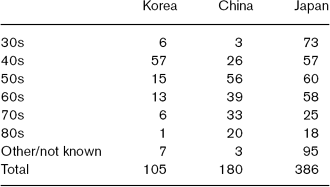
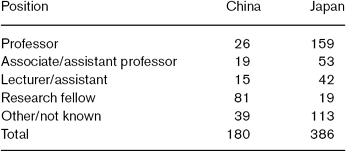
Table 1 shows the age distribution of JPSR scholars in the three countries. In all of the three countries, most scholars are in their 40s and 50s. In Japan, we have quite a few scholars who are in their 30s, but this may be due to the nature of the Japan Political Science Association, because people join the association to look for a job. In Korea and China, on the other hand, the sample consists mostly of people who have permanent academic positions. This can be also seen in Table 2.
Age distribution of JPSIR scholars in Korea, China, and Japan
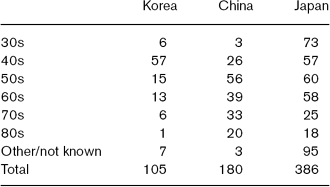
Source: Lee (Reference Lee and Jin2007: 41); CAJS/BCJS (1999); JPSA (2009).
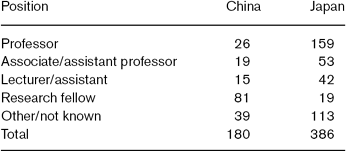
Table 2 shows the comparison of positions of the JPSIR scholars in Japan and China. Comparable data could not be obtained for Korean scholars. In China, there are quite a few people with research positions at various research institutes and historical museums. Again, this is due to the differences in sampling.
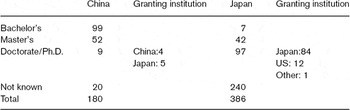
Finally, the educational backgrounds of JPSIR scholars in China and Japan are compared. Since the directory of the Japan Political Science Association does not list the members’ educational background, we have looked at the ReaD database. Unfortunately, only a small proportion of people are in the ReaD database.
Table 3 shows that Chinese scholars have lower attainment rates of postgraduate degrees than do Japanese scholars, although in recent years this may be changing (recall that the Chinese data are 13 years old). Indeed, Professor Guo at the Niigata conference emphasized that there are an increasing number of Chinese scholars with a Ph.D. or equivalent.
Final degrees of JPSIR scholars in China and Japan

4. Trend in JPSIR
Previous research by Jin had described that there have been three stages in Japanese studies in Korea:
The first stage is the germinal stage of research between the nation's liberation in 1945 and 1970, and the second is the stage in which a foundation for Japanese studies was established between 1971 and 1985. The third is the period from 1986 until present, in which qualitative changes are being pursued based on the quantitative expansion of research manpower. (Jin, Reference Jin and Jin2007: 15)
Indeed, the number of JPSIR scholars in Korea shows phenomenal growth only one person got his degree in the 1960s, but the number increased to 14 in the 1970s, 16 in the 1980s, and to 56 in the 1990s (Lee, Reference Lee and Jin2007: 41). It is interesting to know that political science was at the forefront of this growth of Japanese studies in Korea.
Park at the Niigata Conference also described the first, second, and third generations of political scientists who studied Japanese politics in Korea. The second generation obtained their positions in the late 1970s to the mid-1990s, while the third generation entered the profession in the mid-1990s onwards. Thus, JPSIR in Korea has had steady and quite remarkable growth in the past three decades or so.
Japanese studies in the PRC started in earnest in the 1960s, when ‘the Chinese government announced a policy to strengthen foreign studies, including Japanese studies’ (Wang, Reference Wang and Wang2004: 377). But then, the studies were interrupted by the Cultural Revolution, during which a number of intellectuals were persecuted. However, even before the Cultural Revolution was over, Japanese Studies were reinvigorated. Since the 1970s, the number of publications exploded in China.
JPSIR in China also followed the same path. The number of books on Japanese politics published in China per year was 4.5 in the 12 year period from 1949 to 1965. The number dipped to 1.17 between 1966 and 1971 and 0.86 between 1972 and 1978, but it jumped sharply to 15.07 between 1979 and 1993.Footnote 3 Liu also gives a similar timeline: he divides the trajectory of the studies of Sino-Japanese Diplomatic History in the PRC into four periods: (1) 1948–66, (2) 1966–78, (3) 1979–90, and (4) the 1990s onwards, and he explains that Japanese international relations thrived in the latter two periods after a false start in the first period and a sudden dip in the second period.Footnote 4
The number of scholars and publications is only a quantitative aspect of Japanese Studies, but what about quality? Can we say something meaningful about the qualitative aspect of Japanese political studies in the three countries?
In this respect, all the anecdotal evidence mentioned at the Niigata conference points to an improvement in quality. The Korean scholars talked about the repeated inflows of foreign-educated Ph.D.s into Korean academia over the past two decades or so. Also, political science is much more objective and multi-faceted in Korea in comparison with earlier periods. Guo also mentioned an increase in Ph.D.s in China, which indicated an upward trend in the quality of research.
Strangely, the trend in Japan is less clear, but Inoguchi mentions that the gang of four or the Leviathan group energized JPSIR in Japan from the late 1970s onwards. Also, he mentions that large datasets have been compiled in Japan in recent years, indicating that objective and scientific political research is not only feasible, but also actually undertaken in Japan in recent years.
To sum up, Japanese political studies and Japanese international relations are thriving in terms of both quantity and quality in the three countries.
5. Research topics
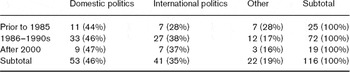
Next, what do scholars study? With the importance of Japan as a trade and foreign policy partner, one would expect that Japan's foreign policy may be of the utmost concern for Korean scholars. Previously, this seems to have been the case, but that is changing. Jin notes that people began to have an interest in domestic politics and political economy as well as Japanese foreign and defense policy. Table 4 shows the subfields of Korean political scientists who study Japan. In all age brackets, more people study Japanese domestic politics than its international relations.
Composition of scholars by major and by year (of final degree)

Source: Lee (Reference Lee and Jin2007: 45).
However, Suh and Kim give a slightly different picture on this same question. They have looked at the contents of books, theses, and articles on Japanese politics since the 1980s, and while the number of articles on Japanese domestic politics has been increasing rapidly in recent years, the ratio of IR to domestic politics in theses and books is still as high as before.Footnote 5
Park describes in his Niigata paper that the research topics in JPSIR in Korea have diversified considerably in recent years. While scholars continue to study subjects that used to be the main concern of Koreans such as Japanese imperialism and Korea-Japan relations, a considerably large number of scholars of more recent generations (especially those in the third generation in his classification) have widened their research horizons.
Interest in Japanese foreign policy in comparison with domestic politics is also strong in China. According to Guo's counting of JPSIR articles in the journal Japanese Studies, a majority of articles (149 out of 235 or 63.4%) deal with Japan's foreign policy and international relations rather than other topics pertaining to domestic politics.Footnote 6 However, he also describes that Chinese scholars have taken an interest in other topics such as Japanese development, institutional reforms, and Japan's new nationalist movements.
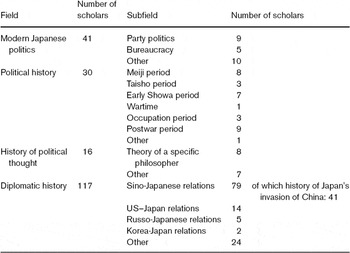
As in Section 3, we have analyzed the research topics of Chinese scholars listed in the Japan Foundation 1999 directory (CAJS/BCJS, 1999). Table 5 shows the results.
Fields and subfields of Chinese scholars who study Japanese politics and foreign policy

Source: CAJS/BCJS (1999).
This classification shows that a majority of JPSIR scholars in China study diplomatic history, and, among them, a majority study Sino-Japanese relations with an emphasis on the history of Japanese aggression towards China. Presumably, this partly reflects the weight placed by state research institutes on these topics and the partly on-going state policy that emphasizes them.
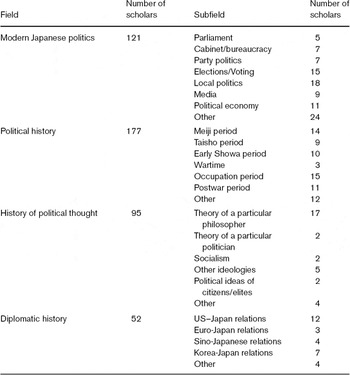
Finally, we have done a similar analysis with regard to Japanese scholars based on the directory of members of the Japanese Political Science Association (JPSA, 2009). The results are shown in Table 6.
Fields and subfields of study of Japanese scholars who study Japanese politics and foreign policy

Source: JPSA (2009), JST.
Among 386 scholars in total, only 52 of them declare themselves to be specialized in diplomatic history, which seems to imply much less emphasis on international relations, but this may be misleading. We have another academic society, the Japan Association of International Relations (JAIR), which assembles specialists on international relations and diplomatic history. Although many scholars belong to both societies, not all of them do. According to the 2008 directory of JAIR, as many as 166 people declare themselves to be specialized in Japanese diplomatic history (JAIR, 2008).Footnote 7
To sum up, the range of research topics in JPSIR, which used to be limited to international relations between Japan and these Northeast Asian countries, is becoming more diversified in all of the three countries. However, it still remains that there is more emphasis on international relations in Korea and China than in Japan.
6. Research approaches/methods
The same trend of greater diversity may be said about the kind of approaches and methods that are used by JPSIR scholars in each of the three countries. This is as important as the topics being researched, because the approaches partly determine the kind of questions scholars ask or the kind of answers that scholars come up with.
Existing studies have provided us with some hints:
Particularly in the analysis of post-war foreign policy, which was quite active in the ‘80s and early ‘90s, the majority was based on the so-called ‘second-image analysis’, a search for internal reasons from foreign policy. However, new scholars after the mid-1990s brought about new research approaches, such as varieties of the so-called ‘second image-reversed’, which utilized links between US–Japan relations and Japan's domestic politics to understand policy, and the ‘two-level game’.
This only pertains to international relations, but this has had an effect on what he calls the ‘military expansion movement’ thesis.
In Korea, the history of colonization weighs heavily on the nature of JPSIR in Korea. ‘One example of this tendency is that most scholars explaining Korea-Japan relations have a tough stance on “caution against Japan”, an extreme theory plainly depicting Japan's pre-war imperialism. Underlying this theory is the argument that modern Japan is still expansion-oriented and has a scheme to subordinate Korea just as it did before the war’ (Jin, Reference Jin and Jin2007: 20). This is an argument that is termed the ‘military expansion movement’ thesis: ‘The basic tendency of most researchers (of defense policy) is to not only acknowledge Japan's conscious increase of its defense capabilities, but also to keep a lookout for the movement.’
However, he also states that the importation of social-scientific approaches from the United States has made this thesis slightly more balanced in recent years:
The generation of scholars who began their studies of Japanese politics in the 1990s shifted the focus of discussion to an analysis of domestic political processes surrounding the defense issue, and demonstrated a more prudent approach regarding the necessity of the military expansion movement. (Jin, Reference Jin and Jin2007: 21)
So, this is an interesting case where a new approach led to a new argument or an answer to the old question.
Regarding China, a similar trend of greater diversity is described by Guo. He gives a few examples of new approaches that are used by JPSIR scholars in China, such as a pluralist approach, a neo-institutional approach, an ecological approach, and a political process approach. It is not clear whether these approaches are similar to those used in the West and in Japan under similar names, but it is interesting to see some degree of convergence of approaches between China and the West.
Inoguchi also talks about greater diversity of approaches that are employed by Japanese scholars in recent years. First, he maintains that a comparative approach is in fashion in Japan. Scholars using this kind of approach see Japan as one piece of information in a larger sample regarding a similar phenomenon. Second, he points to the emergence of large data collection projects, including the AsiaBarometer survey that he himself has been supervising over the years. Again, these kinds of approaches, comparative and quantitative, are characteristic of American political science and thus indicate that JPSIR in Japan may be converging to the Western, or at least, American model.
7. JPSIR as a dependent variable
At the Niigata conference, we extensively discussed the kind of determinants that influence the nature of JPRIR in each of these countries. These determinants are quite diverse, but one can divide them into three classes: (1) those factors that pertain to Japan as a subject matter of JPSIR, (2) those factors that are related to domestic politics in each of the three countries, and (3) economic and other factors that are extraneous to the subject matter but may be important.
7.1 Japan as a subject matter
Political and economic changes in Japan or changes in its international status certainly influence the nature and course of JPSR in the Northeast Asian countries. Park was very explicit that the rise of the status of Japan had a palpable impact on what he calls the third generation of JPS scholars in Korea. These people went to college in the 1980s, and read Chalmers Johnson's MITI and the Japanese Miracle and Ezra Vogel's Japan as Number One. Therefore, they became much more interested in the rise of Japan than their predecessors. Also, they were much less anti-Japanese than the earlier generations of scholars.
Of course, the decline in Japanese economic prowess in the 1990s presumably had a reserve effect.
After the mid-1990s, a different perspective on Japan became a new trend as the nation was experiencing a long-term recession. The recent areas of interest with regard to Japan are the long-term recession of the 1990s, Japanese-style management and financial reforms. (Jin, Reference Jin and Jin2007: 25)Footnote 8
On the other hand, Japan became more active in the security affairs of Northeast Asia after the end of the Cold War, which in turn led to heightened interest in Japan according to Suh and Kim.
This phenomenon had a prehistory. The rise of Japan in the late nineteenth century had a similar impact on China. According to Guo, Chinese youth became interested in why Japan succeeded while China languished after the Opium War. Thus, many aspiring Chinese scholars went to Japan to study. This led to the rapid growth of Japanese political studies in China from the late nineteenth century to the early twentieth century.Footnote 9
7.2 Domestic politics
Participants in the Niigata conference agreed that domestic politics in each of these Northeast Asian countries matter as well. Korea had a transition from an authoritarian regime to a democracy in the early 1990s. According to Park, Koreans now have greater confidence in their system compared to before.Footnote 10 This certainly affects the nature of Japanese studies. Also Suh and Kim say in their paper that the regime shift in Korea freed Korean Japanese international relations from a hither-to narrow focus on Korea-Japan relations.
On the other hand, transparency on the part of government is also reinvigorating a traditional research area: Korea-Japan relations. The Roh Moo-hyun government took a bold step to declassify all the documents from the negotiations over the normalization of 1965. Thus, many scholars are reading these documents and starting to publish their results. In a few years, there will be a dramatic increase in our knowledge about this part of our history. Overall, democratization of Korea seems to have had a very salutary impact on JPSIR in Korea.
The converse may be said about China. Even though Japanese studies are thriving in China, lack of academic freedom is a severe constraint on the further development of Japanese studies. Guo is very frank about the lack of ‘real’ research in certain fields of Japanese political studies such as those pertaining to the Tokyo Tribunal, Japanese militarism, history textbooks, the Yasukuni Shrine, and the constitutional revision.Footnote 11 Of course, this does not preclude the possibility of more creative and original research on less sensitive topics that do not concern the Chinese official position.Footnote 12 But what matters is more psychological than real, and, therefore, lack of freedom of expression will continue to stymie JPSIR in China for some years to come.
The comparatively economic rather than political nature of reform and opening up also had a subtle influence on JPSIR in China, according to Guo. Between 1979 and 1993, many more books were written on the Japanese economy than on Japanese politics. However, the downturn and long-term recession of the Japanese economy in the 1990s, somewhat paradoxically, revived interest in Japanese politics, leading to the publication of more research articles written on Japanese politics than were written on the Japanese economy from 1998 to 2008.Footnote 13
7.3 Economic and other factors
To the extent that academic research requires human and material resources, sufficient funding is a prerequisite for creative, original, and productive research. Thus, a lack of funding could be a severe constraint on JPSIR in any of these Northeast Asian countries. China being a developing country could pose the greatest problems for Chinese scholars as opposed to Japanese and Korean scholars. Guo complains that the funding from the Japan Foundation, which used to be a large benefactor to overseas scholars of JPSIR, is dwindling steadily. Also, Japanese corporations, which sponsor Japanese studies in the countries that they do business with, tend to fund economic and business studies rather than political studies.
In Japan and Korea, institutional problems are more important than a simple lack of funding. Inoguchi points out that the fragmented nature of Japanese funding and the lack of long-term commitment by the state constrain the building of a large database in Japan. Park said during the Niigata conference that Korean research centers of Japanese studies, although individually well endowed, have become ‘islands’ without much contact with each other. The lack of inter-university collaboration may hinder further development of JPSIR in Korea.
8. JPSIR as an independent variable
Finally, we come to the most interesting but perhaps the most difficult question of JPSIR as an independent variable. Does JPSIR influence government policy toward Japan and the rest of the world, public opinion in each country, and the nature of the country's relations with Japan in general? We do not have sufficient enough data to answer these questions, but some discussions were held on these topics during the conference and some hypotheses can be formulated.
8.1 Government policy
If anything, Korean scholars are in the best position to influence their official government policy. The Korean government has a long history of employing academics as full-time staff in the Blue House. A number of political scientists have participated in policy making in the Korean government.Footnote 14 On the other hand, Chinese and Japanese scholars are kept at arm's length and, therefore, their influence on the government are presumably weaker than in Korea, but many academics sit on advisory councils in both countries, and, therefore, could have tangible influence if conditions permit them. For example, during the Hosokawa administration, Akio Watanabe, an expert on Japanese diplomatic history, presided over the drafting of the Higuchi report on Japanese foreign policy. Against the background of the end of the Cold War, the Higuchi report recommended multilateral security cooperation in Asia. In reaction to the issuance of the Higuchi report, officials in the United States were concerned that Japan was moving away from the bilateral alliance with the United States, and tried to strengthen the US–Japan alliance. Thus, this report impacted not only Japan's relations with Asia, but also US–Japan relations directly and indirectly.
8.2 Public opinion
Scholars can influence public opinion through the media. In all of the three countries, scholars are exposed to the media in many different ways.
In Japan, many academics appear on TV and contribute frequently to popular magazines and newspapers. Makoto Iokibe, an expert on Japanese diplomatic history, is particularly influential. Our conference organizer, Takashi Inoguchi, is equally influential.
However, Murata pointed out that perhaps in one sense at least, Japanese scholars are becoming less influential. In the 1960s, Japanese scholars used to contribute to monthly opinion magazines, such as Sekai, Chuokoron, and Shokun. However, the readership of these monthly magazines is declining sharply. The publisher has consequently stopped publishing Shokun, for example. College students, who once were the main readers of these monthly magazines, no longer seem keen on reading them.
Professor Liu also talked about academics’ increasing appearance, including himself, on TV in China. It seems that Chinese TV stations are also eager to tap the talent of scholars.
It is one thing to see academics on TV and their names in the newspapers, it is another to have an impact on public opinion.
It is interesting to note that ‘new thinking’ about Japan in China has had no palpable impact on state policy toward Japan or the public opinion in China. Why is that? An interesting hint may be culled from the bifurcation between the Chinese love toward Japanese culture and public opinion which is mostly anti-Japanese: Wang notes that Murakami Haruki's novels and Japanese TV dramas are extremely popular among the urban youth in China. Presumably, attachment to Japanese culture is supposed to lead to warm feelings toward Japan, but that is not happening for some reason.
Therefore, the same can be said about JPSIR. Even if Chinese scholars depict Japanese politics or Japanese foreign policy in a more positive light than before, that in itself may have little impact on public opinion. But the jury is still out and we need to keep watching.
9. Conclusions
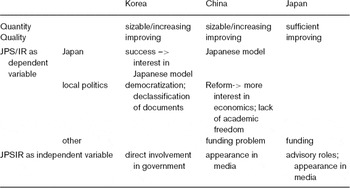
Table 7 summarizes the arguments made so far. First, in terms of the quantity of Japanese political studies and international relations scholarship, there are a sizeable number of scholars in all these countries that we have examined, and the number is increasing year by year, at least in Korea and China. The quality of research is less clear, but given the appearance of new research topics and innovative research approaches in all three countries, it can be tentatively concluded that quality is improving as well.
Summary of findings

We have examined various factors that influence JPSIR in these countries. Obviously, changes in Japan affect the nature of Japanese studies in all these countries. In Korea, the rise of Japan, first economically, and then militarily, led scholars to study first the political economy of Japan and then the growing military role of Japan in Asia. In China, there is strong interest in the Japanese model. Domestic politics in these countries also affect Japanese studies. We can conclude that democratization in Korea has had a very healthy impact on JPSIR. On the other hand, lack of academic freedom in China remains a severe constraint. Lack of funding still remains a significant problem in China.
Finally, we have discussed the impact of JPSIR on government policy and public opinion. The conclusions in this section are inevitably tentative because of the anecdotal and fragmentary nature of evidence. In Korea, there is a distinct possibility of JPSIR scholars influencing official policy because of their direct involvement in policy making. The role of Chinese and Japanese scholars remains more marginal in comparison, but there is a possibility that some influence is being exerted, and the story of the Higuchi report is a case in point. The impact on public opinion is also elusive, but scholars are increasingly exposed to the mass media in all three countries and if they can speak in a coherent voice, there is a possibility that they will gain some influence in the near future.
About the author
Keisuke Iida is Professor in the Graduate School for Law and Politics at the University of Tokyo. He holds a Ph.D. from Harvard University and has formerly taught at Princeton University and Aoyama Gakuin University. His major publications include Legalization and Japan: The Politics of WTO Dispute Settlement (2006) and International Monetary Cooperation among the United States, Japan, and Germany (1999). His current research interests include the politics of regional integration in East Asia, the comparative study of dispute-settlement institutions in the world, and the political economy of financial and currency crises.