Introduction
Obesity is a serious health concern for children and adolescents in the US. Recent estimates maintain that the prevalence of obesity has increased dramatically. For children aged 2–5 years, it increased from 5% to 8.4% within a decade; for those aged 6–11 years, it increased from 6.5% to 17.7%; and for those aged 12–19 years, it increased from 5% to 20.5% (Ogden et al., Reference Ogden, Carroll, Curtin, McDowell, Tabak and Flegal2006, Reference Ogden, Carroll, Kit and Flegal2014).
Children’s obesity is related to the material conditions in the household. That is, their physical well-being is predicated on the ability of their caregivers to provide care and a proper diet (Bradley & Corwyn, Reference Bradley and Corwyn2002; Conger & Donnellan, Reference Conger and Donnellan2007). For these reasons, parental socioeconomic status is paramount in guaranteeing the welfare of children. Between 1988 and 2008, the prevalence of childhood obesity in the US increased at all income levels, but the greatest increase was seen among boys and girls living at or above 350% of the federal poverty level (Ogden et al., Reference Ogden, Lamb, Carroll and Flegal2010). Generally, families challenged with low levels of education and income are more represented in the obesity pandemic than high-SES families (Parsons et al., Reference Parsons, Power, Logan and Summerbell1999). Low-income families may lack other socioeconomic resources tied to income. Among children in low-income families in 2012, 89% of the parents were unemployed and 86% did not have a high school diploma (Jiang et al., Reference Jiang, Ekono and Skinner2014).
Many studies have suggested parental caretaking (Ford & Labbok, Reference Ford and Labbok1993; Costa et al., Reference Costa, del Pino and Friedman2011; Jones et al., Reference Jones, Pollard, Summerbell and Ball2014) and parental characteristics (Shrewsbury & Wardle, Reference Shrewsbury and Wardle2008; Elder et al., Reference Elder, Arredondo, Campbell, Baquero, Duerksen and Ayala2010; Verropoulou & Basten, Reference Verropoulou and Basten2014) are powerful mechanisms that explain the SES–child weight relationship. Although weight gain is shaped largely by health behaviours (Baranowski et al., Reference Baranowski, Cullen, Nicklas, Thompson and Baranowski2003), it is not the case that all children who are in low-SES households with parents with low levels of education gain more weight than children not in those environments. Thus, it is important to note that when comparing weight outcomes among children with low- and high-educated parents, SES is not randomly assigned. Several factors can influence the extent to which parents can achieve high levels of education, and those mechanisms may affect the physical health of their children. Prior work has controlled for many of these factors in standard regression models (Fertig et al., Reference Fertig, Glomm and Tchernis2009). However, many of the studies have typically ignored the issue of non-randomness in educational attainment. Further, controlling for these factors may still not lead to statistically unbiased parameter estimates (DeMaris, Reference DeMaris2004), which could lead to faulty conclusions regarding the mechanisms that link parental education to child weight.
The purpose of this study was to explore selectivity in maternal education, and test whether that selection has an effect on the two major mechanisms (caretaking and parental characteristics) that are associated with both education and child weight. Specifically, it addresses the possibility that parental education effects on child weight that have been seen in prior research stem from the socio-biological link between parents and grandparents. Conversely, the research also suggests the possibility that there may be something qualitatively different about low- and high-educated mothers that could help explain socioeconomic differences in child weight.
Parental socioeconomic selection, grandparental SES and grandchild health
While parental SES and child health are linked, researchers have also been concerned with contextualizing ‘the long arm of the family’ (Modin & Fritzell, Reference Modin and Fritzell2009) to explore whether intergenerational health risks can be transferred (Lawlor et al., Reference Lawlor, Andersen and Batty2009). Medical research, particularly within the field of life-course epidemiology, has found a significant relationship between grandparental socioeconomic status and the health of their grandchildren. Recent research suggests that grandparental SES does relate to the health of their children and their children’s children. However, it seems that only some SES measures are important predictors of child health depending on which grandparent SES measure is used.
Generally, the effects of SES span across generations. Lower levels of grandparental SES has been shown to predict worse adult health outcomes for their grandchildren. Relying on the Danish Civil Registration System, Osler et al. (Reference Osler, Andersen, Lund and Holstein2005) found that all-cause mortality in young adulthood increased with the number of working class parents and grandparents within the family. Thus, there is a cumulative effect of parental and grandparental socioeconomic position on adult mortality outcomes. Likewise, Modin and Fritzell (Reference Modin and Fritzell2009) used the Uppsala Birth Cohort Multigeneration database and found that young men whose maternal or paternal grandfathers were poor had higher average BMI scores than young men whose grandfathers were not poor. However, only the grandfather’s economic position (measured by annual earnings) significantly predicted young men’s BMI. This relationship persisted after controlling for parental SES. Thus, there is evidence of a longer time frame of influence through which earlier generational family socioeconomic position affects child health (Galobardes et al., Reference Galobardes, Lynch and Smith2004; Smith, Reference Smith2009).
Interestingly, grandmother’s SES is consistently found not to be a significant predictor of non-residential grandchildren’s health. Part of the explanation of this finding is that the data were collected for a generation where very few grandmothers worked (Modin & Fritzell, Reference Modin and Fritzell2009). As such, it would be the grandfather’s income that would affect the early life circumstance of the parent, which could matter for the grandchild’s health (Currie, Reference Currie2009). Conditional on the parent’s SES, grandfather’s income should matter because it may provide material assistance to their children when they become parents. This kind of backup economic security could directly benefit the child’s health when the parent’s socioeconomic condition may not be adequate to care for the child.
In addition, grandfather’s income could provide the material conditions necessary for the parents to be healthy, which could help in elevating one’s socioeconomic position. The literature has consistently shown that intergenerational income mobility has remained constant in the US over several decades (Lee & Solon, Reference Lee and Solon2009; McIntosh & Munk, Reference McIntosh and Munk2009). Moreover, healthy parents from high-SES families are likely to be on a trajectory for excellent health later in life (Van de Mheen et al., Reference Van de Mheen, Stronks, Looman and Mackenbach1998; Braveman et al., Reference Braveman, Cubbin, Egerter, Chideya, Marchi, Metzler and Posner2005). Healthy parents with socioeconomic resources would then be able to provide material conditions for their children to be healthy (Teasdale et al., Reference Teasdale, Sorensen and Stunkard1990).
However, as mentioned previously, grandmother’s SES does not seem to be influential in predicting their grandchildren’s health. Specifically, recent research has found that grandchild’s level of obesity is not influenced by any grandmaternal characteristics such as income or BMI (Bao et al., Reference Bao, Desai, Christoffel, Smith-Ray and Nagle2009). Moreover, the prevalence of obesity among children is higher among parents than grandparents for those who engage in bariatric surgery, indicating a two-generation effect rather than a three-generation one (Bao et al., Reference Bao, Desai, Christoffel, Smith-Ray and Nagle2009). This is not to say that grandmothers are not influential in the parent’s socioeconomic attainment. Much like the indirect effects that grandfather’s income has in their grandchildren’s health, grandmothers may also be instrumental in placing the parent on a healthy trajectory. Consistent with the health–behaviour model (Dressler et al., Reference Dressler, Oths and Gravlee2005), grandmother’s lifestyle and health during pregnancy may determine the parent’s fetal development. This ‘prenatal programming’ (Osler et al., Reference Osler, Petersen, Prescott, Teasdale and Sorensen2006) has been shown in studies to be influential in curbing later adult disease.
There are three important critiques of the research on grandparental SES and grandchildren’s health that informs this research. First, the data that have been used to test this relationship have been internationally focused. It is difficult to assert that this argument holds in the US context without data to test the claim, since the US has a different social class configuration than the other societies where the previous data originated. Also, the strength of the relationship between parental SES and child health differs across countries (Gregg et al., Reference Gregg, Propper and Washbrook2007). The combination of these two suggests that extrapolation from international research may not be accurate.
Second, this line of research has predominately described men. Early empirical literature on intergenerational mobility, particularly within the US, has focused on the association between fathers and sons. While some of the rationale for focusing on this relationship stems from institutionalized sexism (Chadwick & Solon, Reference Chadwick and Solon2002), it is also feasible that women’s earnings may have been an unreliable indicator of their SES, since their participation in the labour force, albeit increasing over several decades, has been traditionally lower than men’s. In addition, some studies (e.g. Solon, Reference Solon1999) have excluded women due to the over-representation of non-earning women in their sample.
Third, the use of earnings as an indicator of SES may not be a fair proxy for SES. Income is the metric of choice in economic research because of its convenience in suggesting a physical transfer across generations. However, as one of the most widely used indicators of socioeconomic position (Krieger et al., Reference Krieger, Williams and Moss1997), education has been seen as a longstanding proxy for social class and is often correlated with income (Geyer et al., Reference Geyer, Hemström, Peter and Vågerö2006). However, these two distinct concepts can be disentangled. In a time where education was not heavily relied upon for gainful employment among men, education was used to elevate social class among women (Osler et al., Reference Osler, Petersen, Prescott, Teasdale and Sorensen2006). Thus, it may be beneficial to use grandmother’s education over income. Several review articles have stressed the significance of counting parental education as a valid measure of child socioeconomic resources that are relevant to the health of the child (Hauser, Reference Hauser1994; Zill, Reference Zill1996). Although indirectly related to the socioeconomic attainment of grandfathers, education may be instrumental in the successful healthy birth of their children. A healthy birth may curb disease in later life, which could enable them to have a level of socioeconomic status that would allow them to have a healthy child (i.e. the grandparent’s grandchild).
Theoretical background
In general, proper child weight is determined by many factors, including the material conditions and the parenting practices within the household, which are the most salient. ‘Investment theory’ (Becker, Reference Becker1981) suggests that child weight can be affected by material conditions because money buys care items that the child needs, such as nutritious food and medical consultations. If children do not have the necessary care, then they are likely to consume inexpensive, calorie-dense foods (Pine et al., Reference Pine, Goldstein, Wolk and Weissman2001) and exercise less (Yen & Kaplan, Reference Yen and Kaplan1998), leading to weight gain (Miech et al., Reference Miech, Kumanyika, Stettler, Link, Phelan and Chang2006). According to this theory, more affluent families pass on superior endowments and invest in their children’s physical well-being in ways that poor parents cannot.
To compliment, ‘good-parent theory’ (Mayer, Reference Mayer1997) surmises that having low SES prevents individuals from being effective parents because of the non-monetary investments that come with being of low SES. For instance, low-SES individuals may be working long hours for fear of losing their job or in order to make ends meet (Ehrenreich, Reference Ehrenreich2001). As such, parent’s interactions with their child would be limited, resulting in no transference of cultural capital from parent to child.
Whether material conditions give high-SES children the edge to be successful through the investment that mothers make, or give low-SES parents the burden of balancing life concerns of near-poverty with their child’s socio-educational development, it is still important to recognize that there are intergenerational links between SES, parenting and child weight status. As previously mentioned, high levels of mother’s SES (education) and father’s SES (income) improve the chances of their child being born healthy, which would situate the child to have high levels of SES in adulthood. As the child becomes a parent, they are able to draw upon the material resources of their parents (if necessary) to increase the likelihood of their child being born and staying healthy. In addition, learned behaviours of how to take care of a child would come from how the parent was reared (Benasich & Brooks-Gunn, Reference Benasich and Brooks-Gunn1996). According to prior research, parenting in one generation is predictive of parenting in the next generation, with correlations ranging from 0.2 to 0.4 (Belsky, Reference Belsky2005; Conger et al., Reference Conger, Belsky and Capaldi2009). Positive intergenerational transmission of parenting may benefit child health while negative parenting across generations could potentially affect the health of the child in detrimental ways. For instance, lower SES parents are more likely to use force or authoritarian dispositions to correct child behaviour, which could lead to physical abuse (Hoff et al., Reference Hoff, Laursen and Tardif2002; Hoffman, Reference Hoffman2003).
Studies have shown that socioeconomic status influences the quality of childrearing, and other studies indicate that SES is transmitted from parents to children (Bowles & Gintis, Reference Bowles and Gintis2002; Conger & Donnellan, Reference Conger and Donnellan2007). Recent research found that the poverty of parents predicted financial stress for their adult children, which was related to parenting in both generations (Thornberry et al., Reference Thornberry, Freeman-Gallant, Lizotte, Krohn and Smith2003, Reference Thornberry, Freeman-Gallant and Lovegrove2009). However, a critique of these studies is that SES is measured using only one measure, usually income. Education may be more tied to the parenting process, particularly for mothers, based on the argument that the other SES measures may not have the same variability in the population as parenting strategies have. To clarify, because mothers may not have worked and because they have zero-incomes, their education could be a factor that could differentiate good models of parenting from poor models. In this case, good models would then be beneficial to the child’s health.
Hypotheses
Because of the nature of this research, two sets of hypotheses are discussed. The first set of hypotheses focus on the educational selectivity of the mother. Based on the literature on degree attainment, some variables are expected to predict mother’s educational attainment. Because research indicates racial differences in educational attainment primarily due to structural disadvantage in society (Hochschild, Reference Hochschild1996), white mothers, compared with blacks and Hispanics, will have a higher likelihood of completing their high school education and seeking higher degrees (H1a).
Based on the work regarding intergenerational transmission of socioeconomic position, grandmother’s education should also positively predict educational attainment. That is, the mother will have a greater chance of completing high school if the grandmother (i.e. her mother) also completed high school (H1b).
Family structure is also important to understand educational attainment (Biblarz & Raftery, Reference Biblarz and Raftery1999; Sandefur & Wells, Reference Sandefur and Wells1999; Ginther & Pollak, Reference Ginther and Pollak2004). As such, mothers who come from two-parent families will be more likely to complete high school compared with mothers who are not from intact families (H1c).
Since having interruptions in the education process places women at a higher risk of dropping out of school (Neild et al., Reference Neild, Stoner-Eby and Furstenberg2008), mothers who experience a birth prior to their 18th birthday will have a lower likelihood of completing their high school education, compared with mothers who experienced a birth at age 18 or higher (H1d), when it is assumed that their high school education career would be successfully completed.
The second set of hypotheses tests how the mother’s and child’s characteristics affect the child’s weight. Demographically, mother’s age (H2a), mother’s BMI (H2b) and non-married mothers (H2c) should be associated with high child BMI. Children who were born with low birth weight (H2d) and children who were not breast-fed (H2e) are hypothesized to be associated with high BMI.
Lastly, although grandmother’s educational attainment is hypothesized to predict mother’s educational attainment, it is also expected that grandmother’s educational attainment will not significantly predict (grand)child BMI. However, because of the statistical technique used, this hypothetical assumption cannot be empirically tested in this research.
Data and Methods
To explore the issue of selectivity in parental education and the impact of that selectivity on child weight, this research used data from both the NLSY79 (National Longitudinal Study of Youth 1979) and the NLSY Child/Young Adult Supplement. The NLSY79 is a nationally representative sample of 12,686 young US men and women who were 14–22 years old when they were first surveyed in 1979. These individuals were interviewed annually through 1994 and biennially from 1994 to present. The NLSY Child and Young Adult supplement is a survey of all children born to NLSY79 female respondents starting in 1986. While the NLSY79 contains all the pertinent information on the parents, the child supplement includes assessments for each child as well as demographic and developmental information. This research uses two waves of data from these sources: 1979 data from the NLSY for the mother’s and grandmother’s information as well as the 1994 data from the NLSY Child and Young Adult Supplement for the child’s information. Data from 1994 were used because it was the first wave of data where the children were split into two different samples (i.e. children and young adult), creating the largest sample size to date.
In order to specify the population of interest, several parameters for inclusion in the analytic sample had to be properly identified. First, mothers who had already given birth to a child prior to the start of the 1986 supplement were excluded since this research was interested in examining pre-birth socioeconomic conditions. Second, all children who were not first births since 1986 were excluded since the research was concerned with the first birth in the household. Lastly, households in which the grandmother or grandfather resided with the parent were excluded, since caregiving grandparents may offer a health benefit to the grandchild through direct money transfers within the household.
Child weight
As a measure of child weight, child BMI z-score is the gender/age standardized version of the child’s BMI in 1994. Children (or mothers, when appropriate) who were between the ages of 2 and 20 were asked for their height (in inches) and their weight (in pounds). Alternatively, the interviewer may also have been given permission by the parent(s) to measure the child physically. Although the legal age of adulthood in the US is 18 (US Department of State, 2015), this research used children under the age of 20 in order to capture the full range for children and teenagers. In order to account for age and gender components to child physical development using population-based data, the standardized child BMI z-score was calculated using the ‘zanthro’ command in Stata (Vidmar et al., Reference Vidmar, Cole and Pan2013). This function was developed ‘to allow transformation of child anthropometric data to z-scores using the LMS method and the reference data available from the 1990 British Growth Reference and the 2000 US CDC Growth Reference’ (Vidmar et al., Reference Vidmar, Carlin, Hesketh and Cole2004, p. 1). Information on the LMS method that the Centers for Disease Control and Prevention used to create the 2000 growth charts are discussed elsewhere (Kuczmarski et al., Reference Kuczmarski, Ogden and Guo2002; Flegal & Cole, Reference Flegal and Cole2013).
Parental socioeconomic status
Mothers were asked to report the highest grade or year of regular school that they completed by 1994. A variable mother’s years of education was created to indicate the highest grade completed prior to the child’s birth year. In the original data, mothers who specified more than 20 years of education were given a value of 20. Based on this continuous measure, four categorical variables were created, indicating whether the mother had less than a high school degree, graduated high school, completed some college coursework or graduated from college.
Mother’s characteristics
Mother’s characteristics are important for this research since they contextualize how heredity and social disadvantage may play a role in reproducing intergenerational transfers of health. Mother’s age was captured by self-report. Mothers were asked for their height (in inches) and their weight (in pounds). With these measurements, BMI was then calculated, and four distinct groupings were made based on the Centers for Disease Control and Prevention guidelines (NHLBI, 1998): underweight (BMI<20), normal weight (20≤BMI<25), overweight (25≤BMI<30) and obese (BMI≥30). In addition, respondents were asked their marital status. The responses were collapsed into categories of never married, married (which includes those mothers who re-married) and divorced (which include mothers who were legally separated or widowed).
Children’s characteristics
Children’s demographic characteristics also play an independent role in determining child health. If a child weighed less than 5.5 pounds at birth, the child was coded as having low birth weight. Child breast-fed is a categorical variable that indicates through mother’s self-report whether the child was breast-fed during the first years of life. Race was defined through self-report and was represented by three distinct categories: non-Hispanic white, non-Hispanic black and Hispanic. Gender was also defined through self-report, with males being the comparison category. Also, to account for the fact that not every child was born in the same year, child’s age was included.
Selection criteria
Variables theoretically tied to a mother’s decision to complete high school or college that are unrelated to child’s BMI were also included. Grandmother’s education, or the number of years the grandmother had of completed education, is the variable that best satisfies the selection criterion. Two other selection variables include intact family, which corresponds to whether the mother lived with two biological/adoptive/step-parents at age 14, and teen birth, which indicates whether the mother reported giving birth prior to her 20th birthday.
Analytic strategy
Endogenous selection regression models are ideal for testing how heredity and environment influence weight gain. These models are concerned with whether the dependent variable (i.e. child’s BMI) is a function of a multinomial regime (i.e. mother’s education) (Miranda, Reference Miranda2004). The ‘oheckman’ command in Stata 13.1 (Chiburis & Lokshin, Reference Chiburis and Lokshin2007) was used to estimate the selection criterion equations and the equations to predict child BMI. This command implements full information maximum likelihood that fits both multinomial and continuous parts of the model in order to yield consistent standard errors (Lokshin & Sajaia, Reference Lokshin and Sajaia2004). Other commands for endogenous selection regression models were fitted one equation at a time by either two-step least squares or maximum likelihood estimation, which does not yield statistically consistent standard errors (Kim, Reference Kim2006; Kim et al., Reference Kim, Piger and Startz2008). Thus, the ‘oheckman’ command can allow for simultaneous modelling of the selection regime and the prediction equation. Information on the functional forms for the endogenous selection regression model can be found in the work of Chiburis and Lokshin (Reference Chiburis and Lokshin2007).
Results
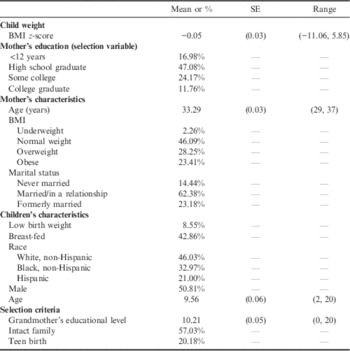
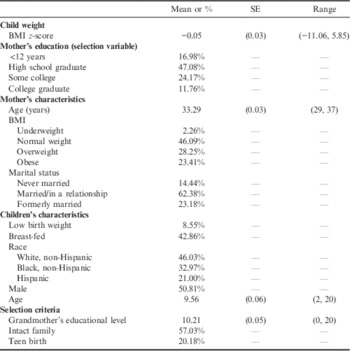
Table 1 presents the means/percentages and standard errors of the variables used in this research. This table gives an overall description of the sample. The average BMI z-score was −0.05, indicating that the children were, on average, at the 48th percentile of BMI according to age and gender. For reference, children between the 5th and 85th percentiles are considered to be of healthy weight.
Unweighted means, percentages and standard errors for sample characteristics (N=5229)
Source: US National Longitudinal Surveys. Note that percentages may not add up to 100% due to rounding.
The two SES variables used in this research were focused on mother’s educational attainment. About 17% of mothers in 1994 did not complete high school prior to the birth of their first-born child. However, nearly half (47%) completed high school and another quarter (24%) had taken some college courses. There were an additional 12% who had at least graduated from college. Thus, this sample consists of highly educated women.
Turning to mother’s characteristics, the average age of mothers in this sample was 33 years. Nearly half of the mothers in the sample (46.1%) were of normal weight. However, about 28% were overweight and 23% were obese according to CDC guidelines. There was a small percentage (2.3%) of mothers who were underweight. Around 14.4% of mothers had never been married as of 1994. The vast majority (62.4%) were married or in a relationship in 1994. About 23.2% of mothers were divorced, separated or widowed in 1994.
For the children’s characteristics, nearly 9% of the children were born with low birth weight (which is very close to national estimates), but nearly half (42.9%) were breast-fed during childhood. White children represented 46% of the sample, while blacks constituted 33% and Hispanics made up 21%. Slightly over half (50.8%) of the children in the sample were male. The average age of children was 9.6 years.
Lastly, some of the selection criteria were based on the previously mentioned variables. Among mothers, the average number of years of education completed by their mothers was 10.2. At age 14, 57% of the mothers lived in an intact (i.e. two-parent) family. Lastly, based on mother’s age at childbirth, one-fifth (20.2%) of mothers experienced their first birth in their teenage years.
Mother’s selection into education through grandmother’s completed education
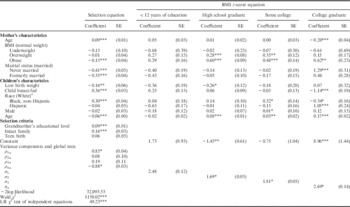
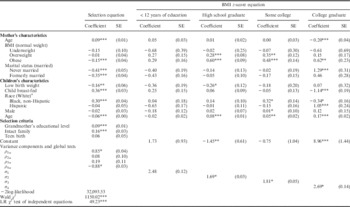
Table 2 presents the Full Information Maximum Likelihood (FIML) estimates and standard errors of the endogenous selection regression models predicting child’s BMI using grandmother’s education as the main selection criterion. Here, childhood BMI z-score and the mother’s selectivity in being in one of four educational categories were modelled simultaneously, allowing for correlation of the effects of the unobserved characteristics. The selection equation predicts the probability of the mother falling in four different categories: not finishing high school, graduating from high school, obtaining some college training or graduating from college. Because the mother’s education variable in the selection equation is an ordinal measure, it was treated as approximately continuous in the regression. As such, the coefficients can be interpreted as affecting the likelihood of the mother obtaining higher levels of education. Mother’s age positively selects on education, indicating that older mothers were likely to obtain higher levels of education than younger ones. However, obesity negatively selects on education, suggesting that obese mothers were much less likely to have higher levels of education relative to mothers who were of normal weight. Regarding marital status, never married and formerly married mothers were less likely to obtain higher levels of education compared with mothers who were married.
Full Information Maximum Likelihood (FIML) estimates and standard errors of ordinal selection models for mother’s education using grandmother’s completed education as the main selection criterion (N=5229)
Source: US National Longitudinal Surveys. Reference categories are in parentheses.
aChild’s and mother’s race are the same.
*p<0.05; **p<0.01; ***p<0.001.
The mother’s educational selectivity was also associated with later outcomes among the children. If children were born with low birth weight, it indicates their mothers were statistically less likely to have higher levels of education, relative to children who were not born with low birth weight. However, if the children were breast-fed, mothers were more likely to have higher levels of education, compared with children who were not breast-fed. Because the child’s race and the mother’s race were identical in the NLSY, the race selection can be interpreted in two ways: first, that black mothers were less likely to have higher levels of education than whites, or second, that black children were less likely to have mothers who have higher levels of education compared with white children. This finding is consistent with the first hypothesis (H1a), namely that white mothers, compared with black and Hispanic mothers, had a higher likelihood of obtaining more education. Also, mothers with older children were negatively selective of having higher levels of education. Since these data were from 1994, this result was expected, as older children would indicate early births during the completion of their high school education.
There were also significant effects from the retrospective variables used to identify selection factors for mother’s education. Mothers were positively selected to have high levels of education if their mothers (or, rather, the child’s grandmother) also had high levels of education. This finding is consistent with the second hypothesis (H1b) regarding the intergenerational transmission of socioeconomic position.
Mothers from an intact (two-parent) family when growing up were more likely to have highly educated mothers. The finding provides support for the third hypothesis (H1c), that family structure is important in understanding maternal educational attainment.
The last selection criterion, which tested the fourth hypothesis (H1d), was not statistically significant, suggesting that mothers who gave birth when they were in their teens had the same likelihood of having higher levels of education as those mothers who waited until after their teens to have their child.
The remaining four equations modelled the child’s BMI z-score allowing for endogenous education selection of the mother for each of the mother’s educational categories discussed earlier. In this manner, the BMI outcome was modelled separately by mother’s completed education, but information on the mother’s educational selectivity was used in each of the stratified models. For those mothers who did not complete high school, marital status negatively predicted child BMI. That is, mothers who were never married or who were formerly married had children with lower BMIs than mothers who were married (H2c). Low-birth-weight children with mothers who did not complete high school were associated with lower BMIs than children of normal birth weight (H2d). Also, Latino children in families where the mother had not finished high school were associated with lower BMI compared with whites.
For mothers who completed high school, being overweight or obese was associated with higher BMI scores for their children relative to being of normal weight (H2b). Low-birth-weight children with mothers who completed high school were associated with lower BMI than children of normal birth weight (H2d). Also, older children of mothers who completed high school were associated with higher BMIs than younger children.
For mothers who had completed some college courses, being overweight or obese was associated with higher BMI scores for their children relative to being of normal weight (H2b). Non-Hispanic black children whose parents had not graduated from college were associated with a higher BMI compared with whites in a similar home environment. Boys had slightly higher BMIs than girls among mothers who completed some college. Similarly, older children of mothers who completed some college were associated with higher BMIs than younger children.
For mothers who had graduated from college, older mothers were associated with lower BMIs than younger mothers (H2a). Being obese as a mother was associated with higher child BMI scores relative to being of normal weight (H2b). Also, mothers who were never married had children with higher BMIs than mothers who were married (H2c). Among mothers who graduated from college, those who breast-fed their child had children with lower BMIs than parents who did not breast-feed their child (H2e). Black children in families where the mother had graduated from college were associated with a lower BMI compared with whites. Conversely, Hispanic children were associated with higher BMIs relative to whites. Lastly, older children had higher BMIs than younger children among mothers who graduated from college.
Variance components
The variance components are presented as well to showcase significant observed and unobserved variation. For the selection equations, the two rhos (ρ) are statistically different from zero. The rho for the selection equation for mothers who had less than 12 years of education was positive, suggesting that mothers who choose to graduate from high school have children with higher BMIs than a random woman in the sample who had a child. The rho for the selection equation for mothers who had graduated from college was negative. This model suggests that mothers who choose to graduate from high school have children with lower BMIs than a random woman in the sample who had a child. However, for mothers who graduated from high school or who had completed some college courses, their children do not fare better or worse than a random mother. The sigma (σ) parameters indicate significant variation in child BMI that is not accounted for by selection-adjusted models by mother’s education.
Discussion
This research investigated how child weight is influenced by selectivity in mother’s education. Prior research on parental education and child BMI has not thoroughly addressed how the heredity and material conditions prior to a child’s birth influence child’s health. The results of this study suggest that socioeconomic selectivity plays, and will continue to play, a powerful role in explaining child weight.
When predicting selection into higher levels of education among the mothers, the results were consistent with prior research. Obese mothers in the sample were less educated than mothers of normal weight. Being single or formerly married negatively selected on poor education. The disparate effects of divorce on degree completion are complex. On the one hand, compared with being married, divorced mothers are less likely to choose to complete their high school degree. Divorced mothers may be living on fixed means because of inadequate amounts of child support/alimony (Espenshade, Reference Espenshade1979; Bianchi et al., Reference Bianchi, Subaiya and Kahn1999). As such, they may decide that finding a job to take care of the family’s needs is better than an academic investment. On the other hand, divorced mothers are more likely to choose to complete their college degree, compared with married mothers. The decision to pursue a college education may have been made in order to acquire the level of SES the family had before the divorce. However, for this sample, this decision may not have been made, as formerly married mothers were less likely to have higher levels of education compared with currently married mothers.
Interestingly, blacks in the sample were more likely to have higher levels of education than whites in the sample. It is possible that the NLSY design sampled highly educated blacks. It could be true, since the NLSY79 collected a supplemental sample (not included in these analyses) that oversampled ‘African-American, Hispanic, economically disadvantaged white, and military youth’ (Bureau of Labor Statistics, 2014).
Grandmother’s educational level was the major selection criterion that was unrelated to (grand)child BMI but was related to mother’s education. The results suggest that using this criterion is appropriate for determining parental socioeconomic influences on child BMI. Future studies should attempt to control for the selection bias in the relationship between parental education and child weight by including this measure. Also, being in a two-parent family was related to parental education and not to child BMI. Some research has used the intact family variable as a measure to adjust for familial influences on diet, and as a proxy for measures such as social class or two-parent income streams (McLanahan & Bumpass, Reference McLanahan and Bumpass1988). However, having an intact family was used as part of the selection criterion instead of an independent predictor of BMI because being in a two-parent family may select mothers who are higher educated or who are able to complete their education prior to the birth of their child because of the potential of having dual social and economic supporters of their goals. In either of these situations, intact families are not just on the causal pathway to child health, but they represent a level of selectivity that would be unaccounted for by simply including it as a control variable. In addition, children from intact families receive more encouragement and more help with school work than children who are not in those families (Astone & McLanahan, Reference Astone and McLanahan1991). Alongside positive parental involvement, children from intact families benefit by having two parents in the home to convey the socialization message that education is critical, compared with having only one residential parent delivering that message in non-intact families.
It is interesting that having a teen birth is not selective on mother’s education in this research. Literature and public discourse suggest that teen births set mothers on a downward education trajectory (Hoffman et al., Reference Hoffman, Foster and Furstenberg1993), which leads to low levels of SES. However, the finding that it is not selective on mother’s education could stem from contemporary research that suggests that interventions that kept teen mothers in school may have not placed them in poor socioeconomic standing, and did not hamper their educational aspirations (Zachry, Reference Zachry2005; Sadler et al., Reference Sadler, Swartz, Ryan‐Krause, Seitz, Meadows‐Oliver, Grey and Clemmens2007; SmithBattle, Reference SmithBattle2007). In this manner, teen mothers could have relatively similar educational outcomes to non-teen mothers.
When adjusting for the selection criterion, three interesting patterns arose from the analyses that predicted child BMI. First, among mothers who had not completed high school, their BMI had no effect on the child’s BMI. However, this was not the case for mothers who had completed at least high school education. Remembering that these analyses are controlling for grandparental education selection and teen mother selectivity, it is possible that stay-at-home mothers in relationships where there is an effective breadwinner in the household are over-represented in this analysis. Regardless of their own eating habits and their sedentary behaviour, the mothers could still be providing healthy nutrition and adequate time for physical activity for their children. However, future research should attempt to test this explanation, as this research could not test this argument.
Second, marriage was not of uniform benefit to lowering child BMI for all the education categories. While it was beneficial among college-educated mothers, there was no effect for any other groups, with the exception of low-educated mothers with less than 12 years of schooling. In this case, not being married was associated with lower child BMI. If this reverse selectivity is robust across samples, it may suggest that policy that encourages marriage among low-income persons could perhaps provide some tangible socioeconomic benefits in the household, but it may not be ideal for protecting the physical health of children in the household.
Third, the effect of race differed across all categories. Keeping in mind that the NLSY sample may have already selected on highly educated blacks, the results suggest that white children were more likely to be obese than black children among mothers who completed college. While some research suggests that college-educated blacks have higher risks of obesity than whites regardless of their educational level (Ogden et al., Reference Ogden, Lamb, Carroll and Flegal2010), this research has not been fully developed and future research should attempt to explore the robustness of the race–SES relationship in child BMI.
In addition, among low-educated mothers, Hispanic children were likely to have lower BMIs than white children. Perhaps a nutrition epidemiologic paradox, this finding may also be a function of the neighbourhoods in which the residents live. If the Hispanic children with low-SES mothers in this sample were living in immigrant neighbourhoods, it is possible that they were more likely to have better access to healthy foods despite having worse environments with respect to physical activity (Osypuk et al., Reference Osypuk, Diez Roux, Hadley and Kandula2009). However, without actual geographical information on the children, it was not possible to test this hypothesis.
These research findings, which are against the mainstream research on racial differences in child BMI, were not found in the other education classes in this research. The socioeconomic differences in child health between whites and Hispanics have been longstanding in the literature. Recently, some research suggests that behavioural changes in diet and exercise reverse the potentially negative effects of lifestyles associated with a more modern life (Popkin & Gordon-Larsen, Reference Popkin and Gordon-Larsen2004). However, for Hispanics, this may not be the case, as higher-educated mothers may be actively acculturating to a more sedentary lifestyle as well as increased consumption of sugar, fat and processed foods (Van Hook & Balistreri, Reference Van Hook and Balistreri2007). This may explain why Hispanic children whose mothers graduated from high school have higher BMI scores than white children. However, Hispanic mothers who do not go to high school place their child at risk of being underweight. Without a basic high school education, Hispanic mothers may not be competitive for steady-paying jobs. As such, they could be relying on external family support (such as extended family or friends) for meals and groceries. This kind of food insecurity may create conditions for the child to be malnourished, which could put the Hispanic child at risk of being underweight (Carmichael et al., Reference Carmichael, Yang, Herring, Abrams and Shaw2007; Weigel et al., Reference Weigel, Armijos, Hall, Ramirez and Orozco2007). This may also explain why Hispanic children whose mothers did not graduate from high school have lower BMI scores than white children.
The results show that, while there are independent effects across mother’s education in predicting child BMI, there was significant variation in the schooling decisions of mothers and the childhood BMI that was unaccounted for by employing these limited variables. Future research should be concerned with identifying those variables that can be used to model these two processes simultaneously and more accurately, since this research suggests that there is some selectivity that past research has not adequately accounted for in statistical models.
From a theoretical perspective, this research is more aligned with good-parent theory than investment theory. Working long hours or not having enough social and cultural capital (non-material investments) through education may have affected the subsequent physical well-being of the child. The differential effects found across education categories provide some support for socioeconomic distinctions for mothers across education attainment as sufficient to proxy for other SES measures such as income or occupation. In this manner, there is some support for good-parent theory in this research. However, it is not a complete argument to say that higher levels of education are beneficial to a child’s weight status. Both the incompletion of high school and the completion of a college degree are associated with high child BMI (as indicated in the ‘constant’ regression estimates presented in Table 2). The social and cultural information obtained through mother’s high school education may have helped lower the child’s risk of being overweight by lowering their BMI, but the increased socioeconomic opportunities associated with a college degree may not work in absolutely benign ways and could exacerbate the risk of gaining weight among children. However, without having all socioeconomic information on the mothers (and other residential parental figures), these results are very tenuous.
This study has some limitations that are worth noting. First, it used only one measure of parental SES (mother’s educational attainment). This again is due to the endogenous selection regression model assumption that individuals have to be able to choose between states. While it is difficult to suggest that individuals can choose income categories, employment or wealth, it is not entirely the case that individuals have the ‘free will’ to complete their high school or college degrees. Structural constraints can still operate to restrict a child’s chances of finishing. Constraints such as poor schools, no parental/community encouragement or engaging in criminal activity can still act as mechanisms that lower one’s chances of graduating (Kozol, Reference Kozol1991).
Second, for a more formal test of good-parent theory, measures of maternal parenting, physical activity and dietary behaviours during the child’s life would have added significantly to this research. Unfortunately, without this information being readily available, it is difficult to make a full account of how good-parent theory helps exacerbate class-based differences in child health.
Third, given the very interesting Hispanic results, it would be worthwhile exploring other racial groups, such as Asians. However, they could not be included because of the small representation in the sample. Fourth, native and immigrant distinctions could not be ascertained in this cohort. This limitation is important for explaining why Hispanic children had high BMIs even when their mothers had a high school diploma. Having a measure that indicated the nativity of the respondents would have helped to solidify this argument. Generally, having information on nativity status and length of residence in the US would have made a stronger racial/ethnic case for how SES determines child health.
Lastly, the educational attainment of mothers in the sample is quite homogenous, possibly due to the cohort selected for this study. That is, a large majority of women in the sample completed high school and among those who completed high school, there was a large majority who completed college. The inclusion of various rates of high school and college completion may have shown even larger contrast effects among those who completed their degrees and those who did not.
This study has furthered the literature on educational selectivity and child weight by inching one step closer to causality by looking at pre-birth educational attainment and subsequent child weight gain and by employing a statistical technique that accounts for endogeneity between SES and child health. The results also contribute to a greater understanding of how a mother’s decision to complete or forego a diploma or a degree can have monumental consequences for their child’s risk of obesity.
The results of this study suggest that race and selection into one indicator of SES seem to be linked. Education, particularly the mother’s, seems to be highly explanatory of children’s BMI, which suggests that increasing maternal education can help curb a child’s risk of being overweight or obese. Future research should explore how programmes designed to help mothers complete high school or college can affect their children’s health. However, for minority mothers, these programmes will only be effective if they also address the structural disadvantage that operates to keep minorities in lower social class standings in society and hinders them from advancing out of their social class. By accounting for this structural disadvantage, this study supplies a better understanding of how educational selection, net of race, affects a child’s physical health.