For a politician, reputation is a crucial commodity. Bad behavior like involvement in a scandal may leave a politician open to damaging criticism from potential opponents. Yet, scandals are hardly automatic political death sentences; some studies estimate that as many as half of American legislators who have been implicated in scandals win reelection (Basinger Reference Basinger2013; Peters and Welch Reference Peters and Welch1980; Welch and Hibbing Reference Welch and Hibbing1997). This suggests that a candidate’s past missteps provide opponents with powerful ammunition under some conditions, but less leverage under others. In this article we focus on one factor that may be particularly influential in determining the extent to which past involvement in a scandal can be used against a candidate: whether it occurred recently or long ago.
Recent events in both congressional and presidential politics demonstrate not only that politicians believe they can overcome the negative effects of previous scandals in some circumstances, but also that their opponents are typically eager to remind voters of those misdeeds. For instance, former Speaker of the House Newt Gingrich sought the Republican presidential nomination in 2012 despite censure by the House of Representatives during a “financial” scandal in 1997, when he was found to have claimed an improper tax exemption. Mitt Romney, one of Gingrich’s primary opponents, issued a press release “celebrating” the 15th anniversary of this censure, presumably to remind voters that Gingrich’s career had not been unblemished.Footnote 1 More recently, former South Carolina governor Mark Sanford, who did not seek reelection to that office in 2010 after his involvement in an adultery scandal the previous year, was elected to represent that state’s First District in Congress. Sanford’s primary opponent—Curtis Bostic—repeatedly referred to Sanford’s affair and described him as a “compromised candidate.”Footnote 2
The scandals in which Gingrich and Sanford were involved varied with respect to the amount of time that had passed when they sought office—Sanford’s was fairly recent, Gingrich’s was not. Yet, each faced attacks from opponents eager to capitalize on character issues, and each man found his past misdeeds to be a reliable part of the media narrative surrounding his campaign. This suggests that politicians implicated in scandals can expect to face character questions stemming from their previous behavior, regardless of the amount of time that has passed since the offense. An unanswered question is whether attacks based on recent misdeeds resonate more with voters than those centered on scandals that occurred long ago.
We report findings from two survey experiments that provide insight into the likely effectiveness of attempts to damage a political opponent by highlighting previous involvement in scandals. One possibility is that people see a misstep that occurred 20 years ago as “old news” that is not particularly relevant to an assessment of an individual’s present-day character. If that is the case, then candidates may have little reason to worry about opponents bringing up skeletons in their closet, so long as sufficient time has passed for the public to view the past behavior as a weak signal of the individual’s character or trustworthiness. However, it is also possible that people see scandalous behavior as a strong and enduring signal about the candidate’s true nature, regardless of whether it occurred weeks or years in the past. If so, candidates may still be vulnerable to accusations of untrustworthiness based on scandals from long ago.
LITERATURE REVIEW AND HYPOTHESES
All else equal, reports that a politician has engaged in scandalous behavior clearly harm his or her career: politicians involved in political scandals are evaluated less favorably (Abramowitz Reference Abramowitz1988; Reference Abramowitz1991; Carlson, Ganiel, and Hyde Reference Carlson, Ganiel and Hyde2000; Doherty, Dowling, and Miller 2011; Funk Reference Funk1996; Groseclose and Krehbiel Reference Groseclose and Krehbiel1994; Jacobson and Dimock Reference Jacobson and Dimock1994; Peters and Welch Reference Peters and Welch1980; Welch and Hibbing Reference Welch and Hibbing1997), have a more difficult time raising campaign funds (Rottinghaus Reference Rottinghaus2014), face higher odds of a high-quality challenger emerging in both the next primary and general elections (Basinger Reference Basinger2013; Lazarus Reference Lazarus2008), and tend to win a smaller vote share in the next election (Basinger Reference Basinger2013; Brown Reference Brown2006). Yet, existing evidence also suggests that voters’ responses to politicians’ missteps depend a great deal on the circumstances involved. For example, people appear to be less inclined to punish politicians embroiled in “moral” scandals (e.g., extramarital affairs) than in “financial” ones (Carlson, Ganiel, and Hyde Reference Carlson, Ganiel and Hyde2000; Doherty, Dowling, and Miller 2011; Funk Reference Funk1996).
Thus, although information about a politician’s involvement in a scandal may signal a lack of character or trustworthiness, the strength of this signal may be conditional. We expect that in addition to the “type” of scandal that embroils a politician, the passage of time may also affect how people treat this signal and ultimately, how they judge scandalous politicians. Experimental studies in both laboratory and survey settings have measured participants’ immediate reactions to vignettes in which the timing of a scandal was omitted or held constant (Berinsky et al. Reference Berinsky, Hutchings, Mendelberg, Shaker and Valentino2011; Carlson, Ganiel, and Hyde Reference Carlson, Ganiel and Hyde2000; Doherty, Dowling, and Miller 2011; Funk Reference Funk1996), but have not varied the length of time since a scandal occurred.
Observational studies tend to examine the immediate ramifications of scandal for a politician’s next election. Political “survival” in these studies is typically defined as a legislator involved in a scandal in legislature t who retains her seat in legislature t + 1 (Basinger Reference Basinger2013; Brown Reference Brown2001; Reference Brown2006; Reference Brown2007; Peters and Welch Reference Peters and Welch1980; Welch and Hibbing Reference Welch and Hibbing1997). Whether the passage of time ameliorates the effects of scandals—that is, whether a scandal at t affects “survival” at t + 2 or later—has only been examined in one study of which we are aware. Praino, Stockemer, and Moscardelli (Reference Praino, Stockemer and Moscardelli2013) find in their study of congressional elections from 1972 to 2006 that the effect of scandal is strongest at t + 1 and then quickly wanes in subsequent elections. However, this work is unable to determine whether this dissipation in effects stems from voters seeing scandals as less indicative of a candidate’s present-day character as they recede into the past, or if it instead can be explained by changes in media coverage of the scandal or other dynamics.Footnote 3
We posit that the passage of time is likely to weaken the extent to which voters view the scandal as a signal of the politician’s true character, particularly in the case of “moral” scandals. For example, we expect that recent involvement in an extramarital affair will tend to be seen as a clear signal of a candidate’s current character. In contrast, having been involved in an identical affair 10 or 20 years ago may be viewed as a weaker signal because it is possible that in the intervening years the candidate’s character has changed. As the amount of time since the past misdeed grows, we would expect the signal provided by the past behavior to be viewed as less meaningful. Thus, as more time passes, the effectiveness of using a past moral indiscretion against a political opponent might be expected to diminish as it comes to be seen as “old news” that says little about a candidate’s present-day character.
Thus, as more time passes, the effectiveness of using a past moral indiscretion against a political opponent might be expected to diminish as it comes to be seen as “old news” that says little about a candidate’s present-day character.
The passage of time may not blunt the damage from all scandals though. Experimental evidence has found that “financial” scandals tend to inflict more damage on politicians than “moral” ones (Carlson, Ganiel, and Hyde Reference Carlson, Ganiel and Hyde2000; Doherty, Dowling, and Miller 2011; Funk Reference Funk1996), perhaps because the former depress evaluations not only of the politician’s personal attributes, but also his or her professional judgment (Doherty, Dowling, and Miller 2011). An additional explanation for this disparity may be that while moral scandals conceivably could happen “in the heat of the moment,” financial scandals typically involve forethought or sustained criminal behavior. Thus, involvement in a financial scandal may be seen as a stronger signal of a politician’s fundamental character than involvement in a sex scandal. Ultimately, it may be more difficult to overcome the negative consequences of financial scandals—even when a great deal of time has passed since the scandal occurred.
EXPERIMENTAL DESIGN, DATA, AND RESULTS
We conducted two survey experiments to examine how the timing of a scandal—whether it occurred recently or long ago—affects the extent to which a political opponent is likely to be able to use it to persuade voters that the candidate in question is unworthy of their support, and also whether such effects differ according to scandal “type” (moral or financial). Each experiment was conducted online and presented participants with a fictionalized biography of a state representative. The full text of each experimental stimulus and all question wording is included in the appendix.
Study 1: Sex Scandals and the Passage of Time
The first study was conducted as part of the 2012 Cooperative Campaign Analysis Project (CCAP). The CCAP was fielded online by YouGov/Polimetrix using both sampling and matching techniques with the goal of approximating an RDD sample. The CCAP is a cooperative project that includes a “common content” section (which includes an array of basic demographic and political questions) and modules designed by individual research teams, each of which take approximately 10 minutes to complete. Our study was included on a team module with a target sample of 1,000 respondents. A subset of 592 respondents was randomly assigned to participate in the experiment we report here. We excluded three additional respondents because they did not provide responses to all items used in the analysis that follows. Summary statistics associated with this sample are presented in column (1) of appendix table A1.
Respondents were asked to read a brief description of a fictionalized state representative running for reelection. In each condition his opponent accused him of being untrustworthy. Respondents were assigned to one of three experimental conditions with equal probability. The first was a control condition that did not include any additional information indicating a lack of trustworthiness. The second and third conditions indicated that the representative had been caught in a scandal in which it was revealed that he had an extramarital affair with a campaign worker—the second condition indicated that the affair occurred 20 years earlier (in 1992); the third indicated that it occurred recently (in 2011). After reading the vignette, respondents rated the representative on several questions. The first question asked respondents how likely they would be to vote for him in the 2012 election on a seven-point scale (very unlikely to very likely).The next two questions asked respondents to rate the job he was doing as a representative (poor to excellent) and how they felt about the candidate “as a person” (negative to positive). Responses to these two questions were measured using a horizontal slider that captured responses on a scale ranging from 0 to 100.We focus our analysis on the effects of the treatments on an index constructed by combining the three items into a mean scale (Cronbach’s alpha = .805) and rescaling the index to have a mean of 0 and standard deviation of 1.
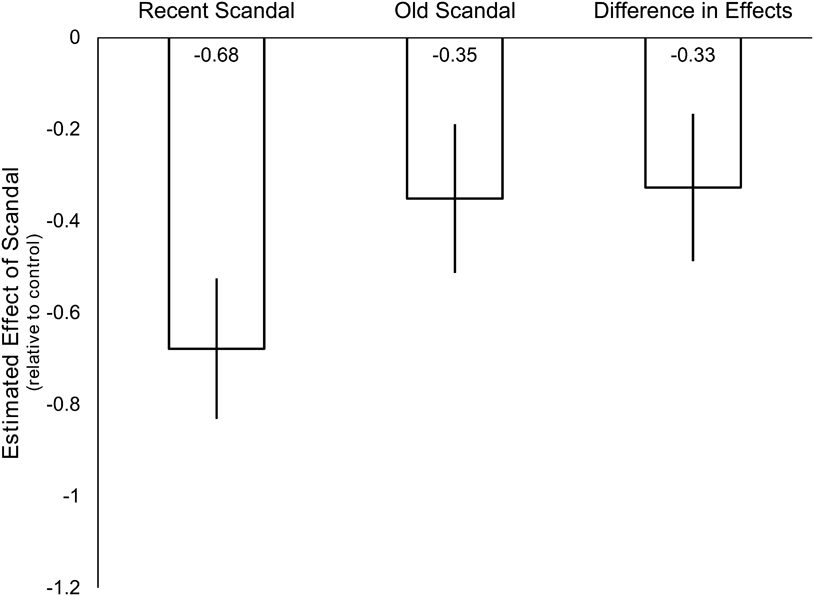
We regressed our measure of summary evaluations of the candidate on the two treatment indicators and a vector of controls that may be expected to affect dispositions toward politicians.Footnote 4 Including these controls modestly reduces the size of the standard errors on the estimated treatment effects but does not affect our substantive findings. This model is presented in column (1) of appendix table A2. We present the estimated treatment effects from this model in figure 1. Whiskers in the figure reflect 90% confidence intervals around these estimates.
Estimated Effects of Old and Recent Sex Scandals (CCAP Study)
Note: Estimated treatment effects from OLS regression model. Whiskers reflect 90% confidence intervals around the estimates. Column (1) of Appendix Table A2 reports the results of the model.

Each of the treatments significantly and negatively affected candidate evaluations. The recent sex scandal resulted in the candidate being evaluated approximately 0.68 standard deviations less favorably than the candidate who was not presented as having been caught in a scandal. When the scandal was described as having occurred 20 years ago, this effect was also negative and statistically significant, but was weaker. Specifically, the “20 years ago” treatment caused the candidate to be evaluated 0.35 standard deviations less favorably than the candidate described in the control condition. The bar on the far right of figure 1 reports the estimated difference in these effect sizes. As indicated by the whiskers, this difference in effect sizes is statistically significant. In summary, the passage of time since the sex scandal occurred resulted in a 48% decrease in the magnitude of the effects of the scandal.
Study 2: Sex Scandals, Tax Evasion, and the Passage of Time
The second experiment was fielded online from August 12, 2013, to August 14, 2013, using participants recruited through Amazon’s Mechanical Turk (MTurk) interface (see Berinsky, Huber, and Lenz Reference Berinsky, Huber and Lenz2012 for further details regarding the use of MTurk to recruit research participants). Participants were paid 50 cents to complete the survey. An initial sample of 715 individuals agreed to participate. Twenty-one respondents whose IP address indicated they were completing the survey from outside of the United States were dropped from the sample, yielding a pool of 694 respondents from the United States. An additional 37 respondents who did not provide usable responses to all of the items used in the analysis, and three respondents who reported being less than 18 years old were also excluded from the analysis, for a final sample size of 654. Summary statistics associated with this sample are presented in column (2) of appendix table A1.
The design of the second experiment was similar to that used in the first experiment, with two exceptions. First, in the second experiment we reduced the amount of time that had passed since the “old” scandal from 20 years to 10 years. Second, we varied both the timing of the scandal and whether the scandalous behavior was an extramarital affair or a failure to pay income taxes. Previously we posited that the mollifying effects of the passage of time on responses to scandalous behavior may be confined to behaviors like extramarital affairs. Such transgressions may be viewed as unsavory missteps that reflect lapses in judgment rather than enduring character flaws like apparent willful refusal to pay taxes. Respondents were assigned to one of the five experimental conditions (control, old sex scandal, recent sex scandal, old tax evasion scandal, recent tax evasion scandal) with equal probability.
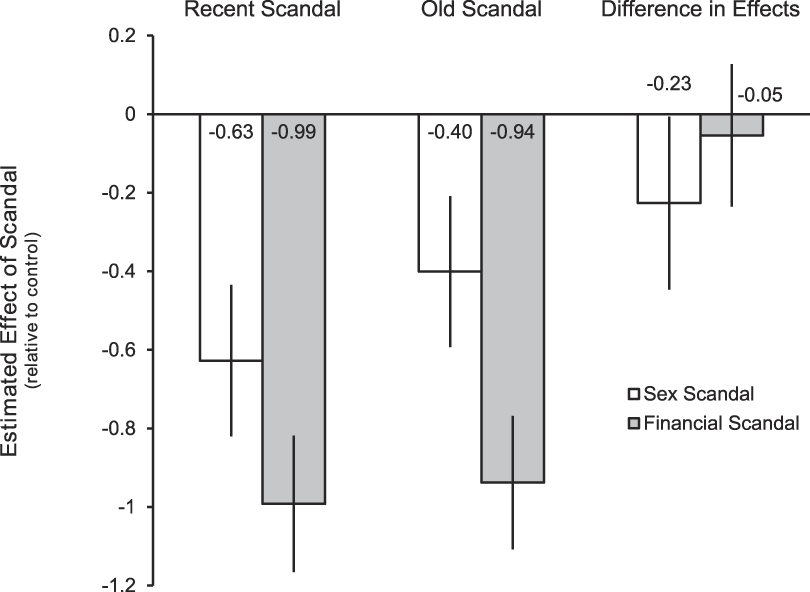
As with the first experiment, our outcome measure is an additive index of three measures of evaluations of the representative in question (Cronbach’s alpha = .840) rescaled to have a mean of 0 and standard deviation of 1.Footnote 5 Again, we regressed this index on the treatment (four) indicators and a vector of controls similar to those used in the first experiment. The regression model is presented in column (2) of appendix table A2. We present the estimated treatment effects from this regression in figure 2.
Estimated Effects of Old and Recent Sex and Tax Evasion Scandals (MTurk Study)
Note: Estimated treatment effects from OLS regression model. Whiskers reflect 90% confidence intervals around the estimates. Column (2) of Appendix Table A2 reports the results of the model.
Several conclusions can be drawn from the findings presented in figure 2. First, each of the four scandal treatments had a statistically significant, negative, and substantial effect on evaluations of the candidate. Second, the effects associated with the sex scandal treatments are similar to those found in the first study: the recent scandal caused the candidate to be evaluated 0.63 standard deviations less favorably (effect from first experiment = -0.69) and the old sex scandal led to evaluations that were 0.40 standard deviations less favorable (effect from first experiment = -.039). The difference in the magnitude of these effects is also, again, statistically distinguishable from zero. Third, the effects of both the recent and old tax evasion scandals were larger than the effects of either sex scandal (p<.05 for all comparisons), suggesting that tax evasion is viewed as a more serious offense for a political candidate than an extramarital affair. Finally, although the passage of time substantially mitigates the negative effects of sex scandals, we find no support for a similar dynamic when it comes to tax evasion scandals. Learning that the candidate was involved in a recent tax evasion scandal caused him to be evaluated 0.99 standard deviations less favorably than a candidate who was not described as having been implicated in a scandal. The comparable effect for a tax evasion scandal that occurred 10 years earlier is 0.94. This difference in effect sizes is small (0.05 standard deviations) and falls well short of conventional levels of statistical significance (p = .624).
Our findings suggest that unlike a moral scandal, a financial scandal such as tax evasion can permanently diminish a candidate’s standing in the eyes of voters.
DISCUSSION: POLITICAL SCANDALS AND THE PASSAGE OF TIME
Few politicians experience an error-free political career. Some of the inevitable missteps that do occur—like misstatements or minor gaffes—are easily managed and ultimately cause little or no harm to the politician’s prospects in the next election. More serious errors like involvement in a scandal may be used by opponents to inflict significant damage. Previous work has found that if politicians are able to make it through one election cycle, the negative electoral effects of a scandal dissipate (Praino, Stockemer, and Moscardelli Reference Praino, Stockemer and Moscardelli2013). Our findings suggest a mechanism for this dissipation—some types of scandal provide a weaker indication of a candidate’s character or capability as the scandalous behavior recedes into the past. Thus, depending on the nature of the scandal, the amount of time that has elapsed may play an important role in determining whether efforts to exploit it to harm a politician in the present are effective. In particular, the evidence presented here makes two contributions to our understanding of the electoral consequences of political scandals.
First, our experimental evidence supports our expectation that compared to more recent moral missteps, people view a “moral” scandal such as marital infidelity as a weaker signal of candidate character when it occurred long ago. In our first experiment, which was conducted using a nationally representative sample of participants, we found that the effect on candidate evaluation of a moral scandal that occurred 20 years ago is only half the size of that associated with an identical misstep that occurred one year ago (see figure 1). We replicated this result in the second experiment, in which the amount of time since the marital infidelity was shortened from 20 to 10 years (see figure 2). Taken together, the findings from these two experiments suggest that as time passes, people view a past moral scandal as a weaker signal of a candidate’s true character than a recent one, ultimately reducing the effectiveness of challenging a candidate with reminders of these past mistakes.
Second, we find little evidence that a tax evasion scandal is any less damaging if it occurred long ago. In our second experiment, we found that the negative effect of a financial scandal 10 years previous on candidate evaluation was no different than that of one that had occurred one year before (see figure 2). These distinctive findings complement previous research that has found financial scandals to be more damaging than moral ones, perhaps because they signal a candidate’s weakness in arenas that bear directly on their role in the political system (Carlson, Ganiel, and Hyde Reference Carlson, Ganiel and Hyde2000; Doherty, Dowling, and Miller 2011; Funk Reference Funk1996).Footnote 6 Our findings suggest that unlike a moral scandal, a financial scandal such as tax evasion can permanently diminish a candidate’s standing in the eyes of voters.
These results imply several promising avenues for future research. For instance, future work could examine finer-grained variations in the timing of a past scandal, which could provide better insight into the rate at which the consequences of a moral scandal decay. Such work could also allow the politician to respond to these accusations and highlight the amount of time that has passed since the indiscretion (on responses to scandal and other political missteps see: Basinger and Rottinghaus Reference Basinger and Rottinghaus2012; McGraw Reference McGraw1990; Reference McGraw1991). Finally, although we have focused on information about candidate scandals, the passage of time may also moderate voter responses to favorable information about a candidate such as past successes in humanitarian, military, or business careers; future research may shed light on this possibility.
As with all studies, our research designs have limitations. For example, findings from survey experiments like those we report here may yield inflated estimates of the consequences of the real world correlates of the phenomena of interest (e.g., Barabas and Jerit Reference Barabas and Jerit2010; Jerit, Barabas, and Clifford Reference Jerit, Barabas and Clifford2013). This limitation could be addressed by implementing a field experiment comparing the effectiveness of campaign advertisements (e.g., campaign mailers) highlighting old versus recent scandals. We also focus on the opposing candidate bringing up the politician’s missteps. It is possible that we would obtain different effects if a (neutral) media source, rather than a political opponent, provided information about the scandal (e.g., Bersinky et al. 2011; Miller Reference Miller2010; the source of the news—cable or network—may also matter, see Peterson and Miller Vonnahme 2014).
These limitations aside, our findings suggest that the relationship between political scandals and voter evaluations of candidates depends on the details of the offense—and in some cases the time elapsed since it occurred. Simply, opponents who would use past bad behavior against a politician would be wise to first consider the nature of the scandalous conduct. Financial scandals may provide an enduring source of ammunition for political opponents in a way that sex scandals do not.
ACKNOWLEDGMENTS
An earlier version of this paper was presented at the 71st Annual Meeting of the Midwest Political Science Association, Chicago, IL, April, 11–14, 2013. We thank participants there, and in particular Beth Miller Vonnahme, for helpful comments.
COOPERATIVE CAMPAIGN ANALYSIS PROJECT (CCAP) EXPERIMENT
Text of Stimulus
Below is a short biography of a candidate running for office in 2012. Please read the biography carefully, and then answer the questions about the candidate that appear below.
Mark Jones is a state representative who has been in office since 1991. In his 22 years in office, he has authored 70 bills that have been signed into law, which have addressed a variety of issues related to education and government spending priorities.
Jones is currently running for reelection on a platform that focuses on addressing his state’s substantial budget deficit. It is widely expected that if he wins reelection, he will be chosen to serve as the chair of the Appropriations or Budget Committee in the State House.
Recently Jones’ opponent, Steve Bell, has heavily criticized Jones’ policy positions, saying that his proposals fail to strike the right balance between taxes and spending. He has also repeatedly questioned Jones’ trustworthiness. [NONE / {Twenty years ago / Last year} Jones was caught in a political scandal. In {1992 / 2011}, it was revealed that he had an extra-marital affair with a campaign worker, Marissa Peterson.]
Question Wording
Likely to Vote For (0-1): If you lived in Representative Jones’ district, how likely do you think you would be to vote for him in the 2012 election? (Very unlikely; Unlikely; Somewhat unlikely; Not sure; Somewhat likely; Likely; Very likely)
Job Rating (0-1):Based on what you know about Representative Jones, how would you rate the job he is doing as a representative? (Poor [0] - Excellent [100])
Feel about as Person (0-1): How do you feel about Representative Jones as a person? (Negative [0] - Positive [100])
MECHANICAL TURK (MTURK) EXPERIMENT
Text of Stimulus
Below is a short biography of a hypothetical state representative who is considering running for reelection in 2014. Please read it carefully and we will ask you some questions about what you have read.
Mark Jones is a state representative who has been in office since 1991. In his 22 years in office, he has sponsored over 30 bills that have been signed into law, which have addressed a variety of issues related to education and government spending priorities.
He is currently considering running for reelection on a platform that focuses on addressing his state’s substantial budget deficit. It is widely expected that if he wins reelection, he will be chosen to serve as the chair of the Appropriations or Budget Committee in the State House.
Recently Jones’ opponent, Steve Bell, has heavily criticized Jones’ policy positions, saying that his proposals fail to strike the right balance between taxes and spending. He has also repeatedly questioned Jones’ trustworthiness. [NONE / {Ten years ago / Last year} Jones was caught in a political scandal. In {2003 / 2012}, it was revealed that he {had an extra-marital affair with a campaign worker, Marissa Peterson / had failed to pay over $15,000 in income taxes}.]
Question Wording
Likely to Vote For (0-1): If you lived in Representative Jones’ district, how likely do you think you would be to vote for him? (Very unlikely [1] - Very likely [7])
Job Rating (0-1):Based on what you know about Representative Jones, how would you rate the job he is doing as a representative? (Poor [1] - Excellent [7])
Feel about as Person (0-1): How do you feel about Representative Jones as a person? (Negative [1] - Positive [7])
Summary Statistics for Both Experimental Samples
The Effect of Old and Recent Scandals on Index of Candidate Evaluation
The Effect of Old and Recent Scandals on Candidate Evaluations (Individual Outcome Items)