I. INTRODUCTION
Intermetallics have been widely investigated as potential structural and functional materials due to their excellent performances such as low density, high strength, and good oxidation/corrosion resistance at high temperatures.Reference Kayani and Park1–Reference Wang, Jiao and Feng3 In general, porous Al-based intermetallics (Ni-, Ti-, Fe-, and Cu-) are well known as materials with good permeability and controllable porosity enabling their applications to be greatly developed in metal filtration, heat insulation, and catalyst supports.Reference Cui, Cao and Chen4–Reference Nakamura, Hashimoto and Tsujimoto6 Porous TiAl-based intermetallics possess the common advantages of metals and ceramic alloys due to a mixed character (metallic and covalent) of atomic bonds, their density is less about 50% in comparison to nickel-based alloys and the operating temperature is up to 700–1000 °C.Reference Feng, Jian and Zhou7,Reference Yeh and Sun8 Several intermetallic compounds such as Ti3Al, TiAl, and TiAl3 are considered as equilibrium phases in the Ti–Al system,Reference Sina and Iyengar2,Reference Jokisaari, Bhaduri and Bhaduri9 while the TiAl3 compound is characterized by the lowest density and highest oxidation resistance in elevated temperature.Reference Jiao, Wang and Kang10,Reference Li, Zou and Zheng11 Moreover, the TiAl3 phase appears first either in solid diffusion or in the solid–liquid reaction on account of its minimum Gibbs free energy.Reference Mirjalili and Soltanieh12,Reference He, Jiang and Xu13 Numerous researchers have developed to synthesize porous TiAl3 intermetallics directly from elemental Ti and Al powders, such as reactive synthesis, hot pressing, and arc melting,Reference Fu, Shi and Zhang14–Reference Zhang, Xiao and Wang16 although the preparation process generally involved complex procedure and high energy consumption.
As a promising alternative method, thermal explosion (TE) is considered as a typical type of the combustion synthesis (CS) reaction, which occurs by heating the whole sample in a constant heating rate and induces the overall volume reaction. Currently, porous materials such as Fe–Al,Reference Cai, Liu and Feng17 Ti–Al,Reference Jiao, Ren and Wang18 Ti2AlC,Reference Khoptiar and Gotman19 and TiC–CuReference Liang, Qian and Han20 have been fabricated by the TE reaction, taking the advantages of low energy requirement, time-consumption, and high productivity. For the sake of pursuing a high porosity and controlled pore size of TiAl3 materials, the space holder method was applied by adding such as carbamide particles into the reactant and then removed by dissolving in deionized water before sintering. Due to its outstanding technical advantages, the space holder with spherical shape and TiH2 powder which transforms into reactive Ti radicals during the heating process making the combustion temperature higher, were selected as attractive reactants. Meanwhile, the decomposing hydrogen can act as a reducing agent resulting in less tendency to oxidation compared to the metallic Ti powder,Reference Yeh and Sun8,Reference Kim, Kim and Lee21 while barely few papers have described the TE reaction using TiH2 as the raw material. In consequence, the combination of decomposition-TE reaction and space holder method can improve the efficiency of production and enhance the open porosity, as well as avoid the pollution that may occurred during the preparation process of titanium powders.
In the present study, porous TiAl3 intermetallic has been fabricated by a novel synthetic method of TE reaction using TiH2 and Al powders as the reactant and spherical carbamide particles as the space holder materials. The pores originated from the replication of spherical space holders were existed in the sintered discs. The combustion behaviors, expansion ratios, phase compositions, and porosity were investigated as a function of carbamide content. Additionally, the surface and fracture morphology as well as the oxidation resistance at high temperature were also discussed.
II. EXPERIMENTAL
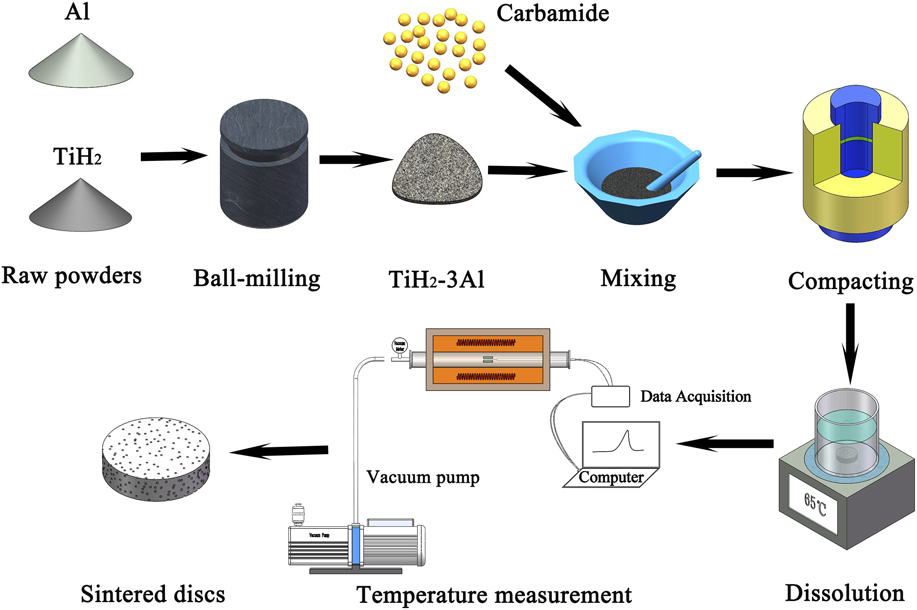
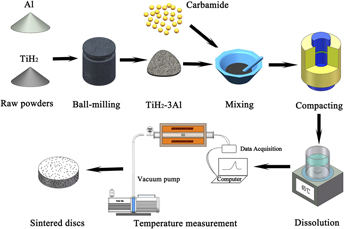
The raw materials used in the experiment involve elemental Al (38–75 μm) and TiH2 (38–75 μm) powders. The TiH2–3Al powders were evenly mixed in a molar ratio of 1/3 using planetary ball mill at 450 rpm for 4 h. The mass ratio of ball and powder was 1:1. Ethyl alcohol was used as the milling medium to prevent oxidation and cold welding. The spherical carbamide (0.7–1 mm) particles were selected as the transient space holder material, which was manually blended with dried TiH2–3Al powder in an agate mortar. The powders were mixed with a volume ratio of carbamide of 0, 30, 50, and 60 vol% and then the mixtures were compacted with a pressure of 300 MPa to prepare cylindrical green compacts with 16 mm in diameter and 2–3 mm in height. Subsequently, the green compacts were put in deionized water to remove the carbamide particles, the temperature was set at 65 °C for 4 h, and water was refreshed every half an hour. The whole experimental process is presented in Fig. 1. The weight of samples was measured for five times before and after dissolution to ensure the complete removal of space holder particles, and then the samples were dried at 40 °C for 24 h.
Illustration of the experimental process.

The value of open porosity was obtained based on the Archimedes principle,Reference Yeh and Sun8,Reference Jiao, Ren and Wang18 and the total porosity was obtained by the equation: θ′ = 1 − V′/V = 1 − M 1/ρthV, where M 1 is the mass of porous bodies in air, V is the external volume of porous samples, and ρth is the theoretical density of TiAl3 (3.4 g/cm3). Phase compositions were determined by X-ray diffraction (XRD) using a Bruker D8 ADVANCE diffractometer (Bruker, Karlsruhe, Germany) operated with Cu target (λ = 0.15406 nm) at 40 kV and 150 mA. SU3500 (Hitachi, Tokyo, Japan) scanning electron microscope (SEM) was applied to achieve fracture morphology of the sintered products. Additionally, the pore characteristics on the surface of the samples were performed by back scattered electron (BSE) pattern equipped with an UANTAX400 (Bruker, Karlsruhe, Germany) energy dispersive spectrometer (EDS) to analyze the elemental composition. Differential scanning calorimetery (DSC) and the thermogravimetric analysis (TG) were used to precisely determine the TiH2 decomposition temperature and weightlessness phenomenon under the argon atmosphere. The sample was heated in the temperature range from 100 to 800 °C with a heating rate of 5 °C/min and the results will be mentioned in Sec. III. In consequence, the green compacts were initially heated to 550 °C for 2 h for the purpose of the completely dehydrogenate, then sintered at 750 °C for 30 min, and the heating rate was same as the DSC measurement condition during the whole heating procedure.
After the furnace cooled down to room temperature, the dimensions of the sintered samples were measured to calculate the expansion/contraction ratios. To capture the heat release during the sintering process, the same experiment was conducted in the vacuum tube furnace, while thermocouple wires (WRe3 and WRe25 with the diameter of 0.1 mm) were placed between the two identical compacts, and the signal was recorded with a frequency of 500 Hz, allowing to register the actual combustion temperature of the samples. The oxidation resistance of four sintered samples was evaluated in the chamber furnace under air atmosphere, at 650 °C for 96 h and the mass changes were measured by weighing the samples for every 12 h. The mass gain value (R) was calculated by the expression: R = (M 2 − M 1)/S,Reference Shi, Qin and Feng29 where S = 2πrh + 2πr 2, M 1 and M 2 represent the mass of the porous bodies before and oxidation, r is the external radius, and h is the external height of the sample before oxidation. Finally, the oxidation kinetics curves were obtained by calculating the mass variation in the unit surface area as a function of exposure time.
III. RESULTS AND DISCUSSION
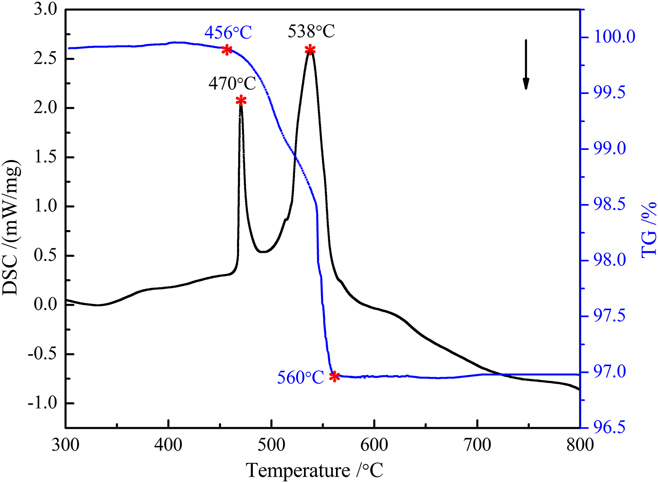
As can be seen in Fig. 2, the DSC curve exhibited two endothermic peaks during the heating process, suggesting that the decomposition of TiH2 powder taken place in two stages, one endothermic peak started at about 470 °C and the other found at 538 °C. According to the TG testing, the phenomenon of weightlessness appeared when the temperature rises to 456 °C and finally ended at about 560 °C, which can be concluded that the dehydrogenation reaction of TiH2 powders mainly occurred in the range of 450–560 °C. The results were in agreement with the studies of Kennedy et al.,Reference Kennedy and Lopez30 the first decomposition reaction corresponds to the reduction of the hydride to δ-TiH1.5, and second, the decomposition of the hydride to form β- and α-phases with the progressive heating.
DSC-TG traces for TiH2 powders with the heating rate of 5 °C/min.
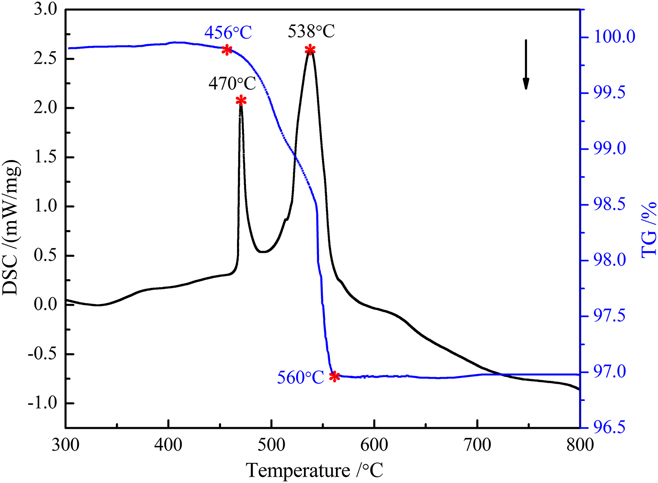
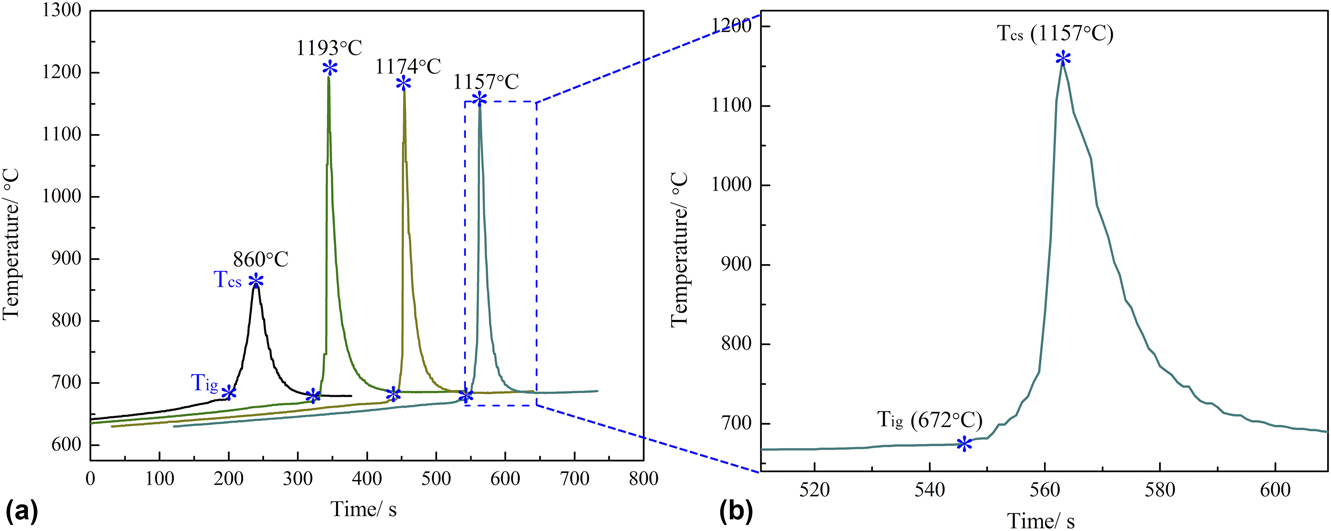
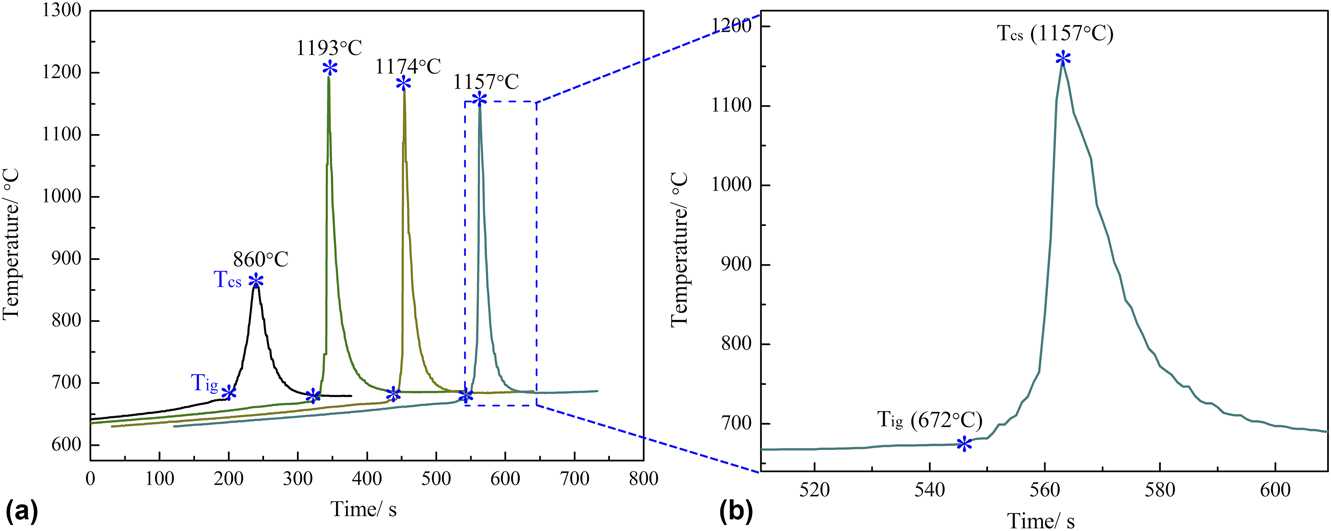
Figure 3 plots four combustion temperature–time curves to characterize the reaction exothermicity of powder compacts with 0, 30, 50, and 60 vol% carbamide (from left to right). The variations of four curves are similar and the acute increase in temperature indicating the violent exothermic reaction occurred, and the peak value corresponds to the combustion temperature of samples, as shown in Fig. 3(a). The ignition temperature (T ig) of four samples is about 672 °C, which is a little higher than the melting point of aluminum (666 °C), and then the specimen temperature climbs evidently to the combustion temperature (T cs) of 860, 1193, 1174, and 1157 °C. The observed combustion temperature is generally higher than previous resultsReference Wang, Jiao and Feng3,Reference Jiao, Wang and Kang10 owing to the presence of active titanium atoms formed by the decomposition reaction. It should be noted that the reaction time, from ignition temperature (T ig) to combustion temperature (T cs), lasted only a few dozen seconds (20–60 s), and the temperature raises almost linearly as evidenced in Fig. 3(b). This shows that the combustion mode of the TE reaction appeared during the sintering process and it is also confirmed by the visual presentation in the Supplementary Material (See SI). The video displayed the whole TE process, the sample color turned gradually from silver to pale red, then a bright light appeared in a few seconds, indicating the TE reaction occurred simultaneously within the sample and caused intense exothermic phenomenon in the Ti–Al system.Reference Li, Zou and Zheng11,Reference Peng, Yang and Liu22 The TE mechanism of the Ti–Al system was studied in previous studies.Reference Wang, Jiao and Feng3,Reference Li, Zou and Zheng11,Reference Cai, Liu and Feng17 Once the sample temperature reached its ignition temperature (T ig), liquid Al appeared and spread rapidly around the solid titanium particles, resulting in the severe reaction between solid titanium and liquid aluminum and formed Ti–Al intermetallics immediately. Ye et al.Reference Ye, Hao and Mo27 have studied that the appearance of liquid Al can transform the reaction mechanism to a solid–liquid reaction, which proceeds at a much higher rate. Additionally, the combustion temperature of the sample with 0 vol% carbamide (black line) is significantly lower than the other three temperatures and the peak is more wider. This result can be explained by the formation of the diffusion layer around the titanium particles before the TE reaction, thereby suppressing the ongoing solid–liquid reaction. The reason of the variation trend will be discussed in later section.
Combustion temperature–time curves of TiH2–75 at.% Al powder compacts (a) and the magnified exothermic peak (b).
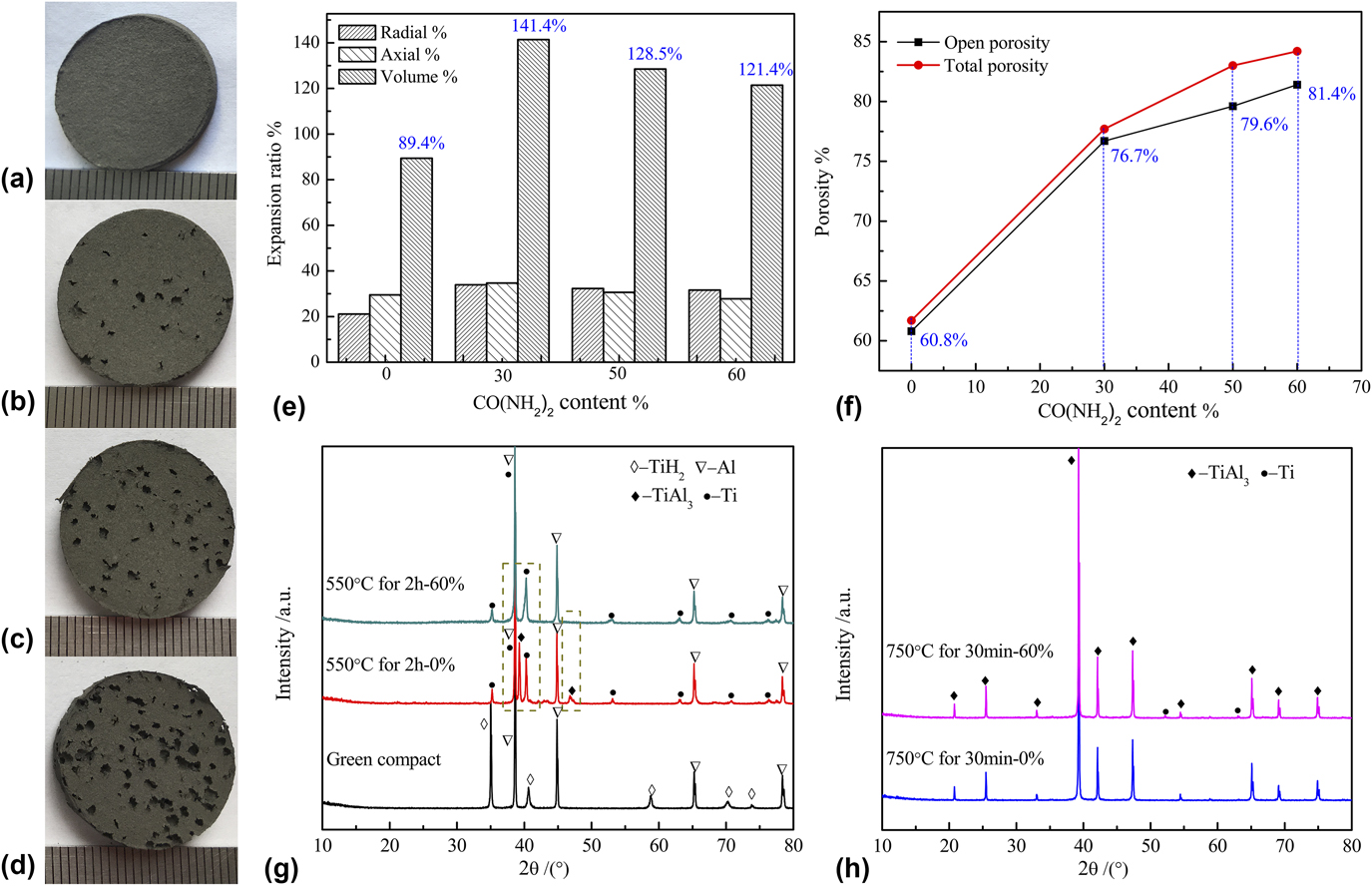
A set of macro-images presented in Figs. 4(a)–4(d) illustrates that all the sintered samples kept the integral cylindrical appearance and no deformation or cracking was found. The large pores [Figs. 4(b)–4(d)] left by space holders were clearly observed by the naked eye. After sintering, there had been an obvious expansion of sintered discs and the volume expansion ratio was 89.4, 141.4, 128.5, and 121.4% for samples with 0, 30, 50, and 60 vol% carbamide respectively, as shown in Fig. 4(e). It can be confirmed that the dimension change for the porous Ti–Al system during the reactive sintering process is one of the most remarkable phenomena.Reference He, Jiang and Xu13,Reference Peng, Yang and Liu22,Reference Jiang, He and Xu23 Meanwhile, the expansion behaviors in axial and radial direction were also observed to be similar with the changing trend of volume expansion. On the one hand, the phase transition and heat released from the TE reaction must cause a considerable expansion effect. On the other hand, with the aid of exothermal reaction between solid titanium and liquid aluminum, the H2 released from decomposed TiH2 powders would be expanded, thereby leading to the volume expansion of compact.Reference Zhang, Xiao and Wang16,Reference Ye, Hao and Mo27,Reference Liang, Yang and Zhang28 In addition, as presented in Fig. 4(f), the open porosity of 60.8% was obtained without space holder, while the porosity of the material considerably increases to 76.7, 79.6, and 81.4% with the addition of 30, 50, and 60 vol% of carbamide, respectively.
Macro morphology and microscopic characteristics of porous TiAl3 intermetallics as a function of CO(NH2)2 content. (a–d) macro images of sintered samples; (e) expansion behaviors; (f) open porosity and total porosity; (g and h) XRD patterns of samples sintered at temperature 550 °C for 2 h and 750 °C for 30 min with 0 and 60 vol% CO(NH2)2 content.
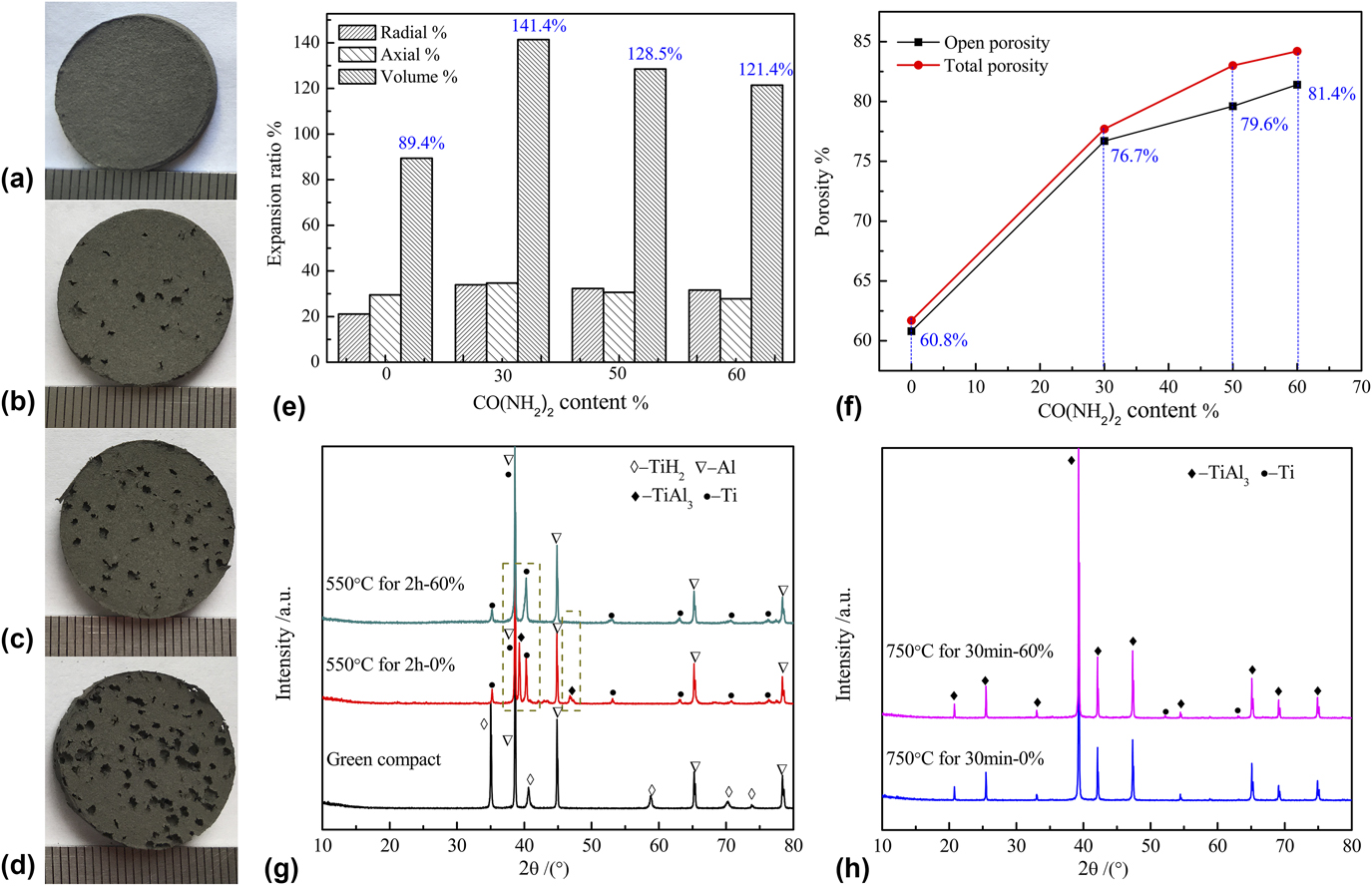
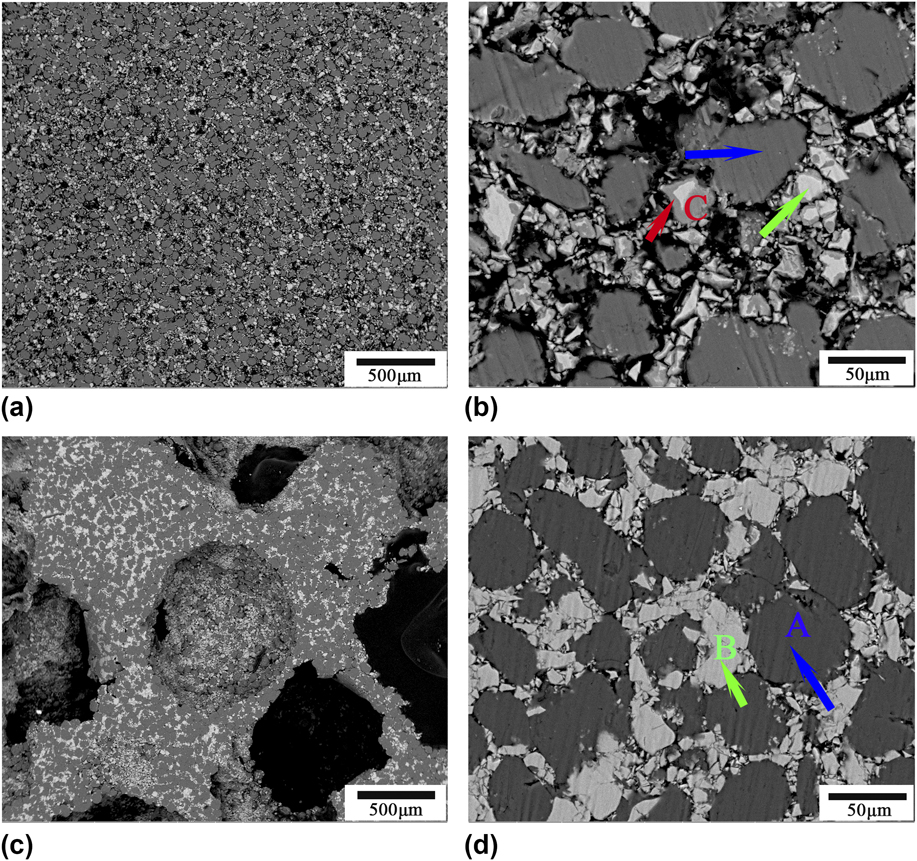
The XRD patterns presented in Figs. 4(g) and 4(h) allow us to identify the phase composition of TiH2–75 at.% Al sintered samples manufactured without space holders and with 60 vol% of carbamide. As can be seen in Fig. 4(g), the green compact only composed with TiH2 and Al phases. No carbamide is detected, signifying that the space holder material was removed thoroughly by dissolution before sintering. For the samples heated to 550 °C for 2 h, no TiH2 phase is identified, confirming that the TiH2 raw material was completely decomposed into metallic Ti. It is obvious that for the 0 vol% carbamide sample, the TiAl3 phase appears with remaining raw materials of Ti and Al phases in the X-ray spectrum. This finding can be explained by the formation enthalpy of TiAl3 ( $\Delta H_{298}^0 = - 146.44\;{\rm{kJ/mol}}$) is the lowest among the other equilibrium phases in the Ti–Al system.Reference Liu, Han and Li24,Reference Wang, Shao and Ye25 Furthermore, the Ti radicals generated by TiH2 decomposition are very reactive, resulting in the occurrence of reactive diffusion between Ti and Al particles even at low temperature (550 °C).Reference Feng, Jian and Zhou7 The formation of the TiAl3 layer around the Ti particles causes the subsequent TE reaction to be limited, which makes the combustion temperature (860 °C) become lower and prolongs the reaction time, as can be seen in Fig. 3. However, for the sample with 60 vol% carbamide, no Ti-containing compounds are observed except for the elemental Ti and Al phases, indicating that the reactive diffusion did not occur for samples sintered at 550 °C for 2 h. On account of the large pores replicating from the carbamide particles still exist in green compact, the empowering of reactive diffusion between solid Ti and Al particles is difficult what is clearly seen in BSE images (Fig. 5). After sintering at 700 °C for 30 min, the phase composition of the products only contains TiAl3 intermetallics, suggesting the full participation of Ti and Al powders in the synthesis of porous TiAl3 materials, as can be seen in Fig. 4(h).
BSE images of samples sintered at 550 °C for 2 h with (a and b) 0 vol% and (c and d) 60 vol% CO(NH2)2 at different magnifications.
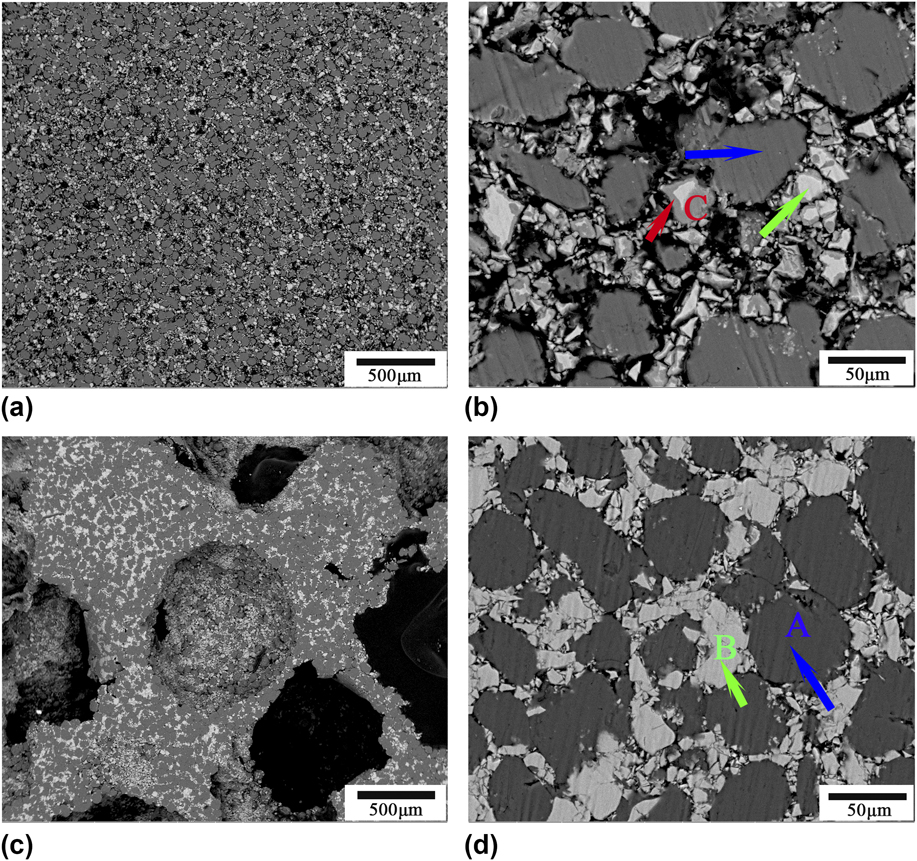
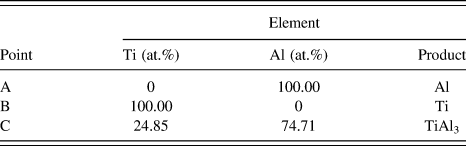
The surface morphology of the samples sintered at 550 °C for 2 h is presented in Fig. 5 and the corresponding elemental analysis is listed in Table I. It is well determined that the dark grey regions are Al (point A) particles, the white regions (point B) represent Ti particles, while the grey areas (point C) are composed of TiAl3 compounds identified by the EDS analysis. As can be seen in Figs. 5(a) and 5(b), some titanium particles are covered by grey layers (TiAl3) existing in the matrix when 0 vol% CO(NH2)2 is added. In comparison to the results presented above, a large amount of large pores can be clearly observed with the addition of 60 vol% CO(NH2)2, as shown in Fig. 5(c). These large pores are connected with each other and the high magnification micrograph of skeletons [Fig. 5(d)] confirms the original state of green compact, where only Ti and Al phases existed and no reaction layer produced during the sintering process. The diffusion distance is stretched due to the presence of large pores and thus the energy in the system is not high enough to make the reactive diffusion occurred. All these findings are in accordance with the XRD results.
EDS analysis of sintered products.

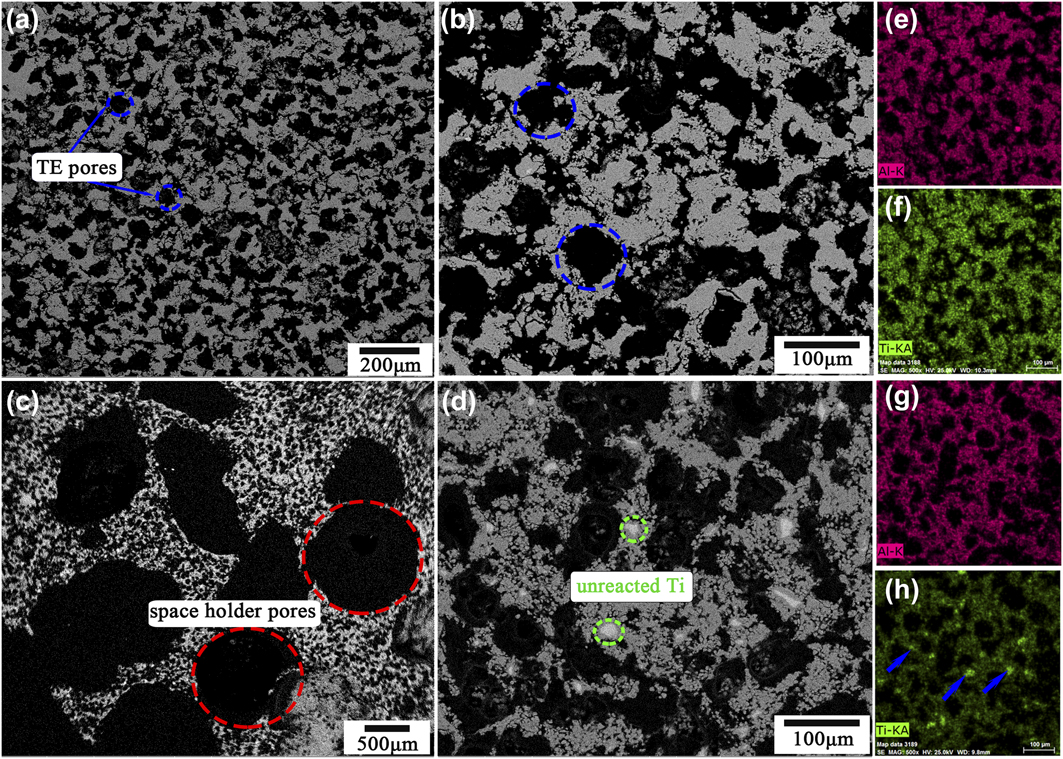
Figures 6(a)–6(d) illustrate the BSE images of porous TiAl3 intermetallics sintered at 750 °C for 30 min with 0 and 60 vol% CO(NH2)2. The EDS analysis reveals that Ti and Al elements are uniformly distributed in the final products [Figs. 6(e)–6(h)]. As evidenced in Figs. 6(a) and 6(b), for the sample without carbamide, a large amount of TE pores can be seen between the product skeletons (marked by blue circles), indicating that the pores in the porous TiAl3 material exhibit a uniform distribution and the holes are of the same size (40–100 μm). After adding 60 vol% carbamide, large pores marked by red circles are obviously observed among the skeletons and the pore size is about 700 μm, which is apparently originated from the removed carbamide particles. Some small Ti particles are still observed in the pore walls suggesting the incomplete reaction during the TE process when adding 60 vol% of carbamide, which are also detected by element mapping in Fig. 6(h) (marked by blue arrows). Sina et al.Reference Sina and Iyengar2 have found that some reaction layers appeared around the titanium particles during the sintering process (973–1023 K) and the single-phase TiAl3 product synthesized from the temperature of 1113 K. Therefore, a higher sintering temperature or longer holding time is required for synthesizing single-phase TiAl3 compound.
BSE images and EDS analysis of porous TiAl3 sintered at 750 °C for 30 min (a and b) 0 vol% and (c and d) 60 vol% CO(NH2)2 at different magnifications; (e–h) element mapping of Ti and Al.

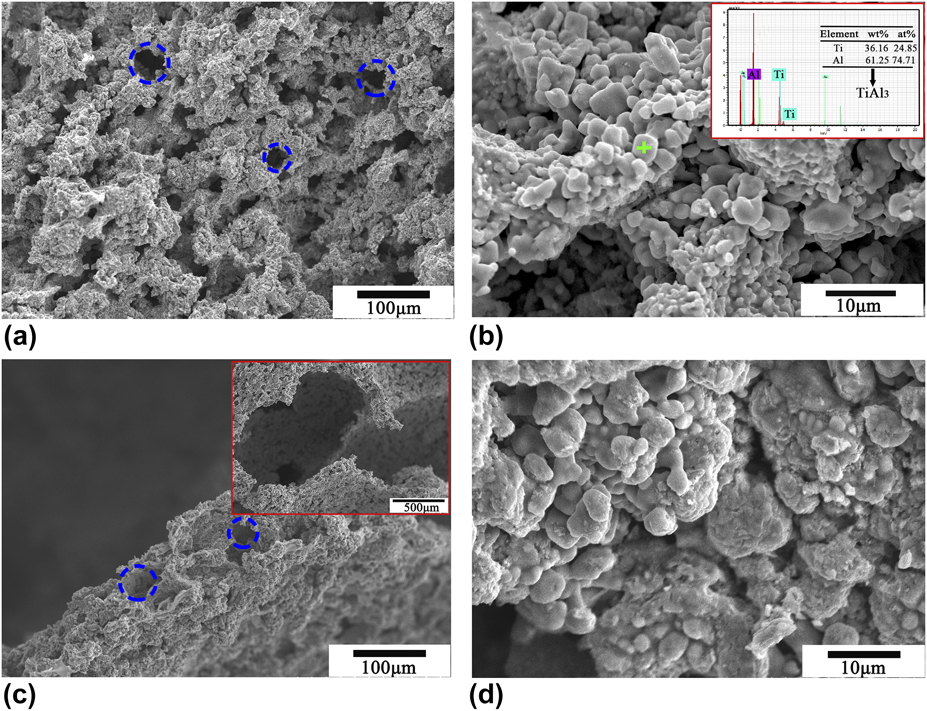
In addition, the SEM fracture morphology and particle characteristics of porous TiAl3 are shown in Fig. 7. Obviously, there are a lot of small pores [marked by blue circles in Fig. 7(a)] found among the interconnected sponge-like skeletons on account of the violent TE reaction. At higher magnification, it can be seen [Fig. 7(b)] that globular particles are obtained through the sintering process and large groups of these particles are well interlinked and formed an open-cellular structure. According to the EDS analysis [top right in Fig. 7(b)] combined with the XRD results, it is confirmed that these skeletons are porous TiAl3 phase. Apart from the large pores (∼700 μm) replicating from CO(NH2)2 particles [as shown in the top right of Fig. 7(c)] a number of small pores embedded in large pore walls are also visible. It should be noticed that the pore size and porosity of the TiAl3 sintered discs are affected by the properties of the space holder particles,Reference Li, Zou and Zheng11 which enables these porous intermetallics to be greatly applied in the filtration system due to the high filtering precision.Reference Cai, Liu and Feng17,Reference Łazińska, Durejko and Lipiński26
SEM photographs of sintered samples of TiAl3 with (a and b) 0 vol% CO(NH2)2 and (c and d) 60 vol% CO(NH2)2.

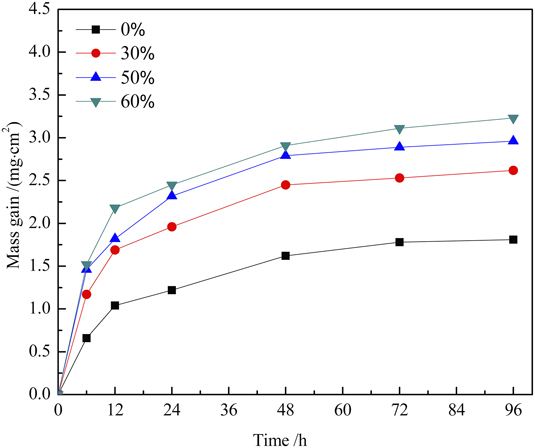
The mass gain versus oxidation time presented in Fig. 8 illustrates the oxidation kinetics of porous TiAl3 materials fabricated by the TE reaction, combining with 0, 30, 50, and 60 vol% CO(NH2)2. All the oxidation kinetics curves showed the parabolic-like behavior, suggesting that the porous TiAl3 materials have excellent high-temperature oxidation resistance at high temperature. It is clearly seen that the mass increases within the first 12 h, and then the total mass maintained a slow upward trend. After 96 h of cyclic oxidation, the mass gain only reached 1.89, 2.62, 2.96, and 3.23 mg/cm2, corresponding to the 0, 30, 50, and 60 vol% CO(NH2)2, respectively. This is caused by the fact that the passivated and dense Al2O3 layers are formed on the surface of porous skeletons, which protects the product from further oxidizing. Particularly, the sintered discs without any space holder exhibits the best high-temperature oxidation resistance and the pore structure is most stable due to the fact that the pores formed by TE are small pores of tens of microns, empowering the surface area of inner pores to be limited and decreased the oxidation extent, which also manifested that the service life of the equipment and the accuracy of filtration are guaranteed under special conditions.
Mass gain of the porous TiAl3 material oxidized at 650 °C in air for 96 h.

IV. CONCLUSIONS
Porous TiAl3 intermetallics were synthesized through an effective and simple process of TE reaction using TiH2 and Al elemental powders, combining with carbamide as the space holder material. The carbamide particles can be removed completely in water leaching before sintering, which has been considered as a green and rapid method for the preparation of spherical-like large pores. The combustion temperature–time curves revealed that an obvious and violent exothermic reaction occurred in the compact monoliths with/without adding carbamide. After TE reaction, only TiAl3 compounds were observed in the sintered products without any carbamide, while very small amount of Ti phase were surrounded by the reaction layer when adding 60 vol% carbamide. The highest volume expansion ratio measured to 141.4% and the maximum open porosity can reach 81.4%. The large pores replicate from carbamide particles and small pores formed by the TE reaction, enabling these porous materials with interconnected channels to be widely applied in heat insulation, filtration, and separation areas. Additionally, the fabricated porous materials possess the excellent oxidation resistance in high temperature.
Supplementary Material
To view supplementary material for this article, please visit https://doi.org/10.1557/jmr.2018.293.
ACKNOWLEDGMENTS
This work was supported by the Fundamental Research Funds for the Central Universities (Grant No. 2018BSCXC17) and the Postgraduate Research & Practice Innovation Program of Jiangsu Province (KYCX18_1944).