INTRODUCTION
Gurnards (Triglidae) are found world-wide in both tropical and temperate seas. Six species occur around the British Isles (Hureau, Reference Hureau, Whitehead, Bauchot, Hureau, Nielsen and Tortonese1986) and are a commercially important by-catch in demersal fisheries. Three species, grey Eutrigla gurnardus (L., 1758), red Chelidonichthys cuculus (L., 1758) and tub gurnard Chelidonichthys lucerna (L., 1758), are abundant and widespread in the English Channel, whilst streaked gurnard Trigloporus lastoviza (Bonnaterre, 1788) is locally abundant in some areas (Parker-Humphreys, Reference Parker-Humphreys2005; Burt et al., Reference Burt, Ellis, Harley and Kupschus2013). The occurrences of both piper Trigla lyra L., 1758 and long-finned gurnard Chelidonichthys obscurus (Walbaum, 1792) in British waters are more sporadic.
Chelidonichthys obscurus occurs in the north-eastern Atlantic, from Mauritania to the southern coasts of the British Isles, including the Azores, Madeira and Mediterranean Sea, where it is quite common in the western basins but absent from the northern Aegean Sea and Black Sea (Hureau, Reference Hureau, Whitehead, Bauchot, Hureau, Nielsen and Tortonese1986). Although relatively common in parts of the Mediterranean Sea to the Atlantic coasts of northern Spain and south-west France (Quéro et al., Reference Quéro, Dardignac and Vayne1989; Sánches et al., Reference Sánches, Blanco and Gancedo2002), it is recorded rarely in British waters. It was reported from the western English Channel in the 19th Century (Yarrell, Reference Yarrell1841; Couch, Reference Couch1877; Day, Reference Day1880–1884; Holt et al., Reference Holt, Garstang and Byrne1898), but was absent from lists of the regional ichthyofauna compiled during the 20th Century (Le Danois, Reference Le Danois1913; MBA, 1957; Le Mao, Reference Le Mao2009).
Little is known about the biology of C. obscurus, and most published data are from the western Mediterranean Sea, where there have been studies of their reproductive biology (Muñoz et al., Reference Muñoz, Hernandez, Sabat and Casadevall2003, as Aspitrigla obscura) and feeding habits (Moreno-Amich, Reference Moreno-Amich1996; Morte et al., Reference Morte, Redon and Sanz-Brau1997; Boudaya et al., Reference Boudaya, Neifar, Taktak, Ghorbel and Bouain2007). The latter studies showed that they fed mainly on mysids, crangonid shrimps and portunid crabs.
The primary aim of this study was to provide new data on C. obscurus in the western English Channel, as recent surveys have started to encounter this species more regularly. A sub-sample of fish collected in 2013 was used to provide additional information on their morphometrics, meristics and diet.
MATERIALS AND METHODS
Scientific trawl surveys provide extensive data on the distribution and relative abundance of many fish species from around the British Isles, including the eastern English Channel (Parker-Humphreys, Reference Parker-Humphreys2005), Celtic Sea (Tidd & Warnes, Reference Tidd and Warnes2006) and western English Channel (Burt et al., Reference Burt, Ellis, Harley and Kupschus2013). The majority of records for Chelidonichthys obscurus were from the latter survey, which was conducted annually by FV ‘Carhelmar’, a 23 m commercial beam trawler (Burt et al., Reference Burt, Ellis, Harley and Kupschus2013). This survey used twin 4 m beam trawls to collect data for demersal fish each October and covered an area in a 65 km radius of Start Point including the area around Lyme Bay (or Great West Bay) in waters 6–83 m depth. These data were used to examine the occurrence of C. obscurus over the period 1989–2013.
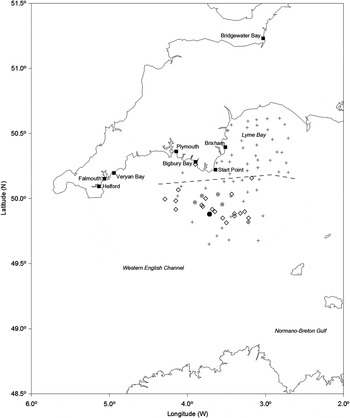
Once on-board, the catches from the port and starboard trawls were sampled separately. In general all commercial species were removed and total length (LT) measured (to the cm below), with non-commercial species generally noted as present. Catches of gurnard were always observed and measured/counted in nearly all hauls (Burt et al., Reference Burt, Ellis, Harley and Kupschus2013). The survey uses a fixed station design, with each station having a unique alpha-numeric prime number. Twenty-five stations where C. obscurus was either caught or in close proximity to sites of capture (Figure 1) were used to provide estimates of relative abundance. Stations were sampled consistently across all years except for 1991 (23 stations), and 1992, 1993 and 1996 (24 stations fished). Catch rates were standardized to the number of fish caught per km2.
Stations of the FV ‘Carhelmar' survey (+) showing sites where the relative abundance of Chelidonichthys obscurus was 1–6 ind.km−2 (ž) and the location of maximum abundance (64.7 ind.km−2; ~). Only those sites south of the dashed line used in the calculation of relative abundance. Occurrence of C. obscurus in other surveys and discard observer programme also given (–).

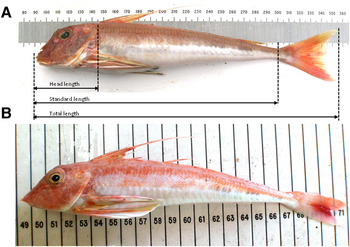
During the 2013 survey, individual body weights (W) for C. obscurus were collected for fresh specimens, which were then retained frozen for subsequent laboratory study. Morphometric measurements (to the mm) were collected for total length, standard length (LS, defined as the distance from the tip of the snout to the inflection in the caudal peduncle) using a measuring board, and head length (snout to top of opercular spine), orbit diameter, inter-orbital width, length of first, second and third dorsal spines, first dorsal fin base, length of pectoral and pelvic fins and anal fin base with callipers. Measurements collected for the head, pectoral and pelvic fins were for the left side of the fish (Figure 2). The number of spines and rays for the dorsal and anal fins were counted to provide meristic data. The diet was recorded as the frequency of occurrence for the various prey taxa (i.e. the number of stomachs containing the prey taxa/total number of stomachs examined × 100).
Specimen of Chelidonichthys obscurus from the western English Channel showing: (A) selected morphometric measurements taken; (B) coloration of freshly caught specimen.

Other distribution data for C. obscurus were collated from four other sources: research vessel surveys conducted by CEFAS; Fishery Science Partnership (FSP) surveys; discard observer programmes (described in Enever et al., Reference Enever, Revill and Grant2007); and information provided by the Marine Biological Association (MBA) from the inshore waters along the south-west coast of England.
RESULTS
Examination of available data from scientific trawl surveys undertaken since the 1980s, and from other more recent sources (including observer programmes on commercial vessels) identified a total of 82 specimens of Chelidonichthys obscurus that were caught in the English Channel, all from 2004 to 2013. Most specimens (N = 58) were captured in the FV ‘Carhelmar’ survey, with three individuals reported in other research vessel trawl surveys. These fish were encountered at depths of 65–77 m.
The discards observer programme and FSP surveys recorded a total of 20 specimens (13–30 cm) between 2004 and 2013, although data prior to this were limited for the study area. A single individual (13.5 cm LT) was recorded in a trawl survey of Bigbury Bay conducted by the MBA in 2008 (26 m water depth).
Other records (N = 13) of C. obscurus in trawl survey data held by CEFAS were from trawl surveys conducted off the west coast of France in the 1980s (south of latitude 46°; depths 97–143 m) and were excluded from further analyses.
All specimens were caught in an area around Start Point (Figure 1). Chelidonichthys obscurus were encountered at six of the fixed stations fished during the FV ‘Carhelmar’ survey. The majority of fish (N = 48) came from one prime station (M5, ~49.89°N 3.74°W) and were persistent from year to year, occurring in six of the seven years when C. obscurus were encountered. In 2012, all specimens came from this single location.
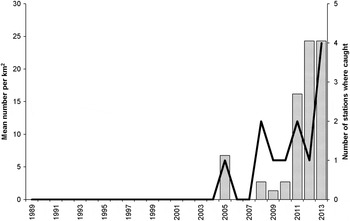
The first reported incidence of C. obscurus in the FV ‘Carhelmar’ survey was in 2005 and they have been caught each year since 2008. The relative abundance in this survey has increased steadily but remained constant for the last two years (Figure 3). The annual occurrence at stations varied between one and four stations per year, the latter recorded in 2013 (Figure 3). The fish from other surveys were observed in the period 2004 and 2013.
Temporal trends (1989–2013) in relative abundance of Chelidonichthys obscurus in the western English Channel during the FV ‘Carhelmar’ survey, shown as the mean number of fish caught per km2 for selected prime stations (see Figure 1) (solid bars, left axis), and the number of stations where caught each year (black line, right axis).

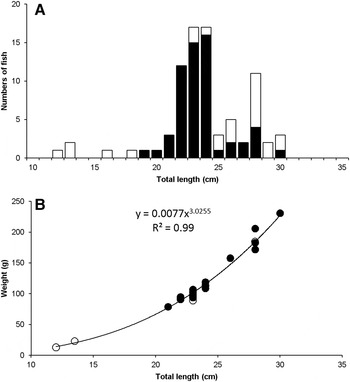
Specimens caught in the FV ‘Carhelmar’ survey were 19–30 cm LT (Figure 4A), with two peaks in the length–frequency (19–24 cm and a smaller peak for fish >24 cm LT). Although sample sizes were low, peaks in the length distribution did not allow for a single cohort to be followed from one year to the next. The length-range in other surveys included some smaller fish, with the overall length-range observed 12–30 cm.
Chelidonichthys obscurus in the western English Channel showing: (A) length–frequency distribution for fish taken in the FV ‘Carhelmar’ survey (black bars; N = 58), and other surveys (open bars; N = 24); (B) length–weight relationship for fish caught during the 2013 FV ‘Carhelmar’ survey (N = 18, solid circles) and from other surveys (N = 4, open circles).

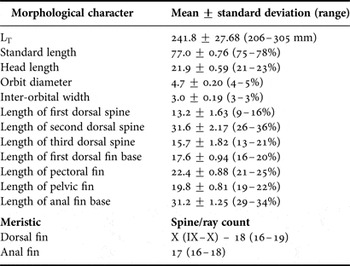
Length and weight data were available for 22 specimens (18 specimens of 21–30 cm LT caught during the 2013 FV ‘Carhelmar’ survey and four specimens from other surveys) and the length–weight relationship was W = 0.0077.LT 3.0255 (r2 = 0.99, Figure 4B). Morphometric and meristic data were collected for a sub-sample of 18 fish (Table 1).
Morphometric and meristic data for Chelidonichthys obscurus (N = 18) from the western English Channel; total length given in mm and other morphometric characters given as % of total length (LT).

Chelidonichthys obscurus were found to feed almost exclusively on crustaceans; primarily mysids, which occurred in all specimens, and were the only prey in 12 specimens. Six fish had fed on a further four prey taxa: amphipods (in 17% of specimens); isopods (11%); juvenile Galathea spp. (6%); and Chlamys varia (6%). Although the diets of most specimens comprised mostly mysids, the largest specimen (305 mm LT) had fed predominately on amphipods.
DISCUSSION
The biology of Chelidonichthys obscurus in the waters of the British Isles is poorly known. Observations on the diet were consistent with studies from the Mediterranean and Cantabrian Seas that have reported crustaceans to account for 96–99% of the diet, by numbers (Moreno-Amich, Reference Moreno-Amich1996; Morte et al., Reference Morte, Redon and Sanz-Brau1997; Boudaya et al., Reference Boudaya, Neifar, Taktak, Ghorbel and Bouain2007) and >90% of the diet by volume (Lopez-Lopez et al., Reference Lopez-Lopez, Preciado, Velasco, Olaso and Gutiérrez-Zabala2011). These authors also found that mysids were present in high numbers, with Morte et al. (Reference Morte, Redon and Sanz-Brau1997) and Boudaya et al. (Reference Boudaya, Neifar, Taktak, Ghorbel and Bouain2007) reporting mysids to comprise 78% and 82.5% of their diet, respectively. Although no large crustaceans were observed in the diet during the present study, Lopez-Lopez et al. (Reference Lopez-Lopez, Preciado, Velasco, Olaso and Gutiérrez-Zabala2011) reported slipper lobster Scyllarus arctus to be an important prey species. The present samples were too limited to provide information on their reproductive biology in this area. Morphometric and meristic data collected (Table 1) were in general agreement with earlier authors (Wheeler, Reference Wheeler1969; Hureau, Reference Hureau, Whitehead, Bauchot, Hureau, Nielsen and Tortonese1986). Combining historical information and the results of the present study gave the following meristic formulae: dorsal fin X (IX–XI) – 18 (16–19) and anal fin 17 (16–18).
Chelidonichthys obscurus is a Lusitanian species that is more common in the western Mediterranean Sea and Atlantic Iberian waters. Sánches et al. (Reference Sánches, Blanco and Gancedo2002) reported it from along much of the Cantabrian shelf, albeit with a discontinuous and patchy distribution, generally occurring in higher densities on grounds off A Coruña, Ribadeo, Santander and Santoña. On the Atlantic coast of France, Moreau (Reference Moreau1881, as Trigla cuculus) thought it was generally common in the southern Bay of Biscay, but rare north of the Loire (~47°N), whilst Quéro et al. (Reference Quéro, Dardignac and Vayne1989) only reported it south of the Gironde (~45.5°N).
Within the English Channel, Moreau (Reference Moreau1881) considered it to be very rare and not extending past Normandy, and this species was also reported by 19th Century ichthyologists in England. Yarrell (Reference Yarrell1841) noted that shining gurnard or long-finned captain (as Trigla lucerna) was ‘not considered rare’ off Brixham and also mentioned a reported capture from Bridgwater (Bristol Channel coast). Captures of C. obscurus by vessels landing at Plymouth and Helford were reported by Couch (Reference Couch1877, as ‘lanthorn gurnard’) and Day (Reference Day1880–1884), respectively. Although Holt et al. (Reference Holt, Garstang and Byrne1898) noted that several specimens were caught from an area of rough ground off Start Point in 1897 (as Trigla obscura), later studies in the English Channel suggest that C. obscurus was either overlooked, less abundant or even absent. It was not recorded in trawl surveys of the area conducted in the early 20th Century (Garstang & Kyle, Reference Garstang and Kyle1903; Steven, Reference Steven1930) and was not mentioned either by Le Danois (Reference Le Danois1913), in his treatise on English Channel fish, or in subsequent lists of the regional ichthyofauna (MBA, 1957; Le Mao, Reference Le Mao2009). It has been largely absent (or unrecorded) from inshore surveys of Devon and Cornwall (Genner et al., Reference Genner, Sims, Southward, Budd, Masterson, McHugh, Rendle, Southall, Wearmouth and Hawkins2010; McHugh et al., Reference McHugh, Sims, Partridge and Genner2011), though Wilson & Connor (Reference Wilson and Connor1976) reported one specimen from Veryan Bay (Cornwall) in 1970, and inshore surveys conducted by the MBA recorded a single specimen from Bigbury Bay (Devon) in 2008.
It is not known definitively if the reappearance of the species represents a re-colonization of former habitat, or if it was simply overlooked, and so the reasons for its apparent absence from much of the 20th Century remain unclear. Whilst of some commercial importance, landings of gurnards are traditionally reported to family level only, and so commercial captures may have been overlooked. Scientific trawl surveys provide the best time series of species-specific information. While there is a possibility that C. obscurus was misidentified and/or overlooked in some field studies, the straight snout with small spines at the tip, dorsal fin with very elongated second ray, coloration (dorsal surface red and fins with a pink margin) and small plate-like scales without spines along the lateral line are characteristic and conspicuous features.
The English Channel represents the north-eastern limit of the Atlantic distribution for several Lusitanian species, including C. obscurus, and it is possible that warmer waters have allowed such species to extend to the area, as water temperature increased markedly in the western English Channel during the 1990s (Stebbing et al., Reference Stebbing, Turk, Wheeler and Clarke2002; Hawkins et al., Reference Hawkins, Southward and Genner2003). It may also be noted that the headlands and capes in the English Channel may create gyres, and such oceanographic features can lead to ‘retention areas’ for planktonic stages (Ménesguen & Gohin, Reference Ménesguen and Gohin2006). Given the restricted distribution of C. obscurus in the English Channel, it might be possible that occasional recruitment pulses that reach the Lyme Bay area are able to form a localized, self-sustaining population due to fronts and eddies retaining planktonic stages (Mullaney & Suthers, Reference Mullaney and Suthers2013).
ACKNOWLEDGEMENTS
The authors thank the owners, skippers and crew of the FV ‘Carhelmar’ for their support with the survey as well as CEFAS scientific staff, including Tom Woods, who assisted with data collection. Ana Ribeiro Santos provided data from the discards observer programme and Professor David Sims kindly passed on details of a specimen caught during trawl surveys conducted by the Marine Biological Association. Additional thanks to Vladimir Laptikhovsky, Alex Tidd and the referees for commenting on the manuscript. This work was supported by the UK's Department for Environment, Food and Rural Affairs (DEFRA) through MD003 and MA016.