INTRODUCTION
Stone tools are some of the most frequent artifacts recovered from households in archaeological sites across ancient Mesoamerica. Thus, lithic datasets are robust resources that can inform Mesoamerican archaeologists in their pursuits to understand the dynamics of ancient economies. More specifically, results from high-magnification usewear studies lead archaeologists to more reliable determinations of tool functions (Fullagar Reference Fullagar, Balme and Paterson2006:208–209) that can improve reconstructions of ancient household practices and identifications of diverse economic strategies (Aoyama Reference Aoyama1995, Reference Aoyama2009; Lewenstein Reference Lewenstein1987; Stemp Reference Stemp2016; Walton Reference Walton2017). Comparative discussions of these household practices and economic strategies help us to form and assess theoretical models of domestic economies in ancient Mesoamerica (Hirth Reference Hirth2009, Reference Hirth2013).
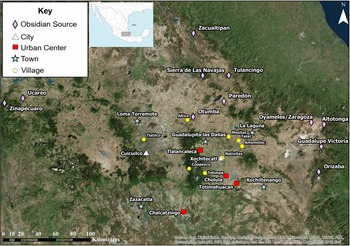
One site that contributes significantly to our understanding of domestic economies in central Mexico during the Early to Middle Formative periods (ca. 1500–400 b.c.) through its lithic data is the village of Altica (1250–800 cal. b.c.), the earliest known settlement in the Teotihuacan Valley presented in a special issue of Ancient Mesoamerica in 2019. Despite its small size and relative distance from larger contemporaneous settlements in central Mexico, Altica participated in regional and interregional trade networks that began to intensify ca. 1000 b.c. (Figure 1; Boksenbaum et al. Reference Boksenbaum, Tolstoy, Harbottle, Kimberlin and Neivens1987; Charlton Reference Charlton and Hirth1984; Healan Reference Healan2019; Johnson and Hirth Reference Johnson and Hirth2019; Stoner and Nichols Reference Stoner and Nichols2019a, Reference Stoner and Nichols2019b; Stoner et al. Reference Stoner, Nichols, Alex and Crider2015; Tolstoy et al. Reference Tolstoy, Fish, Boksenbaum and Vaughn1977). While Altica is located about 17 kilometers walking distance from the Otumba obsidian source, which comprises 96 percent of the site's obsidian (Glascock Reference Glascock2013), Healan's (Reference Healan2019) technological analysis of Altica's lithic assemblage reveals that the local domestic economy did not operate to export obsidian nodules, cores, and/or tools. Instead, Altica residents may have obtained obsidian nodules from one or more sites located even closer to the Otumba source, and there was a local household production focus on expedient percussion flakes and blades rather than bipolar tools commonly found at contemporaneous sites in the Basin of Mexico (Boksenbaum Reference Boksenbaum1980) and other regions in Early–Middle Formative Mesoamerica (Clark Reference Clark, Johnson and Morrow1987; Parry Reference Parry1987; Walton Reference Walton2017).
Satellite imagery of central Mexico and the locations of obsidian sources and notable Formative-period (ca. 1500 b.c.– a.d. 150) sites. Map by the author.

The addition of a systematic obsidian usewear study presented here helps to further reveal that Altica residents used their locally made tools for woodworking and subsistence-related activities. Interpreting the usewear dataset in concert with the site's paleoethnobotanical (McClung de Tapia et al. Reference de Tapia, Emily, Martínez-Yrizar, Adriano-Morán, Cruz-Palma and Chaparro-Rueda2019) and osteological and isotopic datasets (Storey et al. Reference Storey, Buckley and Kennett2019) indicates Altica villagers used obsidian tools following a unifunctional approach to develop a new landscape for agriculture and construct and maintain households. This strategy differed from the multifunctional approaches used by other sites in the region located much farther from obsidian sources. Ultimately, this inclusion of a comprehensive obsidian usewear study for Altica based on the foundation of experimental archaeology (Aoyama Reference Aoyama1995; Hurcombe Reference Hurcombe1992; Kononenko Reference Kononenko2011; Stemp Reference Stemp2016; Walton Reference Walton2019) demonstrates the method's potential to enhance our abilities to understand household practices and domestic economies in ancient Mesoamerica.
SITE DESCRIPTION
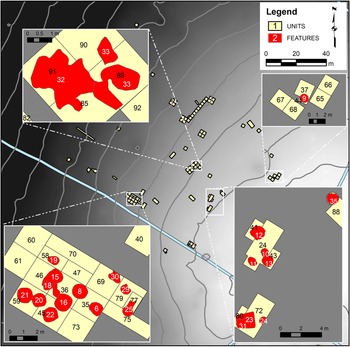
The small village of Altica (6 ha) is the earliest known village (1250–800 cal. b.c.) in the semiarid Teotihuacan Valley, located northeast of modern Mexico City (Stoner and Nichols Reference Stoner and Nichols2019a). When it was originally surveyed by Sanders et al. (Reference Sanders, West, Fletcher and Marino1975) they noted Altica as the only Formative period site in the Basin of Mexico where obsidian artifacts outnumber ceramics on the surface. The 2014 systematic survey conducted by Stoner and Nichols (Reference Stoner and Nichols2019a:Figure 4) included 70 surface collections (5 × 5 m) conducted on a 50-m grid with an additional 31 opportunistic collection squares to help define the limits of the site. Their excavation volume totaled 406 m2 including 25 features attributed to ancient human origin (Figure 2), while 10 other features containing cultural materials were designated as natural formations due to their irregular shapes (Stoner and Nichols Reference Stoner and Nichols2019a:252).
Site map with excavation areas and pit features, courtesy of Wesley Stoner (Stoner and Nichols Reference Stoner and Nichols2019a:Figure 5).

Located on a flat upland ridge subject to inundation, Altica residents may have used some of these pit features dug into the bedrock (tepetate, lahar usually produced after consolidation of hot mud flows) for water capture and storage, especially during the rainy season because there were no permanent streams close to the site. Macrobotanical and microbotanical evidence from excavated contexts at Altica indicate residents cleared pine-oak forest to practice a subsistence strategy that mixed non-intensive maize cultivation with foraging (McClung de Tapia et al. Reference de Tapia, Emily, Martínez-Yrizar, Adriano-Morán, Cruz-Palma and Chaparro-Rueda2019). Living surfaces were not recovered from the four excavation operations, although subterranean pit features including four burials provided secure contexts with accelerator mass spectrometry dates that range from 1125–825 cal. b.c. (Storey et al. Reference Storey, Buckley and Kennett2019:Table 2), which reflect the site's “major” occupation of 1100–800 cal. b.c. (Stoner and Nichols Reference Stoner and Nichols2019a:250). Wattle and daub household construction might have existed in Operation 1 based on four possible postholes and several large pieces of bajareque, a hardened mixture of mud, sticks, and reeds. Furthermore, the presence of Cyperaceae phytoliths recovered from ground stone tools—wherein the filtration of water through cultural deposits propitiated the movement of phytoliths contained within the sediment to the pores of ground stone objects in subterranean pit features (McClung de Tapia et al. Reference de Tapia, Emily, Martínez-Yrizar, Adriano-Morán, Cruz-Palma and Chaparro-Rueda2019:344)—may indicate the use of thatch roofs. Unfortunately, chisel plowing in the 1970s has almost entirely obscured or destroyed any possible architectural foundations that could have helped to delineate associations between specific households and their respective pit features. Furthermore, the fill in most Altica pit features represents mixed materials from several generations of occupation at the site, reducing the possibility of deducing activity areas based on quantities of artifact types. Therefore, it is best to separate and analyze artifacts from Altica based on stratigraphic relationships that are consistent across the site (Stoner and Nichols Reference Stoner and Nichols2019a:Figure 6). The plow zone, Stratum A, extends down to tepetate in almost every excavation unit, and it consists of mostly Middle Formative period ceramics with some mixture of modern materials, Postclassic ceramics, and Colonial ceramics, and even less inclusion of Classic period ceramics. Stratum B—a relatively intact, light-density midden accumulation that was encountered in places just above tepetate but mostly from tepetate down into rapidly-filled pit features, four of which include burials (Storey et al. Reference Storey, Buckley and Kennett2019)—represents the Early–Middle Formative occupation span (Stoner and Nichols Reference Stoner and Nichols2019a:252).
ANALYTICAL METHODS AND SAMPLING STRATEGY
The term “usewear” applies to surface modifications that occurred during all stages of an artifact's use-life history (Fullagar Reference Fullagar, Balme and Paterson2006), which can include hafting (Rots Reference Rots2010), burning (Aoyama Reference Aoyama2009: Figure 5.2), and post-discard soil abrasion (Kononenko Reference Kononenko2011:Plate 110). High-magnification usewear analysis (Keeley Reference Keeley1980; Semenov Reference Semenov1964; Vaughan Reference Vaughan1985) can detect four attributes created by acts of obsidian tool use: striations, edge rounding, micropolishes, and residues (Kononenko Reference Kononenko2011:7–9; Walton Reference Walton2019:898). Striations, micropolishes, and residues are much more reliable attributes for determining specific materials, while edge rounding is more suitable for identifying materials according to a range of densities or activity durations.
Striations can be described in terms of their morphology (e.g., sleek versus rough-bottomed) and orientation (e.g., parallel versus perpendicular to the working edge). Different materials and activities can affect the locations of striations on tool surfaces. Thus, a usewear analyst can note whether striations are isolated or located in close proximity to other striations (e.g., densely packed groups of striations); different materials tend to affect this characteristic more than activity type or duration.
Edge rounding refers to the erosion/smoothing of tool edges, and degrees of edge rounding increase with denser materials and/or longer activity durations. I classify degrees of edge rounding as very light, light, medium, intensive, and very intensive following a similar qualitative classification scheme used by Kononenko (Reference Kononenko2011). It is important to differentiate edge damage—the fracturing or chipping of a tool edge from either use or post-depositional processes—from edge rounding, which can only be produced through durations of tool use.
Usewear polish can be created by repeated physical contact between tool surfaces and different materials. Researchers debate the specific mechanisms that contribute to polish formation. Fullagar (Reference Fullagar1991:2–3) summarizes theories of polish formation on stone tools and demonstrates that amorphous silica is a major contributor towards polish formation on stone tools used to process plants. Christensen et al. (Reference Christensen, Calligaro, Consigny, Dran, Salomon and Walter1998) argue that polish itself is an encrusted coating of the worked material spread across the irregular surface of the tool. There are four stages of polish development for obsidian tools (Fullagar Reference Fullagar1991:6; Kononenko Reference Kononenko2011:8). In Stage 1, freshly flaked edges experience very light edge rounding as jagged edges and loosely adhering flakes are worn back. In Stage 2, patches of smooth polish develop as the surface is abraded, peaks are leveled, subsurface cracks are deepened, and granular material is deposited into surface depressions. In Stage 3, polish characteristics are strong enough to be linked with specific materials worked. During this stage, subsurface cracks are extended and flaked out of the surface just as other surface defects are smooth out via abrasion. In Stage 4, an extensive polished surface can be developed but only through contact with moist siliceous plant material. The distinguishable clarity and thickness of a polish type or pattern of alteration on a tool edge can be affected by multiple factors including activity duration, number of strokes, applied force (Key et al. Reference Key, James Stemp, Morozov, Proffitt and de la Torre2015), and the material properties of the tool itself (Eren et al. Reference Eren, Roos, Story, von Cramon-Taubadel and Lycett2014).
Following Kononenko (Reference Kononenko2011:4), residues are the materials that are either attached to or absorbed by a tool surface. Residues often appear trapped within the varying topographies of microcavities on tool surfaces, but the exact formation processes that cause these residues to remain in contact with tool surfaces are still under investigation (Fullagar Reference Fullagar, Balme and Paterson2006). In this study, I recognize the colors and basic morphologies of residues that remained on tool surfaces after the artifacts were cleaned.
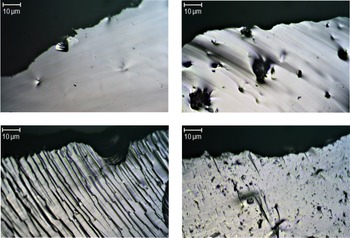
The usewear characteristics and obsidian tool functions identified here are based on my systematic program of 300 experiments with 145 obsidian tool specimens that controlled for two obsidian sources, two activity durations (five and 15 minutes), and 29 different materials that were accessible to pre-Hispanic residents of central Mexico (Walton Reference Walton2019). In March 2018, I also performed four experiments using obsidian percussion flakes to cut slate and observe the resulting usewear characteristics. The results from those experiments are the basis for identifications of stone cutting on artifacts in this study. Obsidian tools for experimentation were created to replicate six common tool forms found in central Mexican archaeology: percussion flakes, percussion blades, unifacial scrapers, bifacial knives, drills, and retouched pressure blades labeled variously as needles, perforators, or bloodletters (Walton Reference Walton2017:70–84). Each freshly knapped tool specimen for the study was cleaned and photographed before use in order to provide control data for each experiment (Figure 3). All specimens were used by hand with a single tool motion, respectively. Specimens were observed after at least two different activity durations, commonly five and 15 minutes.
Photographs (100×) of ventral surface topographies on four unused obsidian tools. Photographs by the author.

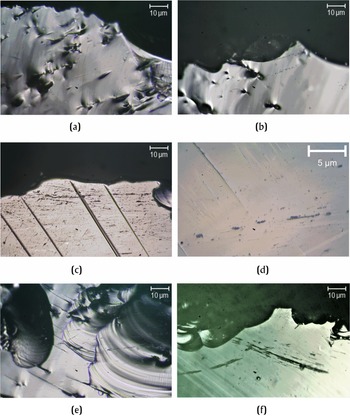
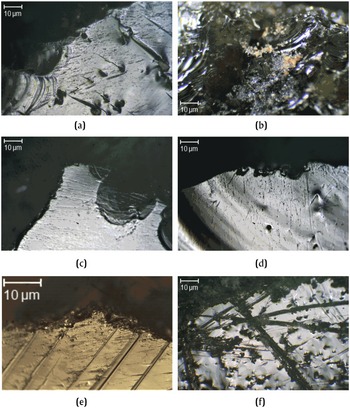
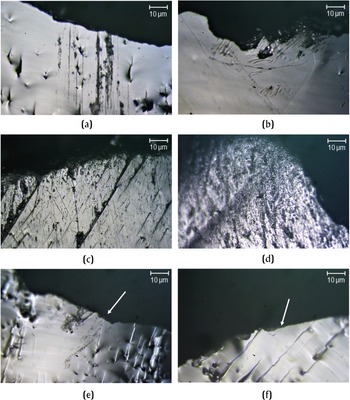
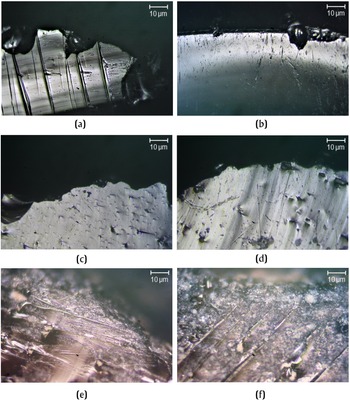
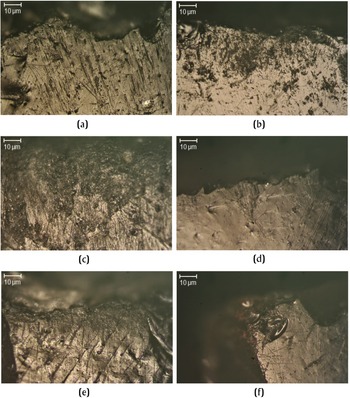
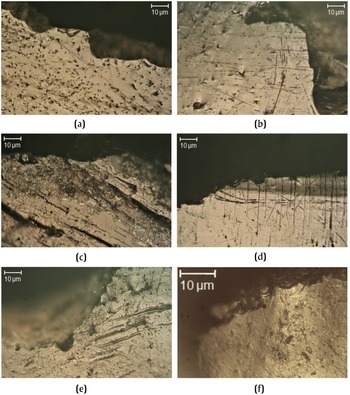
Comparing the experimental usewear patterns replicated by different studies (Aoyama Reference Aoyama1995; Kononenko Reference Kononenko2011; Stemp Reference Stemp2016; Walton Reference Walton2019), along with their own unique findings linked to specific resources within their respective geographic regions, reveals that some specific types of plants can be distinguished from more general categories of plants. The most generalized category of plant materials used with the method of high-magnification obsidian usewear analysis is “soft plants,” which includes a wide array of plants (e.g., gourds, cactus leaves, cactus fruits, potatoes, tomatoes, avocados, and goosefoot) that only produce very light to light edge rounding and striations that are extremely fine, thin, and isolated near a tool's puncture point (Figures 4a and 4b). Thicker grasses can produce more frequent and thicker striations, but generally their usewear patterns—identified by Kononenko (Reference Kononenko2011:76) as part of a “non-woody plant” group—are essentially identical to those documented in the soft plant category that Aoyama (Reference Aoyama1995, Reference Aoyama2009) and I (Walton Reference Walton2019) prefer to use. While the working of soft woods and hard woods can be distinguished in experimental studies based on comparing striation densities (Figure 5), making these distinctions becomes more challenging with archaeological specimens often due to the presence of overlapping or adjacent activities that involved soft wood and hard wood. Thus, the safest approach is to use a generalized wood category, which I do here. Maize can be distinguished apart from grasses and other soft plants because it produces longer striations, polish development located farther beyond a tool edge, and higher degrees of edge rounding (Figures 4c and 4d). Maguey heart scraping can be identified because of the signs of that very specific tool motion: restricted groups of short perpendicular striations bunched together near the impact point, which also displays very light to light edge rounding (Figures 6a and 6b). Maguey leaf can be identified through its extensive polish development, which can be present even at five minutes of tool use (and probably even earlier, but additional testing is needed to demonstrate it; Figures 6c and 6d). Finally, the results of experimental obsidian tool-use studies (Aoyama Reference Aoyama1995; Hurcombe Reference Hurcombe1992; Kononenko Reference Kononenko2011; Stemp Reference Stemp2016; Walton Reference Walton2019) conclusively support the identifiable characteristics for the distinct categories of fish (Figure 4e), meat (Figure 4f), stone (Figures 5e and 5f), animal skin/hide (Figures 6e and 6f), bone (Figures 7a and 7b), soil/clay (Figures 7c and 7d), and ceramic material (Figures 7e and 7f).
Photographs of experimental results using obsidian tools including: (a) 15 minutes of slicing goosefoot (100×); (b) five minutes of slicing tuna (cactus fruit) (100×); (c) 15 minutes of slicing maize (100×); (d) 15 minutes of slicing maize (400×); (e) 15 minutes of slicing fish (100×); and (f) 15 minutes of slicing turkey (100×). Photographs by the author.

Photographs of experimental results using obsidian tools including: (a) 15 minutes of sawing pine (100×); (b) 15 minutes of whittling pine (100×); (c) 15 minutes of sawing oak (100×); (d) 15 minutes of whittling huisache (100×); (e) 5 minutes of cutting slate (160×); and (f) 5 minutes of sawing greenstone (100×). Photographs by the author.

Photographs (100×) of experimental results using obsidian tools including: (a-b) 15 minutes of scraping maguey heart; (c) five minutes of scraping maguey leaf; (d) 15 minutes of scraping maguey leaf; (e) five minutes of scraping rabbit skin; and (f) 10 minutes of scraping rabbit skin. Photographs by the author.

Photographs (100×) of experimental results using obsidian tools including: (a) five minutes of bow sawing; (b) 15 minute of whittling bone; (c) five minutes of shaping clay; (d) 15 minutes of shaping clay; (e) 15 minutes of sawing ceramic; and (f) 15 minutes of ceramic sawing. Photographs by the author.

The documentation and photography of usewear characteristics observed on the obsidian artifacts with X-ray fluorescence (XRF) data were conducted with the assistance of the Thayer School of Engineering at Dartmouth College using an inverted metallurgical microscope. I conducted the remaining laboratory fieldwork using my personal Brunel SP 202-XM dual metallurgical microscope and Canon Rebel XT EOS 350D. Each specimen was immersed in a warm, 10 percent HCl solution for 10 minutes. After HCl immersion, each specimen was removed while wearing latex-free gloves and wiped clean with Kimwipes. Each specimen was viewed through incident light (bright field) and LED lights (dark field) because incident light is more useful for identifying polish stages and striations, while the LED lights are more useful for identifying residues. Both 100 × and 200 × magnifications are effective options for classifying and photographing usewear patterns, while magnifications of 400 × and 600 × can be useful for distinguishing between very similar looking polish stages/types and identifying residues. Ten specimens were tested with Hemastix active reagent strips following the protocol outlined by Matheson and Veall (Reference Matheson and Veall2014:233) for removing and testing bloodlike residues from tool edges.
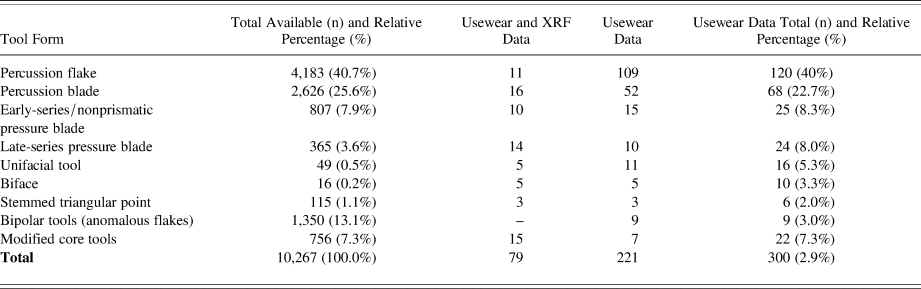
The artifacts that comprise the sample for usewear analysis (Table 1) were determined based on two research goals: (1) to acquire usewear data that could be combined with technological classifications made by Healan (Reference Healan2019) and chemical sourcing data obtained by Glascock (Reference Glascock2013) and Johnson and Hirth (Reference Johnson and Hirth2019); and (2) to acquire a representative sample of the different tool forms in the assemblage. First, I examined the sample collection of obsidian artifacts (n = 150) that was exported to the United States for XRF analysis, which contained 134 potential artifacts for usewear analysis based on technological properties and size. Here all of the available triangular stemmed points (n = 3), bifacial tools (n = 5), unifacial tools (n = 5), and modified core tools (n = 15) were analyzed in addition to 16 percussion blades (47.1 percent), 11 percussion flakes (32.4 percent), 10 early-series pressure blades (66.7 percent), and 14 late-series pressure blades (60.9 percent; Specimens 1–79). Next, I examined the percentages of all tool forms identified by Healan (Reference Healan2019) and determined the amount of each tool form that I needed to acquire from the Altica project's lithic collection in order to obtain a representative sample for each tool form. I started with lots with secure Early–Middle Formative period excavation contexts and expanded to lots with plow zone contexts only when necessary to analyze specific technological forms that were not available from secure excavation contexts (Specimens 80–300). In total, the sample includes 54 specimens (18 percent) from pit features with Early–Middle Formative period burials, 183 specimens (61 percent) from Stratum B and pit features with secure Early–Middle Formative occupation contexts, and 63 specimens (21 percent) from Stratum A, disturbed plow zone contexts.
Sample design for the Altica usewear study.

RESULTS
Postclassic and Other Plow Zone Specimens
An accurate description of obsidian tool functions and related activities at Early–Middle Formative Altica relies first on the identification of usewear specimens that securely date to the Early–Middle Formative in contrast to other specimens from plow zone contexts (Table 2). There are seven specimens that can be identified confidently as Postclassic period artifacts based on the combination of their technological forms, material sources, and plow zone contexts, which contain Postclassic and/or historic ceramics likely from a nearby Aztec village site (TA-199; Nichols and Stoner Reference Nichols and Stoner2019:374). These Postclassic tools include two complete late-series pressure blades made of XRF-sourced Pachuca-1 obsidian used for woodworking (Specimen 29 and 30); one unifacial scraper made of visually sourced Pachuca green obsidian used for maguey leaf scraping (Specimen 281); one hafted unifacial scraper made of visually sourced Pachuca green obsidian used for maguey heart scraping (Specimen 287); one hafted unifacial scraper made of visually sourced non-Otumba translucent gray and black-banded obsidian used for maguey heart scraping (Specimen 289); one unifacial scraper made of visually sourced Otumba gray obsidian used for wood scraping and stone incising/cutting (Specimen 291); and one unifacial scraper made of visually sourced non-Otumba translucent gray obsidian used for stone working (Specimen 292; Table 3). The technological characteristics of these scrapers match those of Postclassic period spoon-shaped scrapers, which were often hafted. In contrast, Formative period scrapers were non-standardized, often discoidal, handheld tools (Walton Reference Walton2017:294). Furthermore, I suspect that the bipolar flake specimens (n = 8)—all from plow zone contexts as none from the technological analysis by Healan (Reference Healan2019) originate from secure Early–Middle Formative excavation contexts—observed in this study do not date to the Middle Formative and likely date to the Postclassic period. Healan (Reference Healan2019) notes that bipolar flaking was not a common lithic production technique employed at Altica, if employed at all, in contrast to other contemporaneous sites in the Basin of Mexico (Boksenbaum Reference Boksenbaum1980) and other regions in Early to Middle Formative Mesoamerica (Clark Reference Clark, Johnson and Morrow1987; Parry Reference Parry1987; Walton Reference Walton2017). In addition, I have identified bipolar tool production in household contexts at the nearby Aztec village of Cihuatecpan (a.d. 1150–1550; Walton Reference Walton2017). The usewear characteristics from Altica's bipolar flakes are similar to the usewear characteristics from Cihuatecpan's bipolar flakes and blades, providing more evidence that bipolar tools were used as expedient kitchen utensils.
Material source and technological data for the Altica usewear study sample, organized first by categories of stratigraphic context and next by specimen number. Specimen numbers for Glascock's (Reference Glascock2013) X-ray fluorescence study are included for Specimens 1–79.

Usewear data and tool functions for the Altica usewear study sample organized first by categories of stratigraphic context and next by specimen number. ALL, all directions; B, brown; BL, black; BR, bright red; D, diagonal; G, green; I, intensive; L, light; LB, light brown; M, medium; P, pink; PAR, parallel; PER, perpendicular; R, red; RB, rainbow; SP, specimen; VI, very intensive; VL, very light; W, white; Y, yellow.

a Blood residue identified microscopically.
b Blood residue identified microscopically with chemical test confirmation.
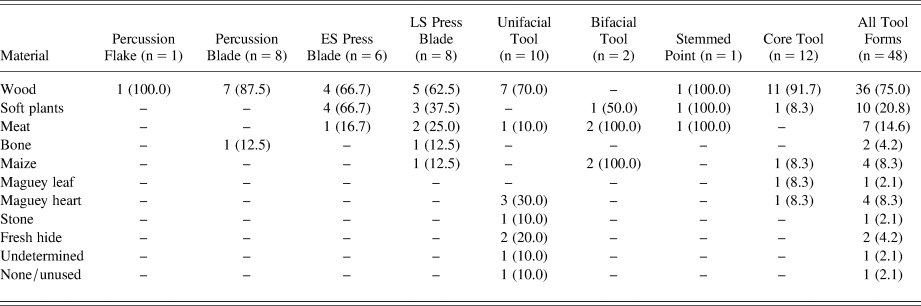
After removing these 15 likely Postclassic artifacts, the plow zone sample includes 48 usewear specimens that may or may not originate from the Early–Middle Formative occupation of Altica. Overall, the high percentage of woodworking evidence (75 percent) present across all tool forms is notable in addition to a general pattern of materials and activities linked to food acquisition and processing (Table 4). The two most common tool forms, modified core tools and unifacial tools, were used for a diverse array of activities compared to blade technologies and bifacial tools, which were used for more specific sets of activities, respectively. There are 29 specimens (60.4 percent) that exhibit discrete tasks with only one type of material, respectively; 17 specimens (35.4 percent) that exhibit tasks with more than one type of material; one specimen (2.1 percent) with an undetermined tool function; and one specimen (2.1 percent) that was not used.
Frequencies of materials present on obsidian use-wear specimens from plow zone contexts at Altica. Percentage values in parentheses. ES Press, early-series pressure; LS Press, late-series pressure.

Early–Middle Formative Specimens
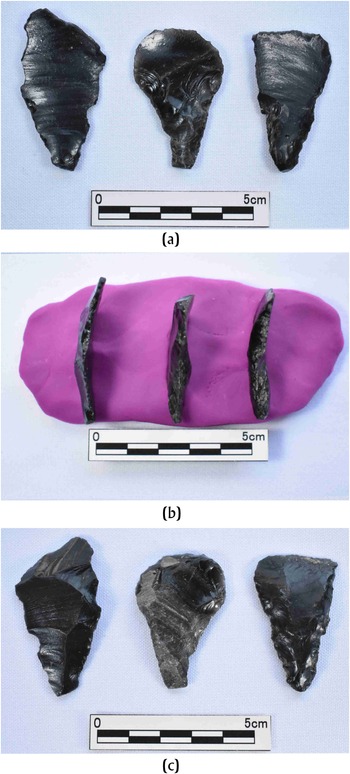
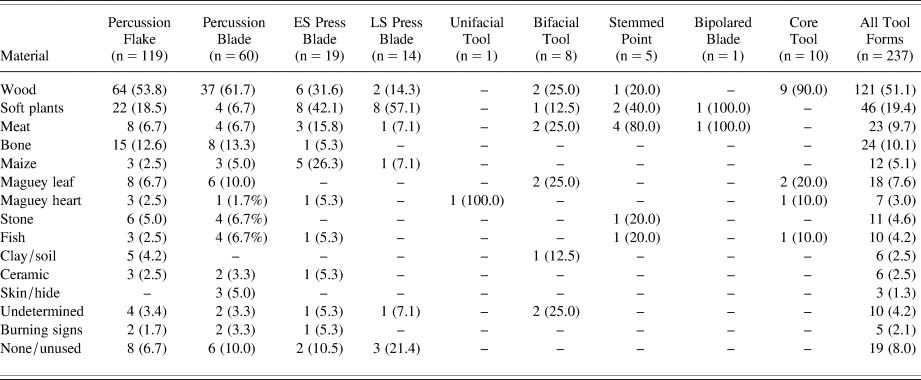
The analyzed sample contains 237 specimens from secure Early–Middle Formative excavation contexts at Altica comprised of 119 percussion flakes (50.2 percent), 60 percussion blades (25.3 percent), 19 early-series nonprismatic pressure blades (8 percent), 14 late-series pressure blades (5.9 percent), 10 modified core tools (4.2 percent), eight bifacial tools (3.4 percent), five triangular stemmed points (2.1 percent), one unifacial tool (0.4 percent), and one bipolared blade (0.4 percent). Collectively, the specimens indicate contact with 12 different types of material (Figures 8 and 9, Table 5). There are 145 specimens (61.2 percent) that exhibit discrete tasks with only one type of material, respectively; 63 specimens (26.6 percent) that indicate tasks with more than one type of material; 10 specimens (4.2 percent) with an undetermined tool function; and 19 specimens (8 percent) that were not used. Woodworking tasks (51.1 percent) were the most prominent activities followed by soft plant processing (19.4 percent) and a third tier comprised of activities involving 10 other types of materials (ranging from 1.3–10.1 percent). The usewear evidence for maize processing (5.1 percent) is infrequent compared to the more frequent processing of various soft plant materials (19.4 percent), which might have included nightshades (Physalis sp.), creeping false holly, beans, squash, chili peppers, amaranth, goosefoot, sage, sweet potatoes, yams, sedges/reeds, and possibly manioc based on paleoethnobotanical analyses (McClung de Tapia et al. Reference de Tapia, Emily, Martínez-Yrizar, Adriano-Morán, Cruz-Palma and Chaparro-Rueda2019). This difference is likely due in part to the use of soft plants for a wider array of purposes beyond food resources, such as bedding and wattle and daub household construction. The presence of usewear patterns linked to meat (9.7 percent), fish (4.2 percent), and skin/hide (1.3 percent) indicates access to animal resources, which complemented the residents’ agricultural strategy. The specimens with evidence for contact with bone (10.1 percent) include examples of incidental contact with bone from butchering and food preparation as well as examples of bone carving, whittling, and cutting in order to craft implements. More tools were used to process maguey leaf (7.6 percent) for fiber extraction compared to maguey heart (3 percent) for sap, or aguamiel, extraction, but this might be an expected observation considering the leaves for one maguey plant comprise a much larger surface area compared to its heart. The evidence for clay/soil (2.5 percent) contact comes exclusively from the action of scraping clay/soil, and three similarly spoon-shaped specimens may indicate a role for obsidian tools in ceramic production at Altica (Figure 10). The ceramic-related tool functions include four examples of ceramic sawing, one example of drilling, and one example of ceramic scraping. The stone working (4.6 percent) evidence is difficult to link to specific artifact types at Altica because the excavations encountered only large-sized pieces of ground stone and one imported greenstone bead that visually resembles Olmec blue jadeite.
Examples of use-wear characteristics (100×) linked to specific tool functions including: (a) scraping wood (Specimen 171); (b) scraping/whittling bone (Specimen 148); (c) scraping maguey leaf (Specimen 246); (d) scraping maguey heart (Specimen 90); (e) shaping clay (Specimen 97); and (f) working ceramic (Specimen 94). Photographs by the author.

Examples of use-wear characteristics (100×) linked to specific tool functions including: (a) slicing soft plant (Specimen 153); (b) slicing maize (Specimen 104); (c) slicing fish (Specimen 227); (d) slicing meat (Specimen 130); (e) cutting stone (Specimen 185); and (f) scraping fresh hide (160×; Specimen 64). Photographs by the author.

Ventral profile and dorsal views of handheld clay shaping tools: (a) Specimen 237; (b) Specimen 188; and (c) Specimen 232. Photographs by Tia Ahlquist and David Walton.

Frequencies of materials present on obsidian use-wear specimens from secure Early–Middle Formative contexts at Altica. Percentage values in parentheses. ES Press, early-series pressure; LS Press, late-series pressure.

The most common tool forms (expedient percussion blades and flakes) were used primarily for processing wood, most often through scraping/whittling followed by cutting/sawing. The soft plants and bone material categories are the next most frequent material types found on percussion flakes, while bone and maguey leaf represent the second tier of materials found on percussion blades. Clay or soil is evident on five percussion flakes but no percussion blades, while animal skin/hide is evident on three percussion blades but no percussion flakes. Finally, both percussion flakes and blades exhibit similar rates of appearance for meat, maize, maguey heart, stone, and fish.
Early-series nonprismatic pressure blades exhibit a wider range of material types (n = 8) compared to late-series pressure blades (n = 4). The material types and polish stages (see below) for late-series pressure blades indicate that they were used almost exclusively for tasks linked to food processing. Early-series nonprismatic pressure blades also functioned primarily to process food, and they have the highest frequency and rate for maize among the Early–Middle Formative specimens (Table 5). Specimen 104—an early-series nonprismatic pressure blade with unifacial trimming—is important to highlight in this context because it comes from Feature 32, a cultural feature containing dense amounts of obsidian and ceramic artifacts, burnt silt, basalt, and bajareque, and it exhibits usewear characteristics linked to soft plants, maize, and maguey heart (Tables 2 and 3). Accordingly, Specimen 104 demonstrates the wider pattern of multifunctional applications of pressure blade technologies to household food production-related tasks.
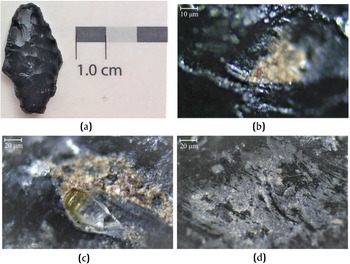
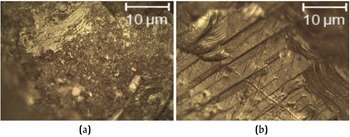
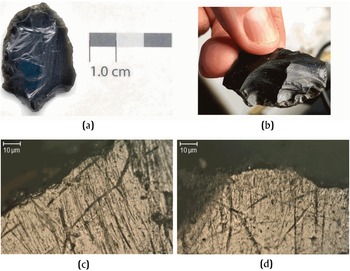
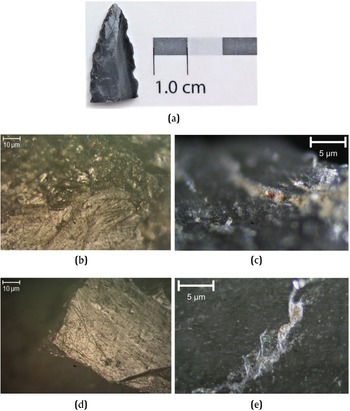
The projectile point specimens include two complete points (Specimens 226 and 265), two bases (Specimens 7 and 34), and one complete preform in production (Specimen 136). Specimen 265, sourced through visual classification as a gray translucent non-Otumba obsidian, has suspected blood residue and more clearly visible white and yellow residues that likely represent resin from hafting (Figure 11). Specimen 7, sourced through XRF as Otumba obsidian (Glascock Reference Glascock2013), also demonstrates suspected blood residue and evidence for hafting through striations with equidistant gaps within its side notch. Specimen 34, sourced through XRF as Otumba obsidian, has light edge rounding, Stage 2 polish formation including meat film residue, and striations indicative of hafting with soft plants (Figure 12). Specimen 136, sourced through visual classification as Otumba obsidian, is a curious example of a bifacial preform in the middle of production for a projectile point, but this production goal was abandoned and the tool was subsequently used to scrape wood (Figure 13). Specimen 226, visually identified as Otumba obsidian, has a heavily scratched surface and blood residues embedded within the microcavities of its edges (Figure 14). There is also one location on the tool where it was rubbed repeatedly across either stone or bone. The combination of a tip with piercing damage and repeated signs of use with rainbow-colored residues (Kononenko Reference Kononenko2011; Walton Reference Walton2019) on the tool may further indicate that it was used to spear fish. The archaeological context of Specimen 226 offers an additional clue to this functional interpretation. Feature 8, a dark circular pit dug into tepetate that contained an obsidian nodule cache filled in one episode, includes macrobotanical evidence of Schoenoplectus sp. (sedge, formerly Scirpus), which is associated with bodies of fresh water and swamps and may indicate semipermanent water storage facilities; an alternative interpretation is that a seed may have been accidentally brought to the site via reeds used for roofing or woven petates (reed mats; McClung de Tapia et al. Reference de Tapia, Emily, Martínez-Yrizar, Adriano-Morán, Cruz-Palma and Chaparro-Rueda2019:344). With either interpretation, it is not unreasonable to suggest that Altica residents had some sort of access to freshwater fish whether that was through middle- to long-distance fishing trips or trade with populations who lived closer to freshwater fish populations.
Example of use-wear characteristics linked to a hafted bifacial point. (a) Specimen 265 exhibits (b) blood residue (100×), (c) yellow residue (50×), and (d) white residue (50×). Photographs by the author.

Examples of (a) residue (160×) and (b) striations (160×) that indicate Specimen 34, a bifacial point base, was once hafted. Photographs by the author.

Specimen 136, a bifacial preform with (a and b) macroscopically visible pressure flakes removed from scraping a hard material, which (c and d) microscopic use-wear characteristics (100×) reveal as wood. Photographs by the author.

(a) Specimen 226, a bifacial point, with use-wear characteristics demonstrating: (b) contact with bone or stone (100×), (c) blood residue (400×); (d) striations and edge damage indicating repeated piercing actions (100×), and (e) rainbow residues indicating contact with fish (400×). Photographs by the author.

The bifacial tool specimens comprise mostly smaller fragments that cannot be reliably classified as either a knife or a projectile point, and their functions include meat slicing, soft plant slicing, maguey leaf sawing and scraping, clay shaping, and wood sawing and scraping. Formally designed unifacial tools that are typical of the Classic period onward in central Mexico (Walton Reference Walton2017) are very rare in the Altica assemblage. The only Early–Middle Formative unifacial tool at Altica (Specimen 214), however, was very likely used for maguey heart scraping, a function that was typical of Classic, Epiclassic, and Postclassic period unifacial tools. Bipolar tools are similarly very rare in the Altica lithic assemblage (Healan Reference Healan2019), and here in the usewear study sample the only Early–Middle Formative bipolar tool (Specimen 169), a blade that was subjected to bipolar percussion, exhibits soft plant and meat slicing along the original blade's edges but lacks signs of use on its bipolared edges. This may be explained by the artifact's context (Feature 21, a rock-concentrated fill concentration located above Burial 2; Table 2), meaning the bipolar percussion was the result of the blade getting smashed by rocks during the filling process rather than by intentional bipolar percussion as a tool production strategy (Boksenbaum Reference Boksenbaum1980).
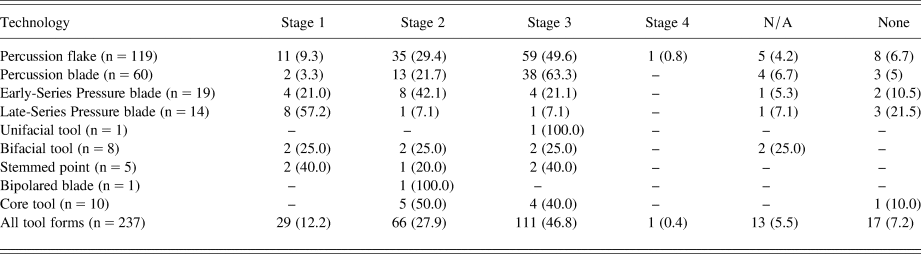
Polish stage development is the best indicator of a tool's use-life duration, especially when controlling for distinct material types, tool motions, and measurements of applied force. Collectively, the Early–Middle Formative specimens exhibit 29 examples of Stage 1 polish development (12.2 percent), 66 examples of Stage 2 polish development (27.9 percent), 111 examples of Stage 3 polish development (46.8 percent), and one example of Stage 4 polish development (0.4 percent; Table 6). Comparing the percentages of polish stage development across different tool forms, percussion flakes, percussion blades, and modified core tools were the most heavily used specimens. In contrast, early-series nonprismatic pressure blades and late-series pressure blades were the most frequent unused tools and tools used for shorter activity durations and/or tasks with softer materials.
Frequencies of polish development stages present on obsidian use-wear specimens from secure Early–Middle Formative contexts at Altica. Percentage values in parentheses.

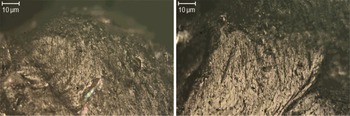
There are 20 Early–Middle Formative usewear specimens that exhibit Stage 1 polish produced exclusively by the processing of soft plants (Table 3), an activity that will only produce Stage 2 polish for some soft plants (e.g., avocado and cactus fruit) after about 15 minutes of continuous tool use. The other examples of Stage 1 polish from the Early–Middle Formative usewear specimens include four cases of meat slicing, one case of fish slicing, one case of meat and soft plant slicing, and three cases of soft plant and maize slicing. There are 30 usewear specimens that exhibit Stage 2 polish produced exclusively by woodworking activities. Wood is also a common material associated with usewear specimens with Stage 2 polish that was created by activities with multiple types of materials (Table 3). Other cases of Stage 2 polish produced by exclusive contact with one type of material include meat (n = 3), soft plants (n = 2), clay (n = 2), maize (n = 1), bone (n = 1), and ceramics (n = 1). There are 52 usewear specimens with Stage 3 polish exclusively from woodworking. Similar to the results for specimens with Stage 2 polish, wood was the most common material found on usewear specimens with Stage 3 polish that resulted from tool use in contact with multiple types of materials. Other cases of Stage 3 polish produced by exclusive contact with one type of material include bone (n = 11), maguey leaf (n = 6), maize (n = 2), maguey heart (n = 1), fish (n = 1), ceramic material (n = 1), clay (n = 1), and stone (n = 1). Specimen 114 exhibits the only example of Stage 4 polish, which was produced by maguey leaf scraping (Figure 15).
Examples of Stage 4 polish produced by scraping maguey leaf (100×) located along the edges of Specimen 114, a noncongruent percussion flake. Photographs by the author.

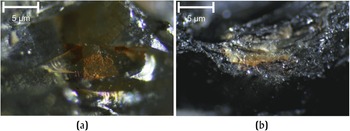
Finally, as part of this usewear study I performed chemical tests on suspected blood residues to ascertain whether the technique outlined by Matheson and Veall (Reference Matheson and Veall2014:233) for removing and testing bloodlike residues from tool edges could work on the Altica specimens. If so, this would refine my visual classification criteria for blood residues apart from other residues, especially residues that include the color red. Ten specimens were subjected to a chemical test for blood residue using Hemastix strips, but only two of them produced positive results (Table 3). Specimen 208—a percussion flake made of visually sourced Otumba obsidian from Feature 16—exhibits clear signs of bone sawing along with blood residue (Figure 16a). Specimen 282, a bipolar flake made of visually sourced non-Otumba obsidian from a plow zone context with concentrations of Formative ceramics, exhibits clear signs for meat and soft plant slicing along with blood residue (Figure 16b).
Blood residues (400×) positively identified through chemical testing from (a) Specimen 208, a noncongruent percussion flake fragment, and (b) Specimen 282, a bipolar flake. Photographs by the author.

DISCUSSION
After removing the Postclassic obsidian usewear specimens from the study sample, the results for the usewear specimens from plow zone contexts (Table 4) are very similar to the results from the usewear specimens from secure Early–Middle Formative occupation contexts (Table 5), which further supports the claim by Stoner et al. (Reference Stoner, Nichols, Alex and Crider2015:20) that an Aztec occupation did not overlap and obscure the underlying Early–Middle Formative period occupation. Overall, the usewear data indicate that residents of Altica used their obsidian tools—the vast majority of which were simple, expedient percussion tools made of local Otumba obsidian—for a diverse array of subsistence-related tasks in addition to a high frequency of woodworking activities. Furthermore, obsidian tools from Altica were about twice as likely to be used for tasks involving one type of material rather than multiple types of material, which is intriguing given its small size and greater distance from emerging Middle Formative towns and urban centers compared to other villages in the region (Figure 1). For example, in contrast to the tool production and acquisition strategies at Altica, residents of the Middle Formative site of Amomoloc (900–650 b.c.), a rural village (2–7 ha) in northern Tlaxcala settled by migrant maize agriculturalists (Carballo and Lesure Reference Carballo, Lesure and Lesure2014; Lesure Reference Lesure2014; Lesure et al. Reference Lesure, Borejsza, Carballo, Frederick, Popper and Wake2006), used a wider variety of material sources for chipped tools and locally produced more types of chipped tools (although not pressure blades, which they imported in whole form) than the residents of Altica (Walton Reference Walton2017:110–118). Furthermore, usewear analysis on tool specimens from Amomoloc revealed that 54 percent were used in contact with one material compared to 40 percent that were used in contact with multiple material types (Walton Reference Walton2017:Table 4.5), reflecting more of a multifunctional tool-use approach compared to the more unifunctional tool-use approach practiced by Altica residents. This pattern of residential multicrafting and multifunctional tool-use approaches is also evident within Cantera phase (700–500 b.c.) lithic assemblages from the urban center of Chalcatzingo (Burton Reference Burton and Grove1987).
Population growth in central Mexico during the late Middle and early Late Formative periods led to regional urbanism and state formation, and these processes helped to provide consumers in the region with wider access to more refined tools created by obsidian knappers who innovated and improved their skills levels (Blanton et al. Reference Blanton, Fargher, Heredia Espinoza and Blanton2005; Carballo Reference Carballo2016; Carballo et al. Reference Carballo, Carballo and Neff2007; De León et al. Reference De León, Hirth and Carballo2009; Walton Reference Walton2017). Due to this increasing demand fueled mostly by independent consumers (Hirth et al. Reference Hirth, Cyphers, Cobean, De León and Glascock2013), obsidian tool forms such as pressure blades, ritual bloodletters, ceremonial eccentrics, unifacial scrapers, bifacial knives, bifacial dart points, and lapidary products largely replaced expedient percussion technologies. Over the course of pre-Hispanic occupation in central Mexico, these tool forms were increasingly used for specialized tasks with certain materials, rather than multiple activities with different materials (Carballo Reference Carballo2011, Reference Carballo2012, Reference Carballo2016; Otis Charlton Reference Otis Charlton1993; Pastrana and Carballo Reference Pastrana, Carballo, Nichols and Rodríguez-Alegría2017; Walton Reference Walton2017, Reference Walton2020; Walton and Carballo Reference Walton and Carballo2016). Within this diachronic framework, this usewear study investigating the rural villagers of Early–Middle Formative Altica helps us to understand that their close proximity to an obsidian source as well as other sites that were exploiting it (Healan Reference Healan2019) greatly impacted their decision to widely adopt a unifunctional tool-use approach rather than a multifunctional tool-use approach. Simply put, even in a small village with expedient tools of poor quality during the earliest establishment of a regional lithic economy, having immediate access to an obsidian source enabled inhabitants to use obsidian tools for single functions.
The most frequent activity of this unifunctional tool-use approach as well as the complementary multifunctional tool-use approach was woodworking, which may have been linked to activities that fit within one, two, or both of the following scenarios. The first scenario relates to the process of land development, household construction, and continued maintenance over the course of human occupation at Altica. Stoner and Nichols (Reference Stoner and Nichols2019a:261) indicate that there is no evidence for a local transition from foraging groups (Parry Reference Parry2001) to sedentary villages in the Teotihuacan Valley. The archaeological record currently indicates that residents of Altica, the first in the Teotihuacan Valley, likely migrated into the Teotihuacan Valley north away perhaps from larger sites in the southern Basin of Mexico at the end of the Ayotla phase (Sanders et al. Reference Sanders, Parsons and Santley1979:95–96). Thus, the newly arrived settlers would have had to clear some of the pine-oak forest in order to establish agricultural plots and build houses, possibly with a wattle and daub and thatch roof construction method. Over time, wooden elements of the initial household constructions would have required maintenance and replacement and new homes and agricultural plots would have required further woodworking-related activities. The migrants would have also needed to immediately create a supply of firewood upon arrival and maintain that supply over time. Many of the thicker obsidian percussion flakes, percussion blades, bifacial knives, and unifacial tools with evidence for woodworking with Stage 2 and Stage 3 polish may have been used as part of the land development and household construction process (e.g., scraping off tree bark, sawing off branches, whittling digging sticks, and creating posts and other structural elements). The stronger, fine-grained basalt tools, comprising four percent of Altica's lithic assemblage (Healan Reference Healan2019:279), would have made more effective chopping axes for felling trees. Smaller obsidian tools with evidence for woodworking, such as pressure blades, may have been limited to crafting finer wooden implements such as spear or atlatl shafts, composite tool handles (e.g., hafted bifacial knives), and tools for sculpting and/or incising clay for ceramic production, among others. A second scenario that is not likely but cannot be ruled out involves the possibility of Altica residents producing objects made of wood for exchange in the emerging intraregional economy within the eastern Basin of Mexico (Stoner and Nichols Reference Stoner and Nichols2019a:261) and/or long-distance exchange networks reaching as far as the west Mexican highlands and southern Gulf Coast lowlands (Glascock Reference Glascock2013; Johnson and Hirth Reference Johnson and Hirth2019; McClung de Tapia et al. Reference de Tapia, Emily, Martínez-Yrizar, Adriano-Morán, Cruz-Palma and Chaparro-Rueda2019; Stoner et al. Reference Stoner, Nichols, Alex and Crider2015). Stoner and Nichols (Reference Stoner and Nichols2019b) identify Altica as a small, terminal node in ceramic exchange networks, meaning ceramics were imported but not subsequently exported. Similarly, Healan (Reference Healan2019) argues that Altica residents acquired their obsidian from another site, possibly one even closer to the Otumba obsidian source, and they did not export obsidian tools. Nevertheless, comparing Altica's woodworking rate (51.1 percent) to the woodworking rates of other Middle Formative villages located in pine/oak forests in the region (Figure 1) such as Amomoloc (900–650 b.c.; 9.6 percent), Tetel (750–500 b.c.; 13.7 percent), Las Mesitas (600–500 b.c.; 17.6 percent), and Late Formative La Laguna (600–400 b.c.; 15 percent; Walton Reference Walton2017:Table 8.4) reveals that Altica is the best candidate for a wood export site. While these findings viewed together point to wood or wooden objects, rather than ceramics or obsidian tools, as possible export products, it is difficult to assign confidence to this interpretation because wooden artifacts were not recovered at the site, let alone specific types of portable wooden artifacts that may have been traded. Thus, the high frequencies of woodworking usewear patterns observed on Altica's obsidian specimens can be more confidently linked to the types of activities described in the first scenario based on land development and household construction rather than the second scenario based on a production strategy for exchange, although this cannot be ruled out and it is possible that activities in both scenarios took place.
The usewear dataset from Altica can also be analyzed in concert with the site's paleoethnobotanical (McClung de Tapia et al. Reference de Tapia, Emily, Martínez-Yrizar, Adriano-Morán, Cruz-Palma and Chaparro-Rueda2019) and osteological and isotopic datasets (Storey et al. Reference Storey, Buckley and Kennett2019) to inform us about Early–Middle Formative period subsistence and diet. Overall, McClung de Tapia and colleagues (Reference de Tapia, Emily, Martínez-Yrizar, Adriano-Morán, Cruz-Palma and Chaparro-Rueda2019) characterize the subsistence strategy of Altica's residents as one that combined non-intensive maize agriculture with foraging. The stable carbon and nitrogen isotope values from the four individuals in burial pits align with this characterization because they indicate similar diets based on C4 plants, which include maize crops (Storey et al. Reference Storey, Buckley and Kennett2019:Figure 5). The ratio of obsidian tools with soft plant usewear patterns to obsidian tools with maize usewear patterns from Altica is 3.8:1, which can be compared to the ratios from other Formative period village sites including Amomoloc (10.2:1), Tetel (8.8:1), Las Mesitas (8.8 percent for soft plants with no evidence for maize processing), and Late Formative La Laguna (ranging from 1.7–2:1; Walton Reference Walton2017:Table 8.4). This comparison may reveal that Altica residents were less reliant on plants obtained through foraging or through trade with lowland sites and more reliant on agricultural maize compared to the residents of Amomoloc, Tetel, and Las Mesitas but not La Laguna.
The usewear data also parallel paleoethnobotanical data by indicating the utilization of maguey plants for both their fibrous leaves and liquid-filled hearts. More specifically, certain specimens indicate the specific action of maguey heart scraping intended to coax and extract aguamiel for direct consumption or pulque production. In terms of dietary balance, the evidence for meat processing is essentially twice as frequent as the evidence for maize processing. It is also important to mention here that it takes a longer activity duration (40–55 minutes) for meat slicing to produce a distinctive bright polish or film on an obsidian tool surface (Hurcombe Reference Hurcombe1992:43–44; Stemp Reference Stemp2016:168) compared to the polish formation process for maize processing (5–15 minutes; Walton Reference Walton2019:915–916), meaning there is a possibility that some of the usewear specimens in this study were used for processing meat but these shorter activities were not detected. The relatively equal rates for meat processing and contact with bone further reinforce that residents from Altica were hunting/trapping, despite the overall lack of animal bones recovered from excavations (Stoner and Nichols Reference Stoner and Nichols2019a:260). Were the residents of Altica proficient hunters? The infrequent and small (3–4.5 cm size grade) stemmed triangular points of poor craftsmanship do not seem to suggest so, or at the very least they did not often make obsidian hunting weapons. One of the most intriguing findings, however, is the connection between one of the points (Specimen 226) and the potential activity of fish spearing. The contemporary landscape of Altica is devoid of natural water sources aside from rainfall and subsequent water erosion during the rainy season. McClung de Tapia and colleagues (Reference de Tapia, Emily, Martínez-Yrizar, Adriano-Morán, Cruz-Palma and Chaparro-Rueda2019) found botanical remains associated with freshwater swamps in some of Altica's pit features, but the closest permanent stream is estimated to be about 10 kilometers from the site (Wesley Stoner, personal communication 2019). Thus, it is unlikely that Altica residents were able to exploit a local fish population. Instead, the 10 specimens with identifications of fish processing likely indicate that Altica residents were making extended trips to fresh water sources and returning with fish and/or obtaining larger fish, rather than just tiny, dried fish that were eaten whole (Widmer and Storey Reference Widmer and Storey2017:55–57), through trade with established populations near the lakes in the southern Basin.
CONCLUSION
The rural village of Altica was a frontier settlement composed of newly established residents who used expedient percussion tools made of nearby Otumba obsidian to transform an area of pine-oak forest into habitable spaces complete with agricultural plots. Wooden artifacts were not recovered from excavations at Altica, and they are very rarely encountered in the central Mexican archaeological record. Therefore, one of the most revealing findings from this usewear study with 237 specimens from secure Early–Middle Formative excavation contexts is the high frequency of woodworking evident on almost all tool forms and especially expedient percussion tools that were used intensively to construct and maintain a new village settlement for approximately 450 years. The site's proximity to the Otumba obsidian source, rather than its connection to regional and interregional trade networks that began to intensify ca. 1000 b.c. (Healan Reference Healan2019; Johnson and Hirth Reference Johnson and Hirth2019; Stoner and Nichols Reference Stoner and Nichols2019a, Reference Stoner and Nichols2019b; Stoner et al. Reference Stoner, Nichols, Alex and Crider2015), was a determining factor for the residents’ unifunctional tool-use approach. The items that they imported included obsidian from west Mexico, ceramics from the Gulf Coast, and a greenstone bead that resembles the Olmec blue jadeite from the Motagua Valley of Guatemala/Honduras. The complete absence of shell artifacts and any indication of local shell working with obsidian tools at Altica reveals that residents were not interested in obtaining shell or able to import it. High frequencies of woodworking activities with obsidian tools might also indicate the production of wood or wooden objects for exchange, but there is not enough evidence from Altica to support that scenario. While Altica residents also used obsidian tools to extract fibers from maguey leaves and scrape maguey hearts for aguamiel extraction and possible pulque production, these activities were conducted only for local household consumption. Similarly, tools crafted out of bone and clay objects shaped by obsidian were meant for local consumption.
Aside from woodworking activities, the usewear data reveal a mix of subsistence-related tasks that match up nicely with the balanced approach to foraging and non-intensive maize agriculture that is indicated by Altica's paleoethnobotanical (McClung de Tapia et al. Reference de Tapia, Emily, Martínez-Yrizar, Adriano-Morán, Cruz-Palma and Chaparro-Rueda2019) and osteological and isotopic datasets (Storey et al. Reference Storey, Buckley and Kennett2019). The usewear data broadly indicate that food resources were relatively balanced between soft plants, maize, animals, and fish, while stable carbon and nitrogen isotope values from four individuals more specifically indicate diets based on C4 plants, which include maize crops (Storey et al. Reference Storey, Buckley and Kennett2019:Figure 5). While hafted bifacial points were present and very likely used for hunting/fishing, these activities appear to have been uncommon and geared towards small game compared to more frequent activities with other tool forms that are more closely linked to the exploitation of plant resources.
Finally, the absence of obsidian tool forms clearly linked to ritual practices such as bloodletting and dedicatory or termination cache offerings at Early–Middle Formative Altica supports the field's model that ritual practices involving obsidian tools originated during the middle to later stages of the Middle Formative period, often (but not always) alongside increases in social differentiation and/or social inequality (Flannery and Marcus Reference Flannery and Marcus2005; Grove and Gillespie Reference Grove, Gillespie and Plunket2002; Parry Reference Parry1987; Walton Reference Walton2020). Instead, ritual practices documented at Altica included burial offerings with other types of prestige goods (Stoner and Nichols Reference Stoner and Nichols2019a:260–261), which were the collective driving force of Middle Formative political and ritual economies (Blanton et al. Reference Blanton, Fargher, Heredia Espinoza and Blanton2005). Obsidian was all but foreign and prestige-building for the residents of Altica. Rather than focusing on the transformation of obsidian into sacred tools for ritual functions, Altica's pioneers used the simplest obsidian tools that they could quickly make or obtain to construct their homes and satisfy the subsistence requirements of daily life in the Teotihuacan Valley.
RESUMEN
Los conjuntos de datos líticos son recursos que ayudan a los arqueólogos mesoamericanos con el estudio de las economías antiguas. Más específicamente, los estudios de huellas de uso nos ayudan a mejorar las determinaciones de las funciones de las herramientas de obsidiana e identificar diversas estrategias económicas en casas antiguas. Este artículo presenta un estudio sobre el uso de artefactos de obsidiana del sitio de Altica, México (1250–800 cal. b.c.)—la aldea más temprano en el Valle de Teotihuacan—para mejorar nuestra comprensión de las economías domésticas en el período formativo temprano-medio. El sitio está ubicado a 17 km caminando de la fuente de obsidiana Otumba, pero las residentes no exportaron nódulos, núcleos o herramientas de obsidiana. En cambio, las residentes usaron las herramientas de obsidiana para trabajar la madera y actividades de la subsistencia.
El análisis de huellas de uso con gran aumento puede detectar cuatro atributos creados por actos de uso de herramientas de obsidiana: estriaciones, redondeo en los filos, micropulidos, y residuos. Las características de uso y las funciones de las herramientas de obsidiana identificadas aquí se basan en mi programa sistemático de 300 experimentos con 145 especímenes de obsidiana que controlaron dos fuentes de obsidiana, dos duraciones de actividad (5 y 15 minutos), y 29 materiales diferentes a los que se podía acceder residentes prehispánicos del centro de México. Los artefactos de Altica en esta muestra para el análisis de huellas de uso se determinaron en base a dos objetivos de investigación: (1) adquirir datos de huellas de uso que podrían combinarse con clasificaciones tecnológicas y datos químicos para fuentes de obsidiana; y (2) adquirir una muestra representativa de las diferentes formas de herramienta en la colección. En total, la muestra incluye 54 especímenes (18 por ciento) de los pozos con entierros del período formativo temprano-medio, 183 especímenes (61 por ciento) del estrato B y pozos con contextos seguros de ocupación en el período formativo temprano-medio, y 63 especímenes (21 por ciento) del estrato A, contextos de la zona de arado.
Los resultados indican la presencia de 12 tipos diferentes de materiales en las herramientas de obsidiana de Altica. Los residentes de Altica pudieron usar un enfoque unifuncional en el uso de herramientas con navajas y lascas de percusión debido a su proximidad a la fuente Otumba. Si bien los objetos de madera pueden haberse exportado, la alta frecuencia de carpintería observada en las herramientas de obsidiana de Altica se atribuye más probablemente a la construcción y mantenimiento de las casas y parcelas agrícolas del asentamiento recientemente establecido. En combinación con análisis previos de los conjuntos de datos paleoetnobotánicos, osteológicos e isotópicos del sitio, los datos de huellas de uso indican además una estrategia de subsistencia que equilibraba el cultivo de maíz con la recolección de recursos silvestres.