Introduction
Among the factors that account for the persistently high fertility in developing countries is the sex composition of living offspring. The literature reports that the effect of sex composition of offspring on fertility depends on marital practices and gender inequality in those societies. In Asian countries and other developed countries where this effect has been studied, the predictive power of sex composition of offspring on fertility has been shown to be very high among parents with a strong preference for one sex (Bongaarts & Potter, Reference Bongaarts and Potter1983; Schultz, Reference Schultz2007). However, sex preferences for children, and specifically the effect of sex composition of offspring on subsequent fertility, have received less attention in sub-Saharan Africa (SSA) than in Asian and other developed countries (Rossi & Rouanet, Reference Rossi and Rouanet2015). This lack of interest may be due to the fact that SSA is regarded as a region with little or no fertility preference for boys, such that no relationship to fertility would be expected (Repetto, Reference Repetto1972; Arnold, Reference Arnold1997; Filmer et al., Reference Filmer, Friedman and Schady2009). However, such a relationship might be concealed by three main factors: a preference for both sons and daughters, the presence of sex-selection technologies and the level of fertility.
Studies in the Asian context attribute the effect on fertility of the sex composition of offspring to son preference, such that couples would adjust the sex composition of their offspring through continued fertility or medical technology (Arnold, Reference Arnold1997; Arnold et al., Reference Arnold, Kishor and Roy2002; Pison, Reference Pison2004; Guilmoto, Reference Guilmoto2009; Lin, Reference Lin2009; Singh et al., Reference Singh, Singh, Singh and Kumar2010; Bongaarts, Reference Bongaarts2013; Behrman & Duvisac, Reference Behrman and Duvisac2017). However, in SSA, in contrast to other regions, families prefer to have offspring of both sexes. Indeed, in most societies in SSA countries, notably in Burkina Faso, the family system is patrilineal, a system of filiation in which the male child carries the lineage of the father or the father’s community. This means, for instance, that the transmission of inheritance, property, family names and titles goes through the male lineage. In addition, the marriage system is patrilocal, with the couple settling in the husband’s home or community. Consequently, offspring composed only of girls can present a risk of loneliness in old age, as the original household is likely to become empty after girls’ departure through marriage. The lineage could also become extinct, since the children of those married girls will be linked to their father’s lineage rather than to their mother’s. Conversely, if the offspring includes at least one boy, the lineage is likely to remain in the family and expand with the arrival of a daughter-in-law and grandchildren. Thus, in SSA, the absence of a male child is likely to upset couples’ initial reproductive plans, driving them to continue procreation beyond the desired number of children (Milazzo, Reference Milazzo2014).
At the same time, there is a preference for at least one daughter. When assessing for son preference using Demographic and Health Survey (DHS) data from 37 SSA countries, Rossi and Rouanet (Reference Rossi and Rouanet2015) found instead a preference for both sexes (sons and daughters) in most countries. One potential explanation might be women’s greater autonomy in SSA compared with South Asia (Jejeebhoy & Sathar, Reference Jejeebhoy and Sathar2001; Moursund & Kravdal, Reference Moursund and Kravdal2003; Mumtaz & Salway, Reference Mumtaz and Salway2005; Schatz & Williams, Reference Schatz and Williams2012). According to the index on Social Institutions and Development, only a very few countries in SSA restrict women’s access to public space and political participation (Jütting & Morrisson, Reference Jütting and Morrisson2005; Jütting et al., Reference Jütting, Morrisson, Dayton-Johnson and Drechsler2008). Women are thus able to engage freely in the economic sphere despite the continued prevalence of other restrictions (e.g. access to land), violence or family discrimination. The social expectations placed on women may also explain the preference for girls. For instance, female children will help their parents until they leave the family (freeing their mothers for other activities) and even after they are married (Amoakohene, Reference Amoakohene2004). Furthermore, unlike in Asia, where dowry is an economic burden on the girl’s family, in SSA the dowry system is unfavourable to the boy’s family (Rossi & Rouanet, Reference Rossi and Rouanet2015). Rossi and Rouanet also explained that even the inheritance system is not totally closed to women in SSA, and that the absence of a son is often remedied through fosterage. Therefore, the potential preference for both sexes in SSA can obscure the effect of the sex composition of offspring on fertility in the region.
The use of sex-selection technologies is essential for couples who want both fewer children and a particular sex composition of their offspring. For example, ‘in a two-child family, ensuring at least one son and assuming no selection at the first pregnancy requires 24 percent of couples to use sex selection at the second pregnancy’ (Bongaarts, Reference Bongaarts2013, p. 202). In societies where there are particular sex preferences and where sex-selection technologies are widely available, accessible and acceptable, couples may use those technologies to adjust the sex composition of their offspring (Fuse, Reference Fuse2010). This occurs, for example, in Asia, where very high sex ratios in favour of sons are observed; this phenomenon is reported in the literature on missing girls (Bongaarts, Reference Bongaarts2013; Bongaarts & Guilmoto, Reference Bongaarts and Guilmoto2015). In SSA, however, the means to identify the sex of a fetus and safe abortion services are not available to many couples (now and in the past), but even when these are available, couples may not want to rely on abortion for moral, religious or other reasons. In this case, son or daughter preference cannot be observed through very high sex ratios in favour of sons. It may be that this context of no sex-selection technologies limits the implementation of the child sex preference practices in SSA, as recent studies have shown that desired sex ratios are above the norm while real sex ratios remain normal in SSA (Bongaarts, Reference Bongaarts2013).
When fertility is high, couples can achieve their latent desired sex composition without demonstrating any preferences. In the context of high fertility, there are many mechanisms (polygamy, family solidarity in the care of children, etc.) to help families, especially men, achieve the desired sex composition of offspring. As emphasized by several authors (Sloane & Lee, Reference Sloane and Lee1983; Pollard & Morgan, Reference Pollard and Morgan2002; Gray & Evans, Reference Gray and Evans2005), high fertility implies that simple sex preferences (e.g. at least one son and one daughter) will be satisfied in the course of having a large number of children. In contrast, in the context of a general decline in fertility, desiring fewer children can conflict with wanting a particular sex composition, as it becomes more difficult for parents to attain both without resorting to sex selection. For example, if couples want two children and a composition of one son and one daughter, then half of those couples will not achieve the desired sex composition (Pollard & Morgan, Reference Pollard and Morgan2002; Bongaarts, Reference Bongaarts2013). Moreover, in a society where the fertility level is high, sex preferences can manifest by short intergenesic intervals resulting, for example, from low contraceptive use (Rossi & Rouanet, Reference Rossi and Rouanet2015) and by unequal investment in children (conscious or unconscious allocation of household resources such as food, education and medical care) (Fuse, Reference Fuse2010). Thus, the fertility decline occurring with the demographic transition in SSA has implications for parents who have a preference for a particular sex composition of offspring.
Fertility is in transition in many SSA countries, especially in urban areas, which calls for a new assessment of the relationship between sex composition and fertility. For example, the development of mass media (radio, newspapers and television, in particular) and more recently of social media (especially Facebook, WhatsApp, Viber and Twitter) in African cities, including Ouagadougou, has encouraged the spread of new family models in favour of low-fertility behaviour (Locoh, Reference Locoh2003; Tabutin & Schoumaker, Reference Tabutin and Schoumaker2004). As reported by Attané (Reference Attané2003, p. 188), ‘The image of romantic love disseminated widely in film and television has helped to fundamentally change the representations of the loving feeling’ among the Mossi in Burkina Faso, with implications for reproductive behaviour. Conversely, the transition in fertility is accompanied by social and economic transformations (Reher, Reference Reher2011). Polygamy appears to be in sharp decline in African cities due to the economic difficulties of supporting two or more families, along with an increase in wives’ aspirations with regard to their children’s education and their own health and overall well-being (Locoh & Mouvagha-Sow, Reference Locoh and Mouvagha-Sow2005). In Ouagadougou, for example, the polygamy rate among women fell from 26.4% to 15.6% between 1993 and 2010, and was estimated at just 6.3% for men in 2010 (Konaté et al., Reference Konaté, Sinaré and Seroussi1994; INSD & ICF International, 2012). The gap between boys and girls in terms of primary school attendance has narrowed considerably in recent years in Ouagadougou following strong social and political mobilization for the reduction of gender inequalities (Lachaud et al., Reference Lachaud, Adjiwanou, LeGrand and Kobiané2014).
A relatively recent study in Nigeria showed a positive relationship between sex composition of offspring and various measures of fertility in Nigeria, which is perhaps a prelude to more systematic effects within the continent. In a study using the 2008 Nigerian Demographic Health Survey (DHS), Milazzo (Reference Milazzo2014) showed that women with first-born daughters had (and desired) more children and were less likely to use contraceptives than were women with first-born sons. Consonant with this result is the recent increase in the sex ratio in Nigeria (Kaba, Reference Kaba2015). Overall, Bongaarts and Guilmoto (Reference Bongaarts and Guilmoto2015) observed an increase in the population sex ratio in SSA from 1970 to 2010.
The aim of the present study was to assess the effect of sex composition of living offspring on women’s fertility intention and behaviour in Ouagadougou, the capital of Burkina Faso, where a decline in fertility and changes in the sociocultural norms relating to childbearing have been recently reported (Rossier et al., Reference Rossier, Soura, Baya, Compaoré, Dabiré and Dos Santos2012; INSD & ICF International, 2012; Bougma et al., Reference Bougma, Pasquier-Doumer, Legrand and Kobiané2014). Using both quantitative and qualitative data, this study investigated three research questions: 1) Do women whose existing children are all of the same sex (boys or girls) have a greater probability of demand for additional children than those with existing children of both sexes? 2) If so, are these differences in fertility intentions expressed through fertility control behaviours, especially differences in modern contraceptive use? 3) What reasons underlie the demand for an additional child (and lower contraceptive use) related to the sex composition of existing offspring? Indeed, if having children of the same sex has consequences on future fertility, then women with children of the same sex must necessarily be more likely to want additional children (in hope of having a child of the missing sex) than are those with children of both sexes. Moreover, this desire for additional children, even when higher among women with children of one sex than among those with children of both sexes, may have no effect on future fertility if both groups of women engage in the same fertility control behaviours (e.g. contraceptive use). Hence the importance of examining issues relating to both fertility intentions and behaviour. Quantitative results can reveal a relationship between two variables (sex composition and demand for additional children on the one hand, and sex composition and contraception use on the other) under the hypothesis of a theoretically causal mechanism, but qualitative data can shed light on the actual causal mechanisms at work. Admittedly, it is somewhat difficult to conceive why women with children of all the same sex would want a large family size, if not for reasons related to the sex composition of their offspring. However, Raley and Bianchi (Reference Raley and Bianchi2006) suggest the possibility that this continued procreation could actually be motivated by a desire for additional children of the same sex. It is possible, in their view, that parents with only girls might want an additional child, not because they desire a son, but because they so enjoy their girl children that they want another, or even another child regardless of sex. For these reasons, addressing the research questions comprehensively called for a combination of quantitative and qualitative data.
Methods
Data
The data for this study came from the Demtrend survey conducted among the population of the Ouagadougou Health and Demographic Surveillance System (Ouaga-HDSS, or Observation de la population de Ouagadougou: www.issp.bf/OPO/), supplemented by a qualitative survey.
Ouaga-HDSS is a longitudinal data collection system started in 2008 in five districts of the city of Ouagadougou (Kilwin, Tanghin, Nonghin, Nioko 2, Polesgo). It covers a population of around 80,000 individuals with diverse socioeconomic profiles. While the first two districts are planned, the three others are unplanned (i.e. informal suburban districts governed by traditional land ownership rules and lacking public infrastructure such as water, electricity and sewers). Since the initial census in 2008, follow-up surveys have been conducted in the selected zones twice yearly to record, among other things, the demographic events occurring in each household. The population monitored in Ouaga-HDSS is not representative of the city of Ouagadougou, but rather of its suburban districts characterized by a population that is young, mainly of rural origin and generally more disadvantaged. As such, the population living in Ouaga-HDSS zones might show fertility and contraceptive use patterns that differ from those of the population of the city as a whole. Nevertheless, the areas covered by the Ouaga-HDSS represent the diversity of neighbourhoods found in many Sahelian cities. More detailed descriptions of the Ouaga-HDSS can be found elsewhere (Rossier et al., Reference Rossier, Soura, Baya, Compaoré, Dabiré and Dos Santos2012; Bougma et al., Reference Bougma, LeGrand and Kobiané2015).
Demtrend is a retrospective survey conducted in 2012 on the Ouaga-HDSS platform to assess the consequences of fertility strategies and household composition on the schooling of children in urban Burkina Faso. It covered all women aged 35–59 years living in the five zones of the HDSS, i.e. a total of 2952 women, along with their spouses, who were asked only about their social origin and family network. It made use of certain data already produced by the HDSS and recorded additional information on fertility behaviours and family formation, schooling of children, family networks and their involvement in schooling, family background and the parents’ attitudes towards school. For the purposes of the present study, sample size was limited to the 2567 women aged 35–49 years, who were well advanced in their reproductive lives. In fact, the impact of sex preference on fertility has usually been investigated by examining data related to the sex composition of living children of couples who do not want any more children (Singh et al., Reference Singh, Singh, Singh and Kumar2010). More detailed descriptions of Demtrend can be found elsewhere (Bougma et al., Reference Bougma, LeGrand and Kobiané2015).
The qualitative component of this study was conducted in February and March 2014. The survey participants were a purposive sample chosen from the Ouaga-HDSS. To maximize the diversity of opinions, the participant selection took into account several socio-demographic characteristics (age, sex, education level, number of children). A total of 23 participants (twelve women, eleven men) from different households with different fertility histories were interviewed. Ten had no education, and twelve had between one and three children. They came from planned and unplanned districts of the Ouaga-HDSS in similar proportions. They signed an informed consent form and were free to end the interview at any time without explanation, but no refusals of any nature whatsoever were encountered. Data were collected through semi-structured individual interviews with an average duration of 60 minutes. Interviews were conducted individually to ensure discretion and reassure participants regarding confidentiality. Saturation, a key concept in qualitative research (Van der Maren, Reference Van der Maren1996), was observed around the 20th interview. Saturation is reached when, after a certain number of interviews, no new information is forthcoming (Laperrière, Reference Laperrière1994). Bougma et al. (Reference Bougma, Lange, Legrand and Kobiané2016) provide more detailed descriptions of this data source.
Definition of variables
Two dependent variables were considered in this study, related to intention for additional children and modern contraceptive use. Demand for additional children was a dichotomous variable captured in the Demtrend survey data by the question: ‘Are you planning now to have other children?’ The response was coded 1 if the woman planned to have another child, and 0 if not. As can be seen, the question did not ask about the sex of the additional child wanted. Thus, the qualitative approach was added to compensate for this limitation in the quantitative data.
Modern contraceptive use was also a dichotomous variable, measured in the Demtrend survey by the question: ‘Currently, do you use contraception with the intention to avoid pregnancy?’ It was coded 1 if the woman reported currently using a modern method such as the pill, IUD, injection, male or female condom, diaphragm or implant. Otherwise, it was coded 0.
The main independent variable was the sex composition of living offspring. It was constructed from the women’s reproductive history and the sex of their children. Three groups were identified: 1) women with existing children of both sexes; 2) women whose existing children were all boys; and 3) women whose existing children were all girls.
The present study also took into account variables that could confound the relationship between sex composition and the dependent variable. Three groups of variables were controlled: support from the family network, household socioeconomic status and the women’s characteristics. Network support was measured by the size (all siblings of the woman and her spouse, and the mother and father of both) and resources of the family network (composite variable based on the educational attainment and work status of the couple’s extended family) (Bougma et al., Reference Bougma, Pasquier-Doumer, Legrand and Kobiané2014). The support of the family network may have an impact on the demand for additional children, because women who receive help from their extended family or who know in advance they can rely on family support may be less prone to control their fertility than those with no extended family to help with their children’s education (Bougma et al., Reference Bougma, Pasquier-Doumer, Legrand and Kobiané2014).
In the absence of any direct measure of household wealth, such as parental income, a composite indicator was used as a proxy of household socioeconomic status. The indicator was based on durable goods and equipment owned, characteristics of the dwelling, sources of water supply and household refuse and waste water management systems. This indicator was constructed using principal component analysis (PCA) to establish five household quintiles of 20%, ranging from 1 (lowest) to 5 (highest). Finally, the women’s characteristics were captured by age at time of survey (proxying changes over time), residence status (planned district or not), ethnic group (Mossi or not), religion (Muslim, Christian), educational level (none, primary, secondary or higher), current number of children and marital status (married or not).
Data analysis
The analyses consisted of three parts. First, a bivariate analysis was performed between sex composition of offspring and demand for additional children, and modern contraceptive use. Given that the two dependent variables were dichotomous, logistic regression was used. For each of the two dependent variables, three logistic regression models were estimated. The first two were the gross effect of sex composition (and each of the other independent variables) on the demand for additional children and on contraceptive use, and the net effects by including sex composition and the other independent variables. The third logistic regression model estimated the combined effects of sex composition and current number of children on the demand for additional children and on contraceptive use, by including an interaction term between sex composition and number of children. These models helped to identify whether there was a parity threshold at which the effect of sex composition on fertility intention and behaviour appeared or was cancelled. Due to the difficulty of directly interpreting interaction terms in non-linear models (Ai & Norton, Reference Ai and Norton2003), the ‘margins’ and ‘marginsplot’ commands in Stata were used to compute average marginal effects (Buis, Reference Buis2010; Williams, Reference Williams2012).
The second part of the quantitative analysis consisted of evaluating the robustness of the results, given that logistic regression models are not the only means of addressing the effect of sex composition of offspring on fertility intention and behaviour. As a robustness check, the data were re-analysed using propensity score matching (PSM) (Rosenbaum & Rubin, Reference Rosenbaum and Rubin1983; Abadie & Imbens, Reference Abadie and Imbens2009). Propensity score matching is a semi-parametric method that matches subjects in a sample (treatment group and control group) based on their likelihood of participating in treatment, and then examines differences in outcomes. One advantage of PSM over logistic regression is that PSM makes it possible to correct for the heterogeneity related to observable variables. It also assumes no particular functional link between treatment (sex composition of offspring) and outcome (demand for additional children or contraceptive use) Caliendo & Kopeinig, Reference Caliendo and Kopeinig2008; Abadie & Imbens, Reference Abadie and Imbens2009).
In this analysis, women whose children were all the same sex (all boys or all girls) were the treatment group, and those with children of both sexes were the control group. The propensity score to have children of the same sex was considered as the likelihood of participating in treatment, and the outcomes assessed were demand for additional children and modern contraceptive use. Thus, the differences in demand for additional children and in contraceptive use between the two groups represented the effect of sex composition, insofar as the treatment group and the control group were appropriately matched and differed only with regard to the treatment. Women whose children were all girls were also matched to those whose children were all boys to know whether the absence of a boy and that of a girl had the same impact on future fertility.
As with the logistic regression models, the covariates for matching the two groups of women included household socioeconomic status, support from the family network and the women’s characteristics (age, residence status, ethnic group, religion, education, current number of children and marital status). All women in the sample were assigned a propensity score regardless of whether they were in the treatment group or the control group. The analytic sample was constructed by matching treatment women to control women using propensity scores. Several procedures with different strengths and weaknesses can be used to assign a match between similar scores; this analysis used the ‘propensity score matching estimator’ developed by Abadie and Imbens (Reference Abadie and Imbens2009), who derived a method to estimate standard errors of the estimator that match estimated treatment probabilities. Their PSM estimator, implemented by the ‘teffects psmatch’ command in Stata 13 or higher, provides much more robust standard errors for estimated coefficients than do other PSM estimators.
Before the results of the PSM were produced, the overlap assumption was checked by comparing the distribution of propensity scores among the three groups of women (those with all boys versus those with both sexes, those with all girls versus those with both sexes, and finally those with all boys, versus those with all girls). In each case, the two curves overlapped on a large range of variation of the scores (results available on request), implying that the overlap assumption was verified (Caliendo & Kopeinig, Reference Caliendo and Kopeinig2008) and the treatment and control groups could be matched.
Finally, in the third part, the general inductive analysis was applied on the collected qualitative data (Blais & Martineau, Reference Blais and Martineau2007) to understand the reasons underlying the demand for an additional child (and contraceptive use) related to the sex composition of offspring.
Results
Relationship between sex composition of offspring and fertility
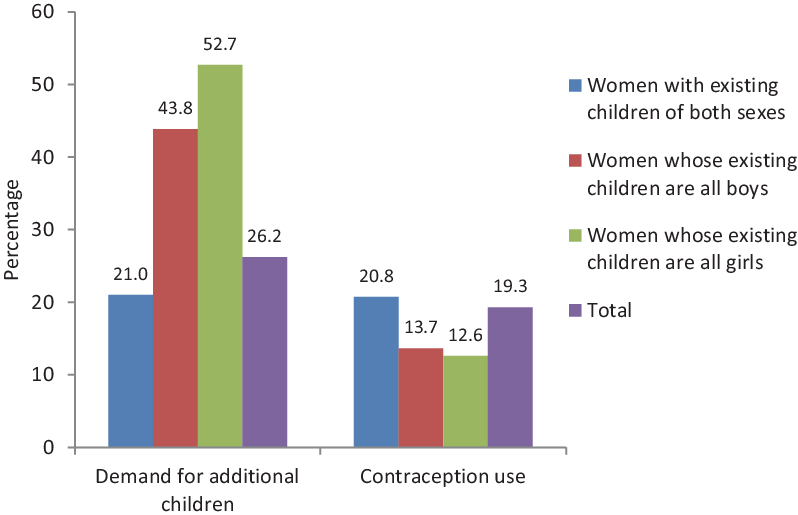
Figure 1 shows the frequency of demand for additional children and contraceptive use for the whole sample population and for the three groups defined above: those with children of both sexes (Group 1), those with all boys (Group 2) and those with all girls (Group 3). Overall, more than a quarter of the women (26.2%) were planning to have more children, while around 19% were using a modern contraceptive at the time of the survey. As expected, the proportions of women who wanted additional children were higher in women with children of all the same sex (43.8%, Group 2; 52.7%, Group 3) than in those with children of both sexes (21%, Group 1). Similarly, contraceptive prevalence was lower in women with children of the same sex (13.7%, Group 2; 12.6%, Group 3) than in those with children of both sexes (20.8%, Group 1).
Percentage of women aged 35–49 wanting additional children and using contraception according to sex composition of their existing children, Ouagadougou. The threshold for statistical significance used in the figure was p<0.05. The differences in demand for additional children and in contraceptive use between women with existing children of both sexes (Group 1) and those with all boys (Group 2) are statistically significant, as are those between Group 1 and Group 3 (women with all girls). The difference in demand for additional children between Groups 2 and 3 is marginally significant (p=0.05), but the difference in contraceptive use between the two groups is not statistically significant. Source: HDSS-Demtrend, Ouagadougou (Burkina Faso), 2012; authors’ calculations.

These bivariate results suggested that having children of the same sex, especially girls, was associated with strong demand for additional children and low contraceptive use in Ouagadougou. However, the observed correlation between the sex composition of offspring and demand for additional children and contraceptive use can be misleading if women with children of the same sex and those with children of both sexes have different socio-demographic profiles.
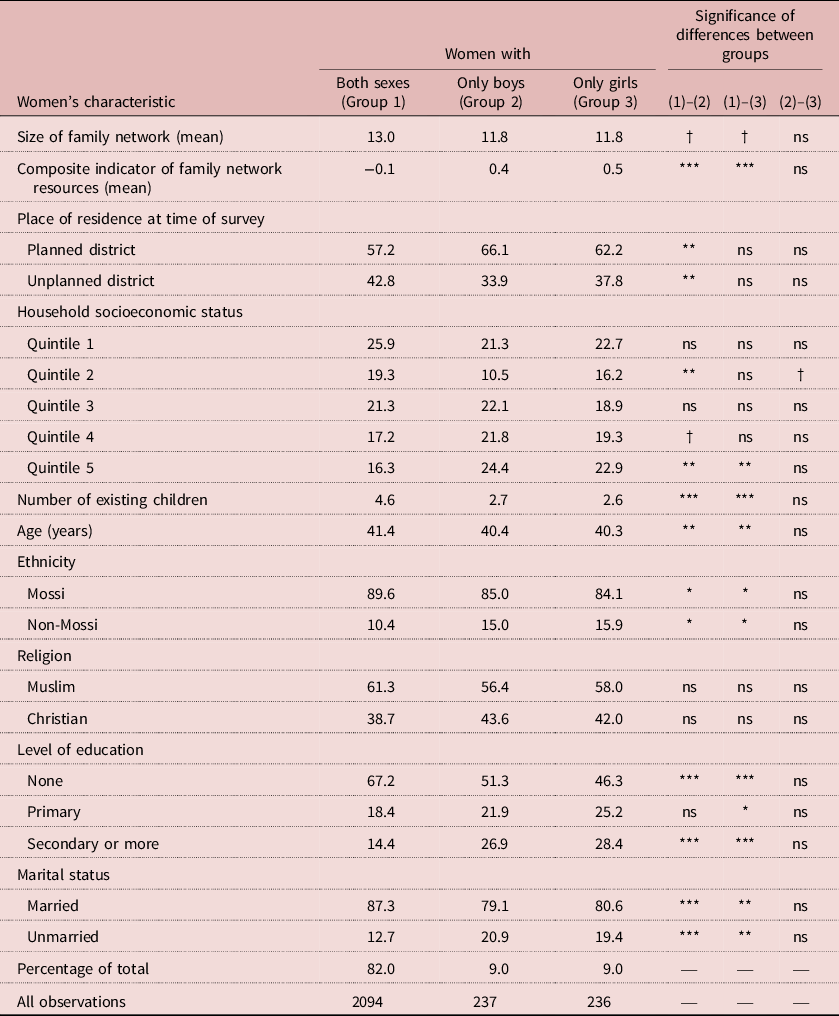
Table 1 compares the three groups according to the distribution of the other covariates. The women with all girls (Group 3) and those with all boys (Group 2) were very similar. However, except for religion, all variables differed across the women with children of both sexes (Group 1) and those with children of the same sex (Groups 2 and 3). For example, of the women in Group 1, 14% had completed secondary education, 34% lived in relatively wealthy households (quintiles 4 and 5), 90% were Mossi and 87% were currently married, whereas for women in Group 2, those percentages were respectively 27%, 46%, 85% and 79%, and for those in Group 3, they were respectively 28%, 42%, 84% and 81%. In addition, size of family network and number of offspring were higher in Group 1 (13 and 4.7, respectively) than in both Group 2 (11.8 and 2.7, respectively) and Group 3 (11.8 and 2.6, respectively). The average number of offspring was lower in Groups 2 and 3 than in Group 1. This difference was to be expected because the single-sex composition becomes rarer as the number of children increases. Also, the women in Groups 2 and 3 were better educated and were, on average, one year younger than those in Group 1, which may partly explain why the average number of children was lower in Groups 2 and 3 than in Group 1. With this low parity, it is not surprising that, regardless of the sex composition of their offspring, women with children of the same sex wanted more children and used less contraception than those with existing children of both sexes. Insofar as the three groups had different socio-demographic characteristics that could also affect their fertility intentions and contraceptive use, multivariate methods were used to assess the net relationship between sex composition of offspring and future fertility.
Socio-demographic profiles of women aged 35–49 years according to sex composition of their existing children, Ouagadougou (in percentages unless otherwise indicated)

Source: HDSS-Demtrend, Ouagadougou (Burkina Faso), 2012; authors’ calculations.
†p<0.10; *p<0.05; **p<0.01; ***p<0.001; ns: not significant.
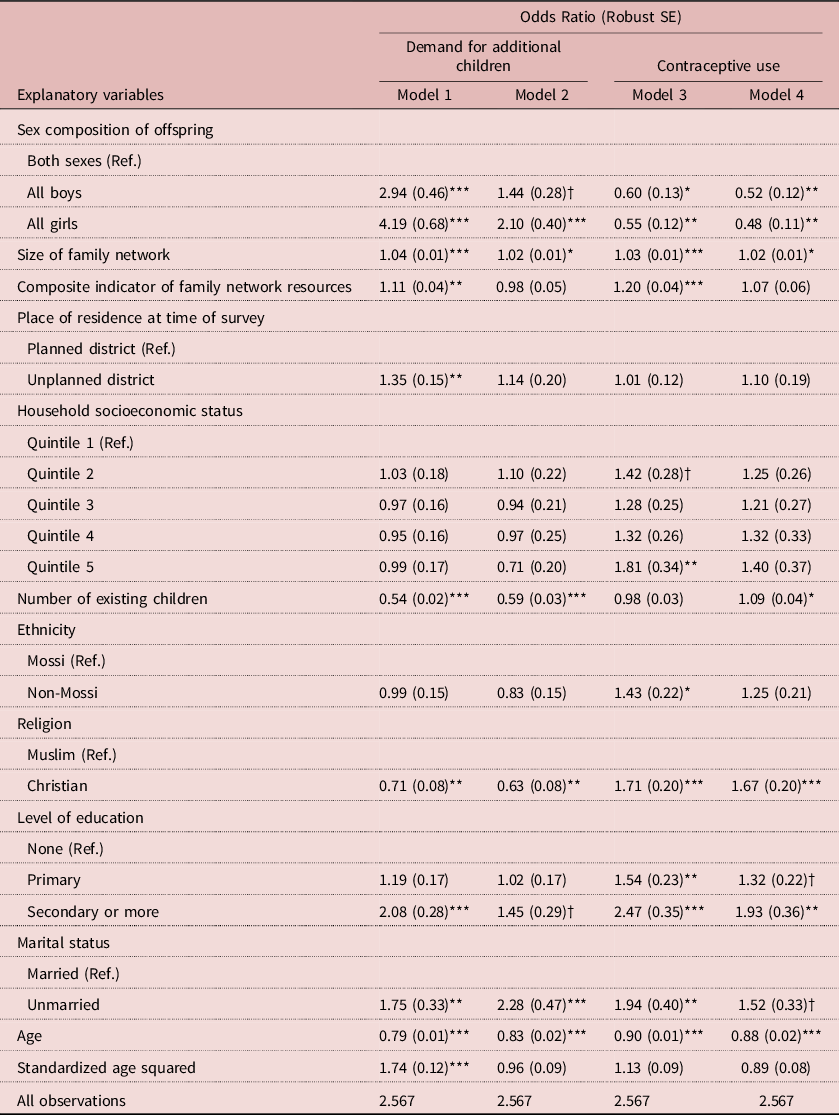
Table 2 presents the unadjusted (Models 1 and 3) and adjusted (Models 2 and 4) results of the logistic regression models estimated for each dependent variable (demand for additional children and contraceptive use). Having children of the same sex, especially girls, was significantly associated with a strong demand for additional children and low contraceptive use in Ouagadougou. In fact, women with all girls and those with all boys were estimated to be, respectively, 2.1 and 1.4 (marginally significant) times more likely to want additional children than those with both sexes (Model 2). Women with all girls and those with all boys were estimated to be, respectively, 52% and 48% less likely to use modern contraception than those with children of both sexes (Model 4). These results suggest that women who placed greater value on gender roles tended to continue their fertility to have both sexes in their offspring. Interestingly, as observed also in the bivariate results (Figure 1 and Models 1 and 3), the desire for additional children and the non-use of contraception were stronger among women with all girls than among those with all boys.
Odds ratios from logistic regression analysis of the determinants of demand for additional children and contraceptive use, Ouagadougou

Ref.: Reference category; SE=standard error.
Source: HDSS-Demtrend, Ouagadougou (Burkina Faso), 2012; authors’ calculations.
†p<0.10; *p<0.05; **p<0.01; ***p<0.001.
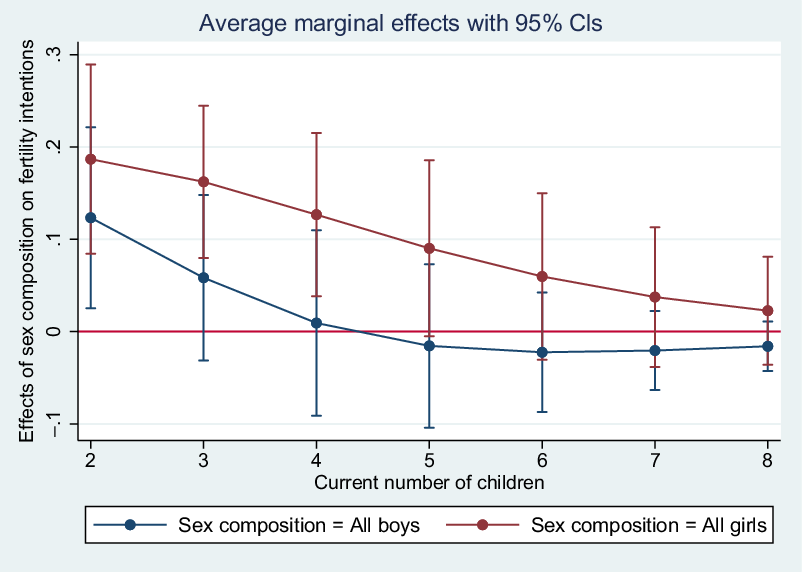
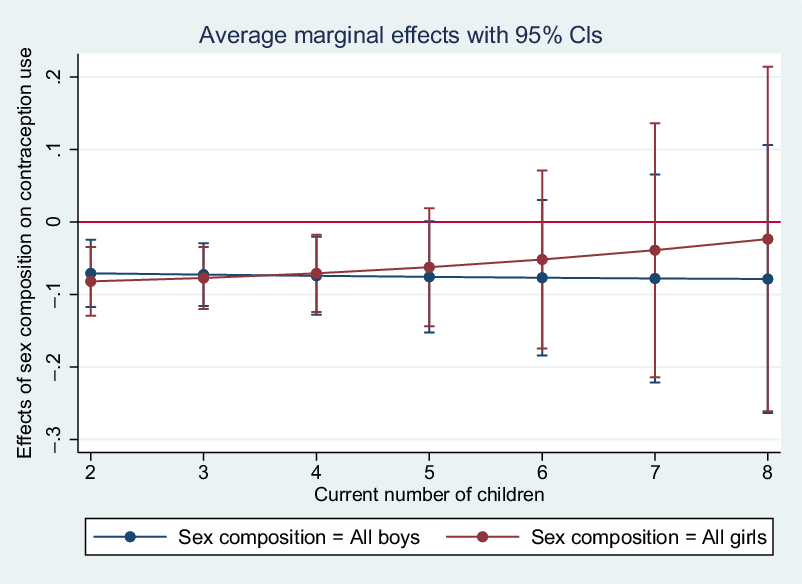
Figures 2 and 3 present the model with interaction between sex composition of offspring and current level of fertility (number of children) for demand for additional children and contraceptive use, respectively. The two figures show that the effect of sex composition was observed only when the number of children was below five. Indeed, when offspring size was below five, the fact that all existing children were girls had a positive and significant effect on demand for additional children, and when the size exceeded four, the effect ceased to be statistically significant (Figure 2). This threshold was even lower when the women’s children were all boys, demonstrating that the demand was higher when all children were girls than when they were all boys. This result was similar for contraceptive use. According to Figure 3, when offspring size was below five, the fact that all children were of the same sex (boy or girl) had a negative and significant effect on contraceptive use, and when the size exceeded four, the effect ceased to be statistically significant. In other words, women with four or fewer children were significantly more likely to desire additional children and significantly less likely to use contraception if their children were all of the same sex (especially girls), compared with women with children of both sexes. Thus, the results indicated that sex composition of offspring affects fertility desires among women with relatively few children in a society with a high total fertility rate.
Interaction between effects of sex composition and number of existing children on demand for additional children, Ouagadougou. Source: HDSS-Demtrend, Ouagadougou (Burkina Faso), 2012; authors’ calculations.

Interaction between effects of sex composition and number of existing children on contraceptive use, Ouagadougou. Source: HDSS-Demtrend, Ouagadougou (Burkina Faso), 2012; authors’ calculations.

The effects of the other independent variables presented certain similarities with previous studies on desire for additional children or contraceptive use (Milazzo, Reference Milazzo2014; Adjiwanou & N’Bouke, Reference Adjiwanou and N’Bouke2015). For instance, the number of offspring was significantly negatively associated with the desire for additional children while positively associated with modern contraceptive use; level of education marginally affected desire for additional children but was strongly associated with contraceptive use. Women with a secondary level of education were two times more likely to use modern contraception than women with no education. Compared with married women, unmarried women were 2.3 times more likely to want additional children and 1.5 times more likely to use modern contraception (marginally significant). Compared with Muslim women, Christian women were 37% less likely to want additional children and 67% more likely to use modern contraception. With regard to other variables, place of residence, wealth quintile and ethnicity were not significantly associated with either desire for additional children or contraceptive use.
Robustness of the relationship between sex composition of offspring and fertility
Table 3 presents the results of the propensity-score model estimates. The results showed that sex composition of offspring was positively associated with demand for additional children on the one hand, and with contraceptive use on the other. All else being equal, the estimated average proportion of demand for additional children was 27% higher in women with all girls, and 22% higher in women with all boys, than in women with both sexes. Similarly, the estimated average rate of contraceptive use was 7% lower in women with all girls, and 5% lower in women with all boys, than in those with both sexes. This confirms that the sex composition of offspring has a positive effect on fertility, in terms of attitudes and behaviours. In addition, the estimated average proportion of demand for additional children was 6% (p=0.107) higher in women with all girls than in those with all boys. However, there was no significant difference between women with all girls and those with all boys in terms of contraceptive use.
Propensity score matching results for women aged 35–49 years, treatment group versus control group, Ouagadougou

ATE=average treatment effect (the effect of sex composition of existing children on demand for additional children and contraceptive use); SE=standard error.
Source: HDSS-Demtrend, Ouagadougou (Burkina Faso), 2012; authors’ calculations.
**p<0.01; ***p<0.001.
Reasons for pursuing fertility in cases of offspring with all the same sex
While the results presented above revealed women’s attitudes and behaviours regarding continued fertility when their existing children were all of the same sex, it was not clear from the quantitative data whether these behaviours were aimed at reaching a predetermined number of children or having a child of the opposite sex. The qualitative results helped to respond to this question. In fact, they showed that continued fertility when existing offspring were all of the same sex was motivated by the hope of having a child of the missing sex. When all children were of the same sex, most of the interviewed participants who were in this situation said they were not currently doing anything to limit their fertility. However, the reasons given by the interviewees underlying the demand for a boy or a girl were numerous and varied depending on the missing sex in the offspring.
The desire for a boy was underpinned by the need for an heir or a husband’s representative to perpetuate the family lineage. Men often use polygamy to maximize their chances of having a boy for these purposes; failure is sometimes experienced as culpability to ancestors.
My initial plan was to have only one wife and three children. I really had the mentality of a public servant, because I knew life would not be easy. But my wife’s first three children were all girls and I continued to try for a boy. The fourth was born, and again it was a girl. There were misunderstandings between me and my wife and she left the marital home. I married two other women in the same year to have more chances of having a boy. It so happened that the first four children of my new brides were still girls. So I was obliged to keep on trying, and the child that followed was finally a boy. I was really delighted. [Man, aged 60 years, with three wives and twelve children, of whom eight were girls]
Another factor in the striving for a boy beyond the desired number of children would be the competition between co-wives, because a polygamous husband tends to pay more attention to the wife who produces the most boys, and women tend to disparage co-wives who only produce girls.
The desire for a girl, over and above the ideal family size, corresponded, in turn, to the mother’s wish for a representative, not only to have help with household chores, but to also have her own reflection in society, i.e. somebody to keep her memory alive after her death and pass on to the next generation all her knowledge and skills. However, the absence of a girl in the offspring appeared to have less impact on the continuation of procreation beyond the desired family size than did the absence of a boy. When it was not possible to achieve gender balance in terms of offspring, almost all of those interviewed would prefer having more boys than girls and, in the worst case, boys rather than girls.
I would like to have two more boys, because one day the daughters will marry and join their husbands. When that time comes, if I have no boys to help me it will be really difficult. I give you the example of a woman who had four children (three girls and one boy). All three of her daughters are married and they have left the household. Her only son went to work in the gold mines [outside Ouagadougou]. She fell ill for the past year and her son did not come back. If she had had three boys and one girl, it would have been better, because at least one of the boys would have taken care of her. One of the girls left her husband and her children since last year to come back to care for her mother. This is not a good thing. It is always better to have more boys than girls. [Woman, aged 26 years, who currently had one boy and two girls]
The desire for a boy or a girl is also supported by the logic of inter-generational transmission of kinship. For some interviewees, the idea that, among the children of the same offspring, a boy might not have a sister or a girl might not have a brother constitutes a privation for which parents are responsible. Similarly, the fact that the grandchildren of the same offspring would be without an uncle or aunt due to the reproductive behaviour of their grandparents also constitutes a deprivation to be avoided as far as possible. Other respondents explained that they were continuing their fertility beyond the initial number of children desired in the pursuit of gender balance (at least two children of each sex) to facilitate the resolution of problems specific to each sex that might arise later among their children.
Discussion
With the onset of the demographic transition in sub-Saharan Africa, couples’ desired number of children may conflict with the sex composition of offspring, with potential effects on future fertility. Using both quantitative and qualitative data, this study provides a first response to this issue in the context of Ouagadougou, the capital of Burkina Faso.
The quantitative results showed that having children all of the same sex (boys or girls) has a net positive effect on continued fertility (high demand for additional children, lower contraceptive use), an effect that is slightly higher when the existing children are all girls. One explanation for this pursuit of fertility beyond the number of children desired is parents’ motivation to have at least one child of the missing sex among their offspring. The absence of a boy appears to have a marginally higher impact on continued procreation beyond the initially desired family size than does that of a girl; this is consistent with the patrilineal and patriarchal system in most Burkinabe societies that puts great emphasis on male birth. However, are parents who already have girls more likely to have additional children in the hopes of obtaining a boy? Similarly, are parents who already have boys more likely to have additional children in the hopes of obtaining a girl? These questions merit attention, given the possibility suggested by Raley and Bianchi (Reference Raley and Bianchi2006) that this continued procreation could, in fact, be motivated by the desire for additional children of the same sex. They posited that parents with only girls might have an additional child, not because they desire a son, but because they so enjoy their girl children that they want another girl, or even another child regardless of sex. This also applies to parents who have only boys and intend to have another child. However, this alternative explanation does not appear valid in the context of Ouagadougou, in light of the views expressed by the interviewees in the present study, which highlighted couples’ strong attachment to having children of both sexes.
Therefore, in contrast to a number of Asian countries (Arnold, Reference Arnold1997; Pison, Reference Pison2004; Guilmoto, Reference Guilmoto2009; Lin, Reference Lin2009; Singh et al., Reference Singh, Singh, Singh and Kumar2010; Bongaarts, Reference Bongaarts2013) and Finland (Andersson et al., Reference Andersson, Hank, Rønsen and Vikat2006), which are characterized by son preference, and Denmark, Norway and Sweden (Andersson et al., Reference Andersson, Hank, Rønsen and Vikat2006), characterized by daughter preference, the results of this study indicate a clear preference for a mixed-sex family composition in Ouagadougou (i.e. parents’ preference to have at least one son and one daughter in their offspring). This aligns with results in Canada (McDougall et al., Reference McDougall, DeWit and Ebanks1999), the United States (Sloane & Lee, Reference Sloane and Lee1983; Pollard & Morgan, Reference Pollard and Morgan2002; Tian & Morgan, Reference Tian and Morgan2015) and most European countries (Andersson et al. Reference Andersson, Hank, Rønsen and Vikat2006; Kippen et al. Reference Kippen, Evans and Gray2007; Mills & Begall, Reference Mills and Begall2010). The main reasons underlying this mixed-sex preference concern the different and non-substitutable roles of boys and girls in the offspring, related to both patrilineal and patrilocal systems, and the logic of inter-generational transmission of kinship. This gender balance preference could explain the stalling fertility decline observed in recent years in Ouagadougou, where the average number of children per woman has hardly varied, remaining at 3.3 to 3.4 between 2005 and 2010.
While this study provides interesting results on fertility intention and behaviour in Ouagadougou in reference to children preferences, it has certain limitations. First, these results cannot be extrapolated to the whole of Ouagadougou or the whole country. The dynamics in suburban areas are definitely different from those in the central capital (Bocquier et al., Reference Bocquier, Madise and Zulu2011). Additional studies are therefore needed to address this question, not only in Burkina Faso but in many others SSA urban areas. Second, this study is based on women’s intentions and behaviours, which are not necessarily representative of the true fertility dynamics within couples. Indeed, it is well established that gender inequality within the continent gives more power to men in terms of fertility decision (Bawah et al., Reference Bawah, Akweongo, Simmons and Phillips1999; Adjiwanou & LeGrand, Reference Adjiwanou and LeGrand2014), even if the situation in urban areas may be starting to change. In urban areas, more communication might be expected between partners in terms of their family size preferences, a more robust factor of fertility outcome (Jennings & Pierotti, Reference Jennings and Pierotti2016). Finally, while fertility decline may reveal the effect of sex composition of offspring on fertility intention and behaviour, it is also possible that changes in the role of children and in expectations around children underlie the fertility decline to some extent.
Acknowledgments
The authors thank the Ouagadougou Demtrend and the Ouaga-HDSS teams for providing access to the data.
Funding
The authors thank All Africa House (AAH) at the University of Cape Town for providing funding for the first author to attend a research visit at the Centre for Actuarial Research (CARe) to conduct this research.
Conflicts of Interest
The authors have no conflicts of interest to declare.
Ethical Approval
The authors assert that all procedures contributing to this work comply with the ethical standards of the relevant national and institutional committees on human experimentation and with the Helsinki Declaration of 1975, as revised in 2008.