


Elected officials can benefit politically from steering benefits to critical constituencies. Yet in numerous contexts, final say over the disbursement of government expenditures lies not with those officials but with unelected bureaucrats. In the United States, generations of reforms—most notably the Hatch Act of 1939 and its amendments—have endeavored to insulate the federal bureaucracy from the pressures of electoral politics. And detailed rules constraining bureaucratic discretion may operate to the detriment of presidential political control in particular (Moe Reference Moe, Chubb and Peterson1989, 279–81). To what extent, then, and under what conditions, will presidents successfully impel bureaucrats to allocate government expenditures for electoral purposes?
Scholarly progress in addressing this question empirically faces two obstacles. First, because standard indicators of a constituency's political importance are inevitably crude, measurement error may obscure or weaken evidence of politically motivated distribution. Second, observable measures of political importance may be correlated with unobservable, electorally irrelevant features of targeted constituencies such as district-level demand for or deservingness of funding. The resulting bias can lead analysts to overstate or understate the true effects of political considerations, depending on the nature of the confounding.
To circumvent these hurdles, I exploit a scandal surrounding a concerted effort by the George W. Bush White House to communicate electoral priorities to political appointees. In January of 2007, a deputy from the White House Office of Political Affairs gave a presentation to political appointees at the General Services Administration (GSA), the federal agency that centralizes procurement for other federal agencies. The briefing identified 56 congressional districts as either “defense” or “targets” in the 2008 election. This presentation—one of many, as was later learned—was in apparent violation of the Hatch Act, which bars most federal employees from using their positions to affect electoral outcomes (U.S. Office of Special Counsel 2011). Two months after the presentation, the Washington Post broke the story and the House Committee on Oversight and Government Reform convened hearings on the presentation.
The release, by the House Committee, of PowerPoint slides used during the GSA presentation permits identification of the congressional districts in question. This provides me with a direct measure of political importance as perceived by the White House at the time, and thus sidesteps the measurement error problem associated with crude proxies of importance.
I consider whether districts identified in the presentation as important experienced significant changes relative to unmentioned districts in allocations of GSA contract dollars following the briefing. My identification strategy relies on the availability of detailed contracting data both before and after the presentation. This feature of the data allows estimation of the briefing's effect via differences in differences, permitting me to control for all potentially confounding observable and unobservable time-invariant features of congressional districts, as well as seasonal variation. The identifying assumptions underlying this approach are far less stringent than those required to assess the effect of targeting via cross-sectional data alone.
I find that in the period immediately following the presentation, vendors in defense districts enjoyed unusually generous contract obligations relative to unmentioned districts from the Public Buildings Service (PBS), the part of the GSA responsible for construction, leasing, purchase, and maintenance of federal offices and storage space. I find, further, that this disparity essentially vanished following publication of the Washington Post story. Closer analysis reveals that observed differences in buildings contracts stem from larger-than-expected new contract awards to vendors in vulnerable Republican districts, and not from an increase in the number of new awards. In contrast, contracts granted by the GSA's other major bureau, the Federal Acquisition Service, appear to have been largely insensitive both to the presentation and to media coverage of the scandal.
Robustness tests reveal that my main results are not attenuated by the presence of “proactive” GSA political appointees, who may have internalized the administration's political goals prior to the presentation. Likewise, the results appear not to be driven by seasonal effects that influence contracts to vendors in different districts asymmetrically. Finally, a series of placebo tests allows me to place a high degree of certitude on the supposition that it was the Political Affairs presentation, and not some other proximate event, that was responsible for the observed changes in the allocation of contracts.
In addition to documenting specific instances of bureaucratic responsiveness and nonresponsiveness to political stimuli, my findings have implications for efforts to refine theories of bureaucratic control and distributive politics. First, the results suggest that the success of efforts to politicize an agency's operations may depend critically on centralized coordination (e.g., from the White House), and not solely on the placement of allies in prominent positions within agencies (a standard metric of politicization). Second, the partial responsiveness of the GSA implies that the irreducibility of an agency's discretion associated with the performance of specific tasks is an important factor limiting efforts by elected officials to politicize government performance. Third, the fact that increases following the briefing came in the form of unusually large new contracts rather than an increase in the number of new contracts suggests that different kinds of expenditures are more susceptible to manipulation than others, even restricting attention to (nominally) discretionary programs. Finally, my findings suggest that although public officials may benefit from allocating expenditures to politically consequential constituencies, it is not necessarily in their interest to be broadly perceived as doing so; consequently, how subject an agency's activities are to public scrutiny may condition efforts to politicize them.
BACKGROUND
The Bureaucracy and the Distribution of Federal Spending
The Political Economy of Distribution. A substantial research agenda in theoretical political economy concerns how officials target government transfers for political benefit. Cox and McCubbins (Reference Cox and McCubbins1986) argue that incumbent parties benefit from directing transfers toward core supporters to maintain existing electoral coalition. In the model of two-party competition described by Lindbeck and Weibull (Reference Lindbeck and Weibull1987, Reference Lindbeck and Weibull1993), in contrast, both parties primarily target marginal constituencies. In the more general setup of Dixit and Londregan (Reference Dixit and Londregan1995, Reference Dixit and Londregan1996), parties trade off between the electoral benefits of targeting pivotal constituencies and of satisfying core groups of supporters. More recent theoretical research examines how distributive considerations may be conditioned by officials’ institutional environment. McCarty (Reference McCarty2000), for example, considers how the implicit threat of a presidential veto can alter legislative appropriations (see also Kiewiet and McCubbins Reference Kiewiet and McCubbins1988). And McGillivray (Reference McGillivray2004) argues that the extent to which core or marginal constituencies will be the primary objects of redistributive largesse depends on a political system's district magnitude and the strength of political parties.
A large empirical literature has endeavored to assess whether federal expenditures in the United States are targeted toward marginal (e.g., Bickers and Stein Reference Bickers and Stein1996; Stein and Bickers Reference Stein and Bickers1994; Wright Reference Wright1974) or core (Carsey and Rundquist Reference Carsey and Rundquist1999; Larcinese, Rizzo, and Testa Reference Larcinese, Rizzo and Testa2006; Levitt and Snyder Reference Levitt and Snyder1996) constituencies. Although much of this research has tended to focus on congressional appropriations, a number of scholars have focused on the role of the president and senior political appointees in directing the executive branch's discretionary allocation of federal funds (Berry, Burden, and Howell Reference Berry, Burden and Howell2010; Berry and Gersen Reference Berry and Gersen2010; Bertelli and Grose Reference Bertelli and Grose2009; Fisher Reference Fisher1975; Mayer Reference Mayer1995; Mebane and Wawro Reference Mebane and Wawro2002; Shor Reference Shor2006).
Bureaucratic Responsiveness to Political Stimuli. The bureaucracy has ultimate discretion over many federal expenditure programs in the United States. An empirical literature related to but distinct from the research described in the preceding has examined the extent to which the political branches can in fact affect bureaucratic performance. Lewis (Reference Lewis2008), Nathan (Reference Nathan1975), and Randall (Reference Randall1979) each document explicit presidential attempts to politicize administration, for example via the strategic placement of political appointees in positions of prominence within the administration, and Moe (Reference Moe, Chubb and Peterson1985b) describes centralization of policymaking authority within the Executive Office of the President over time. Numerous scholars have documented shifts in macro-level indicators of bureaucratic policymaking in response to various political stimuli (e.g., Krause Reference Krause1999; Moe Reference Moe, Chubb and Peterson1985a; Weingast and Moran Reference Weingast and Moran1983; Wood and Waterman Reference Wood and Waterman1991, Reference Wood and Waterman1994). At the micro-level, Arnold (Reference Arnold1979) provides evidence that bureaus charged with disbursing model cities and water and sewer grants tended to prioritize districts whose members sat on relevant oversight and budgetary committees. More recently, Gordon (Reference Gordon2009) provides evidence that the Department of Justice under Bush exhibited partisan bias against Democratic officials when prosecuting public corruption cases.
In the realm of distributive policy making, some degree of agency responsiveness to political demands is to be expected. Nonetheless, the malleability of agency decisions is not unlimited. Federal programs differ markedly in the degree to which Congress has delegated effective discretion to the implementing agency in disbursing funds (Levitt and Snyder Reference Levitt and Snyder1996; Stein and Bickers Reference Stein and Bickers1997, 22). Thus, an enabling statute may leave little room for tinkering at the margins by either presidents or bureaucrats. To the extent that such tinkering does occur, if may risk running afoul of the Hatch Act (5 U.S.C. §§7321–26) if done on the basis of explicitly political considerations. As amended in 1993, the Act prohibits most government employees from engaging in partisan campaign activity on government time, and prohibits the use of “official authority or influence for the purpose of interfering with or affecting the result of an election,” or from soliciting political support in return for favorable treatment (Maskell Reference Maskell1998).
Apart from statutory constraints, scholars of bureaucratic politics have identified a number of other factors that contribute to agency autonomy from the direction of their political superordinates. These include professionalism (Wilson Reference Wilson1989, 59–65); inattention by political principals and asymmetrically well-informed bureaucrats (Hammond and Knott Reference Hammond and Knott1996); the presence of multiple competing principals (Calvert, McCubbins, and Weingast Reference Calvert, McCubbins and Weingast1989); the careful cultivation of external constituencies (Carpenter Reference Carpenter2001); the pursuit by agency managers of self-conscious policies of neutral implementation (Huber Reference Huber2007, 24–25; Ting Reference Ting2010); and the accretion of onerous rules (Moe Reference Moe, Chubb and Peterson1989).
Unaddressed Issues and Methodological Challenges
The Desirability and Efficacy of Politicized Distribution. My analysis touches on several conceptual issues not fully addressed by the existing literature on distributive politics and bureaucratic responsiveness. The first concerns the traceability of efforts to politicize government policymaking (cf. Arnold Reference Arnold1990, chap. 3). Simply put, although an elected official may benefit from departing from a neutral or merit-based policy to reward a critical constituency, it is not necessarily in that official's interest to be broadly perceived as doing so.
Accordingly, how a president weighs the costs and benefits of a specific strategy of politicization may depend on the informational environment and, in particular, the extent to which a policy's implementation is scrutinized (e.g., by the media or a hostile Congress). For example, the appointment, by George W. Bush, of Michael Brown as director of the Federal Emergency Management Agency was widely viewed as an instance of politically motivated patronage (Lewis Reference Lewis2008, chap. 6). Following allegations that the Agency's mishandling of Hurricane Katrina in 2005 was in part a consequence of Brown's inexperience, George W. Bush appointed the far more seasoned R. David Paulison as his replacement. Publicity, in other words, altered the political calculus of patronage.Footnote 1 Note that for the threat of traceability to exert an influence on efforts to politicize, a potential political (e.g., electoral) cost must lurk in the background, even if it is not realized because politicians take steps to avoid it.
While the issue of traceability points to variation in the desirability of politicizing an agency's discretionary allocation decisions, there exists additional variation in the likely efficacy of efforts at politicization. Such variation hinges critically on an agency's effective discretion in disbursing funds. As noted earlier, formula-based programs such as Medicaid matching grants to states leave little room for tinkering at the margins by either presidents or bureaucrats. But formal statutory constraints are merely the tip of the institutional iceberg. Nominally discretionary programs that require the joint participation of multiple agencies or require lengthy review and/or oversight are likely to be less amenable to presidents’ efforts to impose explicitly political considerations on them than programs in which a single agency can take unilateral action. And relating to the issue of traceability, it may be easier to pad specific government expenditures for political gain when readily verifiable information about actual costs is difficult to come by.
Methodological Challenges to Documenting Responsiveness. Two methodological challenges threaten the validity of efforts to examine the political antecedents of discretionary spending empirically. The first issue is one of measurement: Suppose a president were motivated by electoral concerns to direct resources to vulnerable districts. The president and his political staff could have highly detailed information on the vulnerability of certain incumbent co-partisans based, for example, on idiosyncratic knowledge about plausible challengers, brewing scandals, historical understanding of the demographics of and economic interests in the district, knowledge of the upcoming legislative agenda, or personal communications with the legislators themselves. In contrast, the analyst will be forced to rely on proxy measures of marginality such as the incumbent's vote share in the previous election. Unfortunately, the extent to which those measures adequately capture true vulnerability will be heavily context-dependent: For example, a 5% margin of victory in a highly polarized district with few swing voters may actually signify greater safety than a 20% margin of victory does in a more homogeneous, moderate district renowned for its anti-incumbent sentiment.Footnote 2 Reliance on noisy measures of a district's vulnerability may lead to an attenuation of its estimated effect on government spending there.
The second challenge, which may be particularly acute in cross-sectional studies of distribution, concerns omitted-variables bias. Measures of the political significance of a district (e.g., its marginality, whether it is represented by members of the majority party or legislators on a relevant oversight committee, etc.) found to be associated with federal spending may be correlated with unobservable features of the district's demand for that spending (Hird Reference Hird1991; Rich Reference Rich1989). Unlike the measurement error problem described previously, one cannot tell a priori whether this problem will bias estimates of the effect of political importance on spending toward or away from zero. One possible approach to dealing with this problem is the use of district-specific fixed effects in a panel data framework. A fixed-effects approach controls for all time-invariant features of a district; over a sufficiently short span of time, this dramatically reduces the likelihood that an observable measure of political salience or marginality is correlated with unobservable features of the environment. However, of the studies cited, only two (Berry, Burden, and Howell Reference Berry, Burden and Howell2010; and Berry and Gersen Reference Berry and Gersen2010) employ this approach.Footnote 3
The General Services Administration and the PowerPoint Scandal
Functions and Procedures of the General Services Administration. The General Services Administration (GSA) is a federal agency that serves as a centralized clearinghouse for procurement by other agencies. Congress created the agency in 1949 following a recommendation by the first Hoover commission that consolidating procurement within a single federal agency would increase efficiency and reduce the potential for abuse (Arnold Reference Arnold1976; Bailey Reference Bailey1956). Nearly all of the agency's contracting work is handled by two branches (which operate out of the Agency's Washington, DC headquarters and eleven regional offices). The Federal Acquisition Service (FAS) manages contracts with private vendors governing material supplies to be purchased by other agencies. These include everything from motor vehicles to power tools to brooms and mops. The PBS handles purchasing, leasing, property management, and construction of office and storage space for the federal government. The vast majority of the GSA's budget comes from other agencies: For example, client agencies pay rent to the GSA for office space.
Although a full description of the intricacies of government contracting is well beyond the scope of this article, a brief synopsis is warranted. Some “Definite Quantity” contracts involve a fairly straightforward exchange of money for a fixed quantity of a specific good or a service. Because many of the government's procurement and real estate needs are variable and recurrent, however, the GSA often relies on more sophisticated “Indefinite Delivery Vehicles.” These include GSA Schedules, which are long-term supply contracts with multiple vendors; Governmentwide Acquisition Contracts, which cover information technology acquisitions; Blanket Purchase Agreements, which create an expedited relationship between a Schedule contractor and a client agency for recurrent needs; and “Indefinite Delivery, Indefinite Quantity” contracts for services. Many PBS contracts are leases for which the GSA makes monthly rent payments to the lessor.
The standards governing GSA contracting are articulated in the Federal Acquisition Regulation and Federal Management Regulation (formerly the Federal Property Management Regulation). Rules governing contracts, and the discretion granted in choosing private vendors with whom to contract, depend on the size of the anticipated contract as well as the extent to which competition among vendors is primarily based on price or other considerations. For example, when price is the primary consideration, the agency may solicit bids and then choose a vendor via sealed bid. When the agency (or client agency) determines dimensions other than price to be important, it can engage in contracting by negotiation.
Some supply contracts are issued under specific congressional authority, and certain buildings contracts require congressional approval if the associated annual payment exceeds a certain threshold. In my analysis following, I restrict attention to awards not requiring explicit congressional approval.
The Scandal. The November 7, 2006 midterm elections witnessed significant setbacks for the Republican party, which lost control of both houses of Congress for the first time since 1994. Democrats picked up 30 seats previously held by Republicans in the House and six in the Senate, without losing a single Democratic seat in either chamber. Following these losses, the White House Office of Political Affairs assembled historical and current data on public opinion, registration, turnout, and election outcomes into a briefing for Bush administration political appointees. At a brown bag luncheon on January 26, 2007, J. Scott Jennings, Deputy Director of Political Affairs, presented this material in a PowerPoint presentation to a group of 40 GSA political appointees. (Some regional administrators participated by videoconference.) In correspondence prior to the briefing, Jennings’ assistant declined to e-mail the material, as it was “highly sensitive” (U.S. Congress 2007, 45).Footnote 4
Two slides in the briefing were of particular interest: The first, “2008 House GOP Defense,” listed 36 Republican House incumbents and their districts, divided into “priority” and “secondary” defense categories.Footnote 5 Along with the names and districts, the slide also displayed the percentage of the vote in the district for Bush in 2004, and the percentage of the vote in the district for the incumbent Republican in 2006. Asterisks next to 16 names identified incumbents who “may not seek re-election.” The second slide, “2008 House Targets: Top 20,” listed 20 districts and the names of their Democratic incumbents, along with associated 2004 Bush and 2006 Democratic voteshares.Footnote 6 Two more slides showed maps of Senate and gubernatorial races predicted to be competitive in 2008.
According to testimony given by several present, at the conclusion of the briefing the GSA Administrator, Lurita Doan, asked the audience, “How can we help our candidates?” Others present recalled her having said, more specifically, “How can we use GSA to help our candidates?” These witnesses also testified that they understood “our candidates” to mean “Republican candidates,” as all of those present were Republican appointees. The meeting concluded after Jennings suggested that the discussion needed to be “taken off-line” (U.S. Office of Special Counsel 2007, 4-5).
Statements made at the meeting appeared to at least some present to violate the Hatch Act. Those individuals contacted the GSA Inspector General, which referred the matter to the Office of Special Counsel. On March 6, House Oversight and Government Reform Committee Chair Henry A. Waxman wrote to Doan inquiring about the meeting and soliciting her testimony (O'Harrow and Higham Reference Higham2007). The story broke in the Washington Post on March 26 (Higham and O'Harrow Reference O'Harrow and Higham2007).Footnote 7 Two days later, on March 28, the House Government Reform and Oversight Committee convened hearings to investigate the alleged Hatch Act violation. Doan testified that she did not recall the specifics of the meeting. Although Democrats on the committee were incredulous, Republicans were more supportive (U.S. Congress 2007, 179).
On June 8, the Office of Special Counsel, which investigates allegations of Hatch Act violations, released its report on the briefing, recommending to the president that Doan be “disciplined to the fullest extent” for violations of the Hatch Act and failure to cooperate with the investigation. The White House requested and received Doan's resignation 10 months later, although it declined to provide reasons at the time (O'Harrow and Higham Reference O'Harrow and Higham2008).
As will become clear later, media coverage of the briefing plays a prominent role in my analysis. Nonetheless, it should be noted that this particular event received relatively little attention in the media. A flawed, though revealing indicator of this fact is that a Lexis-Nexis search of major newspaper and newswire articles containing the search terms “General Services Administration,” “Doan,” and “Jennings” for the six-month period beginning on March 26, 2007 returned only 70 pieces. In contrast, a search containing terms related to the U.S. Attorney firing scandal—“U.S. Attorney,” “firing,” and “Gonzales” (the Attorney General at the time)—for the six-month period beginning on January 15, 2007 (when that scandal began to receive attention) returned more than 3,000 pieces.Footnote 8
DATA AND METHOD
Data
My main analysis assesses the effects of the briefing and subsequent media coverage on GSA contracts. The raw data for this part of the analysis consist of more than 700,000 GSA Delivery Orders, Purchase Orders, Blanket Purchasing Agreement Calls, and Definitive Contracts in fiscal years 2006 and 2007 that were not issued under specific congressional authority or subject to congressional approval.Footnote 9 These awards are cataloged in the Federal Procurement Data System (FPDS).Footnote 10 I aggregate these awards by vendor congressional district for discrete time periods described in greater detail later, and link the district-level data to the district categorization scheme employed in the GSA briefing.
Aggregating by the congressional district of the vendor rather than the place of performance warrants some discussion. This choice is likely to be uncontroversial in the case of supply contracts: The vendor's district is where the government actually spends the money; whether an agency's regional office receives an influx of stationary or furniture is likely to be politically immaterial. In the case of PBS contracts, in contrast, one might argue that the place of performance is as relevant as the vendor's district, because members of Congress might hope to claim credit for high-visibility construction projects in their districts. In fact, only a small minority of PBS contracts (about 1.5%) are for new construction: The vast majority (about 75%) are lease and rental agreements. Moreover, major construction projects such as new office buildings and courthouses take years to plan and invariably require specific congressional authorizations.
A more practical issue governing this choice is missing data: FPDS codes a vendor's congressional district based on the contractor's address. By contrast, it only records the place-of-performance district only “if it can be determined” (U.S. General Services Administration 2009, 99). Moreover, many awards span several places of performance across different districts—for example, if the government rents several properties from the same lessor or contracts for HVAC repair services across multiple sites. As a consequence, place-of-performance congressional district information is missing for almost 60% of the PBS awards in the data. In contrast, the vendor district is unknown in only 19% of cases. Reassuringly, when both the vendor and place-of-performance data are recorded, they are always identical.
For illustrative purposes, Table 1 displays summary statistics for contracts that meet my inclusion criteria, aggregated by vendor congressional district, for all of fiscal year 2007. As is evident from the table, there is substantial variation among congressional districts in contracting. Once one excludes the District of Columbia, Virginia's 8th and Maryland's 8th districts, which directly abut Washington, receive the most PBS contracts. Likewise, Michigan's 13th and 14th districts, which encompass Detroit, received hundreds of millions of dollars in FAS contracts for automobiles and trucks during the specified period. Maryland's 3rd district, whose vendors had by far the largest number of supply contracts, is an important location for Boise Cascade, a prime vendor of office supplies to the federal government.
Summary Statistics for Fiscal Year 2007 Transactions, by Congressional District

Research Design
Differences in Differences. We are interested in the effect of being mentioned, as either a (Republican) “defense” or (Democratic) “target” district, on subsequent GSA contracting in that district. Let yit be the total dollar value of contracts in district i at time t, with t∈{0, 1} specifying the time period either immediately before (t=0) or immediately after (t=1) the briefing. Let xi be an indicator variable equal to one if district i was mentioned in the Political Affairs briefing, and zero if unmentioned. (I will analyze the briefing's various categorizations separately.) I estimate

where αi is a district-specific fixed effect, τt is a period-specific intercept (normalized to zero for t=0), I(·) is an indicator function, and ϵit is a normally distributed error term with mean 0 and variance σ2it (allowing for heteroskedasticity).  , the “treatment” effect of being mentioned obtained by estimating this regression, is a difference-in-differences estimate, so called as it could also be obtained directly by calculating the sample analog of

The specification in equation (1) is useful for highlighting that the estimator controls for (“differences out”) all time-invariant features of the district, including those associated with district-level demand for government dollars that might confound cross-sectional estimates of political influence. The estimator also controls for period-specific shocks that may arise, for example, from seasonality or scheduling rules in contracting.Footnote 11
If GSA political appointees succeeded in steering contract dollars toward vendors in vulnerable Republican districts, should be positive when comparing defense districts with unmentioned districts. When target districts are compared with unmentioned districts, the expected sign of is more ambiguous: If the administration aimed to deny Democrats the opportunity to claim credit for funding to vendors in their districts, we would anticipate a negative sign. If, however, the administration aimed to use federal contracts to curry support for itself (and, by extension, Republican candidates), we would anticipate a positive sign. Of course, a null finding for target districts could be consistent with the operation of both mechanisms or neither.
Unbiasedness of as an estimate of the causal effect of the briefing on GSA contracting relies on an assumption of parallel paths (e.g., Abadie Reference Abadie2005): that in the absence of the briefing, (logged) spending levels would have changed by the same amount in the mentioned and unmentioned districts. This requirement might be violated in two ways. First, it is possible that some external factor differentially affected the same districts as those mentioned in the briefing at around the same time as the briefing itself. To address this concern, I run a sequence of placebo tests, described in greater detail hereafter, in which I manipulate the date at which the treatment ostensibly occurred. Moving the date in a narrow interval around the date at which it actually occurred enables me to determine whether some event other than those described in the preceding could be responsible for any observed effects. Second, it is possible that some recurrent seasonal effect influences mentioned and unmentioned districts asymmetrically. To address this possibility, I run a different placebo test conducting the same estimation using data from different years to assess whether any observed divergence is attributable to such a recurrent phenomenon.
Media Coverage and Cumulative Effects. The second part of my research design exploits the timing of media coverage of the scandal. Recall that the briefing occurred on January 26, 2007, and that the Washington Post broke the story on March 26. Let t=2 correspond to the period immediately following March 26, and consider the following amended version of the model in equation (1):

It is straightforward to demonstrate that the estimated quantity  is the difference-in-differences estimator for the effect of media coverage of the scandal on districts mentioned in the White House briefing, comparing the periods immediately following and preceding the Post story. If the briefing succeeded in politicizing the agency's contracting decisions (or politicizing them more than they had been already), and publicity had the effect of reducing the incentive to allocate on the basis of electoral considerations, then should be negative in the analysis comparing defense with unmentioned districts, and of a sign opposite to in that comparing target with unmentioned districts.Footnote 12
An additional quantity of interest is  : This is the difference-in-differences estimator comparing the period immediately following the Post story with the period immediately preceding the briefing. can be interpreted as the cumulative effect of the briefing and media coverage. If the media coverage eliminated the incentive to allocate based on political criteria, then should be close to zero for all briefing categories—consistent with a “return to normal levels.” Suppose, on the other hand, the media coverage created an incentive to “reverse course” and affirmatively redress previous politically motivated imbalances by funneling money away from mentioned to unmentioned districts. In that case, the cumulative effect should be negative in the analysis comparing defense with unmentioned districts, and of a sign opposite to in that comparing target with unmentioned districts.
“Proactive” Appointees
A final consideration addressed by my empirical strategy concerns the behavior of GSA political appointees preceding the briefing. It is possible that as loyalists of the Bush administration, political appointees at the GSA were such faithful agents of the White House that they had already discerned which congressional districts were vulnerable from the outcome of the November 7 election, and had already acted on that information by the time of the January 26 briefing (which only told them what they already knew). Such behavior by political appointees would tend to attenuate the estimated effect of the briefing on contracting decisions.
One could, of course, offer several challenges to this account: First, if the only purpose of the briefing was to resolve residual uncertainty in the minds of the appointees, why risk potential violations of federal law as well as negative publicity were the briefing to come to light? And second, why was the material in the briefing labeled “highly sensitive” by Jennings's assistant, and thus not to be transmitted by e-mail?
Nonetheless, I conduct an additional robustness check in which I estimate equation (1) for the periods immediately before and after the election instead of before and after the briefing. If the political appointees had internalized the lessons of the election before the briefing, then the estimates from the analysis of defense districts should be positive. (Again, the anticipated sign for targeted districts is ambiguous.) Because appointees may have lacked the sensitive data in the possession of the Office of Political Affairs, I augment this test with an analysis using readily available measures of district marginality in lieu of the Political Affairs classifications.
RESULTS
Main Results
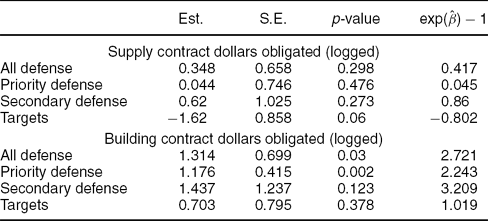
The Effects of the Briefing. I now turn to my main results. Table 2 displays difference-in-differences estimates of the effect of the Political Affairs briefing on GSA contracting. As a first cut, I employ a 59-day window before and after the briefing. (Fifty-nine days corresponds to the length of time between the presentation and the Washington Post story.) I examine, separately, the effect of being labeled a defense district (priority or secondary), a priority defense district, a secondary defense district, and a target district. For each estimate, the control group is unmentioned districts. One-tailed p-values are reported for the hypotheses associated with the defense treatments (given their directional nature), and two-tailed p-values for the target treatment-related hypotheses (given the ambiguity described previously). Because the standard interpretation of coefficients from a regression with a logged dependent variable as a percentage shift can be highly inaccurate when the independent variable of interest is dichotomous (Halvorsen and Palmquist Reference Halvorsen and Palmquist1980), the fourth column of the table reports the quantity exp() − 1. This quantity is a consistent estimate of the percentage shift associated with the treatment, although it is biased downward (see Wooldridge Reference Wooldridge2009, chap. 6).
The Effect of the White House Briefing on GSA Contacting Decisions: Difference-in-differences Estimates

Notes: Heteroskedasticity-consistent standard errors reported. p-values are one-tailed for defense treatments and two-tailed for target treatments.
The top half of the table displays estimates using the natural logarithm of supply contract dollars obligated to be paid during the time period in question as the dependent variable. We observe a large effect of being mentioned as a defense district for supply contracts, but that estimate is not significant at conventional levels. In contrast, the results suggests a substantial decrease in supply contracts in target districts following the briefing (p=0.06, two-tailed). Turning to the building contracts, more pronounced and significant effects appear for defense districts. Vendors in Republican districts labeled vulnerable experienced contracts an estimated 272% larger than those in their unmentioned counterparts. The effect restricting the treatment to priority defense was slightly smaller (224%), but highly statistically significant (p=0.002, one-tailed). The estimated effect of secondary defense status on public buildings obligations was larger still, but that effect is estimated with less precision (p=0.12, one-tailed).
To get a sense of the substantive magnitude of these effects, consider that the median Republican defense district had payments under public buildings contracts not requiring congressional review worth about $53,000 in the 59-day period following the Political Affairs briefing. The counterfactual level of expenditures in that district in the absence of a briefing is just $14,000. Across all defense districts, the PBS made almost $18.7 million in contract obligations in the postbriefing period. The model anticipates that in the absence of a briefing, these districts would have received $5.0 million. The roughly $14 million difference represents 8.4% of total PBS payments for the period.
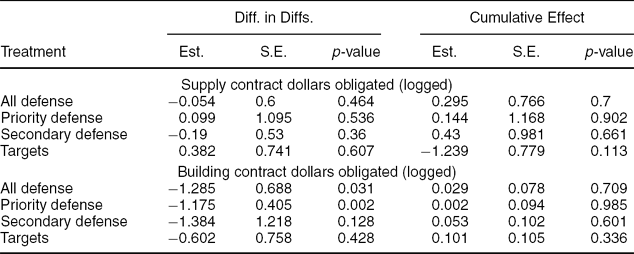
The Effects of Media Coverage. Next, I consider how, and to what extent, coverage of the scandal beginning with the Washington Post story of March 26 altered GSA contracting decisions. Because 59 days elapsed between the GSA briefing and the Post story, I employ that length of time as my window. The first three numeric columns of Table 3 display difference-in-difference estimates for the effect of the story, their standard errors, and associated p-values (as before, one-tailed for defense and two-tailed for target treatments). As in the analysis of the effect of the briefing itself, the media coverage appears to have had little to no effect on supply contract dollars obligated. In contrast, consider the effect of the story on buildings contracts for districts labeled “defense” or “priority defense.” The estimates suggest that vulnerable Republican districts experienced a 72% decline in building contracts compared to unmentioned districts following the story's release, relative to the period between the briefing and the Post story. When attention is confined to priority defense districts, the effect is an approximately 69% decline.
Partial and Cumulative Effect of Media Coverage on GSA Contracting Decisions

Notes: Heteroskedasticity-consistent standard errors reported. p-values are one-tailed for difference-in-difference defense treatments and two-tailed for target treatments and all cumulative effects.
The rightmost three columns describe the estimated cumulative effect of the scandal on expenditures relative to unmentioned districts. As discussed earlier, if media coverage succeeded in restoring contracting to its prebriefing levels, then these estimates should be statistically indistinguishable from zero. For all of the estimates, this is in fact the case: With one exception, standard errors are larger than coefficient magnitudes.
Adjusting for the Threat of False Significance in Multiple Comparisons. A potential threat to inference associated with my analysis is that it makes 12 separate comparisons of mentioned and unmentioned districts: three briefing categoriesFootnote 13 × two types of GSA contracts (FAS and PBS) × two interventions (the briefing itself and the media coverage). The presence of multiple comparisons substantially raises the likelihood that at least one null hypothesis is rejected erroneously.
There are several ways to adjust the rejection criteria to account for this problem. The most conservative is the Bonferroni correction, which controls the “familywise error rate” (FWER): the probability of at least one Type I error in a family of hypothesis tests.Footnote 14 If the minimally acceptable FWER were 0.05, for example, we would reject an individual null hypothesis if the associated p-value fell below 0.05/12≈.004. Using this criterion, we could continue to reject the null for the PBS contracts outcome and the priority defense/briefing and priority defense/media coverage treatments. In fact, we would reject the null for these two treatments for FWERs as low as 0.03.
A second, related approach concerns the False Discovery Rate (FDR): the expected proportion of Type I errors in a set of comparisons. Benjamini and Hochberg (Reference Benjamini and Hochberg1995) suggest an adjustment procedure that consists of rank-ordering p-values from lowest to highest and comparing them to rank-specific thresholds. This approach would again permit us to reject the null hypotheses associated with both briefing and media priority defense treatments for PBS contracts, for FDRs as low as 1.5%.
Robustness
Bandwidth Artifacts.
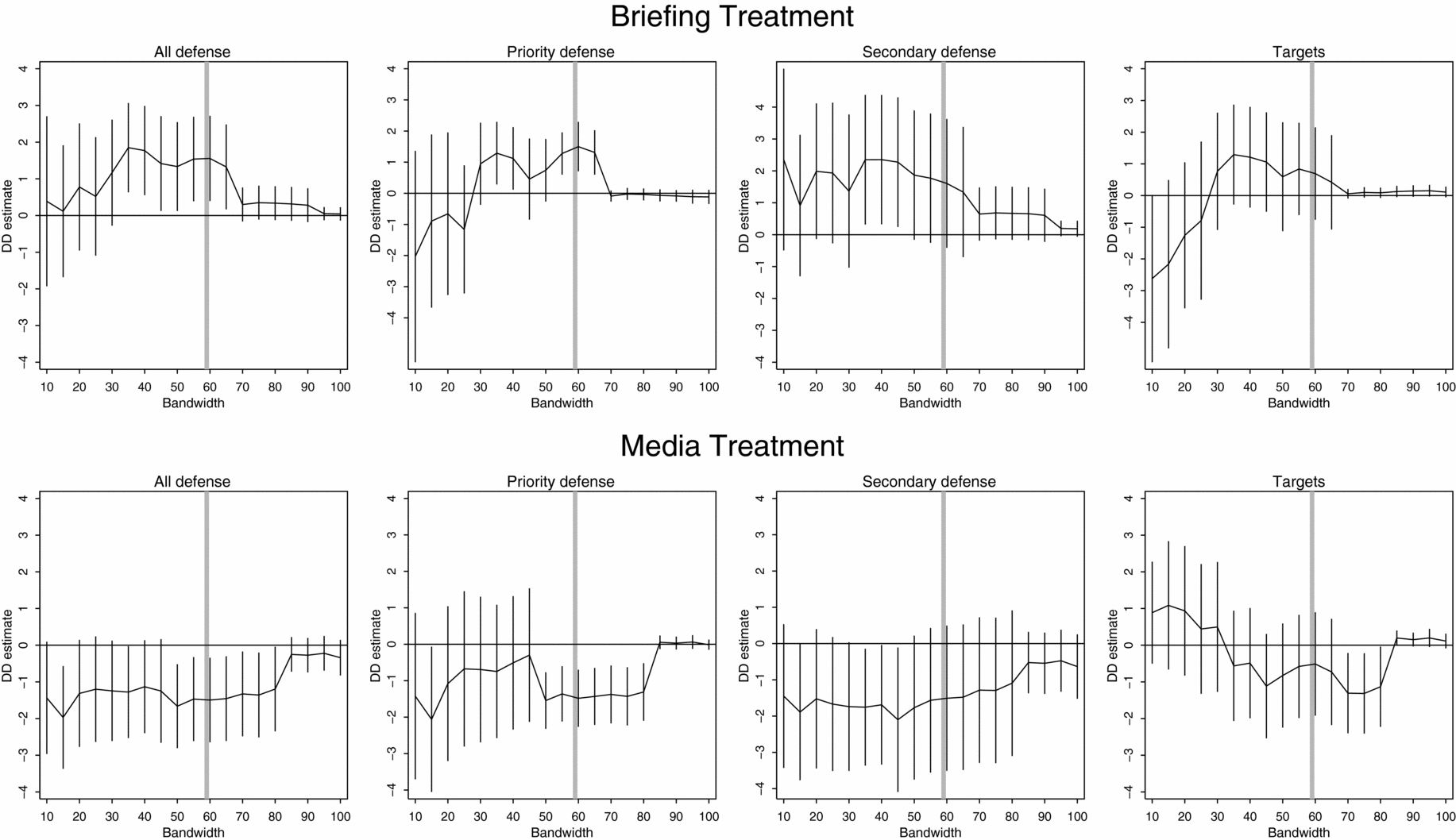
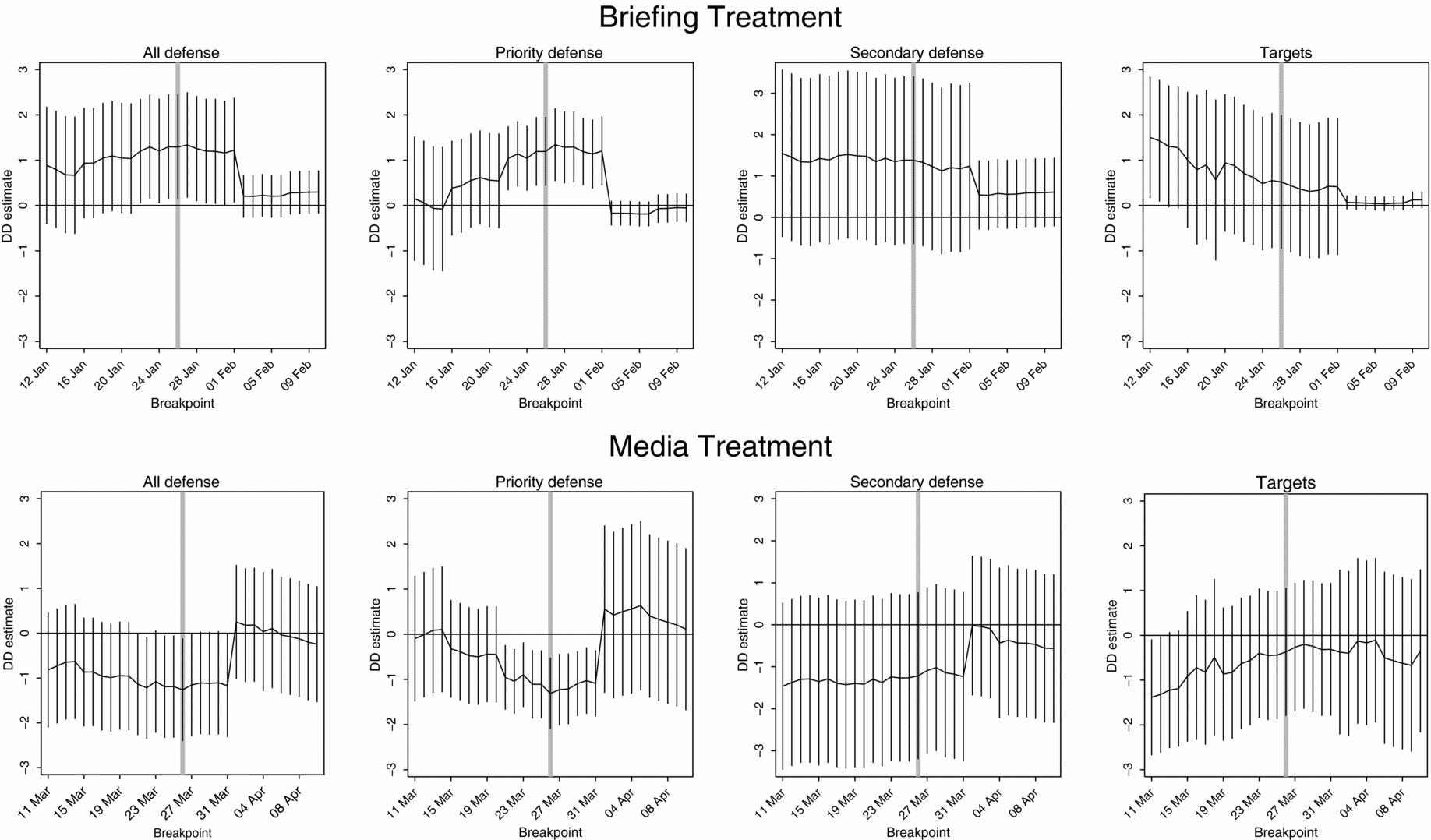
The data indicate a substantial effect of the briefing on dollars obligated by the GSA to buildings contracts, but not to supply contracts. It is possible that the findings described in the preceding are artifacts of the 59-day “bandwidth.” I therefore reran the building contract analyses varying the size of the bandwidth on either side of January 26 (the briefing date) and March 26 (the media coverage date) from 10 to 100 days.Footnote 15 The associated estimates appear in Figure 1. Several features are noteworthy. First, note that the null results on secondary defense and target districts appear largely to hold across bandwidths, although significant effects can be discerned at 35 and 40 days for the secondary defense treatment estimates. Second, over a range of intermediate bandwidths, we observe positive and significant results for the all defense and priority defense briefing treatments, and negative and significant results for the all defense and priority defense media. In contrast, estimates are small and statistically indistinguishable for very small bandwidths (suggesting that agency reaction was not instantaneous) as well as very large ones (in which the effects of the briefing and media coverage of it were offsetting).Footnote 16 An analogous exercise for supply contracts (not reported here) yields insignificant results across treatments and bandwidths.
The Effect of Varying Bandwidth Size on the Magnitude of Estimated Building Contracts: Difference-in-Differences Estimates

“Proactive” Appointees. Next, I consider the possibility that my results are attenuated because political appointees were proactive agents. If those appointees (a) anticipated the information contained in the briefing from having observed the November 7 election; (b) were faithful agents sympathetic to the political goals of the White House; and (c) were capable of directing resources to vulnerable districts and away from target districts prior to the briefing, then we would expect estimates of the effect of the briefing itself to be biased downward.
Suppose it was the election, rather than the briefing, that induced changes in contracting. Then, estimating equation (1) for the periods immediately before and after the election, we should observe significant effects of electoral vulnerability on contracting decisions. Alternatively, suppose that this specialized information was not anticipated, but that the appointees did observe and act on the election returns and how they had changed since 2004. Estimating equation (1) using observed electoral marginality (or change in marginality) as the treatment, again using the November 7 breakpoint, we should observe significant effects of those measures on contracting decisions.
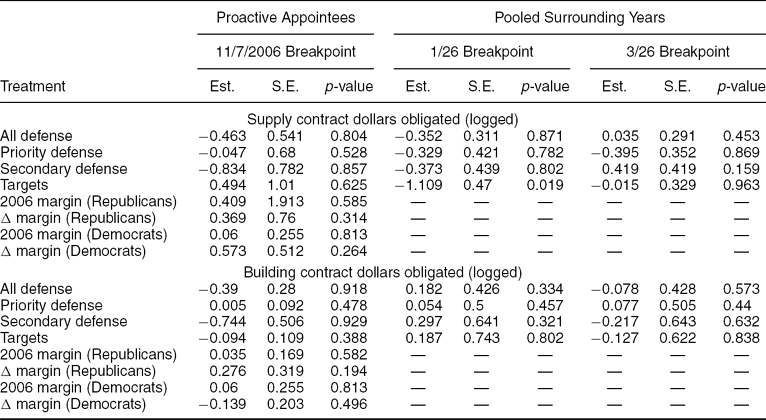
The first three numeric columns of Table 4 display differences-in-differences estimates, standard errors, and associated p-values using the election day breakpoint. Whether we use the White House categorization or the standard measures, none of the estimates is remotely close to statistical significance, and many are of the wrong sign. In other words, we fail to reject the null hypothesis that the information contained in the election itself had no independent effect on GSA contracting.
Testing the Proactive Appointee and Asymmetric Seasonal Effects Hypotheses: Differences-in-differences Estimates Employing 59-day Window

Notes: Heteroskedasticity-consistent standard errors reported. p-values are one-tailed for defense and margin/Republican treatments, and two-tailed for target and margin/Democratic treatments. Pooled data from other years include contracts around January 26, 2004, 2005, 2006, and 2008.
Asymmetric Seasonal Effects. Next, I consider the possibility that my findings are an artifact of some some unobserved but recurrent seasonal factor affecting mentioned and unmentioned districts asymmetrically, rather than the result of the briefing or media coverage of the scandal. To assess this alternative, I gathered data on GSA Supply and Buildings Contracts and pooled them into a panel dataset consisting of contracts to congressional districts in the 59-day periods before and after January 26 and March 26 of 2004, 2005, 2006, and 2008. I then reestimated placebo versions of the difference-in-difference estimates from Tables 2 and 3, adding period-specific effects for all periods to the specification. Statistically significant placebo estimates could imply that the results described previously are spurious.
Results for this test appear in the fourth through ninth numerical columns of Table 4. Critically, none of the estimates for building contracts is remotely close to statistical significance at conventional levels. One statistically significant placebo effect can be found among the estimates for supply contracts: the Democratic target treatment using the January 26 breakpoint. This coefficient is negative and highly statistically significant. This suggests that the negative treatment effect for targeted districts using the supply contracts outcome measure should be discounted as potentially spurious.
Contemporaneous Events. Finally, suppose some nonrecurrent events other than the GSA briefing or subsequent media coverage, which happened to occur at roughly the same times, differentially affected mentioned and unmentioned districts. Although it is impossible to completely rule out this possibility, one way to assess its plausibility is to conduct another sequence of placebo tests: In the difference-in-difference analysis presented earlier, the “breakpoint” dividing contracts into those occurring before and after the briefing was the date of the briefing itself; likewise, the breakpoint for media coverage was the date of the Washington Post story's publication. If, by moving these breakpoints to earlier or later points in time, we detect even larger effects on contracting, then we would have reason to be concerned that these events are simply proxying some other contemporaneous events. Note, however, that it would be unreasonable to expect no effect except using the actual briefing and story dates as breakpoints: Not only is it the case that breakpoints sufficiently close to the actual event dates will yield a treatment variable highly correlated with that associated with the events themselves, but also we might reasonably expect some institutional lag time as the effects of the briefing and/or media coverage ripple through the bureaucratic hierarchy.
Figure 2 displays the results of these placebo tests for building contracts. I draw the reader's attention to the panels associated with the all defense and priority defense treatments. The figures indicate that a range of breakpoints surrounding the briefing and story dates would yield conventionally significant estimates similar to those described previously. However, for both the defense and priority defense treatments, the magnitude of the estimate is maximized by setting the breakpoint at or immediately adjacent to the actual briefing date. Likewise, the magnitude of the effect of media coverage is maximized by setting the breakpoint at the actual date of the media coverage. Together, these findings provide a reasonable degree of assurance that it was the events that occurred during that Friday luncheon and as a consequence of the story's breaking, and not some other transient factor, that account for the observed effects.
Placebo Tests using Alternative Breakpoints in the Interval Surrounding the GSA Briefing and Washington Post Coverage Dates

UNPACKING THE ALLOCATION MECHANISM
The foregoing analysis suggests that the Bush White House was able, via a directive to its political appointees, to redirect some GSA contract awards to vendors in particularly vulnerable Republican districts. Contracts entered into by the GSA's PBS appear to have responded to the directive, whereas those signed by the Federal Supply Service appear to have been insensitive (or considerably less sensitive) to the directive.
Although the empirical findings do indicate responsiveness, they can only shed light on part of the mechanism generating it. Specifically, my results appear to rule out proactive political appointees as a factor governing the agency's response. The findings, however, leave a broader question unanswered: How could appointees have altered the highly particularized output of a huge, complex, hierarchical organization over so short a period? The apparent fact of responsiveness is even more puzzling if one considers how the GSA conducts its tasks: Most of the government's procurement of goods and services, as well as property acquisition and leasing, is conducted via complex indefinite-delivery vehicles; moreover, to set up a new contract, the GSA may have to solicit bids or proposals via advertisement in a local newspaper or on the Internet, evaluate proposals, possibly seek additional information from offerors, and only then establish a delivery vehicle. One would anticipate that the level of intervention necessary to substantially change the course of such a procedure over a short time period would have to be enormous.
Consider, therefore, that responsiveness may have occurred in one of several ways: (a) GSA personnel may have increased the number of new awards in response to the White House directive, possibly by accelerating or otherwise manipulating the timing of contract actions in defense districts and/or slowing them down in others, or giving the green light to favored but backlogged projects; or (b) GSA personnel may not have increased the number of new awards, but may instead have increased the size of the typical awards associated with those contracts.
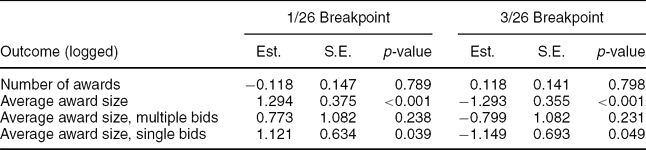
To determine which of these mechanisms may have been operative, I ran a series of additional tests. With respect to mechanism (a), ideally one would conduct a duration analysis looking at the approval hazard rate (the probability that a contract is awarded at time t given that it has been under consideration up through time t). If this mechanism were operative, we would expect an increase in the hazard rate following the briefing for defense districts, but not for unmentioned districts. Unfortunately, such an analysis is not possible, as it requires information on the period of time a specific contract or project is “at risk” of being awarded/commenced, and the GSA does not release this information. However, we can examine whether the period following the White House directive corresponded to a simple increase in the number of new awards in prioritized districts. The first row of Table 5 displays difference-in-difference estimates, standard errors, and associated p-values for the effect of being labeled a priority defense district, using both the January 26 (briefing) and March 26 (Post story) breakpoints. The dependent variable is the natural logarithm of the total number of unique new awards in the district. Neither estimate is statistically significant, and in fact, both have signs opposite to those anticipated. This constitutes evidence against mechanism (a).
The Effect of Priority Defense Status on the Number of Awards and Average Award Size

Notes: Heteroskedasticity-consistent standard errors and one-tailed p-values reported.
The second row conducts the same analysis, substituting the natural logarithm of the average award size as the dependent variable. Here, we see highly statistically significant effects: The Political Affairs briefing produced an approximately 264% increase in the average PBS contract in priority defense districts relative to unmentioned districts, whereas the media coverage of the briefing produced a corresponding 73% decrease. These findings are consistent with mechanism (b) as described.
Another issue concerning the allocation mechanism concerns the nature of the award. As I note earlier, padding government expenditures for political gain may be easier when information about costs is scarce. To assess this possibility, I disaggregated PBS awards into those for which there were multiple bidders on the contract, and those for which a single bid was submitted. We would anticipate a higher degree of responsiveness to political stimuli for the awards with a single bidder, as cost information would be less readily available in the absence of competition.
The estimates corresponding to this analysis appear in the third and fourth rows of the table, and are suggestive. As anticipated, the briefing and media coverage led to large, statistically significant shifts in awards for which a single bid was submitted, but not for multiple-bid awards. Because the effect of the latter is so imprecisely estimated, however, one cannot reject the null hypothesis that the effects are the same.
DISCUSSION
In this section, I first discuss how specific features of the GSA's tasks and the informational environment in which it undertakes them serve as constraints on the effective discretion of the agency's personnel, and how variation in these constraints can help shed light on my findings. Next, I discuss the political benefits associated with the allocation of government contracts, and whether the scandal described here sheds light on a more general pattern of politicization, or whether it represents an isolated event. Finally, I discuss how my findings shed light on the nature of executive centralization and its relationship to politicization.
Effective Discretion in Acquisition and Building Contracting
The foregoing has provided evidence that the GSA, acting on suggestions from the White House, effected a reallocation of PBS contract awards to politically sensitive districts. There is little to no evidence that a similar shift in FAS contracts occurred. In the latter case, however, the effects of the White House suggestions are estimated with a great deal of imprecision. Consequently, the difference in the effect of being labeled a defense district on PBS and FAS contracts is not statistically significant at conventional levels.
With this caveat in mind, it is still worthwhile to consider whether the observed differences across the two branches—imprecisely estimated, to be sure—correspond to what we know about how they actually function, and, in particular, the degree to which line personnel in both possess the kind of discretion that would be necessary to implement the rapid shift observed in PBS contract awards. In general, the fact that the aggregate output of the agency consists of thousands of decisions may actually increase, rather than limit, the flexibility of the agency, because, in spite of the voluminous federal acquisitions regulations, the process affords a certain degree of irreducible discretion to agency personnel and their managers (Mashaw Reference Mashaw1990, 289). Two significant differences between the branches come to mind.
First, most of GSA's supply contracting is necessarily reactive to the needs of other agencies. To take a mundane example, suppose the Kansas City IRS field office needs new file cabinets, or the Forest Service needs a particular variety of heavy-duty work gloves. FAS purchasing agents have little to no discretion in the short term in how to approach such contracts. If the item is available through a GSA Schedule, the client agency can purchase it with no consultation with the GSA at all. If it is not on a Schedule, the GSA may solicit bids from competing sources, but it is likely that the procurement officer from the client agency (or the personnel at that agency making the request) had something specific in mind. In contrast, although the Buildings Service must react to the needs of client agencies in the long term, in the short term it can exercise substantially more autonomy in spending on building care, maintenance, and leasing. This may be particularly true with respect to the timing of projects.
At the same time, administrative procedures associated with new awards may impose transaction costs on agency personnel and appointees, and this is likely the case in both branches of the GSA. The fact that my central findings appear to stem from larger-than-expected average PBS awards in prioritized districts, and not more awards to those districts, is consistent with the notion that a politically efficient allocation must take account of the fixed costs associated with expenditure vehicles.
The second possibility concerns the structure of markets for the products and services procured by the two bureaus. Supply Service personnel may solicit bids in a national market for specific products, and GSA schedule contracts permit a contractor who meets reasonably well-defined criteria to provide products to the government. This environment is, ceteris paribus, more likely to impose some price discipline on contractors than in the case of the Buildings Service, where contracts, by virtue of being geographically constrained, may be less subject to competitive pricing. This difference is underscored by my finding that the average size of contracts with a single bidder reacted to the briefing and media coverage of the scandal in a way that the average size of contracts with multiple bidders did not.
Both of these structural differences between the GSA's two branches suggest that there may be more of an incentive to invest in politicizing the PBS than the FAS. Indeed, a simple measure of this investment appears to bear this out: According to the most recent (2008) Plum Book, a government publication listing leadership and support positions in the federal government, both top managerial positions in the FAS (Commissioner and Deputy Commissioner) are staffed by careerists. In contrast, only one of the three top managerial positions in PBS (the Deputy Commissioner) is, with the other two (Commissioner and Senior Advisor) staffed by noncareer and Schedule C appointees, respectively (U.S. Congress 2008, 160).
Interestingly, a feature of the Building Service that arguably facilitates politically motivated allocation of contracting expenditures—namely, discretion of high-level public officials over spending decisions—is precisely one that development scholars point to when assessing the susceptibility of capital improvement projects to corruption (e.g., Tanzi Reference Tanzi1998). Parallels between the use of public power for private gain (a standard definition of political corruption), and public power for electoral gain, represent a self-evident avenue for additional research (cf., Rose-Ackerman Reference Rose-Ackerman1999, chap. 8).
The Political Benefits of Reallocation
An argument that may be raised against the foregoing analysis is that the benefits of GSA contracting expenditures might be difficult for congressional candidates to take credit for; consequently, it is not clear why the White House would bother trying to politicize them. Moreover, the apparent effects I observe seem small: on the order of $14 million. There are three responses to this objection.
First, regarding the magnitude of the aggregate effect: Recall that this effect is only for the 59-day period between the date of the White House briefing and the Washington Post story. Presumably, the White House did not intend to be detected, and so it is impossible to determine, without very strong assumptions, what the magnitude would have been over the course of 2007 and 2008 had it not been detected. Further, to the extent that there is added political benefit to timing government expenditures to claim credit for them immediately prior to an election (Mayer Reference Mayer1995), it is possible that the effect of being categorized as vulnerable would have grown as the 2008 election grew closer. More generally, the data do not permit me to assess whether the observed effects reflect manipulation of the timing of contract expenditures or shifts in their long-term allocation.
Second, credit-claiming by legislators is just one of several possible mechanisms whereby government expenditures translate into electoral consequences. Another possibility is that the executive branch seeks to target resources in an effort to create partisan loyalties among district-level elites. This latter argument is developed by Mebane and Wawro (Reference Mebane and Wawro2002), who argue, “In light of the traceability problems, or perhaps simply to exploit all possible electoral resources, the president may wish to use [local federal expenditures] to appeal to the elite who have interests in each local area and who control resources that can help or harm the president's reelection chances” (5). Note that although their argument is focused on presidential, rather than congressional, reelection prospects, the argument follows if the President is concerned with the partisan composition of the legislature. This logic also reflects an earlier argument concerning congressional credit-claiming made in Stein and Bickers (1995, 124–25). They argue that the population of politically aware constituents is likely to supply an incumbent's active political support and opposition, and that members of Congress may wish to pursue grant-seeking activity to placate them. The argument translates immediately to the current context.
Although a comprehensive test of the elite-centered mechanism is beyond the scope of the current article, two pieces of supporting evidence are consistent with this account. First, as a descriptive matter, the vast majority of PBS contracts are not for highly visible construction projects (the largest of which require specific congressional authorization), but for less visible expenditures such as leases and maintenance contracts. Second, I reran my analysis of the briefing's effect on PBS contracts using expenditures aggregated by place-of-performance rather than vendor district. As discussed earlier, there are strong substantive and practical reasons to analyze the expenditures at the vendor level. Nevertheless, if credit-claiming is indeed driving the findings, we would expect to see results at least as strong as in the vendor-district-based analysis (recalling that the two often overlap significantly). In fact, we see precisely the opposite—the effect of being mentioned as a defense district on PBS contracting is positive, but statistically insignificant. Given the missing data problems corresponding to the places of performance described earlier, this is perhaps not surprising. However, it does suggest that credit-claiming need not be an important part of the story. More generally, I would note that the findings in this article rely only on the uncontroversial claim that to the extent that economic benefits to a district affects its incumbent legislator's electoral prospects on the margin, they help rather than hurt.
Last, returning to the issue of why the White House would bother, the events surrounding the scandal suggest that it did, even at risk of violating federal law and generating a scandal that, though less damaging than the U.S. Attorney firing scandal, was nonetheless embarrassing. This, along with Administrator Doan's alleged “How can we help our candidates” question, suggests a revealed preference for using government resources for electoral gain.
A question related to the issue of political benefit concerns whether the GSA scandal was an isolated incident or part of a more general pattern of executive influence. To the extent that the threat of bad publicity might mute incentives to politicize, we should expect systematic evidence of it to be the exception rather than the rule.Footnote 17 In January 2011, however, the Office of Special Counsel issued a report listing 75 separate briefings by personnel at the White House Office of Political Affairs from 2001 to 2007 to political appointees in different agencies. This report lends support to the contention that the GSA briefing was representative of a broader phenomenon (at least within the most recent past administration); moreover, it suggests an avenue for future research, in which the effects of these briefings can be compared across different agencies rather than simply between two parts of the same agency.
The Interaction of Politicization and Centralization
In an influential essay, Moe (Reference Moe, Chubb and Peterson1985b) describes how the conjunction of electoral incentives and the need to secure a legacy has led presidents to rely increasingly on two strategies to successfully implement their policy agendas: centralization of policymaking authority in the Executive Office of the President, and politicization via appointments to positions of prominence within administrative agencies. An important question, however, is the extent to which these two strategies interact: As Rudalevige (Reference Rudalevige2009, 17) notes, delegation to loyal agents has low overhead costs, so why should presidents incur the additional costs of centralization?
The findings in this article suggest two answers to the question. The most obvious concerns the locus of informational advantage. The degree to which the policy under examination could prove politically beneficial depended critically on detailed, idiosyncratic knowledge of the electoral landscape unlikely to be in the possession of the typical political appointee. The second concerns coordination: As noted earlier, personnel from the Office of Political Affairs gave numerous briefings to political appointees at different agencies; even if political appointees had the requisite knowledge, communication from the Office could serve to synchronize electorally beneficial activities across agencies, a task that would seem all the more important given the low expected marginal benefit of the actions of any one agency. Viewed in this light, the White House Office of Political Affairs serves a function similar to, though less publicly observable than, that of presidential rhetoric, which can serve to direct the priorities of bureaucrats (Whitford and Yates Reference Whitford and Yates2003, Reference Whitford and Yates2009).
This account stands in contrast to one in which loyalist appointees may share the preferences of the president and work as faithful agents toward achieving his goals, but have limited interaction with, and coordination via the White House (Heclo Reference Heclo1977; Kaufman Reference Kaufman1981). In his discussion of “contingent centralization,” for example, Rudalevige (Reference Rudalevige2002) describes historical cases in which the president found it advantageous to grant discretion to agency personnel to formulate policy initiatives rather than rely on centralized policy making in the Executive Office of the President. In these instances, the informational advantages of those agents made decentralization an attractive choice.
Whereas the accounts of centralization (and decentralization) cited earlier tend to focus on the overarching policy priorities of a particular administration, the current analysis focuses on a more explicitly electoral variant of the phenomenon. This electoral variant, in turn, sheds light on a fundamental issue in presidential appointment politics. Scholars of bureaucratic politics (e.g., Heclo Reference Heclo1977; Lewis Reference Lewis2008) argue that presidents often face a tradeoff between loyalty and expertise when considering whom to appoint to positions of authority in the executive branch. To the extent that recent administrations seem to err on the side of loyalty, the electoral account of centralization provides an explanation: Loyalists are better suited not only to share a president's goals, but also to receive and act quickly on instructions from their political superiors.
CONCLUSION
The extent to which elected officials can push bureaucrats to allocate government resources on the basis of explicitly political considerations, and the conditions under which they will succeed or fail at doing so, are issues that have long concerned political scientists and reformers alike. Previous efforts to assess politically motivated distribution empirically have suffered from a number of methodological challenges. In this article, I have sought to overcome these challenges by exploiting a scandal in which White House personnel under George W. Bush briefed political appointees at the General Services Administration about vulnerable Republican and Democratic districts.
At the most basic level, examining changes in the agency's allocation of GSA contracting awards following the briefing permits me to document an instance of bureaucratic responsiveness to a specific political directive: In particular, the agency's PBS appears to have increased its awards in prioritized Republican districts relative to unmentioned districts following the briefing.
More interestingly, the conjunction of this finding and several others allows me to construct a richer account of the politicization of bureaucratic activities. That the discrepancy between building awards in vulnerable Republican districts and unmentioned districts disappeared quickly in the aftermath of media coverage of the scandal suggests that the degree of public scrutiny of an agency tempers its inclination to deploy its resources for electoral ends. The fact that I observe responsiveness in the Building Service, but no responsiveness in the FAS, is consistent with the fact that the latter branch's effective discretion is constrained by its dependence on actions initiated by other agencies. My finding that the shift in agency resources following the briefing seems to involve changes in the size of the average award, and not in the number of awards, suggests a constraining role of agency procedures. And the fact that the awards showing greatest responsiveness were ones with single bidders reflects the notion that strategies of politicization can be abetted by inadequate information. More generally, this study suggests the value of expanding our theoretical accounts of the principal–agent relationship between elected officials and bureaucrats to better reflect variation in the specific tasks of agencies (cf., Wilson Reference Wilson1989, 244–48), and the extent to which the nature of those tasks constrains efforts at political control, for better or worse.




Comments
No Comments have been published for this article.