

Published online by Cambridge University Press: 13 February 2006
Examiners of dissertations regularly have to endure “literaturereviews” that consist of extended lists of mini-summaries of books.Indeed, quite often “dissertations” amount to little more than alist of book-summaries masquerading as an argument. While there areexcellent courses on qualitative and quantitative methods, moststudents have learnt how to conduct literature reviews exclusivelythrough the method of learning by doing. Ultimately, there is noalternative to this age-old method. However, this essay is premisedon the belief that a brief attempt to understand the generalfunction of a literature review in political science should makelearning by doing easier and more productive.
“If I have seen further [than certain other men] it is by standing upon the shoulders of giants.”—Isaac Newton.
Examiners of dissertations regularly have to endure “literature reviews” that consist of extended lists of mini-summaries of books. Indeed, quite often “dissertations” amount to little more than a list of book-summaries masquerading as an argument. While there are excellent courses on qualitative and quantitative methods, most students have learnt how to conduct literature reviews exclusively through the method of learning by doing. Ultimately, there is no alternative to this age-old method. However, this essay is premised on the belief that a brief attempt to understand the general function of a literature review in political science should make learning by doing easier and more productive.
All parts of a dissertation pose great challenges, but there are a number of reasons why the literature review is particularly problematic. First, a literature review is the first piece of substantial writing in the process of preparing a dissertation. Therefore, there is a great danger that students will spend too much time writing about the literature and too little time doing their own research. Second, the academic literature is vast and intimidating. It can overwhelm students and prevent them from focusing on their own project. I recently encountered a dissertation containing a lot of interesting data on how Polish businesspeople bypass business associations when lobbying the state. Unfortunately, there was little mention of anything other than business associations in the literature review! The student was clearly captivated by the dominance of business associations in the literature, even though she had clearly demonstrated that they were of marginal importance in her country case. The reader had to struggle through pages and pages of detailed discussions of different types of interest group pluralism before finding out that interest groups were not the focus of the thesis. Third, many dissertations are based largely, or even entirely, on secondary sources, thereby creating the risk that the dissertation will be nothing more than a collection of literature reviews. A common example of this phenomenon is when students have selected a number of country cases for qualitative analysis. Many such students make readers trawl through detailed reviews of the work of prestigious country experts in what are supposed to be theory-testing empirical chapters. Fourth, the literature review is both a process and a text. If a student fails to make this distinction then examiners have to read the nightmare literature review: a text that is a report of the process. This article argues that emphasizing the difference between the process and the text helps students produce better literature reviews and better dissertations. However, prior to this distinction is the even more fundamental one between means and end.
A good dissertation is a coherent argument, not a collection of underdeveloped thoughts. In other words, a good dissertation is greater than and a bad dissertation less than the sum of its parts. Every chapter of a dissertation is a means to the end of a good dissertation, and the literature review is no exception. Thus, a literature review has little or no meaning outside of a dissertation. Its merit can only be judged by the contribution it makes to the dissertation as a whole. It may make some interesting comments about some interesting books, but if these comments do not help the student develop a coherent argument over the dissertation as a whole, the literature review is a failure. Many students commit the cardinal mistake of treating the literature review as an end in itself. They fall into the trap of producing a literature review, which merely summarises a body, or bodies, of literature. In contrast, a good literature review is an argument about the literature that justifies the selection of the question the student wants to answer, and the basic approach to answering that question. This is the difference between identifying the giants and hoisting yourself up on their shoulders.
A good beginning is to realize that a literature review is both a process and a text. It is a text in that a section or chapter of the submitted dissertation will be a literature review, whether it is so titled or not. Understandably, students tend to obsess about the text. How long should the literature review be? How many books should be reviewed? Should all books be summarized? Should they all be criticized? A literature review is also a process of reading, thinking about, and writing about the academic literature. It is a mistake to undervalue the process. If the process is treated seriously, and is undertaken consciously as a particular sort of intellectual activity, the resulting text will be that much better. It will be better as a distinct section of writing, and, more important, it will much more effectively fulfill its crucial role in the dissertation as whole. If the process of reviewing the literature has been successful that process will have beneficial results that go beyond the text of the literature review.
The process of reviewing the literature can be divided into selecting, reading and writing. Writing, of course, produces text, but there is a big difference between writing-as-thinking to be read only by the student and supervisor, and the concise, lucid, focused text that should be submitted as a dissertation.
The first problem in a literature review is deciding which literature to review. It is a good idea to try to select your reading conventionally and imaginatively. For example, take a student who wants to study the Indonesian military. The conventional selection is to read books on the Indonesian military, politics, and society. It makes sense to discover the “geography” of a subject by skimming a wide range of sources before committing to in-depth and re-reading of the key sources. Obviously, the student cannot read everything, but she should try to read a “representative sample,” usually by focusing on the sources or authors that are most frequently cited and discussed. Once a student has done a certain amount of conventional reading, she should start trying to select readings more imaginatively.
Sticking with the example of the Indonesian military, an imaginative choice might be to read about the principal-agent theory in economics, which was originally developed to analyze the management of firms. A cursory reading of the literature on Indonesian politics and the military shows that there is an issue of political delegation to the military, which is essentially similar to that analyzed by the principal-agent theory. One of the great challenges of Indonesia's transition to democracy has been civilian control of the military, and it is likely that the principal-agent approach could illuminate this problem and even suggest concrete institutional solutions. In this example, the student's choice of literature gets her off to a great start. She can potentially write a great thesis without generating any new empirical data on the Indonesian military and without developing any theoretical innovations within the principal-agent approach.
A combination of hitherto separate literatures is a simple and effective strategy for successful research. By the time they begin their dissertation, students will have taken a relatively diverse set of courses, including several which treat similar subjects in very different ways. Moreover, they will hopefully have access to a relatively diverse dissertation committee and faculty. Therefore, the example of the Indonesian military is not a mysterious Eureka moment; nor is it an idea that could only be expected from an advanced interdisciplinary scholar. A student may have gained an interest in the Indonesian military from courses in democratization and Southeast Asian politics. The same student may also have studied bureaucracy, the U.S. Congress, or the European Union, all standard subjects in which the chances of encountering the principal-agent model are strong. Many students are well able to test theories, deconstruct assumptions, and solve problems from one course with ideas they have come across in others. Having read the conventional accounts of a particular issue, students should try to identify analogous problems in courses they have studied. In this way, they might well decide on a principal-agent analysis of the Indonesian military. Otherwise, they may end up assuming that the only literature relevant to the Indonesian military is the literature on the Indonesian military. Inevitably, this involves a certain amount of insight that cannot be taught, but the insight is more likely to be developed if a student realizes that immersing herself in a single narrow literature is rarely sufficient for even a modest intellectual breakthrough.
Reading for a dissertation is different than reading for coursework. In reading for coursework, you read a book on its own terms. You read Samuel Huntington because he is worth reading and to understand what he has to say. In a literature review, you do not read a book for its own sake. If you are interested in how culture influences politics, you might well decide to review Huntington's Clash of Civilizations. You would do so, not to find out what the great man has to say, but to see what his work can do for your thesis. Thus, your motivation is instrumental and your attitude is ruthless. No matter how prestigious, interesting, or enjoyable a book is, if it cannot make a contribution to your thesis, you have to put it down and find a book that will.
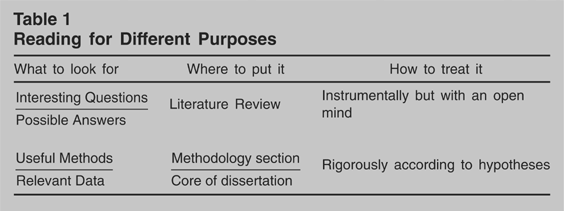
Inevitably, many dissertations are largely, or even entirely, based on secondary literature. In this situation, there is a grave danger of the literature review engulfing the whole dissertation. A good way of avoiding this outcome is to focus strongly on the different reasons for reading different sources. Readings that have been consulted for different reasons should obviously be treated differently. The first reason to read a book is to look for interesting questions on which a dissertation might focus (see Table 1). For example, while reading Huntington you might notice the statement that the break-up of a state is more likely in a state where there are substantial communities belonging to different civilizations, as opposed to merely different cultures (Huntington 1996, 137). Both the hypothesis and the evidence are stated very briefly and unsystematically, but seem quite plausible. A systematic investigation of this hypothesis might make an interesting dissertation.
Reading for Different Purposes

The second reason to read a book is to look for answers to a question which you have already decided on. For example, a student trying to solve the puzzle of the rarity of democracy in Arab countries might look for answers in the literatures on Arab political culture, oil and politics, and U.S. foreign policy. A discussion of both questions and answers is found in a literature review. In both cases, the material should be treated instrumentally. For example, it is not what Huntington says about the global politics that matters, but only his treatment of “cleft countries,” the states through which civilizational borders run. A student trying to explain the rarity of democracy in Arab countries looks at U.S. foreign policy not to understand its sources or its variation across the world, but its effect on the political regimes of Arab countries. Although such reading is focused and instrumental, it also should be conducted with an open mind as to possible questions or answers.
The third reason to read the secondary literature is to find useful methods for replication or adaptation in your dissertation. A dissertation examining the impact of regional organization membership on democracy in the post-Cold War era will need to decide which countries are democracies and which are not. In this respect, a student may want to apply and cite Przeworski's method for deciding whether countries where there has been no alternation in government should be classed as democracies (Przeworski et al. 2000, 23–28).
A fourth reason for consulting a secondary source is to look for data. Przeworski et al. categorized almost all states in the world between 1950 and 1990 as democratic or authoritarian, and their dataset would be relevant to numerous dissertations (59–69). Neither of these references belongs in the literature review section. The methodological reference belongs in a methodology section and the data belong in either a methodology section or the empirical core of the dissertation. Moreover, both of these sources should be treated differently. When looking for data, students may sometimes only need to read a page or two of a book, but a whole methodology needs more careful consideration, again, however, without necessarily engaging seriously with the substantive concerns of the book. Using Przeworski's coding of democracies requires an understanding of his book's first chapter and but does not entail an engagement with the book's core concern with the relationship between economic development and political regime type.
A literature review, even more than most portions of a political science dissertation, evolves through multiple drafts. Early versions may actually be a list of summaries of books, with occasional critical comments or queries, but the final version will be a very focused setting of the scene. Some material may survive from first to final draft, but the material that has been changed or omitted will still inform the review and the thesis as a whole. Intellectual dead-ends and tangents should not end up in the thesis, but this does not mean that they represent a waste of time. A literature review is also a process of elimination, a distillation of a wide-ranging literature down to a specific research project. The final literature review will justify your choices but will not necessarily detail how you came to make them. In other words, the content of the final literature review should be decided on a need-to-know (Dunleavy 2003, 61) not a look-at-what-I've-read basis. As Goethe remarked: “Some books seem to have been written not to impart any information to us, but merely to let us know that their author knew something”. Dissertations are not marked on effort but on intellectual merit. If you cloud your argument in an attempt to show how much work you have done, you will get a lower mark. It is particularly sad for an examiner to have to conclude that, in spite, or even because of, a student's substantial erudition, they have no idea what the student is actually trying to say about the political world.
A literature review is not a succession of book reviews. It should be an argument, not a list. A literature review must establish the intellectual geography of the dissertation and locate the dissertation's project within it. This entails the classification of the literature. For example, take a student who has decided to write about the role of the European Union (EU) in the failure of democratization in Belarus. There are large literatures on both the EU and processes of democratization. These overlap to some extent. The EU's existence is argued to be a major democratizing influence on non-EU European countries, especially those that are closest to its borders. The EU also directly and intentionally affects democratisation with its policies towards other countries. These actions are part of EU foreign policy and EU policy toward Belarus is part of that foreign policy. This procedure clearly locates the dissertation at a certain intersection of a collection of literatures, while also establishing the relationships between the different literatures.
The treatment of individual works should not take the form of a straightforward summary of the work in question. Each work should be subjected to critical analysis, but not criticism for its own sake, nor even criticism for the sake of political science, but criticism focused on the dissertation research question and the research question alone. Critical analysis does not consist of merely, or even always, evaluating a book. In many cases, a piece of literature is not wrong but just not very useful. If the research topic has been well chosen, you will be arguing not that many works are wrong, but that they are irrelevant to your thesis, because you have framed the question or issue in a slightly different way than previous authors. So, for example, a thesis the role of semi-presidentialism in the transition to democracy in Poland, would undoubtedly mention the works of Linz and Stepan. It would probably not argue that they were wrong but rather inapplicable since Linz and Stepan focus on semi-presidentialism's threats to democratic consolidation (1996, 276–283).
Writing an unequivocal paragraph about politics is difficult for even the most lucid writer. Most of the work reviewed will be interpretable in several different ways, some of which make more sense than others. Students should always strive to engage with the most charitable interpretation of the literature. This is not a matter of fairness but of usefulness. If Huntington is dismissed as a befuddled Orientalist, as frequently happens, his ideas are unlikely to move a dissertation project forward. However, if his ideas are presented as plausible given certain conditions, they may suggest a theoretically significant research project for a student. The dissertation can empirically investigate the presence of absence of the conditions identified in the literature review. A really successful literature review can move on from being a summary of existing work to becoming a fruitful dialogue with the literature.
The work of academic giants is not generally composed of lengthy literature reviews, but it usually displays a mastery of the literature. A mastery of the literature is not a mere ability to hold lengthy and detailed discussions on different writings, but rather an ability to put the literature to work to ask new questions and propose new answers. The golden rule of the literature review, as with all sections of a thesis, is that it must be rigorously focused on fulfilling its role in the thesis as a whole. The literature review's role is to elucidate and justify the choice of question and possible answers in the dissertation. Reviewing the literature is not a process, which is reported directly in the text of a dissertation, but is rather a process, which informs a focused setting of the scene for the dissertation's argument. An awareness of this general function of the literature review makes it more likely that a student might enjoy the view from the giants' shoulders.
Iain McMenamin is lecturer in politics, School of Law and Government, Dublin City University, Ireland. His publications have so far specialized in Polish business-government relations, but he has also published in other areas of comparative politics. His work can be found in the British Journal of Political Science, the European Journal of Political Research, and other journals.

Reading for Different Purposes