According to the World Health Organization (2012), tobacco dependence is responsible for 12% of deaths due to cardiovascular diseases worldwide. Smoking accelerates the progression of atherosclerosis in the coronary arteries, and elsewhere, and activates the coagulation system, increasing the risk of clot formation, and consequently the risk of embolism and infarction (Gavina, Pinho, & Maciel, Reference Gavina, Pinho and Maciel2011). Patients with coronary heart disease who quit smoking reduce the risk of dying prematurely by 36% (Royal College of Physicians, 2007). Although a hospitalization due to a cardiac event offers a unique opportunity to quit smoking (Holtrop, Stommel, Corser, & Holmes-Rovner, Reference Holtrop, Stommel, Corser and Holmes-Rovner2009), relapses are still common after clinical discharge (Gavina et al., Reference Gavina, Pinho and Maciel2011). Despite the information about long-term repeated cycles of smoking abstinence and relapse after acute coronary syndrome, there is limited understanding of long-term smoking abstinence predictors, as most studies usually include only six months of follow-up. Thus, it is crucial to identify the predictors of smoking abstinence after an acute coronary syndrome, in order to fully understand smoking behavior and improve smoking cessation interventions for this specific population.
There are many factors that influence smoking abstinence. Quist-Paulsen, Bakke, and Gallefoss (Reference Quist-Paulsen, Bakke and Gallefoss2005) demonstrated that nicotine dependence was an important negative predictor of smoking abstinence 12 months after a coronary event. More recently, Rath, Sharma, and Beck (Reference Rath, Sharma and Beck2013) supported the importance of addressing behavioral dependence in smoking cessation interventions. According to Glover et al. (Reference Glover, Nilsson, Westin, Glover, Laflin and Persson2005), the behavioral aspects of smoking addiction include the rituals associated with smoking, the feelings of security that smoking provides, and the relationship between the smoker and cigarette. Rath et al. (Reference Rath, Sharma and Beck2013) also stated that the behavioral component of smoking addiction encompasses the cognitive, social, and behavioral effects associated with tobacco dependence, within the premise that addictive behaviors are learned and acquired through operant conditioning. Anxiety and depressive symptoms have also been found to negatively influence patients’ attempts to quit smoking after hospitalization for acute coronary syndrome (Perez, Nicolau, Romano, & Laranjeira, Reference Perez, Nicolau, Romano and Laranjeira2008).
According to the tenets of Self-Determination Theory (SDT), there are two critical factors for the initiation and maintenance of health behavior change, such as stop smoking permanently: autonomous self-regulation and perceived competence. Autonomous self-regulation refers to the persons’ feeling a sense of volition, self-initiation, and personal endorsement of a behavior (Williams, Gagné, Mushlin, & Deci, Reference Williams, Gagné, Mushlin and Deci2005). Perceived competence (conceptualized at the level of the person and within the SDT framework) differs from self-efficacy (conceptualized at the level of the behavior and within the social-cognitive theory framework). Perceived competence refers to a person’s perception of her basic capability of carrying out a behavior (Rodgers, Markland, Selzler, Murray, & Wilson, Reference Rodgers, Markland, Selzler, Murray and Wilson2014), whereas Bandura (Reference Bandura1986) indicated that self-efficacy refers to a person’s confidence that she can carry out the behavior under challenging circumstances. Deci and Ryan (Reference Deci and Ryan2000) stated that the need for perceived competence can only be related with behavioral persistence, if the need for autonomy is also met. On the other hand, self-efficacy is purported only to be related to behavioral persistence. If one is self-efficacious over extrinsically motivated behaviors, one might persist, but the need for competence might not be met, and thus it will not lead to a more positive psychological state.
Williams, Niemiec, Patrick, Ryan, and Deci (Reference Williams, Niemiec, Patrick, Ryan and Deci2009) demonstrated that an SDT intervention that enhanced autonomous self-regulation and perceived competence in a large randomized controlled trial facilitated long-term smoking abstinence, and Rocha, Guerra, Lemos, Maciel, and Williams (Reference Rocha, Guerra, Lemos, Maciel and Williams2017) found that perceived competence was a positive predictor of smoking abstinence six months after an acute coronary syndrome. Social supportive behaviors have also been associated with successful smoking abstinence, whereas critical behaviors, such as partner criticism, have been related with earlier relapse (Park, Tudiver, Schultz, & Campbell, Reference Park, Tudiver, Schultz and Campbell2004). Meaning in life (defined as a sense of clear aims in life and a feeling that one’s experiences and daily activities are worthwhile and meaningful) has been indicated as a significant negative predictor of cigarette consumption (Thege, Bachner, Martos, & Kushnir, Reference Thege, Bachner, Martos and Kushnir2009) and a myocardial infarction’s protective factor (Kim, Sun, Park, Kubzansky, & Peterson, Reference Kim, Sun, Park, Kubzansky and Peterson2013).
There were few longitudinal studies that identified smoking abstinence predictors after a six months period in clinical samples, such as smokers who suffered an acute coronary syndrome. In Portugal, there was no study that assessed autonomous self-regulation and perceived competence over time and their impact in long-term smoking abstinence in a sample with these characteristics. Studies on the cognitive working mechanism of smoking cessation in high-risk populations are few and much needed, and identifying long-term psychosocial factors to smoking cessation are relevant to improve intervention for cardiac patient groups. The present study aimed: (1) to analyze the motivation (autonomous self-regulation and perceived competence) and psychosocial variables scores (social support, anxiety, depressive symptoms, and meaning in life) over the three times of data collection (hospitalization, six and 12 months after clinical discharge); (2) to identify baseline differences in the motivation, psychosocial and smoking variables (nicotine dependence and behavioral dependence) scores, and on the longest period of abstinence reported between smokers and ex-smokers 12 months after an acute coronary syndrome; (3) to determine the predictors of smoking abstinence 12 months after an acute coronary syndrome, and (4) to analyze the smoking variables scores and the number of cigarettes smoked per day from Time 1 to Time 3 among participants who remained smokers 12 months after clinical discharge.
Method
Participants
The study’s final sample included 65 patients who were followed since their hospital admission at the department of cardiology of Centro Hospitalar de São João (CHSJ) and Centro Hospitalar de Vila Nova de Gaia (CHVNG) in Portugal, due to an acute coronary syndrome, till 12 months after clinical discharge. The mean of days elapsed between admission to hospital and discharge was approximately 10 (M = 9.72; SD = 7.53). The participants were regular smokers (smoked at least five cigarettes per day) at the time of the hospital admission, were 18 years of age or older, had Portuguese nationality, had no history of psychiatric disorders (dementia or history of or current psychotic illness), and no cognitive impairment. Of the 65 participants, 91% were men and 94% were diagnosed with myocardial infarction. The mean age was 55.68 (SD = 10.77).
This study took place from November 2013 to July 2015. Participants were recruited through a consecutive sampling technique. Figure 1 shows that 110 participants enrolled in the study at baseline (Time 1) (only three eligible patients declined due to lack of willingness to enroll), but one died and 33 were lost at the six month follow-up. Of the 76 participants included in the six months follow-up (Time 2), one died and 10 were lost to the 12 months follow-up (Time 3). We only included the participants who have completed the questionnaires at all three times of data collection.
Recruitment and retention of participants.

Instruments
Some of the instruments used (Treatment Self-Regulation Questionnaire, Perceived Competence Scale, Instrumental-Expressive Social-Support Scale, Hospital Anxiety and Depression Scale, and Meaning in Life Scale) have been described in an initial study (Rocha et al., Reference Rocha, Guerra, Lemos, Maciel and Williams2017). A questionnaire was developed to assess socio-demographic, clinical and smoking habits data. The primary outcome was seven-day point prevalence tobacco abstinence six and twelve months after clinical discharge. Participants responded either ‘‘yes’’ or ‘‘no’’ to the question: ‘‘Have you smoked a cigarette, even a puff, in the past seven days?’’. Participants also responded either ‘‘yes’’ or ‘‘no’’ to having currently used a pipe, cigars, snuff, or chewing tobacco. The self-reported dichotomous question was then coded as zero (currently not smoking) or one (currently smoking).
The Fagerström Test for Nicotine Dependence (FTND) assessed nicotine dependence (6 items; e.g. How soon after you wake up do you smoke your first cigarette?) (Heatherton, Kozlowski, Frecker, & Fagerström, Reference Heatherton, Kozlowski, Frecker and Fagerström1991). Yes/no items were scored from zero to one and multiple-choice items were scored from zero to three. FTND was validated for the Portuguese population by Ferreira, Quintal, Lopes, and Taveira (Reference Ferreira, Quintal, Lopes and Taveira2009). In the current study, the Cronbach’s alpha for this measure at Time 1 was .51 and at Time 3 was .57. The observed FTND score was calculated as the sum of the 6 items.
The Glover-Nilsson Smoking Behavioral Questionnaire (GNSBQ) assessed behavioral dependence of smoking (11 items; e.g. I handle and manipulate the cigarette as part of my smoking ritual) (Glover et al., Reference Glover, Nilsson, Westin, Glover, Laflin and Persson2005). Responses were made on a five point Likert-type scale that ranged from zero (“not at all” in the two first items and “never” in the rest of them) to four (“extremely so” in the first two items and “always” in the rest of them). GNSBQ was validated for the Portuguese population by Rocha, Guerra, Lemos, and Glover (Reference Rocha, Guerra, Lemos and Glover2014) who found two correlated factors: factor 1 (item 1, 2, 4, 5, 8 and 10) was related with the act of smoking itself, and factor 2 (item 3, 6, 7, 9 and 11) was related to social environment and conditioned stimuli associated with smoking effects. In the current study, the Cronbach’s alpha for this measure at Time 1 was .66 and at Time 3 was .79. The observed GNSBQ score was calculated as the sum of the 11 items.
The Treatment Self-Regulation Questionnaire (TSRQ) assessed autonomous self-regulation for smoking cessation (6 items; e.g. The reason I would stop smoking permanently or continue not smoking is because it is very important for being as healthy as possible) (Lévesque et al., Reference Lévesque, Williams, Elliot, Pickering, Bodenhamer and Finley2007). Responses were made on a seven point Likert-type scale that ranged from one (“not true”) to seven (“totally true”). TSRQ was adapted for the Portuguese population by Guerra, Lemos, Queirós, and Rosas (Reference Guerra, Lemos, Queirós and Rosas2003). In the current study, the Cronbach’s alpha for this measure at Time 1 was .81, at Time 2 was .82 and at Time 3 was .66. The observed TSRQ score was calculated as a mean of the 6 items.
The Perceived Competence Scale (PCS) assessed perceived competence to stop smoking successfully (4 items; e.g. I feel confident in my ability to stop smoking permanently) (Williams & Deci, Reference Williams and Deci1996). Responses were made on a seven point Likert-type scale that ranged from one (“not true”) to seven (“totally true”). PCS was adapted for the Portuguese population by Guerra et al. (Reference Guerra, Lemos, Queirós and Rosas2003). In the current study, the Cronbach’s alpha for this measure at Time 1 was .86, at Time 2 was .88 and at Time 3 was .93. The observed PCS score was calculated as a mean of the 4 items.
The Instrumental-Expressive Social-Support Scale (IESSS) assessed social support (20 items; e.g. Over the past six months I have been bothered by problems with spouse/ex-spouse) (Lin, Dean, & Ensel, Reference Lin, Dean and Ensel1986). Responses were made on a five point Likert-type scale that ranged from one (“always”) to five (“never”). IESSS was validated for the Portuguese population by Guerra (Reference Guerra1995). In the current study, the Cronbach’s alpha for this measure at Time 1 was .71 and at Time 3 was .92. The observed IESSS score was calculated as the sum of the 20 items.
The Hospital Anxiety and Depression Scale (HADS) has two subscales that assessed anxiety (7 items; e.g. I feel tense or wound up) and depressive symptoms (7 items; e.g. I feel as if I am slowed down) (Zigmong & Snaith, Reference Zigmond and Snaith1983). Responses were made on a four point Likert-type scale that ranged from zero to three. HADS was validated for the Portuguese population by Ribeiro et al. (Reference Ribeiro, Silva, Ferreira, Martins, Meneses and Baltar2007). In the current study, the Cronbach’s alpha for the anxiety subscale at Time 1 was .78, at Time 2 was .89 and at Time 3 was .91. The Cronbach’s alpha for the depression subscale at Time 1 was .61, at Time 2 was .85 and at Time 3 was .90. The observed HADS score for anxiety was calculated as the sum of the 7 items from the anxiety subscale, and the observed HADS score for depression was calculated as the sum of the 7 items from the depression subscale.
The dimension of meaning in life was assessed through a new Portuguese version of the Meaning in Life Scale (one item has been excluded from its original eight item version) (Guerra, Reference Guerra1992). The new version comprised the remaining seven items after performing a confirmatory factor analysis (7 items; e.g. “I have interest in life and I make plans”, e.g. “I feel slight fulfilled as a person”, a negative formulated item), (Guerra, Lencastre, Silva, & Teixeira, Reference Guerra, Lencastre, Silva and Teixeira2017). Guerra et al. (Reference Guerra, Lencastre, Silva and Teixeira2017) concluded that this scale was an unidimensional scale with a good model of fit. We chose this scale, because it was originally created in Portuguese, it is validated for the Portuguese population, and also because it was created based on behaviors and actions that indicate the presence of meaning in life, in contrast to explicit statements on the level of meaning perceived by the individual. Responses were made on a five point Likert-type scale that ranged from one (“totally agree”) to five (“totally disagree”) . In the current study, the Cronbach’s alpha for this measure at Time 1 was .63, at Time 2 was .81 and at Time 3 was .88. The observed score was calculated as the sum of the 7 items, and some items were scored reversely (Guerra et al., Reference Guerra, Lencastre, Silva and Teixeira2017).
Procedure
All instruments were consecutively administered to each patient who met the inclusion criteria admitted at the Cardiology Department of CHSJ and CHVNG at Time 1 in the order previously described by a trained psychologist. Six months after clinical discharge, participants were contacted personally at the hospitals where the data collection took place on the day of their cardiologist appointment and were asked to complete a follow-up questionnaire about smoking data, TSRQ, PCS, HADS and Meaning in Life Scale. Participants, who were being followed at different hospitals, were mailed the same follow-up questionnaires. We did not assess the following variables at Time 2: nicotine and behavioral dependence (because some participants would be abstinent by then) and social support (to reduce the scope of the study and because we believe it would be a more stable variable rather than the others assessed at this time). Twelve months after clinical discharge, participants were asked to complete all the questionnaires administered at Time 1, personally or by postmail, according to the same procedure described at Time 2. The protocol was individually administered and took about 20 minutes to complete at Time 1 and Time 3, and 15 minutes at Time 2.
This study was approved by the ethics committee of CHSJ and CHVNG and followed the ethical protocol of both hospitals. It assured confidentiality and informed consent was obtained according to the Helsinki Declaration.
Statistical analysis
An independent-samples t-test was conducted to identify baseline differences between the 65 participants who were included at Time 3 and the 45 who were not. A one-way repeated measures ANOVA was conducted to compare scores on the autonomous self-regulation, perceived competence, anxiety, depressive symptoms and meaning in life scores over the three times of data collection. A paired-samples t-test was conducted to compare social support score at Time 1 and Time 3, since this variable was only assessed in these two times of data collection. An independent-samples t-test was then conducted to test for differences in Time 1 scores (autonomous self-regulation, perceived competence, social support, anxiety, depressive symptoms, meaning in life, nicotine dependence, behavioral dependence, and the longest period of smoking abstinence) between smokers and ex-smokers at Time 3. We performed a direct logistic regression (enter method) to identify the impact of the variables included in the study on the likelihood that participants would report that they were regular smokers 12 months after clinical discharge. For logistic regression, we created variables representing change over the two times of data collection (Time 1 and Time 3) by subtracting Time 1 scores from Time 3 scores for each independent variable included in the model. This type of analysis has been used in other studies to obtain a measure of change (Williams et al., Reference Williams, Gagné, Mushlin and Deci2005). All the Tolerance values were higher than .1 and VIF values stood below 10, indicating the absence of multicollinearity. Finally, a paired-samples t-test was conducted to compare scores on nicotine dependence, behavioral dependence, and the number of cigarettes smoked per day at Time 1 and Time 3, since these variables were only assessed in these two times of data collection. All analyses were performed using SPSS 21.0.
Results
It is important to analyze participants who did not complete the study versus those who did complete when studying change of smoking dependence (Williams et al., Reference Williams, Gagné, Mushlin and Deci2005). The 45 participants who were not included at Time 3 presented significantly higher nicotine dependence at Time 1 (M = 4.98, SD = 2.22) than the 65 participants included (M = 3.80, SD = 1.88) (t(108) = 3.00, p = .003, 95% IC [0.40, 1.96], η2 = .08).
All subsequent analysis were performed on the participants who had completed the questionnaires at all three times of data collection. Of the 65 participants included at Time 3, 47 were ex-smokers and 18 were smokers.
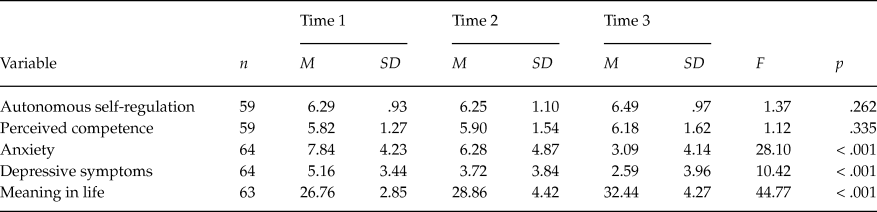
One of our goals was to analyze the motivation and psychosocial variables scores over the three times of data collection. Table 1 shows that there was a significant effect for time concerning anxiety (F(2, 62) = 28.10, p < .001, Wilks’ Lambda = .524, η p 2 = .48), depressive symptoms (F(2, 62) = 10.42, p < .001, Wilks’ Lambda = .748, η p 2 = .25), and meaning in life (F(2, 61) = 44.77, p < .001, Wilks’ Lambda = .405, η p 2 = .59). Anxiety and depressive symptoms scores have decreased significantly over time, whereas meaning in life has significantly increased. There was not a significant effect for time concerning autonomous self-regulation or perceived competence. Social support score increased significantly from Time 1 (M = 84.45, SD = 10.33) to Time 3 (M = 92.13, SD = 9.21) (t(63) = –4.54, p < .001, 95% IC [–11.05, –4.29], η2 = .25).
Change in the motivation and psychosocial variables scores at baseline (Time 1), six months (Time 2) and 12 months follow-up (Time 3)

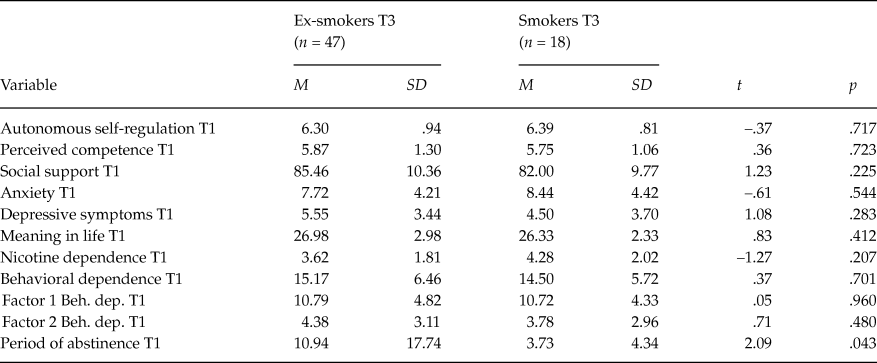
Another of our main goals was to identify baseline differences in the motivation, psychosocial and smoking variables scores, and on the longest period of abstinence reported between smokers and ex-smokers 12-months after an acute coronary syndrome. Table 2 shows that no significant baseline differences were found between smokers and ex-smokers at Time 3, except for the longest period of smoking abstinence. Participants who were ex-smokers at Time 3 reported a significant longer period of abstinence (measured in months) at Time 1 in their attempts to quit smoking than smokers (t(40) = 2.09, p = .043, 95% IC [.23, 14.18], η2 = .06).
Comparison of smokers and ex-smokers at 12 months follow-up (T3) on variables measured at baseline (T1)

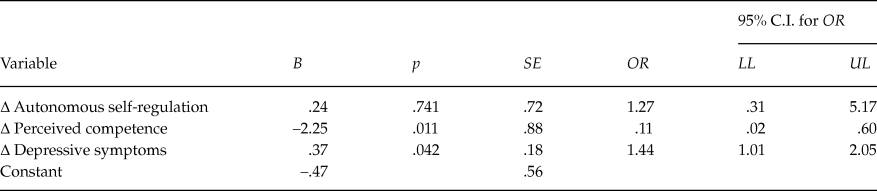
Another goal of our study was to identify predictors of smoking abstinence 12 months after an acute coronary syndrome. Due to their theoretical relevance and to the study’s sample-size, the logistic regression model contained three independent variables: change in autonomous self-regulation, perceived competence, and depressive symptoms. The full model containing all predictors was statistically significant, χ2(3, N = 65) = 45.77, p < .001), indicating that the model was able to distinguish between participants who quitted smoking and participants who did not quit smoking at Time 3. The model as a whole explained between 52.8% (Cox and Snell R square) and 76.1% (Nagelkerke R squared) of the variance in smoking status at Time 3, and correctly classified 91.8% of cases. As shown in Table 3, change in perceived competence and depressive symptoms made a statistically significant contribution to the model. The strongest significant predictor of smoking 12 months after clinical discharge was change in depressive symptoms, recording an odds ratio of 1.44. This indicated that participants who experienced change in depressive symptoms from Time 1 to Time 3 were over one time more likely to report being a smoker 12 months after clinical discharge, controlling for all other factors in the model. The odds ratio for perceived competence was .11 (a value less than one), indicating that participants who experienced change in perceived competence from Time 1 to Time 3 were .11 times less likely to report being a smoker 12 months after clinical discharge, controlling for other factors in the model.
Logistic regression predicting smoking status 12 months after clinical discharge

Note: N = 65. CI = confidence interval; OR = odds ratio; LL = lower limit; UL = upper limit. Model χ2 (3) = 45.77. Change in autonomous self-regulation, perceived competence and depressive symptoms were calculated by subtracting Time 1 scores from Time 3 scores.
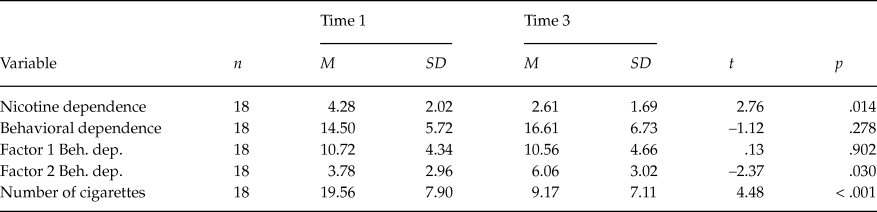
Finally, the study aimed to analyze the smoking variables scores and the number of cigarettes smoked per day over time among participants who remained smokers 12 months after clinical discharge. Table 4 shows that there was a statistically significant decrease on nicotine dependence (t(17) = 2.76, p = .014, 95% IC [.39, 2,94], η2 = .31) and on the number of cigarettes smoked per day from Time 1 to Time 3 (t(17) = 4.48, p < .001, 95% IC [5.49, 15.29], η2 = .54). There was also a statistically significant increase in factor 2 of behavioral dependence from Time 1 to Time 3 (t(17) = –2.37, p = .030, 95% IC [–4.30, –2.54], η2 = .25).
Change in smoking variable scores at baseline (Time 1) and 12 months follow-up (Time 3)

Discussion
The present study aimed to analyze the motivation and psychosocial variables scores over the three times of data collection; to identify baseline differences between smokers and ex-smokers 12-months after an acute coronary syndrome; to determine the predictors of smoking abstinence 12-months after an acute coronary syndrome; and to analyze the smoking variables scores and the number of cigarettes smoked per day from Time 1 to Time 3. The results showed that participants who did not enroll in the study at Time 3 presented significantly higher nicotine dependence at Time 1. Anxiety and depressive symptoms scores significantly decreased over the three times of data collection, whereas meaning in life and social support scores have significantly increased. There was not a significant effect for time concerning autonomous self-regulation and perceived competence. Participants who were ex-smokers at Time 3 reported a significant longer period of abstinence at Time 1 in their attempts to quit smoking than smokers. Smoking abstinence at Time 3 was positively predicted by change in perceived competence and negatively by change in depressive symptoms from Time 1 to Time 3. Participants who remained smokers reported lower nicotine dependence, lower number of cigarettes smoked per day and higher behavioral dependence at Time 3 than at Time 1.
Longitudinal studies often lose a large percentage of participants, and the present study suggested that dropouts tended to be more nicotine dependent. This finding is similar to the one obtained by Williams et al. (Reference Williams, Gagné, Mushlin and Deci2005), further supporting the conclusion that dropouts tend to smoke more and engage in more risk behaviors than completers. Our findings showed that autonomous self-regulation and perceived competence for not smoking remained relatively high and stable over time. We hypothesize that the diagnosis of acute coronary syndrome can explain these results, namely by increasing the personal importance attached to not smoking already at baseline. Similarly, Williams et al. (Reference Williams, Gagné, Mushlin and Deci2005) found that participants who presented a higher probability of coronary artery disease were able to maintain, at least for three years, the relatively high level of autonomous self-regulation for healthier living that they reported at baseline. The perceived competence baseline score reported in the study of Williams, Gagné, Ryan, and Deci (Reference Williams, Gagné, Ryan and Deci2002) with a non-clinical sample was lower than the score reported in the current study. Psychosocial variables scores were not as stable as the motivation scores: anxiety and depressive symptoms significantly decreased over time, whereas meaning in life and social support significantly increased. Boersma, Maes, and Joekes (Reference Boersma, Maes and Joekes2005) found that patients diagnosed with myocardial infarction scored significantly higher on both anxiety and depression scales compared to the general population sample. Anxiety and depressive symptoms might have acted as emotional responses during hospitalization, but the majority of the sample probably adapted over time with lower levels of these symptoms. Returning home after hospitalization and having a better understanding of the disease probably helped participants to feel they had more control of their lives, which might had a positive impact on anxiety and depressive symptoms after clinical discharge (Barnason, Zimmerman, Nieveen, Schultz, & Young, Reference Barnason, Zimmerman, Nieveen, Schultz and Young2012). Kim et al. (Reference Kim, Sun, Park, Kubzansky and Peterson2013) found that meaning in life at baseline among people with coronary heart disease was lower compared to those without coronary heart disease, and indicated that future studies needed to address how meaning in life plays a role across the different stages of heart health. Heintzelman and King (Reference Heintzelman and King2014) stated that meaning in life is usually lower in samples of individuals with addictions than in non-clinical samples. In the present study, we also found that the mean score for meaning in life at baseline was lower than that observed in other samples (Guerra et al., Reference Guerra, Lencastre, Silva and Teixeira2017), and additionally it showed a steady increase over time. An acute coronary syndrome is a life-threatening event which could have negatively affected the patients’ feelings that their experiences were worthwhile and their sense of clear aims in life while being hospitalized. The recovery may be associated with a higher enthusiasm and excitement about life and willingness to live. Social support has been shown to influence the risk of cardiac mortality after an acute coronary syndrome (Uchino, Reference Uchino2006). In this study, participants’ perceptions of social support increased over time. We believe that social support scores increased after clinical discharge, as patients usually spend more time with their relatives and friends when they return home than during hospitalization. In addition, hospitalization is also a period of psychological vulnerability to families, which can influence the social support given to the patient during this period.
It also seems that the impact of the acute coronary syndrome diagnosis prevailed over smoking dependence during hospitalization, as no differences were found in the motivation and psychosocial variables scores at Time 1 between smokers and ex-smokers at Time 3. We hypothesize that the diagnosis affected equally all patients at baseline, making it difficult to identify baseline variables that could be distinctive markers between smokers and ex-smokers 12 months after clinical discharge. Nevertheless, participants who were ex-smokers at Time 3 reported a significant longer period of abstinence at Time 1 in their attempts to quit smoking. These findings are supported by previous studies. Guerra et al. (Reference Guerra, Queirós, Torres, Vieira, Branco and Garrett2008) found, in a sample of students and employees from a Portuguese university, that ex-smokers reported longer periods of smoking abstinence than smokers. The period of abstinence can be an important distinctive marker of smokers and ex-smokers after an acute coronary syndrome. However, it should be noticed that unlike the motivation and psychosocial variables, this is a pre-morbid characteristic that was assessed retrospectively.
Smoking abstinence at Time 3 was positively predicted by change in perceived competence and negatively predicted by change in depressive symptoms from Time 1 to Time 3. This finding supports the evidence from other studies that perceived competence was associated with smoking abstinence. Williams et al. (Reference Williams, Niemiec, Patrick, Ryan and Deci2009) found that supporting autonomous self-regulation and perceived competence facilitated long-term smoking abstinence in a non clinical-sample of 714 smokers. Rocha et al. (Reference Rocha, Guerra, Lemos, Maciel and Williams2017) identified perceived competence as the single positive predictor of early smoking abstinence (six months after an acute coronary syndrome). Holtrop et al. (Reference Holtrop, Stommel, Corser and Holmes-Rovner2009) demonstrated that depression reduced the likelihood of quitting smoking and was a negative predictor of smoking abstinence in a sample of cardiac patients. McClave et al. (Reference McClave, Dube, Strine, Kroenke, Caraballo and Mokdad2009) conducted a study with a large population-based sample and found that ex-smokers were less likely to be currently depressed than smokers. In fact, McClave et al. (Reference McClave, Dube, Strine, Kroenke, Caraballo and Mokdad2009) concluded that ex-smokers had rates of depression comparable with that of the general population. In fact, depression is associated with unhealthy life-styles, such as tobacco dependence which increases the likelihood of suffering an acute coronary syndrome. Some studies have identified difficulties, in cardiac patients, in self-regulating and modulating negative emotions, which might be a reason for them to adopt addictive behaviors (Rocha, Guerra & Maciel, Reference Rocha, Guerra and Maciel2010). Depressive symptoms can be an obstacle to achieve smoking abstinence, as many people smoke as a maladaptive coping mechanism to deal with negative feelings (Royal College of Physicians, 2007). In these cases, depression is not being properly addressed and adaptive coping mechanisms are not being used, which contributes to the high levels of depression usually observed in smokers. More information about this issue could have been obtained if the smoking-related variables had been assessed at Time 2. It can be concluded that perceived competence is a stable positive predictor of short (Rocha et al., Reference Rocha, Guerra, Lemos, Maciel and Williams2017) and long-term smoking abstinence, but depressive symptoms also play an important role in predicting 12 months smoking abstinence. This finding confirms the information about repeated cycles of smoking abstinence and relapse after an acute coronary syndrome. The time elapsed since the diagnosis assignment should be taken into account in smoking cessation interventions, because there are variables (such as depressive symptoms) that do not have an impact at six-months smoking abstinence (Rocha et al., Reference Rocha, Guerra, Lemos, Maciel and Williams2017), but do have a significant impact at 12-months smoking abstinence. Thus it is important to assess and monitor these variables at multiple times throughout the interventions.
Nicotine dependence and the number of cigarettes smoked per day significantly decreased over time among participants who remained smokers 12 months after clinical discharge. This finding is also consistent with previous research showing greater reduction in risk behaviors following a coronary event, such as smoking dependence (Trigo & Rocha, Reference Trigo and Rocha2002). The progressive reduction of cigarettes and the simultaneous decrease of nicotine dependence are important findings that can also facilitate smoking cessation. Falba, Jofre-Bonet, Busch, Duchovny, and Sindelar (Reference Falba, Jofre-Bonet, Busch, Duchovny and Sindelar2004) argued that the cigarette reduction strategy alone can be a predictor of long-term abstinence. Factor 2 of behavioral dependence significantly increased over time. The factor 2 of behavioral dependence is related with the social environment and conditioned stimuli associated with smoking effects. We believe this variable score increased over time, because while people are hospitalized, they do not face behavioral smoking triggers, such as their car, bedroom, or favorite chair. Only when they return home they face these stimuli that can increase behavioral dependence. This finding has clinical implications, because it seems that behavioral dependence is contributing to the maintenance of cigarette consumption 12 months after clinical discharge. Thus smoking cessation interventions for patients diagnosed with acute coronary syndrome should address strategies to deal with behavioral dependence (e.g. activities occupying hands or changing in the environment).
Some limitations of the study should be considered in generalizing from these results. Our sample was a convenience sample, thus this study should be seen as an exploratory investigation. The data from more than 30 participants were not available at follow-up assessments. Thus, it would be important to collect a larger sample to strengthen the study’s statistical power and to allow the inclusion of other variables into the regression model. Ninety-one per cent of the sample was male. This reflects the high prevalence of coronary heart disease in males in Portugal. However, according to Thurston and Kubzansky (Reference Thurston and Kubzansky2007), the co-occurrence of psychosocial risk and its association with coronary heart disease is stronger among women. Thus, the conclusions of the study should be carefully interpreted as mostly valid for men. Another limitation of this study is that it relied on self-report of smoking status. Participants who dropped out were more nicotine dependent at baseline, which render the analyses only suggestive. It would have been interesting to analyze the evolution of smoking-related variables over the three times of data collection in order to obtain subtle information regarding possible fluctuations in smoking status during the cessation process. We believe that assessing nicotine dependence and behavioral dependence at Time 2 would have enriched the study. Thus we suggest the assessment of these variables in all times of data collection in future research. However, the results obtained in this study through the FTND should be interpreted with caution due to its Cronbach’s alpha coefficient.
This study showed that smoking abstinence after hospitalization due to an acute coronary syndrome increased over time, yet at least 18 of the patients remained smokers even after a life-threatening event. Perceived competence played a major role in maintaining short (Rocha et al., Reference Rocha, Guerra, Lemos, Maciel and Williams2017) and long-term smoking abstinence (a year after clinical discharge), which supports the SDT model for behavior change. This study also confirmed the importance of monitoring and intervening on depressive symptoms, as they were found to be a negative predictor of smoking abstinence. Interventions to help cardiac patients to quit smoking should address perceived competence, depressive symptoms and behavioral dependence, as this last variable tends to increase after clinical discharge. Further research is called to deepen the impact of these variables on predicting smoking abstinence after an acute coronary syndrome, to identify the main motives reported by patients that they believe have influenced smoking abstinence and relapses, and to study smokers with higher nicotine dependence who usually tend to dropout.
This study includes a very specific sample: 20% of the Portuguese population smoke and 8% of cardiovascular deaths in Portugal are attributable to smoking dependence (Programa Nacional para a Prevenção e Controlo do Tabagismo, 2016). Thus smoking cessation is twice as beneficial for smokers who suffered an acute coronary syndrome, because it decreases the negative effect of smoking on other cardiovascular risk factors, such as hypertension and diabetes mellitus, and also reduces the risk of dying prematurely. Few studies have assessed smoking predictors after a six months period in samples of smokers who also suffered an acute coronary syndrome. In Portugal, there was no longitudinal study that analyzed autonomous self-regulation, perceived competence and meaning in life over a year and their impact in smoking abstinence in a sample with these characteristics. This study contributes unequivocally to the understanding of smoking abstinence predictors after an acute coronary syndrome and whether they resemble or differ from the predictors of early abstinence (six months after an acute coronary syndrome) (Rocha et al., Reference Rocha, Guerra, Lemos, Maciel and Williams2017). It also underlines the importance of developing SDT based interventions for this specific population in order to help them achieve long-term smoking abstinence. It can be concluded that smoking dependence is a complex biopsychosocial phenomenon influenced by motivation and psychosocial variables whose impact varies through time. This information should be taken into account when designing smoking cessation interventions for this specific population.