Between 2008 and 2012, the number of Canadian residents receiving home care services rose by 55 per cent to approximately 2.6 million people (Turcotte, Reference Turcotte2014). Seventy per cent of this increase in service utilization is attributed to older adults who experience difficulty completing activities of daily living (Canadian Home Care Association, 2013). Today, one in six elderly Canadians living at home receives home support from professionals and unregulated/non-professional workers (Hoover & Rotermann, Reference Hoover and Rotermann2012). Home support is generally defined as the provision of non-professional personal care services in the home under the supervision of professional home support staff. Although there is a rapidly expanding mixed economy of home care provision, much of this assistance is provided by government-subsidized agencies that employ home support workers (also known across Canada as personal support workers, community health workers, community health care aides, home care paraprofessionals, home helpers, or homemakers) to assist with personal care and light household tasks (Canadian Healthcare Association, 2009; Sims-Gould, Byrne, Craven, Martin-Matthews, & Keefe, Reference Sims-Gould, Byrne, Craven, Martin-Matthews and Keefe2010). These workers, whom we identify as home support workers (HSWs), were the focus of the study we discuss in this article.
Although most home care clients are satisfied with the amount of support they receive, a growing proportion of older adults report having at least one unmet home care need due to the lack of access to, or inability to purchase, additional care (Byrne, Sims-Gould, Frazee, & Martin-Matthews, Reference Byrne, Sims-Gould, Frazee and Martin-Matthews2011; Hoover & Rotermann, Reference Hoover and Rotermann2012; McGrail et al., Reference McGrail, Broemeling, McGregor, Salomons, Ronald and McKendry2008). Studies have linked gaps in senior care to adverse consequences including poor nutrition, depression, injuries, falls, hospitalization, institutionalization, and premature death (Capitman, Abrahams, & Ritter, Reference Capitman, Abrahams and Ritter1997; Health Association Nova Scotia, 2014; Health Council of Canada, 2012; LaPlante, Kaye, Kang, & Harrington, Reference LaPlante, Kaye, Kang and Harrington2004; Sands et al., Reference Sands, Wang, McCabe, Jennings, Eng and Covinsky2006). As the Canadian population ages and lives longer in old age, calls for increased availability and accessibility of home care services that address the unmet health and social care needs of older people have renewed urgency (Bernier, Reference Bernier2014; Canadian Home Care Association, 2013; McGrail et al., Reference McGrail, Broemeling, McGregor, Salomons, Ronald and McKendry2008; Turcotte & Schellenberg, Reference Turcotte and Schellenberg2006).
One way to manage growing demand for home care is to improve retention of HSWs who provide 80 per cent of home care services (Ontario Ministry of Health and Long-Term Care, 2005). In the absence of current national or provincial statistics recording the extent of HSW turnover (Canadian Healthcare Association, 2009; The Office of the Ombudsperson, 2012), job tenure is estimated at eight to nine years (Canadian Home Care Association, 2003). Labour shortages are “increasingly dire” (Côté & Fox, Reference Côté and Fox2007, p. 11) and forecast to rise dramatically (Keefe, Légaré, & Martin-Matthews, Reference Keefe, Légaré and Martin-Matthews2009). High turnover is associated with compromised working conditions for employees in a diminished workforce, and with impaired quality of life for clients (Ayalon, Reference Ayalon2010; Karsh, Booske, & Sainfort, Reference Karsh, Booske and Sainfort2005). Recruitment and training of new HSWs are costly to agencies and supporting governments, and often lead to increases in service for clients (Ditson, Reference Ditson1994).
Research on employees within the health care industry as a whole has linked intention to leave, a strong predictor of turnover, with lower levels of satisfaction (American Health Care Association, 2003; Castle, Engberg, Anderson, & Men, Reference Castle, Engberg, Anderson and Men2007; Ditson, Reference Ditson1994; Karsh et al., Reference Karsh, Booske and Sainfort2005; Moyle, Skinner, Rowe, & Gork, Reference Moyle, Skinner, Rowe and Gork2003). Several factors differentiate home support work from other kinds of health care work and may relate to satisfaction. The labour of home support work primarily involves bathing, feeding, and toileting of clients, and is characterized as an emotionally and physically demanding job, often stigmatized, and offering few material rewards (Stacey, Reference Stacey2005). However, despite home support being described as the “dirty work” of care (Stacey, Reference Stacey2005), there is much evidence that HSWs find meaning in their labour of care (Sims-Gould et al., Reference Sims-Gould, Byrne, Craven, Martin-Matthews and Keefe2010; Stacey, Reference Stacey2005). Additionally, HSWs do their work in the client’s home setting, away from co-workers, supervisors, and other staff. As our previous research (Martin-Matthews & Sims-Gould, Reference Martin-Matthews, Sims-Gould, Benoit and Hallgrimsdottir2011) and other studies (Denton, Zeytinoglu, & Davies, Reference Denton, Zeytinoglu, Davies and Lian2002) suggest, there are unique challenges when the client’s home is the HSW’s workplace. These workplace characteristics suggest important differences in workplace satisfaction, motivation and, ultimately, retention.
Three Canadian Jurisdictions: A Unique Perspective
The objective of this study is to focus, exclusively and comprehensively, on the ways in which HSWs experience and describe issues of job satisfaction and dissatisfaction, and recommend strategies to enhance satisfaction. We use a mixed-methods approach, to examine both the association between structural variability in region of employment and patterns of job satisfaction, and the perspectives of workers themselves on the relationships between satisfaction and job, income and organizational characteristics.
Although there is a considerable body of research – and some insightful Canadian work – on the nature of job satisfaction among home care workers (Aronson, Denton, & Zeytinoglu, Reference Aronson, Denton and Zeytinoglu2004; Aronson & Neysmith, Reference Aronson and Neysmith1996a, Reference Aronson and Neysmith1996b; Denton, Zeytinoglu, Davies, & Hunter, Reference Denton, Zeytinoglu, Davies and Hunter2006; Denton, Zeytinoglu, Davies, & Lian, Reference Denton, Zeytinoglu, Davies and Lian2002; Denton, Zeytinoglu, Webb, & Lian, Reference Denton, Zeytinoglu, Webb and Lian1999; Ejaz, Noelker, Menne, & Bagaka’s, Reference Ejaz, Noelker, Menne and Bagaka’s2008; Zeytinoglu, Denton, Davies, & Plenderleith, Reference Zeytinoglu, Denton, Davies and Plenderleith2009), our study represents a unique perspective thus far lacking in the literature. In many prominent Canadian studies, the focus is localized to a specific geography and examines important but unique policy environments (e.g., funding scheme shifts in Ontario). Thus, home care worker responses are very context-specific (Abelson, Tedford Gold, Woodward, O’Connor, & Hutchison, Reference Abelson, Tedford Gold, Woodward, O’Connor and Hutchison2004; Aronson, Denton, & Zeytinoglu, Reference Aronson, Denton and Zeytinoglu2004; Aronson & Neysmith, Reference Aronson and Neysmith1996a; Zeytinoglu et al., Reference Zeytinoglu, Denton, Davies and Plenderleith2009).
Furthermore, other studies encompass the perspectives of HSWs as part of larger projects that incorporate all home care staff including nurses, physiotherapists, social workers and managers. In many such studies, the number of HSWs included is a small percentage of the overall direct care worker population – although this is not always so (for example, Denton et al., Reference Denton, Zeytinoglu, Davies and Lian2002a included data on 424 visiting homemakers in a study of 892 home care workers, and 27 home support workers among 99 focus group participants). In other studies (Dill, Keefe, & McGrath, Reference Dill, Keefe and McGrath2012), direct care workers include those employed in both institutional and home-based settings. As a consequence, the perspectives of HSWs are often dwarfed by the more dominant voices of trained professionals in home care, thus muting the unique and specific experiences of HSWs, especially where their numbers are small. Even where sample sizes of HSWs within large studies are more robust, the different categories of workers across and within occupational groups are not distinguished in the analyses of outcome measures (Ejaz et al., Reference Ejaz, Noelker, Menne and Bagaka’s2008) or systematically analysed with a comparative lens (Denton et al., Reference Denton, Zeytinoglu and Davies2002b).
This study combines the quantitative results of a standardized job satisfaction measure along with verbatim accounts from in-depth personal interviews, to penetrate the topic of HSW job satisfaction. While not claiming to be representative of workers in distinct provincial jurisdictions, we consider similarities and differences in the experiences of HSWs working in different parts of the country. But as our sample is not restricted to a single geographical area, this adds to the Canadian literature on workers in home care.
Our comparison acknowledges that home care is a provincial responsibility in Canada, with considerable variability in the nature of the job, levels of remuneration, and organizational characteristics of the work, both across and within different regions of the country (Canadian Home Care Association, 2013; Martin-Matthews, Sims-Gould, & Tong, Reference Martin-Matthews, Sims-Gould and Tong2012; Seggewiss, Reference Seggewiss2009). Numerous Canadian (Aronson & Neysmith, Reference Aronson and Neysmith1996b; Denton, Zeytinoglu, Davies, & Lian, Reference Denton, Zeytinoglu, Davies and Lian2002) and international (Ejaz, Noelker, Menne, & Bagaka’s, Reference Ejaz, Noelker, Menne and Bagaka’s2008; Karsh et al., Reference Karsh, Booske and Sainfort2005) studies have identified three spheres as highly relevant to job satisfaction among workers in this sector. These are job characteristics (e.g., recognition, schedule, and conflicts in work-life balance); economic factors (e.g., pay); and organizational factors (e.g., supervision, autonomy, support, feedback, and role clarity). We examine each, and conclude with recommendations to enhance HSW job satisfaction.
Method
Study Population
This article reports on findings from a larger mixed-methods project aimed at understanding key issues in the delivery and receipt of home care services from the perspectives of managers, unregulated home care workers, clients, and clients’ family members (Martin-Matthews et al., Reference Martin-Matthews, Sims-Gould and Tong2012; Sims-Gould et al., Reference Sims-Gould, Byrne, Craven, Martin-Matthews and Keefe2010). As part of the project, HSWs who spoke English and provided non-professional services to clients over the age of 65 were recruited using a combination of purposive sampling and random selection. In total, 186 HSWs from Lower Mainland British Columbia (BC, n = 118), the city of Guelph, and surrounding Wellington County, Ontario (ON, n = 28), and Halifax and two rural communities in Nova Scotia (NS, n = 40) were interviewed. Ethics approval for the project was granted by the University of British Columbia, the University of Guelph, and Mount Saint Vincent University. Details of the recruitment and selection process are explained at length elsewhere (Sims-Gould et al., Reference Sims-Gould, Byrne, Craven, Martin-Matthews and Keefe2010).
Data Collection
HSWs participated in audio-recorded, face-to-face, in-depth, semi-structured interviews of 60 to 90 minutes in duration. The same interview schedule was used across the British Columbia, Ontario, and Nova Scotia sites. Interviews were transcribed verbatim for qualitative analysis purposes. Additionally, HSWs were asked to complete the Brayfield-Rothe Job Satisfaction Index (JSI) – an instrument designed specifically to measure job satisfaction across skill levels of employment (Brayfield & Rothe, Reference Brayfield and Rothe1951). Despite its age, and the development of other measures (Castle et al., Reference Castle, Engberg, Anderson and Men2007; Moyle et al., Reference Moyle, Skinner, Rowe and Gork2003), the JSI is still recognized for its high index of reliability and coefficient of correlation, and continues to be widely used in Western countries (Chaudry & Banerjee, Reference Chaudry and Banerjee2004; Faragher, Cass, & Cooper, Reference Faragher, Cass and Cooper2005).
The JSI explores overall job satisfaction using 18 statements, each with a 5-point Likert scale (1 = strongly disagree, 2 = disagree, 3 = neither agree nor disagree, 4 = agree, 5 = strongly agree) of possible responses (Brayfield & Rothe, Reference Brayfield and Rothe1951). The statements include: “I find real enjoyment in my work”; “I definitely dislike my work”; “I consider my job rather unpleasant”; “Most days I am enthusiastic about my work”. Conversely, “items referring to specific aspects of a job” (e.g., pay or working conditions) are not used, since the goal of the score is to provide an “‘over-all’ attitudinal factor” (Brayfield & Rothe, Reference Brayfield and Rothe1951, p. 308). The scores are reverse coded where necessary and tabulated together. Total scores can range from 18 to 90 with 54 representing the neutral point. The higher the total, the greater the HSW’s job satisfaction (Brayfield & Rothe, Reference Brayfield and Rothe1951). Of the 186 JSI surveys completed for this study, 10 (5.3%) were excluded: nine for internal contradictions in responses potentially due to poor English comprehension as flagged in field notes made during interviews, and the tenth because of incomplete responses (Martin-Matthews, Sims-Gould, & Naslund, Reference Martin-Matthews, Sims-Gould and Naslund2010).
Analysis Techniques
The analysis consisted of two components. The first compared descriptive statistics across the three sample groups of HSWs for similarities and differences. The second component involved qualitative analyses of responses to questions about sources of job satisfaction and dissatisfaction, and the examination of responses relevant to job, income, and organizational factors.
Part 1: Descriptive Analysis
We started by identifying potential correlates of job satisfaction for HSWs based on a review of the literature (Aronson, Denton, & Zeytinoglu, Reference Aronson, Denton and Zeytinoglu2004; Denton, Zeytinoglu, Davies, & Lian, Reference Denton, Zeytinoglu, Davies and Lian2002; Ejaz et al., Reference Ejaz, Noelker, Menne and Bagaka’s2008; Karsh et al., Reference Karsh, Booske and Sainfort2005). Of these, the following variables were relevant to our study: employee age, job tenure, sex, union status, immigrant status, and rate of pay. Age was rounded to the most recent birthday. Job tenure was recorded in number of months employed in the industry irrespective of duration with current employer. Immigrant status was strictly defined as being born abroad regardless of how much time had elapsed since arrival in Canada. Pay rate was the nominal rate per hour before taxes and did not include reimbursement for travel or other benefits.
RStudio version 2.15.2 (https://www.rstudio.com) was used to compare the summarizing statistics across the three jurisdictions for statistically significant differences (α ≤ 5%) between groups using analysis of variance (ANOVA).
Part 2: Thematic Analysis
We used QSR International’s NVivo 10 (http://www.qsrinternational.com/product) to qualitatively analyse the HSWs’ interview responses to questions concerning job satisfaction (n = 176). Participants were prompted to describe the extent of their job satisfaction with the questions “Overall, how satisfied are you with your job? Very satisfied, satisfied, neutral, dissatisfied, very dissatisfied?”, “Overall what do you like most about your job?” and “What do you not like about your job?”. As the interviews were open form, HSWs could also organically mention causes of satisfaction or dissatisfaction independently of a prompt. Accordingly, the first author (Author 1) read through each transcript in its entirety and performed descriptive coding. She coded excerpts as fitting in the “Satisfaction” code and made notes of potential themes as part of her ongoing analytic memos. Results of this first read were discussed with the primary investigator (Author 4) regularly (once every two to three weeks), and together, they developed the first batch of analytic themes. After a complete read-through of all the transcripts, the first author proceeded to conduct analytic coding using the themes developed in meetings with the principal investigator. The results of the second coding exercise along with all the excerpts were shared with the whole team. At this point, final themes were established, coding was collapsed, and some excerpts were recoded. The entire process was conducted through collaboration with and consensus among the group (Eakin & Mykhalovskiy, Reference Eakin and Mykhalovskiy2003).
Results
Descriptive Results
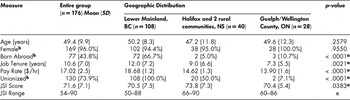
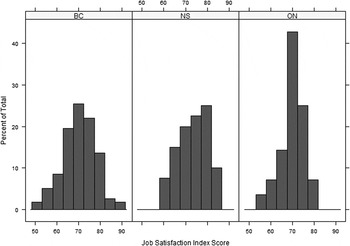
The majority of HSWs in the study were female (n = 169, 96.0%), unionized employees (n = 130, 73.9%), born in Canada (n = 99, 56.2%) (see Table 1). They were between 22 and 70 years of age (mean = 49.42, SD = 9.88) and had been employed in the home care sector from three months to 29 years (mean = 10.55 years, SD = 7.04) at the time of the interviews. JSI scores ranged from 50 to 90, with a mean score of 71.62 (SD = 7.06). Figure 1 is a set of histograms showing the JSI score distribution of HSWs in each of the three provincial jurisdictions.
Demographic and workplace characteristics

a Statistically significant
b Number (proportion)
BC = British Columbia
JSI = Job Satisfaction Index
NS = Nova Scotia
ON = Ontario
SD = standard deviation
Distribution of job satisfaction index scores by province (BC: British Columbia, NS: Nova Scotia, ON: Ontario)

In selecting samples of workers in our main study site in British Columbia, and for the two pilot studies in Ontario and Nova Scotia, we were aware that the overall system of care differed in each of these jurisdictions. For example, in different areas of the regional health authority from which we recruited BC respondents, home support services are provided either solely by health authority providers, by contracted home support service providers, or by a mix of both. In our one Ontario site, publicly funded home care services are coordinated by Community Care Access Centres. There is some evidence that implementation of managed competition in Ontario in 1997 has increased turnover in home care agencies (Aronson & Neysmith, 2006; Denton et al., Reference Denton, Zeytinoglu, Davies and Hunter2006). In Nova Scotia, home care is a publicly funded service delivered through district health authorities via contracted agencies. Not only do different jurisdictions have varying policies and practices (for example, in allocations of time on care plans for specific tasks such as bathing), they can also vary from one area to another within health authorities in the same province (The Office of the Ombudsperson, 2012). The different work environments in the three jurisdictions have associated variations in roles, responsibilities, and scheduling methods that reflect local practices.
Furthermore, the demographics (e.g., age, duration of employment in industry, whether or not born abroad) of the workforce are expected to differ across the jurisdictions. Table 1 reports the data on key demographic and workplace factors, along with the three groups’ respective JSI score means, and standard deviations.
Table 1 also illustrates differences in wages and worker characteristics in the three samples. HSWs within British Columbia were more likely to have been born abroad and to be unionized workers; they had worked in the industry longer, and were paid a higher hourly rate than their Nova Scotia or Ontario counterparts. Despite these differences, JSI score distribution did not vary significantly across the three groups. Of the three jurisdictions studied, HSWs from Nova Scotia (mean = 73.78, SD = 7.25) were marginally more satisfied than those interviewed in British Columbia (mean = 71.52, SD = 7.06) or Ontario (mean = 70.36, SD = 5.43). Other studies that have used the JSI score within the sector have reported mean standard scores of 63.8 (SD = 9.4) for 231 females across varying occupations, 71.5 (SD = 7.6) for public health nutritionists, and 69.4 (SD = 6.9) for a sample of 116 home support workers in Ontario (Brayfield & Rothe, Reference Brayfield and Rothe1951; Martin-Matthews & Wakefield, Reference Martin Matthews and Wakefield1992). Thus, with mean standard scores considerably higher than neutral (set at 54) for all three jurisdictions, the majority of HSWs in our sample reported being satisfied to very satisfied.
Qualitative Results
There are evident descriptive differences across the three groups and key operational distinctions in the roles of HSWs. Thus, the qualitative results have been analysed together except where indicated otherwise to identify intra- and inter-jurisdiction similarities and differences. Given the extent of the differences, it is anticipated that drivers of satisfaction will vary considerably across regions.
As noted in the methods section, the authors examined variations in response to the question “Overall, how satisfied are you with your job? Very satisfied, satisfied, neutral, dissatisfied, very dissatisfied?” Importantly, all participants responded that they were satisfied or very satisfied, as corroborated by the relatively high mean JSI score (mean = 71.62, SD = 7.1). Across all jurisdictions, workers’ relationships with their elderly clients were the primary source of job satisfaction. HSWs highly valued the opportunity afforded by their jobs to improve someone else’s well-being. In fact, one HSW made the explicit distinction between working with the client and with her office administration. “I’m very satisfied with the work. I really see the job and the work as two separate things. The work is with the client and I’m extremely satisfied. The job, with the office administration, is … neutral.” (HSW in NS for 14 years, age 42, JSI = 82). Notably, HSWs with lower JSI scores were more likely to identify as “satisfied” or to qualify their answer with a statement such as, “I’m between satisfied and very satisfied because there are parts of it that I don’t like too much” (HSW in BC for 17 years, age 45, JSI = 66) than were those with higher JSI scores. This correlation supports the validity of the results of the JSI measurement.
As follow-up to the initial question about their level of self-assessed satisfaction, HSWs were asked, “Overall what do you like most about your job?” and “What do you not like about your job?” Their responses described conditions that contributed to their job satisfaction and dissatisfaction. Below, we frame our presentation of these responses in themes consistent with existing literature (i.e., job factors, economic factors, and organizational factors). For each component within these three themes, we illustrate the complexity and nuance in the workers’ verbatim accounts.
Job Factors
Job factors include work hours and schedules (and their implications for work-life balance), travel times and distances between clients, safety of the work, and (dis)continuity in client assignment. Both the number and the distribution of work hours throughout the day were prime sources of dissatisfaction among HSWs in all jurisdictions. Schedules were described as unpredictable and prone to change. HSWs spoke of the problems that “graveyard shifts”, erratic scheduling, and excessive gaps in the workday caused in their personal lives and expressed strong preference for better scheduling to minimize unpaid gaps and excessive driving between clients. “I would be off at one thirty and I’d have to be around for another one-hour job you know … two, two and a half, three hours [later]” (HSW in BC for 20 years, age 61, JSI = 70). “I just don’t like the 10-hour window. You know, I’d rather work eight hours straight without a break… It gets tiring all week, because you’re putting in like, what, 50 hours a week but being paid for 40.” (HSW in BC for 22 years, age 54, JSI = 54). Another HSW described “driving all around the city” to complete six client visits in one day (HSW in BC for 17 years, age 45, JSI = 66).
Client cancellations and the requirement to be on-call exacerbated the perception of “erratic” scheduling. These issues were uniformly described by HSWs as disruptive and frustrating. “I have my set hours and I just tell them I can’t work …” (HSW in NS for 3 years, age 25, JSI = 61). “Because you’ve put down your availability as from seven a.m. till eight p.m. they can call in … but my way of looking at it is I get my schedule on Friday so if that client is not on that schedule, I can make plans. And if something arises, then I can say, ‘No, ’cause I have something else at nine-thirty. I can do them eleven till twelve thirty.’” (HSW in ON for 1.25 years, age 24, JSI = 71). Thus, some HSWs have been able to mitigate the effects of scheduling disruptions on their home life by negotiating their availability outside the week’s scheduled appointments; others maintained strict hours of operation outside of which they are not on-call. But, in general, the combination of erratic work schedules and low levels of financial compensation fuel feelings of resentment: “never knowing if they’re going to cancel, never knowing if the phone is going to ring at 7:30 in the morning. That really bugs me. Especially for $10.42 [an] hour … I think, ‘Why am I doing this?’” (HSW in BC for 3 months, age 58, JSI = 50).
Notably, HSWs in our BC study were the only ones to link their difficulties with scheduling to the casual nature of their employment. Casual employment was described as part-time work, working only on weekends, or within a restricted weekday schedule (i.e., only evenings), with frequent schedule changes. This finding is difficult to interpret. It may be that such positions were either atypical in the other groups (Nova Scotia or Ontario), or that casual employment affiliations in these jurisdictions did not dramatically affect HSWs’ day-to-day scheduling.
Scheduling problems were not limited to how they affected HSWs’ time. They were also perceived as jeopardizing the aspect of their labour that HSWs valued above all else: their relationships with their clients. One HSW who also had a job in a residential long-term care facility illustrated the connection between scheduling methods and familiarity with clients in the two direct care work settings: “My job in the seniors’ home is more satisfying because you get to know the people. [With home support work], I’m everywhere. Well, some places I’ve been to more than once, but a lot of them I haven’t” (HSW in BC for 3 months, age 58, JSI = 50). This highlights an additional job factor identified in our qualitative data regarding the lack of continuity of clients. The issue of the “revolving door of home care” (e.g., Ellis, Reference Ellis2014) is often heard from clients’ perspectives. However, this lack of continuity also challenges HSWs. It prevents them from coming to know the people to whom they provide assistance and requires them to repeatedly negotiate unfamiliar clients in new home environments.
Another source of job dissatisfaction related to scheduling is the volume of travel, particularly in the winter and via public transit (HSW in BC for 17 years, age 61, JSI = 66), described by one HSW as “ping-pong[ing] everywhere” (HSW in BC for 6 years, age 35, JSI = 59). Travel was identified as a motivator for turnover by another: “I think when I reach my 60s I’m not going to want to drive that much and taking the bus is just horrible” (HSW in BC for 17 years, age 45, JSI = 66). Aside from being a nuisance, travelling to clients’ homes was described as a threat to safety. HSWs in Ontario and Nova Scotia noted concerns around winter driving. HSWs in urban areas in all three provinces expressed concern about the time of day they work and the neighbourhoods they visit. “My main concern about safety is traveling and late evenings. Just because people have gotten so crazy over the years with the violence and stabbings, shootings” (HSW in NS for 8 years, age 42, JSI = 78).
Despite admitting that they “prefer working alone” (HSW in BC for 18 years, age 56, JSI = 76), many HSWs recognized the challenges of working independently from other staff in individuals’ homes and the potential threats to safety this imposes.
“If a Hoyer lift is a two-person job and if hospitals and all facilities force it to be a two-person, why does the province send out one HSW into a home? All of a sudden they work in the community and they are disposable? Their backs don’t count?” (HSW in ON for 10 years, age 63, JSI = 62)
“Even with the lift, you have to do a lot of rolling back and forth to get ready for the lift” (HSW in ON for 16 years, age 70, JSI = 72). “And we stress the fact that we’re not allowed to lift by ourselves … We’re trying to work as a group … but we’re all over the place. We really can’t send two girls … that’s twice you have to pay” (HSW in NS for 2 years, age 24, JSI = 76).
Lastly, the safety of the homes in which they worked also contributed to job dissatisfaction. One HSW described the cleaning products in a client’s home as unsafe, but she had to use them anyway: “I have no choice. Whatever they have I have to use because I cannot tell them this is not good for me to use” (HSW in BC for 6 years, age 38, JSI = 61). Others spoke of concerns with pets, and client smoking just prior to or during their visit.
Overall, then, the core element associated with lower levels of job satisfaction among HSWs collectively across the three study locations was scheduling of hours of work. Perceptions of the erratic and unpredictable nature of the work are fundamental to scheduling. This issue cross-cuts concerns about travel time and safety and detracts from the most rewarding aspect of home support work – the relationship with clients. Work schedules reflective of the “revolving door of home care”, providing little or no opportunity to become familiar with clients and their needs, are among the least-liked aspects of employment in this sector. They intersect with assessments of the adequacy of remuneration, our next topic.
Economic Factors
Economic factors related to job satisfaction include both wages and perceived income security. Overall, HSWs described their rates of pay as “satisfying”. This is an intriguing finding for two reasons. For one, it belies the significant variation in levels of pay across the three study sites but not within. Table 1 illustrates the significant wage differences across study sites and the narrow standard deviation within each jurisdiction. Nevertheless, irrespective of geography (and wages), HSWs expressed concern about achieving a livable income from week to week. The commonality of economic concerns was evident despite higher wages among HSWs in British Columbia (mean = $18.68/hr, SD = $1.15/hr), in comparison with the workers in one region of Ontario (mean = $13.90/hr, SD = $1.59/hr) and those in two rural communities, and Halifax, Nova Scotia (mean = $14.62/hr, SD = $1.33/hr).
This issue was characterized in relative terms with the acknowledgement that “the only time I really stress about my job is when I have a loss of hours” (HSW in BC for 15 years, age 44, JSI = 59). The uncertainty of hours of work per week resonated across jurisdictions as another HSW observed, “there’s no guarantee of hours” (HSW in NS for 20 years, age 54, JSI = 70) when asked about how the home care industry could be improved. Another participant said, “the cutting back of hours … I could just say that’s ‘abuse’” (HSW in BC for 11 years, age 47, JSI = 67). This was particularly challenging for casual employees who in some cases worked for multiple agencies in an effort to accrue more hours. For example, one casual employee recalled,
…[working] for several companies because I was casual … you know, to be able to get my hours. I managed to leave some, so now I have only two companies … [and] I tell myself, “okay, if I make 30 hours this week, that’s good enough for me.” (HSW in BC for 3 years, age 55, JSI = 66)
For others, working for multiple agencies was not seen as the solution. One participant, although not planning on leaving her HSW job, conceded, “I need to supplement the income” (HSW in BC for 17 years, age 45, JSI = 66).
HSWs tied this income instability to potential worker turnover. When asked to identify the main issue affecting HSWs at the moment, wages were emphasized:
Pay. And the reason I say pay is because the personal support workers in home care are paid a lot less than the personal support workers in a nursing home. And that is an issue. Because a lot of people will start in home care, get the training there and then move on to a nursing home ’cause they have the skills then. And in the nursing home they are paid higher and they have benefits. (HSW in ON for 4 years, age 50, JSI = 73)
Even HSWs reporting as very satisfied, on the basis of results from the JSI, identified income as a primary concern. “I would say some of my long-term colleagues would not be as satisfied as I am. Like, a lot of them are single people, you know, with one income and stuff. I’m doing this part time as a supplement” (HSW in NS for 3 years, age 50, JSI = 74). The discussions around pay go beyond ensuring an income; as an HSW from Ontario succinctly put it: “if I was dependent on it [income] for a living, certainly from my own agency and the clients, I feel valued but in terms of the pay scale, I don’t” (HSW in ON for 11 years, age 52, JSI = 65).
Economic factors were pervasive as threats to job satisfaction even among the most satisfied workers, and fundamental to dissatisfaction among others. A complex issue, economic factors were more problematic for those who were the sole household wage earner or for whom this job was the sole source of income.
Organizational Factors
Organizational factors include an array of issues at the heart of relationships within home care agencies, such as the ways in which supervision, autonomy, support, feedback, and role clarity influence job satisfaction. Issues of communication and what Dill, Keefe, and McGrath (Reference Dill, Keefe and McGrath2012) characterized as “positive work relationships” are salient here. HSWs who were less satisfied than their peers brought up concerns with communication within their organization. A common sentiment shared by the least satisfied HSWs in the study was the lack of clarity in their job descriptions and feedback for performance. As one HSW summarized, there was a “lack of information, training and understanding from management and supervisors” (HSW in BC for 18 years, age 59, JSI = 58). Another admitted, “I have no clue what they think of me. Not at all. I don’t know if they think I’m doing a fine job” (HSW in BC for 3 months, age 58, JSI = 50).
HSWs also described their management teams as being nonchalant about conflicts in workers’ commitments and clients’ needs. For example, one HSW recounted an episode in which she telephoned her employer to report that she would be late getting to a client; her supervisor’s response was, “‘No big deal. Just make it up in the end’” (HSW in BC 18 years, age 59, JSI = 58). This was deemed problematic for two reasons: First, the casual tone of the response suggested a lack of agency respect for the client’s schedule, and second, the supervisor failed to realize the trickle-down effect of scheduling visits so close together. Workers recognize the implications, with this HSW thinking, “there’s four, five more [clients] after them.”
Other HSWs noted the limited support received from their agency in ensuring a safe working environment, when the agency “just dump[s] you out there and hope[s] you can make the best of it” (HSW in ON for 10 years, age 63, JSI = 62). “Making the best of it” in this case involved working in a home where the client smoked, risking workers’ health and well-being.
A common theme among HSWs was dissatisfaction with the way supervisors (and agency employers as a whole) made them feel. “If the supervisor is no good, you don’t want to work for them” (HSW in BC for 2 years, age 51, JSI = 74). Meanwhile, an Ontario HSW said she was dissatisfied with how she was treated:
… that’s with any of the companies, with the pay and what you make, I feel very dissatisfied. I feel like shit as far as that goes, you know, and that’s not a good way to feel about yourself when you’re working so hard to try and make a difference. … we’re so disposable, you know, like “Okay, well, she’ll quit. We’ll hire another girl tomorrow”. (HSW in ON for 5 years, age 54, JSI = 71)
When asked to clarify why she felt dissatisfied, she noted how the companies “reprimand you as a child, you know. If you do bring something to their attention … they ignore it, they don’t pay attention to what you’re saying”. Other HSWs made similar comments about finding it problematic when concerns were not taken seriously, noting that: “You cannot do something … You have to always listen to your client or your office” (HSW in BC for 6 years, age 38, JSI = 62).
Alternatively, the most satisfied HSWs had favourable recollections of incidents in which they received prompt agency support when an emergency occurred on the job. The perceived responsiveness of their supervisors in such situations was strongly associated with high levels of job satisfaction. HSWs with positive opinions of their supervisors were less likely to subsequently voice safety concerns that persisted after being brought to the agency’s attention by the worker. Many of these HSWs spoke of how quickly the issue was resolved, and of feeling supported by their supervisor; in these cases, they felt comfortable in continuing to alert supervisors to problematic issues in the future. Support to “not have to put up with that abuse” and “leave now” when threatened in the home went a long way to ensure HSW safety and confidence in their supervisors and agencies (HSW in BC for 18 years, age 58, JSI = 55). The quick and effective resolution of such issues was, of course, handled best when client safety was not jeopardized.
Organizational factors were highly relevant to job satisfaction among HSWs in two distinct ways. The most satisfied workers were more likely to have experienced circumstances of being supported by supervisors and to feel they had benefitted from clarity of respective roles and responsibilities within the agency. Workers with lower levels of satisfaction, in contrast, pointed to instances of lack of support from management, and of being forced to negotiate challenging circumstances within clients’ homes on their own.
Discussion
Among this group of home support workers with generally extensive experience of employment in this sector, one might expect several dichotomies to prevail in our analyses: job satisfaction versus dissatisfaction, jurisdictional differences versus similarities. Instead, as noted earlier, complexity and nuance characterize many of the findings. Frequently, job satisfaction and dissatisfaction are flip sides of the same coin. On some issues, there is substantial variability among HSWs employed in different parts of the country; for others, more commonalities than differences characterize our sample of workers. The patterns vary in relation to job, economic, and organizational factors – and are considered now in that light.
Our findings identify the variability, across different jurisdictions within Canada, in rates of pay, in proportion of HSWs who were unionized, in the composition of workforce by immigration status, and length of job tenure. However (and somewhat unexpectedly), irrespective of the unique jurisdictional contexts in which HSWs worked, and the demographic differences between these groups of workers, more commonalities than differences characterized workers’ perceptions of sources of job satisfaction and dissatisfaction.
We compared job characteristics and economic and organizational factors among workers in each of the three distinct jurisdictions. Overall, job factors dominated discussion in the interviews. The evidence suggests that issues of scheduling lie at the heart of home care practice. Their importance to worker job (dis)satisfaction is paramount. Our findings emphasize how casual employees are particularly disadvantaged by current scheduling methods.
HSWs in each jurisdiction emphasized the desirability of work within a schedule that minimized travel between clients, left few gaps in the workday, and effectively minimized disruptions to HSWs personal schedules as a result of last-minute client cancellations or added requests. To date, no effective methods have been applied across jurisdictions to address all these concerns, despite their acknowledged importance (e.g., The Office of the Ombudsperson, 2012). Loss of work hours and erratic or unpredictable scheduling of work were perceived as problematic by all three groups of HSWs. However, reflecting the complexity and nuance that characterized our findings, some HSWs were able to control the extent to which scheduling disruptions impacted their home life by negotiating their availability outside the week’s scheduled appointments or maintaining strict hours of operation outside of which they were not on-call. However, the opportunity to effect control over the work schedule is not possible for all workers, and particularly for those casual employees whose scheduling predictability is tenuous at best – owing to their lack of seniority and existing employment arrangements.
Evidence of the centrality of scheduling practices to worker job satisfaction corroborates other research findings. It also lies squarely at the heart of one of the most challenging aspects of the multi-faceted home care experience. Schedulers not only assign HSWs to clients by matching a client’s needs with the competency of the worker, they also accommodate clients’ schedules and align clients with supervisors. Our research with policymakers in British Columbia revealed that a typical scheduler can be required to process an average of 3,500 (and as many as 7,000) visits in one month. Although admittedly an exceptional circumstance, we found evidence of one eight-hour day in which an agency received 67 referrals or changes to home support plans. The logistics implied here are daunting. Typically, workers are scheduled by seniority for an hour(s) or portion of an hour according to the needs of the client and the terms of the provision of labour agreements. This hour is usually in fact only 50 minutes in length to allow for travel time between clients. However, recent initiatives such as cluster and neighbourhood care increase the likelihood of clients being “co-located” throughout the day or the week (Martin-Matthews et al., Reference Martin-Matthews, Sims-Gould and Tong2012). Such strategies have many benefits, with ease of scheduling workers to clients being a key benefit. Although provinces are exploring strategies to manage scheduling issues (Report of the Expert Group on Home & Community Care, 2015), for HSWs, this fundamental contributor to job dissatisfaction is unlikely to change any time soon.
Work safety was another job factor identified in our study as an important contributor to job dissatisfaction. Threats to safety did vary by jurisdiction (e.g., weather-related driving problems for workers in Ontario and Nova Scotia; neighbourhood safety for workers in Nova Scotia). As other research by our team emphasizes, safety in home care is salient in both the presence and absence of workers. By their very nature, client homes constitute both unique places in which to live and in which to work, and can pose myriad safety concerns. As the home care sector expands, the need arises for a comprehensive understanding of safety from the perspective of all three parties (workers, clients, and family) in the same context (Tong, Sims-Gould, & Martin-Matthews, Reference Tong, Sims-Gould and Martin-Matthews2016).
Although we have presented safety concerns here as one type of job factor related to worker dissatisfaction, our data in fact emphasize complexity and nuance here. Job, economic, and organizational factors frequently intersected in the verbatim accounts of these HSWs. Thus, those who felt that their concerns were acknowledged and quickly addressed by a supervisor were less likely to indicate unmet safety concerns. Agency responsiveness addressed safety concerns and contributed to HSWs’ feelings of support and respect. This is consistent with the finding of Dill et al. (Reference Dill, Keefe and McGrath2012) that positive work relationships were among the strongest factors predictive of considerations of changing employers (Craven, Byrne, Sims-Gould, & Martin-Matthews, Reference Craven, Byrne, Sims-Gould and Martin-Matthews2012).
Our data indicate that wages varied considerably across jurisdictions. We also found that HSWs at all pay grades were concerned about income security. In-depth interview transcripts suggest that this may have as much to do with economic climates within each jurisdiction and strategies to manage precarious scheduling as it does with job factors per se. Our study participants expressed the desire for incomes that aligned with the costs of living in their respective communities. Although pay differed across the provinces, this variation did not explain job satisfaction discrepancies across the groups studied. Interestingly, low wages were not consistently noted as a source of job dissatisfaction. For example, despite being paid significantly less than workers in British Columbia, HSWs in Nova Scotia reported higher job satisfaction. This may have to do with job prospects as well as provision of a livable wage. Our analyses suggest that HSWs in Nova Scotia and the peri-urban region of Ontario lack alternative employment opportunities compared with their British Columbia counterparts, which implies greater appreciation of having a job, despite its challenges. Alternatively (or additionally), their rate of pay may better align with the costs of living in their respective communities. However, HSWs did compare rates of pay within their local area, noting differences between their wage and that of long-term care employees. Union membership alters this pattern, as some unions secure wage parity between their home support and long-term care employees, minimizing the influence that economic factors have on satisfaction and turnover intentions.
Across professions, job satisfaction is strongly correlated with the relationships employees have with their managing teams, supervisors, and organizations (Ayalon, Reference Ayalon2010; Castle et al., Reference Castle, Engberg, Anderson and Men2007; Dill et al., Reference Dill, Keefe and McGrath2012; Moyle et al., Reference Moyle, Skinner, Rowe and Gork2003). Research in other long-term care-related professions has identified a series of organizational factors that foster employee satisfaction (Hannan, Norman, & Redfern, Reference Hannan, Norman and Redfern2001; Karsh et al., Reference Karsh, Booske and Sainfort2005). Our qualitative analysis confirms that patterns of communication, and demonstrated respect and support for HSWs, improve HSW workplace satisfaction. The HSWs in our study took great pride in their relationships with clients and in their ability to help others. Interactions with other co-workers and agency staff were also important, as has also been noted by Ejaz et al. (Reference Ejaz, Noelker, Menne and Bagaka’s2008). Our findings emphasize the ways in which worker satisfaction can be greatly enhanced by agency attention to the “soft skills” of communication and interaction. These organizational features of home care work can ameliorate both tenuous relationships between workers and agencies, and also a perceived lack of respect and recognition of their needs and challenges in delivering the best care possible.
Although many studies of job satisfaction place more emphasis on the challenges that workers face than on the rewards of their labour, it is important to emphasize that, overall, the HSWs in our study were satisfied with their work. And, despite differences on other economic and job factors, this overall finding was true in all three study sites. Frequently, HSWs voiced their satisfaction and emphasized its relevance to job retention: “I’m very satisfied. I hope to be here until at least I’m 60 or 65. I have no plans of leaving tomorrow” (HSW in NS for 13 years, age 53, JSI = 74). Although a significant amount of literature focuses on understanding what causes poor job satisfaction, our findings also emphasize those aspects of job, economic, and organizational work factors that enhance job satisfaction (Sims-Gould et al., Reference Sims-Gould, Byrne, Craven, Martin-Matthews and Keefe2010). Our findings are consistent with those of Stacey (Reference Stacey2005) in emphasizing that expressions of dissatisfaction among HSWs reflect perceptions of “constraints that compromise their ability to do a good job or to experience their work as meaningful” rather than as threats to leave this employment sector.
As noted above, the HSWs whom we interviewed made the link between job satisfaction and intent to remain employed in this sector. Ultimately, however, this study cannot confirm whether or not satisfaction was tied to workplace prospects, in that it was outside the design of this study to follow participants over time. We do identify areas of further research in order to understand what drives HSW satisfaction. Additionally, we demonstrate that many of these issues are not unique to a specific geographic region but rather that many transcend jurisdictional boundaries. Prospective observational research that collects JSI scores for participants at regular intervals and then assesses retention duration would represent a gold standard for research on this topic.
Strengths and Limitations of the Study
Where other studies have looked at home care workers using an expanded definition to include other professionals, have been very context specific, or have lacked systematic analysis of HSWs’ experiences specifically, our study captured the perspectives of HSWs across a diverse set of contexts (e.g., client demographics, geography, and service delivery models) and did not dilute or overpower their perspectives with more senior home care staff. This enabled us to make very specific workplace recommendations for improvements in job satisfaction and retention.
The HSWs interviewed in this study were not random samples representative of HSWs employed in British Columbia, Nova Scotia, and Ontario. Additionally, the three jurisdictions were selected in part owing to convenience and familiarity with those regions by members of the research team. Canadian provinces have well-established differences in both demographic profiles of HSWs and workplace policies that were not directly measured in this study (e.g., training and employment strategies such as distribution of hours and home care services provided) (Seggewiss, Reference Seggewiss2009). Thus, the concerns expressed by the HSWs studied are not generalizable to home care workers across Canada. Nevertheless, HSWs were more similar than dissimilar in factors of satisfaction as seen in Table 1 and “provide[d] critical insights for policy planning” (Schoenberg, Shenk, & Kart, Reference Schoenberg, Shenk and Kart2007, p. 9).
Conclusions and Policy and Practice Implications
Our study indicates that the core elements of job satisfaction intrinsic to the HSW role, and valued by the workers themselves, remain constant in different parts of the country. What vary as a function of the geographical location of workers are the more extrinsic sources of satisfaction. Much of the variability stems from differences in the regulations of health authorities and agencies as well as the skills and expertise of supervisors and schedulers.
Recent provincial reports highlight the need to improve the availability of home care services so that older adults can continue to live at home as long as possible (e.g., Health Association Nova Scotia, 2014; The Office of the BC Ombudsperson, 2012; Report of the Expert Group on Home & Community Care, 2015). Our exclusive focus on HSWs has enabled us to identify multiple aspects of factors that detract from job satisfaction, and gain a better understanding of points of intersection between job, economic, and organizational factors. Our findings emphasize the need for well-thought-out scheduling, income security, preservation of HSW safety, and ongoing communication and support efforts with agency staff. Thus, despite our study limitations, our data, corroborated by findings elsewhere, enable us to advance several recommendations as to how to improve HSW safety.
First, our findings suggest a priority to improve scheduling such that it optimizes HSWs’ travel and work hours. Next, although the pay rate is considered fair in some sectors, our research indicates that ensuring the consistency of working hours through better scheduling, particularly for part-time and casual employees, will significantly improve satisfaction. Every effort to approach, and eventually match, rates of pay for HSWs with those of equivalent long-term care positions is clearly imperative to HSW satisfaction. Lack of wage parity is a strong disincentive for HSWs to continue working in home care, at the very time that unmet client needs, and a dramatically increasing population of older clients, call for more recruitment and enhanced retention. Furthermore, strong relationships with agencies will ensure HSWs’ concerns are addressed in a timely fashion nurturing an environment of respect and well-being for employees.