More than 80% of advanced cancer patients are treated for infection during terminal hospitalization.Reference Thompson, Silveira, Vitale and Malani1 Among these infections, urinary tract infections (UTIs) predominate; reports suggest that 39%–42% involve potential UTI among advanced cancer patients receiving hospice care.Reference White, Kuhlenschmidt, Vancura and Navari2, Reference Reinbolt, Shenk, White and Navari3 Nevertheless, diagnosing UTI in this population is challenging. Specifically, the identification of asymptomatic bacteriuria is complicated by immunosuppression and nonspecific clinical features. This is important because advanced cancer patients with potential UTI often receive antimicrobial therapy, Reference White, Kuhlenschmidt, Vancura and Navari2, Reference Reinbolt, Shenk, White and Navari3 including inappropriate therapy for asymptomatic bacteriuria.
The implications of inappropriate antimicrobial therapy for asymptomatic bacteriuria are unique in advanced cancer patients and extend beyond antimicrobial overuse. Antimicrobial therapy in those receiving palliative care should be concordant with goals of care by promoting comfort and quality of life.Reference Datta and Juthani-Mehta4 However, antimicrobial therapy for asymptomatic bacteriuria conflicts with palliative goals of care if it provides no symptom relief and promotes adverse effects. Moreover, administering antimicrobials may cause pain and introduce additional infection risk.
Evidence suggests antimicrobial stewardship interventions may reduce urine culture ordering and inappropriate antimicrobial therapy for asymptomatic bacteriuria in catheterized patients.Reference Trautner, Grigoryan and Petersen5 Less is known regarding the impact of stewardship interventions in noncatheterized advanced cancer patients. We sought to evaluate the association between asymptomatic bacteriuria or candiduria and antimicrobial use in advanced cancer patients transitioning to comfort measures to inform stewardship interventions.
Methods
We conducted a cohort study of patients aged ≥65 years with advanced cancer who were transitioned to comfort measures during admission to Yale-New Haven Hospital, a 1,541-bed tertiary-care center in New Haven, Connecticut, between July 1, 2014, and November 31, 2016. Advanced cancer was defined as stage 3–4 solid tumors; stage 3–4 lymphomas; or acute, refractory, relapsed, or active liquid tumors requiring chemotherapy or targeted therapies. All advanced cancers were identified by International Classification of Diseases, Tenth Revision codes and were confirmed on medical record review. We subsequently identified the subset of patients with potential UTI, defined as the collection of ≥1 urine culture during admission. The Yale Human Investigation Committee approved this study.
For all advanced cancer patients with potential UTI, we collected demographics, hospitalization information, urine catheter placement dates, urine culture results, and clinical features. Urine cultures were categorized as (1) no growth; (2) bacteriuria or candiduria 10,000 to <100,000 colony forming units per milliliter (CFU/mL); or (3) bacteriuria or candiduria ≥100,000 CFU/mL. Cultures with growth of ≤2 organisms were analyzed. Cultures with no growth, mixed flora (≥3 organisms), or growth <10,000 CFU/mL were defined as no growth. UTI-associated clinical features included fever (>38°C), suprapubic tenderness, costovertebral angle pain or tenderness, urgency, frequency, or dysuria. Additional clinical features evaluated alternate criteria for UTI and included leukocytosis (>14,000 leukocytes/mm3), worsening mental status, urinary incontinence, and gross hematuria.Reference Nace, Drinka and Crnich6 Asymptomatic bacteriuria or candiduria was defined as urine culture growth without any UTI-associated clinical features independent of additional clinical features.
We determined whether patients met 2017 National Healthcare Safety Network (NHSN) symptomatic UTI criteria, defined as urine culture growth of ≤2 organisms including 1 bacterium with ≥100,000 CFU/mL plus ≥1 UTI-associated clinical feature within a 7-day infection window encompassing the 3 calendar days before and after urine culture collection.7 Among patients without NHSN-defined symptomatic UTI, we determined whether UTI-specific antimicrobial therapy was administered and the duration of therapy in antimicrobial days. UTI-specific antimicrobial therapy was defined as antimicrobials prescribed for potential UTI according to physician documentation and continued for ≥1 calendar day after speciation data were reported.
Characteristics were provided as proportions with the specified attribute. Among patients without NHSN-defined symptomatic UTI, we determined the proportion that received UTI-specific antimicrobial therapy. To evaluate factors associated with UTI-specific antimicrobial therapy among patients without NHSN-defined symptomatic UTI, we used a modified Poisson regression model with antimicrobial administration as a binary outcome and length-of-stay as an offset variable. Potential risk factors included gender, cancer type, urine culture growth (no growth; 10,000 to <100,000 CFU/mL; or ≥100,000 CFU/mL), and UTI-associated clinical features. Given the high death rate, we accounted for time at risk and used robust variance estimators to estimate the adjusted incidence rate ratio (IRR) for each factor. All analyses were performed using SAS version 9.4 software (SAS Institute, Cary, NC).
Results
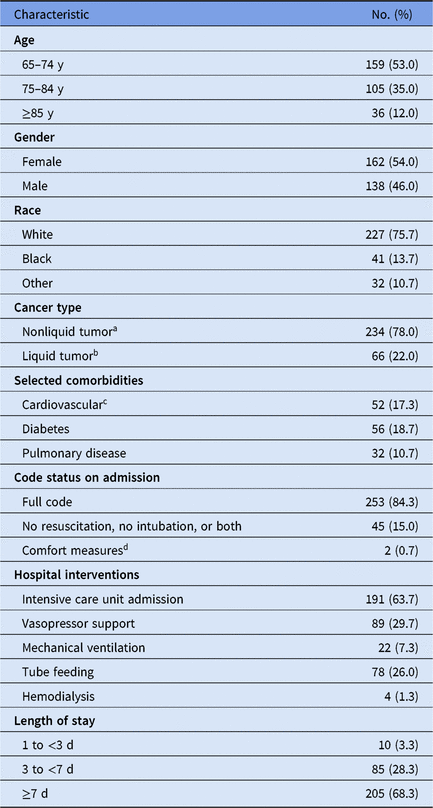
We identified 300 advanced cancer patients with potential UTI who were transitioned to comfort measures. Median age was 74 years (range, 65–99), 162 (54.0%) were female, and 66 (22.0%) had liquid tumors (Table 1). Median length-of-stay was 9 days (range, 2–138), and 173 patients (57.7%) patients died during hospitalization.
Characteristics of Hospitalized Advanced Cancer Patients With Potential Urinary Tract Infection Who Were Transitioned to Comfort Measures at a Tertiary-Care Medical Center (n = 300)

a Includes lung tumor, gastrointestinal tumor and other solid tumor including genitourinary cancer, breast cancer, female reproductive cancer, melanoma, head and neck cancer, connective tissue cancer, central nervous system cancer, thyroid, and unknown primary.
b Includes lymphoma, myeloid malignancy, plasma cell malignancy, and lymphoid malignancy.
c Includes myocardial infarction, congestive heart failure, and peripheral vascular disease.
d These 2 patients changed to a non–comfort-measures code status during admission and subsequently transitioned to comfort measures prior to discharge.
Overall, 536 urine cultures were collected, and 76.9% (n = 412) had no growth. Among the remaining 124 cultures, the most common organisms were Escherichia coli (n = 25), Candida albicans (n=21), and Klebsiella pneumoniae (n = 14).
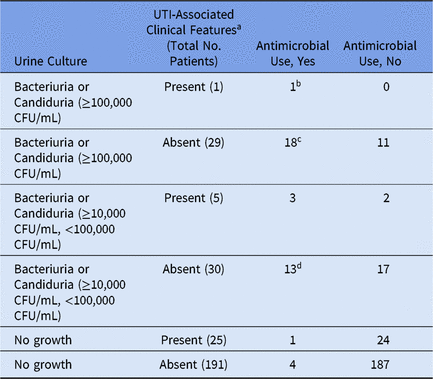
Among 300 patients with potential UTI, 19 had NHSN-defined symptomatic UTI. Among the 281 patients without NHSN-defined symptomatic UTI, 21% (n = 59) had asymptomatic bacteriuria or candiduria, and 14.2% (n = 40) received inappropriate UTI-specific antimicrobial therapy for 279 antimicrobial days. Of these 40 patients, 35 had bacteriuria or candiduria, and 35 lacked UTI-associated clinical features (Table 2). The most commonly prescribed antimicrobials included ciprofloxacin (n = 12), fluconazole (n = 8), and piperacillin/tazobactam (n = 4).
Antimicrobial Use According to Urine Culture Results and Clinical Features in Hospitalized Advanced Cancer Patients Transitioned to Comfort Measures With Potential Urinary Tract Infection (UTI) who Lack National Healthcare Safety Network-Defined Symptomatic UTI

a UTI-associated clinical features were defined as fever (>38°C), suprapubic tenderness, costovertebral angle pain or tenderness, urinary urgency, urinary frequency, or dysuria.
b This patient had candiduria alone and therefore did not meet National Healthcare Safety Network criteria for symptomatic urinary tract infection.
c Additional clinical features were present in 13 total patients, including 10 with leukocytosis (>14,000 leukocytes/mm3) and 7 with worsening mental status.
d Additional clinical features were present in 6 total patients, including 3 with leukocytosis (>14,000 leukocytes/mm3), 4 with worsening mental status, and 1 with urinary incontinence.
In a multivariable model, administration of UTI-specific antimicrobial therapy was associated with bacteriuria or candiduria. For 10,000 to <100,000 CFU/mL, the IRR was 16.9 (95% confidence interval [CI], 6.0–47.2); for ≥100,000 CFU/mL, the IRR was 27.9 (95% CI, 10.9–71.2). However, UTI-specific antimicrobial therapy was not associated with gender (IRR, 1.0; 95% CI, 0.6–1.8), cancer type (IRR, 0.7; 95% CI, 0.4–1.4), or UTI-associated clinical features (IRR, 1.3; 95% CI, 0.7–2.7).
Discussion
We show that most advanced cancer patients with potential UTI lack evidence of NHSN-defined symptomatic UTI. Moreover, 21% of patients without NHSN-defined symptomatic UTI had asymptomatic bacteriuria or candiduria. Patients without NHSN-defined symptomatic UTI were nevertheless treated for UTI, often with broad-spectrum antimicrobials associated with adverse effects,Reference Deshpande, Pasupuleti and Thota8 for 279 antimicrobial days after urine culture speciation data were reported. Such inappropriate antimicrobial therapy was independently associated with bacteriuria or candiduria rather than UTI-associated clinical features. Collectively, this study highlights a potential target of antimicrobial stewardship, namely, restricting urine culture orders in advanced cancer patients transitioning to comfort measures.
Our work confirms published findingsReference Silver, Baillie and Simor9 and supports guidelines recommending urine culture evaluation only in the presence of UTI-associated clinical features.Reference Nicolle, Bradley, Colgan, Rice, Schaeffer and Hooton10 Few studies have examined inappropriate urine cultures in end-of-life advanced cancer patients, a population in whom unnecessary antimicrobials may cause harm and conflict with comfort-oriented goals of care. We show that advanced cancer patients with bacteriuria or candiduria were 17–28 times more likely to receive UTI-specific antimicrobial therapy per patient day when compared to those without bacteriuria or candiduria. Our data further suggest that nonspecific additional clinical features such as leukocytosis may drive antimicrobial administration in those without UTI-associated clinical features. Future studies should evaluate the impact of urine culture order restrictions in end-of-life advanced cancer patients.
This study has limitations. First, the sample size precluded evaluation of other factors predisposing to antimicrobial therapy such as family preferences. However, the strength of the observed adjusted association suggests bacteriuria and candiduria will remain associated with UTI-specific antimicrobial therapy. Second, NHSN definitions may lack sensitivity for symptomatic UTI in older adults.Reference Nace, Drinka and Crnich6 However, of the 19 patients with additional clinical features in the setting of bacteriuria or candiduria and absent UTI-associated clinical features, none met revised McGeer criteria for UTI.Reference Nace, Drinka and Crnich6 Finally, our results may lack generalizability to other institutions.
In summary, many advanced cancer patients with potential UTI have asymptomatic bacteriuria or candiduria for which inappropriate antimicrobial therapy was administered for extended periods. Bacteriuria or candiduria was associated with UTI-specific antimicrobial therapy, suggesting that stewardship interventions should consider restricting urine cultures in this population.
Author ORCIDs
Rupak Datta, 0000-0003-2281-7508
Acknowledgments
We thank the Joint Data Analytics Team at Yale School of Medicine for their support of this study.
Financial support
This work was supported by at the Yale School of Medicine, Section of Infectious Diseases (grant no. 2T32AI007517–16) and by the Claude D. Pepper Older Americans Independence Center from the National Institute on Aging, National Institutes of Health (grant no. P30 AG021342). This work was additionally supported by the Yoshikawa-High Award for Excellence in Research from the Infectious Diseases Society of America Infections in Older Adults Interest Group.
Conflicts of interest
All authors report no conflicts of interest relevant to this work.