Introduction
Genetic studies of schizophrenia (SZ) have typically focused on case-control designs, comparing samples with a diagnosis of schizophrenia to those without. The recent surge of large genome-wide association studies (GWAS) using this case-control design has led to a dramatic improvement of our understanding of the genetic architecture (Henriksen, Nordgaard, & Jansson, Reference Henriksen, Nordgaard and Jansson2017; Hyman, Reference Hyman2018; Sullivan & Geschwind, Reference Sullivan and Geschwind2019). The identification of SZ-associated single nucleotide polymorphisms (SNP) has also allowed researchers to calculate polygenic risk scores (PRS), a quantification of SNP-based genetic risk for SZ. So far, however, linking these PRS to putative biomarkers of SZ has proven difficult (Mistry, Harrison, Smith, Escott-Price, & Zammit, Reference Mistry, Harrison, Smith, Escott-Price and Zammit2017). In contrast to case-control designs, dimensional models of psychopathology are based on state or trait markers present not only in patients but also in the general population. Hence, they can serve as risk phenotypes to study neurobiological continuum models across both non-clinical and clinical populations.
Schizotypy is a trait that can be assessed psychometrically and is considered to reflect psychosis proneness and SZ liability (Grant, Green, & Mason, Reference Grant, Green and Mason2018). Given the ease of applying reliable and well-validated schizotypy questionnaires in large population studies, schizotypy lends itself as a candidate risk phenotype for the psychosis/SZ spectrum (Barrantes-Vidal, Grant, & Kwapil, Reference Barrantes-Vidal, Grant and Kwapil2015). Schizotypy does not imply a psychiatric diagnosis; in fact, schizotypy is neither identical nor conceptually congruent with schizotypal personality disorder, which is a clinical condition often used to study the SZ spectrum (Siever & Davis, Reference Siever and Davis2004). Rather, schizotypy is conceptualized as a trait distributed throughout the general population and associated with proneness to psychosis (Flückiger et al., Reference Flückiger, Michel, Grant, Ruhrmann, Vogeley, Hubl and Schultze-Lutter2019; Nelson, Seal, Pantelis, & Phillips, Reference Nelson, Seal, Pantelis and Phillips2013). As such, schizotypy is a complex phenotype encompassing multiple domains relevant to the SZ spectrum, including positive, negative, and disorganized domains of variation in cognition, emotion, and behaviour (Ettinger et al., Reference Ettinger, Mohr, Gooding, Cohen, Rapp, Haenschel and Park2015; Fonseca-Pedrero et al., Reference Fonseca-Pedrero, Ortuno, Debbane, Chan, Cicero, Zhang and Fried2018; Oezgen & Grant, Reference Oezgen and Grant2018) as well as subclinical features such as delayed motor development (Filatova et al., Reference Filatova, Koivumaa-Honkanen, Khandaker, Lowry, Nordstrom, Hurtig and Miettunen2018). Schizotypal features are more frequent in first-degree relatives of SZ patients (Soler et al., Reference Soler, Arias, Moya, Ibanez, Ortet, Fananas and Fatjo-Vilas2019) and prodromal states (Racioppi et al., Reference Racioppi, Sheinbaum, Gross, Ballespi, Kwapil and Barrantes-Vidal2018).
Several lines of evidence suggest that schizotypy is associated with variation in biological markers of the SZ spectrum, including cognitive, brain imaging, and genetic parameters (Ettinger et al., Reference Ettinger, Mohr, Gooding, Cohen, Rapp, Haenschel and Park2015; Walter, Fernandez, Snelling, & Barkus, Reference Walter, Fernandez, Snelling and Barkus2016). Non-clinical subjects high in schizotypy (i.e. without a psychiatric diagnosis) show lower performance in attention, working memory, and executive functions in general (Lui et al., Reference Lui, Hung, Wang, Ho, Yeung, Wang and Chan2018; Matheson & Langdon, Reference Matheson and Langdon2008; Siddi, Petretto, & Preti, Reference Siddi, Petretto and Preti2017; Steffens, Meyhofer, Fassbender, Ettinger, & Kambeitz, Reference Steffens, Meyhofer, Fassbender, Ettinger and Kambeitz2018). Higher schizotypy in psychiatrically healthy cohorts has been associated with structural variation in brain areas identified to show grey matter loss in SZ, such as prefrontal cortices (Ettinger et al., Reference Ettinger, Williams, Meisenzahl, Moller, Kumari and Koutsouleris2012) and precuneus (Modinos et al., Reference Modinos, Mechelli, Ormel, Groenewold, Aleman and McGuire2010; Nenadic et al., Reference Nenadic, Lorenz, Langbein, Dietzek, Smesny, Schonfeld and Gaser2015). Functional imaging has demonstrated similar effects, with high-schizotypy subjects showing changes in fronto-striatal systems intermediate between low-schizotypy and clinical SZ (Taurisano et al., Reference Taurisano, Romano, Mancini, Giorgio, Antonucci, Fazio and Bertolino2014) paralleled by recent resting-state fMRI studies (Waltmann et al., Reference Waltmann, O'Daly, Egerton, McMullen, Kumari, Barker and Modinos2019; Wang, Ettinger, Meindl, & Chan, Reference Wang, Ettinger, Meindl and Chan2018), anti-saccade fMRI (Aichert, Williams, Moller, Kumari, & Ettinger, Reference Aichert, Williams, Moller, Kumari and Ettinger2012), as well as studies on the dopamine system (Rössler et al., Reference Rössler, Unterassner, Wyss, Haker, Brugger, Rössler and Wotruba2018; Woodward et al., Reference Woodward, Cowan, Park, Ansari, Baldwin, Li and Zald2011).
The molecular genetics of schizotypy are, however, poorly understood (Grant, Reference Grant2015; Walter et al., Reference Walter, Fernandez, Snelling and Barkus2016). There are several studies linking single SZ risk genes to psychometric schizotypy (Meller et al., Reference Meller, Schmitt, Stein, Brosch, Mosebach, Yuksel and Nenadic2019), providing some evidence that schizotypy shares part of its genetic architecture with SZ. At the same time, several of these risk markers have been linked to other psychiatric disorders, which parallels the overlap of genetic risk for SZ with risk for other psychiatric conditions, especially bipolar disorder (Smeland et al., Reference Smeland, Bahrami, Frei, Shadrin, O'Connell, Savage and Andreassen2020).
Only a few studies have used genome-wide approaches to study the genetic overlap of schizotypy and SZ (Fanous et al., Reference Fanous, Neale, Gardner, Webb, Straub, O'Neill and Kendler2007). A genome-wide association study of 4269 nonpsychotic subjects from the Northern Finland Birth Cohort of 1966 found an association of a schizotypy-related measure (Chapman scale) with SZ risk genes (incl. CACNA1C) (Ortega-Alonso et al., Reference Ortega-Alonso, Ekelund, Sarin, Miettunen, Veijola, Jarvelin and Hennah2017). In a study of male army recruits, SZ-PRS was negatively associated with positive and disorganized schizotypy, but only under stressful conditions (Hatzimanolis et al., Reference Hatzimanolis, Avramopoulos, Arking, Moes, Bhatnagar, Lencz and Stefanis2018). This is paralleled by studies of related risk phenotypes, such as psychotic-like experiences (PLEs), showing an inverse relationship with SZ-PRS in healthy adults and also partially in adolescents (Pain et al., Reference Pain, Dudbridge, Cardno, Freeman, Lu, Lundstrom and Ronald2018; Sieradzka et al., Reference Sieradzka, Power, Freeman, Cardno, McGuire, Plomin and Ronald2014). More recently, a study based on UK Biobank data demonstrated an association of psychotic experiences with polygenic risk not only for SZ, but also for bipolar disorder and major depression (Legge et al., Reference Legge, Jones, Kendall, Pardinas, Menzies, Bracher-Smith and Walters2019); the phenotype studied primarily addressed positive symptoms (visual hallucinations, auditory hallucinations, delusions of reference, and delusions of persecution) and related distress. Taken together, despite some initial evidence, it is still unclear whether and to what extent schizotypal traits overlap genetically with risk for SZ (at whole-genome level), and more specifically with PRS linking endophenotypes or subclinical phenotypes to SZ risk (Mistry et al., Reference Mistry, Harrison, Smith, Escott-Price and Zammit2017).
In the present study, we tested the hypothesised association of SNP-related polygenic risk for SZ with schizotypal traits in non-clinical subjects of the multi-centre FOR2107 cohort and a replication sample of blood donors. We tested the association with overall schizotypy, following up with post-hoc analyses for its three dimensions. Also, we controlled for relative specificity by testing associations with polygenic risk for affective disorders (bipolar disorder and major depressive disorder).
Methods
Subjects
For the test sample, we analysed data from healthy subjects recruited into the multi-centre cohort study FOR2107 as part of the Marburg and Münster affective cohort study (MACS) (Kircher et al., Reference Kircher, Wohr, Nenadic, Schwarting, Schratt, Alferink and Dannlowski2019). All subjects gave written informed consent to a study protocol approved by the ethics committees of the Philipps-University Marburg and Westfälische-Wilhelms-Universität Münster.
The MACS samples consisted of healthy subjects (without life-time psychiatric disorder), all of whom had undergone the Structured Clinical Interview for DSM-IV Axis I Disorders (SCID-I) (Wittchen, Wunderlich, Gruschwitz, & Zaudig, Reference Wittchen, Wunderlich, Gruschwitz and Zaudig1997) to confirm the absence of a psychiatric axis I diagnosis. Additional exclusion criteria were history of traumatic brain injury, current or previous neurological disease of the central nervous system, uncontrolled general medical diseases, current or previous substance abuse or dependence, as well as current psychotropic medication. Subjects were recruited from the local communities in Marburg and Münster, respectively.
This MACS sample of N = 623 included 392 (62.9%) female and 231 (37.1%) male participants; mean age was 32.62 years (s.d. = 12.47), ranging from 18 to 65 years. There was no indication of differences in sex-distribution across sites (Marburg: 151 male, 253 female; Münster: 80 male, 139 female; one-tailed chi-square-test, p = 0.835). As participants recruited in Münster were significantly (F (1,622) = 44.535, p = 5.54 × 10⁻¹¹) younger (M = 28.24, s.d. = 10.35) than Marburg participants (M = 34.99, s.d. = 12.89), we included age as a covariate in all analyses. For each participant, we administered clinical interviews and schizotypy assessments and obtained blood samples for genetic analysis within a week.
The Mannheim replication sample consisted of a control cohort of N = 1133 subjects [mean age = 44.63, s.d. = 12.85, range 18–70 years; 617 female (54.5%), 516 male (45.5%)] recruited at blood donation events in the state of Baden-Württemberg, Germany. Written informed consent was obtained from all subjects, and the study was approved by the ethics committee of the Medical Faculty Mannheim, University of Heidelberg. This cohort was a general population sample for which the exclusion criteria related to blood donation were applied: bodyweight <50 kg, concurrent general medical conditions, and an elevated risk for infection. This cohort did not undergo a full psychiatric assessment using the SCID-I. Subjects were handed a questionnaire assessing demographic information and information about their mental and somatic health at the blood donation event which they then mailed back to the study centre.
Phenotyping/assessment of schizotypal traits
We administered the SPQ-B (Schizotypal Personality Questionnaire, brief version) to assess schizotypy through self-report. The SPQ-B is the short form of the well-validated SPQ questionnaire first introduced by Raine (Reference Raine1991). It has been validated in its German translation in previous studies (Barron et al., Reference Barron, Voracek, Tran, Ong, Morgan, Towell and Swami2018; Fonseca-Pedrero et al., Reference Fonseca-Pedrero, Ortuno-Sierra, Lucas-Molina, Debbane, Chan, Cicero and Voracek2017; Klein, Andresen, & Jahn, Reference Klein, Andresen and Jahn1997). In addition to providing an overall assessment of schizotypal traits, the SPQ-B also allows analysis of three major dimensions: a Cognitive-Perceptual factor (measuring positive schizotypy), a Disorganized factor (measuring mainly eccentricity), and an Interpersonal factor (tapping into negative schizotypy and neuroticism). These dimensions reflect the three-factor structure seen in many other schizotypy questionnaires (Asai, Sugimori, Bando, & Tanno, Reference Asai, Sugimori, Bando and Tanno2011; Gross, Mellin, Silvia, Barrantes-Vidal, & Kwapil, Reference Gross, Mellin, Silvia, Barrantes-Vidal and Kwapil2014; Oezgen & Grant, Reference Oezgen and Grant2018).
Given that psychometric assessments of schizotypy tend to show overlap with facets of neuroticism (e.g. Gross et al. Reference Gross, Mellin, Silvia, Barrantes-Vidal and Kwapil2014; Macare, Bates, Heath, Martin, & Ettinger, Reference Macare, Bates, Heath, Martin and Ettinger2012) and that this appears to be of particular relevance to the SPQ (Gross et al., Reference Gross, Mellin, Silvia, Barrantes-Vidal and Kwapil2014), we also calculated adjusted schizotypy scores for four dimensions revealed in previous analyses (Oezgen & Grant, Reference Oezgen and Grant2018), adapted for the brief version of the SPQ: Adjusted Positive, Adjusted Negative, Adjusted Cognitive and Adjusted Eccentricity. These adjusted factors were derived from exploratory factor analyses of three major schizotypy measures and aim to reduce variance between schizotypy measures (due to subtle conceptual differences) by re-assigning items to higher-order factors thought to mirror the common ground between inventories. The adjustment is suggested to lessen the influence of neuroticism on variance shared between items of the SPQ in favour of a stronger ‘schizotypy-signal’ derived from variance shared between items taken from different measures of schizotypy. These adjusted values were used in an additional analysis (mirroring those with the original ‘unadjusted’ values) to confirm that associations were not driven by conceptual contaminants and enable generalisation across instruments (Oezgen & Grant, Reference Oezgen and Grant2018).
Genotyping and polygenic risk score (PRS) calculation
Details on genotyping and PRS calculation have been described before (Opel et al., Reference Opel, Amare, Redlich, Repple, Kaehler, Grotegerd and Dannlowski2018; Witt et al., Reference Witt, Streit, Jungkunz, Frank, Awasthi, Reinbold and Rietschel2017) and details are given in the methods supplement. PRS for schizophrenia (SZ-PRS), bipolar disorder (BD-PRS), and major depression (MDD-PRS) were calculated by summing up minor allele dosages of linkage disequilibrium (LD)-independent SNPs in the test sample, weighted by GWAS effect sizes (Schizophrenia Working Group of the Psychiatric Genomics, 2014; Stahl et al., Reference Stahl, Breen, Forstner, McQuillin, Ripke, Trubetskoy and Sklar2019; Wray et al., Reference Wray, Ripke, Mattheisen, Trzaskowski, Byrne and Abdellaoui2018). Weighted PRS thus represent an estimation of cumulative, additive risk. PRS were calculated at p value thresholds showing the best discrimination of case-control status in the original GWAS (SZ: p = 0.05, BD: p = 0.01, MDD: p = 0.05).
Statistical analysis
Statistical analysis was performed using SPSS (version 24, IBM, Armonk, NY) and R/Rstudio (R Core Team, 2018; RStudio Team, 2015). Distributions of sex and differences in age and SPQ scores were assessed using chi-square tests and univariate and multivariate analyses of variance (ANOVA), respectively. As expected, schizotypy scores showed substantial skewness that remained after common transformation attempts. Schizotypy scale variables were z-transformed to ensure comparability between test and replication samples.
To test our main hypothesis, we performed a multiple regression analysis between SZ-PRS and the SPQ-B total score with age, sex, and ancestry components (C1–C3 in MACS sample, C1–C4 and C7 in Mannheim sample) as covariates. We then tested separate multiple regression models post-hoc with each of the three SPQ-B dimensions and the four adjusted schizotypy scores as the outcome variables. To account for the remaining skewness in the variables, robust standard errors were calculated using bootstrapping (N = 1000) and bootstrapped p values reported.
To aggregate results across samples, combined p values were calculated with the Stouffer meta-analysis method (Stouffer, Suchman, DeVinney, Star, & Williams, Reference Stouffer, Suchman, DeVinney, Star and Williams1949) using the R package gmeta (https://cran.r-project.org/web/packages/gmeta/index.html).
Finally, given the genetic overlap between SZ and affective disorders, we examined potential associations with affective disorders using the BD-PRS and MDD-PRS as independent variables in further multiple regression models.
Since SPQ-B scales (as well as adjusted factors) display significant intercorrelations, p value thresholds were adjusted to account for multiple comparisons according to the Bonferroni-Holm method for the eight schizotypy scores (i.e. SPQ-B total score, SPQ-B Cognitive-Perceptual, SPQ-B Interpersonal, SP-B Disorganised, Adjusted Positive, Adjusted Negative, Adjusted Cognitive, Adjusted Eccentricity) tested for each of the PRS (Eichstaedt, Kovatch, & Maroof, Reference Eichstaedt, Kovatch and Maroof2013).
Exploratory factor analysis (EFA)
To consider sample-specific factor structures that might influence regression results, we also applied a modified approach based on exploratory factor analysis (EFA) of our own data. After conducting an EFA including all SPQ-B items within the MACS and Mannheim samples separately (specifying fixed extraction of three factors and allowing Oblimin rotation; see online supplementary table ST4), we then computed regression models, entering PRS and the aforementioned covariates to predict the respective factor scores (EFA factor 1–3) within each sample. Creating sample-specific factors, this analysis considers variation in factor loadings while being less directly comparable to the standard factor solutions used in the literature (Fonseca-Pedrero et al., Reference Fonseca-Pedrero, Ortuno, Debbane, Chan, Cicero, Zhang and Fried2018).
Power analysis for correlations
Based on the literature reported, we expected small local effect sizes of PRS prediction of schizotypy scores (Cohen's 0.02 ⩽ f 2 < 0.15). To determine the effect size we were able to detect with our data, we conducted an a posteriori power analysis, using the sensitivity test in GPower [v3.1.9.4, (Faul, Erdfelder, Lang, & Buchner, Reference Faul, Erdfelder, Lang and Buchner2007)] for multiple regression models. With a sample size of N = 623 (MACS)/N = 1133 (Mannheim), an alpha level of 0.05, and a power of 0.80, a linear multiple regression model with one tested predictor and five (seven) covariates, this results in 616 (1124) degrees of freedom and enough power to detect a local effect size of Cohen's f 2 ⩾ 0.013 (MACS) and f 2 ⩾ 0.007 (Mannheim), respectively.
Results
Distribution of schizotypal traits
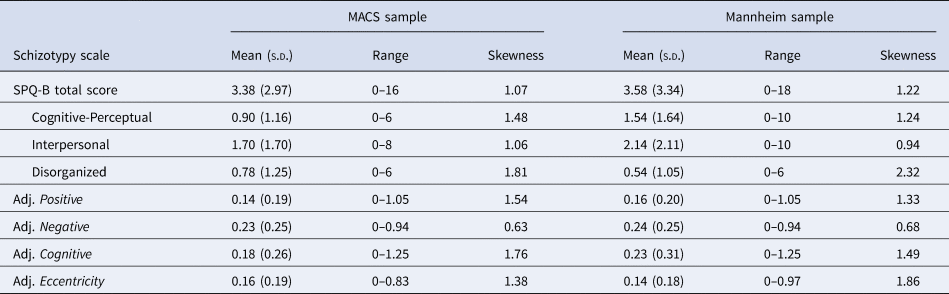
Descriptive statistics for the original scales and adjusted schizotypy scores are shown in Table 1. Both age (F (1,622) = 4.95, padj = .026, partial Eta2 (η 2) = .008) and sex (F (1,622) = 6.61, padj = .020, η 2 = .010) were significantly associated with total schizotypy. Therefore, both variables were included in subsequent correlation analyses.
Distribution of schizotypy scores

s.d., standard deviation.
Association of SZ-PRS and schizotypal traits
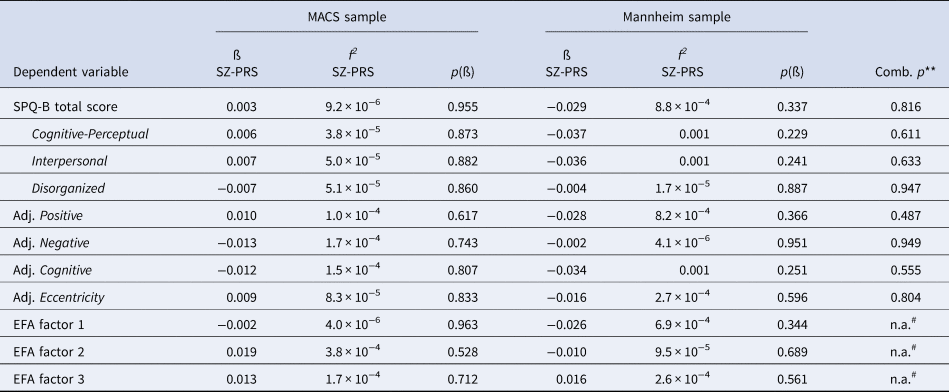
Neither the SPQ-B total score nor the subscores Cognitive-Perceptual, Interpersonal, or Disorganized showed significant associations with SZ-PRS in either sample (Table 2). This observation was confirmed by meta-analysing the p values of each sample. Likewise, analyses of the adjusted factors showed no significant correlation with SZ-PRS.
Model statistics of regression models with SZ-PRS as predictor
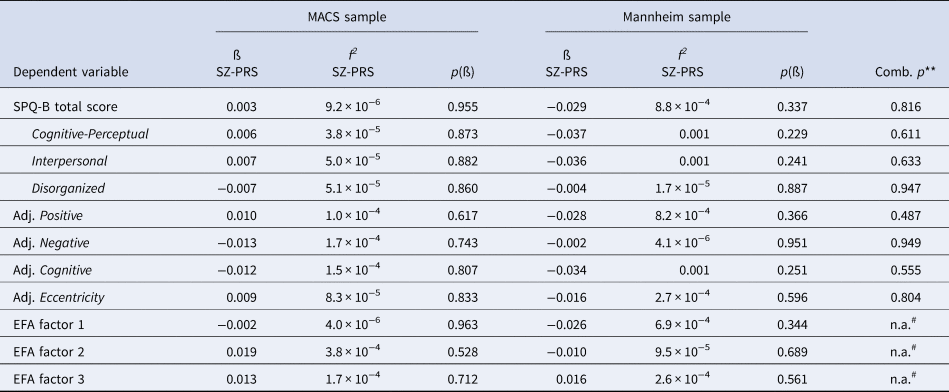
Note: Age, sex, and ancestry components C1–C3 (MACS)/C1–C4, C7 (Mannheim) were included as covariates in all models. All p- and ß- values after z-transformation of PRS values and schizotypy scores and bootstrapping with N = 1000. **p values were combined with the Stouffer meta-analysis method. All combined p values are above the threshold for statistical significance (pT = 0.00455–0.05) after correcting for multiple comparisons according to Bonferroni-Holm. #As factor scores were derived from analyses within each sample and therefore differ p values could not be combined.
Association of BD-PRS and schizotypal traits
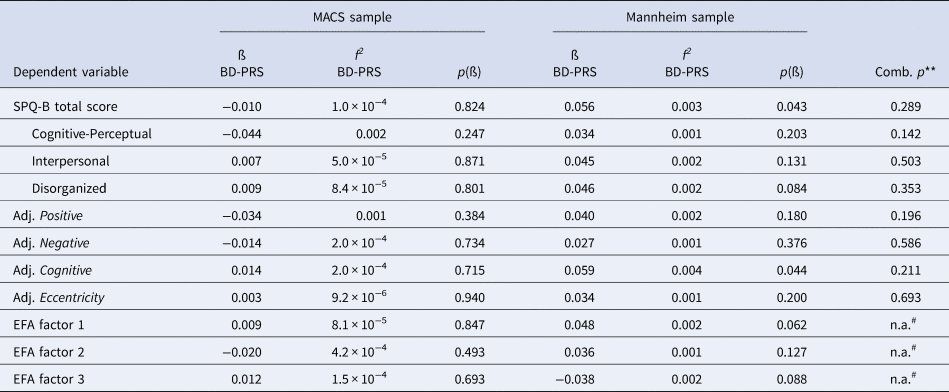
In follow-up analyses testing the association of the PRS for bipolar disorder (BD) with schizotypy, we did not find a significant correlation between BD-PRS and any of the SPQ dimensions in either sample separately or combined (Table 3).
Model statistics of regression models with BD-PRS as predictor
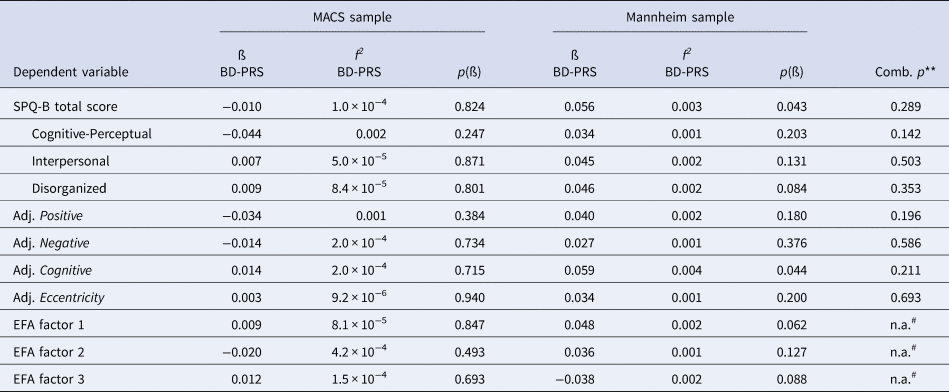
Note: Age, sex, and ancestry components C1–C3 (MACS)/C1–C4, C7 (Mannheim) were included as covariates in all models. All p- and ß- values after z-transformation of PRS values and schizotypy scores and bootstrapping with N = 1000. **p values were combined with the Stouffer meta-analysis method. All combined p values are above the threshold for statistical significance (pT = 0.00455–0.05) after correcting for multiple comparisons according to Bonferroni-Holm. #As factor scores were derived from analyses within each sample and therefore differ p values could not be combined.
Association of MDD-PRS and schizotypal traits
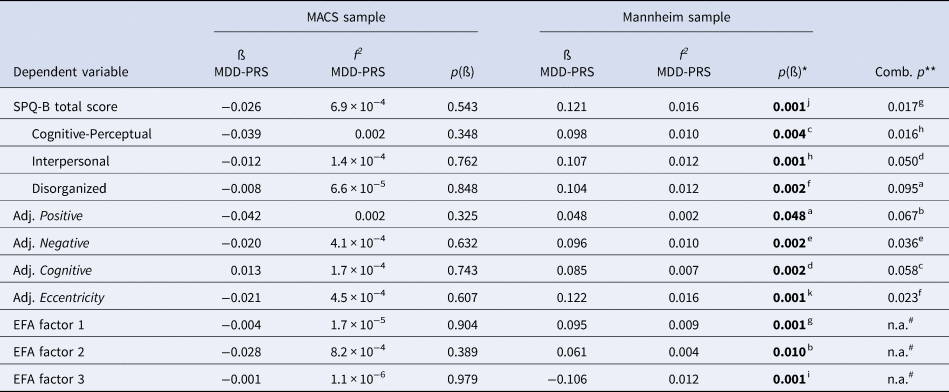
While there was no association of schizotypy with PRS for major depressive disorder (MDD) in the MACS sample, we did observe positive associations in the Mannheim sample, resulting in significant combined probabilities for the total, cognitive-perceptual, and interpersonal subscores (see Table 4).
Model statistics of regression models with MDD-PRS as predictor
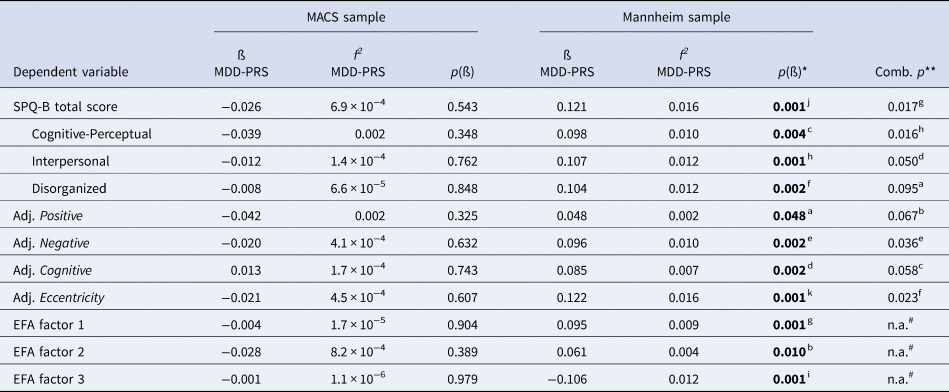
The significant p values in bold.Note: Age, sex, and ancestry components C1–C3 (MACS)/C1–C4, C7 (Mannheim) were included as covariates in all models. All p- and ß- values after z-transformation of PRS values and schizotypy scores and bootstrapping with N = 1000. *p values in boldface indicate significance after correction for multiple comparisons according to Bonferroni-Holm (pT = k0.00455, j0.0050, i0.0056, h0.00625, g0.00714, f0.00833, e0.0100, d0.0125, c0.0167, b0.025, a0.05). **p values were combined with the Stouffer meta-analysis method. All combined p values are above the threshold for statistical significance after correcting for multiple comparisons according to Bonferroni-Holm. #As factor scores were derived from analyses within each sample and therefore differ, p values could not be combined.
When the analysis was repeated for the Mannheim sample with all scales recalculated as the respective subject mean if at least 80% of the items per subscale had been answered, the results remained unaltered (online Supplementary Tables ST1–ST3).
Association of EFA-derived factor scores and SZ-, BD-, and MDD-PRS
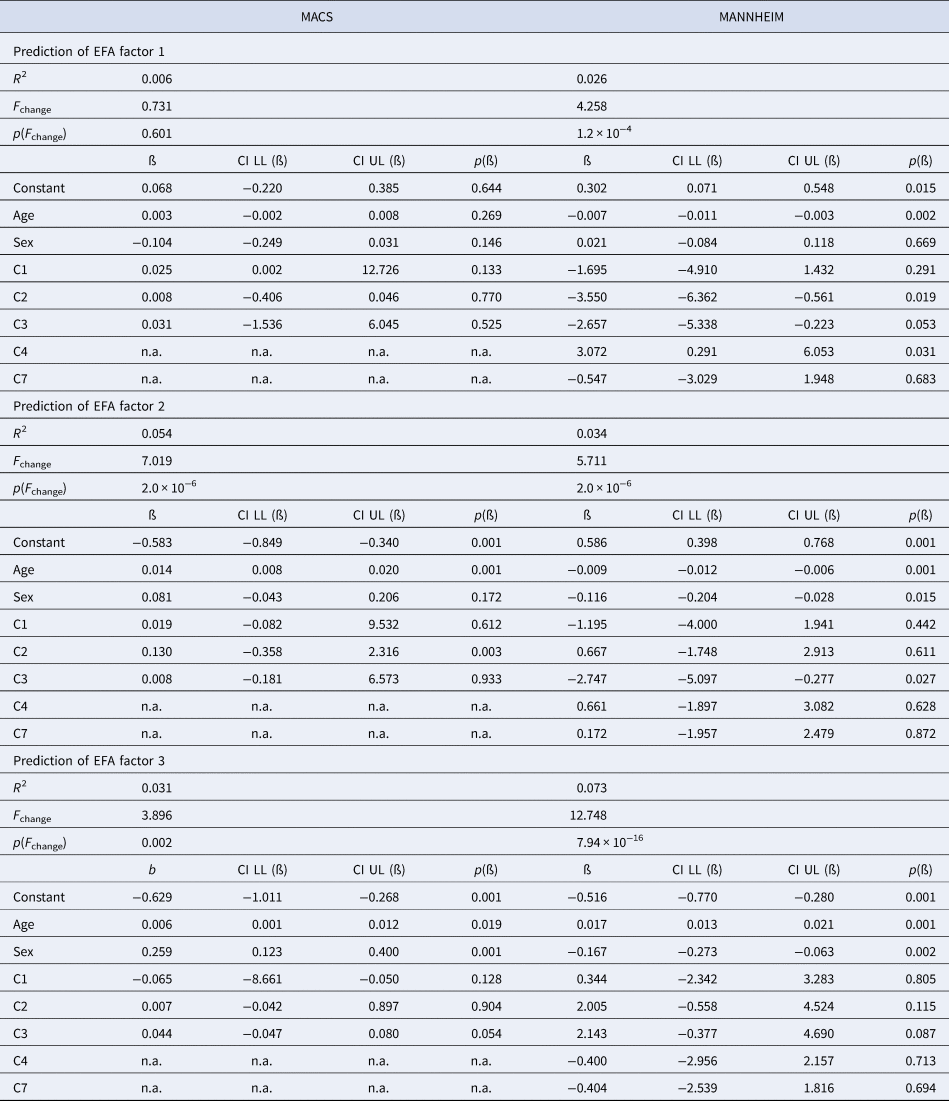
The additional regression models using EFA derived factors scores yielded similar results to the standard scales (see Tables 2–4): Only MDD-PRS showed to be a significant predictor of all three EFA scores, but only in the Mannheim sample. Additional ‘empty’ regression models only including the covariates of no interest (age, sex, ancestry components) as predictors of EFA scores are shown in Table 5.
Model statistics of ‘empty’ regression models
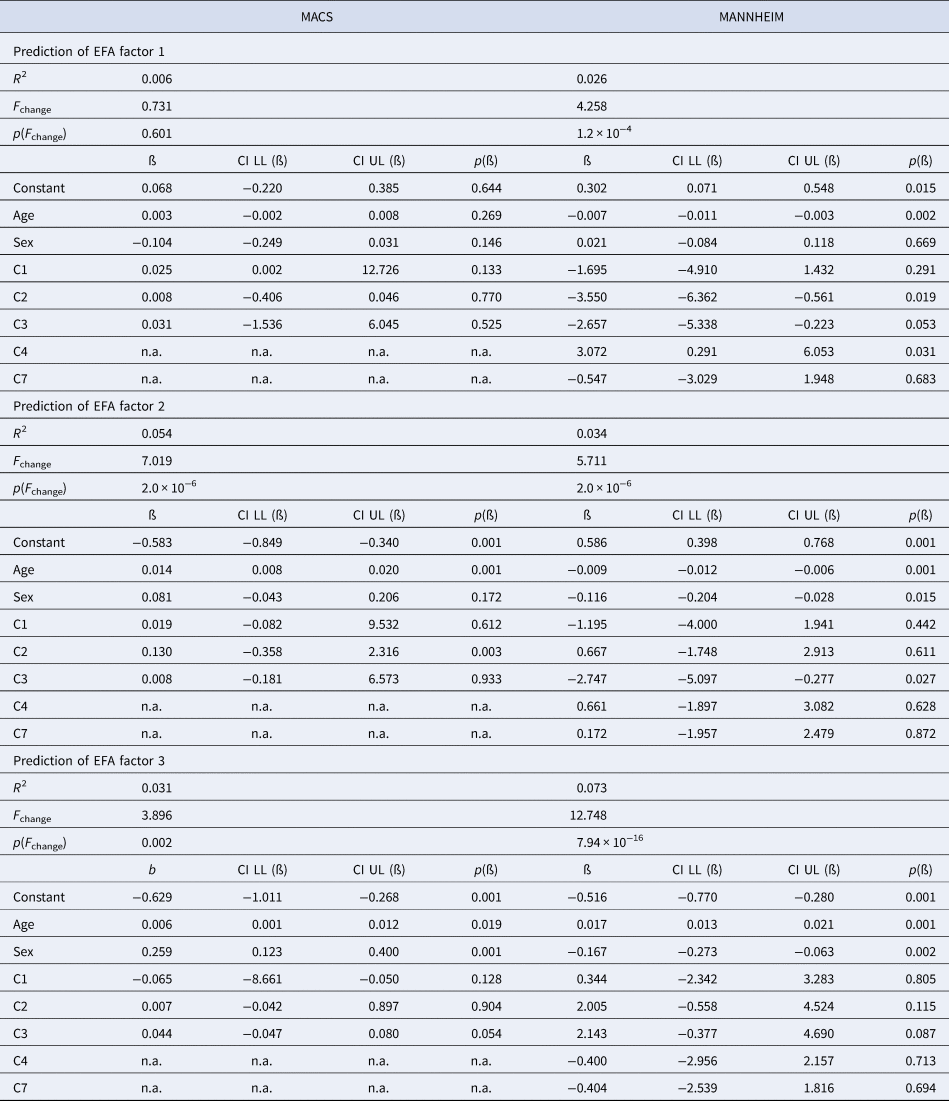
CI LL, lower level of the confidence interval; CI UL, the upper level of the confidence interval.
Note: Ancestry components are MDS C1–C3 (MACS) and PCA C1–C4, C7 (Mannheim).
Discussion
In this study, we provide a large-scale analysis in two independent samples testing the hypothesis that schizotypy is significantly associated with SNP-based polygenic risk for SZ. Neither overall SPQ scores nor subscores/dimensions, adjusted schizotypy factors, or EFA-derived factors were associated with SZ-PRS, BD-PRS, or MDD-PRS in the combined sample after correction for multiple testing. This finding contributes important new aspects to our understanding of the psychosis spectrum at both the phenotype and genotype levels, extending previous findings (Hatzimanolis et al., Reference Hatzimanolis, Avramopoulos, Arking, Moes, Bhatnagar, Lencz and Stefanis2018; Zammit et al., Reference Zammit, Hamshere, Dwyer, Georgiva, Timpson, Moskvina and O'Donovan2014).
In the interpretation of our findings, we will first discuss the use of schizotypy in phenotypic characterization across the psychosis spectrum (contrasting findings in schizotypy v. those in PLEs and considering work in different cohorts). Then we will discuss factors related to the timing of genetic risk impact (i.e. schizotypy and PLEs in adolescence v. adult life) as well as methodological factors and the limitations inherent to our study.
Schizotypal traits are increasingly used as a phenotypic marker of psychosis liability, improving our understanding of the psychosis spectrum (Nelson et al., Reference Nelson, Seal, Pantelis and Phillips2013). They share variance with other measures, such as PLEs and clinical criteria of subjects at ultra-high risk for psychosis (Barrantes-Vidal, Chun, Myin-Germeys, & Kwapil, Reference Barrantes-Vidal, Chun, Myin-Germeys and Kwapil2013; Flückiger et al., Reference Flückiger, Michel, Grant, Ruhrmann, Vogeley, Hubl and Schultze-Lutter2019). In contrast to a growing number of association studies of schizotypy with clinical or cognitive phenotypes or endophenotypes of SZ (Ettinger et al., Reference Ettinger, Mohr, Gooding, Cohen, Rapp, Haenschel and Park2015; Nenadic et al., Reference Nenadic, Lorenz, Langbein, Dietzek, Smesny, Schonfeld and Gaser2015), there are hardly any genetic studies investigating more than one risk gene in relation to schizotypy (for an overview, see Meller et al., Reference Meller, Schmitt, Stein, Brosch, Mosebach, Yuksel and Nenadic2019).
Our findings diverge from association studies using PLEs as subclinical markers. While schizotypy is linked to clinical risk for psychosis (Flückiger et al., Reference Flückiger, Ruhrmann, Debbane, Michel, Hubl, Schimmelmann and Schultze-Lutter2016; Kwapil, Gross, Silvia, & Barrantes-Vidal, Reference Kwapil, Gross, Silvia and Barrantes-Vidal2013), emphasizing its predictive clinical utility in prodromal screening (Schultze-Lutter, Nenadic, & Grant, Reference Schultze-Lutter, Nenadic and Grant2019), it is not fully congruent with PLEs or at-risk states. Most high-schizotypy individuals are not likely to later be diagnosed with psychotic disorders (Chapman, Chapman, Kwapil, Eckblad, & Zinser, Reference Chapman, Chapman, Kwapil, Eckblad and Zinser1994; Gooding, Tallent, & Matts, Reference Gooding, Tallent and Matts2007; Kwapil et al., Reference Kwapil, Gross, Silvia and Barrantes-Vidal2013), suggesting schizotypy encompasses more than just SZ liability. However, we must consider that much of the abovementioned work was carried out in cohorts at risk, including those genetically related to patients with SZ, such as siblings and other people with a higher risk of psychosis (for review, see Walter et al., Reference Walter, Fernandez, Snelling and Barkus2016). In contrast, our MACS sample included only psychiatrically healthy subjects and both the MACS and Mannheim samples do not only have lower schizotypy scores than other samples but also are less likely to have included high-risk individuals. Thus, our negative findings, contrasting results in PLE cohorts such as the UK Biobank cohorts (Legge et al., Reference Legge, Jones, Kendall, Pardinas, Menzies, Bracher-Smith and Walters2019), might be related to the low expression of the phenotype, especially in the MACS cohort with its stringent inclusion criteria.
A recent large study of psychosis proneness using multiple psychometric measures found an association with physical anhedonia and hypomanic features but no other core aspects of schizotypy (Ortega-Alonso et al., Reference Ortega-Alonso, Ekelund, Sarin, Miettunen, Veijola, Jarvelin and Hennah2017); also, the study only found modest heritability across phenotypes. Findings from the ALSPAC study have suggested that SZ-PRS is associated with anxiety and negative symptoms in adolescence but not depressive or psychotic symptoms (Jones et al., Reference Jones, Stergiakouli, Tansey, Hubbard, Heron, Cannon and Zammit2016). Furthermore, a recent study from the UK Biobank using a health questionnaire on frank psychotic experiences in non-clinical subjects found an indication for associations of psychotic experiences not only with SZ-PRS but also with BD-SZ and MDD-PRS, as well as SZ copy number variants (CNV) (Legge et al., Reference Legge, Jones, Kendall, Pardinas, Menzies, Bracher-Smith and Walters2019). Importantly, these phenotypes reflect a more state-related emergence of quasi-psychotic symptoms, which is different from the enduring trait-like quality of core schizotypy features. Our findings could, thus, be reconciled with previous findings by considering the difference between state- v. trait-like features of liability markers. Across the phenotype itself, cognitive disorganization and anhedonia might show higher SNP-heritability than more narrow positive symptom dimensions (Pain et al., Reference Pain, Dudbridge, Cardno, Freeman, Lu, Lundstrom and Ronald2018), which is consistent with some older twin studies examining ‘Meehlian’-based measures of schizotypy (Hay et al., Reference Hay, Martin, Foley, Treloar, Kirk and Heath2001). There is an ongoing debate about which traits actually best predict the emergence of psychotic states in clinical cases, and recent findings tentatively suggest that state-prediction through traits might even differ in clinical and at-risk individuals compared to those without SZ-liability (Grant & Hennig, Reference Grant and Hennig2020). Thus, our findings may result from the fact that our healthy sample may not be optimally suited to reflect the associations between indicators and clinical bearing (i.e. SPQ-values and polygenic risk). Incidentally, analyses of (fully) dimensional schizotypy conceptualizations show similar heritability estimates of positive and negative schizotypy by individual latent genetic factors, which both equally explain variance in disorganized schizotypy (Linney et al., Reference Linney, Murray, Peters, MacDonald, Rijsdijk and Sham2003).
However, studies identifying associations between subclinical psychosis symptoms in population-drawn samples have either failed to show associations with SZ-PRS (Sieradzka et al., Reference Sieradzka, Power, Freeman, Cardno, McGuire, Plomin and Ronald2014; Zammit et al., Reference Zammit, Hamshere, Dwyer, Georgiva, Timpson, Moskvina and O'Donovan2014) or have shown such associations only when pooling patients and controls, but not in non-clinical samples only (Derks, Vorstman, Ripke, Kahn, & Ophoff, Reference Derks, Vorstman, Ripke, Kahn and Ophoff2012). It must be considered, however, that those studies are based on first-wave GWAS data that relied on smaller samples and therefore had significantly less power than recent GWAS. So far, a comprehensive study assessing both state and trait features of the psychosis spectrum is still lacking. Studies of the relationship between SZ-PRS and trait markers other than psychometrically-defined features or symptoms have, indeed, produced inconsistent results: putative endophenotypes like brain structure do not consistently associate with SZ-PRS in psychiatrically healthy subjects (van der Merwe et al., Reference van der Merwe, Passchier, Mufford, Ramesar, Dalvie and Stein2019), while associations of the cognitive function appear to depend on the cohort selected, i.e. healthy cohorts v. patient samples (Mallet, Le Strat, Dubertret, & Gorwood, Reference Mallet, Le Strat, Dubertret and Gorwood2020).
Overall, our findings suggest that neither total schizotypy nor individual dimensions of the construct are substantially related to genetic psychosis risk. In contrast to other studies using the SPQ as a measure for schizotypy, which differs conceptually from ‘true’ schizotypy, we also used the adjustment method suggested by Oezgen and Grant to reduce inter-scale conceptual variance and, potentially, provide a closer approximation of ‘true’ schizotypy from the SPQ-items (Oezgen & Grant, Reference Oezgen and Grant2018). It is unclear whether the above spectrum phenotypes might be related to polygenic risk for other psychiatric disorders like major depression as suggested by a recent systematic review of studies (Ronald & Pain, Reference Ronald and Pain2018), since, unlike our study, many other previous studies did not include PRS scores for other disorders in their analyses. The positive association of schizotypy scales and MDD-PRS in the Mannheim sample suggests further research is needed to understand a potential link to genetic risk for affective disorders. However, this finding should be taken with caution: given the limitations of sample size as well as the negative finding in the MACS cohort, this result might represent a false positive, and replication in further studies would be needed to provide a more definitive interpretation.
The lower heritability of psychosis spectrum features (schizotypal traits v. PLEs) also points to the problem of timing of emerging risk phenotypes and interaction with environmental risk. Association studies have alternately used adolescent and adult samples. For example, the ALSPAC study relied on population-drawn cohorts of adolescents (Jones et al., Reference Jones, Stergiakouli, Tansey, Hubbard, Heron, Cannon and Zammit2016), while other studies analysed adult data (e.g. Ortega-Alonso et al., Reference Ortega-Alonso, Ekelund, Sarin, Miettunen, Veijola, Jarvelin and Hennah2017). Some schizotypal features show only moderate temporal stability in late adolescence, which might make them more prone to variation than other phenotypes, while others are more temporally stable (Ericson, Tuvblad, Raine, Young-Wolff, & Baker, Reference Ericson, Tuvblad, Raine, Young-Wolff and Baker2011; Rosa et al., Reference Rosa, van Os, Fananas, Barrantes, Caparros, Gutierrez and Obiols2000; Venables & Raine, Reference Venables and Raine2015).
Different risk backgrounds of genetic association studies of psychosis proneness also point to environmental risk factors as mediators of genetic risk. Like psychosis, schizotypy as a trait emerges from complex gene–environment interactions (Barrantes-Vidal et al., Reference Barrantes-Vidal, Grant and Kwapil2015). Indeed, subjects scoring high on both types of risk factors might be at particular risk of developing manifest psychosis. Such effects for schizotypy and other risk phenotypes have been demonstrated for interactions with environmental risk factors like stress (Hatzimanolis et al., Reference Hatzimanolis, Avramopoulos, Arking, Moes, Bhatnagar, Lencz and Stefanis2018) or urban environment (Grech, van Os, & Investigators, Reference Grech, van Os and Investigators2017).
The current understanding of the genetic architecture of the psychosis continuum has largely benefited from recent studies linking particular risk phenotypes like PLEs to SZ-PRS. Our findings indicate that schizotypy as one of the main spectrum phenotypes may not be robustly linked to SZ polygenic risk. In the non-clinical part of the psychosis spectrum, this emphasizes the role of other factors, including environmental risk (Karcher et al., Reference Karcher, Barch, Demers, Baranger, Heath, Lynskey and Agrawal2019; van Os et al., Reference van Os, Pries, Delespaul, Kenis, Luykx, Lin and Guloksuz2019). This is in accordance with the limited variance of common intermediate phenotypes that PRS explain (Mistry, Harrison, Smith, Escott-Price, & Zammit, Reference Mistry, Harrison, Smith, Escott-Price and Zammit2018), however, they do not capture the genetic contribution of rare variants like copy number variants (Mowry & Gratten, Reference Mowry and Gratten2013), but only account for the additive risk deriving from common SNPs. We also need to consider the possibility that polygenic risk factors, while successful in case-control studies, might be inherently limited in quantitative measures or risk phenotypes. While integrating multiple biological pathways, only part of the genes and pathways of a PRS might be relevant to schizotypy. However, part of these relevant gene groups might have a transdiagnostic impact, not limited to the psychosis spectrum (Ronald & Pain, Reference Ronald and Pain2018). This ultimately results in a multi-dimensional continuum or continua (van Os, Reference van Os2014; van Os & Reininghaus, Reference van Os and Reininghaus2016), especially considering transdiagnostic overlap with affective disorders.
The use of non-clinical subject cohorts has the disadvantage of low overall schizotypy levels, which need to be considered when interpreting our findings. While avoiding potential confounding factors commonly encountered in clinical samples, the limited variance is a methodological aspect of particular consideration in view of our negative results. Correlational or regression-based analyses will often lead to null results when sample-variance is low. As these methods depend on the shared variance between variables, low variance in the variables will lead to null results, although the true correlation may, in fact, be higher. The short scales of inventories, such as the SPQ-B, are inherently less capable of capturing the same amount of variance as are full scales (Oezgen & Grant, Reference Oezgen and Grant2018); therefore, also the adjustment method cannot perform as well when short scales are used (compared to full scales). Thus, our findings may have been different, had more schizotypal variance been captured within a sample not as ardently screened for psychiatric health. However, our negative findings indicating lack of correlation between schizotypy and SZ-PRS were observed both in the MACS sample (in which participants were included following a full SCID-I interview to exclude psychiatric axis I disorders), as well as the Mannheim sample, which did not undergo in-depth diagnostic procedures, and is thus more likely to represent a general population sample. Additionally, as the effect size of (putative) associations between schizotypy and SZ-PRS are still unknown, our sample may have lacked the power necessary to detect them. In comparison, Hatzimanolis and colleagues found a relationship between full SPQ scores and SZ-PRS (albeit an inverse one), but only in a male sample almost twice as large as ours, under stressful conditions for the participants (i.e. army recruits), and avoiding potential gender effects (entirely male sample) (Hatzimanolis et al., Reference Hatzimanolis, Avramopoulos, Arking, Moes, Bhatnagar, Lencz and Stefanis2018). It must be noted that analyses in the two samples in the present paper differ slightly in details of genetic QC and PRS calculation. However, as standard approaches were followed in both cohorts, we consider our results robust.
In conclusion, findings of our multi-centre study call for a reappraisal of suitable risk phenotypes and delineation within polygenic risk factors for SZ as well as affective disorders for an improved understanding of the biological continuum model of psychosis. Instead, understanding schizotypy as a wider phenotype (compared to merely harbouring risk for SZ or psychosis) and gathering data in a fashion more suitable to this wider understanding of the schizotypy construct may be an important step forward. This is not only crucial for understanding those aspects of schizotypy that are, indeed, associated with SZ liability, but also (and maybe even more importantly) those factors that are not, or even protective with regard to decompensation into frank psychosis, in highly schizotypal individuals.
Supplementary material
The supplementary material for this article can be found at https://doi.org/10.1017/S0033291720002822
Acknowledgements
This work is part of the German multicenter consortium ‘Neurobiology of Affective Disorders. A translational perspective on brain structure and function’, funded by the German Research Foundation (Deutsche Forschungsgemeinschaft DFG; Forschungsgruppe/Research Unit FOR2107). Principal investigators (PIs) with respective areas of responsibility in the FOR2107 consortium are Work Package WP1, FOR2107/MACS cohort and brainimaging: Tilo Kircher (speaker FOR2107; DFG grant numbers KI 588/14-1, KI 588/14-2), Udo Dannlowski (co-speaker FOR2107; DA 1151/5-1, DA 1151/5-2), Axel Krug (KR 3822/5-1, KR 3822/7-2), Igor Nenadic (NE 2254/1-2), Carsten Konrad (KO 4291/3-1). WP2, animal phenotyping: Markus Wöhr (WO 1732/4-1, WO 1732/4-2), Rainer Schwarting (SCHW 559/14-1, SCHW 559/14-2). WP3, miRNA: Gerhard Schratt (SCHR 1136/3-1, 1136/3-2). WP4, immunology, mitochondriae: Judith Alferink (AL 1145/5-2), Carsten Culmsee (CU 43/9-1, CU 43/9-2), Holger Garn (GA 545/5-1, GA 545/7-2). WP5, genetics: Marcella Rietschel (RI 908/11-1, RI 908/11-2), Markus Nöthen (NO 246/10-1, NO 246/10-2), Stephanie Witt (WI 3439/3-1, WI 3439/3-2). WP6, multi–method data analytics: Andreas Jansen (JA 1890/7-1, JA 1890/7-2), Tim Hahn (HA 7070/2-2), Bertram Müller-Myhsok (MU1315/8-2), Astrid Dempfle (DE 1614/3-1, DE 1614/3-2). CP1, biobank: Petra Pfefferle (PF 784/1-1, PF 784/1-2), Harald Renz (RE 737/20-1, 737/20-2). CP2, administration. Tilo Kircher (KI 588/15-1, KI 588/17-1), Udo Dannlowski (DA 1151/6-1), Carsten Konrad (KO 4291/4-1). Acknowledgements extended to the members by Work Package (WP): WP1: Henrike Bröhl, Katharina Brosch, Bruno Dietsche, Rozbeh Elahi, Jennifer Engelen, Sabine Fischer, Jessica Heinen, Svenja Klingel, Felicitas Meier, Tina Meller, Torsten Sauder, Simon Schmitt, Frederike Stein, Annette Tittmar, Dilara Yüksel (Dept. of Psychiatry, Marburg University). Mechthild Wallnig, Rita Werner (Core-Facility Brainimaging, Marburg University). Carmen Schade-Brittinger, Maik Hahmann (Coordinating Centre for Clinical Trials, Marburg). Michael Putzke (Psychiatric Hospital, Friedberg). Rolf Speier, Lutz Lenhard (Psychiatric Hospital, Haina). Birgit Köhnlein (Psychiatric Practice, Marburg). Peter Wulf, Jürgen Kleebach, Achim Becker (Psychiatric Hospital Hephata, Schwalmstadt-Treysa). Ruth Bär (Care facility Bischoff, Neunkirchen). Matthias Müller, Michael Franz, Siegfried Scharmann, Anja Haag, Kristina Spenner, Ulrich Ohlenschläger (Psychiatric Hospital Vitos, Marburg). Matthias Müller, Michael Franz, Bernd Kundermann (Psychiatric Hospital Vitos, Gießen). Christian Bürger, Katharina Dohm, Fanni Dzvonyar, Verena Enneking, Stella Fingas, Katharina Förster, Janik Goltermann, Dominik Grotegerd, Hannah Lemke, Susanne Meinert, Nils Opel, Ronny Redlich, Jonathan Repple, Kordula Vorspohl, Bettina Walden, Dario Zaremba (Dept. of Psychiatry, University of Münster). Harald Kugel, Jochen Bauer, Walter Heindel, Birgit Vahrenkamp (Dept. of Clinical Radiology, University of Münster). Gereon Heuft, Gudrun Schneider (Dept. of Psychosomatics and Psychotherapy, University of Münster). Thomas Reker (LWL-Hospital Münster). Gisela Bartling (IPP Münster). Ulrike Buhlmann (Dept. of Clinical Psychology, University of Münster). WP2: Marco Bartz, Miriam Becker, Christine Blöcher, Annuska Berz, Moria Braun, Ingmar Conell, Debora dalla Vecchia, Darius Dietrich, Ezgi Esen, Sophia Estel, Jens Hensen, Ruhkshona Kayumova, Theresa Kisko, Rebekka Obermeier, Anika Pützer, Nivethini Sangarapillai, Özge Sungur, Clara Raithel, Tobias Redecker, Vanessa Sandermann, Finnja Schramm, Linda Tempel, Natalie Vermehren, Jakob Vörckel, Stephan Weingarten, Maria Willadsen, Cüneyt Yildiz (Faculty of Psychology, Marburg University). WP4: Jana Freff, Silke Jörgens, Kathrin Schwarte (Dept. of Psychiatry, University of Münster). Susanne Michels, Goutham Ganjam, Katharina Elsässer (Faculty of Pharmacy, Marburg University). Felix Ruben Picard, Nicole Löwer, Thomas Ruppersberg (Institute of Laboratory Medicine and Pathobiochemistry, Marburg University). WP5: Helene Dukal, Christine Hohmeyer, Lennard Stütz, Viola Schwerdt, Fabian Streit, Josef Frank, Lea Sirignano (Dept. of Genetic Epidemiology, Central Institute of Mental Health, Medical Faculty Mannheim, Heidelberg University). WP6: Anastasia Benedyk, Miriam Bopp, Roman Keßler, Maximilian Lückel, Verena Schuster, Christoph Vogelbacher (Dept. of Psychiatry, Marburg University). Jens Sommer, Olaf Steinsträter (Core-Facility Brainimaging, Marburg University). Thomas W.D. Möbius (Institute of Medical Informatics and Statistics, Kiel University). CP1: Julian Glandorf, Fabian Kormann, Arif Alkan, Fatana Wedi, Lea Henning, Alena Renker, Karina Schneider, Elisabeth Folwarczny, Dana Stenzel, Kai Wenk, Felix Picard, Alexandra Fischer, Sandra Blumenau, Beate Kleb, Doris Finholdt, Elisabeth Kinder, Tamara Wüst, Elvira Przypadlo, Corinna Brehm (Comprehensive Biomaterial Bank Marburg, Marburg University). The FOR2107 cohort project (WP1) was approved by the Ethics Committees of the Medical Faculties, University of Marburg (AZ: 07/14) and University of Münster (AZ: 2014-422-b-S). The study was supported by the German Federal Ministry of Education and Research (BMBF), through ERA-NET NEURON, ‘SynSchiz – Linking synaptic dysfunction to disease mechanisms in schizophrenia – a multilevel investigation’ (01EW1810 to MR). The study was in part supported by a FlexiFund grant of FCMH (Forschungscampus Mittelhessen; grant 2017_2_1_5) to Igor Nenadić and Phillip Grant.
Data access and responsibility
All PIs take responsibility for the integrity of the respective study data and their components. All authors and coauthors had full access to all study data.
Conflicts of interest
As Biomedical financial interests or potential conflicts of interest, Tilo Kircher received unrestricted educational grants from Servier, Janssen, Recordati, Aristo, Otsuka, neuraxpharm. Markus Wöhr is scientific advisor of Avisoft Bioacoustics.The authors have no conflicts of interest regarding this manuscript.