Narrative Longings, or Reading Is (a) Pleasure
JANE EYRE IS A NOVEL INTENSELY CONCERNED with reading and being read. It is a text fixated on acts of literacy and states of legibility, and it produces reading as a compelling, multivalent locus for narrative pleasures and for the articulation of desire.1
For an extended treatment of reading in Jane Eyre, see Hennelly. Hennelly identifies the many scenes in which reading appears, focusing on the relation of the (outside the text) reader to the narrative itself. He does not, however, connect the process of reading to phrenological readings, or to the narrative's erotics as they are embedded in the novel's focus on reading. See also Alton, Bock.
grants the greatest possible significance to every form of literacy, frequently structuring its articulations of the erotic through reading: reading books or watching others read them, successfully (or unsuccessfully) reading the faces and heads of others, and controlling or failing to command one's legibility. These many crucial literacies do not originate from a chance narrative enthusiasm, but are centrally linked to the novel's equally intense interest in the classificatory arrangements of phrenological systems. Phrenology, that famous nineteenth-century pseudo-science of reading, enables the production of the novel's multiple erotic strands, structuring not only a considerable portion of the heterosexual romance plot(s), but articulating and enabling the novel's female homoerotic dynamics, as well.
In Jane Eyre the structural and epistemological concepts of phrenology free up discursive mobility and enable textual play between multiple erotic trajectories. Within the experience of reading the novel, and within the reading scenes that it contains, overlapping formulations of desire do not so much compete as they fleetingly, simultaneously co-exist. This co-existence is possible because of the conceptual double-sidedness of phrenology, a discursive/cultural phenomenon capable of concurrently supporting multiple, sometimes diametrically opposed, ideological positions. Phrenological articulations of pleasure, as they emphasize the erotics of reading in Jane Eyre, both create and manage desire in manifold forms. One of these forms will be finally triumphant, of course, and the read body, the body of the beloved, can only finally express the fulfillment of heterosexual romance and the shoring up of bourgeois hegemony. However, the process of reading Jane Eyre complicates these hegemonic outcomes. Indeed, because of Brontë's particular combination of scientific discourse with the pleasures of reading, phrenology pries loose the rigid framework of the heterosexual romance plot–a framework that, while finally unbreakable, is revealed as available for multiple formulations of desire.
This examination of multiple narrative erotics seeks both to challenge and to complicate the strictly heterosexual-centered work that has been done on the subject of phrenology in Jane Eyre, and to further explore Brontë's particular eroticizations of phrenological taxonomies.2
Charlotte Brontë's interest in phrenology is well documented and it is clearly a scientific and cultural phenomena with which she was intimately familiar. There are early passages from The Professor where her phrenological references–such as the head of Pope Alexander VI–are taken directly from George Combe's seminal work in British phrenology, The Constitution of Man. See Shuttleworth, “Psychological” 133. See also Combe 38–40. Brontë herself had a phrenological examination in 1851, an experience which elated her and confirmed her strong belief in the practice. Brontë's visit to a phrenologist (in the company of her publisher George Smith) is recounted in Wise and Symington 258.
Phrenological readings turn science into a form of narrative, and scientific narrative into a network of multivalent erotic exchanges. The complex narrative-erotic patterns that result are fluid and potent, creating dynamics that move seamlessly between heteroerotic and homoerotic manifestations, relying on the discursive structures of scientific reading to articulate both hetero- and homoeroticisms. Reading
in the novel
Jane Eyre is cast in its very essence as a queered enterprise. And, due to the novel's persistent linking of legibility with multiple desires, any reading
of Jane Eyre becomes a queered enterprise, as well. This queerness will also have much to do with the novel's history as a “cult text of feminism,” a status I will show is centrally linked to the narrative's production of radical literate pleasures through phrenological models (Spivak 244).
Pleasure in Jane Eyre is a matter of interpretation. The novel's connection between pleasure and the interpretation of language and objects is made viscerally and immediately evident, and the act of interpretation is quickly established as the most gratifying of activities. In the opening passages of the novel, as young Jane's misery at Gateshead Hall comes upon us with swift intensity, every reader can see for herself that the safest, most desirable, most pleasurable place to be is surrounded by narrative, closed up with a set of objects and words to interpret. The alienated Jane finds her solace, quite famously, sitting alone in a window seat perusing Bewick's History of British Birds. In this place of solitary and hidden pleasure, Jane indulges in interpretations of what she sees before her: the “Arctic Zone,” the “quite solitary churchyard,” the “two ships,” the “fiend pinning down the thief's pack behind him” (an “object of terror”) (Brontë 14–15; ch. 1). Every passage and picture that can be endured merits a brief interpretation and, as the narrative voice of an older Jane readily admits, each “picture told a story; mysterious often to my undeveloped understanding and imperfect feelings, yet ever profoundly interesting: as interesting as the tales Bessie sometimes narrated on winter evenings” (15; ch. 1). That every picture tells a story is a matter of gratification for Jane, and that form of gratification is of tremendous import for the novel. Jane's pleasure in mining interpretable narrative surfaces is profound, the only happiness of a deeply unhappy childhood, the only respite from the lack of pleasure that makes Jane's early narrative so poignant: “With Bewick on my knee, I was then happy: happy at least in my way. I feared nothing but interruption, and that came too soon” (15; ch. 1).
Books are not objects desired in and of themselves, but for the interpretive opportunities they present, and because of the pleasure inherent in those moments. And that pleasure is not universally available to everyone because the readable surface requires a literate eye, an interpreter capable of seeing and understanding. At the entrance of John Reed, Bewick's History of British Birds shifts sharply from lush interpretive surface to blunt object of social chastisement (“You have no business to take our books; you are a dependant, Mama says; you have no money”), as well as corporeal abuse (“The volume was flung, it hit me, and I fell”) (17; ch. 1). This abrupt shift from object of self-pleasure to object of social humiliation and physical pain emphasizes not so much the book's inherent power, but the reader's centrality in the equation between readable surfaces and pleasure–and of course it highlights the brutish nature of John Reed, whose misuse of the book as blunt object rather than surface of analytical depth reveals him to be not only a bully but also a blockhead.
Natural interpretive skills, even if “undeveloped” and “imperfect” like young Jane's, reveal the complex interior landscape and critical abilities of their possessor. Reading surfaces is an activity of enjoyment, but such pleasures are available only to those with powers of interpretation. To lose books, or to be forbidden access to them, is punishment and pain. To be alone with a readable text (linguistic or pictorial) is, to those who can read, the path to deep gratification. In this formative beginning of Jane Eyre we can observe the accuracy of Peter Brooks's claim that one can “no doubt analyze the opening paragraph of most novels and emerge in each case with an image of a desire taking on shape, beginning to seek its objects, beginning to develop a textual energetics” (38). The “textual energetics” of Jane Eyre surface immediately, instantly coalescing around the moment of interpretive delight. Having established reading as pleasure in the Gateshead section of the book, Jane Eyre begins to employ the new scientific discourse of phrenology to provide the format for Jane's later affectational and sexual desires. As the novel progresses, pleasure will be in large part organized by the structures of phrenology/phrenological readings. Erotic experience will be welded to the experience of reading the heads and faces of both men and women, configuring the conventional romantic plot and organizing the novel's articulations of female homoerotic desire.
Phrenology as Narrative Act
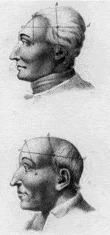
GENERALLY SPEAKING, the nineteenth-century science of phrenology purported to comprehend and classify human beings according the structures, shapes, and external features of the skull (see Figure 10). Put simply, phrenology posited that the physical formation of the head was indicative of the contents within. The practice was, to use Thomas Laqueur's phrase, “the nineteenth century's equivalent of modern biological determinism” (208). In Victorian phrenology, the contents of the head were broken down to represent a mixed array of what was then seen to make up a “self”–personality traits, mental and physical abilities, virtues and faults from the somatic to the moral. Specific features of the head (“organs” or “faculties”) were assigned individual meanings which were then interpreted in relation to each other. The surface of the head (and sometimes face) became an ordered system, a surface available to the literate, a legible plane.3
There are important and extensive differences–historical, conceptual, practical, and cultural–that surround the related but separate theories and practices of phrenology (the reading of heads) and physiognomy (the reading of faces). Jane Eyre, as I will later show, is not at all precise in its distinctions between these forms of reading the body; heads and faces are generally understood to constitute a single surface. While the language of phrenology structures the act of reading (and is clearly the dominant form in the novel), physiognomy and phrenology do not maintain their separateness in Jane Eyre nor do they, in some cases, remain historically separate. For a thorough exploration of the principles behind nineteenth-century physiognomy, see Tytler 82–87. For a complete overview of the distinctions between physiognomy and phrenology see Shuttleworth, Charlotte Brontë 60 and Tytler 87–103.
From Johann Gaspar Spurzheim's Phrenology in Connection with the Study of Physiognomy. Boston: March, Capen and Lyon, 1833. Courtesy of the New York State Historical Association Library
The phrenological head can be understood as an interpretive surface both as structured and as inherently arbitrary as language itself (see Figure 11). The Victorian phrenological head is, rather obviously, a set of signifiers (categories of faculties) all randomly assigned to signs (bumps or indents in the skull), with no particular meaning or truth to any assignation, except the meaning that is claimed at any given moment. The phrenological head is a language waiting to be read by a skilled reader who in fact creates the text itself through reference to particular phrenological maps. Thus, the phrenological reader can learn that the bump over the forehead is indicative of philanthropy, or that the very same bump over the forehead reveals one's potential for language skills. Indeed, since there is clearly no “real” or fixed meaning (however we may define or contest such a concept) to the bump over the forehead, phrenological reading is remarkably close to textual reading because of its inconstant and highly variable relation to what it claims to stably represent via an ordered system. As reader, the phrenologist is the interpreter of the body-as-text. The human subject of such analysis is converted into a legible exterior, her body quite literally transformed into interpretive surface. The system is highly organized, but the text/body itself, because of its nature as text, remains a shifty haze of signs. Phrenology is thus marked by both its rigid taxonomical structure and its representative instability; it is a compellingly contradictory guide to the endless signifying meaning(s) of the textual body.
From Samuel R. Wells's New Physiognomy. New York: Fowler and Wells, 1866. Courtesy of the New York State Historical Association Library
Within this blur of signs, interpretive flexibility is also affected by cultural and ideological forces. Victorian phrenology, as it was practiced, was powerfully interactive with the ideological tensions of its times– indeed, many scholars of Victorian phrenology have addressed the ideological intersections that occurred at the crossroads of phrenology.4
Numerous enlightening studies have put phrenology in context as a cultural, historical, and interpretive structure of complexity and significance. Notable among these are the work of Cooter and Shuttleworth. In further reference to Brontë's literary use of phrenology see also Dames, Jack, Rauch, and Senseman.
Especially important for understanding the role of phrenology in articulating the erotics of
Jane Eyre is that science's unstable relation to ideological representation. Because phrenology could verify or overturn any number of nineteenth-century socio-cultural arrangements via classificatory use of “scientific data,” it was a conceptual structure available for the naturalization of any state, any position, any desire.
Predictably, phrenology was often agreeable to those at the top of any hierarchy of power. If we briefly look at the concept of race, for example, the evidence is especially clear. Historian Nancy Stepan points out that phrenology enabled the “slide from the individual to the group” where “supposed national traits…were correlated with the faculties of a ‘race’ established by head measurements”–and, unsurprisingly, the resultant hierarchy was established with “the European as the standard for comparison” (23–25).5
It is unfortunately beyond the scope of this work to detail phrenology's role in shoring up eurocentric arguments for white superiority or how phrenology functioned specifically as a way to understand Englishness within the context of nineteenth-century empire. For excellent examples of how phrenology was deployed in terms of racial comparisons and how the science was linked to hierarchical arrangements of race, ethnicity, and nationhood, see “On the coincidence between the natural talents and dispositions of nations, and the development of their brains” 46–48, and Stepan 23–28. For an overview of Victorian race science in general, particularly in relation to phrenology and forms of human value hierarchy, see Meyer 14–20.
Phrenology both illustrated and proved the dubious logic of certain racial and/or national hierarchies.
Because it played off nineteenth-century ideas about individualism and self improvement, one of the best examples of phrenology's ideological elasticity is class, a category with more flexibility than racial or national identity. The work of historian of phrenology Roger Cooter provides an analysis of phrenology as a double-sided agent of both social regulation and individual change in the name of Victorian doctrines of self help and hard work. Class taxonomies, Cooter argues, were caught in the complex interplay between stability and change that phrenology inspires and reflects. For example, George Combe (the “Father of British Phrenology”) was adamantly against the rise of the working class out of their place–a place which, phrenology was ready to prove, they naturally belonged (Cooter 238). On the other hand, Combesian phrenology was adopted by many Owenite Socialists as a radicalizing discourse: “[For many Owenite Socialists] phrenology was at one with their…total rejection of conventional social norms…and rejection of the reigning positivist metaphysics of capitalism” (Cooter 242).
In her excellent work on Charlotte Brontë and phrenology, Sally Shuttleworth has pointed out that phrenological reading could offer validation of a person's place in any given class hierarchy and/or proffer enticing possibilities for change, the latter reading being based on what an individual was judged to possess by way of capacity and/or latent abilities (Charlotte Brontë 69). Shuttleworth has argued that this seemingly contradictory aspect of phrenology is in fact the “perfect encapsulation” of a central Victorian ideological conflict: phrenology simultaneously offered a system of control via stable places in the social hierarchy, as well as a possible expansion of any individual's social potential via the Victorian ideals of hard work and self improvement (Charlotte Brontë 70). There are limits to this tension, of course, as it is tied to only certain hierarchies (such as class) that purport to allow movement within Victorian value systems. While Victorians imagined that class was flexible (thanks to dubious capitalist promises of success through hard work and self-improvement) this tension is less present in terms of race or national identity, levels of identification that never contained the promise of potential subject improvement and were not changeable under the rubric of effort and self-discipline.
Phrenology's contradictory nature was, at least for a time, its strength. As a discursive structure able to accommodate opposing positions, phrenology was uniquely available for almost any rhetorical or ideological position–including inconsistent ones.6
I would argue that phrenology's potential for creating both stability and imagined change goes a long way to explaining its extraordinary popularity: “Certainly there was some truth to the claim that for the second third of the nineteenth century, after the Bible, Pilgrim's Progress and Robinson Crusoe, [Combes'] The Constitution of Man was next in circulation” (Cooter 120). It was a new scientific discourse, but phrenology was also a public rage, a sweeping fad, a craze. Such popularity was surely linked to how phrenology could be employed to advance any argument or ideological position, as well as its associations with epistemological power.
Those invested in maintaining specific forms of power and enforcing social hierarchies through science often mobilized the power of phrenology to maintain or create certain group-value distinctions.
7 The ease with which phrenology can be used to generalize about groups and delineate them into hierarchies which reflect and reinforce dominant ideological positions is at the center of phrenology's sometimes all-too-available elasticity, a flexibility which engendered a scientific language of human value that took numerous forms in the century that will follow, some of them nefarious. Phrenology will certainly provide conceptual frameworks that will effect scientific understandings, such as the 1860s fad of craniology and the more modern scientific discipline of physical anthropology, with its persistent interest in cranial measurement. See Russett 31–32 and Gould 97. Nazi science, with its particularly insidious interest in racial hierarchies, employed phrenology-like cranial and facial shape/measurement schemes as part of a larger system of scientific classifications to justify racial stratification and, ultimately, the extermination of Jews and other supposed degenerates.
On the other hand, phrenology's (limited) potential for a re-writing of the rules makes it seem like a potentially liberatory discourse. As a result of this double-sidedness, it was available for almost any nineteenth-century argument concerning the place, role, and value of any group or person. Hence, despite the ways in which phrenology is a product and reflection of Victorian ideologies, as a reading practice it is in many ways an empty discursive container, a double-sided blank page upon which the truth about the mind, body, and social order could be endlessly rewritten with the flexible pen of popular science. And any phrenological truth could contradict another and still be no more or less true.
Gender is, of course, at the forefront of this fraught and contradictory science. If phrenology was infinitely flexible in its availability for addressing power via “proofs” of inferiority or superiority and also equally available for liberatory narratives, links between phrenology and gender seem inevitable. As with race and class, phrenology had a doubled nature when it came to gender and could be understood as both stabilizing and disruptive. Cooter has argued that
middle-class woman [was the second] largest category of persons who attended phrenology lectures…. [T]he majority of these women faced a superannuated perfunctory, compromised role in urban industrial society. They wanted to know that there was an underlying order to social relations, to be assured that those relations were natural and unrestraining, and that they were as individuals in their own right integral to and not just appendages to the natural scheme of things. (190)
Cooter's theory is that phrenology operated as a kind of ideological tranquilizer for distressed middle class women and a phrenological explanation of their place in the “order of things” was sufficient to render many disaffected Victorian women at least temporarily content.
However, phrenology played its double role for gender as it did for other ideological fissures. Phrenology did reassure many women of their worth and their place in society, but it also provided a way for other, less tranquilized women to think about changing that place. For example, a Scottish feminist named Mrs. Hamilton preached the liberatory, feminist powers of phrenology, arguing that developing the potential that phrenology revealed to women would not only show that they could “equal and even excel” men, but would further give them “power to break the chains of the tyrant and the oppressor, and set them completely free” (Taylor 27–28). Phrenology's dual nature promoted both an acceptance of women's place and a questioning of that place.
This tension is clearly one that Brontë exploits in Jane Eyre, where a sly engagement with (im)possibilities for changes in woman's place and for trajectories of transgressive desires are mobilized by the doubled practice of reading and the scientific discourse of phrenology. Since its publication, Jane Eyre has been critically cited as caught between compliance and rebellion; feminist criticism has been particularly interested in how or if the text manages the fine line between gender conformity and transgression.8
As many critics have noted, early reviews of Jane Eyre criticized the ways in which the novel seemed to rupture boundaries for proper female behavior. A particularly vehement (and frequently cited) review was written by Elizabeth Rigby, Lady Eastlake (105–12). An overview of gender-sensitive reviews contemporary to the publication of Jane Eyre can be found in Gilbert 354. An overview of celebratory feminist criticism in relation to Jane Eyre and rebellious femininity can be found in London 211, n. 14.
But phrenological readings–with their dual nature and their ability to promote both orthodoxy and heterodoxy–also have a profound effect on the novel's deployment of textual erotics.
Eroticizing the Legible Subject or, Love Above the Neck
DESPITE THE ATTENTION that has been paid to phrenology's role in managing novelistic “romance,” when such dynamics have been addressed they have taken an uncritical shape in terms of what qualifies as a visible, readable object of desire. The pleasure of reading, and the erotics of that reading, have been seen as existing within only a heteroerotic arrangement and formulated through traditional romance structures. The heterosexual romance plot can easily be seen to have a certain phrenological form, with issues of power, desire, and seduction given their shape through phrenological readings.9
The most thorough investigations of the (exclusively) heterosexual erotics of Jane Eyre through the lens of phrenological concepts and structures are Shuttleworth's. See Charlotte Brontë 170–82, passim and “Psychological” 140–47, passim. I am indebted to Shuttleworth's important work in linking phrenology and textual erotics. Terming Jane and Rochester's mutual readings/witholdings as part of their “erotic struggles,” she examines in detail how Jane Eyre's heterosexual romance is structured through phrenology (“Psychological” 141). She further concludes that Jane and Rochester's reading patterns (the interpretation of other and the protection of self) dovetails with the “forms of erotic enjoyment as engendered by nineteenth-century models of economic, psychological, and sexual regulation” (Charlotte Brontë 171–72). Within this interpretive framework, her observations of erotics within the narrative remain strictly limited to heterosexual forms of desire. Studies of phrenologically structured desire in other Brontë novels remains heterosexually oriented, as well. See Dames.
However, the heteroerotic aspect of phrenology is only one part of a complex deployment of a scientific vernacular–a discourse that simultaneously produces the heterosexual romance plots
and the female homoerotics of the text.
At Gateshead, the young Jane Eyre knows that reading is pleasure. At Thornfield, the adult Jane knows it, too, and we can clearly see how romance in Jane Eyre takes its shape from phrenological exchange. And once one is attuned to the presence of phrenological discourse, it is difficult not to notice that Jane and Rochester's earliest meetings read like phrenological examinations. This oft-quoted example is typical of their phrenological flirtations, beginning with Rochester's invitation to read his face and head:
“Criticize me: does my forehead not please you?”
He lifted up the sable waves of hair which lay horizontally over his brow, and showed a solid enough mass of intellectual organs; but an abrupt deficiency where the suave sign of benevolence should have risen.
“Now, ma'am, am I a fool?”
“Far from it, sir. You would, perhaps, think me rude if I inquired in return whether you are a philanthropist?”
“There again! Another stick of the penknife, when she pretended to pat my head…. No, young lady, I am not a general philanthropist; but I bear a conscience;” and he pointed to the prominences which are said to indicate that faculty–and which, fortunately for him, were sufficiently conspicuous; giving, indeed, a marked breadth to the upper part of his head.” (150; ch. 14)
In turn, Rochester will soon tell Jane that she should be careful when he is reading her eye “beware…what you express with that organ, I am quick at interpreting its language” (154; ch. 14). Their connection is made possible by a shared language of reading and mutual legibility. And these phrenological
pas de deux fill the novel, establishing the erotics of the Jane-Rochester relationship through the pleasures of reading and interpretation. Such is the shape of desire.
Phrenological readings function effectively as heterosexual erotic space, particularly recuperative heteroerotic space, where much forbidden or failed desire can be revised as appropriate whenever that desire goes against an obvious norm. For example, the text exerts considerable pressure on many boundaries through the Rochester/Jane romance: master/servant, employer/employee, rich/poor, familied/orphaned, etc. But phrenology permits this pressuring by articulating a naturalized link beyond or outside the reach of such divisions. Similarly, Jane's relationship with St. John Rivers is characterized by repeated, revealing failures of legibility, illustrating that he is unavailable for the kind of erotic connections that are possible with the highly legible Rochester. St. John's face is an unreadable page and the pleasure of reading is strangely denied to the otherwise always-literate Jane: “St. John's eyes, though clear enough in a literal sense, in a figurative one were difficult to fathom. He seemed to use them rather as instruments to search other people's thoughts, than as agents to reveal his own” (387; ch. 29). The failure of reading justifies the failure of romance –a necessary justification since Jane's rejection of the saintly St. John was perhaps as transgressive to Victorian readers as her romance with a would-be bigamist.10
Shock waves created by Jane's choice of husband reverberated in the decades after the novel's publication, even inspiring a kind of corrected version. In 1864, popular novelist Emma Jane Worboise produced her own thinly veiled re-write of Jane Eyre and focused her efforts on correcting the narrative's moral errors. In Thornycroft Hall, Worboise weeds out all transgressive desires. The Jane-character dutifully takes up her place with the zealous St. John-character and becomes an extremely well-behaved preacher's wife.
In terms of narrative desire, then, phrenology can successfully articulate erotics while ideologically sanitizing erotic transgressions. Phrenology manages the heterosexual plots, reconciling both the orthodox and the heterodox aspects of desire. There remain, however, the broader questions of what
Jane Eyre does to phrenology and how the novel's use of that discursive structure affects the less narrowly defined erotics of the novel.
Science and narrative conjoin in ways that are often partial or tangential and always complex. Gillian Beer has noted that:
Scientific and literary discourses overlap, but unstably…. Yet the expectation lingers that it should be possible to translate stably from one to another…. More is to be gained from analyzing the transformations that occur when ideas change creative context and encounter fresh readers. The fleeting and discontinuous may be as significant in our reading as the secure locking of equivalent meanings. (173)
It is crucial, I think, that we be attentive to the unfounded “expectation” against which Beer warns us, and avoid the “temptation…to trace the lines where science and literature intersect neatly” (Rauch 9). In the case of
Jane Eyre, the novel's use of phrenology is not isolated as the appearance of a certain scientific language within the narrative. Rather, phrenology
intersects with narrative and, as a result, scientific discourse and discursive practices meet in culture, exerting mutually transformative effects, reciprocally shaping each other.
Jane Eyre does not employ phrenological discourse so much as it absorbs and alters the language of that vernacular science.
11 A small example nicely illustrates this point. The 1996 Penguin edition of Jane Eyre, which I use here, marks Brontë's first use of phrenological terminology by noting that “The level of knowledge of phrenology displayed in the novel was however unsophisticated by the standards of some enthusiasts for the theory” (507–08, n. 3). The footnote further records the disparaging comments of a contemporary of Brontë's who claimed that the author's knowledge of phrenology was “correct but not such as would have fallen from the pen of one familiar with phrenology” (507–08, n. 3). Her “familiarity” with phrenology is, however, extremely well established (Shuttleworth, “Psychological” 127–31). What seems like Brontë's awkward or loose use of phrenological conceptual structures and terms actually speaks to my point–Brontë doesn't embed phrenology into the text, not does she move the discourse into narrative in any straightforward way. Rather, she integrates phrenology into the novel on her own terms.
This cooption of the scientific vernacular in
Jane Eyre takes on the particular form and language of phrenology even as it simultaneously alters phrenology's discursive and epistemological structure.
Phrenological readings and the phrenological head itself are phenomena which are uniquely able to hold oppositional yet overlapping discursive and identificatory trajectories. A product of purely constructed meaning, phrenology effortlessly supports the tangential, fleeting, simultaneous variation in erotic positionings that occur throughout Jane Eyre. Phrenology allows the erotic to repeatedly shift in and out of view through what Barthes has called slippage or skidding, the process whereby meaning moves or shifts because a signifier invokes multiple signifieds. Textual erotics do not so much conflict as slide between signifiers and object choices, enacting both heteroerotics and homoerotics. Hence, as a locus for the textually erotic, Brontë's version of phrenology produces a structure for desire that is flexible between object choices, moving seamlessly between hetero and homoerotic manifestations, eliding the binary logic of the gender split as the only configuration for the articulation of desire, queering the text.
“A Cool Observer of Her Own Sex Like Me”: The Homoerotics of Phrenological Reading
IN HIS WORK ON VILLETTE, Nicholas Dames has argued that phrenology employs “an asexual, featureless diagram” where a “gendered binary model of the gaze is inoperable” (369). But it is not the case that phrenology is necessarily genderless–despite the supposedly genderless features of the phrenological head, Victorian phrenological meaning was of course deployed along gendered lines and men and women were uniformly understood to have different tendencies and abilities despite similar phrenological faculties. Phrenology is not genderless by its nature but rather phrenology has the potential to overleap, circumvent, blur, or avoid gender as an organizing factor–if the system is co-opted and deployed in a certain way. In narrative co-optations or corruptions of phrenological discourse, the gender of the textualized body can slip in and out of the erotic/legibility equation in numerous ways, and desire is not organized solely within a male-female gender binary. This is the case in Jane Eyre.
Understood in the proper context of what reading connotes in Jane Eyre, the dynamic of phrenology becomes the key to the complexities of the narrative's approach to the erotic, where interpretation is an act both epistemological and sexualized. Of greatest importance is the presence of erotic slippage within the narrative, that is, the fact that within this narrative any and every phrenological reading can function as an erotic nexus. This creates complex narrative strands where desire and its articulation are attached to the body as a legible surface but that legible surface is no longer stably attached to gender. Gender identity is not necessarily a factor in how erotic phrenological readings are structured as textual phenomena. In other words, there is nothing about the phrenological head itself or use of phrenological discourse that must be gendered, and it is that aspect of the science that Brontë fully exploits.
The narrative of Jane Eyre thus has the potential to articulate heavily eroticized same sex desire for several reasons: first, because any act of reading/interpretation has been, since the opening of the novel, welded to the fulfillment of desire and the experience of intense pleasure and, second, because readings naturalize their own erotic articulations. Finally, the usually inflexible category of gender can be destabilized by the intersection of phrenology with the erotics of literacy; gender identity has the potential to flicker in and out when placed under the particular light of Brontë's phrenology and, as a result of this indeterminacy, the centrality of gender as the organizing structure for the erotic can powerfully (albeit temporarily) fade from view. Thus, phrenological readings carry a triple force: the links between pleasure and reading, the automatic naturalization of erotics expressed through phrenological structures, and the subversion of gender stability. Phrenology, as shaped by Jane Eyre, forms the perfect narrative discourse to simultaneously articulate normative and non-normative strands of desire.
Jane Eyre's own literary desires have been spilling over into the space of intra-female erotics since the beginning of the book, and those particular trajectories of desire are not tangential or secondary, but in fact form a crucial part of how Jane's subjectivity and erotic self is defined. Jane famously terms herself a “cool observer” of her own sex, but despite her claim of “coolness,” and her characterization of her narrative role as that of an “observer,” readers know she is neither indifferent to nor detached from the physical appearance of other women (412; ch. 32). To illustrate how the conceptual organizations of phrenology produce the female homoerotic, I will consider several aspects of female same sex desire here: the formative intra-female erotics of Lowood, Jane's pleasurable artistic productions of numerous female “heads,” and the phrenological reading of Jane performed by Mr. Rochester as the cross-dressed gypsy.
Jane's female homoerotic encounters with other women as textual surfaces match the novel's phrenological phenomenology. Nowhere is this more apparent than at Lowood school, where the locus of phrenological-homoerotic energy is Helen Burns. Predictably, Jane is engaged in an attempt at interpretation when she first meets Helen. As she ponders the inscription tablet of Lowood, reading “the words over and over again… unable fully to penetrate their import,” Jane is stymied by a failed interpretive task (59; ch. 5). But her attention is caught by Helen, and Helen is first signified as an object of interest because of her enticing proximity to that object of pleasure, a book:
I saw a girl sitting on a stone bench near; she was bent over a book, on the perusal of which she seemed intent: from where I stood I could see the title –it was Rasselass; a name that struck me as strange, and consequently attractive. In turning a leaf she happened to look up, and I said to her directly:-
“Is your book interesting?” I had already formed the intention of asking her to lend it to me some day. (59; ch. 5)
The link between Helen and Jane is first created by an understood similarity –
pleasure in reading. Indeed, it is reading that provides the sole reason for Jane's friendliness to Helen, as Jane notes: “I hardly know where I found the hardihood thus to open a conversation with a stranger; the step was contrary to my nature and habits: but I think her occupation touched a chord of sympathy somewhere; for I too liked reading” (59; ch. 5). Jane goes on to note that
Rasselass is beyond the scope of her readerly abilities (“I saw nothing about fairies, nothing about genii”), indicating that while it is the presence of interpretive surface that draws her to Helen, Jane is still too much a novice reader for the more sophisticated pleasures of legibility available to her friend (60; ch. 5). As Jane and Helen encounter each other a second time, Jane interrupts Burns, who is “absorbed, silent, abstracted from all round her by the companionship of a book, which she read by the dim glare of the embers” (65; ch. 6). Echoing Jane's solitary “retirement” in the very opening of the novel, we see Helen Burns similarly seeking out the solitary self-pleasures of reading alone and Jane beginning to express interest in sharing such pleasures.
Having arranged the dynamics of attraction and of pleasure by linking Helen Burns with reading, the Lowood section of Jane Eyre then brings these qualities together powerfully by intersecting Jane, Helen, and Miss Temple in a sensual, shared reading scene. This display of reading aligns factors that will continue to formulate desire throughout the novel: reading, phrenological locations of desires, and the kinesthetic responses of pleasure as organized through both reading and phrenology. Ostensibly, Jane and Helen are invited to Maria Temple's room so that Jane will have the opportunity to clear herself of the unfair charges laid upon her by Brocklehurst. However, the real focus of the scene is the emergence of Helen as a very spectacular kind of reader. Quiet, calm, almost preternaturally self-possessed, Helen is transformed by a force unknown to Jane; in the presence of comfort and “her beloved instructress,” Helen's powers “woke, they kindled” (85; ch. 8). Her transformation is not only psychic and emotional, but involves a physical transmutation. These powers “glowed in the bright tint of her cheek…they shone in the liquid lustre of her eyes…[t]hen her soul sat on her lips” (85; ch. 8). The manifestation of Helen's interior qualities upon the surface of her outer body reflects the particular phenomenology of this narrative, where interior qualities are visible upon the outer, textualized surface.
Having achieved this outer revelation of inner self, Helen Burns and Maria Temple begin an exchange so marvelous that Jane cannot help but exclaim over the display. Especially thrilling is their relation to books: “[H]ow many they had read! What stores of knowledge they possessed!” narrates the enraptured Jane (85; ch. 8). Yet most exciting of all is the moment of reading aloud: “my amazement reached its climax when Miss Temple asked Helen…to recall the Latin her father had taught her, and taking a book from a shelf, bade her read and construe a page of ‘Virgil’; and Helen obeyed, my organ of Veneration expanding at every sounding line. She had scarcely finished ere the bell announced bed-time” (85–86; ch. 8). Reading here becomes a display of other-directed, sexualized prowess. Jane's corresponding, phrenological erection of her Venerability organ, an organ of considerable size that has been already powerfully stimulated by the earlier appearance of Maria Temple, reaches its “climax” in the literary moment. Through the medium of phrenological response, Helen's literary powers register as Jane's somatic reaction. The voyeuristic Jane, observing the advanced literary-erotic bonds of the experienced Helen and Miss Temple, takes pleasure in their exchange, an exchange framed in unmistakable terms of sexual arousal. Phrenology, erotic pleasure, and literacy–forces which will also structure the courtship of Jane and Rochester–are forged in Miss Temple's room.
The intimacy between Jane and Helen reaches another level of intensity (and achieves closure) in the moment of Helen's death. As they lie together in bed, Helen dies–Jane's “face against Helen Burns's shoulder, [Jane's] arms round her neck” (96; ch. 9). Spinning out Jane's desire along the axis of Helen's erotic abilities and then shutting that trajectory down via Helen's demise is, of course, how the novel first opens up female homoerotics and then compresses them below the heteroerotic surface.12
Helen's link to erotic energy is furthered by the form of her death as a consumptive. Shuttleworth (who frequently focuses on phrenology as a means of female medico-social regulation) has noted that consumption “was consistently linked in Victorian medical texts with a repression of sexuality” (Charlotte Brontë 160). If Helen's illness is a coded or oblique reference to sexual repression, it certainly furthers the erotic intensity of her character, as does her constant engagement in the sexual(ized) activity of reading.
But Helen's death does not collapse the female homoerotic, but rather re-directs narrative erotics as articulated through phrenology and image interpretation. While the female homoerotic can only ultimately be asymmetrical with and secondary to romance, the same sex desires of Lowood establish that pleasure in literacy, phrenological constructs, and physical reactions and desires are all centrally intersected. These desires further establish that gender is in fact not the organizing factor for such pleasures. As the narrative creates the early erotic trajectories of Jane's life, the female homoerotic is articulated through the very same structures that will articulate the heterosexual romance plot itself.
One of the reasons why phrenology is a discursive structure that has the potential to slip around the erotic limitations set by gender is its focus on the human head, rather than that (in fact also elastic) vague signifier the human body, which is often understood to be gendered without much flexibility. In Jane Eyre, phrenological readings are often of both the face and the head, and it is important that such readings overlap in many ways. Although phrenology is distinguished from physiognomy by numerous and complex differences in both logic and practice, Brontë simply sweeps those various differences away and, attaches (as it were) the face to the head, reading them as similar. Faces are part of the readable surface, and they take on phrenological (and therefore erotic) significance in the narrative.
The production and enjoyment of the legible surface through portraiture (almost always of a female head or face) is repeatedly linked to Jane's experience of pleasure. In the Lowood artistic portfolio which she presents to Rochester on her arrival at Thornfield, she describes the intense delight felt in producing the paintings: “To paint them, in short, was to enjoy one of the keenest pleasures I have ever known” (143; ch. 13). That the experience of painting is linked to erotic satisfaction is made even clearer by Jane's more conventional representations: “One morning I fell to sketching a face: what sort of a face it was to be, I did not care or know. I took a soft black pencil, gave it a broad point, and worked away. Soon I had traced on the paper a broad and prominent forehead, and a square lower outline of visage: that contour gave me pleasure” (262; ch. 21). This pleasure-giving forehead, we are not surprised to learn, turns into “a very faithful representation of Mr. Rochester,” welding Jane's desires to her artistic representations (262; ch. 21). But such desire is not confined to heterosexually organized channels. Jane Eyre repeatedly creates images of the female head, finding significant pleasurable interest in both producing and contemplating them. In fact, over the course of the novel, Jane draws the heads of many women: the “Evening Star,” her as-yet-unseen rival Blanche Ingram, her cousins Georgiana and Eliza Reed, and Rosamund Oliver. In two of these artistic moments–the drawings of Blanche and of Rosamund–the larger narrative linkage of the eroticized head, the pleasures of its representation, and narrative trajectories of same sex desire will be especially apparent.13
Johnson has addressed the erotics of portraiture in Jane Eyre and Jane's excessive focus on painting the female head. She argues that after Jane's original paintings are shown to Rochester, her artistic work is “domesticated and subordinated to courtship,” losing its erotic and creative force through “acceding too much to the drama of male desire” (177–78). I would argue that Johnson (and she has much company in this regard) has missed the integral force of Jane's pleasure in the female head because much of that force is organized around female homoerotic desires, even as the narrative claims the erotic focus of her paintings is heterosexual. Johnson reads Jane's pleasure as erased because pleasure as expressed is not conventional or stable in object choice across gender. She seems to make the common assumption that heteroerotics constitute the only possible desires of the text.
Previous to Blanche's actual appearance in the novel, Jane seeks to discipline her own erotic impulses and return her feelings “into the safe fold of common sense” (182; ch. 16). She accordingly draws a sketch of herself, a “Portrait of a Governess, disconnected, poor, and plain” and then produces an extremely detailed and fastidious portrait of the (still imaginary) Blanche (183; ch. 16). The purported purpose of Jane's artistic project is erotic self control, the quelling of her desires for Rochester through the invocation of the superior figure of Blanche. Blanche thus becomes a lushly rendered surface in which Jane's improper desire for Rochester is recast through production of the perfect female head, a head in which, holograph-like, Rochester and Blanche strangely overlap. Jane directs herself:
[T]ake your pallette, mix your freshest, finest, clearest tints; choose your most delicate camel-hair pencils; delineate carefully the loveliest face you can imagine; paint it in your softest shades and sweetest hues, according to the description given by Mrs Fairfax of Blanche Ingram: remember raven ringlets, the oriental eye;–what! you revert to Mr. Rochester as a model! Order! No snivel!–no sentiment!–no regret! I will endure only sense and resolution. Recall the august yet harmonious lineaments, the Grecian neck and bust…(183–84; ch. 16)
Like the unstably gendered phrenological head, Blanche (as imagined) morphs into Rochester and back into Blanche again, as Jane Eyre practices self mortification of the most sensuous kind through fine tints, camel-hair pencils, and soft, sweet hues. The subject of the painting is a substitute for erotic desire, which becomes clear when one notes the tendency of the rendered head to become Mr. Rochester's. Hence, in the case of Blanche, Jane's desire is welded to the female head as she seeks to master what she posits as unwise
hetero sexual longings. However, the narrative overlays those longings with the female homoerotic–not separate from or against the heteroerotic, but simultaneous to it.
Jane's drawing of village beauty Rosamund Oliver is the novel's second example of Jane's rendering of substitutional desires (and the revealing repetition of the word “pleasure” that surrounds the process). Rosamund, a doll-like version of conventional female perfection, sees Jane drawing and asks if Jane will sketch her portrait; Jane's response: “With pleasure” (412; ch. 32; my emphasis). The gratification of Jane's work is due to a “thrill of artist-delight at the idea of copying from so perfect and radiant a model” (412; ch. 32; my emphasis). And the process itself is enjoyable, too: “I took a sheet of fine cardboard, and drew a careful outline. I promised myself the pleasure of colouring it” (412; ch. 32; my emphasis). Jane sketches with pleasure, thrills at the idea of the task, and anticipates further pleasure while coloring it in. As with the portrait of Blanche, her task resonates with the intense delight of rendering and enjoying the female object.
Jane's drawing of Rosamund forcefully links art to the female homoerotic gaze. Like her drawing of Blanche, it is ostensibly substitutional for heterosexual desires and is Jane's attempt to startle St. John into an admission of his own longings. Yet the erotic force of Rosamund's portrait is more clearly linked to Jane's pleasure than anyone else's. Portraits of the female head, then, are surprisingly complex: they are initially located around heteroerotic desires that must be quelled, connecting them to erotic management. However, their effect is to increase desire rather than subdue it. Female heads are interpretive surfaces that are linked to narrative knots of repression and pleasure, and they are created with pleasure by Jane Eyre herself, who produces the image-text and indulges in the repeatable joys of observing heads, be they male or female.
But perhaps nowhere do we see phrenology's power to destabilize gender more clearly than when Mr. Rochester dresses up as a gypsy and insists on telling the fortunes of only the ladies who are “young and single” (218; ch. 18). Carla Kaplan has described this transformation as a moment where Brontë “problematize[s] Rochester's gender identity” (89). But because we do not know that the gypsy is Rochester, it is only retroactively that his gender becomes “problematic.” Indeed this cross-dressing moment is not known to involve cross-dressing until it is past and the scene of desire between women has already taken place. Further, the female homoerotic moment (albeit a temporary one) intersects with the erotic telling of fortunes, that is, a rhapsodic and powerfully homoerotic phrenological reading. While sometimes noted for its oddity (and I think more often ignored because of it) this scene is not so bizarre as may first appear. The gender elasticity, the sexualized rapture of a phrenological experience, the pleasure of reading, the female head as erotic text available to another woman–all these are in line with the narrative's erotic phenomenology.
It is crucial to recognize that this instance of phrenological fortune telling is a thinly masked sexual experience. The first hint we have had of this is Blanche's failed encounter with the gypsy, from which she returns with a markedly phrenological disdain both for the alleged pleasure of reading and for the rather wanton organs of her fellow party members: “Now, now, good people… Really your organs of wonder and credulity are easily excited” (219; ch. 18). Echoing the reference to the excited and “expanding” organs of Jane Eyre when she witnesses Helen Burns' reading performance, the excitement of the party at Thornfield is already couched in terms that will indicate the erotic significance of the readings performed by the gypsy. Blanche's failed, ungratified experience is meanwhile highlighted by her immediate failed engagement with a book: “Miss Ingram took a book, leant back in her chair, and so declined further conversation. I watched her for nearly half an hour: during all that time she never turned a page” (219; ch. 18). The narrative casts Blanche as eager but sexually unsatisfied; she cannot find pleasure in being read or in reading, either through a phrenological reading experience or a literary one. In this novel, the failure of reading can only be a most powerful indicator of dissatisfaction and the failure of desire.
The gypsy's reading of Jane Eyre is spectacular in its phrenological eroticism and it is arguably the most sensuous scene in the novel. While Jane is dubious, she is seduced by the gypsy's powers of reading. The moment of surrender is the moment where the gypsy offers to read her head:
“… besides, what is in a palm? Destiny is not written there.”
“I believe you,” said I.
“No,” she continued, “it is in the face: on the forehead, about the eyes, in the eyes themselves, in the lines of the mouth. Kneel, and lift up your head.”
“Ah! Now you are coming to reality,” I said as I obeyed her. (223; ch. 19)
What follows is the longest, most intimate phrenological reading of the novel, a reading in which Jane Eyre is sensuously read piecemeal:
The flame flickers in the eye; the eye shines like dew; it looks soft and full of feeling; it smiles at my jargon; it is susceptible; impression follows impression through its clear sphere. When it ceases to smile, it is sad; and unconscious lassitude weighs on the lid….The eye is favourable.
As to the mouth, it delights at times in laughter; it is disposed to impart all that the brain conceives…Mobile and flexible, it was never intended to be compressed in the eternal silence of solitude: it is a mouth which should speak much and smile often….That feature too is propitious.
I see no enemy to a fortunate issue but in the brow; and that brow professes to say,–“I can live alone…. The forehead declares, “Reason sits firm and holds the reins…”
“Well said, forehead; your declaration shall be respected.” (226–27; ch. 19)
This reading experience is so fraught with eroticism that it eventually shatters the ability of the narrative to restrain itself. As the gypsy begins to encroach on romantic space, she must leave the female gender because that gender cannot perform in the erotic space of romance: “So far I have governed myself thoroughly” says the finally emergent Rochester, “but farther might try me beyond my strength” (227; ch. 19). The narrative toys with a similar boundary, negotiating the female homoerotic alongside the heteroerotic with equal adroitness.
Despite the logic of the narrative's production of a prolonged, sensuously erotic reading of Jane by a woman, the homoerotic cannot remain a stable narrative structure and a re-submersion of the female homoerotic into the heteroerotic plot is required. In the case of Helen Burns, that resubmersion was easily accomplished through death. Miss Temple is summarily married off. Even sensuous portraits, like those of Blanche and Rosamund, can be given away to be admired by more appropriate owners, such as St. John Rivers. But the gypsy, the homoerotic narrative flashpoint, happens also to be the heteroerotic center of the romance plot, so she cannot die or be married off or turned into an aesthetic object of admiration. So, in a transformation that I think is unique to the rather common project of heterosexual recovery in realist narrative, Brontë quite literally turns the figure of female homoerotics into the hero.
But, despite the (particularly creative) heterosexual recovery that takes place here, such recovery does not erase the narrative experience of female homoerotic phrenological readings. Even readers of the novel who are familiar with the narrative must, as they read, experience this overlay of the lustful, prodding, manipulative gypsy with the lustful, prodding, manipulative Rochester. Like the almost-holographic portraits of Blanche and Rochester, the site of desire flickers between desiring subjects, desirable objects, and sites of gender. The final, permanent overlay of Rochester in place of the gypsy does not eliminate her figure or undo the homoerotic scene; it merely encodes and captures that experience, leaving us the gypsy's (present and absent) ghost. Ultimately, the work of heterosexual recuperation seals the female homoerotic moment within the amber of the heteroerotic plot, catching the female homoerotic and embedding it within normative romance, where it remains both obscured and undeniable.
The Multiplicity of Erotic Discursive Strands or, Why Jane Eyre is Not a Lesbian
“IF ANY VICTORIAN AUTHOR might have been conscious of passion between women and have accordingly alluded to it in her fiction,” writes Sara Putzell-Korab, “it is Charlotte Brontë” (186). In recent years, queer desires, particularly female homoerotic desires, have been sighted gliding like increasingly visible ghosts along the margins of Brontë's narratives, even occasionally being coaxed into the center of analysis. Most of this work has recognized the non-normative desires of Villette. The sometimes explicitly sexualized and sometimes gender-radicalized relation of Villette narrator Lucy Snowe to acquaintance Ginevra Fanshawe has been carefully unpacked (Putzell-Korab 186–93). Ann Weinstone has analyzed Lucy Snowe's queerness as a textual force that articulates non-conventional sexual attachments to both men and women and also challenges categories of sexual and gender identities, affecting and queering both the text and the reading experience. Most notably, Kathryn Bond Stockton has read Villette through the lens of psychoanalytic and post-structuralist theories, engaging with the narrative as a site of both female homoerotic desire and of female autoerotic textual energies (122–65, passim). Stockton's queer interrogations also address Brontë's lived experience, providing a convincing and especially well argued analysis of Brontë's passionate homoerotic correspondence with Ellen Nussey (108–09). The homoerotics of that relationship can be seen as having implications for reading Brontë's narratives as well, at least to the extent that the deep longings of the author can be understood to suffuse her texts.
Although the non-conventional erotics of Jane Eyre have not been as thoroughly explored as those of Villette, critics have also hinted at heterodox narrative dynamics. Peter Brooks–whose work on the erotics of reading I have employed in this essay and which I will later note as an example of the perils of privileging male heterosexual desire in narrative–obliquely claims that any “adolescent reader of the Brontës, of Jane Eyre and Wuthering Heights, is obscurely aware of how erotic Jane and Catherine can be” (144). Other critics, who have depended less upon vague gestures towards the “obscurely” erotic than Brooks, have noted the important space of specifically queer desires in Jane Eyre, especially erotics between women. Lisa Moore, for example, writes that Jane's love for Helen requires that “[Helen] must die… to make the point that Jane's salvation does not lie in the direction of union with other women” (Moore 178, n. 53). All these different sightings of the queer within Brontëan texts testify to trajectories of desires within her narratives; they represent the growing critical approach of which this essay is a part, a growth which depends on the extent to which we are able (and, of course, willing) to read queerly.
The works of these critics call our attention to the larger question of how we can understand desire in pre-modern narrative as something not only totalizingly male and heterosexual, bringing us face to face with the question of how we read queerly. The work of many lesbian-feminist/queer theorists has laid the groundwork for such a task, citing how disruptive figures and transgressive textual erotics complicate traditional narrative along the lines of female homoerotic.14
Castle, de Lauretis, Jagose, and Roof.
The identification of pre-lesbian homoerotic narrative is possible, I would claim with Marilyn Farwell, if we agree that female homoerotic textual energies (what Farwell somewhat problematically identifies as “lesbian”) can be generated from within narrative by disruption or reorganization of fluid subject positions, moving towards and/or away from any number of object choices. In short, desire in traditional texts can be more plastic than may first appear, and can carry queer elements:
lesbian narrative space is the combination and interchangeability of the conventional active and passive functions that have been strictly divided into male and female and, most often, male and female characters. As a result, the lesbian subject realigns some of the accepted narrative categories, particularly those of protagonist and object, narrator, and closure. In other words, the lesbian subject redraws the gender boundaries in the narrative categories in which subjectivity is posited. The narrative system, then, is unavoidable, but also can be stretched to accommodate different power relations. (Farwell 61–62)15
Farwell further notes that this definition will “make easier the identification as lesbian texts that do not contain specific lesbian characters, themes, or lesbian authors and yet not exclude more traditionally defined lesbian narratives” (62). While we might also see the totalizing project of identification around a label–“lesbian”–as ultimately constructed, her definition is especially useful for considering how we may read the female homoerotic as it exists in narrative in pre-modern, pre-lesbian formulations.
Heterosexual desire is always predicated on categories of gender and its related binaries of affect, appearances, power relations, etc., as narratively organized and naturalized around (constructed) gender difference. However, through the disruption of the stability of such naturalized binaries, the erotic can be identified in textual locations other than the heterosexual romance plot or, as Farwell terms it, the traditional narrative structure can be seen as “stretched.” This narrative potential is supremely available in the novel
Jane Eyre, both as the reading experience of the heroine and as the experience of the reader herself.
The “stretching” of the narrative is important here because the female homoerotics of Jane Eyre can never be about the particular sexual identity of Jane herself but rather only about her (or the text's) queerness. From a queer perspective, this question of female homoerotic desire is not related to Jane Eyre's “sexual identity,” or to locating textual erotics within a heterosexual/homoerotic binary split.16
It is impossible to claim that Jane Eyre, our relentlessly literate heroine, is a lesbian: first, the premise is historically nonsensical. Second, such a claim makes no sense textually–the multiple erotics of the text are too flexible, too open, and too mobile among subjectivities to imagine a sexual orientation in the sense of stable object choice. Finally, such a claim runs exactly opposite to the means by which the novel produces its most radical erotics: through the flexibility of gender and gender identity, as well as the undercutting of the heterosexual matrix within which (and through which) that stability is articulated.
We know that this split is constructed, and we know too that such a fissure is predicated on the fallacy of both its naturalness and its stability. Narrative queerness is rather a representative project or discursive dynamic where gender instability fractures, slips out of or works against what Butler has termed the “heterosexual matrix,” “a hegemonic discursive/epistemic model of gender intelligibility that assumes that for bodies to cohere and make sense there must be a stable sex expressed through a stable gender (masculine expresses male, feminine expresses female) that is oppositionally and hierarchically defined through the compulsive practice of heterosexuality” (Butler 151, n. 6).
Jane Eyre produces space outside of the heterosexual matrix and enables the production of the female homoerotic narrative trajectory through the gender slippage–or, perhaps more accurately, the slipping away of gender –that is potentially located in any phrenological reading. As gender is destabilized, heterosexuality, which is predicated on both gender constancy and definitional opposition, is not annihilated, but rather crowded about with other erotic valences, de-centered. Within the destabilizing force of phrenology as Brontë employs it, narrative erotics outside of the heterosexual matrix are possible, and they are everywhere.
But what does it mean for the heteroerotic and the female homoerotic to coexist along the shared arc of such a scientific discourse, to overlap– even if ultimately separated–because of the phrenological textual representations of desire? Much of narrative theory has for its province a considerable breadth of feminist or radically revisionist theories of multivocality in narrative. Such theories almost inevitably center on the significance of competing or overlapping discursive strands. From Bahktinian dialogics to Foucault's observations on the intersection of discursive force fields, current understandings of narrative lean towards the multivalent cacophony of simultaneity. In much criticism, as Kaplan has pointed out, the mere identification of competing discursive strands is sometimes seen as enough to signal a radicalizing textual discourse (11). Kaplan importantly notes that the observation of such strands “cannot answer in advance the question of what conclusions we might draw about the particular forms taken by [the] presence and interaction [of such strands], cannot answer the difficult questions about how–in concrete instances of dialogic exchange – conflicting agendas are negotiated and ‘footings’ are arranged” (11). In the “concrete instance” of phrenology as a discursive/erotic structure (which is “the particular form taken” in Jane Eyre), we are presented with questions similar to what Kaplan proposes. If a female homoerotic strand of erotic textuality is framed through the erotics of reading and organized largely by phrenological structures (and related structures of body/text legibility), it can only be concluded that such a strand deeply impacts our experience of Jane Eyre.
The queerness of the text is rooted in the doubled narrative articulations of phrenology, and it becomes apparent that the Victorian scientific taxonomies for individual and social management (what Shuttleworth calls phrenology's “perfect philosophy for the new industrial economy”) also–perhaps surprisingly–opens discursive spaces for erotic scattering (Charlotte Brontë 64). But what makes it possible for a constricting science often aimed at the enforcement of the status quo to interact with realist narrative and become a force for the articulation of the perverse or queer? The answer is, I think, located in possibilities created when science and literature interact. Gillian Beer has argued that science does not have “clear boundaries once it has entered literature,” but that genres “establish their own conditions which alter the significance of ideas expressed within them” (186). Phrenology is exactly such an example: the particular effects of the use of scientific concepts and discursive structures are unpredictable over time and among readers/authors. Phrenology and its related understanding of the body as readable text make it possible to narratively articulate plural trajectories of desire by enacting the concept of reading a head along the lines of literate desire, enabling a loop of erotic seepage where erotic narrative reading becomes doing science and doing science becomes the site of textual pleasure. The doubled nature of the erotics in the narrative is the doubled nature of the scientific discourse at hand–a discourse corrupted, co-opted and reorganized by Brontë. Beer's typically pithy and insightful statement that an “engrossing question is what happens when unforeseen readers appropriate [scientific] terms and texts,” reveals that part of the “engrossing” issue in Jane Eyre is not the use of phrenology proper (arguably mostly a means of nineteenth-century social and individual control) but rather Brontë's mis-use, or perhaps transformative use, of it (Beer 1).
An emergent discourse of social and personal classification like phrenology, as Foucault remarks, is an effect of power; but it is also an effect that does not only repress or censor. Indeed, the effect of such systems can be understood as generative: “power produces; it produces reality; it produces domains of objects and rituals of truth” (Foucault, Discipline 194). The domain of truth produced by phrenology is related to control (“The individual and the knowledge that may be gained of him belong to this production”) but such control is related to the production of ever more control with ever less success (Foucault, Discipline 194). Science thus “makes possible” the articulation of a non-normative desire, even if only in certain limited ways. For example, sexology–as Foucault has famously noted–created a version of same sex desire through the creation of an identity, i.e., an institutionalized reification of that desire, the invention of the homosexual. And, while that reification is not by any means equivalent to empowerment, that attempt at control produces new means to articulate such desires (thus “homosexuality began to speak in its own behalf”) (Foucault, History 101). In a sense, phrenology as a newly “invented,” institutionalized structure for talking about ideologically acceptable forms of subjectivity works in a similar fashion–as the text of Jane Eyre absorbs that discursive system, the narrative creates meaning through its articulation of body as text and the gender slippage possible within that articulation. The signifying system of phrenology (absorbed by Brontë) enables free play outside of the signifying system of gender and creates a space in which we temporarily slip outside of the compulsory heterosexuality embedded in that system.
However, that articulation is always doubled with the controlling aspect of phrenology, and of dominant ideological strands. This is the cyclical nature of the discursive process, which is neither inherently liberatory or oppressive, but both. As phrenology controls through its terms, its examinations, its significatory systems, and as it constructs that system of control, it also expands the potential for rendering new articulations. As the discursive field of phrenology produces the structures of desire in narrative, and as reading is cast as an act of pleasure, phrenology operates as both the mechanism of pleasure's control and its dissemination. Thus can the phrenological readings of Jane Eyre articulate and structure female homoerotic desire even as they also organize/enforce the gender-based erotic mechanics of the heterosexual romance plot.
There is nothing about the presence of female homoerotics in nineteenth-century narrative that necessarily delegitimates the heterosexual romance plot, or renders that plot less valid. The homoerotic pleasures of the text are articulated through a central discursive structure, but they are also tangential, partial, fleeting. But it is worth considering, however, that their transitory nature may also add to their erotic charge:
Is not the most erotic portion of a body where the garment gaps? In perversion (which is the realm of textual pleasure) there are no “erogenous zones” (a foolish expression, besides); it is intermittence…which is erotic: the intermittence of skin flashing between two articles of clothing (trousers and sweater), between two edges (the open-necked shirt, the glove and the sleeve); it is this flash itself which seduces, or rather: the staging of appearance-as-disappearance. (Barthes, Pleasure 10)
is a novel which is particularly dexterous at fostering
and veiling female homoerotics, at producing the seductive “flash itself,” a flash often best seen by feminist, lesbian feminist and queer readers.
Conclusion: Reading the Reader Reading Desire
A GREAT DEAL OF CONTEMPORARY NARRATIVE THEORY speculates upon links between narrative and pleasure. This connection is central to Roland Barthes's later work, such as The Pleasure of the Text, where the multifaceted, revolving center of Barthes's interpretive meditations is the relation of pleasure of reading/writing and the delights bound up in or flung loose from those practices. We see further articulations of this connection from Peter Brooks, whose work locates desire as an important aspect of narrative, particularly employing Freudian conceptual frameworks to examine the erotics of textual practice. Work such as Barthes's and Brooks's have been crucial in illuminating the links between reading and pleasure, narrative and desire. These works have also been taken to task by many feminist and queer critics who have, I think rightly, noted that an easy slippage from “desire” to “male heterosexual desire” often lies at the heart (if that is the correct organ) of such theories (Farwell 49–50; Kaplan 16–17). The desires of nineteenth-century texts, their pleasures in narrative, may be understood as always at least partially organized around male heterosexual and homosocial pleasures. But these texts are neither stably nor monolithically organized around those pleasures, and it is these flexibilities and possibilities that must be further interrogated.
Brontë's use of phrenology is one way to explore the location of narrative pleasure via multiple configurations of desire. Through phrenology, the female homoerotic can be discerned as a distinct narrative trajectory–and the reader of Jane Eyre has a particular and significant role in the experience of that desire. In his work on Villette and phrenology, Nicholas Dames points out that the “reader, phantasmically, replaces M. Paul as Lucy's object of study, object of torture, and object of desire” because “the language of the clinic [functions] as a carrier, not a concealer, of eros” (386).17
Dames's work, like my own, owes much to feminist critic Brenda Silver's formative work on Brontë and readerly identifications in Villette, in which she posits a multiplicity of readerly subject positions within Brontë's narrative structures. Silver develops the idea of the reader(s) as narrative participant(s), positing that Brontë's textual project critiques the conventional landscape of femininity via a doubled form of address. This dual narrative stance first addresses the “conventionalized or socialized reader” while a second (and increasingly powerful) narrative stance speaks to a “rebellious” reader with whom narrator Lucy Snowe gradually forms a “shared perspective” (Silver 94–95). Silver's model helps us interrogate the multiple layers of readerly investments and interests specifically mobilized and in play throughout Brontë's fiction.
What Dames recognizes here is the erotics of scientific/clinical representational systems, as well as the links between text and reader forged through such discursive constructs. But the relationship between textual erotics and phrenology do not, in fact, transform the reader into an object of desire. Jane's narrative will instead repeatedly commit toward its reader what the narrative posits as the ultimate act of eroticism: a (guarded) willingness to become the textual surface through which eroticism is experienced.
Jane Eyre invites us to read and, therefore, to desire.
This permission to read, however, will be effected by the novel's preoccupation with managing that readerly experience, its didactic determination to train us in correct reading and accurate understanding, to fashion our interpretations. Because so much of our reading model in Jane Eyre is structured phrenologically, we seem to be freely endowed with the powers of readerly analysis. But like any phrenologist, our empowerment is only partial as we are attached to a system that manages us even as we manage it. This is especially clear when we consider the manipulative project of the text itself: as it offers itself as an erotic surface, the text also guides and controls our readings, repeatedly calling upon us as that now-famous “Reader.” It cajoles, passionately disclaims, and twists us up in layers of direction concerning how we should read.18
Much has been made of the fact that Jane Eyre repeatedly addresses us as “Reader,” although that is not an unusual narrative strategy in realist fiction. But I think that the weight of readerly identity is felt with particular acuteness in Jane Eyre because the constant application of the label “Reader” creates and reflects the centrality of both control and the erotic act in progress. If to read is to desire, to be addressed as “Reader” is to be repeatedly addressed as the one who desires, a reading subject who is enmeshed in the erotic by the very nature of the act in which she is engaged. With each returning reference to us as “Reader,” we are repeatedly located within Jane Eyre's multivalent erotic frame–and ever more subject to her guidance and the manipulations of the text. See also Kaplan 93–98.
Thus, our reading empowerment is also the means by which the legible surface pilots us. And, in the case of feminist interrogations, we are not only seduced by the narrative's offering of itself as an erotic surface, but additionally by our own participation in the creation of the meaning of our own seduction, by our own particular set of readerly desires, by the tempting sound of what Barthes calls “ the discourse speaking according to the reader's interests” (
S/Z 151).
It is this eroticization mixed with control that has everything to do with the fact that Jane Eyre has more than a “critical history.” It also has a distinct, well-established “critical history of being read.” There is a substantial body of work that directly addresses the experience of reading the novel. Often, within this “history of being read,” there is a particular feminist framework embedded in the understanding of reading as experienced–an experience that is cast and recast as liberatory, positively rebellious, enabling. One can easily cite several well-known examples from the past decades: Adrienne Rich in the 70s, Jane Lazarre and Pat MacPherson in the 80s, Ellen Brown in the 90s. However, claims about the liberatory aspects of reading Jane Eyre, or about the novel's inherently feminist nature, are suspect. Bette London, for example, claims that Jane fools us as feminists and that reading Jane Eyre is an experience where pleasure is not articulated in the “exhilaration of freedom” but in “the pleasures of submission–submission to the text” (199). Carla Kaplan has similarly noted that feminist criticisms, in their “recuperative” and reader-participant versions, have often been “freighted with [their] own romance ideology” and that we must abandon wish fulfillment for a more sophisticated approach than naively flinging our passionately desiring, projecting selves into Jane's narrative (98). Admittedly, it is crucial to recognize that Jane Eyre does not finally break free of convention, or turn her back on heterosexual desire or hierarchies of gender, or completely circumvent constricting mechanisms of social control. Of equal importance, however, is that Jane's eventual capitulation does not erase the radical processes of the text in progress–and I wish to claim that the textual process of Jane Eyre is more erotically radical, and offers more potential spaces for transgressive desires, than has been sufficiently formulated in the past.
It is not necessary that readers become Jane's bedazzled lover and/or her willing feminist dupe (or both), but the project of disengagement with the seductive reading experience of Jane Eyre is perhaps more difficult than may first appear, especially since the wide net of the narrative casts the radically erotic within the process of reading. Even if we are intent upon observing (as opposed to reveling in) our seduction, the erotics of reading Jane Eyre pull us in by the nature of the act. It is not just that we are seduced by Jane's convincing or our feminist longings, but that we are participant in the narrative's schema for pleasure: reading another person. Because the act of reading is an erotic act, we are persistently engaged in an erotic enterprise. We may delight in Jane's seductions or we can try to resist them, but the textual process of Jane Eyre leaves us no other readerly role than that of an erotic player, even if that role is irritated resisting reader or determinedly detached voyeur. Once we acknowledge this, and we recognize the novel's multiple object choices, the process of erotic participation takes on a more complex configuration. The issue has never been if we can resist the text's erotics or discontinue a certain participatory agenda. The issue is the recognition of the variety of erotic readings that the narrative intrinsically demands.
The significance of that recognition is that it reveals the breadth of our seduction. The novel shores up tradition, constructing a romance plot of (now mythic) proportions, providing a relatively conventional ending. It also provides other possibilities within the reading experience, possibilities which include multiple eroticized links between women predicated on the passionate act of reading. Like phrenology as a discourse, the text manipulates the signifying systems of power by providing simultaneous, contradictory configurations of the erotic, by locating different erotic possibilities in the same textual space. It is within this multivalent narrative texture that the most radical possibilities of Jane Eyre actually lie: its presentation of transgressive female homoerotic possibilities which are frequent and unstable, yet seamlessly woven into one of the most well-known heterosexual romance stories in English literature.
The expectation that erotic pleasures as expressed in narrative should be stable in order to “count” is an error. If female homoerotics cannot emerge triumphant at the end of the novel, their ultimate instability or lack of final primacy as an erotic configuration does not erase the importance of their role in the textual process. Instead, the continual narrative configuration of female homoerotics, articulated through the same phenomenology of legibility that organizes the text's heteroerotics, places the experience of transgressive desires at the center of the narrative experience. Whether we valorize Jane Eyre as feminist, or reveal its liberatory limits, the same fact becomes clear: it is not having read the novel but reading it that locates its multiple configurations of desire. To read Jane Eyre is to exist in a fleeting but powerful narrative space where multiple desires are legible and where legibility is forged by Brontë's bold cooptation of a vernacular scientific discourse. Within this process, a host of erotic possibilities lie upon the page, awaiting our pleasure.