Introduction
Humic acid (HA) is a special kind of pollutant. It is a naturally occurring macromolecular organic compound that is found in urban sewage, landfill leachate, and natural water bodies. HA is not toxic, but can give water a yellowish-brown color, and produces an unpleasant taste and odor (Jarvis & Majewski, Reference Jarvis and Majewski2012). More importantly, during the treatment of urban water supplies, HA reacts with chlorine disinfectants to form carcinogenic products, such as chloroform, haloacetic acids, and halo ketones (Li et al., Reference Li, He, Li, Li and Pan2017; Tan et al., Reference Tan, Zhou, Hua and Zhang2010; Wang et al., Reference Wang, Wen, Wu and Xu2014). Due to the production of these carcinogenic compounds, HA is considered hazardous to ecosystems and public health. Nevertheless, when HA and heavy metal ions coexist in water, HA enhances the harmfulness of heavy metals (Wang et al., Reference Wang, Dionysiou, Lin, Huang and Xie2021b; Zhang et al., Reference Zhang, Ou, Duan, Xing and Wang2015). This is because HA has large, surface-active functional groups such as -COOH, -OH, -C=O-, -O-CH3, and -NH2, which can form complexes with heavy metal ions and promote their migration into the environment. This way, HA affects the occurrence, transformation, bioavailability, and toxicity of heavy metal ions. Therefore, during water treatment, the removal of HA is of particular significance. This also means that developing effective HA-removal technologies is essential. Compared with coagulation and flocculation (Sudoh et al., Reference Sudoh, Islam, Sazawa, Okazaki, Hata, Taguchi and Kuramitz2015; Zhou et al., Reference Zhou, Huang, Niu, Su, Zhen and Zhao2018), advanced oxidation techniques (Yang et al., Reference Yang, Luo, Lei, Wang, Sun, Zhou, Zhang and Xia2021), microbial treatment (Collado et al., Reference Collado, Oulego, Suarez-Iglesias and Diaz2018), membrane filtration (Lowe & Hossain, Reference Lowe and Hossain2008), and ion exchange (Bolto et al., Reference Bolto, Dixon and Eldridge2004), adsorption (Saldaña-Robles et al., Reference Saldaña-Robles, Saldaña-Robles, Saldaña-Robles, Damian-Ascencio, Rangel-Hernández and Guerra-Sanchez2017; Wang et al., Reference Wang, Yue, Cui, Zhang and Dong2021a) is considered to be one of the simplest, most common, most efficient, and most cost-effective techniques (Wang et al., Reference Wang, Li and Yue2022). Humic acid in aqueous solutions can be removed through adsorption or by anchoring it on or to the adsorbent. As a result, it can exert its excellent metal-ion complexing/chelating properties and simultaneously remove the metals from the solution. Controlling the migration of these metal ions in water overcomes the challenge of enhanced mobility of heavy metals after complexation by HA.
Natural surfaces of clay minerals in bentonite have a high affinity for various active functional groups contained in HA. This characteristic, combined with being an inexpensive and abundant resource, has made bentonite particularly interesting to many researchers (Anirudhan et al., Reference Anirudhan, Suchithra and Rijith2008; Chen et al., Reference Chen, Koopal, Xiong, Avena and Tan2017; Doulia et al., Reference Doulia, Leodopoulos, Gimouhopoulos and Rigas2009; Majzik & Tombacz, Reference Majzik and Tombacz2007; Peng et al., Reference Peng, Luan, Chen, Tian and Jia2005; Salman et al., Reference Salman, El-Eswed and Khalili2007; Shaker et al., Reference Shaker, Komy, Heggy and El-Sayed2012).
Bentonite is a clayey material that is mainly composed of montmorillonite. It is widely used as an adsorbent for heavy metals due to its good adsorption performance and low cost. It has the advantages of being inexpensive and effective as an adsorbent. Bentonite has a large specific surface area (Naderi et al., Reference Naderi, Delavar, Ghorbani, Kaboudin and Hosseini2018) as well as a special layered structure (Hua, Reference Hua2018), excellent ion exchange capacity (Mo et al., Reference Mo, He, Su, Ma, Feng and He2018), high bonding strength (Ge et al., Reference Ge, Zhang, Yu, Zhang and Cho2018), and mechanical and thermal stabilities (Bhattacharyya & Ray, Reference Bhattacharyya and Ray2015; Glatstein & Francisca, Reference Glatstein and Francisca2015). It is a multifunctional material used in many fields and, therefore, is often called the ‘multi-purpose clay.’ It is widely used to adsorb inorganic or organic pollutants such as heavy metal ions, dyes, and HA. Due to its negative surface charge, natural bentonite is often used to adsorb cationic pollutants (such as Pb2+, Cd2+, Cu2+). Its adsorption capacity for anionic pollutants (such as HA and CrO4 2-) is usually low. In order to improve its adsorption capacity for anionic pollutants, organic modifiers are widely used to modify its surface charge and lipophilicity. Recent studies have demonstrated that adsorbents with amino groups have good adsorption properties for HA, such as graphitic carbon nitride (Wang et al., Reference Wang, Li and Yue2022; Wang et al., Reference Wang, Yue, Cui, Zhang and Dong2021a), amino-modified SBA-15 (Tao et al., Reference Tao, Xu, Wang, Liu, Wan and Zheng2010), polyacrylonitrile fibers (Deng & Bai, Reference Deng and Bai2003a), and APTES (Zhou et al., Reference Zhou, Huang, Niu, Su, Zhen and Zhao2018). Due to the presence of the -NH2 group, HA can be adsorbed through electrostatic interaction and hydrogen bonds. The above considerations indicate that bentonite, after amino-modification, has a good potential to be used as an adsorbent for removing HA.
The overarching goal of the present work was to find a green, inexpensive, and efficient method for removing HA from aqueous solutions. More specifically, the study aimed to: (1) characterize the properties of APTES-modified bentonite with various solid-to-liquid ratios, properties such as crystal structure, chemical state, functional group, morphology, and zeta potential; (2) study the adsorption behavior of HA using amino-modified bentonite by analyzing the effects of initial concentration, pH, and time, and evaluating the kinetics, adsorption isotherms, and thermodynamic parameters; and (3) elucidate the adsorption mechanism of HA using amino-modified bentonite.
Materials and Methods
Reagents and Materials
All chemicals (standard analytical grade) were used without further purification. Humic acid (fulvic acid ≥ 90%; total acid groups of 9-10 meq g-1), APTES (98%), and absolute ethanol were purchased from Aladdin Chemical Co., Ltd. (Shanghai, China). Raw bentonite samples were collected from Xiazijie (Xinjiang, China) and provided by Xinjiang Nonmetallic Minerals Xiazijie Bentonite Co., Ltd. with a CEC (cation exchange capacity) of 56.3 mmol 100 g-1. The deionized water used in the experiments was made in the laboratory (>18.25 MΩ cm). A 0.45-micron syringe membrane filter was obtained from Tianjin Jinteng Experimental Equipment Co., Ltd. (Tianjin, China) and was used for filtering humic acid solution after adsorption.
APTES-modified bentonite
The amino-modified bentonite was prepared by grafting APTES to the surface according to the methods described in the literature along with minor modifications. A weighed amount of dry bentonite was dispersed in the mixture of ethanol and ammonia (volumetric ratio of 100:0.1). A known amount of 3-aminopropyltriethoxyorganosilane (APTES, 98%) was added to the mixture, and the mixture was stirred (300 rpm) and heated (80°C) in a condenser flask under reflux for 24 h until a brown product formed. The resulting product was washed three times with ethanol and deionization water, and dried in an oven at 60°C for 24 h. In this work, the bentonite, modified with APTES, was labeled as B-N x , while the unmodified bentonite was labeled as ‘bentonite.’ Four different solid-to-liquid ratios (w/v) of B-N x were prepared. In the naming convention of these samples, the x represents the ratio of solid-to-liquid and had values of 0.25, 0.5, 1, and 2.
Experiments on the adsorption of HA on amino-modified bentonite
A series of adsorption experiments was carried out to evaluate the effects of the degree of modification of amino-modified bentonite, initial concentration of HA, pH, time, and temperature on the adsorption capacity of the synthesized adsorbents. First, 1.000 g of HA was dissolved in 0.1 mol·L-1 NaOH solution to give a 1 g·L-1 suspension of HA. The pH of the desired solution was sequentially adjusted to 3, 5, 7, 9, and 11 using either a HCl or NaOH solution (0.1 mol·L-1). 20 mg of sorbent, i.e. amino-modified bentonite, and 20 mL of HA solution at various pH and concentrations were mixed in a 100-mL conical flask. The mixture was shaken at 200 rpm at a temperature of 25°C for 24 h to ensure adsorption equilibrium of HA on the sorbent. The solution was filtered through a 0.45 μm filter paper. The UV-Vis spectrum of the humic acid solution (obtained using an EvolutionTM 300 UV-Vis spectrophotometer; Thermo Fisher Scientific, Inc., Waltham, Massachusetts, USA) revealed an absorption peak (not shown) at 254 nm with the absorption extending into the visible region as well, thus giving the solution a yellowish-brown color, which is consistent with previous research findings (Wang et al., Reference Wang, Li and Yue2022; Zhou et al., Reference Zhou, Huang, Niu, Su, Zhen and Zhao2018). HA concentrations were calculated from absorbance values using the Beer-Lambert Law and a standard curve over the range of 0 to 400 mg HA/L with R2 = 0.9997. The results reported were the average of three replicates, and taken as the equilibrium concentration after adsorption to the adsorbate. The amount adsorbed (q t ) and the adsorption efficiency (r) were calculated using Equations 1 and 2, respectively.


where q t is the amount of HA adsorbed onto the amino-modified bentonite at time t (mg g-1), c 0 is the initial concentration of HA (mg L-1), c t is the equilibrium HA solution concentration at time t (mg·L-1), v is the solution volume (mL), and m is the amount of amino-modified bentonite (mg).
Adsorption kinetics
The kinetics model can directly reflect the speed of mass transfer during the adsorption process. In order to reveal quantitatively the kinetics of the adsorption of HA on amino-modified bentonite, pseudo-first order kinetics (Equation 3) (Gupta et al., Reference Gupta, Gupta and Sharma2001), pseudo-second order kinetics (Equation 4) (Ho & McKay, Reference Ho and McKay1999), and intraparticle diffusion (Equation 5) (Ho & McKay, Reference Ho and McKay1998) models were tested.


where q t and q e are the amounts of adsorption at time t and at equilibrium (mg g-1), respectively; k1 is the pseudo-first order kinetics adsorption rate constant (min-1); k2 is the pseudo-second order kinetics adsorption rate constant (g (mg min)-1); kint is the intra-particle diffusion rate constant (mg (g min1/2)-1); and c is the intercept.
Adsorption isotherm models
In order to optimize the design of the entire adsorption system, the most appropriate correlations must be established for the equilibrium conditions. Due to the various adsorption mechanisms, the models used to fit the experimental data were also varied. Among them, the most common ones are the well known Langmuir model (Equations 6 and 7) and the Freundlich model (Equation 8) (Freundlich, Reference Freundlich1907; Langmuir, Reference Langmuir1916; Langmuir, Reference Langmuir1918; Sposito, Reference Sposito1979).


where c e is the equilibrium concentration of HA in the solution (mg L-1), q e is the amount of HA adsorbed at equilibrium (mg g-1), q max is the theoretical maximum adsorption capacity (mg g-1), KL is the Langmuir constant (L mg-1) related to the binding strength, KF is the Freundlich model constant regarding the adsorption capacity, n is the heterogeneity factor, and c 0 is the highest initial metal ion concentration (mg L−1). R L is either irreversible (R L = 0), favorable (0 < R L < 1), linear (R L = 1), or unfavorable (R L > 1) adsorption.
Adsorption thermodynamics
In order to reveal the effect and influencing mechanism of temperature on the adsorption of HA, various thermodynamic parameters were calculated using Equations 9, 10, and 11.


where K d is the partition coefficient of the mineral-water interface (mL g-1), R is the universal gas constant, T is the temperature (K), ΔH is the enthalpy change (kJ mol-1), ΔS is the entropy change (kJ·(mol K)-1), and ΔG is the change in Gibbs free energy (kJ mol-1).
Characterization
The adsorbents before and after adsorption were analyzed using various instrumental techniques. The phase composition of the powder samples was examined with CuKα radiation using a Rigaku D/max IIIA X-ray diffractometer (Tokyo, Japan), with a scanning speed of 10°2θ/min over the range of 5–90°2θ and tube current and voltage of 20 mA and 30 kV, respectively. A Perkin-Elmer Fourier-transform infrared spectrophotometer (Fitchburg, Massachusetts, USA) was used to measure the vibrational energies of the chemical bonds of pellitized samples dispersed in KBr. A Zeiss Ultra 55 field emission scanning electron microscope (Oberkochen, German) was used to prepare the samples using the gold-coated film method. The micro-morphological changes in the samples were observed with the following settings: Resolution: 0.8 nm at 15 kV, 1.6 nm at 1 kV, 4 nm at 0.1 kV; magnifications: 12 to 900,000× (SE) and 100 to 900,000× (BSE). The zeta potential of the samples was measured using a Zetasizer Nano Zs90 zeta potential and nanoparticle size analyzer procured from Malvern (Malvern, UK). A Thermo-Fisher Evolution TM 300 UV-visible spectrophotometer (UV-Vis) (Waltham, Massachusetts, USA) was used to detect the change in absorbance of HA solution at 254 nm. X-ray photoelectron spectroscopy (XPS) measurements were obtained using a Thermo ESCALAB Xi+ X-ray photoelectron spectrometer (Thermo Fisher Scientific Co., Ltd., Waltham, Massachusetts, USA) to explore the changes in chemical bonds of the samples.
Results and Discussion
Preparation of Amino-modified Bentonite
The main chemical components of bentonite samples (Table 1) were SiO2, Al2O3, Fe2O3, K2O, and Cl. The samples also contained a small amount of SO3 and CaO. The samples were weakly alkaline (pH of 8.76). Moreover, the CEC was 56.3 mmol/100 g, indicating that the samples had good adsorption of cations.
Chemical composition of raw bentonite (wt.%)

*LOI: Loss on Ignition
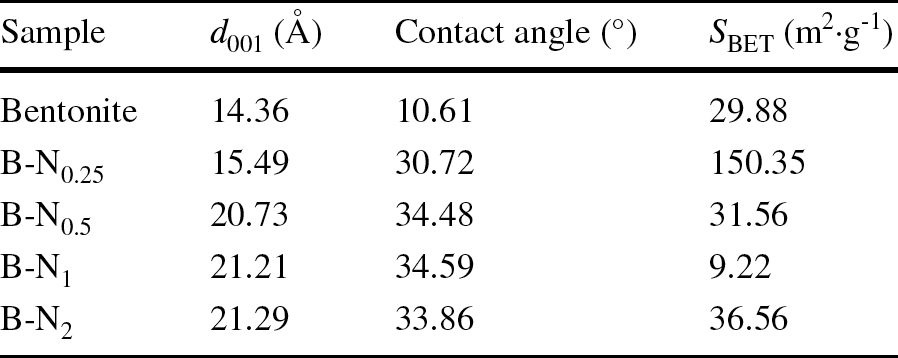
The solid-to-liquid ratios (w/v) of APTES-modified bentonite were sequentially varied through values of 1:0.25, 1:0.5, 1:1, and 1:2. The comparison of XRD patterns for bentonite and modified bentonite (Fig. 4, Table 2) gave the basal spacing at 6.1°2θ (14.36 Å) before the modification. The introduction of APTES shifted the peak to lower angles, giving basal spacings of 15.49 Å for B-N0.25, 20.73 Å for B-N0.5, 21.21 Å for B-N1, and 21.29 Å for B-N2. This suggests that APTES was grafted/inserted into the interlayer domains of the constituent montmorillonite (Mnt) of the bentonite (Bertuoli et al., Reference Bertuoli, Piazza, Scienza and Zattera2014; Huskic et al., Reference Huskic, Zigon and Ivankovic2013). However, with the addition of APTES, the increase in basal spacing was non-linear, suggesting that APTES molecules were first grafted onto the Mnt surface, and then entered the interlayer space. Eventually, further increases in the amount of APTES failed to increase the interlayer spacing, indicating that the adsorption of APTES in the interlayers reached the maximum. The structure of hydrolyzed APTES was similar to an alkyl chain with a height of ~4 Å (He et al., Reference He, Duchet, Galy and Gerard2005). Therefore, the observed maximum interlayer spacing of 21.29 Å indicated that APTES was arranged in not more than two parallel bilayers between the Mnt layers.
Basal spacing (d 001), contact angle, and specific surface area of raw and amino-modified bentonite

After APTES modification, the contact angle and specific surface area measurements (Table 2) of bentonite revealed that, with the increase in the APTES loading, the contact angle increased due to the presence of more hydrophobic surface. Moreover, the APTES loading affected the specific surface area, which increased from 29.88 m2 g-1 for the raw bentonite to a maximum of 150.35 m2 g-1 for B-N0.25. The value decreased to 9.22 m2 g-1 for B-N1, and increased again to 36.56 m2 g-1 for B-N2. When the solid-to-liquid ratio was 1:0.25, a sharp increase in the specific surface area was observed, which was due to the dispersion of Mnt by anhydrous ethanol that was used in the modification process. Only a small amount of APTES reacted with the external Mnt surfaces and did not enter the interlayer. As the amount of APTES increased, it gradually moved into the interlayers, resulting in a gradual reduction in the specific surface area. When the solid-to-liquid ratio was 1:2, some APTES self-polymerized, which could not be accommodated in the interlayers. For this reason, the surface occupied by APTES and the interlayer spacing of Mnt decreased, while the specific surface area increased.
The mechanism for the grafting of APTES onto bentonite is proposed as follows (Fig. 5). The Si-O groups forming the basal surfaces of Mnt are known to form hydrogen bonds with polar molecules such as H2O (Yan et al., Reference Yan, Low and Roth1996a; Yan et al., Reference Yan, Low and Roth1996b; Yan et al., Reference Yan, Roth and Low1996c; Yan et al., Reference Yan, Roth and Low1996d; Yan & Stucki, Reference Yan and Stucki1999; Yan & Stucki, Reference Yan and Stucki2000). Such groups in the hydrolyzed form of APTES become hydrogen bonded to the basal surfaces both internal and external to the interlayer region. This could be considered a condensation reaction (Bertuoli et al., Reference Bertuoli, Piazza, Scienza and Zattera2014). The irreversible grafting reaction between Mnt and APTES included two basic steps (He et al., Reference He, Duchet, Galy and Gerard2005). At first, the APTES molecules occupied only the external surfaces and the specific surface area remained unchanged. Then, the APTES molecules expanded the interlayers as they moved into them, thus increasing the specific surface area. Previous studies demonstrated that APTES molecules were arranged in parallel bilayers between the natural Mnt layers (He et al., Reference He, Duchet, Galy and Gerard2005).
Surface-charge Characteristics of Amino-modified Bentonite and Humic Acid
Zeta potential measurements (Fig. 1) revealed that raw bentonite, amino-modified bentonite, and HA were all negatively charged at the pH values of 2, 3, 5, 7, 9, and 11. HA is well known as an anionic polyelectrolyte over a wide pH range. As a mineral, raw bentonite is mainly composed of Mnt, and has a permanent negative charge on its basal surfaces due to isomorphic substitution. The amino-modified bentonite obtained from APTES modification had amino silane cations. With the decrease in pH, the zeta potential of amino-modified bentonite increased distinctly.
Zeta potential of bentonite, amino-modified bentonite, and HA at various pH

Adsorption of HA Using Amino-modified Bentonite
Effects of pH, initial concentration, and degree of modification of amino-modified bentonite on the adsorption of HA
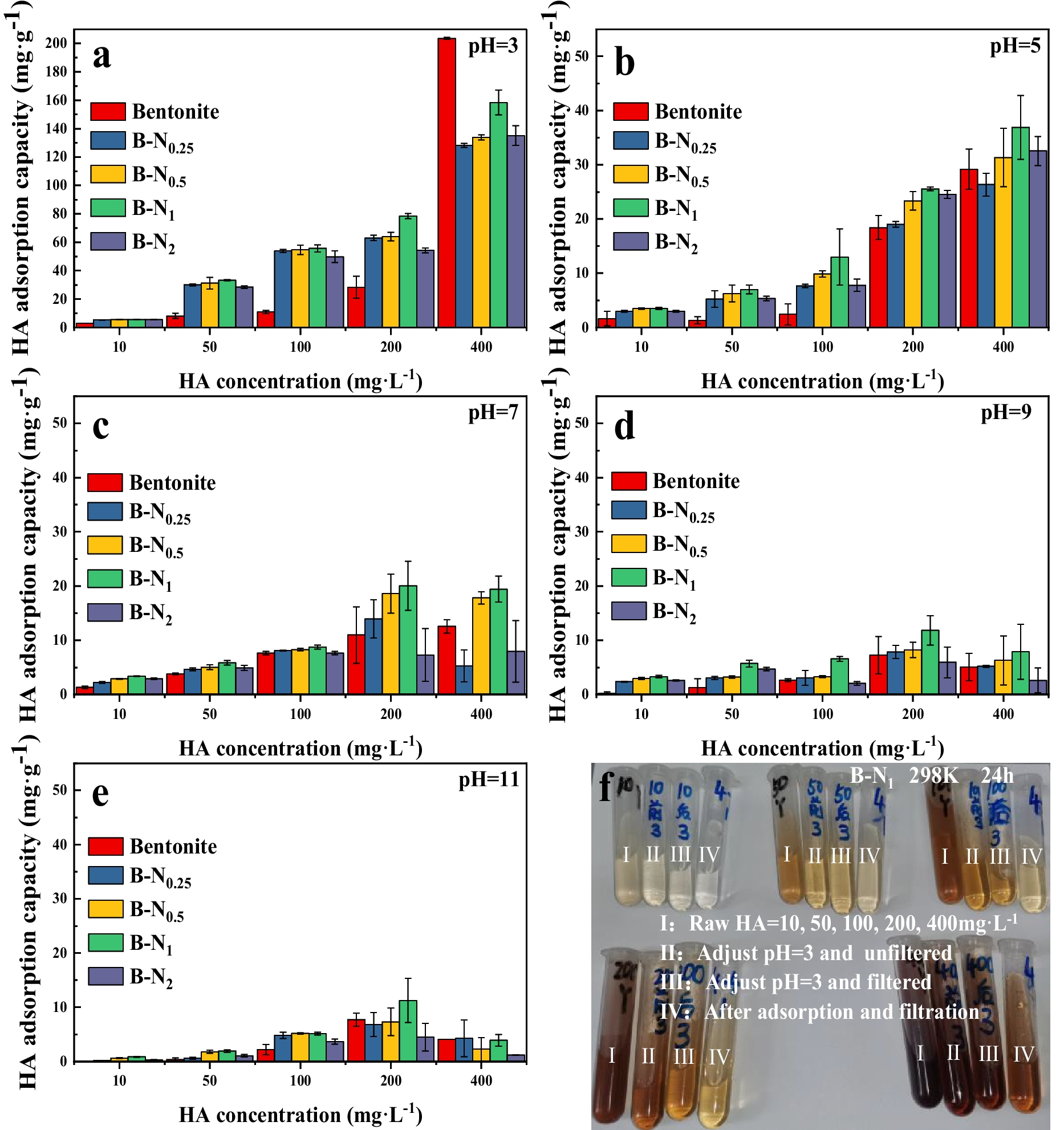
The adsorption of HA onto amino-modified bentonite is significantly affected by pH, HA concentration, and modification degree (Fig. 2a-e). As pH increased gradually from 3 to 11, the adsorption of HA onto amino-modified bentonite with different modification degrees decreased. The effect of HA concentration on adsorption is also related to pH. Under acidic conditions (pH 3 and 5), the adsorption increased with increasing HA concentration (10–400 mg L-1). At HA concentration of 400 mg L-1 and pH 3, the adsorption of HA onto amino-modified bentonite with different modification degrees reached a maximum, namely 203.56, 128.21, 133.84, 158.37, and 135.11 mg g-1, respectively. Under neutral or alkaline conditions (pH 7, 9, and 11), the adsorption increased with increasing concentration to a certain optimal point, and then decreased. The adsorption also first increased and then decreased with increasing modification degree (VAPTES:mMnt from 0 to 2), with B-N1 (VAPTES:mMnt = 1) exhibiting the greatest adsorption of HA. Considering the above three factors, when pH was 3 and HA concentration was 400 mg L-1, B-N1 exhibited the greatest adsorption of HA, which was 158.37 mg g-1. An anomalous phenomenon that does not conform to the above patterns was also observed, where the adsorption of HA onto raw bentonite reached 203.56 mg g-1 at pH 3 and HA concentration of 400 mg L-1.
Adsorption of HA by raw and amino-modified bentonite at various pH (T = 25°C; t = 24 h): a-e effect of B-N x as adsorbent on the extent of HA adsorption; f visible changes in color of samples from a-e

pH is a critical factor that affects the surface chemistry of amino-modified bentonite and the conformation of HA. At low pH, the surface of amino-modified bentonite became positively charged due to protonation of -NH2, inducing electrostatic adsorption of negatively charged HA (Wang et al., Reference Wang, Li and Yue2022). As the solution pH increased, the deprotonation of the surface of amino-modified bentonite led to a decrease in HA adsorption. This indicated that the adsorption capacity of amino-modified bentonite for HA is related to the surface-loaded -NH2 groups. In addition, under low pH conditions, the protonated HA became coiled and aggregated, forming droplet aggregates, which favored HA adsorption (Deng & Bai, Reference Deng and Bai2003b). At pH 2.5, the average hydrodynamic diameter of HA aggregates (50 mg L-1) increased gradually from ~460 nm to 1700 nm within 1 h (Lan et al., Reference Lan, Wu, Liu, Stroet, Liao, Chai, Mark, Liu and Wang2022). As the droplets increased gradually and became spherical, the HA aggregates become more compact. With higher HA concentrations, more large aggregates, precipitation, and even flocculation can occur. At pH 3 and with HA = 400 mg L-1, the addition of raw bentonite promoted the aggregation of HA, resulting in a large number of large HA aggregates (>460 nm) in the system. After filtration through a 0.45 μm membrane, the large HA aggregates were removed, and the supernatant became clear (Fig. 2f). The absorbance also decreased, and the calculated adsorption capacity increased. This is probably the reason for the anomalous adsorption capacity of raw bentonite for HA. As the degree of modification increased, the adsorption capacity of amino-modified bentonite for HA increased gradually to an optimal point and then decreased. This indicated that the number of surface-loaded -NH2 groups also affected the adsorption capacity of amino-modified bentonite for HA. Therefore, considering the cost and performance of adsorbents, B-N1 was selected as the most suitable adsorbent for further experiments.
Isothermal adsorption, intraparticle diffusion, and adsorption kinetics and adsorption thermodynamics of HA on amino-modified bentonite
From the adsorption results of HA on amino-modified bentonite at various pH and initial concentrations of HA, sample B-N1 had the best adsorption performance for HA, so it was selected as the optimal adsorbent to be used in subsequent experiments.
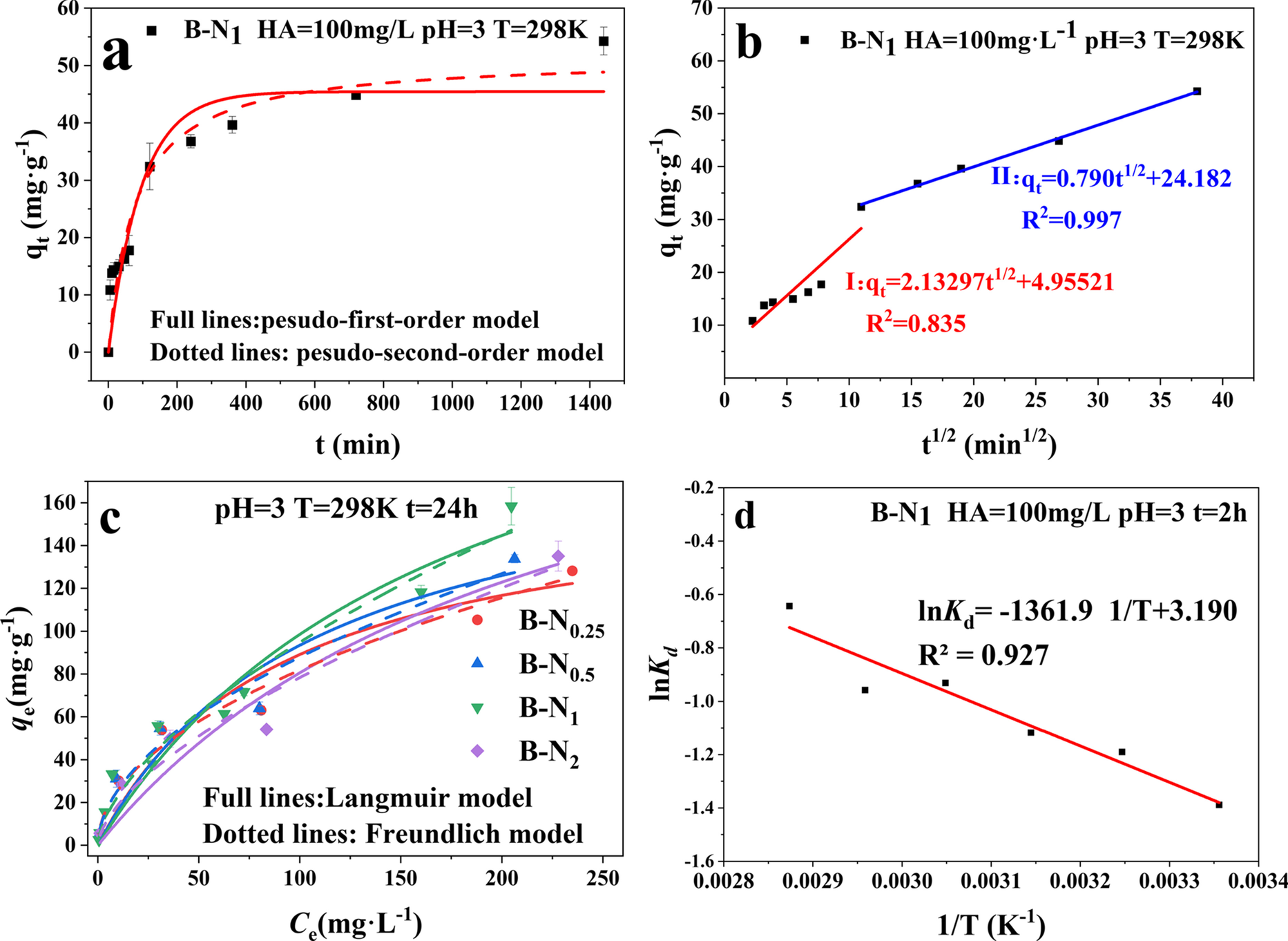
The kinetics data of HA adsorption on B-N1 fitted the pseudo-second order model well, as indicated by the coefficient of determination (R2 = 0.921) (Table 3). The results showed that the adsorption of HA was related to the surface groups of B-N1 (Doulia et al., Reference Doulia, Leodopoulos, Gimouhopoulos and Rigas2009). The kinetic process (Fig. 3a) showed a sharp increase during the initial phase of adsorption (<120 min), which was attributed to the abundance of available exchange sites, strong chelation, and efficient mass transfer. When the contact time between B-N1 and HA was prolonged, the HA adsorbed on B-N1 increased slowly. The large adsorption capacity in the first 2 h was due to the availability of abundant adsorption sites on B-N1, which were gradually filled with HA molecules over time (Dehghani et al., Reference Dehghani, Zarei, Mesdaghinia, Nabizadeh, Alimohammadi, Afsharnia and McKay2018). When many adsorption sites on the surface of B-N1 were occupied, the intermolecular repulsion force of the adsorbed HA increased. The rate of adsorption decreased gradually. In order to elucidate the diffusion mechanism, the intra-particle diffusion model was used to simulate the diffusion process of HA (Fig. 3b). The results indicated that the adsorption of HA involved two stages. First, HA was transported to the outer surfaces of B-N1 through the liquid film, and then migrated from the outer surfaces into the inner pores. Therefore, the diffusion step mainly consists of membrane and intraparticle diffusion (Wang et al., Reference Wang, Li and Yue2022). The Freundlich model gave the best fit of the data for HA adsorption on amino-modified bentonite (Wang et al., Reference Wang, Yue, Cui, Zhang and Dong2021a) (R2 = 0.958-0.973) (Fig. 3c, Table 4). Furthermore, B-N0.25 showed a greater adsorption affinity (KF) than other amino-modified bentonites. The fitting results of the Langmuir model (Table 4) showed the maximum monolayer adsorption of HA on B-N0.25, B-N0.5, B-N1, and B-N2 to be (q m ) 169.015, 193.505, 272.230, and 258.887 mg/g, respectively. Of these, the maximum adsorption capacity of B-N1 was the highest. The respective R L values were calculated to be 0.185, 0.217, 0.294, and 0.385, indicating a favorable adsorption of HA by amino-modified bentonite (Bagherifam et al., Reference Bagherifam, Brown, Fellows, Naidu and Komarneni2021).
Kinetic parameters of HA adsorption on amino-modified bentonite

a Adsorption kinetics of HA onto B-N1; b internal diffusion for HA uptake by B-N1; c adsorption equilibrium isotherms of HA onto B-N0.25-2; d thermodynamic parameters of adsorption of HA on B-N1

Isothermal adsorption constant and coefficient of determination for the adsorption of HA on amino-modified bentonite

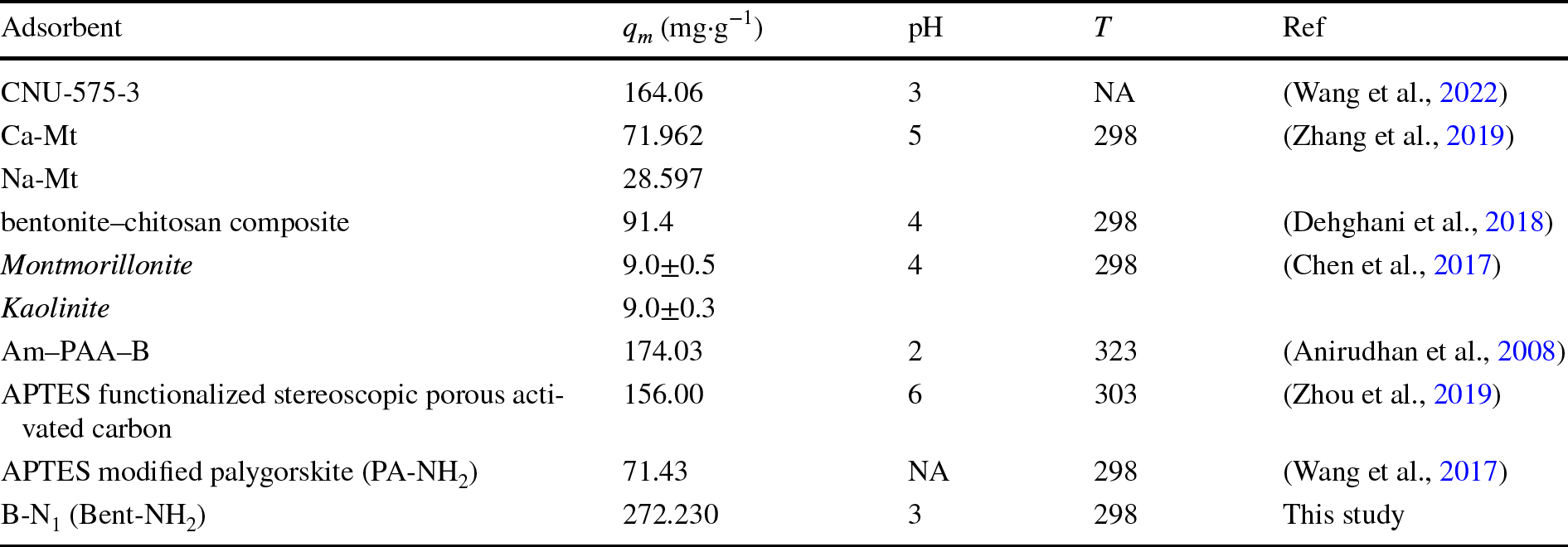
In terms of thermodynamic parameters (Table 5), ΔH was positive, indicating that the adsorption of HA by B-N1 was an endothermic process. On the other hand, ΔG was positive and decreased with the increase in temperature, indicating that high temperature was more conducive to the adsorption of HA. Additionally, B-N1 was compared with the reported bentonite-based adsorbents and other samples for adsorption of HA (Table 6). The results showed that B-N1 was more competitive than other adsorbents in terms of the removal of HA from aqueous solution.
Thermodynamic parameters of adsorption of HA on B-N1

Comparison of HA adsorption performance of amino-modified bentonite and other samples

Structure, Morphology, and Spectroscopic Properties of Adsorbed Samples
Comparison of the XRD patterns from the samples before and after HA adsorption (Fig 4a) showed that the d 001 value increased significantly after modification with the APTES, indicating that it entered the Mnt interlayers and was arranged in parallel double layers. After the adsorption of HA, the basal spacing increased slightly compared with that before the adsorption, suggesting that small HA molecules in HA may have entered the Mnt interlayer during adsorption. Meanwhile, the raw bentonite sample was not purified before the modification. After modification and adsorption, partial loss of Mnt in the sample was observed during the suction filtration process. Enhancement of the quartz peak in the sample was observed as a result.
Comparison of a X-ray diffraction, b SEM, c FTIR, d XPS scans, e O1s XPS spectra, and f N1s XPS spectra before and after adsorption of HA by raw and amino-modified bentonite

SEM images showed (Fig. 4b) that the bentonite had a characteristic layered pattern of irregular clay folds. After loading APTES, a smooth and dense structure appeared due to the covering of APTES, proving that APTES successfully modified the bentonite. Comparison of the SEM images of HA and B-N1-xf-HA confirmed that B-N1 was wrapped onto the surface of HA.
Most of the characteristic FTIR vibration positions of bentonite remained unchanged after amino modification (Fig. 4c). The characteristic peaks of unmodified bentonite were present at 3698 and 3622 cm-1, which were due to the stretching vibrations of Al-OH. Moreover, the symmetric and asymmetric O-H overlapping stretching vibration of the adsorbed water molecules caused a broad band near 3436 cm-1. The band at 1640 cm-1 was the manifestation of the bending vibration of O-H. The asymmetric stretching vibration of the Si-O-Si tetrahedra in Mnt caused the vibration near 1035 cm-1. After APTES modification, the stretching vibration peak of -CH2 (Mekidiche et al., Reference Mekidiche, Khaldi, Nacer, Boudjema, Ameur, Lerari-Zinai, Bachari and Choukchou-Braham2021) was observed at 2937 cm-1. At the same time, many small peaks in the range 1490-1580 cm-1 appeared, confirming the presence of the organic modifier in the bentonite. Perhaps the amino groups grafted onto bentonite were involved in the coupling of HA through electrostatic or hydrogen bonding.
In order to clarify the adsorption mechanism of HA by B-N1, a comparison of XRD, FTIR, and XPS results before and after adsorption was conducted. The characteristic peaks of the full XPS spectra of HA, B-N1, and B-N1-xf-HA (Fig. 4d) at 532.17, 401.87, 284.80, and 102.73 eV were attributed to the binding energies of O1s, N1s, C1s, and Si2s, respectively. Compared to O1s peaks before and after the adsorption (Fig. 4e), the O1s peaks of B-N1-xf-HA showed apparent shifts to higher binding energies, with transitions of ~0.36 eV. This transition indicates that the oxygen-containing groups of HA were electronically coupled to the -NH2 groups on the surface of B-N1 (Wang et al., Reference Wang, Yue, Cui, Zhang and Dong2021a). The peaks at 399.29, 399.82, and 399.87 eV were assigned to the nitrogen atom in the -NH2 group (Fig. 4f), whereas those at 401.82 and 401.98 eV were ascribed to the protonated amine (-NH3 +). Moreover, the N1s peak shifted to lower binding energy during the adsorption of HA. Combined with the high resolution spectrum of O1s, the electronic coupling between the amino group on the bentonite surface and the oxygen-containing group of HA was proven (Feng et al., Reference Feng, Hasegawa, Suga, Nishide, Yang, Chen and Li2019). At the same time, the area ratio of -NH3 +:-NH2 of B-N1 was 1:0.67. After the adsorption, the ratio changed to 1:0.48, indicating that protonated amino groups may have been generated on the surface of B-N1, induced by H-bonds under low pH conditions. Furthermore, lower pH induced more protonated amino groups for the adsorption of HA. This may explain why amino-modified bentonite effectively adsorbs HA under low pH conditions (Deng & Bai, Reference Deng and Bai2004; Quan et al., Reference Quan, Sun, Xu, Liu, Han, Xu, Meng, Wu and Zhang2020; Zhao et al., Reference Zhao, Luo, Wasikiewicz, Mitomo, Nagasawa, Yagi, Tamada and Yoshii2008); upon protonation, -NH2 switches from an electron-donating to an electron-accepting state. One may speculate, therefore, that electrostatic interactions may exist mainly between the protonated -NH2 and -COO-. As revealed earlier, the adsorption of HA on amino-modified bentonite is mainly regulated by electrostatic interactions and hydrogen bonds (Xie et al., Reference Xie, Lu, Mao, Wang, Han, Hu, Lu, Wang and Zeng2020; Zhang et al., Reference Zhang, Lu, Zhan, Qiu, Wang, Wu, Li, Qiu and Peng2021).
Mechanism Analysis
In summary, the preparation process of amino-modified bentonite and its adsorption mechanism for HA (Fig. 5) involved the grafting of APTES into the Mnt interlayers, on their outer surfaces, and at layer edges to obtain amino-modified bentonite. Next, in an aqueous solution at pH 3, HA was adsorbed onto amino-modified bentonite. The -COO- on the surface of HA became adsorbed to the -NH3 + on the surface of B-N1 through electrostatic interaction, which is the primary adsorption process, and also through the formation of hydrogen bonds between the unprotonated amino groups on the surface of amino-modified bentonite and the oxygen-containing groups of HA. Both of these adsorption mechanisms were strongly affected by the pH. As the pH increased, the amino groups of amino-modified bentonite deprotonated. The electrostatic interactions and hydrogen bonds weakened or became ineffective, which led to the desorption of HA.
Schematic diagram of the preparation process of amino-modified bentonite and its adsorption mechanism for HA

Conclusions
In this study, a new type of amino-modified bentonite adsorbent was prepared through APTES modification using raw bentonite. The adsorbent had a high adsorption capacity for HA in an aqueous solution. The results showed that at 298 K, the maximum adsorption capacity of B-N1 was 272.23 mg g-1. The adsorption kinetics fit the pseudo-second order model, as well as the Freundlich model. The results also showed that the adsorption affinity was mainly related to the number of amino groups loaded on the surface of the bentonite. The adsorption mechanism of HA on amino-modified bentonite consisted of electrostatic interactions and hydrogen bonding. The study showed that amino-modified bentonite has significant potential to be applied as an adsorbent of HA in aquatic bodies.
Acknowledgments
This work was supported by the National Key R&D Program (2018YFC1802902).
Declarations
On behalf of all authors, the corresponding author approves all ethical responsibilities for publication in the journal Clays and Clay Minerals and consent to participate. This manuscript has not been published in full or in part previously and has not been submitted elsewhere nor is it under consideration by another journal.
Conflict of Interest
The authors declare that they have no conflict of interest.