I. Introduction
For some time now, there has been a perceived need to prepare law students to handle legal issues beyond national borders.Footnote 1 Much has been written on how globalisation should shape legal education, but no clear direction has emerged. Different stakeholders no doubt influence the multiple strategies suggested.Footnote 2 Law faculties also differ greatly in terms of human capital, resources and legal culture, and what is appropriate for a particular law school will vary.Footnote 3 The volume of potentially relevant material in a more global practice is overwhelming, even if it is agreed that most legal problems are not global in the strict sense of the word (Twining, Reference Twining2010, pp. 24–25); no law school could teach it all and it would be silly to try. There is no blueprint for global initiatives (Fine, Reference Fine2000, pp. 598–599).
Running parallel to acknowledgements that legal education should prepare students for a more global practice is the recognition that domestic law continues to be central to the practice of law (Bortoluzzi, Reference Bortoluzzi2010, pp. 10, 17–19; A-Khavari, Reference A-Khavari2006, pp. 81–82; Loke, Reference Loke2006, pp. 279–280). Most law schools focus on teaching students the law applicable in their jurisdiction.Footnote 4 There are notable exceptions, such as the trans-systemic approach used at McGill University,Footnote 5 and the Global Law programme at Tilburg University which blends social science and global law.Footnote 6 These programmes, though, have not been widely adopted. The law schools that incorporate a more fundamental global orientation have, for historical or other reasons, the will and resources to be different. Graduates of most law schools seek admission to practise the national law of the law school, and law degrees represent proficiency in that domestic law.Footnote 7
Both of these apparently opposing impulses, to accept or reject a global orientation in the law school curriculum, suggest that law schools could better prepare students by taking a skills approach that addresses the processes or skills required in a more global practice (Risse, Reference Risse2004, p. 148; Bortoluzzi, Reference Bortoluzzi2010, p. 12). The methods explored here allow the law school curriculum to supplement a core curriculum based on domestic law by identifying and teaching key global legal skills in a variety of upper-level courses,Footnote 8 without placing unrealistic demands on law school offerings and budgets.Footnote 9 In fact, the approach explored in this paper is premised on a diverse group of students, each with their own national orientation, who are used to create a learning experience that sensitises them to the demands of global practice and develops their ability to analyse unfamiliar environments.
Taking a skills approach to global legal education arguably requires some rethinking of what legal skills are. Skills have in fact been included in a number of discussions of global legal education,Footnote 10 but the proposed lists of global legal skills frequently reiterate domestic conceptions of legal skills, albeit supplemented with fairly general suggestions regarding comparative law and legal culture. Domestic legal skills have developed a number of areas potentially relevant to global legal practice,Footnote 11 reviewed in more detail below,Footnote 12 but conceptualising legal skills in a manner suited to domestic legal systems is ultimately insufficient in the global context. What students do not need, for example, is another IRAC (the ubiquitous format of Issue, Rule, Analysis, and Conclusion used to structure common-law analysisFootnote 13), but rather exposure to those aspects of global practice which differ from skills in domestic legal systems. In the sense suggested here, global legal skills refers not just to the analytical methods used in the domestic law of jurisdictions that are foreign to a student, but to the tools necessary to navigate between a student's domestic system and other systems. Legal skills in the global context should also enable students to understand and incorporate the future experiences they will have with a variety of legal environments.
This paper seeks to articulate how law schools can conceptualise legal skills at a global level. The paper focuses on the abilities that are primarily though not exclusively active in problem-solving in this context. Specifically, the paper suggests that students should be exposed to the distinctive qualities of comparative thinking, such as learning how to more coherently compare unfamiliar environments,Footnote 14 and gaining proficiency in framing questions suited to particular types of legal work, such as advocacy or transactions.Footnote 15 Question framing as used in this paper is based on the field of heuristics, and the main writer considered is maths scholar George Polya. The paper also examines the contribution of Robert Rhee, a legal academic who applied Polya's heuristic approach to the Socratic method, and then briefly reviews the limitations of this problem-solving approach in more recent educational research. The paper then considers how heuristics as explained by these authors could apply to global legal skills and gives an example of how heuristics, together with comparative thinking, could be taught in the law school context.
The skills identified in the paper are based on the author's experience teaching common-law methodology to civil-law students in a graduate degree programme for many years, as well as teaching global legal skills in the context of persuasive argument and advocacy. The struggles faced by civil-law graduate students and their resulting insight into different legal systems persuaded the author that students in an initial law degree need preparation in skills beyond the domestic context in order to be competitive. These challenges led the author to develop a skills course at the National University of Singapore Faculty of Law, Comparative Advocacy, which addresses the issues raised by advocacy in a more global practice. The observations that form the basis of the skills articulated in this paper therefore arise out of the experiences of students in these courses over the years. Additional empirical research on preparation for global practice and actual practice requirements is needed to develop the area of global legal skills.Footnote 16 The precise extent that lawyers assist with issues outside national borders is still unclear, and currently scholarship on global legal education proceeds without it. Additionally, application of the global legal skills suggested in this paper in different jurisdictions must be context-specific. The paper is therefore primarily theoretical in nature and attempts to bring a skills perspective to the task of identifying the distinctive thinking tools required when law students encounter the legal other.
II. Conceptualising global legal skills
Legal skills are frequently defined in a way that distinguishes what lawyers know from what lawyers do, with skills focusing on what lawyers do.Footnote 17 Legal skills courses often focus on particular tasks performed by lawyers, such as advocacy, negotiation and transactional work, but the oft-cited distinction between doing and knowing does not necessarily describe the learning that occurs in legal education, or the abilities that are required for successful law practice (Shultz and Zedek, Reference Shultz and Zedek2011). The doing–knowing distinction also creates a division between doctrinal and skills courses that is occasionally counter-productive. When students learn rules of law they also learn legal analysis, and when students learn legal analysis or legal research they necessarily learn legal rules. Substance is intimately connected with skills. For the purposes of this paper, a better definition of skills would arguably be the considerable variety of analytical processes used to solve a legal problem, processes that are not tied to one particular subject matter but which apply to multiple areas of law.
This larger notion of legal skills is evident in discussions of the skills required in a more global legal practice (Menkel-Meadow, Reference Menkel-Meadow2011, p. 101; Cahn, Reference Cahn2001, p. 59). Lists in varying degrees of detail have been suggested; some lists articulate skills that duplicate domestic legal skills, such as research and writing.Footnote 18 Some lists note the need for skills that address more global demands but do not attempt further detail.Footnote 19 Toni Fine notes that legal education must develop more concrete notions of what globalised legal and related skills are required, and she identifies basic methodologies of comparative law practice as particularly important (Fine, Reference Fine2000, pp. 601, 602).Footnote 20 Jonathan Cahn identifies three sets of skills: English language skills, lawyering skills that translate across national boundaries, and an aptitude for multi-disciplinary problem-solving (Cahn, Reference Cahn2001, p. 59). In the Australian context, Afshin A-Khavari identified eleven skills relevant to transnational practice, noting that many incorporate intercultural dimensions: reflexes of a bi-jural or multi-jural mind, or the ability to think through different legal problems using two or more legal systems; interdisciplinary problem-solving; legal research particularly in foreign law; legal analysis; sorting between urgent and less urgent information; communication skills; multilingual abilities; and mediation, arbitration, diplomatic, advocacy, and legal consulting skills (A-Khavari, Reference A-Khavari2006, pp. 85–87).
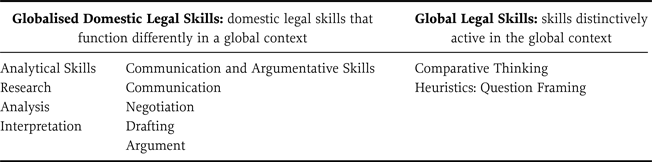
These lists include skills that are familiar in the domestic context, such as legal research, legal analysis and communication. There is little doubt that these types of skills are relevant to legal practice at any level, and there is a wealth of material addressing these skills in the domestic context of many jurisdictions. However, Jeffrey Waincymer has suggested that attempts to internationalise legal education benefit from an articulation of the goals to be acquired (Waincymer, Reference Waincymer, Steele and Taylor2010, pp. 68–88). In order to prioritise the skills needed in law school, this paper distinguishes between two categories of skill at work in the global context: “globalised domestic legal skills”, skills that appear similar to domestic legal skills but work differently in the global context; and “global legal skills”, skills that are distinctively global, or at least significantly more prominent in a global context. This paper suggests that these global legal skills are comparative thinking, together with the ability to frame relevant questions to understand an unfamiliar legal environment, and that together they form appropriate goals in skill training at a global level (see Table 1).
Categories of global legal skill

For example, if a lawyer is called upon to represent a client in an international arbitration, the familiar domestic law skills of research, analysis, communication and argument would all be called upon. If, however, the panel comprises arbitrators from different jurisdictions, analysis of the law and the way it is communicated and argued would have to consider the challenges posed by a diverse panel (Sourgens, Reference Sourgens2007, pp. 12–20). Persuasive argument, a skill set developed and taught in many domestic common-law faculties, is called for, but a lawyer with stronger comparative abilities will be better able to predict and address the different tone and types of argument required to persuade a diverse arbitration panel. Comparative argument of this type is an example of legal skills that look similar to the domestic context but, when practised in a global context, impose dramatically expanded requirements in terms of law, legal culture and language. Such skills can be referred to as globalised domestic legal skills, because they are similar to the domestic legal skills taught by some law schools but they function differently in the global context. The challenges posed by these skill requirements are considerable, but not that far beyond our imagination, and manageable if the proper resources are available.
Globalised domestic legal skills, however, are only part of the global picture, and the easier part. The reason that globalised domestic legal skills have been envisioned and taught to some degree at this point is that the departure and destination jurisdictions – the beginning and end points of the process – are known. When Damaska (Reference Damaska1968) describes the conceptual disconnect faced by a continental civil-law student studying American common law, he can do so not only because he has been through this experience as a student and professor, but because the starting and ending points of comparison are clearly identified: from a European civilian jurisdiction to the American common-law system. Thankfully, some of what law students will encounter in a more global practice, such as major legal traditions, can be predicted and incorporated into the law curriculum, but others cannot. As lawyers, students will also hopefully be working with mentors who will assist them to navigate new environments. The fact remains, though, that throughout their legal career, lawyers will likely be encountering environments that are different from their domestic environment, in ways they have not previously studied. Preparing students to handle what they have not yet been taught is part of what the global environment requires. The question then becomes what skills could help a lawyer analyse an unfamiliar environment.
2.1 Insight from domestic legal skills
To some degree, of course, law schools already address the issue of how to deal with unknown law.Footnote 21 The prevailing wisdom in legal education professes that law schools should primarily teach a way of thinking, not substance. Even law schools that focus on domestic law do not teach every domestic legal rule, and legal research is taught to enable students to update and find relevant law.
Donald Schön's work on the reflective practitioner highlights the degree to which most professional work starts in confusion and requires practitioners to plunge into doing without knowing.Footnote 22 Teaching methodologies developed for certain areas of domestic legal skills also have considerable relevance to global legal skills. In particular, clinical legal education has explored how to teach students to manage the uncertainty contained within domestic legal practice.Footnote 23 Susan Bryant and Elliot S. Milstein discuss the reflective discussion of clinical experiences known as ‘rounds’, a class discussion of clinical cases which is not the finely focused feedback of one-on-one student supervision or the introduction of teacher defined learning points regarding theories of lawyering or social justice (Bryant and Milstein, Reference Bryant and Milstein2007, pp. 200–201). Most relevant to the global context are the rounds teaching techniques of collaborative learning, reflection, moving from the particular to the general, and contextualized thinking (pp. 208–223). Collaborative learning occurs when students identify a range of options together to solve a legal issue in a context of uncertainty (pp. 208–213).Footnote 24 Collaborative learning is not just a collection of ideas, but rather a process of emergent knowledge that describes the potential of a group of learners to develop insight and knowledge using a synthesis of individual ideas (see Bryant and Milstein, Reference Bryant and Milstein2007, p. 211 n. 40; Bryant, Reference Bryant1993, p. 460 n. 6). Collaborative learning is especially important when divergent thinking and creativity is called for,Footnote 25 such as the global legal context where students must seek the insight of other perspectives. Collaborative learning helps teach students to look at issues through the eyes of others, thereby sensitising them to their own perspectives and the role that perspective plays in the analytical process (Bryant, Reference Bryant1993, p. 490). Collaborative learning is also crucial in the global context because, while most law schools teach a critical mass of domestic law, they cannot teach more than a fraction of foreign or international law,Footnote 26 thereby requiring beginning lawyers to rely on each other to an even greater degree.
Bryant and Milstein also note that all professionals learn through the process of reflection, which in the case of clinical students involves using clinical cases to give meaning to lawyering theories and exploring when theories need refining (Bryant and Milstein, Reference Bryant and Milstein2007, p. 213). An important lesson arising out of reflection involves making implicit assumptions explicit, which often remain hidden until someone suggests a different approach (p. 215). When students move from the particular to the general, they not only test theory against the context of the real world. They also develop tentative hypotheses about lawyering to explain previous experience and test future experiences, and in a collaborative classroom, share those theories with other students (p. 216). Contextualised thinking allows students to select what variables in the environment are most relevant in selecting and applying an explanatory theory (p. 220).
The lessons learned from clinical legal education are highly relevant to methods explored in this paper regarding global legal skills. However, as explored below, the extent of diversity encountered once law students leave the domestic environment arguably presents a different order of difficulty. There is uncertainty in domestic legal practice, but once lawyers leave the domestic sphere, more of the matters that students take for granted are open to question. For example, lawyers trained in jurisdictions such as the US and the UK work with layperson juries as a matter of course. Other jurisdictions have no role for laypersons in the resolution of legal disputes. Once this particular difference is pointed out, students can take note, but how can students venturing into an unfamiliar jurisdiction identify the matters that will pose conceptual challenges, for the lawyer and the matter at issue?
Cross-cultural competence is another area of insight developed in the context of clinical legal skills. Susan Bryant's article on ‘The Five Habits’ notes that American students will inevitably interact with those who are culturally different (Bryant, Reference Bryant2001, p. 39). If students are taught how to recognise the influence of culture in their work, and to understand if not accept the viewpoint of others, they will gain the skills necessary to communicate and work positively with future clients and colleagues (p. 40). One of the techniques used in cross-cultural competence is ‘Parallel Universe’, the explicit exploration of alternative explanations for client behaviour (Bryant, Reference Bryant2001, pp. 70–72; see also Bryant and Milstein, Reference Bryant and Milstein2007, pp. 223–225). Of relevance to global legal practice is the distinction between individualistic and collective cultures, particularly if a dispute is contested using an Anglo-American adversarial method of dispute resolution (Bryant, Reference Bryant2001, p. 46).
This area of intercultural communication has obvious relevance to global legal skills, but some of the learning points articulated arise out of particular domestic environments. Work in this area is partially grounded in diversity training and the need to make students aware of racist or sexist attitudes. While some students might be surprised to learn that they actually have some of these assumptions, the existence of race and gender issues would surprise very few (American) students. How can students identify issues they are less aware of? In terms of an overall teaching approach, instructors can highlight this kind of ‘disorienting moment’Footnote 27 as an example of what students may encounter in a global context, but the common understandings about life and legal culture shared by a law school community are precisely the missing elements that students may encounter when they engage with unfamiliar jurisdictions.
The teaching methods suggested in this paper build on the domestic legal skills research reviewed above, but suggest that other development is needed. Global legal skills should help students identify the key characteristics of an unfamiliar environment. The field of heuristics, an area of education scholarship that is better developed outside legal education, informs much of the approach. Additionally, since students normally analyse unfamiliar legal environments by comparing them to the system in which they have been trained or are familiar with, they also need exposure to the distinctive characteristics of comparative thinking, which is relative in some ways that domestic analysis is not.
2.2 Characteristics of comparative thinking
The mathematician George Polya asserted that comparison is one of the requirements of problem-solving. According to Polya, we can scarcely imagine a problem absolutely new, unlike any unrelated or formerly solved problem; if such a problem did exist, it would be insoluble (Polya, Reference Polya1957, p. 98). In order to solve problems, students have to extract relevant elements from memory and mobilise the pertinent parts of formerly acquired knowledge (p. 110).
Comparative thinking is then a basic tool of understanding, and one used in domestic law. For example, when common-law students compare the common-law remedies available to a client in the law of tort and contract law, they are using comparison to better understand concepts previously understood in isolation. However, comparison seems to function differently in domestic as opposed to unfamiliar legal environments, because the gap between what is known and what is unknown is considerably greater. Functioning in a global environment requires students to understand unfamiliar law and culture, occasionally in ways that contradict fundamental student assumptions about legal rules as well as the role of law.
The clinical legal skills work on collaborative learning and intercultural communication is relevant here, to the extent that these areas highlight the role that the student plays in legal analysis. But when students attempt to understand less familiar environments by comparing them to a familiar domestic system, they will encounter two conceptual challenges. First, what they perceive is influenced by their own perspective and training; and second, what they perceive is influenced by the points of comparison they are using. The process of comparative thinking appears different from the way most domestic legal analysis is learned because the student learning process is relative in two ways: (i) the student's point of view is fundamentally important; and (ii) the insight produced depends upon the points compared.
2.2.1 The first relativity: the student's point of view is fundamentally important
When students study their domestic legal system, their shared assumptions create a basis for understanding that may not even be discussed. However, when students encounter a different environment, they encounter the self (Legrand, Reference Legrand, Nicholson and Biddulph2008, p. 5). Students' legal culture and legal training predisposes them to see law in a certain way, and so what students see and what they need to understand is determined in a very fundamental way by their legal identity (Bryant and Milstein, Reference Bryant and Milstein2007, p. 210; and see Bryant, Reference Bryant2001, p. 49). Günter Frankenberg raised this issue in connection with comparative law (Frankenberg, Reference Frankenberg1985). He suggested that comparison always proceeds from a given context, and that we must make scrupulous efforts to take the observer's perspective and experience into account (1985, pp. 415, 441). For example, if a student needs to work on a project in Malaysia and Singapore, the student would need to acquire somewhat different knowledge and abilities depending on his or her prior training. A US trained law student might group Malaysia and Singapore together, as they are both Asian nations with a common-law system (Fordham, Reference Fordham2006, p. 1). This student's challenges would likely be in distinguishing between them, for example in the role of sharia lawFootnote 28 or the extent to which English is used.Footnote 29 A US trained law student would be familiar with the common law, and therefore might think that the countries are essentially similar to the US, but the student might not grasp the concept of commonwealth identity and how it makes concepts from countries in the English tradition more persuasive than the US (Bell, Reference Bell and Tan1999, p. 12). On the other hand, a student from a jurisdiction where Islamic law plays a more prominent role, such as Malaysia, might need to grasp how a more secular country like Singapore incorporates Sharia principles.Footnote 30 Despite a history of shared statutes and precedents, the law and economic status of Singapore and Malaysia have diverged, so if a Singapore law student were assigned to the project, she might need to engage in more study of Malaysian primary materials than might be anticipated.Footnote 31
In helping students to cope with the relative nature of what they will require in a global context, law school courses can always make comparisons and point out differences between jurisdictions. However, a skills approach suggests that in order to grasp the individual nature of comparative insight, students need to make their own comparisons and discover for themselves what, in particular, they need to learn. Students will be better prepared for a global context if they begin practice with an appreciation that their legal culture and legal training predisposes them to see law in a certain way, and that this aspect of their legal identity needs to be recognised and addressed in order for them to function effectively.
2.2.2 The second relativity: comparative insight depends upon the points compared
The second way in which comparative thinking at a global level appears to differ from domestic legal analysis is that the insight gained by the student into different environments depends upon the points students compare. For example, a law student trained in Singapore could be called upon to help prepare for an oral argument in different forums. When compared to the Singapore Court of Appeal, the atmosphere in the Supreme Court of Canada during oral argument is more informal, humour arises more often, judges take a more respectful tone toward advocates, and some judges would be fluent in French as well as English.Footnote 32 If the forum was the UK Supreme Court, a Singapore trained law student would find that venue even more informal than the Supreme Court of Canada, with judges sitting at the same level as the advocates, wearing business suits instead of robes and wigs, and not appearing to be terribly concerned about time limits.Footnote 33 For all students, the dominant characteristics of forums are determined in part by what forums are compared.
As noted above, comparison is a basic tool, and insight into purely domestic legal analysis also depends to some degree on the points of comparison. The difference, though, is that domestic law and legal culture create a legal community, and students are expected to reach the insights shared by that community. The diversity of perspectives in a more global legal practice renders a community illusive, if not downright unobtainable. Students must learn from their experience in practice, but they need to know how the relative nature of the learning process affects the points they think they have learned.
Courses that purport to prepare students for a more global practice arguably need to address the distinctive elements of comparative thinking. Raising awareness of the relative nature of comparative thought is an appropriate goal because it differs from the challenges of domestic analysis many students learn, and because appreciation of this point may only arise haphazardly if left to self-discovery in practice.
In view of the two ways in which comparative thinking appears to be relative when contrasted with domestic legal analysis, what do students need? A didactic structure that students invariably follow, such as IRAC, will not do the necessary work. There is nothing wrong with applying IRAC in a domestic context, or with the idea of using a template of some sort to structure analysis. Given the relevant nature of comparative thinking, though, the global environment will require students to essentially create their own structure, in response to the particular task, jurisdiction and their needs. At some level, the structure needs to be questions, not answers.
2.3 Asking the right questions: heuristics
Given the variety of jurisdictions that law students can potentially encounter, and the fundamental manner in which student assumptions about law and legal culture may be wrong, students preparing for a more global practice need to learn how to ask the right questions. Framing the skill goal in this way allows for an analytical process that connects the student's particular background, including insights and limitations, with an unfamiliar jurisdiction. Students require a structure that allows them to make the necessary discoveries as well as reflect intelligently on their cumulative experiences. More specifically, they require a method that guides exploration of new environments, and allows them to identify key challenges posed by the environment and prioritise information, not a structure that tells them what to do in advance.
Scholars of pedagogy outside legal education, such as Richard Paul and Linda Elder, have addressed the general skill of question formulation. In their book Critical Thinking, Paul and Elder include a chapter entitled ‘Learn to Ask Questions: The Questions The Best Thinkers Ask’, where they assert that it is not possible to be a good thinker and a poor questioner (Paul and Elder, Reference Paul and Elder2006, p. 84). They note that while questions define tasks, express problems and delineate issues, answers ‘often signal a full stop in thought’, and only when an answer ‘generates further questions does thought continue’ (p. 84).
The importance of asking the right question is understood in the fields of legal pedagogy and advocacy.Footnote 34 Asking the right questions indicates that the questioner understands the context and has identified the issues raised by the context. In many US law schools, the art of asking questions is arguably at the heart of the Socratic teaching method. However, in the Socratic method, teachers ask most questions and students attempt to answer. If law schools cannot teach students everything they need to know in a global environment, then a method which assists students to figure out what they need to know is required. Generating only questions is obviously insufficient, but conveying the importance of questions to understanding new situations, and developing student ability to ask the type of questions better suited to generate potentially relevant information, is a legal skill worth developing in the complex world law students are entering. A model with much to offer this approach can be found in the field of heuristics.
2.3.1 Heuristics: overview
Heuristics does not have a single meaning, but the two definitions most relevant to this paper refer to either the study of problem-solving (Polya, Reference Polya1957, pp. vii, 129) or the rules of thumb used as problem-solving devices (Mullins, Reference Mullins2003, pp. 48–49). In his study of heuristics in the field of mathematics, George Polya noted that heuristics has a long history, beginning with Euclid (Polya, Reference Polya1957, pp. 112–113), and has been examined in numerous fields apart from maths, such as logic, psychology and education (p. vii). Modern heuristics endeavours to understand the process of problem-solving, and especially ‘the mental operations typically useful in this process’ (pp. 129–130).
2.3.2 Heuristics in the law
Writing in the legal field, Mullins noted that current usage of the term ‘heuristics’ has been influenced over the past few decades by cognitive psychology and decision theory (Mullins, Reference Mullins2003, p. 49). This usage corresponds more closely with the second definition of heuristics as problem-solving devices. Because the human mind is limited, our ability to deal with complexity and variables is limited. In order to reach decisions, our ‘bounded rationality’ (p. 48) causes us to resort to a heuristic approach that selects key variables out of the potentially infinite number. As Mullins puts it, to deal with limited brainpower and time, we use ‘mental shortcuts and rules of thumb’ (p. 48). Mullins used Saks and Kidd's example of how to figure out the next move in a game of chess: we do not systemically review every possible move (an algorithm), but rather the positions of the pieces in the centre of the board and the most important pieces (a heuristic).Footnote 35 Heuristics therefore simplify the decision-making process, frequently approximating the success rates of much more complicated types of analysis.Footnote 36
As used in much of the legal literature today, heuristics refers to a rule of thumb, or educated guess, that reduces the complexity of analysis and focuses on selected variables (Kelman, Reference Kelman2011). Mullins argued that rules of statutory interpretation are not rules of law, but rather heuristic, decision-making rules of thumb, which can used for different contexts and therefore pose no theoretical difficulty when they conflict in the abstract (Mullins, Reference Mullins2003, pp. 64–67). The difficulty posed by heuristics used in this sense is that it introduces bias into the decision-making process. For example, most of the time it makes sense to think of the plain meaning rule of statutory interpretation as a heuristic. It is reasonable to assume that the words used in a statute were meant to convey the meaning normally attributed to them by the bulk of informed readers (p. 57), and people interpreting statutes do not normally have the time to consider every possible nuance of every statutory word. However, in applying the plain meaning rule, the reader normally assumes that his or her plain meaning is everyone's plain meaning (p. 59). Each reader brings a different background to the statutory text, and a less biased statutory interpretation would have to consider the possibility that the reader's plain meaning is ambiguous to someone else (p. 60).
The definition of heuristic as a quick and dirty method of making decisions, which gets decisions made but incorporates bias, is also used in other domestic law contexts. Cass Sunstein cautions against the use of moral heuristics or moral shortcuts, because although rules of thumb can work well most of the time they also systematically ‘misfire’ (Sunstein, Reference Sunstein2004, p. 1558). In their book on how to engage in policy-making, Problem Solving, Decision Making, and Professional Judgment, Brest and Krieger (Reference Brest and Krieger2010) address two main heuristic biases, the representative heuristic, which leads people to confuse how often a characteristic occurs in a population with the likelihood that an event will happen (pp. 217–219), and the availability heuristic, which leads people to predict how probable an event is based on how quickly a similar incident comes to mind (pp. 252–254). They note that correcting for these biases is problematic (pp. 254–257).
Other authors in the legal field have used heuristics in another sense, as a device of discovery. That approach appears relevant to global legal skills. For example, Judith Younger described a heuristic approach she used, a Community Land Use Game for a land use planning seminar (Younger, Reference Younger1969). After an initial class meeting, which presented legal concepts and rules, students engaged in a game where they made actual decisions in simulated problems. Younger defined heuristic as ‘serving to indicate or point out; stimulating interest as a means of furthering investigation’ (p. 461 n. 2). Younger noted that when used to describe a teaching method, a heuristic encourages the student to ‘discover for himself’ (p. 461 n. 2).Footnote 37 More recently, Kristen Holmquist referenced heuristics when she criticised the narrow approach to lawyering skills envisioned in the Carnegie Report (Holmquist, Reference Holmquist2012, pp. 362–363). She recommended that the law curriculum be fattened up with the complexity posed by client problems (pp. 373, 353–354). Holmquist suggested that students be exposed to the stock stories that lawyers develop to resolve client problems, which she states function as heuristics. As law students progress from novice to expert, they develop a refined sorting ability through trial and error, enabling the stock stories to become categorising and ordering tools (p. 369). Lawyers become better organisers of knowledge using a kind of ‘heuristic retrieval’, and it is this skill that Holmquist argues will help law students become better problem-solvers (p. 370 n. 52).
More directly relevant to a global practice environment is Paul Tremblay's suggestion that a provisional heuristic can be used in the context of counselling across cultures (Tremblay, Reference Tremblay2002). Tremblay developed a method in which students identify the places where culture is most apt to differ and plan a client meeting based on these tentative generalizations, accompanied by a disciplined naivety that responds to actual events (p. 386). More matters are arguably open to question (p. 385) in global legal practice compared to counselling clients in a domestic context. However, the emphasis on the provisional nature of heuristic devices and their use as a preliminary orientation (p. 391) to spur student inquiry suits the global environment well.
In summary, heuristics as used in the legal field refers to two distinct ideas: methods of teaching that attempt to guide students to make their own discoveries, and truncated devices used to make quicker decisions. This paper examines the former meaning of heuristics in order to evaluate its relevance to the kind of problem-solving skills students require in a more global environment.
2.3.3 Heuristics as a method of teaching and problem-solving
According to Robert Rhee, no one has been more influential in the teaching of mathematical problem-solving than George Polya (Rhee, Reference Rhee2012, p. 882). In his book How to Solve It, Polya sought to teach problem-solving to maths students, and in particular how to go about solving problems that mathematicians did not know the answer to, as opposed to problems that challenged students but not the field as a whole. Polya noted that, as ordinarily taught, maths was presented as a systemic whole, a deductive science in which required principles have already been established, but that maths in the making – developing solutions to problems where the answer is not known – is an experimental, inductive science (Polya, Reference Polya1957, p. vii). He devised a series of questions that students and teachers could use to help work towards a solution, which he broke up into the four stages: ‘Understanding the Problem’, ‘Devising a Plan’, ‘Carrying Out the Plan’, and ‘Looking Back’. The questions within each stage focus on techniques for solving maths problems, such as restating the problem, considering its relationship to other problems, and breaking the problem down into more manageable parts. For example, in the ‘Devising a Plan’ section, Polya suggested that students ask ‘Do you know a related problem?’ and ‘Could you solve a part of the problem?’ (pp. xvi–xvii).
The entire series of questions, wonderfully distilled, is only two pages long. Polya's method is removed from the level of specifics. He created broad categories of the stages of problem-solving, and within those stages identified the main problem-solving techniques that students could consider using to solve the problem. Polya noted that the questions he devised were used by professionals in the field, but that none of them were guaranteed to work in any particular circumstance.Footnote 38
Polya's list of questions was designed to help students solve problems in mathematics, but he suggested that it should be of interest to anyone concerned with the ways and means of invention and discovery (Polya, Reference Polya1957, p. vi). He argued that in the study of problem-solving, we should not neglect any sort of problem, and we should try to find out the common features in handling all sorts of problems, independent of the subject matter (p. 130).
Robert Rhee has taken up the suggestion that Polya's method of problem-solving could be applied to other fields (Rhee, Reference Rhee2012). Rhee explored how Polya's heuristic technique of simple questions to stimulate curiosity and creativity could reinvigorate the Socratic teaching method used in some law schools (p. 882). Rhee notes that the fields of mathematics and law are both problem-solving branches of knowledge (p. 882) and, like problems in mathematics, the solutions to legal issues are multivariate and require critical analysis (p. 883). The main goal of legal education is not to get students to the right answer, but to teach a thought process (p. 883). Law schools in the US and elsewhere have used the Socratic method to teach this analytical process, which Rhee describes as a ‘dialogue, an intellectual journey whose end is sometimes unclear’ (p. 884). The conclusions reached through this process are tentative, and the student ‘rightfully shares a substantial burden of discovery’ (p. 884). The hope is that the incremental accumulations of these sessions become the building blocks for thinking, although Rhee argues that the Socratic method alone is not up to what is typically the next level of legal analysis, the persuasive argument that requires students to disaggregate a complex fact pattern and reconstitute the facts to support a case theory built on plausible interpretations of the legal structure (pp. 884–885).
Rhee suggests that what is needed at this more complex level is a framework, a ‘heuristic that puts the classroom process into a larger structure of a problem-solving process’ (Rhee, Reference Rhee2012, p. 885) which can assist students struggling to handle the uncertainty and complexity of problems (pp. 886–887) and which better resembles the real world of messy facts and issues on multiple levels. Rhee recommends Polya's work in part because Polya understands that problem-solving is not deductive, but rather inductive, depending on ‘educated guesses and messy intuitions that may or may not advance the problem’ (Rhee, Reference Rhee2012, p. 887). Rhee agrees with Polya's distinction that, unlike the proof of a mathematical solution where the final answer is known by the teacher in advance, mathematics in the making requires guessing at the solution, combining observations and following analogies, trying and then trying again.Footnote 39 This sort of problem-solving requires inductive reasoning, ‘facilitated by a heuristic that stimulates the mental process’ (Rhee, Reference Rhee2012, p. 890).
2.3.4 Heuristics in global legal skills
Rhee (Reference Rhee2012, p. 889) applied heuristics to domestic legal analysis in common-law jurisdictions,Footnote 40 and he helpfully pointed out that a problem-solving approach is vital when solutions are uncertain and have multiple dimensions. Given the uncertain nature of legal issues in the global context, applying the creativity and flexibility of heuristics to global legal education appears promising. This section of the paper therefore reviews how Polya's approach to heuristics can be incorporated into law school teaching about global legal skills, and how law school teaching would need to move beyond what Polya devised.
Heuristics has not yet been discussed in the context of global legal skills, but it has been discussed briefly in connection with comparative law. In the edited collection Educating European Lawyers (Akkermans and Heringa, Reference Akkermans and Heringa2011), Jaap Hage defines heuristics as ‘techniques to increase the chance that good hypotheses [about the law] are generated’, and suggests that studying available hypotheses and their shortcomings are examples of a heuristic (Hage, Reference Hage, Akkermans and Heringa2011, p. 69). As a whole, the book addresses the problem of how to educate a European lawyer as opposed to a merely national lawyer, and Hage's contribution asserts that examining available hypotheses about the law is a valuable heuristic, if the law is viewed as ‘so many hypotheses about the most viable solution for some societal problem’ (p. 70). Hage notes that comparative law is merely a valuable tool, and that the selection of the best hypothesis from a set of viable ones is a matter of scientific method (p. 70). Hage's brief treatment of heuristics supports its relevance in comparative contexts, but ultimately Hage is interested in the use of heuristics to discover the best solution in law for a legal problem, as opposed to understanding an unfamiliar environment.
The foregoing discussion suggests that Polya's heuristic approach is well suited to a global legal environment because it helps the problem-solver encounter unfamiliar environments, and it proposes a method that is essentially suggestive, not didactic. Students need conceptual tools that help them identify the challenges of an unfamiliar environment that may not have been taught yet, and it is this unknown quality of global legal practice that makes an experimental method salient.
One aspect of Polya's method that is well suited to global legal practice is its direct engagement with the unknown. Polya explained that there are two types of problem-solving in mathematics, which he calls problems to find and problems to prove (Polya, Reference Polya1957, pp. 154–157, 131). Problems to prove have a known solution, which may be beyond the ability of a particular student but not beyond the ability of more advanced professionals or the field as a whole. The aim of a problem to prove is to show conclusively that a certain clearly stated assertion is true, or else to demonstrate that it is false. Problems to find are those problems where the solution is unknown. Polya states that we may seek all sorts of unknowns, e.g. the identity of a murderer in a murder mystery, the next chess move in a game of chess, or the identification of an unknown variable in a maths problem. The aim of a problem to find is to find an unknown, whatever it is. When this is accomplished, the problem becomes a problem to prove, and then the expertise of the field should be applied to prove or disprove the solution offered.
Polya's How to Solve It list of questions, and the majority of his approach to heuristics, is specially adapted to solve problems to find (Polya, Reference Polya1957, pp. 131, 155–157). Because the problem-solver is venturing into the unknown, the resulting conclusions are necessarily tentative.Footnote 41 Polya describes this tentative quality of reasoning in a manner that is quite relevant to legal problem-solving in the global context. He notes that, as our examination of the problem advances, we foresee more clearly what should be done and how it should be done, but we do not foresee such things with certainty, only with a certain degree of plausibility, and at many stages we must be satisfied with a more or less plausible guess (p. 158). In mathematics, some problems will be solved and others unsolved, but the key aspect of the method is not to mistake the quality of resulting knowledge. If the problem-solver takes a heuristic conclusion as certain, he or she may be fooled and disappointed, but if the problem-solver neglects heuristic conclusions altogether, he or she will make no progress at all (p. 181). Polya suggests that we should follow, but keep our eyes open; trust, but look (p. 181).
Polya's description of the tentative nature of solutions to problems demonstrates why thinking about global legal skills as a structure similar to IRAC will not produce satisfactory results. IRAC is a didactic device, which in the beginning stage of legal education quite helpfully tells students how to categorise legal knowledge (issues, rules, analysis) and how to present the solution to a legal issue in a manner that is recognised by professionals as logical (Neumann and Tiscione, Reference Neumann and Tiscione2013, pp. 147–148). IRAC is a template designed to give certainty and structure to legal analysis by limiting the information that is considered relevant. However, in unfamiliar environments, the knowledge acquired by students is necessarily tentative. When Polya's list of questions is used by a problem-solver, the list does not close down possibilities, as IRAC does. It expands them. Students in a more global legal context need a tool that intelligently prompts them to expand the ways in which to engage with an unfamiliar legal environment.
However, while some aspects of Polya's approach to heuristics appear particularly well suited to the global legal environment, others require modification. Polya's heuristic approach was the first and best known exploration of how to teach informal approaches to thought over a range of knowledge domains (Nickerson, Reference Nickerson1988, p. 17), and thinking of an unfamiliar environment as a problem to be solved still leads researchers to Polya's work (see French and Rhoder, Reference French and Rhoder1992, p. 163; Putnam, Lampert, and Peterson, Reference Putnam, Lampert and Peterson1990, p. 102). A number of studies have provided evidence that the teaching of a specific heuristic improves performance in intellectually demanding tasks,Footnote 42 and in the field of writing, heuristic prompts helped students to come up with ideas for writing (Pea and Kurland, Reference Pea and Kurland1987, p. 307). However, certain heuristic methods for problem-solving have been called ‘weak methods’, because ‘while they are applicable in a wide variety of contexts, it is not always clear how to apply them in a given context’ (Nickerson, Reference Nickerson1988, p. 18). Heuristics are valuable because they ‘remind the thinker of possible steps to take’, but in order to be generalisable ‘they must be vague enough and broad enough to cover all situations’ (French and Rhoder, Reference French and Rhoder1992, p. 103). In the decades after Polya, educational research focused on the teaching of problem-solving in particular domains (see Flower, Reference Flower1981). According to Gott, numerous studies have demonstrated that as system realism and complexity increase, ‘processing demands often overload the performer's working memory and degrade heuristic performance’ (Gott, Reference Gott1988, p. 116).
When applied to global legal skills, these correctives to Polya's approach suggest that law students would benefit more from a heuristic if it incorporated a subset of domain knowledge. A heuristic would function better in global legal skills if it focused on particular areas of practice, such as advocacy, negotiation or transactions. Once students have a working heuristic, it can allow them to break a problem down into manageable units and organise the problem in a way that enables understanding (French and Rhoder, Reference French and Rhoder1992, p. 181).
The second way that Polya's heuristic could be modified is that in order to engage students in the learning process and reflect the relative nature of comparative thinking, students could help develop the heuristic, as opposed to receiving the heuristic from the teacher. The advance made by Polya's heuristic was that all questions on his list were potentially relevant, with none guaranteed to be relevant. The problem-solver is thereby drawn into the problem-solving process and required to try different tools to see what, if anything, works. The drawback to Polya's approach is that the list is given to students. Polya's students, of course, could not possibly have generated the list, which articulated mental operations at a high level of generality and was generated from years of study and teaching. Polya's list has no option but to function as a gift from teacher to student. However, global legal skills offer another option: a student-generated heuristic. If the heuristic is generated by students in a circumscribed area such as advocacy or transactions, then students can generate a problem-solving heuristic out of course materials provided by the instructor. The resulting heuristic will better reflect the particular needs created by the student's background and training. Students can gain confidence in experimenting with unfamiliar environments by applying their heuristic in class and receiving feedback and guidance from the instructor and, more importantly, from fellow students.
A student-generated heuristic is consistent with Polya's suggestion that, ideally, the teacher understands what is going on in the student's mind, and asks a question or indicates a step that ‘could have occurred to the student himself’,Footnote 43 but for whatever reason did not at that point in time. The goal of teaching with the heuristic is the least degree of intrusion manageable, and the greatest degree of input from the student. If the heuristic is understood as a fundamentally flexible structure under student control, then students can later modify the heuristic to integrate future experiences in problem-solving, thereby transforming the heuristic into a lifelong learning device. Finally, once the features of a heuristic are appreciated, students can apply the concept to other areas of legal practice and analysis.
Teaching the skill of generating a heuristic offers considerable advantages, but the heuristic contemplated here is inextricably linked to the user's perspective. How can students produce a heuristic that incorporates the flexibility required by global legal practice, thereby overcoming the limitations of training focused on one domestic legal system, but which avoids becoming performance art?
III. Incorporating comparative thinking and heuristics in law school teaching: a course in Comparative Advocacy
Developed at the National University of Singapore Faculty of Law, the course Comparative Advocacy focuses on dispute resolution in a global legal environment but is designed primarily to develop students' problem-solving skills in unfamiliar legal environments. Students in the course should acquire:
1. an understanding of how comparative thinking differs from domestic legal analysis, together with a heightened degree of self-awareness regarding their legal training and perspective; and
2. a self-generated heuristic for engaging with unfamiliar environments in which they will use advocacy in dispute resolution.
In terms of course structure, the course moves through three parts, all designed to build up substantive knowledge together with the skills necessary to identify comparative difference in unfamiliar legal environments:
I. Introduction: the first part of the course introduces comparative concepts such as legal culture, the nature of comparative analysis, and the potential challenges of a more global legal practice.
II. Characteristics of legal systems and elements of advocacy: in the second part of the course, students explore how various authors have identified particular characteristics that are potentially relevant to dispute resolution via advocacy, e.g. judge/lay decision-makers, the adversarial/inquisitorial continuum, and adversarial or negotiatedFootnote 44 approaches.
III. Case-studies: after studying particular jurisdictions, students view either live or videotaped court proceedings in cases from various forums and jurisdictions. For every court observation, students submit an Advocacy Evaluation, in which they identify key characteristics of the forum and critique whether and how the advocates responded to the challenges posed by the case observed in that forum. All Advocacy Evaluations are reviewed, returned with feedback and discussed as a class, which allows students to compare their analysis with the points noted by the instructor, and more importantly with students from their and other jurisdictions. This class discussion offers students an opportunity to gain self-awareness of how their training and legal culture allows them to have certain insights while inhibiting others.
The main teaching method in the course is a series of court observations which the students analyse in the Advocacy Evaluations. Before they do any court observations, students begin the learning process by generating an initial list of the characteristics of dispute resolution forums together with the elements of advocacy that lawyers can change in response to forum differences. To generate this initial list, students draw upon readings that address differences in legal tradition, forums, procedure and advocacy styles, as well as their own training and experience. The list is generated by the class as a whole, and it constitutes the students' beginning heuristic. The list is then incorporated into the Advocacy Evaluation Instructions as factors which, in the manner of Polya, are potentially but not necessarily relevant.
Students conduct a number of Advocacy Evaluations over the course of a semester. Students consider the list they generated as a class when analysing each court observation, but students are instructed to identify additional characteristics that appear relevant to a particular court observation. This approach requires students to ignore less relevant matters and be on the lookout for new characteristics that the observation may bring up. Each court observation will, by virtue of its location in a different level of court or jurisdiction, raise some new issues for students to identify, ranging from the slightly different to the radically new. Students identify the most relevant characteristics of the dispute forum, describe the case at issue and the advocacy they observe, and suggest working hypotheses that connect aspects of these elements. For example, a lay decision-maker might prompt a relatively slower pace of argument, but a slower pace might also be appropriate if a judge is taking notes of a decision, or if argument is being delivered in translation.
The provisional nature of student knowledge is reinforced by the request that students generate hypotheses regarding the connections among forum, case and advocacy. The technique of devising one or more working hypotheses is suggested in the collaborative learning explored in clinical legal skills (see Neumann, Reference Neumann2000, p. 406; Bryant, Reference Bryant2001, p. 87; Tremblay, Reference Tremblay2002, p. 386), Hage's writing on the use of heuristics in comparative law (Hage, Reference Hage, Akkermans and Heringa2011, p. 70), and Polya's approach to heuristics (Polya, Reference Polya1957, pp. 113, 158).Footnote 45 Various student hypotheses, for example that the use of emotion-based arguments is persuasive with lay decision-makers, are put forth and considered by the class as a whole, to be added to the corpus of possibilities for current and future observations, such as the delivery of emotion-based argument to an appellate judicial panel. Because student knowledge in the course is provisional, one of the course goals is to increase a student's tolerance for ambiguity (Frankenberg, Reference Frankenberg1985, pp. 441, 453–455).
Feedback on the Advocacy Evaluations is given in two ways. Students receive instructor feedback which identifies workable hypotheses and useful comparative techniques, such as critical reflection on course readings, incorporation of prior training and experience, and comparative use of other court observations. A simple but important technique is to make the basis of comparisons explicit, for example not to merely assert that a forum was formal, but to instead describe the type of formality and articulate the comparative bases for concluding it is formal. An express comparison supports the goals of the course because it reminds students of the two relativities of comparative thinking: their role in the comparative process and the role of different points of comparison.
Instructor feedback is, however, secondary to the main learning mechanism, which is class discussion. Upper-class electives at the National University of Singapore Faculty of Law have the advantage of a diverse student roster from different countries and backgrounds, and it is in the interplay of student ideas that the varied significance of the court observation comes to life. Having read the Advocacy Evaluations, the instructor can ensure that diverse perspectives are addressed, but the excitement of sharing views and hearing what others think is the true animator of discussion. The ideas of collaborative learning and emergent knowledge are familiar ones in domestic legal skills circles, but they take on particular resonance in global legal skills. Because legal systems vary in ways that cannot necessarily be anticipated, students in this area need the perspective of the legal other even more than in the domestic sphere.
Student progress with Advocacy Evaluations over the course of the semester indicates that, although there is a large list of potentially relevant characteristics, students gain awareness that not all will be relevant in a particular court observation, and that among relevant characteristics some take priority over others for reasons attributable to the case, the forum or the student's background.Footnote 46 Having applied an initial heuristic to a variety of court observations over the course of a semester, students are also able see how their initial list needs to be expanded.
Students conclude the class by generating their own heuristic, called an Advocacy Template. In this final assignment, students articulate and organise master lists of elements of forum and advocacy. The assignment helps integrate the learning points of the course. It also acts as a potential template for future use, which students can build upon when they encounter unfamiliar environments in legal practice. The Advocacy Template is phrased as a series of questions in order to help prompt consideration of a range of factors, but students are given freedom to synthesise, organise and prioritise as they see fit. Students explain their choices in a Self-Critique where they review the advantages and disadvantages of the Advocacy Template as they have articulated and structured it.
The advantages in using this teaching method to support the development of global legal skills appear to be that students are given opportunities to engage with a variety of less familiar environments, together with a structure that makes those environments more comprehensible by placing the environments in a comparative position. By generating an initial heuristic and then applying it in a variety of settings, students are given opportunities to see how a generally phrased heuristic (the initial class-generated heuristic) can be adapted to function in a more specific environment (the court observations). Having tested the initial heuristic during the course, students leave class having generated a more informed heuristic in the Advocacy Template, which they can take into practice.
Students contemplating legal problem-solving in unfamiliar environments are of course proceeding on limited knowledge.Footnote 47 The student-generated heuristic in the Advocacy Template gives students a beginning structure with which to consider unfamiliar environments, although as Polya (Reference Polya1957, pp. 9–10) and Frankenberg (Reference Frankenberg1985, p. 445) note, there is no guarantee that students will understand the unfamiliar. As a heuristic, the Advocacy Template is an educated guess, but if viewed as a process rather than a blueprint, it can be revised to incorporate future experience and learning (Bryant and Milstein, Reference Bryant and Milstein2007, p. 250; Aiken, Reference Aiken1997, p. 30).
This teaching method is arguably well suited to the majority of law schools with curricula that focus on domestic law. The method assumes students come to the course with established perspectives on law and legal culture, and uses the diversity of the classroom experience to raise students' self-awareness by learning from the perspectives of others. The course structure in fact relies on student familiarity with domestic systems and uses the dissonance between the student's familiar environment and the ‘shock of the new’ (Hughes, Reference Hughes1980) as a teaching device to gain self-awareness, rather than a defect to be cured (Frankenberg, Reference Frankenberg1985, pp. 442–443). This approach therefore appears workable in the many law schools that prioritise domestic law in their core curriculum and are likely to continue doing so.
Finally, the approach described in this paper has been developed in the context of advocacy, but it could be translated into other areas of legal skills such as transactional work or negotiation. The model requires a certain variety of jurisdictions to be effective, but no particular jurisdictions are required, so the approach can be grounded in areas of instructor expertise.
Can the model be applied to courses with a doctrinal focus? Some aspects of the approach, such as the collaborative learning that arrives at comparative insight and underscores the centrality of ambiguity, may not be well suited to a course framework that seeks to establish one consistent view of a body of positive law. Other aspects of the approach, such the technical goal of explicit comparisons and the generation of provisional hypotheses about the law, could be used in doctrinal courses that incorporate the law of more than one jurisdiction. In particular, making the basis of comparisons explicit supports more coherent comparative thinking. Articulating the authority relied on, such as academic writing, observation or student experience, highlights the centrality of student orientation and allows comparative analysis to be examined and improved.
The teaching method developed in Comparative Advocacy has some drawbacks. It is labour intensive in the way that many skills courses are, because different court observations are required every time the course is offered. Also, because the course makes use of court observations, case-studies are limited to live court observations and videotaped proceedings such as oral argument. There are considerable logistical issues posed by student observations of live court proceedings. The availability of videotaped oral argument is currently somewhat limited, which can result in a less diverse presentation of unfamiliar environments than would be optimal, although more jurisdictions have been experimenting with making oral argument available to the public.Footnote 48
Another difficulty is that, although the course presents a number of predetermined learning points, some learning experiences arise from student interaction. These learning points represent important advances for students but are difficult to orchestrate in advance. In a recent run of the course, a student from China compared courts in China with a US federal court ruling on an issue of justiciability, and observed that courts in the US specifically resisted exercising their jurisdiction in order to retain their power and respect. This student was able to share a fundamental difference between the courts of these jurisdictions with the class, a learning point that would not necessarily have occurred with a student from another jurisdiction.
The course also relies on a sufficiently diverse student body. When students share observations from their Advocacy Evaluations in class discussion, they experience first-hand the ways in which others see things differently, and thus grasp the need to seek out those perspectives in global legal practice. While a sufficiently diverse student group is required, creating the diversity that leads to learning about comparative thinking does not necessarily require that all students be from different countries. Frequently, students from the same country have diverse cultural backgrounds which can contribute to class discussions of perspective. To the extent that students in the course are more homogeneous, efforts could be made to tie up with students with different backgrounds and training.
Another challenge posed by this approach is that instructors need to have or gain practice experience in the area of skills the course focuses on, in some variety of jurisdictions, although experience in no particular jurisdiction is required.
IV. Conclusion
The title of this paper asserts that global legal education does not need another IRAC. If IRAC is understood as a framework that provides answers instead of questions, then this assertion is correct. There is no didactic format that will enable students to function in a more globalised practice environment. However, as Polya and his counterparts in domestic legal skills demonstrate, students encountering unfamiliar problems can benefit from a framework. In a more global practice environment, students need a flexible framework that allows them to identify the challenges posed by unfamiliar legal environments. In this more complex environment, the burden on student discovery has never been greater, but exposure to and practice within a framework designed to produce relevant questions, together with an appreciation for the ways in which comparative thinking can differ from domestic legal analysis, should make student engagement with unfamiliar legal environments more coherent.
In attempting to grapple with the challenges of global legal education, this paper has expressly adopted a skills approach. In attempting to articulate how skills training could advance global legal education, the paper could perhaps be faulted for simplifying difficult, complex issues that are best left to specialists in comparative, international and transnational law. Ideally, these potentially complementary fields should communicate with each other, and if they do, no doubt even better teaching solutions will be devised. Since that is very hard to do (Fish, Reference Fish1989) this paper offers the instant observations and suggestions as a way of enlarging our circles of understanding (Legrand, Reference Legrand, Nicholson and Biddulph2008, pp. 6–7), so that students can in turn expand theirs.