It was George W. Bush who sent me back to Charles Ives. Not that I had strayed too far: Ives's music is one of my guilty pleasures; I like it in spite of myself. But this music is above all the music of America, and when America's leaders act with a catastrophic mixture of incompetence, brutality, and contempt for the rule of law, the music sounds different. How could it not? Its nationalistic fervor sounds too much like the rhetoric of the Bush White House. Its American quality, still instantly recognizable after a century, feels too much like a hymn to America the exception, the one nation that can act just as it pleases because it is so . . . exceptional. Yet at the same time Ives's music tempts us to hear it as the sound of the other America, the better America, that Bush and his cohort have debased. The music claims the legacy of a lost innocence and seeks its recovery through a heroic march towards inner and outer freedom. To hear Ives nowadays, at least for this American, is to be both moved and bemused. So without George W. Bush I might not have asked myself so sharply, after hearing a rousing performance of Ives's Second Symphony on the radio, why I let this music sucker me in—again. How close was I to the person at the recorded concert who let out a war whoop at the final cadence?
These questions offer an unexpected opportunity for political reflection. They further raise the question of the relationship between politics and musical form, and, with form, of musical analysis. And they invite an effort to distinguish between what is inspiring and what is dismaying about the political legacy that the music conveys—something that most of the scholarship on Ives has been notably reluctant to attempt.
Ives was deeply preoccupied with the national identity of his music in part because national identity preoccupied the America of the Progressive Era when most of his signature works were written. The three-way election of 1912 between former President Theodore Roosevelt, his vice president and successor William Howard Taft, and the eventual victor, Woodrow Wilson, was an open dispute on this issue, which for Ives, as for many others, boiled down to the values gained and loss in the breakneck advance of modernity.
Ives's music registered this conflict by cultivating a spiky, propulsive, somewhat pugnacious style wary of lyrical indulgence, the musical equivalent of a no-nonsense Yankee traditionalism at odds with the decadence that kept advancing in the name of progress. This suspiciousness about lyricism required Ives to develop a new vocabulary to express emotional and spiritual peaks. His efforts to meet that requirement situate his music in a wider cultural context that has inevitably changed over the course of a century but is still far from exhausted.
Nowhere in Ives were these efforts more direct than in his First Orchestral Set, Three Places in New England, apparently composed piecemeal ca. 1912–17 and 1919–21.Footnote 1 The scenes depicted in this explicitly pastoral work form the essential coordinates of Ives's worldview. The elegiac opening movement, “The ‘St. Gaudens’ in Boston Common (Col. Shaw and his Colored Regiment),” uses thematic quotation to identify the Civil War as the heart of the modern nation's memory. The scherzo-like middle movement, “Putnam's Camp, Redding, Connecticut,” embraces an exuberant antebellum fantasy drawn from Ives's postbellum boyhood. The meditative finale, “The Housatonic at Stockbridge,” depicts a moment of cultural and personal maturity in which the deferred resolution of the war, the reconciliation of North and South, is transposed to a double pastoral fantasy: of Ives united with Harmony—both his wife, Harmony, and an allegorical figure of concord—and the human united with the natural. The medium of these unions is the sound of distant music mingled with the music of nature, each imitated at a distance both formal and temporal by the music we hear. The scene is the bank of a river, Ives's favorite hymn-derived locale for sublime reconciliation. Neither personal memory nor allegory, however, could carry the full burden of national nostalgia, which demanded something more communal, something more ritualistic. But Ives had already started to provide exactly that.
He had, to be precise, already begun working on a series of independent pieces that he would eventually shape into a big symphonic statement about America, or more exactly about the traditional America he felt modernity was destroying. Ives traced the idea for the work to 1904 but seems to have composed most of it between 1909 and 1917; he assembled it ca. 1917–19 and called the result A Symphony: New England Holidays. There was no complete public performance until a few months before the composer's death in 1954, but today the symphony is one of Ives's best-known efforts.Footnote 1
I like this music very much—and yet I shouldn't. What I hear in it, at Ives's urging, is a narrow nationalism that identifies America with the history and culture of one its regions—not my own, by the way. Ives's America equals New England before the Civil War. It is rural; it is white; it is Protestant. This is a world that Ives idealized. He fantasized it as the world of his childhood (it wasn't); he imagined it as the world envisioned by unorthodox New England thinkers like Emerson and Thoreau (it wasn't); he conceived of it as a practical model of the organic society (it wasn't).
Why does hearing Ives's music in this cultural context attract rather than repel me and make my listening more significant? To answer, we need to concentrate on the historical particularity, the specific consistencies of feeling, perception, and cognition, through which the music's technical inventions serve cultural as well as aesthetic ends. Historical particularity in this sense is not a contrary of generality. Instead it has the property I have elsewhere called localized generality.Footnote 3 It represents a middle ground between allegory and inventory: between an ideologically driven macro-history on one hand and, on the other, a micro-history confined to documentation. This middle ground is the location of meaning and the scene of interpretation. It is where musicology must look to satisfy the now normative demand for cultural significance and it is where figures such as Ives, closely tied to ideological narratives by both themselves and others, may partly escape the force of their own fictions.
Ives's music responds to historical conditions of rapid change, unresolved national trauma, social inequality, and political uncertainty—conditions that sound all too familiar. Hearing the music amid these complexities makes it possible to discriminate between the narrowness of Ives's solutions to musical and cultural problems and the breadth of implication that those same solutions carry. What I find rewarding in his music is the invitation to do that. This is music that dares me not to like it while it also dares me to explain how I possibly could.
A Symphony: New England Holidays is a work of both recollection and reinvention; it is nostalgic without apology but with an edge of bitterness. Despite his conspicuous use of “advanced” techniques and dissonant sonorities, Ives was not trying to find a new world in this music. He was desperately trying to hang on to an old one. He shared this desperation with many Americans of his generation who were still struggling with the dark legacies of the Civil War—a conflict that had preserved national unity but at the cost of national identity. Ives was not alone in being driven by this unresolved trauma into a longing for an ideal past. But he was almost alone in understanding that the only route to that past runs through the living present, to which the past returns in stray bursts of vivid involuntary memory. For Ives such memory is above all musical, but the musical means by which it revives the past were of a kind that the past could never have imagined.
Ives's reputation as a culture hero rests on the idea that he was the first to create a genuinely American music by decisively breaking away from the European models followed as a matter of course by the American composers of his era. Like many on both continents, he was absorbed in the problem of creating a genuinely national style and brought up short by the paradoxes haunting this enterprise.
By the late nineteenth century, national styles based on familiar tunes and stylistic traits had become commodities. They formed part of the system of images by which national identities were marketed. These styles were as recognizable as brand names. They still are. The problem is that anyone could use them. The American Amy Beach could compose a Gaelic Symphony just as the German Mendelssohn had composed a Scottish Symphony fifty years earlier, while Debussy, having barely set foot across the border, could create the definitive musical image of Iberia, even if, for popularity, it could never rival the fabricated Spain of Bizet's Carmen.
The result of absorbing the vocabulary of national character into the lingua franca of concert music was thus a kind of musical Esperanto. Ives rejected this idiom emphatically. He wanted to write American music, not to create medleys of Americana. He quickly decided that national materials could remain musically authentic only if they were modified, even distorted, by outside forces. The idea was to create a layered musical space in which traditional forms of expression came into productive collision with modern compositional techniques. The problem of national identity would center on the question of how much and how well traditional musical materials could become self-transfiguring without becoming self-forgetful. It is not an easy question. Ives sought an answer by forming musical collages of very different materials drawn from both vernacular and high-art sources. He left these materials without synthesis; he highlighted the dissonance and discontinuity their combination produced.Footnote 4
But we need to go beyond the stereotyped and potentially invidious assumption that brash defiance of “the rules” is quintessentially American. Ives wanted American national energy and spiritual fervor to triumph over what he took to be European decorum and its effete ideal of good taste.Footnote 5 To that end, he would make any number of technical innovations in defiance of inherited aesthetic norms: in other words, he would become a modernist. He would fuse the familiar image of the self-reliant Yankee with that of the solitary artist-hero who hears new sounds that stodgier ears can't. He would make the musical craft of respected American contemporaries such as Beach, Edward McDowell, or Ives's teacher Horatio Parker sound fatally genteel in comparison to his pungent refusal of respectability. He would drown out music for the right ear, so to speak—well-formed, aesthetically appealing, broadly edifying—with music for the left, the gauche—ill-formed, aesthetically aggressive, roughly evangelizing. He would dispense with both the theory and practice of good musicianship to foster the kind of impression he made on the film composer Bernard Herrmann, a great admirer: “People looking around at Ives to find his musical technique or form are all wasting their time, because he didn't have any. . . . [There was just] some kind of a miasma that hit him and he went to work on it.”Footnote 6
This was a strategy that tapped into both a potent body of myths about American identity and the explosive energies of an emerging modernism. Yet it was not necessarily as forward-looking in its expressive content as it was in its technical means. Like many other modernists (the Eliot of The Waste Land, the Stravinsky of Le Sacre du Printemps), Ives would search for the newest fangled ways to be old-fashioned. He would recover the spiritual and social wholeness that the alienated modern age had lost, but that its technical sophistication could help make recoverable, at least in art. And so Ives's style is not only full of dissonance and discontinuity, but also, famously, of quotation. It is a virtual catalog—or ragbag—of traditional American tunes, especially patriotic tunes and hymn tunes, representing a narrow but influential band of nineteenth-century musical practice. Ives's compositional persona is half that of a curator of a museum of Americana, and half that of the Mad Hatter.
Rather in the spirit of his younger contemporary William Carlos Williams, who sought in the city what Ives longed for in the country, Ives wanted to concentrate American identity into the immediate sound of an American idiom. But this idiom could not just be grafted onto standard or traditional techniques of expression; to do so would make the techniques seem formulaic and the idiom a mere dialect. Technique and idiom somehow had to produce each other, to influence each other at the root, and in ways that the ear could follow without a chart. As Williams put it in reference to poetry, “[E]ach speech having its own character, the poetry it engenders will be peculiar to that speech also in its own intrinsic form.”Footnote 7 The idea was not simply to sound American, but to find the peculiar form—in all senses of the word peculiar—intrinsic to American sound.
Ives accordingly evolved a pair of techniques that are simple in conception but capable of diverse and complex realizations.Footnote 8 The first technique is the creation of a general musical environment, an acoustic horizon, against which various melodies can be quoted, invented, and collaged. These horizons are equally at home in the city (New York in Central Park in the Dark) and the country (New England always, always long ago). They are usually vague, slow, and static. Some of them persist during most or all of a whole movement in which other things come and go. Some of them are framing devices—preludes, often extended, and postludes, usually brief. Either way, most of these horizons constitute a transcendental screen on which historically specific images are projected. Ives would not have liked the cinematic metaphor, but the technique recalls (and may loosely derive from) the effects of pre-cinematic devices such as the magic lantern and the zoetrope—a parlor toy that produced a shimmer of moving images through the slits of a rotating cylinder. The mosaic of melodies corresponds with the projected images in which the past lives on as an apparition. Beyond the musical images the horizon shifts in and out of attention like the flicker of a silent film.
The second technique is a variant of the familiar device of ending a piece by recalling its beginning. Ives's innovation is to form such cyclical closes without reference to melody. Although he does write melodic climaxes, these usually occur as breakthroughs, not logical conclusions; they tend to represent moments of quasi-divine revelation. Most of these breakthroughs evolve from earlier anticipations; some seem to appear out of nowhere. Most take the form of a familiar tune, usually a Protestant hymn—a “Bethany” (“Nearer, My God, to Thee”) or “In the Sweet Bye and Bye.”Footnote 9 Such epiphanies deliver their transcendental message and then depart. Ives's cyclical closes tend to come in their wake. Instead of returning to an earlier melody, Ives strips away the various layers of melody that have accumulated during a piece. He reexposes the static, empty horizon in the horizon's purest form. This stripping away constitutes a metaphor, from Ives's point of view a revelation, of an essence that is as much political as it is spiritual. Like the later poetry of Walt Whitman, the music culminates in a recognition of the unity of metaphysics and American democracy.Footnote 10
Ives devised these techniques because he wanted a national style that both escaped commodity values and opposed them. The old America he celebrated, as opposed to the new America he resisted, was to be imagined as a culture that above all could not be commodified. This resistance to commodity values was supposedly the source of American authenticity, just as Ives's resistance to musical commodification was the source of his claims to both authenticity and modernity. The enemy was the spirit of “rest, commodity, and reputation” that stood in the way of “truth” and in American music too often took the form of “local color.” But
if the Yankee can reflect the fervency with which “his gospels” were sung—the fervency of “Aunt Sarah,” who scrubbed her life away . . . [and who] after a fourteen-hour work day on the farm, would hitch up and drive miles through the mud and rain to “prayer meetin',” her one articulate outlet for the fullness of her unselfish soul—if he can reflect the fervency of such a spirit, he may find there a local color that will do all the world good.Footnote 11
Ives designed his framing procedures in order to make these claims—and to make good on them. The procedures allow his music to incorporate melodies and styles from the nation's diverse musical traditions without simply reproducing those melodies and styles. The result is to translate the condition of localized generality into a sonorous space where the melodic and stylistic contents can appear in all their singularity—where they can clash and scatter and morph as they like. The contents are free to signify, and to signify national identity, without needing to make traditional types of musical sense.
Another way to put this, consistent with Ives's own practice, is to say that he sought to write music that could be described but not analyzed. By resisting analysis, by pushing past the available means of making musical sense, Ives's compositions sought to provoke descriptions in which their national character would fully appear. The Holidays Symphony exemplifies both this practice and its ideological motives. In so doing, it also raises questions about the ideological force of analysis itself. But in what sense can analysis and description be contraries? Doesn't each involve the other? How can either be made to mark the limit of the other?
When I say that this music “cannot” be analyzed, I mean that it has no coherent identity within its original frame of reference. Either in whole or in part—but here the part envelops the whole—the music can neither be subsumed under the norms of musical sense-making prevalent in its time nor understood to form substitutes or extensions of those norms, unlike, for example, the streams of parallel chords that may substitute for tonal voice leading in Debussy or the motivic elaboration that replaces harmonic organization in Schoenberg's atonal period. (Or fails to replace it: a distrust of the adequacy of surrogates probably helped induce Schoenberg to develop an alternative rationality in twelve-tone composition.) Even where Ives uses such techniques—and he would use anything—he denies them the value of aesthetic ideals.
Music that defies analysis in this sense is hard to compose. In composing it, Ives anticipates both the aesthetics and the political resonance of dada and surrealism, artistic modes with which he otherwise makes a strange bedfellow. The temptation to recuperate such music for standard forms of rationality is strong, but it is precisely that temptation the music sets out to oppose. We refuse this music if we make too much formal sense of it. We may be able to fit it into latter-day analytical systems, but there is a serious question about whether we should try. For what is most conspicuous about the music its not its adaptability to a future coherence but its positive lack of adaptability to a present coherence.
Such music might be said to embody Alain Badiou's idea—which also postdates the music but avoids updating it—that truth emerges not from the conceptual systems that support our understanding but from events that break with those systems. Though Ives and Badiou have little else in common, they both find in the event a means of affirming the transformative power of singularities, and more particularly of multiple singularities.Footnote 12 Ives's reasons for making his music “evental”—Badiou's term—are explicitly political and local to a particular time and place. But his practice is exemplary because the concepts of system, event, and break suggest that there is a more general sense in which all acts of rupture with prevailing givens are political.
Consider “Thanksgiving and Forefathers' Day,” the finale of the Holidays Symphony.Footnote 13 Ives based this movement on “an organ Prelude and Postlude for a Thanksgiving Service” composed in 1897, music he later called “the first piece [of mine] that seems to me to be much or any good now.”Footnote 14 According to Ives:
The Postlude started with a C minor chord with a D minor chord over it, together, and later major and minor chords together, a tone apart. This was to represent the sternness and strength and austerity of the Puritan character, and it seemed to me that any of the major, minor, or diminished chords used alone gave too much a feeling of bodily ease, which the Puritan did not give in to.Footnote 15
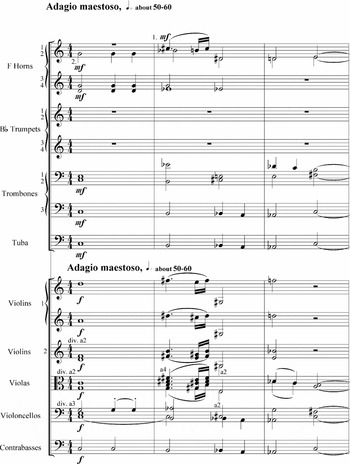
This description appears to begin with a simple analytic statement, but the appearance is deceptive. “A C minor chord with a D minor chord over it, together” does not make a coherent tonal formation. Nor does the actual opening of “Thanksgiving,” which Ives either misremembered or changed; the “chords” in the score are C major and D minor. (In Example 1, the second measure makes a similar combination, but at the distance of a minor third, not a major second, and with no modal opposition: A-flat major and B major.)Footnote 16
Charles E. Ives, “Thanksgiving and Forefathers' Day,” A Symphony: New England Holidays, ed. Jonathan Elkus (New York: Peer International, 1991), mvt. 4, mm. 1–3.

There is something wrong, a category mistake, in using a triadic vocabulary to designate the hexachords Ives refers to. None of the “combined” triads he describes or scores makes sense in a tonal context, nor can any hexachord formed by superimposing triads be heard as a tonal entity. Yet the tonal system remains the frame of reference within which the hexachords appear. They can be heard only as negatives within that frame. They cannot be analyzed there, only described in terms that expose them as unintelligible.
That unintelligibility forms the basis of a further description, this one semiotic rather than formal: the hexachords represent the harsh, anti-sensuous integrity of the Puritans. The music is not well formed as a tonal utterance, but precisely because of that it is well formed as a sign. The sign is iconic. Because the hexachords offend the tonal ear, because they grate on the body tuned to the language of tonality, the music mimics the feel of the Puritan worldview. It invites the relevant attributions of “sternness and strength and austerity.” It embodies an unyielding belief, something that does not give in. It reflects the unbreakable foundation of the national character.
Unlike most iconic signs in music, this one imitates neither sound nor motion. What it signifies is something otherwise intangible. Ives's hexachordal writing in “Thanksgiving” does not signify by matching a tonal pattern with a physical reality. It signifies by being tonally dark; it has no support other than its mimicry of a complex historical reality that acts as its ultimate cause. Without the supplement of description, which in this case is also the supplement of the political, this music would—within its frame of reference—be just so much noise. Its analytic emptiness is its political fullness.
The same descriptive logic operates over large spans whenever Ives makes use of static horizons and non-melodic cyclical closes. Because the formal framework is a negativity, a void, a non-identity, it can accommodate any and every variety of melody, motive, and process. But the relationship of these materials to the framework is purely acoustic, purely phenomenal; the music knows neither law nor structure but only contingency. It can be heard but not analyzed. The only way to make sense of this music is to go outside the formal frame of reference the music has abandoned and, from that external perspective, produce a description that the music can be heard to exemplify. To some extent, all musical descriptions with an evocative dimension must traverse some such external territory. But Ives seeks to radicalize the process.
He does not, however, leave the results to chance; his music is not hermeneutically open. On the model of “Thanksgiving,” the descriptions that Ives wants are national and political, and he summons them—often, of course, answering the summons himself—by his characteristic farrago of quotations, allusions, citations, and parodies of American tunes. The placement of a collage of familiar figures against a dense, unintelligible ground readily translates into the projection of national identity onto a transcendental or metaphysical screen. The result is a reflective depth that seems to belong to the figures themselves. Unlike the straightforward quotation or adaptation of anthem-like melodies that commodify nationalist sentiment and summon audiences into a mindless ecstasy of group identification, Ives's blending, deformation, and fragmentation of national melodies locates the principle of identity in the listener's capacity to remember and describe. Ives's music—and this is what is both impressive and insidious about it—does not ask its listener merely to feel like an American but to think like one.
The Holidays Symphony is a large fresco of these techniques, a musical analogue of the pictures that Whitman imagined adorning the tomb of Abraham Lincoln:
Ives is on record as saying that the “holiday movements (perhaps less in ‘Thanksgiving,’ which has some religious significance) are but attempts to make pictures in music of common events in the lives of common people (that is, of fine people), mostly of the rural communities. That's all there is to it.”Footnote 18 But the programs he attached to the movements are more eloquent—and less disingenuous. For “Washington's Birthday”:
“Cold and solitude,” says Thoreau, “are friends of mine. Now is the time before the wind rises to go forth and see the snow on the trees.”
And there is, at times, a bleakness, without stir but penetrating, in a New England mid-winter, which settles down grimly when the day closes over the broken-hills.Footnote 19
For “Decoration Day”:
The March stops—and in the silence, the shadow of the early morning flower-song rises over the Town and the sunset behind West Mountain breathes its benediction upon the day.Footnote 20
Ives's pictures are clearly meant to carry no less weight than Whitman's, and to touch no less closely the nub of national life. What remains to be emphasized is that they are pictures. The Holidays Symphony is a cycle of compositions that seeks to depict as literally as possible the experience of boyhood in the New England of the 1880s from the vantage point of the seasonal cycle of patriotic holidays. The acoustic depictions—one could call them “phonographs” if the term were not already taken—are assumed to produce the same sense of intimacy with the distant, that is, the same nostalgia, as the visual record of a bygone day. Ives noted particularly the music was “based on something of the memory that a man has of his boy holidays, rather than any present-day program of such.”Footnote 21 This combination of depiction and retrospection constitutes the ideological core of the music, and candidly so. The first movement, “Washington's Birthday” (begun in 1909, and the true nucleus of the work) clearly situates itself within a musical horizon suggestive of the distance into which the past has receded. In this it sets the tone for the whole cycle.
“Washington's Birthday” is a rustic triptych in sound. It begins with a spare, static texture voiced by muted strings. It evolves into a stern, meditative slow movement full of dim intimations but empty of specific reference. And then it abruptly brings the past to life with the musical representation of a raucous barn dance. But the dance recedes. It breaks up and dissipates like a mirage or a dream and the opening texture returns and fades into silence.
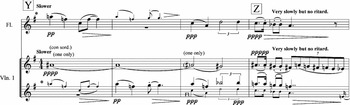
The dissolution of the dance is the moment of epiphany. As the music remembers them, the evening's festivities would end with a traditional parting number, the sentimental parlor song “Goodnight, Ladies.” The music recalls this ending with a slightly distorted quotation of the tune played softly by solo flute and first violins, shown in Example 2.
Charles Ives, “Washington's Birthday,” A Symphony: New England Holidays, ed. James B. Sinclair (New York: Associated Music, 1991), mvt. 1, mm. 178–81.

The distance between past and present widens as a muted solo violin, already present as a faint undertone, adds a dissonant shadow to the tune as harmonized in sixths. The farewell gesture in the past thus also becomes a farewell gesture to the past, a double “goodnight” highlighted by the sudden isolation of the two instrumental voices in tenuous alliance. The past thus parted from is itself double; it is both the time of the composer's bygone youth and the scene of a bygone, and a better, premodern world. The fadeout at the close of the movement, yet another farewell, carries the same double value. The opening returns as the vehicle of a timeless universal element, the stuff of sturdy spiritual contemplation, but it departs, too quickly, with a touch of wintry chill that is just this side of mortal. That the cycle begins with this network of farewells is essential. The larger design of the symphony is meant to counteract the necessity of farewells, even at the cost of willfully confusing nostalgia with utopia.
For Ives, the “transcendental” circularity exemplified in “Washington's Birthday” provides the place where the universal and the national or patriotic meet and fuse. Each of the symphonic holidays ends with a variant of this return, this reexposure of the musical landscape prior to the events enacted in its embrace. The middle two movements, “Decoration Day” and “The Fourth of July,” both begin and end with the bare horizon. Although “Thanksgiving” begins majestically in full stride, it fades into the bare background at the close. The four holidays together project a seasonal cycle moving from winter through autumn. Like each of the holidays it contains, this cycle repeats itself perennially.
By arranging the originally independent tone poems so that the cycle begins with winter, Ives endows each performance of the symphony with a “transcendental” character, a ritual movement from death to rebirth to enjoyment to the fullness of the harvest. By choosing holidays that are all patriotic in character, he ties this fusion of mythical and natural rhythms to the concept of the nation and its embodiment in the New England landscape. It is as if the rotation of the seasons were producing the fusion of the national and the universal. Spiritual truth is wedded to national identity by the benign authority of nature. And through the varied but unmistakable repetition of the circular process in the first three movements, leading to its climactic transformation in the last, Ives associates both the mythical and the national ideas with the higher laws of musical form.
As the seasons turn in the Holidays Symphony, there is a gradual change in proportion between the bare horizon and the melodic medley projected on its surface. In “Washington's Birthday” the proportions border on the classical in their balance and symmetry. The bare horizon occupies roughly the first two of the music's ten minutes. Its closing appearance is shorter, which is typical, but the returning horizon is linked to the collage by the famous fade-out—“Goodnight Ladies”—and it lingers long enough to carry a clear sense of completion, a closing meditation that absorbs the meaning of what the music has remembered. In “Decoration Day,” the collage does not emerge from the horizon (which thickens into a dense collage of its own) until the piece is nearly over. The outburst of a raucous town parade is ebullient and blaring, but tellingly brief. It fades away as if the memory of it could not be sustained because the world to which it belonged is long gone.
“The Fourth of July” seems to revive that world with a bang. After a beginning on the scale of “Washington's Birthday,” the music erupts like the fireworks it depicts. This is not the detached reflection of Debussy's near contemporary Feux d'artifice but musical mimicry at its most literal. The celebration is the longest and the noisiest in the cycle and its collage is the most overstuffed; its energies would be Dionysian if they were not so red, white, and blue. But the end is a surprise: after a big booming climax portraying the finale of the fireworks display there is a sudden drop in volume and about nine seconds of decrescendo fizzing out from pianissimo to nothing. The texture suggests both the visual aftermath of the fireworks, the flakes of light dissolving into the darkness, and the sudden collapse of the musical memory that had seemed to restore the “boy's Fourth” of an earlier time to life.
The stage is thus set for the transcendental appearance of “Thanksgiving,” which absorbs the preceding cycles into the linear trope of a pilgrimage before fading, at the last moment, into the endlessness of cyclical time. “Thanksgiving” sternly and strongly makes its way to a grand choral finale, a hymn sung by voices unheard until now, a Puritan anthem that gives Beethoven's Ninth Symphony the New World form it had secretly always wanted. The chaos of the modern urban world thus yields to the spiritual authority of the traditional rural hymn, not for the first time in Ives, and not for the last.
Perhaps because three of these holidays are still celebrated and still form cardinal points in the American year, the Holidays Symphony today may seem neither an expression of Progressive era nationalism nor a particularly political work, but just an “American” work, whatever that means. But it cannot have been one without the other. It was never meant to be. Not only would this music have been impossible to conceive apart from its political context, but the very concept of context is misleading here. Context is what these musical holidays seek to break down. The music is itself conceived politically, conceived as a practice of politics. It is as inseparable from political life as a Sousa march. The alluring concurrence of civic ideals with natural and ritual cycles is by no means a mere fabrication, but it is as much or more an image as it is a memory. To listen to it one must consent to be placed by it in a certain imaginary America with a vexed and indefinite relationship to historical truth.
First, the holidays are political in that they seek to represent a civic creed that all Americans can presumably hold in common regardless of party affiliation. All four holidays are grounded in foundational events of the nation's history. The first three turn on the ideal of liberty, which finds its spiritual sanction in the last. In third position, the Fourth of July, the celebration of the symbolic birth of both liberty and the nation, fraternal twins, becomes contingent on the national reunification, the second birth, marked in second position by Decoration Day, a holiday inaugurated after the Civil War. In last position, “Thanksgiving” gives the cyclical idea a still more primary historical foundation, the originary moment of colonial prehistory, which also coincides with the “discovery” of unspoiled and fruitful nature in the New World.
Second, the holidays are political in their locally general addresses to the Progressive era and the unresolved legacy of the Civil War. The two addresses seamlessly coincide, their relationship marked, perhaps, by the fiftieth-anniversary “reunion” on the battlefield at Gettysburg in 1913 of surviving veterans from both sides of the conflict who had fought there. Decoration Day, now celebrated as Memorial Day, originally commemorated the Civil War dead by decorating their graves. When the symphonic cycle places Decoration Day as the preface to the Fourth of July, it posits the reconciliation of North and South, and therefore an implicit acceptance of the failure of Reconstruction, as the precondition of liberty.
Third, the holidays are political in their identification of the Puritan heritage of New England as the spiritual basis for both the common creed and the national-metaphysical logic of reconciliation. By voicing the legendary Puritan traits of plainness, asceticism, Englishness, and Protestantism, the symphony allies itself with the very cultural images that were most contested, and supposedly most threatened, in 1913 as they are again today. The chorale that concludes “Thanksgiving,” “God! Beneath Thy guiding hand / Our exiled fathers crossed the sea,” consummates this alliance. It establishes the entire cycle as a journey to the mythical point of national origin, the place and moment (Plymouth, Massachusetts, in 1621) at which the westward quest for freedom and the sense of divinely sanctioned mission converge.
Like most of Ives's work, A Symphony: New England Holidays solves its formal problems and achieves its nationalist purposes by the same means, the portrayal of the American Scene by the musical portrayal of American scenes. The scenes of choice are not only partial and selective but also misleading in their nostalgia. Like the tourist industry in the New England of today, they identify America with a rural Yankee way of life that may never have existed. Ives uses a quintessentially urban-modernist collage technique to piece together the tunes associated with these scenes. But the tunes themselves belong to a world that Ives thought he had lost forever to urban modernity, not realizing perhaps that this world could be imagined only in retrospect and precisely only from the vantage point of urban modernity. We know this world very well, despite the inconvenience of its nonexistence: the rugged and spiritual world of the New England countryside, the communal, well-governed sphere of American pastoral. Ives's musical images of this world are exceptionally vivid, the more so, perhaps, for being so out of touch with reality—both his and ours.
The questions raised by this music are dramatized forcefully in the conflict between the pictorial ideal and the collage principle. In Ives's milieu, the pictorial ideal suggests an allegiance to a unifying American imaginary, a literal imagining of the nation that in the decades around 1900 became a widespread cultural project in response to political issues with an uncanny resemblance to those of today: immigration, economic transformation, national unity, empire. The collage principle pulls in the opposite direction. It embraces the very forces of difference that the pictorial ideal seeks to exclude and thus to control. Its spirit is the spirit of pragmatism, in keeping with William James's view of the world as a whirling confusion of sense data. Ives's music can reconcile the collage principle with the American imaginary only by being highly selective about the materials that go into the collages and by framing the collages to impose both moral and temporal distance on them. The music can recover the ideal past only by making the irrecoverability of the past an aesthetic premise.
In this contradiction lies the music's modernity. At the level of form, and whether he wants to or not, Ives is working out a basic tension in American life, then and now, between messianic intensity (the unifying image) and democratic energy (the sensory hubbub). Deciding which to favor is the question that shaped American politics and the American imagination with increasing urgency after the Civil War, the moment at which, paradoxically, political unification coincided with a catastrophic collapse of the unifying imaginary, or of what seemed, at least, to have been one in retrospect. This is the larger national issue behind Ives's local scenes. Its friction, the contrary motion of the image and the collage, gives the music its continued power even at a time when many of the tunes found in the collages have faded from common memory.
Even so, the enterprise cannot wholly survive the loss of the world that it keeps on musical life support. By clinging to the historical particularity of American music, Ives denies himself the possibility of grand mythmaking. He can record and transform a certain American sound, but to do so he must forgo the possibility of representing America more generally. Ives thus denies himself the broad appeal of an Aaron Copland. Copland succeeds far better in becoming an American icon by creating rather than curating a melodic vocabulary of Americana. This is a vocabulary that evokes but does not belong to the world of American pastoral, even though Copland's most famous moment, the Shaker hymn from Appalachian Spring, manages to do both at once.
Ives's projection of historical distance and its pathos is completely lacking in Copland, which is why some listeners find Copland's America too fabricated. One may like it quite a lot but not quite believe it. Unlike Ives, for whom the American imaginary is always at best a spectral presence, Copland invokes that imaginary as a mythic imperative. He distances himself from it only by cultivating a more severe modernist style as a counterweight to his “populist” compositions. Ives composes the withdrawal of an ideal in which he clearly believes; Copland composes the arrival of an ideal in which he does not have to believe because the audience does, which is just what his music tells them to do.
Just compare the “Hoedown” movement of Rodeo (1942) to the barn dance of “Washington's Birthday.” Copland's piece is like Ives's barn dance stripped of its multiple frames. The music is perfectly immediate; it does not mimic or depict the memory of a vigorous country dance but adapts the dance genre to a symphonic setting. In other words, the music is a hoedown. The audience can't dance to it, but they are supposed to want to.
Two contrasting treatments of this piece make especially clear both the deeper understanding and the greater isolation of the Ives. Some years ago, when worries about cholesterol had depressed the sale of beef in the United States, the cattle industry created a series of successful television commercials in which happy American families ate sizzling steaks with the “Hoedown” on the soundtrack. The spots ended with the slogan: “Beef. It's what's for dinner.” The audience was meant to understand that eating beef was at the heart of being American regardless of whether it was good for American hearts. Beef put you in touch with the legendary Old West, the spirit of which was still alive on the range in your home even if it was not still home on the range. The music conveyed the message that beef eaters could live as boldly as the famous Marlboro Man, but without the really unhealthy habit of smoking.
It would be absurd to try the same thing with Ives's barn dance. The music's energy is phantasmal; it all too clearly belongs to a world that has been irrecoverably lost except in the music itself. Ives's distanced mimicry would both reveal and mourn the obsolescence of the world that the beef industry's ads sought to invoke with Copland's “Hoedown.” But just for this reason, it would also be absurd to expect Ives's music to rouse its audience to an irrepressible nationalist glee, which the “Hoedown” is quite capable of doing. In a 2005 performance at Bard College by the American Symphony Orchestra, the string players stood up to perform the “Hoedown”—the finale of the Rodeo suite—just as if they were at a real hoedown after a real rodeo. The audience was electrified. But Ives, or so his formal framing of American nostalgia suggests, would not want his music to have this effect. He wanted his listeners to be solitary thinkers pondering the nation's legacies and losses, not the members of a patriotic mob.
Perhaps the difference isn't as clear as he hoped it would be, but there is a difference, and the difference is inseparable from the musical forms involved. Copland subsumes the collage principle under the poetic idea and becomes a high-culture hero with crossover appeal. Ives subsumes the poetic idea under the collage principle and becomes what he liked to play at being: the cranky Yankee genius in a world of his own which is also the world gone by—and long past analysis: Good night ladies, good night sweet ladies, good night, good night.