1 Introduction
Originally, quantales were invented to formalize the logic of observables in quantum physics, which became useful to describe the “spaces” of
 $C^\ast $
-algebras (see [Reference Borceux, Rosický and Van Bossche3, Reference Kruml and Paseka11, Reference Kruml and Resende12]) and non-commutative geometry (see [Reference Connes4, Reference Mulvey and Pelletier13–Reference Mulvey and Resende15, Reference Protin and Resende17, Reference Resende19]). The literature on quantales often emphasizes that these structures are required to have units. Unital quantales, as a valued domain, have wide applications in theoretical computer science, logic, quantitative domain, enriched category, and many-valued topological space (see [Reference Abramsky and Vickers1, Reference Fan6, Reference Hofmann and Waszkiewicz10, Reference Resende18, Reference Yetter21, Reference Zhang22]). By definition, a quantale is a complete lattice Q with a semigroup multiplication
 $\&$
that distributes over arbitrary joins, that is,
 $$ \begin{align}a\&(\bigvee_{i\in I}b_i)=\bigvee_{i\in I}(a\& b_i)\ \ \text{and}\ \ (\bigvee_{i\in I} b_i)\& a=\bigvee_{i\in I}(b_i\& a)\end{align} $$
for all
 $a\in Q, \{b_i\}_{i\in I}\subseteq Q$
. A quantale Q is said to be unital provided that there exists an element
 $e\in Q$
such that
 $q\&e=q=e\&q$
for all
 $q\in Q$
. Q is said to be commutative provided that
 $a\&b=b\&a$
for all
 $a,b\in Q$
.
Definition 1.1 Let Q be a complete lattice. Then, we say that Q supports a (unital) quantale if there exists a semigroup multiplication
 $\&$
on Q such that
 $(Q, \&)$
becomes a (unital) quantale. An element e of Q can become a unit means that Q supports a unital quantale with unit e.
In [Reference Rosenthal20], one can see that every complete lattice Q can support a quantale
 $(Q, \&_a)$
where
 $a\in Q$
and
 $\&_a$
is a semigroup multiplication determined by
 $$ \begin{align}\forall x, y\in Q,\ x\&_a y=\left\{\begin{array}{@{}ll} 0, & \text{if}\ \ x=0\ \text{or}\ y=0,\\ a, & \text{otherwise.}\ \ \end{array}\right.\end{align} $$
In [Reference Paseka and Kruml16], Paseka and Kruml investigated the construction of unital quantales from a given quantale, and they proved that every quantale Q can be embedded into a unital quantale
 $Q[e]$
. For some special quantales, by addition of an isolated unit, Gutiérrez García and Höhle considered the construction of unitally non-distributive quantales (see [Reference Gutiérrez García and Höhle8]). Based on the above work, Han and Lv further discussed the construction of unital quantales from a given quantale in [Reference Han and Lv9]. According to the construction of unital quantale
 $Q[e]$
, by (1.2), one can easily see that if a complete lattice L is isomorphic to
 $Q\times \mathbf {2}$
for some complete lattice Q, then L can support a unital quantale, where
 $\mathbf 2$
is the two-element lattice. So, we have the following two questions.
Question 1: Does every complete lattice support a unital quantale?
If the answer to Question 1 is negative, then we have Question 2 to ask.
Question 2: Which class of complete lattices can support unital quantales?
In order to answer the above questions, we need to review some concepts and notations. Let L be a complete lattice,
 $a, b\in L$
. Then, L is said to be trivial if
 $\mid L\mid =1$
and a is said to be comparable if
 $a\leq b$
or
 $b\leq a$
for all
 $b\in L$
. Further, we let
 $[a, b]=\{x\in L \mid a\leq x\leq b\}$
and
 $(a, b]=\{x\in L \mid a< x\leq b\}$
. a is called a lower-cover of b (or b is called an up-cover of a) if
 $a\neq b$
and
 $[a, b]=\{a, b\}$
. A non-empty subset S of L is said to be a sublattice if S is closed under
 $\wedge $
and
 $\vee $
. We denote by
 $L\times M$
the Cartesian product of complete lattices L and M. Then,
 $L\times M$
is a complete lattice with pointwise order. In this article, we denote the bottom element and the top element in a complete lattice by
 $0$
and
 $1,$
respectively. For the notions and concepts, which are not explained, please refer to [Reference Birkhoff2, Reference Eklund, Gutiérrez García, Höhle and Kortelainen5, Reference Gierz, Hofmann, Keimel, Lawson, Mislove and Scott7, Reference Rosenthal20].
2 Not every complete lattice can support a unital quantale
As we all know, every complete lattice can support a quantale. However, in this section, we will prove that not every complete lattice can support a unital quantale, that is, the answer to Question 1 is negative. To see this, we need to consider the following complete lattices.
Lemma 2.1 Let
 $(Q, \&)$
be a unital quantale with unit e. Then,
 $a\& b\leq a\wedge b$
for all
 $a, b\in [0, e]$
.
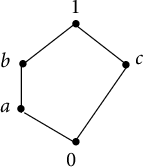
Example 2.2 Let
 $N_5=\{0, a, b, c, 1\}$
be a complete lattice which is determined by Figure 1. Then, the top element 1 cannot become a unit.
The partial order on
 $N_5$
.

To see this, we assume that
 $1$
is the unit in quantale
 $(N_5, \&)$
. Then, by Lemma 2.1, we have that
 $b\&a\leq b\wedge a=a$
and
 $b\&c\leq b\wedge c=0$
, which implies that
 $b=b\&1=b\&(a\vee c)=(b\&a)\vee (b\&c)=b\&a\leq a$
, contradiction.
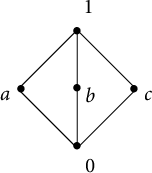
Example 2.3 Let
 $M_3=\{0, a, b, c, 1\}$
be a complete lattice which is determined by Figure 2. Then, the top element
 $1$
cannot become a unit.
The partial order on
 $M_3$
.

To see this, we assume that
 $1$
is the unit in quantale
 $(M_3, \&)$
. Then, by Lemma 2.1, we have that
 $a\&b\leq a\wedge b=0$
and
 $a\&c\leq a\wedge c = 0$
, which implies that
 $a=a\&1=a\&(b\vee c)=(a\&b)\vee (a\&c)\leq 0$
, contradiction.
Definition 2.4 Let L be a complete lattice and
 $x\in L\backslash \{0\}$
. Then, x is called an
 $N_5$
-element (an
 $M_3$
-element) of L if there exists some sublattice M of L such that x is the top element in M and M is isomorphic to
 $N_5$
(
 $M_3$
).
Lemma 2.5 Every
 $N_5$
-element or
 $M_3$
-element of a complete lattice L cannot become a unit of L.
Proposition 2.6 If every non-bottom element of a complete lattice L is either an
 $N_5$
-element or an
 $M_3$
-element, then L cannot support a unital quantale.
Remark 2.7 It is easy to obtain an equivalent statement of Proposition 2.6, that is, if a complete lattice supports a unital quantale, then it must have a non-bottom element which is neither an
 $N_5$
-element nor an
 $M_3$
-element. Based on this equivalent statement, we see that the converse of Proposition 2.6 is in general not true (see, Examples 2.9 and 2.10).
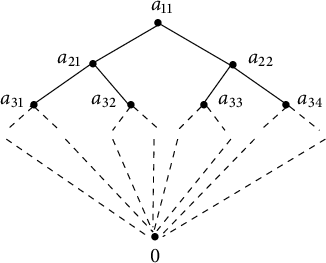
Example 2.8 Let
 $L_1=\{a_{ij} \mid 1\leq j\leq 2^{i-1}, i=1, 2, \cdots ,n, \cdots \}\cup \{0\}$
be a complete lattice determined by Figure 3 in which every non-bottom element of
 $L_1$
has precisely two lower-covers, and every element of
 $L\backslash \{0, a_{11}\}$
has precisely one up-cover.
The partial order on
 $L_1$
.

It is easy to check that every non-bottom element of
 $L_1$
is an
 $N_5$
-element. By Proposition 2.6, we have that
 $L_1$
cannot support a unital quantale.
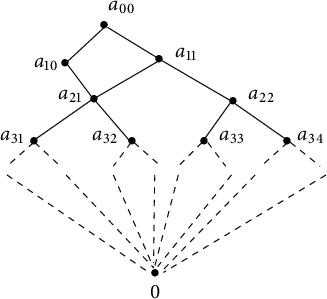
Example 2.9 Let
 $L_2=L_1\cup \{a_{00}, a_{10}\}$
and the partial order on
 $L_2$
be determined by Figure 4. Then,
 $L_2$
is a complete lattice. Further, one can see that every element of
 $L_2\backslash \{a_{10}, 0\}$
is an
 $N_5$
-element, and
 $a_{10}$
is neither an
 $N_5$
-element or an
 $M_3$
-element. Surprisingly,
 $L_2$
can indeed support a unital quantale.
The partial order on
 $L_2$
.

Figure 4 Long description
At the top is a zero zero. The next level has a one zero to the left and a one one to the right. From a one zero, a two one branches left and a two two branches right. From a one one, a two two branches left and a two two branches right. The third level has a three one, three two, three three, and three four, each connected to the previous level. Dashed lines connect each of these to the bottom node labeled zero. All connections are shown with straight or dashed lines, indicating the partial order structure.
To see this, we define now a binary operation
 $\&$
on
 $L_2$
as follows:
 $\forall x, y\in L_2$
,
 $$ \begin{align*}x\& y=\left\{\begin{array}{@{}ll} 0, & \text{if}\ \ x=0\ \text{or}\ y=0,\\ 0, & \text{if}\ \ x\in (0, a_{21}], y\not\in\{a_{10}, a_{00}\}\ \text{or}\ x\not\in\{a_{10}, a_{00}\}, y\in (0, a_{21}], \\ y, & \text{if}\ \ x=a_{10},\\ x, & \text{if}\ \ y=a_{10},\\ y, & \text{if}\ \ x=a_{00}, y\in (0, a_{21}],\\ x, & \text{if}\ \ x\in (0, a_{21}], y=a_{00},\\ a_{00}, & \text{otherwise.}\ \ \end{array}\right.\end{align*} $$
Then,
 $(L_2, \&)$
is a commutative unital quantale with unit
 $a_{10}$
.
Example 2.10 Let I denote the unit open interval
 $(0, 1)$
with usual order
 $\leq $
,
 $\Sigma =\{\sigma _r \mid r\in (0, 1)\}$
and
 $\Gamma =\{\tau _r \mid r\in (0, 1)\}$
. Further, we let
 $r\in (0, 1)$
,
 $X_r=\{x_{r,i} \mid i\in (0, 1)\}$
,
 $Y_r=\{ y_{r,j} \mid j\in (0, 1)\},$
and
 $L_3=I\cup \Sigma \cup \Gamma \cup (\bigcup \limits _{r\in I}(X_r\cup Y_r))\cup \{\top , \bot \}$
. Next, we define a binary relation
 $\leq _{L_3}$
on
 $L_3$
as follows:
 $\forall a,r,i,j\in I$
,
 $x\in L_3$
,
 $$ \begin{align*}i\leq_{L_3} j \Longleftrightarrow i\leq j,\ \sigma_i\leq_{L_3} \sigma_j \Longleftrightarrow i\leq j\Longleftrightarrow \tau_i\leq_{L_3}\tau_j,\end{align*} $$
 $$ \begin{align*}x_{r,i}\leq_{L_3} x_{r,j} \Longleftrightarrow i\leq j \Longleftrightarrow y_{r,i}\leq_{L_3} y_{r,j},\end{align*} $$
 $$ \begin{align*}a\leq_{L_3} \sigma_r \Longleftrightarrow a\leq r \Longleftrightarrow a\leq_{L_3} \tau_r,\end{align*} $$
 $$ \begin{align*}a\leq_{L_3} x_{r,i} \Longleftrightarrow a\leq r \Longleftrightarrow a\leq_{L_3} y_{r,i},\end{align*} $$
 $$ \begin{align*}x_{a,i}\leq_{L_3} \sigma_r \Longleftrightarrow a\leq r \Longleftrightarrow y_{a,j}\leq_{L_3} \tau_r,\end{align*} $$
 $$ \begin{align*}\bot\leq_{L_3} x\leq_{L_3}\top.\end{align*} $$
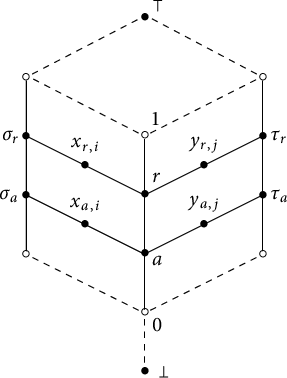
It is easy to check that
 $(L_3, \leq _{L_3})$
is a complete lattice (Figure 5). Further, we see that every element of
 $\Sigma \cup \Gamma \cup \{\top \}$
is an
 $N_5$
-element, and every element of
 $I\cup (\bigcup \limits _{r\in I}(X_r\cup Y_r))$
is neither an
 $N_5$
-element nor an
 $M_3$
-element. However,
 $L_3$
indeed cannot support a unital quantale (see Proposition 2.12).
The partial order on
 $L_3$
.

Figure 5 Long description
At the bottom is a black dot labeled bottom. Above it is a white dot labeled 0. The next layer has three black dots labeled sigma sub a, a, and tau sub a, connected horizontally. The middle layer has three black dots labeled sigma sub r, r, and tau sub r, also connected horizontally. Vertical edges connect sigma sub a to sigma sub r, a to r, and tau sub a to tau sub r. Between sigma sub a and a is a black dot labeled x sub a comma i, and between a and tau sub a is y sub a comma j. Between sigma sub r and r is x sub r comma i, and between r and tau sub r is y sub r comma j. At the top is a white dot labeled 1, and above it a black dot labeled top. Dashed lines connect the outermost nodes to form a cube-like structure. All edges represent covering relations in the partial order.
For convenience, we use
 $\leq $
instead of
 $\leq _{L_3}$
. The following lemma lists some properties of complete lattice
 $L_3$
.
Lemma 2.11 Let
 $L_3$
be the complete lattice in Example 2.10 and
 $a,r,i,j\in I$
. Then:
-
(1)
 $\bigvee \limits _{b< r}b=r$
,
$\bigvee \limits _{r\in I}r=\top $
and
$\bigvee \limits _{r\in I}\sigma _r=\top =\bigvee \limits _{r\in I}\tau _r$
.
-
(2)
$\bigwedge \limits _{j\in I}y_{r,j}=r=\bigwedge \limits _{i\in I}x_{r,i}$
,
$\bigvee \limits _{j\in I}y_{r,j}=\tau _r$
and
$\bigvee \limits _{i\in I}x_{r,i}=\sigma _r$
. -
(3)
$\bigvee \limits _{b< r}x_{b,j}=\sigma _r$
and
$\bigvee \limits _{b< r}y_{b,j}=\tau _r$
. -
(4) if
$a\neq r$
, then
$\sigma _r\vee a=\sigma _{r\vee a}=x_{r,i}\vee x_{a,j}$
and
$\tau _r\vee a=\tau _{r\vee a}=y_{r,j}\vee y_{a,i}$
. -
(5)
$\sigma _r\wedge a=r\wedge a=x_{r,i}\wedge y_{a,j}$
and
$\tau _r\wedge a=r\wedge a=\sigma _r\wedge \tau _a=r\wedge \tau _a$
. -
(6) if
$a\neq r$
, then
$x_{r,i}\wedge x_{a,j}=a\wedge r = y_{r,i}\wedge y_{a,j}$
. -
(7) if
$a< r$
, then
$\sigma _a\wedge x_{r,i}=a$
. -
(8) if
$x\in \Sigma \cup (\bigcup \limits _{r\in I}X_r), y\in \Gamma \cup (\bigcup \limits _{r\in I}Y_r)$
, then
$x\vee y=\top $
.


Proposition 2.12
 $L_3$
cannot support a unital quantale.
Proof Assume that
 $L_3$
supports a unital quantale
 $(L_3, \&)$
with unit
 $\Upsilon $
. Then, we have the following different cases for unit
 $\Upsilon $
.
Case 1:
 $\Upsilon \neq \bot $
.
Assume that
 $\Upsilon =\bot $
. Then, by
 $(1.1),$
one can see that
 $\bot =\bot \&\top =\Upsilon \&\top =\top $
, contradiction.
Case 2:
 $\Upsilon \not \in \Sigma \cup \Gamma \cup \{\top \}$
.
Assume that
 $\Upsilon \in \Sigma \cup \Gamma \cup \{\top \}$
. Since every element of
 $\Sigma \cup \Gamma \cup \{\top \}$
is an
 $N_5$
-element, by Lemma 2.5, we have that
 $\Upsilon $
cannot become a unit, contradiction.
Case 3:
 $\Upsilon \not \in I$
.
Assume that
 $\Upsilon =r\in I$
. Then, we will prove that there exists
 $d< r$
such that
 $\sigma _d\leq x_{di}$
, contradiction.
To see this, we first give the following asserts.
(1) For all
 $b\in I$
with
 $b< r$
, we have that
 $b\leq \sigma _r\& b\leq \sigma _b$
.
There exists an element
 $c\in I$
with
 $c< b$
. By Lemma 2.11, we have
 $b=r\& b\leq \sigma _r\&b=(\sigma _c\vee r)\&b=(\sigma _c\&b)\vee (r\&b)\leq \sigma _c\vee b=\sigma _b$
.
(2) There exists
 $r>b_0\in I$
such that
 $b_0< \sigma _r\& b_0\leq \sigma _{b_0}$
.
Assume that for all
 $b\in I$
with
 $b< r$
,
 $b=\sigma _r\& b$
. Then,
 $r=\bigvee \limits _{b< r}b = \bigvee \limits _{b< r}(\sigma _r\&b)=\sigma _r\&(\bigvee \limits _{b< r}b)=\sigma _r\&r=\sigma _r$
, which implies that
 $r=\sigma _r$
, contradiction.
(3) For
 $b_0< d < r$
, we have that
 $\sigma _r\&d=\sigma _d$
.
Since
 $b_0< \sigma _r\&b_0\leq \sigma _r\&d$
, by (1) and Lemma 2.11 we have that
 $\sigma _r\&d=\sigma _d$
.
By (3) and Lemma 2.11, we have that
 $\sigma _d=\sigma _r\&d=(x_{d,i}\vee r)\&d=(x_{d,i}\&d)\vee (r\&d)=(x_{d,i}\&d)\vee d\leq (x_{d,i}\&r)\vee d\leq x_{d,i}\vee d=x_{d,i}$
, which implies that
 $\sigma _d\leq x_{d,i}$
, contradiction. Thus,
 $\Upsilon \not \in I$
.
Case 4:
 $\Upsilon \not \in \bigcup \limits _{r\in I}(X_r\cup Y_r)$
.
Assume that
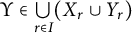 $\Upsilon \in \bigcup \limits _{r\in I}(X_r\cup Y_r)$
. Then, we will prove that there exist
 $b, r\in I$
such that
 $b< r$
,
 $(Y_r\cup \{\tau _r\})\cap \{m\in L_3 \mid m\leq \tau _b\}\neq \emptyset $
or
 $(X_r\cup \{\sigma _r\})\cap \{m\in L_3 \mid m\leq \sigma _b\}\neq \emptyset $
, contradiction.
Without loss of generality, we suppose that
 $\Upsilon =x_{r,i_0}\in X_r$
for some
 $r\in I$
. Then, we have the following asserts.
(1) For all
 $b\in I$
with
 $b< r$
, we have
 $\sigma _r\&b=b$
and
 $b\&\sigma _r=b$
.
Since
 $b=x_{r,i_0}\&b\leq \sigma _r\&b=(\sigma _b\vee x_{r,i_0})\&b=(\sigma _b\&b)\vee (x_{r,i_0}\&b)\leq (\sigma _b\&x_{r,i_0})\vee b= \sigma _b$
, we have that
 $b\leq \sigma _r\&b\leq \sigma _b$
. For all
 $x_{b,j}$
, we have that
 $\sigma _r\&b=(x_{b,j}\vee x_{r,i_0})\&b=(x_{b,j}\&b)\vee (x_{r,i_0}\&b)\leq (x_{b,j}\&x_{r,i_0})\vee b=x_{b,j}$
. By Lemma 2.11, we have
 $b\leq \sigma _r\&b\leq \bigwedge \limits _{j\in I}x_{b,j}=b$
, which implies that
 $\sigma _r\&b=b$
. Similarly, we can show that
 $b\&\sigma _r=b$
.
(2)
 $\sigma _r\&r=r=r\&\sigma _r$
and
 $r\&r=r$
.
By (1) and Lemma 2.11, we have
 $r=\bigvee \limits _{b< r}b=\bigvee \limits _{b< r}(\sigma _r\&b)=\sigma _r\&(\bigvee \limits _{b< r}b)=\sigma _r\&r$
. Similarly, we have
 $r=r\&\sigma _r$
. For
 $b\in I$
with
 $b< r$
, we have
 $\sigma _b\&r\leq \sigma _b\wedge r=b$
and
 $r=\sigma _r\&r=(\sigma _b\vee r)\&r=(\sigma _b\&r)\vee (r\&r)\leq b\vee (r\&r)\leq b\vee (r\&\sigma _r)\leq b\vee r=r$
, which implies
 $r\&r=r$
.
(3) For all
 $b\in I$
with
 $b< r$
, we have
 $r\&b=b=b\&r$
.
We let
 $c\in I$
and
 $c< b$
. Then, for all
 $x_{c,j}$
, by (1) we have
 $x_{c,j}\&b\leq x_{c,j} \& x_{r,i_0}=x_{c,j}$
and
 $x_{c,j}\&b\leq \sigma _c\&b\leq \sigma _r\&b=b$
, which implies that
 $x_{c,j}\&b\leq x_{c,j}\wedge b=c$
. Thus,
 $b=\sigma _r\&b=(x_{c,j}\vee r)\&b=(x_{c,j}\&b)\vee (r\&b)$
, which implies
 $b=r\&b$
. Similarly, we can prove that
 $b=b\&r$
.
(4) For all
 $b\in I$
with
 $b< r$
, we have
 $r\&\sigma _b=b=\sigma _b\&r$
.
By (2), we have that
 $\sigma _b\& r\leq \sigma _b\& x_{r,i_0}=\sigma _b$
and
 $\sigma _b\& r\leq \sigma _r\& r=r$
, which implies
 $\sigma _b\& r\leq \sigma _b\wedge r=b$
. It follows from (3) that
 $b=b\&r\leq \sigma _b\&r\leq b$
, that is,
 $b=\sigma _b\&r$
. Similarly, we can show that
 $r\&\sigma _b=b$
.
(5) For all
 $b\in I$
with
 $b< r$
, we have
 $r\& x_{b,j}=b=x_{b,j}\&r$
.
By (3) and (4), we have that
 $b=r\&b\leq r\& x_{b,j}\leq r\& \sigma _b=b$
, that is,
 $r\& x_{b,j}=b$
. Similarly, we have
 $b=x_{b,j}\&r$
.
(6) For all
 $b\in I$
with
 $b< r$
, we have
 $\tau _r\&b=\top \& b$
and
 $b\&\tau _r=b\&\top $
.
By (1) and (3), we have that
 $\tau _r\& b=(r\vee \tau _b)\&b=(r\&b)\vee (\tau _b\&b)=b\vee (\tau _b\&b)=(\sigma _r\&b)\vee (\tau _b\&b)= (\sigma _r\vee \tau _b)\&b=\top \&b$
. Similarly, we have
 $b\&\tau _r=b\&\top $
.
(7)
 $r< \tau _r\& r=\top \&r\leq \tau _r$
.
By (6), we have that
 $\tau _r\& r=\tau _r\&(\bigvee \limits _{b< r}b)=\bigvee \limits _{b< r}(\tau _r\&b)=\bigvee \limits _{b< r}(\top \&b) =\top \&(\bigvee \limits _{b< r}b)=\top \&r$
. Further, one can see that
 $r=r\&r\leq x_{r,i_0}\&r\leq \top \&r=\tau _r\&r\leq \tau _r\&x_{r,i_0}= \tau _r$
.
Assume that
 $r=\tau _r\& r$
. It follows from (5) and Lemma 2.11 that for all
 $b< r$
, we have that
 $r=\top \& r=(x_{b,j}\vee \tau _b)\&r=(x_{b,j}\&r)\vee (\tau _b\&r)=b\vee (\tau _b\&r)\leq b\vee (\tau _b\&x_{r,i_0})\leq b\vee \tau _b=\tau _b$
, which implies
 $r\leq \tau _b$
, contradiction. Thus,
 $r< \tau _r\& r=\top \&r\leq \tau _r$
.
By (1)–(7), for all
 $b< r$
, we see that
 $r<\top \&r=(\sigma _b\vee \tau _b)\&r=(\sigma _b\&r)\vee (\tau _b\&r)=b\vee (\tau _b\&r) =(b\& r)\vee (\tau _b\&r)=(b\vee \tau _b)\& r=\tau _b\& r\leq \tau _r\& r\leq \tau _r$
, which implies that
 $r<\tau _b\&r\leq \tau _r$
, that is,
 $\tau _b\&r\in Y_r\cup \{\tau _r\}$
. Obviously,
 $\tau _b\&r\leq \tau _b\&x_{r,i_0}\leq \tau _b$
. However,
 $(Y_r\cup \{\tau _r\})\cap \{m\in L_3 \mid m\leq \tau _b\}=\emptyset $
, contradiction. Thus,
 $\Upsilon \not \in \bigcup \limits _{r\in I} X_r$
. Similarly, we can show that
 $\Upsilon \not \in \bigcup \limits _{r\in I} Y_r$
.
From Cases 1–4, it follows that
 $\Upsilon \not \in L_3$
, contradiction. Therefore,
 $L_3$
cannot support a unital quantale.
By Example 2.8 and Proposition 2.12, we have the below conclusion.
Proposition 2.13 Not every complete lattice can support a unital quantale.
3 Complete lattices supporting unital quantales
In Section 2, we see that not all complete lattices can support unital quantales. In this section, we will investigate Question 2, that is, which class of complete lattices can support unital quantales.
An element x of quantale Q is called a zero-factor of Q provided that
 $x\neq 0$
and there exists an element
 $y\in Q\backslash \{0\}$
such that
 $x\& y=0$
or
 $y\&x=0$
.
Proposition 3.1 Every complete chain supports a commutative unital quantale without zero-factors.
Proof Let I be a complete chain,
 $e\in I\backslash \{0\}$
. Then, we have two ways to define a binary operation on I such that I becomes a commutative unital quantale without zero-factors.
(1) The first way to define a binary operation
 $\&$
on I is given as follows:
 $$ \begin{align*}\forall x, y\in I,\ x\& y=\left\{\begin{array}{@{}ll} \ \ 0, & \text{if}\ \ x=0\ \text{or}\ y=0,\\ x\wedge y, & \text{if}\ \ x,y\in (0, e],\\ x\vee y, & \text{otherwise.}\ \ \end{array}\right.\end{align*} $$
It is easy to check that
 $(I, \&)$
is a commutative unital quantale with unit e and L has no zero-factors.
(2) The second way to define a binary operation
 $\otimes $
on I is given as follows:
 $$ \begin{align*}\forall x, y\in I,\ x\otimes y=\left\{\begin{array}{@{}ll} \ 0, & \text{if}\ \ x=0\ \text{or}\ y=0,\\ x\wedge y, & \text{if}\ \ x,y\in (0, e],\\ \ y, & \text{if}\ \ x\in (0, e],\ y\in (e, 1],\\ \ x, & \text{if}\ \ y\in (0, e],\ x\in (e, 1],\\ \ 1, & \text{otherwise.}\ \ \end{array}\right.\end{align*} $$
It is easy to check that
 $(I, \otimes )$
is a commutative unital quantale with unit e and L has no zero-factors.
Proposition 3.2 Let Q be a complete lattice and
 $e\in Q\backslash \{0\}$
. If
 $[0, e]$
supports a
 $($
commutative
 $)$
unital quantale with unit k and Q satisfies the condition
 $(\ast )$
 $$ \begin{align}\forall x\in (0, e], y\in Q\backslash [0, e],\ x\leq y\Longleftrightarrow e\leq y, \end{align} $$
then Q supports a
 $($
commutative
 $)$
unital quantale with unit k.
Proof Let
 $([0, e], \&)$
be a (commutative) unital quantale with unit k. Then,
 $\&$
can be extended to a binary operation
 $\otimes $
on Q as follows:
 $$ \begin{align*} \forall x, y\in Q,\ x\otimes y=\left\{\begin{array}{@{}ll} \ 0, & \text{if}\ \ x=0\ \text{or}\ y=0,\\ \ y, & \text{if}\ \ x\in (0, e],\ y\in Q\backslash [0, e],\\ \ x, & \text{if}\ \ x\in Q\backslash [0, e],\ y\in (0, e],\\ x\&y, & \text{if}\ \ x,y\in (0, e],\\ \ 1, & \text{if}\ \ x,y\in Q\backslash [0, e]. \end{array}\right. \end{align*} $$
It can be verified that
 $(Q, \otimes )$
is a (commutative) unital quantale with unit k. Further, if
 $([0, e], \&)$
has no zero-factors, then
 $(Q, \otimes )$
has no zero-factors.
Corollary 3.3 Let Q be a complete lattice and
 $e\in Q\backslash \{0\}$
. If
 $[0, e]$
is a chain and Q satisfies the condition
 $(\ast )$
, then Q supports a commutative unital quantale without zero-factors.
Corollary 3.4 Every complete lattice with non-bottom minimal element supports a commutative unital quantale without zero-factors.
Proof Let Q be a complete lattice with non-bottom minimal element e. Then,
 $[0, e]=\{0, e\}$
and Q satisfies the condition
 $(\ast )$
. By Corollary 3.3, we have that Q supports a commutative unital quantale without zero-factors.
Corollary 3.5 Every finite complete lattice supports a commutative unital quantale without zero-factors.
Proposition 3.6 Let Q be a complete lattice and
 $a\in Q\backslash \{0, 1\}$
be a comparable element. Then, we have:
-
(1) if
$[a, 1]$
is a chain, then Q supports a commutative unital quantale. -
(2) if
$[0, a]$
is a chain, then Q supports a commutative unital quantale without zero-factors.


Proof (1) Assume that
 $[a, 1]$
is a chain. Then, we can define a binary operation
 $\otimes $
on Q as follows:
 $$ \begin{align*}\forall x, y\in Q,\ x\otimes y=\left\{\begin{array}{@{}ll} \ 0, & \text{if}\ \ x, y\in [0, a],\\ x\wedge y, & \text{otherwise}. \end{array}\right.\end{align*} $$
It is easy to verify that
 $(Q, \otimes )$
is a commutative unital quantale with unit
 $1$
.
(2) The proof follows directly from Propositions 3.1 and 3.2.
Let Q be a complete lattice and
 $\{\bot , e, \top \}\cap Q=\emptyset $
. Next, we will consider three types of extensions
 $Q_\bot , Q_e, Q_\top $
of Q, where
 $Q_\bot =Q\cup \{\bot \}, Q_e=Q\cup \{e\}, Q_\top =Q\cup \{\top \}$
. We, respectively, define the relations
 $\leq _{Q_\bot }, \leq _{Q_e}, \leq _{Q_\top }$
as follows:
 $$ \begin{align*}\leq_{Q_\bot}=\ \leq_Q\cup\{(\bot, x) \mid x\in Q_\bot\},\end{align*} $$
 $$ \begin{align*}\leq_{Q_e}=\ \leq_Q\cup\{(0, e), (e, e), (e, 1)\},\end{align*} $$
 $$ \begin{align*}\leq_{Q_\top}=\ \leq_Q\cup\{(x, \top) \mid x\in Q_\top\}.\end{align*} $$
It is easily checked that
 $(Q_\bot , \leq _{Q_\bot }), (Q_e, \leq _{Q_e}),$
and
 $(Q_\top , \leq _{Q_\top })$
are complete lattices, called the extensions of Q. By Corollary 3.3 and Proposition 3.6, we have the following result.
Corollary 3.7 For any complete lattice Q, the extensions
 $Q_\bot , Q_e, Q_\top $
can all support unital quantales.
The proof of Theorem 3.8 can be found in Theorem 2.4 in [Reference Han and Lv9]. For the convenience of readers, we will give the main details.
Theorem 3.8 Let Q be a complete lattice with
 $Q=M\times K$
. If M or K supports a commutative unital quantale without zero-factors, then Q supports a unital quantale.
Proof Without loss of generality, we assume that
 $(K, \&)$
is a commutative unital quantale without zero-factors and e is the unit. By (1.2), we have that
 $(M, \&_a)$
is a quantale with
 $a\in M$
. Next, we define a binary operation
 $\&_\ast $
on Q as follows:
 $\forall (m, k), (n, k^\prime )\in M\times K$
,
 $$ \begin{align*} (m, k)\&_{\ast}(n, k^\prime)=((m\&_a n)\vee(m\ast k^\prime)\vee(n\ast k), {k}{\&}{k}^{\prime}), \end{align*} $$
where
 $\ast $
is a module operator from
 $M\times K$
into M defined by
 $$ \begin{align*} \forall m\in M, k\in K, m\ast k=\left\{\begin{array}{@{}ll}0, & \text{if } k=0,\\m, & \text{otherwise}. \end{array}\right. \end{align*} $$
It can be verified that
 $(Q, {\&}_{\ast })$
is a unital quantale with unit
 $(0, e)$
.
Corollary 3.9 Let Q be a complete lattice with
 $Q=M\times K$
satisfying one of the following conditions:
-
(1) M or K is a non-trivial complete chain;
-
(2) M or K is a non-trivial finite complete lattice;
-
(3) M or K has a comparable element e such that
$[0, e]$
is a chain.

Then, Q supports a unital quantale.
In the following, we will give a complete lattice which does not belong to any of the aforementioned types of complete lattices supporting unital quantales.
Example 3.10 Let I denote the unit open interval
 $(0, 1)$
with usual order
 $\leq $
,
 $\Sigma =\{\sigma _r \mid r\in (0, 1)\}$
. Further, we let
 $X=\{x_{r} \mid r\in (0, 1)\}$
and
 $L_4=I\cup \Sigma \cup X\cup \{\top , \bot \}$
. We define a binary relation
 $\leq _{L_4}$
on
 $L_4$
as follows:
 $\forall r,i,j\in I$
,
 $x\in _{L_4}$
,
 $$ \begin{align*}i\leq_{L_4} j \Longleftrightarrow i\leq j \Longleftrightarrow\sigma_i\leq_{L_4} \sigma_j,\end{align*} $$
 $$ \begin{align*}i\leq_{L_4} \sigma_j \Longleftrightarrow i\leq j\Longleftrightarrow i\leq_{L_4} x_j,\end{align*} $$
 $$ \begin{align*}x_{r}\leq_{L_4} \sigma_j \Longleftrightarrow r\leq j,\end{align*} $$
 $$ \begin{align*}\bot\leq_{L_4} x\leq_{L_4}\top.\end{align*} $$
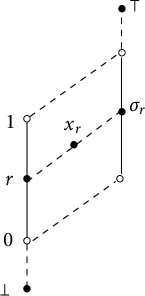
It is easy to check that
 $(L_4, \leq _{L_4})$
is a complete lattice (Figure 6).
The partial order on
 $L_4$
.

We let
 $I_r=\{a\in I \mid a\leq r\}, X_r=\{x_a\in X \mid a\leq r\},$
and
 $\Sigma _r=\{\sigma _a\in \Sigma \mid a\leq r\}$
. Next, we define a binary operation
 $\otimes $
on
 $L_4$
as follows:
 $\forall x, y\in L_4$
,
 $$ \begin{align*}x\otimes y=\left\{\begin{array}{@{}ll} \ \ \bot, & \ \text{if} \ \ x=\bot\ \text{or}\ y=\bot,\\ x\wedge y, &\ \text{if}\ \ x, y\in I_r,\\ x_{a\wedge c}, & \ \text{if}\ \ x=x_a\in X_r, y=x_c\in X_r,\\ \sigma_{a\wedge c}, & \ \text{if}\ \ x=\sigma_a\in \Sigma_r, y=\sigma_c\in \Sigma_r,\\ a\wedge c, & \ \text{if}\ \ x=a\in I_r,\ y=x_c\in X_r\ \text{or}\ x=x_a\in X_r, y=c\in I_r,\\ a\wedge c, & \ \text{if}\ \ x=a\in I_r,\ y=\sigma_c\in \Sigma_r\ \text{or}\ x=\sigma_a\in \Sigma_r, y=c\in I_r,\\ \sigma_{a\wedge c}, & \ \text{if}\ \ x=x_a\in X_r, y=\sigma_c\in\Sigma_r\ \text{or}\ x=\sigma_c\in\Sigma_r, y=x_a\in X_r,\\ \ \ y, & \ \text{if}\ \ x\in I_r\cup\Sigma_r\cup X_r,\ y\in L_4\backslash(I_r\cup\Sigma_r\cup X_r),\\ \ \ x, & \ \text{if}\ \ y\in I_r\cup\Sigma_r\cup X_r,\ x\in L_4\backslash(I_r\cup\Sigma_r\cup X_r),\\ \ \ \top, & \ \text{otherwise}.\ \ \end{array}\right.\end{align*} $$
It is easy to verify that
 $(L_4, \otimes )$
is a commutative unital quantale with unit
 $x_r$
and
 $L_4$
has no zero-factors.
Further, we will obtain more interesting observations for complete lattice
 $L_4$
.
(1) Since every element of
 $\Sigma $
is an
 $N_5$
-element, it follows from Lemma 2.5 that
 $\sigma _r\in \Sigma $
cannot become a unit.
(2) Every element of
 $I\cup X$
is neither an
 $N_5$
-element nor an
 $M_3$
-element. Based on the above description, we see that every element
 $x_r$
of X can become a unit. However, every element of I cannot become a unit (see the proof of Case 3 in Proposition 2.12).
(3) The top element
 $\top $
is neither an
 $N_5$
-element nor an
 $M_3$
-element. Also,
 $\top $
cannot become a unit.
Assume that
 $\top $
can become a unit in quantale
 $(L_4, \&)$
. For
 $d,r\in I$
, we have that
 $d\&\sigma _r\leq d\wedge \sigma _r\leq r$
, which implies that
 $\sigma _r=\top \&\sigma _r=(\bigvee \limits _{r< d}d)\&\sigma _r=\bigvee \limits _{r< d}(d\&\sigma _r)\leq r$
, contradiction.
(4)
 $L_4$
does not belong to any of the aforementioned types of complete lattices supporting unital quantales in Propositions 3.1, 3.2, and 3.6, and Theorem 3.8.
To see this,
 $L_4$
is obviously not a chain and also
 $L_4$
has no non-trivial comparable elements. Further, we see that there are no non-bottom elements e in
 $L_4$
such that
 $L_4$
satisfies the condition
 $(\ast )$
, and
 $L_4$
is not isomorphic to any product lattice
 $M\times K$
for all non-trivial complete lattices M and K.
4 Conclusion
From Remark 2.7, we see that if a complete lattice supports a unital quantale, then it must have a non-bottom element which is neither an
 $N_5$
-element nor an
 $M_3$
-element. However, the converse is in general not true. From Examples 2.10 and 3.10, one can see that for the non-bottom elements of a complete lattice which are neither an
 $N_5$
-element nor an
 $M_3$
-element, some can become a unit while others cannot. So, it is not easy to determine whether a complete lattice can support a unital quantale. In other words, it is very difficult to give a necessary and sufficient condition for a complete lattice to support a unital quantale.
Acknowledgments
The authors are very grateful to the referees for the very careful reading of the manuscript and very useful comments.