As the most practical means of accessing information and communicating, the internet occupies a significant place in many people’s lives, from their homes to their mobile phones. The internet has become accessible almost everywhere, from personal computers, free connection points and cell/mobile phones. The facilities available on the internet include: sending and receiving emails; written or visual communication; communication via social media; accessing all kinds of information and doing research; immediate access to news reports and events worldwide; sharing one’s own knowledge, opinions and ideas; entertainment activities, including listening to music, watching films and playing games; online banking; and buying and selling goods and services (Gönül, Reference Gönül2002; Griffiths, Reference Griffiths2000; Song, LaRose, Eastin, & Lin, Reference Song, LaRose, Eastin and Lin2004).
Davis (Reference Davis2001) described healthy internet use as employment for a reasonable length of time for a specific purpose without leading to any cognitive or behavioural disturbance. The growth in internet use has led to various emerging disadvantages in addition to the advantages enjoyed by users. Goldberg (Reference Goldberg1997) first suggested that the internet might give rise to addiction. Feelings of tension and unease when not online, and using the internet for longer periods to overcome these negativities, indicate that it is not being used effectively (Young & Rodgers, Reference Young and Rodgers1998). Together with unhealthy internet use, concepts such as problematic internet use, misuse of the internet, pathological internet use and internet addiction began threatening individual and social health, and these concepts have become fields of interest for researchers. Arısoy (Reference Arısoy and Tamam2009) described internet addiction as the inability to prevent excessive use, loss of importance of the time spent offline, feelings of irritability and aggression when offline, and impairment of the individual’s family, social and work life due to constant internet use.
The addiction concept initially prompts people to think of substances like tobacco, alcohol and marijuana. Despite this, the opinion that a range of behaviours, such as playing computer games, shopping and gambling, may cause addiction has currently gained popularity. To identify behavioural and technological addictions, the criteria considered for substance addiction are noted (Griffiths, Reference Griffiths1996). With the inclusion of the heading ‘Substance use and addiction disorders’ in the Diagnostic and Statistical Manual of Mental Disorders (5th ed., American Psychiatric Association [APA], 2013), a range of compulsive behaviours began to be assessed as addiction. Thus, internet addiction is accepted as an official psychological disorder.
Internet use is mostly widespread among young people and adolescents aged 16–24 (Hosťovecký & Prokop, Reference Hosťovecký and Prokop2018; Kaltiala-Heino et al., Reference Kaltiala-Heino, Lintonen and Rimpela2004; Öztürk et al., Reference Öztürk, Odabaşıoğlu, Eraslan, Genç and Kalyoncu2007). During adolescence, the individual may seek different ways of achieving independence and autonomy, and establishing bonds with peers. Internet use may appear attractive to the adolescent in the socialisation process in terms of portraying oneself differently to how one really is, stressing one’s positive aspects and avoiding anxieties. With the transition from adolescence to adulthood, time spent online increases for reasons such as embarking on higher education, a greater need to perform research, the availability of an easy means of contacting others (particularly those far away), and day-to-day time management becoming the responsibility of the individual rather than the family. According to the Turkish Statistical Institute (TSI) data for January–March 2015, internet use was the highest (77%) in the 16–24 age group, and the internet in Turkey is most commonly used for creating a profile on social media, and for sending messages or sharing photographs, videos, music, and so on. As adolescents have become the group that make the most use of the internet, research into internet addiction among adolescents and university students has increased (Kurt, Reference Kurt2015; Li, O’Brien, Snyder, & Howard, Reference Li, O’Brien, Snyder and Howard2015; Siyez, Reference Siyez2015; Wu, Ko, Tung, & Li, Reference Wu, Ko, Tung and Li2016).
Studies concerning internet addiction have shown associations between addiction and depression (Batıgün & Kılıç, Reference Batıgün and Kılıç2011; Chen & Lin, Reference Chen and Lin2016), loneliness (Ceyhan & Ceyhan, Reference Ceyhan and Ceyhan2008; Yao & Zhong, Reference Yao and Zhong2014), psychological well-being (Castellacci & Tveito, Reference Castellacci and Tveito2018; Sharma & Sharma, Reference Sharma and Sharma2018), perceived social support (Esen & Siyez, Reference Esen and Siyez2011; Sezer & İşgör; Reference Sezer and İşgör2017), self-esteem (Błachnio & Przepiorka, Reference Błachnio and Przepiorka2019; Yao, He, Ko & Pang, Reference Yao, He, Ko and Pang2014) and anxiety (Romano, Truzoli, Osborne, & Reed, Reference Romano, Truzoli, Osborne and Reed2014). Increased time spent online may lead to a decrease in face-to-face communication and a weakening of social interaction. Internet addiction reduces time spent on genuine social and interpersonal relations and results in social isolation (Chou & Hsiao, Reference Chou and Hsiao2000; Tateno et al., Reference Tateno, Teo, Ukai, Kanazawa, Katsuki, Kubo and Kato2019). At the same time, psychological factors such as loneliness, depression and social anxiety are also risk factors for internet addiction (Caplan, Reference Caplan2003). The cause and effect relationship between individuals’ psychosocial characteristics and internet addiction is yet unclear (Odacı & Kalkan, Reference Odacı and Kalkan2010).
Individuals who think they cannot be successful in genuine social relations and who believe they possess inadequate problem-solving skills may think that establishing communications via the internet is more appropriate for them. They may also avoid communication entirely and devote the time they spend alone exclusively to the internet. Unhealthy internet use has been described as a behavioural pattern developed to compensate for areas of life in which individuals are unsuccessful (Gönül, Reference Gönül2002). From that perspective, internet addiction may be considered a mechanism for coping with insufficiencies in problem-solving skills.
Şahin, Şahin, and Heppner (Reference Şahin, Şahin and Heppner1993) reported that subjects who regarded themselves as sufficient in terms of problem-solving skills were more entrepreneurial in interpersonal relations and possessed a positive perception of self, as well as fewer illogical beliefs. Individuals with negative self-perception expose themselves by adopting an anonymous identity as a way of overcoming their social anxieties. Individuals may prefer either real or virtual communications, based on positive or negative outcomes of relational types in interpersonal relations. There is also the possibility of negative automatic thoughts in a depressive tendency in which individuals regard themselves, those around them and their future in a negative way (Flett, Haghbin, & Pychyl, Reference Flett, Haghbin and Pychyl2016; Hjemdal, Stiles, & Wells, Reference Hjemdal, Stiles and Wells2013; Hollon & Kendall, Reference Hollon and Kendall1980). Individuals with illogical beliefs and negative automatic thoughts may prioritise internet use to avoid the real world, in which they are unhappy and hopeless, and to establish a new world in which they will feel better.
Aim of the Research
Although internet addiction is reported to be associated with various personal, social and psychological factors in the literature, the number of variables investigated in Turkey is very limited. The authors think that there is a need for studies on the causes of internet addiction and the psychosocial characteristics with which it is associated. This research investigated internet addiction among young people at high school or university in terms of various psychological, social and personal variables. The purpose of the study was to compare internet addiction in young people at high school or university in terms of types of interpersonal relations, automatic thoughts and problem-solving skills. The following hypotheses were tested in that context:
1. There is a significant difference between groups with limited symptoms or without symptoms of internet addiction in terms of styles of interpersonal relations, automatic thoughts, and problem-solving perceptions.
2. Interpersonal relationship styles, automatic thoughts, and problem-solving perceptions predict internet addiction.
3. Total internet addiction scores vary depending on sex, stage of education, social media use, and daily mean time spent online.
Method
Research Design
The purpose of this research was to investigate the internet addiction status of young people at high school and university in terms of interpersonal relationship styles, automatic thoughts, and problem-solving skills. The study was based on a correlational design among quantitative methods. A correlational design makes it possible to evaluate relations among two or more variables (Cohen, Manion, & Morrison, Reference Cohen, Manion and Morrison2007; McMillan & Schumacher, Reference McMillan and Schumacher2006). In studies with a correlational design, functionality is acquired for two important functions: (1) explaining important human behaviours, and (2) predicting the probable results of those behaviours (Fraenkel, Wallen, & Hyun, Reference Fraenkel, Wallen and Hyun2012). In line with the nature of correlational research, the objective was to determine the power of specific independent variables (interpersonal relations, automatic thoughts, and problem-solving skills) to predict a dependent variable (internet addiction).
Participants
The study group consisted of 285 (59.4%) first- and second-year university students at a technical university in north-eastern Turkey from the faculties of Pharmacology, Engineering, Economics and Administrative Sciences, and Education; and 195 (40.6%) third- and fourth-year high school students attending Anatolian, Social, Health or Vocational high schools affiliated to the Kırşehir Provincial Education Directorate. Females comprised 53.3% (246 subjects) of the 480 participants and males comprised 46.7% (224 subjects). Students’ ages ranged between 16 and 40, with a mean of 19.04 years (SD 2.39). The participants comprised a risk group of individuals due to their age range. To allow the possibility of comparison, high school and university students were included in the study group.
When the participants were asked, 93.5% used smart phones while 6.5% did not use smart phones. Among the participants, 88.8% had an internet connection on their phone, while 11.3% did not. The internet was accessed from their phones by 77.9% of participants, from personal computers by 11.5%, from free access points by 5%, from tablets by 2.9% and from cyber cafes by 2.7% of participants. In terms of duration, 19.2% used the internet for less than 1 hour per day, 46% of participants used the internet 1–3 hours per day on average, 26.5% used the internet for 4–6 hours per day, and 8.1% used the internet for more than 7 hours per day. Among the participants, five individuals were identified to be pathological internet users according to the Internet Addiction Scale. Due to the low numbers in this group compared to the groups showing limited symptoms and showing no symptoms, it was considered that a valid comparison could not be made. As a result, these participants were not included in the study. Psychological counselling services of the relevant institutions were informed and requested to provide appropriate interventions for these pathological internet users.
Data Collection Tools
Personal Information Form
Designed by the researchers, the Personal Information Form was used to inquire into participants’ sex and stage of education. To determine internet use, another group of questions inquired about whether students used smart phones, whether they had internet connections via their phones, where they most went online, daily length of internet use on average, and social media use (e.g., Facebook, Twitter, Instagram).
Internet Addiction Scale (IAS)
This scale was developed by Young (Reference Young1998) to identify pathological internet use and was adapted into Turkish by Bayraktar (Reference Bayraktar2001). It consists of 20 items adapted from the Diagnostic and Statistical Manual of Mental Disorders (4th ed.; DSM IV; APA, 1994) ‘Psychoactive substance addiction’ criteria. This 6-point Likert-type scale consists of the options never, rarely, sometimes, generally, very often and always (scores 0–5). Scores of 80 or more are described as indicating ‘pathological internet users’, scores of 50–79 as indicating ‘limited symptoms’, and scores below 50 as indicating ‘no symptoms’. Cronbach’s alpha internal consistency coefficient of the scale is .91 and the Spearman Brown value is .87. The Cronbach’s alpha internal consistency coefficient calculated in this study was .92.
Interpersonal Relationship Styles Scale (IRSS)
Developed by Şahin, Durak, and Yasak (Reference Şahin, Durak and Yasak1994), this scale is intended to identify individuals’ styles of interaction with others. It consists of 31 items, each scored from 0 to 3 (never, sometimes, often, regularly). The scale comprises two subdimensions — ‘nourishing’ and ‘inhibiting’ relations. Nourishing style relations consist of ‘open and respectful’ and inhibiting relations of ‘self-centred and vindictive’ subdimensions. High scores on nourishing relations indicate positive interpersonal relations, while high scores on inhibiting relations indicate a negative interpersonal relationship style. Cronbach’s alpha internal consistency coefficient for the scale is .79, and a split-half reliability coefficient is .63. This scale has been calculated to exhibit −.24 correlation with the UCLA Loneliness Scale and −.38 correlation with the Offer Loneliness Scale. In this study, the internal consistency coefficient was found to be .80.
Automatic Thoughts Scale (ATS)
This scale was developed by Hollon and Kendall (Reference Hollon and Kendall1980) to measure the most commonly encountered automatic thoughts and negative self-assessment. It was adapted to Turkish culture by Şahin and Şahin (Reference Şahin and Şahin1992). This Likert-type scale consists of 30 items scored between 1 and 5 (never, rarely, sometimes, often or always). Possible scores range between 30 and 150, with higher scores indicating frequent occurrence of negative automatic thoughts. It contains the subdimensions ‘Negative Self-Concepts’, ‘Confusion/Escape Fantasies’, ‘Personal Maladjustment and Desire for Change’, and ‘Loneliness/Isolation’ and ‘Hopelessness’. Cronbach’s alpha internal consistency coefficient of the scale is .93 and a half-split reliability coefficient is .91. Correlation with the Beck Depression Scale has been calculated at a level of .75. In this study, the Cronbach’s alpha internal consistency coefficient was calculated as .95.
Problem Solving Inventory (PSI)
The PSI is intended to evaluate perceived problem-solving behaviours and skills. It was developed by Heppner and Petersen (Reference Heppner and Petersen1982) and adapted into Turkish by Şahin et al. (Reference Şahin, Şahin and Heppner1993). It is a 6-point, 35-item Likert-type scale. Items are scored as always, generally, often, sometimes, rarely or never (scores 1–6). Higher scores show that individuals regard their problem-solving skills as inadequate. Cronbach’s alpha internal consistency coefficient for the inventory of the scale is .88 and a half-split reliability coefficient is .81. The internal consistency coefficient of the scale was calculated as .83 in this study.
Application
The relevant permissions were obtained from the departmental heads of faculties and principals of high schools where administration was to take place. Administration took place in a class environment during lessons and lasted approximately 20 minutes. Participants were given information about the aim of the research, and students willing to participate were asked to complete the measurement tools. Informed consent was obtained from voluntary university students. High school students were asked to fill out a consent form from their parents to participate in the study. As part of the informed consent process, participants were assured that the collected data would be securely and confidentially stored by the researcher, not distributed to other parties and only used within the scope of this research. In addition, the necessary permissions were obtained from the researchers who developed and adapted the measurement instruments before they were used. The data obtained were transferred to computer and analysed on SPSS 18.0 software. The lowest significance value was accepted as p < .05.
Results
Comparison of the Limited Internet Addiction Symptom and No Symptom Groups in Terms of Various Variables
Young people with limited symptoms or no symptoms of internet addiction were compared in terms of nourishing and inhibiting styles used in interpersonal relations and of automatic thoughts and problem solving. The findings are shown in Table 1.
A Comparison of the Group Exhibiting Limited Symptoms and the Group with No Symptoms

Note: **p < .01.
The use of a nourishing style in interpersonal relations by the young people enrolled in the study did not differ significantly depending on whether they exhibited limited symptoms of internet addiction or no symptoms (t = 0.323, p > .05). However, a statistically significant difference was determined in young people using an inhibitory style in terms of exhibition of limited symptoms or no symptoms (t = −7.436, p < .01), with individuals exhibiting limited symptoms of internet addiction using an inhibiting style more than individuals exhibiting no symptoms. In terms of automatic thoughts, a significant difference was observed between the groups (t = −4.818, p < .01), with the group exhibiting limited symptoms of addiction having fewer automatic thoughts. Young people’s problem-solving perceptions varied significantly depending on whether they exhibited limited symptoms or no symptoms (t = −5.360, p < .01), with individuals not exhibiting symptoms perceiving themselves to be more sufficient in terms of problem-solving skills.
Explanation of Internet Addiction with Various Variables
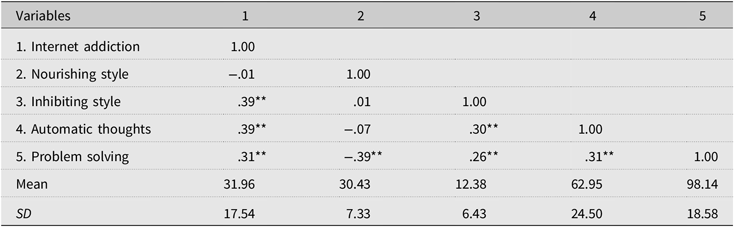
Correlation coefficients between total internet addiction scores and nourishing and inhibiting relationship styles, automatic thoughts, and problem-solving perception are shown in Table 2. Internet addiction was significantly correlated positively with an inhibiting relationship style (r = .39, p < .01), automatic thoughts (r = .39, p < .01) and problem-solving perceptions (r = .31, p < .01). No significant correlation was determined between internet addiction and a nourishing relationship style (r = −.01, p > .05). This indicates that individuals who make greater use of an inhibiting relationship style have more negative automatic thoughts and feel that their problem-solving skills are less sufficient as their internet addiction scores increase.
Correlations Among Variables

Note: **p < .01.
Stepwise hierarchical regression analysis was performed to identify variables predicting internet addiction. When including variables found to be significantly correlated with internet addiction in the analysis, correlation coefficients were noted. Inhibiting relationship style, automatic thoughts, and problem-solving perception were variables included in the equation, respectively. The results are shown in Table 3.
Variables Predicting Internet Addiction

Note: **p < .01.
An inhibiting relationship style, the first variable included in the equation, explains 15% of total variance, F(1,473) = 86.939, p < .01) After being included in the equation, automatic thoughts and relationship style together explained 23% of the total model variance, F(2,472) = 72.980, p < .01. The problem-solving perception variable, the last included in the equation, explained 25% of the total variance, together with the other two variables, F(3,471) = 54.899, p < .01. Analysis revealed that an inhibitory style (β = .39, p < .01), automatic thoughts (β = .29, p < .01) and problem-solving perception (β = .16, p < .01) made specific contributions to the model.
Variation in Total Internet Addiction Scores by Various Demographic Variables
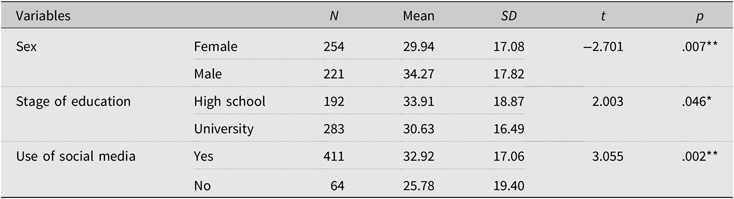
Results showing whether the total score obtained for internet addiction varied depending on sex, stage of education and use of social media are shown in Table 4. Findings regarding whether the total score varied depending on daily length of internet use on average.
Variations in Total Internet Addiction Scores Depending on Sex, Stage of Education and Social Media Use

Note: *p < .05, **p < .01.
Variations in Total Internet Addiction Scores Depending on Mean Daily Length of Internet Use

Note: **p < .01.
Independent group t-test results showed a significant difference in total internet addiction scores between the sexes (t = −2.701, p < .01), with males having higher internet addiction scores than females. Internet addiction scores also varied significantly in terms of stage of education (t = 2.003, p < .05), with high school students exhibiting higher total internet addiction scores than young people at university. Internet addiction scores also varied significantly depending on whether subjects made use of the social media or not (t = 3.055, p < .01), with young people using social media having higher internet addiction scores than those not using social media.
The Kruskal-Wallis test results showed a significant difference in total internet addiction scores depending on time spent online per day on average, χ2(3) = 55.27, p < .01. The Mann-Whitney U test was applied to identify the source of the variation. This revealed significant differences between those using the internet for less than 1 hour a day and those using it for 1–3 hours (U = 8,509.50, p < .05), those using it for 4–6 hours (U = 3,325.50, p < .01) and those using it for 7 hours or more than 7 hours (U = 818.00, p < .01). In addition, a significant difference was determined between those using the internet for 1–3 hours a day and those using it for 4–6 hours (U = 9,025.50, p < .01) or for more than 7 hours (U = 2,080.00, p < .01). No significant difference was observed between those using the internet for 4–6 hours a day and those going online more than 7 hours per day (U = 1,896.00, p > .05). The findings are shown in Table 5.
Discussion
Human beings are by nature social entities that establish social relations throughout the course of their lives. Internet addiction is a phenomenon that condemns individuals to sit at their computers and that has a negative impact on socialisation. Human beings employ various styles of interpersonal relations. A nourishing relationship style involves expressing one’s needs to the other person and using open and respectful language. An inhibiting relationship style, on the other hand, is characterised by such features as regarding oneself as superior to the other person, mockery and anger (Şahin et al., Reference Şahin, Durak and Yasak1994). Our study documented that young people with limited symptoms of internet addiction used an inhibiting style more than individuals with no symptoms. Individuals who employ an inhibiting relationship style experience problems in interpersonal relations and are unable to establish healthy communication. It is thought, but needs further investigation, that they are able to meet the social needs which they cannot meet in real life in the virtual world instead. They may have the power to initiate, maintain and conclude communication with a single touch of a key. They are not obliged to abide by specific rules in interpersonal communications and are able to shape relations in whichever direction they wish.
Negative automatic thoughts regarding themselves may be one of the impulses that encourage young people to spend greater and uncontrolled time online. Automatic thoughts are various ideations that occur when changes of feelings take place, which cannot be controlled and which are not processed through a logical filter (Beck Reference Beck2001). Research has shown that subjects with depressive symptoms have more negative automatic thoughts (Aydın & Aydın, Reference Aydın and Aydın1990; Dobson & Breiter, Reference Dobson and Breiter1983; Hollon & Kendall, Reference Hollon and Kendall1980). There are also studies showing an association between unhealthy internet use and depression (Burnay, Billieux, Blairy, & Laroi, Reference Burnay, Billieux, Blairy and Laroi2015; Yen et al., Reference Yen, Ko, Yen, Chen, Chung and Chen2008). Our study showed that the group with limited symptoms in terms of internet addiction possessed more negative automatic thoughts than the group with no symptoms. An individual with negative automatic thoughts may elect to spend more time online to avoid problems in real life and to feel better. Further, it may not be difficult to cope with problems online (Özçınar, Reference Özçınar2011; Ümmet & Ekşi, Reference Ümmet and Ekşi2016); the individual can surf the web as they wish, play games and even lose the games while playing. The person with negative automatic thoughts creates accounts intended to portray him/herself differently on social media than real life. Thanks to this created virtual reality where the person is satisfied, he/she can overcome negative automatic thoughts and cope with depressive symptoms.
Problem-solving skills are those used by an individual to overcome problems encountered throughout life. When the confidence individuals feel in their problem-solving skills is low, they seek to develop various and inappropriate coping strategies (Heppner, Baumgardner, & Jackson, Reference Heppner, Baumgardner and Jackson1985). Young people without symptoms of internet addiction appear to perceive themselves as having better problem-solving skills than those exhibiting limited symptoms. Individuals who believe their problem-solving skills are poor may seek a solution online when they encounter a problem in life. In addition, since they think that they will experience fewer problems on the internet, they may again choose to spend most of their time online. Since people can decide on what music to listen to, or news reports to read, or game to play, or chat rooms to enter when online, they encounter fewer problems. When they do encounter a problem, they close that web page rather than striving to find a solution.
One of the findings of this study is that an inhibiting style of relationship, automatic thoughts and problem-solving skills are predictive of internet addiction. As young people’s internet addiction scores rise, they make greater use of an inhibitory style of relationship, have more negative automatic thoughts, and perceive their problem-solving skills to be less adequate. People who have a negative self-perception, who experience problems in expressing themselves, and who have low confidence in their ability to solve problems they encounter may feel more at ease in a virtual environment. They portray themselves as they would like to be and establish contact with more people than they could meet in real life. In addition, since these individuals spend time in an environment other than the real world, they will not regard problems they encounter as serious issues requiring a solution.
Investigation of whether young people’s internet addiction scores vary depending on sex and stage of education showed that males had higher scores of internet addiction than females, and high school students had higher scores of internet addiction than those at university. In agreement with these findings from our study, previous studies have also shown that males make greater use of the internet and exhibit higher addiction scores (Chou & Hsiao, Reference Chou and Hsiao2000; Willoughby, Reference Willoughby2008). According to Turkish Statistical Institute figures for 2015 (TSI, 2015), 64% of males and 45.6% of females use computers, and 65.8% of males and 46.1% of females use the internet. Since females devote more time to social activities and males to technological ones, males may be considered the group at risk in terms of misuse (Aydemir, Reference Aydemir2018; Dökmen, Reference Dökmen2016). High school students having higher internet addiction scores than university students may be attributed to the fact that the former still live with their families and their relations with their social circles are still under family control. Since the high school students in our study were in their third and fourth years, they may have experienced pressure from families due to the proximity of university entrance exams. It may be that high school students who are expected to spend time in their rooms studying will prefer to go online via smart phones or computers when they are tired of studying, rather than going out of their rooms and being reprimanded.
Young people who used social media had higher internet addiction scores than those who did not. Sharing takes place on an uninterrupted basis on social media accounts, and individuals are made aware of these by regularly checking their accounts. Numerous messages regarding different people and events appear in minutes, and unless these are monitored on a constant basis, they soon become out of date. Individuals seize every opportunity to go online, both to be able to monitor this constant flow and to be capable of inclusion in the process. Failure to use the internet for specific periods and in a controlled manner shows that an individual uses it in an unhealthy way (Laconi, Tricard, & Chabrol, Reference Laconi, Tricard and Chabrol2015; Spada, Reference Spada2014; Young & Rodgers, Reference Young and Rodgers1998). Increasing time spent online is a significant risk factor for addiction. In this study, internet addiction scores increased with daily time spent online on average, but with no difference being observed between 4–6 hours of use and 7 hours of use. The absence of any difference between these two levels may derive from both representing lengthy periods spent on the internet. Research indicates that increased time spent online is correlated with internet addiction (Aslan & Yazıcı, Reference Aslan and Yazıcı2016; Ayhan & Köseliören, Reference Ayhan and Köseliören2019; Chung, Sum, & Chan, Reference Chung, Sum and Chan2019; Odacı & Kalkan, Reference Odacı and Kalkan2010; Özçınar, Reference Özçınar2011; Pontes, Kuss, & Griffiths, Reference Pontes, Kuss and Griffiths2015).
Conclusion and Recommendations
Conclusions
The results of the present study show that the group with limited symptoms of internet addiction differed from the group with no symptoms in terms of inhibitory relationship styles, automatic thoughts, and problem-solving skills. These three variables also explain internet addiction to a significant extent. Additionally, this study found that males had higher internet addiction scores than females, high school students had higher scores than university students, subjects using the social media had higher scores than those not using them, and those spending more time online had higher scores than those spending less time online.
Recommendations
While this study reveals a number of important conclusions, it is also of considerable importance in terms of study group selection. Studies in the literature have generally been performed with a single specific group, such as high school or university students, while the present study included both high school and university students. Comparison of the results made it possible to identify the most at-risk group. The study findings show that adolescents at high school and males are a risk group particularly, and interventional measures directed toward these students need to be implemented without loss of time. These may include skills training sessions on problem solving, establishing healthy communication, and rational and logical thinking, in order to reduce or eliminate internet addiction. In addition, this study makes a significant contribution to the literature by identifying high school adolescents as being more at risk than university students in terms of internet addiction. Further studies might consider whether high school students are a more at-risk group than university students in terms of other types of addiction, such as alcohol, narcotics and smoking, and might also investigate relations between internet addiction and a tendency to other forms of addiction.
It is expected that school counsellors have a significant role to play to address the issue of adolescent internet addiction. Automatic thoughts as a symptom of depression were found to be more common in adolescents with higher internet addiction scores. Therefore, school counsellors may consider a cognitive approach to address the symptoms of depression in adolescents and to take prevention measures for associated self-injurious behaviour or suicide attempts. At the same time, it was found that an inhibiting style in interpersonal relations and poor problem-solving skills are related to internet addiction. It is an appropriate approach for school counsellors to do supportive studies to improve communication and problem-solving skills of adolescents. Although the subject of internet addiction was discussed together with different variables in the literature, it is considered important to evaluate psychological, social and personal variables concurrently, as outlined in our study. It is recommended that school counsellors apply social-cognitive individual and group interventions to address the internet addiction problems in a holistic manner by identifying individuals who display symptoms. In these interventions, evidence-based treatments for internet addiction, such as cognitive behavioural therapy, reality therapy and rational emotional behaviour therapy approaches, can be utilised. According to the results of our study, it is thought that social media use, period of internet use, interpersonal relationship styles, automatic thoughts, and the ability to solve problems can be guidelines for school counsellors to determine the students with symptoms of internet addiction.
The identification of psychological, social and personal variables associated with internet addiction in young people is important as it was found to be a critical age group in terms of internet addiction. Since only five participants were identified as pathological internet users, this study was performed among young people exhibiting limited or no symptoms. New studies in this area might be planned with broader sampling to include the psychological dimension. The variables considered may help professionals who provide support services understand the nature of internet addiction. It is recommended that psycho-educational activities be developed and provided for educators, families and young people on how to establish controlled internet use of a duration consistent with its proper purposes. Young people often spend time at home and with their families. For this reason, the family needs to be supportive and take precautions on internet addiction. School counsellors need to consider a range of responses such as: providing seminars to inform families and to gain awareness about this issue; raising awareness of the school community on health services, psychological health and current issues; and arranging group activities for students with symptoms and those who use the internet in a pathological manner. At the same time, individual counselling services might be provided in line with the willingness of the student concerned. In cases of pathological cases of internet addiction, it is recommended that unless the school counsellor has expertise in this area that these students be referred to a specialist therapist.
Conflict of interest
None.
Ethical approval
All procedures performed in studies involving human participants were in accordance with the ethical standards of the institutional research committee and with the Helsinki declaration and its later amendments or comparable ethical standards.