Introduction
Over 500,000 older people in England (Government, Reference Government2013), and over a million in the USA receive home care every day (Jones et al., Reference Jones, Harris-Kojetin and Valverde2012). Older home care clients have substantial physical, mental, and cognitive needs. Around a third have dementia, 17–28% depression and 19% clinically significant anxiety (Cooper et al., Reference Cooper, Katona, Finne-Soveri, Topinkova, Carpenter and Livingston2006; Nikmat et al., Reference Nikmat, Al-Mashoor and Hashim2015; Wang et al., Reference Wang, Kearney, Jia and Shang2016). Paid carers who provide personal care and assistance to clients in their own homes are variously termed direct carers, personal care attendants, home health attendants, certified nursing assistants, home carers, or orderlies. In the UK in 2014/15, there were over 10,000 regulated home care providers, 4% were local authority, and the remainder independent or voluntary organizations. Paid carers in England were predominantly female (85%), with a broad age range (45–54 years the most prevalent age group), two-thirds were of British nationality (UKHCA, 2016), demographic profiles similar in other Western countries (Jones et al., Reference Jones, Harris-Kojetin and Valverde2012). Home carers are low paid (Muntaner et al., Reference Muntaner, Li, Xue, Thompson, Chung and O'Campo2006) and often receive minimal training and supervision.
In the 2016, the UK Alzheimer's Society Fix Dementia Care campaign survey of people affected by dementia, only 2% of respondents believed home care workers had sufficient dementia training, 49% did not think home care workers understood the needs of people with dementia, and 38% thought that home care workers did not know how to treat people with dementia with understanding and dignity. The consequences of this, in terms of care quality, were often “harrowing” (Carter, Reference Carter2016). The situation urgently needs to change, and to enable this, enhancing the evidence-based quality and effectiveness of existing home care resources is imperative. Existing training usually focuses on teaching knowledge or skills, but managing stress and coping might also be important. A third of home carers have reported low resilience and high stress levels (Elliott et al., Reference Elliott, Stirling, Martin, Robinson and Scott2015). Turnover among home carers is high (King et al., Reference King, Parsons and Robinson2012a) and associated with low job satisfaction (Chou et al., Reference Chou, Fu, Kroger and Ru-Yan2011), irregular, antisocial hours, poor management support, and workload pressures (Fleming and Taylor, Reference Fleming and Taylor2007). Low job satisfaction in 1,641 Taiwanese home care workers was associated with low pay and poor promotion prospects and low family support (Chou et al., Reference Chou, Fu, Kroger and Ru-Yan2011). Home carers’ well-being matters, because staff stress and resilience are likely to affect care quality and life quality of clients, and high turnover erodes learning from experience and training.
Standard models of home care are task-orientated: Needs (e.g. personal care, meals, or shopping tasks) are identified and help planned to meet them. This may undermine family carers and “person-centered care” and be inappropriate for older people, especially those with dementia (Rothera et al., Reference Rothera2008). In contrast, person-centered or needs-based care aims to see the person with dementia as an individual and focus care around what matters to them. In an interview study, 40 English older home care recipients did not feel that carers tried to involve them in their care (Sykes and Groom, Reference Sykes and Groom2011). Interventions have improved outcomes for care home residents with dementia and staff in research studies (Cooper et al., Reference Cooper, Barber, Griffin, Rapaport and Livingston2015; Lawrence et al., Reference Lawrence, Fossey, Ballard, Ferreira and Murray2016), but few older people's home care service interventions have been tested. Home carers’ experiences and needs differ from carers in care homes. They usually work alone, their workplace is the client's home and they have more contact with family carers, bringing challenges and opportunities in delivering person-centered care.
Interventions to change how home care services for older people are delivered could potentially improve clients’ and the paid carers’ lives but have never been systematically reviewed. Our objective was to systematically review quantitative and qualitative studies. We evaluated staff training and psychological interventions targeting paid home carers and home care agencies, which sought to improve health or well-being of older home care clients, and/or staff well-being. Our research questions are what is the effect of interventions that seek to change how paid home carers deliver home care to older clients on clients’ health and well-being and staff well-being? What components of multi-faceted interventions are valued and used by home carers?
Methods
Search strategy and selection criteria
We searched PubMed and Web of Science on 10th January 2016 using the keywords: training, education, intervention, treatment, therapy or trial with home care, paid care, domiciliary care, home making, personal care, direct care worker, certified nursing assistant, home health attendant, orderlies or in-home service and dementia, Alzheimer, cognitive impairment, aged, or older or elder. We also searched using MeSH terms (home care services, aged, psychological interventions, or education). We searched included papers’ references and relevant systematic reviews.
We included primary, quantitative, or qualitative research evaluating interventions aimed at improving the health or the quality of life of older people with or without dementia receiving home care, or the health, burden, knowledge, job satisfaction, or retention of home care workers (defined as people paid to provide hands on care, who do not have extensive professional training), through training, supervision, or other interventions aimed at home care workers or management. We included all studies reporting relevant outcomes (proxy, self- or observer rated) for older home care clients and/or staff. We excluded single case reports, dissertations, meeting abstracts, and studies in which a significant intervention component involved residential care or was delivered directly by health or social care professionals.
Quality assessment
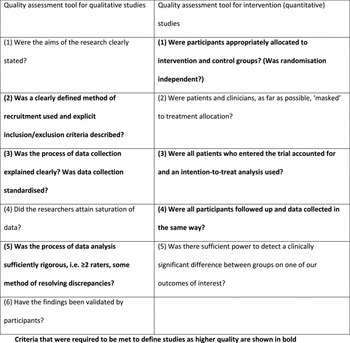
Blerta Cenko and Claudia Cooper (CC) rated paper quality independently, using operationalized checklists developed by our group and used in several other reviews e.g. (Boyle, Reference Boyle1998) (Figure 1). They discussed discrepancies in quality scores to reach consensus. We used the a priori criteria for defining higher quality studies used in earlier studies (see Figure 1) (Mukadam et al., Reference Mukadam, Cooper and Livingston2011).
Tools used to assess quality of qualitative and quantitative studies.

Analysis
For quantitative studies, we present a narrative synthesis, as the heterogeneity of outcomes precluded meta-analysis. For qualitative studies, we used a “thematic synthesis” (Braun and Clarke, Reference Braun and Clarke2006) to summarize and organize the main themes that informed our research question of what intervention characteristics improved staff or resident well-being. CC inductively coded data from the qualitative papers’ results sections in an open-ended, exploratory manner. Penny Rapaport (PR) reviewed the data and the coding frame; differences were discussed and the codes refined. CC then developed overarching themes that related these descriptive themes to the research question of what impact staff perceive the interventions to have on themselves and the well-being of their clients, and what components of multifaceted interventions were perceived to have contributed to these affects and were valued. We presented qualitative and quantitative findings as an integrated narrative analysis, followed by results of our qualitative thematic analysis.
Results
Search results
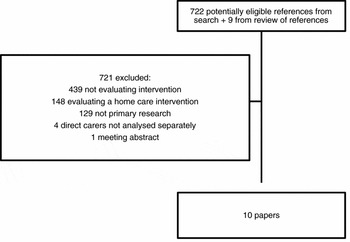
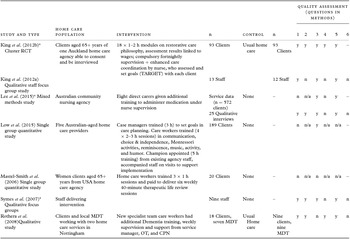
We included ten papers describing eight studies (see Figure 2 for search strategy and reasons for exclusion; Tables 1 and 2 for study details). Four studies took place in the USA, three in Australasia, and one in the UK. These papers included six quantitative evaluations, of which we rated one as higher quality (King et al., Reference King, Parsons, Robinson and Jorgensen2012b), and four qualitative evaluations, of which we rated two as higher quality (Symes et al., Reference Symes, Mastel-Smith, Hersch, Binder, Malecha and McFarlane2007; Lee et al., Reference Lee2015). We presented all papers due to the paucity of evidence but described the single, higher quality quantitative paper in more detail. Because both qualitative and quantitative analyses are included for two interventions, we describe quantitative and qualitative findings together, grouped by intervention type, followed by a synthesis of themes from qualitative papers.
Search strategy.

Studies reporting outcomes for older home care clients

aHigher quality studies are shown in bold.
Intervention with higher quality, quantitative evidence
The only quantitative study we rated as higher quality, a cluster Randomized Controlled Trial (RCT), evaluated implementation of goal-based care plans in New Zealand home care agencies. A nurse interviewed clients to set goals and devise a goal attainment plan that included repetitive activities of daily living (ADL) exercises (King et al., Reference King, Parsons, Robinson and Jorgensen2012b). Paid carers visited from daily to every two weeks. Care managers reassessed clients’ needs every three months. There were 18 paid carer training sessions based around a philosophy of restoring and/or maintaining physical function rather than symptom-focused care, wages were linked to achieving training competencies, and fortnightly compulsory group supervision. Clients and carers were geographically aligned to reduce travel. Participants with severe mental or physical health problems precluding outcome completion were excluded; 78% of those assessed for eligibility took part. Only 5% of participants had cognitive impairment (Abbreviated Mental Test Score <7). On the primary outcome of health-related quality of life, the intervention group improved relative to controls over seven months (mean difference in short form 36 scores: 3.8, 95% confidence interval −0.0 to 7.7, p = 0.05) and mental subscale scores (4.2, 0.0–8.4, p = 0.05). Staff turnover reduced in the intervention compared with the control group (17.9% vs. 42.5%). There were no significant group differences on the outcomes of physical health-related quality of life, mastery, social support, ADLs, or physical functioning.
In a qualitative evaluation of the same study, pre-intervention and control group interviews identified problems with working conditions, including inadequate communication and management support, low wages, unguaranteed hours, and no time allowed for travel. A lack of information about clients made the work harder and at times unsafe. Many staff had thought of leaving. Orientation and training were perceived as poor. Those in the intervention group valued the training and supervision; small group size enabled them to voice concerns, and they found it reassuring to know others had difficulties too. They valued having more flexibility, feeling trusted and being more involved with clients, and deciding together what to do rather than having set tasks. Decreased travel times were valued (King et al., Reference King, Parsons and Robinson2012a).
Specialized dementia home care
Rothera et al. (Reference Rothera2008) qualitatively interviewed home care stakeholders, comparing their experiences of a specialist dementia service in Nottingham, UK, and standard services. The specialist service focused on clients’ overall needs, requirements, and preferences, rather than specific tasks. Carers were trained in dementia care. They could perform tasks flexibly, undertaking visits outside the home or providing respite for family carers, and roster design ensured maximum continuity of staff/client relationships. There was weekly group supervision with a care manager, occupational therapist, and community psychiatric nurse. Multi-disciplinary reviews enabled care managers and carers to monitor clients’ needs and adjust care plans accordingly.
Clients valued the increased carer continuity. Family carers felt that their burden was shared with workers in the new service. Paid carers preferred the new service, feeling they had autonomy to respond to clients’ preferences and needs. Communication was reported to be improved, with telephone support from other team members a particularly valued addition. Greater continuity allowed care workers to develop relationships with clients and understanding of their life histories, relevant activities, and routines.
Activity programme intervention
In a single group, quantitative study, Low et al. (Reference Low2015) evaluated a 12-month social and recreational activity programme, in five Australian-aged home care providers, including two specializing in care for people from ethnic minorities. A total of 189 clients, 55% with dementia diagnosed participated. Champions, appointed to drive practice change, attended a 5-h training session to learn about organizational change, and interpersonal skills required for the role. Care managers received 3 h of training on setting meaningful social and recreational goals. Paid carers were trained over four 2–3 h sessions on: person-centered approaches; dementia and the unmet needs model of challenging behaviors; communication skills; autonomy and control; reminiscence; music; physical activity; Montessori activities; humor; and reciprocity. Champions accompanied carers on buddy visits to support them in practicing techniques. Clients and carers were matched on language spoken where possible. Outcomes were assessed six months prior and immediately prior to the intervention, and up to 12 months afterward. On the primary outcome, staff-rated client engagement did not change post-intervention, but client and family-rated engagement increased. There were 14 secondary outcomes; of these the only outcomes to change significantly post-intervention were apathy, dysphoria, and agitation on the Neuropsychiatric Inventory, which decreased, and contradictorily client and family self-rated apathy which increased. Loneliness and client satisfaction did not change. In terms of staff outcomes, self-efficacy and job satisfaction were also similar before and after the intervention.
Life review therapy
Two papers reported quantitative (Mastel-Smith et al., Reference Mastel-Smith, Binder, Malecha, Hersch, Symes and McFarlane2006) and qualitative (Symes et al., Reference Symes, Mastel-Smith, Hersch, Binder, Malecha and McFarlane2007) results of a study in which USA home carers were trained and paid to deliver a therapeutic life review intervention to women aged 65 years and over without cognitive impairment. In the quantitative evaluation, Geriatric Depression Score, the sole reported outcome, significantly decreased post-intervention for up to 20 weeks (p = 0.004), with a moderate effect size (0.66) in the 14 participants who completed all outcomes. Results for six patients who dropped out are not reported (Mastel-Smith et al., Reference Mastel-Smith, Binder, Malecha, Hersch, Symes and McFarlane2006). We do not know whether there were any positive effects on the care worker's practice with other clients, or support to implement this. In the qualitative evaluation, rated higher quality, carers found the training helpful. They were enthused and interested in their clients’ life stories, and thought that the intervention improved clients’ moods, by reducing loneliness and through retelling their stories, carers felt closer to their clients. They did not think it directly improved their work satisfaction.
Medication management training
Lee et al. (Reference Lee2015) qualitatively interviewed 27 nurses, 7 paid carers, 18 clients, and 10 family carers about an Australian community nursing team initiative to train paid carers to administer medication in place of nurses, and analyzed secondary data. The clients were aged 73 years and older, around half had complex needs, which were not defined. We rated the qualitative study component as higher quality. Clients and their family carers were generally positive, but often unaware whether a nurse or carer had visited them. The nurses reported having confidence and trust in the paid carers. Some carers found nurses reluctant to delegate, and some nurses had concerns about unspecified risks. Implementation was facilitated by the pre-existing relationships between carers and nurses. At the most successful implementation site, an elder nurse acted as an advocate/champion. One year post-implementation, 714 (3.3%) of visits were by carers, compared to 43 (0.25%) before. No medication adverse incidents involved carers.
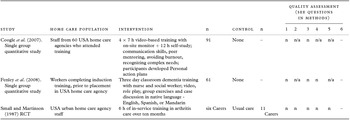
Staff training without supervision (Table 2)
Three staff training interventions, none of which included ongoing supervision, are reported in Table 2. No client outcomes were reported for these studies, all of which took place in the USA. In an RCT we rated as lower quality, Small and Martinson (1987) randomized Californian paid carers to receive basic training or extended training on arthritis management techniques but no further support or supervision. Knowledge about arthritis did not differ between groups. Many of the carers reported that patients were unwilling or unable to undertake the recommended activities; they felt that the patients did not consider them credible teachers.
Studies reporting staff outcomes only

Coogle et al. (Reference Coogle, Parham, Jablonski and Rachel2007) evaluated four 7 h video-based training sessions with homework assignments between sessions; covering communication skills, peer mentoring, avoiding burnout, and recognizing complex needs; in carers from 60 home care agencies, a third of whom had clients with dementia. Participants developed Personal Action Plans. Among 91/230 carers completing follow-up, extrinsic job satisfaction (relating to working conditions) declined post-intervention, whereas intrinsic job satisfaction (achievement, recognition, and responsibility) did not change. Six to twelve months later, carer resilience increased, but job satisfaction and commitment scores did not change. Fenley et al. (Reference Fenley, Bober, Powell, Berman and Altman2008) evaluated a dementia training for New York minority ethnic home carers, working with people with Alzheimer's disease. The 10 h training over two to three days involved lectures, role play, group exercises, and case discussion. A total of 61/144 participants completed follow-up; they had higher dementia knowledge post-training and rated it as useful and relevant.
Summary of qualitative themes
Across the four qualitative evaluations, three common themes emerged around the intervention components that care workers valued. The first theme was valuing greater flexibility to work to a needs-based rather than task-based model. In interventions that sought to change carer's overall approach to care, staff appreciated being able to individually tailor care provision, recognizing benefits for their clients and themselves. Staff felt more autonomous, trusted, and appreciated by clients, staff, and relatives for existing and newly developed skills (Rothera et al., Reference Rothera2008; King et al., Reference King, Parsons and Robinson2012a). When medication management was added to the home carers’ role, role flexibility was valued by carers and other team members (Lee et al., Reference Lee2015).
Another theme was staff valuing interventions that enabled them to build positive relationships with clients. Having the opportunity to get to know their clients better via life review (Symes et al., Reference Symes, Mastel-Smith, Hersch, Binder, Malecha and McFarlane2007), setting individually tailored goals or having more freedom to talk to clients, was seen as rewarding for staff and clients. They described how spending more time talking with clients’ helped to address clients’ loneliness and low mood. Staff in two studies also reported that having more time to discover their clients’ preferences made it easier to provide care (Rothera et al., Reference Rothera2008; King et al., Reference King, Parsons and Robinson2012a). Improved relationships with clients were enhanced when interventions included practical steps to increase continuity in client–carer relationships and sharing of client information within teams.
A final theme was valuing opportunities to share new learning and information with colleagues. This was via small group-based training sessions, introduction of additional team meetings, formal supervision sessions, and access to mentors or elders support (Symes et al., Reference Symes, Mastel-Smith, Hersch, Binder, Malecha and McFarlane2007; Rothera et al., Reference Rothera2008; King et al., Reference King, Parsons and Robinson2012a). Carers welcomed the chance to share challenges and experiences with colleagues, especially as they typically work alone and have limited contact with other carers, increasing a sense of belonging and decreasing isolation.
Discussion
We found only one, higher quality RCT, in which goal setting care plans, and care worker training and supervision improved client health-related quality of life in older people mostly without cognitive impairment (King et al., Reference King, Parsons, Robinson and Jorgensen2012b). The only interventions we found that improved client outcomes comprised training with additional implementation, such as regular supervision, appointing champions, buddy visits, or ongoing support from other staff. The multi-component interventions, for which we found most evidence, focused on setting meaningful goals and giving workers skills and role flexibility to focus care around the client, their needs and their goals – in other words person-centered rather than more traditional task-based care. Other important components of training discussed challenging behaviors and communication skills. Where carers were not supported after training to implement new learning or systems, they felt unable to do so (Small and Martinson, Reference Small and Martinson1987). In addition to carer training and supervision, management interventions included reducing travel times through geographical alignment, matching staff, and clients on language where possible and careful rostering to maximize continuity of client–staff relationships. All of these interventions potentially increased time or opportunities for staff to build relationships with clients. Carers enjoyed knowing more about their clients’ lives, where interventions enabled this. Two successful RCTs paid carers to deliver the intervention (Mastel-Smith et al., Reference Mastel-Smith, Binder, Malecha, Hersch, Symes and McFarlane2006) or linked wages to achieving training competencies (King et al., Reference King, Parsons, Robinson and Jorgensen2012b).
Although any interpretation of the limited evidence base that we found would be cautious and preliminary, it is interesting that the common elements we found in successful interventions were also those that have been part of effective interventions for care home staff. There is more evidence about effective interventions to improve outcomes for staff and clients in care homes, which is becoming more systematic, evidence-based, and manualized (Lawrence et al., Reference Lawrence, Fossey, Ballard, Ferreira and Murray2016). In care homes, interventions to support staff getting to know, understand, and connect with residents with dementia were valued by staff (Rapaport et al., 2016). Future home care sector research can learn from this, although the challenges are different. Implementation of any future intervention will be critical in the home care sector, which compared with care homes remain relatively unregulated, financially driven, and task focused.
Half a million older people receive home care in England, so the lack of evidence about how these services might be delivered most effectively to improve client and carer well-being is a missed opportunity to improve care. Improvements in home care services have the potential to be cost effective, as the home care workforce is already in place, and with training and support may be able to support people with dementia who are at high risk of care home placement to live at home for longer.
In considering outcomes for future trials, there are several mechanisms through which good quality home care might improve clients’ life quality. It should seek to engage clients, and to deliver practical and personal care effectively and with humanity, retaining dignity and reducing loneliness, and social isolation. It is also an opportunity to monitor nutritional intake, and sometimes to detect undiagnosed mental or cognitive illnesses. It should be delivered by well supported, satisfied staff, with good staff retention enabling the continuity of care that clients and their families want. The interventions for which we found the strongest evidence were based around goals set with clients; Goal attainment scaling has been developed to do so in a standardized way (Rockwood et al., Reference Rockwood, Howlett, Stadnyk, Carver, Powell and Stolee2003) and might be particularly suited to a trial of home care, which is tailored to personal needs.
Conclusions
Despite concerns about the quality of older people's home care provision in most Western countries (Jones et al., Reference Jones, Harris-Kojetin and Valverde2012; Government, Reference Government2013), there is a dearth of evidence about how to improve it. There is preliminary evidence from the only quantitative study we rated as higher quality that client well-being can be increased and staff turnover decreased through interventions targeted at home care. High-quality evidence regarding client health outcomes is currently lacking. Where interventions have included staff training with ongoing supervision and implementation, they have generally been successful. Home carers value interventions that promote needs-based care and allow them flexibility in their role. More research in this sector including feasibility testing of the first home care intervention trials to include health and life quality outcomes for clients with more severe dementia is now needed.
Conflict of interest
None.
Description of author's roles
CC conducted the initial searches, CC and BC independently rated the papers, CC and PR conducted the qualitative thematic analysis, all authors revised the paper critically for intellectual content and approved the final version for submission.