




No CrossRef data available.
Article contents
Predictors of postconcussion symptom complex in community dwelling male veterans
Published online by Cambridge University Press: 12 February 2004
Abstract
The presence of a persistent postconcussion symptom complex (PPCSC) was examined in a non-referred sample of male veterans with a history of mild head injury and a comparison group without a history of head injury. Hierarchical logistic regression procedures were used to determine possible predictors of PPCSC using variables supported by previous research (i.e., preexisting psychiatric difficulties, demographic and social support variables, and history of an accidental injurious event). Although PPCSC was common in all groups (23% of the total sample), a significantly greater proportion of individuals in the mild head injury with loss of consciousness group (37.2%) had PPCSC compared with three other groups (head injury without loss of consciousness = 26.1%; motor vehicle accident without head injury = 23%; and control = 17.3%). However, the most salient predictors of PPCSC were early life psychiatric difficulties such as anxiety or depression, limited social support, lower intelligence, and interactions among these variables. The predictive value of loss of consciousness was significant, but low (1.4% of unique variance). The findings provide support for the premise that PPCSC is mediated in part by individual resilience, preexisting psychological status, and psychosocial support. (JINS, 2003, 9, 1001–1015.)
Keywords
Information
- Type
- Research Article
- Information
- Journal of the International Neuropsychological Society , Volume 9 , Issue 7 , November 2003 , pp. 1001 - 1015
- Copyright
- © 2003 The International Neuropsychological Society
INTRODUCTION
The Centers for Disease Control and Prevention (CDCP) estimate that 1.5 million Americans survive traumatic brain injuries every year (CDCP, 1999; Sosin et al., 1996). The majority of these are mild head injuries (MHI) requiring only a brief or no hospitalization (CDCP, 2002; Guerrero et al., 2000). Though most individuals who experience MHI completely recover within the first three months (Binder et al., 1997), a significant minority continue to report distressing symptoms for months (Alves et al., 1993; Dikmen et al., 1986; Hartlage et al., 2001; Powell et al., 1996) or years post injury (Alexander, 1992; Deb et al., 1999; Hartlage et al., 2001). Frequently these complaints involve a constellation of physical, emotional, and cognitive symptoms collectively known as postconcussion syndrome (PCS). This symptom complex typically involves ongoing complaints of headaches, dizziness, depression, irritability, fatigue, and cognitive difficulties, often without demonstrable structural changes to the brain (Eisenberg & Levin, 1989) or neuropsychological dysfunction (Dikmen et al., 1986; Levin et al., 1987b). However, the etiology of persistent PCS symptoms, particularly in the absence of objective findings, remains controversial.
We have chosen the term persistent postconcussion symptom complex (PPCSC) to describe this phenomenon because formal diagnostic criteria for PCS vary between the Diagnostic and Statistical Manual of Mental Disorders–4th Edition (DSM–IV; American Psychiatric Association, 1994), which requires neuropsychological evidence of attention or memory difficulty, and the International Statistical Classification of Disease and Related Health Problems–10th Edition (ICD–10; World Health Organization, 1992), which does not. In addition, the ICD–10 suggests that there may be hypochondriacal preoccupation, while the DSM–IV does not list that as a diagnostic criterion. However, the complex of symptom complaints is similar between the two classification systems.
Some researchers posit that PPCSC reflects subtle neurological dysfunction typically beneath the threshold of routine diagnostic procedures such as CT, MRI, and EEG completed shortly after injury (Hayes & Dixon, 1994; Miller, 1996; Povlishock & Coburn, 1989). Evidence for this premise is supported by follow-up MRI scans on concussed individuals, which reveal alternations in the ventricular system and white matter (Andersen & Bigler, 1995). Additional support is found from animal model studies utilizing tracer and immunocytochemical methods, and from human studies of individuals who die from unrelated causes following a MHI. Post-injury observations in these cases show evidence of neuronal axon stretching, but not typically severing (Grady et al., 1993; Povlishock & Coburn, 1989). This type of axonal injury has been observed following noninvasive minor head injury as well (Jane et al., 1985), with a pathological cascade including swelling, cytoskeletal disruption, impairment in axonal transport, and chromatolysis (Christman et al., 1994). Theoretically, axonal injury is thought to be associated with the cognitive, emotional, and behavioral symptoms associated with PCS (Hayes & Dixon, 1994), while secondary neuroplastic changes such as compensatory dendritic sprouting, reafferentation, and neurochemical changes would account for the post-traumatic recovery period of typically 3 months (Elson & Ward, 1994; Levin et al., 1987a). According to this model, persistent symptoms may be the result of “less-than-optimal reafferentation of traumatically damaged synaptic pathways … mediating subtle but important aspects of cognition, emotion, personality, and behavior” (Miller, 1996). Though limited, evidence of subtle neurophysiological and neuropsychological alterations in patients with PPCSC can be found in the literature. For example, Gaetz and Weinberg (2000) examined event-related potential response latencies and amplitudes in 20 subjects with continued symptoms and a matched control group. Differences greater than 2.5 standard deviations were found on visual and auditory event- related potentials in the symptomatic group compared with the control subjects. Also, Leininger and colleagues (1990) reported neuropsychological sequelae in symptomatic patients up to 22 months following brief loss of consciousness or a period of disorientation.
Conversely, others contend that symptoms are the result of psychological mechanisms such as expectations following a MHI (Mittenberg et al., 1992), poor coping styles (Bohnen et al., 1992; Marsh & Smith, 1995), or emotional reactions to an adverse event (Bryant & Harvey, 1999). For example, Mittenberg and colleagues (1992) found support for the notion that implicit beliefs regarding a set of symptoms anticipated following a head injury account for persistent PCS. Soliciting expected symptoms using a 30-item symptom checklist for postconcussion syndrome, they demonstrated that control subjects (n = 223) asked to imagine symptoms following a head injury reported very similar symptoms as those subjects who had experienced a head injury (n = 100). Head injured subjects reported an average of 13.8 symptoms (SD = 8.3) while the control group anticipated an average of 14.8 symptoms (SD = 7.6). In terms of poor coping, level of psychological distress has been found to be higher in head injured subjects with prolonged postconcussion symptoms compared to those with uncomplicated recoveries despite average neuropsychological test findings (Karzmark et al., 1995). Higher levels of self-reported psychological distress have also been shown on the Minnesota Multiphasic Personality Inventory (MMPI or MMPI–2; Butcher et al., 1989; Hathaway & McKinley, 1983) as measured by group means on the Hysteria, Hypochondriasis, and Depression Scales (Youngjohn et al., 1995). Goldberg and Gara (1990) and Youngjohn et al. (1995) reported that patients involved in a non-serious motor vehicle accident (i.e., no head injury) with lingering psychiatric distress typically clustered into groups with clinical features of depression, post-traumatic stress disorder, difficulty adapting to pain, and PCS. Di Gallo et al. (1997) and Bryant and Harvey (1999) also provide support that PPCSC partly reflects anxiety from the experience of an adverse event perceived as life-threatening (i.e., post-traumatic stress response).
Still other findings indicate that a neurogenic versus psychogenic conceptualization is insufficient to explain this perplexing phenomenon. Secondary gain or financial incentive (Lees-Haley & Brown, 1993; Youngjohn et al., 1995) can play a significant role in PPCSC. According to a meta-analytic review that included approximately 20 different samples, the effect of financial incentive on outcome following MHI is quite large (effect size = .47; Binder & Rohling, 1996). Furthermore, concomitant psychiatric difficulties such as depression and anxiety (Fann et al., 1995; Trahan et al., 2001) also appear to be important moderators of this syndrome. Fann et al. (1995) examined the incidence of psychiatric disorders and postconcussion symptoms in a group of 50 outpatients seen consecutively at a brain injury rehabilitation center. Twenty-six percent of the patients had current major depression and 24% had current generalized anxiety disorder; patients with psychiatric disorders reported more severe postconcussion symptoms and were more functionally disabled. King (1996) reported that self-report measures of depression, anxiety, and stress completed within one week of mild to moderate head injury were highly predictive of severity of post-concussion symptoms 3 months post-injury.
Though empirical support is limited, Alexander (1992) suggested that factors apart from physiologic and psychologic contribute to or lower the threshold for expression of postconcussion symptoms, or maintain or exacerbate the symptom complex over time, particularly with milder types of injury (e.g., emergency room GCS of 15 following a brief loss of consciousness at the scene). These factors may include demographic variables, preexisting psychiatric disturbance, and post-injury environmental factors, all of which appear to have some relationship to PPCSC. For example, Fenton and colleagues (1993) found female gender, older age, and social difficulties to be associated with chronic symptoms. Santa Maria and colleagues (2001) reported a similar gender effect. Preexisting psychiatric disturbance and psychosocial problems are often found in symptomatic patients (Binder, 1997; Fenton et al., 1993; Greiffenstein & Baker, 2001; Robertson et al., 1994) and tend to complicate recovery from MHI (Fann et al., 1995). Also, post-injury environmental factors such as quality of social support and environmental stress have been demonstrated to influence PPCSC (Gouvier et al., 1992; Radanov et al., 1991; Wood et al., 1984). In a recent study, Ponsford et al. (2000) identified psychiatric problems, stress level, and history of other neurological problems including previous head injury as salient predictors of the number of postconcussion symptoms three months following MHI.
Adding to the controversy surrounding PPCSC is the lack of specificity of symptoms to MHI. Headaches, memory and concentration problems, dizziness, anxiety, irritability and fatigue are commonly seen in other populations. High rates of these symptoms have been documented in chronic pain patients (Iverson & McCracken, 1997), medical patients (Fox et al., 1995a), outpatients seeking psychological treatment (Fox et al., 1995b), and non-head injured personal injury claimants (Dunn et al., 1995). In fact, the base rates of these symptoms are relatively high in normal individuals recruited for analog studies (Mittenberg et al., 1992; Wong et al., 1994). Generally high base rates and lack of specificity of PPCSC symptoms to head injury per se make identifying factors predictive of the persistence of symptoms following MHI even more challenging.
Interpretation of findings regarding PPCSC are further complicated by methodological issues. The vast majority of studies on this topic have used referred, symptomatic subjects (Gasquoine, 1997). Patients with ongoing complaints are more likely to seek treatment and compensation than those in the general population of MHI, although the majority of individuals who experience MHI do not seek treatment (Binder & Rohling, 1996). Because of these factors, the relationship between PPCSC and the natural recovery from MHI is unknown.
In summary, the premise that PPCSC is a complex phenomenon mediated by multiple determinants (e.g., neurological and psychological factors, financial incentives, demographic characteristics, preexisting or comorbid mental health conditions, environmental support, or co-existing environmental stressors) is supported by the literature. However, few studies have simultaneously examined the relationship of these variables on PPCSC. Furthermore, the vast majority of studies in this area have relied on clinical samples, which has limited generalizability to the general population of MHI. Identifying salient variables that exert an influence on the presence PPCSC and its relationship to the natural recovery from MHI requires the use of a non-referred sample. The goals of this current study were: (1) to examine the prevalence of PPCSC in a non-referred, community-dwelling sample of male veterans, (2) to examine the contribution of multiple factors—preexisting psychiatric difficulties, demographic and social support variables, and history of an accidental injurious event—to the presence of a PPCSC in such a sample, and (3) to examine whether the influence of variables predicting PPCSC differ between a MHI sample and a non-head injured sample.
METHODS
Data
The data utilized in the current investigation were that of the Vietnam Experience Study (Centers for Disease Control, 1988a, 1988b). These data were collected in the mid-1980s as part of a study investigating the effects of the Vietnam experience on veterans. The total sample consisted of 4462 randomly selected male US Army veterans who served during the Vietnam Era and who had (1) first entered the military between January 1965 and December 1971, (2) been on active duty for at least 4 months, (3) served only one tour of duty, (4) obtained a military occupational specialty, and (5) achieved a pay grade no higher than E-5 (Sergeant) upon discharge. Participants were flown from their city of residence to a city in the southwestern United States for a 3-day comprehensive evaluation involving extensive medical, psychological, and neuropsychological examinations.
The medical evaluation included a 30-min structured medical history questionnaire, a general physical, electrocardiogram, nerve conduction velocity and pulmonary function tests, as well as neurological, dermatological, audiology, and visual examinations. Psychological evaluation involved a semi-structured psychiatric interview and a self-report measure of psychological status. The purpose of the medical history questionnaire was to gather information regarding health-related events that may have occurred during the time interval from military discharge to study date, which was approximately 16 years post military discharge. Questions pertaining to current physical (e.g., headaches, dizziness), emotional (e.g., depression, anxiety) and cognitive (e.g., memory and concentration problems) symptoms, along with past history of various medical disorders, were surveyed.
During the interview, participants were asked, among many others, the following three questions: (1) Since your discharge from active duty, have you been injured in a motor vehicle accident (MVA)? (2) Since your discharge from active duty, have you injured your head (HI)? and (3) Did you lose consciousness as a result of the head injury? If participants were unclear if they had lost consciousness, they were asked if they had “blacked out” in the accident. Thus, loss of consciousness (LOC) included a disturbance of consciousness or period of post-traumatic amnesia, not just unconsciousness. Responses to these questions were the basis for the formation of four groups: No MVA/No HI, MVA without HI, HI without LOC, and HI with LOC.
Persistent Postconcussion Symptom Complex (PPCSC)
The presence of a PPCSC was not overtly solicited in the original data collection but was derived for the current study from questions pertaining to current symptoms posed during the medical history interview and questionnaire. Questions whose content reflected various postconcussion symptoms listed in the ICD–10 (World Health Organization, 1992) and the DSM–IV (American Psychiatric Association, 1994) were selected. To illustrate, presence of headache was determined by a “Yes” response to, “During the past year have you had unusually frequent or severe headaches?” from the medical history questionnaire. Similar interview questions were, “In the past six months have you had trouble concentrating?” or “In the past six months have you had trouble with your memory?” Answers on these latter series of questions were based on a 4-point, frequency of occurrence scale (0 = never, 1 = sometimes, 2 = often, 3 = very often). Only items endorsed as occurring often or very often were considered to represent a current PPCSC symptom.
Three psychological PPCSC symptoms were not covered in the medical interview or questionnaire—fatigue, depression, and anxiety. Presence of these symptoms was determined from responses on the Minnesota Multiphasic Personality Inventory (MMPI; Hathaway & McKinley, 1983). Sadness or depression was determined from a true response to, “Most of the time I feel blue.” Anxiety was determined from a true response to, “I feel anxiety about something or someone almost all the time.” Fatigue was determined from a positive response to at least two of the following three items: (1) “I do not tire easily” (false); (2) “I feel weak all over much of the time” (true); and (3) “I feel tired a good deal of the time” (true).
Individuals were classified as either satisfying subjective symptom criteria for postconcussion syndrome for ICD–10 or DSM–IV. For the ICD–10 criteria, we adopted the Mittenberg and Strauman (2000) symptom classification scheme. Table 1 presents the percentages of participants who met these various criteria. Because symptoms were not overtly solicited but extracted from various measures as described above, we selected a more stringent classification for PPCSC for the regression analysis, namely, requiring that both ICD–10 and DSM–IV subjective symptom criteria were met. As stated earlier, the term persistent postconcussion symptom complex (PPCSC) was utilized in this study instead of postconcussion syndrome. The latter requires neuropsychological evidence of attention or memory difficulty (DSM–IV), and preoccupation with symptoms (ICD–10), as well as a documented history of head injury. Our objective was to examine this phenomenon in community dwellers who either did or did not have a MHI. Thus, complete diagnostic criteria for PCS were not used in this study; just the subjectively reported symptom complex.
Criteria for determination of PPCSC and percentage of subjects who met each criterion

Research Participants
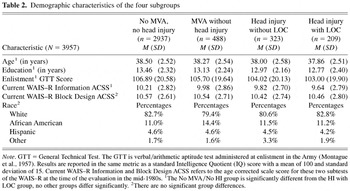
Of the original 4462 participants, 55 individuals who required hospitalization following their head injury were excluded from the current analyses in order to capture only those with minor or mild uncomplicated head injuries. An additional 121 were excluded because they were missing data for one or more variables of interest in the current study. Finally, 329 were excluded because they met symptom-based classification criteria for either ICD–10 or DSM–IV PPCSC, but not both. This left a remaining sample of 3957 for the prediction analysis. Of these, 2937 had not experienced injury in a MVA or had a HI since military discharge (i.e., No MVA/No HI group), 488 had experienced an injury in a MVA but did not have a HI (i.e., MVA without HI group), 323 had a HI without disturbance of consciousness (i.e., HI without LOC group), and 209 had a HI with disturbance of consciousness (i.e., HI with LOC).
Demographic characteristics of these groups are presented in Table 2. This sample represented quite well the general population of males from this cohort, as would be expected given that a military draft was essentially responsible for the original selection process, from which the current sample was randomly selected.
Demographic characteristics of the four subgroups

Given that the evaluations were conducted approximately 16 years after military discharge, the adverse events (i.e., either MVA or HI) would, on average, have likely occurred about 8 years prior to the evaluation. No data were available on the severity of the HI other than the occurrence of a period of disturbed consciousness reported by 209 of the participants and the fact that, although injured, no HI participant required overnight hospitalization for their injuries. In addition, no data were available regarding severity of the MVA. However, 102 of the MVA without HI group (20.4%) reported hospitalizations for various fractures (n = 53), internal injuries (n = 21), contusions (n = 12), trunk injuries (n = 7), or observation (n = 9).
Measures
Variables thought to be or found to be associated with the presence of PPCSC in previous research studies were selected from the Vietnam Experience Study data set. Four domains were represented: (1) demographic factors (age, education, race, and enlistment cognitive ability); (2) early life psychiatric difficulties (i.e., prior to military enlistment); (3) current social support; and (4) history of an accidental injurious life event.
Demographic variables
Demographic variables included age, level of education, race, and level of intellectual ability at enlistment. Race was coded White or Minority for the prediction analyses. Level of premorbid intellectual ability was defined as performance on the General Technical Test (GTT; Montague et al., 1957) at time of military enlistment. The GTT is a verbal/arithmetic aptitude test administered at enlistment in the Army and again at the time of data collection (current). Results are reported in the same metric as a standard Intelligence Quotient (IQ) score with a mean of 100 and standard deviation of 15. The GTT has been shown to be a measure of general intellectual ability (g; Centers for Disease Control, 1989). In the present data set the correlation between current GTT and current WAIS–R Information subtest was .73; and the correlation between current GTT and the average of WAIS–R Information and Block Design subtests was .75.
Early life psychiatric difficulties
Responses on the psychiatric Diagnostic Interview Schedule, Version III–A (DIS–III–A; Robins et al., 1981) were used to determine the presence of early life psychiatric difficulties. The DIS–III–A is a standardized questionnaire used to assess the prevalence of psychiatric disorders in the general population. The instrument consists of modules that are grouped together in diagnostic categories (e.g., anxiety, mood, substance use). Diagnoses on this version of the instrument were made according to DSM–III (American Psychiatric Association, 1980), not DSM–IV, and were generally considered to represent “current” diagnoses. Inclusion of a graphic time line and redundant questions regarding age of onset and duration within each DIS–III–A criterion scale assists recall of whether a symptom or disorder began within or before the asked-for time frame. The temporal component of these items is useful in determining both comorbidity and the presence of preexisting psychiatric problems (Shaffer et al., 1993). Early life psychiatric difficulties were conceptualized as being either internalizing problems (i.e., anxiety, depression, mania, psychosis), or externalizing behaviors (i.e., conduct disorder and substance abuse) and were determined based on symptoms or disorders that were reported to have begun prior to the age of 20. In order to be classified as having early life psychiatric problems a threshold number of symptoms in each diagnostic category, typically representing a positive response of 50% or more of the items, was required. Thirty-three percent of the sample reported early life psychiatric difficulties. Of those who reported early life psychiatric difficulties, 64% involved drug and/or alcohol problems, 52% had conduct disorder symptoms, 16% had anxiety related symptoms and 12% experienced depressive symptoms. Less than 3% reported problems with psychotic behavior or mania. Nearly 30% of the sample endorsed early life externalizing problems whereas only 7.4% endorsed early life internalizing problems. Presence or absence of early life internalizing and/or externalizing problems were the variables used in regression analyses.
Satisfaction with social support
Satisfaction with and availability of social support were determined by responses on two DIS–III–A items: “How satisfied are you with the kinds of relationships you have with your family and friends” (1 = very satisfied, 2 = somewhat satisfied, 3 = somewhat dissatisfied, and 4 = very dissatisfied); and, “In times of trouble, can you count on at least some of your family and friends?” (1 = most of the time, 2 = some of the time, and 3 = hardly ever). These items were used to group participants into one of three categories: good social support (49.4% of the sample; very satisfied with support, and support was available most of the time), average social support (42.7% of the sample; somewhat satisfied with support, and support was available most or some of the time), and poor social support (7.9% of the sample; dissatisfied with support, or support was hardly ever available).
Accidental injurious life event
Analyses were conducted separately for two samples: those with and without head injury. Presence or absence of disturbed consciousness was used as a predictor variable in the analyses of the sample with a head injury, while presence or absence of an injurious MVA (excluding head injuries) was used as a predictor variable in the sample without head injury.
Data Analytic Strategy
Differences among the groups were examined through analysis of variance (ANOVA) and contingency table analyses, depending on the level of variable measurement. Group differences in presence of PPCSC and the likelihood of exhibiting PPCSC were evaluated through contingency table analysis and the resultant odds ratios.
Hierarchical logistic regression analyses were completed separately within the head injury sample and within the sample without head injury. Examining predictors of outcomes in separate samples allows for evaluation of whether a MHI population has unique or different predictors compared with the general population.
The demographic, early life psychiatric difficulties, social support, and accidental injurious life event variables described above were entered as sets of predictor variables in the hierarchical logistic regression analyses. Subsets of possible two- and three-way interactions were also selected a priori for examination. Variables were entered in blocks, with the main effects entered first followed by the set of two-way and then the set of three-way interactions. The selected interaction variables are presented in Table 4. To determine the unique contribution of each set of predictor variables, each block was entered last relative to all other blocks of predictors. The change in variance associated with the last step represents the unique contribution of that set of predictors. This procedure was used to evaluate the unique contribution of the main effects prior to any interaction effects, the unique contribution of the two-way interactions over and above the main effects but prior to the three-way interactions, and the unique contribution of the three-way interactions over and above all other predictors. Similarly, the unique contribution of each specific variable within a block was evaluated using an analogous procedure. The statistic derived by McKelvey and Zavoina (1975) for estimating percentage of variance accounted for was used because this statistic has been shown to most closely reflect the exact variance accounted for under a variety of conditions (DeMaris, 2002).
RESULTS
PPCSC symptom cluster criteria were examined in those participants who did not required hospitalization after a head injury (n = 4328). They may have met criteria for one but not necessarily both ICD–10 or DSM–IV symptom sets for postconcussion syndrome (i.e., PPCSC). Approximately 23% of the sample met ICD–10 or DSM–IV subjective symptom criteria for postconcussion syndrome (i.e., PPCSC). However, only 18% of the sample met postconcussion subjective symptom criteria for both the ICD–10 and the DSM–IV. Approximately 73% of the sample met neither ICD–10 nor DSM–IV subjective symptom criteria for PCS. The percentage of individuals who endorsed each symptom is shown in Table 1. Individual symptoms were quite common, ranging from 16% percent of the sample reporting dizziness to 29% of the sample reporting irritability (see bottom half of Table 1). Nearly 45% of the sample endorsed some combination of headache, dizziness, malaise, fatigue, or noise intolerance, while 40% endorsed some combination of irritability, depression, anxiety, or emotional lability.
Next we examined possible preexisting differences among the groups that were used for all subsequent analyses (n = 3957, now excluding those who met criteria for one but not both ICD–10 and DSM–IV symptom sets for postconcussion syndrome). Table 2 shows subgroup characteristics. The no MVA/no HI group was significantly older, more educated, and more intelligent than the HI with LOC group, p < .05 in all cases. However, these differences were quite small (i.e., less than 1 year difference in age and education and less than 4 IQ-equivalent points). No other demographic differences among the groups were found.
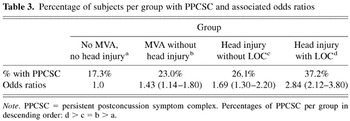
Results of contingency table analysis showed significant group differences in the number of individuals with and without PPCSC [χ2(3, N = 3957) = 64.1, p < .001]. Further analyses revealed that the HI with LOC group had a significantly greater proportion of individuals with PPCSC compared with each of the other groups, p < .05 in all cases. The no MVA/no HI group had the lowest frequency. The MVA without HI group and HI without LOC group did not differ significantly from each another. Table 3 presents the percentage of subjects per group with PPCSC together with the odds ratios and 95% confidence limit intervals relative to the no MVA/no HI control group. As seen by the odds ratios, the HI with LOC group was 2.84 times more likely to have PPCSC than the control group (no MVA/no HI).
Percentage of subjects per group with PPCSC and associated odds ratios

Variance in presence or absence of PPCSC explained by predictor variables

Predictors of PPCSC in the Head Injury Sample
The previously described hierarchical logistic regression procedure was used to determine which factors predicted PPCSC. The overall model was significant and accounted for 33% of the total variance in PPCSC status [χ2(26, N = 532) = 137.85, p < .001]. As seen in Table 4, the largest predictors in the model were demographic factors (9.2%), followed by early life psychiatric difficulties (6.3%), the set of two-way interactions (5.4%), and social support variables (4.9%). Of the two early life psychiatric difficulties, internalizing problems accounted for the vast majority of the variance (4.9%). The experience of disturbed consciousness in the HI accounted for a small but statistically significant amount of unique variance (1.4%).
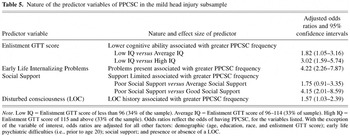
Table 5 shows the odds ratios and presents an explication of the salient predictor variables of PPCSC, after controlling for all other main predictor variables (i.e., excluding the interaction terms). The presence of PPCSC was more likely in individuals of lower intelligence, those who had experienced internalizing early life psychiatric difficulties (e.g., anxiety, depression, mania, psychosis), and those who perceived their social support system as limited or unsatisfactory. Individuals with low pre-injury cognitive abilities were 1.8 times more likely to have PPCSC compared to those with average pre-injury abilities, and 3 times more likely to have PPCSC than individuals who had high pre-injury cognitive abilities. Individuals with poor social support were about 1.8 times more likely to have PPCSC compared to those with average support, and 4.2 times more likely to have PPCSC than individuals with good social support. Similarly, individuals with a history of earlier life internalizing problems were 4.2 times more likely to have PPCSC than individuals without such a history. Finally, those with a history of LOC were 1.6 times more likely to have PPCSC than those without.
Nature of the predictor variables of PPCSC in the mild head injury subsample

Figure 1 shows the nature of the significant interactions among predictor variables. Figure 1a shows the interaction between premorbid intelligence and LOC in terms of PPCSC status. Individuals with lower levels of intelligence and a history of LOC have the highest frequency of PPCSC, while those with lower intelligence and no history of LOC have a substantially lower level of PPCSC. With average to higher levels of intelligence the frequency of PPCSC is similar whether or not there is a history of LOC. This suggests that those with lower intelligence are particularly vulnerable to developing PPCSC after a MHI with LOC.

The nature of the significant interactions among predictor variables of PPCSC. (A) The interaction between premorbid intelligence and LOC in terms of PPCSC status. (B) The interaction between premorbid intelligence and level of social support on PPCSC status. (C) The interaction between premorbid internalizing psychiatric difficulties and level of social support on PPCSC.
Figure 1b demonstrates the nature of the interaction between premorbid intelligence and level of social support. Frequency of PPCSC increases as the level of social support decreases and as the level of premorbid intelligence declines. However, those with average levels of intelligence show a differential benefit from good social support and an enhanced vulnerability to PPCSC with poor social support. The effect of social support on PPCSC status is much more linear in individuals with below or above average levels of premorbid intelligence.
Finally, Figure 1c demonstrates the nature of the interaction between premorbid internalizing psychiatric difficulties and level of social support on PPCSC. A premorbid history of internalizing problems substantially increases the frequency of PPCSC and level of social support has minimal effect. However, in those without a history of internalizing problems, social support plays a substantial role in PPCSC—with lower levels of social support being associated with dramatically increased frequency of PPCSC.
Predictors of PPCSC in the Sample without Head Injury
For the sample without head injury, the overall logistic regression model also was significant and accounted for 23.9% of the total variance in PPCSC status [χ2(26, N = 3425) = 462.57, p < .001]. However, results of the binomial test of proportions revealed that the total amount of variance explained by predictors in the MHI sample (33%) was significantly higher than that explained in the sample without head injury (23.9%, binomial test of proportion, p < .001). As seen in Table 4, the largest predictors in the model were demographic factors (11.4%), followed by early life psychiatric difficulties (3.6%), and social support variables (3.6%). As in the sample with MHI, the presence of PPCSC was more likely in individuals of lower intelligence and those who perceived their social support system as limited or unsatisfactory. However, unlike the findings within the sample with MHI, both internalizing and externalizing early life psychiatric difficulties increased the likelihood of PPCSC. Examination of the interactions revealed that no interaction accounted for more than 0.7% of variance. Interestingly, a history of a non-HI injurious accidental event, independent of social support and pre-injury mental health status, had virtually no effect on PPCSC status (0.1% variance).
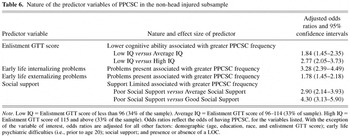
Table 6 shows the odds ratios and presents an explication of the salient predictor variables of PPCSC in this sample, after controlling for all other main predictor variables (i.e., excluding the interaction terms). Individuals with low cognitive abilities were 1.8 times more likely to have PPCSC compared to those with average pre-injury abilities and nearly 2.8 times more likely compared to individuals with high pre-injury abilities. This effect associated with premorbid intelligence is virtually identical to that seen in the sample with MHI. The effect of social support is also very similar across the two samples. In this sample without a history of HI, individuals with poor social support were 2.9 times more likely to have PPCSC compared to those with average social support, and 4.3 times more likely than individuals with good support. Also similar to the sample with MHI, individuals with a history of earlier life internalizing problems were 3.3 times more likely to have PPCSC than individuals without such a history. However, a history of earlier life externalizing problems also increased the likelihood of having PPCSC by 1.8 times over no history of externalizing problems.
Nature of the predictor variables of PPCSC in the non-head injured subsample

DISCUSSION
The present investigation sought to (1) examine the prevalence of PPCSC in a non-referred, community dwelling sample of male veterans; (2) identify salient predictors of PPCSC in a MHI sample and a non-head injured control sample; and (3) determine if the relationships among the chosen predictors were unique to MHI or similar to the general population. First, the results showed that the presence of a PPCSC is rather common. Depending upon which set of criteria were used to define PPCSC (ICD–10 vs. DSM–IV), up to 23% of the total sample had PPCSC. Even in those subjects who had experienced neither a MVA nor a HI, the presence of PPCSC was over 17%. These findings provide additional evidence of the high base rates for these symptoms and are similar to those of other studies of normal control subjects (Mittenberg et al., 1992; Wong et al., 1994) and various samples of non-head injured medical patients (Fox et al., 1995a; Iverson & McCracken, 1997), mental health outpatients (Fox et al., 1995b), and non-head injured personal injury claimants (Dunn et al., 1995).
The results of contingency table analyses indicate that persons who experience a MHI with LOC have a significantly higher prevalence of PPCSC than the various control groups. However, the results of the logistic regression analyses demonstrate that a MHI with loss of consciousness is only a small factor in predicting the presence of PPCSC (1.4% of unique predictive variance). Rather, multiple factors, including demographic, psychiatric, and social support variables and their interactions accounted for approximately 33% of the variance in PPCSC status in the sample with MHI. In contrast, the same factors (with the exception of injurious motor vehicle accident instead of LOC) accounted for substantially less variance in PPCSC in the sample without a HI (24%). These findings indicate a more robust role of these variables in outcome following a MHI than in the general population. Lower levels of pre-injury intellectual ability, early life emotional problems (e.g., depression, anxiety), and the perception of generally poor social support were associated with higher frequencies of PPCSC in the MHI sample. Interestingly, the interactions demonstrate important moderator relationships among the predictor variables in the sample with MHI that do not exist for the sample without HI.
The association between lower level of cognitive ability and PPCSC is consistent with reports examining the relationship between post-injury cognitive ability and long-term outcome. Higher levels of intellectual capacity have been found to be associated with positive outcome post head injury (Novack et al., 2001). These findings are also in accord with the notion that increased “cognitive reserves” result in better outcomes (Satz, 1993; Stern, 2002). Individuals with MHI who have lower levels of premorbid cognitive abilities were nearly twice as likely to have PPCSC compared to those with average ability, and three times more likely than those with high premorbid intellectual ability. The interaction between pre-injury intellectual ability and LOC provides further evidence of the impact of “cognitive reserve” on outcome. In the MHI sample, those who experienced LOC and who had lower pre-injury cognitive ability had the highest frequency of PPCSC. Conversely, the presence or absence of LOC had little impact on the frequency of PPCSC in individuals with average to high intellectual ability. Thus pre-injury cognitive ability appears to moderate outcome and those with low cognitive ability are the most vulnerable to PPCSC following MHI.
The presence of PPCSC was also associated with limited social support. Individuals with MHI who view their social support as limited or unsatisfactory had a much higher rate of PPCSC, nearly two times greater than those with average social support and over four times that of those with good social support. The deleterious efforts of post-injury environmental factors such as poor social support (Wood et al., 1984) and increased psychosocial stress (Gouvier et al., 1992; Luis & Mittenberg, 2002; Ponsford et al., 2000; Radanov et al., 1991) have previously been identified as influential in outcome following mild head injury. The perception of poor social support however, may well be the result of PPCSC or other pre-injury variables such as internalizing emotional problems (see Figure 1c). Individuals with emotional difficulties are generally less likely to develop satisfactory social support systems. However, individuals with limited social support and no history of internalizing emotional problems also have increased rates of PPCSC compared to those with average to good social support, albeit to a lesser degree than those with premorbid emotional problems. Regardless of causal factors, there appears to be a relationship between persistent symptoms and sub-optimal social support.
There also appears to be a complex relationship between social support and cognitive ability. As shown in Figure 1b, those with low cognitive ability and poor social support were by far the most vulnerable to PPCSC, while those with high intellect and poor social support had a much lower frequency of PPCSC. Although speculative, it may be that individuals with higher cognitive abilities develop more complex coping systems, and thus, do not rely as heavily on social support. For example, they may tend to be more self-reliant and use more independent methods (e.g., reading and other intellectual pursuits) as alternative or additional coping mechanisms. Those with average cognitive ability represented an intermediate group; these individuals tended to have increased vulnerability to PPCSC when social support was poor but benefit from good social support as much as those with high abilities.
One of the most robust associations was found between PPCSC and early life internalizing problems, which uniquely accounted for 4.9% of the variance. Those MHI individuals with a history of depression, anxiety, mania, or psychosis in young adulthood were over four times more likely to have PPCSC. Again, these findings are similar to previous reports on the moderating effects of current psychiatric difficulties (Fann et al., 1995; Trahan et al., 2001) and pre-injury emotional distress (Binder, 1997; Greiffenstein & Baker, 2001; Robertson et al., 1994). However, to our knowledge this is the first report examining the impact of early life psychiatric problems on PPCSC and, thus, we were able to extend existing findings in this area. In fact, this finding is rather striking given that only a small portion of the total sample (7.4%) reported such problems.
Although LOC accounted for only a small but significant amount of the variance in PPCSC status, those MHI individuals who experienced some form of LOC were still nearly 3 times more likely to have PPCSC compared to those who did not experience any injurious event, and about one and a half times more likely than those with an injurious event (Table 3). However, as shown by the regression analysis, the relationship of LOC to PPCSC is complex and strongly influenced by pre-injury status (i.e., cognitive ability, emotional difficulties), environmental factors (namely, quality of social support), and the interaction among these variables. Nevertheless, after controlling for these other variables, even within those individuals who had a MHI, those with a LOC had a 60% higher risk for PPCSC, thus providing evidence for a direct relationship between LOC and PPCSC.
Within the non-head injured sample, the presence of PPCSC was also more likely in individuals with lower pre-injury cognitive ability, limited or unsatisfactory social support, and a history of internalizing psychiatric problems. In contrast to the MHI sample, externalizing early life psychiatric problems such as conduct disorder or substance abuse were also associated with PPCSC. Interestingly, a history of non-HI injurious accidental event had virtually no predictive ability on PPCSC, suggesting that a post-traumatic emotional reaction is not a major factor in the persistence of symptoms. Also, dissimilar to the MHI sample where interactions among predictor variables accounted for a significant amount of variance (5.4%) in PPCSC, interactions have virtually no impact in the sample without head injury. Thus, MHI itself appears to be a moderating factor of the relationships among pre-injury cognitive reserve, social support, and pre-injury internalizing psychiatric problems and PPCSC.
General Conclusions
The persistence of PCS symptoms over months or years following MHI has long been a subject of controversy with proponents on both sides of the neurogenic versus psychogenic debate. The high rate of PPCSC following a self-reported MHI along with the relatively small predictive value of LOC found in this investigation provide evidence that PPCSC is mediated to a large degree by individual resilience. Intellectual capacity, preexisting psychological problems, social support, and interactions among these three variables play an important role and are more prominent in the MHI population compared to the population at large. This suggests that even a MHI can adversely affect the ability of an individual, particularly when one's reserves prior to injury are less than optimal, to cope or adapt; thus increasing the likelihood of PPCSC.
The current findings are consistent with other studies (e.g., Ponsford et al., 2000) that have found numerous factors influential in postconcussion symptoms. The results of this study are most congruent with the multifactorial model recently proposed by Greiffenstein (2000). This model posits that post-injury outcome is the final product of predisposing, precipitating, and perpetuating factors. Predisposing factors (e.g., early-life psychiatric difficulties, lower intellectual ability) represent an increased vulnerability to adverse outcome following injury. Precipitating factors are events associated with the head injury or initial post-injury symptoms (e.g., severity of head injury, medical information provided post-injury). Perpetuating factors are circumstances that perpetuate the symptoms long after the initial trigger is gone (e.g., in this study possibly poor social support and the interactions among social support, pre-injury intelligence, early life psychiatric difficulties, and head injury severity, i.e., LOC).
Limitations of the Current Study
Several factors limit the generalizability of this study. The sample was entirely male. Also, because we relied on archival data that were collected for another purpose, details of injury severity, time post onset, and compensation status related to HI are unknown. In addition, all information about HI was based on self-report unsubstantiated by other data. However, the head injuries in the current study were clearly mild because no post-injury hospitalization was required, even in an era of non-managed health care (1966–1986). It is likely that reliance on self-report for head injury related factors would increase random error and hence render it more difficult to find reliable predictors of PPCSC. Thus, the current findings may reflect an underestimate of the relationships among these predictor variables. In contrast, an important advantage of these data is that the set of variables was obtained in a non-clinic, non-referred, population-based randomly selected sample and without regard to HI status. At the time of evaluation, participants could not have known that their outcome data would ever be examined in relation to HI. Therefore, the data likely are free of HI-attributable reporting bias.
We sought to examine PPCSC following an uncomplicated MHI (i.e., minor to mild) as defined by a brief loss or alteration of consciousness without associated hospitalization. However MHI occurs on a continuum and presence of disturbed consciousness alone is not always the best predictor of injury severity (Gronwall, 1989). Degree and duration of unconsciousness as well as length of post-traumatic amnesia (PTA), an important measure of severity of concussion (Alexander, 1992), were not available. It is conceivable that degree (i.e., disturbed consciousness vs. coma), duration (seconds vs. minutes), and length of PTA may exert a variable impact on PPCSC.
Another limitation is that the presence of early life psychiatric difficulties was determined retrospectively and any post-injury assessment of pre-injury status is subject to inaccuracies. Although the authors of the DIS–III–A suggest this is a useful measure of determining preexisting psychiatric disturbance (Shaffer et al., 1993), it is possible that distortions in recall of early-life psychiatric problems occurred. It should be noted, however, that the largest percentage of difficulties reported by the current sample involved drug- and/or alcohol-related problems or conduct disorder symptoms. These findings are consistent with other studies on premorbid personality characteristics in head injured persons, suggesting that such behaviors place one at risk for a head injury (Kolakowsky-Hayner et al., 1999; Robertson et al., 1994).
We also took a unique approach to defining PPCSC. Although based on many ICD–10 and DSM–IV criterion for PCS, symptoms were determined by various questions extracted from the medical history interview or MMPI. PCS is generally diagnosed by symptom checklists that seek to quantify severity of symptoms (Miller & Mittenberg, 1998), history of head injury, neuropsychological evidence of attention or memory difficulty, and preoccupation with symptoms. All these data were not available in this investigation. We attempted to address this limitation by (1) using the concept PPCSC rather than PCS (2) requiring that symptoms occurred “often” or “very often”; and (3) requiring that both ICD–10 and DSM–IV subjective symptom criteria be met. Our objective was to examine this phenomenon in community dwellers, both those who reported having a MHI several years ago, as well as those who never experienced a head injury. We did not distinguish between individuals reporting symptoms in relation to a head injury or the intensity and frequency of such symptoms. Similar alterations to formal PCS criteria have been employed by other researchers examining postconcussive symptoms in patients with chronic pain (Iverson & McCracken, 1997), and other non-head injured samples (Dunn et al., 1995; Fox et al., 1995a, 1995b).
It is also possible that co-existing or post-injury psychological disorder such as depression, anxiety, or PTSD, either related to or independent of the injurious event, account for the PPCSC in the MHI sample. However, previous investigation (Curtiss & Vanderploeg, 2001) using these same data found no difference in somatization disorder, generalized anxiety disorder, or combat-related PTSD among the four groups (No MVA/No HI; MVA without HI; HI without LOC; and HI with LOC) after controlling for demographic, co-morbid medical conditions, and early life (pre-injury) mental health problems. Although there was a slight increase in prevalence of depression in the two head injured groups (adjusted odds ratios of 1.72 and 1.98 for the HI with and without LOC, respectively), the PPCSC psychological symptoms of irritability, sadness/depression, and anxiety used in this study did not differ across the four groups (Curtiss & Vanderploeg, 2001).
Finally, the multivariate analysis in the MHI sample accounted for no more than a third of the variance in PPCSC status, suggesting that other variables not evaluated in this study need to be considered in future research. Factors such as gender, post-injury cognitive functioning, rehabilitation interventions, and compensation seeking status are avenues for further study.
In contrast to the limitations just described, this study is unique in that it is the first, to our knowledge, to examine the phenomenon of persistence postconcussion symptoms in a non-referred MHI sample. Furthermore, these findings could potentially have implications for the clinical management and treatment of PPCSC. Though little can be done to alter certain influential predisposing factors (i.e., level of intellectual ability) or precipitating factors (i.e., accidental injury), other predisposing factors (i.e., pre-existing internalizing problems) and perpetuating factors (i.e., poor social support) are amenable to intervention. Although further investigation is needed, effective pharmacological treatment of early life symptoms of depression and anxiety that have lingered into adulthood may potentially mitigate against developing PPCSC following a MHI. In addition, limited social support and dissatisfaction with social support may be attenuated by clinical intervention; the efficacy of social skills training has been demonstrated in other populations (Accordino & Herbert, 2000; Timmerman et al., 1998). Finally, these results, in conjunction with other studies (Gouvier et al., 1992; Luis & Mittenberg, 2002; Ponsford et al., 2000; Radanov et al., 1991; Wood et al., 1984), indicate that clinicians should consider multiple factors including innate ability, emotional status, and environmental factors when assessing and treating PPCSC.
ACKNOWLEDGMENTS
This research was supported by the Department of Veterans Affairs and the Defense and Veterans Brain Injury Center, Uniformed Services University of the Health Sciences, Bethesda, MD. The first author, Cheryl A. Luis, Ph.D., is now at the Wien Center for Alzheimer's Disease and Memory Disorders at Mount Sinai Medical Center/Miami Heart Institute, Miami Beach, FL and affiliated with the Department of Psychiatry and Behavioral Sciences, University of Miami, Miami, FL. Portions of the paper were presented at the 109th Annual Meeting of the American Psychological Association, San Francisco, California.
References
REFERENCES
Accordino, M.P. &
Herbert, J.T.
(2000).
Treatment outcomes of four rehabilitation interventions for persons
with serious mental illness.
Journal of Mental Health,
22,
268–272.Google Scholar
Alexander, M.P.
(1992).
Neuropsychiatric correlates of persistent postconcussive syndrome.
Journal of Head Trauma Rehabilitation,
7,
60–69.CrossRefGoogle Scholar
Alves, W.,
Macciocchi, S.N., &
Barth, J.T.
(1993).
Postconcussive symptoms after uncomplicated mild head injury.
Journal of Head Trauma Rehabilitation,
8,
48–59.CrossRefGoogle Scholar
American Psychiatric Association.
(1980).
Diagnostic and statistical manual of mental disorders
(3rd ed.).
Washington, DC:
Author.
American Psychiatric Association.
(1994).
Diagnostic and statistical manual of mental disorders
(4th ed.).
Washington, DC:
Author.
Andersen, C.V. &
Bigler, E.D.
(1995).
Ventricular dilation, cortical atrophy, and neuropsychological
outcome following traumatic brain injury.
Journal of Neuropsychiatry and Clinical Neurosciences,
7,
42–48.Google Scholar
Binder, L.M.
(1997).
A review of mild head trauma. Part II: Clinical implication.
Journal of Clinical and Experimental Neuropsychology,
19,
432–457.Google Scholar
Binder, L.M. &
Rohling, M.L.
(1996).
Money matters, a meta-analytic review of the effects of financial
incentives on recovery after closed-head injury.
American Journal of Psychiatry,
153,
7–10.Google Scholar
Binder, L.M.,
Rohling, M.L., &
Larrabee, G.J.
(1997).
A review of mild head trauma, Part I: Meta-analytic review of
neuropsychological studies.
Journal of Clinical and Experimental Neuropsychology,
19,
421–431.CrossRefGoogle Scholar
Bohnen, N.,
Jolles, J.,
Twijnstra, A.,
Mellink, R., &
Sulon, J.
(1992).
Coping styles, cortisol reactivity, and performance on vigilance
task of patients with persistent postconcussive symptoms after mild
head injury.
International Journal of Neuroscience,
64,
97–105.CrossRefGoogle Scholar
Bryant, R. &
Harvey, A.G.
(1999).
Postconcussive symptoms and posttraumatic stress disorder after
mild traumatic brain injury.
Journal of Nervous and Mental Disease,
5,
302–305.CrossRefGoogle Scholar
Butcher, J.N.,
Dahlstrom, W.G.,
Graham, J.R.,
Tellegen, A.M., &
Kaemmer, B.
(1989).
The Minnesota Multiphasic Personality Inventory–2: Manual for
administration and scoring.
Minneapolis, MN:
University of Minnesota Press.
Centers for Disease Control.
(1988a).
Health status of Vietnam veterans: I. Psychosocial characteristics.
The Centers for Disease Control Vietnam Experience Study.
Journal of the American Medical Association,
18,
2701–2707.Google Scholar
Centers for Disease Control.
(1988b).
Health status of Vietnam veterans: II. Physical health. The Centers
for Disease Control Vietnam Experience Study.
Journal of the American Medical Association,
18,
2708–2714.Google Scholar
Centers for Disease Control.
(1989).
Health status of Vietnam veterans: Vol. IV. Psychological and
neuropsychological evaluation.
Atlanta, GA:
Author.
Centers for Disease Control and Prevention.
(1999).
Traumatic brain injury in the United States: A report to congress.
Retrieved September 14, 2002, from
http://www.cdc.gov/ncipc/pub-res/tbicongress.htm
Christman, C.W.,
Grady, M.S.,
Walkre, S.A.,
Holloway, K.L., &
Povlishock, J.T.
(1994).
Ultrastructural studies of diffuse axonal injury in humans.
Journal of Neurotrauma,
11,
173–186.Google Scholar
Curtiss, G. &
Vanderploeg, R.D.
(2001, August).
Long-term mental health and psychiatric consequences of mild head
injury. In
R.D. Vanderploeg (Chair),
Resolving controversies in mild TBI: Neuropsychological, psychosocial,
and psychiatric outcomes.
Symposium conducted at the meeting of the American Psychological
Association, San Francisco, CA.
Deb, S.,
Lyons, I., &
Koutzoukis, C.
(1999).
Neurobehavioural symptoms one year after a head injury.
British Journal of Psychiatry,
174,
360–365.CrossRefGoogle Scholar
DeMaris, A.
(2002).
Explained variance in logistic regression: A Monte Carlo study of
proposed measures.
Sociological Methods of Research,
31,
27–74.Google Scholar
Di Gallo, A.,
Barton, J., &
Parry-Jones, W.
(1997).
Road traffic accidents: Early psychological consequences in
children and adolescents.
British Journal of Psychiatry,
170,
358–362.Google Scholar
Dikmen, S.,
McLean, A., &
Temkin, N.
(1986).
Neuropsychological and psychosocial consequences of minor head
injury.
Journal of Neurology, Neurosurgery, and Psychiatry,
49,
1227–1232.CrossRefGoogle Scholar
Dunn, J.T.,
Lees-Haley, P.R.,
Brown, R.S.,
Williams, C.W., &
English, L.T.
(1995).
Neurotoxic complaint base rates of personal injury claimants:
Implications for neuropsychological assessment.
Journal of Clinical Psychology,
51,
577–584.3.0.CO;2-E>CrossRefGoogle Scholar
Eisenberg, H.M. &
Levin, H.S.
(1989).
Computed tomography and magnetic resonance imaging in mild to
moderate head injury. In
H.S. Levin,
H.M. Eisenberg, &
A.L. Benton (Eds.),
Mild head injury (pp.
133–141).
New York:
Oxford University Press.
Elson, L.M. &
Ward, C.C.
(1994).
Mechanisms and pathophysiology of mild head trauma.
Seminars in Neurology,
14,
8–18.Google Scholar
Fann, J.R.,
Katon, W.J.,
Uomoto, J.M., &
Esselman, P.C.
(1995).
Psychiatric disorders and functional disability in outpatients with
traumatic brain injuries.
American Journal of Psychiatry,
152,
1493–1499.Google Scholar
Fenton, G.,
McClelland, R.,
Montgomery, A.,
MacFlynn, G., &
Rutherford, W.
(1993).
The postconcussional syndrome: Social antecedents and psychological
sequelae.
British Journal of Psychiatry,
162,
69–74.Google Scholar
Fox, D.D.,
Lees-Haley, P.R.,
Earnest, K., &
Dolezal-Wood, S.
(1995a).
Base rates of postconcussive symptoms in health maintenance
organization patients and controls.
Neuropsychology,
4,
606–611.Google Scholar
Fox, D.D.,
Lees-Haley, P.R.,
Earnest, K., &
Dolezal-Wood, S.
(1995b).
Post-concussive symptoms: Base rates and etiology in psychiatric
patients.
Clinical Neuropsychologist,
9,
89–92.Google Scholar
Gaetz, M. &
Weinberg, H.
(2000).
Electrophysiological indices of persistent post-concussion symptoms.
Brain Injury,
9,
815–832.Google Scholar
Gasquoine, P.G.
(1997).
Postconcussion symptoms.
Neuropsychological Review,
7,
77–85.CrossRefGoogle Scholar
Goldberg, L., &
Gara, M.A.
(1990).
A typology of psychiatric reactions to motor vehicle accidents,
victims of nonserious accidents.
Psychopathology,
23,
15–20.Google Scholar
Gouvier, W.D.,
Cubic, B.,
Jones, G.,
Brantley, P., &
Cutlip, Q.
(1992).
Postconcussion symptoms and daily stress in normal and head injured
college populations.
Archives of Clinical Neuropsychology,
7,
193–211.CrossRefGoogle Scholar
Grady, M.S.,
McLaughling, M.R.,
Chistman, C.W.,
Valadka, A.B.,
Flingner, C.L., &
Povlishock, J.T.
(1993).
The use of antibodies targeted against the neurofilament subunits
for the detection of diffuse axonal injury in humans.
Journal of Neuropathology and Experimental Neurology,
52,
143–152.CrossRefGoogle Scholar
Greiffenstein, M.F.
(2000).
Late post-concussion syndrome as learned illness behavior: Proposal
for a multifactorial model.
Brain Injury Source,
4,
26–27.Google Scholar
Greiffenstein, F.M. &
Baker, J.W.
(2001).
Comparison of premorbid and postinjury MMPI-2 profiles in late
postconcussion claimants.
Clinical Neuropsychologist,
15,
162–170.CrossRefGoogle Scholar
Gronwall, D.
(1989).
Behavioral assessment during the acute stages of traumatic brain
injury. In
M.D. Lezak (Ed.),
Assessment of the behavioral consequences of head trauma. Vol. 7:
Frontiers of clinical neuroscience.
New York:
Alan R. Liss.
Guerrero, J.,
Thurman, D.J., &
Sniezek, J.E.
(2000).
Emergency department visits association with traumatic brain
injury: United States, 1995–1996.
Brain Injury,
14,
181–186.Google Scholar
Hartlage, L.C.,
Durant-Wilson, D., &
Patch, P.C.
(2001).
Persistent neurobehavioral problems following mild traumatic brain
injury.
Archives of Clinical Neuropsychology,
16,
561–570.CrossRefGoogle Scholar
Hathaway, S.R. &
McKinley, J.C.
(1983).
The Minnesota Multiphasic Personality Inventory,
Minneapolis, MN:
National Computer Systems.
Hayes, R.L. &
Dixon, C.E.
(1994).
Neurochemical changes in mild head injury.
Seminars in Neurology,
14,
25–31.Google Scholar
Iverson, G.I. &
McCracken, L.M.
(1997).
Postconcussive symptoms in persons with chronic pain.
Brain Injury,
11,
783–790.CrossRefGoogle Scholar
Jane, J.A.,
Steward, O., &
Gennarelli, T.
(1985).
Axonal degeneration induced by experimental noninvasive minor head
injury.
Journal of Neurosurgery,
62,
96–100.CrossRefGoogle Scholar
Karzmark, P.,
Hall, K., &
Englander, J.
(1995).
Late-onset post-concussion syndrome after mild head injury: The
role of premorbid, injury-related, environmental, and personality
factors.
Brain Injury,
9,
21–26.Google Scholar
King, N.S.
(1996).
Emotional, neuropsychological, and organic factors: Their use in
prediction of persisting postconcussion symptoms after moderate and
mild head injuries.
Journal of Neurology, Neurosurgery, and Psychiatry,
61,
75–81.CrossRefGoogle Scholar
Kolakowsky-Hayner, S.A.,
Gourley, E.V.,
Kreutzer, J.S.,
Marwitz, J.H.,
Cifu, D.X., &
McKinley, W.O.
(1999).
Pre-injury substance abuse among persons with brain injury and
persons with spinal cord injury.
Brain Injury,
13,
571–581.Google Scholar
Lees-Haley, P.R. &
Brown, R.S.
(1993).
Neuropsychological complaint base rates of 170 personal injury
claimants.
Archives of Clinical Neuropsychology,
8,
203–209.CrossRefGoogle Scholar
Leininger, B.E.,
Gramling, S.E.,
Farrell, A.D.,
Kreutzer, J.S., &
Peck, E.A.
(1990).
Neuropsychological deficits in symptomatic minor head injury
patients after concussion and mild concussion.
Journal of Neurology, Neurosurgery, and Psychiatry,
53,
293–296.CrossRefGoogle Scholar
Levin, H.S.,
Gary, H.E.,
High, W.M., Jr.,
Mattis, S.,
Ruff, R.M.,
Eisenberg, H.M.,
Marshall, L.F., &
Tabaddor, K.
(1987a).
Minor head injury and the postconcussional syndrome:
Methodological issues in outcome studies. In
H.S. Levin,
J. Grafman, &
H.M Eisenberg (Eds.),
Neurobehavioral recovery from head injury (pp.
262–275).
New York:
Oxford University Press.
Levin, H.S.,
Mattis, S.,
Ruff, R.M.,
Eisenberg, H.M.,
Marshall, L.F.,
Tabaddor, K.,
High, W.M., Jr.,
Frankowski, R.F.
(1987b).
Neurobehavioral outcome following minor head injury: A three-center
study.
Journal of Neurosurgery,
66,
234–243.Google Scholar
Luis, C. &
Mittenberg, W.
(2002).
Mood and anxiety disorders following pediatric traumatic brain
injury: A prospective study.
Journal of Clinical and Experimental Neuropsychology,
24,
270–279.Google Scholar
Marsh, H.V. &
Smith, M.D.
(1995).
Post-concussion syndrome and the coping hypothesis.
Brain Injury,
9,
553–562.Google Scholar
McKelvey, R.D. &
Zavoina, W.
(1975).
A statistical model for the analysis of ordinal dependent variables.
Journal of Mathematical Sociology,
4,
103–120.Google Scholar
Miller, L.
(1996).
Neuropsychology and pathophysiology of mild head injury and the
postconcussion syndrome: Clinical and forensic considerations.
Journal of Cognitive Rehabilitation,
14,
8–23.Google Scholar
Miller, L. &
Mittenberg, W.
(1998).
Brief cognitive behavioral interventions in mild traumatic brain
injury.
Applied Neuropsychology,
5,
172–183.CrossRefGoogle Scholar
Mittenberg, W.,
DiGiulio, D.V.,
Perrin, S., &
Bass, A.E.
(1992).
Symptoms following mild head injury: Expectation as aetiology.
Journal of Neurology, Neurosurgery, and Psychiatry,
55,
200–204.Google Scholar
Mittenberg, W. &
Strauman, S.
(2000).
Diagnosis of mild head injury and the postconcussion syndrome.
Journal of Head Trauma Rehabilitation,
15,
783–791.Google Scholar
Montague, E.,
William, H.,
Lubin, A., &
Gieseking, C.
(1957).
Army tests for assessment of intellectual deficit.
United States Armed Forces Medical Journal,
8,
883–892.Google Scholar
Novack, T.A.,
Bush, B.A.,
Meythaler, J.M., &
Canupp, K.
(2001).
Outcome after traumatic brain injury: Pathway analysis of
contributions from premorbid, injury severity, and recovery
variables.
Archives of Physical Medicine Rehabilitation,
82,
300–305.CrossRefGoogle Scholar
Ponsford, J.,
Willmott, C.,
Rothwell, A.,
Cameron, P.,
Kelly, A.M.,
Nelms, R.,
Curran, C., &
Ng, K.
(2000).
Factors influencing outcome following mild traumatic brain injury
in adults.
Journal of the International Neuropsychological Society,
6,
568–579.CrossRefGoogle Scholar
Povlishock, J.T. &
Coburn, T.H.
(1989).
Morphopathological change associated with mild head injury. In
H.S. Levin,
H.M. Eisenberg, &
A.L. Benton (Eds.),
Mild head injury (pp.
37–53).
New York:
Oxford University Press.
Powell, T.J.,
Collin, C., &
Sutton, K.
(1996).
A follow-up study of patients hospitalized after minor head injury.
Disability and Rehabilitation: An International Multidisciplinary
Journal,
18,
231–237.CrossRefGoogle Scholar
Radanov, B.P.,
Di Stefano, G.,
Shinidrig, A., &
Ballinari, P.
(1991).
Role of psychosocial stress in recovery from common whiplash.
Lancet,
338,
712–715.CrossRefGoogle Scholar
Robertson, E.,
Rath, B.,
Fournet, G.,
Zelhart, P., &
Estes, R.
(1994).
Assessment of mild brain trauma: A preliminary study of the
influence of premorbid factors.
Clinical Neuropsychologist,
8,
69–74.Google Scholar
Robins, L.N.,
Helzer, J.E.,
Croughan, J., &
Ratcliff, K.A.
(1981).
National Institute of Mental Health Diagnostic Interview Schedule:
Its history, characteristics, and validity.
Archives of General Psychiatry,
38,
381–389.CrossRefGoogle Scholar
Santa Maria, M.P.,
Pinkston, J.B.,
Miller, S.R., &
Gouvier, W.D.
(2001).
Stability of postconcussion symptomatology differs between high and
low responders and by gender but not by mild head injury status.
Archives of Clinical Neuropsychology,
16,
133–140.Google Scholar
Satz, P.
(1993).
Brain reserve capacity on symptom onset after brain injury: A
formulation and review of evidence from threshold theory.
Neuropsychology,
7,
273–295.CrossRefGoogle Scholar
Shaffer, D.,
Schwab-Stone, M.,
Fisher, P.,
Cohen, P.,
Piacentini, J., &
Davies, M.
(1993).
The Diagnostic Interview for Children–Revised Version
(DISC–R): I. Preparation, field testing, interrater reliability,
and acceptability.
Journal of the American Academy of Child and Adolescent Psychiatry,
32,
643–650.Google Scholar
Sosin, D.M.,
Sniezek, J.E., &
Thurman, D.
(1996).
Incidence of mild and moderate brain injury in the United States,
1991.
Brain Injury,
10,
47–54.Google Scholar
Stern, Y.
(2002).
What is cognitive reserve? Theory and research application of the
reserve concept.
Journal of the International Neuropsychological Society,
8,
448–460.Google Scholar
Timmerman, I.G.,
Emmelkamp, P.M., &
Sanderman, R.
(1998).
The effects of a stress-management training program in individuals
at risk in the community at large.
Behavior Research and Therapy,
36,
863–875.CrossRefGoogle Scholar
Trahan, D.E.,
Ross, C.E., &
Trahan, S.L.
(2001).
Relationship among postconcussional-type symptoms, depression, and
anxiety in neurologically normal young adults and victims of mild brain
injury.
Archives of Clinical Neuropsychology,
16,
435–445.CrossRefGoogle Scholar
Wong, J.M.,
Regennitter, T., &
Barrios, F.X.
(1994).
Base rates and simulated symptoms of mild head injury among normals.
Archives of Clinical Neuropsychology,
9,
411–425.CrossRefGoogle Scholar
World Health Organization.
(1992).
International statistical classification of diseases and related health
problems
(10th ed.).
Geneva:
Author.
Wood, F.,
Novack, T.A., &
Long, C.J.
(1984).
Post-concussion symptoms: Cognitive, emotional, and environmental
aspects.
International Journal of Psychiatry in Medicine,
4,
277–283.Google Scholar
Youngjohn, J.R.,
Burrows, L., &
Erdal, K.
(1995).
Brain damage or compensation neurosis? The controversial
post-concussion syndrome.
Clinical Neuropsychologist,
9,
112–123.CrossRefGoogle Scholar

Criteria for determination of PPCSC and percentage of subjects who met each criterion
Demographic characteristics of the four subgroups
Percentage of subjects per group with PPCSC and associated odds ratios

Variance in presence or absence of PPCSC explained by predictor variables
Nature of the predictor variables of PPCSC in the mild head injury subsample

The nature of the significant interactions among predictor variables of PPCSC. (A) The interaction between premorbid intelligence and LOC in terms of PPCSC status. (B) The interaction between premorbid intelligence and level of social support on PPCSC status. (C) The interaction between premorbid internalizing psychiatric difficulties and level of social support on PPCSC.
Nature of the predictor variables of PPCSC in the non-head injured subsample
 You have
Access
- 64
- Cited by