Introduction
In September 1850, the widely read Anglo-Indian periodical Calcutta Review published an anonymous article portraying the end of colonial rule. In making a not-so-uncommon comparison between the British empire in India and its predecessor, the Mughal empire, the author drew a rather uncanny picture of what the power of time could and could not destroy:
The deeds of the Great Moguls, their public works, their roads, their dykes, have all but perished: a few ruins are all that remain ‘to say “here was or is:”’ but the revenue system of Akbar Shah—that is not forgotten: the remembrance of it lives in the minds of a grateful nation. So also, if vernacular education should consolidate our revenue system, should render the landholders themselves capable of guarding the rights assigned to them at the Settlement and of bequeathing the inheritance to their children, then we may believe that, in a future age, when the British rule may have passed away, when our roads, canals, and colleges may have been mingled with the dust, yet the good settlement will not be forgotten for posterity.Footnote 1
Some context is needed for making sense of this passage. The author was writing soon after the ‘good settlement’—that is, the first systematic revenue settlement of the North Western Provinces (NWP) had just been brought to a conclusion and the first official scheme of rural ‘vernacular education’ had just been set in motion. The settlement was the culmination of decades of efforts of the colonial government in asserting full control over ‘true’ revenue information using reformed administrative technologies of record-keeping and land surveying. Following the settlement, the new scheme of vernacular education aimed to disseminate these technologies among the rural population of North India. According to the author of the article, most likely a British colonial official, this ‘good settlement’, consolidated by ‘vernacular education’, would stand as the firmest proof of British benevolence, outliving the colonial government itself as well as the other monuments of its civilizing mission.
What is particularly intriguing about this passage is the author's choice of symbolism. The ‘roads, canals and colleges’ here referred to were all pride of the empire. Public works like roads and canals were the archetypal examples that colonial writers used not only to portray the British empire as continuing the legacies of the ‘Great Mughals’, but more importantly to indicate the former's superiority over the latter. These spectacular public works embodied the technological ‘improvement’ that Europeans had brought to a ‘backward’ India.Footnote 2 The colleges, where modern ‘scientific knowledge’ was taught and produced, were similarly central to the discourse of intellectual ‘progress’ for which India supposedly owed Britain its gratitude.Footnote 3 Yet, for our author here, the seemingly quotidian works of the revenue settlement, together with the equally petty scheme of rural vernacular education, surpassed all of these colonial grandeurs. This unreserved praise for the revenue settlement and rural education in the NWP was not a unique case. Between the late 1840s and mid-1850s, colonial North India witnessed a flood of panegyric newspaper articles, pamphlets, and official reports in this respect.Footnote 4 This article is an attempt to trace the historical processes that led to such ideological hyperbole and ask what these processes tell us about the making of the British colonial state in India.
The connection that contemporary authors were drawing between the revenue settlement and rural education deserves our particular attention. Since Christopher Bayly's Empire and Information, historians have recognized how the fiscal administration of the East India Company (EIC) was an integral part of the colonial project of ‘knowing the country’.Footnote 5 In this sense, we could and should see the petty technicality of determining tax or sorting out land ownership as constituting a realm of ‘revenue knowledge-making’ inseparable from the high forms of colonial knowledge such as philology and cartography. More recently, works on Indian scribal communities in both the precolonial and the colonial contexts have demonstrated that the transition from Mughal to British colonial modes of governance was intimately linked to the changes in the forms of knowledge that a clerical employee of the government was expected to possess.Footnote 6
Several questions, however, still remain if we consider this growing body of scholarship in relation to the passage cited at the beginning of this article. Was the education of the landholders the same as the training of the scribes? If not, what were the nature and content of this rural vernacular education? Why was the connection being drawn between education and revenue? In the end, why did so many British officials consider the combination of the settlement with this particular kind of education to be so powerful that it could even survive the British empire itself?
In answering these questions, I particularly wish to bring the two recent works on British colonialism in India by Neeladri Bhattacharya and Jon Wilson into conversation.Footnote 7 Reading Bhattacharya's analysis of governance together with that of Wilson on law, one can spot some curiously understated connections. Bhattacharya speaks of ‘[a] ceaseless search for certainty and inner coherence’ as a central defining logic of imperial power.Footnote 8 This search for coherence was built on the meticulous pursuit of, recalling Bayly's argument, knowledge about varied local practices.Footnote 9 Wilson similarly identifies the particular form that early Company power took as growing out of a quest for ‘stable categories of rule’.Footnote 10 But he argues that this quest was essentially one for ‘general, abstract rules, which could be applied mechanistically by an authoritarian state’.Footnote 11 Drawing on both these authors, this article proposes to understand colonial governance and law in terms of an oscillating process. The British repeatedly claimed to have achieved a level of abstraction that allowed them to administer India by deducting local rules from general principles, once in late eighteenth-century Bengal (Wilson), once in mid-nineteenth-century NWP, and again after the cadastral survey of North India in the 1860s (Bhattacharya). A period of bottom-up inductive information gathering preceded each of these claims of abstraction. But an unfolding process of crisis (i.e. the recognition of the ungroundedness of these claims) always followed, initiating another round of inductive engagement with the society that in turn led to a higher level of abstraction. One of these cases of post-crisis engagement fell in the gap between the scope of Bhattacharya and Wilson in terms of both chronology and geography. The former largely focuses on Punjab in the second half of the nineteenth century while the latter centres on Bengal before the 1830s. As we shall see in the following pages, the rapid expansion and slow consolidation of colonial rule in the Gangetic plain in the first half of the century exposed the tension within the logic of abstraction that the British had previously developed in Bengal. The efforts to solve this tension then foreshadowed both the inductive mode of rule and many of the actual practices of land survey that Bhattacharya identified in late nineteenth-century Punjab.
Methodologically, this article tries to accomplish these historiographical goals by broadening the existing focus on certain groups of intermediaries (often meaning Indian revenue officials) to include a larger network of social relationships. Local revenue administration in precolonial India had always functioned on the basis of the negotiation between higher-level state officials, local officials, landholders, and the ordinary peasants.Footnote 12 I will argue in this article that, as the colonial state replaced the Mughal empire and its regional successors, it sought to reconfigure these social relations of negotiation through revenue settlement and rural education. This reconfiguring was not only meant for monetary purposes, but was also profoundly intertwined with the remaking of the Indian population into a new kind of colonial legal subjects that were both law-knowing and law-abiding.Footnote 13 The colonial state during this period, however, simply lacked the means to maintain stable control over the local worlds of the Indian officials and villagers. The actions and feelings of these people thus defied the British desire to remodel Indian society from their own vantage point.
This article starts by tracing how the ways in which the EIC relied on Indian assistance in producing reliable knowledge about revenue changed between the late eighteenth and early nineteenth centuries. I will then discuss how rural vernacular education became coupled with this prolonged effort of appropriating Indian skills towards the 1850s. Finally, I turn to an assessment of how the intersection of administration, education, and law was challenged at the local level.
Controlling documents, taming people, and appropriating skills
Ever since the EIC obtained the Diwani of Bengal in 1765, it had been struggling with gathering correct information about its revenue base. This struggle only intensified in the aftermath of the disastrous Bengal famine of 1769, though not so much out of moral concern than of the desire for fiscal recovery. This section will tell the story of how the EIC experimented with a variety of ways of controlling revenue administration in its pursuit for the ‘true’ knowledge about the rural economy of North India. By the 1830s, such experiments led the colonial state to mobilize the skilled scribal labour of the Indian officials in generating new documentation.
EIC administration in the three decades following the acquisition of the Diwani was marked by the intermediary roles that prominent revenue officials played between the state and the tax-paying villages. Most important to the British were certain provincial-level Indian officials called the sadr qanungo (principal registrars). At this early stage, besides an premature attempt to retrieve revenue documents directly from rural areas, the Company's tax collection mostly operated on the superficial basis of the sadr qanungo's documents that recorded past assessments.Footnote 14 The EIC was vexed by the fear that such dependence on the qanungo would enable these Indian officials to cheat the British at will. The Resident at Midnapur, for example, argued in 1772 that, while the qanungo possessed ‘a most perfect knowledge of the Province, and a very great influence over the zamindars’ that could have been of great value for the EIC, they kept this knowledge and influence for their own use, encroaching on the revenue due to the state treasury.Footnote 15
After the EIC territory rapidly expanded into the Gangetic plain (which soon formed the NWP) in the first few years of the nineteenth century, this problem of distrust became even more pressing. Here the British found themselves having to deal with administrative networks that were more diffused than those they had encountered in Bengal, consisting of primarily district and subdistrict qanungo as well as numerous village patwari (accountants). British officials generally believed that the patwari's documents, produced at the lowest level of administration, should have been most detailed and valuable. But at the same time, they could not help seeing these documents as almost intrinsically unreliable. As one British Collector put it:
The putwaree's dufter, and kham accounts kept by the zemindars are in most cases so inaccurate, and in some, through wilful concealment, so false, that I am convinced little information is to be obtained from them … and little dependence should be placed on the deposition or affirmation of persons whose continuance in service and support of themselves and families depend upon their unconditional obedience to the will and orders of their employers.Footnote 16
Here, the power relation between the Indian officials and the local landholders was reversed while the discourse of unreliability remained in place: the qanungo were unreliable, as they wielded an unchecked influence over the landholders; the patwari were unreliable, as the landholders held an unchecked power over them.
The logical outcome of this kind of reasoning was that, as the British officials saw it, it was only a third party standing neutrally above both the Indian officials and the landholders, namely the colonial state, that was capable of remedying the wrongs. To transform itself into this ‘impartial’ third party, the colonial state went through a rather winding process of policy change. In Bengal, initially, Lord Cornwallis, the then Governor General of India, decided to abolish the office of qanungo after the Permanent Settlement was declared in 1793. The logic behind this outright abolition was that the settlement had effectively taken all the land-revenue documents from the qanungo and put them under the custody of the EIC.Footnote 17 In the following decades, however, this confidence was confronted by the reality of continuing administrative confusion. As Dirk Kolff has shown, British officials in the newly conquered Gangetic plain gradually started to cast doubt on Cornwallis's idea that the Permanent Settlement could preclude further detailed investigation.Footnote 18 New information was generated every day by administrative transactions such as the payment of rent and land transfer, which required not a dead body of documents, but continual documentation. As the British officials found themselves completely outnumbered in the vast and densely populated Gangetic plain to achieve this kind of documentation on their own, they reverted to the reliance on the qanungo and the patwari in the 1810s. But this time, instead of simply making use of the qanungo and patwari, the colonial government set out to transform them from loosely regulated intermediaries into closely supervised state bureaucrats or semi-bureaucrats. With elaborate new legal regulations, the British endowed themselves with formal power over the appointment, duties, salary, and punishment of the qanungo and the patwari.Footnote 19 Within this power hierarchy, the British now demanded from the local Indian officials not only the existing documents they possessed, but also their scribal labour.Footnote 20
The colonial desire for reliable knowledge about revenue, however, remained unsatisfied. As the Settlement Officer of Kanpur later recalled, many British officials started to suspect during this period that even if the local Indian officials were loyal, they might not know the correct information about the land in the first place.Footnote 21 In this respect, the settlement of the NWP since 1833 (the settlement referred to at the beginning of this article) stood as yet another turning point in the changing history of colonial revenue knowledge-making. This settlement required the British officials as well as their Indian subordinates to trace the ultimate source of knowledge—that is, the land itself—and prepare documents on the basis of a direct engagement with the land in the form of what is later known as the ‘revenue survey’.Footnote 22
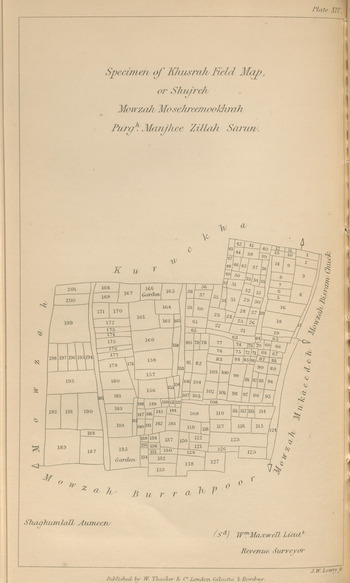
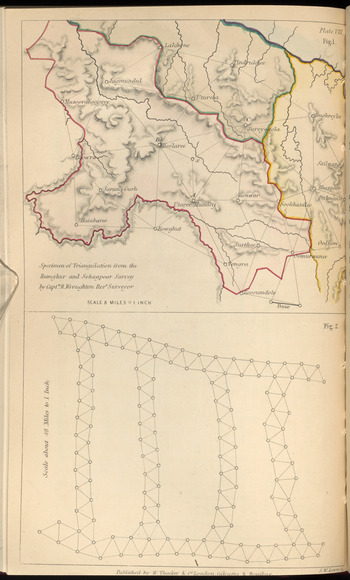
Requiring documentation to be based on survey brought new challenges. At first glance, these challenges appeared to be technical in nature. According to the official plan of the survey, the basic unit of land measurement was the ‘field’, which was defined as a single piece of land occupied by one cultivator under one title.Footnote 23 The numbers of such fields in the Gangetic plain were so great that the government considered it too costly to hire British professional surveyors to measure all these fields with the European survey technique of triangulation.Footnote 24 The government was thus compelled to make use of Indian survey methods developed in precolonial times known as the khusrah (khasra) survey.Footnote 25 While differing in practice from place to place, the khasra survey essentially consisted of measuring land with a rod or a rope (jarib) and calculating areas using basic geometry.Footnote 26 This means that, from a technical perspective, the khasra survey required less training and less investment in equipment than triangulation. The Indians who were capable of conducting this type of survey were accordingly much more easily available at a minimal wage. The cost of the khasra survey was thus much lower.Footnote 27 But the simplicity of the khasra survey also made the British worry about its accuracy. The government therefore came up with the plan in which European technology set the standard for Indian skills. When a village was surveyed, its outer boundaries would be mapped by the so-called ‘Professional Survey’ using basic triangulation. The minute divisions of the fields lying inside the village, on the other hand, would be measured by the khasra survey. If the total area of the village calculated from adding up the area of individual pieces of fields differed from the area yielded by triangulation by more than 5 per cent, then the khasra survey of this village would be considered inaccurate and need to be redone.Footnote 28
Specimen of a khasra field map. Source: Smyth and Thuillier, A Manual of Surveying for India, 2nd ed. (London, 1855).

Two specimens of the use of triangulation in a topographical survey. Source: Smyth and Thuillier, A Manual of Surveying for India, 2nd ed. (London, 1855).

This attempt to accommodate the khasra survey, as Bhattacharya has pointed out, was to be fiercely attacked by later British surveyors as an irredeemable compromise of scientific precision and thus the origin of administrative confusion.Footnote 29 But this accusation should be understood as an effort of the new generation of colonial techno-bureaucrats in establishing their authority by distancing themselves from and concealing their indebtedness to the NWP settlement.Footnote 30 For the colonial government in the 1830s, the problem was less about technology itself than about its institutional context. While previously British and Indian revenue officials were sufficient for the paperwork of documentation, now the need to measure the land pushed the government to bring in new types of skilled personnel: the British professional surveyors and the Indian khasra surveyors. But the incorporation of these two groups into the existing structure of colonial revenue administration was not a straightforward issue. No matter whether it was the khasra survey or the Professional Survey, the measuring of the land was not primarily meant for cartographical purposes, but was essentially intended to assist the British revenue officials to form a settlement—that is, to determine land occupancy and to calculate the amount of revenue that the land could yield.Footnote 31 To achieve this goal, the survey conducted by the surveyors and the settlement works carried out by the revenue officials were supposed to be closely integrated. The British professional surveyors, the Indian khasra surveyors, and the revenue officials, however, formed each of their own different institutional bodies. The British surveyors constituted a loosely identifiable branch of the colonial bureaucracy under the Surveyor General in Calcutta, distinct from the commanding hierarchy of the revenue department of the EIC. As we shall see later, these two branches of the government had different objectives in the revenue survey.Footnote 32 The case of the Indian khasra surveyors was even more complicated. These indigenous surveyors were often collectively named by the British as the amin (literally deputies). These amin were never formally incorporated into any colonial survey department because the British surveyors did not consider the khasra survey to be qualified as a kind of science.Footnote 33 The revenue department of the EIC, on the other hand, did try to make more regular use of the amin.Footnote 34 But unlike the qanungo and the patwari whose office was traditionally well defined, a separate, distinct indigenous office of surveyor did not really exist. The word amin in colonial usage was in fact an umbrella term that denoted a diverse range of local service providers who were customarily called upon to measure the land when such a need arose.Footnote 35 Due to the diversity of the amin, the early attempt of the Board of Revenue to formalize the office ended up with no result. In sum, the institutional connections between the three groups of personnel involved in the 1833 settlement were weak. The essential challenge that the revenue survey brought about thus did not lie in the grafting of European technologies onto Indian skills, but in the coordination of different institutional groups.
To make sure that this coordination would work smoothly, Lord Bentinck, the then Governor General of India, called a conference in January 1833 that brought together the British revenue officials and the professional surveyors to discuss the manners in which the upcoming settlement should be conducted.Footnote 36 The issue of whether the revenue or the survey branch of the government should superintend the khasra survey was particularly debated during the conference. In earlier experiments, the amin used to form a temporary establishment under the British revenue officials because field survey was closely connected to settlement works such as the settling of boundary disputes and the assessment of land.Footnote 37 The British surveyors, however, considered everything related to measurement as their job. They managed to persuade Lord Bentinck during the conference to entrust the responsibility of directing the khasra survey to them.Footnote 38 In the course of the revenue survey after 1833, the amin thus worked as contract labourers under the British surveyors.Footnote 39 It was then decided that the survey and the settlement should be integrated through a streamlined procedure of cooperation between the revenue officials and the surveyors.Footnote 40 As the British surveyors saw it, such reallocation of tasks allows the revenue survey to proceed in a more efficient manner than when the Professional Survey and the khasra survey as were controlled by different governmental bodies.Footnote 41
Redefining skills and remodelling subjects
Our story so far resembles James Scott's classical narrative that high modernist state projects aim to gather information about the society so as to make it liable for easier resource management.Footnote 42 But colonialism, as is common knowledge now, means more than the imposition of an external system of social control. It is also built on a regime of the internal discipline of subjecthood. Colonial education has served as a primary example of this disciplining dimension of British rule in India. Recent works by Parimala Rao and Jana Tschurenev among others are pushing our understanding of education beyond high colonial ideology and towards the on-the-ground experience of learning in small towns and villages.Footnote 43 These studies nonetheless concentrate on education itself and have not paid enough attention to the intimate links that were being drawn between education, revenue, and law—links that transformed each of these three sites of colonial power relationships.Footnote 44 This section thus discusses how the first colonial scheme of mass rural education grew out of the logic of the revenue settlement of the NWP and became entangled with a discourse about an ideal ‘legal subject’ that was predicated on the knowledge about property rights.
British colonial officials had long been debating about how the general Indian mass should be educated and the purpose of their education.Footnote 45 For Lord Moira, the petty schoolmasters of existing indigenous village schools should be the first resort of the government because they offered the most basic and necessary education in reading, writing, and arithmetic to the great majority of the people. Any attempt towards higher levels of instruction and even evangelization would have to wait until the people were ‘enlightened’ by these basic forms of knowledge.Footnote 46 Others like Holt Mackenzie and Lord Auckland, however, adhered to the contrary. For them, the Indian peasants were still so poor that they would not be interested in education beyond the necessity of life.Footnote 47 The British should therefore start with educating the upper and middle classes by setting up universities and schools in urban centres and then try to extend their efforts to smaller towns and villages.Footnote 48
Contrary to Mackenzie and Lord Auckland's prediction, however, the few government schools established in the major cities of the NWP sank into a dismal condition by the early 1840s. G. Clerk, the then Lieutenant Governor of the NWP, argued in 1843 that this failure was not due to any innate backwardness or lack of interest in the pursuit of knowledge on the part of the Indians as Mackenzie believed. Rather, it was due to the fact that ‘they [the Indians] would not resort to a school which was not in unison with their feelings … the Government means should, if possible, co-operate with the existing establishment, so that the interest of the community should be retained, and their feelings carried along with the Govt. undertaking’.Footnote 49
Clerk did not specify what he meant by the ‘feelings’ of the Indians. But, since he hoped that the government schools could train teachers in ‘our science and the English language’ and send them to the village school to educate the villagers, it seems that indigenous village schools regained their prominence for Clerk mainly as a convenient channel of transmitting European knowledge to the Indian rural population in a top-down manner.Footnote 50
Clerk's successor, James Thomason (Lieutenant Governor of the NWP, 1843–53), inherited Clerk's idea that colonial education should utilize existing institutions that aligned with the interests and feelings of the educated. But what distinguishes Thomason from earlier colonial writers including Clerk is the ways in which he conceived these interests and feelings. Thomason's previous appointment as the settlement officer of Gorakhpur, one of the earliest settled districts of the NWP, gave him the opportunity to witness how in some places the patwari took on the responsibility of teaching elementary literacy to the children in their own villages.Footnote 51 Probably inspired by these local practices of instruction, Thomason proposed an educational scheme that, instead of drawing a hierarchical connection between rural education and higher levels of European learning, was designed to be complementary to the revenue settlement of the NWP.
For Thomason, the purposes of connecting education with the settlement were twofold. First, this kind of education was an extension of the various measures of ensuring accurate revenue documentation discussed earlier in this article. Thomason argued that the reliability of the revenue documents produced during the settlement was compromised by the technical incompetence of the local Indian officials. According to him, many village patwari could not keep records ‘intelligibly’.Footnote 52 They thus needed to be (re)educated in their own administrative skills. This purported defect might not indicate real incompetence of the patwari, but was more likely the result of the prevalent use of several cursive scripts in vernacular administrative traditions that could appear confusing for a British official, most of whom learned the vernaculars through neatly printed textbooks.Footnote 53 But no matter what the case was, the point here is that Thomason was determined to level the different practices of record-keeping with a universal standard of intelligibility that would not block the British officials from accessing the records.
Second, and more profoundly for Thomason, the purpose of establishing accurate revenue documentation was not only the smooth collection of tax, but also the welfare of the Indian rural population:
[The revenue documents] are compiled on an uniform system, and are the acknowledged groundwork of all judicial orders regarding rights in land.
It is important for his own protection, that every one possessing any interest in the land, should be so far acquainted with the principles on which these articles are compiled, as to be able to satisfy himself that the entries affecting himself are correct.Footnote 54
This argument marked the transformation of the revenue documents from mere administrative papers into legal evidence. Administrative papers were the means by which the state protected its fiscal interest against the purported corruption of the Indian officials. Such papers became legal evidence when they were used by the villagers to defend their own rights in land in potential disputes among themselves or with the state. But since most of the villagers (including many landholders) were illiterate, Thomason believed that they were unable to read and check the revenue documents that were proofs of their property rights. This left space for the few literate scribes, landholders, and moneylenders to forge documents for their own illicit interests.Footnote 55 Thomason thus contended that the ordinary villagers also needed to learn the skills of reading, basic arithmetic, record-keeping, and land measurement through their own vernacular languages.Footnote 56 This was the kind of education that the panegyric newspaper article cited at the beginning of in this article was referring to.
At first sight, educating the villagers still only provided another layer of external check on the accuracy of revenue documentation: as the villagers could now read the documents themselves, they could do the work of ‘double-checking’ before the documents were handed over to the government. A closer look, however, suggests a deeper concern at work. For the British, bringing the villagers into the making of revenue knowledge required quite different measures to be taken as compared to the earlier bureaucratization of the Indian officials. The latter group appeared to the British to be actively desiring employment. But the ordinary peasants, as the British saw them, did not desire to defend their own rights. Many colonial commentators claimed that Indian peasants either lacked the notion of property rights or were too oppressed to let their natural inclination towards private property grow before the British came. The legal consciousness of cherishing one's own property rights or indeed the idea of property rights itself was something that first needed to be cultivated among the Indian villagers.Footnote 57 Rural education was thus not merely about improving the information basis of the fiscal administration of the state, but was also about the making of a new colonial legal subjecthood.
We can discern how the British envisioned this subjecthood from the textbooks that they prescribed for the village schools. Thomason had a series of four manuals prepared in Urdu with the intention of making them the standard textbooks for the training of the local officials and villagers throughout the NWP.Footnote 58 These manuals, penned by Ram Sharan Das (often spelt as Ram Surrun Doss), the then Deputy Collector of Delhi, dealt with Perso-Urdu alphabet, basic arithmetic, the patwari's duties, and land measurement.Footnote 59 We know little about Ram Sharan Das's life. But we do know that the Indians occupying the post of Deputy Collector were often selected from local revenue officials, though usually the higher-ranked tahsildar (head of an administrative subdivision) rather than the pettier qanungo or patwari. It is thus highly probable that, in his past career, Ram Sharan Das had himself practised the kinds of skills that he wrote about in the manuals. In this sense, these manuals exemplify an effort to make administrative skills teachable by transcribing them from the embodied practices of the local officials into abstracted, redistributable texts. Thomason also claimed that these manuals were written in close conformity with existing administrative practices.Footnote 60 But this claim should be understood in line with Thomason's larger concern over Indian incentives. Learning a lesson from the failure of earlier state-initiated schools, Thomason took care to warn the British district officials that they should not force the establishment of village schools, but should provide stimulus to the villagers themselves in pursuing education and aid them in selecting and sustaining schoolmasters.Footnote 61 The use of Indian administrative skills condemned by latter British surveyors, as we have noted earlier in this article, thus was no longer merely the result of administrative pragmatism. Instead, teaching Indian knowledge, as opposed to Clerk's plan of transmitting European knowledge, now became a way of encouraging the villagers to actively and voluntarily participate in their own ‘empowerment’.
When the skills were transcribed from practice to print, however, they were not reproduced intact, but rather went through a process of redefinition by the colonial authority. The first aspect of this redefinition is standardization. The first volume of his four manuals, Acchar abhyas (The Practice of Alphabet), for example, teaches how to write the Perso-Urdu script in a neat form of nastaliq. This calligraphic style was rarely used for official record-keeping (especially at the lower levels) in the Indo-Persian world in the early modern period but later, during the heyday of nationalism, became the standard way of writing and printing in modern Urdu across a variety of genres.Footnote 62 Acchar abhyas thus represents a critical moment of transition in this history of nastaliq. In this manual, Ram Sharan Das discussed how to write clear nastaliq for governmental paperwork. In doing so, he (or rather his British patron) set up this particular form of nastaliq as the new standard for official writing while paying no regard to the different cursive scripts actually in use in different places.Footnote 63 Similarly, while Indian units of measurement such as bisva and bigha often differed from region to region, another of Ram Sharan Das's manuals, Map-tol (Measurement and Weight), gave a set of standardized units of length and made them convertible to the English inch and foot.Footnote 64
Second, and more importantly, these manuals revealed how the standardization of skills was buttressed by the bureaucratic power hierarchy that the British had been trying to establish between themselves and the local Indian officials since the early nineteenth century. The manual Patwari ki kitab (The Book of the Patwari) most vividly illustrates this point. At first glance, the book appears to be filled with rather terse descriptions and samples of the types of records that a patwari must keep. But, on several occasions, Ram Sharan Das reminded his readers that all these seemingly ‘neutral’ technicalities were meant to work towards a specific end—that is, the orders of the colonial government:
It is required that the patwari, recognizing these papers [a list and samples are provided earlier] as the true foundation of their future paperwork, should keep them in order with great care; and at the end of the year, they should prepare whatever papers according to the orders of the sahibs of the Sudder Board [of Revenue] (ba mujib-i hukm-i sahiban-i sadar bord) which will be explained later.Footnote 65
Whether Ram Sharan Das was really fully committed to such prescriptions that he wrote under British supervision was another question. The point here is that when he started to write for Thomason, Ram Sharan Das was already deeply embedded in the colonial bureaucratic power hierarchy, as he held the highest position that an Indian could attain in the revenue department at that time. No matter whether he wrote Patwari ki kitab as a guide to strategies of ‘career success’ for his Indian colleagues or simply to satisfy his British employers, he was structurally positioned to prescribe obedience.
The role that power played in the redefinition of skills becomes most obvious if we compare Ram Sharan Das's manuals with similar administrative manuals that the British obtained from their intermediaries–informants in Bengal in the late eighteenth century. A certain Udaicand, for example, wrote a manual in Persian on revenue administration entitled Dastur al-‘amal (The Rule of Practice), which was copied for the British official Richard Johnson in Calcutta in 1788. The style and the contents of the text as well as the title itself recalled an established genre of composition in the high Indo-Persian scribal traditions that date back to the medieval period:
[T]he enlightened-minded scribes (nivisand[a]-ha-yi raushan-zamir) and the masters of administration, with their excellence of skill and understanding of affairs, having applied the expertise in consolidation and the competence in management to the business [of the government] and the completion of the revenue document of the past, present, and future, had decorated every corner of the account books by writing down the division of goods and lands and the registers of the dealings of the countries with the nib of the blessed pen (nuk-i qalam-i khujasta).Footnote 66
For Udaicand, the technique of administrative record-keeping meant an ‘art of administration’ (hunar-i umurat) rather than the petty skills of paperwork described by Ram Sharan Das.Footnote 67 The very language that Udaicand used was accordingly the embellished literary Persian as opposed to Ram Sharan Das's extremely terse Urdu. Being the son of a Kayasth (a well-known scribal caste) family of Bengal, Udaicand saw himself as a proud heir of this sophisticated scribal culture.Footnote 68 The EIC administration at this time could not seriously contend with this kind of self-fashioning. It is only the consolidation of the institutional power hierarchy between the local Indian officials and their British superiors later in the nineteenth century that formed the precondition for the modification of indigenous administrative skills and the redefinition of the Indian officials’ cultural status.
Reading Ram Sharan Das alongside Udaicand illustrates how Thomason and his followers envisioned the ideal colonial subjects. Such subjects should cherish their property rights and know how to defend these rights. What undergirded these external modes of conduct was a particular type of consciousness: the colonial subjects should internalize the idea that both the rights and the defence of rights ultimately derived from the power of their British masters. They were indeed ‘subjects’ in the double sense of the word: both the subject that acts as an agent and the subject that is submissive to another actor. They should obey the colonial state by knowing and making use of the state's legislation. This notion of the enlightened but obedient Indian subjects was the major ideological pillar that upheld the ostentatious claim of the longevity of the legacy of the revenue settlement cited at the beginning of this article.
The (un)making of the colonial legal subjects
The elaborate system of revenue knowledge production and rural education of the 1850s produced mixed results. While the British did obtain more detailed revenue accounts, historians have argued that such accounts only amounted to a distorted representation of rural Indian society.Footnote 69 This section will show that the possibility of such distortion haunted many contemporary British observers. As we shall see, if the British put accurate revenue knowledge at the foundation of their ambition of fostering a new colonial subjecthood, then the unreliability of such knowledge would understandably shake the whole edifice of colonial ideology.
Distortion happened starting from the very first steps of the settlement, namely the measurement and classification of the land. The land was not an ‘objective’ space waiting to be surveyed. It was rather part of the local social and physical landscape, the surveying of which required a combination of skills beyond measurement. In Budaun, for example, the river that flowed through the district often changed its course, revealing its bed and inundating cultivated land. Adapting to the caprice of the river, the villagers had to negotiate continuously among themselves to transform the changing course of the river into land boundaries.Footnote 70 Boundaries that did not overlap with salient topographic features were even harder to locate, since they were often simply collectively acknowledged by the villagers.Footnote 71 In addition, because different types of land such as ‘cultivated’ and ‘culturable’ were assessed differently, the surveyors were required to first classify the land they measured and then calculate the area of each type of land separately.Footnote 72 To apply the skills of measurement effectively, one thus also had to make use of the skills of a local revenue official—that is, the skills of identifying shifting land occupancy and the types of land usage.
The bureaucratic infrastructure of the revenue survey, however, proved to be inefficient and even counter-effective in facilitating this combination of skills. According to the decision of Bentinck's 1833 conference, the Collectors were supposed to summon the local Indian revenue officials to mark out the village boundaries before the surveyors were to proceed.Footnote 73 But, as mentioned earlier, the revenue officials and the surveyors were two separate bureaucratic bodies. They were not always able to coordinate seamlessly as they wanted to.Footnote 74 Without the close supervision of the revenue officials, both the British surveyors and the Indian amin, neither of whom were experts on the issue of land usage, often classified the land according to their own discretion, disregarding the locally and temporally varying physical conditions such as precipitation.Footnote 75
In this respect, Thomason's rural education, which encompassed the skills of both revenue administration and land measurement, showed some promising signs. In Aligarh, the government hired a certain Abdool Kadur (Abdul Qadir) in 1853 to teach the local patwari land measurement. The British commended Abdul Qadir for being ‘industrious and capable’. The patwari he taught, however, were found to be deficient in ‘practical knowledge’ because Abdul Qadir had not asked them to ‘apply their acquired rules to actual fields’.Footnote 76 Many patwari nevertheless did gradually became adept at surveying as they practised more. Combining the skills of measurement, their original expertise in revenue administration, and their intimate acquaintance with the local landscape, the patwari trained in this way helped to enhance the quality of the khasra survey in many places.Footnote 77
What colonial rural education failed to achieve was its larger goal of transforming this limited ‘success’ into the basis of an obedient legal subjecthood. As we have seen in the previous section of this article, British officials represented by Thomason envisioned the ideal colonial subjects as people who would obey the colonial state by cherishing property rights: they should obey not out of the fear for coercive power, as under the ‘despotic’ regimes of the Mughals, but out of an appreciation of the ‘benefits’ of the revenue policies of the colonial state. In reality, Indian villagers were quick at taking advantage of the expanding colonial regime of documentation in addressing proprietary disputes among themselves. It was, of course, not the British who taught them to do so. Recent studies on documentary practices in early modern South Asia have clearly demonstrated that both the states and the ordinary people had long been engaged in producing, preserving, and utilizing written evidence, although these documentary cultures did not always map onto their European counterparts.Footnote 78 But what is important as well as ironic here is that even the British district officials themselves did not always celebrate these indigenous efforts of protecting ‘property rights’ as signs of the achievement of rural education, as they should have done if they truly bought into the official ideology. Instead, as the villagers flooded both the mofussil courts (lower-level courts established outside urban centres and presided by Indian judges) and the district courts, many British officials came to realize that the kind of legal consciousness that they purportedly wished to nurture would quickly obscure even the limited improvement of accuracy in revenue administration.
A large number of village legal cases from the 1850s demonstrate this point clearly.Footnote 79 In a case from Allahabad, for example, a group of cultivators charged with arrears of rent claimed, as did the mofussil judge, that the patwari of their villages always produced partial testimony because he was the ‘sworn ally’ of the plaintiff, a landholder in the village.Footnote 80 In Mainpuri, the defendant in a land dispute accused the patwari of falsifying documents in collusion with the plaintiff, a tenant of the defendant, who was the patwari's brother.Footnote 81 In Gorakhpur, a landholder brought up a case in which she accused the patwari of her village for furnishing false evidence in favour of the defendant, a cultivator charged with arrears of rent. The defendant replied that the plaintiff made this accusation because, since her previous attempt to oust the patwari had failed, she was now trying to take her revenge.Footnote 82 The list goes on.Footnote 83 Our evidence here, mediated by the colonial reports, does not always allow us to inquire into any actual ‘collusion’ that was going on. But what is worth noticing is that all the measures that the British had taken for insuring accurate revenue knowledge-making, from bureaucratization to the revenue survey, did not change things in any dramatic way for the colonial government as compared with the situation four decades ago: discourses of collusion and forgery still featured prominently in the accusations against the local Indian officials. There were nevertheless two major differences. First, now it was not only the British but the villagers themselves who were using this language of collusion to charge against each other. Second, while the British only spoke of the collusion between the local officials and the landholders, in the actual legal cases, those accused of collusion included both the landholders and their tenants.
One is tempted to see these cases as signs of the ordinary villagers’ ‘appropriating’ the colonial discourse for their own use. But again, the idea of the tie between the local Indian officials and their patrons, kins, and allies was not a colonial ‘invention’ that the British taught to their Indian subjects. It is only because the villagers understood the existing local worlds of social relationship constituted by, among other things, acknowledged forms of service exchange, kinship, and shifting rivalries and alliances at particular points of time that all these forms of relationship could become hotly contested points in the colonial law courts. For the villagers, these contested relationships were parts of the everyday reality that they had to deal with and mattered no less, if not far more, than the orders of a foreign Collector who lived miles away. In other words, despite the colonial efforts to make the villagers identify themselves solely with the state, the local population was still invested in both the local and the ultra-local networks of power. For the Indian officials in particular, this meant that, while they did begin to serve the British as (semi)bureaucrats, sometimes quite effectively, they simultaneously retained the incentives as well as the capacity to revert back to the local worlds and subvert the interest of the colonial state.
The ways in which the British officials dealt with these disputes illustrate the inability of the district-level colonial bureaucracy to transform the complicated local social relationships in favour of government interest. The British district judges, in making their decision regarding the appeal cases from the mofussil courts, generally would not conduct any field investigation. Rather, they mainly relied either on certain abstract rules of logical deduction such as ‘written accounts are superior to oral evidence’ or on the examination of existing records to determine whether the arguments provided by the plaintiffs, the defendants, and the Indian judges were to be trusted.Footnote 84 Confined in their offices in the urban centres, the British officials sometimes even ran into conflict among themselves when dealing with the ceaseless petitions filed by the local population. This is clearly exemplified by the case of Ghazipur. When unfavourable charges were brought to him against certain patwari in the late 1840s, the Collector believed the accusers in most cases. His superior, the Commissioner of the Benares Division, however, tended to find these accusations doubtful. Similar to the British district judges, both the Collector and the Commissioner here made their judgement simply on the basis of comparing the petitions submitted by the different parties involved.Footnote 85 This divergence of opinions suggested that, even if many British officials boasted how they traversed rural North India themselves during the 1833 settlement, they were unable to continue to do so in order to familiarize themselves with the changing local social worlds after the settlement concluded.Footnote 86 Without a sustainable close contact between the government and the localities, the Settlement Officer of Agra warned that the patwari in the future would not be able to keep the village revenue documents up to date in the correct form.Footnote 87 The Settlement Officer of Mainpuri also expressed the fear that the lapse of time would destroy the utility of the revenue documents and nullify the achievement of the settlement.Footnote 88
Not only did Thomason's rural education fail to create an obedient subjecthood; it did not always appear relevant to the villagers and sometimes even incited their suspicion. This is partly due to the fact that the skills Thomason wanted to redefine had their well-established positions in the local social worlds. Certain kinds of skills were often closely bound with particular roles played by particular local social groups. The above-cited case of Abdul Qadir, who was hired to teach the patwari a new skill, was still rare during this period. In more cases, oppositions arose when British officials attempted to disrupt the original connection between skills and social groups. For example, while Thomason and his supporters believed that the neat Urdu script should be adopted as the standard for record-keeping in order to ensure universal intelligibility, H. S. Reid, the then Visitor General of Schools of the NWP, reported in 1852 that, in places where the kaithi script was commonly used, the patwari were unwilling to switch to Urdu.Footnote 89 Many from the merchant families were also reported to want their children to simply learn how to sign their names in mahajani and had little interest in other scripts.Footnote 90 Even more tellingly, C. C. Fink, in his report on education in Agra, related that a patwari asked him what the village accountants should do if the government taught the landholders to read and write and keep their own accounts.Footnote 91 The grand vision of rural education never looked the same from the rural perspective.
To point out the difficulties that the colonial state experienced in accessing the local worlds of social relationships is not to recall the stereotype of an enclosed Indian ‘village community’. The very fact that the local Indian officials simultaneously set their foot in two worlds of power defies this notion. What I wish to emphasize is simply the significance of the local scenarios in shaping larger power dynamics. From the standpoint of the colonial state, local social relationships were sources of ‘corruption’. Bureaucratization and education were essentially means that the British adopted to uproot the Indians from these relationships and enlist them into the colonial network of knowledge-making. But if the local social worlds continued to matter so much for the people living in the localities, if the colonial state could not even ostensibly displace the ties between these social worlds and a couple of hundreds of local officials, it is only expectable that the state would fail to transform the subjecthood of the entire rural population. In the end, the ideal colonial subject remained a mere ideal.
Conclusion
For most of the British officials who furnished the less sanguine reports about the revenue settlement and the scheme of rural education, the problems were solvable local failures in a generally well-functioning system. Reid, for example, claimed that Indian peasants in the 1850s were ‘simple-minded’ and opposed education just like the peasants of Sussex, England, in the 1830s did the same. As the difference between England and India was simply a time gap, the British officials only needed to be patient and wait for their efforts to bear fruit.Footnote 92 Yet people like Reid failed to predict that, only a few years after the conclusion of the settlement of the NWP, the 1857 Rebellion mobilized peasants across large parts of North India and destroyed many of the revenue documents that the colonial government took pains to amass.Footnote 93 On the eve of the Rebellion, colonial ideology did not so much appeal to the subjects as it fooled the ideologues themselves.
The ‘good settlement’, nevertheless, did outlive the empire, though in a rather ironic way that the newspapers of the 1850s did not foresee. Many documents produced under the British or even earlier regimes are still legally valid today. Moreover, both the latter-day Raj and independent India inherited most of the legacies of the 1833 settlement, from its bureaucratic infrastructure to the ambition of knowing the country as well as the problems that haunted these colonial designs. Few monuments, films, or novels commemorate these ‘unexciting’ aspects of colonial history, as the anonymous author in Calcutta Review might have hoped for. But bureaucracy, law, land property, as well as the documents that bound all these different realms of socio-economic life together—the empire is remembered through these institutional and material presences, seemingly quotidian yet reaching deep into the everyday experience of intermediate officials and the ordinary people alike.