Introduction
China's rapid economic development in recent decades has been largely promoted and accompanied by unprecedented population migration from rural areas to cities, and from small cities to big cities. Data from the 2005 population sample survey reported over 147 million internal migrants, of whom 78% were rural-to-urban migrants (National Statistics Bureau of China, 2005). Under the national household registration system (hukou), citizens are registered where they were born or work in the formal sector, government, state-owned firms or schools (Chan & Zhang, Reference Chan and Zhang1999). Citizens who leave their place of hukou for over three months are registered as migrants. Hukou is closely linked with social welfare, e.g. migrants without hukou cannot work in formal sectors, are not covered by local health insurance and their children cannot attend local primary schools. Therefore, migrants in China are marginalized economically and socially (Biao, Reference Biao2004).
Migrant health care experience is related to their demographic, socioeconomic and behavioural characteristics. First, the ‘healthy migrant’ effect operates, with migrants being relatively younger and healthier than non-migrants (Wu, 2004; Ling et al., Reference Ling, Liu, Han, Tang and Fang2005; Hesketh et al., Reference Hesketh, Ye, Li and Wang2008). Second, migrants' poorer living conditions and socioeconomic status contribute to greater illness (Yang, Reference Yang2007; Chen et al., Reference Chen, Stanton, Li, Fang, Lin and Xiong2009). Third, single, unmarried young migrants living away from their family and the more conservative rural culture, are likely to experience risky sexual behaviour (Zheng et al., Reference Zheng, Zhou, Zheng, Yang, Zhao and Lou2001; Shen et al., Reference Shen, Lou, Gao, Xu and Zhang2003; Chen et al., Reference Chen, Li, Stanton, Fang, Lin and Cole2004). The stress of financial and employment difficulties for migrants places them at greater risk of mental ill health (Wong & Song, Reference Wong and Song2008). Lastly, migrants may have to work in unhealthy and dangerous working conditions, with weak enforcement of health and safety regulations (Hu et al., Reference Hu, Cook and Salazar2008).
Migrants are further marginalized in their health care service. Greater delays in seeking treatment for tuberculosis have been observed among migrants, compared with residents (Long et al., Reference Long, Li, Wang, Yue, Tang and Tang2008; Wang et al., Reference Wang, Long, Liu, Tolhurst and Tang2008; Wei et al., Reference Wei, Chen, Chen, Newell, Li and Sun2009a). The hukou system means migrants are less willing or able to contribute to and use health insurance schemes (Hesketh et al., Reference Hesketh, Ye, Li and Wang2008). This causes migrants' low utilization of public health services and a greater reliance on unlicensed private clinics due to their low cost and convenient opening hours (Ministry of Health, 2006). For example, a study in Guangzhou reported migrants' health visit rates of the last two weeks and hospitalization rates of last year were 5.5% and 1.5% respectively, significantly lower than those of the residents (17.8% and 4.6%) (Ling et al., Reference Ling, Liu, Han, Tang and Fang2005). Migrant women use less antenatal care (Zhao et al., Reference Zhao, Kulane, Gao and Xu2009), which is associated with greater risk of unfavourable birth outcomes, such as prematurity and low birth-weight (Zhan et al., Reference Zhan, Zhenwei and Blas2002).
China's society is traditionally divided between the rich and well-educated urban population, and the poor and less-educated rural population. Most migrant studies compare rural-to-urban migrants with urban residents, and explain the migrants' social and health vulnerability with reference to their rural origin (Liang & Ma, Reference Liang and Ma2004; Li et al., Reference Li, Zhang, Fang, Xiong, Chen and Lin2007). However, it is also important to disaggregate the migrants, as the characteristics of urban migrants, whose proportion is growing, are different from rural migrants. A new framework considering both rural and migrant resident groups was proposed to analyse migrants' deprivation from social welfare (Zhang, Reference Zhang2007). In this paper, this framework is used to analyse the knowledge and utilization of health care among the four groups in Kunming city: rural migrants, urban migrants, urban residents and rural residents (who live within the boundaries of the city, but in a rural setting).
Methods
Population
In August 2005, a cross-sectional structured questionnaire survey of a random sample of the population was conducted in Guandu district, Kunming. Kunming is the capital city of Yunnan province in south-west China. Guandu district is located on the verge of the city and covers areas with both urban and rural lands. Migrants cluster here due to low house rent and relatively loose regulations.
Sampling
The target sample of 1000 migrant and 1000 resident households was predetermined according to logistic and economic considerations. Stratified random cluster sampling was employed. The administrative unit in the community was used as the cluster unit. All eight communities with registered migrants in Guandu district were selected. A weighting for each selected community was calculated based on the ratio of its migrant households to the total, and the sampling size in each community was calculated according to its weight. Under the cluster level, participant households were approached randomly according to the registered list of households provided by the local community administration.
The study was approved by the Ethical Committee of the Chinese Academy of Social Sciences. Yunnan Provincial Family Planning Committee provided logistic support. The Committee has an extended family planning network in the community with updated migrant lists. Twenty Committee staff were trained, and administered the survey with eight experienced researchers from the Chinese Academy of Social Sciences. Selected households were first approached by a local community worker or telephoned to arrange an appointment. If the first appointment was missed, a further two home visits were made. Informed consent was signed by the interviewee prior to the survey. A total of 1951 households (98% of the target of 2000) were surveyed. In 814 households, both spouses were present, and separate questionnaires were collected for each spouse. In total, 2765 individuals were surveyed.
Data collection
Household-level data consisted of 32 variables, including data on housing conditions, household income, household goods and the socio-demographic characteristics of all household members. Average household monthly income was grouped into three levels: low income (less than 268 Yuan, US$34), middle income (268–500 Yuan, US$34–64) and high income (more than 500 Yuan, US$64), according to the standard of Kunming city welfare department. Individual-level data (101 variables) included socio-demographic and socioeconomic characteristics; social insurance and hukou status; employment characteristics; reasons for migration; knowledge and use of health services; and health treatment-seeking behaviour.
Migrant status was used to categorize individuals into four groups:
• Rural residents: those who hold a rural hukou of Kunming city.
• Urban residents: those who hold an urban hukou of Kunming city.
• Rural migrants (also known as rural-to-urban migrants): those who had a rural hukou outside of Kunming, have lived in the research area for more than 3 months and are registered as migrants.
• Urban migrants (also known as urban-to-urban migrants): those who had an urban hukou outside of Kunming, have lived in the research area for more than 3 months and are registered as migrants.
Knowledge and use of health services (in the past 12 months) refers to four types:
• High-level hospitals refer to big general hospitals at the district, city or provincial levels. They are public hospitals aimed at providing specialized care. However, people may visit high-level hospitals for common illnesses.
• Township hospitals include township hospitals in rural areas, community health centres in urban areas and community maternal stations in both. In the period of study, most were still small community hospitals focused on acute care for common diseases and maternal care. However, these services were being transformed into primary care facilities, aiming to provide curative care for common diseases and preventative care. The new rural health insurance encourages more utilization of township hospitals rather than high-level hospitals.
• Private clinics include unlicensed private clinics and unqualified private doctors (there were no licensed and high-quality private clinics in the research area). These are usually not licensed and provide a low quality of care. However, private clinics are often low cost with longer opening hours than other health facilities, making access convenient for low-income people in the community.
• Drugstores are pharmacies which are easy places to obtain drugs. However, no medical consultation is provided and drugs are usually given based on request, and usually without prescription (even for antibiotics).
People may visit all the four services when seeking health care. Services and drugs from township hospitals and high-level hospitals are financially covered if patients have the urban or rural health insurance schemes. Condoms are freely provided in the community maternal stations, and are available for a charge in all other services except high-level hospitals.
Statistical analysis
Analyses were done with SPSS 14.0. Knowledge and use of health services were compared between the four groups: rural residents, urban residents, rural migrants and urban migrants. Inferential statistical analyses were done at the individual level, using the χ 2 test and analysis of variance as appropriate. Multivariate analysis at the individual level was performed by stepwise logistic regression of four dichotomized (yes/no) variables:
• Knowledge of each of the four types of health services.
• Use in the past 12 months of each of the four types of health services.
• Knowledge of a source to obtain condoms (as a marker for knowledge of sexual health care).
• For women only, use of a medical institution (hospital, maternal hospital or private clinic) as the place of their last birth in the previous three years.
The multivariate analyses took into account independent variables including gender, marital status, age, education, average household monthly income and hukou status. All p values <0.05 were regarded as statistically significant.
Results
Socioeconomic and demographic characteristics
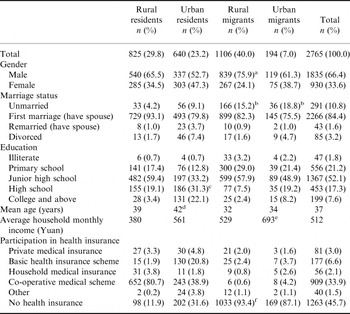
Of the sample population (2765), rural migrants were the largest group (40.0%), followed by rural residents (29.8%), urban residents (23.2%) and urban migrants (7.0%) (Table 1). The majority (85%) of migrants were rural-to-urban migrants. Two-thirds of the respondents were male, with the proportion of males being higher in the rural migrant group (p<0.001). Most respondents were in their first marriage, although migrants had a higher proportion of unmarried (p<0.001). Urban residents had a higher proportion educated above high school compared with other groups (p<0.001). Migrants were younger than non-migrants (p<0.001). Most migrants did not have any kind of health insurance, while the majority of residents had the rural health insurance or the basic health insurance of Kunming city.
Characteristics of the population in four groups in Guandu district, Kunming

a Significantly higher than rural residents (χ2=25.057, p<0.001) and urban migrants (χ2=99.260, p<0.001) and rural residents (χ2=24.570, p<0.001).
b Rural migrants (χ2=13.170, p<0.001) and urban migrants (χ2=13.658, p<0.001) were significantly higher than urban residents. Urban residents was significantly higher than rural residents (χ2=13.639, p<0.001).
c Percentage of high school and above was higher in urban residents than urban migrants (χ2=37.475, p<0.001) and rural residents (χ2=142.291, p<0.001). Urban migrants (χ2=43.869, p<0.001) and rural residents (χ2=55.947, p<0.001) were significantly higher than rural migrants.
d Significant difference was found among four groups (F=157.230, p<0.001); urban residents was significantly higher than rural residents (p<0.001) and rural residents was significantly higher than rural migrants (p<0.001) and urban migrants (p<0.001).
e Significant difference was found among four groups (F=42.432, p<0.001); urban migrants was significant higher than urban residents (p=0.015) and rural migrants (p=0.017). Urban residents (p<0.001) and rural migrants (p<0.001) was significantly higher than rural residents.
f Significantly higher than urban migrants (χ2=9.357, p=0.002). Urban migrants was significantly higher than urban residents (χ2=186.027, p<0.001). Urban residents was significantly higher than rural residents (χ2=85.751, p<0.001).
On average, the monthly income of the surveyed households was 693 Yuan (US$89, US$1=7.8 Yuan in 2005) for urban migrants, 529 Yuan (US$68) for rural migrants, 561 Yuan (US$72) for urban residents and 380 Yuan (US$49) for rural residents. The ANOVA analysis showed that the income differences between groups were significant (p<0.05), and that the income of urban migrants was significantly higher than for other groups.
Knowledge of health services
Urban residents had significantly better knowledge of high-level hospitals compared with the other three groups (χ2=275.82, p<0.001). Rural residents had significantly greater knowledge of township hospitals than urban migrants (χ2=109.86, p<0.001) and urban residents (χ2=183.52, p<0.001).
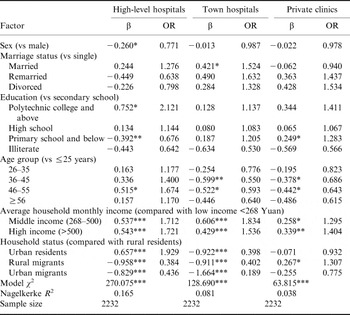
Table 2 shows the multivariate analysis of knowledge of health services. After controlling all the other variables in the model, urban residents were more likely to know high-level hospitals than rural residents (OR=1.929, p<0.001), while rural residents had more knowledge of high-level hospitals than rural and urban migrants (OR=0.384, p<0.001 and OR=0.436, p<0.001 respectively). Rural residents were more likely to know township hospitals compared with urban residents (OR=0.398, p<0.001), rural migrants (OR=0.402, p<0.001) and urban migrants (OR=0.189, p<0.001).
Logistic regression models of health service knowledge in Guandu district, Kunming

* p<0.05;
** p<0.01;
*** p<0.001.
Comparison of utilization of health services among four groups in Guandu district, Kunming

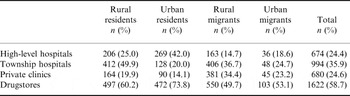
Column percentages do not add to 100% as respondents can report use of more than one health service.
Logistic regression of health service utilization in Guandu district, Kunming

* p<0.05;
** p<0.01;
*** p<0.001.
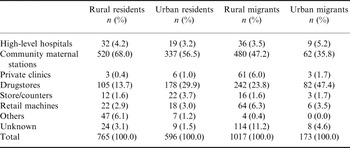
Knowledge of sources of condoms shows a split between migrants and residents (Table 5). A significantly higher proportion of rural migrants did not know any source of condoms (χ2=364.72, p<0.001). In the multivariate analysis, urban residents were more likely to know how to get condoms than rural residents (OR=3.027, p<0.001), while rural migrants had less knowledge than rural residents (OR=0.379, p<0.001). The most known source of condoms for urban migrants was drugstores, whereas residents and rural migrants reported community maternal stations as the most known source.
Knowledge of condom source among four groups in Guandu district, Kunming

Use of health services
Reported use of health services in the past 12 months varied significantly between groups (Table 3). As for levels of knowledge, the utilization rate of high-level hospitals was significantly higher in the urban residents (42%) than other groups (χ2=167.68, p<0.001). Rural residents used more often township hospitals (50%) than any other groups (χ2=151.69, p<0.001). On the other hand, rural migrants had the highest level of visits to private clinics (34.4%) (χ2=106.29, p<0.001). Drugstores were significantly more likely to be used by urban residents (73.8%) than other groups (χ2=99.81, p<0.001).
Multivariate analysis of health service utilization is shown in Table 4. The univariate associations between migrant groups and use of the four health services (described above) were corroborated in the multivariate analysis. Urban residents used high-level hospitals more (OR=2.021, p<0.001). However, no significant difference of use of high-level hospitals was found between rural residents and rural migrants (OR=0.755, p>0.05). With regards to the use of township hospitals, the level reduces in the order of rural residents, rural migrants, urban residents and urban migrants (p<0.001). Urban and rural migrants were less likely to use drugstores than rural residents (OR=0.739 and 0.622, p<0.001).
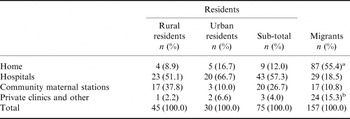
Table 6 shows the place of delivery for women giving birth three years prior to the survey. A significantly higher proportion of migrants (55.4%) reported delivering at home compared with residents (p<0.001). The same information was found after controlling socioeconomic variables in a logistic regression (OR=2.18, p<0.05, migrants vs rural residents). A greater proportion of migrants (15.3%) than non-migrants reported their last birth in a private clinic (p<0.05).
Places of delivery for pregnant women in three groups in recent three years in Guandu district, Kunming

a Significantly higher than residents (χ2=39.437, p<0.001).
b Significantly higher than residents (χ2=6.287, p=0.012).
Discussion
Strengths and limitations of the study
Previous studies on migrants in urban China have used a urban–rural segmentation, comparing rural-to-urban migrants with urban residents (Hu et al., Reference Hu, Liu, Li, Stanton and Chen2006; Jia et al., Reference Jia, Jia, Liu, Dye, Chen and Chen2008; Chen et al., Reference Chen, Stanton, Li, Fang, Lin and Xiong2009). This reflects concerns that rural-to-urban migrants are socially and economically marginalized by the household registration system (Li, Reference Li2004). The current study, however, added two neglected groups: the first were urban migrants, a group disadvantaged due to their migrant identities but benefiting from having grown up in urban settings; the second group is rural residents. Previous studies on migrants in China mostly collected data from the urban neighbourhoods; however, this approach excluded people living in the peri-urban areas, which are the preferred first destinations for migrants due to relatively cheap living costs. Rural residents in the peri-urban area live with migrants, and both groups are experiencing rapid urbanization. In this study, all the four groups are included, which is unique among studies in China.
Due to the rapid urbanization, there are urban residents whose registration status was recently changed from rural to urban residence (called nong zhuan fei in Chinese). This group was termed as urban residents in the study, but they may share some similarities in terms of health knowledge and practice with rural residents due to their rural origin. However, the questionnaire did not distinguish between the nong zhuan fei population and the original urban residents. This unmeasured factor may be confounding and diluting the observed differences between the urban and rural residents.
Three limitations of this study should be noted. First, Kunming is a middle-level large city in the south-west of China, which may affect the transferability of results to other Chinese cities. Second, changes to the rural health insurance schemes since 2006 are not reflected in the results. Third, the study has not commented on the appropriateness of health service use (that is, is the right type of service used for the health condition). In China, patients can visit high-level hospitals without being referred from primary care facilities. During the last decade's unsuccessful marketization of health care in China, hospitals relied heavily on fees for drugs and expensive medical check-ups, which created higher costs for patients and unnecessary prescriptions. This problem is common to all four health services and has resulted in a rapid increase in health spending, prohibitive out-of-pocket costs, less equitable health care utilization and lower efficiency of the health system's performance (Liu et al., Reference Wang, Long, Liu, Tolhurst and Tang2008). In the present study, utilization of health care reflected patients' knowledge and ability to pay. For example, poor migrants often chose low-quality private clinics while urban residents often chose high-level hospitals.
The socioeconomic change from rural–urban divide to migrant–resident divide
The social and economic systems in China have experienced fundamental changes since the 1990s taxation reform. Social welfare became the responsibility of local governments, funded through local taxation (Smart & Smart, Reference Smart and Smart2001). Therefore, rich provinces provided better social welfare for both urban and rural residents while poor provinces had to reduce the benefits to their residents. In rich cities, rural residents in the peri-urban areas gained urban hukou status due to the rapid economic development and urbanization. As differences between the east and west of China widen, regional differences in social welfare have increased. At the same time, there is no mobility for migrants of social welfare benefits, which operate at a national level. This means migrants cannot access welfare systems if they do not have a hukou status. Thus, the two segmentations, i.e. the rural–urban divide and migrant–resident divide, have to be taken into consideration in analysing migrants' health knowledge and utilization.
The rural–urban divide
The rural–urban divide had influenced negatively the income, education, health services knowledge and behaviours of the rural population, as reflected by their knowledge and utilization of health services in this study. The findings show the urban–rural divide still prevails. For example, rural migrants used private clinics more, but had less knowledge of high-level hospitals than their urban peers. Also, rural migrants were less likely to know a source to obtain condoms. Rural residents had more knowledge about township hospitals and used them more often than urban residents, whereas urban residents and migrants were more likely to utilize high-level hospitals. This is because village doctors, who are private, are generally the first stop for farmers and township hospitals are well known and utilized in rural areas (Rao & Gao, Reference Rao and Gao2004; Wei, et al., Reference Wei, Liang, Walley, Liu and Dong2009b). Also, new rural health insurance schemes promote township and community hospitals to rural residents. Urban residents use high-level hospitals partly because their health care insurance schemes do not cover primary health facilities, and partly because there is perceived high quality associated with big hospitals (Liu, Reference Liu2004).
The migrant–resident divide
Current health insurance schemes managed by local government include the urban employee basic health insurance scheme and the rural health insurance. The health insurance schemes are financed through individual premiums, employer contributions and local tax contributions. Migrants do not have hukou status and cannot work in the formal sectors, so they are excluded from the local health insurance schemes. Also, migrants are mostly engaged in manual work (for example, street vendors, rubbish collectors), so they are marginalized economically. Furthermore, the main reason for migrating is economic, i.e. to earn more money than at home; migrants tend to save more and spend less. Therefore, it is not surprising to find that migrants use the cheapest health care such as unlicensed private doctors (Wu, Reference Wu, Rao and Gao2004), rather than hospitals (which, though publicly owned, are privately operated).
Residents reported greater use of high-level hospitals and township hospitals compared with their migrant peers. Urban migrants had a similar pattern of health service utilization (i.e. greater use of drugstores and lower use of high-level hospitals) to their rural peers. Migrants' utilization of private clinics was associated with their poor education, lack of insurance, low income and low health knowledge. Delivery by a skilled birth attendant with access to an efficient referral system is crucial for reducing maternal mortality (World Health Organization, 2004). However, similar to other research (Zhan et al., Reference Zhan, Zhenwei and Blas2002), the results show pregnant migrant women were more likely to deliver at home or use unqualified doctors, as compared with residents. Migrants have low awareness of urban maternal health services (Wang et al., Reference Wang, An, Zhang and Wang1999) and have financial constraints to accessing antenatal care (Zhao et al., Reference Zhao, Kulane, Gao and Xu2009). More frequent delivery at home or being attended by unqualified health workers helps to explain migrant women's greater risk of unfavourable birth outcomes (Zhan et al., Reference Zhan, Zhenwei and Blas2002).
Previous research has focused on the urban–rural divide; however, this paper's findings suggest that it is important to use a combination of the migrant–resident divide and the historical urban–rural divide. Reform of the household registration system should aim to reduce differences in status between urban and rural households. The incoming social welfare reform in China has focused on improving the mobility of social welfare benefits regardless of hukou, in order to break the urban–rural divide. For example, big cities like Wuhan, Shenzhen, Hangzhou and Shanghai are implementing policies to expand welfare to the local rural population, as well as encouraging qualified migrants to apply for the local hukou.
The urban–rural divided system for the registered residence formed during the planned economy period still has far-reaching influence. Due to poor income and education, rural migrants' access to urban health care is severely restricted. This restriction has disadvantaged rural migrants compared with urban migrants, as the latter are only influenced by the regional segmentation. Therefore, it is still crucial for health policy makers and planners to improve the utilization of health care of rural migrants. The health problems of the migrant population should be viewed from the double perspectives of migrant–resident and urban–rural segmentation.
Conclusions
This study is the first to analyse China internal migrants' health problems using a double segmentation framework, combining urban–rural and migrant–resident segmentations. The new framework contributes to understanding the observed differences in health knowledge and utilization among rural residents, urban residents, rural migrants and urban migrants. Rural migrants are the most disadvantaged; their marginalization is rooted in an historical rural–urban divide and loss of social opportunities due to lack of local house registration. Abolishing the household registration system is crucial to reduce social inequity. However, migrants are not identical, and it is important to recognize the growing number of urban migrants who have different health problems. It is important to set up a transferable health insurance scheme benefiting all migrants, and to provide information targeted at the different groups on health services and their utilization.