INTRODUCTION
The adoption of tillage practices for crop production date back to the invention of animal-drawn implements, with the benefits of tillage recorded as early as the 1800s (Gebhardt et al. Reference Gebhardt, Daniel, Schweizer and Allmaras1985; Lal et al. Reference Lal, Reicosky and Hanson2007). In present-day conventional tillage systems, a mould board plough is typically used for primary tillage followed by the use of secondary tillage implements such as power harrows for seed bed preparation. In this approach it is usual that <15% of crop residues are left on the surface (El Titi Reference El Titi2003) and the tillage depth is ⩾20 cm (Jastrow et al. Reference Jastrow, Amonette and Bailey2007). The environmental concerns about soil erosion, soil degradation and pollution of water brought about by tillage have resulted in the development of alternative tillage systems whose popularity have varied over time (Gebhardt et al. Reference Gebhardt, Daniel, Schweizer and Allmaras1985) but are currently gaining more attention. Reduction of tillage in crop cultivation was first attempted primarily as a strategy to reduce soil erosion during the late 1950s in the US Corn Belt and Great Plains and increased in popularity globally especially after the discovery of the herbicides atrazine and paraquat (Six et al. Reference Six, Feller, Denef, Ogle, de Moraes Sa and Albrecht2002c, d ; Hermle et al. Reference Hermle, Anken, Leifeld and Weisskopf2008). This and other different forms of tillage practices that reduce soil or water loss compared to ploughing have been referred to as ‘conservation tillage’ (Liu et al. Reference Liu, Gao, Wu, Tanveer, Wen and Liao2013). Soil inversion in this context is not considered as conservation tillage, and shallow ploughing, if done, should be <10 cm (El Titi Reference El Titi2003).
The current review focuses specifically on zero tillage (also called no tillage or direct drill) which aims to conserve soil and water by not disturbing the soil surface and leaving 30% or more crop residues on the surface (Erenstein & Laxmi Reference Erenstein and Laxmi2008). Where relevant, a distinction is made from reduced tillage (also called minimum tillage), where only the upper 5 cm are disturbed (Wang et al. Reference Wang, Cai, Hoogmoed, Oenema and Perdok2006). In 1999, the area under zero tillage was about 45 million hectares (Mha) globally, of which 96% was in North and South America (Derpsch & Friedrich Reference Derpsch and Friedrich2009). By 2007/08 this area had more than doubled to 111 Mha spread across all continents (Table 1) (Derpsch et al. Reference Derpsch, Friedrich, Kassam and Li2010). The largest area was in South America (46.8%), followed by North America (37.8%) and the least in Africa (0.3%) and Europe (1.1%). Zero-tillage practices have been widely documented for their benefits including protection of soil against erosion and degradation of soil structure (Petersen et al. Reference Petersen, Mutegi, Hansen and Munkholm2011), greater aggregate stability (Zotarelli et al. Reference Zotarelli, Alves, Urquiaga, Boddey and Six2007; Fernández et al. Reference Fernández, Quiroga, Zorati and Noellemeyer2010), increased sequestration of carbon (C) (Six et al. Reference Six, Conant, Paul and Paustian2000a , Reference Six, Elliott and Paustian b ; West & Post Reference West and Post2002) and improved biological activity (Helgason et al. Reference Helgason, Walley and Germida2010). The reduced use of fuel in field preparations is a significant economic attraction to farmers and adds substantially to environmental protection (Petersen et al. Reference Petersen, Schjønning, Thomsen and Christensen2008). Further emphasis has been given in recent years to the climate change mitigation opportunities by following zero-tillage systems considering in particular the potential C storage in soil and reduction in emissions of carbon dioxide (CO2) (Peigne et al. Reference Peigne, Ball, Roger-Estrade and David2007; Koga & Tsuji Reference Koga and Tsuji2009; Farina et al. Reference Farina, Seddaiu, Orsini, Steglich, Roggero and Francaviglia2011).
Area under zero tillage in different countries – adopted from (Derpsch et al. Reference Derpsch, Friedrich, Kassam and Li2010)

* FAO (2013).
It has recently been reported that zero tillage can bring about stratification of organic C at the soil surface (Baker et al. Reference Baker, Ochsner, Venterea and Griffis2007) compared to the more uniform distribution of C typically found in conventionally tilled soils (Campbell et al. Reference Campbell, Zentner, Selles, Biederbeck, McConkey, Blomert and Jefferson2000), questioning the effective sequestration obtainable under zero tillage. The surface-accumulated crop residues under zero-tilled soils may decompose, releasing CO2 to the atmosphere (Petersen et al. Reference Petersen, Schjønning, Thomsen and Christensen2008). Crucially, climate change mitigation benefits, such as reduced CO2 emissions by virtue of increased sequestration of C and increased methane (CH4) uptake under zero tillage, could be offset by increased emissions of nitrous oxide (N2O), a greenhouse gas (GHG) with high global warming potential (Six et al. Reference Six, Feller, Denef, Ogle, de Moraes Sa and Albrecht2002c , Reference Six, Paustian, Elliott and Combrink d , Reference Six, Ogle, Breidt, Conant, Mosier and Paustian2004; Chatskikh & Olesen Reference Chatskikh and Olesen2007). The warming potential refers to the radiative forcing impacts of each greenhouse gas relative to CO2, as detailed in IPCC (Reference Houghton, Ding, Griggs, Noguer, van der Linden, Dai, Maskell and Johnson2001). Increased N2O emissions have been related to enhanced denitrification under zero tillage, due to formation of micro-aggregates (<250 μm) within macro-aggregates (>250 μm) that create anaerobic micro-sites (Hermle et al. Reference Hermle, Anken, Leifeld and Weisskopf2008), high microbial activity leading to high competition for oxygen (West & Marland Reference West and Marland2002a ) and a dense soil structure (Regina & Alakukku Reference Regina and Alakukku2010). Soil structure and soil wetness exert a considerable role in GHG emissions from soil (Ball Reference Ball2013). Avoiding tillage in crop production can also impact on crop yields and ultimately global food security (Huang et al. Reference Huang, Zhang, Li, Li, Chan, Heenan, Chen, Unkovich, Robertson, Cullis and Bellotti2008). A yield reduction of 21 and 15% in wheat and barley, respectively, was reported over 6 years in zero-tilled soil compared to conventional tillage by Machado et al. (Reference Machado, Petrie, Rhinhart and Qu2007). Among other factors, the yield reduction with zero tillage has been mainly attributed to increased weed growth, which makes it necessary to apply more herbicides. The potential for any mitigation by zero tillage therefore needs to be considered together with its impact on crop yields, as climate change and global food security are intrinsically linked. The objectives of the current paper were to evaluate zero tillage for: (i) mitigation of climate change by sequestration of C and by reducing or balancing emissions of major GHGs from the soil and (ii) its effect on crop yield.
MATERIALS AND METHODS
For the present study, datasets pertaining to C storage in soils and crop yield under zero tillage were compiled.
Datasets on soil organic matter
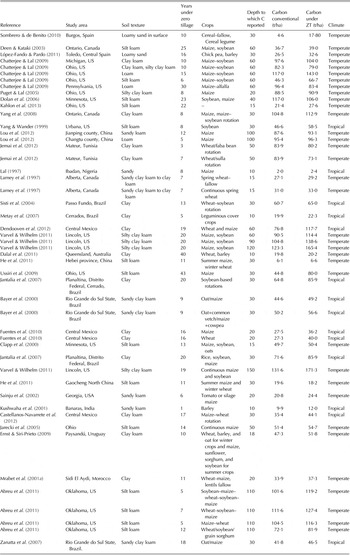
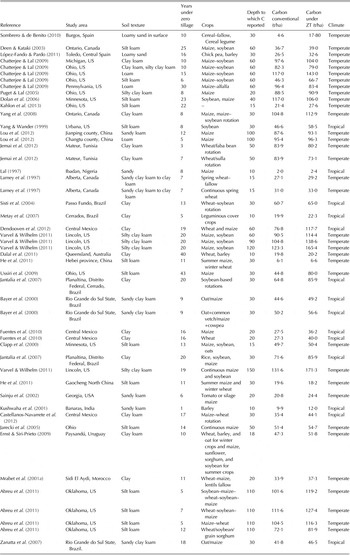
A total of 49 datasets were collected from peer-reviewed research papers using the search term ‘zero (or no) tillage and carbon’ in Web of Science. Only those papers with paired conventional tillage (CT) and zero-tillage (ZT) treatments were selected (Table 2). The C data were reported in t/ha. When only C concentrations were reported, bulk density values were used to convert C content to C stock using the following equation.
 $${\rm t}\,{\rm C}\,{\rm per}\,{\rm ha} = \displaystyle{{\% {\rm C} \times {\rm bulk}\,{\rm density} \times {\rm soil}\,{\rm depth} \times 100} \over {100}}$$
Global examples of C stocks reported under conventional and zero tillage
Note here that zero-tillage tends to result in denser soils with higher bulk densities (Mangalassery et al. Reference Mangalassery, Sjögersten, Sparkes, Sturrock, Craigon and Mooney2014), hence soil profiles of the same depth will contain a greater soil mass in zero-tilled soils (Powlson & Jenkinson Reference Powlson and Jenkinson1981; Ellert & Bettany Reference Ellert and Bettany1995): this has implications for C content calculations. Specifically, basing the calculations on depth may result in an over-estimation of the positive effect of zero tillage on soil C stocks. Indeed using data from Ellert & Bettany (Reference Ellert and Bettany1995), depth-based calculations resulted in estimates of C stocks c. 16% higher than mass-based calculations.
Yield datasets
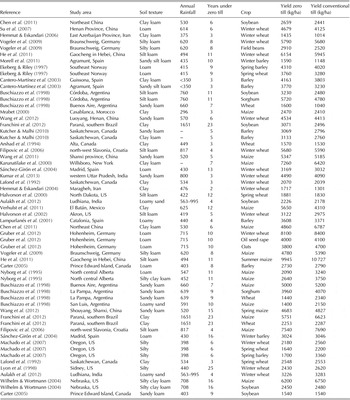
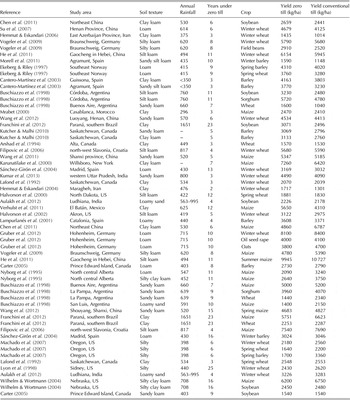
A review of the existing literature was made to compile a dataset for comparing crop yield under zero tillage and conventional tillage. Sixty one datasets were used, from peer-reviewed research papers that made one-to-one comparisons with zero tillage and conventional tillage found using the search terms ‘crop yield and zero (or no) tillage’ in Web of Science (Table 3). The relative yield was then computed as follows.
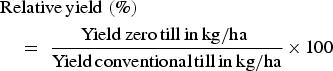 $${\eqalign{& {\rm Relative}\,{\rm yield\; (\% )}\;\cr & \quad= \; \displaystyle{{{\rm Yield}\,{\rm zero}\,{\rm till}\,{\rm in}\,{\rm kg/ha}\;} \over {{\rm Yield}\,{\rm conventional}\,{\rm till}\,{\rm in}\,{\rm kg/ha}}}\,{\rm \times\, 100}}}$$
Reported yields under various crops in zero till and conventional tillage systems, with increases and decreases associated with zero till highlighted
Statistical analysis
The locations of the studies reported in each paper were separated into tropical and temperate based on the climatic information provided in the paper and FAO agro-ecological zoning guidelines (Fischer et al. Reference Fischer, Nachtergaele, Prieler, Van Velthuizen, Verelst and Wiberg2008). Regression equations were developed to explore the potential for C sequestration with zero and conventional tillage separately and under tropical and temperate conditions. The aim was to derive conclusions regarding the effect of duration of zero tillage on sequestration of C and soil depth on net sequestration C rate. The yield advantage or disadvantage under zero tillage with respect to conventional tillage was computed from the selected published literature. Linear regressions were carried out on the yield differences against duration of zero tillage. All the statistical analysis was carried out in Genstat (v. 14).
TILLAGE INFLUENCES IMPORTANT SOIL PROPERTIES
Zero-tillage affects soil aggregation by decreasing oxidation of soil organic matter, which acts as a binding agent for macro-aggregates (Andruschkewitsch et al. Reference Andruschkewitsch, Koch and Ludwig2014). Hence, water-stable aggregates (>250 mm) become more stable under zero-tillage systems (Tisdall & Oades Reference Tisdall and Oades1980). Kasper et al. (Reference Kasper, Buchan, Mentler and Blum2009) observed 18·2% of soil aggregates in the stable class under conventional tillage compared with minimum tillage which contained 37·6% stable aggregates. Continuous tillage practices also make aggregates susceptible to disruption under exposure to frequent wetting and drying cycles (Six et al. Reference Six, Feller, Denef, Ogle, de Moraes Sa and Albrecht2000c , Reference Six, Paustian, Elliott and Combrink d ). The effects of wetting and drying cycles are more intensive on the top soil and hence structural instability is generally greater in tilled soil where manual disaggregation of top soil occurs (Hernanz et al. Reference Hernanz, López, Navarrete and Sánchez-Girón2002). Utomo & Dexter (Reference Utomo and Dexter1982) observed wet–dry cycles decreased the proportion of water stable aggregates >0·5 mm.
Soil organic matter accumulates with zero-tillage practices, especially near the soil surface (upper 5 cm), when compared to conventionally tilled soils (Angers et al. Reference Angers, Recous and Aita1997; Gosai et al. Reference Gosai, Arunachalam and Dutta2009). Under conventional tillage, crop residues are mixed with soil in the plough layer and hence nutrients are more or less evenly distributed (Wright et al. Reference Wright, Hons, Lemon, McFarland and Nichols2007), unlike zero tillage where an enhanced biochemical and physical environment at the surface would be expected, due to longer retention of crop residues there. Under minimum tillage, a reduction in soil organic matter turnover can affect net mineralization of nitrogen (Kong et al. Reference Kong, Fonte, van Kessel and Six2009) and result in lower nitrogen availability for crops. Net immobilization of nitrogen has been reported during the transition periods to zero tillage (Jastrow et al. Reference Jastrow, Amonette and Bailey2007). However, in the long term, the nitrogen concentration in the surface layer of zero-till soils has been found to be higher than in conventionally tilled soils (Ussiri et al. Reference Ussiri, Lal and Jarecki2009). Zero-tilled soils have also been reported to accumulate phosphorus and potassium at the surface (Wright et al. Reference Wright, Hons, Lemon, McFarland and Nichols2007). Franzluebbers & Hons (Reference Franzluebbers and Hons1996) observed greater surface accumulation of P, K, Zn and Mn in zero-tilled soil than in conventionally tilled soils and Bauer et al. (Reference Bauer, Frederick and Busscher2002) found enhanced accumulation of Ca and Mg in the upper layers of zero-tilled soils.
Tillage has both direct (by exposing them through inversion of soil) and indirect (by altering the soil microclimate) impacts on soil macro-organisms, with the effect being largely negative to their population (Roger-Estrade et al. Reference Roger-Estrade, Anger, Bertrand and Richard2010). In the long term, zero-tillage practices can be beneficial for earthworm populations compared with conventionally tilled soils due to enhanced availability of food resources (Eriksen-Hamel et al. Reference Eriksen-Hamel, Speratti, Whalen, Légère and Madramootoo2009). An abundance of microbial biomass has been found in soils under zero tillage, including saprophytic fungi and arbuscular mycorrhizal fungi (Roger-Estrade et al. Reference Roger-Estrade, Anger, Bertrand and Richard2010). Helgason et al. (Reference Helgason, Walley and Germida2010) found up to 32% higher microbial biomass under long-term zero-till systems than conventionally tilled soils.
CLIMATE CHANGE AND GREENHOUSE GASES
According to the Intergovernmental Panel on Climate Change (IPCC Reference Solomon, Qin, Manning, Chen, Marquis, Averyt, Tignor and Miller2007b ) the increased concentration of GHGs in the atmosphere is the major cause of global warming and associated climatic changes (Ugalde et al. Reference Ugalde, Brungs, Kaebernick, McGregor and Slattery2007). The global atmospheric CO2 concentration increased from 280 ppm in 1750 to 379 ppm in 2005, which has been attributed primarily to fossil fuel use and land use change (IPCC Reference Solomon, Qin, Manning, Chen, Marquis, Averyt, Tignor and Miller2007b ) with a total increase of 1·9 ppm per year. Apart from CO2, the atmospheric concentration of CH4 increased to 1774 ppb in 2005 from the pre-industrial value of 715 ppb (increase of 148%). Nitrous oxide continues to rise at the rate of 0·26% per year, measured at 319 ppb in 2005, 18% higher than its pre-industrial value (IPCC Reference Solomon, Qin, Manning, Chen, Marquis, Averyt, Tignor and Miller2007b ). Agriculture can act as both a sink and source for the GHGs of CO2, CH4 and N2O based on the various mitigation strategies adopted. The IPCC (Reference Metz, Davidson, Bosch, Dave and Meyer2007a ) have suggested three broad mitigation options to reduce GHG emissions from agriculture; (i) reducing soil disturbance, (ii) enhanced sequestration of C in soil (West & Post Reference West and Post2002; Lal Reference Lal2004a ) and (iii) reduced emissions of CO2 during decomposition of crop residues triggered by ploughing and reduced use of fossil fuel in farm operations (West & Marland Reference West and Marland2002a ). Each of these is covered in further detail in the synthesis below.
SEQUESTRATION OF CARBON UNDER ZERO TILLAGE
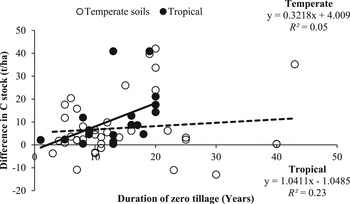
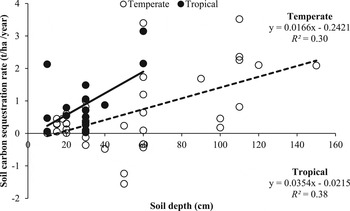
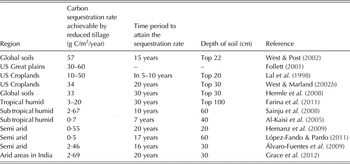
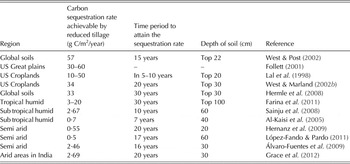
Soils are the largest C reservoirs of the terrestrial C cycle (Lal Reference Lal2004a ), and increasing C sequestration in soil can mitigate increasing atmospheric CO2 concentration (Kimble et al. Reference Kimble, Lal, Follet, Lal, Kimble, Follet and Stewart2001). A reduction in soil tillage is suggested to increase the rates of C sequestration by altering soil physico-chemical and biological conditions (Marland et al. Reference Marland, GartenJr, Post and West2004). Zero tillage is important for land management as it can help to sequester as much as 100–1000 kg C/ha/year (Lal Reference Lal2004a ). The sequestration of C under zero till management occurs faster under humid conditions, with Six et al. (Reference Six, Ogle, Breidt, Conant, Mosier and Paustian2004) reporting sequestration within 5 years under such climatic conditions. Example sequestration rates obtained under various zero-tillage studies are presented in Table 4. West & Marland (Reference West and Marland2002a ) obtained a mean C sequestration rate of 340 kg/ha/year from 76 long-term experiments for the plough layer of soil extending up to 30 cm over 20 years. Similarly a comparable sequestration of C was observed by Six et al. (Reference Six, Feller, Denef, Ogle, de Moraes Sa and Albrecht2002c , Reference Six, Paustian, Elliott and Combrink d ) in the upper 30 cm of zero-tilled soil for both tropical (325 kg/ha/year) and temperate (113 kg/ha/year) conditions. The C sequestration capabilities increased considerably with an increase in duration of zero tillage, with the increment more evident under tropical conditions (Fig. 1, P < 0·05 for tropical and non-significant (NS) in case of temperate). The present analysis suggests the C sequestration rate under zero tillage of the top 25 cm soil (ploughing depth) was 864 kg/ha/year in tropical regions against 173 kg/ha/year in temperate soils (Fig. 2, P < 0·05 for tropical and P < 0·001 for temperate). The changes in C sequestration are also dependent on many other variables such as crop rotation, soil type (Gaiser et al. Reference Gaiser, Abdel-Razek and Bakara2009) and soil drainage (Duiker & Lal Reference Duiker and Lal1999). McConkey et al. (Reference McConkey, Liang, Campbell, Curtin, Moulin, Brandt and Lafond2003) observed a linear relationship with clay content and increase in C stock under zero till, which was further confirmed by Grace et al. (Reference Grace, Antle, Aggarwal, Ogle, Paustian and Basso2012) who recorded more than double the sequestration rate in clay soils compared to sandy soils in India. The ability to sequester C also depends on the initial C content at the initiation of zero-tillage practices as there is an upper limit of maximum C that could be sequestered (Stewart et al. Reference Stewart, Paustian, Conant, Plante and Six2007). Therefore, it is crucial to consider these parameters when evaluating the benefits of zero tillage.
Net sequestration of C (t/ha) under zero tillage in comparison to conventional tillage as affected by duration under zero tillage in tropical and temperate soils (F 1,55 = 1·42, NS overall, F 1,16 = 4·40, P < 0·05 tropical, F 1,37 = 0·54, NS temperate; for the datasets used please refer to Table 2).

Carbon sequestration rate in tropical and temperate soils (F 1,55 = 16·57, P < 0·001 overall, F 1,16 = 7·03, P < 0·05 tropical, F 1,37 = 17·73, P < 0·001 temperate; please refer to Table 2 for the sources of data used in this figure).

Soil C sequestration rates under zero tillage
Longevity of sequestered carbon under zero tillage
Lal (Reference Lal2004b ) suggested that C sequestration by zero tillage might be viewed as a short-term strategy only. An initial decline of soil C has been reported with zero tillage compared to conventional tillage due to the absence of incorporated residues and organic inputs into deeper layers of soil (Kong et al. Reference Kong, Fonte, van Kessel and Six2009). After 5 years, de Rouw et al. (Reference de Rouw, Huon, Soulileuth, Jouquet, Pierret, Ribolzi, Valentin, Bourdon and Chantharath2010) reported a net loss of C (1·33 t/ha) under zero till in comparison to tilled soil in Laos. The initial delayed response to sequestration of C after conversion from conventional tillage was also reported by West & Post (Reference West and Post2002), who observed little or no increase during 2–5 years and then a large increase between 5 and 10 years. The time required to reach a ‘steady state’ in C sequestration varies with respect to climate, soil type and management practices and can range from 5 to 30 years according to the studies listed in Table 4. The initial soil C content in relation to the equilibrium level that a particular soil can achieve is important in deciding the effectiveness of zero tillage with respect to the sequestration (de Rouw et al. Reference de Rouw, Huon, Soulileuth, Jouquet, Pierret, Ribolzi, Valentin, Bourdon and Chantharath2010). Angers & Eriksen-Hamel (Reference Angers and Eriksen-Hamel2008) found a weak but significant correlation for soil organic C (R 2 = 0·15, P ⩽ 0·05) with the duration of zero tillage and hypothesized that the positive effect of zero tillage would increase with time. In the current analysis, C under zero tillage in tropical regions was significantly correlated with the time since conversion (R 2 = 0·22, P ⩽ 0·001), but this was not significant for temperate regions. This is in agreement with reports that in temperate soils, the time period to attain sink saturation is around 100 years, with lower values for tropical soils (20–50 years) (Lal Reference Lal2004b ; Smith Reference Smith2004; Alvaro-Fuentes & Paustian Reference Alvaro-Fuentes and Paustian2011).
Physical aspects of carbon sequestration with zero tillage
Aggregation
Tillage generally reduces soil aggregation and consequently particulate organic matter content (Wright & Hons Reference Wright and Hons2005). Under tillage, macro-aggregates are physically broken up due to shearing forces and by exposure to wet–dry and freeze–thaw cycles (Conant et al. Reference Conant, Easter, Paustian, Swan and Williams2007). Zero tillage is reported to increase sequestration of soil C, especially in the surface layer, and the major mechanism underlying such sequestration is an increase in micro-aggregation (Lal & Kimble Reference Lal and Kimble1997) and decrease in decomposition of soil organic matter (Chatterjee & Lal Reference Chatterjee and Lal2009). Six et al. (Reference Six, Elliott and Paustian1999) found proportions of crop-derived C in macro-aggregates were similar under zero till and conventional tillage, but proportions of crop-derived C were three times greater in micro-aggregates (250–2000 μm) from zero tillage than micro-aggregates from conventional tillage. Although the crop-derived C in macro-aggregates was similar in both conventional tillage and zero till, the zero till system had 28% more total organic C in all aggregate size classes compared to conventional tillage (Madari et al. Reference Madari, Machado, Torres, de Andrade and Valencia2005). Six et al. (Reference Six, Conant, Paul and Paustian2000a , Reference Six, Elliott and Paustian b ) developed a conceptual model to explain the C sequestration from zero tillage which hypothesized that tillage enhances macro-aggregate turnover and decreases the formation of new micro-aggregates. Under zero tillage the turnover of macro-aggregates decreases and the crop-derived C is sequestered within stable micro-aggregates and preserved within macro-aggregates. The improvement in soil aggregation and organic C preservation by zero tillage has been demonstrated by other workers, including Wright & Hons (Reference Wright and Hons2005) and Mrabet et al. (Reference Mrabet, Saber, El-Brahli, Lahlou and Bessam2001b ). Six et al. (Reference Six, Elliott and Paustian1999) attributed the decrease of C sequestration by tillage to increased macro-aggregate turnover. By following zero tillage the turnover of macro-aggregates are decreased and formation of stable micro-aggregates occur within macro-aggregates (Denef et al. Reference Denef, Zotarelli, Boddey and Six2007), which serve as long-term C stabilization sites. The increased macro-aggregation and its decreased turnover under zero tillage can cause a 1·5 times slower C turnover in temperate soils, due to C stabilization within micro-aggregates (Six et al. Reference Six, Feller, Denef, Ogle, de Moraes Sa and Albrecht2002c , Reference Six, Paustian, Elliott and Combrink d ).
Soil bulk density
Previous studies have indicated that continuous zero tillage practices over the long term reduce the bulk density of soil (Dam et al. Reference Dam, Mehdi, Burgess, Madramootoo, Mehuys and Callum2005; Li et al. Reference Li, Liu, Cheng, Wang, Qin, Jiao, Li and Hu2011). Lal et al. (Reference Lal, Mahboubi and Fausey1994) found that after 28 years of maize and soybean, the lowest bulk density soil was in zero till soils. In another study, a continuous zero till system for 43 years had significantly decreased bulk density at the surface (0–15 cm) of a silt loam soil in Ohio (P < 0·05) with little effect on the sub-surface layer (15–30 cm) (Ussiri et al. Reference Ussiri, Lal and Jarecki2009). The reduction in soil compaction under zero tillage is mainly due to reduced traffic, additional crop residues at the surface (Jastrow et al. Reference Jastrow, Amonette and Bailey2007) and increased biological activity provided by soil macro and micro fauna (Simmons & Coleman Reference Simmons and Coleman2008) and changes in soil structure (Zhang et al. Reference Zhang, Li, Zhang, Wei, Chen and Liang2012). The lower bulk density is beneficial for easier root penetration into deeper layers, thereby increasing the crop-derived C input. This is specifically important in the case of deep-rooted plants, since photosynthates are translocated into the below-ground portions of the soil through rhizodeposition (Baker et al. Reference Baker, Ochsner, Venterea and Griffis2007). The decreased soil bulk density can also aid the downward movement of surface-accumulated C (Luo et al. Reference Luo, Wang and Sun2010), by preferential accumulation of plant residues moving in the soluble fraction (Angers & Eriksen-Hamel Reference Angers and Eriksen-Hamel2008). Blanco-Canqui et al. (Reference Blanco-Canqui, Schlegel and Heer2011) also found a moderate negative correlation between bulk density and soil organic C throughout a 1 m soil depth under zero till, indicating increased soil organic C could aid in reducing soil compaction. However, there are contrasting reports stating that continuous zero tillage can lead to increased soil strength and soil bulk density (Schjønning & Rasmussen Reference Schjønning and Rasmussen2000; Hernanz et al. Reference Hernanz, Sánchez-Girón and Navarrete2009). Hill (Reference Hill1990) noticed increased bulk density and soil strength in the zero till treatments over an 11–12 year zero-tillage experiment under continuous maize cultivation in Maryland, USA. López-Fando & Pardo (Reference López-Fando and Pardo2011) found significantly higher surface bulk density under zero till soil than conventionally tilled soil over 20 years of experimentation in central Spain. It is possible that several factors contribute to increased bulk density with zero-tillage systems but most likely is the increased settling of soil due to lack of cultivation (Hermle et al. Reference Hermle, Anken, Leifeld and Weisskopf2008), which can lead to soil consolidation (Peigne et al. Reference Peigne, Ball, Roger-Estrade and David2007). Other possibilities include enmeshment of soil particles due to root action and impact of rainfall on the soil surface. However, the enhanced bulk density might not negatively impact on root growth if pore continuity is enhanced by creation of more biopores (Peigne et al. Reference Peigne, Ball, Roger-Estrade and David2007), although further work is needed to explore the precise impact on pore geometry of zero tillage.
Soil structure and porosity
Soil structure is an important factor in determining the sequestration or decomposition of organic matter as it governs the physical space available for micro-organisms, aiding their actions in terms of aeration, moisture supply (Strong et al. Reference Strong, De Wever, Merckx and Recous2004) and mobility. Kay & VandenBygaart (Reference Kay and VandenBygaart2002) reported that zero tillage might cause a decline in total porosity but with increased porosity in the uppermost layer of the soil (upper 5 cm), near to the crop residues. Minimum and zero-tillage practices initially lead to a decline in macro-pore volume in soil, which ultimately reduces diffusion of air into soil in comparison to conventional tillage (Schjønning & Rasmussen Reference Schjønning and Rasmussen2000). However, over time, there have been reports of increases in macro-porosity especially near to the soil surface (Zhang et al. Reference Zhang, Chan, Oates, Heenan and Huang2007), due to the retention of stubble (Bronick & Lal Reference Bronick and Lal2005) and formation of macro-pores by the activities of soil organisms and plant roots (Kay & VandenBygaart Reference Kay and VandenBygaart2002). Arshad et al. (Reference Arshad, Franzluebbers and Azooz1999) observed more micro-pores under zero tillage than conventional tillage. Smaller aggregates (50–250 μm or less), which can develop more readily when the soil is subjected to less disturbance, have a higher capacity for protection of organic matter than larger aggregates due to their smaller pore sizes (Bachmann et al. Reference Bachmann, Guggenberger, Baumgartl, Ellerbrock, Urbanek, Goebel, Kaiser, Horn and Fischer2008). In undisturbed conditions, the organic matter lying between aggregates or inside larger aggregates are less prone to microbial attack and therefore has increased longevity of residency (Chivenge et al. Reference Chivenge, Murwira, Giller, Mapfumo and Six2007).
Chemical aspects of carbon sequestration with zero tillage
Soil organic matter consists of different fractions with varying physico-chemical properties, each of which differs in turnover time (Del Galdo et al. Reference Del Galdo, Six, Peressotti and Cotrufo2003). Tillage alters aggregate dynamics and prevents the formation of stabilized C fractions such as intra-aggregate organic C (Six et al. Reference Six, Elliott and Paustian1999). The turnover of soil organic matter is dependent upon the type of organic matter in soil with the labile fraction requiring only 0·4–1·2 years for decomposition, whereas many years (400–2200) are required to decompose passive pools comprising of humic fractions, especially in cold, temperate soil (Lal & Kimble Reference Lal and Kimble1997). These include humic and fulvic acids and organo-mineral complexes. Microbially transformed substances are converted into humic forms through the intermediaries of quinones and amino compounds, the reaction being mediated by biological and inorganic catalysts (Stevenson Reference Stevenson1994). The main determinant in this phenol oxidation is oxygen availability, which is directly related to cultivation practices in soil (Jastrow et al. Reference Jastrow, Amonette and Bailey2007). The nature of association of organic matter with mineral particles heavily influences the chemical stabilization of C. Soils containing 2 : 1 clay minerals tend to preserve C more than those dominated by 1 : 1 clay minerals owing to their higher cation exchange capacity (CEC) and specific surface available to 2 : 1 type of clay minerals (Six et al. Reference Six, Conant, Paul and Paustian2002a , Reference Six, Elliott and Paustian b ). Thus zero tillage, by directly affecting the physical characteristics, has a significant impact on the chemistry of soil C dynamics.
Biological aspects of carbon sequestration with zero tillage
The number and diversity of soil organisms has been reported to increase with a reduction in tillage (Roger-Estrade et al. Reference Roger-Estrade, Anger, Bertrand and Richard2010). Soil micro-organisms improve soil aggregation and thus indirectly influence C cycling by assisting with the physical protection of soil organic matter (Noguez et al. Reference Noguez, Escalante, Forney, Nava-Mendoza, Rosas, Souza and García-Oliva2008). Peigne et al. (Reference Peigne, Ball, Roger-Estrade and David2007) found zero-tillage systems contained more fungi than bacteria on the surface layers. Fungi have the capacity to efficiently sequester C in aerobic conditions and have greater C utilization efficiency than bacteria. Fungi attack more frequently on lignitic materials, producing monomers which are important constituents of humic materials and the residues of fungal death cells are resistant to microbial degradation (Jastrow et al. Reference Jastrow, Amonette and Bailey2007). Mycorrhizal fungi are effective in increasing soil organic C through their effect on soil aggregation and are also efficient in securing C from the plant, thus adding extra C to soil organic matter (Manns et al. Reference Manns, Maxwell and Emery2007). Tillage incorporates crop residues and places them close to decomposers while under zero tillage they are initially kept away from decomposers (de Rouw et al. Reference de Rouw, Huon, Soulileuth, Jouquet, Pierret, Ribolzi, Valentin, Bourdon and Chantharath2010). In zero tillage, where disturbance is less, fungal hyphae grow and form bridge structures between soil and surface residues and form a major component of the soil fabric (Jastrow et al. Reference Jastrow, Amonette and Bailey2007). Upon decomposition, these hyphal masses add to the soil C pool by way of the recalcitrant by-products of decomposition. The dry weight of hyphae in soil has been reported to be 0·03–0·5 mg/g and the amount of soil C derived by arbuscular mycorrhizal fungi is estimated to be in the range of 54–900 kg/ha for a soil depth of 30 cm (Zhu & Miller Reference Zhu and Miller2003). Frey et al. (Reference Frey, Elliott and Paustian1999) indicated fungal biomass in no till soils can vary from 6·8 to 74·3 μg C/g compared to 2·8 to 32·7 μg C/g in tilled soil. The contribution from microbial fungal C has been reported to be c. 0·08 to 0·2% of total C (Rillig et al. Reference Rillig, Wright, Nichols, Schmidt and Torn2001).
Impact of soil depth on carbon sequestration under zero tillage
Previous work to estimate the C sequestration benefits of zero tillage have been criticized for being limited to the upper 20 cm of soil or less (Baker et al. Reference Baker, Ochsner, Venterea and Griffis2007). In the current meta-analysis it was found that C sequestration with zero tillage takes place independently of soil depth (up to the maximum depth of 160 cm considered in the present study, although not all studies used in the meta-analysis considered as deep as 160 cm; Fig. 2). Significantly higher C was sequestered under zero tillage compared to conventional tillage, under both tropical (R 2 = 0·30, P < 0·05) and temperate conditions (R 2 = 0·38, P < 0·001) up to a depth of 160 cm. Multiple linear regression of C sequestration with depth and duration of tillage also indicated significant C increases under tropical (P < 0·01) and temperate conditions (P < 0·001). Angers & Eriksen-Hamel (Reference Angers and Eriksen-Hamel2008) also found significantly greater soil organic C under zero tillage compared to full inversion tillage at depths up to 30 cm, by comparing 23 studies of zero-tilled soils for more than 5 years to >30 cm depths. The greater soil C at sub-surface depths recorded in full inversion tillage was not sufficient to offset the surface gain under zero tillage. Similarly, Six et al. (Reference Six, Feller, Denef, Ogle, de Moraes Sa and Albrecht2002c , Reference Six, Paustian, Elliott and Combrink d ) also found a net sequestration of C to a depth of 50 cm after 20 years of zero tillage. In a long-term tillage experiment over 17 years by López-Fando & Pardo (Reference López-Fando and Pardo2011), a significant effect of zero tillage on C sequestration in the top 30 cm depth was found. This indicates that a net C sequestration is possible with zero tillage when the whole soil profile is considered, which might be due to the C addition to lower layers from the plant roots and leachates. It is worth noting, however, that care is needed when interpreting the C sequestration potential of different tillage systems since most studies do not account for the differences in soil mass resulting from the different soil bulk densities with respect to tillage. This can result in an over-estimation of C stocks, as shown for zero-tilled soils compared to tilled soils by Ellert & Bettany (Reference Ellert and Bettany1995).
Greenhouse gas emissions with zero tillage
Carbon dioxide emissions under zero tillage
Decomposition of plant residues and organic matter by the action of soil microbes and respiration of microbes and plant roots are the major sources of emissions of CO2 in soil (Oorts et al. Reference Oorts, Merckx, Gréhan, Labreuche and Nicolardot2007). Immediately after tillage, emissions of CO2 are known to rise. Chatskikh et al. (Reference Chatskikh, Olesen, Hansen, Elsgaard and Petersen2008), in an experiment in Denmark, reported a 34% increase in emissions under tilled soil compared to reduced tilled soil. Ellert & Janzen (Reference Ellert and Janzen1999) showed that enhanced release of CO2 immediately after tillage was associated with the release of CO2 stored in soil pores and from stimulated biological production. The CO2 flux soon after soil disturbance has been related to the depth of tillage and the degree of soil disturbance (Álvaro-Fuentes et al. Reference Álvaro-Fuentes, Cantero-Martínez, López and Arrúe2007). Reduced turnover of soil organic matter through adoption of zero tillage can lead to decreased emissions of CO2 (Six et al. Reference Six, Conant, Paul and Paustian2000a , Reference Six, Elliott and Paustian b ). In south-western Saskatchewan, Canada, there was a 20–25% reduction in CO2 flux under soils that had been zero tilled for 13 years compared to conventional tillage attributed to slower decomposition of the surface left crop residues under zero-tilled soil (Curtin et al. Reference Curtin, Wang, Selles, McConkey and Campbell2000). Mangalassery et al. (Reference Mangalassery, Sjögersten, Sparkes, Sturrock, Craigon and Mooney2014) have also shown significant reductions in CO2 in zero-tilled compared to conventional tilled soils after 5–10 years post-conversion. In a long-term tillage experiment maintained for 25 years, Bauer et al. (Reference Bauer, Frederick, Novak and Hunt2006) found the CO2 flux from conventional tillage was higher compared to zero tillage, irrespective of timing. Zero tillage has been reported to reduce CO2 emission rate by 0·6 t C/ha/year compared to conventional tillage in a long-term experiment under maize (43 years) in the USA (Ussiri & Lal Reference Ussiri and Lal2009). While evidence points to less tillage leading to a significant reduction in CO2 emissions, a long-term study by Oorts et al. (Reference Oorts, Merckx, Gréhan, Labreuche and Nicolardot2007) found that, on more than half of the sampled days, zero tillage exhibited larger CO2 emissions and they attributed it to the achievement of equilibrium between input and output under long periods (32 years) of zero tillage.
Nitrous oxide emissions under zero tillage
In contrast to CO2 emissions, most research reports increased N2O emissions under zero tillage compared to conventional tillage (Ball et al. Reference Ball, Scott and Parker1999; Chatskikh & Olesen Reference Chatskikh and Olesen2007; Oorts et al. Reference Oorts, Merckx, Gréhan, Labreuche and Nicolardot2007). This has frequently been attributed to decreased water-filled pore space and mineral nitrogen concentration (Oorts et al. Reference Oorts, Merckx, Gréhan, Labreuche and Nicolardot2007), reduced gas diffusivity and air-filled porosity (Chatskikh & Olesen Reference Chatskikh and Olesen2007), increased water content (Blevins et al. Reference Blevins, Cook, Phillips and Phillips1971) and a denser soil structure (Schjønning & Rasmussen Reference Schjønning and Rasmussen2000; Beare et al. Reference Beare, Gregorich and St-Georges2009) as a result of a lack of disturbance. Overall, increased N2O fluxes reported with zero-tilled soils have been linked to the increased anaerobic conditions provided by the increased bulk density and decreased soil porosity due to soil consolidation (Ball et al. Reference Ball, Scott and Parker1999). The physical characteristics of the soil in different layers, as modified by different tillage practices, may affect the flux of N2O. If N2O is produced at surface layers, which are frequently more permeable, the gas is likely to be emitted to the atmosphere, but if the point of production is in lower layers, overlaid by compact layers, the N2O produced may be consumed within the profile over time. Although most reported N2O emissions are quantitatively less in comparison to CO2 emissions, N2O assumes a greater significance due to its larger global warming potential (296 times that of CO2: IPCC Reference Houghton, Ding, Griggs, Noguer, van der Linden, Dai, Maskell and Johnson2001). Indeed, increased N2O emissions have the potential to offset 75–310% of the climate change mitigation obtainable from the sequestration of C in soil (Regina & Alakukku Reference Regina and Alakukku2010). The adoption of zero tillage over longer terms (20 years) has been reported to nullify this adverse effect on N2O emissions, with lower N2O emissions recorded under zero tillage than in tilled soils in humid climates and similar emissions under both tillage types in dry climates (Six et al. Reference Six, Ogle, Breidt, Conant, Mosier and Paustian2004). Similar reports were also made by Kessavalou et al. (Reference Kessavalou, Doran, Mosier and Drijber1998) and Chatskikh et al. (Reference Chatskikh, Olesen, Hansen, Elsgaard and Petersen2008), attributable to increased N2O consumption in soil (Luo et al. Reference Luo, Wang and Sun2010) although there is a lack of published long-term studies in this area. A further confounding issue is the uncertainty associated with estimation of N2O which remains high in most experiments due to significant spatial and temporal variability (Chatskikh et al. Reference Chatskikh, Olesen, Hansen, Elsgaard and Petersen2008; Ussiri et al. Reference Ussiri, Lal and Jarecki2009). It seems that further long-term location-specific studies combining different greenhouse gases and C sequestration are urgently needed to investigate the impact of zero tillage on N2O flux, especially to investigate the time post-conversion at which N2O emissions from zero tillage fall below those from conventional tillage as reported by Six et al. (Reference Six, Ogle, Breidt, Conant, Mosier and Paustian2004).
Methane emissions under zero tillage
Most previous studies indicate increased absorption of CH4 in soils under zero tillage due to reduced surface disruption (Kessavalou et al. Reference Kessavalou, Doran, Mosier and Drijber1998; Regina & Alakukku Reference Regina and Alakukku2010), greater pore continuity (developed over time) and the presence of more micro-sites for methanotrophic bacteria (Hütsch Reference Hütsch1998). The increased soil bulk density reported with zero tillage might prevent the efflux of CH4 leading to its oxidation within soil (Li et al. Reference Li, Liu, Cheng, Wang, Qin, Jiao, Li and Hu2011). Long-term studies by Ussiri et al. (Reference Ussiri, Lal and Jarecki2009) indicated a net CH4 uptake in zero-till soils in silt loam soil under maize in the USA (0·32 kg CH4-C/ha/year for zero till v. 2·76 kg CH4-C/ha/year in conventional till). Continuous ecological disturbance under tillage can be detrimental to methane oxidizers. Most previous studies indicate that zero-tilled soils act as net sinks for methane. However, both increased and decreased CH4 consumption has been reported in zero-till soils (Hütsch Reference Hütsch1998; Venterea et al. Reference Venterea, Burger and Spokas2005). If a zero-tillage system creates anaerobic micro-sites or creates conditions favourable to enhance water-logging conditions then it is likely that CH4 production and emissions will increase.
Net emission of greenhouse gases
To obtain a realistic assessment on the potential of zero tillage for reducing GHG, the combined emissions of all major GHGs need to be considered. There are very few studies that have considered the global warming potential of different gases between conventional and zero-tillage systems. While increased N2O emissions from zero tillage have been reported, crucially some long-term studies have indicated a stabilization of N2O emissions under reduced tillage over 20 years, especially in humid climates (Six et al. Reference Six, Ogle, Breidt, Conant, Mosier and Paustian2004). In a long-term study, Ussiri et al. (Reference Ussiri, Lal and Jarecki2009) observed lower total emissions of N2O under 43 years of zero till in comparison to conventional tillage and the global warming potential under zero-till systems was found to be 51–58% less than under conventional tillage. Mangalassery et al. (Reference Mangalassery, Sjögersten, Sparkes, Sturrock, Craigon and Mooney2014) recently reported reductions of c. 20% under zero tillage, though the time since conversion was <10 years. A complete life-cycle analysis of a zero-till system and conventional till system was carried out by West & Marland (Reference West and Marland2002b ) based on comparisons of 76 long-term experiments up to soil depths of 30 cm. After accounting for the CO2 emissions from different inputs and production activities for maize, wheat and soybean in the US and comparing C sequestered under zero till, the net C sequestration reported was 368 kg C/ha/year. However, in an alternative study involving a global data analysis of zero till v. conventional tillage covering tropical and temperate soils it was found that, after accounting for the C sequestered and CH4 taken up in soil, net sequestration was negative with an overall negative greenhouse balance of 214 kg CO2-equivalents/ha/year (Six et al. Reference Six, Feller, Denef, Ogle, de Moraes Sa and Albrecht2002c , Reference Six, Paustian, Elliott and Combrink d ). However, Six et al. (Reference Six, Feller, Denef, Ogle, de Moraes Sa and Albrecht2002c , Reference Six, Paustian, Elliott and Combrink d ) only compared systems with tillage or zero-tillage elements, excluding experiments with the potential for additional C sequestration such as cover crops and crops in rotation. Robertson et al. (Reference Robertson, Paul and Harwood2000), after only 8 years of experimentation, reported a low net global warming potential under zero till (14 g CO2-equivalents/m2/year) compared to conventional till (114 g CO2-equivalents/m2/year). In most studies it would seem the slightly higher or comparable N2O emissions under zero till is compensated for by the significantly enhanced C storage. For example, following a 30-year simulation experiment, Chatskikh et al. (Reference Chatskikh, Olesen, Hansen, Elsgaard and Petersen2008) showed that zero tillage can decrease net GHG release by 0·56 t CO2-equivalents/ha/year compared to conventionally tilled soil while a field study over 43 years by Ussiri et al. (Reference Ussiri, Lal and Jarecki2009) found a decrease of 1·03 t CO2-equivalents/ha/year with zero tillage compared to conventional tillage (52% reduction).
The most consistent trend in the literature suggests that overall, zero tillage reduces GHG emissions in the long term (c. 20 years), but crucially some uncertainty still exists as to when the positive effects are first recorded and how long these effects can be observed. Large uncertainties still remain and further work is needed both to define the underlying mechanisms and understand the variation between agricultural systems.
Soil quality and yield responses under zero tillage
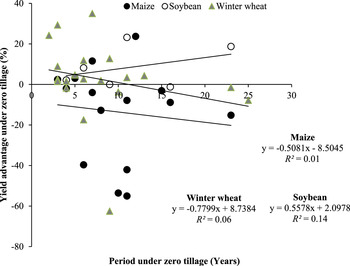
Current analysis suggests there is a lack of consistently reported effects of zero tillage on yield: 0·53 of publications examined in the present study reported an increase in crop yield with zero tillage, whereas 0·47 reported higher yield under conventional management (n = 61). The most negative effects have been recorded in maize with an average of 0·36 reduction in maize yield by following zero tillage over 10 years reported in 15 publications (Fig. 3). The data on winter wheat (n = 20) generally suggested little effect on yield following the adoption of zero tillage over conventional tillage (1% reduction) (Fig. 3), though an 8% reduction in barley yield was observed over 10 years. However, the research in this area is conflicting: Machado et al. (Reference Machado, Petrie, Rhinhart and Qu2007) reported a yield reduction of 21 and 15% in wheat and barley, respectively, over 6 years, in zero-tilled soils compared with conventionally tilled soils. Declining cereal yields under short-term zero tillage practices have also been reported by Känkänen et al. (Reference Känkänen, Alakukku, Salo and Pitkänen2011). A meta-analysis of 47 European studies by Van den Putte et al. (Reference Van den Putte, Govers, Diels, Gillijns and Demuzere2010) comparing the crop yields under conservation tillage with conventional tillage reported yield reductions ranging from 0 to 30% depending on crop type, tillage depth, and texture of soil and crop rotation, with an average yield reduction of 4·5%.
Yield advantage v. years under zero tillage for winter wheat, soybean and maize (taken from the data in Table 3).

The major constraint for realizing good yields with zero tillage is the infestation of weeds (Vakali et al. Reference Vakali, Zaller and Köpke2011). Weeds compete with the seedlings for important resources necessary for growth such as light, water, nutrients and space, which may lead to poor germination, establishment and crop growth (Gruber et al. Reference Gruber, Pekrun, Möhring and Claupein2012). The surface retention of crop residues may also adversely affect the crop yield. Increased accumulation of crop residues, especially straw in poorly drained soils, can increase water-logging and disease as well as reduce crop yield by affecting germination (Wuest et al. Reference Wuest, Albrecht and Skirvin2000; Wang et al. Reference Wang, Cai, Hoogmoed, Oenema and Perdok2006). It can potentially reduce the efficiency of applied fertilizers and pesticides, and affect drying and wetting regimes of soil (Carter Reference Carter1994; Känkänen et al. Reference Känkänen, Alakukku, Salo and Pitkänen2011). The residue left on the surface may also affect nutrient availability to the crops, especially nitrogen due to immobilization.
Potentially, the negative effects of zero tillage on yield can be offset in the long term, following the development of an enhanced soil structure, which will support enhanced crop yields in the future. Wang et al. (Reference Wang, Cai, Hoogmoed, Oenema and Perdok2006) found increased yield under soybean of 7·7% with zero tillage over 10 years compared to conventional tillage (Fig. 3). The increased yields with zero tillage were mainly attributed to improvements in soil structure through non-disturbance and retention of crop residues at the surface. The positive aspects of surface retention of crop residues are a reduction in evaporation losses from soil, reduction in crust formation and enhanced protection from soil erosion (Guérif et al. Reference Guérif, Richard, Dürr, Machet, Recous and Roger-Estrade2001). In dry regions such as north-west China, crop residues left at the surface can be helpful for storing water (Huang et al. Reference Huang, Zhang, Li, Li, Chan, Heenan, Chen, Unkovich, Robertson, Cullis and Bellotti2008) and in temperate regions it can prevent frost damage. Long-term tillage experiments in Switzerland over 15 years found comparable yields of wheat under reduced and conventional tillage systems (Anken et al. Reference Anken, Weisskopf, Zihlmann, Forrer, Jansa and Perhacova2004), as also reported for maize yield during 11 years of experimentation in Canada (Dam et al. Reference Dam, Mehdi, Burgess, Madramootoo, Mehuys and Callum2005), which is in contrast to many other studies (Chen et al. Reference Chen, Liu, Li, Li, Song, Cruse and Zhang2011). When combining zero tillage with retention of stubble, Huang et al. (Reference Huang, Zhang, Li, Li, Chan, Heenan, Chen, Unkovich, Robertson, Cullis and Bellotti2008) obtained 12·5% more yield from pea and 14% more spring wheat yield under conventional tillage over 4 years of experiments. They observed that the yield advantage of zero-tilled soils with respect to conventional soils disappeared when the stubble was removed, indicating the necessity of combining both zero tillage and residue retention to maximize productivity. This suggests there is potential for crop yields to be increased or maintained under zero tillage by carefully addressing the yield-limiting factors such as weed growth, slow initial growth, nutrient deficiency, pest pressure and a hardened sub-surface (Lyon et al. Reference Lyon, Stroup and Brown1998; Machado et al. Reference Machado, Petrie, Rhinhart and Qu2007). It is worth noting that when considering the benefits of zero tillage over conventional tillage, there are considerations other than yield, as often a slight reduction in yield can be overcome by reduction in cultivation costs (Hobbs Reference Hobbs2007).
The adoption of zero tillage in combination with other sustainable land use management options such as diversified crop rotation involving non-cereals (Van den Putte et al. Reference Van den Putte, Govers, Diels, Gillijns and Demuzere2010) has the potential to harness even better results. Infrequent tillage has been suggested as an alternative strategy to address the problem of compaction and weed growth. Conant et al. (Reference Conant, Easter, Paustian, Swan and Williams2007) observed that such practices can sequester as much C as continuous zero-till systems, based on a modelling study. Indeed, field studies on periodic tillage by Yang et al. (Reference Yang, Drury, Reynolds and Tan2008) found tilling of a long-term zero-till soil (13 years) destroyed the surface stratification of soil C in the 0–5 cm layer, which was offset by soil C gains in the 10–20 cm depth. Similar results were reported by Kettler et al. (Reference Kettler, Lyon, Doran, Powers and Stroup2000) and Pierce et al. (Reference Pierce, Fortin and Staton1994). However, such studies need to be conducted for each agro-ecological region to determine the fine balance between offsetting GHG emissions and maintaining good yields. The yield perspective is also important from a global change view point. Carbon sequestration may also be affected by biomass, which in turn is correlated with higher crop yield (de Rouw et al. Reference de Rouw, Huon, Soulileuth, Jouquet, Pierret, Ribolzi, Valentin, Bourdon and Chantharath2010), and hence maintaining crop yield at satisfactory levels is important both for food security and climate change mitigation.
Zero tillage can be beneficial in sequestering C not only at the soil surface, but also in deeper layers in both tropical and temperate climatic conditions. The greatest concern regarding the ability to contribute to mitigating climate change through zero tillage relates to the reported enhanced emissions of N2O. However, declining N2O emissions with zero tillage over longer timescales (e.g. 20 years) have been reported recently. In addition, when considered as a whole, most studies report a reduction in net warming potential following adoption of zero-tillage practices. Adopting further agronomic management along with zero-tillage strategies including weed control, crop rotation, cover crops and controlled traffic systems to control N2O emissions may be the most beneficial ways in addressing the problem of yield reduction compared to environmental benefits.
Funding support to this work was provided by the International Fellowship programme of the Indian Council of Agricultural Research, India and a Research Excellence Scholarship by the University of Nottingham, UK.