Introduction
Obesity remains a prevalent global health issue. The negative effects of obesity are diverse and are observed at the personal, family and wider societal level (Mo-suwan et al., Reference Mo-suwan, Lebel, Puetpaiboon and Junjana1999; Datar et al., Reference Datar, Sturm and Magnabosco2004). One important consequence of obesity is its effect on school performance, which has a significant influence on the quality of labour and broader labour productivity (Mo-suwan et al., Reference Mo-suwan, Lebel, Puetpaiboon and Junjana1999). There is therefore an extensive literature examining the empirical relationship between obesity and school performance.
Evidence from the fields of public health and health economics has shown that obesity has negative impacts on academic achievement in school and that these impacts can persist until entry into the labour force (see a review by Sørensen & Sonne-Holm, Reference Sørensen and Sonne-Holm1985; see also: Taras & Potts-Datema, Reference Taras and Potts-Datema2005; Caird et al., Reference Caird, Kavanagh, Oliver, Oliver, O’Mara, Stansfield and Thomas2011; Cohen et al., Reference Cohen, Rai, Rehkopf and Abrams2013). In contrast, several studies, including Canning and Mayer (Reference Canning and Mayer1967), Datar and Sturm (Reference Datar and Sturm2006), Wang and Veugelers (Reference Wang and Veugelers2008) and Barrigas and Fragoso (Reference Barrigas and Fragoso2012), found no statistical evidence of a direct relationship between obesity and school performance. Other studies have indicated a reverse relationship in which school performance affects obesity in later years (Alatupa et al., Reference Alatupa, Pulkki-Råback, Hintsanen, Ravaja, Raitakari and Telama2010; Chen et al., Reference Chen, Fox, Ku and Wang2012). This type of reverse relationship is part of a wider literature which focuses on differing pathways of educational effects on health (see Chandola et al., Reference Chandola, Clarke, Morris and Blane2006). Direct comparisons between these studies, however, are difficult because of differences in the use of econometric (statistical) models, data and choices of variables.
Earlier studies used standard regressions (e.g. Mo-suwan et al., Reference Mo-suwan, Lebel, Puetpaiboon and Junjana1999), which were inferior to instrumental variable (IV) or fixed-effects (FE) models, which allow analysts to control for unobserved heterogeneity (e.g. Kaestner & Grossman, Reference Kaestner and Grossman2009). Recent studies have also used a structural equation approach to take into account various pathways through which obesity affects school performance, and how school performance in early years affects obesity in later years (see, for example, Wang & Veugelers, Reference Wang and Veugelers2008). While the structural equation approach has been found to be more efficient and robust in estimating the inter-relational aspect of the relationship between obesity and school performance, the dynamics of the relationship have mostly been ignored in the empirical literature.
Human capital theory (Grossman, Reference Grossman1972, Reference Grossman1999, Reference Grossman2000) clearly describes the inter-relationship between health and educational outcomes. In addition, the theory of skill formation, developed by Heckman (Reference Heckman2006), Cunha and Heckman (Reference Cunha and Heckman2007), Cunha and Heckman (Reference Cunha and Heckman2008) and Cunha et al. (Reference Cunha, Heckman and Schennach2010), states that a subject’s current cognitive and non-cognitive skills are built on those skills previously acquired. Based on this theory, this paper argues that cognitive skills, non-cognitive skills and child health follow a dynamic inter-relationship where the stock of cognitive skills, non-cognitive skills and health in the current period is a function of these skills, as well as other factors such as educational inputs, health inputs and the environment, in the previous period. Failing to account for this dynamic inter-relationship between child health and learning outcomes could expose empirical models to potential biases due to mis-specification. However, most of the existing empirical studies in the literature used static specifications. Therefore, the main contribution of this paper is the application of a dynamic specification to investigate the inter-relationship between cognitive outcomes, non-cognitive outcomes and childhood obesity (one measure of child health). Specifically, the simultaneous equation modelling approach was applied, in which both health and learning performance in the past were included among other determinants of child health and learning outcomes in the current period.
The relationship between obesity and learning outcomes
Most evidence from systematic reviews, such as Taras and Potts-Datema (Reference Taras and Potts-Datema2005), Caird et al. (Reference Caird, Kavanagh, Oliver, Oliver, O’Mara, Stansfield and Thomas2011) and Cohen et al. (Reference Cohen, Rai, Rehkopf and Abrams2013), consistently indicates that overweight and obese children have poorer levels of academic achievement. However, among this strand of literature, only a limited number of studies have controlled for the effects of unobserved individual factors that affect both obesity status and school performance of children.
To address unobserved individual effects, Sabia (Reference Sabia2007) applied two common approaches, namely a fixed-effects (FE) estimator and an instrumental variable (IV) estimator. These were used to examine whether early human capital accumulation is adversely affected by obesity in the USA, using data from the National Longitudinal Study of Adolescent Health. Sabia (Reference Sabia2007) found significant evidence of a negative relationship between Body Mass Index (BMI) and Grade Point Average (GPA) for white females aged 14–17 but not for males and non-white females. In this dataset, GPAs were self-reported and hence may have suffered from upward biases if students inflated their grade levels. The instrumental variable used was ‘parental self-report of perceived obesity’, which is more likely to suffer from measurement errors than direct measures of obesity, such as BMI. Ding et al. (Reference Ding, Lehrer, Rosenquist and Audrain-McGovern2009) selected genetic markers as IVs for child health and found that obesity was associated with almost one standard deviation reduction in GPA. Averett and Stifel (Reference Averett and Stifel2010) selected the mother’s BMI as an IV and reported that overweight children also achieved about one standard deviation lower GPA. Kenney et al. (Reference Kenney, Gortmaker, Davison and Austin2015) also applied a fixed-effect estimator to the Early Childhood Longitudinal Survey-Kindergarten Cohort to estimate the effects of obesity on the academic ability of school children in the USA. The researchers found that increases in the BMI z-score from Grades 5 to 8 were significantly associated with the reduction in teacher perceptions on academic ability, despite there being no significant relationship between BMI changes and standardized test scores. The authors acknowledged that fixed-effects estimators eliminated the influence of time-invariant observable factors, such as ethnicity and gender. One common limitation of these studies is that they do not explore the dynamics of the child’s health–school outcome relationship, despite having access to rich panel datasets.
Factors contributing to the negative association between obesity and school performance have also been investigated widely in the literature. Han (Reference Han2012) argued that childhood obesity may be associated with poor school performance due to behavioural problems, reduced educational expectations, poor work habits and school absences. Falkner et al. (Reference Falkner, Neumark-Sztainer, Story, Jeffery, Beuhring and Resnick2001), Miller and Downey (Reference Miller and Downey1999) and Strauss (Reference Strauss2000) indicated that obese individuals have lower levels of self-esteem, and exhibit more behavioural problems that disturb their cognitive development. Others have argued obese students may also lack the attention span, concentration, task persistence and flexibility that are key to effective learning (Rimm, Reference Rimm2004). Bub et al. (Reference Bub, McCartney and Willett2007), Campbell et al. (Reference Campbell, Spieker, Burchinal and Poe2006), Fan and Chen (Reference Fan and Chen2001), Farkas (Reference Farkas2003) and McLeod and Kaiser (Reference McLeod and Kaiser2004) showed that behavioural problems, reduced levels of educational expectations and poor work habits had a detrimental impact on academic achievement. Janssen et al. (Reference Janssen, Craig, Boyce and Pickett2004) and Kaestner and Grossman (Reference Kaestner and Grossman2009) showed that overweight and obese school-aged children were more likely to be bullied or discriminated against by peers, which could result in depression and adversely affect educational achievement. Thus, the behavioural pathways found in these studies suggest a tri-directional relationship between obesity, cognitive skills and non-cognitive skills, which was examined in this study for the first time in the Australian context.
Despite the finding of a negative relationship between obesity and school performance, which dominates the empirical literature, there is ample evidence showing the contrary (Datar & Sturm, Reference Datar and Sturm2006; Wang & Veugelers, Reference Wang and Veugelers2008; Kaestner & Grossman, Reference Kaestner and Grossman2009; Carter et al., Reference Carter, Dubois and Ramsay2010; Chen et al., Reference Chen, Fox, Ku and Wang2012). Datar and Sturm (Reference Datar and Sturm2006), who used multivariate regression models, found no significant differences in emotional and school functioning scores among obese children. Wang and Veugelers (Reference Wang and Veugelers2008) used structural equation models to investigate the inter-relationships between body weight, self-esteem and school performance among 4945 Grade 5 students in the Nova Scotia province of Canada, controlling for child’s gender, place of residenc, household income, parental education, physical and sedentary activity levels, diet quality, school neighbourhood income level and school-level academic performance. The empirical results revealed that body weight affected self-esteem negatively and that school performance affected self-esteem positively, but that body weight did not affect school performance.
On the issue of the direction of causality, only a few studies have investigated whether poor school performance causes obesity. Alatupa et al. (Reference Alatupa, Pulkki-Råback, Hintsanen, Ravaja, Raitakari and Telama2010) examined the impact of school performance on adulthood obesity in Finland in a 21-year follow-up study. The participants were 732 healthy women and men derived from a population-based cardiovascular risk-in-young-Finns study. The study, which used linear, logistic regression and general linear modelling, found that school performance throughout the different school stages negatively affected adult obesity but only among women. This finding might be because females experienced poor school performance more stressfully than males (West & Sweeting, Reference West and Sweeting2003), and as a consequence females may overeat to overcome stress (Torres & Nowson, Reference Torres and Nowson2007). Similarly, Chen et al. (Reference Chen, Fox, Ku and Wang2012), in a Taiwanese-based study, pointed out that poor academic performance may increase the risk of children being overweight or obese. However, this finding needs to be tested in a larger representative sample across Taiwan instead of only one school district, as well as replicated with other age groups. Cho et al. (Reference Cho, Lambert, Kim and Kim2009) tested whether poor school performance may increase the risk of being an overweight adolescent, and in turn may cause poor school performance. Based upon a population of 2000 high school students in South Korea, the study used a two-step simultaneous equation regression. It found that poor school performance increased the risk of adolescents being overweight which, in turn, caused poor school performance. Additionally, studies have shown that overweight children are also more likely to have lower self-esteem, and higher rates of anxiety disorders, depression and other psychopathologies. However, the direction of causation from poor school performance to obesity is not always significant. Arendt (Reference Arendt2005) and Jurges et al. (Reference Jürges, Reinhold and Salm2011) used IV estimators and found no causal relationship between education and overweight and obesity in Western Germany and Denmark, respectively.
In summary, most previous studies have found that there are significant negative relationships between school performance and obesity. However, there are no known previous studies that have used dynamic models to explore the dynamic inter-relationships between childhood obesity, school performance and behaviour in Australia. This paper fills this gap by using a dynamic specification and structural equation modelling approach.
Methods
Theoretical background
The theoretical foundation of this study’s empirical model was the theory of human capital proposed by Grossman (Reference Grossman1972, Reference Grossman1999, Reference Grossman2000) and the theory of skill formation developed by Heckman (Reference Heckman2006), Cunha and Heckman (Reference Cunha and Heckman2007, Reference Cunha and Heckman2008) and Cunha et al. (Reference Cunha, Heckman and Schennach2010). These theories state that human capital consists of health, cognitive and non-cognitive skills, and that every child is endowed with an initial stock of human capital. This initial stock is determined by family traits (e.g. genetics, attitude towards education) and environment (e.g. prenatal care, early childhood education). The stock of human capital grows over time, and is a function of health and a variety of educational inputs, such as school-based and extracurricular activities, books, educational materials and family-bonding activities. These theories also argue that health affects the development of cognitive and non-cognitive skills and that cognitive skills can affect the production of non-cognitive skills, and vice versa. Thus, these theories imply that the stock of human capital in the current period is built upon the stock of human capital in previous periods, with the additional influence of health inputs, educational inputs and other factors. Empirical investigations based on these theories have revealed that early intervention programmes have resulted in more efficient learning at schools, since they build strong foundations for both cognitive and non-cognitive skills, leading to the better formation of future skills and achievement of labour market outcomes (Cunha & Heckman, Reference Cunha and Heckman2007, Reference Cunha and Heckman2008). Thus, this study adopted a dynamic specification to describe the inter-relationship between cognitive skills, non-cognitive skills and childhood obesity (a proxy for child health), as follows:
 $$Y_{{it}} {\,\equals\,}\beta _{0} {\plus}\beta _{1} Y_{{i,t{\minus}1}} {\plus}\beta _{2} O_{{it}}^{{\rm {\asterisk}}} {\plus}\beta _{3} X_{{it}} {\plus}\beta _{4} Z_{i} {\plus}\eta _{i} {\plus}{\varepsilon}_{{it}} $$
 $$O_{{it}} {\,\equals\,}\gamma _{0} {\plus}\gamma _{1} O_{{i,t{\minus}1}} {\plus}\gamma _{2} Y_{{it}}^{{\rm {\asterisk}}} {\plus}\gamma _{3} X_{{it}} {\plus}\gamma _{4} Z_{i} {\plus}\eta _{i} {\plus}{\varepsilon}_{{it}} $$
where
 $Y_{{it}}^{{\asterisk}} $
is the latent variable representing the cognitive and non-cognitive skills of child i in period t;
 $O_{{it}}^{{\asterisk}} $
is the latent variable representing the child’s physical health; Y
it and O
it are the manifestation of
 $Y_{{it}}^{{\asterisk}} $
and
 $O_{{it}}^{{\asterisk}} $
, representing school outcomes and obesity status of the child; X
it
is a set of time-varying variables; Z
i
is a set of time-invariant variables; η
i
represents time-invariant unobserved individual characteristics; ε
it
represents random error; and β
s
and γ
s
are parameters to be estimated. Note that the dynamic relationship in Eqns (1) and (2) refers to the evolution within each component of human capital. This system does not provide information on the importance of the order in which obesity or cognitive/non-cognitive issues occur.
The component η i in the composite error term of Eqns (1) and (2) may include some time-invariant unobserved characteristics, such as family traits, that affect both obesity status and school outcomes. Therefore, using standard estimators for Eqns (1) and (2) may have produced biased parameters due to mis-specification. In addition, the presence of η i in both equations suggests that the two error terms may be correlated. The significance of this correlation coefficient suggests that parameters of the joint estimator are more reliable than separate estimators. In this paper, Eqns (1) and (2) were estimated as a system using the conditional mixed-process estimator proposed by Roodman (Reference Roodman2007), where the correlation coefficients between error terms were also estimated among the main parameters. The empirical specification used in this study was similar to the simultaneous equation model by Cho et al. (Reference Cho, Lambert, Kim and Kim2009), except that the lagged dependent variable was included in both equations to reflect the evolution of knowledge accumulation and child health development.
It was expected that the lag of school outcomes and the lag of childhood obesity status would have positive relationships with their respective outcomes (i.e. estimated parameters β 1 and γ 1 being positive). However, the signs of β 2 and γ 2, which represent the inter-relationship between childhood obesity and school outcomes, may be less clear. On the one hand, obese children may have, or face, poorer biophysical health and behavioural conditions (i.e. being bullied or lack of confidence or self-esteem), which are detrimental to school performance. Hence it could be expected to produce a negative association. On the other hand, children who spend too much time studying at the expense of physical activities could improve school outcomes but also increase the chance of being obese. In this case, a positive association could also be expected.
As noted in the literature review and highlighted by Heckman and Mosso (Reference Heckman and Mosso2014), obesity can affect cognitive skills via behavioural (i.e. non-cognitive) skills. Thus, the study also examined the dynamic of a tri-directional relationship between obesity, cognitive skills (Y C) and non-cognitive skills (Y NC) by splitting Eqn (1) into two and estimating a system of three equations as follows:
 $$Y_{{it}}^{\rm C} {\,\equals\,}\beta _{0} {\plus}\beta _{1} Y_{{i,t{\minus}1}}^{\rm C} {\plus}\beta _{2} Y_{{it}}^{{\rm NC^{{\rm {\asterisk}}} }} {\plus}\beta _{3} O_{{it}}^{{\rm {\asterisk}}} {\plus}\beta _{4} X_{{it}} {\plus}\beta _{5} Z_{i} {\plus}\eta _{i} {\plus}{\varepsilon}_{{it}}^{\rm C} $$
 $$Y_{{it}}^{{\rm NC}} {\,\equals\,}\beta _{0} {\plus}\beta _{1} Y_{{i,t{\minus}1}}^{{\rm NC}} {\plus}\beta _{2} Y_{{it}}^{{\rm C^{{\rm {\asterisk}}} }} {\plus}\beta _{3} O_{{it}}^{{\rm {\asterisk}}} {\plus}\beta _{4} X_{{it}} {\plus}\beta _{5} Z_{i} {\plus}\eta _{i} {\plus}{\varepsilon}_{{it}}^{{\rm NC}} $$
 $$O_{{it}} {\,\equals\,}\gamma _{0} {\plus}\gamma _{1} O_{{i,t{\minus}1}} {\plus}\gamma _{2} Y_{{it}}^{{\rm C^{{\rm {\asterisk}}} }} {\plus}\gamma _{3} X_{{it}}^{{\rm NC^{{\rm {\asterisk}}} }} {\plus}\gamma _{4} X_{{it}} {\plus}\gamma _{5} Z_{i} {\plus}\eta _{i} {\plus}{\varepsilon}_{{it}} $$
Data sources
The main data source for the study was the first five waves of the Longitudinal Study of Australian Children (LSAC), which is a nationally representative survey first conducted in 2004 and then repeated every two years, with the final wave planned for 2018 (Soloff et al., Reference Soloff, Lawrence and Johnstone2005). The survey included two cohorts: children born between March 2003 and February 2004 (B Cohort), and those born between March 1999 and February 2000 (K Cohort). This study focused on the K cohort because the National Assessment Program-Literacy and Numeracy (NAPLAN) test scores, which were the choice of school academic outcomes in this study, were not available for the B cohort. The main disadvantage of this choice was that the information on child health and education in the first two years of life, which is critical for later development (Glewwe et al., Reference Glewwe, Jacoby and King2001), was missing. The LSAC sample contains approximately 5000 children in each cohort, with an average of 20 children per cohort, per postcode. The final respondent samples for the K Cohort were 4982, 4464, 4331, 4169 and 3956 children for waves 1, 2, 3, 4 and 5, respectively.
Choice of variables
To measure each child’s cognitive outcomes, NAPLAN scores for (1) reading, (2) writing, (3) spelling, (4) grammar and (5) numeracy tests were obtained. These are standardized tests administered by the Australian Curriculum, Assessment and Reporting Authority (ACARA), and conducted annually on stipulated days, with students participating simultaneously nationwide. The NAPLAN data, which are available from wave 2 to wave 4, are linked to the LSAC using individual identity numbers. In addition to the NAPLAN test scores, the study used two cognitive test scores that are relevant for international comparison: (1) the Peabody Picture Vocabulary Test (PPVT), of which data are available from wave 1 to wave 3 for the K cohort, and (2) the Matrix Reasoning Test, for which data are available for the K cohort from waves 2 to 4.
It is also possible that childhood obesity affects children’s behaviours (non-cognitive skills). As proxies for behavioural outcomes of children, five Strengths and Difficulties Questionnaire (SDQ) scores, available from the LSAC, were selected: the emotional symptoms scale, conduct problems scale, hyperactivity scale, peer problem scale and the pro-social skills scale. These measures were calculated as the sum of responses to five 3-point questions in the LSAC (0=not true, 1=somewhat true, 2=certainly true) about the feelings and behaviours of children. For example, pro-social skills were measured from responses to the following five questions:1) I try to be nice to other people, 2) I usually share with others; 3) I am helpful if someone is hurt, upset or feeling ill; 4) I am kind to younger children; 5) I often volunteer to help others. All outcome variables in the analysis were standardized for ease of interpretation and to mitigate the potential issues of heteroskedasticity. The selected behavioural indicators revealed a high level of reliability and consistency, with a Cronbach α-coefficient of 0.83.
The main individual characteristics of children included age, gender, whether English was spoken at home, Aboriginal and Torres Strait Islander (ATSI) status, and whether the child was the first-born of the family. The main family characteristics included the logarithm of total household income, age, education and health status (both physical and mental health), employment status of parents, the presence of both biological parents at home and housing tenure (i.e. own outright, rent or paying mortgage). Those variables that included the financial investment of parents in the resources that support child development, the number of books at home and whether the child had a computer at home were also controlled for. The final control was for the characteristics of the neighbourhood, to account for the possible influence of social capital, an index of neighbourhood facilities, and the percentage of people in the neighbourhood who had completed Year 12 of schooling and speak English.
Results
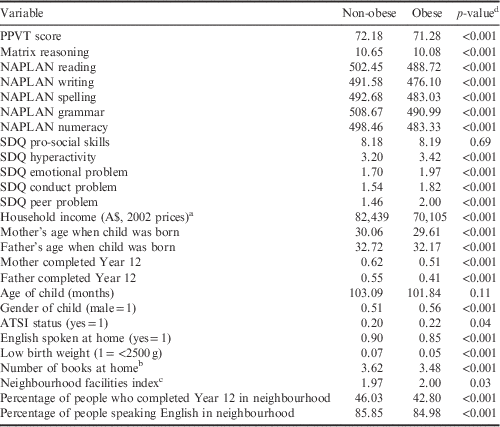
The descriptive statistics in Table 1 show that there were systematic differences between the characteristics of obese and non-obese children. In general, non-obese children achieved slightly higher NAPLAN test scores than obese children. Similarly, non-obese children had better behavioural characteristics than obese children. One exception was pro-social skills, for which there was little difference between obese and non-obese children. Among household characteristics, obese children lived in households with lower incomes and their parents spent slightly longer hours at work. The lower wage rate of obese children’s parents is probably due to their relatively lower level of education (i.e. a lower percentage having completed Year 12). Obese children were also more likely to live in single-parent households and less likely to speak English at home. In addition, obese children were more likely to live in neighbourhoods with poorer facilities, with a lower proportion of people with Year 12 education and a lower proportion speaking English. The only notable observation concerning children’s characteristics was that the obese group was more likely to include boys than girls.
Descriptive statistics of study sample for the five-wave period 2004–2012

a The study excluded 300 households with a total income of less than A$10,000 in the analysis because of possible errors. Basic transfers such as unemployment benefits can provide about A$10,000 per year to households.
b Categorical variable: 1=1–10 books; 2=11–20 books; 3=21–30 books; 4=more than 30 books.
c Average of the 4-point Likert scale (1=strongly agree, 4=strongly disagree) coded responses to questions about the ability to access affordable, regular public transport, basic shopping facilities and services such as banks, medical clinics, etc. in the neighbourhood.
d The t-test was used for continuous variables and the Kruskall–Wallis test was used for categorical variables.
ATSI: Aboriginal and Torres Strait Islander.
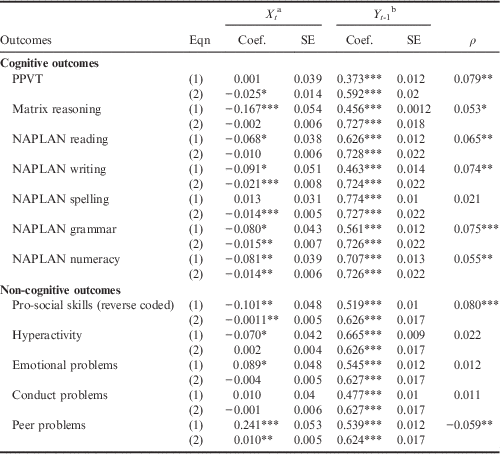
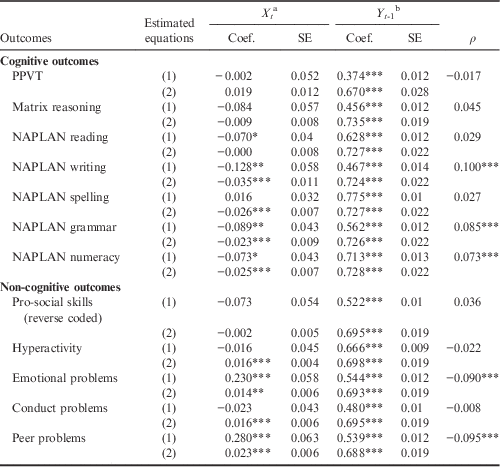
Results from the conditional mixed process estimator shown in Table 2 revealed that the inter-relationship between childhood obesity and school outcomes (PPVT, matrix reasoning and the NAPLAN test subjects) was mostly negative and significant. For example, obese children had lower NAPLAN numeracy test scores by 0.08 standard deviations (SDs), while a one SD improvement in numeracy test scores was associated with a 1.4 percentage point SD and a one SD improvement in numeracy test scores was associated with a 1.4 percentage point SD reduction in the probability that the child would be obese. (The study applied a linear probability model for Eqn (2) so that the parameters could be interpreted as marginal effects. A probit estimator gave similar results but parameters are not easily interpreted.) The correlation coefficient (ρ) revealed a significant association between the error terms in Eqns (1) and (2). Thus, estimating the two equations simultaneously as a system provided more reliable estimates. The positive sign of all lagged dependent variables was as expected and was statistically significant, showing the development of children in the current period was built upon progress in the past period. One added benefit of a dynamic specification was that it was possible to estimate the long-term effects of all parameters using a Taylor series approximation. In particular, the effects of observable factor X on school outcomes in the current period, as specified in Eqn (1), was β
3, its effects in the next period outcome were β
3×β
1, the effects in the subsequent period were
 $\beta _{3} {\times}\beta _{1}^{2} $
, and so on. Based on the Taylor series approximation, the long-term effect of factor X was
 ${{\beta _{3} } \over {1{\,\minus\,}\beta _{1} }}$
. Therefore, the long-term effect of childhood obesity on numeracy skills was a reduction of 0.28 SDs (i.e.
 ${{0.081} \over {1{\,\minus\,}0.707}}$
).
Obesity and school performance: main parameters
Parameters of other covariates are not reported for brevity but can be made available by the authors upon request.
a X t represents childhood obesity in Eqn (1) and school outcomes in Eqn (2).
b Y t-1 represents school outcomes in Eqn (1) and childhood obesity in Eqn (2).
***p<0.01; **p<0.05; *p<0.1.
However, the results were not consistent among the selected outcomes. For example, childhood obesity had no significant association with PPVT test scores but an increasing PPVT test score was associated with a 2.5 percentage point reduction in the probability of obesity, although the estimate was only significant at the 10% level. In contrast, obese children had lower matrix reasoning test scores by 1.7 SDs, although the reverse causation was not significant (i.e. improved matrix reasoning was not significantly associated with a lower probability of obesity). The inter-relationship between obesity and non-cognitive outcomes was also not consistent, with the exception of social problems (the study reverse-coded the pro-social score index so that it could be interpreted as ‘social problem’, to have a consistent interpretation with the remaining SDQ scores) and peer problems. In particular, obese children had lower social problem scores by 0.1 SDs, while the improvement of one SD in the social problem scores was associated with a 1.1 percentage point reduction in the probability of being obese. This finding was surprising given it could be expected that obese children would be more likely to have problems with social skills, for example, due to a higher probability of being bullied or discriminated against. Obese children had higher scores (by 0.24 SDs) in terms of having problems with their peers and, in a reverse equation, an increase of one SD in peer problem scores was associated with an increase in the probability of obesity by one percentage point. Obese children were less likely to be hyperactive (by 0.07 SDs) and more likely to have emotional problems (by 0.09 SDs), but these parameters were only significant at the 10% level. The correlation coefficient (ρ) showed no significant correlation between error terms in Eqns (1) and (2) for hyperactivity, emotional problems and conduct problems, suggesting that estimating the two equations as a system provided no additional benefits for these outcomes.
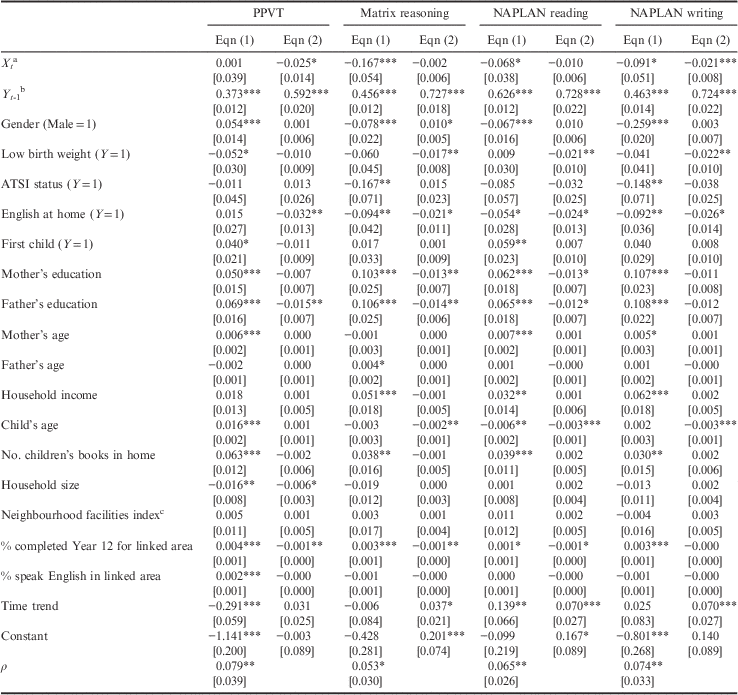
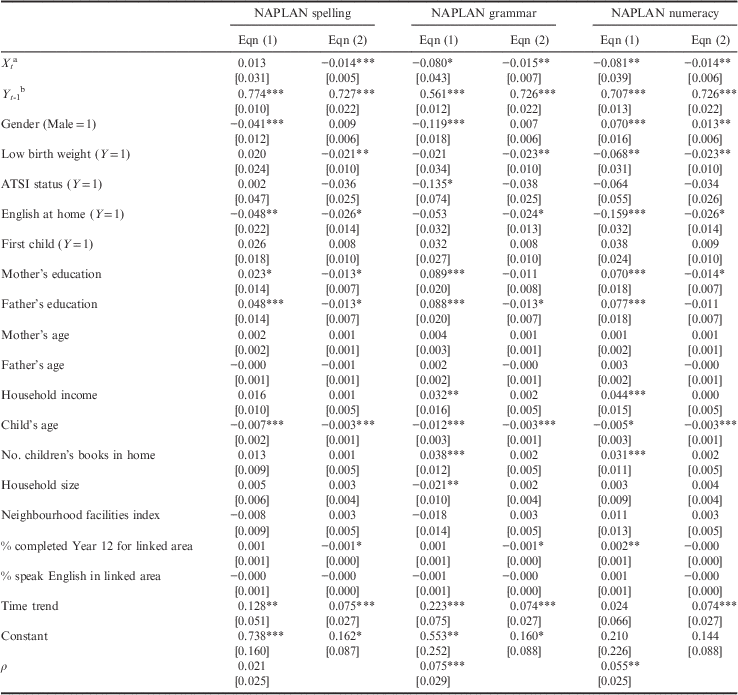
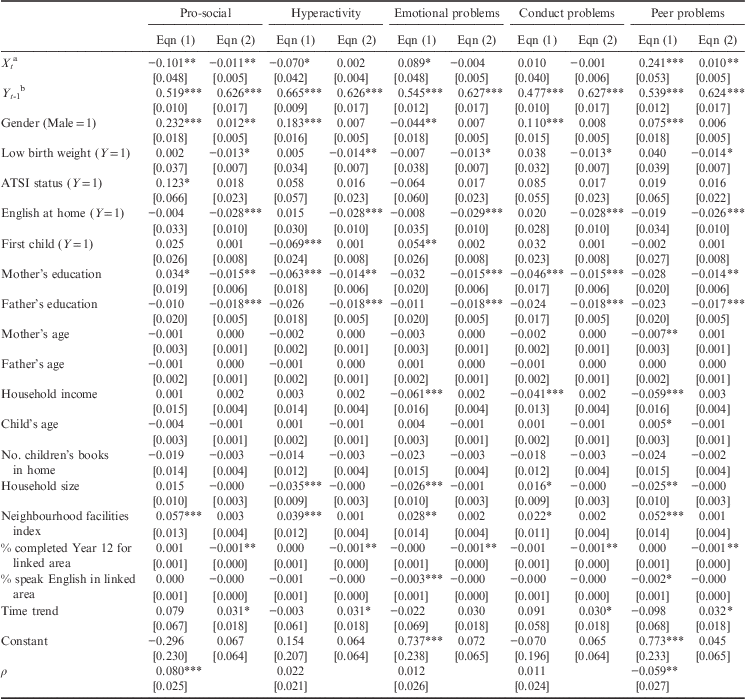
Among the remaining parameters, significant determinants of school outcomes and childhood obesity were gender, whether English was spoken at home, parental education, household income, the number of children’s books in home, the age of the child and the percentage of people who had completed Year 12 in the neighbourhood (see Tables 3, 4 and 5). In particular, it was found that boys achieved higher scores in PPVT (by 0.05 SDs) and numeracy (by 0.07 SDs) but they performed worse than girls in matrix reasoning (by 0.08 SDs), reading (by 0.07 SDs), writing (by 0.26 SDs), spelling (by 0.04 SDs) and grammar (by 0.12 SDs). Boys were also more likely to have problems with social skills (by 0.23 SDs), hyperactivity (by 0.18 SDs), interaction with peers (by 0.7 SDs) and general conduct (by 0.11 SDs). However, boys were less likely to have emotional problems (by 0.04 SDs).
Results of the conditional mixed process estimator for cognitive outcomes: PPVT, matrix reasoning, reading and writing

Robust standard errors are in brackets.
a X t represents child obesity in Eqn (1) and school outcomes in Eqn (2).
b Y t-1 represents school outcomes in Eqn (1) and child obesity in Eqn (2).
c The neighbourhood facility index is defined as the average of 4-point Likert scale (1=strongly agree, 4=strongly disagree) questions about the ability to access affordable, regular public transport, basic shopping facilities, and services such as banks, medical clinics, etc. in the neighbourhood.
ATSI: Aboriginal and Torres Strait Islander.
***p<0.01; **p<0.05; *p<0.1.
Results of the conditional mixed process estimator for cognitive outcomes: spelling, grammar and numeracy

Robust standard errors are in brackets.
a X t represents child obesity in Eqn (1) and school outcomes in Eqn (2).
b Y t-1 represents school outcomes in Eqn (1) and child obesity in Eqn (2).
ATSI: Aboriginal and Torres Strait Islander.
***p<0.01; **p<0.05; *p<0.1.
Results of the conditional mixed process estimator for non-cognitive outcomes

Robust standard errors are in brackets.
a X t represents child obesity in Eqn (1) and school outcomes in Eqn (2).
b Y t-1 represents school outcomes in Eqn (1) and child obesity in Eqn (2).
ATSI: Aboriginal and Torres Strait Islander.
***p<0.01; **p<0.05; *p<0.1.
Children of mothers or fathers who had completed Year 12 of schooling had significantly higher cognitive outcomes and were less likely to have behavioural problems. For example, children of a mother who had completed Year 12 education, had higher scores in PPVT (0.05 SDs), matrix reasoning (0.1 SDs), reading (0.06 SDs), writing (0.11 SDs), spelling (0.02 SDs) grammar (0.09 SDs) and numeracy (0.07 SDs). They also had lower scores in all non-cognitive measures, with the exception of social skills. Children of a mother with Year 12 education had a 0.03 SD higher score for poor social skills, but this parameter was only significant at the 10% level. An increase in household income by one SD was associated with an increase of test scores in matrix reasoning, reading, writing, grammar and numeracy by 0.05, 0.03, 0.03 and 0.04 SDs, respectively. Students also had lower scores in emotional problems, conduct problems and peer problems by 0.06, 0.04 and 0.06 SDs, respectively when household income increased by one SD. The number of books at home was positively associated with cognitive outcomes with a marginal effect from 0.03 to 0.06 SDs, but the association with non-cognitive outcomes was not significant. Children in areas with a higher proportion of people having completed Year 12 had higher scores in PPVT, matrix reasoning, reading, writing and numeracy, with a modest magnitude from 0.001 to 0.004 SDs. They also had lower scores in behavioural problems, with the small marginal effect of 0.001 SDs.
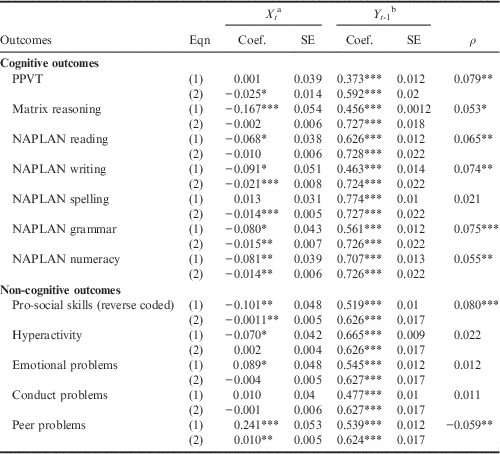
For sensitivity analysis, self-reported obesity status was chosen to measure childhood obesity. The results of the main parameters, presented in Table 6, showed a similar outcome. In particular, childhood obesity and cognitive outcomes were negatively associated in both directions, but the statistical significance of the inter-relationship was only found for writing, grammar and numeracy. Similarly, obese children had a significantly higher chance of having emotional and peer problems. For example, obese children had higher scores for emotional problems by 0.23 SDs. In the reverse direction, an increase in the emotional problems score by one SD was associated with an increase in the probability of being obese by 1.4 percentage points. Parameters of the lagged dependent variables were also significant in both equations and across all selected outcomes.
Sensitivity analysis for self-reported obesity status: main parameters

Parameters of other covariates are not reported for brevity but can be made available by the authors upon request.
a X t represents child obesity in Eqn (1) and school outcomes in Eqn (2).
b Y t-1 represents school outcomes in Eqn (1) and child obesity in Eqn (2).
***p<0.01; **p<0.05; *p<0.1.
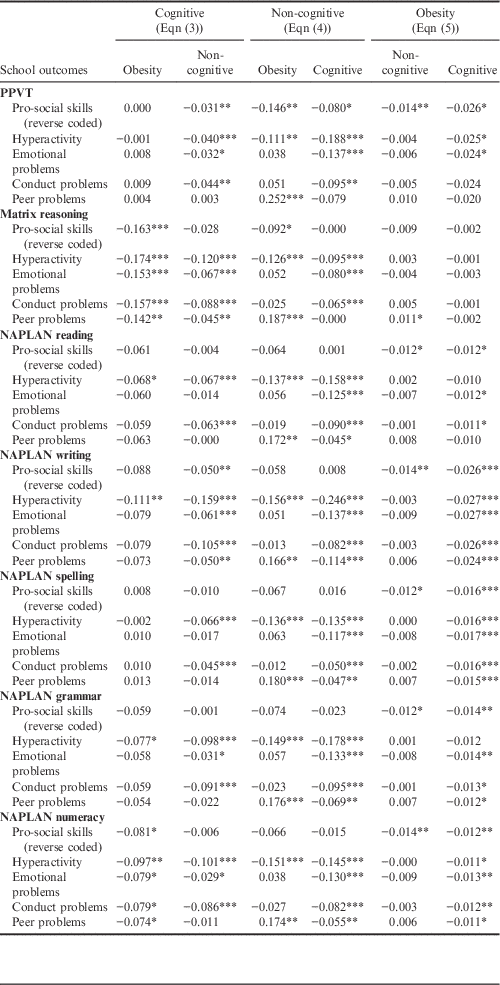
Table 7 presents the results of the three-equation estimates, which explored the dynamic tri-directional relationship between obesity status, cognitive skills and non-cognitive skills. The findings were consistent with the main results, which showed that PPVT was not significantly affected by obesity, but was negatively affected by poor social skills. hyperactivity and problems with general conduct and emotion (but note that the pro-social skills were reversely coded in the analysis and hence these parameters should be interpreted as lack of, or poor, social skills). This means that children with good social skills (i.e. those less likely to have poor social skills), less hyperactivity and who had fewer problems with their general conduct and emotions, were associated with higher PPVT scores. Results for Eqn (4) showed that obese children exhibited a lower chance of having poorer social skills (by 0.146 SDs) and being hyperactive (by 0.111 SDs) but were more likely to have problems with peers (by 0.252 SDs). Also, despite obesity being not significantly associated with PPVT, the reverse direction was significant at the 10% level. Thus, one SD improvement in PPVT scores was associated with a lower probability of being obese by 2.6 percentage points. Consistent with the results shown in Table 2, the three-equation parameters also showed that obesity had little or no significant effect on reading, spelling and grammar. However, this estimator revealed the additional information that higher cognitive outcomes were significantly associated with a lower probability of having behavioural problems. Overall, the results showed that childhood obesity had little or no significant association with poor cognitive skills, with the exception of matrix reasoning. However, obesity was associated significantly with poor behavioural skills. In the reverse direction, non-cognitive skills were also most significantly associated with childhood obesity.
The dynamic tri-directional relationship between obesity status, cognitive and non-cognitive skills

Parameters of other covariates and standard errors are not reported for brevity but can be made available by the authors upon request.
***p<0.01; **p<0.05; *p<0.1.
Discussion
This study is, to the authors’ knowledge, the first to examine the interaction between obesity and cognitive and non-cognitive school outcomes in Australia, using the first five waves of the Longitudinal Study of Australian Children. The study adopted a dynamic specification using the simultaneous equation modelling approach to capture both the inter-temporal and inter-relational aspects of the interaction between obesity and school performance. The empirical results show that obesity status generally has a significant effect on most school outcomes, and that school outcomes also affect obesity. The findings show the strong effects of past learning on school outcomes in various indicators, giving support for early rather than remedial interventions. Another important finding is that obese children face problems with non-cognitive outcomes (e.g. problems with their peers), which has a significant impact on cognitive outcomes. The results are robust in terms of choice of estimators and choice of obesity indicators (either BMI or self-reported).
In addition to providing a new and more reliable set of empirical findings in the Australian context, the results have several new policy and intervention implications. First, attention needs to be given to obese children from the beginning of their school lives, as learning outcomes in early school years are likely to affect learning outcomes in future school years. This implication is consistent with the findings of Heckman (Reference Heckman2006), Cunha and Heckman (Reference Cunha and Heckman2007, Reference Cunha and Heckman2008) and Cunha et al. (Reference Cunha, Heckman and Schennach2010), that early interventions targeted at disadvantaged children had much higher returns than later interventions, such as reduced pupil–teacher ratios, public service training, criminal rehabilitation programmes, tuition subsidies or expenditure on police. Second, attention should be given to addressing a variety of behavioural problems of overweight and obese children. That is, the empirical results provided consistent evidence that these problems have negative impacts on cognitive performance. Third, children, teachers or educational instructors, as well as parents and communities, should be aware that obese children have a higher chance of facing peer problems. In particular, overweight and obese children are more likely to be bullied than those who are not, which is consistent with the findings of similar previous studies (see, for example, Van Geel et al., Reference Van Geel, Vedder and Tanilon2014; Puhl et al., Reference Puhl, Latner, O’Brien, Luedicke, Forhan and Danielsdottir2015).
These results have a number of policy implications. Notably, policies should be directed to helping obese children from the beginning of their school lives. Children, teachers, parents and communities should be more aware of the strong association between being obese and being bullied.
Acknowledgments
The authors acknowledge the support of the QUT library and the Institute of Family Studies in providing the dataset for this study. They thank the anonymous reviewers for their valuable comments.
Ethical Approval. The research used a secondary de-identified data set. The authors assert that all procedures contributing to this work comply with the ethical standards of the relevant national and institutional committees on human experimentation and with the Helsinki Declaration of 1975, as revised in 2008.
Conflicts of Interest. The authors have no conflicts of interest to declare.
Funding. This research received no specific grant from any funding agency, commercial entity or not-for-profit organization.