INTRODUCTION
In wheat (Triticum aestivum L.), starch is a major component of grain yield, accounting for 0·65–0·75 of the final dry weight of the grain (Hurkman et al. Reference Hurkman, McCue, Altenbach, Korn, Tanaka, Kothari, Johnson, Bechtel, Wilson, Anderson and Dupont2003), and an important factor affecting the processing quality of wheat. Therefore, a better understanding of the mechanism for starch accumulation and its variation would be helpful both to improve processing quality and to promote grain yield in wheat. Extensive studies have been carried out on starch synthesis in wheat leaves and grains. It has been reported that the enzymes involved in starch synthesis, including sucrose phosphate synthase (SPS; EC 2.4.2.14), sucrose synthase (SuSy; EC 2.4.1.13), ADP-glucose pyrophosphorylase (AGPase; EC 2.7.7.27), soluble starch synthase and granule-bound starch synthase (SSS and GBSS; EC 2.4.1.21) and starch branching enzyme (SBE; EC 2.4.1.18) play key roles in starch synthesis and accumulation in wheat grain (Okita Reference Okita1992; Baroja-Fernández et al. Reference Baroja-Fernández, Muñoz, Saikusa, Rodríguez-López, Akazawa and Pozueta-Romero2003; Emes et al. Reference Emes, Bowsher, Hedley, Burrell, Scrase-Field and Tetlow2003; Yang et al. Reference Yang, Zhang, Wang, Xu and Zhu2004). Studies have revealed that activities of enzymes involved in starch synthesis in wheat are both developmentally and environmentally determined (Jenner et al. Reference Jenner, Ugalde and Aspinall1991). Ercoli et al. (Reference Ercoli, Lulli, Mariotti, Masoni and Arduini2008) showed that grain yield and dry matter and N accumulation and remobilization were reduced by water stress during grain filling. Activities of SSS, GBSS and SBE in winter wheat grains reached a maximum at the mid grain-filling stage, decreased significantly under moderate or severe drought stress, but were maintained at a high level under optimum water status (Xu et al. Reference Xu, Yu and Zhang2003). The starch from wheat grown under water stress conditions showed lower amylose and lipid content, lower pasting temperature and higher peak viscosity, final viscosity and setback at 15 days after anthesis (DAA) (Singh et al. Reference Singh, Singh, Singh and Singh2008). The amount of post-anthesis assimilates transferring into the grain decreased considerably under drought, while the remobilization of pre-anthesis stored nitrogen and the transferring of post-anthesis accumulated nitrogen into the grain declined significantly with waterlogging, which led to differences in the protein and starch contents of wheat grains. Both drought and waterlogging decreased the activities of GBSS and, especially, SSS (Xie et al. Reference Xie, Jiang, Cao, Dai and Jing2003). Ahmadi & Baker (Reference Ahmadi and Baker2001) reported that reduction in grain growth rate of water-stressed wheat plants resulted from decreased SSS activity, whereas growth cessation is due mainly to the inactivation of AGPase.
In recent years, frequent soil water stress in the north of China has influenced both the dry matter production and the grain formation of wheat (Ma et al. Reference Ma, Jia, Zhang, Zhang, Yao and Yang2007). Wang et al. (Reference Wang, Zhang, Yang and Zhu2004) showed that moderate water deficit promoted the senescence process and the reallocation of carbohydrate from the stems to grains, shortened the grain-filling period, and increased grain-filling rate and starch accumulation rate (SAR) in the grains. A controlled water stress imposed during the grain-filling period of wheat and rice can enhance remobilization of pre-stored carbon reserves to grains and accelerate grain filling (Yang et al. Reference Yang, Zhang, Wang, Xu and Zhu2004). Many results in wheat production have shown that water-saving irrigation did not significantly reduce wheat yields, and might enhance water use efficiency. However, little is known about how the starch accumulation and activities of related enzymes in grains would respond to different irrigation patterns. The objective of the present study was to investigate any differences that may be found in starch accumulation of wheat cultivars field-grown in irrigated and rainfed conditions. The activities of SuSy, AGPase, SSS, GBSS and SBE in relation to starch accumulation in two wheat cultivars were therefore investigated.
MATERIALS AND METHODS
Agronomy and experimental design
Two winter wheat (T. aestivum L.) cultivars, BY535 (starch content 695 g/kg) and JM20 (starch content 635 g/kg), were used in the experiment.
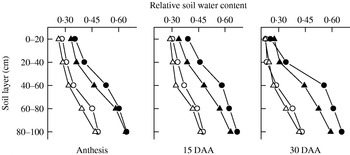
The experiment was carried out under irrigated and rainfed conditions at Tai'an (36°09′N, 117°09′E; 128 m asl) and Dezhou (37°30′N, 116°19′E; 21 m asl), P. R. China, respectively, in the 2004/05 growing season. In Tai'an, the 0–200 mm soil layer contained 71·5 mg/kg available nitrogen, 12·5 mg/kg available phosphate and 80·5 mg/kg available potassium. In Dezhou, available nitrogen, phosphate and potassium levels were 62, 8·5 and 122·5 mg/kg, respectively. Before planting, fertilizer was applied at 6 kg/m2 farmyard manure, 11·2 g/m2 N, 12 g/m2 P2O5 and 11·2 g/m2 K2O. N (11·2 g/m2) was top-dressed at the stem elongation stage (GS 31; Zadocs et al. Reference Zadocks, Chang and Konzak1974). Two contrasting water regimes (irrigated and rainfed) were used at both experimental sites. The irrigated treatment received three irrigations with the total water amount of 2250 m3/ha during the whole growth period (750 m3/ha each at before sowing, pre-wintering and jointing stages, respectively), while the rainfed treatment had no irrigations. The total rainfall during the wheat-growing period was 201 and 92·2 mm in Tai'an and Dezhou, respectively. The moisture content in the soil after anthesis is shown in Fig. 1. The experiment was a 2×2 (two cultivars, two levels of soil moisture) factorial design with four treatments. Each of the treatments had three plots as replicates in a completely randomized block design. Plot dimensions were 3 m×3 m. Plants were sown on 6 and 15 October 2004 in Tai'an and Dezhou, respectively, at a density of 180 seeds/m2. Normal crop farming practices (Jin Reference Jin1996) were implemented to minimize pest, disease and weed incidence.
The relative soil water content after anthesis in two sites (▴, irrigated in Dezhou; •, irrigated in Tai'an; ▵, rainfed in Dezhou; ○, rainfed in Tai'an).

Plant sampling
Spikes that flowered on the same day were labelled with thread. From 7 DAA (0·5 of spikelets exserted anthers), plants were sampled at 7-day intervals till maturity. Flag leaves and grains in the middle spikelets of selected ears were detached. Flag leaves and half of the sampled grains were frozen in liquid nitrogen for 2 min and then stored at −40°C until assayed for enzyme activities. The remainder of the grains were dried to constant weight at 80°C for measurement of grain weight and starch content.
Determination of amylose and amylopectin contents
Amylose and amylopectin contents in wheat grains were determined with a coupled spectrophotometer assay (Jiang et al. Reference Jiang, Cao, Dai and Jing2003). For the determination, 100 mg of milled grains were stirred with 10 ml of 0·5 m KOH for 30 min at 90°C and then diluted to a volume of 50 ml with distilled water. From this, 2·5 ml was removed to a fresh tube containing 20 ml distilled water. This solution was adjusted to pH 3·5 with 0·1 m HCl and 500 μl of I2-KI reagent added. Finally, this solution was diluted to a final volume of 50 ml with distilled water. After standing for 20 min, the mixture's absorbance was measured with a TU-1901 spectrophotometer at 473, 554, 633 and 741 nm.
Enzyme extraction and assays
The preparation of enzyme extract was similar to the method of Nakamura et al. (Reference Nakamura, Yuki, Park and Ohya1989). All enzyme assays were optimized for pH and substrate concentration and were shown to be within the linear phase with respect to incubation time and protein concentration. During assay, the background value of each sample was determined by adding the same volume of denatured enzyme extract.
The enzyme activities were determined as described previously: SPS and SuSy (Doehlert et al. Reference Doehlert, Kuo and Felker1988; Wardlaw & Willenbrink Reference Wardlaw and Willenbrink1994), AGPase, SSS and GBSS (Nakamura et al. Reference Nakamura, Yuki, Park and Ohya1989) and SBE (Li et al. Reference Li, Shen, Chen and Luo1997).
Statistical analysis
All measurements were replicated and data were analysed for variance using the SAS statistical analysis package (version 8.0; SAS Institute, Cary, NC). Data from each sampling date were analysed separately.
RESULTS
Accumulation of amylose and amylopectin in single grain
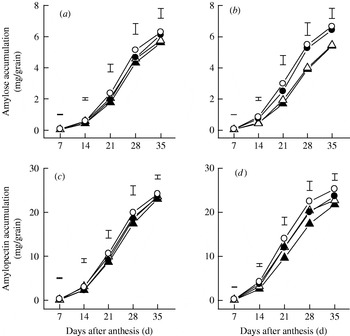
The accumulation of both amylose and amylopectin in grains in two cultivars showed an increase in both irrigated and rainfed conditions at the two experimental sites (Fig. 2). With the process of grain filling, the accumulation of amylose and amylopectin increased rapidly and reached a maximum at 35 DAA. Water deficit had a great effect on starch accumulation. Higher accumulation of both amylose and amylopectin in grains was observed in the cultivars grown under water deficit compared with those grown under irrigation, suggesting that drought was responsible for higher accumulation of starch in grains.
Amylose and amylopectin accumulations in grains of wheat grown in Tai'an (a, c) and Dezhou (b, d) experimental sites (▴, irrigated JM20; •, irrigated BY535; ▵, rainfed JM20; ○, rainfed BY535). Vertical bars indicate 1 s.e.

SAR
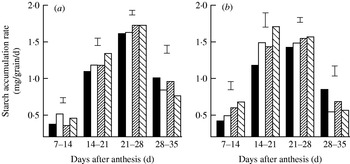
The SAR in both cultivars followed a similar pattern under both irrigated and rainfed conditions. It rose gradually and then declined after reaching a maximum, yet the peak value and the peak-occurring time were different (Fig. 3). The peak value of SAR under the two planting conditions in the Tai'an experimental site occurred at 21–28 DAA, whereas that under irrigated and rainfed conditions in the Dezhou experimental site occurred at 14–21 DAA and 21–28 DAA, respectively. Compared with irrigated plants, SAR was enhanced (averaging 20 % higher) at 7–21 DAA and was reduced (averaging 22 % lower) at 28–35 DAA in plants of both cultivars subjected to soil water deficit. This suggests that rainfed conditions are more beneficial for starch accumulation at early filling stage and disadvantageous at late-filling stage.
SAR in grains of wheat grown in Tai'an (a) and Dezhou (b) experimental sites (▪, irrigated JM20; □, rainfed JM20;  , irrigated BY535;
 , rainfed BY535). Vertical bars indicate 1 s.e.

SPS activity and sucrose content in flag leaves
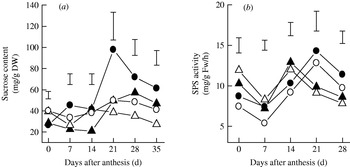
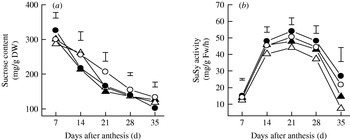
The SPS activities in two cultivars showed the same pattern under both irrigated and rainfed conditions (Fig. 4b). With the rainfed treatment, SPS activity in JM20 was higher at anthesis and 7 DAA, and then declined gradually to values lower than those in irrigated treatment after 14 DAA, whereas the SPS activity in BY535 was lower than those in irrigated treatment throughout the whole grain-filling period. The results suggest that water deficit is detrimental to SPS activities in flag leaves during the grain-filling stage.
Sucrose content (a) and SPS activity (b) in flag leaves of wheat grown in Tai'an experimental site (▴, irrigated JM20; •, irrigated BY535; ▵, rainfed JM20; ○, rainfed BY535). Vertical bars indicate 1 s.e.

The sucrose content in flag leaves exhibited a similar tendency to SPS activities after anthesis (Fig. 4a). Compared with irrigated plants, the sucrose content in rainfed JM20 significantly increased at early filling stage (0–14 DAA) and decreased at late-filling stage (21–35 DAA), respectively; whereas the sucrose content in BY535 under rainfed conditions was significantly lower than that under irrigated conditions from 7 DAA. These results suggest that water deficit enhances the capacity of plants to provide sucrose during early grain filling and reduces it at late grain filling; however, irrigated conditions markedly improved the ability during mid and late grain filling, especially in BY535.
SuSy activity and sucrose content in grains
The SuSy activities in grains of two cultivars exhibited single-peak curves during grain filling, with the highest peak value occurring at 21 DAA (Fig. 5b). During the early filling period (7–14 DAA), the SuSy activities in grains decreased by 8 % in the rainfed treatment than in the irrigated treatment, yet the former were 17 % lower than the latter during mid- and late-filling period (21–35 DAA). These results suggest that water deficit decreased the capacity of plants to break down and take up sucrose, especially during mid to late grain filling.
Sucrose content (a) and SuSy activity (b) in grains of wheat grown in Tai'an experimental site (▴, irrigated JM20; •, irrigated BY535; ▵, rainfed JM20; ○, rainfed BY535). Vertical bars indicate 1 s.e.

The sucrose content in grains of the two cultivars decreased almost linearly during grain filling under irrigated and rainfed conditions, with the maximum occurring at 7 DAA (Fig. 5a). Water deficit led to enhanced sucrose content in grains of the two cultivars at 14–35 DAA (increased by 14 %), indicating that rainfed conditions could ensure the assimilate supply for grain filling.
Activities of enzymes related to starch synthesis
AGPase activity
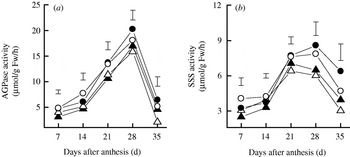
The AGPase activity in grains of both cultivars showed single peak curves with peaks at 28 DAA under irrigated and rainfed conditions (Fig. 6a). In comparison with irrigated conditions, AGPase activity in both cultivars under rainfed conditions were higher before 21 DAA and decreased rapidly after 28 DAA. The results indicate that water deficit contributed to the enhancement of AGPase activity during early grain filling, whereas water supply increased AGPase activity significantly during late grain filling.
AGPase (a) and SSS (b) activities in grains of wheat grown in Tai'an experimental site (▴, irrigated JM20; •, irrigated BY535; ▵, rainfed JM20; ○, rainfed BY535). Vertical bars indicate 1 s.e.

SSS and GBSS activity
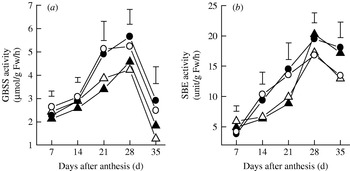
During grain filling, both SSS and GBSS activities examined in the two cultivars presented single peak curves, while their maximum peak value were different between the two cultivars (Figs 6b and 7a). Compared with the irrigated treatment, the SSS and GBSS activities were higher before 14 DAA and declined significantly at the late grain-filling stage under rainfed conditions, indicating that drought was responsible for higher starch accumulation at early grain filling, whereas irrigation was more beneficial to the accumulation of starch at late grain filling.
GBSS (a) and SBE (b) activities in grains of wheat grown in Tai'an experimental site (▴, irrigated JM20; •, irrigated BY535; ▵, rainfed JM20; ○, rainfed BY535). Vertical bars indicate 1 s.e.

SBE activity
Under both irrigated and rainfed conditions, the SBE activity in the grains of two cultivars exhibited single peak curves with peaks at 28 DAA (Fig. 7b), which responded differently to water supply. Compared with the irrigated treatment, the SBE activity in the two cultivars increased by 11 % and decreased by 20 % during early (before 21 DAA) and late (after 21 DAA) grain-filling stage, respectively, under rainfed conditions. This implies that irrigation may benefit the SBE activity during late-filling period, yet the rainfed conditions increase SBE activity during early filling period.
DISCUSSION
The present results, in agreement with previous reports, revealed that the activities of enzymes involved in starch synthesis were enhanced by water deficit and that the effect of soil water status on the activities of enzymes varied with grain-filling stage. The rainfed conditions led to increases and decreases during early and late grain-filling period in activities of SuSy, AGPase, SSS and SBE, respectively, in good agreement with the SAR in grains (Xie et al. Reference Xie, Jiang, Cao, Dai and Jing2003). Furthermore, the present study showed that the lower sucrose content in grains was associated with the higher activities of SuSy, AGPase, SSS and SBE at the early grain-filling stage under rainfed conditions, indicating that both a faster sucrose transformation rate and a higher SAR occurred during early grain filling; however, the SAR and activities of starch synthesis related enzymes in wheat grains under rainfed conditions were obviously lower than those under irrigated conditions during the late grain-filling period. Based on the experimental results, the reason probably lies in the physiological restriction of sink activity at this stage under rainfed conditions. Therefore, it is believed that the physiological mechanism for the lower SAR in rainfed wheat grains during the late period is the reduced activities of enzymes involved in starch synthesis.
It has been documented that the activities of enzymes involved in starch synthesis in weak-gluten wheat are generally higher than those in strong-gluten wheat during the grain-filling period, which is responsible for the higher starch content in weak-gluten wheat grains (Yan et al. Reference Yan, Wang, Dai, Li, Fu, He and Yin2007). Furthermore, the present study implied that the effect of soil water status on the activities of enzymes varied with cultivars. In rainfed treatment, the activities of SSS and GBSS in JM20 (strong-gluten) declined rapidly and were obviously lower than those in irrigated treatment during late grain filling, whereas those in BY535 (weak-gluten) were slightly reduced, suggesting that the two gluten type cultivars responded to soil dryness differently in terms of starch accumulation. The activities of enzymes in strong-gluten wheat tended to be more susceptible to water deficit than those in weak-gluten wheat.
In the present study, both sucrose content and the activity of SPS in flag leaves were substantially reduced under rainfed condition, especially during the late grain-filling period, indicating that photosynthate produced in flag leaves was influenced by water deficit; however, the sucrose content in grains still remained at a higher level under rainfed conditions, showing that the reduction of photosynthate produced in flag leaves was not the limiting factor for starch accumulation in grains, which was similar to previous studies (Zhang et al. Reference Zhang, Wang, Wang and Zhao2003; Fischer Reference Fischer2007). This is probably attributable to the following reasons. The starch accumulation in wheat grains depends on carbohydrate from two resources: current assimilation in the leaves and ear after anthesis, and remobilization of nonstructural carbohydrate stored in vegetative tissues (mainly the stem and sheath) either pre-anthesis or during initial grain filling. The amount of photosynthate relies on photosynthesis area and rate of both leaves and non-leaf organs. After anthesis, the photosynthesis area and rate of leaves are obviously reduced by soil water deficit, especially during the late grain-filling period. As a result, non-leaf organs became the main photosynthetic source for grain filling and the decline of photosynthetic capacity in flag leaf had little influence on grain. However, pre-anthesis assimilate reserves in the stem and sheath of wheat contribute 8–27 % of the final grain weight. A mild water deficit during grain filling would be beneficial to the grain filling by enhancing remobilization of stored reserves from the stems to grains (Gebbing & Schnyder Reference Gebbing and Schnyder1999). Hence, the allocation of photosynthate to grains and the starch accumulation in grains are to a great extent determined by sink strength. The higher metabolic activity in wheat grains would benefit both the allocation of photosynthate to grains and the formation of starch granules (Fisher & Gifford Reference Fisher and Gifford1986; Wang et al. Reference Wang, Yin, He and Cao1998).
This research was supported by the National Natural Science Foundation of China (30270781, 30571099), the National Basic Research Program of China (973 Program 2009CB118602), the Scientific Research Fund of Dezhou College (07rc009) and the Scientific Research Development Program of Education Department of Shandong Province (J08LF52).