Introduction
Child marriage is a global problem affecting millions of adolescent girls in Africa and Asia. Economic insecurity and poverty are commonly viewed as the primary determinants of child marriage. The top ten global hotspots for child marriage – Niger, Central African Republic, Chad, Burkina Faso, Bangladesh, Guinea, South Sudan, Mozambique, Mali and India – are low-income countries with high poverty rates. However, all of these countries are also severely challenged by climate change (Carrington, Reference Carrington2011). Landlocked African hotspots such as Burkina Faso, Niger, Chad, Central African Republic, Mali and South Sudan face declining rainfall and increased risks of droughts resulting from changing climate conditions while coastal Mozambique and Guinea both face the additional risk of tropical storms. Two South Asian hotspots, Bangladesh and India, account for more than a quarter of the girl population at risk of early marriage. Coastal regions in both countries remain severely vulnerable to rising sea levels and displacement. A quarter of the world population live within 100 km of the coast and two-thirds of the disasters experienced by this population each year are related to extreme weather events (Adger et al., Reference Adger, Hughes, Folke, Carpenter and Rockström2005). Yet the connection between climate vulnerabilities and child marriage in coastal areas is not well-documented.
In general, women and children are considered to be the worst victims of climate change and natural disasters (Lambrou & Piana, Reference Lambrou and Piana2006; Neumayer & Plümper, Reference Neumayer and Plümper2007; Terry, Reference Terry2009; Rabbani et al., Reference Rabbani, Rahman and Mainuddin2009; Alam & Collins, Reference Alam and Collins2010; Rahman, Reference Rahman2013). Children are particularly exposed to climate change, not only because of their physical vulnerability to natural disasters, but also because of indirect effects arising from conflict, economic displacement, undernutrition and migration (Hilleboe et al., Reference Hilleboe, Sterrett and Turnball2013; Currie & Deschênes, Reference Currie and Deschênes2016). In the case of female adolescents, such vulnerabilities can manifest themselves in terms of poor marriage market outcomes, which have life-long consequences. According to international media reports, climate change is turning a generation of young girls in Africa into child brides. In countries such as Malawi and Mozambique, up to 40% of child marriages are due to the floods and droughts caused by climate change (Chamberlain, Reference Chamberlain2017). Similar anecdotal evidence is also emerging for Bangladesh (Jha, Reference Jha2016).
The incidence of natural disasters increases household’s vulnerability to poverty and often leads to loss of family welfare (Skoufias, Reference Skoufias2003; Khandker, Reference Khandker2007; Alam & Collins, Reference Alam and Collins2010). Nevertheless, the ability to cope with disasters is often constrained by localized social norms and practices (Paul, Reference Paul1998; Rashid & Michaud, Reference Rashid and Michaud2000; Mottaleb et al., Reference Mottaleb, Mohanty and Mishra2015; Rahman, Reference Rahman2013; Alam & Rahman, Reference Alam and Rahman2014). In climate-vulnerable African countries with the custom of bride price, marrying off one’s daughter to an older man brings extra cash. In climate-vulnerable South Asian countries with the custom of dowry, early marriage of a female member can help save on additional dowry costs associated with marriage at an older age. In other words, marriage of under-aged girls can be a (mal-)adaptation strategy adopted by the family in response to the increased economic hardship caused by natural disasters and climate shocks. Therefore, the popular perception is that humanitarian crises and natural disasters push adolescent girls into forced marriages (Felten-Bierman, Reference Felten-Biermann2006; Lemmon & Elharake, Reference Lemmon and ElHarake2014; Tong, Reference Tong2015).
For Bangladesh, studies have associated the origin of child marriage with poverty and dowry (Gairbo & Imam, Reference Geirbo and Imam2006; Schuler et al., Reference Schuler, Bates, Islam and Islam2006; Chowdhury, Reference Chowdhury2010), family honour/dignity (Chowdhury, Reference Chowdhury2004; Schuler et al., Reference Schuler, Bates, Islam and Islam2006), early onset of menarche (Field & Ambrus, Reference Field and Ambrus2008; HRW, 2015; Asadullah & Wahhaj, Reference Asadullah and Wahhaj2019), lack of female education and employment (Jensen & Thornton, Reference Jensen and Thornton2003; UNFPA, 2012) and inter-generational effects (i.e. parental education and marriage timing) (Bates et al., Reference Bates, Maselko and Schuler2007). By contrast, environmental factors such as climate change have received almost no attention as a correlate of child marriage in these studies (see Chowdhury, Reference Chowdhury2004, Reference Chowdhury2010; Geirbo & Imam, Reference Geirbo and Imam2006; Schuler et al., Reference Schuler, Bates, Islam and Islam2006; Field & Ambrus, Reference Field and Ambrus2008). Equally, recent economic research on the impact of natural disasters and weather shocks in Bangladesh and other developing countries has been limited to outcomes such as agricultural productivity, food security, household income, expenditure, asset and labour market participation and outcomes (e.g. see Akresh, Reference Akresh2016; Mahajan Reference Mahajan2017; Chanana-Nag & Aggarwal, Reference Chanana-Nag and Aggarwal2020; Smith & Frankenberger, Reference Smith and Frankenberger2018; Karim, Reference Karim2018). Two exceptions are Hoogeveen et al. (Reference Hoogeveen, van der Klaauw and van Lomwel2011) and Corno et al. (Reference Corno, Hildebrandt and Voena2020), which suggested that climate factors interact with local cultural norms in varied manners and that the potential impact on child marriage is context specific.
The main objective of this study was to examine the correlation between natural disasters and child marriage, which has hitherto received limited attention in quantitative studies. That was done by profiling female victims of child marriage in disaster-prone coastal areas of Bangladesh where gender relations and family decisions are likely to be shaped by the experience of climate-related disasters. The analysis was based on a mixed-method approach; for recent studies on child marriage following a similar approach, see Alston et al. (Reference Alston, Whittenbury, Haynes and Godden2014) and John et al. (Reference John, Edmeades and Murithi2019). The primary source of data was in-depth qualitative interviews of women who married before the age of 18 years. The sample was drawn from eight villages located in four coastal districts in south-western Bangladesh. This was complemented by focus group discussions in sample villages. Representative quantitative data on women in sample villages were collected independently as part of a nationwide quantitative survey on women – the 2014 WiLCAS (Women’s Life Choices and Attitudes Survey).
Gendered impact of climate change
While there are many studies documenting the impact of climate- and weather-related changes on agricultural output, labour productivity, health, conflict and economic growth (Tol, Reference Tol2009, Reference Tol2018; Dell et al., Reference Dell, Benjamin and Benjamin2014), relatively less is known about the gendered impact of climate change on children and adolescents (e.g. Sellers, Reference Sellers2016). One study by Maccini and Yang (Reference Maccini and Yang2009) found that favourable weather conditions (e.g. higher rainfall during childhood) leads to better health among women in adulthood, while Miguel (Reference Miguel2005) found that extreme rainfall events in Tanzania increased the incidence of ‘witch’ murders (in particular of elderly women) confirming the view that the burden of negative income shocks is borne mostly by female members of the household who have low productivity. In the case of India, Mahajan (Reference Mahajan2017) reported a negative effect of low rainfall (i.e. dry shocks) on female-to-male wage ratio in rain-fed agricultural areas. Evidence also indicates a larger adverse effect of exposure to a natural disaster in the past month on health outcomes among girls (relative to boys) (Datar et al., Reference Datar, Liu, Linnemayr and Stecher2013). Droughts have also been found to increase dowry deaths among women (Sekhri & Storeygard, Reference Sekhri and Storeygard2014). Cross-country evidence shows that natural disaster lowers the life expectancy of women more than men (Neumayer & Plümper, Reference Neumayer and Plümper2007). The relatively high vulnerability of women is associated with their lower economic status and marginalized position in society, which also limit their adaptation and mitigation capacity (Rashid & Michaud, Reference Rashid and Michaud2000; Terry, Reference Terry2009; Neumayer & Plümper, Reference Neumayer and Plümper2007; Rahman, Reference Rahman2013; Alam & Rahman, Reference Alam and Rahman2014).
For Bangladesh, research on the socioeconomic impact of climate factors on women’s lives is limited. However, available evidence suggests that natural calamities affect women more than men – 90% of the dead in the 1991 cyclone disaster were women (Ikeda, Reference Ikeda1995). Compared with other parts of Bangladesh, women are more susceptible to the effect of poverty in disaster-prone areas than men because their livelihood activities are culturally determined and involve household chores. Evidence also indicates that during periods of flooding, women prioritize the feeding of men and children by consuming less food themselves (Rabbani et al., Reference Rabbani, Rahman and Mainuddin2009).
For developing countries, two studies have quantitatively examined the impact of climate shocks on early marriage. Hoogeveen et al. (Reference Hoogeveen, van der Klaauw and van Lomwel2011) reported no effect of negative rainfall shocks on the timing of marriage in rural Zimbabwe. On the other hand, Corno et al. (Reference Corno, Hildebrandt and Voena2020) documented differential patterns of early marriage in Africa and Asia conditional upon the direction of marriage payments. Corno et al. (Reference Corno, Hildebrandt and Voena2020) reported opposing effects of droughts in the two regions: a negative (positive) correlation between drought and early marriage in India (Africa). Parents use female child marriage as a strategy to cope with climate-related income volatility, bringing it forward in communities with a custom of bride price payments and delaying it in the case of dowry practice. Therefore, the authors concluded that ‘…the relationship between aggregate income realizations and the timing of marriage in equilibrium is not univocal’ and is contingent upon ‘the cultural norms regarding the direction of the marriage payments’. At the same time, Corno et al. (Reference Corno, Hildebrandt and Voena2020) found no climate effect in countries where bride price was weakly practised (i.e. less than half of the population engaged in bride price payments). In the case of India, the effect has been shown to be weaker where socioeconomic infrastructure was well-developed. However, no quantitative study could be identified that had revisited these findings in a context where the custom of marriage payments was not a community-wide practice. One related study is McDougal et al. (Reference McDougal, Jackson and McClendon2018) on Ethiopia and India. However, the analysis in this is entirely qualitative, describing the process of early marriage decision-making but providing no quantitative data on dowry.
The nature and causes of child marriage in Bangladesh
Globally, Bangladesh is recognized for the progress it has made in improving women’s welfare through a number of government and non-governmental interventions and policy initiatives (Asadullah et al., Reference Asadullah, Savoia and Mahmud2014). During the MDG era, income poverty fell steadily, fertility declined and female literacy increased. The rise in female school enrolment has raised the opportunity cost of early marriage. Yet, Bangladesh has the highest prevalence rate of child marriage in South Asia (Raj et al., Reference Raj, McDougal and Rusch2012). It is a global hotspot for child marriage, with two out of every three women (62.8%) aged between 20 and 49 years marrying before they reached the age of 18, and approximately one out of four before their 15th birthday (UNICEF, 2015). The wide prevalence of child marriage persists despite Bangladesh adopting a number of international laws and formulated national policies to delay the timing of marriage among girls (Asadullah & Wahhaj, Reference Asadullah and Wahhaj2016).
In Bangladesh, women’s status at home and in the community is shaped by patriarchal norms. The choice of timing and mates for marriage is mostly decided by parents or relatives (Schuler et al., Reference Schuler, Bates, Islam and Islam2006; Chowdhury, Reference Chowdhury2004, Reference Chowdhury2010; Alston et al., Reference Alston, Whittenbury, Haynes and Godden2014; HRW, 2015). Marriageable girls are variously considered a ‘commodity’ (UNFPA, 2012, p. 6), ‘burden’ (UNFPA, 2012, p. 13), ‘shame’ (HRW, 2015, p. 57), ‘liability’ (Chowdhury, Reference Chowdhury2010, p. 198), ‘the spine of a fish stuck in the throat’ (Chowdhury, Reference Chowdhury2004, p. 244) or ‘rope around their parents’ neck’ (Simmons, Reference Simmons1996, p. 258). In rural areas, women are expected to marry by the time they reach their early twenties (Geirbo & Imam, Reference Geirbo and Imam2006) and refrain from sexual relations prior to marriage (Rashid & Michaud, Reference Rashid and Michaud2000). Therefore, parents want to discharge their responsibility as soon as a girl attains puberty (HRW, 2015, p. 132).
Marriage decisions are also influenced by other economic and non-economic factors. From an economic point of view, poverty is identified as a prime cause of child marriage. In South Asia, girls born in the poorest quintile are four times more likely to be child brides than those born in the richest quintile (UNFPA, 2012). In Bangladesh, economically distressed families tend to marry their daughters off at an early age (Schuler et al., Reference Schuler, Bates, Islam and Islam2006; Nour, Reference Nour2009). The custom of dowry is another cause of early marriage in girls (Geirbo & Imam, Reference Geirbo and Imam2006; Schuler et al., Reference Schuler, Bates, Islam and Islam2006; Chowdhury, Reference Chowdhury2010). Dowry refers to ‘the transmission of large sums of money, jewellery, cash and other goods from the bride’s family to the groom’s family’ (Chowdhury, Reference Chowdhury2010, p. 198). Despite legal bans on dowries introduced in the 1980s, the practice has continued alongside dowry-related violence (BBS, 2011b; Odhikar, 2016). According to White (Reference White2017), dowry is on the rise in Bangladesh and reflects the perceived weakness of women’s economic contribution to a marriage. Recent statistics show that 33.7% of currently married women paid dowry before marriage and 12.6% after marriage (BBS, 2013). Besides, a total of 5206 cases of dowry-related to violence against women were recorded between 2001 and 2016 (Odhikar, 2016). The cost of dowry is positively associated with girls’ age of marriage (Chowdhury, Reference Chowdhury2004; Field & Ambrus, Reference Field and Ambrus2008; Alston et al. Reference Alston, Whittenbury, Haynes and Godden2014).
From a socio-cultural point of view, younger brides are looked for in the marriage market because they are perceived to have greater sexuality, a longer period of fertility, be more obedient and easier to control (Schuler et al., Reference Schuler, Bates, Islam and Islam2006; Chowdhury, Reference Chowdhury2004). For poor parents, any speculation about young daughter’s behaviour and character can increase the cost of dowry (Chowdhury, Reference Chowdhury2004; Schuler et al., Reference Schuler, Bates, Islam and Islam2006; Wahhaj, Reference Wahhaj2018). Because of the fear of shame and stigma, it is a social custom for parents to marry off a daughters at an early age, usually soon after reaching puberty.
The incidence of child marriage is reportedly also common in locations threatened by natural disaster (Felten-Bierman, Reference Felten-Biermann2006; HRW, 2015). In Bangladesh, studies have found that natural disasters aggravate the existing economic and social vulnerability that stimulates forced child marriage (CCC, 2009; Alston et al., Reference Alston, Whittenbury, Haynes and Godden2014; HRW, 2015). The connection between disaster and early marriage is not unexpected because women are more vulnerable and dependent on the patriarch during natural disasters. Against constant threats of sexual harassment and insecurity during natural disaster, parents seek refuge in early marriage in order to preserve the purity of their adolescent daughters (Felten-Bierman, Reference Felten-Biermann2006; CCC, 2009; Rahman, Reference Rahman2013; HRW, 2015). One study noted that during the flood season, when schooling is affected, adolescence girls are more vulnerable to early marriage in Bangladesh (CCC, 2009, p. 42). However, anticipation of disaster is an equally important factor for child marriage (CCC, 2009; Barr, Reference Barr2015; HRW, 2015). In Bangladesh, a natural disaster event worsens the already existing relationship between dowry and child marriage. Alston et al. (Reference Alston, Whittenbury, Haynes and Godden2014) found that 45% of female respondents in coastal areas in Bangladesh experienced forced marriage due to climate-related shocks and poverty. Similar patterns were documented after cyclone Sidr in 2007 (World Vision, 2013) and cyclone Aila in 2009 (HRW, 2015).
Natural disasters and climate challenges in Bangladesh
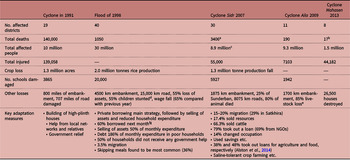
Coastal Bangladesh is exposed to various forms of climate-induced natural disasters such as cyclones, floods, droughts, riverbank erosion, tidal surges, tornados, water logging, soil salinity, landslides and thunderstorms (see Table 1). Such disasters increase households’ vulnerability to poverty and adversely affect family welfare (Skoufias, Reference Skoufias2003; Khandker, Reference Khandker2007; Alam & Collins, Reference Alam and Collins2010). Between 1965 and 2013, 45 major cyclones hit coastal areas with devastating effects on human life, nature and physical infrastructure (DoDM, 2014). The cyclones of 1970 and 1991 took a toll of 300,000 and 150,000 lives respectively with extensive property damage worth 3 billion US$ (Dilley et al., Reference Dilley, Chen, Deichmann, Lerner-Lam, Arnold and Agwe2005; DoDM, 2014). According to one estimate, 97.7% of the population and 97.1% of land area are at risk of multiple hazards in Bangladesh (Dilley et al., Reference Dilley, Chen, Deichmann, Lerner-Lam, Arnold and Agwe2005, p. 9). Bangladesh ranks 5th out of 171 countries included in the World Risk Index 2016, with high exposure to natural hazard and vulnerability (BEH & UNU-EHS, 2016). Around 40 million people living in the coastal region are vulnerable to salinity intrusion, cyclone/storm surge and tidal waves (CZPo, 2005; DoDM, 2014) and this figure is expected to grow to about 60.8 million by 2050 (Ahmad, Reference Ahmad2005).
Major climate-related shocks to coastal Bangladesh, 1991–2013

Sources: GOB, 2008; GED, 2009; Khandakar, Reference Khandker2007; Del Ninno, Reference Del Ninno, Dorosh and Smith2003, Alam & Collins, Reference Alam and Collins2010; Kumar et al., Reference Kumar, Baten, Masud, Osman and Rahman2010; Skoufias, Reference Skoufias2003; DoDM, 2014; Sultana & Mallick, Reference Sultana and Mallick2015; also UNICEF (https://www.unicef.org/bangladesh/4926_6202.htm) and IFN (http://www.internationalfloodnetwork.org/aila.htm).
a Two-thirds in Barisal division, followed by Khulna (GOB, 2008); 47% of houses damaged in Barguna, 9% in Barisal, 19% in Patuakhali and 1% in Satkhira.
b Most death in Barguna and Patuakhali.
c Two million lost income.
d High among poor and flood-exposed villages.
e In Satkhira, 292 km of embankment and 41 bridges damaged; 33 schools in Assasuni completely destroyed and 49 in Tala upazila.
f Only 2% from formal institutes and 30% from relatives.
g 54% remain in debt for over 6000 TK in 1999.
Coping with natural disasters requires adjustment to peoples’ basic needs, such as food, clothing, education, housing and health (Alam, Reference Alam2003; Sarkar et al., Reference Sarker, Alam and Gow2012; Mottaleb et al., Reference Mottaleb, Mohanty and Mishra2015). Often it is achieved by spending less on women, thereby increasing female mortality (Ikeda, Reference Ikeda1995; Neumayer & Plümper, Reference Neumayer and Plümper2007), and results in violence against women (Nasreen, Reference Nasreen and Dasgupta2010; Rahman, Reference Rahman2013; Alam & Rahman, Reference Alam and Rahman2014) and other forms of discrimination (Terry, Reference Terry2009; Rashid & Michaud, Reference Rashid and Michaud2000; Neumayer & Plümper, Reference Neumayer and Plümper2007; Rahman, Reference Rahman2013; HRW, 2015).
Methods
Study setting
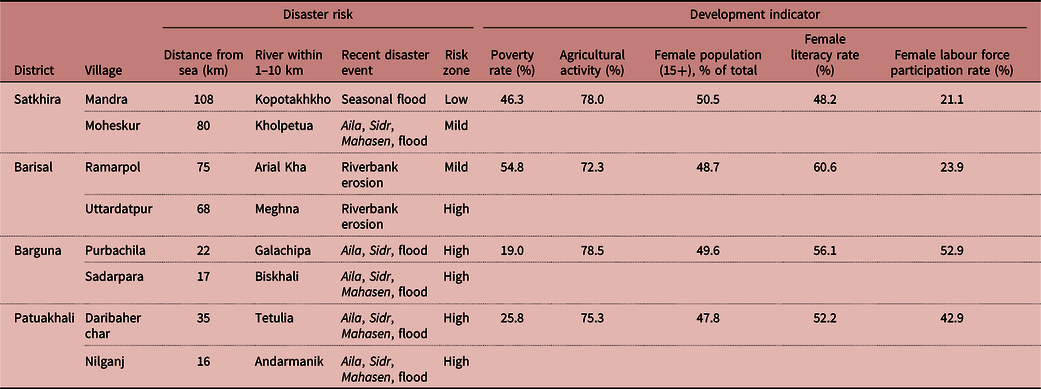
The qualitative data were obtained from four coastal districts of Bangladesh, namely Satkhira, Barisal, Barguna and Patuakhali. Coastal districts were identified with reference to the Coastal Zone Policy 2005 (CZPo, 2005). These districts are mostly vulnerable to salinity intrusion, cyclone/storm surge and tidal waters. Two upazilas were chosen from each district and one village from each upazila (i.e. sub-district). In total, eight villages from four coastal districts were selected. Moreover, the selected villages belonged to different disaster risk zones (i.e. high, mild and low risk) based on three criteria: distance from the sea, village location within 1–10 km of a flash flood prone river and recent disaster events (see Table 3). Sample locations varied between 108 km (e.g. Mandra in Satkhira district) and 16 km (e.g. Nilganj in Patuakhali district) from the Bay of Bengal. In addition, they were at the banks of big rivers such as the Meghna, Galachipa and Arial Kha.
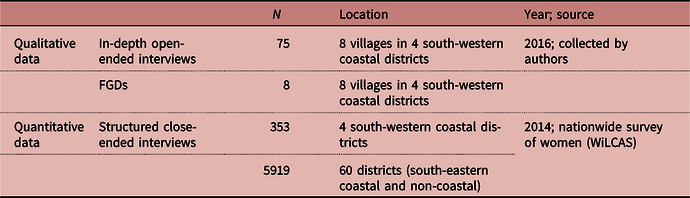
Description of sample by data collection method and source

In-depth interviews limited to married women while each FGD comprised six married individuals, both men and women.
Coastal villages chosen for in-depth interviews were part of the WiLCAS 2014 quantitative survey.
WiLCAS 2014 also included a module based on interviews of the village heads to gather village-specific data.

Data collection
Fieldwork was conducted between May and June 2016. In addition to in-depth interviews of 75 women aged 17–45 years, who married before the age of 18, eight focus group discussions (FGDs) were conducted. Each FGD session was mixed-gender and comprised three female and three male respondents. The respondents were initially briefed about the scope and objectives of the study and their permission was received for audio-recording and the taking of visual images during interview. The in-depth interviews primarily focused on the lived experience of women and their views on the climate characteristics of their village in their pre-marriage years.
Along with a close-ended questionnaire for basic information of the respondents, a guided questionnaire was developed to capture the pre-marital social, economic and environmental settings of the survey women. A unique aspect of the study design was that in all sampled villages, a detailed quantitative survey had previously been conducted in 2014 as part of a nationwide study of the lives of women in Bangladesh (for further details, see Asadullah & Wahhaj, Reference Asadullah and Wahhaj2019). Detailed information on the migration history, employment patterns, dowry prevalence, social norms governing women’s outside mobility and employment in the community, as well as household’s socioeconomic status, was provided by this study. Table 2 summarizes the study samples by data collection method and source.
Data analysis
Conditioning qualitative sample selection on a pre-existing quantitative survey helped ensure trustworthiness of the qualitative research through prolonged engagement. The study team visited the sample villages for WiLCAS in 2014, while the team conducting the qualitative survey comprised individuals recruited from coastal Bangladesh. This helped the researchers to be immersed in the local culture and obtain an adequate representation of the voices of the study respondents. All interviews were tape-recorded. The audio recordings were first transcribed in Bengali and then translated into English. The text data were analysed following the methodology proposed by Attride-Stirling (Reference Attride-Stirling2001). Attride-Stirling’s thematic analysis approach starts with an open coding method, in which small codes are used to classify certain quotes and experiences, which are subsequently clustered together to form themes (Flick, Reference Flick2002). The sets of themes are then grouped together for further analysis.
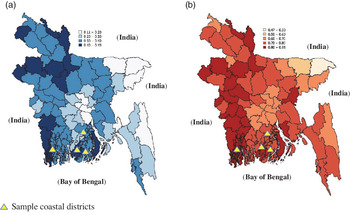
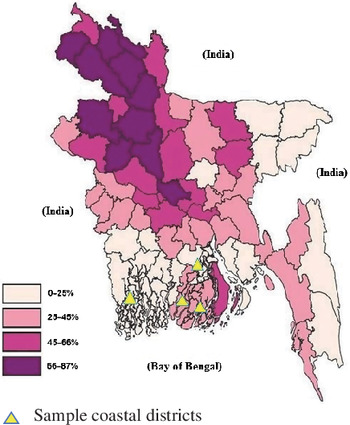
From both primary and secondary data, the most common incidences of disaster were identified to be the flood of 1998, cyclone Sidr in 2007, cyclone Aila in 2009 and occasional riverbank erosion. Based on these indicators five villages were classified in a high-risk zone, two in a mild-risk zone and one in a low-risk zone. The geographic vulnerability of the sample villages located in the four south-western coastal districts in terms of proximity to the sea (Bay of Bengal) is evident from Figure 1. Also, locally these are also known as strictly traditional and religiously conservative districts within Bangladesh.
District-level prevalence of early marriage in Bangladesh, 2014. a) Proportion married by age 15; b) proportion married by age 18. Source: authors’ own data, based on WILCAS 2014. Triangles indicate sample coastal districts.

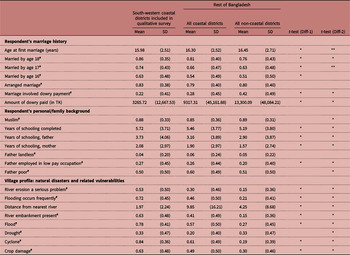
Figure 1 presents district-level data on the prevalence of early marriage in Bangladesh while Table 4 describes the profile of villages and women in the study districts, as well as in other coastal and non-coastal districts of Bangladesh. Both are based on WiLCAS 2014 data. Four out of every five women were married before the age of 18, regardless of the sample area (coastal or non-coastal), with a mean age at first marriage of 16 years. Almost 80% of marriages were arranged without the women’s consent. Compared with non-coastal locations, women in the sample coastal villages were systematically more likely to have experienced early marriage regardless of the indicators used (e.g. ‘age at first marriage’, ‘married by 18’ or ‘married before 18’). At the same time, their marriages were (statistically) significantly less likely to involve dowry payment; the amount of dowry paid (in Bangladesh Taka, TK) was also smaller. In terms of socioeconomic background, parental literacy rate (proxied by years of schooling) was very low in all the districts. However, the data showed a high poverty rate (father being poor) in the coastal districts compared with all non-coastal districts (60% and 50% respectively). Lastly, Table 4 shows sizeable differences between coastal and non-coastal samples in terms of both threat of natural disaster and experience of different natural disaster events such as river erosion, frequent flooding and cyclones. Compared with non-coastal areas, the sample villages were also twice as likely to have experienced a major event of crop damage in the last 10 years. These differences were always statistically significant. In sum, except for droughts, the sample villages in the south-western coastal districts in particular, and coastal districts in general, were more vulnerable to various natural disasters compared with non-coastal districts.
Characteristics of respondent women aged 20–39 years and disaster exposure by location of their villages, WiLCAS 2014

Data from WiLCAS 2014 household and community surveys.
# Indicates 1/0 indicator variable.
Flood, drought, cyclone and crop damage recorded in terms of at least one major incident in the last 10 years.
t-test of differences refers to two-tail tests.
*p<0.05; **p<0.10.
Diff-1: gap between south-western coastal and non-coastal districts; Diff-2: gap between all-coastal and non-coastal districts.
Results
Four themes were identified from the in-depth interviews and FGDs: (i) natural disasters, (ii) dowry, (iii) poverty and (iv) family honour.
Experience of natural disasters
Natural disaster was confirmed to be a common and repeated experience for most people in this region. More than two-thirds (72%) of the respondents had experienced natural disaster at least once before marriage. The most commonly named disasters were the flood of 1998, cyclone Sidr in 2007 and cyclone Aila in 2009. Respondents reported being regularly exposed to tidal water, cyclone storms, salinity intrusion and occasional riverbank erosion. In terms of frequency, flood was the most common type of natural disaster event, followed by cyclone and riverbank erosion. Study participants appeared vulnerable to negative income shocks (such as joblessness, loss of farming land/enclosure and worn-out houses) as well as loss of human capital.
Climate disasters limited the livelihood options of the marginalized. Many households had lost their land, trees and houses, and male household members had become jobless as a result of natural disaster. Several respondents had to discontinue schooling because of damaged school infrastructure and impaired transport systems due to natural disaster.
Many respondents had landless parents, and even those with land faced considerable economic uncertainty as they predominantly relied on single-crop farming. In some instances, the level of hardship was so acute that respondents did not have three square meals a day before their marriage, let alone continue in school.
Figure 2 plots data for ‘marriage by age 18’ by year for the qualitative sample drawn from the south-western districts, based on reported age at first marriage. A large proportion of the respondents married shortly after major floods and cyclones. This suggests a correlation between the incidence of early marriage and climate-related shocks. Clear spikes can be observed in marriage counts, which coincide with the 1991 cyclone, 1998 and 2004 floods and 2007 and 2009 cyclones. This suggests a positive link between climate vulnerabilities and the prevalence of child marriage. Yet the respondents did not directly refer to natural disasters and climate changes when recounting their marital experience.
Distribution of respondents by year of marriage and incidence of major natural disasters, qualitative sample (south-western districts). Source: authors’ own data.

Economic correlates of child marriage: poverty and the rising cost of dowry
Poverty in coastal Bangladesh is characterized by climate-related income shocks, particularly as the population primarily relies on agriculture (either crop farming or fishing) for their livelihoods. Therefore, traditional economic forces such as poverty play an important role in marriage processes in the coastal region. Labour market options for women in coastal villages are limited, undermining the economic value of daughters. In this context, unmarried daughters, particularly those in large families, are considered a burden for parents when they can no longer afford to feed them. Poor households force girl children into marriage as part of their economic survival strategy, and in many cases it is the eldest daughter who falls victim to this strategy. Some of the sample respondents were married off within few years of a major natural disaster such as the flood of 1998, and cyclones Sidr and Aila in 2007 and 2009 respectively.
In some instances, a girl’s marriage was slightly delayed, often because their family had an alternative income source or did not receive a suitable marriage proposal. One case in point was Salma, whose family was affected by a natural disaster 7 years ago (around the time when cyclones Sidr and Aila hit the Bangladeshi coastal belt). She escaped marriage at a very young age as she secured work in the capital city, Dhaka. However, a few years later she returned home because of employment uncertainties and consequently fell victim to marriage at the age of 16. She narrated her story:
Because of poverty in the family, I went to Dhaka with my aunt when I was in grade 5 and then worked in a ready-made garment factory. But the employer of the factory did not pay me for long enough; so, after a couple of years I returned to my parents’ household. I was the eldest among four sisters and my father was still going through a financial crisis. He used to mention frequently, ‘How long will I feed you? I cannot keep doing this anymore’. So, he decided to marry me off when I was only 16. (Salma from Uttordatpur, married at 16, high-risk zone, Barisal district)
In the sample villages, women were employed in agriculture where farming had been less affected by flooding or/and riverbank erosion (e.g. Satkhira district). Even in these villages, most marriages were arranged and forced. For instance, in Satkhira, Morjina and Jhorna worked as agricultural labourers on nearby land for TK 120 for half a day’s work. Although poverty forced them to work as labourers, their choices were driven by different circumstances. Morjina had to work even though her husband was a van driver (who didn’t earn enough to survive at subsistence level). Jhorna, on the other hand, lived with her parental family after separating from her husband, and had to work because of the extra mouth (herself) added to her already destitute parental family.
This is consistent with a study in this area of Bangladesh that found that women in the villages spent as much time as men on work, but that the majority of their work was concentrated on home production. Besides, the physical boundary of their work place lay within a range of 200–400 m of the house (Cain et al., Reference Cain, Khanam and Nahar1979, pp. 412–428). A high level of female seclusion in the study villages was observed (more so in villages that were physically more vulnerable to natural disasters because of their physical geography). Higher enrolment in school and involvement in paid work, either as a labourer in the field or as a garment worker in Dhaka, was not sufficient to enhance marital agency. One respondent elaborated:
My parents were in abject poverty and our house was frequently flooded. After my father’s death, I went to Dhaka for work. One day, my maternal uncle called and lied that my mother was ill. He then insisted that I return to my home village. When I returned home, my mother forced me to marry for the sake of family honour and dignity. (Rina from Purbachila, married at 13, high-risk zone, Barguna District)
Another common driver of child marriage is the custom of dowry (Chowdhury, Reference Chowdhury2004, Reference Chowdhury2010; Schuler et al. Reference Schuler, Bates, Islam and Islam2006, Do et al., Reference Do, Iyer and Joshi2006; Geirbo & Imam, Reference Geirbo and Imam2006; Alston et al., Reference Alston, Whittenbury, Haynes and Godden2014). As the cost of dowry increases with the age of the bride, poor parents tend to marry off their daughters earlier as part of a survival strategy (Schuler et al., Reference Schuler, Bates, Islam and Islam2006; Nour, Reference Nour2009; HRW, 2015). Alston et al. (Reference Alston, Whittenbury, Haynes and Godden2014) argued that in disaster-prone coastal areas of Bangladesh, early marriage is a common mal-adaptative strategy adopted by poor households in response to their economic vulnerability. However, in this study sample, only one-third (i.e. 34.6%) of the respondents had paid dowry at the time of marriage. In comparison, 46.3% of marriages in Bangladesh involve dowry payments according to a national survey (BBS, 2013).
The amount of dowry paid in cash varies between TK 800 and TK 40,000, and in-kind gifts include sewing machines, cows, motorbikes and wedding clothes. These cash amounts are substantially lower than dowry payments in northern Bangladesh (BRAC, 2004, cited in Geirbo & Imam, Reference Geirbo and Imam2006, p.5). In some cases, the amount was so small that the respondents regarded the transfer as Dan (a gift) rather than dowry.
Socio-cultural correlates of child marriage: family honour and puberty
Income poverty and dowry-related concerns aside, traditional socio-cultural forces such as family honour and relational sentiments also dominated the list of key drivers of child marriage in the in-depth interviews. Terms like Dangor (grown up), Siyana (mentally mature) and Upozukto (qualified) were used in the community to describe the marriage-readiness of adolescent girls on reaching puberty. The fear of physically mature daughters bringing dishonour to the family – poribarer mukhe chunkali deya (defame and stigmatize family image) – was a commonly used justification for early marriage. Most importantly, this concern about family honour was commonly found across all socioeconomic groups. For example, Mitu Rai was a 20-year old girl from a well-off middle-class Hindu family in Barguna district. At the time of interview, she would have been in the first year of university had she not been married off 5 years earlier. Unlike many other girls in the study area, her father was financially well-off with low vulnerability to economic losses stemming from natural disasters. But he could not overcome the fear of losing family honour and dignity after Mitu experienced ‘eve-teasing’ (sexual harassment) several times. She explained:
My father was a businessman and I was one of the two children of our parents. We had TV and electricity at home [which many in this area consider a privilege]. When I was in class 8, some local boys harassed me on my way to school. I informed my parents about this. As the boys were politically influential, my father could not act against them. Instead, 2–3 months later, he arranged my marriage. (Mitu from Purbachila village, married at 15, high-risk zone; Barguna district)
Morjina (aged 18 at the time of interview) described similar experiences. She was a student at a Madrasa (Islamic School) and regularly attended school in veil (purdah). Yet, she could not escape eve-teasing. Her parents ended her schooling and marrying her off at the age of 15. The marriage was arranged in such haste that her parents could not attend the Kalma programme (wedding ceremony). One respondent explained that adolescent girls’ status in parents’ eyes in patriarchal coastal Bangladesh:
We [girls] are like stockpiles for our parents and the sooner they can unload, the more relieved they feel. Everyone only cares about family honour. Teenage daughters are married off early so that they do not get into any trouble. This is how things work among us, the lower-class (poor) people. (Rojina from Daribaherchar village, married at 13, high risk zone village, Patuakhali district)
Besides risking family honour, non-conformity to norms governing outside interactions of unmarried girls (e.g. having illegal affairs or being divorced) increases the cost of their marriages. In a rural setting, any speculation about unmarried girls spoils her prospects in the marriage market or, at least, increases the cost of dowry as reparation. Therefore forced child marriage becomes a solution for poor families as an escape both from social ignominy and the financial cost of a bigger dowry. When Shahnaz was interviewed (aged 20 at the time), she had already been married twice. Previously, her educated father had vowed that he would never give dowry for his daughter’s marriage. But eventually, when Shahnaz’s first marriage broke up and rumours of eve-teasing (by a local boy) spread, her father not only agreed to a proposal he had initially refused, but also agreed to pay a large sum as dowry. In Shahnaz’s words:
When I was young, my elder sister eloped to marry one of my cousins. This made my father very apprehensive about me. So, he married me off when I was very young. I was so young that I did not understand the difference between parental family and in-law’s family. Eventually my marriage did not work. When I was young my father used to say, if anyone asks dowry I will never give my daughter. But later when the local boy became very desperate, my father agreed to marry me off to a distant relative’s son. I was married a second time at 15 and my father paid TK 30,000 as dowry and other small utensils for my in-law’s family. (Shahnaz from Moheskur village, married at 15, mild-risk zone village, Satkhira district)
Concern over family honour aside, this study also observed several cases where early marriage was arranged to satisfy the whims of elderly family members. Some respondents were married young just because their grandparents wanted to see a grandson-in-law before they died. This is common when the bride’s father is living with extended family before his daughter’s marriage. Khadiza (from Daribaher char, Patuakhali district) was married off while she was in grade 10 of school. Her family had no financial problems, nor any apprehension about the cost of dowry (according to her, people in her village did not take dowry). However, she was married at 16 at her grandfather’s whim. Her maternal uncles wanted her to continue with her studies but her grandfather, with whom her father was living at the time, had the final say regarding her marriage timing. Similar evidence was found across several coastal villages. In some cases, multiple extended family members, living together in a joint family household, put pressure on parents with marriageable daughters.
Sometimes parents’ desire to see their daughters as brides also led to early marriage. Rahima, for instance, was informed about her marriage on the day of the ceremony (she was 15). Her father said:
You are my liability and I want to marry you before I die. If I die before that, I will not be able to see you married off [or as bride]. (Nilganj village, high risk zone, Patuakhali district)
Another respondent said:
I was married off when I was in grade 6. My school was far from home and during the flood season the roads became mud-covered. But that was not a problem. The main concern was the family honour. My father and my five maternal uncles lived together in the same house. I was the only daughter in the extended family and everyone was worried about me. My grandfather, who was the main decision maker in our extended family, wanted to see the grandson-in-law. So my father had to give in. (Parul from Purbachila, married at 17, high-risk zone village, Barguna district)
One common factor that came across during the FGDs was that the prejudice (kusongoskar as it is called in Bengali) of getting daughters married off early is still a dominant practice in rural areas. Due to widespread social and national campaigns parents are sending their daughters to schools, but less to educate/empower, and more to ameliorate their value in the marriage market. Therefore, as soon as they find a satisfactory groom match, they stop their daughter’s education. One male respondent during a FGD narrated:
Nowadays, parents are very aware of the value of the education of their daughters in our area. They want them to study at least up to grades 10 or 12. Because they know that it increases her worth/appeal in the marriage market. However, if they find a suitable match for her, they still don’t hesitate to marry her off. (Shop owner from Moheskur, mild-risk zone village, Satkhira district).
Another female respondent who was married young said:
Our family was severely affected during both cyclone Sidr [in 2007] and cyclone Nargis [in 2008]. My parents then migrated to Dhaka and I was sent to my maternal uncle’s house, from where I continued my study. When I was in grade 8, my father asked me to come to Dhaka to attend a wedding function of a female cousin. During that visit, my father married me off without my consent and I couldn’t oppose my parents’ decision. (Jorina from Purbachila, married at 16, high-risk zone, Barguna)
Discussion
Adolescent girls around the world become targets of child marriage in the aftermath of natural disaster due to their lack of agency and low economic value (UNICEF, 2001; Lemmon & Elharake, Reference Lemmon and ElHarake2014; Alston et al., Reference Alston, Whittenbury, Haynes and Godden2014; HRW, 2015). Social norms and social roles combine with other forms of inequality making women disproportionately exposed and vulnerable to climate hazards (Neumayer & Plümper, Reference Neumayer and Plümper2007; Rabbani et al., Reference Rabbani, Rahman and Mainuddin2009). This study examined the nature of a specific social norm – the custom of early marriage – and its interaction with the practice of dowry, in a situation of climate vulnerability.
The qualitative evidence confirmed the role of family honour attached to daughters in traditional Bangladeshi society – keeping girls unmarried, particularly when they are physically mature, is a matter of shame and stigma for the family (Chowdhury, Reference Chowdhury2004; Schuler et al., Reference Schuler, Bates, Islam and Islam2006; HRW, 2015). This norm is so pervasive that sometimes women themselves endorse this social custom. The most common explanation given in the survey was that ‘… when a girl is physically mature, parents consider it their responsibility to marry her off before any accident takes place.’
This is consistent with Chowdhury (Reference Chowdhury2004), who found this sentiment to be prevalent among brides’ as well as grooms’ families. However, in contrast to Alston et al. (Reference Alston, Whittenbury, Haynes and Godden2014), the qualitative data in this study did not indicate dowry-related concern to be the primary driver of child marriage in south-western Bangladesh. In addition, the nationwide quantitative survey WiLCAS 2014 showed that dowry prevalence was less common in southern compared with northern Bangladesh (see Figure 3). Even though dowry payment is widespread across Bangladesh, the prevalence of dowry in coastal districts is almost half that in non-coastal districts. Most importantly, the average size of dowry payments is much smaller in coastal (smallest in south-western districts) compared with non-coastal districts of Bangladesh (Table 4).
District-level dowry prevalence in Bangladesh, 2014. Source: authors’ own data, based on WILCAS 2014. Triangles indicate sample coastal districts.

The general observation from these in-depth interviews in disaster-prone villages of Bangladesh is that child marriage is a common practice across different socio-cultural (educated vs illiterate; Hindu vs Muslim etc.) and economic (landed vs. landless; working women vs. home maker) groups. Both a veiled Muslim girl (Morjina) and an unveiled Hindu girl (Mitu) become child brides, within just a few months of their first eve-teasing (sexual harassment) experience. A daughter from a landed wealthy family was married early just because the grandfather and uncles wanted to see a son-in-law. An educated (12th grade) respondent, as well as an illiterate Hindu respondent, became child brides – the former because her family was insolvent, and the latter because the family received a marriage proposal that was too good for them to refuse. Daughters of a primary school principal and a landless farmer also could not escape child marriage due to relational sentiments (preserving family ties). Similarly, employment before marriage did not deter early marriage, sometimes due to social pressure and often because of poverty in the parental family.
An important pattern in all qualitative interviews was the absence of any direct reference or to natural disasters and climate change by respondent women when narrating their marital histories. This contrasts with quantitative data on marriage timing across female respondents in the main sample, which confirmed a clear correlation with climate events. Moreover, women in coastal districts, particularly the four districts included in this study, showed a systematically higher early marriage prevalence compared with women from non-coastal districts. Concerns relating to family honour and poverty generate early-marriage pressures at all times, and so they are embedded in the minds of the respondents as factors behind their marriage timing. But natural disasters are infrequent and so, even if households cope with these events by adjusting the marriage timing of their adolescent daughters, people may not associate the two types of events.
How does the observed quantitative correlation in coastal Bangladesh between marriage timing and climate shocks compare with the pattern observed in quantitative studies in sub-Saharan Africa where unmarried daughters are a source of wealth? In contrast to droughts, households of all socioeconomic strata in the study area were vulnerable to cyclones and floods. In this context, even when customs relating to marriage payments are not universal, unmarried women’s vulnerability to climate shocks is increased given the traditional customary norm that decides marriage readiness based on the timing of puberty.
In sum, the qualitative evidence presented on the prevalence of child marriage across different socioeconomically vulnerable groups in south-western Bangladesh suggests that the practice of child marriage is a risk-coping mechanism adopted by households in the face of shared vulnerability to climate change. Large community-wide shocks can induce parents to time their daughter’s marriage as a consumption-smoothing strategy – marrying off a daughter early is ‘one less mouth to feed’. Findings from this study imply that policies addressing the causes of child marriage need to recognize the environmental risk factors in vulnerable locations. At the same time policies should address women’s vulnerability to child marriage in disaster-prone areas to build climate change resilience. Existing international (see UNFCCC, 2015) policy agendas contain few safety-net provisions for women. In natural disaster-prone areas, gender justice in climate change policies cannot be ensured without acknowledging women’s vulnerability to child marriage. There are also concerns that climate change induced migration to cities is contributing to child marriage as migrant unmarried girls’ ‘honour’ is at risk in urban locations (Jha, Reference Jha2016). Future quantitative research should re-visit these issues and formally evaluate the competing explanations for child marriage in climate-affected regions in developing countries with high prevalence of the problem but differential cultural practices governing marriage timing and payments.
Acknowledgments
The authors are grateful to the seminar participants at BRAC University for their useful comments.
Funding
This research received funding through the Australian Government’s Development Research Awards Scheme (Agreement No. 66396). The views expressed here are those of the authors and not necessarily those of the Commonwealth of Australia.
Conflicts of Interest
The authors have no conflicts of interest to declare.
Ethical Approval
The authors assert that all procedures contributing to this work comply with the ethical standards of the relevant national and institutional committees on human experimentation and with the Helsinki Declaration of 1975, as revised in 2008.