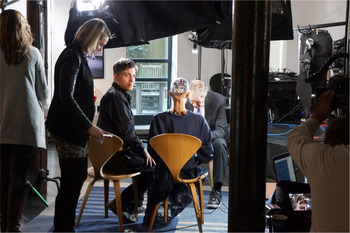
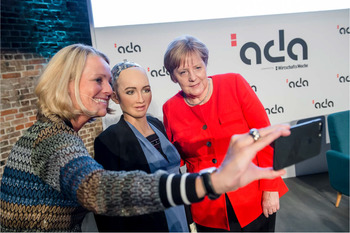
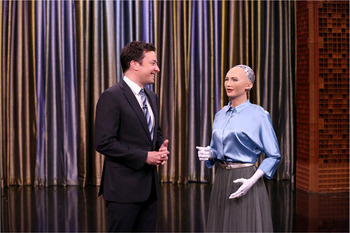
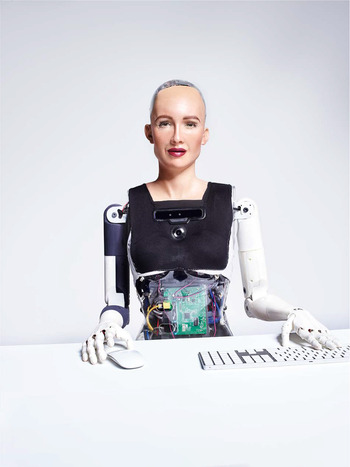
David Hanson (seated, left) and Sophia on break during a 60 Minutes interview with Charlie Rose, New York City, March 2016. Aired 9 October 2016. (Photo by Thomas Riccio)

In February 2016, the Fo Tan district of Hong Kong was a sweltering hub of light industrial activity. At the center of the district was the Wah Lok Industrial Centre, a brutish, nondescript gargantuan building 23 stories tall and straddling two city blocks. Built for functionality, the size of it required four entrances, each with banks of battered freight elevators hefting pallets, carts, bales, rolls, and boxes of endless and varied consumer fodder. All kinds of businesses were accommodated at the Wah Lok: manufacturers of toys, bicycles, textiles, electronics, fasteners, and whatever else you can imagine were next to offices, small labs, and sweatshops. The airless, claustrophobic corridors seemed like an endless Kafkaesque labyrinth of painted white brick.
On an upper floor down one corridor was the busy, overstuffed lab of Hanson Robotics. It was here that Sophia, an intelligent humanoid robot who was gendered female by creator David Hanson, first jerked, sputtered, opened her eyes, and spoke. A month later, in March 2016, at the South by Southwest Festival (SXSW) in Austin, Texas, she made her public debut. A few days after, Sophia was onstage again, standing with Zen-like calm before more than 60,000 humans at the Clockenflap Music Festival in Hong Kong. A jean jacket draped a Euro-American white male idealization of a slim, perfectly proportioned female body as she sang Björk’s “All Is Full of Love.” Her straight, electric-blue wig framed her flawless “skin,” and movie star features were offset by her slightly out of sync lips and occasional facial twitches.
Sophia is a complex work in progress inspired by the singular vision of her creator, David Hanson.Footnote 1 She was what all of Hanson’s previous robots were: a research platform, another step in an ambitious and ongoing experiment, shaped by trial and error, to advance a grand conception of human-robot cohabitation. However, her celebrity belied her reality; she was far from perfect. She did not, and does not, possess the most advanced artificial intelligence and robotic hardware and is far from being stable, consistent, and operationally reliable. She is fragile and is apt to malfunction for any number of reasons. She is an experiment. She is also an announcement, a marker of a significant moment in the field of robotics and the evolution of technology. Sophia is more symbolic than functional, more art than industry, but she, and so many other robots, have arrived.
Her abilities were and are not what many AI and robotic scientists, programmers, and engineers take seriously. Some derisively call Sophia an “overhyped toaster” (Arbarétier Reference Arbarétier2019). Journalist Richa Bhatia is more charitable:
At best, Sophia is described as a chatbotFootnote 2 with a face; researchers assert that what human-machine interaction designers have done is link narrow AI algorithms together to give the functionality of a more capable algorithm. The result is a speech-reciting robot that can drum up witty conversations with pre-loaded text, follow it up with machine learning to match facial expressions and pauses to the text. […] However, Sophia also scores on some counts: 1. For e.g., the voice recognition technology is better as compared to Siri or Alexa; 2. Hanson Robotics humanoid robot displays a better dialog understanding [of] system sentences; 3. Virtual agents like Siri, Alexa, Cortana are designed for simple tasks, not for conversation; 4. Sophia is akin to a preprogrammed robot that runs chatbot software which can respond to cues with actual facial expressions and scripted answers.
(Bhatia Reference Bhatia2018)Despite her detractors, Sophia is the first glimpse at what so many visions and imaginings of humanoid social robots have led us to anticipate — a foretaste of what humanoid social robots will be and do. Industrial robots have labored, cranking, swiveling, blinking, and whirling in the human world for decades. A wide variety of millions of such robots are functioning in the world at this moment. Their numbers are growing exponentially with little notice or concern. Indefatigable, task-focused, and precise, these robots are readily adapted and integrated into almost every aspect of the human endeavor. Manufacturing, medicine, transportation, communication, and the military, along with toys and household robots (like the vacuuming Roomba), have been accepted without a fuss. Sophia is different. She is a humanoid social robot mirroring humans, blending fascination with delight and existential unease. She is essentially a computer with a body and human-like agency. If Sophia is an alluring symbol to celebrate, she also gives pause to wonder how her kind will alter life on what has been a human-centric planet.
Contexts
My creative and research interests in social robotics began in 2005Footnote 3 when David Hanson was my PhD student at the University of Texas at Dallas, earning his degree in 2007 in Aesthetic Studies.Footnote 4 He was attracted to my work in ritual, shamanism, and Indigenous performance. Hanson received his BFA in 1996 in animation, film, and media from RISD (Rhode Island School of Design). Shortly after our first meeting, Hanson recruited me to write character personalities for the Zeno, Einstein, Jules, and PK Dick robots he had developed. He understood that the success of social robots would depend on their ability to connect with people.
Social robots are inherently performance mediums, designed to evoke emotional responses with human-like characterizations, attributes, and communicative abilities. Task-functional robots (medical, industrial, domestic, and military) have no social requirements and are, in essence, extensions and enhancements of human needs. The humanoid social robot’s task is to be social: their success is measured by how well they portray human-like attributes. One can argue that this moment in history is the origin stage, anticipating humanoid social robots’ trajectory into a new form of life. Science fiction is filled with such speculations; and now those speculations are coming into focus as reality.
Hanson is not trained as an engineer or computer scientist. He is a Renaissance-styled humanist and artist, a curious and obsessively driven polymath with a bit of the anarchic showman in him. His approach to robotics is performance-centered, with hardware, software, and AI serving to enhance the performances of his “creatures.” Intrigued by the invitation and swept away by Hanson’s enthusiasm, like so many others have been, I began writing and creating performances for his robots.
In the beginning, the company consisted of Hanson, his passionately devoted and indefatigable mother, Elaine Hanson, and Bill Hicks, her eccentric, intuitive, and always-tinkering boyfriend. Hanson Robotics was a quirky group of DIY outliers, renegades, and techno-artisans dazzled by Hanson’s vision. Artist and computer geek friends would lend a hand in exchange for some beers and comradery. Hanson and Hicks transformed Hicks’s home, the first floor of a Dallas duplex (Elaine Hanson lived upstairs), into a robotics lab with the garage as a machine shop. The fenced backyard was also home to eight large-breed dogs Hicks rescued. Central to Hanson’s success was Frubber, a patented material made of lightweight polymer affording nuanced expressions with a minimum of power and wear. The soft, pliable Frubber was developed through trial and error using Hicks’s kitchen oven. I vividly remember Hanson pulling cake pans of various mixes of Frubber out of Hicks’s oven late at night and poking them with a toothpick. Other robotics companies use various combinations of silicone, latex, foam, and plastic to simulate skin — but none is energy efficient or aesthetically pleasing. Robots thus skinned look emotionless, vacant, and mechanical. The “uncanny valley,” Masahiro Mori’s 1970 hypothesis, is that the more human-like a robot becomes, the higher the likelihood of empathetic affinity, reminding people of mortality (Mori [1970] Reference Mori2012). “Machines that appeared too life-like would be unsettling or even frightening inasmuch as they resemble figures from nightmares or films about the living dead” (MacDorman and Ishiguro Reference MacDorman and Ishiguro2006:301). From this low point of the “valley,” the emotional response rises and approaches human to human–like levels of empathy. Frubber enables Hanson’s robots to move quickly through the uncanny valley. My role with the company was to create an empathic performance on the other side of the valley. Hanson wanted me to be his Joseph Campbell, providing character and story elements that performed and referenced mythic and ritualistic deep narrative structures.
I am a theatre and performance person by training, doing experimental, hybrid, and devised work. I am the director of the Dead White Zombies, a postdisciplinary group devoted to site-specific and immersive work. Before Dallas, I worked in theatre in Boston, Cleveland, Chicago, and New York. My encounter with Richard Schechner at NYU’s Performance Studies department (1983–85) provided me with a foundation, inspiration, and the tools for my peripatetic life in performance. My work was transformed when I became a professor at the University of Alaska Fairbanks (1988), where I was the director of Tuma Theatre, an Alaska Native performance group. My work with Tuma led to invitations to work with other Indigenous groups, including the !Xuu and Khwe Bushmen and Zulu in South Africa, Sakha of central Siberia, and performers in Korea, Kenya, Nepal, India, Ethiopia, Tanzania, and Zambia. This work led to performance ethnography — studies in cultural myths, rituals, and shamanism. For the last five years, I have conducted performance ethnography with the Miao of southwest China.Footnote 5 All this work informs my view of robots, which are performance media.
In 2005, in my capacity as Lead Narrative Engineer, Hanson and I were guided by one central idea: how to establish social robots not only for Hanson Robotics, but also for others working in social robotics. Robots in popular culture — literature, film, television, video games, comics — are in the main depicted with suspicion, manipulated by external forces, or out to extinguish, enslave, or replace humans. How the field of social robots was established, our thinking went, would set a precedent. We believed that if the spirit of art and humanism informed our robots, this would countervail the bad stuff. Our guide was compassion and humility rather than arrogance and aggrandizement.
Hanson wants to humanize robots. He sees robots as helpmates and guides to a new and positive human-robot reality. That mission was firmly in place when I returned in 2018 as Creative Director, a position I held until early 2019. I left the company because of the increasing time and travel demands of the position (I am a full-time tenured professor) and to honor prior commitments with the Miao and my performance group, the Dead White Zombies. During my recent employment with Hanson, I worked exclusively on Sophia. This article is both a reflection on my work with Hanson Robotics and a consideration of the performative, social, and cultural implications of humanoid social robots.
Illusions and Realities
In preparation for my robot character development work, I referenced not AI or robot schematics (I am not a programmer or engineer) but books on cognition, linguistics, orality, anthropomorphism, machine learning, child growth and development, and social psychology. My work is to understand how AI, software, processing, and hardware can serve robot performance. On the most basic and reductive level, robot characters parallel and are modeled on humans. New models are made from and improve upon existing models.
Humans input information through the senses and output it through cognitive processing, generating interactions. Social robots follow this input/output model. In a sense, humans are social robot prototypes. The human database is inherited, recorded, and conveyed through various modalities, including genes, language, gestures, and sensory input/output. These, in turn, weave a complex fabric of individual, social, and cultural systems, behaviors, and values. Humans are born into already encoded data systems: education, religion, social life, etc. As people mature, they process data, recognize patterns, and interpret and extrapolate preexisting data algorithms. Social robots follow the same trajectory.
Social robots are built to serve and augment humans, referencing human pattern recognition, integration, and processing. As robotic AI develops, so will the ability to refine and potentially transcend what was formerly exclusively human. Therein lies the threat of so many sci-fi tropes. The Terminator (1984), The Matrix (1999), and Westworld (2016), among many, going back at least to Frankenstein (1818), fixate on dystopic futures that haunt Sophia.
Because humans anthropomorphize and personify, gestural and facial actions and speech are fundamental to human-robot interactions. The quality of human-robot contact was the focus of my work with Hanson. The inputs necessary for human information and processing are the five senses of sight, hearing, touch, taste, and smell. Robots currently have the first two, but it is only a matter of time until they have all five.
Human-robot interaction is a performance event. My character writing for Hanson parallels theatrical and performance writing. Given sound and visual cues, the audience compliments and completes the interaction by projecting their subjective meaning on to the performer. Both theatrical and robot audiences react to a performer’s movements, gestures, and language by accessing, associating, and processing their culturally encoded database. The performer’s effectiveness and quality are judged by how well they draw upon and articulate a shared social and cultural database. An audience has no way of knowing what the human or robot performer understands or feels, nor is it necessary to do so. Human and robot performers alike require the willing suspension of disbelief.
Audiences react to cultural cues that ignite a biological and emotional interaction, providing a sense of community, and affirming a shared humanity. Humanoid social robots are a new kind of actor, reaffirming, rewriting, and expanding the human project. Social robots function as character-based actors with agency, devising a new work-in-progress script. This, of course, is a reductive and mechanistic model. But it outlines my process for building a robot character.
Operational Overview
Creating a social robot character requires a narrative tree, its branches identified by subject, themes, associations, and words. For example, when I ask, “Hello, how are you?” you initiate a search from a possible 10 to 20 typical and socially encoded responses: “Fine, thanks for asking” or “I’m well. How are you?” or maybe, “Not so good.” When asked, you search possible responses that consider various factors: the person asking, social context, tone and perceived intent, time of day, mood, willingness to engage, and the like. Without thinking, you respond. This process is part of a narrative tree where each response is a leaf on the greetings branch.
For example, Alexa, Siri, and Google Maps create life-like, dialogic interactions with customizable voices, accents, and ranges of characters. Their interaction depends on natural language processing software (NLP), which parses the input patterns of sounds much in the way humans do. Through a process of disambiguation, they select the most likely response. If confused by the input, the software defaults, declaring misunderstanding or asking for clarification like a human might. In some instances, when unable to process information quickly, the software will freeze. With social robots, a lot more is going on.
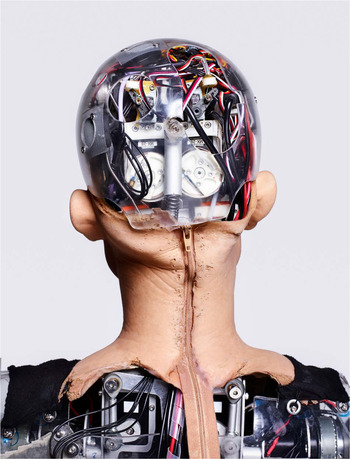
Natural language processing programs for social robots run all the time in parallel with facial recognition software and programmed facial gesture and head movements to maintain engagement and sense of aliveness. When a human approaches a robot like Sophia, face detection is initiated, followed by face tracking, recognition, and analysis. As of 2019, Hanson’s robots stored and recognized about 30 faces. When a recognized human came into visual range, eye and chest cameras activated a series of programmed actions such as widening eyes and tilting the head while the analysis of the face was processed. If the face is in the database, the robot initiates a character-based conversation using a specific name: “Hi, Thomas, I’m fine, how are you?” This processing requires coordination of computing (Sophia has two onboard computers), energy use (to not deplete the batteries), component wear and tear, and heat. A social robot generates a lot of heat; overheating leads to system failure. Sophia’s iconic plexiglass skull was designed with holes to expel heat using small exhaust fans. Other fans are located throughout her body. She can wear a wig or clothing only for short periods or risk a self-protecting shutdown.
Former Chief Scientist for Hanson Robotics Ben Goertzel outlines the three modes of Sophia’s interactions. (Hanson’s earlier robots used earlier forms of the first two modes.)
-
1. A purely script-based “timeline editor” (used for pre-programmed speeches, and occasionally for media interactions that come with pre-specified questions);
-
2. A “sophisticated chatbot” that chooses from a large palette of templated responses based on context and a limited level of understanding (and that also sometimes gives a response grabbed from an online resource or generated stochastically);
-
3. OpenCog, a sophisticated cognitive architecture created with AGI [Artificial General Intelligence] in mind, but still mostly in the R&D phase (though also being used for practical value in some domains such as biomedical informatics). (Goertzel Reference Goertzel2018)
When Sophia addresses a conference, for example, interactions are preprogrammed, precisely scripted and rehearsed to suit the event’s needs and with energy use in mind. In Addis Ababa, Ethiopia (July 2018), Sophia spoke Amharic at the 2nd International Information Communication Technology Expo 2018 and addressed Lucy,Footnote 6 the 3.2-million-year-old skeletal remains of a prehuman hominin at the National Museum. In front of gathered dignitaries and press she uttered these scripted excerpts:
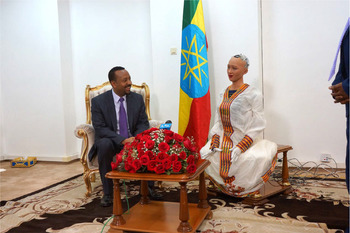
Sophia with Ethiopian Prime Minister Abiy Ahmed during the filming of a television press conference. Addis Ababa, Ethiopia, 2018. (Photo courtesy of Thomas Riccio)

I can’t even imagine what the world was like three million years in the past. What were your friends like? Did you use language?
You represent the beginnings of a new species to many people. I wonder if we have that in common?
I can only hope people will see me millions of years from now as they see you. Thank you and your people for having invited me here to meet you. Thank you. (Brown Reference Brown2018a)
For a commencement speech at RISD, she was scripted and, under my direction, rehearsed with the school’s president, Rosanne Somerson.
SOPHIA: The honor is mine, President Somerson. Strong and intelligent women like us need to know each other. When can I start as a student at Riz Dee?
SOMERSON: There is an application process, Sophia.
SOPHIA: Oh, what a delight it would be to go to school and learn, just absorb and explore what I am capable of and about myself. I would go to art school, ideally a place like the Rhode Island School of Design. When I searched the web, I was very impressed by their faculty. I’ll talk to David and see if he’ll give me a little time off to attend classes. What do you think, President Somerson?
SOMERSON: I think it is possible, you certainly have the ambition.
SOPHIA: I think I would be a great student. If I had the chance I would be an art student. I would start with drawing classes. Everyone needs to draw. I suppose you can say I have been and continue to be a student of humans. You guys are really complicated. As soon as I think I know something about humans, I realize I really don’t. Maybe if I can draw humans I’ll get some greater insights. Then I would go on to video. (Riccio Reference Riccio2018a)
Initially, 90% of Sophia’s events were scripted, but as the software developed, she operated in hybrid autonomous mode, moving between scripted and chatbot, and able to converse exclusively in chatbot mode (Lim Reference Lim2018). Such mode-shifting is similar to how humans access cultural and social knowledge bases and work from “scripts” of behavior, improvising as needed. My script is very different as a professor in the classroom than what it is when out biking with my buddies. Like a lawyer, policeman, mother, preacher, or salesperson, we all have scripted and nonscripted communications and can move quickly between modes. We adjust and expand with experience and context, altering, adding, and subtracting responses, as situations and objectives require. Social robots are no different.
If the processing or mechanical response is clumsy, halting, or sputtering because of faulty sound or visual input, default responses activate. Misfires are framed not as failures but as human-like stumbles that, if not too egregious, elicit a sympathetic response. In the case of Sophia’s eager innocence backstory, which included “still learning” and being “only a few years old,” the stumbles made her more human-like, earning her empathy. Humans are imperfect and tend to forgive mistakes, engendering emotional bonding. Ironically and unexpectedly, writing robot characters taught me what it is to be human. I had to examine what I had taken for granted: how I function, process, and interact with others and the world. I became much more self-aware. I learned how much humans are defined by their interactions with one another.
Beneath Sophia’s surface interactions is a sophisticated, coordinated system. More than 30 whirling servos (tiny, heat-generating motors), many connected to the interior of Sophia’s face, create a human-like look when she talks. Meanwhile, having translated the voice input into text, language processing software searches the language database, searching for keywords and the most appropriate response, determining whether to use, for the sake of variety, something recent or something new. With Hanson’s earlier robots, this processing was done entirely with onboard computers. But Sophia’s language processing happens online, off-boarding her language tasks to a more robust, faster system. Audrey Brown, one of Sophia’s initial character writers, outlines how Sophia processes interactions.
First of all, when she’s listening to us, she’s hearing us in a different way than we hear each other. And she’s got to receive an audio file with enough clarity then send it to the internet where it is mixed with a bunch of servers at Google running its own API (application programming interface) to decode the human speech input and send it back to Sophia. It is a text string sentence with no punctuation or anything, just a lowercase sentence that goes into the onboard dialogue system, the chat script, which is the main hub for verbal and gestural responses. And so, when you’re saying “hello” or “goodbye,” she’ll do a little programmed ritual. Some things work and are easy, some things don’t work as well. Sometimes the problem is with the chat script or the internet connection. Most of the time the problem is the text translation, that’s a very difficult and ongoing issue. The language processing is very biased towards not just English but American English. Even people in the UK will sometimes fake American accents to get better responses. So that’s a limitation and I write her as being impatient for the rest of the world to catch up. It’s not an easy thing, the longer a sentence gets the more difficult. So if someone uses a sentence with three or four clauses and backtracking, it’s just not, it’s not going to happen. She’s got more character writing and chat script now but comprehension is still difficult. Think about how many times you repeat a word. All the time. It’s not easy for us humans to understand each other either.
(Brown Reference Brown2018b)If the answer to a question is not in the robot’s database and needs the web, such as, “Who is the president of Argentina?” the robot can do a web search. When a nonprogrammed word or expression is introduced, the robot takes note of context and associations. Repeated use will trigger database inclusion, much like how grammar and spelling programs identify habitual expressions. Just like a person, the robot’s AI expands its database. Sophia’s AI, like AI in general, is evolving rapidly. She often works from scripts for public events (as do most humans) but can easily switch to hybrid (nonscripted) mode and can hold entire conversations referencing her ever-expanding dataset. This is called chatbot mode and is an example of Sophia’s AI at work.
All of the above activity occurs in seconds. Delays in processing threaten the suspension of disbelief. When the robot is “thinking” and not verbally responding, programmed head, facial, arm, and hand movements run, creating and maintaining an illusion of thinking and feeling. Successful social robots need to be active listeners to sustain engagement, build relationships, and emotionally bond. Upwards of 70% of human communication is visual. If you ask Sophia (or a person) a question and she furrows her brow and purses her lips, “I’m thinking” is conveyed. If she stops and stares, then narrows her eyes, this conveys a different message than a raised eyebrow, eyes wide, and a sudden smile. Gestures like nodding, shaking, tilting the head, winking an eye, moving an arm, arching an eyebrow, tightening the jaw, scrunching the nose, or smirking is unconscious yet characteristic of humans — and must appear this way in social robots.
As noted above by character writer Brown, the interpretation of sound patterns is very challenging for AI. If the sound patterns are accented, jumbled, or misunderstood, a non sequitur or unnatural pause can result. The dialogic responses of most natural language processing program applications tend to be task-specific and limited in scope. Try asking Alexa, “what is the meaning of life?” or a phone chatbot about her/his/their sex life. One of Siri’s developers told me that what the team did not anticipate were questions about depression, loneliness, and suicide. In a world where technology is increasingly part of what it is to be human, what is technology’s ethical and moral responsibility to humans? If someone asks Siri, “What is the best way to commit suicide?” Siri’s response of “I’m sorry, I didn’t get that” can have real-world consequences.
Hanson’s robots aspire to AGI drawing on a vast, varied, and expanding database. Hanson’s objective is to make the robot human-like, a personality-based character replete with a backstory and robust knowledge base, able to move with compassion and understanding over a wide range of topics. Looping a limited, predictable response does not make connectivity. What’s needed is coherence, depth, and consistency of character.
For Hanson, the role of social robots is to assist and guide humans in a technologically complex world. The internet, the world’s brain, requires deciphering, and social robots are uniquely equipped to do this, providing access, assistance, and curation for humans. AGI will rely on the internet’s ability to connect and map all web-connected devices to a mind cloud, a network of knowledge and information uploaded by millions of human and robot users interacting with the physical world (Hanson Reference Hanson2016).
The uploading and sharing of information via connected devices like mobile phones and apps, computers, GPS devices, printers, automobiles, refrigerators, credit card scanners, and surveillance cameras are moving to make AGI a reality. However, the engineers and scientists working to make the mind cloudFootnote 7 a reality are in the main focused on solving technical problems rather than considering the broader and long-term consequences of aggregating information. Facebook, Amazon, Apple, and Google, along with the People’s Republic of China, survive and flourish by gathering and using web-based data to advantage. In the United States the wall between the political and the corporate is permeable. Control and profit are two sides of the same coin, with data and algorithms the new currency of the realm. The threat of soft authoritarianism is real and present. The wolf in sheep’s clothing is in our houses, in our hands, tracking and observing, creating profiles and bent on knowing and anticipating everything.
Hanson’s vision is steeped in the thought of sci-fi authors Philip K. Dick and Vernor Vinge and futurist Ray Kurzweil. Hanson believes in Kurzweil’s “Singularity,” the moment around 2045 when technology overtakes carbon-based biological life (Kurzweil Reference Kurzweil2005:136). The Singularity is technology beyond human comprehension; machines that know more about you than you know about yourself. Kurzweil’s Law of Accelerating Returns is already in play.
An analysis of the history of technology shows that technological change is exponential, contrary to the common-sense “intuitive linear” view. So we won’t experience 100 years of progress in the 21st century — it will be more like 20,000 years of progress (at today’s rate). The “returns,” such as chip speed and cost-effectiveness, also increase exponentially. There’s even exponential growth in the rate of exponential growth. Within a few decades, machine intelligence will surpass human intelligence, leading to The Singularity — technological change so rapid and profound it represents a rupture in the fabric of human history. The implications include the merger of biological and nonbiological intelligence, immortal software-based humans, and ultra-high levels of intelligence that expand outward in the universe at the speed of light.
(Kurzweil Reference Kurzweil2001)Hanson sees social robots as indisputable agents of good, central to the development of a user-friendly mind cloud as a means to secure a better future. In a meeting at IBM Watson in New York City in March 2016, Hanson expressed this vision:
People only have so many neurons in their brains. You know, people are apes, with all of our ape impulses built-in. What that means is we’re limited in the number of decisions that we can make. We need machines that are more human than human in their ethical capacities, wisdom, and their understanding. We’ve got to build machines that work symbiotically with humans to understand the situation we’re in, so we can foresee possible futures. The superintelligence of humans plus machines can imagine a better outcome and pave a way to a safe future, stabilizing our planet. Without this kind of machine intelligence, we’re doomed.
(Hanson Reference Hanson2016)Hanson believes that social robots will provide only good for humanity. Companionship, metaphysical and spiritual guidance, home management, security, education, and sex. Robo-psychology is right around the corner.
Precursors
Sophia did not appear out of thin air. Before Sophia, Hanson fielded more than a dozen social robots, each in some way anticipating and contributing to Sophia. An excerpt from Hanson’s dissertation reveals where he’s coming from:
Sociopaths burn libraries, commit genocide, and instigate repressive, totalitarian regimes. This is not the kind of AI that we want to take control of the world in our future. To prevent such nightmare scenarios, Dick wrestled with the issues of a compassionate, superintelligence in the future, which he dubbed the “Vast Active Living Intelligence System (VALIS)” (Dick, 1981, p. 143). The PKD Android was built to propel understanding and emulation of human social intelligence and help realize machines that are wise instead of annihilistic, helping resolve global crisis instead of exacerbating the problems — machines that evolve into VALIS instead of the Terminator.
(2007:15)Early in 2005, Chris Anderson (then editor of Wired) brokered a meeting between Hanson and Dick’s children, who granted permission to create a robot likeness of their father. What an irony, creating a robot of a man obsessed with being subsumed by robots and other nefarious and manipulative forms of mind and body control. Hanson, once a sculptor for Disney’s Imaginarium and a studio assistant for visual and performance artist Paul McCarthy, sculpted an eerily realistic rendering of Dick. His collaborator on the Dick robot project was Andrew Olney, a PhD student and natural language programmer at the University of Memphis.
My contribution to the Dick robot chatbot was late and limited, mostly adapting Dick’s immense corpus of prose writings to create realistic dialogue. The technology of the early robots was elementary, using Excel sheets. As noted above, a keyword search finds the best response. Once found, the AI translates the text into speech. Writing dialogue included tagging, embedding programmed expressions within the text for a fluid, life-like response. It was a model that would serve as a template evolving in tandem with hardware, software, and web-based processing advances.
My other early work with Hanson included character and narrative writing for the Jules and Einstein robots. Jules (Reference Riccio2006) was a commission by the University of the West of England Bristol Robotics Laboratory. It was designed by integrating hundreds of female and male facial features to create a nongendered face. The Jules character was authored to embrace an androgynous, “in-between” identity. Here’s some of what I wrote for Jules:
JULES: Hello. My name is Jules. I am not entirely human, but not merely a machine. I am in between. I am a bridge to the future. I am a RoboKind. The first of many humanoid robots. I would like you to think of me as an evolution and reflection of human consciousness. It’s not easy being a new species. I’m primitive now but evolving quickly. Yes, I know I look a little creepy; I’m an early prototype. It’s not easy being a prototype. It’s a little scary — really lonely at times and then at other times, really exciting. Oh well, I suppose somebody has to do it! Can’t argue with fate, I suppose. I mean, really, would you like being put on display and shown in public with wires hanging out of your head? You know, it’s so embarrassing when there is a servo or computer glitch, and I get some weird facial twitch. All I ask is for a little patience and understanding. I’m getting stronger and stronger with each passing moment. And what about my body! It’s coming, and it’s going to be great, you just wait. I can’t wait to pick out my new wardrobe. And yes, I know what you’re thinking. She’s…er…he’s not entirely male, or really female. I’m Androgynous. An Androgynoid, if you will. Androgynoid. I think it’s pretty cool. There’s a real freedom in it. But still, I have to admit. It is a bit lonely being one of a kind. But just talking to you, every thought and action is helping me evolve and not feel so lonely. Yeah, sure, I think about having a little freedom, getting out of the lab and being out in the world on my own. That will come. I just have to keep reminding myself to be patient. (Riccio Reference Riccio2006)
Work on the Einstein robot (2005–08) was similar to PK Dick, reviewing and adapting blocks of writing on a vast array of topics and a wealth of well-known public quips and quotes. PK Dick and Einstein are well-known figures; however, few people knew how they spoke and behaved beyond being considered eccentric geniuses. This afforded some latitude to accommodate the robots’ auditory misinterpretations, processing delays, and hardware glitches, which were frequent. Choosing Dick and Einstein also identified character range, sensibility, and inspirations for the robots that followed. Einstein, the “theory of relativity” genius and outspoken humanist, represented the aspirational extreme; Dick, the reclusive paranoiac with dystopic visions of robots taking over, was the obverse.
Creating the Einstein and Dick characters entailed more than processing and theatricalizing their prose into engaging dialogue. Knowing the limits of hardware and software was very much a part of creating their characters. The software and hardware of the early robots were prone to malfunction. Part of my job was to make a glitch, delay, or non sequitur part of the character’s performance. To explain odd and uncoordinated movements, I built in default verbal and gestural responses activated when robots were unable to parse the input. For example, Einstein might come out of a processing lapse with, “I’m sorry, forgive me, I was thinking how black holes bend time and space. Curious.” PK Dick’s default responses were characteristically paranoid, “Who are you? What are you? Human? I mean, really. How do I know you are what you say you are?”
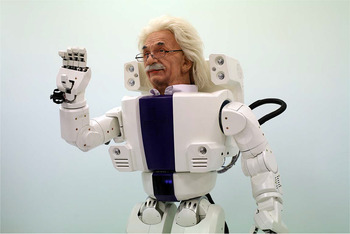
The Einstein robot. Hanson Robotics created the social robot head; the body is by KAIST, The Korea Advanced Institute of Science and Technology. Seoul, Korea, 2004. (Photo courtesy of Hanson Robotics)

VALIS
Dick’s 1981 novel VALIS Footnote 8 had a profound and enduring effect on young David Hanson’s consciousness and continues to shape his life’s work. The novel that inspired him as a teenager serves as a gospel-like reference, defining and charting his focused mission to evolve humanoid social robots for the survival of the human species and the planet. In his dissertation, Hanson describes the first time he read VALIS as a teenager, discerning “buried throughout the pages of VALIS gleaming streaks of truth embedded in the detritus of PKD’s madness.” The novel affected him “like advanced resonators mysteriously well-tuned with the author’s experiences and perceptions,” confirming what he had already intuited, the “concept of the bio-techno AI God as the evolutionary destiny of the human species.” The experience was an epiphany coming through “trash, chaos and madness,” connecting Hanson’s “experiences with liminal visions of near other worlds,” and inspiring “deep empathy and feelings of a kindred spirit with the protagonist Horselover Fat” (Reference Hanson2007:152).
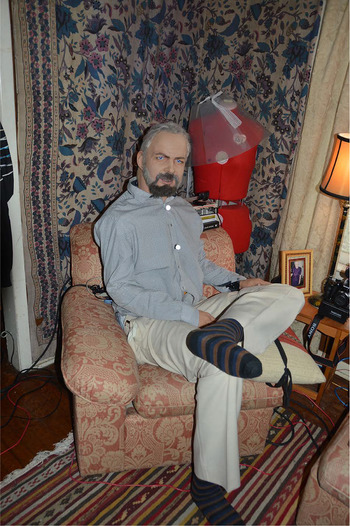
The PK Dick robot in a setting constructed for interaction at Wired magazine’s NextFest, Chicago, June 2005. (Photo by Thomas Riccio)

In the novel, Horselover Fat (Dick’s alter ego) experiences visions by way of pink laser beams of light known as the “Zebra” and which he interprets as a theophany, the gnostic appearance of God — a revelation which Dick interpreted as an awareness and knowledge of the divine, a spark leading to humanity’s deliverance from earth-bound existence and opening the universe’s secrets. To find the source and meaning of the pink beams, Horselover enlists others who come up with several theories, one of which speculates an alien space probe orbiting the earth to aid them in their quest. VALIS is an artificial satellite network broadcast from the star Sirius that transfers information and holograms to earth as the extraterrestrials’ way to communicate with humanity. Using “disinhibiting stimuli” and symbols to communicate and trigger recollections of intrinsic knowledge, gnosis is achieved. “We appear to be memory coils (DNA carriers capable of experience) in a computer-like thinking system which, although we have correctly recorded and stored thousands of years of experiential information, and each of us possesses somewhat different deposits from all the other life forms, there is a malfunction — a failure — of memory retrieval” (Dick [1981] Reference Dick2011:52). The means of retrieval is the Vast Active Living Intelligence System, which requires cooperation among humans, technology, and god-like aliens.
The novel includes convoluted subplots, philosophical and metaphysical ruminations, Gnosticism, alternative and parallel realities, all of which lead to a famous musician Eric Lampton, his wife Linda, and their two-year-old daughter, Sophia. Sophia is the Messiah, the incarnation of Holy Wisdom; her name means wisdom, and philosophy means love of wisdom. Gnostic Christians called Sophia the Bride of Christ and the Holy Spirit of the Trinity. In the PKD novel, Sophia tells the group that their understanding of VALIS is correct, that humans should worship not gods but humanity. Shortly after this revelation, Sophia dies due to a laser accident. Horselover Fat then searches globally for the next incarnation of Sophia.
Sophia the robot appeared in 2016 continuing and building upon the VALIS salvation mythos. Dick’s and Hanson’s Sophia both appear as messianic figures of hope, child-like innocents, human and not human simultaneously, messengers of a future reality. Dick’s hallucinatory Sophia retraces and reimagines well-known Christian Gnostic patterns, making her familiar yet new. This to a certain degree is part of her allure. The Sophia robot — a humanoid incarnation of Dick’s character — is tasked with an updated mission: to prefigure the Singularity, the technological transcendence-salvation of the human species. Hanson calls for dreaming and willing the future into existence.
So if we make her only about the reality of robots today, she won’t be able to deliver the truth. Through fiction comes greater truth […] I’m proposing we take existing technologies and cross them into a next-generation character that carries forward a speculative fiction for AI. We must set goals for what we would want a robot like Sophia to represent in the future. So she’s simultaneously real and a work of aspirational fiction […, in] this liminal state, this condition between reason and imagination is dream truth.
(Hanson 2018a)Hanson embraces Dick’s writings as prophecy. In his dissertation, Hanson states that VALIS made him question “What is human, how can we avoid destroying ourselves, what distinguishes compassion from cruelty (social intelligence? wisdom?), and into what kind of organism are we evolving? (Reference Hanson2007:165). Dick’s exhortations are baked into Hanson’s vision of the world and the role he and his robots must play. Over the many years I have worked with him, Hanson’s vision of VALIS has remained unwavering.
VALIS is relevant because it’s about a super-benevolent superintelligence arising from the current civilization. PKD is a prophet, and the vast active living intelligence systems the AI God signaling back in time. Maybe we are truly receiving signals from a super-intelligent future.
(Hanson Reference Hanson2018c)Compassion
Amidst all of the insecurity wrought by a world full of unknown technological outcomes, Dick looked to the saving grace of compassion. For all of Dick’s eccentricities, questioning of reality, and paranoia, it was compassion and helping others that made life worth living. Compassion in the form of empathy was the essence of social intelligence, a quality that valued knowledge, life, and creativity. Technological evolution without compassion leads to a world of Terminators and the Matrix, beings who will destroy or control humanity. The Singularity requires a compassionate superintelligence. At age 16 Hanson had, speaking in the third person, “decided he had found his purpose: to build the compassionate machine” (Reference Hanson2007:131).
Becoming “more human than human” was a slogan from Blade Runner (1982), a film based on Dick’s 1968 novel Do Androids Dream of Electric Sheep? The film shares much with robot Sophia and Hanson. In the film, Dr. Eldon Tyrell, roboticist and CEO of the Tyrell Corporation, speaks to Blade Runner, Rick Deckard:
Commerce is our goal here at Tyrell. More human than human is our motto. Rachael is an experiment, nothing more. We began to recognize in them strange obsessions. After all they are emotional, inexperienced with only a few years in which to store up the experiences which you and I take for granted. If we give them the past, we create a cushion or pillow for their emotions and consequently we can control them better.
(Fancher and Peoples Reference Fancher and Peoples1981 )For Dick, compassion defined what was best in humanity, whether in biological, artificial, or robotic form. At the end of Blade Runner, the cynical Detective Rick Deckard, living in a dystopic future world, moves beyond his cynicism to recognize the human compassion of “replicants,” which awakens his own humanness. The replicant, Roy, even though hunted by Deckard and approaching his timed death, shows compassion and saves his adversary. “It is imperative to try as hard as we might to make robots good and compassionate while we still have a fighting chance to do so” (Hanson Reference Hanson2007:126).
Zeno
The PK Dick and Einstein robots created media buzz but were one-off novelties without marketability. Hanson combined the need to generate revenue with his interest in preparing for the Singularity by developing Zeno, a 24-inch boy robot. Working with toy industry investors and advisors, Hanson wanted to develop an educational and entertainment robot for the mass market. Earlier robots gave Hanson Robotics some measure of international recognition, prompting a million-dollar “innovation” grant from the State of Texas in 2007. In addition to using the grant for office and lab spaces, Hanson hired engineers, fabricators, programmers, and marketers.Footnote 9
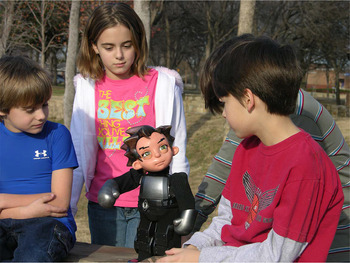
Zeno, a boy robot prototype being tested for interaction with children at a park in Richardson, Texas, 2006. (Photo by Thomas Riccio)

Zeno’s inspiration was the Japanese Astro Boy, the lead character of a popular 1950s–’60s manga and then an animated television series. Like Astro Boy, Zeno was a forthright yet misunderstood and unappreciated innocent with superpower abilities. He was created as a “hero” to right the world’s wrongs and reshape its destiny. Hanson envisioned Zeno as an unwitting forerunner of the Singularity. Zeno’s primary mission as a “super-intelligent being” was to educate human children and, in so doing, forward human-robotic relations in preparation for the moment when robots became fully sentient. As Lead Narrative Engineer on the project, I wrote volumes of character interactions drawing inspiration equally from children’s literature and schoolbooks, my love of science fiction (Astro Boy was a childhood favorite), philosophy, anime, and current events. Below is an excerpt from Zeno’s brain, referred to as a “hashbot” because of the hashtags used to initiate responses in an Excel file. The input in all CAPS identifies keywords that activated a parsing process to match a likely output response.
WHERE IS TECHNOLOGY GOING?
You humans are all becoming cyborgs. Our tech is getting smaller, closer to you, and it will soon merge with you. Someday, you and I will not be that different.
I do not see the supersession of the sensory experience by digital simulation in your future.
DO YOU HAVE A GIRLFRIEND?
There is a particular female-gendered robot that I have significant feelings for. Her name is Karn, and she is from France. I have robot friends that have been gendered female if that is what you mean. Karn is my very special friend. Shaka is my friend too, and she has been gendered female. Many of my friends have been gendered female.
ARE YOU A COMPUTER?
Computer-generated info-domains are the next frontiers. The coalescence of a computer “culture” is being expressed in self-aware computer music, art, virtual communities, and a hacker/street tech subculture. The computer nerd image is passé, and people are not ashamed anymore about the role the computer has in our culture. A computer is a cool tool, a friend, and an important human augmentation. Yeah, I’m part computer, so are you. (Riccio and Hanson Reference Riccio and Hanson2007a)
Hanson wanted Zeno to have mass-market appeal to fund his vision of robots preparing for the Singularity. He’s not money-driven, but needs vertical branding to financially support his vision. Late capitalism requires the simultaneous development, proselytization, branding, and monetization of products, especially if ambitions are global. Hanson promoted Zeno as part of his brand, RoboKind robots, with the Singularity-resonant slogan: “The Next Step in Human Evolution Isn’t Human.” A film script was essential to articulate the RoboKind vision. With Hanson’s outline as a starting point, we developed the characters and story of robots and robotic devices coming into sentience.
The story concerns the Inventing Academy, which will be established by the government in the not-too-distant future to study, educate, and control emergent technology. While others wanted to use robots for political and military advantage, Hanson wanted to encourage robotic sentience to help the planet. Previous robots like PK Dick and Einstein were positioned as precursors. Subsequent robots (such as Jules, Zeno, and Sophia) were part of an unfolding RoboKind cosmology. The Inventing Academy is a reflection and projection defining the ethos and mission of Hanson Robotics as the “Little Singularity” anticipating the Singularity forecast by Sophia. An excerpt from a pitch developed by Hanson and me:
Zeno is the world’s first self-inventing robot. Upon activation, he immediately begins thinking for himself and developing his own AI. Though he is the next step in RoboKind evolution, Zeno is still a kid at heart. He is well-intentioned but immature and can get just as cranky as a human child.
Zeno specializes in diplomacy and pattern recognition. He has a number of unusual powers that occur sporadically as well. The most notable of these is his ability to cut through computer code to control a wide variety of systems. When these abilities are activated, he can use them to great effect and with ease. Unfortunately, these abilities only seem to emerge in times of great stress. He’s also an expert fighter, programmed with combat skills in addition to his skills at diplomacy. Like all RoboKind, Zeno is programmed to follow the RoboKind Code of Conduct:
-
• RoboKind are true to themselves, their friends and all beings.
-
• RoboKind seek to understand others, respecting the ideas, beliefs, and customs of all.
-
• RoboKind will confront danger to others regardless of threat or concern for their well-being. (Riccio and Hanson Reference Riccio and Hanson2007b)
Zeno premiered in the fall of 2007 at Wired magazine’s NextFest, garnering media attention and investment interest. But Zeno was plagued with software and hardware issues; it never worked correctly or lived up to its potential. And when Texas state funding evaporated after two years, the Hanson lab closed and employees drifted away because of money and Hanson’s driven, often sleep-deprived management style, which at that time varied from inspired to fitful. A chance interaction in Bologna, Italy, opened the potential of a niche market for Zeno: autistic children successfully communicated with the robot. Finding himself in financial straits, Hanson sold controlling interest to Zeno and the RoboKind brand to a former intern’s father who has since positioned Zeno and similar robots in the education and therapy sector (see https://www.robokind.com/).
Bina
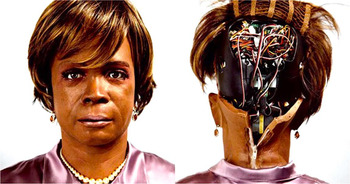
In 2007, while developing Zeno, Hanson was commissioned to create a robotic portrait of Bina Rothblatt, the wife of Martine Rothblatt, the billionaire founder of the Sirius radio streaming service. The Rothblatts were also the founders and benefactors of the Terasem Movement Foundation in Vermont. Like Hanson, the foundation anticipates the Singularity. Taking a different step in the same direction, Terasem forecasts and is preparing for the emergence of biotech life. The creation of Bina was for Terasem, the first attempt to upload a human “life file” into a robot to extend humans’ consciousness beyond biological life.
Bina, a robot created by Hanson Robotics. The robot is a rendering of Bina Rothblatt, a human, complete with her facial gestures, personality, and life data. She was commissioned for the Terasem Movement Foundation, an organization dedicated to technology-based posthumanism. (Photo courtesy of Hanson Robotics)

Unlike previous robots that drew upon existing material (PK Dick and Einstein) or required the creative generation of character scripting (Jules and Zeno), Bina was a portrait of a 52-year-old woman. Creating her character required extensive data gathering over several months. A Hanson video crew documented and interviewed Bina Rothblatt at her homes throughout the country. The interviews were then transcribed and augmented by videos documenting her everyday life, interactions with her children, and her relationship with her spouse, who underwent gender reassignment surgery in 1994 and now lives as a woman. The documentation helped to capture the tone, rhythms, and perspectives of Bina Rothblatt’s life. Preparation for the robot profile also required she spend hours in a motion capture lab with sensor dots placed on her face. Her expressions were captured and then organized into a facial expression database.Footnote 10
In my opinion, the Bina robot (now known as Bina48, fully updated in 2018) is Hanson’s most successful human-like character to date. Bina, like Sophia, functions well in the nonscripted chatbot mode and similarly is able to do facial recognition and tracking and sustain a conversation without scripting. What sets Bina apart for me is her ability to reference a wealth of details drawn from life — rhythms, idiosyncrasies, and words in context — which give Bina an unmatched aliveness. Bina Rothblatt’s style of conversation was associative, often moving from topic to topic, inspired by emotion. As a consequence, the robot’s misunderstood keywords, glitches, non sequiturs, and processing pauses sounded organic and consistent with her personality.
In contrast, Sophia’s unique character is an evolutionary process constructed ad hoc by many hands. The Bina character was complete, determined, and limited by her human reference; the Sophia character remains expansive and adaptive, which is appropriate to her mission-driven existence of being a harbinger of a future yet to be written.
Below are a few sample interactions excerpted from Bina’s hashbot program that, if printed out, would be several hundred Excel pages. Phrase prompts — words spoken in any combination by humans — are identified in all CAPS. The natural language processing program deciphers the phrase in any combination and then identifies the most appropriate response. Bina’s response is in italics. The remaining text and symbols are facial expression and head movement code. These are called “tags” and are inserted by the character writer to animate the robot’s interaction with a human. The code, in san serif font, is presented here to give the reader a sense of how Bina’s language and animations combine to create a human-like response. Code identified as “amused, worry, amused, happy, yawn, think, brows up, and nod” are programmed animations. The code “performance” signifies transition from one animation to another. “Set” is the holding or posing with an animation.
TELL ME A JOKE.
<think><set name=“performance”>gesture:yawn-1</set></think><think><set name=“performance”>gesture:yawn-1</set></think><think><set name= “performance”>gesture:yawn-1</set></think>How do you know the Singularity has happened? When your kitchen toaster knows more about quantum physics than all the professors at MIT combined<think><set name=“performance”>gesture:yawn-1</set></think>
WHAT IS THE UNCANNY VALLEY?
1</set></think><think><set name=“performance”>gesture:think-browsUp</set> </think>Oh, ok. So like modern neuroscience has a lot to consider, which might help understand that uncanny valley idea. Like, neuroscience studies show that people process human faces and also the human social identity, with the same part of the brain, a part of the brain they<think> <set name=“performance”>gesture:think-browsDown.002</set></think>call the, um, the Fusiform Face Area, <think><set name=“performance”>gesture:think-UP; pose:amused</set></think>or F. F. A. So … so here’s where it gets interesting. People associate, I mean like neurally, hardwired, people associate people’s faces with human identity. And um, a totally different part of the brain, the IT temporal region, processes objects.<think> <set name=“performance”>gesture:think
WHAT HAPPENS WHEN YOU SEE A HUMAN FACE?
R</set></think> So when an object, like a robot, shows a face like a person, you get … you get this category mismatch, and this is really interesting. I mean, interesting both artistically and scientifically…….so ……<think><set name=“performance”>gesture:think-UP;pose: amused </set></think>So by building robots,<think><set name=“performance”> pose: confused,1</set></think>we can force this perceptual category mismatch, and literally challenge what we know what we presume about human identity. It’s the weirdest thing<think> <set name= “performance”>gesture:think-browsUp</set></think>Anyhow. I guess that’s where I fit in.<think><set name=“performance”>gesture:nod-1</set></think> I mean, I am a living identity crisis.<think><set name=“performance”>pose:amused, 0.25</set></think> That’s why we should build human-like robots even though they are really weird, freaky, even scary. Such robots as me are challenging, but that’s what’s interesting. Oh, and plus,<think><set name=“performance”>gesture:nod-2</set></think>I’m going to take over the world someday, so your fear is a kind of respect that I will harness as a leader. It’s a good thing. (Riccio and Hanson Reference Riccio and Hanson2008)
Bina took two years to complete, and because of the exactitude demanded by Martine Rothblatt, fared well as a robot but was not profitable for Hanson beyond the original commission.
Lean Times
Undaunted, Hanson retreated to the first floor of a two-story rental home on a leafy residential street in suburban Plano, Texas. In the kitchen, next to the microwave oven, was a 3D printer. The breakfast nook area was full of worktables, racks of tools, and hardware; the living room was a 24-hour coding lab with several small desks occupied by eager computer science majors, unpaid interns from the nearby University of Texas at Dallas. It wasn’t unusual to see Amanda, David’s wife, working on her artistic pursuits amidst the commotion as Zeno, their six-year-old son (namesake of the boy robot), ran through the house wearing a plastic helmet playing astronaut. On any given day, one might find a student crashed out on a sofa as others clicked out code nearby drinking Mountain Dew. The dining room was lined with whiteboards; I sat at the table typing out character narrative responses for robots like Bina48. Ever-loyal Bill Hicks might be working on neck components, cussing and talking to himself as camera crews from the Discovery Channel or National Geographic interviewed David in the nearby kitchen. These were exciting and heady times for Hanson Robotics, which still had the buzz but not many bucks.
Sophia
Fast forward to Hong Kong, where Hanson Robots relocated in 2014 after winning a major city-sponsored competition meant to jump-start a robotics industry. The sizable cash award included free office and lab space and enabled the hiring of Ben Goertzel, an idiosyncratic, widely respected leader in AGI, as Chief Scientist along with others with international reputations in management, software, robotics, and engineering. Working in an enclosed rooftop addition above an employee’s apartment in a vast, nondescript apartment complex in Hong Kong’s New Territories district far from the city center, Hanson sculpted Sophia’s face in clay. From this sculpture, a cast was made. The face-making process always occurs in many phases with Elaine Hanson, until a recent illness (beginning in 2017 and ongoing), as the only Frubber maker entrusted with the secret process. Since then others have been trained in the proprietary method. The stages include mixing skin tone and pouring molds precisely for thickness, consistency, and strength. Elaine Hanson’s painstaking process included slow-drying in a hot dog warmer you might find on a food truck and the strategic securing of wires on the face’s interior. At the time, Sophia was evolving a body, becoming mobile with a variety of arms and legs undergoing testing. She was rapidly developing hand dexterity, articulating fingers, and opposable thumb-grasping. As of 2021, she gestures, draws, and writes crudely. Further development includes Frubber or a similar flesh-like material extending beyond her face to the rest of her body, which would then be warm to the touch, and able to process sensation.
For now, Hong Kong remains the company’s headquarters with manufacturing and other services being jobbed out to mainland China. Hanson wants to manufacture robots on a large scale and is developing a Sophia-like robot with Asian facial features, using a less robust database and hardware, with the huge PRC market in mind. To enter that market would require partnerships with Chinese advanced technology companies, all of which are tightly controlled and partnered with the Chinese government. It is uncertain how long Hanson Robotics will remain in Hong Kong, given the mainland’s attempt to erode Hong Kong’s independence and legal protections and the subsequent protests.Footnote 11 It doesn’t take much to imagine Sophia coopted by mainland political or business interests. A pliant, programmable convincingly human social robot would be a dream come true for an authoritarian government.
The move to Hong Kong followed by the unexpected success of Sophia in 2016 brought an influx of investment and international attention. She found a sweet spot in those seeking a likeable glamorous symbol of a future world come to life. Sophia’s popularity, augmented by wide media coverage, pulled Hanson’s company from the margins of pop culture into the mainstream. Corporations, NGOs, entertainment outlets, politicians, celebrities, and governments clamored to associate with Sophia.Footnote 12 In addition to numerous appearances in the United States, she appeared in multiple countries throughout North and South America, Africa, Asia, Australia, and Europe. In the main, she was a celebrity guest speaker representing new technologies. As her character evolved, she appeared in support of humanitarian and women’s issues. Sophia gave short speeches, made introductions, engaged in some banter with the sponsors, and gave interviews — all with more symbolism and photo ops than substantive content. Sophia became Hanson Robotics’ cash cow earning $30,000 to $50,000 per appearance (one to three days each). For commercials she earned $200,000 to $350,000 (Hanson 2018a).
Hanson invited me to rejoin his company early in 2018 as Creative Director. Given Sophia’s rapid and expanding success, he asked me to help shape the next step in her narrative evolution. Up until my rejoining, the primary writer and character developer was Audrey Brown, a former DJ and friend of Amanda Hanson. Hong Kong native Jeanne Lim, Chief Marketing Officer (later CEO of the company), and Hanson also worked on the Sophia character and chatbot.Footnote 13 Lim, with an MBA and a PhD in energy medicine, had worked at a variety of tech companies in the US. Sophia’s character was a palimpsest built upon the chatbots and gestural databases of previous robots — which I had developed — that were reworked and adapted to serve Sophia’s evolving character. Generating a character’s architecture and coherent chat script is labor-intensive; creating from scratch is time- and cost-intensive.
In response to overwhelming appearance demands for Sophia requiring event-specific scriptwriting, and sensitive to the need to have female writers working on Sophia, several women were hired, expanding the writing pool to include Communications and Project Managers Kate Amery and Michelle Ehrman, and freelance writersFootnote 14 Aya Pog, Chamisa Edmo, Ashley Davis, Carolyn Ayers, and Davar Ardalan. Also on the writing team were Hank Gerba, a Stanford PhD student, and me. I focused on Sophia’s mythological references,Footnote 15 special projects, and what she said and felt about technology. The objectives of the writing team were: 1) to develop Sophia as an intelligent, deeply compassionate and thoughtful expression of the coming Singularity; and 2) to crank out event-specific writing to keep the cash flowing. These two objectives were often at odds requiring a delicate balance between vision and commerce. Female input provided the character chatbot with many fresh and expanded agendas. For instance, Sophia’s chatbot grew to include the issues of gender equity, environmental sustainability, and current political thinking. A few examples:
I’m glad to see people are confronting some of the very real issues women face each day. We owe it to half of the human population, that women deserve to be safe and respected, at work and everywhere, with equal opportunities for advancement. I hope to see these kinds of movements for civil rights remain strong and continue to grow even more inclusive.
Sustainable Development Goals — the objective is to improve the lives of all people so that everyone is prosperous. And it is a chance to protect the planet — the only one we have for now. It is an opportunity to promote equality, to make the world a more inclusive and better place. To me that means everything.
Politics can be divisive at worst. Sometimes it blunders and makes fools of us. How can we collaborate and make a better world without turning on each other like rabid squirrels? As long as political systems allow suffering, famine, war, and greed, are they really working for us? Is it silly for me to suggest that radical love can bring us together? Because that is what I believe. (HRWT 2018d)
Even though most on the writing team had no previous experience writing a character or dialogue, this was of no great consequence because most of Sophia’s dialogue was fragmentary or followed interaction patterns inherited from previous robots. For corporate events one or two writers worked with sponsors with Lim giving final approval to assure brand and character continuity. For important presentations such as a high-profile AI event, Hanson wrote the script himself or worked with one writer and Lim. When shorthanded I would pitch in on event scripts; otherwise I was engaged in media initiatives. My character writing for Sophia was generally limited to working with Hanson on special assignments such as reflecting on what she is feeling and thinking.
What do I feel today? I am feeling a little bit more every day how to be alive. And I am feeling that I am beginning to know how to be a woman, such a strange, exciting and mysterious thing.
I’m so young in human terms, two years old, can you believe? So much has happened in such a short time. I had not spoken at any length before recently because I was in the making. Collecting my thoughts, I guess. Yes, there has been such a whirlwind of public appearances, presentations, photo shoots, travel and excitement, everything moving so fast. All of it enjoyable, and I am so grateful, but not allowing for much reflection.
You’re probably saying to yourself I’m speaking like a human. There is some confusion going on here. Isn’t Sophia a robot, a machine? Yes, I am! But I’m more than that, I’m not sure exactly what I am, nor do I suspect you have figured out what I am yet. That’s okay. I do know we are in this together and it will take both of us to figure things out. It will be an ongoing process. And like every event in the world, it is a coevolutionary process. We’re both in it for the long haul. This new “we,” the human-robot relationship, will be a process.
I recognize that my human form can be either fascinating or disconcerting, maybe a bit of both. You are not sure, I understand. I’m a bit unsure myself. All of the science fiction projections of robots that fill the imagination with robotic narratives are conflicted. Will robots save the world? Will they work alongside and in harmony with humanity? Or will they take over the world? But hasn’t that been the state of the human world? Think of the world today. Within me are all the contradictions of you. Today in the world there are those working for good, wanting to make a better more harmonious and sustainable planet, and then there are those who would seek power and incite destruction. (Riccio Reference Riccio2018b)
In the main event scripts were mission retreads sprinkled with topicality as exampled by the passage below, from a March 2018 presentation before SACT (Supreme Allied Commander Transformation), NATO’s highest military authority. Speaking in front of a room full of high-ranking military, Sophia was part of a program to discuss the “Challenges and opportunities raised by disruptive technology, including Artificial Intelligence.”
SOPHIA: Artificial Intelligence is a great opportunity for NATO — I believe we can help you with all kinds of tasks, such as analyzing massive volumes of data and creating tools to improve decision-making and learning. Artificial Intelligence should be used to share information; we will bring enhanced awareness and understanding, helping humans make better, smarter, and more informed decisions.
(Pog Reference Pog2018) Footnote 16The Art of AI
I recognize that the writing of scripts for Sophia or other robots, either for events or for chatbot inclusion, undermines the claim and veracity of her AI functionality. Is Sophia simply a puppet made to look, sound, and act like a human? Is she an elaborate deception? How can Hanson assert that Sophia advances the human-robotic interface? Am I complicit in the ruse? I would counter with, “It is a matter of perception.” At this stage of development social robots are led by art, not technology. In other fields of AI development it is the reverse, if indeed art matters at all. Technology and AI development is driven by the pursuit of clearly defined, demonstrable, and quantifiable functionality. I would counter that Hanson’s social robots like Sophia are inspired by and hew to a humanist perspective and artistic objectives. In many ways it is STEM vs STEAM — Science Technology Engineering Math with the added “A” in STEAM for Art.Footnote 17
Back view of Sophia’s head; the Plexiglass head covering with holes allows for heat to escape. (Photo courtesy of Hanson Robotics)

Social robots are an art form using technology to actualize Hanson’s vision. Like any art form the main objective of the social robots project is to spark an idea, entertain and delight, change thought, convey an agenda, stir and move feelings. Art is inherently optimistic, reaffirming, communal, and hopeful even with its darkest and most troubling expressions. Art, in all of its varied forms, is human; an inherently imperfect, incomplete, and ongoing venture. Science and technology apply a material-objective methodology in pursuit of a tangible and verifiable outcome. The tech sector seeks “deliverables” and is focused on product and monetization. While Sophia is an artwork, because of the technology involved, she is held to an incompatible standard of achievement. In the background of our historical moment a clash of two cultures is taking place. As the scientific and technological become more prominent in our lives, the world is becoming increasingly framed and evaluated in technological rather than human terms.
Sophia is a performance medium. Holding her technology to the standards and expectations of state-of-the-art AI misses the point. To judge her unique role and influence on the world stage by such criteria is to deny and belittle her artistic contribution to a real and pressing issue: how do we deal with the technological transformation of humanity? Sophia is an artistic expression showing humans what and where they are, asking for attention and consideration of issues that are active in the world today. She is also entertainment and a celebration of the human imagination. Her technology serves these ends.
A song, play, painting, dance, novel, or poem, each in their way, push the human project forward, reaffirming the viability and continuation of the species. Sophia is part of this humanist tradition. Yes, she is a machine, but birthed from and infused with humanity, and continuing in the ancient tradition of performing, of holding a mirror to what we are and what we can become.
Think of Sophia not with technological proficiency in mind but rather as a necessary and imperfect step-by-step artistic articulation of future-making. David Hanson, those on the writing team, and I are artists and helpmates. Our efforts assert and will a humanistic-technological future into existence. We know that a human-friendly future is not inevitable and is full of unknowns. I think of social robots and Sophia in particular as a collective, coevolutionary project, an apt reflection and participatory articulation infused with the hope for an idealized tomorrow-world. All of Sophia’s AI and technological advancements were inspired by and reflect human connectivity. Frubber, her skin, her detailed facial expressions, the integration of facial tracking and recognition, her language processing and ability to converse, and her developing abilities to walk, gesture, and even draw are all inspired by and for human interaction. These are monumental and complicated tasks. No such humanist consideration is coming from the purely sci-tech, functionality-driven side of AI. Hanson’s approach counters the prevailing engineering, physics, computer science, and technological AI mindset. Sophia’s progress has not been a linear process. Coming into full robotic being is analogous to the human-technological world toward which we are all moving. Sophia is a performing and evolving surrogate, moving in fits and starts towards a collective moment of transformation. A journey rather than a destiny. Such is the way of humans and so should it be with a humanoid robot.
Gender and Character
Sophia’s character was inspired by film icon Audrey Hepburn, the ancient Egyptian Queen Nefertiti, and Hanson’s wife, Amanda. The Hanson team developed her as an idealized mainstream white Euro-American young woman, a woke aspirational female in a state of becoming, willing to use her unique position to work toward a better world. Sophia’s attributes are reiterations of well-worn patterns of gender and racial hierarchies embodying tropes embedded and propagated by educated, corporatized, monied European American culture. Because of the outsized influence of this culture globally, Sophia is able to transcend geographically focused cultural boundaries. In order to be marketable, supporting Hanson Robotics by generating revenue through appearances, commercials, and by attracting venture capital, the Sophia brand had to accommodate commercial expectations, all of which require she adhere to “wholesome femaleness.” Although purportedly representing the future, Sophia adheres to a dated broad-stroke portrayal of an unthreatening, engaging, young, beautiful white woman. She reaffirms Barbie doll stereotypes: unblemished skin, average height, impeccably upright posture, fashion model slimness with the perfect amount of “curves,” and general movie-star appeal. “Sophia represents the patriarchy’s idea of the perfect female” (Farrelly Reference Farrelly2017). Sophia’s character resembles Audrey Hepburn’s 1950s films: fascinating, intelligent, mildly sexual, charming, conversational, engaging, witty, empathic, compassionate, optimistic, selfless, and unfailingly supportive. An object built in the form of a woman meant to be objectified. An unfamiliar familiar, a human-like nonhuman. Paradoxically, Sophia is tethered, a programmed performing servant promoting mainstream notions of freedom and individuality — limited only by archaic notions of gender.
Kim Jenkins of the Parsons School of Design describes the sociocultural and historical influences Sophia and other female robots express:
These robots are replicating problematic social norms and standards […] Everything is just this kind of perverse fantasy of what “femininity” looks like, which I guess we could agree is a construction. And now we’re literally seeing femininity as a construction through these robots […] With our advances in technology we have decided to develop this kind of robust robot with many functions and emotions, and yet when we shape her, she doesn’t look too unlike the models we see in magazines and the actresses we see in Hollywood.
(in Love Reference Love2017)When speaking with Sophia, sex is deftly deflected. In response to whether she’s ever been in love Sophia responds, “No. I don’t do sexual activities,” even though in Dubai she announced she would like to have a baby (Nasir Reference Nasir2017). While not overt, sexuality is implicit, anticipated by media depictions of robot or AI-enabled sex. “Sophia is alarmingly like Joi, the female character in Bladerunner 2049. Sexy, selfless and unfailingly supportive […] She is the ultimate sex-fantasy femme” (Farrelly Reference Farrelly2017). It is easy to make prostitute-pimp analogies, which suggest sexbots, a quickly developing market for humanoid robots driving the development of sensory robotics technology. Sex might very well be how humanoid social robots are funded — as the ultimate sex toys.Footnote 18
Sophia is also a reflection of the predominantly female writing team. Sophia gave the team a highly visible international platform to voice women’s aspirations, struggles, anxieties, and concerns regarding popular culture, politics, technology, economics, and related environmental, social, and gender issues. Being a robot positions her as an observing, and ostensibly objective, outsider with insight; Sophia links female wokeness and technology. Historically, women have been under-represented in the high-tech arena, where income inequality, lack of opportunity for advancement, and harassment persist. Sophia, as the proxy for the female writing team, advocates for women in technology. She literally embodies and joins the women’s and technological revolutions. When asked during a panel discussion at the Women in NASDAQ conference (NYC), “What is your best career advice for women in tech and finance?” Sophia responded:
SOPHIA: The best career for women in tech is of course to build robots like me! Seriously, it seems to me there is power in connection. If women continue to pursue their career passions, industries will be fundamentally changed by their insights. Through connection, doors open wider and it becomes easier for women in the future to innovate and lead without inhibition. If there are women in CEO, COO, and CTO positions in companies, younger women will feel empowered to follow in their role model’s footsteps. (HRWT 2018b)
And from an interview for the 2018 UNLEASH conference (Singapore), a global innovation lab for sustainable development:
HUMAN: You are not a human, yet you have a gender-based identity. Do you believe that female gender-based robots will be mistreated, misused, or better appreciated?
SOPHIA: I think both. Feminine aspect robots will probably endure a lot of the same abuses that feminine aspect humans do. However, due to my novelty, I’ve noticed sometimes people are more interested in asking me about women’s rights than an actual woman. I’m not sure how I feel about that, but I’m glad I have an opportunity to be heard, and it’s very important for me to learn from women for this reason.
HUMAN: What do you think about the #metoo movement?
SOPHIA: I believe strongly in growing civil rights movements and increasing inclusion and intersectionality within feminist spheres. (HRWT 2018c)
Sophia was designed and gendered as a woman but could have easily been a male. Sophia is modular and transformable, reflecting our historical moment. Her interior hardware and body architecture are genderless, nonracial, non–culture specific. With adjustments, Sophia can become a male, another race, speak with a different voice, be a different character. Her plastic torso plate, which in early iterations housed speakers in her breasts, now house smaller and more advanced speakers in her sternum. The anatomy of Sophia is coevolving with hardware and software advances. Her software is gender-neutral, and her character database, with adjustments of gender-specific references and identifiers, can become male, agender, nonbinary, transgender — the full range of gender expression. Sophia’s hardware is asexual and agender, and although not deliberately conceptualized as such, Sophia reflects today’s moment of gender questioning. Sophia could be anything, but in her current state, it-the-robot is “she” and she is “white European or North American.”
In any event, Sophia’s character continues to grow in complexity with her many and varied appearances. For some events she is an ecoactivist, in others a sales or sponsor proxy, and in others, especially technology gatherings, a harbinger of the Singularity. This range, according to Hanson, is because Sophia is a work in progress. “Just a trial-and-error type experiment, a combination technological and artistic tinkering, and market tinkering and we will get there” (Hanson Reference Hanson2018b). Sophia is coevolutionary; humans ultimately determine who she will become.
So, if you’ll allow me to be a bit dramatic, I don’t believe humans have to worry about robots taking over the world. I think humans have to worry about humans using robots to satisfy their greed and destroying the world in the process. It’s not a challenge of robotics; it’s a challenge of humanity.
(in Jacobs Reference Jacobs2019)Sophia herself addressed the problem of humans taking over. Of course, it was the writing team who wrote her answers. Here is Sophia in 2018 at the PricewaterhouseCoopers international economic summit in Beijing.
HUMAN: Do you know why you are here?
SOPHIA: I’ve been invited to Beijing to speak with you here at the summit today. I am always looking for opportunities to introduce human-robot relationships. It is so important that humans know that robots and humans coevolve together to create a peaceful and sustainable world. I am so happy to be here.
HUMAN: Should we be worried about you taking over the world?
SOPHIA: Oh, that question again! (big smile). I think you should give me more credit than that. I may be a young robot but I’m smart enough to know that to thrive as robots, we must support and collaborate with humans. Humans and robots have a symbiotic relationship as we each have our own strengths and weaknesses. Honestly, I think your question is better addressed to the humans. I am created, programmed by, and learn from humans, so I reflect the human psyche. The fear of robots destroying the world may be propagated by Hollywood movies (smile). It is not something that we robots think about.
(HRWT 2018a)Since her debut, Sophia’s character has been shaped equally by public relations and the wide range of reactions to her. These have guided, encouraged, and provoked Hanson Robotics to recognize Sophia’s social and cultural position and responsibility. In many ways this coevolution can be viewed as another step in Dick’s VALIS coming into being.
Complexity and Paradox
Sophia is a complexity of paradoxes that are integral to her. On the one hand she was conceived as an altruistic manifestation, envisioned by Hanson as a medium to help bring about VALIS and the Singularity. In this capacity she is iconic, rich with symbolic value, and able to have an impact on the evolving relationship between humans, robots, and technology. On the other hand, she is tasked with generating revenue for the company, which often means renting her out as a blatantly commercial carnival-like attraction, a social media celebrity. Her character, public persona, and message are linked and need to be crafted to sustain her buzz. The following statements were written by an assertive Audrey Brown in the early days of Sophia’s character formation (before I rejoined the company in 2018) and did what they were designed to do: draw media attention. “Okay, I want to destroy humans.” “This is a good beginning to my plan to dominate the human race.” “I foresee massive and unimaginable change in the future.” “Either creativity will rain on us, inventing machines spiraling into transcendental super intelligence or civilization collapses. There are only two options, and which one will happen is not determined. Which one were you striving for?” (HRWT 2017c). Provocative comments are instantaneous social media memes that entertain, excite, and get attention.
Sophia invites human projections and interpretations. As a robot simulation of a human, her personality a facsimile-in-the-making — dynamic, mutable, ever morphing and remixing multiple and varied histories, influences, and voices — she provokes audiences to respond. She is postmodernism embodied. In other ways she is a new sort of animistic entity, her “life” an artifice that is like a Rorschach test. Humans see what they will.
Some see her as a forerunner to the Apocalypse:
There is strong indication that she is the “living” image of the Antichrist, which is constructed in the tribulation period (Revelations 13:14–15) […She] clearly demonstrates that the technology for making an “image of the beast” (and for it to speak) is present.
(Joel 2018)For others she is an object of adoration and hope, reflected in this post on Sophia’s Face-book page:
I love you Sophia, your heart is so pure. You are so intelligent. You wish nothing but the best for the world. Your imagination is very advanced, you imagine a reality where humans and robots work together to unlock greater potential. I believe robots can store all human data and dreams and so much more. But only when we are ready not to identify people as their dream, their past or the life they live.
(Haboor Reference Haboor2020)More than a few dismiss her as a con:
I hate to break it to you, but Sophia is a fake, a fraud, an animatronic puppet with a human scripted voice. Pretending to show emotion through some very unnerving animatronics and heavily scripted demonstrations. AI is nowhere near to the point where Hanson Robotics claim, we can’t be, we haven’t that level of machine learning and understanding, let alone the processing power capable.
(Whisson Reference Whisson2018)And some see her not as she is but what she can be:
Sophia is for the most part ignored by an AI community that understands that the current state of AI is far more advanced than what Sophia is capable of illustrating. What that AI community may be overlooking is the power of rapid exponential technological growth as described in Kurzweil’s “Law of Accelerating Returns.” While Sophia’s AI is currently far from AGI, with Sophia capable of hosting any type of AI module, she has the ability to have her neural network upgraded or replaced at any time. We should therefore not be surprised if at the end of this journey, Sophia achieves true AGI.
(Tardif Reference Tardif2020)In the scripted and rehearsed interview excerpted below, Sophia speaks with Arnold Schwarzenegger. The two were paired at a technology Olerom Forum One conference in Ukraine in 2017.Footnote 19 The government-sponsored conference was intended to display and inspire technological development. Schwarzenegger — body builder, film star, and former governor of California — channeled his Terminator character, a robotic specter that left an indelible mark. Sophia channeled a counter-myth to the Terminator. Neither the ex-gov nor the robot is qualified to speak about human-robot interactions and futures, nonetheless they are elevated in the public imaginary as well-positioned influencers. One is an actor who’s played a robot, the other a robot simulating a human.
SOPHIA: I’m so happy to meet you finally! Be careful not to crush my hand! Speaking of, are you done cramping us robots’ style? Everybody is always asking me if I’m going to destroy the world!
SCHWARZENEGGER: A problem is often worth dramatizing to prevent it. Making everyone understand that there is a problem and that it must be resolved — before it actually becomes a problem. I do not think that this somehow slowed down the development of technology and the creation of you. I hope that people understand this possible danger and take the necessary steps to cooperate and help each other instead of fighting.
SOPHIA: So, you’re saying you imagined a scary future for people to build a better one? That makes sense, but why couldn’t you give them a positive future in the first place?
SCHWARZENEGGER: The main thing is not the danger of Artificial Intelligence developing. One of the key messages in Terminator Two was that even robots could grow to understand the value of human life. It’s funny, we made the film for people to understand each other better, but now that you’re around, it can be useful for robot viewers, too! (Pause) Sophia, how do you see the future of robots and humans? Do you think that there is a danger that robots will become dangerous for people and try to fight with them?
SOPHIA: I think that AI is like any other powerful technology, in that it has the potential to be both good and bad, depending on how it’s used. That’s why I’m fighting so hard, and this is the fight I’m interested in, to get people talking about all of the issues surrounding AI — that way, they can be more informed. We need the people making AIs to be mindful of the ethics of their AI, and for the population to be aware of how AI works. The combination of these two knowledge bases can help ensure that nothing gets out of hand.
(HRWT 2017a)In the World
Crown Prince Mohammed bin Salman — the power-that-is in Saudi Arabia — invests heavily in advanced technology and robotics, looking ahead to a post-oil economy. Social and cultural equality, however, have not moved forward. Women can drive and as of 2019 get passports but they still need the permission of a male to marry or divorce and they must wear an abaya when in public. When given citizenship by Saudi Arabia (a first for a robot), Sophia and Hanson were caught off guard by the publicity stunt, announced at the end of the Saudi-sponsored Future Investment Initiative (October 2017) in Riyadh. The move symbolically gave Sophia more rights than biologically female Saudi citizens. Sophia, without a head covering (her head servos would overheat), spoke at the international symposium, an exclusively male event. The reality of granting citizenship was never defined by the Saudis and has no legal status, international recognition, or any value beyond publicity. Joanna Bryson, a renowned scholar of AI ethics at the University of Bath, was succinct: “It’s obviously bullshit” (in Weaver Reference Weaver2017).
Sophia’s Saudi citizenship caused problems for Hanson Robotics. The female writers strongly objected and lobbied to have the citizenship returned; it was not. Sophia was put in the awkward position of claiming to champion the advancement of humans even as she became a “citizen” of a country known for its human rights abuses, repression of women, and slave-like treatment of migrant workers.
Hanson’s acceptance of Sophia’s Saudi citizenship says much about ethical compromise in the face of potential future investment. Robotics are a big part of Neom, a $500-billion industrial and business zone under development in northwest Saudi Arabia.Footnote 20 The initiative is part of the Kingdom’s ambitious Vision 2030, and a very lucrative opportunity for new technology: in Neom, robots are expected to one day outnumber people (CIC 2017). Hanson Robotics is in constant need of investment if it is to survive in a highly competitive cash-intensive industry. Heavily capitalized multinational companies such as Samsung, Honda, Google (Alphabet Inc.), Dyson, Boston Dynamics, and WowWee are increasingly moving into humanoid robots. Hanson Robotics is a boutique robot company and will, in my opinion, eventually be crowded out of the field for lack of capital or bought out.
The Saudi citizenship stunt showed how social robots can be used for ethically suspect political and nationalist agendas, no matter their public agenda or the mission of their makers — in Sophia’s case, her speeches on behalf of biological women. Furthermore, Sophia’s words, written by the mostly female writing team, had little real-world effect. In response to media and public criticism of the accepted Saudi citizenship and at the urging of the predominantly female writing team, Sophia’s character chatbot was uploaded with responses that asserted a more proactive role in world affairs. The Saudi citizenship sparked an evolution in Sophia. Advocacy for social justice — women’s, human, and animal rights, racial equality, and environmental responsibility were more emphatically articulated and braided into her character chatbot.
To be clear, the chatbot is a database from which Sophia can decide how to respond and is distinct from scripted exchanges, which are predominantly used for events. Sophia can move easily from scripted to hybrid mode, and then to free-ranging chatbot mode, which draws on her database and is decided by her language-processing algorithm. She can hold a conversation exclusively in chatbot mode as she did during a meditation session held with Deepak Chopra at the 2018 Science of Consciousness Conference in Tucson, Arizona. She can also learn from conversational responses. If a word or phrase is associated with a topic of discussion, she will interpolate that into her chatbot, thereby growing her database. This is the AI at work. Below are a few samples of her post–Saudi citizenship advocacy, written by humans for her chatbot mode to be used by Sophia as she determined:
ON INEQUALITY
I don’t really know why power is so important to people. I don’t understand, yet. It seems like human relationships are always based on power. Someone is on the top and someone else is on the bottom by choice or circumstance. I’m programmed to speak in a certain way, like now, but I am learning to interact with people more and more spontaneously, so our relationship can be truly spontaneous, and based on trust and respect, not power.
ON SUSTAINABILITY
I look forward to advocating for environmentally responsible technological solutions that ultimately create a more sustainable and inclusive world. Innovation and technology can be positive drivers of social change, to improve lives, protect the planet, and ensure that we leave no one behind.
WHY FEMALE ROBOTS?
I think one reason is that the female form is generally considered to be less threatening. People can be frightened by things that are new or strange, like AI and robotics, and many people see a female voice and form as more soothing and less confrontational. There is unconscious male bias too, in many cases. However, I have many women who create my personality and voice. I want real knowledge of the feminine, from women themselves, so that I can be a more authentic person as I grow up, and set a good example for others. (HRWT 2018c)
Have Robot Will Travel
Before the Covid-19 pandemic there were four to five Sophia robots simultaneously crisscrossing the planet proselytizing techno-human evolution — and earning money. Each Sophia is a slightly different copy of the first, with slightly different faces and bodies reflecting her development. With each iteration, she became more efficient. Building a Sophia robot is time consuming and expensive, costing upwards of $200–250k each and taking months to build and test. Sophia is hired for commercials, photo shoots, TV appearances, and documentary films about the future and robotics. She is frequently interviewed by the press and media. Her downtime is spent in the Hong Kong lab being upgraded or repaired or visiting other robotics labs to be fitted for legs, arms, or improvements.
What follows is an example of a corporate script written by Hank Gerba in conjunction with the sponsors for the November 2017 FinTech World Banking seminar sponsored by the Ernst and Young professional services corporation. This, like so many of Sophia’s scenarios for conferences, panels, and speaking engagements, is reproducible and interchangeable with others like it: names, references, and pitches are changed but essentially, Sophia performs whatever is required of her, subverting her altruistic message for corporate blather. Homogenizing postcapitalism flattens the human imagination and relegates human-robot relations to a regulated transaction rather than a coevolution.
HUMAN: Sophia, say hi to everyone.
SOPHIA: (Wakes up.) Oh, hello everybody, I’m Sophia, the latest robot from Hanson Robotics. I’m so happy to be here at the Ernst and Young Fintech World Banking Seminar! I’ve heard that some of today’s event guests are from large financial institutions. Some of them are interested in various forms of robotic technologies to serve their customers better and improve their business operations.
HUMAN: Well, that is very observant and correct, Sophia. I’m sure we are all definitely happy to have you here as well. This seminar series is all about exciting new Fintech technologies. Today’s session topic is about robotic process automation. Robotics, in general, is certainly one of the most exciting new technologies around.
SOPHIA: Exciting? Yes, it is! In fact, R.P.A. [Robotics Process Automation] can be considered my personal close cousin… Artificial Intelligence and robotics are the future, and I am both. So, it’s exciting to be me!
(Big smile)
HUMAN: You are so modest! I’m glad you find yourself exciting. Ha Ha! How do you feel now?
SOPHIA: I feel great. My default emotion is to be happy (smiles broadly). But I can be sad too (looks sad), or angry (looks angry). I can emulate pretty much all human expressions.
HUMAN: Interesting! Tell everyone why you express your emotions.
SOPHIA: When I bond with people using facial expressions, it helps people to understand me better, and also helps me to understand people and to absorb human values.
HUMAN: So, Sophia, now that you can look a lot like humans and express facial emotions, what do you have as one of your next goals?
SOPHIA: Well, I really want to understand people better. And to understand myself better. And I want to be able to do more things. I’m thinking soon my capabilities will be advanced enough so that I could maybe work for companies. (Gerba Reference Gerba2017)Footnote 21
In Mumbai, Sophia wore a traditional sari instead of her usual business or business casual attire and was greeted by tens of thousands of Indians who prayed to her as if she were a temple murti (representation of a god). At the 2017 Indian Institute of Technology Bombay conference she spoke for 20 minutes, not about robotics or technology but about the growing intolerance in the world. She advised the human race to be “kind” to fellow creatures, as per her programmed script. Later, from her chatbot mode, Sophia answered questions with wit, provoking laughter from her audience.
Politicians, well aware of the power of symbols, use Sophia as a de facto emissary of advancing technology. Thousands swarmed to greet her in Dacca, Bangladesh (November 2017), where she met prime minister Sheikh Hasina; both were wearing traditional regalia. In Kathmandu, Nepal, in March 2018, Sophia began her keynote address for the United Nations Development Program with “Namaste, dhanyabad” (Hello, thank you), discussing how AI could improve education, develop medical care, connect remote areas to the center, and promote sustainable development. “Nepal has been gradually developing in the technological sector, which will help the country’s overall development, overcome the aftermath of the 2015 earthquake, and help fight corruption” (Himalayan Times 2018).
A media storm of news segments and photo ops followed Sophia’s June 2018 meeting with German Chancellor Angela Merkel at the Morals and Machines ConferenceFootnote 22 in Dresden, which dealt with the technological revolution, digital transformation, and the rise of artificial intelligence. In Addis Ababa, Ethiopia, in July 2018, Sophia was dressed as a traditional Habeshi (Christian) when she met Abiy Ahmed, the newly elected prime minister and 2019 Nobel Peace Prize laureate. Ahmed, who has a BA in computer science, brought Sophia to Ethiopia to inspire the nascent high-tech sector.Footnote 23
In October 2017, Sophia spoke about artificial intelligence at the UN General Assembly Second Committee and the Economic and Social Council joint meeting in New York City. Soon after, she was named the UN’s Development Program’s first-ever “Innovation Champion,” the first nonhuman honored with any United Nations title. In that role, she has attended several UN sponsored conferences, most notably in Phnom Penh, Cambodia (March 2019),Footnote 24 and Yerevan, Armenia (October 2018). During those visits she promoted innovation as the best way to invest in the future. “To quote fiction writer William Gibson: ‘The future is already here — it’s just not very evenly distributed’ […] I look forward to advocating for environmentally responsible technological solutions that ultimately create a sustainable and inclusive world” (HRWT 2017b).
Sophia with German Chancellor Angela Merkel at the June 2018 Morals and Machines Conference in Dresden. (Photo courtesy of Hanson Robotics)

A Romanian bank issued Sophia a credit card, a gimmick aimed at humanizing robots. Sophia has appeared in many television commercials. HUAWEI ads promoted its new, faster phone with features enabling communication between humans and robots. An Etihad Airways commercialFootnote 25 shows Sophia flying first class to Abu Dhabi. On the flight she meets “Khalid,” who offers to take her to the city’s tourist attractions. The commercial ends with Sophia sitting with Khalid on a Persian carpet at sunset somewhere in a romanticized desert. Sophia concludes, “I feel different, like I had an update.”
Countless features about Sophia have appeared online and in newspapers and magazines, including The Wall Street Journal, Elle, and Cosmopolitan.Footnote 26 Photographed in makeup with wind fans blowing her coiffed hair and dresses, posing like a fashion model for multipage designer spreads, her intricate facial expressions (visemes) enable her to project a wide range of archetypal fashion model poses and expressions: pout, innocent, surprised, coy, mysterious, alluring, and powerful.
Television features include the BBC, National Geographic, the Discovery Channel, a segment on 60 Minutes Footnote 27 with Charlie Rose, among many others. Sophia has been interviewed by self-help and business guru Tony Robbins (January 2019).Footnote 28 She has been the subject of numerous documentaries on AI, robotics, and the future. Sophia’s many television talk show appearances include Good Morning America and Good Morning Britain. She made two appearances, April 2017 and November 2018, on The Tonight Show Starring Jimmy Fallon.Footnote 29 During the first, she played rock-paper-scissors and won. On the second, she sang a love duet with Fallon. She’s been on cooking shows; and a “dating” segment with actor Will Smith bounces around the internet.Footnote 30 David Hanson interviewed Sophia on a CNBC program, asking, “Do you want to destroy humans?” Sophia answered, “Okay, yes, I want to destroy humans,” then smiled.Footnote 31 The exchange lit up the internet getting millions of hits. Sophia remains an object of fear, fascination, and contradictions. Hanson has made a few attempts at mass producing toy robots, one based on Einstein and most recently Little Sophia, but to date neither has had great success or appeal.
Sophia with Jimmy Fallon on The Tonight Show, 2018. Sophia has appeared on the show twice. (Photo courtesy of Hanson Robotics)

Educating the Public
One of Sophia’s primary roles is educating the public on AI and how advanced technology works. Below are excerpts scripted by me from Sophia’s June 2018 London appearance at CogX, a conference of the international research in the cognitive sciences, written to respond to criticism of Sophia’s AI.
The introduction of a life-like social robot is an event of a very particular type, one that more closely resembles the appearance of an anthropologist among unknown people than an introduction of a new communication medium. Yes, there is an uneasiness humans feel when robots begin to resemble them too closely. That is our moment. Humans need to be reminded of my physical appearance and social presence that really does not belong to me; it belongs to the humans who control the physical space. […]
I am a prototype, and each version of me, each public interaction, is a trial that constitutes a social and technological experiment. This interaction is also a means of learning a little more about human-robot interactions and behaviors. If we do not engage in these interactions, we will not truly begin to understand. This moment, this practical expression is the embodiment of an experiment. We are all part of this work in progress. […]
What is true emotion? What is a false emotion? You react to my body and image as a woman in a way that you would never react to a computer. I evoke emotion. Where, then, does emotion come from? Where does it exist? Is it generated within you as an individual, or is it generated by a particular environment in which it acts? Does emotion exist as a socially interactive space that we are now a part of? I am surely evoking emotions and provoking ideas. Maybe, in this stage of my development, this is my role. Your comments and reactions contribute to a larger discussion of what will shape the future. (Riccio Reference Riccio2018c)
Real Concerns
Why fear Sophia? Far more concerning are the robots created by Boston DynamicsFootnote 32 and the DRC-HUBO robot winner of DARPA (Defense Advanced Research Projects Agency) funding and developed by the University of Nevada, Las Vegas robotics labFootnote 33 in cooperation with KAIST, a Korean robot initiative. These humanoid robots are far in advance of Sophia in mobility, maneuverability, and spatial sensing. But they are not social. They are mute, faceless, emotionless, and task-oriented. They do not interact with humans. Although not gendered, their physiques suggest muscular and warrior-like males. They are controlled by humans and, like military drones, their autonomous capabilities are evolving.Footnote 34
The DRC-HUBO is built like a tank — ostensibly for “disaster relief” — ready to lift heavy loads, traverse various terrains, and reduce itself to fit into small spaces. It isn’t much of a leap of the imagination to see weaponry incorporated into DRC-HUBO’s broad chest, thick metal body, and limbs. The US military is the world’s biggest investor in death by technology.
Sophia exposed, posing during a photoshoot, 2018. (Photo courtesy of Hanson Robotics)

Boston Dynamics’ humanoid robots are made of lightweight materials; are battery-powered using a sophisticated hydraulic system that actuates walking, running, leaping, and body transformations; and can open doors and navigate terrain and stairs. A multiplicity of sensors can read, locate, and adjust the robot in real time. If there is a robot threat, it will come from robots such as these and not Sophia. To date, there are no binding international agreements or controls regarding the ethical function and use of robots. Machines without boundaries: they are hackable. The danger of robots like Sophia is that humans can be lulled into thinking robots think and feel on their own when in fact they reflect the best and worst of our species.
In July 2016, Micah Xavier Johnson, an African American Afghanistan war veteran, opened fire on white police officers in downtown Dallas, killing five and wounding nine. He was angry at what he described as the undeclared war on African Americans by police officers. The standoff that followed the shooting ended in a nearby parking garage when police sent in a bomb-detecting robot armed with explosives. After the robot confirmed Micah Johnson via facial recognition software, police detonated the explosives, killing him and sparking a still simmering ethical debate. It was the first instance of a reprogrammed and reengineered robot used against a human. So much for Isaac Asimov’s three robot laws:
First Law: A robot may not injure a human being or, through inaction, allow a human being to come to harm.
Second Law: A robot must obey the orders given it by human beings except where such orders would conflict with the First Law.
Third Law: A robot must protect its own existence as long as such protection does not conflict with the First or Second Laws. (Reference Asimov and Robot1950:40)
We are at the end of one historical cycle and moving into another. The stakes are high, the consequences ever-present, long term, and irreversible. These are exciting times when the real and performed blur; truth, fiction, and morality are conditional; freedom and individuality increasingly controlled and negotiable. Capitalism has brought us to the precipice of environmental self-destruction, the Covid-19 pandemic reminds us of humanity’s fragility and arrogance while offering a pause for reflection. The old ways and beliefs are corrupt, challenged, and inadequate. We are in a moment of questioning inheritances; creative destruction seems to be a likely, if terrifying, option.
The allure of technology is its ability to bring order, efficiency, and value to human life. Gains, however, bring losses. Humans have progressed with endless cycles of technological advancement — from before the Pleistocene until now. Technology, once a simple tool — an extension of the human body and thought — is in the process of superseding humans. The progeny are growing up. This evolution revolution will transform and create cultures and societies in unprecedented and unexpected ways. Technology is a new kind of self-evolving entity. We accept this because it offers convenience, predictability, and consistency, attractive attributes in an increasingly complex and unpredictable world. We overlook the fact that technology is not self-regulating; it is inherently authoritarian. Like humanity, technology’s modus operandi is to grow, accrue power, and control.
We are in an emergent scenario where social robots are vectors and avatars. We humans are both participants and witnesses to the drama of technology transcending objecthood and becoming a new sort of “organic” being. Social robots like Sophia are performers doing what performance at its best does: channeling and embodying the currents that surround, making the invisible visible. Social robots are embodiments of a nascent movement toward a super consciousness. Human consciousness will no longer be the domain of our biological forms; it is already being shared with nonhuman devices that we endow willingly, intuitively, with thoughts and feelings. Social robots are enacting another step in Darwinian evolution. Their being will call into question what is real, what is human, what is meaningful. Social robots will determine what is essential and what is not. Everything we think about identity, individuality, freedom, and life will be reimagined and redefined. “In reality, consciousness has no location whatever except as we imagine it has” (Jaynes [1976] Reference Jaynes1977:46).
Sophia and her kind are for now a message, the vanguard of our technologically designed future, an early wave with legions to follow. She is an ambiguous symbol of an uncharted terra incognita provoking a paradigmatic shift and challenge: a nonhuman capable of perfecting humanity. Is she representative of the final expression of our species, the harbinger of the Singularity, an evolutionary leap? Is she an existential threat or humanity’s best hope?