


Introduction
The design of institutions that foster lasting peace has been a central concern for both policymakers and scholars. Yet institutional design often reveals little about how peace institutions actually function or what political legacies they leave behind. Governance frameworks may look unrecognizably different from their original design when they hit the ground, especially in messy and violent post-accord contexts. They are subject to bureaucratization, funding dynamics, and (violent) political interference. As a result, they often generate unforeseen or unwanted effects.
The existing scholarship struggles to explain a common empirical observation: peace institutions often die hard. To be sure, sometimes peace institutions are formally disbanded or wither away when they fail to deliver on their promises. Yet in many other instances, they persist – mutating, becoming entangled with shifting political landscapes, shaping legal and political developments in unexpected ways and beyond their intended scope, and leaving legacies that cannot easily be undone. The difficulty in accounting for institutional persistence amid failure is not due to any scholarly neglect of institutions. Quite the opposite. Peacebuilding scholarship, from liberal peace proponents to their critics, has long placed institutions at the centre of analysis. Scholarly contentions, however, have largely centred on institutional architecture and the (in)capacity to effect structural change. This is evident in debates on statebuilding,Footnote 1 democratic design,Footnote 2 and external interventions to (re-)build states,Footnote 3 which highlight the tensions between political aims, contested institutional legitimacy, and the challenges of meeting societal demands for the construction of state order. These debates typically adopt an instrumental approach, examining institutions as means to an end and prioritizing the short- and medium-term outcomes of institution-building in violent post-accord contexts. Despite its contributions, this approach sidelines institutions as political entities in their own right, with often long-term trajectories and legacies.
This article centres the political lives of peace institutions and advances cross-disciplinary debates by introducing a historical-institutionalist lens to peace research. It shows that historical institutionalism adds analytical depth to why peace institutions persist, offering explanatory patterns premised on political system change and institutional navigation rather than on initial design or general legitimacy.
Historical institutionalism has enriched International Relations (IR) scholarship by providing a refined analytical vocabulary for how institutions endure global change,Footnote 4 whether through path dependence or gradual transformation. This literature tends to adopt a broad definition of institutions as codified rules subject to enforcement, which may take the form of organizational bodies, but can also relate to laws or policy.Footnote 5 It commonly starts from the observation that complex (Western) political systems with multiple veto points generate a status quo bias. Transformation can nevertheless occur through what Mahoney and ThelenFootnote 6 call modes of incremental institutional change, such as the ‘displacement’ of existing rules and organizations by new alternatives, or the addition of new institutions that leave existing arrangements intact while altering the broader institutional architecture and the ways in which it structures behaviour (‘layering’). Change can also occur when institutions remain formally unchanged, either through contextual shifts that alter their effects (‘drift’) or through actors who reinterpret and enact existing institutions to serve new purposes (‘conversion’). While these four concepts – layering, displacement, drift and conversion – are analytically distinct, institutional development in complex and densely layered systems often proceeds through their entanglement.
This article’s conceptual contribution lies in applying these concepts heuristically to peacebuilding contexts, adding an important nuance to (institutional) research. As an analytical lens, historical institutionalism foregrounds the political trajectory of peace institutions – the political jostling within and around them that underpins their perseverance – and the legacies they create. We advance this contribution through a threefold argument. First, the analytical focus on longue durée trajectories invites a reappraisal of peace institutions whose short-term limitations amid violence and resurging conflict often distract from their political legacies. Such legacies include political opportunities, legal frameworks, cooperative spaces, and local governance structures that they yield over time. Some of these engender unforeseen potentials for peaceful transformation. Second, peace institutions survive not through rigid continuity but through change. As such, their political significance and practical functionality tend to shift over time (mainly through ‘drift’ and ‘conversion’), yielding outcomes that were not intended or foreseen at the time of their creation. Third, there are patterns to the institutional change that takes place in peacebuilding contexts. Crude change dynamics are rarely engendered directly by institutional reform and instead emerge at critical junctures in the evolution of conflict. Displacement of deep-seated institutions typically follows decisive military victories or violent contextual changes. More subtle change through drift and conversion is vital in the aftermath of critical junctures, when peace institutions remain weakly embedded and vulnerable to actors aiming to redirect or undermine them.
We develop these arguments through four complementary case discussions, focusing on selected institutions from Cyprus, Colombia, Angola, and Sri Lanka. The selection reflects the authors’ long-term research expertise, which informs the conceptual contribution, as well as methodological considerations: it spans four continents and four different types of institutions – a bi-communal municipality, constitutional court, parliament in a party-state apparatus, and provincial council. The four cases also encompass diverse histories of violence, colonialism, state formation, external interventions, and socio-economic welfare. This diversity helps to rebut the potential critique that historical institutionalism would only be productive in specific peacebuilding settings with rather Western-leaning political systems. At the same time, the cases converge in their experience of major armed conflict evolving through a sequence of peace accords and violent escalations over several decades. They therefore invite a longue durée perspective to trace political trajectories and institutional legacies within troubled histories of (pseudo-)democratic governance. With this methodological set-up, we do not make comparative claims, nor do we aim to present ideal types. Instead, the set-up serves our argument that historical institutionalism is relevant for peacebuilding in vastly diverse institutional contexts. This diversity allows us to observe emerging explanatory patterns of institutional resilience and legacy-building that may inform future theory development.
The article’s first half is conceptual and examines how institutions feature in peace scholarship, then introduces analytical lenses from historical institutionalism, and finally outlines caveats for translating them to peacebuilding. The second half is empirical and applies these lenses to four cases. We conclude by highlighting the main insights and their potential for further theory-building.
Revisiting institutions in peace research
States make peace and peace makes states, as Joshi and Mac GintyFootnote 7 suggest with a twist on Tilly’s famous dictum. Peacebuilding shapes (inter)national institutional architectures, just as these architectures shape peacebuilding. IR scholarship has taken this dynamic seriously by placing institutions at the heart of studies on international order and interstate war.Footnote 8 Institutional frameworks have been of central concern to peace research too, but primarily in relation to (im)mediate peacebuilding objectives.
Scholarly attention to institutions gained momentum with internationally led peacebuilding interventions in the 1990s and the concurrent rise of the ‘liberal peace’ agenda. This body of work placed institutional design at the heart of peacebuilding, focusing on which forms of state governance, electoral systems and juridical frameworks best promote peaceful outcomes – and what process of arriving at such a design has the best chance of success. As a result, there is a well-established literature on constitutional reform, power-sharing and different models of democracy in relation to (violently) divided societies.Footnote 9 The diagnosis of ‘failed’ or ‘collapsed’ states in the Global South yielded a plethora of academic interventions on ‘statebuilding’ and the role of external actors in strengthening the governing apparatus of conflict-ridden states,Footnote 10 along with myriad calls to expand or rethink these interventions.Footnote 11
Critics have challenged liberal peacebuilding paradigms for replicating Western models of state–society relations as normative templates, imposing simplistic categories of strong or weak institutions.Footnote 12 They highlighted the lack of local awareness; orientalist assumptions; hubris about shaping political outcomes; counterproductive tendencies towards militarization; and the irony that purportedly liberal interventions often produce illiberal outcomes.Footnote 13 Amid critiques of Western norm imposition and overreaching designs, some authors argued that peacebuilding should first focus on securing the institutional capacity of the state to then be followed by reforms towards electoral democracy and economic deregulation.Footnote 14 Over the past two decades, the scholarly verdict on statebuilding and the international peace architecture remains sobering, however.Footnote 15 The externally supported (or imposed) creation of peace institutions often proves ineffective, politically vexed, and normatively ambiguous at best.
Yet, this record of failure does not mean peacebuilding institutions are without impact. While some are disbanded or collapse quickly, many others integrate with local institutional landscapes, become targets of co-optation, or serve as focal points for counter-mobilization. Recent contributions to peace research engage more directly with the political realities of peacebuildingFootnote 16 and move beyond institutional design to examine the political (ab)use of institutions in practiceFootnote 17: how they are shaped, contested, and reinterpreted on the ground. Scholarship on hybrid orders underlines how the everyday workings of governance often diverge from their intended design.Footnote 18 Formal state and peacebuilding institutions operate within broader, often messier landscapes of informal institutions. The concept of ‘hybridity’ captures the blending of local and international, liberal and illiberal, and state and non-state forms of order, expanding peace research to include informal norms, traditions, localized governance, and the governing practices of insurgent movements. The rebel governance literature adds that insurgent experimentation with governance not only overlaps with state structures but also generates alternative institutional orders intended to supplant the state itself.Footnote 19 Together, this work underscores the multiple points of contact and entanglement between informal orders and externally promoted peacebuilding institutions.
These reflections shed light on the puzzle that we started with: peacebuilding institutions often fall short of their intended goals, generating widespread frustration, yet they persist by accumulating new functions. Of course we see peacebuilding institutions fail – the challenges are insurmountable and the politics a quagmire. Of course we see frustration – the results are disappointing. And of course institutions take on new functionalities – implementation is murky in such contexts. In other words, scholarship clearly shows that peacebuilding institutions often do not live up to expectations, attributing their failure to the complexity of their mission and to the institutional, political, legal, and social contexts in which they operate. Fair enough.
But there is scope to expand on these insights, to study institutions in and of themselves, as entities that chart their own paths and generate their own governance dynamics. Institutions create their own interests. They shape avenues for political contention. They necessitate bureaucracies with people, careers, resources, and procedures. All of these are legitimized under formal institutional mandates but, simultaneously, institutions engage with informal norms and orders, and develop their own imperatives. Peacebuilding institutions lend themselves to alternative, or rival, political pursuits. Common citizens in war-torn societies know this, as do peace scholars. Yet, curiously, much of the peacebuilding literature has settled on questions of institutional design, capacity building and endless drives to resolve (what are seen to be) implementation problems.
To place institutions themselves, their political lives, at the heart of the analysis, a different conceptual language is required. We find this language in historical institutionalism, which, as IR scholars have amply demonstrated,Footnote 20 accounts for the persistence of institutions amid major contextual shifts and the legacies they produce despite perceived failures. Translating historical institutionalism from the original subject matter (the political dynamics around bureaucracies in well-established Western democracies) to war-ridden societies necessitates some adjustment and reflection, though. We will turn to this after introducing the conceptual vocabulary in the next section.
Historical institutionalism as an analytical lens
Historical institutionalism is a strand of institutionalism that originated in political science and public administration to examine how institutions endure and evolve through the interplay of continuity and change.Footnote 21 Traditionally, historical institutionalism is associated with the concept of path dependence – the self-reinforcing ‘lock-in’ of institutions – which produced a strong analytical emphasis on continuity. Change, then, was typically attributed to exogenous shocks that disrupt institutions, enabling powerful political actors to alter historical trajectories. This frames continuity and change in terms of (institutional) structure versus political agency.Footnote 22
Conceptual developments in historical institutionalism, however, have increasingly emphasized that institutional change often unfolds incrementally, and sometimes quietly, behind a façade of continuity rather than through overt reformist interventions.Footnote 23 This perspective highlights endogenous (institution-internal) processes of change, showing how institutions endure because of, rather than despite, transformation over time. It shifts the focus from institutions as path-dependent rule-sets to the political legacies of historical struggles, shaped by conflict, compromise, and evolving power relations.Footnote 24 Institutions are often fraught with tension, reflecting unfinished compromises between dominant and subordinate groups, and are embedded in overlapping arrangements that generate diverse and often unforeseen effects.Footnote 25 These endogenous dynamics in complex environments drive change, and institutions survive through active adaptation, not rigidity.
We now briefly introduce the key terms advanced by these interventions to clarify the analytical lenses they offer for studying peacebuilding institutions.
Political system and institutional design
Historical institutionalists commonly discuss two contextual conditions as crucial for institutional reform and development: the status quo bias of the political system and the rule design.
Status Quo Bias refers to the tendency of political systems towards institutional continuity. Historical institutionalism highlights several systemic barriers to far-reaching institutional reform: powerful vested interests that benefit from existing arrangements; collective action problems; institutional ‘hardwiring’ against future reforms (e.g. in law); and fears of ‘collateral damage’ that may ripple across interconnected institutions.Footnote 26 These barriers increase the status quo bias and push change agents towards pursuing gradual, endogenous change rather than outright revision. Status quo bias is particularly strong in polarized or gridlocked systems with high legislative barriers, where reform is difficult.Footnote 27 In this article, status quo bias highlights the institutional environment, veto points, and organized interests that shape the bandwidth of peacebuilding reforms.
Rule Design refers to the degree of precision with which institutional rules are specified. Where status quo bias channels actors towards pursuing change from within existing arrangements, rule precision shapes the opportunities for institutional reinterpretation and transformation.Footnote 28 Ambiguous rules concerning an institution’s mission or modus operandi often reflect negotiated compromises. Such ambiguity invites strategic reinterpretation during implementation, turning, for example, courts and bureaucracies into arenas of political contestation. Precise rules, on the other hand, reduce ambiguity and ease enforcement, yet also limit the flexibility in the face of unforeseen developments. Rule design thus straddles the combined imperative of preventing (undesired) appropriation and the (desired) ability to adapt. As an analytical vocabulary for the present article, it prompts questions about the precision of peace institutions’ mandates and their scope for strategic reinterpretation.
Four modes of endogenous institutional change
Against the background of the political system (extent of status quo bias) and rule design (level of precision), historical institutionalists identify four modes of endogenous change.
1. Displacement occurs when existing rules or institutions are supplanted by new ones.Footnote 29 While displacement may accompany major reforms and institutional breakdown, it can also unfold gradually as new institutions are introduced that directly compete with older ones, eroding their authority and crowding them out. An incumbent administration may lack the power (or political appetite) to dismantle an established department, but it can create a new authority with a closely related mandate that renders the existing body increasingly redundant. Displacement is successful when supporters of the old institution are unable to prevent defection to the new rules. Displacement directs our attention to what is arguably the principal mode of change envisaged by many peacebuilding reforms, namely the supplanting of the formal and informal institutions that sustain violent conflict. Conversely, displacement may also describe how spoilers establish alternative institutions that circumvent, challenge, and marginalize existing peace institutions.
2. Layering occurs when new rules or bodies are added to existing institutions, altering their functioning without displacing them.Footnote 30 A political party with an austerity agenda may be unable to dismantle a public pension system or introduce a rival one, but by supplementing it with voluntary schemes, it can gradually transform the public system over time.Footnote 31 Unlike displacement, layering does not introduce competing institutions to render existing ones redundant or defunct, but adds new rules, bodies, or mandates to existing institutions that continue to function. These additions may change the logic of the original institution – but existing institutions can also adapt, absorb, or render new layers ineffective. Layering can capture change when spoilers are able to preserve institutions against peace reforms and peacebuilders instead work within the existing institutional system by adding new elements whose cumulative effects are expected to reshape existing institutions.
3. Drift occurs when institutions remain formally unchanged while shifts in context alter their effects.Footnote 32 If urbanization propels a major shift in the spatial demography of electoral preferences, a deliberate refusal to update the boundaries of electorates will tilt electoral outcomes.Footnote 33 Drift thus concerns deliberate political inaction: the avoidance of updating formal rules in the face of changing circumstances.Footnote 34 Status quo bias amid environmental change is often attributed to reform deadlock, yet the failure to update institutions does not necessarily reflect political paralysis. It can be a strategic choice, as changing contexts alter the role, authority, or effects of existing institutions. Drift is particularly relevant to peacebuilding, given that societies affected by conflict often undergo profound transformations. It foregrounds how institutions navigate such changes and the political struggles surrounding institutional inaction, through which their effects may be recalibrated.Footnote 35
4. Conversion occurs when political actors reinterpret and enact institutions in ways that redeploy them towards purposes beyond their original intent.Footnote 36 Mahoney and ThelenFootnote 37 cite the YMCA’s transformation from a missionary movement into a community organization. Like drift, and unlike displacement and layering, conversion does not entail the introduction of new institutions. Whereas drift operates through contextual change and institutional inaction, conversion combines formal institutional continuity with substantive change by exploiting ambiguities in existing institutional design. Conversion reminds us that institutions are multipurpose tools that often allow considerable leeway in how rules and objectives are interpreted, generating contested and often unforeseen outcomes – especially when actors outside the coalition that created them succeed in tweaking the rules.Footnote 38 Through our analytical lens, conversion sheds light on how peacebuilders, politicians, and bureaucrats jostle over the interpretation and enactment of peace institutions.
Towards a heuristic lens
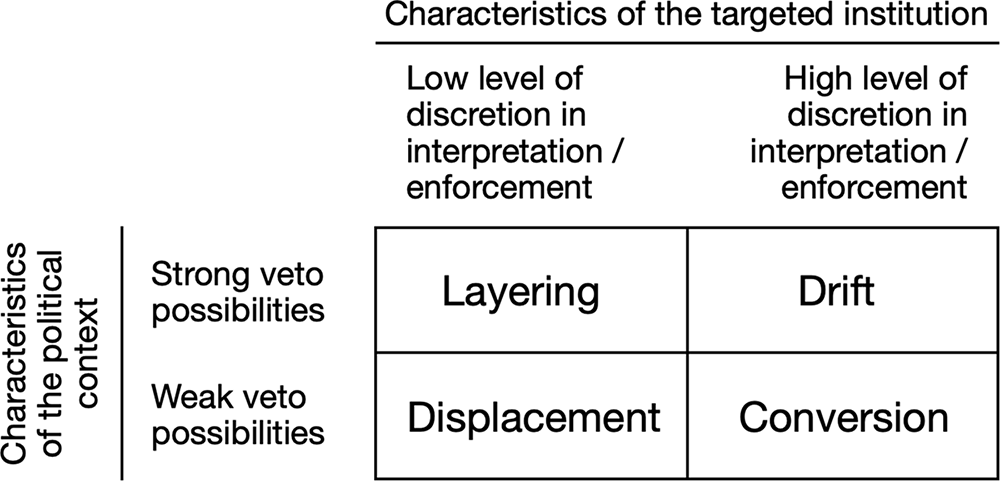
Historical institutionalists argue that these conditions and modes converge into distinct clusters of endogenous change, as summarized in Figure 1.Footnote 39
Overview of key terms in historical institutionalism with regard to endogenous change (adapted table from Mahoney and Thelen, 28, reproduced with permission).

Short Description: Four named change types fill a two by two grid, set against discretion level across the top and veto strength down the side.
In political systems with high status quo bias, where actors wield strong veto power over rule changes, drift and layering tend to dominate. Which of the two prevails depends on rule design. Where rule interpretation and enforcement are highly discretionary, drift becomes more likely; where discretion is limited by more precise rules, change is more likely to proceed through layering. By contrast, where veto possibilities are weak, institutional change is more likely to take the form of conversion when rule design allows for reinterpretation, or displacement when opportunities for reinterpretation are limited.
These clusters are ideal types, however, as institutional change rarely unfolds in isolation. Institutions operate within overlapping environments characterized by varying levels of rule precision and veto power. This is particularly evident in peacebuilding, which grapples with formal and informal institutions interacting across local, national, regional, and international scales. As a result, different modes of change may coexist, overlap, or become entangled.
The perspective and scale of analysis also matter. Within a health ministry, the creation of a new legal instrument that bypasses existing regulations may appear as displacement. Yet when viewed from the perspective of broader national governance, the same reform may be better understood as a new layer of rules within the health sector. Similarly, the introduction of democratic institutions through peacebuilding may displace certain authoritarian decision-making procedures while simultaneously appearing as layering: the addition of a new political arena to a gridlocked constellation of formal and informal institutions through which violent conflict evolves.
In our view, this does not weaken the analytical value of historical institutionalism. Rather, it suggests that these modes are best understood not as universal distinctions or deterministic models, but as a heuristic analytical vocabulary. They allow us to identify and contrast institutional trajectories and legacies amid the ebb and flow of peacebuilding across contexts, provided they are carefully adapted to the premises of each case (e.g. displacement in relation to what?).
Historical institutionalism in peacebuilding contexts
Translating core concepts of historical institutionalism from studies of governance in Western democracies to peacebuilding contexts requires some conceptual reflection. Conflict-ridden societies do not necessarily exhibit ‘weak’ formal institutions. Advanced constitutional traditions may well coexist with protracted political violence, as Comaroff and ComaroffFootnote 40 note in formerly colonized contexts. The ‘postcolony’, they argue, tends to produce a state that is simultaneously ‘hyperpresent’ – through bloated bureaucratic apparatuses or militarized security institutions – and absent from people’s everyday lives, for example, due to the neoliberal privatization of welfare. This duality gives rise to ‘counterfeits of legality’ that blur the boundaries between licit and illicit (dis-)order. In such contexts, legal procedures, citizenship, and civil society are not staple institutional entitlements but contingent claims continuously reworked through political negotiation.Footnote 41
Peacebuilding contexts are typically marked by a convergence of formal and informal institutions, shaped by postcolonial state formation, permeated by logics of violence, and far removed from Weberian ideals of bureaucratic order – yet still capable of producing social order. Peace institutions are often introduced into institutional landscapes that are already hybrid, where they must navigate centralized state logics while engaging with diverse, localized governance arrangements.Footnote 42 This does not mean these institutions lack presence, relevance, or functionality; rather, they operate within governance systems marked by additional layers of complexity, even relative to already highly intricate, consolidated Western liberal democracies.
While the strategic creation of a new ministry is a conventional example of displacement in historical-institutionalist literature, the emergence of insurgent state institutions (as with the Tamil Tigers), the declaration of a new republic (as in Northern Cyprus), or the establishment of an entire postcolonial state apparatus (as in Angola) demand conceptual stretching. All of these examples may be analysed as displacement, but their analysis warrants greater attention to informal–formal blending and to the heightened stakes of governing amidst violence. Compared to the conventional focus of historical institutionalism, the contexts we study harbour more radical variance in status quo bias and more drastic ruptures. These dynamics are not about winning or losing an election, about shifting public resources or about warping controversial legislation. They involve all that, but they also involve accountability for war crimes, revolutionary movements, new constitutions, redrawing of territory and redefining the foundations of citizenship. Moreover, there is often a large degree of international involvement, be it through the operations of external militaries or foreign donors leaving a significant imprint on public expenditure. Attention to institutional trajectories and legacies thus calls for widening the focus to encompass formal and informal structures (e.g. elite networks or rebel rule), official norms of judicialization and social grievance mechanisms, as well as practices of collaboration, contestation, and mobilization within, outside, and across formalized institutions.
And yet, we posit, the basic tenets of historical institutionalism can be applied. Despite the political whirlwind that war-torn polities may sometimes appear to be, the rubric of state failure sells the governing institutions of these countries short. And so does the tendency to attribute failure to implementation problems and contextual difficulties. Historical institutionalism reminds us that – sometimes quite subtle, bureaucratic or technical – institutional dynamics play a significant role in peacebuilding contexts.
Four case studies
We now turn to our case discussions in Cyprus, Colombia, Angola, and Sri Lanka. Each section revisits long-standing qualitative research by the respective author through the lens of historical institutionalism. Each case certainly has a complex peacebuilding history that has been analysed from different theoretical angles by extensive scholarship. These empirical sections do not seek to rival existing theoretical accounts of these conflicts but to show how the analytical vocabulary of historical institutionalism expands the interpretative scope in each case and in peace research more broadly.
Cyprus: the renewed relevance of a bi-communal constitution
Cyprus’s governance landscape is fractured between a (mainly) Greek Cypriot South, now an EU member state, and a (mainly) Turkish Cypriot North, a self-declared state under effective Turkish control. Yet the island formally remains grounded in a bi-communal constitution designed to integrate both communities. This leaves many institutions stuck, splintered, or seemingly defunct – despite still operating. This case zooms in on the political lives of two interconnected institutions: key clauses of the 1960 Constitution of Independence and the bi-communal municipal arrangements of the capital Nicosia. Through them, we show how historical institutionalism helps explain the survival of governance within a dysfunctional constitutional framework: institutional displacement in the 1970s and 1980s during the era of partition, followed by drift, conversion, and layering in subsequent decades. Taken together, these processes reveal how institutions creatively adapt, assume new functions far removed from their original design, and open spaces for collaborative governance across conflict cleavages.
The animosity between the Greek Cypriot majority and Turkish Cypriot minority inhabiting the island is steeped both in the historical process of colonial state formation and in the broader regional stand-off between Greece and Turkey. The 1960 Constitution of the Republic of Cyprus was a compromise that failed to satisfy the political ambitions of both communities. The complex power-sharing agreement required cooperation between Greek and Turkish Cypriots at virtually all levels of government. Yet, this cooperation was short-lived. Constitutional constraints were unable to tame the forces of ethnopolitical animosity, and in 1963, violence broke out between the two communities. As a result of the violence, Turkish Cypriot elected officials and civil servants were unable to continue occupying their positions (or made a demonstrative withdrawal), leaving the Republic of Cyprus under exclusive Greek Cypriot control. Because the Constitution required bi-communal cooperation in running the government – including the municipalities – without Turkish Cypriot participation, a legal impasse emerged. The Supreme Court decided that the (now mono-communally enforced) Constitution should remain in place, however.Footnote 43 The decision reflected a strong status quo bias: although the Constitution no longer functioned as originally intended, it continued to underpin the Republic’s international legitimacy. Formally replacing or amending it risked triggering a constitutional crisis and calling the very existence of the Republic into question.Footnote 44
The legal impasse quickly became a political blockade: by withdrawing from their posts, Turkish Cypriot officials effectively activated their veto power, since every municipal decision required their explicit agreement.Footnote 45 Their absence made constitutional compliance impossible and left municipalities unable to deliver basic services, a blockage that even a state of emergency could not circumvent (declaring it required Turkish Cypriot consent). Administrative paralysis thus turned into a weapon within the broader conflict. Institutional layering onto the Constitution offered a way around a political system gridlocked in inter-communal conflict: the Supreme Court formally retained the Constitution but simultaneously introduced a new rule known as the doctrine of necessity. The doctrine allowed officials to deviate from the letter of the law in cases of ‘imperative and inevitable necessity’, ‘in order to ensure the very existence of the State’.Footnote 46 The continuous running of the government, even in the absence of Turkish Cypriots, constituted such a necessity. Through this decision, the Supreme Court effectively endorsed the continued operation of the government – including the municipalities – under exclusive Greek Cypriot control, contrary to the letter of the Constitution, a state of affairs that persists to this day. The need for layering and the retention of the doctrine of necessity became even more evident following the 1974 Turkish invasion of the island and the unilateral declaration of independence of the Turkish Republic of Northern Cyprus (TRNC) in 1983.
The Turkish invasion in 1974 marked the apotheosis of a violent process of population exchange, with Greek Cypriots being displaced to the south of the island and Turkish Cypriots to the north. The split between North and South comprised a hard and highly militarized divide that only very few people were able to cross. Soon after, Turkish Cypriots established parallel institutions to those of the Republic of Cyprus. These new realities on the ground also altered the effects of the constitutional provisions retained in 1964. Article 173 of the Constitution provided two sets of elected officials (Greek Cypriots and Turkish Cypriots), who would cooperate to jointly administer the largest municipalities of the Republic, including Nicosia. After 1983, however, the context changed and the city was effectively administered in two halves divided by a frontline: Greek Cypriots running the municipality of (south) Nicosia in the Republic of Cyprus and Turkish Cypriots running the municipality of (north) Nicosia within the TRNC. The constitutional rules relating to municipalities were deliberately kept in place, even in divided Nicosia. These contextual shifts clearly changed how the municipal administration functioned. Keeping the bi-communal set-up alive thus engendered drift, creating a rare situation in which cross-divide cooperation between Greek and Turkish Cypriot officials – each working for their respective ‘municipality’ of Nicosia – became possible once again.
Since collaboration between Greek and Turkish Cypriot officials in matters relating to the municipality was provided for in the Constitution, joint projects between the two mayors of Nicosia became both legally acceptable and politically palatable. While the adherence to the bi-communal rule design afforded drift towards Greek-Turkish cooperation amid conflict escalation, this collaboration soon evolved beyond the original mandate. The Greek Cypriot–controlled and Turkish Cypriot–controlled municipalities of Nicosia began to reinterpret their roles in ways that diverged fundamentally from what the Constitution had envisioned. Operational practices gradually shifted, producing endogenous institutional change that can be described as conversion. Reaching across the divide was no longer simply a nuisance in addressing the inhabitants’ needs. It became the purpose.
The two mayors of Nicosia restarted their cooperation in 1978, when they agreed to the joint operation of the Mia Milia Sewage plant for the benefit of both sides. Although the mayors were clearly pioneers in that they were willing to even consider bi-communal cooperation, especially so soon after the Turkish invasion and the resulting split of the country, the rationale for the joint project resembled the wording of the 1960 Constitution. In the words of UNDP Cyprus, the project was ‘a perfect example of bi-communal cooperation between sewerage engineers from both sides, with main objective the provision of the best possible service to both communities of Nicosia’.Footnote 47 The 1978 sewage plant was replaced in 2013 by a new wastewater treatment plant built next to the original site. This time, the main rationale behind the joint project was not only to provide better service to the public, but also promoting trust-building between the two communities. This was clearly articulated through the title of the promotional video that accompanied the project: ‘Wastewater brings communities together’.Footnote 48
A more recent example of a trust-building project implemented by the two Nicosia municipalities is the agreement to extend the linear park that has been formed parallel to the Pedieos/Kanlidere river in the south part of Nicosia, to the north.Footnote 49 In this instance, there was no pressing need for cooperation between the two Nicosia municipalities, as the purpose of the project (the creation of the park) was less urgent than the handling of waste. Yet, the two mayors opted to take the project under their wing and push for its implementation. This suggests that cooperation between the two municipalities, provided for in Article 173(3) of the Constitution, has moved well beyond its original purpose. In the words of the Greek Cypriot mayor in a joint appearance with his Turkish Cypriot counterpart in 2024, ‘bicommunal cooperation at the city level [is important because] that could pave the way for a settlement of the Cyprus problem’.Footnote 50
The intertwined institutional trajectories of the ‘doctrine of necessity’ and bi-communal municipal cooperation in Nicosia show that institutional layering helped stabilize the governance architecture and avert state collapse when outright political reform to advance peace was not feasible. At the same time, maintaining bi-communal rules – despite the severe governance challenges they posed – opened space for cooperation across the divide: first as the tacit continuity of basic service provision (drift) and later, through acts of conversion, as a deliberate form of political engagement.
Colombia: the constitutional court as a guardrail of peacebuilding
Colombia has seen the creation of more peace institutions than almost any other context. Since 1984, roughly 35 peace agreementsFootnote 51 have generated more than five dozen implementing bodies.Footnote 52 Colombia’s expanding ‘thicket’ of peace institutions is frequently dismissed as overly bureaucratic and politically weak – but there is more to the story. This section traces the Constitutional Court’s trajectory to show why institutional resilience matters in the face of belligerent politics: it generated a lasting legacy of guardrails for peacebuilding reforms and institutions. Importantly, the Court’s national and international prominenceFootnote 53 emerged not by design but through institutional change against considerable political odds.
The Court originated in Colombia’s first major attempt to build comprehensive peace. By the 1980s, successive administrations faced growing pressure to negotiate with guerrilla groups and reform a political system long dominated by Liberal and Conservative elites who routinely relied on states-of-siege exceptions to sustain exclusionary rule. President Gaviria convened a National Constituent Assembly, framing it as a ‘peace pact’ to reform state institutions that were clearly unable to confront escalating violence driven by drug cartels and paramilitary forces.Footnote 54 The Assembly marked an unprecedented break with elite politics by incorporating a broad range of societal sectors. Its outcome, the 1991 Constitution, introduced a new institutional architecture, including an expanded catalogue of fundamental rights; the tutela as an expedited legal mechanism through which citizens could protect constitutional rights; the Defensoría del Pueblo (Ombudsman’s Office) to promote human rights and offer a non-judicial complaint mechanism; and, most notably, the Constitutional Court.
But implementation faltered, the country entered one of its bloodiest decades, and the perception grew that, in Colombia, ‘beautiful political discourses’ too often ring hollow. From a historical-institutionalist perspective, this can be traced to two neuralgic veto points. First, the Colombian state expanded slowly and unevenly across its territory, leaving many regions under localized governance structures shaped by armed insurgency and illegal economies.Footnote 55 A centralized bureaucratic state has long coexisted with localized political orders ruled by caudillos – strongmen who, often in alliance with political elites and armed groups, co-opted newly created democratic institutions at the local level and orchestrated the systematic killing of political opponents.Footnote 56 Negotiations with the largest guerrilla groups collapsed as they became embroiled in drug-fueled battles for regional control with cartels, paramilitaries, and state forces. Second, national Liberal and Conservative elites in Bogotá activated their veto power within existing institutions, particularly Congress, using long-cultivated clientelist networks (la maquinaria) to block or dilute institutional reforms they feared would threaten their power base. Constitutional reform failed to displace Colombia’s institutional architecture which, despite its democratic design, was deeply co-opted by informal power alliances and unable to contain violent conflict. Instead, the reforms engendered layering, opening new political arenas that, in the case of local democratization efforts, tragically became sites of violent contestation over their capture.
Even amid this strong status quo bias, the Court evolved into what former justice Manuel José Cepeda calls a bridge between violent reality and constitutional discourse,Footnote 57 a transformation that occurred through conversion. The Court’s creation was contested – opponents warned of excessive judicial interference – and the government backed it only on the assumption that its role would remain confined to technical oversight, avoiding political questions. Yet already in its early years, the Court’s judges progressively reinterpreted and enacted their mandate, developing landmark jurisprudence on health, abortion, and socio-economic rights. This unfolded through dynamic interplay with the tutela, which became a principal channel for citizens to address their grievances and bypass a stifled political system. Concomitantly, the Defensoría del Pueblo, despite persistent violence and significant regional constraints, gradually expanded rights awareness through its territorial presence, reinforcing this dynamic. By 2019, nearly eight million tutelas had been filed, creating a feedback loop in which citizen claims prompted the Court to broaden the range of political issues it interpreted through constitutional rights.Footnote 58 Central to this conversion strategy was the Court’s expansive application of the ‘constitutional block’ doctrine. Grounded in Article 93, the Court accorded international human rights and humanitarian law constitutional status and applied evolving international jurisprudence to review domestic legislation, thereby progressively expanding the substantive content and interpretive scope of constitutional rights.Footnote 59
From the outset, the Court addressed core matters of armed conflict. It sharply restricted, and effectively outlawed, the executive’s routine use of state-of-siege powers. It declared the situation of millions displaced by violence an ‘unconstitutional state of affairs’, ordering structural measures to remedy systemic failures in state protection. Importantly, it became an institutional counterweight to President Uribe Vélez (2002–2010), whose authoritarian ‘hard hand’ politics further militarized armed conflict and encompassed political repression and war crimes. Uribe exploited the language of peace to justify sharply reduced sentences for demobilising paramilitaries under the 2005 Peace and Justice Law, including for those responsible for grave crimes. The Court repeatedly struck down expansions of executive military authority, but the Peace and Justice Law presented a more delicate challenge. Rather than acting as a potential spoiler of peace, the Court responded through conversion: it upheld the much-criticized law while fundamentally reinterpreting its operation, conditioning benefits on full disclosure of crimes, dismantling macro-criminal structures, and protecting victims’ rights. The Court converted constitutional review into a safeguard against sham peace, thereby establishing the ‘judicialization of peace’.Footnote 60 This institutional norm renders peace contingent on constitutional and, by extension, international legal review, placing the Court at the centre of both the design and implementation of peace agreements. The Court’s expansive interpretation of victims’ rights laid the groundwork for the 2011 Victims Law and its globally unique institutional architecture, which would become foundational to subsequent peace processes.
When President Santos succeeded Uribe and opened peace talks with the guerrilla group FARC-EP, the political context shifted. The judicialization of peace risked drifting from a guardrail into an obstacle that narrowed the scope of a participatory and broad supported peace negotiation. Yet the Court converted the rules governing the judicialization of peace. In reviewing the 2016 Peace Agreement, it placed greater emphasis on peace as a constitutional duty to uphold the core architecture of transitional justice, accepting reduced sentences and prioritising those most responsible, provided that victims’ rights to truth, justice, and reparations were protected.Footnote 61
The judicialization of peace proved crucial once the 2016 Peace Agreement faced political backlash. Uribe’s right-wing coalition mobilized support for a “No” vote in the peace referendum, questioning the agreement’s legitimacy and stalling implementation.Footnote 62 Yet the Court’s earlier review had confirmed the agreement’s compliance with domestic and, through the constitutional block doctrine, international legal standards, thereby providing a shield of legality against politicization. By conferring national and international legitimacy, the Court raised the political costs of dismantling the new peace architecture, particularly the Special Jurisdiction for Peace, which became the target of sustained political smear campaigns.Footnote 63 After Uribe’s candidate Duque, a vocal opponent of the agreement, won the presidency, his government refrained from seeking outright displacement. Instead, it pursued what might be termed subversive layering, introducing new rules under its ‘peace with legality’ agenda that remilitarized the conflict while weakening, delaying, and defunding peacebuilding institutions – an attempt to kill the agreement by ‘a thousand cuts’.Footnote 64 While the judicialization of peace carries risks – most notably procedural rigidity when implementation is time-sensitive and legal constraints on the political negotiations of transitional justiceFootnote 65 – this conversion of constitutional norms and procedures nonetheless helped the peace architecture survive political opposition and entrenched it within Colombia’s constitutional status quo.
Colombia’s regionally fragmented governance and entrenched elite networks, fed by illicit economies, have spun a long history of violence and repeatedly resisted displacement through peacebuilding reforms. A historical-institutionalist lens nevertheless highlights that peace institutions have carved their own trajectories: evolving from thin institutional layers into constitutional and lived parts of the political system. The Constitutional Court’s trajectory of institutional conversions enabled it to outgrow its initial role, adapt to political volatility, and become a central anchor and protective shield of the peacebuilding architecture. While some institutions of that architecture were temporary by design (such as the Truth Commission, 2018–2022) or decommissioned, more typically they have persisted – despite heavy criticism or periods of neglect – sometimes in restructured or renamed form. Even as institution-building creates its own bureaucratic tensions, it has yielded a legacy of human rights practices, legal limits on warfare, and guardrails for peace politics that open space for victims, activists, and peacebuilders.
Angola: institutional drift towards democracy?
Angola offers a stark contrast to contexts with dense peacebuilding architectures. After decades of civil armed conflict, following thirteen years of anti-colonial struggle, and several failed peace initiatives, the 2002 agreement established a victor’s peace that finally brought armed hostilities to an end – without any real political transition and with little concession to the defeated party. Through a historical-institutionalist lens, postcolonial statebuilding and protracted conflict produced layered institutional trajectories. Informal insurgent governance persisted after independence, leaving formal state institutions as thin layers atop enduring rebel orders. However, this case discussion also reveals that even nominal or weak institutions can shape political possibilities amid violent war- and peace-making. It contends that the National Assembly (the parliament of post-independence Angola) drifted from a façade institution within a party-state to a forum that, under economic crisis and social mobilization, acquired new meanings and opened limited but potentially significant space for political pluralism in the absence of a negotiated transition.
Angola attained independence in 1975, after a coup d’état in Lisbon overthrew the Portuguese regime and accelerated the process of decolonization. Three separate movements had been fighting the Portuguese occupier for thirteen years: FNLA (National Liberation Front of Angola), MPLA (Popular Movement for the Liberation of Angola), and UNITA (National Union for the Total Independence of Angola). The plan for Angola’s transition from a Portuguese overseas territory into an independent state involved a transitional government led by a Portuguese high commissioner and a Presidential College composed of the leaders of each liberation movement – a tripartite structure that was to be replicated across all ministerial cabinets. This model formally disbanded, or displaced, the colonial administrative apparatus at the national level, but it also confronted the regionally fragmented governance systems that had emerged through anti-colonial resistance. During the years of colonial war, local orders built by and around leaders of the militant movements organized not only armed struggle but also forms of social and political ‘rebel governance’.Footnote 66 After independence, these embedded informal rule systems proved remarkably resilient to national attempts to displace them through new centralized state authority, and they survived the moment of independence largely intact. None of the liberation movements were willing to relinquish the influence they had accumulated in their respective regions in exchange for uncertain democratic cohabitation. In the vocabulary of historical institutionalism, leaders of FNLA, MPLA, and UNITA – fearing the unclear distribution of power under post-independence institutional reforms – activated their veto points as regional strongmen.
Thus, the tripartite national governance alliance collapsed, and the movements started to fight over territorial and institutional control. MPLA captured the capital and declared itself the ruling party, UNITA hence shifted from liberation movement to a rebel movement opposing the MPLA, while FNLA was militarily marginalized, and survived only as a minor party. Unsurprisingly, within the context of the Cold War, international allies contributed to the escalation of the civil war.
After more than a decade of civil war waged between MPLA and UNITA (and their external patrons), the 1990s were marked by peace efforts, largely driven by the changing geopolitical landscape resulting from the end of the Cold War. Attempts at durable peace in 1992 and 1994 were truncated due to entrenched mistrust between the two movements, their lingering competition for power and national hegemony, weak UN enforcement, and dwindling international attention.Footnote 67 Angola returned to full-scale war in 1998.
The final period of armed conflict, which the MPLA termed ‘war for peace’, eventually lived up to its name. After the death of UNITA’s founder and longtime leader, Jonas Savimbi, in February 2002, the continuation of fighting was untenable, and the movement surrendered. A swift, minimally negotiated process produced a victor’s peace for the MPLA. UNITA was transformed into a political party, its leaders were co-opted, silenced, or sidelined, and its soldiers were demobilized, integrated into the military and police forces, or simply abandoned. The military victory decisively displaced the fragmented regional governance structures rooted in the anti-colonial struggle, integrating regional control under an all-pervasive Angolan nation-state.
Over the following years, the MPLA consolidated a ‘party-state’.Footnote 68 UNITA’s presence in the National Assembly was largely symbolic, legitimizing what effectively became an authoritarian state under the guise of a pluralist parliamentarian democracy and on the back of fulgurant economic growth. Between 2002 and 2008, the country’s economy expanded tenfold, with the surge in oil revenues invested in major infrastructure projects – the party-state’s main agenda for post-conflict Angola.Footnote 69 Highly visible in its security and legal apparatus, the state remained thin in social provision. The formal, bureaucratic institutions of a democratic state remained thin institutional layers atop informal systems of patronage and corruption that structured the political order. Formal democratic institutions were weak and routinely bypassed by MPLA officials in exchange for electoral loyalty, while UNITA, kept inside parliament as a token opposition, lacked both resources and voice.
But the 2014 oil-price crash gradually altered the picture. Economic crisis brought inflation, debt, unemployment and growing public discontent.Footnote 70 As declining oil revenues made the costs of co-optation harder to sustain, the democratic system, and particularly the National Assembly, began to drift towards a different function. It had been a symbolic institution without real governing power, but its continued existence provided UNITA with a venue to articulate grievances publicly in a country where civic space is tightly restricted. UNITA leveraged the Assembly’s visibility and the electoral arena to re-enter politics, give voice to social grievances and rebuild organizational capacity. Its vote share has risen at every election (2008: 10%; 2012: 19%; 2017: 27%; 2022: 44%), nearly winning the popular vote, an outcome that poses a serious challenge to the long-entrenched authoritarian rule of the MPLA.
A historical-institutionalist perspective highlights several insights for understanding peacebuilding in Angola’s violent, postcolonial context. At the moment of formal independence, democratic statebuilding displaced the institutions of colonial administration but failed to displace the informal, regionally entrenched governance structures forged during anticolonial resistance. State institutions eventually became layers atop entrenched rebel governance structures which, reinforced by international support, produced new orders of violence. Their displacement came not through peacebuilding reforms, but through military victory in 2002.
Yet the persistence of parliament left an important political legacy. As the political and economic context shifted and the one-party state struggled to maintain control through co-optation and repression, UNITA used this largely symbolic institution as a channel for articulating popular grievances. Triggered by the economic crisis, the parliament began to drift into a more meaningful arena of political engagement – a gradual, endogenous opening that hints at the possibility of deeper democratization (though caution is in order hereFootnote 71). Its continued existence played a role in containing grievances within the formal political institutions, rather than seeing them expressed through radical rupture or the resurgence of armed conflict.
Sri Lanka: the seven lives of the North-Eastern Provincial Council
This final section discusses the North-Eastern Provincial Council (NEPC), the autonomous administration of Sri Lanka’s Tamil-dominated region. It demonstrates how historical institutionalism helps explain the remarkable resilience of the NEPC. It shows how the NEPC survived against the odds by lending itself to dramatically different political projects. And it illustrates a temporal pattern in which institutional displacement occurred in a period of militarized clashes and diplomatic arm-twisting, while layering, drift and conversion occurred in the drawn-out aftermath where belligerents seek to scuttle the legacy of a forceful external imposition.
Throughout the 1980s, India deployed military and diplomatic coercion to impose a framework of provincial autonomy as a compromise between a unitary Sri Lankan state (a demand of the Sinhala majority community) and a separate Tamil state (a Tamil-minority demand). As a regional hegemon, India imposed its preferred solution to the conflict between the Sri Lankan government and the Tamil separatists – despite resistance from both parties – by enforcing the 1987 Indo-Lankan Accord. This prompted the creation of the Provincial Council System, established through the Thirteenth Amendment to Sri Lanka’s Constitution of 1988. At its core, the amendment devolves legislative and executive power from the centre to the provinces. Each province comprises a democratically elected council that is supported by a bureaucratic apparatus and kept in check by a presidentially appointed Governor.
That the NEPC failed to deliver on its original peacebuilding objective barely needs arguing. Within two years of its creation, the council had collapsed as an elected institution; its bureaucratic apparatus was placed under central government control; and the war resumed with a sharp escalation of violence. Yet, the council continues to exist, be it as a demerged Eastern and Northern council (EPC and NPC) since 2007.Footnote 72 This section illustrates how the council became a vehicle for diametrically opposed political projects across the 35 years of its existence. We will structure this turbulent history in seven (partly overlapping) lives. For more detailed empirical discussion, see Klem’s earlier workFootnote 73 as well as Amarasinghe et al.,Footnote 74 Loganathan,Footnote 75 and Welikala.Footnote 76
In its first lease of life, the NEPC was a fragile façade. India propped it up to deliver on the Indo-Lankan Accord, which arguably amounted to externally imposed institutional displacement through a hostile implant into the Sri Lankan state apparatus. The amendment inserted a new form of power-sharing into an otherwise highly centre-oriented Constitution, yielding ample legal and political contradictions and ambiguities. Despite opposition from the Sri Lankan government and the Liberation Tigers of Tamil Eelam (LTTE), India pushed through the provincial elections of 1988. It provided massive military deployment, operational support, cars, and other resources, and it regularly arm-twisted the Colombo government into compliance. India thus went all-out to project the NEPC as a Tamil government of sorts, despite threadbare political legitimacy.
In its second life, the NEPC became an obsolete appendage. The elected council was dissolved in 1990, and no new elections were held for 18 years. The bureaucratic apparatus continued to operate under the control of the Governor, an unelected presidential stalwart. Meanwhile, the central government, unable to dismantle the NEPC, resorted to layering, introducing administrative protocols that strangled the NEPC’s governing capacities and reduced its finances to a trickle. Moreover, the Sri Lankan government subtly displaced the NEPC, rendering it largely moot by creating new governing bodies under central government tutelage that had extensive powers and routinely bypassed the provincial administration.
In the NEPC’s third life, it was subject to cannibalization. When the LTTE occupied the voids left by the Indian army (which retreated from Sri Lanka in 1990), it captured many of the NEPC’s resources. While the NEPC continued to exist as a threadbare set of offices with a legal mandate, its cars, fridges and office supplies were confiscated to be reused for what would become the institutional framework of a new de facto Tamil state. The LTTE started creating its own departments and authorities and would assume an increasingly state-like posture throughout the 1990s – an insurrectory version of displacement.
The NEPC’s fourth life was that of a puppet. The LTTE had initially rejected the NEPC as treason to the Tamil cause but then realized its utility. Creating governing institutions is costly, and the still-existing NEPC was a cost-effective alternative. Given that the vast majority of its civil servants were Tamil, they could be subjected to LTTE control. With well-placed visits, letters, and phone calls, the LTTE took parts of the NEPC administration under remote control, reorienting its original purpose towards what started to resemble a de facto state. This insurrectory form of conversion reworked procurement procedures and the distribution of (what remained of) state welfare benefits dispensed to the population.
With the Norwegian-facilitated peace talks of the early 2000s, the NEPC regained prominence and became a nucleus for peaceful collaboration – its fifth life. Creating new forms of shared governance proved difficult during the government–LTTE peace talks, due to legal-constitutional obstacles and the ethno-national pressures of electoral politics. The NEPC was one of the few available platforms to experiment with limited forms of collaboration between the two parties (similar to the bipartisan administration of Nicosia’s municipality in Cyprus discussed above). It experienced drift: a new political dynamic gave a seemingly moribund institution new significance. Unlike the institutions of the LTTE’s de facto state, the NEPC was considered a legitimate disbursement channel for development donors to foster confidence-building between the negotiating parties and reach out to the war-stricken population of the northeast. NEPC bureaucrats grew accustomed to plentiful project funding, regular capacity-building workshops and a caravan of consultants.
The Norwegian peace process collapsed in the mid-2000s. The war resumed and resulted in a comprehensive LTTE defeat in 2009, following an unprecedented massacre among the Tamil civilian population. The triumphant Sri Lankan government enjoyed abundant political capital, and the Tamil nationalist movement was in disarray. The NEPC reincarnated once more after the war. In its sixth life, the council fell prey to what many would describe as ‘normal’ Sri Lankan politics. Rather than effecting a degree of regional self-governance, many Sinhala and Muslim political strongmen used provincial council departments to serve their constituencies, thus turning the institution into an instrument of patronage – a classic form of conversion. The LTTE had curtailed such politicking in the Northeast, but now that their surveillance was gone, patronage politics came in with full force. Some NEPC bureaucrats ironically felt nostalgia for the times of war – an era without all-powerful politicians.
This sixth life was mainly manifest in the multi-ethnic EPC after it was ‘demerged’ from the North. A seventh life, however, emerged in parallel, but mainly in the North – an almost exclusively Tamil province. The NPC came to serve as a stage to display unresolved Tamil grievances to international audiences. Tamil nationalist parties won the 2013 Northern elections with a landslide and thus came to govern the institution they had always spurned. Rather than bigging up their role by delivering patronage – as per ‘normal’ Sri Lankan politics – they paradoxically governed the NPC to demonstrate its uselessness. They delivered few results on provincial competencies but passed many angry resolutions lambasting the central government on issues that provinces have no say on. This could be seen as a highly performative variant of conversion. The Tamil leadership aimed to show that the Provincial Council System did not address Tamil grievances and that international involvement was therefore needed to create a genuine form of self-governance.
Across the seven lives of the NEPC, we thus see all four change dynamics of historical institutionalism, and their complex interactions. Some of these are arguably extreme versions of institutional redeployment. There is also an overall historical trend. In the early years, we see competing forms of displacement (along with layering), respectively propelled by India, the Sri Lankan government and the LTTE. As the years pass, we see the more subtle transgressive tactic of conversion. After critical conflict junctures (new peace process, end of war), we see drift.
Across these phases and dynamics, the NEPC is testament to the remarkable adaptive capacity and endurance of bureaucratic institutions: implementing autonomous regional governance, offering governance structures for a rebel state, enabling political collaboration across the conflict divide, or lending a stage to exhibit unaddressed ethnic grievances. Amidst Sri Lanka’s highly turbulent conflict trajectory, the institutional framework of the provincial council persevered, despite it being the solution that nobody in Sri Lanka wanted.
Concluding discussion
We discussed four peacebuilding contexts that differ markedly in their political and historical setting, focusing on distinct types of institutions: a bi-communal municipality; a constitutional court; a parliament in a one-party state; and a provincial council. All four institutions have long political trajectories, spanning three to five decades, and they have significantly shaped how peace efforts have unfolded in each country. Engaging these extended historical trajectories is necessarily ambitious. Our goal has not been to engage in rival theory-building on these cases, but to distill key institutional trajectories and legacies in order to ground our threefold argument: (1) that historical institutionalism offers an analytical lens for longue durée trajectories of peace institutions and their (unanticipated) legacies; (2) that these institutions persist through change amid failure; and (3) that change follows distinct, sequenced patterns of institutional transformation. We briefly discuss these in turn.
All discussed institutions failed their primary mission to build peace. Some were monumental failures. The Cypriot constitution failed catastrophically in holding together a bi-communal state. Others had only fleeting or limited impact. Angola’s successful peace accords institutionalized military victory but did not advance the promise of a democratic, independent state. In Colombia, repeated peace efforts produced a dense institutional landscape that endured but often seemed powerless amid escalating political violence. In Sri Lanka, the NEPC found itself surrounded by a re-escalating war. But all peace institutions outlived their political opponents and continued to evolve amidst turbulent conflict developments.
Across the four cases, institutions persisted because they changed – and they changed because they persisted. Through this change, the peace institutions took on unintended and unanticipated roles within their broader national institutional contexts, roles that ultimately defined their political legacies: they averted a constitutional crisis amid military intervention and preserved bi-communal collaboration (in Cyprus), set legal limits on armed conflict and justice guardrails for peace institutions (Colombia), offered non-violent arenas for grievances (Angola), and provided a platform to experiment with power-sharing during peace talks (Sri Lanka). The vocabulary of historical institutionalism offers a heuristic lens to capture these trajectories and their legacies. In addition, it reveals several cross-contextual patterns.
Peace institutions must confront a status quo entrenched by wartime institutions, but once established, they can also benefit from a status quo bias. Formally disbanding them is thus cumbersome, due to entrenched veto players among elites, insurgents, or international actors. In both Cyprus and Sri Lanka, a constitutional reset would open an unappealing can of worms. The MPLA in Angola needs the façade of a democratic state just as opponents of the 2016 Peace Agreement in Colombia must symbolically commit to peace processes in order to meet international expectations.
Displacement is arguably a central objective of many peacebuilding reforms. Yet while they may succeed in displacing particular bodies, rules, or norms, displacing the broader formal–informal institutional system associated with armed conflict is far more difficult. It usually requires watershed shifts in the conflict context. In Cyprus, displacement followed the 1974 Turkish invasion and the resultant creation of a separate northern entity. In Angola, UNITA’s military defeat and the subsequent co-optation of its elites enabled the MPLA’s one-party system to displace regionally fragmented rebel governance. In Sri Lanka, India’s militarized intervention prompted multiple and shifting waves of displacement: Colombo’s creation of rival authorities and the LTTE’s establishment of de facto state institutions. Colombia, by contrast, lacks decisive military victories or externally imposed institutions in the past three decades. Correspondingly, its peacebuilding reforms are more aptly understood through the lens of layering, generating a dense and overlapping institutional landscape.
Layering often occurs when peacebuilding reforms introduce new institutions that gradually alter, without supplanting, conflict-related institutions. It may also arise when efforts to displace entrenched institutions fail, resulting in the accumulation of institutional layers. In Cyprus, the ‘doctrine of necessity’ formally preserved the Constitution while effectively nullifying its foundational clauses on the bi-communal character of the state. In Angola and Colombia, layering occurred in the build-up of formal democratic institutions atop deeply embedded informal institutions, regionally fragmented and rooted in violent conflict. These changes affected the institutional landscape and its political structures, but the new institutions also became susceptible to co-optation and hybridization, ultimately transforming the democratic and rights-based aspirations of the peacebuilding framework.
While displacement and layering tend to accompany shifts in the broader conflict context, drift and conversion are more common in long-term processes of institutional adaptation. With regard to drift, the persistence of a bi-communal municipal administration gained renewed importance after Nicosia’s division in 1974, opening unexpected political possibilities. Angola’s parliament, initially not a site of political contestation, similarly drifted into a forum capable of voicing public grievances, and potentially fostering democratization, rather than renewed conflict. In terms of conversion, the design of the NEPC was redirected to serve Tamil governance by the LTTE after India’s withdrawal from Sri Lanka in 1990, and reconverted into a vehicle of patronage politics once LTTE dominance faded. In Colombia, the Constitutional Court exemplifies conversion through a series of rulings beyond its original scope to protect citizens and victims when the political context grew increasingly violent and hostile to building peace.
In sum, our case discussions reveal recurring temporal patterns of institutional change: displacement and layering are often associated with major reforms prompted by broader shifts in the conflict context, while drift and conversion are more subtle forms of adaptation that tend to occur in their wake. These patterns raise further questions for peacebuilding research and practice – for instance, what conditions make peacebuilding reform through institutional displacement possible; which characteristics of peace institutions steer them towards drift or conversion; and when do different modes of institutional change produce more peaceful rather than violent outcomes?
At a moment when the international liberal order is widely said to be in decline – abandoned, ridiculed, or ignored by authoritarian-leaning international politics – historical institutionalism offers grounds for cautious hope. Institutions do not simply vanish when neglected or defunded. As our cases show, they continue to operate in drifting contexts, with repurposed or converted rules. These can generate unintended or even adverse effects, but they also retain the potential to be reactivated or redirected towards peaceful outcomes – often quietly, under the radar, and obscured by the overwhelming headlines of violence and atrocity that dominate the global narrative.
Our argument should therefore not be misread as yielding a sardonic conclusion, namely that peacebuilding institutions fail, that they are abused and that at best they become wasteful legacies that we cannot get rid of. This is not completely untrue, but it is too simple and too cynical. Peacebuilding institutions may have a poor record in delivering the exact mandate they were given, but through their perseverance – our case discussions suggest – they also generate positive outcomes in terms of defending human rights, fostering interaction between severed communities, advancing democratization, and carving out spaces for collaboration and contention. This may not be quite in the way, at the time and place that was envisaged, but it does happen. Phrased more provocatively: peacebuilding institutions cannot engineer peace, but through their endurance they can create unforeseen ruptures and political spaces, and these may contribute to peace.
Acknowledgements
This research would not have been possible without the many interlocutors across the different contexts whose experiences, insights, trust, and reflections informed the knowledge and arguments presented in this article. We also wish to thank Maria Stern and Miguel Barreto Henriques for their support at different stages of this project. This article was also enabled by the European Research Council grant titled ‘SovereignPerformance’ (Consolidator Grant 101170073). Views and opinions expressed are, however, those of the author(s) only and do not necessarily reflect those of the European Union or the European Research Council. Neither the European Union nor the granting authority can be held responsible for them.
Funding statement
This research and the writing of this article were supported by the Swedish Research Council (Vetenskapsrådet), Grant No. 2022-03624. The funder had no role in the process of researching, writing, and submitting the article for publication.
Competing interests
The authors declare none.

 Open access

