Two major issues in developmental psychopathology have been the relation of children's problem behaviors to their self-regulation and to the quality of the parenting they experience. Most of the data relevant to these issues are correlational rather than experimental; thus, in recent years, longitudinal models have been used to further test and refine assumptions regarding causal relations among these variables. In numerous studies, only direct relations of parenting and children's self-regulation to maladjustment have been examined. However, an increasing number of researchers have argued for the use of cascade and/or panel structural equation models (SEMs) to test hypotheses regarding interrelations among these variables. For example, as is discussed in more detail shortly, it has been hypothesized that the quality of parenting affects children's self-regulation, which in turn affects children's problem behavior (e.g., Eisenberg, Cumberland, & Spinrad, 1998; Gottman, Katz, & Hooven, Reference Gottman, Katz and Hooven1997).
In an ideal test of such a cascade effect, all three constructs are assessed at a minimum of three times; stability of all three constructs is taken into account, as are relations among predictors and adjustment within time, and tests of mediating paths are conducted (Cole & Maxwell, Reference Cole and Maxwell2003; Masten et al., Reference Masten, Roisman, Long, Burt, Obradovic and Riley2005). In the present study, using assessments at 18, 30, and 42 months of age, we examined the hypothesis that quality of parenting (e.g., punitive/minimizing responses and low warmth and sensitivity) predicts young children's subsequent self-regulation, which in turn predicts their future externalizing and internalizing symptoms. Less is known about the predictors of problem behaviors in young children than in school-age children (Keenan & Shaw, Reference Keenan, Shaw and McCord1995). However, because there is evidence that internalizing and externalizing problems in toddlerhood tend to predict later maladjustment (Campbell, Shaw, & Gilliom, Reference Campbell, Shaw and Gilliom2000; Keenan, Shaw, Delliquadri, Giovannelli, & Walsh, Reference Keenan, Shaw, Delliquadri, Giovannelli and Walsh1998), understanding factors that relate to and may affect the early emergence of internalizing and externalizing symptoms is critical for prevention and interventions.
Self-Regulation and Its Relation to Maladjustment
Children's capacities to effortfully manage their emotions and behavior are considered key abilities for successful social adaptation and adjustment (Shonkoff & Philips, 2000). Individual differences in self-regulation are believed to have an early emerging, temperamental/personality basis (Caspi & Shiner, Reference Caspi, Shiner, Damon and Lerner2006; Rothbart & Bates, Reference Rothbart, Bates, Eisenberg, William and Lerner2006). The aspect of temperament involved in self-regulation is labeled effortful control (EC), defined as “the efficiency of executive attention, including the ability to inhibit a dominant response and/or to activate a subdominant response, to plan, and to detect errors” (Rothbart & Bates, Reference Rothbart, Bates, Eisenberg, William and Lerner2006, p. 129). EC includes the abilities to voluntarily or willfully focus and shift attention and inhibit or initiate behaviors, processes that likely contribute to the modulation of emotional experience and emotion-linked behavior (Rothbart, Ziaie, & O'Boyle, Reference Rothbart, Ziaie, O'Boyle, Eisenberg and Fabes1992). EC, including executive functioning skills involving attention and inhibitory control, appears to develop some in the first and second year of life (Diamond, Reference Diamond1990; Putnam & Stifter, Reference Putnam and Stifter2002) and then improve greatly in the third year of life (Kochanska, Murray, & Harlan, Reference Kochanska, Murray and Harlan2000; Mezzacappa, Reference Mezzacappa2004; Posner & Rothbart, Reference Posner, Rothbart and Richards1998; Reed, Pien, & Rothbart, Reference Reed, Pien and Rothbart1984; Rueda et al., Reference Rueda, Fan, McCandliss, Halparin, Gruber and Lercari2004). Individual differences in toddlers' EC have been found to be relatively stable across individuals in the early years (Kochanska et al., Reference Kochanska, Murray and Harlan2000).
In infancy, orienting behaviors serve a regulatory function in regard to anger (Stifter & Braungart, Reference Stifter and Braungart1995) and, in the preschool years, EC has been linked to the modulation of emotion, for example, during disappointment tasks (Kieras, Tobin, Graziano, & Rothbart, Reference Kieras, Tobin, Graziano and Rothbart2005) and in emotion-evoking interactions with peers (Eisenberg et al., Reference Eisenberg, Fabes, Nyman, Bernzweig, Bernzweig and Pinuelas1994). Because of the role of EC and related skills in the regulation of emotion, it is not surprising that EC has been linked conceptually to low levels of young children's externalizing and internalizing problems. EC is expected to affect maladjustment by contributing to the processing of information, as well as to the modulation of emotion and behavior. For example, the abilities to shift attention from negative thoughts and to focus on affectively neutral or positive thoughts and activities appear to be useful strategies for cutting off negative emotion and have been associated with low levels of anger, anxiety, and depression (Derryberry & Reed, Reference Derryberry and Reed2002; Derryberry & Rothbart, Reference Derryberry and Rothbart1988; Silk, Steinberg, & Morris, Reference Silk, Steinberg and Morris2003). The tendencies to refocus on nondistressing stimuli or engage in a new, distracting activity appear to reduce arousal (Crockenberg & Leerkes, Reference Crockenberg and Leerkes2004; Erber & Tesser, Reference Erber and Tesser1992; Harman, Rothbart, & Posner, Reference Harman, Rothbart and Posner1997), and may contribute to information processing and planning (Eronen, Nurmi, & Salmela-Aro, Reference Eronen, Nurmi and Salmela-Aro1997; NICHD Early Child Care Research Network, 2005), which can be used to cope successfully with stressful situations.
Consistent with expectations, EC and related measures of self-regulation have been fairly consistently negatively related to externalizing problems, even in the toddler and preschool years (Eiden, Colder, Edwards, & Leonard, Reference Eiden, Colder, Edwards and Leonard2009; Kochanska, Barry, Aksan, & Boldt, Reference Kochanska, Barry, Aksan and Boldt2008; Olson, Sameroff, Kerr, Lopez, & Wellman, Reference Olson, Sameroff, Kerr, Lopez and Wellman2005; Raaijmakers et al., Reference Raaijmakers, Smidts, Sergeant, Maassen, Posthumus and van Engeland2008; Rydell, Berlin, & Bohlin, Reference Rydell, Berlin and Bohlin2003; Spinrad et al., Reference Spinrad, Eisenberg, Gaertner, Popp, Smith and Kupfer2007). However, findings have not always been consistent; for example, Murray and Kochanska (Reference Murray and Kochanska2002) found little relation between EC and problem behaviors in the toddler years and a relation with attention-related externalizing problems but not a broader range of externalizing problems in the preschool years.
Although some investigators have found inverse relations between EC and internalizing problems in later childhood and in adolescence (Lengua, Reference Lengua2006; Martell et al., Reference Martel, Nigg, Wong, Fitzgerald and Jester2007; Muris, Reference Muris2006; Muris, de Jong, & Engelen, Reference Muris, de Jong and Engelen2004; Oldehinkel, Hartman, Ferdinand, Verhulst, & Ormel, Reference Oldehinkel, Hartman, Ferdinand, Verhulst and Ormel2007; contrast with Eisenberg et al., Reference Eisenberg, Sadovsky, Spinrad, Fabes, Losoya and Valiente2005), the relation of EC with internalizing problems is not highly consistent, especially in the early years. Lemery, Essex, and Smider (Reference Lemery, Essex and Smider2002) found that EC at 3.5 and 4.5 years (averaged across these ages) tended to predict low levels of internalizing problems at 5.5 years, especially for inhibitory control (but less so for attentional control). Rydell et al. (Reference Rydell, Berlin and Bohlin2003) found that parent-rated regulation of fear, anger, and exuberance (constructs related to EC) at age 5 and 6 (average) was inversely related to childrens' internalizing problems at home at age 6.5 years; only regulation of fear was also associated with low internalizing problems at school at age 8. In a sample of children with relatively few problem behaviors, Murray and Kochanska (Reference Murray and Kochanska2002) found a marginal negative relation between EC and problems behaviors (internalizing and externalizing combined) in toddlerhood but a quadratic relation in the preschool years. This quadratic relation was because children with higher EC were rated higher on internalizing behaviors than were children with moderate levels of EC. Moreover, Spinrad et al. (Reference Spinrad, Eisenberg, Gaertner, Popp, Smith and Kupfer2007) reported that adult-reported EC was negatively related to some aspects of internalizing (e.g., separation distress) for 18- and 30-month-olds, but it was not related to inhibition to novelty (sometimes considered an internalizing problem in young children; Carter, Briggs-Gowan, Jones, & Little, Reference Carter, Briggs-Gowan, Jones and Little2003). Thus, it appears that the relation between self-regulation and internalizing problems in the early years of life may vary with the dimension of internalizing examined, and perhaps also with the measure of self-regulation or EC.
The relations of maternal socialization to children's EC and social functioning
Although children's EC is influenced by heredity and specific genes (Posner, Rothbart, & Sheese, Reference Posner, Rothbart and Sheese2007; Yamagata et al., Reference Yamagata, Takahashi, Kijima, Maekawa, Ono and Ando2005), twin studies indicate that it is affected by the environment as well as heredity (Goldsmith, Buss, & Lemery, Reference Goldsmith, Buss and Lemery1997; Rothbart & Bates, Reference Rothbart, Bates, Eisenberg, William and Lerner2006). Parents probably are especially important socializers of young children's EC (and problem behaviors) because they play such a major role in young children's lives, help them modulate their emotions and behavior, and teach and model self-regulatory skills (Kopp, Reference Kopp1989).
The aspects of parenting most studied in young children are warmth/support and sensitivity (i.e., responsiveness to a child's cues and the appropriateness of the parent's responses to the child's emotions). Mothers who are disapproving or hostile may model dysregulation, whereas those who are more positive, supportive, and sensitive likely model constructive ways to manage stress and relationships (Halberstadt, Crisp, & Eaton, Reference Halberstadt, Crisp, Eaton, Philippot and Feldman1999). When mothers respond to children's emotions in unsupportive ways, such as punishing the child or ignoring or minimizing their child's emotions, children may experience heightened arousal, which is likely to interfere with their ability to process information and self-regulate and may even cause dysregulation (Hoffman, Reference Hoffman2000). Similarly, Kopp (Reference Kopp1989) argued that when a mother responds promptly and effectively to her infant's distress, this experience modulates the infant's arousal and the child can effectively process and learn, including about self-regulation. Sensitive, supportive mother–child interactions are viewed as contributing to a secure attachment, which in turn is believed to influence the child's regulation abilities (Cassidy, Reference Cassidy1994; Thompson, Reference Thompson, Eisenberg, William and Lerner2006). In addition, when mothers are supportive and sensitive, children would be expected to be more invested in internalizing their mothers' goals/agendas and more motivated to learn from interactions with their parents (Grusec & Goodnow, Reference Grusec and Goodnow1994; Hoffman, Reference Hoffman and Eisenberg1982).
Consistent with such theory, maternal sensitivity and use of sensitive strategies to help children regulate themselves have been associated with infants' and young children's self-regulation/EC (Gable & Isabella, Reference Gable and Isabella1992; Spinrad, Stifter, Donelan McCall, & Turner, Reference Spinrad, Stifter, Donelan McCall and Turner2004) and a reduction in negative emotion (Fish, Stifter, & Belsky, Reference Fish, Stifter and Belsky1991). For example, low maternal warmth/sensitivity at age 2 has been found to predict lower self-regulation at age 3 (Eiden, Edwards, & Leonard, Reference Eiden, Edwards and Leonard2007). Similarly, observed maternal warmth/support when the child was 18 months old predicted children's ability to shift attention at 3.5 years of age (Gilliom, Shaw, Beck, Schonberg, & Lukon, Reference Gilliom, Shaw, Beck, Schonberg and Lukon2002). In one of the few studies with more than two assessments, Belsky, Pasco, Fearon, and Bell (2007) found that maternal warmth/support versus hostility at age 54 months predicted better attentional control in first grade, and a similar pattern was found from maternal warmth/support in Grade 1 to children's attention in Grade 4. Maternal warmth and/or positivity in the early school years (Eisenberg et al., Reference Eisenberg, Sadovsky, Spinrad, Fabes, Losoya and Valiente2005; Valiente et al., Reference Valiente, Eisenberg, Spinrad, Reiser, Cumberland and Losoya2006) also has been found to predict EC across 2 years, and maternal warmth/support has been associated with 6- to 8-year olds' regulation of positive affect (Davidov & Grusec, Reference Davidov and Grusec2006).
Conversely, mothers' nonsupportive or punitive responses to negative emotions have been related to lower emotion regulation or EC in preschoolers (Eisenberg & Fabes, Reference Eisenberg and Fabes1994; Spinrad et al., Reference Spinrad, Stifter, Donelan McCall and Turner2004) and school-aged children (Lengua, Reference Lengua2008), although few investigators have studied this relation in toddlers. Similarly, parental power assertion at 22 to 45 months is consistently negatively related to children's EC across this age range (Kochanska & Knaack, Reference Kochanska and Knaack2003). However, in a study of 33- to 40-month olds, maternal warmth and negative emotion were not directly related to concurrent EC or EC 6 months later (Lengua, Honorado, & Bush, Reference Lengua, Honorado and Bush2007). In the current investigation, mothers' observed sensitivity and warmth and reported supportive and nonsupportive reactions to their toddlers' negative emotions were used to measure mothers' socialization practices. We expected maternal supportive versus less supportive parenting to be positively related to EC.
Eisenberg et al. (Reference Eisenberg, Cumberland and Spinrad1998) proposed that some of the relations between parenting and children's problem behaviors are mediated through children's emotion-related regulation (including EC). However, only a few investigators have tested this mediated relation. There has been some support for this relation in work with older children (Eisenberg et al., Reference Eisenberg, Fabes, Shepard, Guthrie, Murphy and Reiser1999, Reference Eisenberg, Sadovsky, Spinrad, Fabes, Losoya and Valiente2005; Hofer, Eisenberg & Reiser, in press; Kim & Brody, Reference Kim and Brody2005; Valiente et al., 2008; Yap, Allen, & Ladouceur, Reference Yap, Allen and Ladouceur2008). In general, parental warmth, support, and positivity, sometimes combined with other aspects of positive parenting, have been positively associated with children's EC or other measures of self-control, which in turn have inversely predicted subsequent externalizing (Eisenberg et al., Reference Eisenberg, Fabes, Shepard, Guthrie, Murphy and Reiser1999, Reference Eisenberg, Sadovsky, Spinrad, Fabes, Losoya and Valiente2005; Valiente et al., Reference Valiente, Eisenberg, Spinrad, Reiser, Cumberland and Losoya2006) and internalizing (Valiente et al., Reference Valiente, Eisenberg, Spinrad, Reiser, Cumberland and Losoya2006) problems.
This type of cascade/mediational model rarely has been tested in work predicting toddlers' and young preschoolers' maladjustment. In a study in which stability of constructs was controlled, Belsky et al. (Reference Belsky, Pasco Fearon and Bell2007) found that supportive parenting combined with low hostility and high respect for the child's autonomy at 4.5 years predicted higher attentional control in first grade, which in turn predicted lower externalizing problems in third grade. In one of the only studies examining this set of relations in very young children, Spinrad et al. (Reference Spinrad, Eisenberg, Gaertner, Popp, Smith and Kupfer2007) found that at both 18 and 30 months, sensitive, supportive parenting related to concurrent EC, which in turn related to low concurrent externalizing behavior and separation distress but did not predict inhibition to novelty (the latter two are aspects of early internalizing scales). Across time, positive parenting at 18 months predicted EC at 30 months when accounting for stability of constructs but 18-month EC did not predict 30-month problem behaviors above and beyond the within-time correlations between these two constructs. The authors hypothesized that the across-time cascade of relations might be found if more assessments were available or the time gaps between assessments were larger.
Of course, the degree to which children are regulated may also affect parents' behavior; mothers would be expected to be more supportive and less negative if their children are well-regulated, resulting in bidirectional relations between quality of parenting and children's EC. Consistent with this possibility, Bridgett et al. (Reference Bridgett, Gartstein, Putnam, McKay, Iddins and Robertson2009) found that a decline in infants' regulation from 4 to 12 months of age predicted more negative parenting (power assertive, permissive, and/or practices that unintentionally reinforce misbehavior) at 18 months (also see Eisenberg et al., Reference Eisenberg, Fabes, Shepard, Guthrie, Murphy and Reiser1999, for a child effect in older elementary school children). Using the large NICHD childcare study sample, Belsky et al. (Reference Belsky, Pasco Fearon and Bell2007) obtained evidence that children's attentional regulation predicted mothers' sensitivity/support across time (as well as vice versa) across the age span of 54 months to fifth grade (two of three such paths were significant). However, to our knowledge, this mediated relation has not been tested using multiple assessments and controlling for stability within the first 4 years of life.
The Current Study
The main goal of the current study was to extend the Spinrad et al. (Reference Spinrad, Eisenberg, Gaertner, Popp, Smith and Kupfer2007) study to examine whether children's EC at 30 months mediated the relation between mothers' supportive socialization strategies at 18 months and children's externalizing and internalizing problems at 42 months of age. In addition, paths from child maladjustment to EC and from EC to parenting were examined, as were within-time associations among parenting, EC, and maladjustment and the stability of these constructs. Given Spinrad et al.'s (2007) finding that supportive, sensitive parenting at 18 months predicted EC at 30 months, we expected this relation to be evident in the early years and perhaps again a year later. We were especially interested in whether EC at 30 months would predict maladjustment at 42 months when controlling for stability of the constructs across time and if EC mediated the relation of 18-month parenting quality to 42-month maladjustment. Spinrad et al. (Reference Spinrad, Eisenberg, Gaertner, Popp, Smith and Kupfer2007) may not have found an across-time path between parenting and EC because EC is relatively rudimentary at 30 months (although it was correlated with problem behaviors within time); with increased development, EC could have more of an impact on maladjusted behavior. If EC was related to maladjustment within each assessment but did not predict it across time when controlling for stability, one possible explanation is that a causal relation between EC and maladjustment is established early and does not change over time.
It is also possible that the relation between EC and maladjustment is not causal, at least at a young age. Lemery-Chalfant, Doelger, and Goldsmith (Reference Lemery-Chalfant, Doelger and Goldsmith2008) found that a substantial degree of the covariation between EC and maladjustment within or across time was accounted for by heredity. Moreover, environmental factors such as other aspects of parenting or the familial context could affect both EC and maladjustment. For example, Popp, Spinrad, and Smith (Reference Popp, Spinrad and Smith2008) found that cumulative family risk was related to both regulated temperament and quality of parenting. In any case, the model tested in the present study was designed to provide initial information on possible cascade effects among these variables from 1.5 years to 3.5 years of age.
A secondary issue was to examine if quality of parenting, EC, and maladjustment was stable across time. Given findings of some stability in parenting in the early years (e.g., Kochanska & Coy, Reference Kochanska and Coy2002; Spinrad et al., Reference Spinrad, Eisenberg, Gaertner, Popp, Smith and Kupfer2007), we expected moderate stability in quality of parenting. Because EC is still relatively immature at 18 months of age, we anticipated only moderate stability in EC from 18 to 42 months; Kochanska et al. (Reference Kochanska, Murray and Harlan2000) has found moderate stability in EC across the preschool years. Although there is some stability of problem behaviors in the early years (Keenan et al., Reference Keenan, Shaw, Delliquadri, Giovannelli and Walsh1998; Smith, Calkins, Keane, Anastopoulos, & Shelton, Reference Smith, Calkins, Keane, Anastopoulos and Shelton2004), we expected it to be modest to moderate because young children would be expected to display somewhat different problem behaviors with the development of language and executive functioning/EC capacities.
Method
Participants
Participants were recruited at birth from three local hospitals in a large metropolitan area in the Southwest (Spinrad et al., Reference Spinrad, Eisenberg, Gaertner, Popp, Smith and Kupfer2007). Laboratory visits were conducted when the child was approximately 18, 30, and 42 months old, which were referred to as Time 1 (T1), Time 2 (T2), and Time 3 (T3), respectively. Mothers, fathers, and nonparental caregivers completed questionnaires.
The initial assessment involved 256 children and their mothers (including nine families who participated only by mail; 141 boys, 115 girls; ages 16.8–20.0 months, M = 17.8 months, SD = 0.52). At T2, 230 toddlers and their mothers participated (including 14 families who participated only by mail; 128 boys, 102 girls; ages 27.2–32.0 months, M = 29.8 months, SD = 0.65). At T3, 210 children participated in the study (117 boys, 93 girls, ages 39.17–44.20 months, M = 41.75 months, SD = 0.65), including 18 who participated only by mail.
In terms of ethnicity, 77% of children were non-Hispanic and 23% were Hispanic. In addition, in terms of race, 81% of children were Caucasian, although African Americans (5%), Native Americans (4%), Asians (2%), and Pacific Islanders (less than 1%) were also represented (2% identified themselves as “more than one race” and 5% did not report race). Annual family income ranged from less than $15,000 to over $100,000, with the average income at the level of $45,000 to 60,000. Parents' education ranged from eighth grade to the graduate level; the average number of years of formal education completed by both mothers and fathers was approximately 14 years (2 years of college). At the 18-month assessment, 59% of all mothers were employed (82% of these full time). Eighty-five percent of the parents were married and had been married from less than 1 year to 25 years (M = 5.9 years, SD = 3.8). Fifty-eight percent of the children had siblings, and 42% were firstborns.
The individuals who participated at all three time points (n = 198) were compared to those who were lost because of attrition at one or two assessments (n = 67) on the T1 demographic and study variables. In terms of demographic variables, families that were lost because of attrition were lower on family income (M = 3.61; 3 = between $30,000 and $45,000; 4 = between $45,000 and $60,000) and mothers' education (M = 4.00; 3 = high school graduate; 4 = some college) than those who remained in the study (M = 4.20 and 4.36), ts (226, 238) = 2.09 and 2.12, ps < .04, respectively); they did not differ on other variables.
Attrition analyses were also conducted to determine if there were differences between the individuals who participated at T3 (n = 210) versus those that only participated at T1 (n = 55). No significant differences in demographic or study variables were found.
Procedures
At each assessment, mothers and fathers were sent a packet of questionnaires by mail to complete and to bring to the laboratory visit (fathers were sent a shorter packet that did not include temperament assessments). Laboratory sessions lasted approximately 1.5 to 2 hr. As part of a series of tasks, mothers were observed interacting with their child during both free play and challenging puzzle tasks. In addition, toddlers' EC was assessed during a delay of gratification task. All tasks were videotaped for later coding. Mothers completed additional questionnaires in the laboratory (including a measure of reactions to children's negative emotions). At the end of the session, the participants were paid. In addition, mothers were asked to give permission for questionnaires to be sent to the child's nonparental caregiver (or another adult who knew the child well). Caregiver questionnaire packets were sent and returned through the mail. At T1, 200 fathers and 173 caregivers returned questionnaire packets (33 participants did not have a caregiver); at T2, 161 fathers and 152 caregivers returned questionnaire packet (23 participants did not have a caregiver), and at T3, 136 fathers and 151 caregivers returned questionnaires (26 participants did not have a caregiver).
Measures
Mothers' responses to negative emotion
At all time points, mothers' responses to their toddlers' negative emotions were assessed with the Coping With Toddlers' Negative Emotions Scale (Spinrad et al., Reference Spinrad, Eisenberg, Gaertner, Popp, Smith and Kupfer2007), which was adapted from the preschool version of the scale (Eisenberg & Fabes, Reference Eisenberg and Fabes1994; Eisenberg, Fabes, & Murphy, Reference Eisenberg, Fabes and Murphy1996). This instrument presents parents with 12 hypothetical situations in which their child is upset, distressed, or angry, and mothers rated the likelihood of responding to the scenario in each of seven possible ways. For example, scenario was, “if my child is going to spend the afternoon with a new babysitter and becomes nervous and upset because I am leaving him, I would … ” The measure consisted of seven subscales including: (a) distress reactions (“feel upset or uncomfortable because of my child's reactions”; αs = 0.77, 0.81, and 0.83 at T1, T2, and T3, respectively), (b) punitive (“tell my child that he won't get to do something else enjoyable, such as going to the playground or getting a special snack, if he doesn't stop behaving that way”; αs = 0.78, 0.81, and 0.75 at T1, T2, and T3, respectively), (c) minimizing reactions (“tell him that it's nothing to get upset about”; αs = 0.84, 0.85, and 0.85 at T1, T2, and T3, respectively), (d) expressive encouragement (“tell my child that it's ok to be upset”; αs = 0.92, 0.93, and 0.92 at T1, T2, and T3, respectively), (e) emotion focused (“distract my child by playing and talking about all of the fun he will have with the sitter”; αs = 0.75, 0.76, and 0.78 at T1, T2, and T3, respectively), (f) problem focused (“help my child think of things to do that will make it less stressful, like calling him once during the afternoon”; αs = 0.79, 0.82, and 0.84 at T1, T2, and T3, respectively), and (g) granting the child's wish (“change my plans and decide not to leave my child with the sitter”; αs = 0.67, 0.68, and 0.70 at T1, T2, and T3, respectively). Two larger subscales were created based on previously reported principal components analyses (Spinrad et al., Reference Spinrad, Eisenberg, Gaertner, Popp, Smith and Kupfer2007). The first composite represented supportive strategies and consisted of the average of problem-focused, emotion-focused, and expressive encouragement subscales. The second composite reflected unsupportive strategies included the minimizing and punitive reactions. Distress reactions and granting the child's wish did not load on either factor and were dropped. The subscales were averaged to create the supportive and nonsupportive scales.
Maternal observed sensitivity and warmth
Maternal sensitivity was assessed during two mother–toddler interactions in the laboratory. First, a free-play interaction was observed in which mothers were presented with a basket of toys and asked to play as they normally would at home for 3 min. Second, a teaching paradigm was used in which mothers and children were presented with a difficult puzzle (animal and geometric shapes at T1, pegs/geometric shapes at T2, and Lego® model at T3). Mothers were instructed to “teach their child to complete the puzzle” and given 3 min to complete the task. Mothers were rated for sensitivity on a 4-point scale every 15 s for the free-play and every 30 s for the puzzle task (Fish et al., Reference Fish, Stifter and Belsky1991). Maternal sensitivity to the child was based upon behavioral evidence of being appropriately attentive to the child as well as appropriately and contingently responsive to his/her affect, interests, and abilities (1 = no evidence of sensitivity, 2 = minimal sensitivity, 3 = moderate sensitivity, 4 = mother was very aware of the toddler, contingently responsive to his/her interests and affect, and had an appropriate level of response/stimulation). Interrater reliabilities (intraclass correlation coefficients [ICCs]) were assessed for approximately 25% percent of the sample and were .81, .86, and .68 for the free play at T1, T2, and T3 and .82, .71, and .83 for the puzzle task at T1, T2, and T3, respectively. Maternal sensitivity was positively correlated between the two tasks at each age, rs (243, 214, 190) = .18, .27, and .29, ps < .01 at T1, T2, and T3, respectively. Thus, to reduce the number of indicators and increase the reliability of the construct, a composite of maternal sensitivity was created by averaging the scores across the free play and puzzle tasks.
In addition, we coded maternal warmth during the teaching task (scored every 30 s) based upon mothers' levels of friendliness, displays of closeness, physical affection, encouragement and positive affect with the child, and the quality of the mothers' tone/conversation (1 = no evidence of warmth, 2 = minimal warmth, 3 = moderate warmth, 4 = engaged with the child for much of the time and touched the child in a positive way, 5 = very engaged with the child, positive affect was predominant, and the mother was physically affectionate). ICCs for approximately 25% of the sample were .83, .66, and .88 at T1, T2, and T3, respectively.
EC
EC was assessed with the attention focusing, attention shifting, and inhibitory control subscales of the Early Childhood Behavioral Questionnaire (ECBQ) at T1 and T2 (Putnam, Gartstein, & Rothbart, Reference Putnam, Gartstein and Rothbart2006) and with the Child Behavior Questionnaire (CBQ) at T3 (Rothbart, Ahadi, & Hershey, Reference Rothbart, Ahadi and Hershey1994; Rothbart, Ahadi, Hershey, & Fisher, Reference Rothbart, Ahadi, Hershey and Fisher2001). Mothers and nonparental caregivers rated EC using the attention focusing, attention shifting, and inhibitory control subscales (1 = never, 7 = always). The attentional focusing subscales consisted of 12 items (ECBQ) or 14 items (CBQ) assessing children's ability to concentrate on a task (e.g., “When playing alone, how often did your child play with a set of objects for 5 minutes or longer at a time?” (ECBQ), “Sometimes becomes absorbed in a picture book and looks at it for a long time” (CBQ); αs = 0.76 and 0.79 at T1, 0.81 and 0.85 at T2, and 0.77 and 0.74 at T3 for mothers and caregivers, respectively). The attention shifting subscales assessed children's ability to move attention from one activity to another (12 items for both the ECBQ and CBQ, e.g., “During everyday activities, how often did your child seem able to easily shift attention from one activity to another?”; αs = 0.69 and 0.76 at T1, 0.73 and 0.71 at T2, and 0.67 and 0.80 at T3 for mothers and caregivers, respectively). The inhibitory control subscale included 12 items (ECBQ) or 13 items (CBQ) used to assess children's ability to control their behavior (e.g., “When told ‘no,’ how often did your child stop an activity quickly?”; αs = 0.81 and 0.90 at T1, 0.88 and 0.88 at T2, and 0.77 and 0.82 at T3, for mothers and caregivers, respectively). For both mothers and caregivers, composite scores for children's EC were created by averaging the subscale scores of attention shifting, attention focusing, and inhibitory control, rs (233–235) = .25 to .31, ps < .01, and rs (156–162) = .34 to .49, ps < .01, for mother and caregiver reports, respectively, at T1; rs (218–221) = .30 to .36, ps < .01, and rs (141–143) = .45 to .53, ps < .01, for mother and caregiver reports, respectively, at T2; and rs (203) = .23 to .51, ps < .01 and rs (147–148) = .41 to .65, ps < .01, for mother and caregiver reports, respectively, at T3. To reduce the number of variables for analyses, we created a larger composite averaging the two reporters (when available) to create an adult report composite, rs (163, 146, 145) = .12, .18, and .25, ps = ns, .03, and .01, for T1, T2, and T3, respectively. We did not separate mothers' and caregivers' reports at 18 months to maintain consistency in the latent factors at all ages (and they did load together in Spinrad et al., Reference Spinrad, Eisenberg, Gaertner, Popp, Smith and Kupfer2007) and because aggregation of reporters/measures increases reliability (Rushton, Brainerd, & Pressley, Reference Rushton, Brainerd and Pressley1983).
Children also participated in a snack delay task at each age (Kochanska, Coy, & Murray, Reference Kochanska, Coy and Murray2001; Kochanska et al., Reference Kochanska, Murray and Harlan2000). At T1 and T2, children were presented with a placemat that had pictures of hands and were instructed to keep their hands on the placemat. Then, a snack was placed at the top center of the mat (a goldfish cracker at T1 and M&M at T2) and a clear plastic cup was placed over the snack. The toddler was instructed to wait to pick up the cup and eat the snack until the experimenter rang a bell. Practice trials were conducted to ensure that the child understood the task. After the practice trials, four trials were conducted. In these trials, halfway through each delay, the experimenter picked up the bell as if to ring it, but did not ring it until the delay time had expired. The delays were 10, 20, 30, and 15 s. At T3, an adapted snack delay was used in which children were instructed to hold a candy (M&M) on their tongue without eating it (three trials of 20, 40, and 30 s). Children's level of restraint was coded during each of the trials on a 4-point scale (1 = child exhibits no restraint and eats the snack immediately, 2 = child exhibits minimal self-restraint, 3 = child exhibits moderate self-restraint, and 4 = child exhibits extreme attempts at self restraint, does not eat candy). ICCs computed on 25% percent of the sample were .92, .99, and .93 at T1, T2, and T3, respectively.
Children's maladjustment
At all time points, mothers, caregivers, and fathers completed parts of the Infant/Toddler Social and Emotional Assessment (ITSEA; Carter et al., Reference Carter, Briggs-Gowan, Jones and Little2003). Adults rated each item on a 3-point scale (0 = not true; 2 = very true). The externalizing scale consisted of two subscales including activity/impulsivity (6 items) and aggression/defiance (12 items). We also assessed toddlers' peer aggression (6 items) at the T2 and T3 assessments but not at T1 because the items seemed inappropriate for very young children. To maintain equivalence of constructs in the longitudinal models, we did not include the peer aggression subscale in the present study. Moreover, because activity/impulsivity could overlap with measures of temperament/reactive control (including EC) and seemed less an index of symptoms, as in Spinrad et al. (Reference Spinrad, Eisenberg, Gaertner, Popp, Smith and Kupfer2007), we chose to use only the aggression/defiance subscale of the externalizing scale at each age. To measure internalizing problems, adults reported on children's separation distress (6 items) and inhibition to novelty (5 items). Similar to issues with the externalizing scale, although we included the internalizing subscales of general anxiety (10 items) and depression/withdrawal (9 items) at T2 and T3, these subscales were not included at T1 because of age appropriateness (Carter et al., Reference Carter, Briggs-Gowan, Jones and Little2003). Again, because inhibition to novelty is likely more temperamentally based than separation distress, we chose to use only the separation distress scale at 18 months. However, in supplemental analyses below, we briefly report the findings when including all of the mentioned ITSEA subscales (see footnotes 1 and 2). Reliabilities (alphas) for the T1 scales were 0.75, 0.74, and 0.77 for mother, father, and caregiver ratings of externalizing, and 0.61 and 0.64 for mothers' and caregivers' ratings of separation distress (fathers' alphas were low so their reports were dropped). For the T2 scales, reliabilities were 0.75, 0.72, and 0.83 for mother, father, and caregiver ratings of externalizing, respectively, and 0.62 and 0.60 for mother and caregiver ratings of separation distress, respectively. At T3, reliabilities were 0.81, 0.75, and 9.84 for mother, father, and caregiver ratings of externalizing, respectively, and 0.65 and 0.67 for mother and caregiver ratings of separation distress, respectively. To reduce the number of variables, mothers' and fathers' reports of aggression/defiance were averaged to create a composite reflecting parent-reported aggression/defiance, rs (194, 157, 131) = .40, .35, and .50, ps < .01; caregiver reports were kept as a second indicator of maladjustment.
Socioeconomic status (SES)
SES was computed at each age by creating a composite of mothers' reports of annual family income, mothers' highest level of education, and fathers' highest level of education, which were all standardized and averaged.
Results
Descriptive analyses: Relations with sex and SES
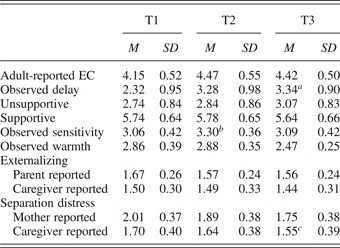
We found few sex differences in the variables. However, at T2, mothers were more sensitive toward their daughters than sons; in addition, girls had higher T3 restraint scores during the delay task than did boys and were higher in T3 separation distress (caregivers' reports) than were boys (see Table 1 for means and standard deviations).
Means and standard deviations of study variables
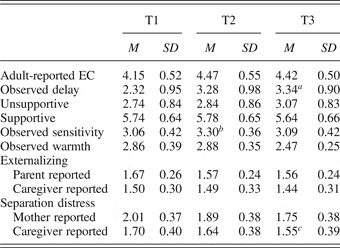
Note: T1, Time 1; T2, Time 2; T3, Time 3; EC, effortful control.
aSex difference: t (184) = −3.71, p < .01; boys, M = 3.13; girls, M = 3.59.
bSex difference: t (213) = −2.48, p < .05; boys, M = 3.25; girls, M = 3.37.
cSex difference: t (113.08) = −2.35, p < .05; boys, M = 1.48; girls, M = 1.64.
There were a number of relations between SES and concurrent study variables. At T1, SES was correlated with maternal unsupportive behaviors, maternal sensitivity, maternal warmth, parent-rated externalizing, caregiver-rated externalizing, and caregiver-rated separation distress, rs (232, 234, 234, 238, 163, 161) = −.33, .39, .32, −.18, −.23, and −.30, ps < .01, respectively. At 30 months, SES was correlated with observed restraint, maternal unsupportive behaviors, maternal sensitivity, maternal warmth, parent-rated externalizing, caregiver-rated externalizing, and caregiver-rated separation distress, rs (207, 211, 208, 208, 220, 146, 145) = .24, −.37, .38, .36, −.25, −.21, and −.19, ps < .01, .01, .01, .01, .01, .01, and .05, respectively. At 42 months, SES was correlated with adult-reported EC, maternal unsupportive behaviors, maternal sensitivity, maternal warmth, parent-rated externalizing, caregiver-rated externalizing, mother-rated and caregiver-rated separation distress, rs (203, 186, 186, 186, 203, 145, 203, 139) = .23, −.29, .40, .28, −.31, −.25, −.15, and −.23, ps < .01, .01, .01, .01, .01, .01, .05, and .01, respectively. Thus, SES was used as a covariate in the models.
Correlations among indices of a construct
Correlations among reports of maladjustment
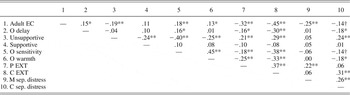
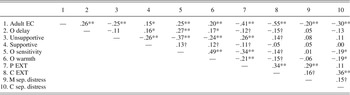
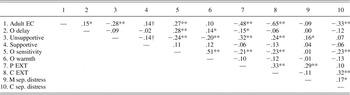
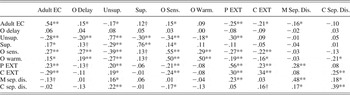
Correlations among parents' and caregivers' reports of maladjustment are presented in Tables 2, 3, and 4. Parents' reports of externalizing problems were positively related to caregivers' reports at each age, and mothers' and caregivers' reports of separation distress were at least marginally positively correlated at each age. In addition, separation distress and externalizing problems were positively correlated within reporter at each age.
Correlations of study variables within 18 months of age
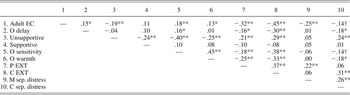
Note: EC, effortful control; O, observed; P, parent reported; EXT, externalizing problems; C, caregiver reported; M, mother reported; sep. distress, separation distress.
†p < .10. *p < .05. **p < .01.
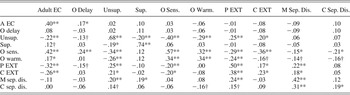
Correlations of study variables within 30 months of age
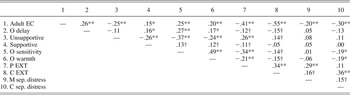
Note: EC, effortful control; O, observed; P, parent reported; EXT, externalizing problems; C, caregiver reported; M, mother reported; sep. distress, separation distress.
†p < .10. *p < .05. **p < .01.
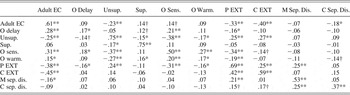
Correlations of study variables within 42 months of age
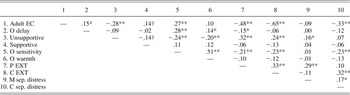
Note: EC, effortful control; O, observed; P, parent reported; EXT, externalizing problems; C, caregiver reported; M, mother reported; sep. distress, separation distress.
†p < .10. *p < .05. **p < .01.
Correlations among reported EC and observed regulation
At all assessments, observed regulation was significantly positively correlated with adults' reports of EC.
Correlations among maternal socialization variables
Mothers' reports of unsupportive strategies in response to negative emotion were at least near significantly (usually significantly), negatively related to their supportive strategies and to observed sensitivity and warmth at each age. Mothers who displayed more warmth were also more sensitive at each age.
Relations of maternal socialization and toddlers' EC to toddlers' maladjustment
To examine relations among the study variables, we first computed zero-order correlations. Next, using multiple indicators for each measure, we tested longitudinal SEMs that controlled for stability in the constructs over time, as suggested by Cole and Maxwell (2004).
Zero-order concurrent correlations
Concurrent correlations of children's maladjustment with mother socialization and children's EC are presented in Tables 2, 3, and 4. Within time at T1 and T2, mothers' sensitivity and warmth were negatively related to externalizing problems (marginally for caregiver-reported externalizing at T2) and caregivers' reports of separation distress (marginally for sensitivity and caregiver-reported separation distress at T1), and mothers' sensitivity similarly predicted low maladjustment at T3 (but warmth did not). Mothers' unsupportive strategies were at least marginally, positively related to externalizing problems at each age; they also were correlated with caregivers' reports of T1 separation distress and mothers' reports of T3 separation distress.
Adult-reported EC was negatively related to externalizing problems and caregivers' reports of separation distress at each age (although the latter correlation was near significant at T1). Similarly, high adult-reported EC was related to low mother-reported separation distress at T1 and T2 (but not T3). Observed regulation was at least marginally negatively related to both indices of externalizing problems at T1 and T2 and parents' reports of externalizing at T3. Observed regulation was negatively associated with caregivers' reports of T1 separation distress.
Zero-order longitudinal correlations
Longitudinal correlations of socialization variables and EC to children's maladjustment are presented in Tables 5, 6, and 7. Mothers' sensitivity and warmth at T1 negatively predicted T2 and T3 externalizing problems, as well as T3 separation distress (a few of these relations were near significant). Similarly, T1 warmth negatively predicted T2 caregiver-reported separation distress (and some other correlations were marginal over time). T1 unsupportive strategies were positively related to T2 and T3 parent-reported externalizing problems and T3 caregiver-reported externalizing problems. At a trend level (p < .10) or better, T2 sensitivity predicted lower T3 externalizing problems, and T2 warmth was negatively correlated with T3 parents' ratings of externalizing problems and caregivers' ratings of separation distress. In addition, T2 unsupportive strategy use was positively related to T3 externalizing problems.
Correlations of study variables between 18 and 30 months of age
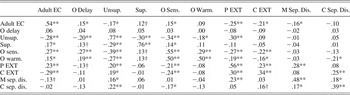
Note: Variables for 18 and 30 months are along the vertical and horizontal axes, respectively. EC, effortful control; O, observed; Unsup., unsupportive; Sup., supportive; Sens., sensitivity; Warm., warmth; P, parent reported; EXT, externalizing; C, caregiver reported; M, mother reported; Sep. Dis., separation distress.
†p < .10. *p < .05. **p < .01.
Correlations of study variables between 18 and 42 months of age
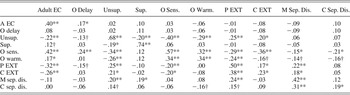
Note: Variables for 18 and 42 months are along the vertical and horizontal axes, respectively. EC, effortful control; O, observed; Unsup., unsupportive; Sup., supportive; Sens., sensitivity; Warm., warmth; P, parent reported; EXT, externalizing; C, caregiver reported; M, mother reported; Sep. Dis., separation distress.
†p < .10. *p < .05. **p < .01.
Correlations of study variables between 30 and 42 months of age

Note: Variables for 30 and 42 months are along the vertical and horizontal axes, respectively. EC, effortful control; O, observed; Unsup., unsupportive; Sup., supportive; Sens., sensitivity; Warm., warmth; P, parent reported; EXT, externalizing; C, caregiver reported; M, mother reported; Sep. Dis., separation distress.
†p < .10. *p < .05. **p < .01.
Adult-reported EC at T1 negatively predicted T2 externalizing problems and mothers' reports of separation distress, although it did not predict T3 maladjustment. T2 adult-reported EC was inversely related to T3 externalizing and caregiver-reported separation distress. T2 observed regulation was negatively related to T3 parent-reported externalizing problems.
Measurement models
Prior to computing the SEMs, measurement models were tested through confirmatory factor analyses, which examined whether the manifest variables related to one another in the expected manner. The models contained 4 latent constructs at each age (a total of 12 latent constructs): maternal strategies, children's EC, internalizing problems, and externalizing problems. For maternal strategies, mothers' reports of unsupportive responses to negative emotion, supportive responses, maternal warmth (during puzzle), and maternal sensitivity (combined responses in free play and puzzle) were used as indicators. The latent construct of EC included the composite of adult-reported EC and the delay restraint score. For externalizing problems, parents' (mother and father averaged) and caregivers' reports were indicators. For internalizing problems, mothers' and caregivers' reports of separation distress were indicators. Correlations among the latent factors within time were estimated. Measurement errors of the study variables were allowed to covary within reporter when indicated by the modification indices. The models were tested using Mplus Version 4.2 (Muthén & Muthén, Reference Muthén and Muthén1998–2006) because it accounts for incomplete data by using a maximum likelihood estimation method. Model fit was assessed with the chi-square statistic (χ2), comparative fit index (CFI), and the root mean square error of approximation (RMSEA). Nonsignificant chi-square statistics, CFIs greater than 0.90, and RMSEAs less than 0.08 indicate an adequate model fit, although the chi-square statistic is affected by sample size and, consequently, was not considered the primary indicator of fit (Kline, Reference Kline1998).
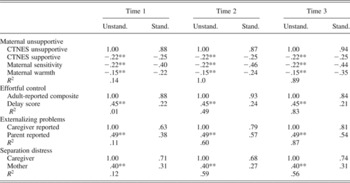
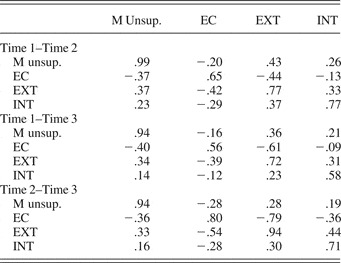
The measurement model contained a warning, indicating that correlations among the latent variable of mother parenting at T2 and mother parenting at T1 and T3 were above 1.0. The measurement error for T3 maternal nonsupportive strategies was set using the formula (1 − α) × variance (Jöreskog & Sörbom, 1996), which resolved the issue. The measurement model fit the data adequately, χ2 (df = 320, N = 264) = 464.79, p < .01, CFI = 0.93, RMSEA = 0.04 (90% confidence interval [CI] = 0.03–0.05). All of the model-estimated loadings were significant and in the expected direction (i.e., all positive loadings with the exception of supportive strategies, sensitivity, and warmth, which negatively loaded on the parenting construct, as expected, see Table 8). Within time at each age, mothers' unsupportive socialization was significantly negatively correlated with EC and positively correlated with externalizing problems (and separation distress at T1 only). In addition, EC was negatively correlated with both internalizing and externalizing problems at each age, and separation distress was positively correlated with externalizing problems at each age. All across-time relations between unsupportive socialization and both EC and externalizing problems were significant, as were all negative relations between EC and externalizing problems. Externalizing and internalizing were significantly positively related across time except 42-month externalizing was not related to 18-month internalizing problems. Unsupportive parenting and internalizing problems generally were not related across time except 18-month internalizing was positively related to unsupportive parenting at 30 and 42 months. EC and internalizing problems were usually (three of four instances) negatively related across a 1-year period but not across 2 years.
Standardized and unstandardized loadings and R2 for latent constructs (Model 3)
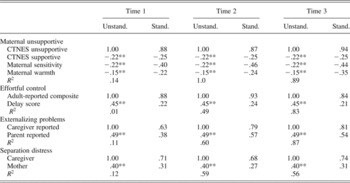
Note: Unstand., unstandardized loadings; Stand., standardized loadings; CTNES, Coping With Toddlers Negative Emotion Scale.
**p < .01.
Even though the CFI was relatively low in this model, for parsimony and because none of the results changed, we present only the one model including both internalizing and externalizing problems. However, when we computed separate models for the two types of problem behaviors, the fits were better, χ2 (df = 200, N = 264) = 273.33, p < .01, CFI = 0.96, RMSEA = 0.04 (90% CI = 0.03–0.05) and χ2 (df = 201, N = 264) = 288.52, p < .01, CFI = 0.95, RMSEA = 0.04 (90% CI = 0.03–0.05), for the externalizing and internalizing models, respectively.
Next, we tested the factorial invariance of the model (to test whether the relations of the latent variables to the manifest variables were constant over time). We compared the unconstrained measurement model to a model in which the loadings of the various observed variables were constrained to the same value as their equivalent loadings at the other time points (constrained model). This comparison was not significant, Δχ2 (10) = 19.84, p > .05, indicating that the factor loadings were equal across waves, χ2 (df = 332, N = 264) = 484.63, p < .01, CFI = 0.93, RMSEA = 0.04 (90% CI = 0.03–0.05). Thus, in the longitudinal models, the loadings were set to be equal across time.
SEMs
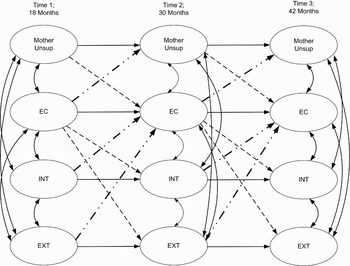
We computed a series of nested models to examine the potential influence of maternal and child behavior over time (see Figure 1). Because of the relations between SES, child's sex, and the study variables, we included SES and child sex as a predictor in the model (including the path only when significant).
Conceptual models. Mother Unsup, mothers' unsupportive reactions; EC, effortful control; INT, internalizing problems; EXT, externalizing problems. (—) Model 1 refers to the continuity model. (- - -) Model 2 includes all paths from Model 1 and adds the key cascade paths from parenting to EC and EC to problem behavior. (– • •) Model 3 includes all paths from Model 2 and adds transactional paths from problem behaviors to EC and parenting and from EC to parenting.

In the first model, we tested only the continuity of constructs over time. This model included within-time correlations among the constructs and the autoregressive paths (i.e., paths predicting latent constructs from its prior level) to control for stability in the constructs over time. The model fit the data adequately, χ2 (489, N = 264) = 730.21, p < .01, CFI = 0.93, RMSEA = 0.04 (90% CI = 0.04–0.05). All of the autoregressive paths were positive and significant. The fit for separate models for externalizing and internalizing was χ2 (327, N = 264) = 500.29, p < .01, CFI = 0.94, RMSEA = 0.05 (90% CI = 0.04–0.05) for externalizing and χ2 (355, N = 264) = 580.14, p < .01, CFI = 0.92, RMSEA = 0.05 (90% CI = 0.04–0.06) for internalizing problems.
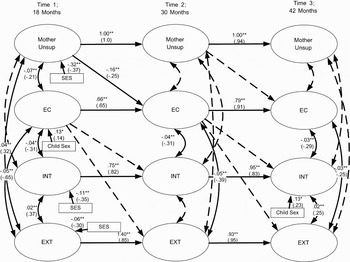
In the next model, we tested the structural model examining whether parenting at T1 and T2 predicted EC a year later, and whether EC at T1 and T2 predicted maladjustment a year later, using procedures outlined by Cole and Maxwell (2004). The model fit the data adequately when both INT and EXT were in the same model, χ2 (483, N = 264) = 717.15, p < .01, CFI = 0.93, RMSEA = 0.04 (90% CI = 0.04–0.05), and the fit was significantly improved from the continuity model, Δχ2 (6) = 13.06, p < .05. The fit for separate models for externalizing and internalizing was χ2 (325, N = 264) = 498.02, p < .01, CFI = 0.94, RMSEA = 0.045 (90% CI = 0.04–0.05) for externalizing, and χ2 (323, N = 264) = 481.18, p < .01, CFI = 0.94, RMSEA = 0.04 (90% CI = 0.04–0.05) for internalizing. The autoregressive paths for all of the constructs were positive and significant (see Figure 2). The path from T1 mothers' unsupportive behavior to EC at T2 was negative and significant, even after controlling for stability in the constructs. The path from T2 unsupportive parenting to T3 EC was not significant. The paths from T1 and T2 EC to maladjustment 1 year later were not significant. Concurrent SES negatively predicted T1 mother unsupportive socialization, T1 externalizing, and T1 internalizing problems. Child sex (being female) was a significant positive predictor of T3 internalizing and T1 EC. In terms of concurrent correlations among the major constructs, T1 maternal unsupportive parenting was negatively related to T1 EC and positively correlated with T1 externalizing problems. EC was negatively related to externalizing and internalizing problems concurrently at all ages. Internalizing and externalizing problems were at least marginally positively correlated at each age.Footnote 1
The cascade model (Model 2). Mother Unsup, mothers' unsupportive reactions; EC, effortful control; INT, internalizing problems; EXT, externalizing problems; SES, socioeconomic status. Dashed lines indicate tested but not significant paths. Numbers are only present when paths/correlations are significant. The top numbers are unstandardized estimates, and the numbers in parentheses are standardized estimates. Child sex is coded 1 = male and 2 = female; χ2 (483; n = 265) = 717.15, p < .01, comparative fit index = 0.93, root mean square error of approximation = 0.04 (90% confidence interval = 0.04–0.05). *p < .05. **p < .01.

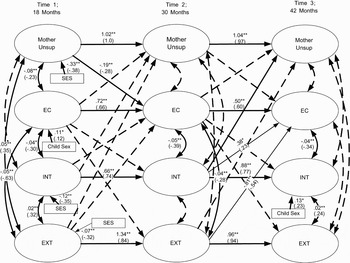
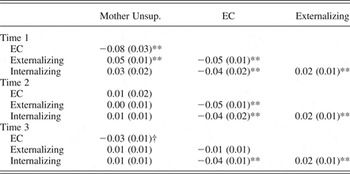
In the final model, we tested a transactional cascade model, in which we added paths from EC at T1 and T2 to mothers' unsupportive parenting 1 year later and paths from maladjustment at T1 and T2 to unsupportive parenting and EC a year later. The fit of this model improved the fit from the previous model, χ2 (473, N = 264) = 698.91, p < .01, CFI = 0.93; RMSEA = 0.04 (90% CI = 0.04–0.05), Δχ2 (10) = 18.24, p = .05 (see Figure 3). All indicators significantly loaded on their respective constructs (see Table 8). As with the prior model, the autoregressive paths for all of the constructs were positive and significant, and the negative path from T1 mother unsupportive parenting to T2 EC was significant. In addition, there was a negative path from T2 externalizing to T3 EC and a positive path from T2 internalizing to T3 EC (see Figure 2).Footnote 2 The former path, but not the latter, was significant when EXT and INT were in separate models (for the coefficient for the INT to EC, the path was still positive but p > .10). Thus, the path from INT to EC was either a suppression effect or was apparent only when the unique effect of INT, controlling for effects because of co-occurring EXT, were examined. Correlations among the constructs within time are presented in Table 9, and correlations among the latent constructs are presented in Table 10. Of particular note in regard to the within-time relations, mother unsupportive parenting was negatively related to EC and positively related to externalizing at T1 and EC was negatively related to internalizing at all three assessments and negatively related to externalizing at T1 and T2.Footnote 3
The bidirectional model (Model 3). Mother Unsup, mothers' unsupportive reactions or behaviors; EC, effortful control; INT, internalizing problems; EXT, externalizing problems; SES, socioeconomic status. Dashed lines indicate tested but not significant paths, and bold lines indicate significant bidirectional paths. Numbers are only present when paths/correlations are significant. The top numbers are unstandardized estimates, and the numbers in parentheses are standardized estimates. Child sex is coded 1 = male and 2 = female; χ2 (473; n = 265) = 698.91, p < .01, comparative fit index = 0.93, root mean square error of approximation = 0.04 (90% confidence interval = 0.04–0.05). *p < .05. **p < .01.

Within time associations of latent constructs (standard errors) for Model 3
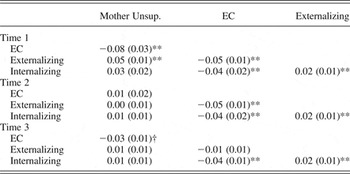
Note: Unsup., unsupportive; EC, effortful control.
†p < .10. **p < .01.
Across time correlations among latent variables (Model 3)

Note: M, mother; Unsup., unsupportive; EC, effortful control; EXT, externalizing; INT, internalizing.
Discussion
In the present study, the potential cascade effect of parenting predicting EC, which in turn predicts externalizing and internalizing symptoms, was examined with a longitudinal sample of young children. Consistent with Spinrad et al. (Reference Spinrad, Eisenberg, Gaertner, Popp, Smith and Kupfer2007) and using the same sample, there was evidence that unsupportive (vs. supportive) parenting at 18 months predicted low levels of children's EC at 30 months, even when controlling for the stability of the constructs. This relation is consistent with the view that quality of parenting at 18 months affects change in children's EC across the next year. In addition, in the confirmatory factor analysis (CFA; in which correlations among latent constructs but not across-time paths are included), the latent construct for unsupportive parenting was significantly negatively correlated with EC and positively correlated with externalizing problems within and across time. Thus, unsupportive parenting was consistently correlated with low EC and high levels of maladjustment. Nonetheless, using models (SEMs) in which the stabilities of parenting, EC, and problem behavior were taken into account, quality of parenting at 30 months was not significantly related to either EC or problem behaviors at 42 months. Thus, although parenting was related to EC and problem behaviors in predictable ways at all three ages and across time, the interrelations at 30 and 42 months evident in the CFAs appeared to reflect the stability of the same relations found at 18 months across time and the prediction of 30-month EC from 18-month parenting. This pattern of findings suggests that although quality of maternal behavior with 18-month-olds may have an effect on 30-month EC, parenting had no additional direct effects on EC.
Although there were no cumulative effects of EC on maladjustment over time after controlling for within-time covariation and continuity over time, it is important to note that the latent construct of EC was negatively correlated with internalizing at each age and with externalizing problems at T1 and T2. Because of these within-time relations between EC and maladjustment at T2 and T3, it is quite possible that the apparent early effects of parenting on 30-month EC had some effect on maladjustment within time at T2 and/or T3.
The lack of across-time predictive relations in the stringent cascade SEM for socialization at 30 months with 42-month EC and between EC and subsequent problem behaviors was unexpected. In studies of children 54 months old through elementary school, researchers have found that quality of parenting predicts EC across time, even when controlling for the stability of both constructs, and that EC in turn predicts less problem behavior (Belsky et al., Reference Belsky, Pasco Fearon and Bell2007; Eisenberg et al., Reference Eisenberg, Sadovsky, Spinrad, Fabes, Losoya and Valiente2005; Valiente et al., Reference Valiente, Eisenberg, Spinrad, Reiser, Cumberland and Losoya2006). Several explanations are possible for the discrepancies in findings. In general, parenting in older children has been assessed in somewhat more challenging contexts, although this has not always been the case (e.g., in Belsky et al., Reference Belsky, Pasco Fearon and Bell2007, at 54 months). In addition, in studies with older children, parental expression of positive and/or negative emotion (Eisenberg et al., Reference Eisenberg, Sadovsky, Spinrad, Fabes, Losoya and Valiente2005; Valiente et al., Reference Valiente, Eisenberg, Spinrad, Reiser, Cumberland and Losoya2006) or respect for autonomy (Belsky et al., Reference Belsky, Pasco Fearon and Bell2007) has been part of the parenting constructs, whereas these components of parenting were less central (although not totally absent) in our parenting construct. Thus, the assessment of parenting differed somewhat across studies.
However, it is also possible that parenting has less effect on EC at 3 to 4 years, an age at which EC and related executive functioning are rapidly emerging (Garon, Bryson, & Smith, Reference Garon, Bryson and Smith2008; Jones, Rothbart, & Posner, Reference Jones, Rothbart and Posner2003; Reed et al., Reference Reed, Pien and Rothbart1984). During this period, quality of parenting may not be as important as other variables such as heredity or the larger social context (e.g., poverty that limits interactions with certain types of objects or other learning experience). Perhaps quality of parenting has more effects on individual differences in EC during its early emergence (at around 18 months) than at 30 to 54 months because of the potential role of emerging language skills in early EC. (Note that the measure of EC at 30 and 42 months in this study was similar to that used in some studies with older children; e.g., Eisenberg et al., Reference Eisenberg, Sadovsky, Spinrad, Fabes, Losoya and Valiente2005; Valiente et al., Reference Valiente, Eisenberg, Spinrad, Reiser, Cumberland and Losoya2006.) For example, Lewis, Carpendale, Towse, and Maridaki-Kassotaki (Reference Lewis, Carpendale, Towse, Maridaki-Kassotaki, Sokel, Muller, Carpendale, Young and Iarocci2010) have argued that language, social understanding, and self-regulation emerge during communicative exchanges, and that language is fostered by exchanges in which adults promote the infant's joint attention, which in turn contributes to an understanding of words related to attention and knowledge. Sensitive, warm mothers are prone to engage in interactions that promote joint attention (Hustedt & Raver, Reference Hustedt and Raver2002) and the development of language related to internal states and “self-talk” about modulation of behavior, which could contribute to rudimentary self-regulatory skills early in life (Findji, Reference Findji1993; Raver Reference Raver1996; see Hrabok & Kerns, Reference Hrabok, Kerns, Sokel, Muller, Carpendale, Young and Iarocci2010; Thompson, Reference Thompson, Eisenberg, William and Lerner2006). In addition, sensitive parenting that helps young children regulate sensory stimuli may be especially important for rudimentary self-regulation but less relevant after the earliest years (see Hrabok & Kerns, Reference Hrabok, Kerns, Sokel, Muller, Carpendale, Young and Iarocci2010).
In contrast, the positive relation found between positive parenting and EC during the elementary school years in other research may be because of supportive, positive parents engaging in a somewhat different and more sophisticated array of scaffolding, modeling, and teaching behaviors (e.g., modeling constructive coping, helping children to learn methods for regulating their emotions or separate the self from objects/people in the environment [perspective taking], discussing emotions and their regulation; see Eisenberg et al., Reference Eisenberg, Cumberland and Spinrad1998; Giesbrecht, Muller, & Miller, Reference Giesbrecht, Muller, Miller, Sokel, Muller, Carpendale, Young and Iarocci2010; Gottman et al., Reference Gottman, Katz and Hooven1997; Power, Reference Power2004) than used by mothers of toddlers/preschoolers, behaviors that foster EC in children who have already developed a moderate level of executive attention, language, self-understanding, or other skills that are relevant. When entering into school and having to deal with a more structured and demanding environment, children may benefit from types of parental guidance that are not as relevant at earlier ages. For example, attentional control appears to be especially critical to academic success (Duncan et al., Reference Duncan, Dowsett, Claessens, Magnuson, Huston and Klebanov2007), so parents may increasingly try to provide children with strategies for improvement in this domain of functioning. In brief, it is quite possible that different components of parenting have different effects on children's EC depending on the developmental level of a child's EC.
Of course, it is also quite possible that aspects of parenting not measured in the present study predict and even cause individual differences in EC in the preschool years. For example, parenting behaviors that direct children's attention to objects and people outside the self (e.g., that encourage perspective taking) appear to be related to cognitive self-regulation (Giesbrecht et al., in press). In the future, it would be useful to examine the relations of different aspects of parenting to EC in longitudinal cascade models.
The lack of predictive across-time relations between EC and problem behaviors when controlling for the stability of EC and problem behaviors also was unexpected. Such relations have been found in similar models in older children (e.g., Belsky et al., Reference Belsky, Pasco Fearon and Bell2007; Eisenberg et al., Reference Eisenberg, Sadovsky, Spinrad, Fabes, Losoya and Valiente2005; Valiente et al., Reference Valiente, Eisenberg, Spinrad, Reiser, Cumberland and Losoya2006). Most of the zero-order correlations between EC and internalizing or externalizing problems 1 year later were significant in this study (correlations across 2 years were not significant). Although the latent constructs of EC and externalizing problems were correlated across time in the CFAs, as were EC and internalizing across 1 year, these relations evaporated when paths from EC to maladjustment (or vice versa) were added and the stability of constructs was controlled. However, as previously noted, given the within-time correlations between EC and maladjustment constructs in the SEM, it is possible that EC affects problem behaviors within the assessment window at 30 or 42 months, although the direction of effect cannot be determined. The within-time relations between EC and maladjustment when controlling for the stability of constructs suggest that the relation between the two constructs at 30 and 42 months is not due merely to the prior relation between the two or to the stability of the constructs from 18 months onward. Thus, there may be a number of indirect pathways of influence from early parenting to later problem behaviors, often occurring within a given age. In addition, it is important to note the within-time correlations at 18 months among parenting, EC, and maladjustment could be because of effects of the constructs on one another prior to 18 months that are then carried across age through the pathway from 18-month parenting to 30-month EC or the within-time relations between EC and maladjustment. However, it is also quite possible that relations among parenting, EC, and problem behaviors at a young age stem at least partly from a third causal factor.
In line with this last possibility, Lemery-Chalfant et al. (Reference Lemery-Chalfant, Doelger and Goldsmith2008) found that heredity accounted for much of the relation between EC and elementary school children's problem behaviors and that shared additive genetic influence accounted for the covariation between self-regulation and symptoms of psychopathology. However, EC has been found to predict school-aged children's internalizing and externalizing problems in cascade models (e.g., Belsky et al., Reference Belsky, Pasco Fearon and Bell2007; Eisenberg et al., Reference Eisenberg, Sadovsky, Spinrad, Fabes, Losoya and Valiente2005; Valiente et al., Reference Valiente, Eisenberg, Spinrad, Reiser, Cumberland and Losoya2006). Perhaps change in the nature and severity of externalizing and internalizing problems explains why EC did not predict maladjustment in early childhood in our stringent panel model but has done so in similar studies in school children. For example, indices of maladjustment that tap toddlers' and young preschoolers' separation distress and aggression/defiance may be less severe and perhaps less related to contextual experiences than are the modes of aggression/antisocial behavior and internalizing problems (e.g., depression anxiety, social withdrawal) typically assessed in school children. It is also possible that EC affects maladjustment only after children's EC is fairly sophisticated and mature. Longitudinal research charting relations between EC and maladjustment from early in life into the school years is needed to better delineate any developmental shifts in potentially causal linkages between EC and maladjustment.
Of interest, in the final SEM, a predictive, negative, across-time path was found between externalizing problems at 30 months and EC at 42 months. This path held when internalizing problems were also in the same model. It is quite possible that aggressive/defiant 30-month-olds, in comparison to children lower in these externalizing problems, elicit different responses from their social environment and are less likely to create or take advantage of opportunities to learn attentional and behavior self-regulation strategies. For example, they are likely to interact in less optimal ways with peers and nonparental caregivers and, consequently, may elicit more hostility and lower quality play and social communication. It is also possible that parents view defiance and aggression at 30 months as normative (the “terrible 2s”) and as a phase that children grow out of and thus are not highly focused on changing such behavior.
Another interesting finding was that internalizing problems at 30 months positively predicted EC at 42 months. This finding is consistent with Aksan and Kochanska's (Reference Aksan and Kochanska2004) finding that EC in the preschool years is associated with fearfulness and behavioral inhibition but not with most research with older children. However, the relation between EC and internalizing was not significant when externalizing problems were not in the same SEM with internalizing problems. Given the positive relation between externalizing and internalizing problems, this may be a suppression effect. However, another possible interpretation is that internalizing problems not coupled with externalizing problems are associated with EC, whereas internalizing problems that co-occur with externalizing problems are not. This is consistent with research suggesting that internalizing that is pure (i.e., does not co-occur with externalizing problems) is not as consistently negatively related to EC as is internalizing that co-occurs with externalizing problems (Eisenberg et al., Reference Eisenberg, Cumberland, Spinrad, Fabes, Shepard and Reiser2001, Reference Eisenberg, Sadovsky, Spinrad, Fabes, Losoya and Valiente2005, Reference Eisenberg, Valiente, Spinrad, Cumberland, Liew and Reiser2009). Moreover, this finding also highlights the importance of including both internalizing and externalizing problems in the same model.
In the SEMs, unsupportive versus supportive parenting, EC, and maladjustment were stable across time. Although this stability was expected (see introductory section), these findings confirm that individual differences in these three constructs are evident from early in a child's life, which likely contributes to the previously discussed stability over time in the pattern of relations among quality of maternal socialization, EC, and maladjustment.
This study has a number of strengths, including the use of multiple methods and reporters and a stringent panel design. However, even the use of such a design does not allow for strong conclusions regarding causality. A weakness of the study is that the measure of EC differed at 30 and 42 months; however, this did not seem to be a problem because EC at 18 and 30 months could be constrained to be equal in the SEM. Moreover, there is some argument that the delay of gratification task measures a “hot” system involving emotional processing (Mischel & Ayduk, Reference Mischel, Ayduk, Baumeister and Vohs2004). Moreover, the skills required for simple response inhibition (such as in many delay tasks) may develop earlier than executive functioning skills that involve more mature attention, more complex response inhibition (e.g., holding a rule in mind, responding to that rule, and inhibiting a prepotent response), and shifting one's response set in accordance to new rules (see Garon et al., Reference Garon, Bryson and Smith2008). In addition, given that the delay procedure involves a reward (as opposed to other widely used EC tasks that require the participants to slow down their motor activity, or to suppress a predominant response), it is possible that this task measures other aspects of control that may be less voluntary (i.e., impulsivity). Scores on this task loaded with adults' ratings of EC, which gives us confidence that the ability to delay is a reasonable indicator of EC in very young children (Spinrad et al., Reference Spinrad, Eisenberg, Gaertner, Popp, Smith and Kupfer2007).
Although children's ability to delay appeared to be a relatively good indicator of EC, there are a number of limitations in measures of EC in young children. For example, measures of EC at this age are undoubtedly linked to developmental abilities, particularly language skills. Thus, more work needs to be done to develop appropriate EC tasks that do not require such abilities; there are few good measures of EC for 18-month-olds.
In addition, although the sample was relatively diverse, it included mostly working and middle-class families, and the majority of families were Caucasian. Thus, the findings may not generalize to low socioeconomic or minority families. Moreover, we did not include a measure of fathers' socialization behaviors. Links between fathering and children's regulation and EC may differ from the processes involving mothers (Kochanska et al., Reference Kochanska, Barry, Aksan and Boldt2008), and researchers should consider fathers' behaviors in future work.
Conclusion
In summary, although unsupportive versus supportive parenting at 18 months predicted EC at 30 months in a stringent panel SEM, there was little evidence of additional effects of parenting on EC or that EC mediated the relation between parenting and maladjustment in the preschool years. These findings suggest that causal relations among parenting, EC, and maladjustment might differ in the preschool years from the cascade effect of parenting → EC → maladjustment found when children are in elementary school. Given the relations among these variables prior to controlling for stability of variables in this study, it is important to identify the reasons for the within- and across-time correlational relations among quality of parenting, EC, and maladjustment. Moreover, attention to the role of development in the pattern of relations among parenting, EC, and maladjustment before and after entry into school is merited because the causal relations among these constructs may change over this period of development.