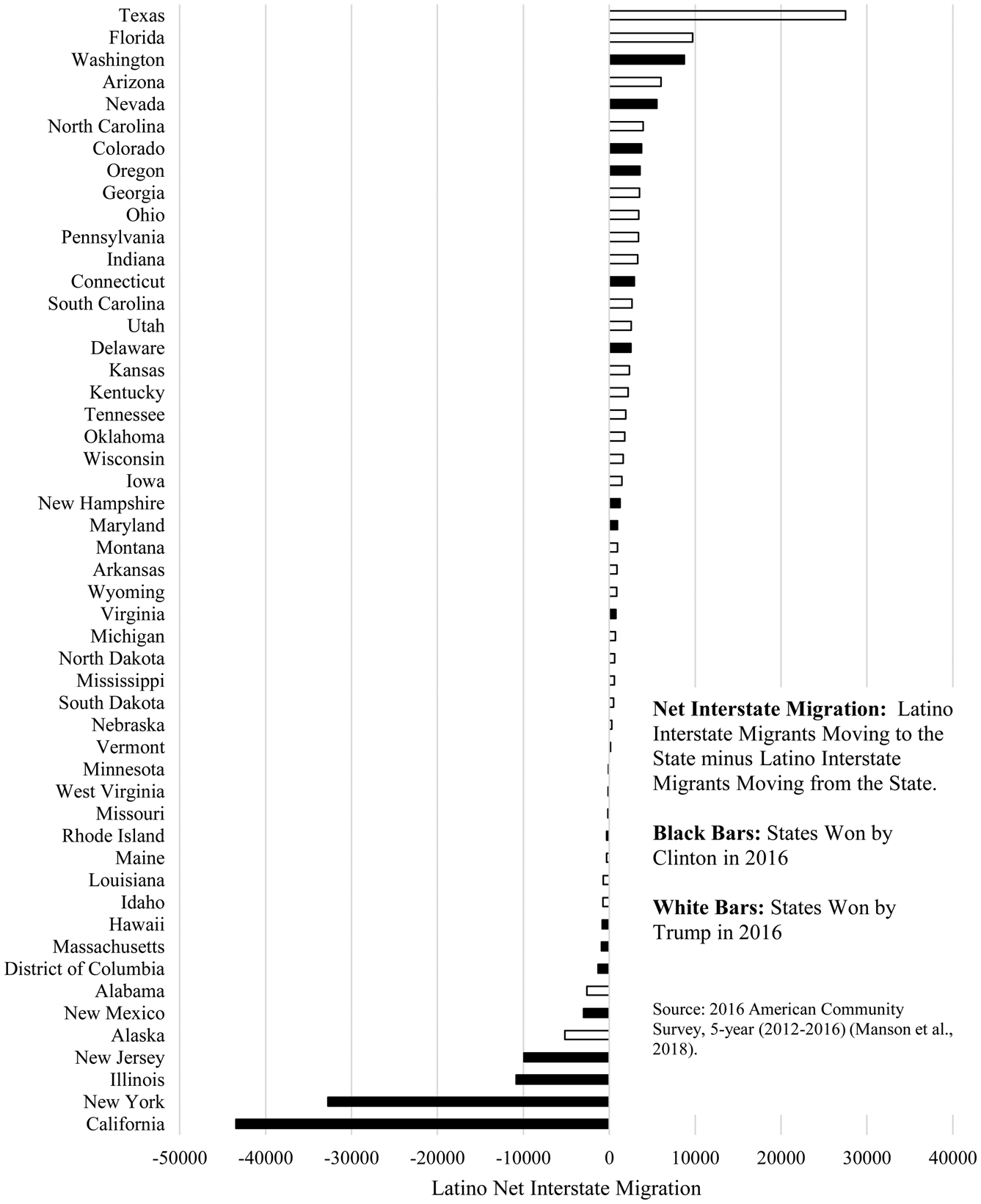
Between 2010 and 2015, an estimated 1.4 million Latinos, or 3.6% of the Latino population in the United States, moved to a different state (U.S. Census 2015). These interstate migrants contributed to the continued growth of the Latino population in “new destination” states—states primarily in the South and the Midwest with small Latino populations and historically attracting few Latino migrants from other states or abroad (Frey Reference Frey2015; Massey Reference Massey2008). Beyond the social and cultural dynamics associated with Latino population dispersion, interstate migration holds the potential to alter the political composition of destination states, particularly as Latinos migrate to traditionally Republican strongholds. For example, as Figure 1 shows, of the 34 states with positive net Latino interstate migration from 2012 to 2016, 24 (70.5%) voted for Republican Presidential Nominee Donald Trump in the 2016 election, while only seven (43.8%) of the 16 states with net losses of Latino interstate migrants favored the Republican candidate. Moreover, while Census migration flow data are only available at the regional-level, between 2010 and 2015, 45.4% of Latino inter-regional migrants moved from generally more liberal regions like the West and Northeast to relatively conservative regions such as the South and Midwest, while only 31.9% flowed in the reverse direction.
Latino Net Interstate Migration (2012–2016) and 2016 State Presidential Vote.

The ideological asymmetry between states that experienced net gains and net loses via Latino interstate migration implies a potential geo-political shift if Latino interstate migrants infuse conservative states with more liberal voters, while draining liberal voters from liberal states. However, such a transformation rests on the answer to a more basic question of whether Latino interstate migrants hold invariantly more liberal political orientations than destination state voters, assimilate to the new state's political context, or “pack their politics” and thus bring the political orientations of their previous state to a destination state. These varying possibilities are not only rooted in a broader literature on interstate and international migrants' political behavior, but also imply fundamentally diverging substantive impacts of Latino migration on destination state politics.
Despite evidence that interstate migration in the United States affects the political context of destination states, particularly in the South (Bass and De Vries Reference Bass and De Vries1995; Frendreis Reference Frendreis1989; Frey Reference Frey2015; Hood and McKee Reference Hood and McKee2010; Lublin Reference Lublin2004; McKee and Teigen Reference McKee and Teigen2016; Parker Reference Parker, Swansbrough and Brodsky1988; Scher Reference Scher1997; Wolfinger and Hagen Reference Wolfinger and Hagen1985), and considerable attention to the political effects of the recent dispersion of Latino migrants across the United States (cf. Frey Reference Frey2015; Hatalsky and Kessler Reference Hatalsky and Kessler2017; Massey Reference Massey2008; Sanchez Reference Sanchez2015), the limited amount of individual-level data on Latino migrants and their political preferences limits our understanding of the implications for Latino interstate migration. Instead, current analyses generally rely on individual samples of white non-Latinos combined with proxies for political preferences based on demographic characteristics, ecological inference, and/or county- or state-level data to infer the preferences of interstate migrants and their impact on destination states politics (cf. Gimpel and Schuknecht Reference Gimpel and Schuknecht2001; Hillygus, McKee and Young Reference Hillygus, McKee and Young2017; Jurjevich and Plane Reference Jurjevich and Plane2012; McKee and Teigen Reference McKee and Teigen2016; Robinson and Noriega Reference Robinson and Noriega2010). Thus, regardless of the popular account that Latino interstate migration combined with Latinos' general preference for Democratic candidates contributes to shifting state political orientations—a component of the narrative of the “destiny of demographics” implying that Latino population growth inevitably results in more liberal state electorates (cf. Frey Reference Frey2015; Hatalsky and Kessler Reference Hatalsky and Kessler2017)—there is a distinct lack of empirical evidence on Latino interstate migrants and the politics they bring to destination states (“new” or otherwise).
This study addresses the empirical void by testing the prominent theoretical models of interstate migrant voting behavior with a sample of Latino voters. Importantly, several of these models suggest that the assumption of a constant political disposition held among Latino migrants as they move across state borders is incorrect, and subsequently predictions of sweeping or even marginal changes in the political composition of states may not emerge. Employing data from the 2016 Collaborative Multi-Racial Post-Election Survey (CMPS) (Barreto et al. Reference Barreto, Frasure-Yokley, Vargas and Wong2017) to compare Latino interstate migrants' vote to that of Latino destination state residents in the 2016 Presidential and Congressional elections, and controlling for a number of individual-level demographic factors, the results demonstrate that Latino interstate migrants' choices in the Presidential and Congressional elections are conditioned by the political context of their previous state of residence. Latino voters seemingly “pack their politics” when moving to another state. In addition, neither political homophily, the tendency of moving to locations that match one's existing political dispositions, nor the process of political adaptation to destination state politics are supported. These findings, combined with recent interstate migratory patterns, suggest that while a more liberalizing effect congruent with the destiny of demographics narrative is largely correct, the extent of the continued impact of Latino interstate migration depends on the political context of migrants' previous state relative to the context of their destination state.
LATINO INTERSTATE MIGRATION AND THE POLITICS MIGRANTS PACK
With 3.6% of Latinos moving across state lines during the 5-year period from 2010 and 2015, the Northeast and West Census regions experienced negative net interstate migration by Latinos while the South and Midwest regions gained Latinos through domestic migration (U.S. Census 2015). The migratory pattern, in part, contributed to substantial increases in Latino populations in many “new destination” states across the country (see Figure 1). Between 2007 and 2014, for instance, ND, KY, LA, DE, and MD comprised the top five states in terms of rates of Latino population growth. Expanding the period to 2000–2014, the top five included SD, TN, SC, AL, and KY, each of which witnessed at least a two-and-a-half-fold increase over the 14-year period. In terms of Latinos as a substantive proportion of the population, the landscape across the states transformed over the last several decades. In 1970, the median state's Latino population fell at just 1.4%. By 2000, the median state's Latino population grew to 4.7%, and by 2015, that number almost doubled to 9%, with no state's Latino population falling below the 1970 median and only 12 states below the median from 2000 (Minnesota Population Center 2011).
Even with migration patterns and their political dynamics forming one basis for renewed interest in the influence of Latino voters, no studies directly examine the voting behavior of Latino interstate migrants. Instead, the literature, while recognizing variation across the states in Latino political dispositions (Norrander and Manzano Reference Norrander and Manzano2010), generally assumes Latino migration results in a uniform increase in Democratic or liberal voters with the potential to alter the electoral mix in destination states (Frey Reference Frey2015). Yet, there are good reasons to question this assumption as existing theories suggest diverging effects of interstate migration.
First, movers may be more Republican than non-movers for a variety of reasons usually associated with the economic position of Republicans and their ability to pursue economic opportunities (Gimpel and Schuknecht Reference Gimpel and Schuknecht2001).Footnote 1 Such was the basis for one explanation of why Southern states become more Republican while net loss states in the Northeast and Midwest tended to be left with relatively more Democrats (Bass and DeVries Reference Bass and De Vries1995; Lublin Reference Lublin2004; Scher Reference Scher1997; Wolfinger and Hagen Reference Wolfinger and Hagen1985). While Latinos, with a few notable exceptions, are recently characterized by a solid Democratic bent (Barreto and Segura Reference Barreto and Segura2014; Leal Reference Leal, Rodolfo, Leal and Meier2007; Sanchez Reference Sanchez2015), if Latino movers are indeed more likely to vote for Republicans than non-movers, the degree of change in destination states would be offset by a higher proportion of Latino Republicans moving than the overall Latino population. However, recent studies of Anglo or more general population samples suggest that this pattern may be changing, with movers from the Midwest or the Northeast to the South bringing their Democratic dispositions with them (Hillygus, McKee and Young Reference Hillygus, McKee and Young2017; McKee Reference McKee2010; McKee and Teigen Reference McKee and Teigen2016). Nevertheless, the conservative mover hypothesis, that domestic migrants are less liberal than non-movers, counters the general assumption of the effects of Latino dispersion.
Homophily, or the process of migrants choosing to move to states with similar political orientations, leads to a second hypothesis that counters the anticipated liberalizing effect of Latino domestic migration on destination states (Bishop and Cushing Reference Bishop and Cushing2008; Cho, Gimpel and Hui Reference Cho, Gimpel and Hui2013; Gimpel Reference Gimpel1999; McDonald Reference McDonald2011). Based primarily on studies of county- or neighborhood-level analyses, homophily lies at the heart of the concept of “the Big Sort” which describes a growing homogeneity in political preferences within, and increased divide across, geo-political units based on the self-selection of movers. At the state level, the homophily hypothesis predicts that liberal movers will relocate to more liberal states while conservative movers relocate to more conservative states. Observationally, there should be no difference in new arrivals compared to current residents, and a static political orientation of movers as they cross state lines. The subsequent effect on state-level politics is a growing disparity across states as their political alignments are reinforced by new domestic migrants, while the political composition of the destination state remains static.
Finally, theories derived from the political socialization literature anticipate two diverging behaviors of domestic migrants. On one hand, migrants may quickly assimilate the political orientation prevalent in their destination states due to the desire to conform to new political norms (Brown Reference Brown1988; Lyons Reference Lyons2011; McBurnett Reference McBurnett1991). Observationally, this would equate to the expectation of the homophily hypothesis, with no discernable difference between domestic migrants and non-migrants in destination states. On the other hand, migrants may bring the politics and social preferences from their home state to their destination state (Frendreis Reference Frendreis1989; Glaser and Gilens Reference Glaser and Gilens1997; Hood and McKee Reference Hood and McKee2010; Jurjevich and Plane Reference Jurjevich and Plane2012; Parker Reference Parker, Swansbrough and Brodsky1988; Rice and Pepper Reference Rice and Pepper1997; Robinson and Noriega Reference Robinson and Noriega2010; Wals Reference Wals2011; Reference Wals2013). Here, rather than assimilating to the new state's politics, domestic migrants' political dispositions vary by the political context of the state they left. This explanation lies at the heart of studies reporting that the infusion of new migrants from differing contexts altered the electoral landscape of destination states. Such studies generally focused on migrants from liberal states or regions and their liberalizing effects on traditionally conservative states in the South and elsewhere. Yet, the theory also applies to migrants from relatively conservative states, and thus migration holds the potential to move destination state politics in either direction. Moreover, related studies of immigrants from Latin America find that some broader political orientations are formed in the country of origin and immigrants bring these “political suitcases” with them to the United States (Wals Reference Wals2011; Reference Wals2013; White et al. Reference White, Nevitte, Blais, Gidengil and Fournier2008). In short, there exists a good amount of research on both domestic and international migration suggesting that the impact of new migrants on the political context of destination states depends on the political landscape of the previous state of residence.
Beyond diverging theoretical predictions, Latinos' unique social experiences underscore the need for evaluating Latino interstate migrants considering the almost exclusive use of white non-Latino samples in the existing literature on interstate migrants' voting behavior. First, while a variety of studies demonstrate that Latinos tend to hold more liberal policy positions than the general public and are subsequently more likely to vote for Democrats (Barreto and Segura Reference Barreto and Segura2014; Leal Reference Leal, Rodolfo, Leal and Meier2007; Sanchez Reference Sanchez2015), Latino political dispositions do vary by country of origin to some degree (Barreto and Segura Reference Barreto and Segura2014; Garcia Bedolla, Monforti, and Pantoja Reference Garcia Bedolla, Lavariega Monforti and Pantoja2007; Leal Reference Leal, Rodolfo, Leal and Meier2007). Given the geographic concentration of Latino populations in the United States by country of origin, interstate migration may result in varied patterns nested in the specific national origins of migrants in state-to-state dyad flows rather than a uniformly liberalizing effect. If migrants move due to a desire to re-locate to states with substantial populations of co-ethnics with similar national ancestry, then political homophily may result as a byproduct of this desire. Without controlling for individual-level measures of national ancestry, even general results that include Latinos in the sample potentially overstate the role of political matching in relocation decisions or underestimate the effect of socialization that occurs in previous states.
A second justification for specifically studying Latino interstate migrants rests in the unique political socialization process experienced by Latinos. Latinos are less likely to identify with a party and are more politically ambivalent when it comes to partisan attachment (Hajnal and Lee Reference Hajnal and Lee2011). While often rooted in specific policy concerns, ambivalence about party attachment implies that Latinos may be more likely to adopt the broader partisan orientation of destination state Latinos than other racial/ethnic groups. A Latino sample thus offers a stronger test of models predicting that interstate migrants “pack their politics.”
In addition to the potentially unique nature of how Latino interstate migrants respond to shifting state political contexts, a major empirical weakness in much of the literature is a dearth of data, even for white non-Latinos, that accounts for both individual-level political and demographic factors as well as observations on both origination and destination states. This type of data is essential, however, as several theories suggest that the politics of previous states lie at the heart of domestic migrants' preferences in the voting booth and influence on destination state politics. Only with observations on both the destination and origination states' political contexts can one delineate the degree to which each affects voter preferences. Individual-level data such as partisan identification and ideology are necessary to control for political predispositions that anchor vote choice regardless of interstate migrant status. Demographic characteristics such as income, education, unemployment status, and even marital status may be correlated with both vote choice and the propensity to move across state lines as opportunities for jobs and familial considerations play prominent roles in locational decisions. Yet previous empirical approaches primarily utilize region of origin as proxies for migrants' previous political context, county- or state-level changes in electoral politics of the destination state to infer individual-level preferences, or some combination of the two. The result is an existing literature that faces significant hurdles in isolating the individual-level political behavior of domestic migrants assumed to lead to aggregate political realignment, as well as being of limited generalizability due to the lack of data on Latino migrants.
RESEARCH DESIGN
To overcome these limitations, this study utilizes new and unique individual-level data from the 2016 CMPS to evaluate the validity of general theories from the interstate migration literature as applied to Latino interstate migrants. The 2016 CMPS gathered data for a nationally representative sample through a self-administered online survey conducted from December 3 2016 to February 15 2017 (complete details of which are provided in the Data Appendix and online Supplemental Materials). Two subsets of the survey respondents were utilized as samples, all of which were self-identified Latino citizens who indicated a preference for either a presidential or U.S. House of Representatives candidate in the 2016 General Election. The first subset included over 1,500 self-reported voters. The second sample consists of over 900 self-reported voters whose voting status could be verified through public records. Non-verified self-reported voters fell into two major categories. About 18% of self-reported voters were found to have not voted, while just over 19% of the self-reported sample's voter status could not be determined. Given the large discrepancy in the number self-reported and verified voters, analyses are presented for both groups as even non-verified self-reported vote choice provides a reasonable measure of political preference and orientation even if the actual act of voting did not occur. The two samples are remarkably similar in terms of vote choice (67% and 68% self-reported voters voted for Clinton and the Democratic House candidate, respectively, compared with 68% and 69% of verified voters). The Data Appendix provides summary statistics for both groups across the range of dependent and independent variables. Ultimately, the analyses reveal very few substantive differences in the results across the two samples.
The research design compares the voter preferences of Latinos who have moved to a state with long-time residents within the destination state to determine the degree to which migrants' vote choices deviated from those of current residents' choices. Such an approach allows the analysis to test the major competing hypotheses derived from general theories of domestic migrants' political behavior while controlling for the potential of co-ethnic groups to impart a greater assimilation effect on migrants. In other words, the design compares Latino movers to Latino non-movers, rather than Latino movers to the state's general population.
The uniqueness of the 2016 General Election raises some concern about the generalizability of results emerging from the 2016 CMPS. The heated rhetoric regarding immigration in the election potentially led to an anomalous national uniformity in the Latino vote that was insulated from political contexts in either destination or originating states (Wilkinson Reference Wilkinson2018). The immigration-focused election coupled with a highly polarized electorate where partisan identities became intertwined with racial/ethnic, gender, and policy identities (Mason Reference Mason2018). These two factors potentially bias the results away from detecting any socialization or conservative mover effects as Latino voters' partisanship and general policy dispositions override other potential factors in vote choice.Footnote 2 To partially address these concerns, two indicators of vote choice are employed as dependent variables in the analyses. The first is the respondent's self-reported presidential vote choice in the 2016 general election, coded 1 for Democratic nominee Hillary Clinton and 0, otherwise. This serves as a high-profile and nationally comparable measure of political preferences. However, the intense rhetoric of the campaign and unique level of interest it generated among Latino voters may limit generalizability by biasing the results toward null findings. The analysis thus employs a second measure of vote choice, the respondent's reported preference for U.S. House of Representatives, to compensate for this limitation. The lower profile of a House race allows respondents to utilize different cues, such as party affiliation or incumbency, when casting a ballot and therefore provides a useful check on the results based on presidential vote choice. Congressional vote choice is coded 1 if the respondent reported voting for the Democratic candidate, and 0 otherwise.
The two key independent variables are based on the survey item asking the respondent if they have lived someplace else before their current residence and the city and state of that previous residence. For those reporting living in a different state prior to their current residence, the Interstate Migrant variable is coded 1, and 0 for those indicating no previous place of residence or they moved from within the same state. Migrants made up 27% of the self-reported, and 26% of the verified, voter samples.
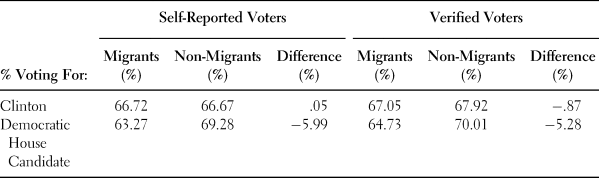
Table 1 presents an initial glimpse into the voting preferences of interstate migrants and non-migrants for both samples. As noted above, there is little difference in vote choice across the samples of self-reported and verified voters, with differences in vote choice within verified status of 1% or less. But do migrants and non-migrants differ in vote choice? The toplines suggest little variation in vote choice for the Presidential candidate in 2016 across migrant status. In both samples, about 67% of each group indicated a preference for Hillary Clinton. However, while majorities of each group supported the Democratic candidate for Congress, migrants were about 5–6 percentage points less likely to prefer the Democrat than non-migrants, a difference that was statistically significant only for the self-reported sample (χ2 = 5.34, p < .021).
Vote Preference of Interstate Migrants and Non-Migrants

The similarities in preferences suggest either homophily is at work or, in the case of preferences for the Congressional candidate, migrants are more conservative than non-migrants. However, these results are of limited use for testing socialization theories as they do not account for the political orientation of the previous state. Similar patterns would emerge if comparable numbers of migrants moved from conservative and liberal states and brought their previous state's diverging political orientations with them. Assimilation would produce the same results as well. In short, when comparing migrants' political dispositions to non-migrants' dispositions within a state, the null results of the bivariate relationship underscore the need to account for the political context of migrants' previous states.
To do so, the study employs two measures of a state's ideological context which are mapped to a migrant's previous state of residence. Both measures essentially equate to an interaction between the previous state's political context and the interstate migrant variable. For both measures, the values vary for interstate migrants, with a positive relationship indicating a greater probability of voting for the Democrat if one moves from a more liberal state compared with a move from a more conservative state. Values for non-migrants are coded as zero.
The first measure of the political context in a migrant's previous state, Previous State Obama Vote, is the proportion of the popular vote for Democratic Nominee Barack Obama in the 2012 general election. While this measure captures the previous political context in the most proximate previous election, it also levies a drawback in terms of a potential inconsistency with more general and longstanding ideological orientations across the states and the uniqueness of the context of both the 2012 and 2016 elections. Thus, a second indicator of Previous State Ideology, is utilized. It is measured as the average of Shor and McCarty's (Reference Shor and McCarty2015) lower and upper chambers' mean legislative ideology scores. The ideology scores are comparable across the states and capture the state legislature's political orientation, thus insulating the measure from the contemporary context of 2016's presidential election. The two variables are highly correlated over the samples of self-reported (r = .87) and verified voters (r = .88), as well as the sub-samples of migrants (r = .86), and are thus introduced in separate models to avoid collinearity issues.
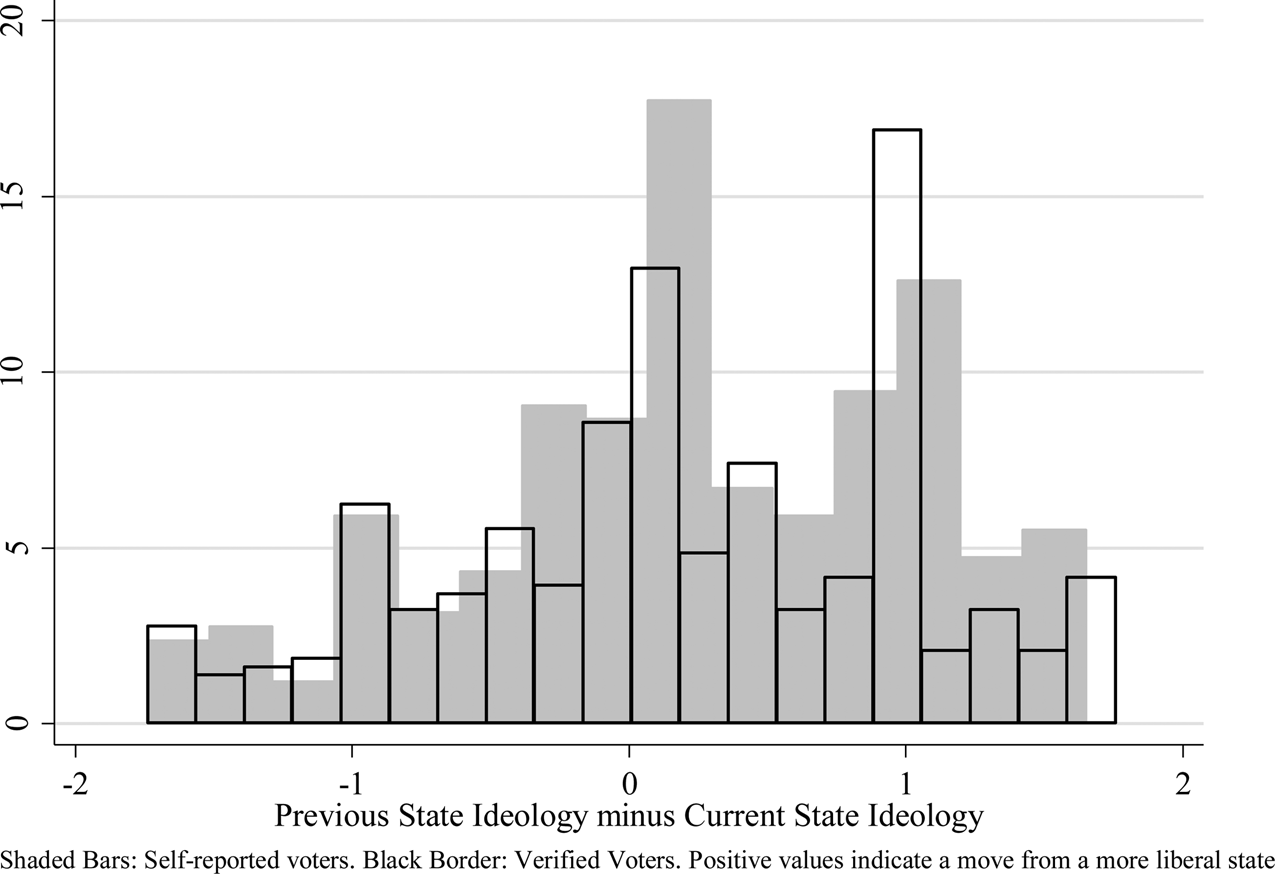
The samples employed in the analyses provide adequate variation in terms of state migrant flows across differing state contexts and reflect the general patterns of known state gains and losses. To illustrate, Figure 2 presents the sample distribution of the difference in migrants' previous state and current state ideology as measured with the Shor and McCarty's legislative ideology data. Note that the distribution is centered slightly above zero (mean = .19 and .22, SD = .83 and .80, self-reported and verified voters, respectively), indicating more movers to relatively conservative states. Yet, a substantial proportion of migrants in each sample moved to relatively more liberal states than their previous state in both samples (35% of self-reported, and 40% of verified voters). The variation in the differences in previous and current state political contexts further underscores the need to account for such differences in models of migrant vote choice.
Distribution of the Difference in Movers' Previous State Ideology and Current State Ideology for Self-Reported and Verified Voters.

To test the competing models of migrant vote choice, the analysis turns to Probit models to estimate the probability of voting for Clinton or the Democratic House candidate. Vote choice is modeled as a function of the two key independent variables to test the four competing hypotheses regarding domestic migrant versus non-migrant political behavior, as well as a bank of individual-level control variables and state fixed effects.Footnote 3 (Variable descriptions and summary statistics are provided in the Data Appendix.) The basic model is as follows:
 $$ {\rm Prob} \left( {{\rm Vote \,\, for \,\, Democrat}} \right) \!= b_1\left( {{\rm Interstate \,\, Migrant}} \right) + b_2\left( {{\rm Previous \,\, State 's \,\, Political \,\, Context}} \right) + b_n\left( {{\rm Individual \,\, Level \,\, Controls}} \right) + b_j\left( {{\rm State \,\, fixed \,\, effects}} \right) + e_i, where {:} $$
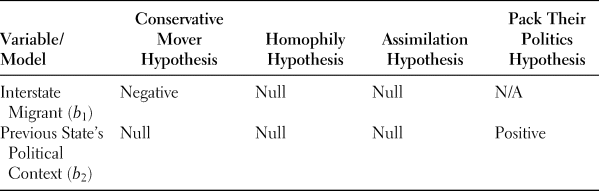
The Interstate Migrant variable is coded as described above and allows for the analysis to test the hypotheses related to arguments that (a) domestic migrants are more conservative than non-migrants (The Conservative Migrant Hypothesis), and (b) that homophily drives migration decisions as migrants seek states with similar political orientations (The Homophily Hypothesis). The former implies a negative sign for the coefficient for the domestic migrant dummy variable (b 1<0). The latter predicts that the coefficient be indistinguishable from zero (b 1 = 0).
Political ideology is either the Previous State's 2012 Obama Vote or the Previous State Ideology measure as described above. Given the inclusion of state fixed-effects, the respective coefficients for political ideology measure the difference between non-migrants' and migrants' vote choice as the latter move from states with differing political contexts. However, since both variables serve as interactions with the interstate migrant variable, joint interpretations are required. Positive values for the coefficient (b 2) are generally expected if interstate migrants bring their previous states' political context with them as they cross state lines (The Pack Your Politics Hypothesis). If, on the other hand, migrants adopt their new state's politics, b 2and b 1 will be indistinguishable from zero (The Assimilation Hypothesis). Table 2 summarizes the expected direction of these two key independent variables' coefficients for each of the hypotheses.
Expected Relationships for Models of Migrant Vote Choice

Note: Cell entries refer to the expected sign of the coefficient for the Interstate Migrant and Previous State's Political Context variables. Null refers to an anticipated null relationship (coefficients indistinguishable from zero), while N/A indicates the model requires no specific direction to the sign of the coefficient.
In addition, the survey allows for a variety of individual-level demographic and political variables to control for potential alternative explanations for vote choice. Of primary importance, the set of controls for partisan affiliation—Democrat and Republican partisan orientation (coded 1 for each, and 0 otherwise) with Independents as the omitted baseline category—are included to account for the influence of partisanship that likely does not change as one moves across state lines. A seven-category Conservativism scale was constructed by re-coding a traditional Likert Scale of political ideology to 1 for very liberal to 7 for very conservative. These measures provide key controls for isolating the relationship between political context and vote choice.
The models also include a variety of individual-level controls to account for both general patterns of vote choice and those specific to the Latino community. Reflecting the general gender gap, Latinas tend to hold more liberal policy preferences than Latinos, and thus the variable Female (females = 1; males = 0) is included in the model and expected to have a positive effect on both vote choices (Garcia Bedolla, Monforti, and Pantoja Reference Garcia Bedolla, Lavariega Monforti and Pantoja2007). Age, coded as the respondent's age in years, captures the potential for variation in age to correlate with both vote choice and propensity to move. The effect of religion is accounted for by two variables. Evangelical is coded 1 if the respondent indicated that they considered themselves Evangelical or born-again, and 0 otherwise. Given the prominence of Catholicism among Latinos, and the church's stance on a variety of policy issues, from abortion to immigration, Catholic is accounted for in the model and coded as 1 if respondents considered themselves to be Catholic, and 0 otherwise. Education levels, which may correlate with both vote choice and a respondent's propensity to move and their locational choice, are captured with the variable College Education, which is coded 1 if the respondent completed at least some college or a 2-year degree, and 0 otherwise. Since economic circumstances are primary drivers of interstate migration decisions and potentially vote choice, three variables are employed to capture unique aspects of economic well-being. First, a three-category Income variable is included in the model, placing respondents in household income categories of <$40,000, $40,000–$79,999, and over $80,000 per year. The lowest category is treated as the baseline category, with dummy variables included for the middle and upper income levels. Homeowner is a proxy for both income and wealth and is coded 1 for a respondent who owns the home they currently live in, and 0 otherwise. Employment status is measured by the dummy variable Unemployed, coded 1 for those currently unemployed, and 0 otherwise. Finally, marital status is included since married couples tend to vote for the more conservative candidate (Flanigan and Zingale Reference Flanigan and Zingale2009) and may be less likely to move given familial and dual-career considerations. Married is coded 1 if the respondent indicated they were married, and 0 otherwise.
In addition to the variables listed above, Latinos' tendency to vary political preferences by immigration status and national origin justifies four additional control variables. Since national origin groups and foreign-born citizens potentially vary both in their vote choice and geographic distribution, the controls include a dummy variable for Foreign-Born which is coded 1 if the respondent indicated that they were born outside of the United States, and 0 otherwise. While the sample was somewhat limited in terms of respondents indicating national ancestry from countries traditionally sending fewer Latino immigrants to the United States, adequate numbers of respondents indicated that they were either born in Puerto Rico or identified themselves as being of Mexican or Cuban descent to include these national-origin indicators in the analysis. Moreover, these categories account for most of the substantive group differences reported in previous studies (Barreto and Segura Reference Barreto and Segura2014; Leal Reference Leal, Rodolfo, Leal and Meier2007). Puerto Rican, Mexican, or Cuban are coded as 1 if the respondent indicated they were born in Puerto Rico, or traced their ancestry to Mexico or Cuba, respectively, and 0 otherwise.
The models also include a set of state fixed-effects which serve both substantive and methodological purposes. The state fixed-effects control for the unique and varied Latino political preferences and culture in each state which may account for a portion of migrant and non-migrant vote choice (Griffin and Newman Reference Griffin and Newman2008; Norrander and Manzano Reference Norrander and Manzano2010). Thus, the model compares Latino interstate migrants to non-migrants within each state which leads to a more rigorous test of the hypotheses of interest. In addition, the fixed-effects provide a baseline from which to estimate the effect of the political context of interstate migrant's previous state.
One limitation of the data is that while length of residence may affect the magnitude of previous state socialization and assimilation, the survey instrument did not allow for a precise measure of how long a respondent resided within a state. For instance, if a previous residence was indicated, but it was within the state, it was impossible to determine if the respondent had ever resided in a different state and subsequently the length of time since a previous interstate move. However, lacking a length of residence indicator in the models should bias results away from the reported results as migrants who moved years ago, and thus would be less affected by previous state contexts, are included with more recent migrants who are apt to be less assimilated.
RESULTS
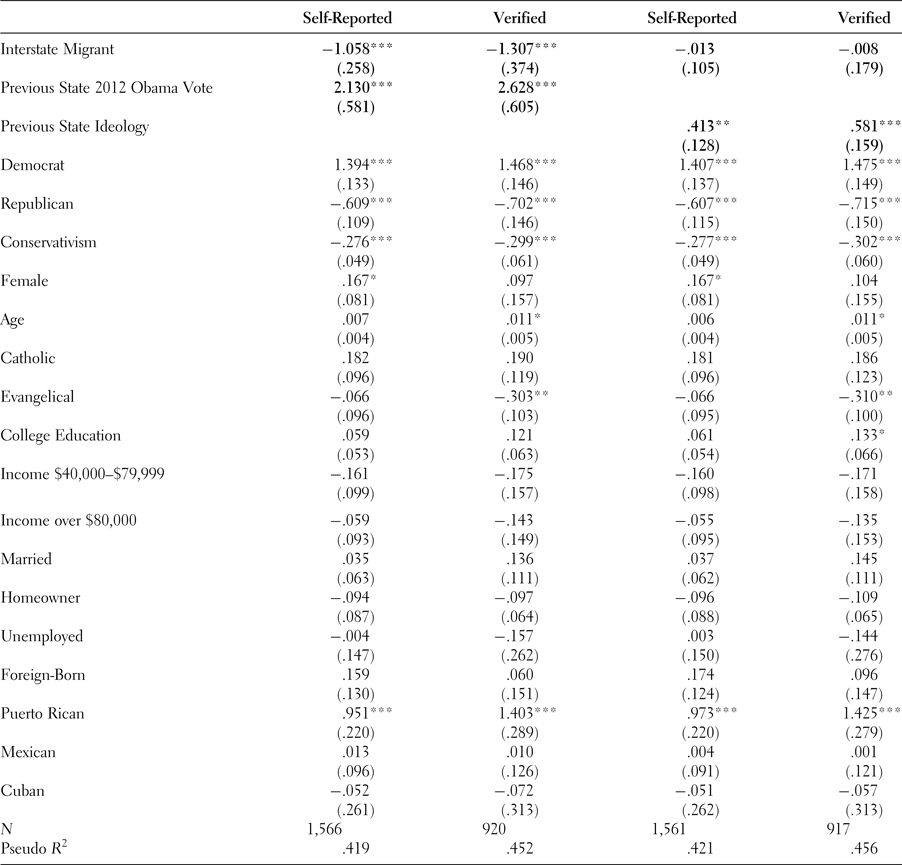
The results of the analyses of Presidential vote choice are presented in Table 3 for both self-reported and verified voters. The first two columns of coefficients employ the vote for Obama in a migrant's previous state as a measure of previous state political context, while the last two columns replace the Obama vote with the more general state ideology measure. Overall, the specifications do a reasonable job of explaining vote choice among Latinos, with Pseudo R 2 values of about .42 for self-reported voters and about .45 for verified voters.
Interstate Migration Effects on Latino Vote Preference for Clinton in the 2016 Elections

Note: Probit coefficients with robust standard errors clustered in parentheses.
*p < .05, **p < .01, and ***p < .001 in a two-tailed test. A constant, and State and DC Fixed Effects are included but not reported. CA serves as the baseline state, with 38 clusters in Self-Reported models and 28 in Verified models out of 51 (including DC) utilized due to small sample sizes and collinearity.
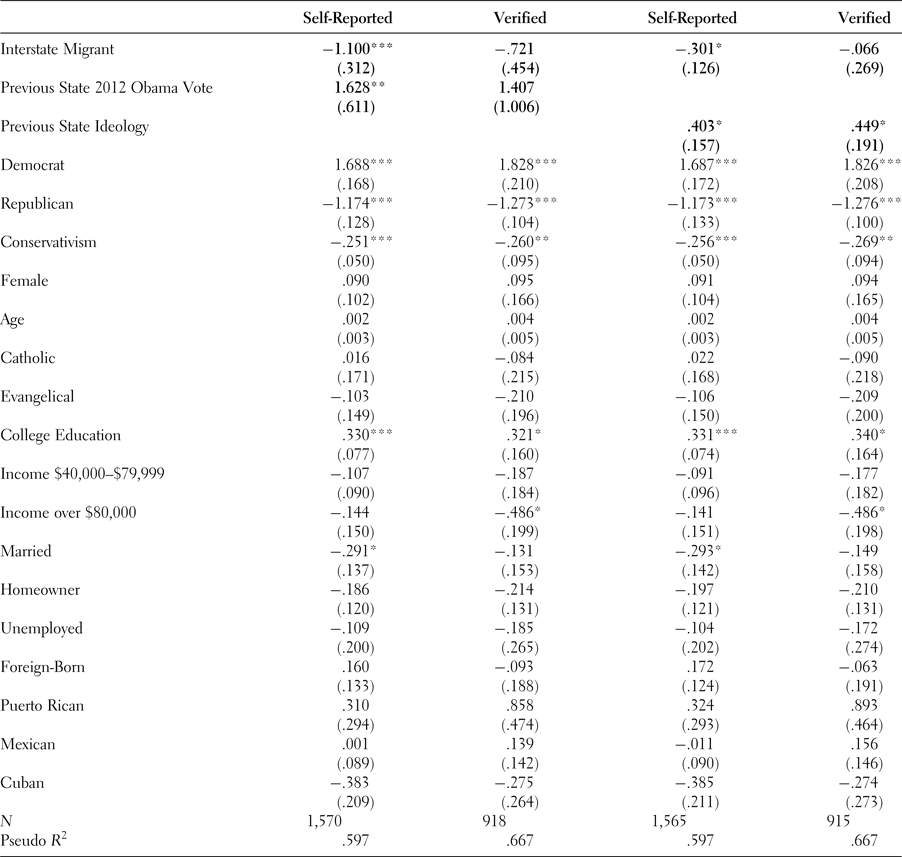
Table 4 reports the results of the analyses employing the Congressional vote preference as the dependent variable. As in Table 3, the first two columns of results present models including the Obama vote as a measure of previous state context, while the two remaining columns report models relying on the more general measure of state ideology. The amount of variation in Congressional candidate preferences accounted for by the models increases relative to the Presidential preference models in Table 3, with Pseudo R 2s between .59 and .66, for self-reported and verified voters, respectively.
Interstate Migration Effects on Latino Vote Preference for the 2016 Democratic House Candidate

Note: Probit coefficients with robust standard errors clustered in parentheses.
*p < .05, **p < .01, and ***p < .001 in a two-tailed test. A constant, and State and DC Fixed Effects are included but not reported. CA serves as the baseline state, with 39 clusters in Self-Reported models and 27 in Verified models out of 51 (including DC) utilized due to small sample sizes and collinearity.
Summarizing results for the controls across both indictors of vote choice presented in Tables 3 and 4, partisanship and ideology consistently correlated with vote preference across all models and samples. A few other factors were consistently associated with either the preference for Clinton or the Democratic House candidate, but not both. For instance, Puerto Ricans tended to be more likely to vote for Clinton than other groups, and those with some college education preferred the Democratic House candidate to a greater extent than those with less than a college education. However, the other controls exerted inconsistent, or completely lacked, discernable correlations across the various specifications and even within dependent variables. The lack of a consistent association with common variables associated with Latino partisanship, such as gender and Cuban ancestry, likely speaks to the power partisanship and ideology exert on preferences for Democratic Presidential and House candidates among Latino voters. This explanation is supported by subsequent analyses (not reported) revealing significant correlations of vote choice with the Cuban and Female dummy variables when partisanship is not included in the specification. In other words, the reported results do not necessarily deviate from established understandings of Latino party identification. Instead, partisanship itself exhibits a stronger and more direct association with vote choice than various demographic attributes.
The main interest of this study, however, lies with the association between vote choice and the interstate migrant variable and migrants' previous states' political contexts. The interactive nature of the two variables of interest requires a bit of caution in interpreting the coefficients individually as each interstate migrant is also associated with some positive value of the Previous State Obama Vote, and negative to positive values of the Interstate Migrant measure. Nonetheless, the results suggest significant differences between migrants and non-migrants, depending on a migrant's previous state context (refer to Table 2 for expected relationships for each hypothesis). At the least, interstate migrants do not seem to consistently engage in the type of political homophily suggested by some theories, as coefficients for the interstate migrant dummy variable, the previous state's political context measures, or both, differ from zero. The exception is a single model of verified voters' preferences for the Democratic House candidate using the Obama vote as a measure of political context, where such lower-profile races might draw on an individuals' ideological orientations instead of the specific dimensions of the political context in a particular Presidential Election (substituting the previous state's 2016 Clinton vote produced marginally significant results, p < .07 in a two-tailed test). The most important take away from the analyses, however, is that the positive and consistent coefficients for the previous state context variable indicate that Latino interstate migrants bring the politics of their previous state with them to some degree, undermining the argument that migrants will assimilate to their new political contexts.
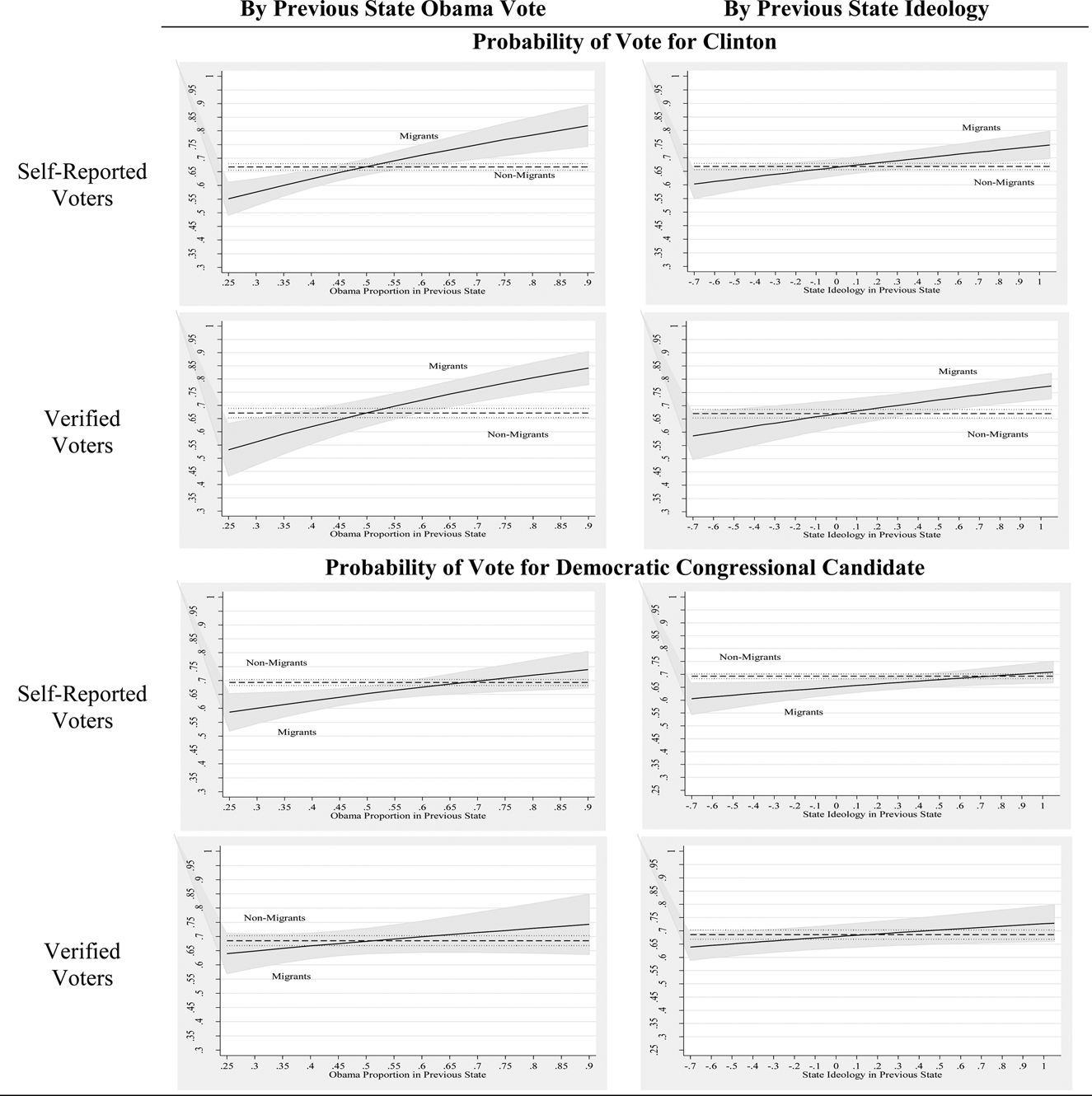
To more clearly convey the results, Figure 3 graphically presents the comparison between Latino migrants and non-migrants across an in-sample range of previous state contexts. The top four graphs present the relationship between a previous state's political context and the estimated probability of voting for Clinton for self-reported voters (top row of graphs) and verified voters (second row of graphs). The bottom four graphs present the relationship between political context and the estimated probability of voting for the Democratic Congressional candidate for both self-reported (third row) and verified voters (fourth row). The left column of graphs for both dependent variables measures political context by the proportion of the state's vote for Obama in 2012, while the right column measures context using the State Ideology variable. For each graph, the estimated probability of voting for the Democratic candidate is based on the observed values approach, which varies the value of the political context while all other variables are held at their observed values for each respondent in the sample (Hanmer and Kalkan Reference Hanmer and Ozan Kalkan2015). Estimated probabilities and associated confidence intervals for migrants are reported for the in-sample range of previous state political contexts. Estimated probabilities for non-migrants are presented as a baseline, where coefficients for previous state context and interstate migrant are held at zero.
Estimated Probability of Voting for Clinton and the Democratic Congressional Candidate by Previous State's Political Context.

Overall, the previous state context tends to be associated with the probability of voting for both Clinton and the Democratic Congressional candidate in the 2016 general election. The most pronounced relationship, and arguably the most substantively important, emerges between the previous state's Obama vote and the estimated probability of voting for Clinton (the graphs in the upper left). For both self-reported and verified voters, clear differences emerge across migrant and non-migrant voting patterns. Migrants from more conservative states are not only less likely to report voting for Clinton than migrants from more liberal states, they are also distinguishable from non-migrants across a substantial range of political contexts. When utilizing state ideology as a measure of previous state context, the relationship is more muted, yet migrants from the most liberal states remain significantly more likely to vote for Clinton than migrants from the most conservative states.
Estimates from specific destination and departure state combinations help to illustrate these results. For instance, the probability of voting for Clinton for those who moved from a state like TX, with about 41% of the popular vote for Obama in 2012, or AZ with 44% for Obama, is .63 and .64, respectively, for both self-reported and verified voters. If an individual moved from a state like NJ or CA, where Obama received about 60% of the popular vote in 2012, the probability of voting for Clinton in 2016 increased to just over .71 for both samples. Moreover, this seven-percentage point change is based on relatively small differences in state electoral dispositions. The actual in-sample range for Obama's 2012 vote was 24% in UT to 91% in DC, with eight states above the 60% threshold and 24 states below TX' 41%.
State ideology exhibits a similar pattern. Latinos moving from TX (state ideology of −.60) or AZ (state ideology of −.44) voted for Clinton with probabilities of about .61 and .62, respectively, for self-reported voters, and .01 less for verified voters. while those moving from more liberal states like NY (state ideology of .66) and CA (state ideology of 1.05) voted for Clinton with probabilities of .74 and .77, respectively, and again, with minor differences for verified voters. These examples place the typical Latino non-mover outside of the interstate movers' estimated confidence intervals, and vice versa. Support for Clinton among Latino interstate movers clearly varied by their state of previous residence and did so in significant and relatively substantial ways.
Not surprisingly, the relationship is not as strong for models of respondents' preferences for Congressional candidates. The general pattern holds, but statistically significant differences between migrants from liberal and conservative states only emerge among the self-reported sample. And while migrants do differ from non-migrants, that difference only appears in migrants from the most conservative set of states in the self-reported sample. Among the verified voter sample, migrants and non-migrants are statistically indistinguishable regardless of migrants' previous state political context. It is important to underscore that these results emerge from the fairly low-information nature of Congressional elections, where partisan affiliation and general ideology overwhelm specific issues that drive preferences in more high-profile Presidential elections, especially among verified voters.
Revisiting the states used as examples above, the probability of voting Democratic in the congressional race for movers from states like TX or AZ is estimated at .67 for both self-reported and verified voters when relying on the Obama proportion of the vote to model previous state context. Employing the general state ideology measure for each state leads to estimates of 62% for both samples. The probabilities marginally increase to .70 for self-reporting voters from NY and CA based on Obama's 2012 popular vote and .68 for verified voters. Based on state ideology, the estimates range from .69 (NY) and .71 (CA) for self-reported voters and .71 (NY) and .73 (CA) for verified voters. Thus, substantial differences across movers from different states emerge, in the range of seven to 11 percentage points based on variation in the state ideology measure, but less so using the Obama vote as a proxy for state context. For both models, however, the most pronounced differences between movers and typical non-movers emerges from movers from more conservative states.
At this point, the evidence provides clear and consistent support for the argument that interstate movers bring the politics of their previous state of residence to their destination state. The effects reflect important differences across a reasonable range of movers' previous state contexts, across samples of self-reported and verified samples, and approximate in magnitude to other substantively important differences such as the Latino/a gender gap. Moreover, the results inform our understanding of the effects of migration on state electoral politics and policy more generally. First, the findings underscore the general conclusion, although usually relying on less specific measures of state context and more limited models, that the pattern of interstate migration flows can potentially alter the politics of destination states. Movers from more liberal states should move politics in destination states to the left while movers from more conservative states impose the opposite effect. This is in line with earlier studies demonstrating migration from traditionally more liberal regions liberalized Southern state politics and accounts for leftward shifts in the Mountain West (cf. McKee and Teigen Reference McKee and Teigen2016; Robinson and Noriega Reference Robinson and Noriega2010). Second, the findings undermine the arguments that movers adopt the political leanings of their destination state (assimilation) or that migrants seek out states with political contexts that align with their existing preferences (homophily). Instead, interstate migrants' voting preferences differ from the non-moving Latino cohort in their new state after controlling for other common variables associated with voting preferences, the most important of these being party affiliation and political ideology.
THE POLITICAL IMPLICATIONS OF LATINO MIGRATION
What implications do these findings hold for the practical effects of Latino interstate migration flows on state electoral politics? The magnitude and direction of migration flows' effects depend on the combination of the political contexts in the previous state of residence and the destination state, as well as the relative size of the Latino influx into the state and the current residents' preferences. As the analysis reveals, all else equal, if Latino migration flows from liberal to conservative states, new migrants should push destination state politics in the liberal direction. The reverse potentially applies as well given the large pool of potential Latino movers in relatively conservative states such as TX and AZ. With the national sample utilized in the data set, and variation across the states in terms of the demographic composition of Latino populations, specific state-level estimates of the impact of Latino migration flows are constrained to relative impacts. Moreover, the reaction of non-Latinos to migration flows could offset any liberalization of the context (cf. Hajnal and Rivera Reference Hajnal and U. Rivera2014; Hopkins Reference Hopkins2010). However, a few purely illustrative examples do highlight the possibility of diverging effects of Latinos on destination state politics.
In the case of a conservative state such as TX, where 43.1% of all voters voted for Clinton in 2016, and with estimates derived from the observed values of the verified voter sample using a state's Obama vote in 2012 as the proxy for previous state ideology (second column of results from Table 3), non-moving Latinos are estimated to support Clinton at a rate of 71%. Interstate migrants from a more liberal state, such as CA, were estimated to support Clinton at a rate of 76%, while interstate migrants from a conservative state like AZ would be estimated to support Clinton at 63%. Thus, even migrants from a relatively conservative state bring a 20-percentage point difference in presidential voting preferences compared with the state as a whole, while moving the overall Latino vote in a slightly more conservative direction. In other words, Latino migrants from both states would move the statewide electorate in a more liberal direction, but slightly more so if the influx was solely from CA, assuming current residents, including non-Latinos, maintain a static disposition.
A similar story of consistently more liberal Latino migrants emerges in some of the most liberal states as measured by support for Obama in 2012. Latino interstate movers to MA (with a statewide Clinton vote of 60%) would generally bring a slightly more liberal bent relative to the state as a whole, but may move the state's Latino voting bloc in different directions depending on the state from which they migrated. Latino support for Clinton among non-movers is estimated from the sample at 75%, compared with 79% for movers from a state like CA and 71% from a state like TX. Thus, as with the case of TX, the overall electoral needle in the state would move to the left regardless of whether Latino migrants originated from CA or TX. But the Latino voter block may be nominally moved to the right if migrants were predominately from TX instead of CA. Even if migrants moved from one of the most conservative states, like OK, their estimated level of support for Clinton would be 67%, still seven percentage points above MA statewide support.
These two illustrative cases highlight the nuances of the impact of Latino interstate migration revealed by the central analysis. On one hand, the generally anticipated direction of the effect of Latino interstate migration seems supported—inflows of Latino interstate migrants should move statewide electorates in new destination states in a liberal direction. On the other hand, these effects are dynamic and vary by both state of origin as well as the reference group within the destination state. Latinos from more conservative states are less liberal than those from liberal states, and thus the magnitude of the impact on the overall electorate depends on the origination state. Moreover, it is not adequate to simply assume that new Latino migrants will resemble the current Latino constituency. In cases where the bulk of migrants come from relatively conservative states, the Latino electorate within a state may become more conservative, albeit still more liberal than non-Latinos even in the most extreme pairings.
CONCLUSION
The political behavior of interstate migrants and their effect on state political alignments has long held the attention of both political scientists and practitioners. Yet, the data utilized to understand the potential impact of interstate migration flows has importantly, and mostly for practical reasons, overlooked Latino migrants as well as lacked the combination of both specific political behavior and state context variables necessary to access the impact of migration and the validity of the varied theoretical models of migrant voting behavior. This study overcomes both hurdles and provides support for the argument that Latino interstate migrants pack their politics when moving to a different state rather than adopting the political preferences of Latino voters in their destination state or moving to states that match their pre-existing preferences. While the results directly apply to the Latino population, it confirms previous findings relying on less direct measures based on more general populations as well as those related to international migrants.
While the recent stagnation in foreign immigration has led to slower growth of the Latino population in the United States relative to its highs over the last several decades, the proportion of the Latino population that is U.S.-born has increased. This population should continue to migrate across state lines to pursue economic opportunities outside of traditional Latino population centers. As they do, the migration flow will contribute to the realignment in states with traditionally small Latino populations, but the magnitude will be conditioned on the origin states' electoral contexts relative to the destination states' contexts. In Southern states, Latino migration should reinforce the liberalizing effects of non-Latino migration. In the Midwest, which has experienced net out-migration by non-Latinos, Latino migration may supplant the loss of those presumably more liberal voters (McKee and Teigen Reference McKee and Teigen2016). The effects of Latino out-migration, specifically in the West and Northeast, are less clear as this study did not compare non-moving voters to previous state to movers.
The interstate migration patterns and the political preferences that Latinos bring to their destination states are likely to remain important elements of state-level electoral politics and subsequently public policy. In presidential vote choice, and to a lesser extent congressional vote choice, Latino interstate migrants are likely to bring a more liberal political orientation to their destination state compared to the statewide context. But it is also important to note that the effect of new migrants' politics may interact with the reaction to migration by non-Latino residents (Hopkins Reference Hopkins2010). A wide array of research suggests that diversifying political contexts are associated with more conservative attitudes and vote choices (Hero Reference Hero1998; Hero and Tolbert Reference Hero and Tolbert1996). The effects on political alignment may thus be offset by triggering a threat mechanism among current residents within a state. One interesting empirical question arising from this research is the degree to which reaction against Latino migrants depends on the political attitudes migrants bring to a state. Do Latino migrants from liberal states provoke different reactions than those from more conservative states as the latter may not impact the political context to the same extent as the former? Investigating such dynamics by building on the empirical findings presented above will increase our understanding of the roles of diversification and migration on the political alignments within the states and the nation.
SUPPLEMENTARY MATERIAL
The supplementary material for this article can be found at https://doi.org/10.1017/rep.2019.4
Data Appendix
Survey Methodology: The CMPS 2016 interviewed 10,145 Latino, Black, Asian, and White Non-Hispanics in an online respondent self-administered format from December 3 2016 to February 15 2017. Potential respondents were randomly selected from a national voter registration database (and non-registered voters, which were not included in this study, were randomly selected from email addresses from online vendors). Respondents were provided a $10 or $20 gift card as compensation for their participation. Of the total sample, 1,816 registered Latino voters were surveyed, given their preference, in either English or Spanish. Among those, 1,655 reported voting in the 2016 general election. Due to a lack of observations on some variables for some respondents, and the omission of states with sample sizes inadequate to compare migrants to non-migrants, sample sizes utilized in the analyses varied from 915 to 1570 Latino self-reported voters, and 915 to 920 verified voters. Results are based on the unweighted sample. The CMPS 2016 will be posted to ICPSR in early 2021. A more detailed discussion of the methodology is available on the CMPS website, located at: http://www.latinodecisions.com/files/1214/8902/9774/cmps_methodology.pdf
Variable Descriptions, Summary Statistics, and Data Sources