INTRODUCTION
Côte d'Ivoire produces 42% of the world's cocoa beans, making it the first cocoa producing country (ICCO, 2016). However, despite attempts that began in the 1970s to intensify the yield by shifting cropping systems from extensive agroforestry to intensive monoculture (Kébé et al., Reference Kébé, N'Guessan, Tahi, Assiri and Koko2009), Côte d'Ivoire's average cacao (Theobroma cacao L.) yield remains around 250 to 600 kg of dry beans per hectare (Assiri et al., Reference Assiri, Yoro, Deheuvels, Kebe, Keli, Adiko and Assa2009). In the meantime, research and development recommendations for cacao cultivation, based on full sun cropping systems and use of selected genetics, commonly achieve yields over 1.5 tons ha−1 (Pang, Reference Pang2006). The general explanation for large differences in yield observed between datasets belonging to research stations and farmer's fields is that smallholders do not use the entire recommended technical packages (Aneani and Ofori-Frimpong, Reference Aneani and Ofori-Frimpong2013). The use of uncontrolled genetics is mentioned as one of the main limiting factors in smallholder's plantations. In Côte d'Ivoire, the recommended selected hybrids seedlings are rarely used, representing only 10% of the cultivated area (Assiri et al., Reference Assiri, Yoro, Deheuvels, Kebe, Keli, Adiko and Assa2009). To date, the most common practice is collecting open pollinated pods from productive orchards and using the seeds for planting. The resulting genetic population consists in a mix of amelonado, local trinitario and selected hybrids progenies (Assiri et al., Reference Assiri, Yoro, Deheuvels, Kebe, Keli, Adiko and Assa2009). Because of this genetic mix, cacao trees in the same orchard present a high degree of phenotypic variability, notably in yield (Lockwood, Reference Lockwood1976).
In Ghana, Auchinleck (Reference Auchinleck1927) was the first to characterize tree-to-tree variability in cacao yield. He observed that individual trees yields were not normally distributed within an orchard, but were rather positively skewed and spread out over a gradient of yield, ranging from zero to more than 300 pods a year. Similar observations were made later in Trinidad and Costa Rica for different cacao genetic progenies and environmental contexts, regardless of the tree age and even in the most uniform conditions and under the best agronomical practices (Bartley Reference Bartley1970; Cunningham and Burridge, Reference Cunningham and Burridge1959; Enriquez et al., Reference Enríquez, Cruz and Mora1987; Somarriba and Beer, Reference Somarriba and Beer2011). This asymmetrical distribution is responsible for a high imbalance in the overall yield of the trees. In Auchinleck's data, the 36% highest yielding trees accounted for 73% of total production (Auchinleck, Reference Auchinleck1927). Similar results were observed by Burle (Reference Burle1962) in Côte d'Ivoire. The author reported that 50% of the cacao population accounted for only 16% of the production, while 13% of the best yielding trees accounted for 36% of the whole production. More recently, Adomako and Adu-Ampomah (Reference Adomako and Adu-Ampomah2003) and Sounigo et al. (Reference Sounigo, Paulin, Clément and Eskes2003) reported high degrees of heterogeneity in the yield of individual cacao trees in breeding trials of cacao hybrids and clones in Ghana and Côte d'Ivoire, leading to high coefficients of variation (CV) in tree yield, ranging from 26% up to 95% within families. In the progenies of five controlled hybrids in Puerto Rico, Irizarry and Rivera (Reference Irizarry and Rivera1998) reported that 2 to 3% of the highest yielding trees accounted for more than 60% of the family total production.
To date, available literature has outlined yield variability in cacao focusing only on the difficulties for efficient breeding or comparative experimentations for management practices. These studies assumed that the differences in yield between treatments are partly biased by the phenotypic variability of trees due to genetics or environmental conditions. Therefore, the homogeneity in these factors should be fostered in order to accentuate the sensitivity of any comparative experimentation on cacao, whether in controlled conditions or in field trials (Adomako and Adu-Ampomah Reference Adomako and Adu-Ampomah2003; Bartley Reference Bartley1970; Cunningham and Burridge, Reference Cunningham and Burridge1959; Sounigo et al., Reference Sounigo, Paulin, Clément and Eskes2003). Even though this high variability in cacao tree productivity raises important questions, no interest has been shown in how the control of this variability could improve the efficiency of cacao-based cropping systems. The present paper characterizes the tree-to-tree yield variability in different cacao plots in an agro-industrial cacao plantation in Côte d'Ivoire. The aim was to obtain insights into the cacao tree-to-tree yield variability and discuss related efficiency gaps and the opportunities they might represent to improve cacao productivity in seedling-based cropping systems.
MATERIALS AND METHODS
Study area
Data were collected in Mbrimbo Estate, located in Tiassalé Department in Côte d'Ivoire, West Africa (6°02′21.6′′N - 4°54′12.6′′W). This area has suitable climatic conditions for cacao growing, with average annual precipitation over 1600 mm, but is frequently subject to dry periods that can last as long as three or four months (Kouassi et al., Reference Kouassi, Kouamé, Koffi, Dje, Paturel and Oulare2010).
Plantation and plot characteristics
In Mbrimbo estate, cacao orchards cover 190 ha, in which the cacao trees are 1 to 7 years old. Cultivated area is divided into plots ranging from 1 to 2.5 ha in size, depending on the age and planting material. The seven plots used in our analysis, named A, B, C, D, E, F and G, are the oldest, i.e. the trees were all planted in April/July 2008 and were 6–7 years old when the data were collected. In all the plots, soils are disturbed or modal oxisols, with patches of clay loam in plots C, E and G, localized lateritic crusts in plots B and E, and superficial stones in plot G. High mortalities of cacao trees are observed when lateritic crusts and stone layers are present.
Genetics and cropping systems
The trees were planted from seeds collected in an old cacao orchard located nearby, which consisted in a mix of amelonado, trinitario and hybrids. The plots were planted at two different densities, 1111 trees per hectare in plots A, B and C (3 × 3 m spacing), and 1333 trees per hectare in plots D, E, F and G (3 × 2.5 m spacing). The trees were grown without shade, using an intensive cropping system with frequent pruning and sanitary harvests and a high level of inputs including frequent fertilization and sanitation treatments. Mirids are the main pest and are responsible for localized high mortality patches.
Data
On the seven selected plots, 13 058 cacao trees were planted and to date 9845 are still alive. Only healthy harvested pods were taken into account in this study. Pods presenting damage caused by rodents, physical injuries or any kind of pest or disease resulting in degraded beans were harvested separately for sanitary purposes. The healthy pods harvested from the 9845 adult trees were counted and recorded from August 2014 to August 2016. The 2 years of data from individual trees and the production of whole populations were averaged. Only the average yields were used in this study. As production data were only available on the number of harvested pods per tree, cocoa yield was recorded in terms of pod production. A randomized sample of 150 pods was collected and the fresh beans were weighed to determine the pod index (the number of pods required to produce 1 kg of commercial dry cocoa beans). A standardized coefficient of 0.35 was used to transform the fresh cocoa weight to dry cocoa weight (Lachenaud, Reference Lachenaud1984).
Analysis
A one-way ANOVA was performed on the full data set to characterize the plots effect on yield. Descriptive statistics of cacao populations and individual tree yields were calculated. Mortality rates were assessed for each plot. Tukey's test was used to classify and rank the different plots according to the yields of cacao trees in each plot. Normality tests were performed for each plot. Pearson's skewness coefficients were calculated to characterize the asymmetry of distributions for every plot. Histograms showing the distributions of frequencies for individual tree yields were built for every plot. We used the Rice Rule to calculate the recommended number of classes (k), estimated from the number of data (n), using the formula: k = [2n 1/3].
In order to provide more illustrative results, cacao trees were also ranked according to their yields in a hierarchical classification and grouped in non-symmetrical ‘pod yield classes’. Eight ‘pod yield classes’ were defined because they better illustrate the effect of yield variability on the unequal contribution of the trees to production: 0 pods, 1–5 pods, 6–10 pods, 11–15 pods, 16–20 pods, 21–30 pods, 31–40 pods and more than 40 pods. The average yields of each tree, calculated from the 2 years of data, were rounded up to fit the classes. This classification was assessed empirically in order to provide informative data that clearly illustrate the effects of yield distribution in each plot. The percentages of trees in each pod yield class were assessed for every plot and for the total population (the whole orchard), which groups the trees of the seven plots. The percentage contribution of each class to overall yield was also calculated for each plot and for the total population. For each plot and for the total population, the percentage population found in each class was compared to the contribution of the class to total yield. Some descriptive ratios were assessed, by considering the participation to overall yield of the 20% highest and 20% lowest yielding trees in each plot.
To discuss the effects of unproductive cacao trees, we defined as ‘unproductive’ every tree that has produced two or less pods over the study (i.e. average yield ≤ 1 pod per year). The percentages of unproductive cacao trees in each plot and total population were also calculated.
RESULTS
Calculation of the pod index
The average weight of fresh beans per pod from the 150 pods was 107.3 g. It corresponds to an estimated dry bean weight average of 37.6 g per pod. The calculated pod index is 26.6 (=1000/37.6).
Descriptive statistics of the cacao populations
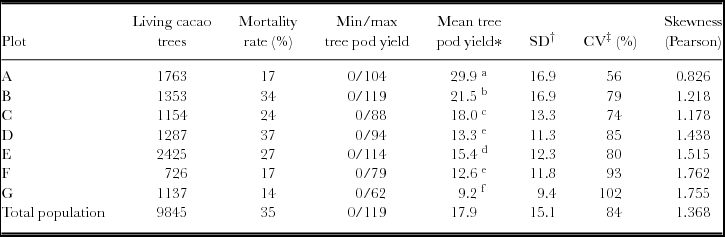
The plot mortality rates varied from 14 to 37%, while the mortality rate in total population was 35% (Table 1). The mean individual tree yield of the total population was 17.9 pods per tree per year (Table 1). Tukey's test revealed significant variation in average tree yield among plots (P < 0.05), except for plots D and F. Plot G had the lowest mean yield with 9.2 pods per tree per year, while plot A had a significantly higher mean yield than all the other plots with 29.9 pods per tree per year (Table 1). Based on the calculated pod index, the estimated plot yields of dry beans ranged from 401 kg ha−1 in plot G to 1037 kg ha−1 in plot A. The yield of the total population was 623 kg ha−1. The CV in the different plots revealed high variability in terms of individual tree pod yield within plots, ranging from 56% in plot A to 102% in plot G (Table 1).
Cacao populations and tree yield parameters.

*Mean yields followed by the same letter are not significantly different (P < 0.05, Tukey's test); †Standard deviation; ‡Coefficient of variation (%).
Distribution of cacao tree yields among the plots
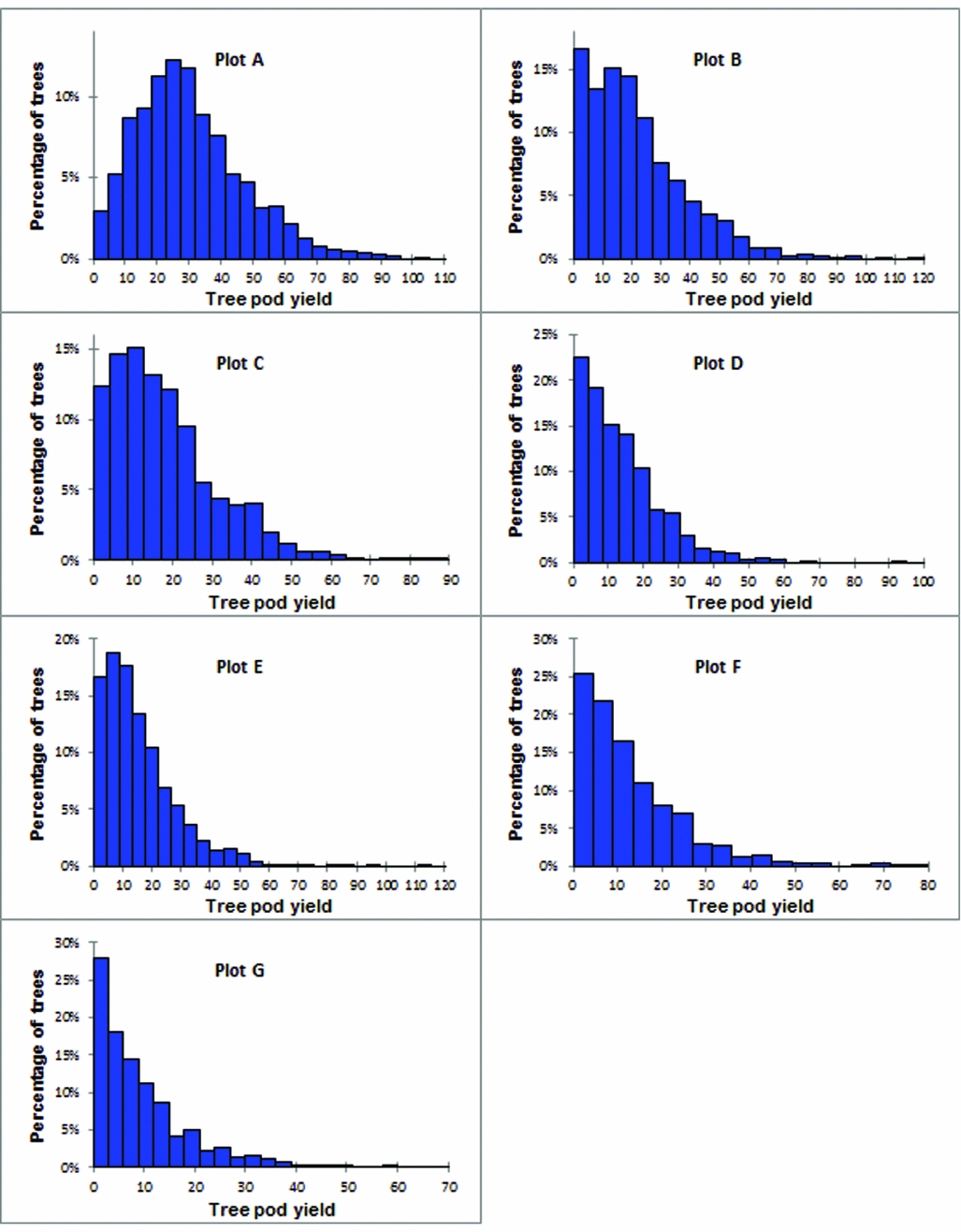
According to the number of trees per plot, the calculation of the number of classes (k) with the Rice Rule resulted in k varying from 18 in plot F to 26 in plot E. Histograms showed distributions significantly different from normal distribution and positively skewed for all plots (Figure 1). Pearson's coefficients of skewness ranged from 0.83 in plot A to 1.76 in plot G (Table 1). The most productive plot (plot A) showed a slightly more normally shaped distribution, which is consistent with its lower coefficient of skewness compared to the other plots (Figure 1 and Table 1).
Histograms showing the distribution of average pod yields of individual cacao trees.

Distribution of cacao tree yield among the ‘pod yield classes’
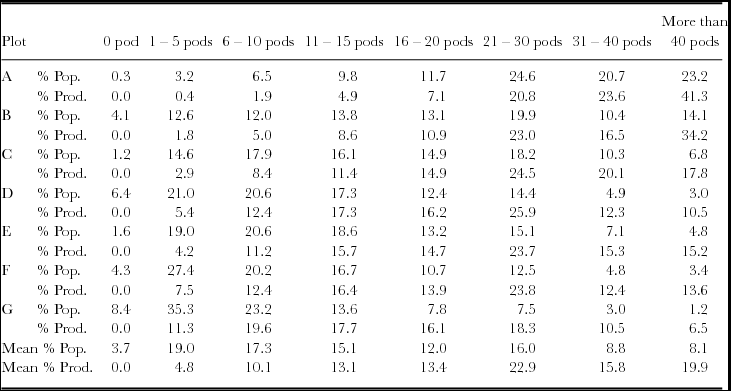
All the individual tree yields were sorted in the non-symmetrical pod yield classes (Table 2). An average of 3.7% adult cacao trees did not produce any pods during the 2-year observation period. The lowest percentage was in plot A (0.3%) while the highest percentage was in plot G with 8.4% of the trees in the ‘O pod’ class. No significant correlation (P > 0.05) was found between mortality rates and percentages of unproductive trees in the seven plots. An average of 8.1% of the cacao trees produced more than 40 pods per year (Table 2). However, they accounted for an average 19.9% of the total number of pods produced by the plot. The minimum was in plot G, where 1.2% of highest yielding cacao trees produced 6.5% of the pods, and the maximum in plot A, where 23.2% of the cacao trees produced 41.3% of the pods.
Percentage distribution of trees in each pod class (% Pop.) and percentage contribution of the pod yield class to total plot productions (% Prod.)

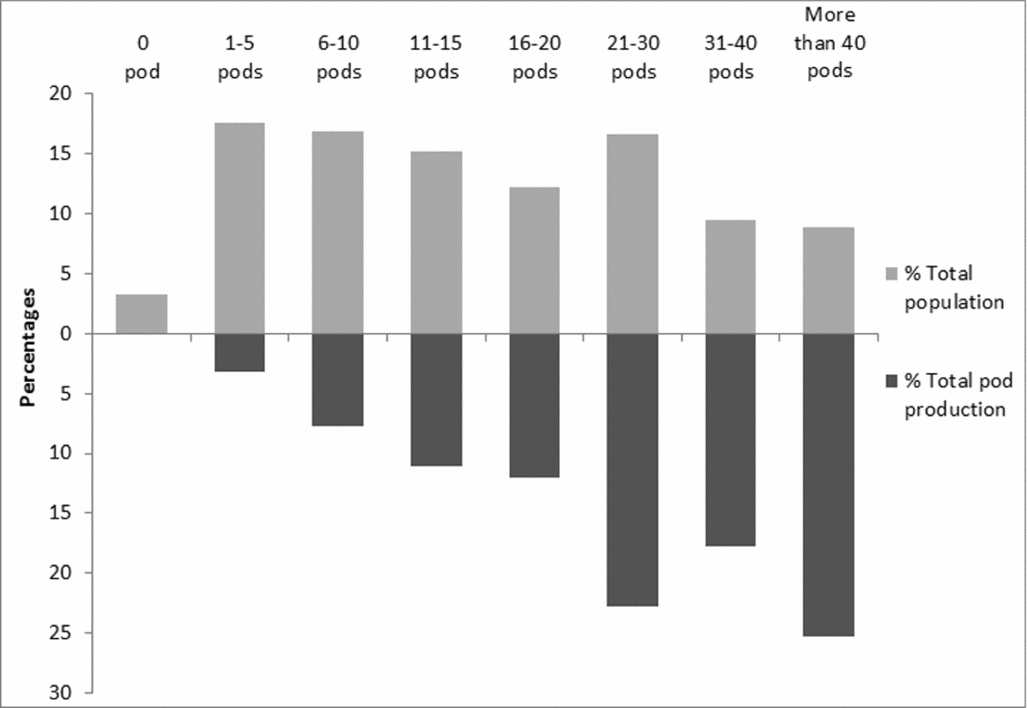
The 20% lowest yielding cacao trees accounted for less than 6.5% of the yield of each plot (average 3%), as shown in Table 3. At the opposite end of the scale, the 20% highest yielding cacao trees in each plot accounted for 37 to 53% of the plot production (average 46%). The CV of 11% is quite representative of the constant contribution of the highest yielding trees to production in the seven plots studied. The contributions of each pod yield class to the total cacao population and total pod production confirm that the lowest yielding cacao trees represent high percentages of the population, but low percentages of production (Figure 2). At the opposite end of the scale, the highest yielding trees represent high percentages of productions, but small percentage of the population.
Percentage contribution of the 20% highest and 20% lowest yielding cacao trees in each plot to the total production of the plot.

*CV = coefficient of variation (%).
Percentage of the total cacao tree population in each yield class and the contribution of each yield class to total pod production.

Unproductive cacao trees
The percentages of unproductive cacao trees ranged from 0.9% in plot A to 16.4% in plot G, with an average of 7.7%. The unproductive cacao trees represented 6.8% of total population (Table 4).
Percentages of unproductive trees in each plot and total population.

DISCUSSION
The high mortality rates observed in plots B, C, D and E can be attributed to localized environmental limiting factors, mainly soil limitation (presence of lateritic crusts or stone layers within the top 1 m layer of the soil), and high incidence of patches of mirids, localized at the edges of plots next to abandoned fruit trees or forest. Tukey's test indicated significant variability in pod yield average among the plots, confirming that the plots present a gradient of response by the cacao populations to specific environmental conditions and agronomical management. However, the steadiness of the observations (high CVs and positive skewness) made on such different plots is significant and all the literature reported hereafter supports our results.
Unproductive cacao trees
We found that a total of 6.8% of the cacao trees could be considered as ‘unproductive’ (Table 4). This result is consistent with observations made by Adomako and Adu-Ampomah (Reference Adomako and Adu-Ampomah2003), who found between 7.1 to 27.2% unproductive cacao trees in their trials. Considering that the 7 years old cacao populations were conducted following an industrial design management, meaning that they were planted with constant spacing between the trees (i.e. the spacing between lines and rows was respected) and have been managed homogeneously within the different plots, we may argue that (i) 6.8% of the labour, tools or inputs invested in the orchards over the 7-year period were spent on unproductive trees; (ii) the unproductive trees, while failing to contribute to total yield, use space, labour, nutrients and water. Unlike mortality, which results in a gain of space and can thus increase the production of neighbouring trees (Bastide et al., Reference Bastide, Paulin and Lachenaud2008; Lachenaud and Oliver, Reference Lachenaud and Oliver1998), leaving unproductive trees in an orchard implies that competition for resources with neighbouring productive trees may continue, with the related impact on yield and (iii) unproductive trees can host pests and diseases and can encourage their development as they represent a vegetation continuum for pest dissemination, contribute to shading (with the related microclimate conditions) and provide trophic resources, substrates or inoculums for pests and diseases.
Even if the provision of other positive services such as pollination might be attributed to the presence of unproductive trees, no published study supports this hypothesis. In order to correct this situation, different strategies can be considered, such as removing the unproductive trees, replacing them with other service trees (i.e. fruit trees or leguminous species, for instance), or turning them into productive cacao trees, applying rational or innovative agronomical practices such as replacement or grafting, for example. These corrective strategies could represent an important optimization lever for efficient use of area, inputs and labour.
The variation in tree-to-tree cacao pod yield
Analysis of cacao tree yields revealed a marked imbalance between the relative weight of the yield classes in the total population and in the total yield of the orchard (Figure 2). Regarding the related gaps in efficiency, two important issues need to be addressed. From a physiological perspective, high-yielding trees take advantage of the available natural resources more efficiently, with better uptake of resources or allocation of assimilates (partitioning) towards reproductive organs (flowers, cherelles and pods). Conversely, low-yielding trees do not use available resources (including inputs) efficiently, as the resources are either poorly assimilated by the trees, or mainly allocated to the vegetative parts of the tree to the detriment of fruiting (Bastide et al., Reference Bastide, Aguilar, Lachenaud, Paulin, Jimmy and Bouletare2010; Daymond et al., Reference Daymond, Hadley, Machado and Ng2002; Pang Reference Pang2006). From an agronomical point of view, this unequal performance also implies that high-yielding trees exploit the investments in agricultural management and inputs more efficiently. As the invested inputs and labour are divided equally between the cacao trees, low-yielding trees have very short returns compared to high-yielding trees. This is especially important for fertilization, as applying fertilizer on trees that have less ability to produce only increases their vegetative growth, thereby intensifying competition with neighbouring trees, or causes losses to the environment.
Concerning the improvement of seedling-based cacao cropping systems, these issues raise the following hypothesis: (i) to improve the performance of a cacao orchard, yields of individual cacao trees need to be as homogeneous as possible. The aim is to maximize the efficiency of each individual tree with respect to returns from crop management practices and inputs investments, as well as for efficiency in land use; and (ii) if cacao trees performances are homogenized, the individual yields should be contained within a reduced range of values, whose distributions should be as symmetrical as possible around the average yield. To improve the efficiency in resource use, distribution should centre on the potential mean tree yield, as defined by the main components of the cacao cropping system (genetics, limiting environmental factors, available resources, labour and inputs investments, etc.). Thus, increasing the productivity of the low-yielding trees could be another optimization lever for a plantation with high variability in tree-to-tree yield. In this study, in Mbrimbo estate, reducing heterogeneity by improving pod production of the lowest yielding trees (including the unproductive trees) to reach a target average yield of 30 pods per tree would correspond to a gain of 418 kg ha−1 in the yield of cocoa.
The origins of tree-to-tree yield variability in cacao orchards: interactions between genetic, environment and management
Cacao-tree variability in yield within an orchard is partly explained by the genetic origins of the planting material (Lotodé and Lachenaud, Reference Lotodé and Lachenaud1988). From the 1960s until now, controlled hybridization has been widely used to improve the performance of cacao seedlings. This was based on the research for heterosis, which relies on crossing of varieties with distant parentages (local varieties and international clones) to acquire improved traits (hybrid vigour). The hybridization of clones has indeed resulted in higher yielding populations, and gain of useful genetic traits, such as resistance to pests and diseases, or improved quality criterions (Lanaud, Reference Lanaud1987). However, high parent heterozygosis also implies phenotypic heterogeneity of the seedlings. According to Irizarry and Rivera (Reference Irizarry and Rivera1998), ‘The high yielding ability attributed to controlled-pollinated seeds in cacao is confined to a few superior trees’. Some authors estimated that the hybrids with highest average yield were in fact those with higher yield variability (Enriquez et al., Reference Enríquez, Cruz and Mora1987; Lockwood et al., Reference Lockwood, Owusu-Ansah and Adu-Ampomah2007; Paulin and Eskes, Reference Paulin and Eskes1995). As a result, classic breeding trials focused on assessing the higher yielding crosses, which led to the diffusion of highly heterogeneous hybrids. This partly explains the high heterogeneity in some traits, including yield components, observed within orchards of selected hybrids and hybrid progenies (Paulin and Eskes, Reference Paulin and Eskes1995). However, genetics alone does not explain all the variability observed in trials and plantations (Bastide et al., Reference Bastide, Aguilar, Lachenaud, Paulin, Jimmy and Bouletare2010; Lockwood et al., Reference Lockwood, Owusu-Ansah and Adu-Ampomah2007; Lotodé and Lachenaud, Reference Lotodé and Lachenaud1988). To assess the genetic and environmental contributions to yield heterogeneity within a cacao orchard, some studies compared populations of controlled hybrids and selected clones. Sounigo et al. (Reference Sounigo, Paulin, Clément and Eskes2003) observed a remaining 36% average CV within clone populations in controlled conditions in Côte d'Ivoire. This emphasizes that other factors may be responsible for the heterogeneity in tree productivity, including environmental factors, particularly soil and micro-topography, differences in the development of individual trees and inter-tree competition (Bartley, Reference Bartley1970; Lachenaud et al., Reference Lachenaud, Bekele, End and Eskes2005; Lotodé and Lachenaud, Reference Lotodé and Lachenaud1988). In order to identify innovative agronomical strategies to foster homogeneous yields among trees from an orchard, factors explaining the yield variability require further investigation (Adomako and Adu-Ampomah, Reference Adomako and Adu-Ampomah2003; Bartley, Reference Bartley1970; Lachenaud et al., Reference Lachenaud, Bekele, End and Eskes2005; Sounigo et al., Reference Sounigo, Paulin, Clément and Eskes2003).
CONCLUSION
This paper reports tree-to-tree yield variability in a cacao plantation in Côte d'Ivoire. Our results showed positively skewed distributions of cacao-tree yields among plots under different environmental conditions. Overall, they showed that high percentages of trees are unproductive or poorly productive and low percentages of high-yielding trees bear large parts of the plots production. These results are consistent with those reported in seedling-based cacao plantations, which are characterized by uncontrolled genetics, but are rarely described in the literature. Our data set also revealed that the potential yield of a cacao population is levelled by the least productive trees. As a result, the investments in crop management practices are not recovered equally by each tree, depending on its individual yield. These gaps in efficiency could be overcome through the homogenization of the cacao trees yield within the orchard. Corrective strategies should focus on reducing the share of low-producing trees and lowering the dispersion of individual cacao tree yield. The cacao tree populations therefore need to centre on an optimum average yield that corresponds to the potential yield defined by the components of the cocoa cropping system (genetics, limiting factors, available resources, labour and inputs, etc.). Further investigations should be undertaken to assess in depth the factors responsible for tree-to-tree variability in yield and identify the related corrective agronomical strategies.
Acknowledgements
This paper is the result of a collaborative work between SAB and Cirad and all the data were provided by SAB, which we would like to thank for their support and willingness to participate into the research for development of cacao in Côte d'Ivoire. We especially thank M. Dany-Claude Konan and the technical team of Mbrimbo estate for the hard work provided to collect data.