Introduction
Depression and dementia are the most prevalent and disabling mental disorders among older populations. Evidence that depression and dementia often exist concurrently has stimulated speculation that there are complex associations between these two conditions (Rovner et al. Reference Rovner, Broadhead, Spencer, Carson and Folstein1989; Emery & Oxman, Reference Emery and Oxman1992; Alexopoulos et al. Reference Alexopoulos, Meyers, Young, Mattis and Kakuma1993). Many studies (e.g. Jorm, Reference Jorm2001; Andersen et al. Reference Andersen, Lolk, Kragh-Sorensen, Petersen and Green2005) have shown that depression increases the risk of dementia. However, some studies (Vinkers et al. Reference Vinkers, Gussekloo, Stek, Westendorp and van der Mast2004; Ganguli et al. Reference Ganguli, Du, Dodge, Ratcliff and Chang2006) have found that depressive symptoms are cross-sectionally associated with cognitive impairment but not subsequent cognitive decline (i.e. a temporal relationship), suggesting that the presence of depression alone does not increase the risk of cognitive decline. The conflicting results have raised an important question about whether there is a relationship between depression and dementia in their syndromal as opposed to symptom levels.
Knowledge of the relationship between depressive symptoms and cognitive impairment and between depression and dementia has been derived mainly from studies in western countries. In many western populations, low socio-economic status, high depression, and cardiovascular risk factors tend to co-occur (Wilson et al. Reference Wilson, Chen, Taylor, McCracken and Copeland1999; Chen et al. Reference Chen, Hu, Qin, Xu and Copeland2005; Chen & Tunstall-Pedoe, Reference Chen and Tunstall-Pedoe2005; Almeida et al. Reference Almeida, Flicker, Norman, Hankey, Vasikaran, van Bockxmeer and Jamrozik2007), making the relationship between depression and dementia difficult to unravel. By contrast, older people in China exhibit different patterns of risk factors with extremes of absolute deprivation combined with high levels of social support (Chen et al. Reference Chen, Wei, Hu, Qin, Copeland and Hemingway2005), low levels of depression (Chen et al. Reference Chen, Hu, Qin, Xu and Copeland2004) and low levels of some cardiovascular risk factors, including serum cholesterol and body mass index (Chen et al. Reference Chen, Peto, Collins, MacMahon, Lu and Li1991; Hu et al. Reference Hu, Wang, Chen, Jin, Yang, Stampfer and Xu2000). Studying such a population may offer internationally applicable insights into the association between depression with dementia.
Using a standardized method, the Geriatric Mental State Examination (GMS; Copeland et al. Reference Copeland, Prince, Wilson, Dewey, Payne and Gurland2002), we examined the mental status of older residents in China (Chen et al. Reference Chen, Hu, Qin, Xu and Copeland2004), following our Medical Research Council Ageing in Liverpool Project – Health Aspects (MRC-ALPHA) study in the UK (Wilson et al. Reference Wilson, Chen, Taylor, McCracken and Copeland1999). The elderly people were diagnosed as having different levels of syndromes of depression and dementia (organic disorder). We hypothesized that their relationship was temporal, but that the highest level of depressive syndrome at baseline increased the risk of follow-up organic syndromes. In this study, we examined the Chinese cohort to determine a relationship between syndromes of depression and organic disorder and investigated its variations with age, gender and cardiovascular disease (CVD) co-morbidity. For comparison, we also analysed data from the MRC-ALPHA study to test our hypothesis.
Method
Study populations
Chinese
The participants were a cohort of elderly people from a mental health study in Hefei city, Anhui Province, China. The methods used in the study have been described previously (Chen et al. Reference Chen, Hu, Qin, Xu and Copeland2004). In brief, in 2001 we randomly selected 1810 people aged ⩾65 years from the residency committee lists, who had lived for at least 5 years in Yiming district of Hefei city, Anhui Province. Permission for interview and informed consent were obtained from each participant but if that was not possible, from the closest responsible adult. Refusals were respected. Ethical approval was obtained from Anhui Medical University and the district government.
A total of 1736 persons participated in the study (a response rate of 95.9%). The participants were interviewed (wave I) at home by a trained survey team from the School of Health Administration, Anhui Medical University. The main interview materials were the GMS, a comprehensive semi-structured mental state interview (Copeland et al. Reference Copeland, Prince, Wilson, Dewey, Payne and Gurland2002), and a general health record that included risk factors (Chen et al. Reference Chen, Hu, Qin, Xu and Copeland2004). Blood pressure and physical measurements were taken. The validation study of the depression cases was carried out by two consultant psychiatrists. One year after the baseline interview, 1293 participants (74.5%) were successfully reinvestigated (wave II) using the same protocol.
British
The participants were those from the MRC-ALPHA study (Saunders et al. Reference Saunders, Copeland, Dewey, Gilmore, Larkin, Phaterpekar and Scott1993). The study methods have been described in detail previously (Wilson et al. Reference Wilson, Chen, Taylor, McCracken and Copeland1999). In brief, a sample of 6035 people aged ⩾65 years was selected randomly from the Liverpool Family Practitioner Committee Central Computerized list of general practice patients in 1989. Of these, 5222 participants were interviewed (wave I), with a response rate of 86.5%. The main interview materials included the GMS and the Minimum Data Set. Two years later 3519 participants (67.4%) were successfully reinterviewed (wave II), and 4 years later 2238 participants (42.9%) were reinvestigated (wave III). Permission for interview and informed consent were obtained from each participant or, if that was not possible, from the closest responsible adult. Refusals were respected. Ethical approval was obtained from the MRC and the local Liverpool ethical committee.
Assessment of syndromes of depression and dementia
A computer program-assisted diagnosis, the Automated Geriatric Examination for Computer Assisted Taxonomy (AGECAT; Copeland et al. Reference Copeland, Dewey and Griffiths-Jones1986), was used to analyse the information from the GMS to identify the principal mental disorders in the study participants. AGECAT was developed using a theoretical model and tested against its success at replicating diagnoses on samples diagnosed by psychiatrists. It first attempts to replicate the process by which a psychiatrist achieves a syndromal diagnosis followed by a differential diagnosis. GMS symptoms are coalesced into 150 ‘symptoms components’. At stage 1 the symptom components are brought together into groups that typify the major symptom areas of each diagnostic syndrome. The scores on these individual groups determine the final syndromal level of ‘confidence of diagnosis’. Thus the system uses both quantitative and qualitative measures when allotting subjects to levels of confidence, and required for its construction many hundreds of clinical decisions on the placement of groups of symptom components on the syndrome levels. Individual participants are allocated to levels of confidence of diagnosis (0–5) on each of the eight diagnostic syndromes: organic disorder, depression, mania, schizophrenia and paranoid, obsessional, phobic, hypochondriacal, and general anxiety. At stage II the various syndrome levels are compared with each another to derive a final differential diagnosis, a level of confidence of diagnosis from 0 to 5. A level ⩾3 in most circumstances designates a ‘case level’, which has been shown to correspond with what psychiatrists usually recognize as ‘a case for intervention’. Levels 1 and 2 are designated as ‘subcases’, whereas level 0 (no confidence level on any syndrome) is classified as ‘well’. GMS-AGECAT depression and dementia ‘case’ diagnoses have been compared with psychiatrists' diagnoses and DSM-III criteria, and validated in a variety of settings (Copeland et al. Reference Copeland, Prince, Wilson, Dewey, Payne and Gurland2002), including those in the UK and China (Copeland et al. Reference Copeland, Beekman, Dewey, Hooijer, Jordan, Lawlor, Lobo, Magnusson, Mann, Meller, Prince, Reischies, Turrina, deVries and Wilson1999; Liu et al. Reference Liu, Li, Zhang and Chen2001; Chen et al. Reference Chen, Hu, Qin, Xu and Copeland2004).
Statistical analysis
Differences in syndrome levels of depression and organic disorder between Chinese and British subjects and between genders were tested by the χ2 test. Spearman's correlation was used to examine the relationship between syndrome levels (scores 0–5) of depression and organic disorder. Differences in correlation coefficients among the subgroups were tested. A logistic regression model was used to explore the association between baseline depressive syndromes and follow-up organic syndromes. All analyses were performed with SPSS version 13.0 (SPSS Inc., Chicago, IL, USA).
Results
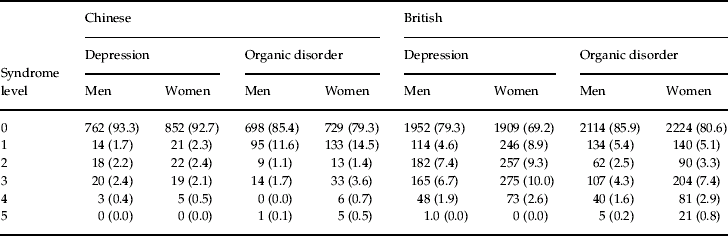
Table 1 shows distributions of syndrome levels of depression and organic disorder at baseline. Chinese subjects had a significantly lower prevalence of depressive syndromes but a similar level of any organic syndrome compared to the British. There were significantly more women having some level of organic syndrome in both Chinese and British samples compared with men, and excess for depressive syndromes in British women but no excess in Chinese women.
Number (%) of patients with syndromes of depression and organic disorder at baseline

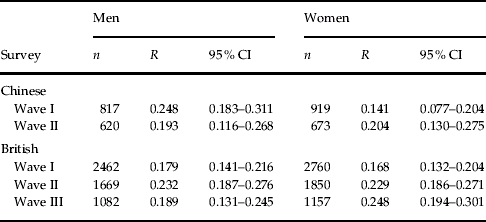
There was a cross-sectional correlation between syndrome levels of depression and organic disorder (Table 2). The correlation coefficient R appeared to be similar between the two populations and between different survey waves: in the Chinese it was 0.186 [95% confidence interval (CI) 0.141–0.231] in wave I and 0.213 (95% CI 0.161–0.264) in wave II, while in the British R was 0.180 (95% CI 0.154–0.206), 0.234 (95% CI 0.203–0.264) and 0.234 (95% CI 0.195–0.272) in waves I, II and III respectively. There was no gender difference in the correlation, except that in the Chinese wave I there was a stronger correlation in men than in women (p=0.021) (Table 2). The magnitude of the association seemed to be stronger in older than younger participants: in the Chinese wave I the correlation coefficient in age groups 65–75 v. 85+ years was 0.113 v. 0.342 (p=0.043) and in the British wave II 0.138 v. 0.314 (p<0.001), but not in other wave data.
Cross-sectional correlation of syndrome levels of depression and organic disorder in older people

R, correlation coefficient; CI, confidence interval.
All p⩽0.001.
Separate analyses for participants with and without CVD showed similar patterns of correlations. For example, in those without CVD, the correlation coefficients were 0.117 (95% CI 0.051–0.182) and 0.203 (95% CI 0.128–0.276) in the Chinese waves I and II respectively, and 0.184 (95% CI 0.151–0.217), 0.240 (95% CI 0.200–0.279) and 0.264 (95% CI 0.215–0.327) in the three British waves.
Association of depression syndromes at baseline with follow-up organic disorder was less substantial. The correlation coefficient was 0.075 (95% CI 0.021–0.128) in the Chinese (0.068, 95% CI −0.01 to 0.145 for men, and 0.089, 95% CI 0.014–0.163 for women; gender differences p>0.05), and in the British the correlation coefficient was 0.093 (95% CI 0.061–0.125) at the 2-year follow-up (0.058, 95% CI 0.011–0.105 for men, and 0.104, 95% CI 0.059–0.148 for women; p>0.05) and 0.093 (95% CI 0.049–0.130) at the 4-year follow-up (0.030, 95% CI 0.025–0.035 for men, and 0.114, 95% CI 0.057–0.170 for women; p=0.046). The correlation increased with age: among those aged 85+ v. 65–74 years, the correlation coefficients in the Chinese were 0.258 (95% CI −0.031 to −0.507) v. 0.059 (95% CI −0.006 to −0.123) and in the British 0.130 (95% CI 0.061–0.197) v. 0.070 (95% CI 0.019–0.121) at the 2-year follow-up and 0.116 (95% CI 0.016–0.244) v. 0.070 (95% CI 0.010–0.129) at the 4-year follow-up, all comparisons p>0.05. Patterns of weak associations in elderly subjects with and without CVD at baseline were not changed substantially (data on request). Restricting participants to those without any organic syndromes at baseline, we found no association in the Chinese (r=–0.021 in men, r=–0.015 in women) and in the British (–0.022 to 0.044, in men and women at the 2- and 4-year follow-up).
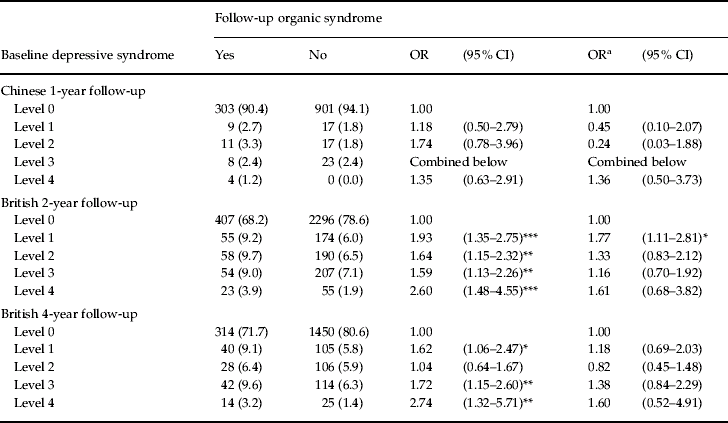
In a multiple adjusted logistic regression model for analysing data on grouping all organic syndromes at follow-up, there was a relationship to baseline depression in the British but no obvious evidence for a ‘dose–response’ relationship (Table 3). Restricting participants to those without any organic syndromes at baseline, the magnitude of the relationship was attenuated, with the statistical significance disappearing, but depressive syndromes at level 4 seemed to increase the risk of a syndrome of organic disorder in both Chinese and British (Table 3).
Numbers (%) and odds ratio (ORs) of patients with follow-up organic syndromes across baseline depressive syndromes

CI, Confidence interval.
ORs adjusted for age, gender, educational level and cardiovascular diseases (hypertension, angina, coronary heart disease and stroke).
a In participants who were free of any organic syndromes at baseline.
* p⩽0.05, ** p⩽0.01, *** p⩽0.001.
Discussion
In a population financially poorer but having a lower prevalence of depressive syndromes and depression in China compared to western countries, we found a similarly high proportion of people with organic syndromes. The relationship between syndrome levels of depression and organic disorder might be temporal, and this was maintained for different age, gender and people with and without CVD. These were confirmed in the UK population-based study.
Strengths and limitations of the study
The strengths of the study were that (1) we used two markedly different populations in terms of socio-economic status, social support and prevalence of depression [2.2% (Chen et al. Reference Chen, Hu, Qin, Xu and Copeland2004) v. 10.0% (Saunders et al. Reference Saunders, Copeland, Dewey, Gilmore, Larkin, Phaterpekar and Scott1993)] and cardiovascular risk to investigate the relationship between syndromes of depression and organic disorder; and (2) the two cohorts had high response rates and the number of participants was relatively large, which gave sufficient power to test the relationship, including that in the subgroups. A limitation of our study was that the duration of follow-up in the Chinese cohort was short, only 1 year, but the findings were consistent and supported by the long-term follow-up data of the MRC-ALPHA study.
Temporal relationship between syndrome levels of depression and dementia
To the best of our knowledge, our study is the first to report a possible temporal relationship between syndrome as opposed to symptom levels of depression and organic disorder. Previous studies have investigated whether depression symptom scores predict subsequent decline on cognitive tests. An earlier review summarized four of these studies, with only one of them showing a significant association (Jorm, Reference Jorm2000). Since then, several papers of this type of study have been published. Cervilla et al. (Reference Cervilla, Prince, Joels and Mann2000) observed that depressive symptoms predicted cognitive decline in men but not in women. Geerlings et al. (Reference Geerlings, Schoevers, Beekman, Jonker, Deeg, Schmand, Ader, Bouter and Van2000) found an effect in people with a higher level of education but not in those with a lower level. More recently, two studies (Vinkers et al. Reference Vinkers, Gussekloo, Stek, Westendorp and van der Mast2004; Ganguli et al. Reference Ganguli, Du, Dodge, Ratcliff and Chang2006) that involved relatively small numbers of participants from The Netherlands (also only in participants aged 85+) and rural America suggested no such association. There are some concerns that analysing the scores derived by simply adding together depression symptoms may prove to be less powerful for identifying the association because the symptoms would not be weighted for individual importance, whereas some specific depressive symptoms (such as ‘motivational symptoms’ rather than ‘mood symptoms’) could themselves predict dementia (Jorm, Reference Jorm2001; Wilson et al. Reference Wilson, Krueger, Arnold, Schneider, Kelly, Barnes, Tang and Bennett2007). Thus, in this study we analysed data on the syndrome clusters instead. Although our findings show a possible temporal relationship between syndrome levels of depression and dementia, grouping organic syndrome levels of 1–5 in the follow-up appeared to be related to the highest level of baseline depressive syndromes. Recently, we have observed that only the most severe depression (i.e. GMS-AGECAT level ⩾4, but not level 3) was associated with an increased risk of developing dementia (Chen et al. Reference Chen, Hu, Wei, Qin, McCracken and Copelandin press). All these findings taken together suggest that the temporal associations of symptoms of depression with cognitive decline or dementia, if they exist, need further investigation.
In conclusion, our study found that the relationship between depression and dementia at syndrome level might be temporal. We believe that the finding is unlikely to result from chance or bias. The possible increased, but not ‘dose-dependent’, risk of organic syndromes at follow-up when related to baseline depressive syndromes should encourage further research into the aetiological roles of depressive symptoms, syndromes and cases of depression in incident dementia.
Acknowledgements
We thank the many Chinese and British residents who participated in the Anhui Older Health Study and the MRC-ALPHA study, and the survey interviewers. The Chinese cohort was funded by The Royal Society, UK (Grant no. 574006.G603/22085) and Universities China Committee, London, and the MRC-ALPHA by the Medical Research Council (MRC) and later by the MRC and the Department of Health as part of the MRC-CFA Study, UK. L. W. holds a Special Training Fellowship in Health Services and Health of the Public Research award from the MRC. R. C. is supported by the BUPA foundation.
Declaration of Interest
None.