Introduction
Early-life conditions have profound long-term health consequences over the life course. There is a large body of literature that examines the detrimental impact of prenatal and early childhood (mostly age −9 to 24 months) malnutrition on adult health/mortality in the vein of the ‘fetal origin hypothesis’ (Barker & Osmond, Reference Barker and Osmond1986; Barker, Reference Barker1997; Barker et al., Reference Barker, Eriksson, Forsen and Osmond2002; Black et al., 2007; Chen & Zhou, Reference Chen and Zhou2007; Gluckman et al., Reference Gluckman, Hanson, Cooper and Thornburg2008). These studies provide strong and consistent evidence that maternal and fetal malnutrition could trigger a wide range of diseases in later life, such as coronary heart disease, hypertension and diabetes. This is induced through the human body's adaptation to limited supply of nutrients in early life as well as the resulting permanent changes in physiology and metabolism.
Nevertheless, it is well known in the field of human biology that the velocity of human growth has two peaks (e.g. Cameron & Bogin, Reference Cameron and Bogin2012). One is at the very beginning of life (i.e. fetal and infant stage), and the other is during late childhood (i.e. around age 14), known as the adolescent growth spurt. Although a greater amount of body growth takes place during infancy and early childhood, it is during late childhood that the human body experiences the most important physical changes (ibid., pp. 5).
Late childhood is marked by the onset of puberty and dramatic changes in body size, shape and composition. During this stage, children gain physical, mental and emotional maturity at a rapid pace. Biological studies indicate that the adolescent growth spurt plays a critical role in the normal development of the human body, at least in the following aspects:
-
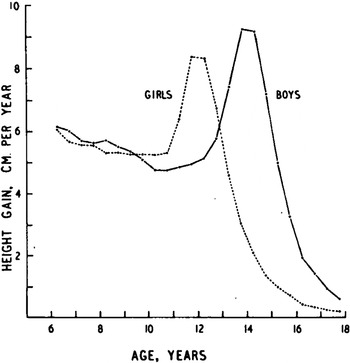
• Height. The human body does not grow linearly (Tanner, Reference Tanner1981; Rogel et al., Reference Rogol, Clark and Roemmich2000). After a rapid growth in the first two years of life, the velocity of body growth usually decelerates and remains relatively constant until the onset of puberty, when growth rate accelerates again (as depicted in Fig. 1). During the period of adolescent growth spurt, girls gain 25 cm in height on average with a peak velocity of 9 cm/year, while boys gain about 28 cm with a higher peak of 10.3 cm/year (Rogel et al., Reference Rogol, Clark and Roemmich2000). It has been shown that substantial height catch-up can occur during this period, thus providing an additional window of opportunity to improve adult height (Prentice et al., Reference Prentice, Ward, Goldberg, Jarjou, Moore and Fulford2013). Since adult height is an important predictor for a wide range of mortality risks in later life and shorter adults have a shorter expectancy of life than their taller counterparts in general (Elo & Preston, Reference Elo and Preston1992), late childhood malnutrition could induce harmful long-term health outcomes associated with retarded height attainment.
Fig. 1.The adolescent growth spurt.
Source: Tanner (1981).
-
• Weight. Late childhood is also a period for significant weight gain. About half of the adult weight is gained during adolescence (Rogel et al., Reference Rogol, Clark and Roemmich2000). Malnutrition during childhood could force the human body to reduce physical activities and slow down metabolism, which may force the body to reach a lower level of energy turnover in response to the limited energy supplies. Furthermore, when foods become affluent in later life, these people are especially vulnerable to gaining more weight and becoming overweight or obese.
-
• Skeleton, bone mass, muscle, strength and body composition. The skeletal and muscular dimensions of the human body expand rapidly during late childhood (Tanner, Reference Tanner1981; Rogel et al., Reference Rogol, Clark and Roemmich2000). Studies show that about half of the peak adult bone mass is accumulated during the adolescent growth spurt (Parfitt, Reference Parfitt1994). Skeleton development is especially sensitive to calcium and other nutritional intake at this stage in reaching bone growth potential (Parfitt, Reference Parfitt1994; Whiting et al., Reference Whiting, Vatanparast, Baxter-Jones, Faulkner, Mirwald and Bailey2004). Similarly, failure to gain enough muscle due to undernutrition may affect the optimal function of some organs and result in a reduction in physical activity in later life (Tanner, Reference Tanner1981; Rogel et al., Reference Rogol, Clark and Roemmich2000).
-
• Sexual maturity and intellectual and emotional advancement. Late childhood is marked by the onset of puberty, and undernutrition at this stage could affect the timing of sexual development. For instance, malnutrition for girls is related to a later age at menarche. The slowdown of sexual development may cause further emotional and psychological problems. There is considerable evidence to suggest that sexual and skeletal maturity are linked to social and emotional development (Tanner, Reference Tanner1981; Whiting et al., Reference Whiting, Vatanparast, Baxter-Jones, Faulkner, Mirwald and Bailey2004).

The significance of the adolescent growth spurt reinforces that late childhood is a critical stage that can result in diverging growth trajectories and different health outcomes in later life. Previous studies on the life-course nutrition and health relationship have almost exclusively concentrated on the long-term health effect of fetal and early childhood malnutrition. In contrast, little attention has been paid to the nutrition status during late childhood when the human body also develops rapidly (Prentice et al., Reference Prentice, Ward, Goldberg, Jarjou, Moore and Fulford2013). Moreover, most of the empirical studies regarding the detrimental effects of childhood malnutrition on adult health have been conducted in developed countries, whereas in developing countries, where childhood malnutrition is much more prevalent, few studies have been done and few conclusive findings reached due to lack of data and quality constraints.
This study uses data from a nationally representative sample survey in China to explore the impact of late childhood nutrition intakes on a wide range of adult health indicators. Specifically, taking advantage of the rich health information collected in the survey, this study examines whether the frequencies of consuming various kinds of foods at age 14 influence the health status when a respondent grows up. A series of health indicators, including both self-reported measures and objective biometrics, are used to examine the potential health impact more comprehensively. In view of the fact that the growth trajectory since late childhood is characterized by considerable gender differences, all the analyses are conducted separately for males and females to explore possible variations between genders.
Data and Methods
Data
The data used in this study are from a national sample survey of the Chinese population: the 2008 survey of Internal Migration and Health in China (IMHC, see http://www.ccpr.ucla.edu/IM-China for documentation and details). The IMHC is a joint project conducted by the University of California, Los Angeles, and the Capital University of Medical Sciences at Beijing. A multi-stage, stratified probability sampling was employed, and in total 3000 respondents aged between 18 and 64 were randomly selected and interviewed from 150 townships throughout mainland China.
The IMHC collected rich information on respondents' socio-demographic characteristics, educational and migratory histories, economic activities and physical and psychological health. In addition to the information collected through questionnaire interview, a brief medical examination was made by the recruited medical staff for each respondent at the survey site, and a variety of biometric indicators such as height, weight, blood pressure and lung capacity were collected.
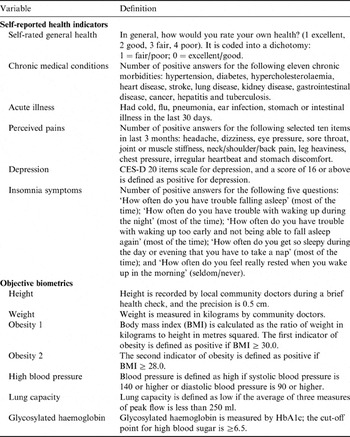
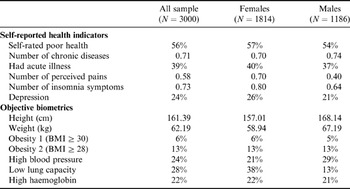
The health indicators used in this study include both self-reports (i.e. self-rated general health, medical history of common chronic diseases, the occurrence of acute illness, self-perceived pains/discomforts, insomnia, depression) and objective biometrics (height, weight, body mass index, blood pressure, lung capacity, glycosylated haemoglobin, etc.) of adult health status. Brief definitions of, and descriptive statistics for, these health measures are given in Table 1 and Table 2, respectively. It is worth noting that obesity is defined in two alternative ways, with the first using the common cut-off of body mass index (BMI)≥30, and the second using a lower cut-off (BMI≥28), which is recommended specifically for the Chinese population (Wu, Reference Wu2006).
Definitions of health measures in the Internal Migration and Health in China (IMHC) survey

Descriptive statistics of adult health status (unweighted), IMHC survey, 2008

The base N values for some of these variables are slightly less than reported due to missing values.
To the special interest of the current study, the IMHC survey asked respondents to report the frequencies of consuming each of the following categories of foods at age 14: 1) meat; 2) fish; 3) milk and other dairy products; 4) tofu and other soy products; 5) green vegetables; 6) fruits; 7) potato, yam and taro; 8) rice, noodle and bread; and 9) sweets and snacks. The corresponding response categories were: 1) at least three times a day; 2) twice a day; 3) once a day; 4) 2–3 times a week; 5) once a week; 6) 2–3 times a month; 7) once a month; 8) a few times a year; 9) only during holidays; 10) once a year or less; and 11) never. These items were used to construct measures for the nutritional condition during late childhood, which serve as the key independent variables in this study. Food frequency questions such as the above have been used extensively to measure eating habits and dietary quality in population surveys (Cade et al., Reference Cade, Thompson, Burley and Warm2002), and it has been proven to be a reliable and valid measure for the eating habits of adolescents (Rockett et al., Reference Rockett, Breitenbach, Frazier, Witschi, Wolf, Field and Colditz1997; Speck & Bradley, Reference Speck and Bradley2000). Although the retrospective reports on these questions many years later may induce recalling errors, the existing evidence to date suggests that this kind of recalling is reasonably trustworthy, with moderate to high validity and replicability (Maruti et al., Reference Maruti, Feskanich, Colditz, Frazier, Sampson and Michels2005, Reference Maruti, Feskanich, Rockett, Colditz, Sampson and Willett2006).
Methods
Using the retrospective information on the frequencies of dietary intakes at age 14 as described above, a principal component factor analysis was performed to construct indices for dietary quality. Cronbach's alpha is greater than 0.8 for the nine items of food intakes, indicating high inter-correlations among them. Three principal factors (with Eigen value≥1) were retrieved from these nine items, and taken together they account for about two-thirds (66.9%) of the total variance of the original variables.
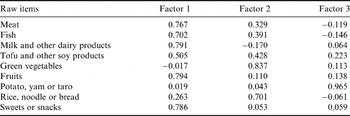
Table 3 shows factor loadings from the principal component analysis. The nine items yielded three clear-cut main factors. Factor 1 is closely related to the frequencies of consuming meat, fish, milk and other dairy products, fruits, sweets and snacks and tofu and other soy products. It is the most important factor telling from the statistics of the analysis, and it accounts for 36% of the total variance observed in the raw items. Factor 2 is related closely to eating green vegetables and rice/noodle/bread. It explains another 19% of the total variance after an orthogonal varimax rotation. The frequency of eating potato, yam or taro is singled out to form another factor (Factor 3), and it contains 12% of the total variance additionally.
Factor loadings for frequencies of dietary intakes at age 14, IMHC survey, 2008

Principal component factor analysis with orthogonal varimax rotation; N=2974.
The three factors derived above were used as the key independent variables to indicate the late childhood nutrition status in the following analysis. A higher value of these factors indicates less frequent consumption of the corresponding foods. To specify, Factor 1 indicates the inverse frequency (or scarceness) of high-quality nutrient intakes, as seen from its close correlation with nutrient-rich diets (such as meat, fish, milk, fruits and sweets). Individuals who scored high on this factor are likely to be undernourished from the high-quality nutrient sources during late childhood (i.e. rarely eating meat, fish, milk, fruits, sweets, etc.). Similarly, Factor 2 and Factor 3 indicate inverse frequencies of some basic (e.g. vegetable/rice/noodle/bread) or relatively low-quality (e.g. potato/yam/taro) nutrient intakes respectively. In addition to their different nutrient qualities and ingredient components, these two factors may also signify some special dietary habits, shaped either by natural and socio-cultural environments such as richness of certain type of food determined by regional chief crops.
Using the three indicators as key independent variables, a series of OLS or logit regression models were fitted for the selected health indicators, according to their detailed quantification. Specifically, for continuous dependent variables such as height and weight, OLS regressions were estimated. For dichotomous outcome variables such as self-reported general health, logit models were built instead. For count-dependent variables such as the number of diagnosed chronic diseases, the number of perceived pains, and the number of insomnia symptoms, both OLS regressions and Poisson regressions were estimated. Since the results are qualitatively the same, only the OLS results are reported for simplicity. All these regression models were fitted separately for men and women to explore possible gender differences.
Results
Adult height
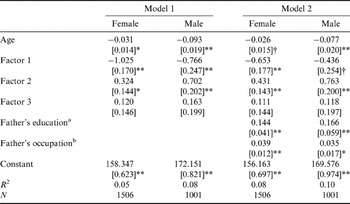
The impact of late childhood nutrition on adult height is firstly examined with regard to the critical role of height in both assessing overall childhood conditions and predicting other health problems in later life (Elo & Preston, Reference Elo and Preston1992). Using the three factors denoting nutritional intakes around age 14 as the key predictors, a set of OLS regressions are built for respondents' adult height. Among them, Model 1 controls only for age difference, and Model 2 further controls for family background as measured with father's education and occupation when the respondent was 14. Table 4 presents the results of these OLS regressions.
Late childhood nutrition and adult height (OLS regressions), IMHC survey, 2008

a Father's education is measured by the number of years of schooling.
b Father's occupation is measured by a score of the International Socio-Economic Index (ISEI).
†p<0.1; *p<0.05; **p<0.01.
As shown in Model 1 (see Table 4), Factor 1 shows a strong negative effect on height, suggesting that the respondents who ate nutrient-rich food (meat/fish/milk/fruit/sweets) less often around age 14 tend to attain a shorter stature eventually. This effect is more substantial for females than for males. On the other hand, the coefficient of Factor 2 suggests that the respondents who ate green vegetable, rice, noodle and bread less often around age 14 are taller on average during adulthood. The opposite directions of long-term health effects from Factor 1 and Factor 2 throw some light on possible substitution between these different categories of food intakes. In contrast to the first two factors, Factor 3 (the frequency of eating potato/yam/taro) is not significantly related to adult height according to Model 1.
After controlling for family background in Model 2, the effect of Factor 1 on height is attenuated somewhat. This indicates the mediating effect of the nutritional condition for family socioeconomic background on health. The frequency of high-quality nutrient intakes during late childhood is positively associated with respondents' socioeconomic status and family background. Yet, after controlling for these covariates, a higher frequency of eating nutrient-rich diets during late childhood still shows significant positive impacts on adult height. This is especially so for females. In contrast to the attenuated effect of Factor 1, Factor 2 shows a stronger effect on adult height after controlling for family background in Model 2. This suggests that, holding family socioeconomic background constant, a higher frequency of eating low-nutrient diets (vegetables/rice/noodle/bread) at age 14 has salient negative impacts on adult height.
The control variables examined in this study also show significant impacts on adult height. The model results show that age is negatively related to height. Given that the respondents in the sample are all of working age (18–64), the age difference in height mainly reflects the cohort effect of living condition improvements on individual health. That is, the Chinese population has experienced substantial improvements in average living conditions and life quality during the past half century, which have possibly contributed to increases in average height among younger generations. Consistent with the pattern observed in the rest of the world, the gender difference in height is substantial, and males are around 13 cm taller than females on average in China when age, dietary intakes at age 14 and family background are held constant.
Self-reported health indicators
In the following, six selected measures of self-reported health are modelled to examine the impact of late childhood nutrition on adult health. These health measures include self-rated poor health, number of chronic conditions, occurrence of acute illness, number of perceived pains, number of insomnia symptoms and a scale of depression. A series of nested models are estimated for each of these health indicators, separately for females and males. To specify, Model 1 examines the health impact of late childhood nutrition conditioning solely on age, Model 2 estimates the health impact of late childhood nutrition conditioning on age, father's education and occupation and Model 3 further controls for adult height as a means to proxy some unmeasured heterogeneity that is health-related and may be revealed through individuals' height differences.
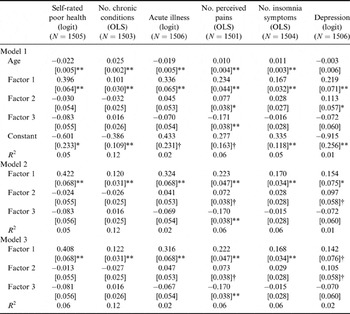
Table 5 shows the nested regression results of selected self-reported health indicators for females. After controlling for age difference, Factor 1 has significant positive effects on all six self-reported health indicators for females. Lower frequency of eating nutrient-rich diets (such as meat, fish, milk, soy products and sweets) during late childhood predicts women's higher likelihood of reporting poor general health, greater numbers of chronic conditions, higher likelihood of experiencing acute illness during the past 30 days, greater numbers of perceived pains during the past three months, greater numbers of insomnia symptoms and higher likelihood of depression. The corresponding effects remain robust for most of these health indicators after controlling for father's education, father's occupation and the respondent's adult height, as seen in Model 2 and Model 3 respectively.
Regression results of late childhood nutrition on self-reported health indicators for females, IMHC survey, 2008

Model 2 controls for father's education and occupation in addition to age; Model 3 further controls for adult height.
†p<0.1; *p<0.05; **p<0.01.
Compared with the significant long-term health impact of the nutrient-rich dietary intakes (as measured in Factor 1), other dietary intakes (measured with Factor 2 and Factor 3) during late childhood show relatively limited impacts on women's self-reported health conditions when they grow up. The coefficients of Factor 2 suggest that less frequent intakes of vegetables/rice/noodle/bread at age 14 contribute to a greater number of perceived pains during the past three months and higher likelihood of depression for women. The magnitudes of these effects decline only marginally when family background and adult height are held constant (in Models 2 and 3).
In contrast with the significantly positive coefficients of Factor 1 and Factor 2 on the self-reported health indicators, Factor 3 shows a significant negative effect on females' perceived pains during the past three months, and the effect remains robust even after controlling for other covariates in Model 2 and Model 3. Therefore, females who ate potato/yam/taro less often at age 14 are less likely to report greater numbers of perceived pains in adulthood. This result suggests that frequent consumption of (or high reliance on) high-starch food at the critical period of adolescent growth spurt has salient harmful effects on females' physical well-being.
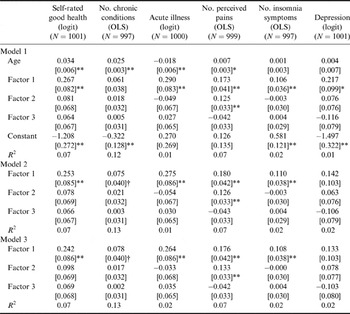
In parallel with the model fit for females in Table 5, Table 6 presents the corresponding model results of self-reported health indicators for males. Compared with those results for females, the corresponding effects for males are smaller in magnitude and less significant statistically. The model results in Table 6 show that the frequency of consuming nutrient-rich diets at age 14 (i.e. Factor 1) has significant positive effects on most of the self-reported health indicators for men. When age difference is held constant, males who ate meat/fish/milk/soy products/fruits/sweets less often at age 14 have a higher likelihood of reporting poor general health, higher likelihood of experiencing acute illness during the past 30 days, greater numbers of perceived pains during the past three months, greater numbers of insomnia symptoms and higher likelihood of depression. These effects remain largely significant (with the exception of the effect on depression) even after controlling for other covariates in Model 2 and Model 3. Compared with the effects of Factor 1, Factor 2 has a significant effect only on the number of perceived pains, and Factor 3 shows significant effects on none of the health indicators examined here.
Regression results of late childhood nutrition on self-reported health indicators for males, IMHC survey, 2008

Model 2 controls for father's education and occupation in addition to age; Model 3 further controls for adult height.
†p<0.1; *p<0.05; **p<0.01.
Taken together, the model results in Tables 5 and 6 suggest that high-quality or nutrient-rich diets during late childhood have significant and independent long-term effects in boosting the health stock for both men and women, even after controlling for family background and adult height. This holds true for almost all the self-reported health indicators examined in this study. Therefore, the results arrived at so far support that undernourishment during late childhood not only retards individuals' normal growth (as manifested in adult height and shown in Table 4), but also does harm to adult health conditions more broadly.
Other objective biometrics
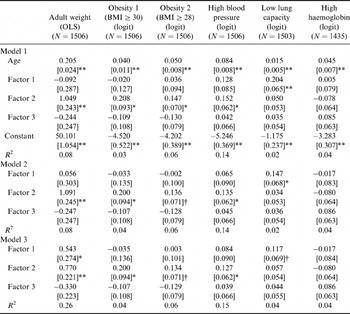
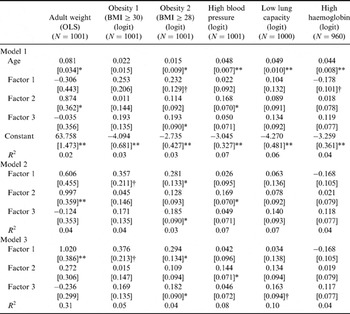
Health is a complex concept. It has been suggested that self-reported measures can differ from objective measures in that they tend to reflect different domains of health (Murray & Chen, Reference Murray and Chen1992; Sen, Reference Sen2002). In order to examine the comprehensive health impacts of late childhood nutrition intakes, similar analyses are conducted for six selected objective biometrics in addition to adult height. The objective indicators examined here include adult weight, two alternative classifications of obesity, high blood pressure, low lung capacity and high haemoglobin (as described in Table 1). Tables 7 and 8 display the nested regression results of these objective health indicators, for females and males respectively.
Regression results of late childhood nutrition on selected objective biometrics for females, IMHC survey, 2008

Model 2 controls for father's education and occupation in addition to age; Model 3 further controls for adult height.
†p<0.1; *p<0.05; **p<0.01.
Regression results of late childhood nutrition on selected objective biometrics for males, IMHC survey, 2008

Model 2 controls for father's education and occupation in addition to age; Model 3 further controls for adult height.
†p<0.1; *p<0.05; **p<0.01.
As shown in Table 7, Factor 1 has significant positive effects on females' incidence of low lung capacity. After controlling for the age difference (in Model 1), females who ate nutrient-rich diets less frequently at age 14 are more likely to be diagnosed with low lung capacity. The effect is attenuated somewhat when family background is controlled for in Model 2, yet it is still statistically significant. After adjusting for adult height, Factor 1 shows a significant effect on weight, indicating that the females who had less access to nutrient-rich diets during the stage of adolescent growth spurt tend to gain more weight at a comparable stature in adulthood.
Compared with Factor 1, Factor 2 shows significant positive effects on adult weight, the two indicators of obesity and high blood pressure. Holding age constant, females who ate vegetables/rice/noodle/bread less often at age 14 are more likely to gain greater weight in adulthood, to be obese and to have high blood pressure. These effects remain largely significant even after controlling for other covariates in Model 2 and Model 3. These results are consistent with the biological finding that childhood malnutrition may permanently change the biological balance between energy intake and consumption into a lower level and thus place individuals at higher risks of obesity, high blood pressure, and so on. In contrast to Factor 1 and Factor 2, Factor 3 does not show significant effects on any of the objective health indicators in Table 7, after controlling for other covariates in the models.
Table 8 presents the corresponding model results of objective health indicators for males. As seen in Model 1, Factor 1 shows only marginally significant (p<0.1) positive effects on males' likelihoods of obesity (BMI≥28) and high haemoglobin, when age difference is held constant. Yet, the corresponding effect on the likelihood of obesity becomes stronger and more significant when family background is controlled for (in Model 2 and Model 3). Similarly, the effect of Factor 1 on adult weight also becomes statistically significant when height is adjusted for in Model 3. These results provide further evidence supporting the theory that undernutrition (or less frequent consumption of nutrient-rich diets) during late childhood has long-lasting negative effects on an individual's physical health.
The coefficients of Factor 2 show that less frequent intakes of basic nutrient diets such as vegetables/rice/noodle/bread also have significant negative effects on men's health. And these impacts are more salient for the risk of high blood pressure. Factor 3 shows a significant positive effect on males' risk of obesity (BMI≥28) as well. This effect remains robust even after controlling for other covariates in Model 2 and Model 3. Therefore, men who ate potato/yam/taro less frequently at age 14 are also more likely to be obese.
With respect to the two obesity indicators using different cut-offs of BMI, although the observed basic pattern is similar, the results in Table 8 show that some effects only reach the level of statistical significance when the cut-off of 28 is used instead of 30. This is probably due to the relatively lower incidence of higher BMI in China and the small sample size, as is evident from the substantially larger estimated standard errors for the first indicator of obesity (BMI≥30).
Overall, the results found in this study provide support for a lasting harmful impact of late childhood undernourishment on adult health. And the effect is salient not only for self-reported or perceived health conditions, but also for some objective biometrics, such as adult height, weight, obesity and high blood pressure.
Discussion and Conclusion
This study analyses the long-term effect of late childhood nutrition on adult health in China. Specifically, it examines whether the frequency of eating various kinds of foods at age 14 has long-lasting health impacts when the respondent grows up. The findings suggest that undernourishment during late childhood is a significant predictor for a variety of health problems at adulthood. In particular, the respondents who had less access to nutrient-rich diets (i.e., meat, fish, milk, soy products, fruits and sweets) at age 14 tend to be shorter when they grow up. They are also more likely to report poor general health, greater numbers of chronic diseases, higher likelihood of acute illness, greater numbers of physical pains, and suffer more from insomnia symptoms and depression. They even tend to gain more weight as an adult and are more likely to be diagnosed with high blood pressure or low lung capacity (mainly for females). Respondents who ate green vegetables/rice/noodle/bread less often at age 14 tend to report more physical pains and higher likelihood of depression, gain more weight and become obese at adulthood, and have a higher risk of developing high blood pressure.
The analysis in this study also suggests that the evidence of a harmful effect of late childhood undernourishment on adult health is more consistent for self-reported health measures than for the objective biometrics examined here. In addition, females seem to suffer more from late childhood malnutrition than males, especially for self-reported health measures. This is probably due to the practice of within-family gender discrimination, which is prevalent in some Asian societies (Chen et al., Reference Chen, Huq and D'Souza1981; Osmani & Sen, Reference Osmani and Sen2003), and its interaction with family socioeconomic status. In societies with strong son preference, girls are likely to be especially deprived when family resources such as high-quality food are inadequate. Another possibility is that adolescent girls may be more likely to value and pursue a ‘thinner’ body to meet the social ideal of physical beauty even when foods are abundant (McLaren, Reference McLaren2007). This may also result in a more severe malnutrition among females.
The predictive power of late childhood nutrition on adult health is largely independent of the health differences associated with age, sex, father's education and occupation, and even adult height. This suggests that the adolescent growth spurt is a much more complex phenomenon, rather than just a simple accelerated growth of the human body. Although the growth of neuronal tissues generally takes place during the first two years of life, many other important tissues continue to develop well beyond this early period. During late childhood, there is a marked acceleration in the growth of lymphoid tissues, musculoskeletal and gastrointestinal tissues and reproductive organs (Prentice et al., Reference Prentice, Ward, Goldberg, Jarjou, Moore and Fulford2013). This indicates that the human body has a high demand for nutritional intakes during this period. In case that the demand cannot be met adequately, the maturation of various human organs is likely to be hampered perpetually. This hindrance could lead to a variety of health problems throughout the rest of life. The findings from this study highlight the relevance of late childhood as another critical stage of body growth, and it is crucial to take a broader life-course perspective in order to understand human development and health.
Notwithstanding, this study has several drawbacks and the findings reported here should be viewed with some caution. First, the measurement of late childhood nutrition is not optimal due to data limitation. On the one hand, it is based on retrospective information and is thus subject to potential recalling errors. On the other, the survey collected information on the frequency of various dietary intakes but not on the quantity of each dietary intake, and as a result, the analyses in this study are unable to quantify the amount of consumption of each nutrient. Moreover, although the adolescent growth spurt seems to occur a little earlier for females than for males, as shown in Fig. 1, the data only allow the nutrition condition to be traced back to age 14 for both men and women. Yet, this is expected to have no more than a minor impact on the reported findings, given that for many respondents the living condition or nutrition status is less likely to change dramatically in a short period during late childhood. Nevertheless, it still merits exploring whether measures at different ages for males and females are more efficient in examining the impact of late childhood nutrition on health.
Secondly, due to the lack of information on health and nutrition status at other stages of life, the current study is unable to rule out the possibility that the observed health effect of late childhood undernutrition reflects an accumulated life course disadvantage. That is, people who are deprived of adequate dietary intakes during late childhood may continue to face similar hardships as life goes on, and thus have poorer adult health. Nonetheless, in addition to asking people to recall their dietary intakes at age 14, the IMHC also collected information on the current dietary intakes in a similar way for each respondent. When effort is taken to examine the independent effect of late childhood nutrition by controlling for current nutrition status (results not shown here, but available on request), the former still imposes a significant impact on most of the self-reported measures of adult health, though the results for the objective biometrics become less stable.
Finally, this study shows significant associations between late childhood nutrition and a variety of indicators of adult health; however, to better understand the dynamics and underlying mechanisms between child development, nutrition and health, more systematic investigations from both biological and social perspectives are still needed.
Acknowledgments
The research was supported by the Fundamental Research Funds for the Central Universities, and the Research Funds of Renmin University of China (13XNJ034). The authors are grateful for valuable comments and suggestions from the anonymous reviewers. An earlier version of this paper was presented at the 2013 IUSSP conference in Bussan, Korea.