

INTRODUCTION
Roger Howell, a participant in the Xeropolis excavation who himself completed the excavation of the Trench CC ‘deep sounding’ in 1969, originally agreed with Mervyn Popham that he would publish the pottery of Lefkandi Phases II–VI (at first named 2–6).Footnote 1 Although he produced a preliminary draft that covered all phases, this needed very substantial revision before it could be accepted for publication; but changes in his personal circumstances made it increasingly difficult for him to work on the text, and he finally had to abandon the task in 2005. The Lefkandi Subcommittee was committed to getting as much of the unpublished material from the original Xeropolis excavation published as possible in a Lefkandi Vol. V. However, this plan had to be abandoned when it proved too difficult to realise it. It was agreed that I would cover Phases IV–VI, and this article is the result. I could only consider this because Roger Howell had very generously passed on to me all that he could find of his manuscript, along with copies of the illustrations, both drawings and photographs, made of the material.Footnote 2 This material constitutes a vital source of information on the pottery, almost all of which was discarded long ago after preliminary study. Basing an account of the pottery of Phases IV–VI almost entirely on Roger Howell's manuscript and copies of the accompanying illustrations was the only way that I could see of producing a general account, since I was in no position to undertake a study of the material stored in Eretria Museum. My lack of first-hand knowledge of the material was a considerable drawback, but I had general familiarity with the material of these phases from the Greek mainland as a whole and had incorporated the Lefkandi material previously into my account of the Middle Helladic (MH) pottery sequence (Dickinson Reference Dickinson1977, 17–23). Since no more was intended than a general account, this did not seem to be an insuperable problem, provided that the manuscript could be relied upon. This too did not seem a problem; although it has its limitations (see further below), the manuscript offers a solid general account of the stratigraphy and pottery of each of Phases IV–VI, that is clearly the result of extensive study, and it was possible to devise new illustrations, based on the copies of the originals that Roger Howell had provided (it has not been possible to illustrate everything mentioned in his text, so references will be found in the account below to catalogued pieces that are not illustrated).
Inevitably, any account based almost wholly upon the study of a manuscript cannot be compared with one based on first-hand experience of the material. But I believe that a general account of Phases IV–VI pottery, that provides some detailed information on various stages in a distinctive Euboean tradition of Middle Helladic pottery production, does have value. This tradition, that survived in essentials deep into the early Mycenaean period, involved the production of pottery that was often of excellent quality, but was not strongly influenced by any outside source, such as the north-east Peloponnese or Aigina. Study of it should give scope for making enlightening comparisons with contemporary sequences and deposits elsewhere in central Greece and on the Greek mainland generally.
THE HOWELL MANUSCRIPT
As the essential basis for this account, Roger Howell's manuscript deserves some description. It was once comprehensive, in the sense that it covered all of Phases II–VI, but unfortunately it now has gaps: one or two individual pages have been lost, and so, more seriously, has a whole section of nineteen pages, including thirteen catalogue entries. Luckily, these losses do not involve anything vital. In the manuscript, each phase is given an introduction that discusses the strata and features identified as belonging to it and the evidence of later intrusions, and lists the excavation level numbers and pottery lots attributed to each feature. This is followed by a catalogue of the vessels and sherds that were singled out for cataloguing from each source in order, with references to drawn figures and photographs. Following the catalogue, there is a summary account of the wares into which the pottery has been divided that covers the range of shapes and, where appropriate, the styles of decoration represented within each ware. These accounts draw particularly on the evidence of sample lots that were retained complete (one each from Phases IV and V, two from Phase VI); material from some trials, especially Trial IX, also seems to have been retained in quantity or completely intact, according to Miss Ioanna Galanaki (who had studied parts of the Middle Helladic pottery stored in Eretria Museum while working on a PhD). The account of each phase is ended with a general summary that picks out salient features and comments on trends in development, parallels with other sites, etc., and the manuscript ends with a section that discusses the chronology of the whole sequence, both absolute and in relation to other known sequences and material.
The value of the manuscript is evident, but it very obviously represents a work in progress. The bulk consists mostly of carbon copies of the typed pages (some are top copies), of which the originals will have gone to Mervyn Popham. Corrections and additions in pen, biro or pencil, sometimes hard to read, are frequent, especially in the first sections on Phases II–IV. These include, either in the typescript or inserted by hand, references to illustrations that use a continuous numbering system, with an initial B, for the catalogued pieces, which is found on the copies of the illustrations. But this system was not applied systematically in the text, which makes relating comments on individual pieces to the catalogue entries and illustrations difficult. There is very little quantification of the pottery, and estimates for the different wares that are identified for each phase are based solely on sherd count in the sample deposits, which represent only a small part of the total sherd material for each phase (thus, the samples for Phases II and III contain only 235 and 176 sherds respectively; the later samples contain rather more, since pottery was more abundant, but 1002 for Phase V is the largest). The total number of catalogued items, 861, was also relatively modest, and only about a quarter came from the sample deposits.
Since what is intended here is a relatively short introduction to the material, which will not include any kind of catalogue, these limitations do not present insuperable problems, but a further limitation must be mentioned: the scrappiness of the material available to Roger Howell for study. This consisted largely of small sherds, rarely over 3 cm high and often less, that come from ‘wash’ deposits, trampled-down yard levels, decayed mud-brick, etc. Cross-joins between different lots and non-joining pieces of the same vessel could only occasionally be identified, and only rarely could significant sections of profiles be reconstructed, let alone complete or nearly complete vessels. The Phase VI material, much of which came from within a building, represents a partial exception to this; several vessels could be restored. One notable disadvantage of this scrappiness, apart from the partial picture of the range of shapes which must result, is that strays and cast-ups are harder to identify, especially if they belong to a ware that, like Colour-Coated in Phase IV, is represented by only a handful of sherds. In the circumstances, the assignation of many of the smaller pieces has to be regarded as somewhat provisional, especially if these belong to types that seem rarely represented in a particular phase.
His comments on particular pieces show that Roger Howell was well aware of the problems, and he was clearly dissatisfied with the nature and size of the sample recovered. He did not think that it offered a complete picture either of the full sequence of occupation phases covering the late Early and Middle Helladic periods or of the range of material belonging to each phase. Nevertheless, his account of it provides a very useful introduction to the material.
COMMENTS ON THE STRATIGRAPHY
Although some useful material was recovered in stratified deposits in various trials (see further below), a full sequence of strata that can be allotted to Phases II–VI was found only in the ‘deep sounding’ in Trench CC, which provided the basis on which the successive pottery phases assigned to Middle Helladic were originally described and classified.Footnote 3 In 1965, a small sounding, 1.50 x 1 m, was taken down in the centre of the trench from the Late Helladic (LH) levels to bedrock. In 1966, the rest of the 5 x 5 m trench was continued down into the MH levels, though it had to be reduced to nearly half its size, and in a small area bedrock was reached again, at some 8.5 m below the surface. In 1969, the whole trench was taken down to bedrock, with the aid of a 2 m extension in upper levels to provide access.
It seems that originally the area of the sounding lay at the foot of a fairly steep slope that led up to a rocky ridge, and to a great extent the successive strata were formed of silt and refuse washed down from above and apparently held in by a perimeter wall, as Roger Howell has suggested. Nevertheless, remains of structures were found in most phases, both stone socles for walls and deposits of decayed mud-brick, and what appear to be yard surfaces associated with structures were identified, which often take up much of the surface area exposed. The nature of the deposits often made it difficult to separate them clearly, so that during the excavation, parts of what were actually superimposed layers were certainly or probably dug together; thus, it would be unwise to place too much weight on the occurrence of fragments of pottery typical of one phase in deposits of another. The stratigraphy was further confused by pits dug down from higher layers, which again were not always distinguished during the excavation, and in the later phases by the use of the area for baby and child burials, which entailed the sinking of shafts from Phase VI down to small chambers hollowed out in the soil of Phase IV.
Unfortunately, only some stratigraphic sections for the lower part of the ‘deep sounding’ have been found, and the Howell manuscript, although giving a detailed account of the excavated features in each phase, does not give figures for the size or depth of the various features and strata. The best guide available, outside the Day Books, has to be the section of the north face of the ‘deep sounding’ published at a scale of 1:125 (Popham and Sackett Reference Popham and Sackett1968, 6, fig. 6), which shows a sequence 8.25 m deep. On this section it is helpfully indicated which strata are assigned to Phases I–V, thus allowing some estimation of their relative size.
Despite the problems of separating the stratigraphical layers, it was often possible to distinguish successive strata: two (A and B) were distinguished in Phase IV, and at least two, A and B, in Phase VI (Roger Howell's description suggests that the later, Stratum B, could actually be subdivided). That Phase V is represented by only a single rather thin stratum, containing no certain remains of structures, is remarkable, given the likelihood that this was a long and important period at Lefkandi, and the possibility that the sequence is interrupted here must be considered (see further below). There are certainly conspicuous changes in the pottery between Phases IV and V, and equally marked changes between Phases V and VI, so much so that Roger Howell was ready to believe that these changes indicated breaks in the sequence. Why such breaks should occur, in an area whose deposits include a considerable amount of wash from above, is not easy to explain, but it must presumably have something to do with the construction history of the area above Trench CC from which material is thought to have been washed down. In any event, in his manuscript Roger Howell argued that ‘we should, perhaps, be wary of supposing that it [Trench CC] contains a complete ceramic sequence’. Study of his accounts of the pottery assigned to Phases IV–VI leads me to state more positively that there are indeed gaps in the sequence, and that some stages are not represented by separate deposits anywhere on Xeropolis, but at best by pieces identifiable in later deposits or mixed material.
The sources of evidence for each of Phases II–VI, with consideration of their major stratigraphic features, will now be briefly summarised. A layer of mud-brick rubble at the top of Phase I, probably the remains of collapsed walls, effectively divides it from Phase II, in which three strata could be distinguished, though only the latest covered the whole area of the trench. What was defined as Stratum A was actually the silty fill of two large depressions, in the north and south-east of the trench, the latter still containing mud-brick. Both contained postholes, which in the south-east had certainly been sunk from Stratum B, a grey ashy deposit only clearly identifiable in the south-east. A stony surface in the north-east on the same level supported a hearth or oven. Finally, Stratum C, which was quite thick, covered everything; it was largely mud-brick rubble, mixed with silt, and not clearly separated from the earliest Phase III deposits. In total the deposits are nearly 70 cm deep in the north section.
At the beginning of Phase III, a stone and mud-brick structure was erected just to the north-east of the excavated area, but only the exterior of its south-west corner was uncovered in Trench CC. The area to the south and west seems to have formed an open yard in which silt and refuse gradually accumulated. A series of surfaces was discovered, one above the other, but it was usually difficult to trace them across the whole area of the trench. According to the excavators three were particularly clear, and thus the deposit was divided into three strata. It was emphasised by the excavators that, because the layers of this yard were not always clearly distinguishable, there was some confusion between one layer and the next during the excavation; as a result, the three strata may not be completely pure. They totalled about 50 cm in depth.
The lowest yard surface, of hard brown earth on gravel, was the most easily distinguishable; three pits were sunk from it into the Phase II deposit below. Layers of silt, patches of floor of differing consistency and material, and rubbish accumulated above this, together with decayed mud-brick in the later stages, that had probably fallen from the building to the north-east. A yard floor may have capped the top stratum, C, and there were traces of what might be simple stone and mud-brick walls bounding the yard, but this floor was not traceable in the north part of the trench, and overall the stratigraphy was very messy and inconclusive.
Phase IV seems to succeed Phase III directly, and was effectively represented only in Trench CC. Two strata were distinguished in excavation, covering about 75 cm in the north section. A wall built at the top of the Phase III deposit projected into Stratum A, which is in fact similar in nature to the deposits immediately below. Stratum A was much disturbed by pits dug down from Stratum B, but a mud-brick wall built within Stratum A continued in use into Stratum B, forming the southern boundary of a yard area; this yard seems attached to a building whose existence is indicated by a curving stone foundation in the north-west part of the trench. Pits and likely stone-robbing trenches probably introduced later material into Stratum B. These pits included small chambers hollowed out for Burials 5 and 7–10, reached by shafts that were dug down from Phase VI, that will have disturbed the strata further. The top of the stratum is marked by a mass of trodden down mud-brick debris, which includes largely Phase IV types.
Material attributed to Phase V, the period of ‘classic’ Grey Minyan, is not only widely spread on Xeropolis itself but is found on the low headland to the east, on the hill slope to the north, and in a small pit in the Protogeometric cemetery of Palia Perivolia, far to the west. Its heavy presence on the site is underlined by the occurrence of characteristic pieces, especially Grey Minyan, in all later occupation deposits, down to those of the Late Geometric period. It is therefore remarkable, to say the least, that in Trench CC it is represented by only a single relatively thin and uneven stratum, varying in thickness from about 25 to a maximum of 50 cm. Some deposits were also found in a few trials, but they are not very impressive.
As noted above, a trodden mud-brick stratum was considered to divide Phase IV from Phase V in Trench CC. This may well represent debris from two walls that actually projected some way into Phase V, but they are thought more likely to be of Phase IV date. The structure to which these belong would have been abandoned and left to collapse, which could imply that the area was left deserted for a substantial period. Unfortunately, this mud-brick stratum was not separated well in excavation from the layers at the bottom of Phase V, and there was a varying but quite considerable admixture of Phase IV material in these layers. A ‘main’ Phase V deposit was identified above these mixed layers, which contained building debris such as blocks of mud-brick and stones but no certain part of a structure. This ‘main deposit’ was disturbed by the tomb shafts that had been dug down through the Phase V stratum to reach the burial chambers in Phase IV, and also by pits dug from Phase V down into the mud-brick stratum, not all of which were recognised during excavation. All of these could have introduced later material.
It seems highly implausible that this extremely thin stratum represents a continuous accumulation of washed-down rubbish for the whole of the phase, surely a long one, during which ‘classic’ Grey Minyan was current. Rather, there must have been some change in the use of the area which was the source of wash, although the great density of sherds, particularly remarked upon by Roger Howell, suggests that this was still used for dumping household breakages and general rubbish at some times. Given the variety of forms actually found in the material, it even seems questionable whether it is right to treat what has been attributed to Phase V as a homogeneous phase, rather than a sporadic and potentially mixed accumulation of material over a considerable period of time. Even the ‘main deposit’ contained a notably large fragment (66/P.442, Fig. 2:6), which Roger Howell attributed to Phase IV on stylistic grounds (though this attribution might actually be questioned). Overall, it has to be admitted that this is the least satisfactorily represented stage in the sequence, and that the material preserved does not cover the development that took place between Phases IV and VI adequately.
As already stated, there is plausible evidence from the pottery of a further break in the CC sequence between Phases V and VI. Phase VI material was found over a wide area on Xeropolis and on the low headland to its east, and frequently occurred in later levels on the site as well. The most significant deposits were found in Trench CC, and were clearly of substantial depth, around a metre or more. There were also recognisable deposits in several trials, but only a few pieces were catalogued from these.
In CC the sequence was relatively clear. First, the whole area of the trench may have been levelled off, to form the base on which a building was neatly constructed; a rectangular room defined by three walls (FF, HH and QQ) was excavated, with evidence for a courtyard to the east and traces of another room to the west. The courtyard had a plaster floor that may have been relaid as many as eight times; there was also more than one floor inside the building. A destruction deposit containing much mud-brick and several largely complete vases and other large fragments, particularly at the top of the deposit, filled and overlaid most of the structure, but wall FF survived in use, to have a new wall, EE, built onto it at a higher level. The building and yard floors and the destruction deposit were classified as Stratum A, along with the material from the removal of the walls of the room, but material associated with wall EE and the later use of FF was classified as Stratum B.
Following the house's destruction, the whole area seems to have been unoccupied for long enough to allow clear signs of erosion to appear in the north of the trench. During this time, the area was evidently used as a cemetery. One burial, 6, was sunk into Stratum A, beneath the floor, containing a goblet that is either late LH I or early LH IIA (Popham and Sackett Reference Popham and Sackett1968, 10, fig. 10). But the chambers of Burials 5 and 7–10, as stated above, were hollowed out in Stratum B of Phase IV. These are all likely to be early Mycenaean, and three vases found with Burial 9 are most probably LH IIB.Footnote 4 One or two sherds that can be classified as LH I and more that are clearly LH II were found in the fills of the shafts and chambers. Further pits, some of which may have been parts of a burial shaft and a chamber, were cut into the stratum. A silty fill built up on the eroded surfaces, which contained more Mycenaean sherds, including both LH IIA and IIB. The material from the cemetery phase and the deposit above were all classified as Stratum B; in one obviously late emendation to the Howell manuscript the fill containing early Mycenaean sherds was called Stratum C, but in the catalogue this is not separated. Finally, a large square room was founded on the LH IIA–B fill, to some extent following the alignment of lower walls. Its date is not entirely clear; two LH IIIA2 sherds were associated with one wall, but a fill thought to be subsequent to the room's use held nothing later than LH IIIA1.
It seems clear now that the early Mycenaean decorated material referred to above, all probably imported, was contemporary with the Phase VI material among which it was found. There were no distinguishable LH I–IIA levels at Lefkandi; the ‘LH I–II’ levels identified elsewhere, as in several trials (Evely Reference Evely2006, 96, 102, 112), are datable by their latest pottery to no earlier than LH IIB. Typical Mycenaean plain and domestic types appear only very rarely in Phase VI deposits, which essentially represent a final stage of the MH tradition.
THE TRIALS
(I would like to emphasise that I use the terms MH I, II and III below where these were used by Roger Howell to date phases. I remain uneasy about the use of these terms, in the absence of a detailed presentation of such a system of phases, covering all significant wares, for reasons set out in Dickinson Reference Dickinson2010, 22. Hale Reference Hale2016 provides a very useful framework for Grey Minyan.)
The only trials to produce much material of later MH and pre-Mycenaean phases were Trials C and T in the western series, D in the eastern series and IX in the central series, although MH material was found in some other trials (W, I, II). The representation of the phases is very variable. Scraps of Phase IV material were found only in Trials IX and X, according to Roger Howell. Structural remains datable to Phase V include a hearth and wall in Trial D, a wall on a hard clay floor in Trial I, and two walls of a building, much disturbed by later pits, in Trial IX. Trials C, D, T, I, II and IX all produced Phase VI deposits or material mixed with that of other periods. Very little is known about this material apart from the fact of its existence; six pieces were catalogued from Trials D, I and IX.
The western series
Trial C
This was northernmost in the series. It measured 3 x 4 m and was taken down to a depth of 12.10 m in a limited test pit (Evely Reference Evely2006, 87, 91). Of special interest was a small segment of a major wall, associated with several occupation levels and rebuilt at least once, which might have been a fortification. This was founded on a reddish clay surface, below which there was a fill containing ‘late MH’ (probably Phase VI) and a few LH I–II (and possibly LH IIIA) sherds. This may date the construction of the wall to early in the Mycenaean period.
Trial T
This was well to the south of Trial C, towards the middle of the western edge of the hill; it measured only 1 x 2 m (Evely Reference Evely2006, 94). Below a sequence of Mycenaean building levels, there were two wash levels containing occupation debris. The upper can be dated to LH IIIA by its content, but the lower contained late MH, and some LH I–II sherds were among the finds in a small pocket (Evely Reference Evely2006, 94, 96). The excavation was not carried below the lower wash level.
The eastern series
Trial D
This trial was near the south-east edge of the hill (Evely Reference Evely2006, 102). It originally measured 3 x 4 m, but by the time the earlier levels had been reached it was restricted to less than a quarter of that area. Severe erosion meant that pre-Mycenaean levels were reached almost immediately. Over bedrock was a Phase I deposit, overlaid by a hard floor associated with a wall and clay structure at right angles to the wall. Above this was a sequence of MH occupation levels and then road surfaces which have associated MH II–III pottery. A pit in the north-west contained LH I–II sherds (Evely Reference Evely2006, 102). A complete Grey Minyan goblet of Phase VI type (Popham and Sackett Reference Popham and Sackett1968, 10, fig. 11) and a large part of an ‘Aiginetan’ matt-painted vessel were thought to be possible grave-goods that would have accompanied a pit burial.
The central series
Trials I and II
These were 2 m square tests dug near the north edge of the hill, II being 12 m south of I (Evely Reference Evely2006, 112). In both there were layers close to the surface containing typical LH IIA and IIB pieces, and fragmentary remains of late MH occupation (Evely Reference Evely2006, 112).
Trial IX
This was excavated at a high point of the hill (Evely Reference Evely2006, 133–5). Originally measuring 5 x 4.5 m, it was reduced to 1.32 x 1.30 m in the south-west corner for the earlier levels. There was probably a late MH building here, but the strata were disturbed by the cutting of pits that have been dated to LH II, at least one of which contained a burial.Footnote 5 A test below revealed a series of MH layers, down to a Phase III pebble floor whose makeup was a mixture of Phases I and II material. Roger Howell did not believe that any of the MH layers were pure, but catalogued three pieces that he attributed to Phase VI, including one likely and one certain matt-painted import of the ware classified as Δ1β.
THE POTTERY OF PHASES IV–VI
Phase IV
Phase IV pottery is closely related stylistically to Phase III; this is hardly surprising, since the stratigraphical evidence strongly suggests continuity of occupation in the area. Unfortunately, it also indicates that the deposits were much disturbed by the digging of pits within the stratum defined as Phase IV, and also of small burial chambers approached by shafts that must have been sunk from Phase VI (though not always identified during excavation). But the main defining features of the phase seem to be clear.
The principal wares of Phase IV belong to a tradition that had its beginnings in Phase II. The local clay has a naturally reddish yellow colour, and fired to brown shades, generally light and sometimes reddish, as in the commonest fabric, which Roger Howell termed Plain Ware. This was basically a fine ware, showing improvement from Phase III, but vases might still be unevenly fired, with mottled or greyish surfaces, and perhaps for this reason a pale brown or even whitish slip was commonly applied, though not on large storage vessels, and surfaces were generally polished. This had now become the commonest ware, at 47.9 per cent in the sample lots, but Grey Minyan had also become much more common (40.9 per cent, from 13 per cent in Phase III), and was considerably improved in appearance and fabric, which in earlier phases might be handmade and verge on semi-coarse. But products still varied in their shade of greyness, even on the same vase, and a thin slip was often applied, but had a tendency to wear off.
Plain Ware seems to have displaced Coarse Household Ware (in Phase IV only 5 per cent, with a further 4.8 per cent of pithos fragments) as the commonest fabric for ordinary domestic vases. Coarse Household Ware had been established as a new ‘domestic’ ware in Phase II; it was handmade, containing much grit temper in its fabric, and tended to be fired with a variegated surface, reddish brown or grey, which was commonly polished or smoothed originally. Interiors could often be a different colour from exteriors and more frequently dark, presumably from use in cooking. Two other wares were distinguished, both essentially fine ware, but only represented by a few sherds each, Pattern-Painted Ware (0.8 per cent) and Colour-Coated Ware (0.5 per cent).
Production evidently centred on Grey Minyan and Plain Ware, which have many shapes and features in common, including frequent signs that the potter's wheel was used in their manufacture. One can only speculate why very similar ranges of shapes, particularly open shapes, should have been produced in two separate wares, but Plain Ware does vary considerably in quality. The standard open shapes, cups and bowls, were very common in Plain Ware, but closed shapes, jugs and jars, were also made, though less well represented, as is typical of settlement deposits. Grey Minyan, which was more demanding technically, being fired under reducing conditions, had a more limited range that only very rarely included examples of standard closed shapes. It was now being fired to produce a more uniform colour than before, and vessels seem on the whole to be of thinner fabric than those in Plain Ware (thicknesses range between 0.3 and 0.5 cm on the majority of measured pieces), but quite a number of Plain Ware, especially those of smaller size, have thicknesses of 0.5–0.6 cm or less. Grey Minyan vases can have more elegant profiles than equivalent shapes in Plain Ware, but, perhaps because output had increased, less care was taken to polish them, and wheelmarks are often visible on vase interiors.
The very rare survivals of the Colour-Coated class, which are distinguished by having coloured slips, most commonly brown or grey-brown, but sometimes grey, black or even red, mostly belong to the same range of open shapes as Grey Minyan and Plain Ware, although there are pieces from closed vases. This tradition was clearly dying out, if not already dead, for the possibility that the few pieces identified are cast-ups cannot be ruled out. But Pattern-Painted Ware, despite its relative rarity, evidently had vitality. It was essentially of the same fabric as Plain Ware, and examples were quite often slipped in the same way. The main shapes seem to have been heavy bowls and closed vessels, probably both jugs and jars. The paint might be applied in varying levels of thickness, none of which bonded well with the surface; even when ‘crusted’ it could often flake off, leaving only a shadow. When thick, the paint generally had a brown or red-brown colour, but when thin it most often fired as various shades of grey; sometimes thick and thin applications of what seems to be the same paint were used together to create a bichrome effect. The remains are so fragmentary that it is difficult to get an impression of their original effect, but matt-painted vessels of essentially similar nature have been found at many mainland sites.Footnote 6 Such decorated vessels might be expected to enliven the otherwise rather sombre effect that an assemblage of the ‘best’ pottery might give at a more formal or ceremonial occasion.
In general, the shaping of the vases seems competent. The least impressive are the rather roughly shaped broad-mouthed jars in Coarse Household Ware, although these might be carefully polished. Roger Howell identified plentiful evidence for the use of the potter's wheel on the open vessels in Grey Minyan and Plain Ware, but, as has been argued by Choleva (Reference Choleva2012), this may well represent use of the wheel to finish pots that were built by the coil method. Signs of wheel use have also been identified on the necks of large vessels, but the bodies of large vessels, including bowls, in the heavier, less well-prepared fabrics were probably handmade. Too few profiles are preserved even in part to allow any firm conclusion about the potters’ skill in shaping vases; it seems clear that the movement to more angular profiles, which would have placed greater demands on skill, had started, but this feature is only identifiable on some of the smaller shapes, while others, and the few large shapes of which much has been preserved, show a rounded profile as before. This is the clearest indication of the relative position of Phase IV within the MH sequence, suggesting a date later than Pefkakia Phase 4, in which profiles are almost universally rounded, but earlier than Phase 5, in which angular profiles are dominant although some rounded profiles still appear. Maran notes these links and suggests an overlap with early stages of Lerna V, and so a relatively early position in MH generally (Reference Maran1992b, 334, cf. figs 8 [Phase 4], and 9:17–21, 10:1–17 [Phase 5]). Comparisons with the sequence at Mitrou, in which the closest links seem to be with Phase 3, support a similar dating (Hale Reference Hale2016, 269–72).
Bases remained mostly flat on all shapes, although there are some exceptions. Especially notable are two low pedestal bases in Grey Minyan; the better preserved has a diameter of 8 cm and so is likely to have supported a vessel of some size. Handles may be of the rectangular strap or circular rolled type; examples of both have been found that are attributable to a wide range of shapes, and it is noteworthy that even at this relatively early stage rolled handles placed on the rim or shoulder, vertically or obliquely, and rising above the rim, are found quite frequently, a feature first appearing at Mitrou in Phase 3 (Hale Reference Hale2016, 270, fig. 11:7, 271), but at Pefkakia not before Phase 5 Early (Maran Reference Maran1992b, fig. 9:18). Many minor variations can be identified, particularly in rim shape on open vases, which suggests that there was little attempt at standardisation, but very few pieces have truly unusual shapes or decoration.
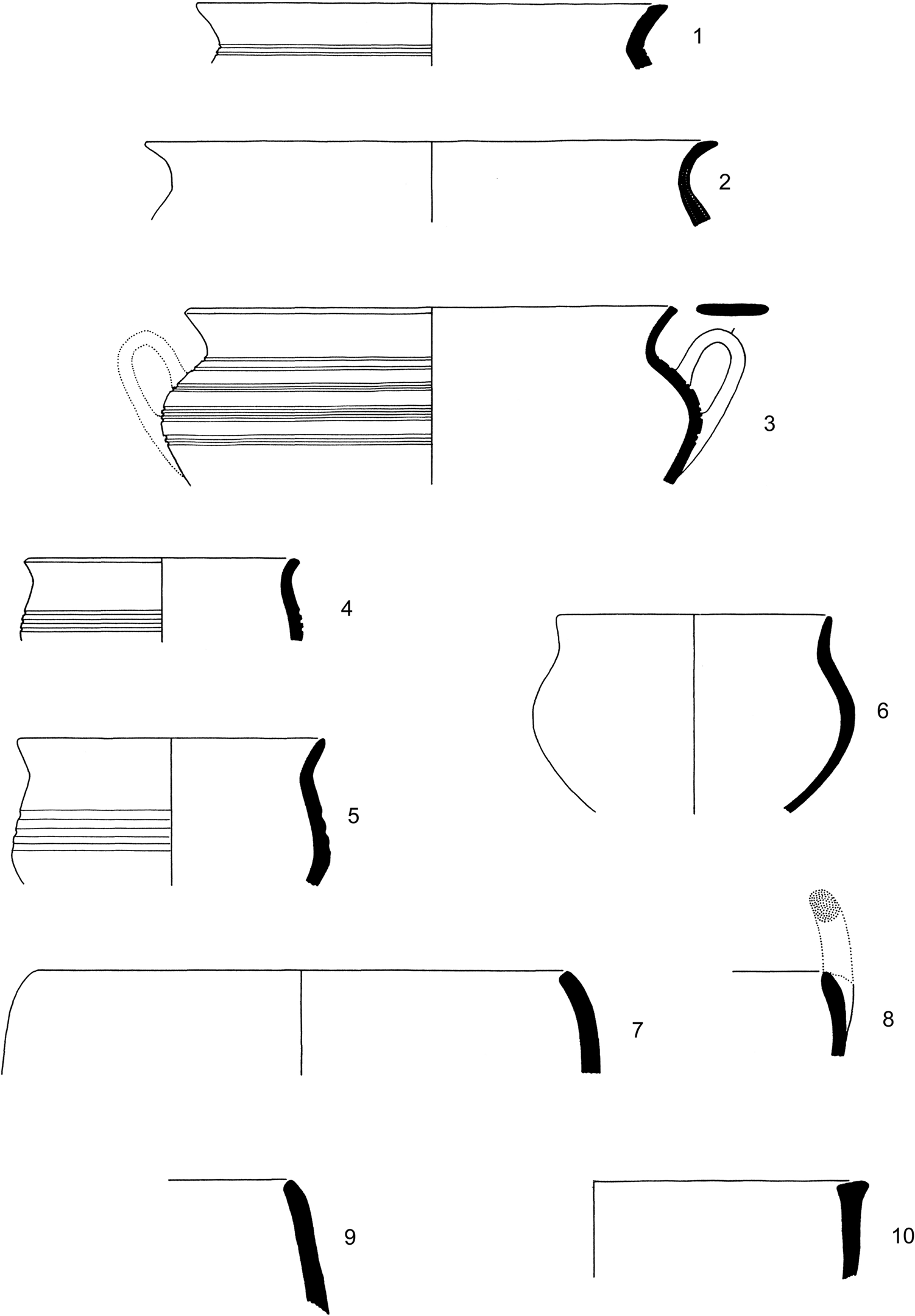
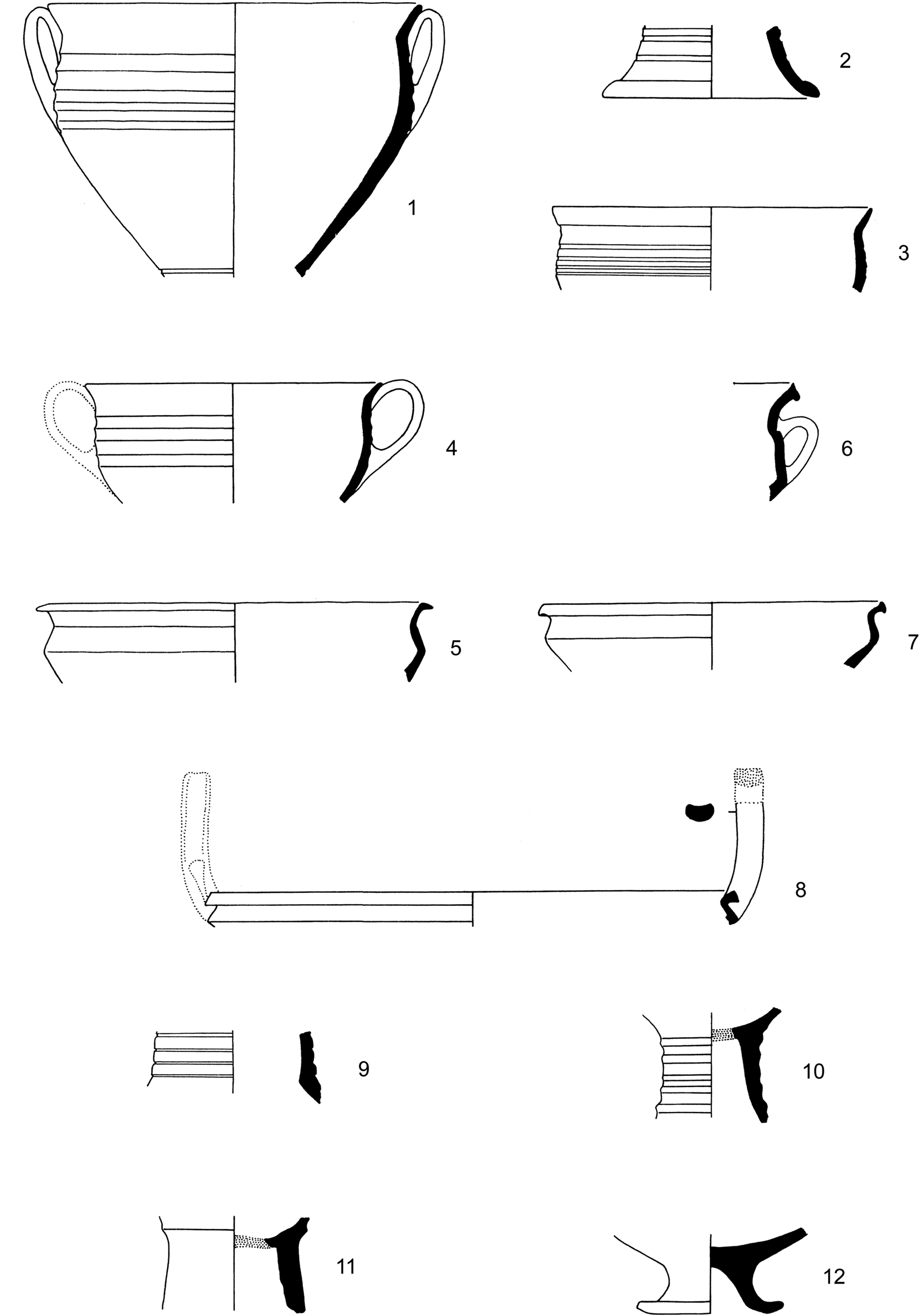
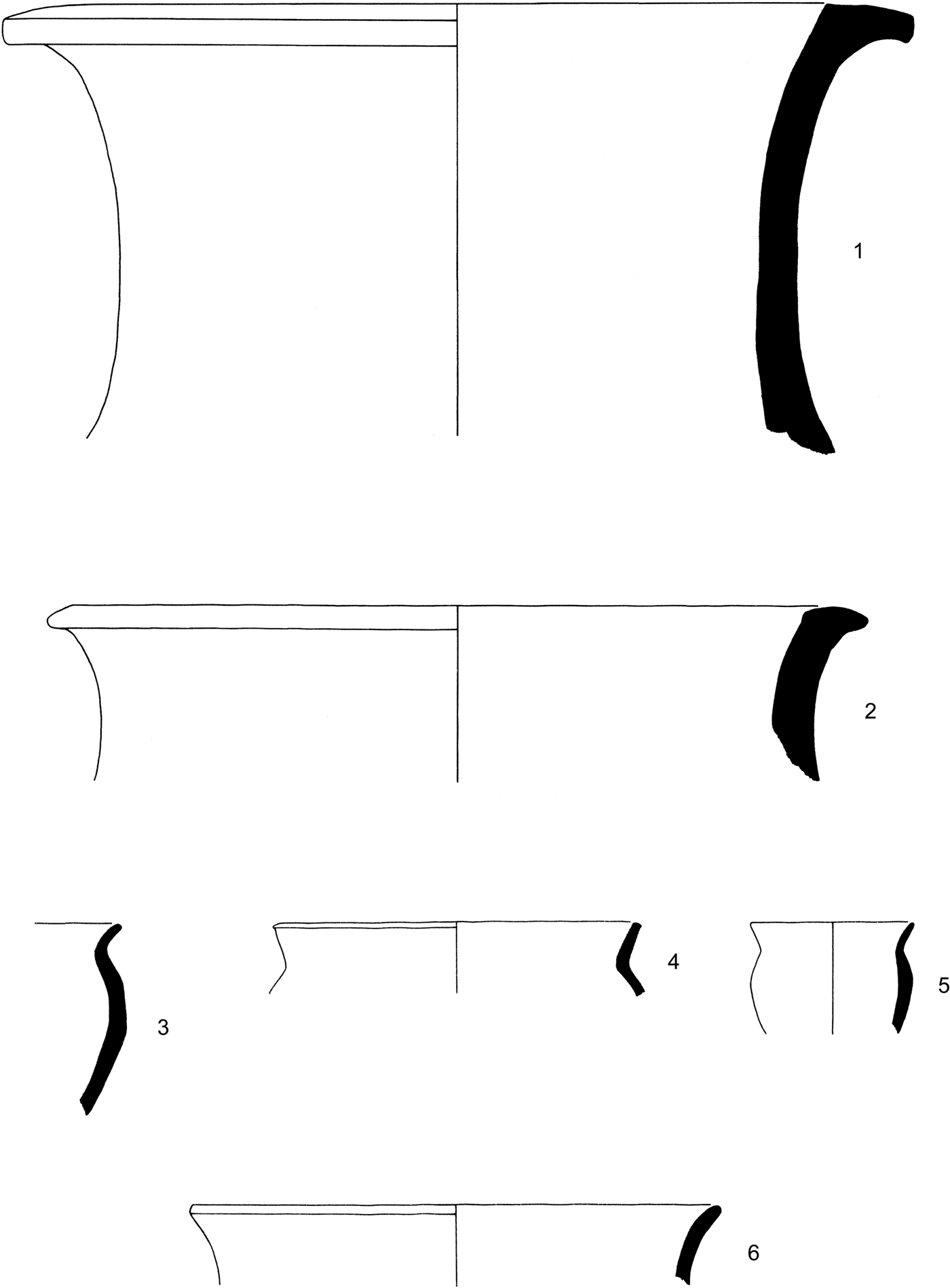
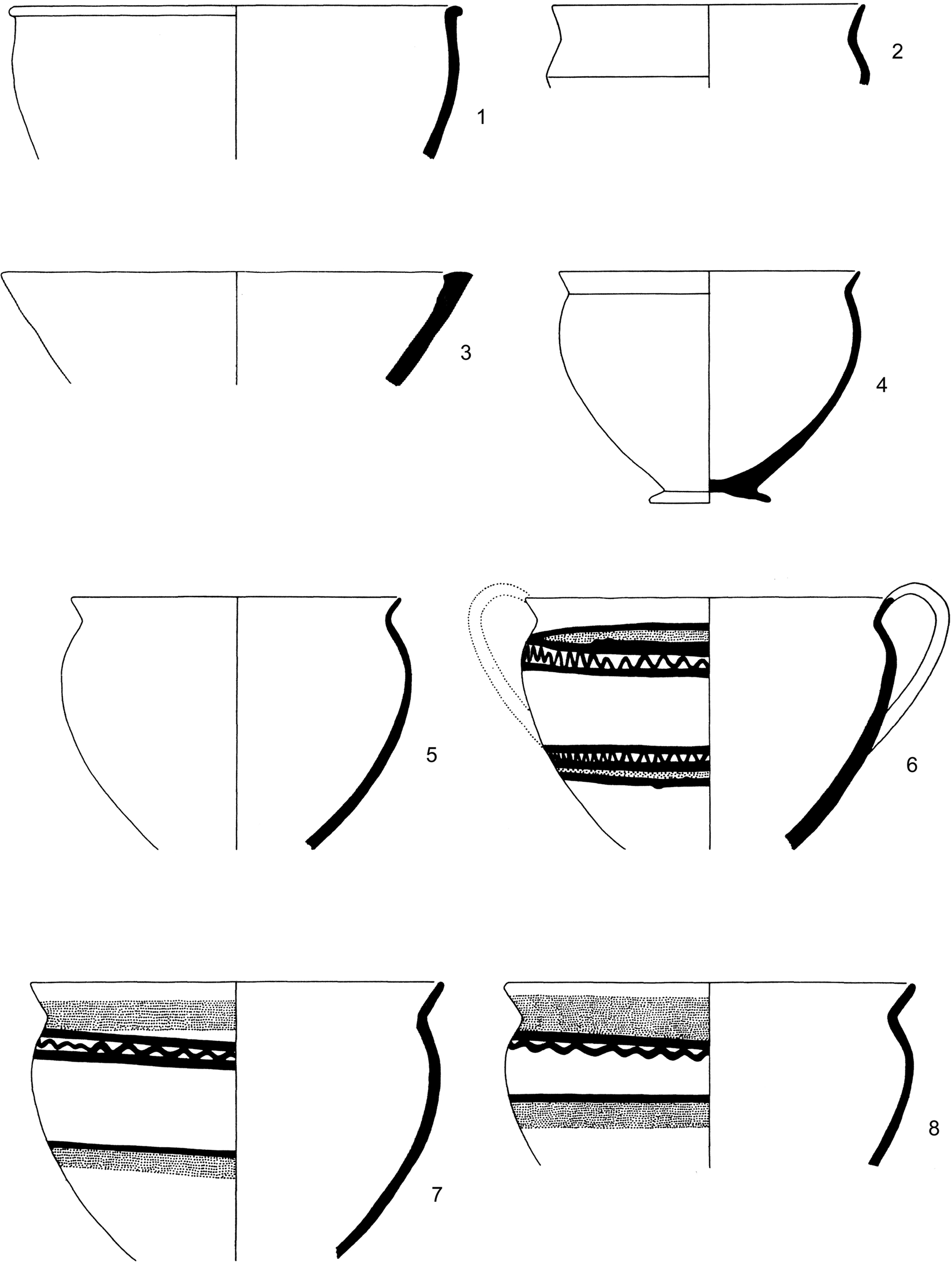
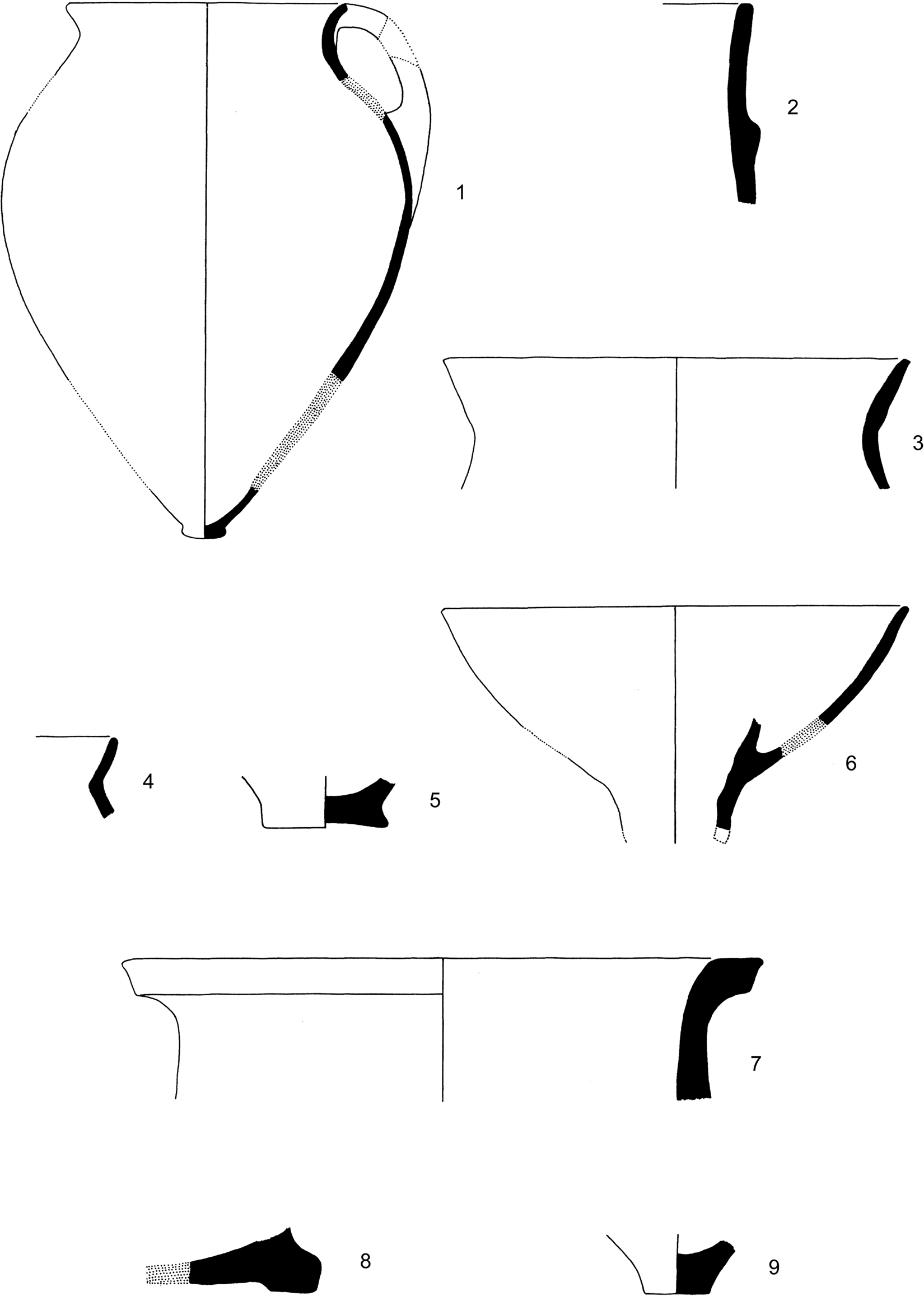
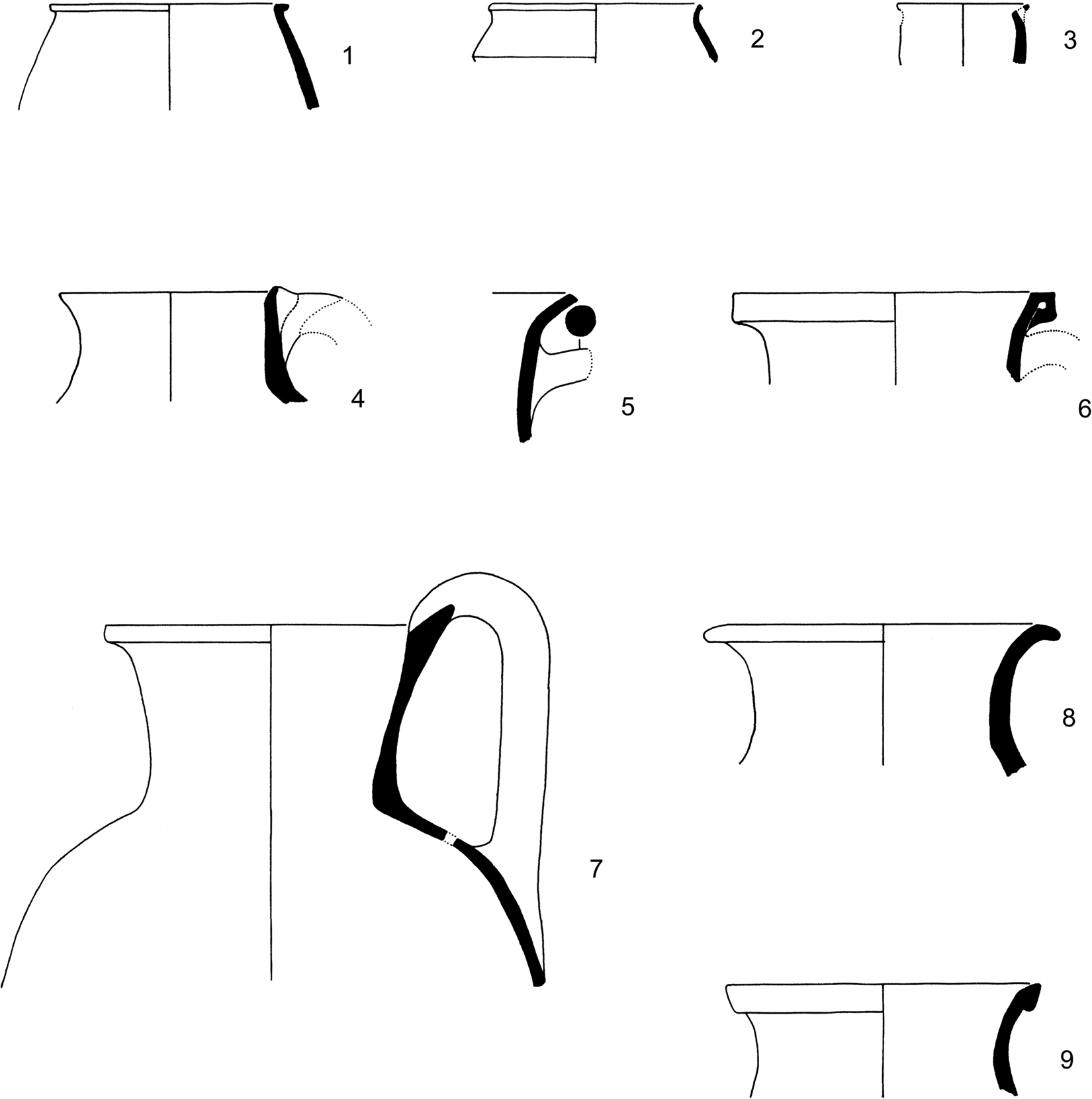
The basic range of open shapes is limited. Many are variants of two-handled bowl forms that evidently descend directly from the EH III ‘Bass bowl’ (Fig. 1:1–6)Footnote 7 and dominate the Minyan range. In general, they still have rounded profiles, but Fig. 1:5 shows incipient carination; their handles are likely to have been vertical straps set on the shoulder. Plain Ware bowls of older forms current in Phase III are also quite common still, especially the type with incurved rim and rounded profile (Fig. 1:7–8); some have a more or less straight upper body (Fig. 1:9–10). Whether these were two-handled cannot be determined, but it seems possible; fragments with at least one rolled handle attached to the rim are found (e.g. Fig. 1:8).
Phase IV large and medium bowls (2–4 Grey Minyan). (1) 66/P.852, H. 3.2, D. 23; (2) 66/P.974, H. 4.2, D. 28; (3) 69/P.601, H. 8.7, D. 22; (4) 66/P.983, H. 4.1, D. 13.4; (5) catalogue entry lost; (6) 66/P.808, H. 9.7, D. 13; (7) 66/P.926, H. 5.1, D. 26; (8) 66/P.917, H. 4.1; (9) 66/P.791, H. 6.8, D. 35; (10) 66/P.927, H. 4.8, D. 27.Footnote 8
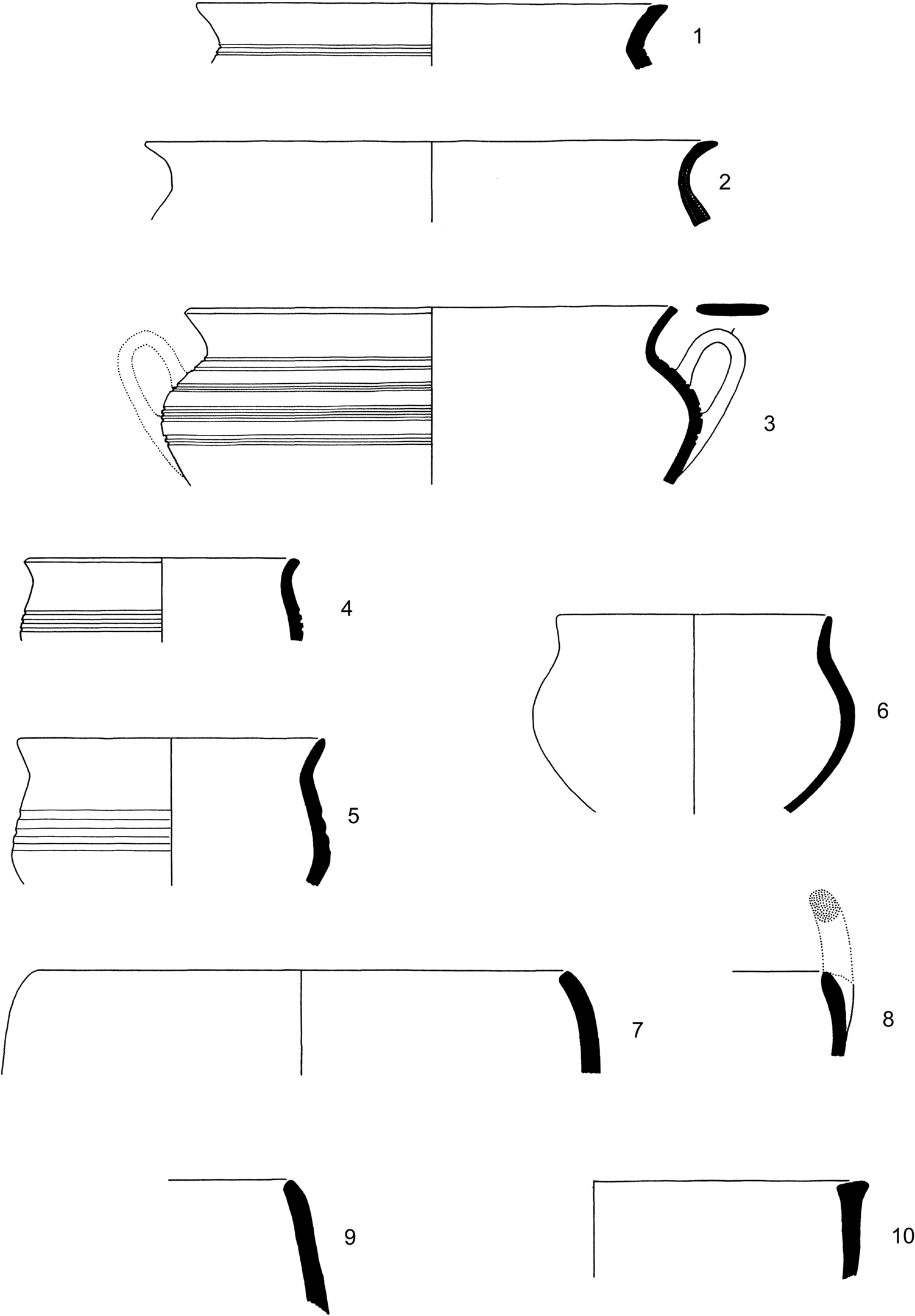
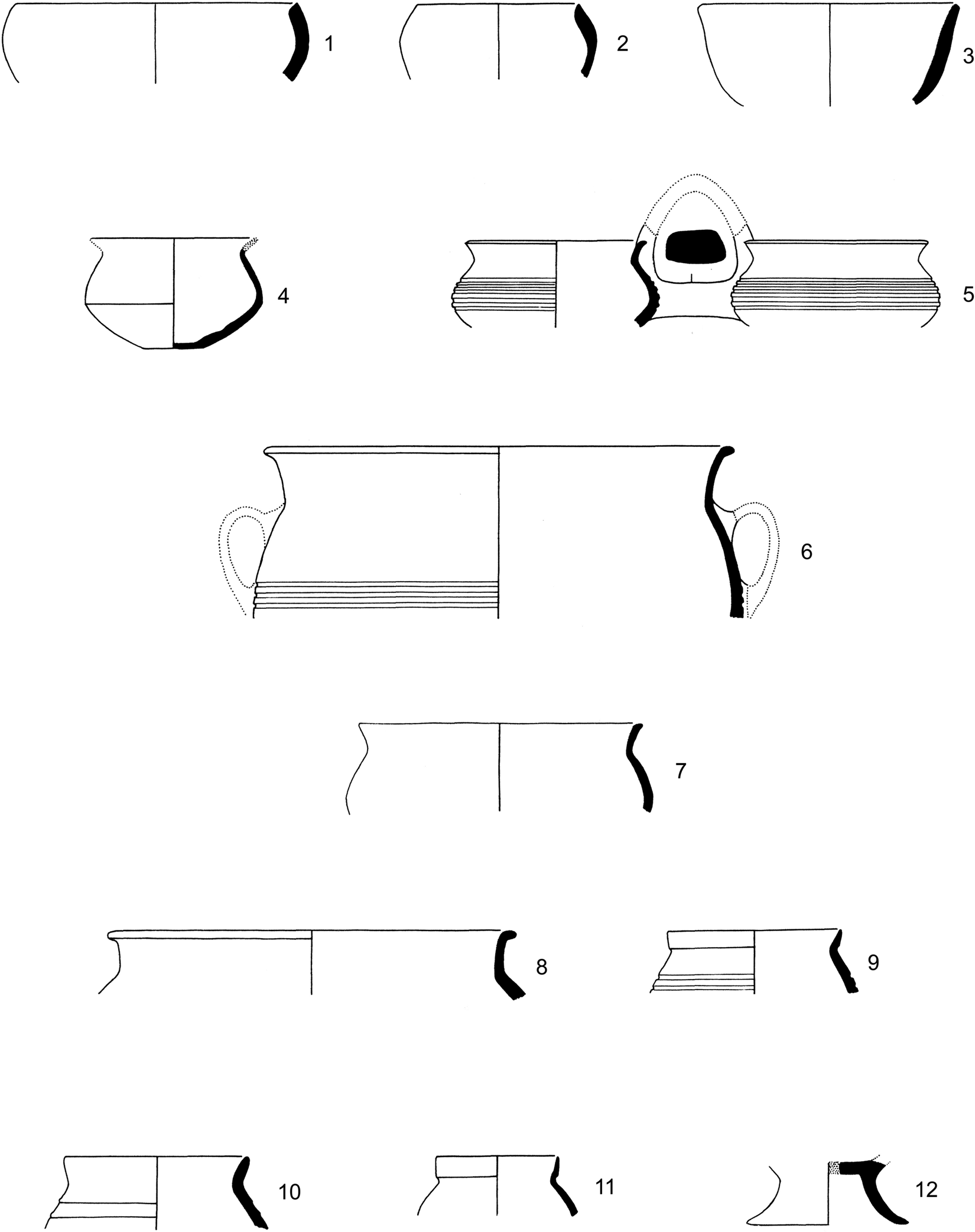
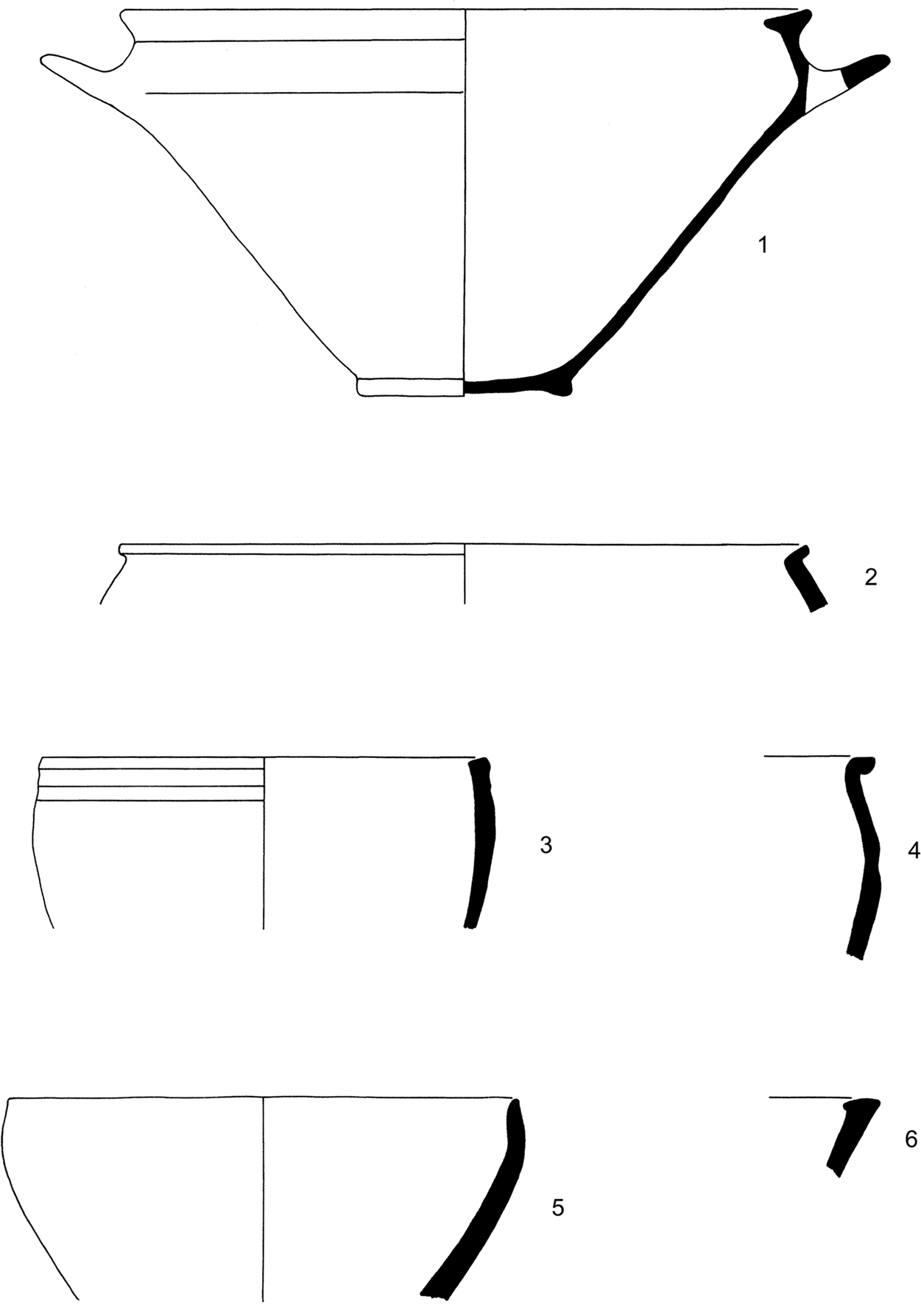
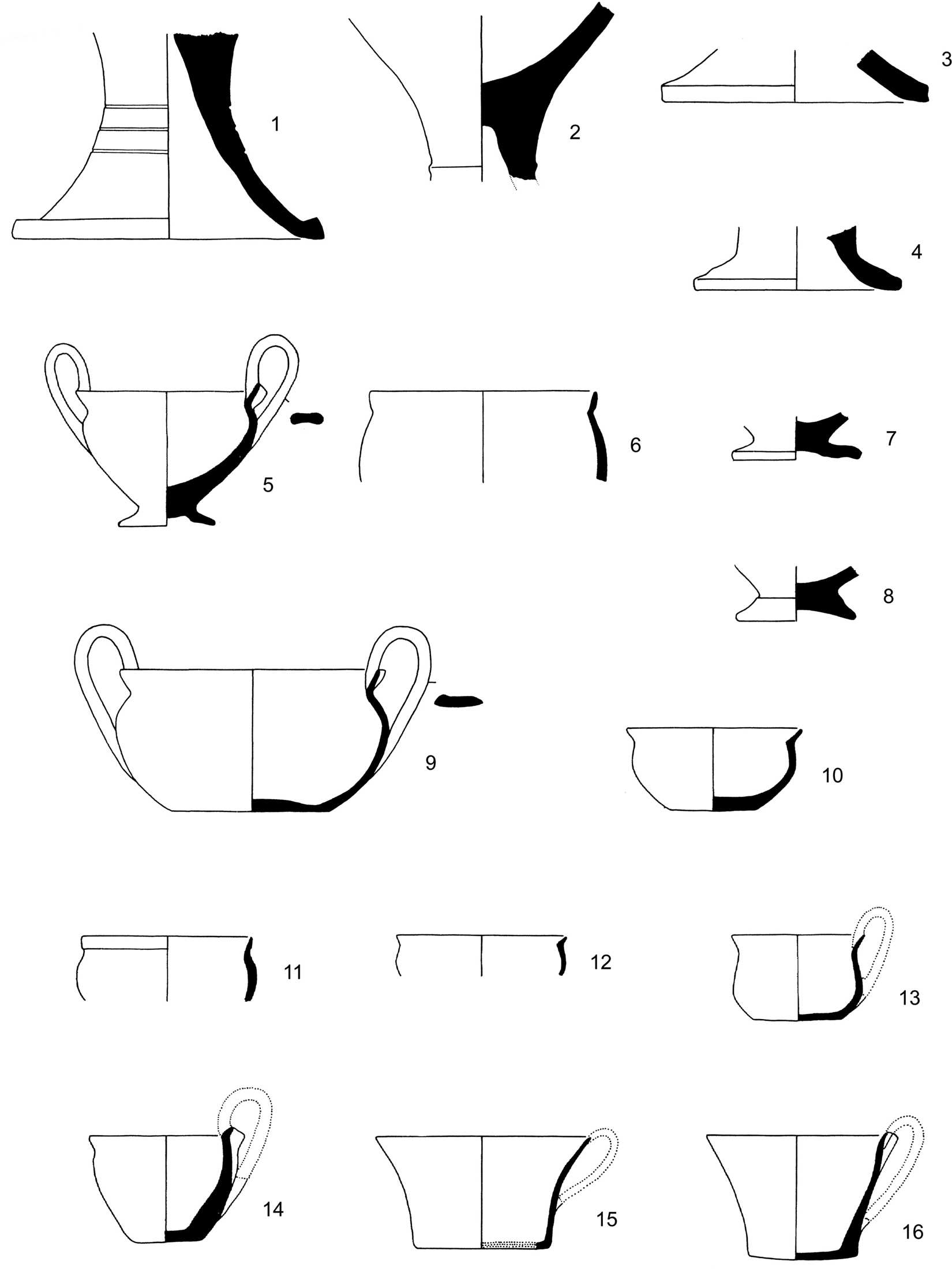
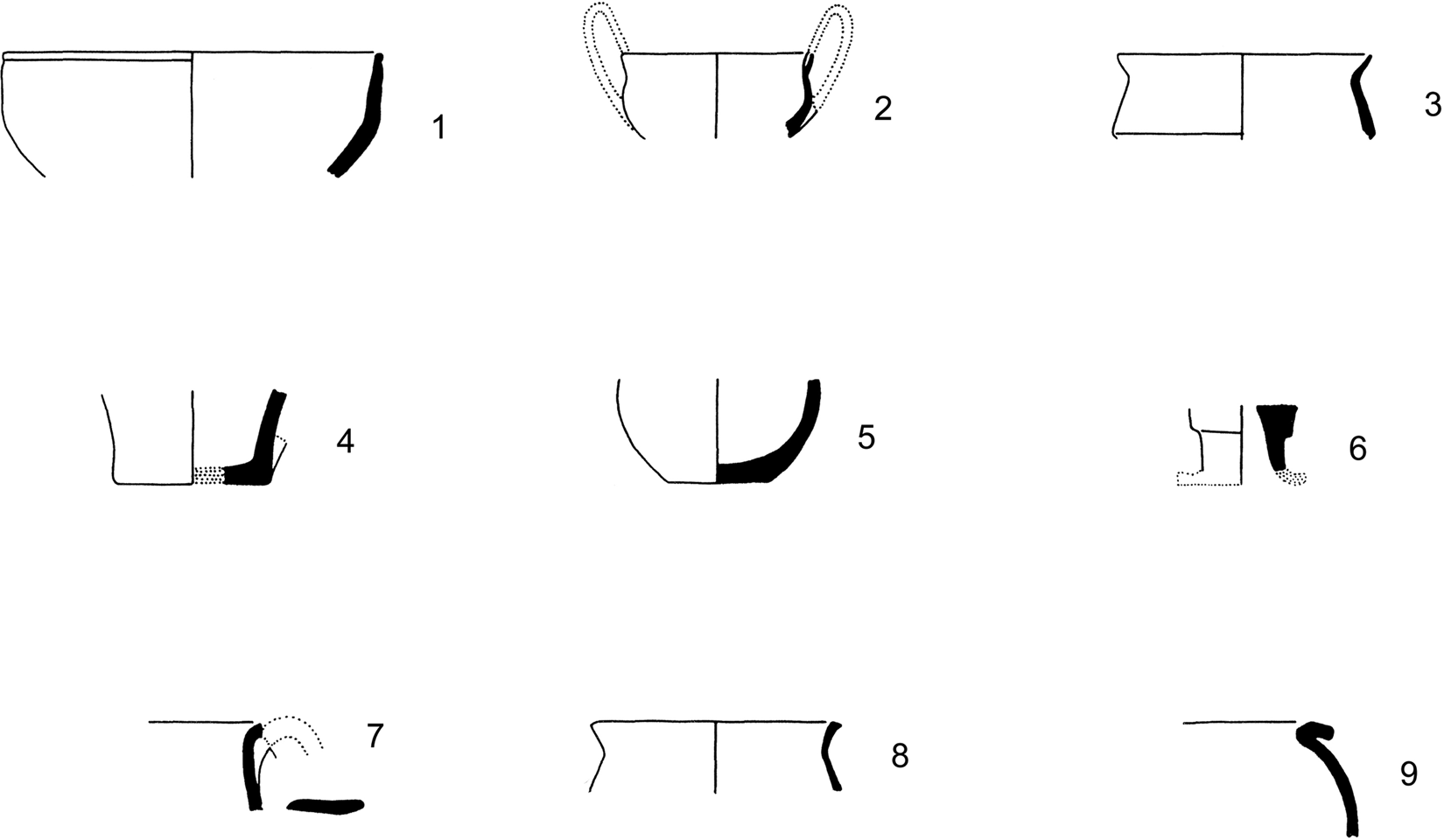
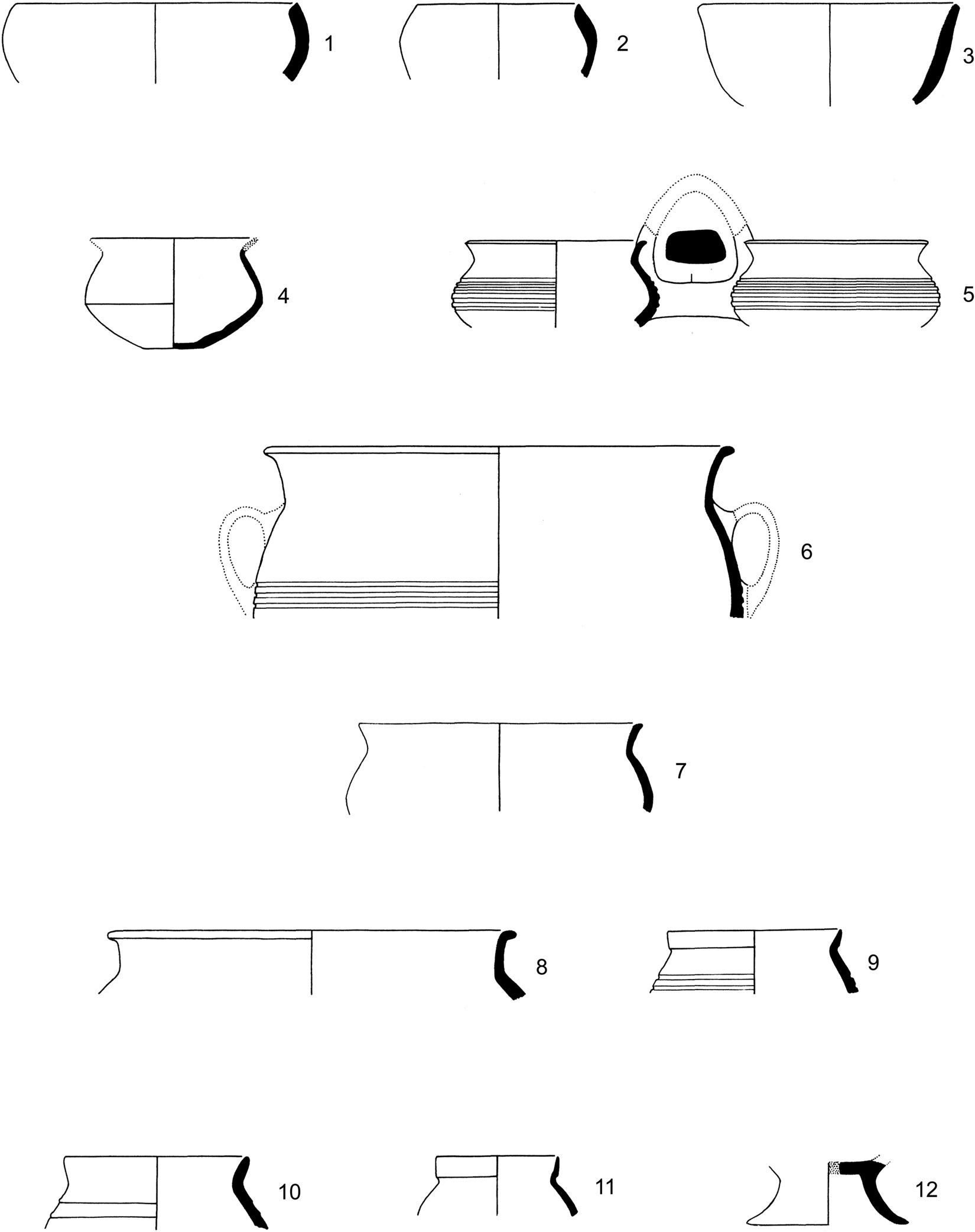
Whatever the type, bowls range remarkably in size. The largest have rim-diameters of 20 cm or more (Fig. 1:9 was estimated at 35 cm), there is a popular middle range at 12–15 cm (Fig. 2:1), and there are small ones at 10 cm or even less (Fig. 2:2, also Fig. 3:5, which is related both to bowls and kantharoi); these last are particularly popular in Grey Minyan. Some are small enough to have had the function of cups, although there is little evidence for ‘classic’ cups with a single vertical handle (Fig. 2:4 might have been of this type); there are also examples of small, simple vessels that seem intended for cups, often with flaring mouths (Fig. 2:3). The range of sizes may well reflect differences in function, from individual drinking or food vessels, the smallest perhaps intended for children's use, to bowls that would hold a meal for a whole household. One exceptional Grey Minyan vase, a ‘double cup’ linked by a horizontal strut and basket handle, with fine grooved decoration, is worth noting (Fig. 2:5). The shape is best known from Messenia; it has been thought to have a ritual function (Howell Reference Howell, McDonald and Wilkie1992, 60 with n. 21).
Phase IV small bowls, cups, collar-necked and other jars, pedestal foot (4–6, 8–12 Grey Minyan). (1) 66/P.782, H. 3.9, D. 14; (2) 66/P.1048, H. 3.7, D. 8; (3) 66/P.929, H. 4, D. 17; (4) 66/P.449, H. 5, D. base 3; (5) 66/P.273, H. 4.3, D. 9; (6) 66/P.442, H. 8.5, D. 23; (7) 66/P.848, H. 4.5, D. 14; (8) 66/P.885, H. 3.6, D. 18; (9) 66/P.980, H. 3.1, D. 8.5; (10) 66/P.953, H. 3.6, D.9; (11) 66/P.1071, H. 3, D. 6; (12) 66/P.987, H. 3.1, D. foot 8.
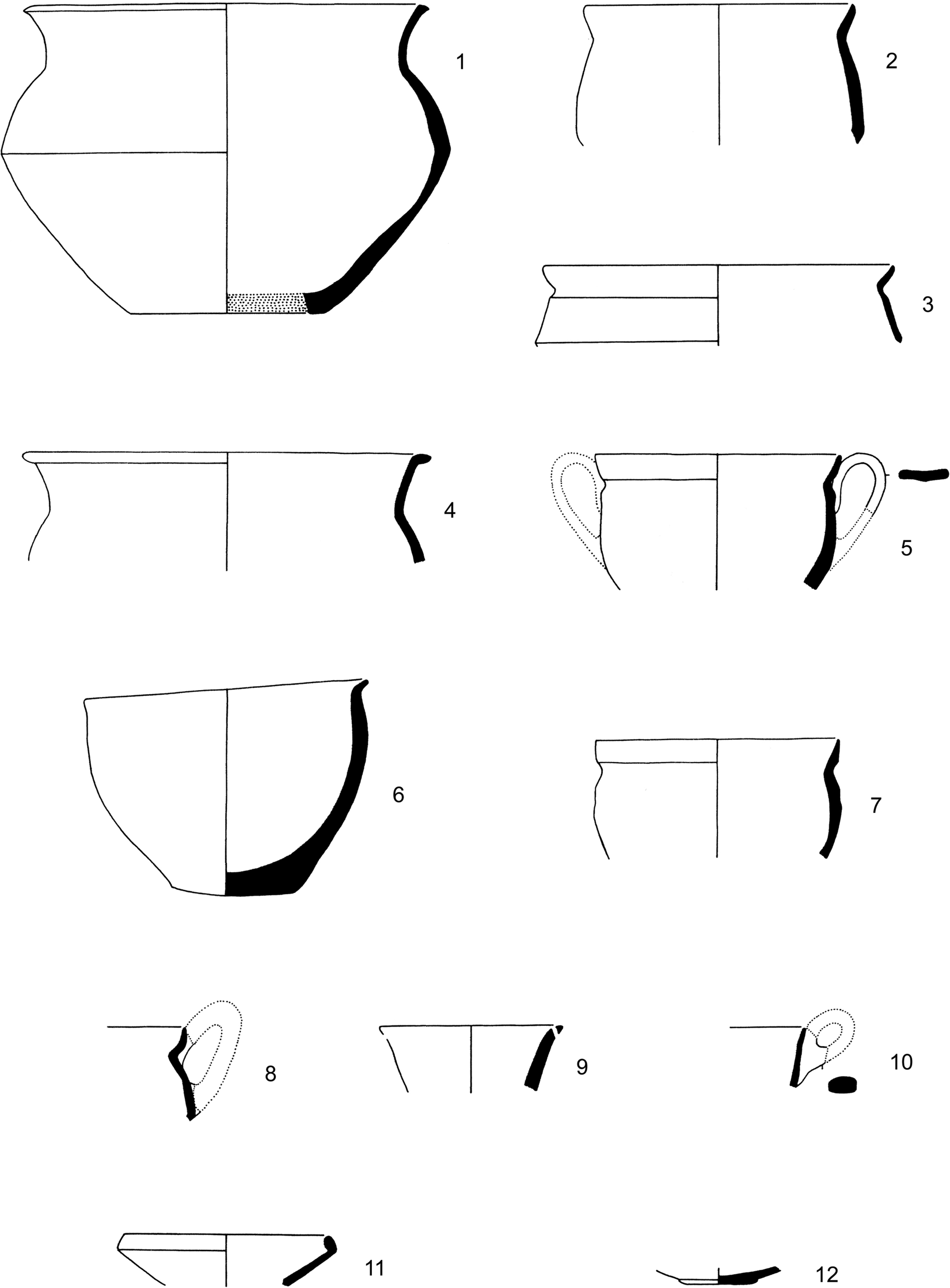
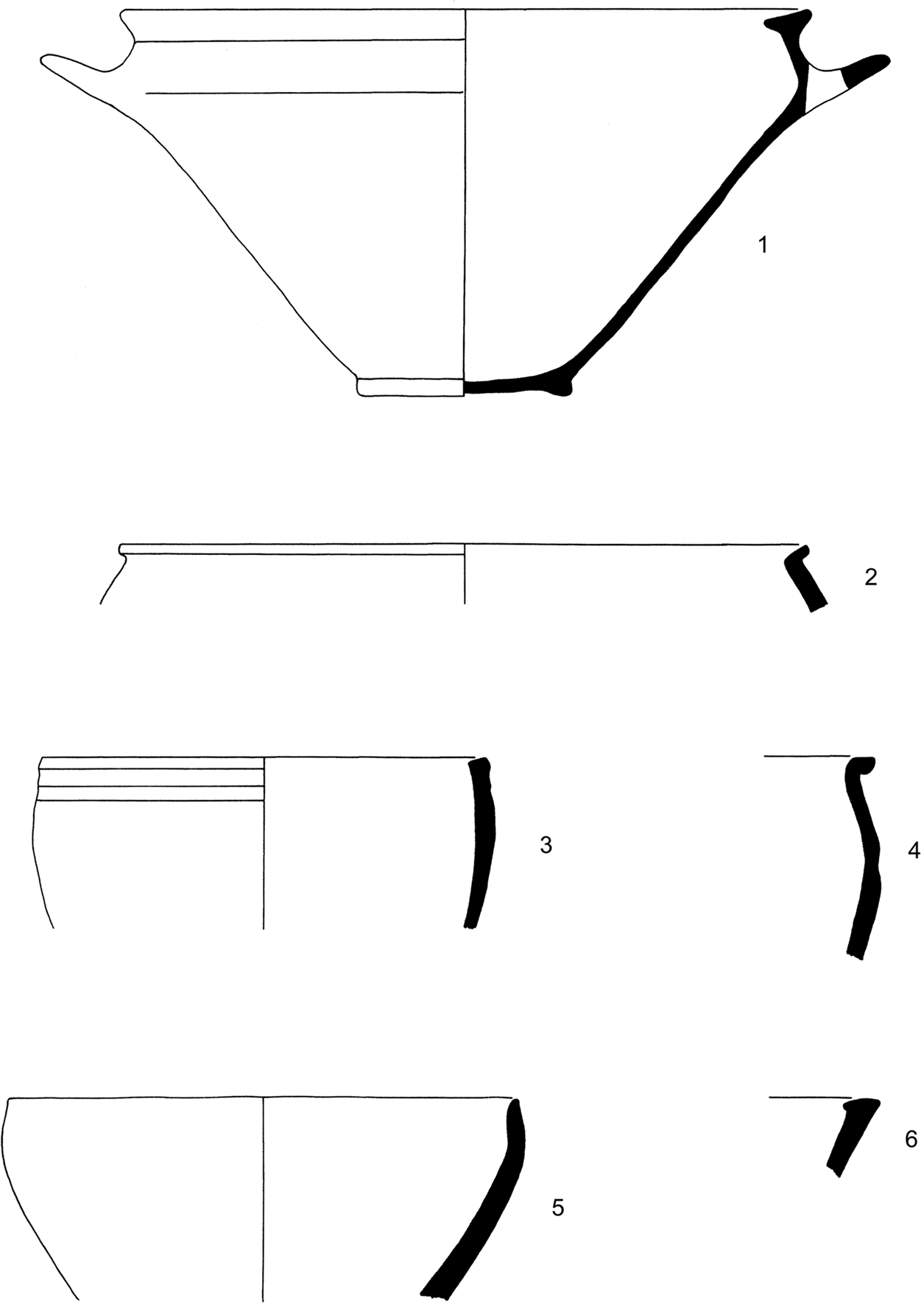
Phase IV kantharoi, small bowls, jar necks (4–5 Grey Minyan). (1) 66/P.911, H. 4.9, D. 17; (2) 66/P.809, H. 4.7, D. 10; (3) 66/P.854, H. 4.9, D. 15; (4) 66/P.970, H. 4, D. 12; (5) 66/P.985, H. 4, D. 8; (6) 66/P.788, H. 4, D. 13; (7) 66/P.928, H. 3.6, D. 13; (8) 66/P.924, H. 7.3, D. 14; (9) 66/P.925, H. 5, D. 15.

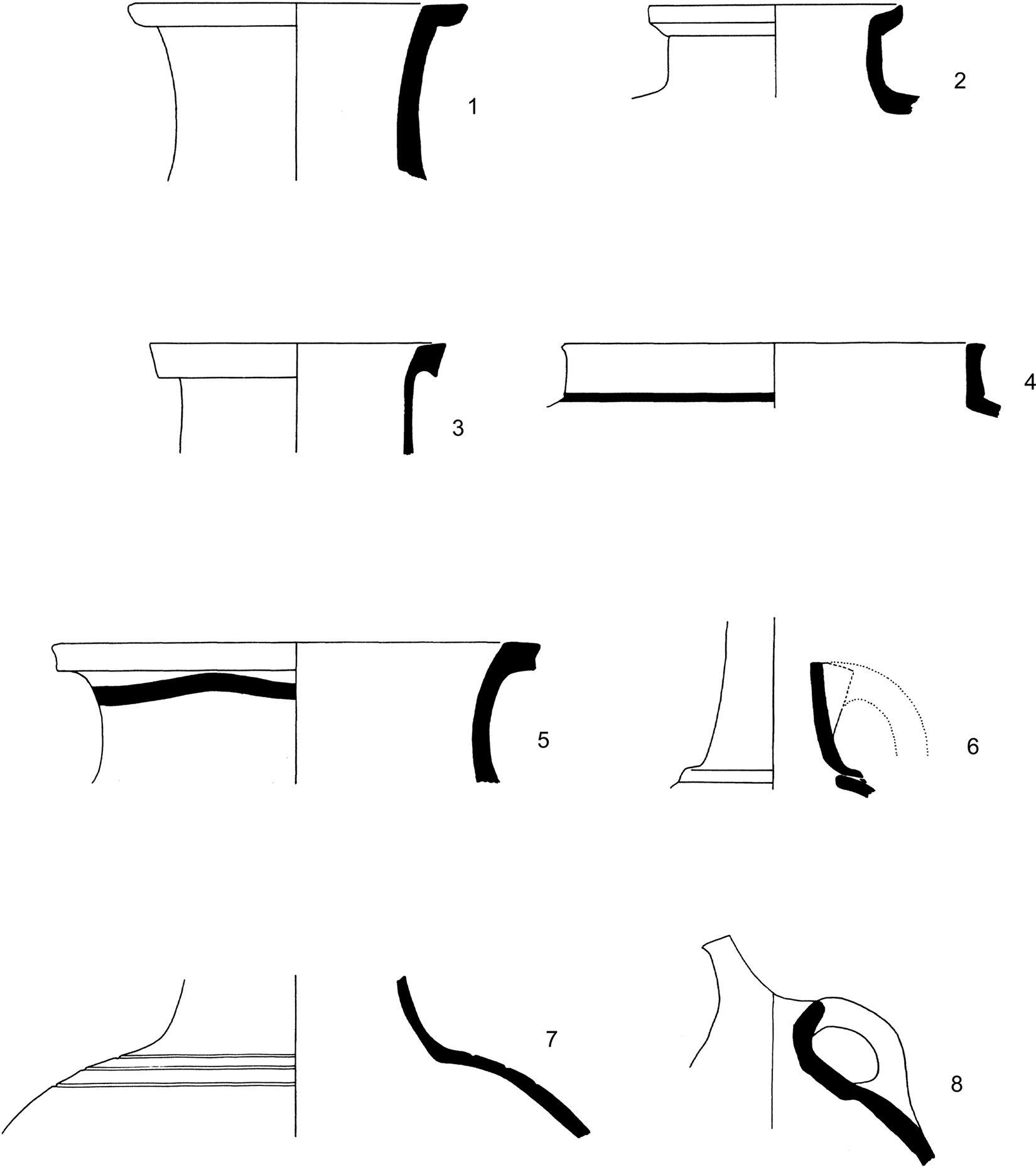
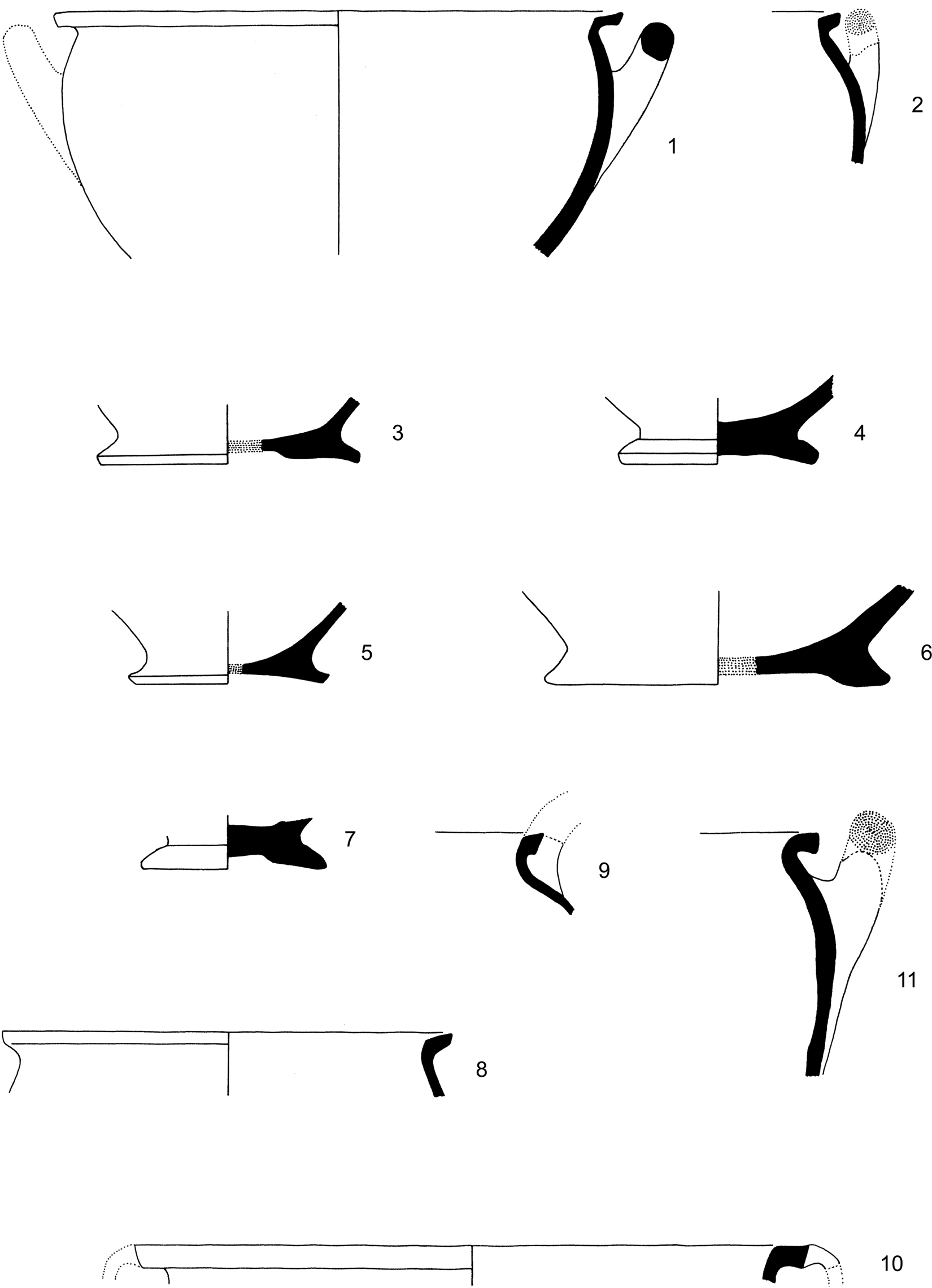
A close relative of the Minyan bowl shape, particularly popular in Grey Minyan, is what Roger Howell termed the collar-rimmed jar. Strictly speaking, such a designation may be correct, since the possession of a separate neck may be considered the distinctive feature of a jar. But in point of fact many of these vessels are likely to have been much closer to bowls in appearance, and the term jar might better be reserved for those examples where the body is very much wider than the neck. Unfortunately, few pieces are sizeable enough to show clear evidence of this feature. Typically, the neck is quite high, vertical or slightly flaring, and has a pinched or flat-topped lip, a feature that was common in Phase III and is also found on smaller bowls, especially in Grey Minyan. Some of the best examples have very wide mouths, as on the large fragment 66/P.442, attributed to Phase IV by Roger Howell (Fig. 2:6), which belongs to a very large example, but this was found in the Phase V ‘main deposit’, and so might be of early Phase V date; Fig. 2:7 is smaller. Such vessels probably closely resembled the very similar shapes best described as bowls, although these often had more flaring mouths, that are found at Pefkakia in fine Grey Minyan throughout Phases 5 and 6 (Maran Reference Maran1992b, figs 9:19–20, 12:6, 15:5,8, 18:14). The shape seems to be already developing in Phase 4 (Maran Reference Maran1992b, fig. 8:3,10), and shows a natural development into the heavy Grey Minyan angular bowl typical of the ‘classical’ Minyan assemblage (Dickinson Reference Dickinson1977, 19, fig. 2:4, furthest left). But there are also pieces of vessels more likely to be true jars, with a broad body, in this and related shapes; the large example Fig. 2:8 has a close parallel in Plain Ware, but the majority are Grey Minyan and small (e.g. Fig. 2:9–11).
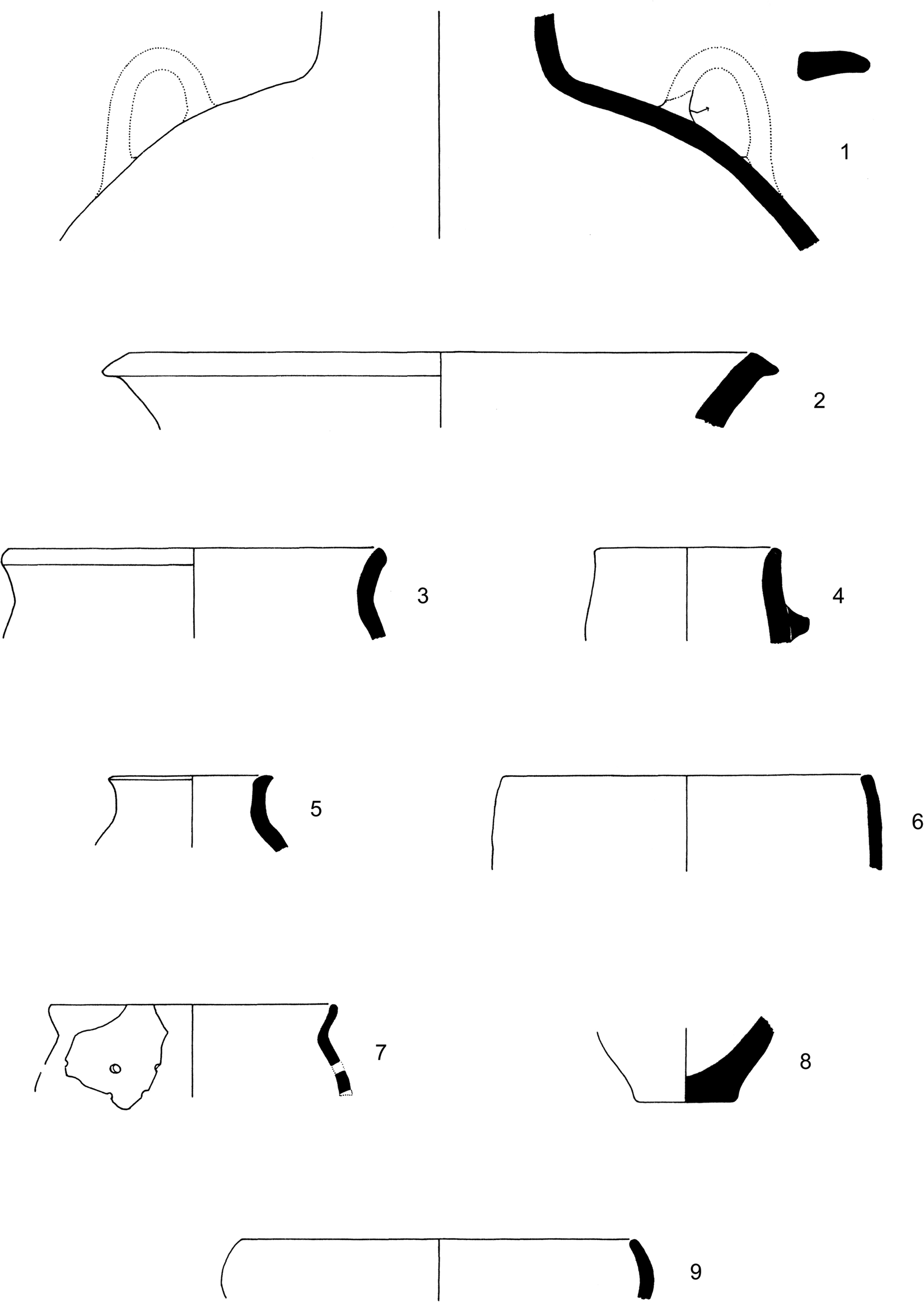
Another two-handled fine ware shape that was clearly developing into its classic form in this phase, and is common in both Plain Ware and Grey Minyan, is the kantharos, essentially a shallow two-handled bowl with high-swung handles (cf. Hale Reference Hale2016, 250). Bowls with such handles can be found in Phase III, but they are not shallow in proportion to their breadth nor angular in profile, as many Phase IV examples are. The handles may be vertical and swung above the rim (Fig. 3:4), but just as often, it seems, they are set horizontally on the rim, at an angle (Fig. 3:1–2); either way, they are most often rolled. The merging of the lip, originally everted as on bowls, into a concave upper body sharply set off from the lower body, a typical feature of later kantharoi, is clearly becoming established. Profiles with this feature seem most likely to belong to kantharoi, even when handle remains are not preserved (e.g. Fig. 3:3). Kantharoi are never as big as the biggest bowls, but the rims on the largest can have diameters of 17–18 cm, commonly they are 12–15 cm and the smallest can be 10 cm or less. The likelihood is that, as with the much later kantharoi of historical times, these were drinking vessels. Various other forms of bowl also appear, that can mostly be related to the commonest forms (Fig. 3:5–7).
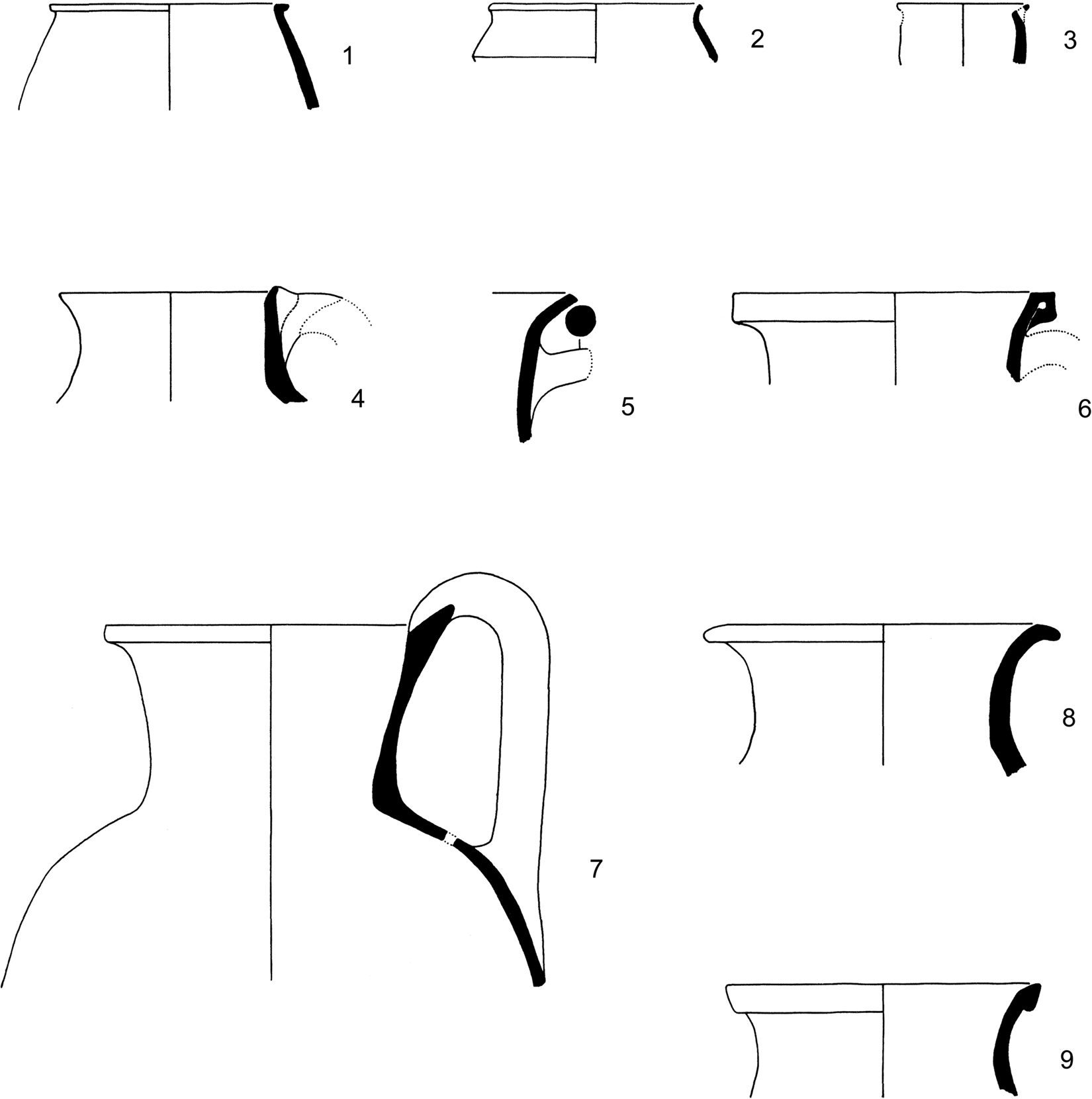
Larger forms of jug and jar are found in Plain Ware only. Not much can be said of them, because of the small size of most identifiable fragments, but they seem to have normally concave (or sometimes straight) necks that flare into simple straight or outcurving rims, with diameters that fall in a range of 13–16 cm (Fig. 3:8–9). The bodies probably had piriform or oval profiles (cf. Fig. 4:1, an extremely large amphora form), and flat bases. One or two notably broad examples may belong to wide-mouthed jars. Their handles are either straps, most commonly vertical from shoulder to neck, or rolled and set horizontally on the vessel body.
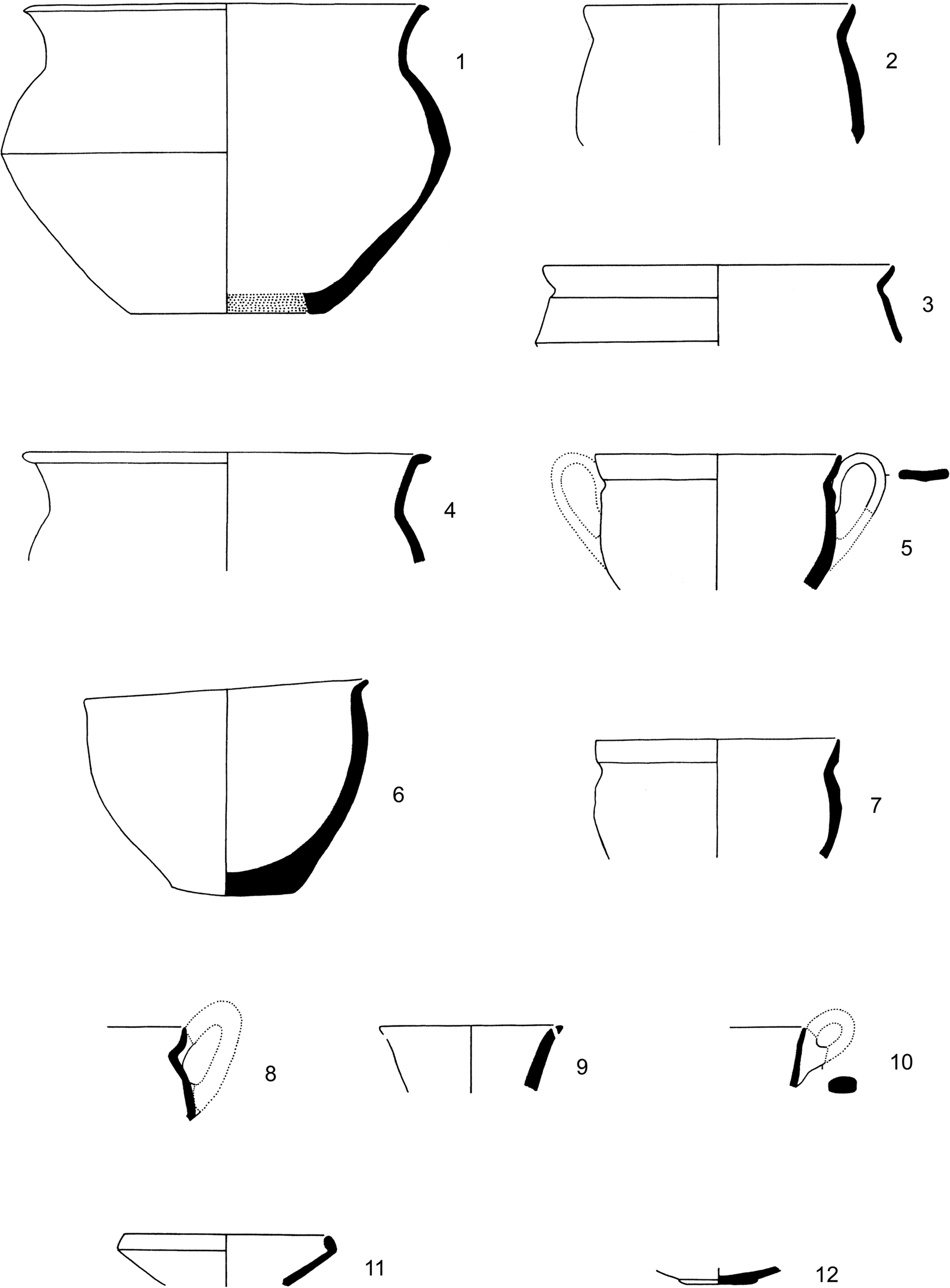
Phase IV amphora, Household Coarse Ware vessels. (1) catalogue entry lost; (2) 66/P.1030, H. 3.8, D. 33; (3) 66/P.988, H. 9.5, D. 18; (4) 66/P.905, H. 4.7, D. 9; (5) 66/P.904, H. 3.8, D. 8; (6) 66/P.801, H. 4.5, D. 18; (7) 66/P.1032, H. 5.1; (8) catalogue entry lost; (9) 66/P.816, H. 2.9, D. 19.

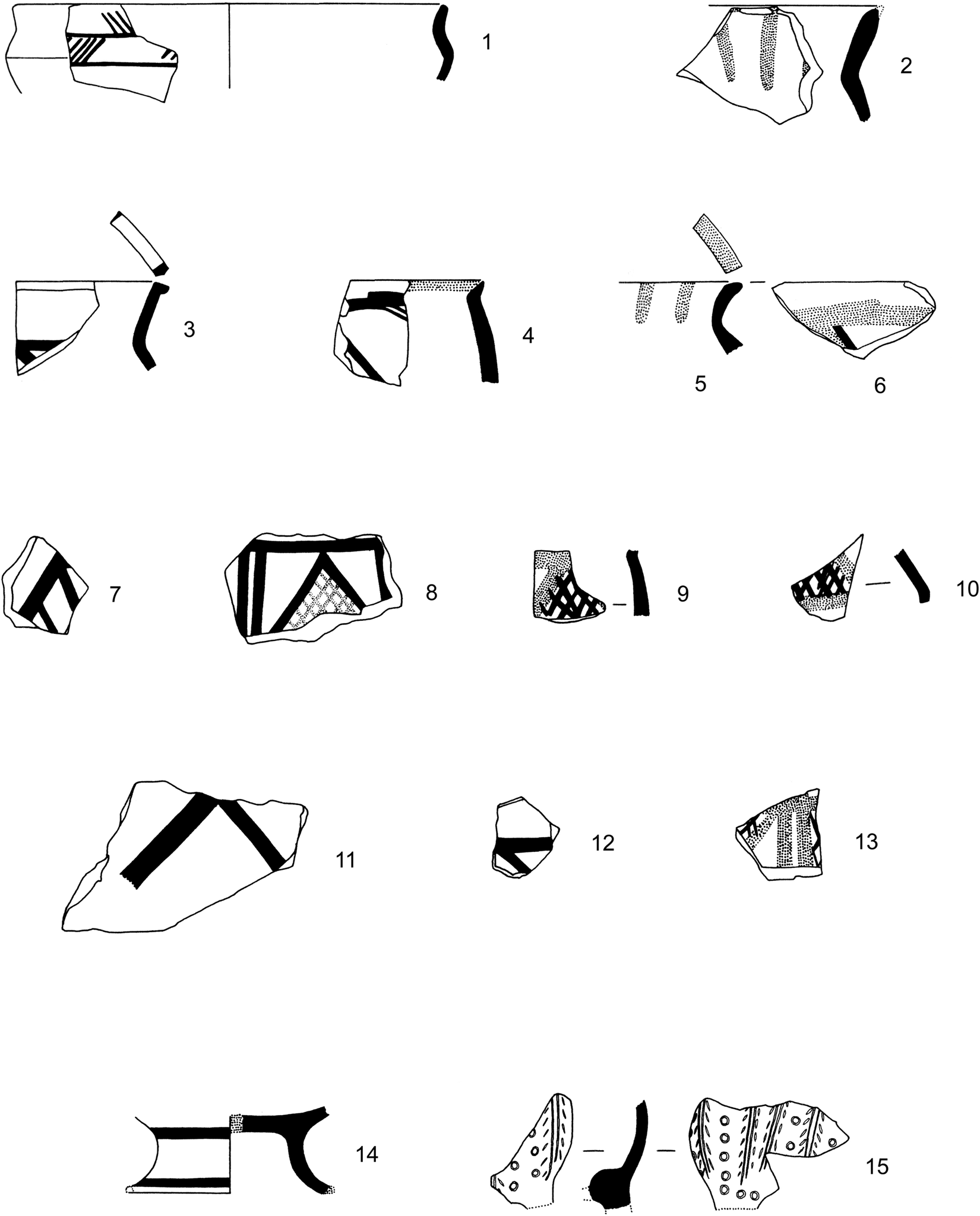
Household Coarse Ware and pithoi were well represented by body sherds, but fragments revealing shape are relatively rare. The range of Household Coarse Ware shapes is nevertheless quite varied, including bowls (Fig. 4:6) and jars (Fig. 4:3,5) of different sizes, a beaker-like vase with a decorative knob (Fig. 4:4), an extremely large rim (Fig. 4:2, d. 33 cm) that must belong to a very substantial storage jar, a surprisingly narrow base (Fig. 4:8, just over 4 cm), fragments of strainers, one jar-like (Fig. 4:7), and a pedestal base. The fragments of pithoi are too small to give any real indication of their shape but include two rims whose body thicknesses are respectively 1.2 and 2.2 cm, and pieces of large crescent and rolled handles. One piece of incised coarse ware that could be an import may be noted (66/P.966); it is decorated with a broad net pattern rather than the vertical ‘herringbone’ patterns typical of the Peloponnesian ware once called ‘Adriatic’ (cf. Sarri Reference Sarri2010, 83).
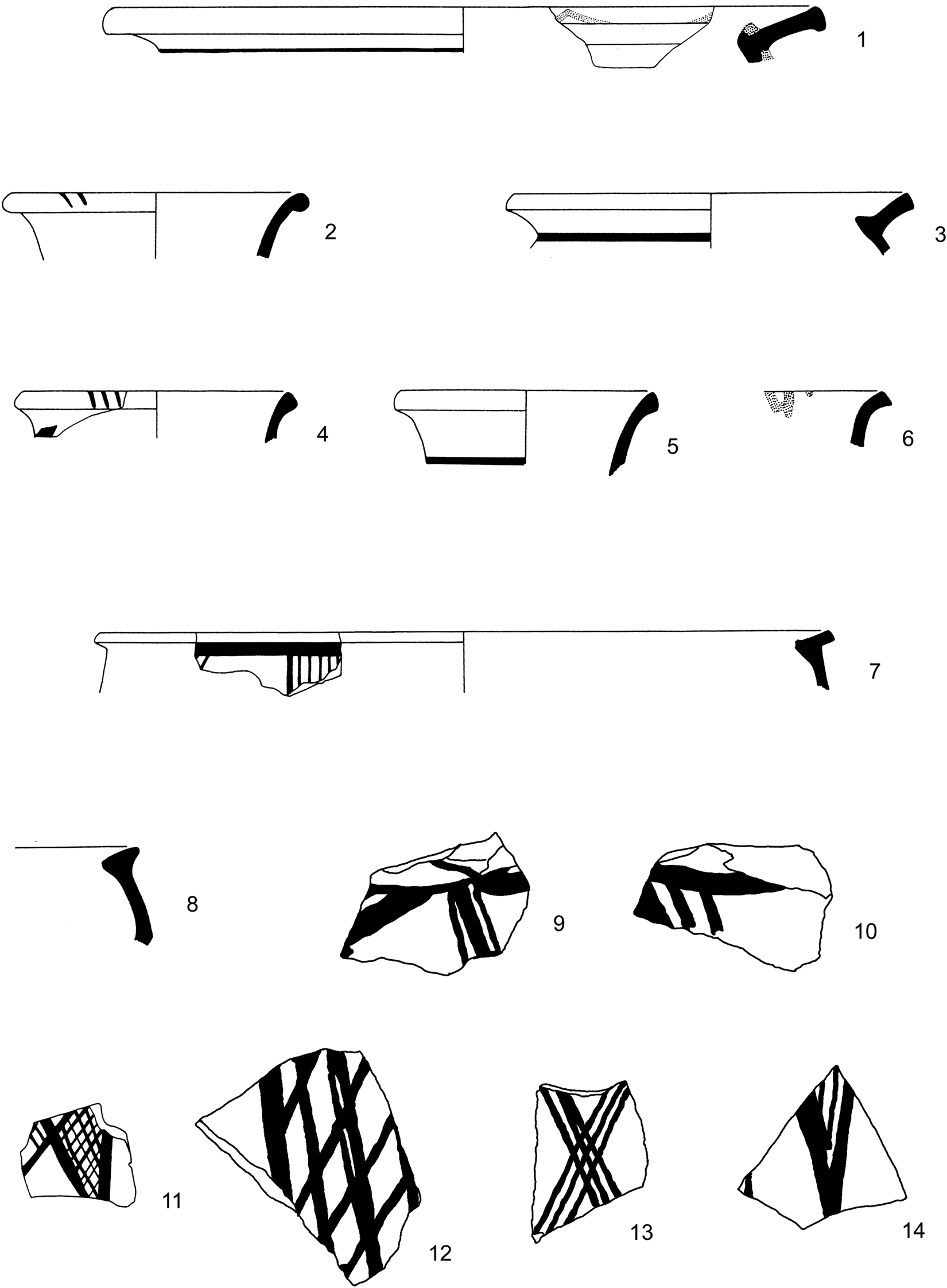
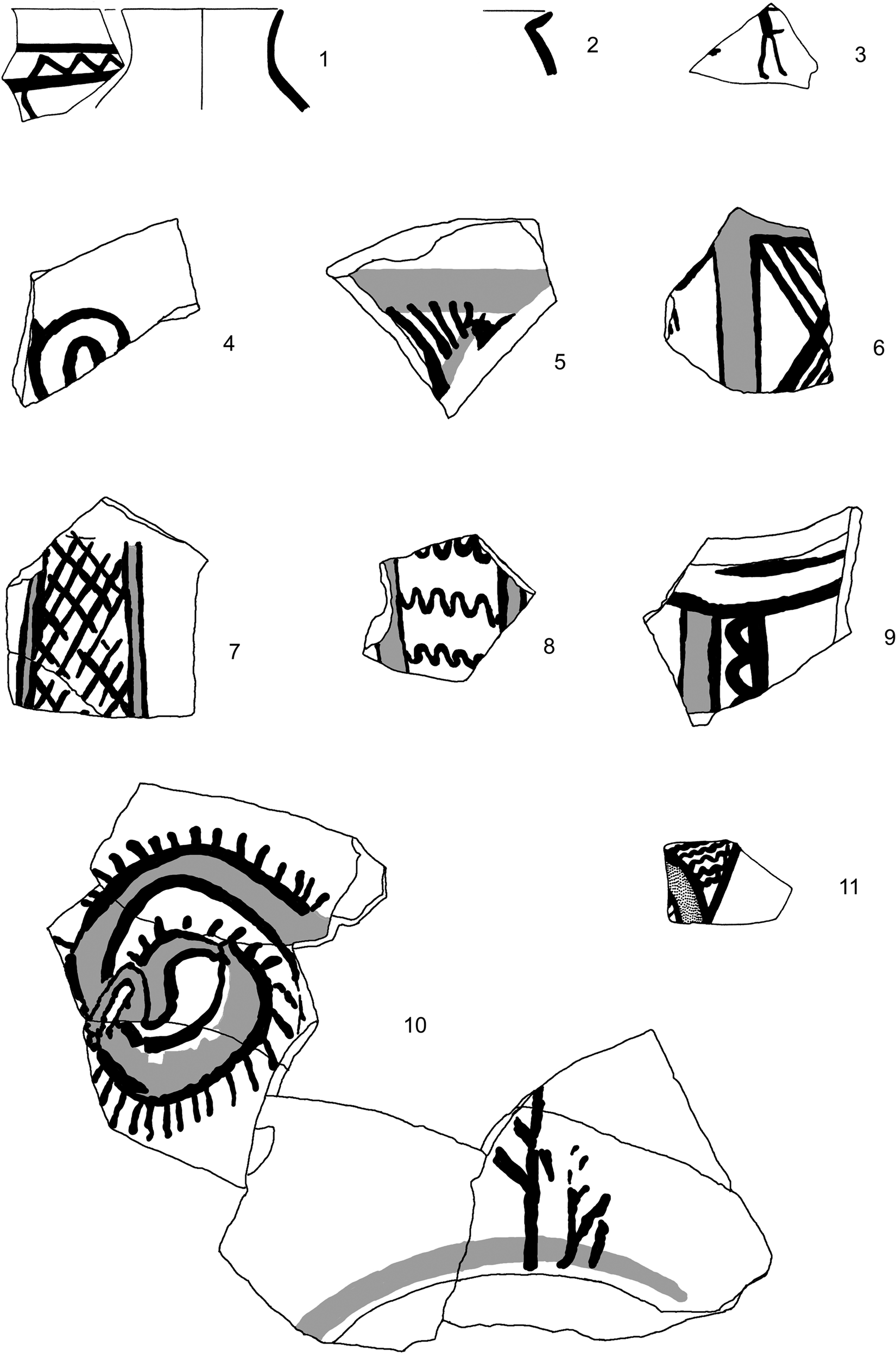
Decoration, applied to a minority of vessels, comes in two main forms, incised or painted, on vessels of finer ware; coarse vessels and pithoi may also be decorated, with applied clay knobs or ribs. On Grey Minyan and Plain Ware open shapes, the decoration consists of sets of incised horizontal grooves, which are generally confined to the shoulder or upper part of the vessel, though they can appear low on the body or in both locations. Fig. 1:3 is a particularly elaborate example; there are many others, both Plain (e.g. Figs 1:5, 3:3) and Grey Minyan (Figs 1:4, 2:5–6,9, 3:5). The grooves, quite neatly applied, were often broader than in Phase III, where this form of decoration first appears. This can create an impression of fluting or ribbing, the characteristic feature of the long-recognised ‘Argive Minyan’ bowl; but that particular type, most commonly found in Dark Burnished ware in the Peloponnese, is clearly not as early as I once suggested,Footnote 9 and does not seem to appear at Lefkandi at all. A very few pieces, almost all Grey Minyan, were decorated with more elaborate incised and impressed patterns; these may well be imports.
The other form of decoration, in matt paint, is found, as noted above, on heavy bowls and closed vessels. The paint often seems to continue a crusted quality that it had before (a ‘thin line’ style has disappeared), but it can be rather fugitive, a feature also common at Nichoria (cf. Howell Reference Howell, McDonald and Wilkie1992, 45, 54, 63 particularly). In the new form of bichrome decoration introduced, thick bands of paint, often crusted and reddish or plain brown, are used to outline geometric shapes, especially triangles, which are filled with hatching or cross-hatching in much thinner paint, generally appearing grey.
The decoration consists of simple groups of horizontal bands, chevrons, and hatched or, more often, cross-hatched triangles; most lines are thick, but the cross-hatched filling of triangles is always thinner than the triangular frame. Sets of thin oblique parallel bars are seen on one fragment that is very probably from a kantharos (Fig. 5:1), and what may be a fragment of another has a bichrome cross-hatched triangle above the carination (Fig. 5:10). Other pieces give some idea of where decoration might be placed. Thus, bands can encircle the base of a jar neck (Fig. 5:3) or bowl rim (Fig. 5:4), run along a handle or around the pedestal foot of a bowl (Fig. 5:14). On Fig. 5:3–4, there was clearly a decorative zone immediately below the neck or rim, filled with some form of triangular decoration. Other fragments show cross-hatched triangles below a horizontal band (e.g. Fig. 5:9), and it seems very likely that decoration mostly consisted of rows of various triangular ornaments arranged in a zone on the vases’ upper bodies, sometimes set off in panels or ‘metopes’ by groups of vertical bars (Fig. 5:8). Cross-hatching may also have been used to fill rectangular panels and larger zones, as on two examples known only from xeroxes of photographs (66/P.821, 870). On large vessels the ornaments seem correspondingly large (Fig. 5:11–12, both of which are simple matt-painted, not bichrome), but whether there might be more than one zone of decoration on such vessels is not at all clear. Subsidiary decoration can also be noted inside rims; there are vertical languettes on Fig. 5:2,5, both considered bowls. The possibility that this ware is related to, and even includes members of, the class now termed ‘Magnesia Polychrome’ (Maran Reference Maran, Felten, Gauss and Smetana2007, 171–4) cannot be ignored, but without inspection of the material by an expert it would be speculative to assert it.
Phase IV Pattern-Painted, and a probable Cycladic import (no. 15). (1) 66/P.797 H. 4.3, D. 2.1; (2) 66/P.1084, H. 5.4; (3) 66/P.1054, H. 4.2; (4) 66/P.906, H. 4.9; (5)–(6) 66/P.1114, H. 3.6; (9) 66/P.920, H. 3.2; (10) 69/P.570, H. 2.8; (14) 66/P.1053, H. 4.2, D. at base of pedestal c. 10; (15) 69/P.597, H. 5.3. No data are recorded for (7) 66/P.1022, (8) 66/P.698, (11) 66/P.918, (12) 66/P.1025, and (13) 66/P.962.

Otherwise, only a few pieces have been identified as likely imports; almost all are thought to be Cycladic. The majority are painted, including bichrome examples, but there are two pieces of bowls in Household Coarse Ware (for one, of very micaceous fabric, see Fig. 4:9) and one unusual piece, a fragment of an animal-shaped vessel with fine incised decoration (Fig. 5:15), that has links with a vessel from Eutresis.Footnote 10
Phase V
As noted above, this phase is poorly represented in the Trench CC stratigraphy, varying in depth between 25 and 50 cm only. Indeed, the stratum has been so disturbed by later pits and burial shafts that less than half of the nearly 200 pieces catalogued as examples of this phase come from what Roger Howell termed the ‘main deposit’ that is supposedly free from disturbances, while 71 come from the mixed layers beneath this ‘main deposit’. In such circumstances, it seems perfectly possible that some material may actually belong to earlier or later stages, which fall in the gaps that can be observed stylistically between the most characteristic forms of Phase V and those of Phases IV and VI respectively. Certainly, the abrupt change between the still only occasionally angular shapes of the Minyan forms in Phase IV and the commonly angular, sometimes sharply carinated forms of Phase V supports the notion of an effective break in the sequence. Comparison with the Mitrou sequence also strongly supports the case for a break, and suggests that it was prolonged; while, as noted above, Phase IV's closest links seem to be with Mitrou Phase 3, Phase V has clear parallels in Phases 6 and 7, in which the ring-stemmed goblet in its various forms is very popular (Hale Reference Hale2016, 279–88).
It should be noted that the chronological gaps that these suggested breaks in the sequence represent must be quite substantial. For, as noted above, the affinities of Phase IV, which has links with Pefkakia Phase 4 and to some extent Phase 5, and also with Mitrou Phase 3, are with a fairly early stage of MH, termed MH IB by Roger Howell and MH I Late by Hale. But the dominant forms of the Phase V ‘main deposit’ belong to what, following Howell's system, is best termed mature and advanced ‘MH II’, equivalent to Pefkakia Phases 6–7 and Mitrou Phases 5–7, so that there is nothing that correlates fully with Pefkakia Phase 5 or Mitrou Phase 4. Similarly, much of ‘MH III’ seems to be missing from the sequence, for the lower stratum A of Phase VI in CC seems likely to overlap with a final stage of ‘MH III’, at best.
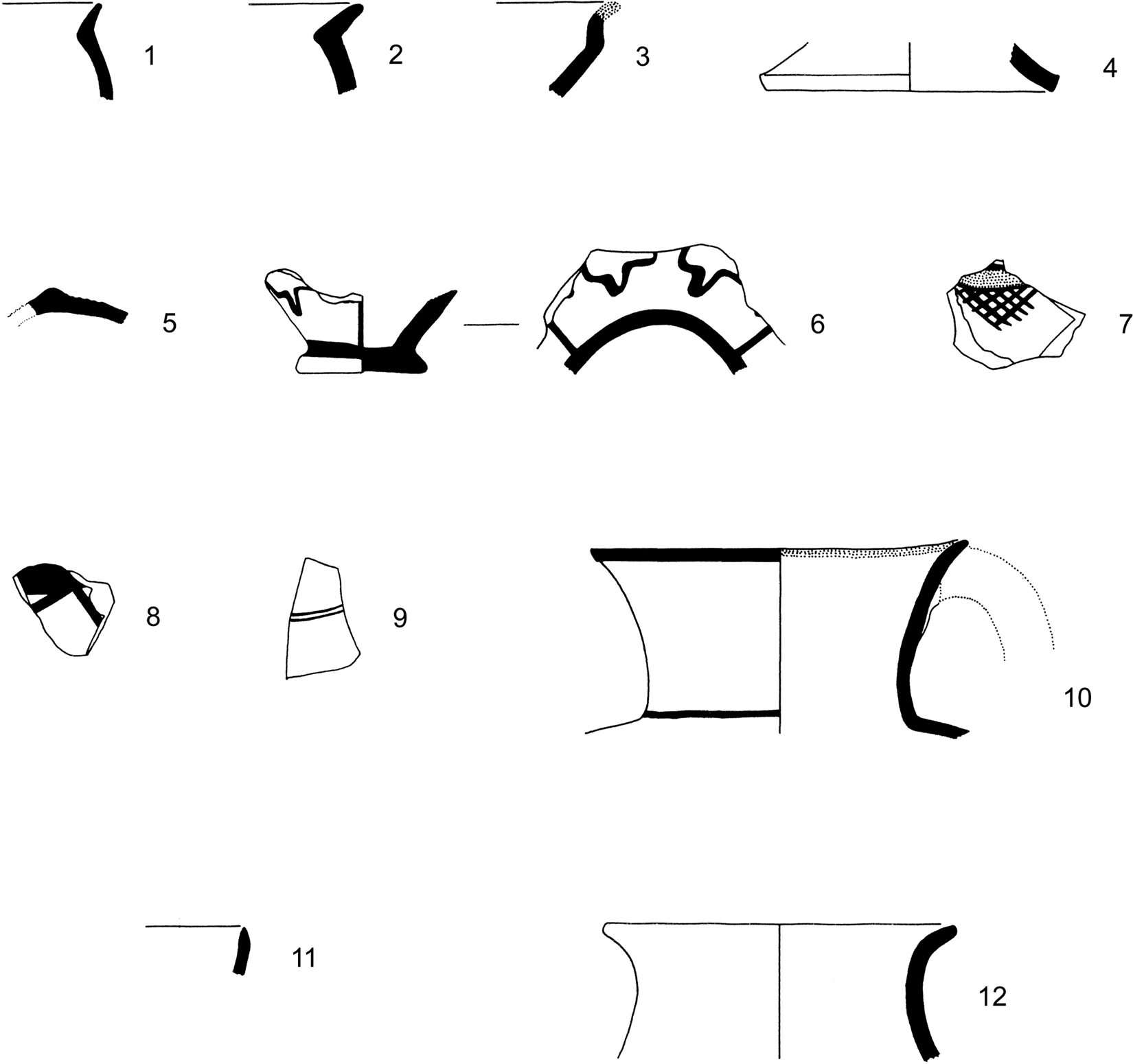
The idea that material of more than one stage could be mixed in the material classified as Phase V gains potential support from the wide variety in the forms of bowl and goblet represented, which is particularly noticeable in the case of one shape, the ring-stemmed goblet. This appears abruptly without any obvious antecedents, apart from the two low pedestal feet in Grey Minyan already noted in Phase IV. The first clear examples of the shape, an upper body and foot in Plain Ware (Fig. 6:1–2), come from quite low in the Phase V stratum. The upper body fragment has a simple everted rim and rather rounded profile, which is decorated with grooving in a similar manner to what was current in Phase IV. The type is known from other slightly smaller examples, in Plain Ware (Fig. 6:3) and Grey Minyan (Fig. 6:4); it might be considered an early or transitional form. The profiles of these two resemble those of late MH and early Mycenaean goblets, but they are from relatively early contexts within the stratum and their grooved or facetted decoration suggests that they are Phase V. This type has no close parallel at Pefkakia, where the ring-stemmed goblet first appears in fine Grey Minyan in Phase 6 Early, with a more markedly angular shape and moulded lip (Maran Reference Maran1992b, fig. 12:10). There are Grey Minyan examples at Lefkandi of this form also (Fig. 6:5), but more often the rim and shoulder are run together into a concave lip that may be deep (Fig. 6:6), often combined with a more complex profile, or shallow (Fig. 6:7). Both variants are well represented at OrchomenosFootnote 11 and Mitrou, where the goblet first appears in Phase 5; the shallow-lipped form appears first in Pefkakia Phase 6 Early, but it is long-lived, continuing to Phase 7 at Pefkakia (Maran Reference Maran1992b, figs 12:9, 15:10–12, 18:16, 20:13) and at Mitrou.Footnote 12 To judge from the Orchomenos and Pefkakia parallels, the Lianokladhi goblet would generally have had strap handles on the shoulder, while the Pteleon goblet would most often have rolled and slightly flattened ‘basket’ handles set vertically on the rim.
Phase V ring-stemmed and other goblets (3–12 Grey Minyan). (1) 66/P.446, H. 13.8, D. 19; (2) 66/P.1169, H. 3.6, D. of foot 11; (3) 66/P.1270, H. 4.2, D. 16; (4) 69/P.582, H. 6.2, D. 15; (5) 66/P.1216, H. 4.1, D. 20; (6) 69/P.502, H. 6.2, D. 27; (7) 66/P.1281, H. 3.4, D. 17; (8) 66/P.1282, H. 1.8, D. 27; (9) 66/P.1301, D. pedestal 8; (10) 66/P.1302, H. 5.9, D. pedestal 5; (11) 66/P.1351 H. 4.9, D. pedestal 6.5; (12) 66/P.1104, H. 1.5, D. base 7.5.

This degree of variety in a single shape might well be thought greater than one would expect in a single phase. Other evidence may also be taken into account, such as the presence of small fine Grey Minyan vases that would not look out of place in Phase VI (see further below). Thus, it seems possible that not only may individual pieces of the missing stage(s) between Phases IV and V be mixed in with Phase V deposits, especially lower down in the stratum where the levels are mixed anyway, but that the upper deposits may contain later types that fall in the stylistic gap between Phases V and VI. Overall, what Roger Howell termed the ‘main deposit’ may provide the most reliable basis for an impression of Phase V, although even this contains at least one large fragment that he dated earlier (Fig. 2:6), and good examples of popular types were found above and below the ‘main deposit’.
The Phase V stratum in CC does have one notable positive feature, the quantity of pottery that it contained, which includes a number of pieces of considerable size, thus giving a clearer impression of the range of shapes represented. However, many fragments that preserve only a small portion of the rim cannot be certainly assigned, although Grey Minyan examples are likely to belong either to ring-stemmed goblets or to angular bowls. It is clear that Grey Minyan shapes of the ‘classic’ forms, especially the ring-stemmed goblet, were very prominent in the material, and that these forms were also well represented in Plain Ware, which is even more popular than before. It now constitutes almost half the total,Footnote 13 while Grey Minyan is reduced to 36.2 per cent, but as before the Plain Ware has a range of quality. The Grey Minyan is of almost uniformly good quality, with more standardised shapes, and should be considered the finest ware of the time. It is largely if not entirely wheelmade, hard-fired to a quality that is often ‘metallic’, and generally polished to some extent; the surface colour tends to dark shades of grey, but examples with a brown tint are known, and such brown colouring is often noticeable in the core.
Plain Ware may be either reddish brown or pale brown in appearance. Improvements in clay preparation and firing were noted by Roger Howell, but deliberate polishing has become rare, although the local clay has a natural shininess. Some resembles Grey Minyan in quality and has the same shapes, but as in Phase IV the category comprises a wide range of open and closed shapes. Pattern-Painted pieces are very rare in comparison with these two dominant wares, although more common than before at 2.3 per cent (i.e. 23 sherds in the retained sample of 1002 sherds). The clay is the local reddish brown, normally with a very pale brown or yellowish-brown slip, and the paint is normally a thin dullish grey or grey-brown, darker when applied more thickly; it adheres better than in Phase IV. Colour-Coated sherds constitute a further 1.3 per cent (so 13 sherds). Coarse Household Ware, which shows little change, and pithos fragments make up the rest, constituting 5.8 per cent and 5.4 per cent respectively; the latter include less grit in their fabric, and some are of well-prepared clay.
The increasing skill of the potters is apparent not only in the firing, and the thinness of the vase body on some Grey Minyan pieces (0.25 cm on some fragments of cups and comparable pieces), but in the shaping of vases, particularly the big goblets with their often elaborated rims, ringed stems, and added decoration in the form of grooving and rilling on the shoulder, a feature also found on bowls, and relief ribs on the lower body. These goblets can also be very large: their rim diameters frequently exceed 20 cm, and the largest recorded is 30 cm, while the pedestal feet can be as much as 15 cm in diameter. But, as a comparison of two stem fragments (Fig. 6:9–10) indicates, there were considerable variations in size. A sizeable but smooth pedestal (1 cm thick; Fig. 6:11) probably also supported a large goblet, perhaps of a different form, as seems likely also for low feet like Fig. 6:12. It seems very plausible that, as Maran (Reference Maran, Felten, Gauss and Smetana2007, 174 n. 40) has suggested, the largest goblets had a communal purpose, intended to hold enough for a whole group, who might either pass them around, an action for which the somewhat smaller Pteleon goblet type with rolled handles on the rim (cf. Fig. 6:8) seems particularly appropriate, or serve themselves by dipping individual drinking vessels into the contents of the goblet, which would suit the deeper Lianokladhi goblet form better.
Large as ring-stemmed goblets often are, Plain Ware bowls can be even larger, as is certified by a complete example from Trial IX (d. 31.4 cm; Fig. 7:1); the rim of a very similar fragment (66/P.444), more rounded on top, has an even larger estimated diameter, at 38 cm. Several examples which have short thick flat rims, everted or horizontal, range between 20 and 35 cm in diameter (e.g. Fig. 7:2). There is considerable variety of treatment (e.g. Fig. 7:3–4), and examples of older types survive (Fig. 7:5). Such bowls can have considerably thicker walls than most Grey Minyan vessels (from 0.7 to over 1 cm), and the great majority have rounded profiles, but one seems to be straight-walled (Fig. 7:6); what seem to be the bases are usually ringed. An unusual bowl fragment, whose diameter cannot be measured but which must have been substantial, since the body wall is 1 cm thick (66/P.1333), may be mentioned here; it has a simple everted rim above a rounded body, on which there is a horizontal rolled handle.
Phase V large Plain Ware bowls. (1) 66/P.406, H. 17.5, D. 31.4, D. base 9.8; (2) 66/P.1317, H. 3.1, D. 31; (3) 69/P.509, H. 7.9, D. 20; (4) 66/P.1253, H. 9.3, D. 26; (5) 66/P.537, H. 9.2, D. 23; (6) 66/P.1173, H. 3.7, D. 30.
There is plenty of evidence for medium-sized bowls between 15 and 20 cm in rim-diameter as well, including a complete collar-necked example in Plain Ware (Fig. 8:1), showing that the shape survived, though it is no longer common. There is at least one Grey Minyan example (Fig. 8:4), but other Grey Minyan bowls have simpler rim-profiles and angular bodies (Fig. 8:2–3). One with a very thin rim and high-swung handle may be closer to a kantharos (Fig. 8:8), a shape that is otherwise surprisingly difficult to identify; but to judge from Pefkakia examples they can have rims indistinguishable from those of small goblets with rounded profiles (Maran Reference Maran1992b, figs 13:14, 16:6–7,11,15). Ring and raised flat bases whose diameters range between about 4.5 and 9 cm are likely to belong to bowl shapes of this kind of size, but are hard to link up with substantial rim and body fragments. There are also shapes that are better defined as cups, with rim-diameters ranging from 15 down to 7 cm, including an unusually poorly produced complete Plain Ware example, which is pared on the outside (Fig. 8:6), and collar-rimmed fragments that may be more characteristic (Fig. 8:7). Comparable pieces to the Lefkandi sample can be found in Pefkakia Phases 6–7 (e.g. Maran Reference Maran1992b, figs 13:3–6,8, 15:15–20). Finally, there are late-looking pieces, including a goblet with rounded profile (Fig. 8:5), a clear ‘Vapheio cup’ rim (Fig. 8:10) and a similar but perforated rim (Fig. 8:9), a number of small low pedestal and ring bases which would suit small goblets, bowls and cups (e.g. Fig. 8:12), and what may be a dish or a lid (Fig. 8:11). Fragments of unusual smaller vases in fine Plain Ware, none illustrated, also deserve mention: a lid (66/P.437), a portion of a double cup (66/P.1334) and a miniature bowl that seems to be from the handle of a dimiteus or ‘spinning bowl’ (69/P.565).Footnote 14
Phase V medium bowls, cups and small open shapes (2–5, 8–12 Grey Minyan). (1) 66/P.1150, H. 15, D. 20, D. base 8; (2) 66/P.1092, H. 6.9, D. 13; (3) 66/P.1346, H. 3.9, D. 17; (4) 66/P.1094, H. 5.3, D. 20; (5) 66/P.440, H. 6.6, D. 12; (6) 69/P.584, H. 9.5–10.7, D. 14, D. base 6.1; (7) 66/P.1359 H. 2.3, D. 13.5; (8) 66/P.1285, H. 4.8; (9) 69/P.535, H. 3.3, D. 9; (10) 69/P.556, H. 3; (11) 66/P.1223, H. 2.6, D. 10; (12) 66/P.1350, H. 0.9, D. 4.
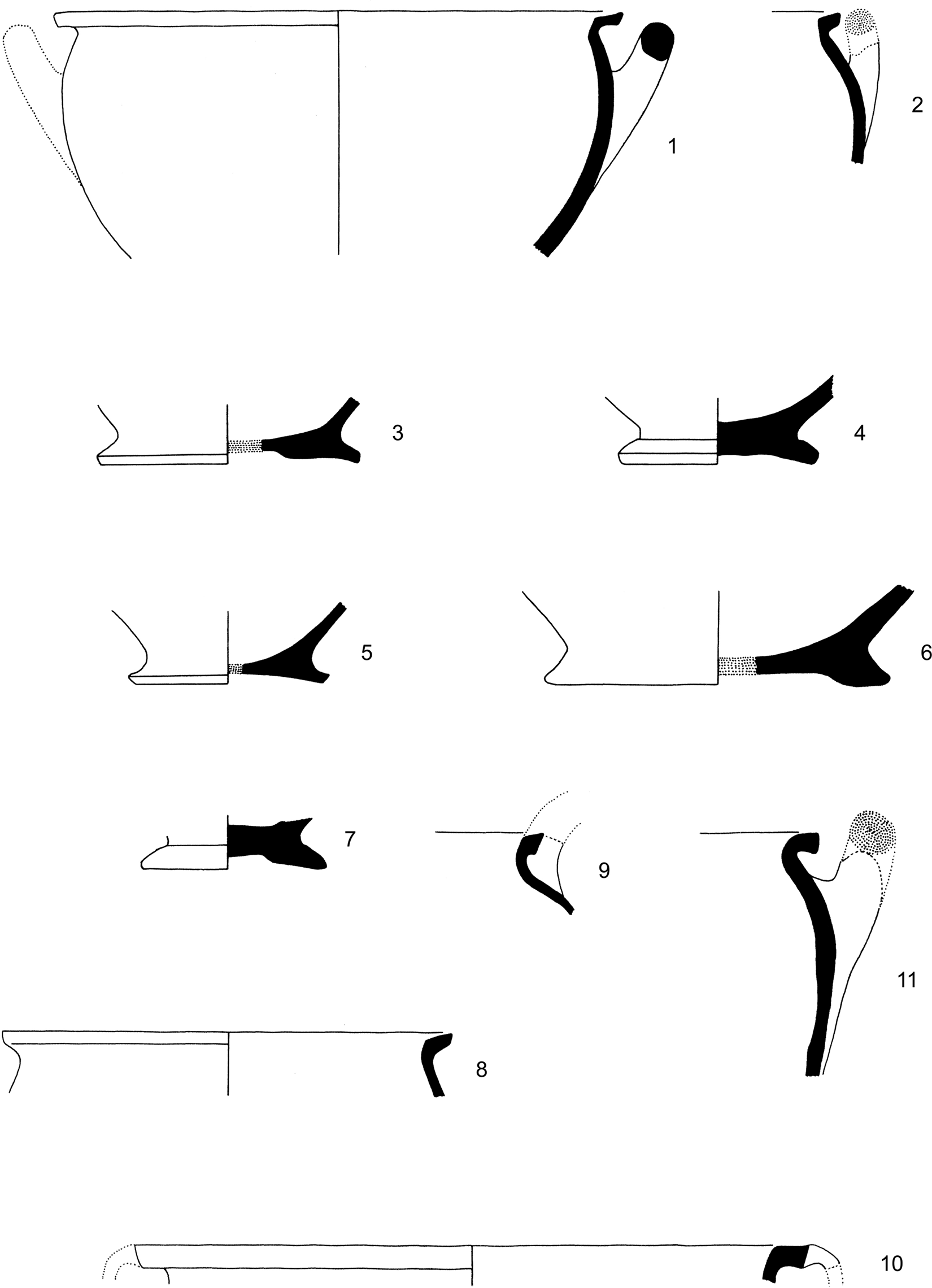
As before, it is not possible to say much about closed vessels, except that these were made in most wares. There is evidence of small jar-like vessels, both wide and narrow-mouthed (Fig. 9:1–3), in both Plain Ware and Grey Minyan, and some small ring and flat bases might well belong to these. But the bulk of closed fragments that give any indication of shape belong to larger jugs and jars, mostly coming from rims and necks.Footnote 15 Exceptionally, Fig. 9:7 preserves nearly half the vessel; it may well give an idea of the appearance of many, for its rim diameter, at 14 cm, falls in the middle of the characteristic 13–15 cm range. If this may be taken as typical, the common body shape would have been ovoid, and its total height was probably a bit over double the 15 cm preserved. The handle(s), to judge from this and several other pieces (e.g. Fig. 9:4–6), would normally be rolled. A range of mouths and necks in Plain and Pattern-Painted Ware, all of similar size and type to the examples identified in Phase IV, probably belong to comparable vases, varying only in the shape of the lip (e.g. Fig. 9:5–6,8–9, Plain); there is a comparable range from Orchomenos. Fig. 9:4, with a smaller (d. 10 cm) everted lip, is probably from a jug, but this is not otherwise an easy shape to identify in relatively fine wares, apart from a single catalogued spout fragment (69/P.585) and Fig. 9:7 (which Roger Howell classified as a hydria, perhaps on the grounds of size, since there is no report of a belly handle, the distinguishing feature of a hydria). Some vertical strap handles might belong to jugs, and Household Coarse Ware vessels of the well-known type generically called a cooking jar (like Fig. 10:5) could have served as jugs.
Phase V large and small jar and jug shapes (2–3 Grey Minyan). (1) 66/P.1316, H. 4.5, D. 10; (2) 66/P.1134, H. 2.5, D. 9; (3) 66/P.1263, H. 2.6, D. 5.5; (4) 66/P.441, H. 5, D. 10; (5) 69/P.536, H. 6.3, D. 14; (6) 66/P.1359, H. 3.9, D. 13.5; (7) 70/P.? (number not recorded; from Palaia Perivolia), H. 15.2, D. 14; (8) 66/P.1106, H. 6.5, D. 15; (9) 66/P.1228, H. 4.8, D. 13.2.
Phase V large Plain Ware storage jar, pithos, Coarse Household Ware jars. (1) 66/P.452, H. 22, D. 44; (2) 66/P.1336, H. 8.6, D. 40; (3) 66/P.460, H. 9.3; (4) 66/P.1329, H. 3.7, D. 18; (5) 66/P.1160, H. 5.5, D. 8; (6) 66/P.1278, H. 3.9, D. 26.

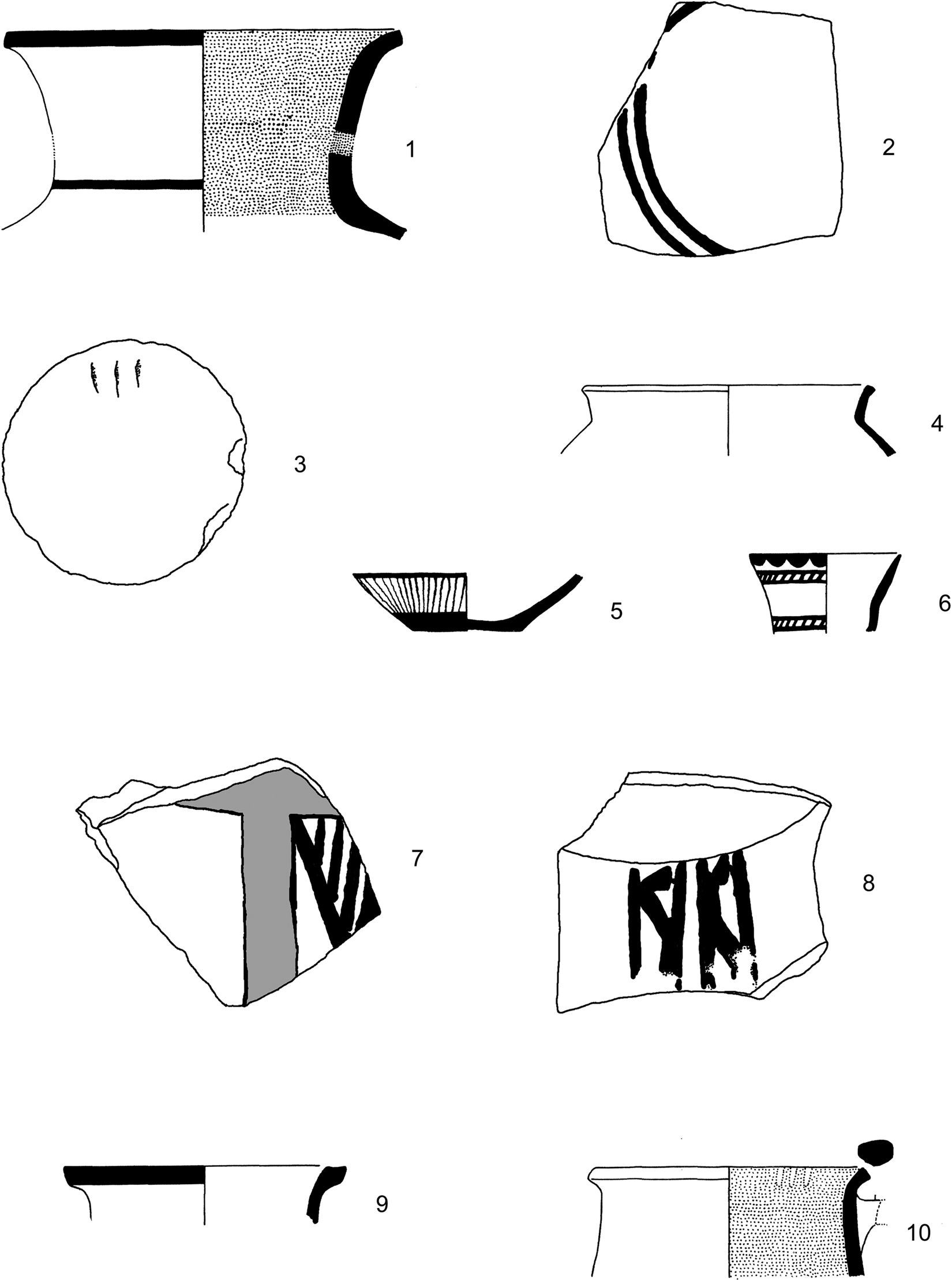
There is striking evidence for large storage vessels in the Plain, Pattern-Painted and Household Coarse wares. The most substantial of these, in Plain Ware, Fig. 10:1 (mouth d. 44 cm, h. 22 cm), is actually larger than either of the pithos rims identified (Fig. 10:2 shows one), though not as thick-walled. A matt-painted rim with an internal ledge to support a lid, a feature found on large Aiginetan Matt-Painted jars (e.g. Siedentopf Reference Siedentopf1991, pls 15–16, 22:104,106), and also at Orchomenos on local matt-painted storage jars (Sarri Reference Sarri2010, pl. 75 especially), is almost as big (Fig. 11:1, d. 35 cm), and smaller versions, but still very sizeable, are known (Fig. 11:2, Pattern-Painted; Fig. 10:4,6, Household Coarse). The Household Coarse Ware examples may sometimes have had horseshoe-shaped lugs attached to the body instead of handles: one large example has been catalogued (69/P.521), attached to a body fragment 1 cm thick. The majority of recognisable Household Coarse Ware shapes, however, were variants of the standard cooking jar, which could differ widely in size (e.g. Fig. 10:3,5). Larger vessels might be decorated with applied finger-impressed or slashed bands, but examples are rare. Two probable jar-fragments incised with vertical and oblique grooves are attributable to the class once called ‘Adriatic’ (66/P.1430, 1595). Their appearance makes an interesting link with Boeotian sites, where relatively many examples have been found; the whole group may be Peloponnesian imports (Sarri Reference Sarri2010, 83).
Phase V Pattern-Painted. (1) 66/P.1250, H. 2.8, D. 35; (2) 66/P.1147, H. 3.1, D. 20; (3) 69/P.518, H. 3.4, D. 15; (4) 66/P.1311, H. 2.6, D. 14; (5) 66/P.1146, H. 4.1, D. 13; (6) 69/P.526, H. 2.9; (7) 69/P.538, H. 3, D. 26; (8) 66/P.1115, H. 4.9. No data recorded for (9) 69/P.524, (10) 66/P.1375, (11) 69/P.545, (12) 69/P.543, (13) 69/P.544, and (14) 66/P.1184.

As already noted, relatively many storage vessels belong to the Pattern-Painted category, but the scrappiness of the material makes it particularly difficult to form a picture of them and the class as a whole. This was surely a direct continuation of the earlier painted styles, with very similar features. The recognisable shapes include jars, narrow-necked vessels that were probably jugs (Fig. 11:9; Fig. 11:6 must be from a small jug or jar), and bowls, which may often have been carinated in shape (Fig. 11:8). One remarkably large bowl (Fig. 11:7) is likely to have been similar in shape to a well-known type of Aiginetan Matt-Painted bowl (Siedentopf Reference Siedentopf1991, 33–5).
The patterns favoured seem much the same as in Phase IV (one is unusual, a chequerboard pattern on a body fragment, 66/P.1406), and they were probably arranged in similar ways, but the fragments preserved are generally too small to give any idea of the overall decorative plan. There are several examples of bands drawn horizontally below rims and at the base of necks, or running vertically or obliquely down from these onto the body; thin bands may flank thick (Fig. 11:9–10); two groups of three lines are drawn across each other on Fig. 11:13. Hatching and cross-hatching were relatively common, probably used as before to fill simple panels and triangular motifs, which might have been set out in narrow (as probably on Fig. 11:7) or broad (as on Fig. 11:12) horizontal or vertical zones; or motifs might have been free-standing in otherwise empty space (as apparently on Fig. 11:11,14). Jar rims often seem to be decorated with little groups of dashes (Fig. 11:2,4), and there could be festoons or hanging loops on the inside of jar lips (Fig. 11:1,6). The general impression is of a rather sparse style. It should be noted that there is no clear evidence for Pattern-Painted small vases, and bichrome decoration seems to have gone out of fashion, for it was identified on only one clearly local piece in the sample deposit. It did, however, occur on a number of probably Cycladic imports.
Apart from the possibly Peloponnesian pieces already noted, there are imports from several different sources. The rare Colour-Coated pieces may all be imported; some are simply fragments, coated with a polished black or brown slip, but others, classified by Roger Howell as ‘Red Minyan’ (a somewhat misleading name, since the red colour is that of the coat, not the clay; Fig. 12:1–4), are clearly of a ware well known in the Cyclades, whose shapes are pedestalled bowls and goblets, both high and low-stemmed (Caskey Reference Caskey1972, 378, fig. 9:D125,128, also 392, pl. 93:G38).
Phase V Certain and probable imports (1–4 ‘Red Minyan’, 5–8 Cycladic, 9–10 Aiginetan, 11–12 Cycladic or north Euboean). (1) 69/P.549, H. 4; (2) 66/P.481, H. 3.8; (4) 66/P.1254, H. 1.9, D. foot 12; (5) 69/P.550, H. 1.3; (6) 69/P.596, H. 4.2, D. base 5; (10) 66/P.443, H. 7.9, D. 15; (11) 66/P.1378, H. 1.9; (12) 66/P.1327, H. 5.5. No data are recorded for (3) 69/P.464, (7) 69/P.532, (8) 69/P.551, and (9) 66/P.923.

Both rounded and angular forms of profile are found at Lefkandi. Other surely Cycladic pieces are the top of a ‘duck vase’, coated with a polished red-brown slip (Fig. 12:5), and the base of a matt-painted panelled cup (Fig. 12:6); a bichrome fragment of sandy, slightly micaceous clay was thought by Roger Howell to be possibly Melian (Fig. 12:7). The very micaceous pink clay of Fig. 12:8, a small matt-painted vessel with everted rim, suggests that it is also of Cycladic origin. Two Household Coarse Ware pieces, an incurved bowl rim and a jar neck (Fig. 12:11–12), were thought to be Cycladic or north Euboean because of their micaceous fabric. There are fragments of Aiginetan ware, in the characteristic porous and sandy micaceous fabric, most often a pale greenish grey or greenish yellow in colour and decorated in grey or black matt paint. These come especially from Matt-Painted hydriai (e.g. Fig. 12:9–10), but there are at least two crescent lugs from apparently plain vessels. Finally, a small fragment of a grey-coated rim (69/P.562) and a piece decorated with a white matt spiral on dull dark grey (66/P.1394) were thought likely from their fabric and appearance to be Minoanising if not Minoan.
Phase VI
Again, there is an impression of very marked change in the pottery, and Roger Howell commented that assessing the degree of continuity from the previous phase was made more difficult because the deposits contained a considerable admixture of Phase V types, especially Grey Minyan. However, he noted that the individual Phase V pieces were often small and could have been introduced through incorporation into building material. He presented a strong argument for suspecting a break in the sequence between Phases V and VI, on the basis of comparison with the Eutresis sequence, pointing out that the Phase V material is almost identical with that from the first MH level at Eutresis, and Phase VI material is closely similar to that from the third level, but material comparable to the second level was barely identifiable. Although the more elaborate painted styles evident in the second MH level at Eutresis (Goldman Reference Goldman1931, 156–62, figs 215–25) might never have been adopted at Lefkandi, this does seem to support the idea that there is a gap in the CC sequence, which cannot be filled by material from elsewhere on the site.
To judge from the depth of deposit, exceeding 1 m, the period of time represented by Phase VI was quite considerable, although there is very little evidence of development between the two distinct strata into which Phase VI can be divided stratigraphically. At first glance, the phase might well be taken for a final stage of the MH sequence, which is how it is presented in the preliminary report (Popham and Sackett Reference Popham and Sackett1968, 10–11), although in his manuscript Roger Howell considered it likely that it was contemporary with part of the early Mycenaean period, since rare LH I and IIA pieces, probably imports, were found in the upper strata. This makes sense of the results of excavation all over the site, in which no separate LH I or II strata could be identified, and agrees with what has been concluded from the observed sequences at other central Greek sites, Eutresis and Mitrou.Footnote 16 It reflects what has become increasingly clear, as indicated at Peloponnesian sites like Tsoungiza (Rutter Reference Rutter, Gauss, Klebinder-Gauss and von Rüden2015), that the decorated Mycenaean style was developed in a context in which wares deriving from MH traditions were dominant, and took time to spread. Several decorated wares deriving from MH traditions survived for much of the early Mycenaean period, and the general range of pottery produced, particularly the plain fine ware, only slowly took on a ‘Mycenaean’ aspect. This seems surprising, since at Mitrou, which might seem even more distant from major centres like Mycenae and Thebes than Lefkandi, Mycenaean decorated pottery was already being locally manufactured, if in small quantities, by LH I Sub-Phase 3 (Hale et al. Reference Hale, Vitale and Van de Moortel2016). Such differences may reflect the formation of new networks, reflecting new relationships, in this period.
In fact, quite a number of Mycenaean decorated fragments, mostly LH II (including LH IIB) but in at least two cases likely to be LH I, have been found in Stratum B of Phase VI; there may even be one or two from Stratum A, but these could have been introduced during the later disturbance caused by the digging of pits and tombs. There are also several complete vases from the graves dug down from Phase VI, and also from pits, one a possible grave, from Trial IX.Footnote 17 All are probably imports; the Mycenaean decorated style was certainly well established at Thebes by LH IIA (Mountjoy Reference Mountjoy1999, 644–5; there is also an unpublished domestic deposit), and local manufacture may have begun at Chalkis in that phase (Mountjoy Reference Mountjoy1999, 695 n. 362, 698–700), while as just noted local production had begun at Mitrou even in LH I. Only brief references can be made to the Lefkandi pieces here, for they have not been studied as an integral part of the relevant deposits.
In other respects, the pottery in both strata of Phase VI basically continues the range of wares already established in Phase V and shows many features that are typical of the period in central Greece contemporary with the early Mycenaean period in the Peloponnese. Thus, it has long been argued that the Mainland Polychrome ware, now widely believed to have been developed in Boeotia, flourished contemporaneously with LH I and lasted into LH IIA, if not later;Footnote 18 a local variant of this ware is typical of Phase VI. Equally, the ‘hawk's beak’ type of krater rim, well known at Eutresis,Footnote 19 and thickened amphora rims are both common Phase VI types. The latter have been dated to the LH I period by Maran (Reference Maran1992a, 136, n. 122), although he allows for the possibility that the ‘hawk's beak’ rim could have appeared earlier in central Greece.Footnote 20 Further indications that Stratum B of Phase VI is early Mycenaean in date is shown by the rare appearance of the two typical innovations in domestic pottery, the conical cup and tripod cooking pot (a single leg), in the same contexts as LH II decorated pieces, and also, equally rarely, of Plain Ware cups and goblets that resemble LH II Plain Ware types.Footnote 21
Some other salient features of Phase VI also fit what might be expected of early Mycenaean, particularly LH I, deposits. Thus, fine Plain Ware is heavily predominant (60 per cent, to a maximum 22.8 per cent Grey Minyan). It now generally shows the reddish yellow colour of the Lefkandi clay; if surfaces are slipped, a less common feature, they are normally a very pale brown. Grey Minyan also changes in appearance, having a yellowish grey tone. Open shapes dominate the assemblage and are mostly rounded in profile, not angular, and often notably thin-walled (0.3–0.5 cm); the deep-bodied two-handled goblet, a typical early Mycenaean shape, is very well represented. Paint-decorated pottery is still not very common, but is better represented than before, at 3.1 per cent of the total, including a number of imports. Its most significant group, the variant of Mainland Polychrome, surely replaced Grey Minyan as the finest ware, but the monochrome style using thin grey or brown paint also continued (see below). The survival of Grey Minyan as a well-represented ware and of large vessels simply decorated with matt paint shows the tenacity of some MH traditions. For comparison, at Mitrou Grey Minyan is still dominant in the phase classified as MH II Final/MH III, but Plain Ware became dominant in the early LH I sub-phases, although Minyan wares survived, and shapes were uniformly globular (Hale Reference Hale2016, 283).
A striking feature of Phase VI is the importance of the krater shape, popular in the Plain, Grey Minyan, and Pattern-Painted wares (Fig. 13). These are always large: most rim diameters range between 20 and 30 cm, but what appears to be a matt-painted if not bichrome rim (Fig. 13:10) is 33 cm, and a Grey Minyan rim (66/P.1488) has even been reported as 40 cm, but this may be an overestimate; however, a Plain Ware base with a diameter of 17 cm (Fig. 13:6) certainly supported a krater of very considerable size. The major characteristics are a flat ledge rim and deep, generally rather piriform body; examples with straight sides are known. The body thickness most generally falls between 0.4 and 0.8 cm, though can be up to 1 cm, but the fabric is always that of fine ware. The rims may be flat or tilted up or down, and quite often they are thicker at the edge, the ‘hawk's beak’ form (Fig. 13:1,9–11). Handles, where preserved, are most often rolled and placed horizontally on the body, but there are vertical rolled (Fig. 13:9) and strap (Fig. 13:10) handles that attach to the rim. The likely bases average around 10 cm in diameter but can be a few cm more or less, and may be of ring or raised and hollowed form (Fig. 13:3–7). The fact that these vessels were made in the finest wares suggests that they are ceremonial vases rather than simple domestic forms, plausibly taking over the function of the biggest Grey Minyan goblets of the previous phase. The shape may well have developed from the large bowls with short flat rims and rounded bodies found in Phase V; it is well represented at Orchomenos (Sarri Reference Sarri2010, pls 39–44), but not at Pefkakia, apparently.
Phase VI kraters (1–6 Plain Ware; 7–9 Grey Minyan; 10 Pattern-Painted, Bichrome?; 11 Bichrome). (1) 66/P.436, H. 12.1, D. 28; (2) 66/P.1490, no data recorded; (3) 66/P.1623, H. 12; (4) 66/P.1408, H. 4.5, D. base 10; (5) 66/P.1472, H. 4.1, D. foot 10; (6) 66/P.1648, H. 5, D. base 17; (7) 66/P.1450, H. 2.6, D. foot 9.1; (8) 66/P.1640, H. 3.4; (9) 66/P.1637, H. 4; (10) 66/P.1663, H. 1.9, D. 33; (11) 66/P.1523, H. 3.3, D. base 13.
There is evidence for bowls as large as the smaller kraters, notably one in Grey Minyan, with a small rounded lip and deep rounded body (Fig. 14:1, d. 23 cm); a scrap of a bichrome rim (66/P.1510) may well be from an even larger vessel (estimated d. 26 cm). Such vases might be reserved for special occasions like the kraters, but there are also Plain Ware bowls that seem like ordinary table ware, such as two survivals of earlier types, one with the now rare angular profile (Fig. 14:2), the other with a simple flaring shape and thickened rim (Fig. 14:3), both of which might be cast-ups; fragments of spouted bowls (e.g. 66/P.1571, d. 20 cm) should fall in this category. But such bowls are relatively few, compared with earlier phases, probably because many of their functions were now being fulfilled by the kraters.
Phase VI big bowls and goblets (1, 5 Grey Minyan; 2–4 Plain Ware; 6–8 Bichrome). (1) 66/P.1555, H. 7.8, D. 23; (2) 66/P.1424, H. 5.8, D. 24; (3) 66/P.1660, H. 9.2, D. 16; (4) 66/P.228, H. 11.8, D. rim 15.4, D. foot 6.7; (5) 66/P.227, H. 12.9, D. 16.5; (6) 66/P.229, H. 12.9, D. 18.6; (7) 66/P.237, H. 14.2, D. 21; (8) 66/P.512, H. 9.3, D. 21.
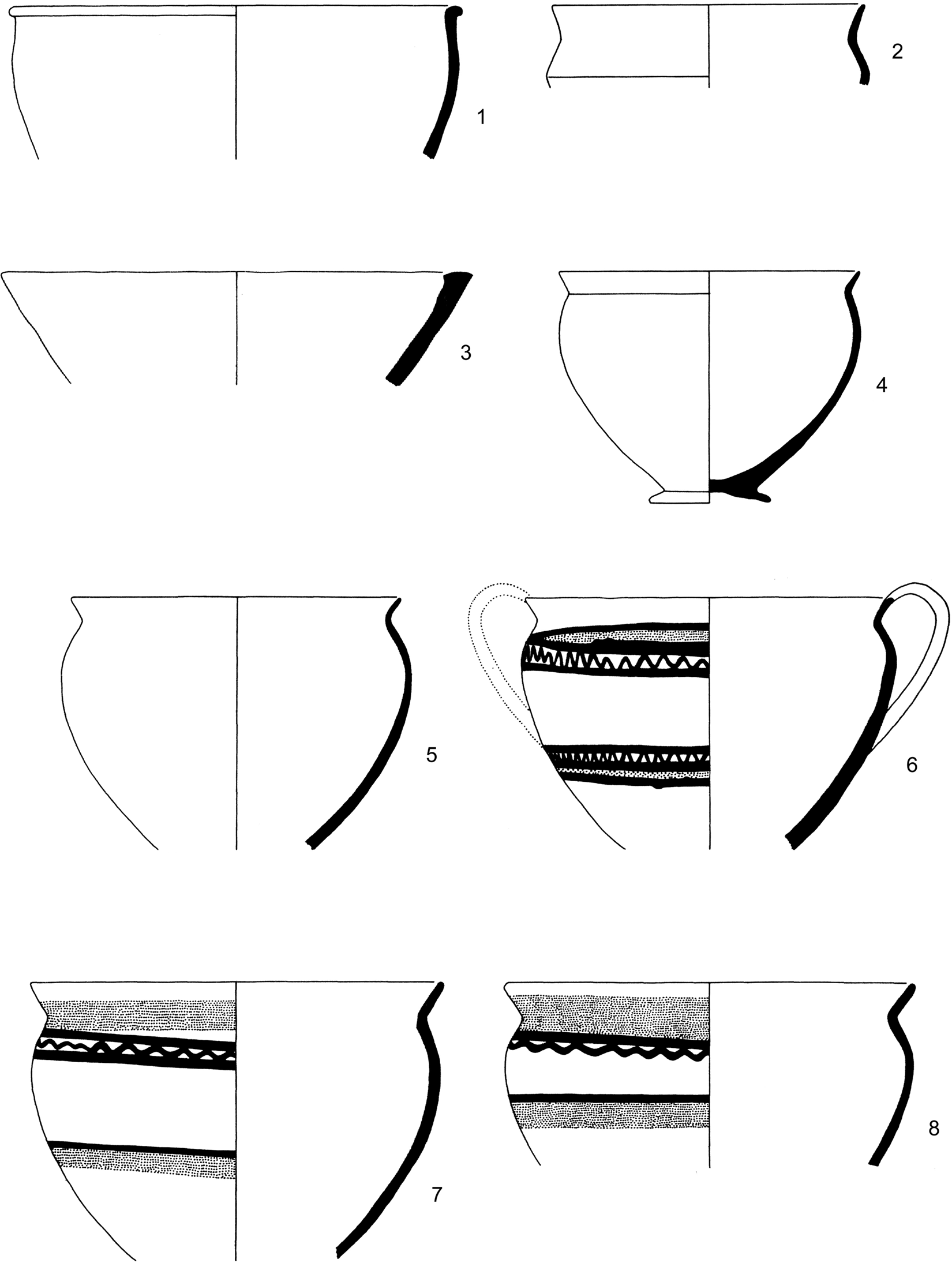
There is also a substantial class of medium to large goblets that are clearly similar in body shape to kraters but have plain everted rims and handles that are most often of the vertical strap form, sometimes high-swung above the lip in the manner of a kantharos. A complete Plain Ware example is associated with the CC house deposits (Fig. 14:4), and there are large fragments in the other two fine wares (Fig. 14:5–8). The Bichrome versions of this shape are particularly impressive; two have diameters of 21 cm (Fig. 14:7–8), of which the first is over 14 cm tall. None has been preserved complete, but it seems likely that most had no separate stem, but tapered to ring or hollowed bases similar to those of kraters and also the smaller goblets like Fig. 15:5. However, remains of Plain Ware and Grey Minyan pedestal feet (e.g. Fig. 15:3–4) have been found, some of which are substantial enough to suggest that they could have belonged to sizeable goblets with low pedestals, and there are indications that the high-pedestalled goblet may have survived in Plain Ware. Fig. 15:2 includes the top of a ringed stem, while a lower stem and foot certainly belongs to its final form, with grooved rather than modelled rings on the stem (Fig. 15:1, with a foot diameter of 16.4 cm). This type is commonly found in Grave Circle B at Mycenae, but not well represented north of the Isthmus of Corinth.Footnote 22 At Lefkandi, such pieces are so rare that they may be survivals from a stage intervening between Phases V and VI.
Phase VI goblets, kantharoi and cups. (4, 9 Grey Minyan; rest Plain Ware). (1) 65/P.67, H. 11.3, D. base 16.4; (2) 66/P.435, H. 9.4, D. pedestal 5.2; (3) 66/P.1443, H. 2.8, D. foot 14; (4) 66/P.1562, H. 4.4, D. foot 11; (5) 66/P.224, H. 7.5 (+ 2.5 handles), D. rim 9.7, D. foot 5; (6) 66/P.1400, H. 4.9, D. 12; (7) 66/P.1647, H. 2.5, D. foot 7; (8) 66/P.1514, H. 3.2, D. foot 6.3; (9) 66/P.225, H. 7.6, D. rim 12.7, D. base 7.8; (10) 66/P.230, H. 4.4, D. rim 9.2, D. base 4.4; (11) 66/P.1593, H. 3.4, D. 9; (12) 66/P.1517, H. 2.1, D. 9; (13) 66/P.438, H. 4.5, D. 7; (14) 66/P.222, H. 5.6, D. rim 8, D. base 3.5; (15) 66/P.1622, H. 6, D. rim 11.4, D. base 7; (16) 66/P.236, H. 6.6, D. rim 10.1, D. base 5.8.
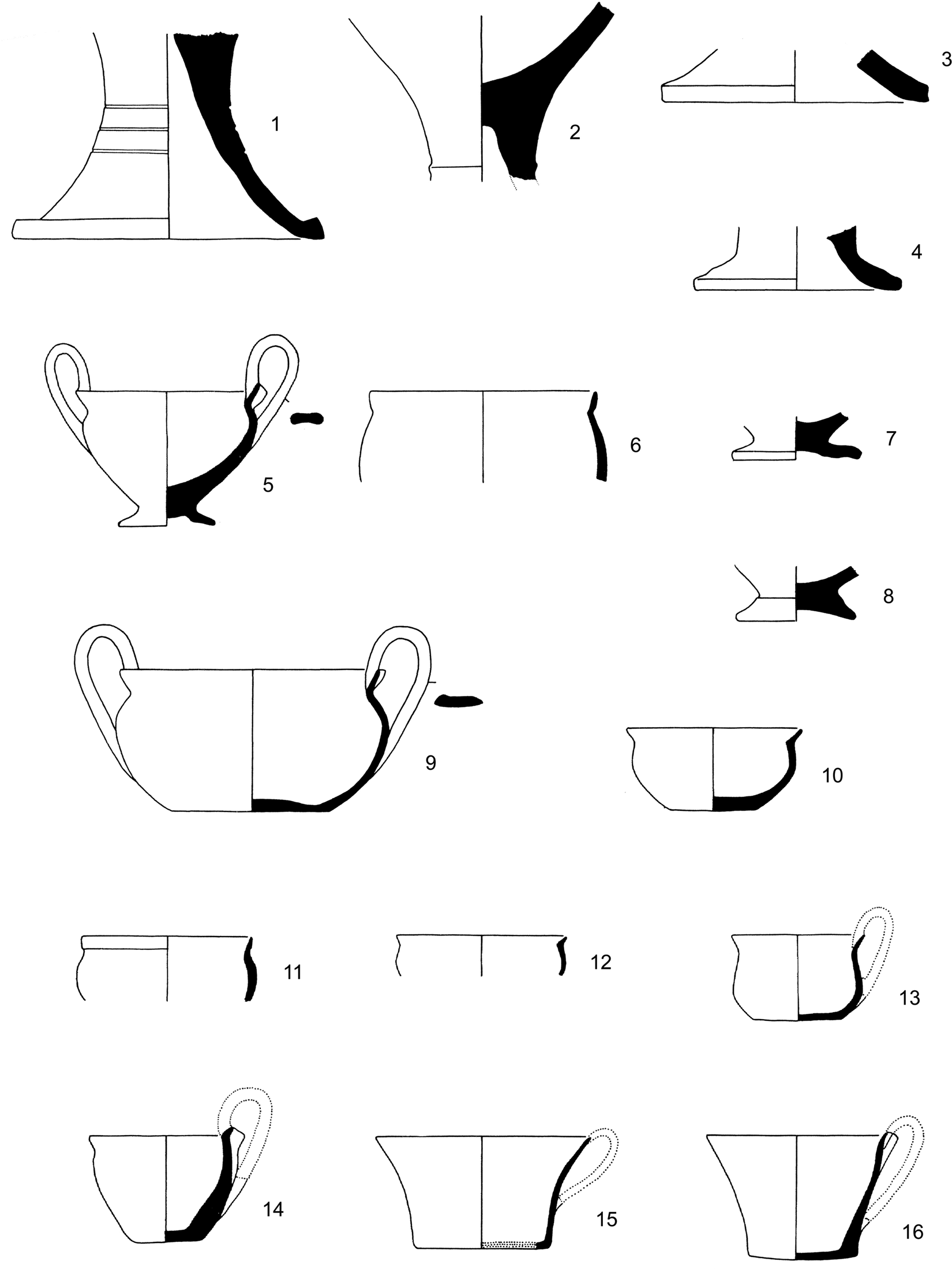
In addition to the more substantial vessels, there was a range of smaller two-handled goblets and one-handled cups, with diameters varying from 7 to 12 cm and often falling in the 9–10 cm range, that could only have served as ordinary drinking vessels. One complete Plain Ware goblet on a raised foot (Fig. 15:5) and a flat-based Grey Minyan kantharos with a rounded profile (Fig. 15:9) come from a deposit closely associated with the house in Trench CC; another complete goblet very similar to Fig. 15:5 but Grey Minyan (64/P.7) was found in Trial D, perhaps a grave offering. It does not seem that kantharoi were actually very common (there are some pieces of much smaller Grey Minyan examples, e.g. Fig. 16:2, d. 6 cm), but small goblets were clearly a well-known type (e.g. Fig. 15:6–8), and shallow round-profiled cups with notably thin body walls (0.2–0.3 cm) and flat bases were evidently popular also (e.g. Fig. 15:10–12). The shortness of the rim on these, and also on some goblets, is noteworthy: if found on a Peloponnesian site, they would surely have been classified as early Mycenaean plain ware, and a few may in fact be imports (e.g. 66/P.1612, a probable goblet rim, was thought to be of non-local clay), that could have had some influence on local production. But there is no sign of the typical feet and stems of early Mycenaean plain goblets, and very little of the elaborated foot-profiles that developed during LH II.
Phase VI small Grey Minyan vessels. (1) 66/P.1401, H. 4, D. 12; (2) 66/P.1445, H. 2.8, D. 6; (3) 66/P.1484, H. 2.7, D. 8; (4) 66/number unrecorded, H. 3, D. base 5; (5) 66/P.1564, H. 2.8; (6) 66/P.1614, H. 2.2, D. pedestal 2.6; (7) 66/P.1557, H. 2.8; (8) 66/P.1419, H. 3.7; (9) 66/P.1420, H. 2.3, D. 8.
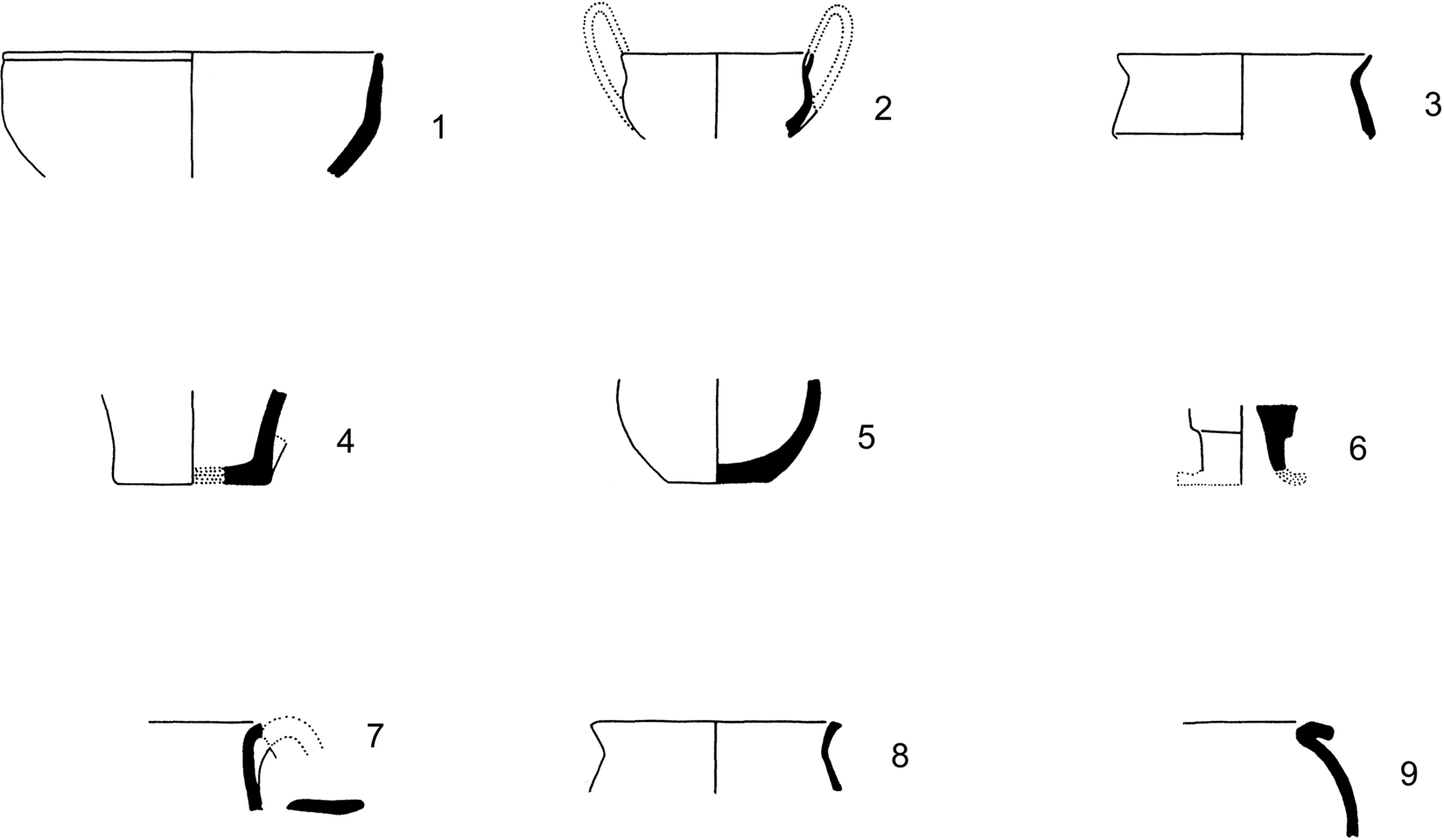
On all these forms, as well as on some mug-like cups with a high-swung handle (Fig. 15:13–14, perhaps also Fig. 16:5,7), rounded profiles are dominant. A few examples of angular forms could be identified (e.g. Fig. 16:3), but most of these could be older strays. One exception, which reflects the Minoan influences that lay behind the development of the Mycenaean style, is the straight-sided cup, for these are effectively ribless Vapheio cups, the original form of the shape in Crete and Kythera, that is found in the late MH wares of the Peloponnese and appears at Mitrou at the beginning of local LH I. The two best examples, with complete profiles, are in Plain Ware, and they vary in quality (Fig. 15:15–16); one base in Grey Minyan was also catalogued (Fig. 16:4). A large fragment of a Pattern-Painted version of this shape may be an import, but a small bichrome fragment with a horizontal rib, reported by Roger Howell but apparently uncatalogued, may be locally made.
There is also some evidence for small vessels, open and closed, in Grey Minyan (Fig. 16). Several of these have already been cited; others relate to shapes that are not readily recognisable, such as a miniature pedestal, one of two catalogued (Fig. 16:6), or are rarities, like a small bowl with straight upper body (Fig. 16:1) and two miniature jars (Fig. 16:8–9). Similar small open and closed vessels in Grey Minyan can be found at other sites,Footnote 23 and the Lefkandi examples may not all be local products.
In general, small open vessels seem rare in comparison with the situation in the latest stages of MH in the Peloponnese, especially the north-east, and also at Mitrou, but the deficit is made up partly by likely imports, including the majority of the Mycenaean decorated pieces reported, both from CC strata and elsewhere on the site. These are mainly from open vessels such as Vapheio and semiglobular cups and stemmed goblets (among them at least two pieces of LH IIB ‘Ephyraean goblets’); several complete vessels, mostly of open shapes, were found in the children's graves dug down from this level. Pieces of closed shapes, mostly small like alabastra but in some cases large, jugs and jars, even possibly ‘palatial’ LH IIA, were also recognised. The range of decorative motifs noted is wide, which along with their relative rarity is an argument for considering these pieces imported.Footnote 24
The evidence for large closed shapes is substantial, but the continuing scrappiness of the material means that, as before, informed guesses have to be made about their overall appearance. The commonest shape is, as before, represented by the relatively wide jar-neck, most often quite tall, gently concave, and ranging between 10 and 16 cm in diameter, which should belong to an amphora-like shape. The lip may be ledged (Fig. 17:1–2), even of ‘hawk's beak’ type (Fig. 17:3), and many examples belong to the Pattern-Painted class, with bands of matt paint at the rim or around the base of the neck (e.g. Fig. 17:5). One exceptionally low and broad Pattern-Painted example (Fig. 17:4) looks likely to be from a jar with an even broader body, but the majority are likely to have had bodies resembling an ovoid amphora. The two clearest jugs are of differing forms, one having a tall narrow neck (Fig. 17:6), and the other, of which the whole upper body is preserved, a beaked spout (Fig. 17:8). The very large neck and shoulder fragment Fig. 17:7, with grooved decoration on the shoulder, should also belong to a jug or amphora shape.
Phase VI jars and jugs (4–5 Pattern-Painted; rest Plain Ware). (1) 66/P.1441, H. 8.5, D. 16; (2) 66/P.1615, H. 5.4, D. 14; (3) 66/P.1442, H. 5.2, D. 12; (4) 66/P.1436, H. 3.6, D. 20; (5) 66/P.1605, H. 6.7, D. 23; (6) 66/P.1486, no data recorded; (7) 66/P.226, H. 7.7, D. at top of neck 10.4; (8) 66/P.223, H. 8.5, D. neck 4.7.
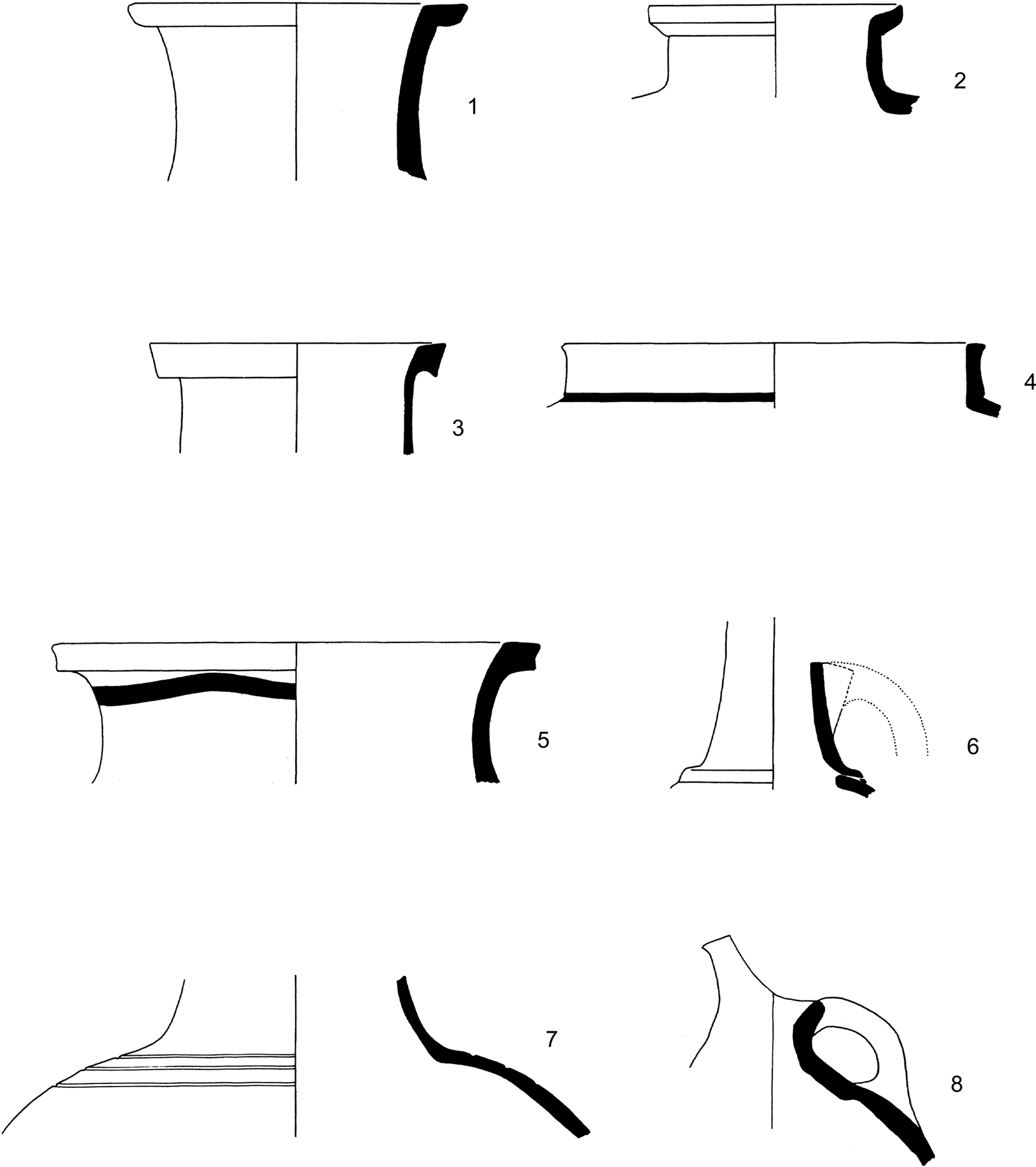
Coarse Household Ware is commoner than before in the sample deposits, at 7.4 per cent, and at least some of it shows an improvement in quality to something resembling the thin gritted Mycenaean coarse ware. It is now more often reddish brown than grey-brown, can still have variegated patches, and is rarely polished, though generally smoothed. The range of shapes is dominated by deep jug, jar and bowl shapes with broad flaring mouths (Fig. 18:1,3), which range widely in diameter, up to an estimated 40 cm in one case; an example whose profile is almost complete (Fig. 18:1) is smaller than most, and notable for tapering to a base too narrow to stand on, indicating that it must have been sunk into a bench or the floor. Its handle is of the characteristic type for these vessels, vertical and oval in section. Another large piece of a rim from a very sizeable jar is distinctive in being effectively vertical and having a finger-impressed band some distance down the body (Fig. 18:2). There continue to be examples of horseshoe-shaped lugs, and there are fragments of much smaller vessels of finer quality (Fig. 18:4–5), some of them probably Aiginetan or Cycladic imports to judge from their fabrics. One quite exceptional shape was reconstructed by Roger Howell from two pieces, separately catalogued (Fig. 18:6). He interpreted this as a firebox in a passage worth quoting:
A hollow cylindrical stem was pierced around its lower circumference and perhaps formed at its upper end a bulbous box, around the base of which was fixed a conical basin. The inside of the stem and box appeared to be blackened by fire, showing that it had been filled with charcoal to heat liquids in the bowl; the holes round the stem would have allowed air to fan the smouldering charcoal.
This reconstruction may be right, but the piece deserves further study before it is accepted and parallels are sought; at least the stem fragment does suggest an elaborate shape, probably of Aegean inspiration.
Phase VI Household Coarse Ware and pithoi. (1) 66/P.1502, H. 27.6, D. rim 14, D. base 2.4; (2) 66/P.1409, H. 4.5, D. base 10; (3) 66/P.1626, H. 6.8, D. 24; (4) 66/P.1521, H. 4.3; (5) 66/P.1457, H. 3.8, D. base 6.4; (6) 66/P.216+220, H. 6.3, D. 19.5; (7) 66/P.1520, H. 7.5, D. 33; (8) 66/P.1529, H. 3.4, D. base 18; (9) 66/P.1475, H. 3.3, D. 3.4.
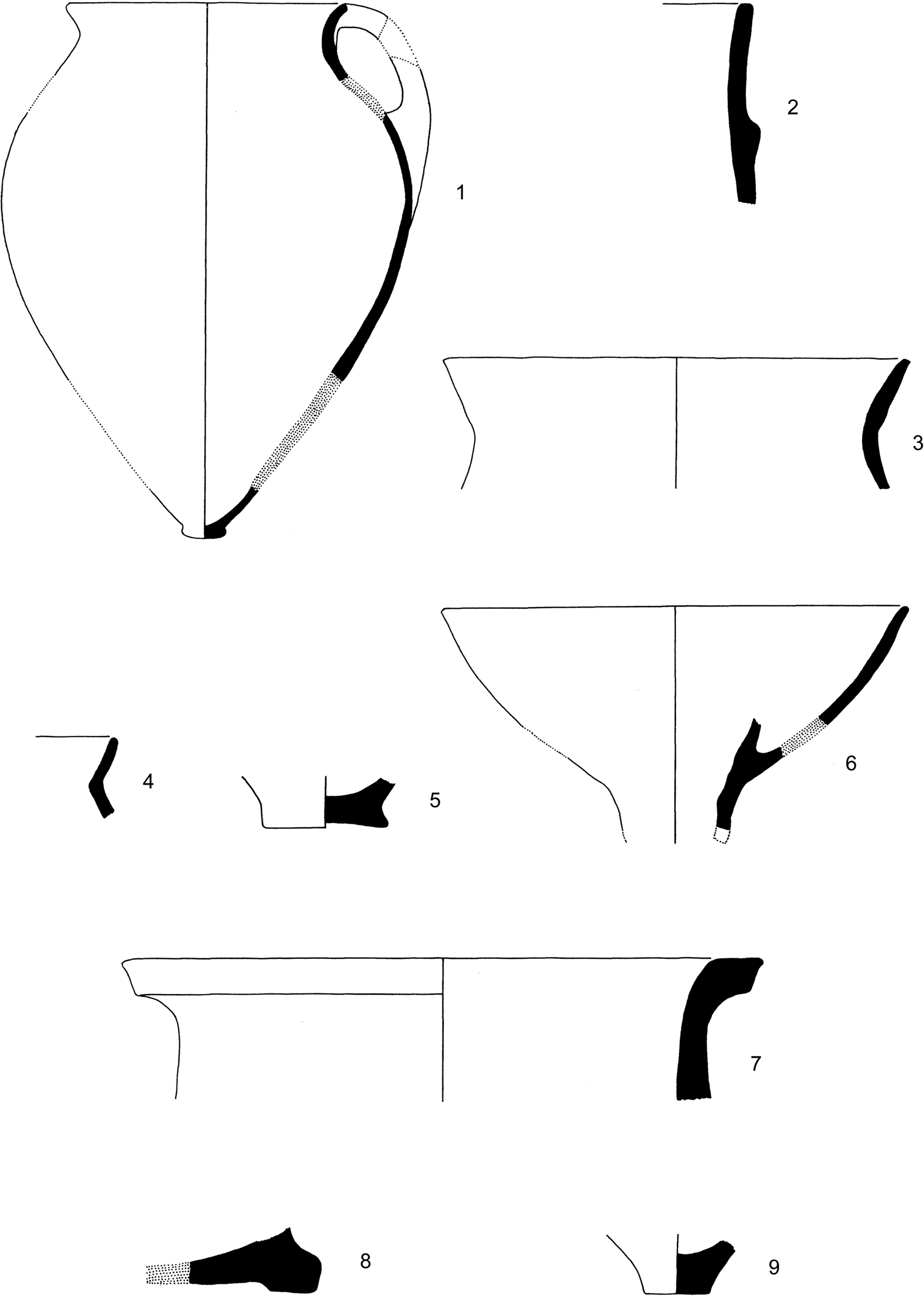
Pithos fragments, at 5.9 per cent, are about as common as before, but none are notably large. Their fabric now often contains very little grit tempering, so that it is similar to that of Plain Ware. As with the Household Coarse Ware, there are pieces of large vessels, with mouth-diameters of over 30 cm (Fig. 18:7), and also of smaller examples. Several pieces are decorated with applied bands slashed obliquely; in one case (66/P.1530) the band clearly divides a tall rim from the body. They are likely to have varied considerably in form, as is indicated particularly by the variety of bases: some are ringed (e.g. Fig. 18:8, d. 18 cm), some flat (one edge of a flat base, 66/P.1554, is of relatively fine fabric but is remarkably thick, 3.7 cm above the base) and some taper to a disproportionately small and narrow shape (Fig. 18:9).
The Pattern-Painted wares are more abundant than earlier, but still form a small percentage of the total (3.1 per cent). The most significant development here is undoubtedly the introduction of a new Bichrome style, of which much more can be said than of previous painted styles, because much larger pieces are preserved, particularly of goblets. Numerically, pieces decorated in monochrome matt paint are more common, but they seem heterogeneous, including what are almost certainly imports, to be discussed below, and likely Phase V cast-ups. The majority are jar necks with plain bands in matt grey or brown at the rim or the base of the neck (cf. Fig. 17:4–5). One piece of a small jar or jug with a zigzag motif framed by bands at the base of the neck is worth noting (Fig. 19:1), as is what looks like a goblet rim (Fig. 19:2), which was decorated with two overlapping bands on the outside and a group of five dashes inside the rim. Two krater fragments with apparently curvilinear motifs are reported; one has two curving bands by the handle (66/P.1652), the other shows two loops that may be part of a curving plant pattern or simply a poor attempt at drawing a spiral (Fig. 19:4). But the clearest sign that decoration could be more adventurous than is suggested by this scrappy material is indicated by one small piece, on which part of a quite clearly male figure is shown in ‘matchstick man’ style, with possible traces of another, in faint grey paint (Fig. 19:3).
Phase VI Pattern-Painted (1–4 matt-painted; 5–11 Bichrome). (1) 66/P.1480, H. 5.1, D. 8; (2) 66/P.1665, H. 3.2. No data are recorded for (3) 66/P.235, (4) 66/P.1586, (5) 66/P.1522, (6) 66/P.1525, (7) 66/P.1479, (8) 66/P.1531, (9) 66/P.1653, (10) 66/P.231, and (11) 66/P.1487.
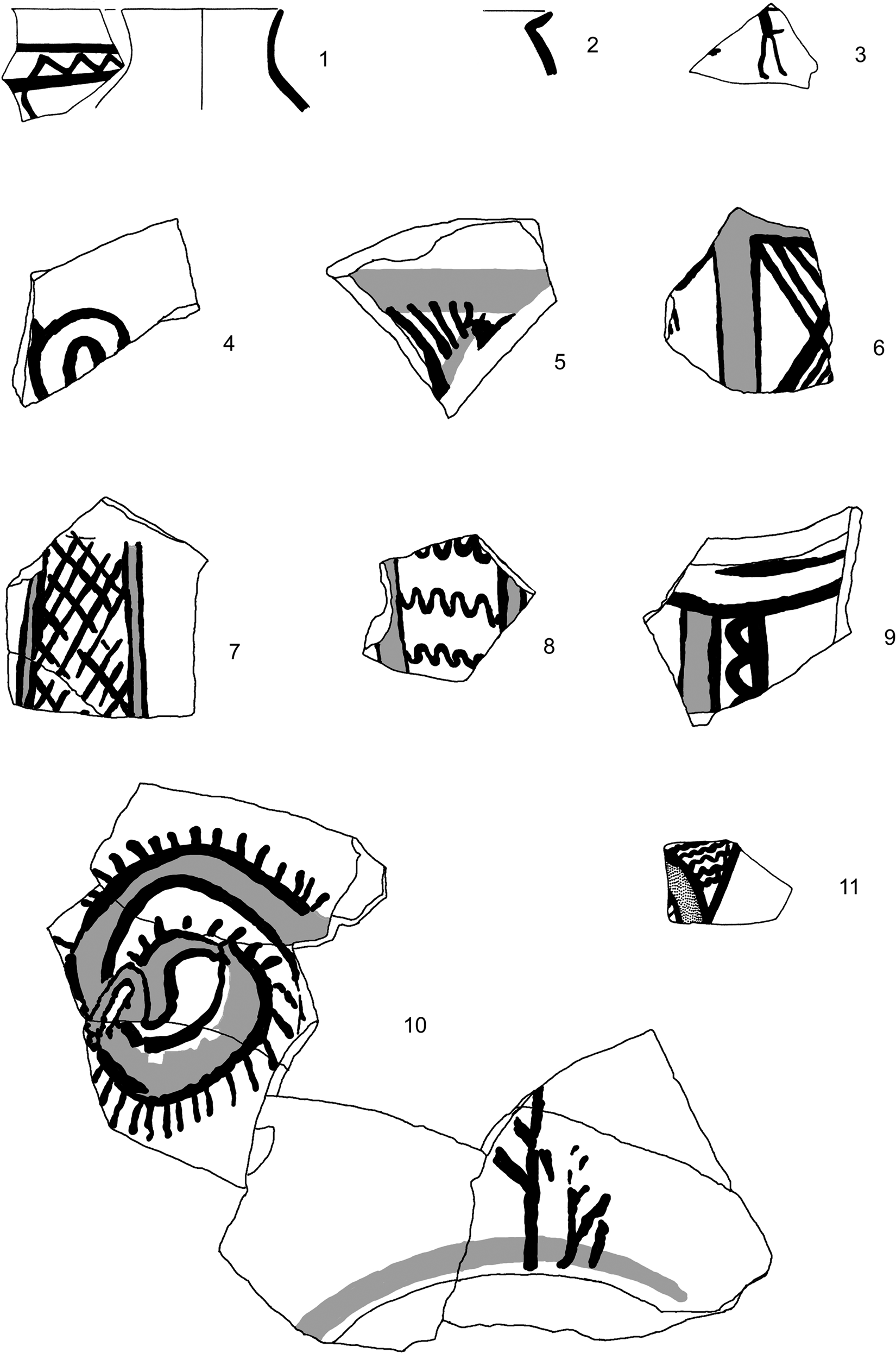
In the circumstances, interest must centre on the new Bichrome style. Its fabric is that of the best Plain Ware, reddish brown with a lighter, sometimes yellower brown, often streaky self-slip, that was created by finishing the surface with very wet hands. A light, sometimes high polish was applied to exteriors, and interiors where accessible. The two paints used are a thick, sometimes crusted paint, that can range from reddish shades to purple, and a thinner, finer grey paint, which can vary to dark brown and black. Most commonly, the red paint is used for broad bands, which are often flanked on one or both sides by thin grey to dark bands; these are sometimes doubled to flank a tightly drawn wavy line.
Grouped in various combinations, such bands are used horizontally on and below the rims of goblets and on lower bodies (Fig. 14:6–8); there is a close parallel from Orchomenos (Sarri Reference Sarri2010, photo pl. 4:3). Similar groups of straight and wavy bands also appear on the bodies of the more rarely represented kraters (e.g. Fig. 19:5; Fig. 19:6–9 are also apparently open and should be from goblets, bowls or kraters) and large closed vessels (e.g. Fig. 19:10–11), which may also have red-coated rims and grey or black bands at the base of the neck. Between the horizontal bands there may be vertical bands, quite often in the dark paint only, that can enclose rectangular panels containing some decorative motif; these can include cross-hatching, sets of wavy lines and triangular patterns, similar to those in earlier phases (Fig. 19:6–8). These filled panels sometimes appear to be only part of the frame for a broader zone or panel that might contain some further motif, but too little is preserved of the large vase bodies for their decorative schemes to be clear.
That there could be more elaborate patterns than those mentioned is indicated by one unusually large fragment, from near the base of a closed vessel, which shows a coiling shape, fringed along the edges and apparently springing from grouped vertical bars (Fig. 19:10).Footnote 25 Another fragment shows a complex curvilinear pattern, that might be part of a bird (Fig. 19:11). If so, it stands a good chance of being an import, plausibly Boeotian, for there are no clearly local examples of the range of motifs and styles characteristic of Mainland Polychrome. Some further bichrome fragments might be of similar origin, while others that have some mica in their clay, but not the gold mica found in much Aiginetan fabric, are more likely to be Cycladic (e.g. Fig. 20:7–9). Many of these sherds seem to belong to closed vases (Fig. 20:8 belongs to a narrow-necked vase of jug or amphora type).
Phase VI imports (1–3 Aiginetan; 4–5, 7–9 probably or possibly Cycladic; 6 Greek mainland?; 10 uncertain). (1) 66/P.1650, H. c. 9.7, D. 18; (3) 66/P.1606, D. of base 4.8; (4) 66/P.1456, H. 3.3, D. 13.5; (5) 66/P.233, H. 2.7, D. base 5; (8) 66/P.1632, H. 3.4; (9) 66/P.1629, H. 2.7, D. 13; (10) 66/P.1440, H. 5.1, D. 13. No data are recorded for (2) 66/P.234, (6) 66/P.212, and (7) 66/P.1634.
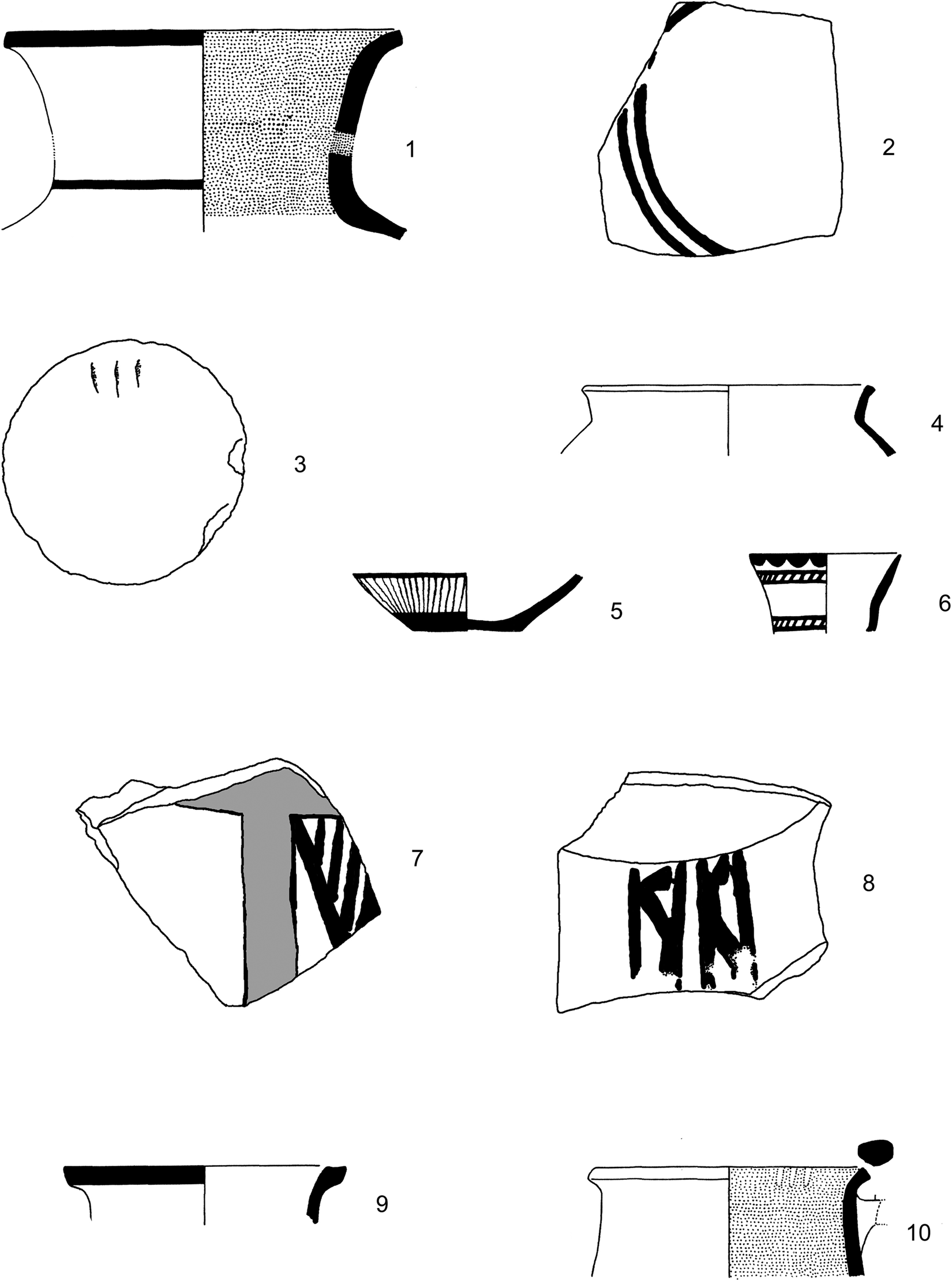
There is a relatively small but varied group of likely imports; these in fact make up a noticeable portion of the Pattern-Painted wares, but not all are painted. These include the vases decorated in Mycenaean style already referred to. Others are likely to be Aiginetan, including a small coarse jar rim and shoulder (Fig. 20:4) and three raised coarse bases of different diameter which show the same potter's mark of three incised dashes (Fig. 20:3 is the smallest); two of them contain gold mica. Quite a large group, mostly certain and likely pieces of hydriai, was identified as of the typical Aiginetan sandy porous fabric. This includes one well-preserved neck (Fig. 20:1) that is, unusually, coated inside. Some body fragments are decorated with the typical double circles motif on the body (Fig. 20:2; a larger piece covering much of the belly, 64/P.44, shows two sets of circles), but two small fragments show different motifs, a large cross-hatched triangle and vertical bars on one (66/P.1463), and on the other, a much smaller vase, a cross-hatched triangle next to an oblique line and the edge of a chequerboard pattern flanked by bars (66/P.1552).
Other pieces with a much more micaceous and sandy red-brown clay and a thick yellow slip seem likely to be north Cycladic (or possibly south Euboean), including pieces of a cup and miniature pedestal decorated in bichrome style and the cup base Fig. 20:5, which is notable for the clear Minoan link of its decoration with Ripple pattern. Few other Minoan links have been detected, but two sherds were considered by Roger Howell to be Minoan or Minoanising imports, both probably from closed shapes, in fabrics with much grit temper. One is from a large coarse vessel clearly of the Polychrome Light-on-Dark class, with bands of dusky red and white on a semilustrous black coat (66/P.1448); the other comes from quite a thick (0.8 cm) flat base, with a dark band above the base on a semilustrous dark reddish-brown coat (66/P.1466).
A relatively large and well-preserved piece of a Vapheio cup shape with fine matt-painted decoration (Fig. 20:6) seems more likely to be a product of a mainland, even Peloponnesian workshop, rather than local,Footnote 26 and a few other matt-painted pieces were thought by Roger Howell to be imports of mainland origin. But the pieces that most clearly originate from elsewhere on the mainland, apart from the Mycenaean decorated, are two examples of the ‘Lianokladhi Matt-Painted’ Δ1β ware, that is particularly well represented at Lianokladhi in the Spercheios valley, but is widely distributed in Thessaly and central Greece. The most substantial belongs to a large closed vessel, decorated on the shoulder with elaborate groups of linked chevrons standing on horizontal lines (catalogued in 1965, but number not recorded in the Howell manuscript). Unfortunately, these interesting fragments come from very mixed levels in Trial Trench IX, so that their precise dating is unclear, but they seem likely to fall in late MH at earliest.
Finally, there are a few decorated pieces of uncertain origin, from small open vessels and from jugs or jars. The most substantial is from a jug-neck shaped like a broad cone, only slightly flaring at the mouth, of slightly micaceous red-brown and porous clay, soft-fired; its interior is coated with red paint and shows traces of vertical bands in white matt paint (Fig. 20:10). This might be related to the ‘Red Minyan’ class, no longer found, some of which is decorated in white. This whole class of likely imports would undoubtedly benefit from further study, now that our knowledge of the wares current in the Aegean in the New Palace or Second Palace Period has been much improved through study of the material from Ayia Irini (Kea) and Akrotiri (Thera).
SUMMARY
The identified sequence of pre-Mycenaean phases at Lefkandi forms much more of a genuine sequence in its earlier than later stages. Effectively, in the material covered above, we get snapshots of stages in the Lefkandi sequence that may, in the terminology becoming popular, be classified as MH IB or later MH I (Phase IV), an advanced stage of MH II (Phase V), and what may well begin in MH III but is contemporary with much of LH I–II (Phase VI). There is limited scope for surmises about developments between Phases IV and V, and between V and VI. The evidence that Lefkandi provides is nevertheless of considerable value, and Phase VI provides the fullest picture yet available from central Greece for a phase that is early Mycenaean in date but in terms of pottery style is still basically MH. The links of the Lefkandi sequence with those of Pefkakia and Mitrou will be evident from the account above, and the general similarities in the typology of the Minyan wares, in particular, with what is characteristic not only at Pefkakia and Mitrou but also more central sites with long sequences such as Lerna and Kolonna, mean that the successive phases can be placed in a relative chronological framework, both with these and with the sequence at Ayia Irini on Kea and the Minoan sequence. But the presence of occasional Minoan-seeming pieces is not as much help as it might be, since, being small fragments, they are not easy to attribute to a single phase, and may not be Minoan from Crete but rather Minoanising of the type well known from Lerna and Ayios Stephanos, that is closely linked with the local Minoan pottery of Kythera.
Such pieces are not prominent among the heterogeneous group of what appear to be imports, among which likely Aiginetan and Cycladic pieces are far more conspicuous, though still not especially numerous. In this respect Lefkandi fits the picture presented by the material from Orchomenos, where only a single Minoan piece could be identified (Sarri Reference Sarri2010, 79–84). The appearance of potentially Peloponnesian pieces and also of two pieces of the northern Δ1β ware, again paralleling finds at Orchomenos, underlines the possibility that Lefkandi played a significant role as a node in the basically maritime exchange network(s) linking the southern Aegean with the central and northern mainland. It is to be hoped that further work at important sites with long sequences such as Kirrha and Mitrou will shed more light on developments at Lefkandi, particularly in the painted wares, which, apart from Aiginetan Matt-Painted, remain poorly known.
Perhaps the most striking feature of the pottery, as reflected particularly in the later phases, is the notable self-confidence of the Lefkandi potters, shown in their general indifference to foreign styles. Aiginetan Matt-Painted, notably popular at Mitrou, makes only a limited appearance and was clearly not popular enough locally for any attempt to be made to imitate its commonest types. This is equally true of the best-known Cycladic and Minoan or Minoanising types current when Aiginetan Matt-Painted was flourishing. This lack of interest in outside developments continued even in the final stages of MH, when Cycladic and Minoan influences led to the development of new styles on the mainland, particularly in the north-east Peloponnese, but also on Aigina and to some extent in Attica, Boeotia and Phocis.Footnote 27 Some examples of the plausibly Boeotian Mainland Polychrome style almost certainly reached Lefkandi, and the Phase VI Bichrome style may be seen as the local potters’ rather limited response to that style. But otherwise they show no evidence of more than sporadic responses to developments elsewhere on the mainland; they did not adopt any of the new shapes systematically, let alone the new styles and motifs. It is remarkable how little evidence there is even for the adoption of the Mycenaean types of plain goblet, a very popular shape in the developing Mycenaean cultural region.
In this, as before, they may be reflecting the conservatism of their customers, who, for a while at least, may have felt no need to change their behaviour and replace the drinking vessels and large jugs and jars that will have featured at their ceremonial occasions. But the examples of imported LH I–II decorated pottery, many of them drinking vessels, show that developments in the outside world were not totally ignored, and it may well have been in response to a change in demand that the potters finally began to produce recognisably Mycenaean decorated and plain wares, although the early stages of this process are still inadequately documented.
This represents a remarkable foreshadowing of a similar situation in the Early Iron Age, when the local ‘Sub-Protogeometric’ style not only endured for generations after the development of the Geometric style in Attica, but accepted very little influence from it, despite the importing of many fine Attic Geometric vases for use as elite grave-goods, until finally, and with seeming abruptness, a local Euboean version of the Late Geometric style emerged. It is possible that, if a better range of Lefkandi graves of the early Mycenaean period could be found, it might offer a similar picture; certainly, some good examples of LH I–II decorated vases come from the tombs containing children's burials in Trench CC. But in the end, it must be admitted that our picture of Lefkandi over the generations that saw the transition from MH to Mycenaean is patchy, and likely to remain so until relevant levels have been investigated further.
ACKNOWLEDGEMENTS
This paper has taken a regrettably long time to produce, for which I must bear responsibility, though some factors causing delay have been beyond my control. It could not have been written at all without Roger Howell's provision of copies of his manuscript and associated illustrations, and I thank him very warmly for his willingness to provide these. In the course of the successive revisions that I have given it, I have received useful comments from Miss Ioanna Galanaki and Dr Iro Mathioudaki, who sent me a copy of her PhD thesis. I have benefited considerably from Dr Chris Hale's readiness to send me a copy of Hale Reference Hale2016 before publication and Dr Salvator Vitale's provision of a copy of the paper of which Hale et al. Reference Hale, Vitale and Van de Moortel2016 is an abstract. My two anonymous reviewers made very useful comments on the text originally submitted. Dr Hayley Saul (now at the University of Western Sydney, Australia) did very good work in preparing figures from selections that I chose from the illustration copies provided by Roger Howell, and Mr Dominic Andrews provided corrected tiffs of these, which had become somehow distorted. Finally, I am very grateful to Dr Georgia Flouda for providing a translation of my abstract into Greek.