I. INTRODUCTION
It has been known for a long time that the surface and environmental effects play an important role in the plasticity of materials.Reference Rehbinder1 They are also known to be vital in determining the tribological (friction and wear) properties of materials such as ceramics which show a strong dependence on sliding atmosphere.Reference Fisher, Anderson, Jahanmir and Shlhei2, Reference Sasaki3 Components based on bulk ceramic materials and ceramic coatings have been observed to exhibit friction and wear behavior that is dependent on the environment in which they operate.Reference Fischer4–Reference Singer, Fayeulle and Ehni6 Explanations for this focus on chemisorption affecting friction or near-surface mechanical properties being altered by the environment. A lubricating fluid between contacting surfaces can greatly reduce the frictional forces and wear. The lubricating fluid may play several roles such as forming a thin adsorption layer or giving a thin layer with a low shear stress compared to the stress needed to shear two contacting solid surfaces. The chemical reaction of the fluid with the surface may also change the materials mechanical properties.
Indentation hardness is often used as a guide to a material’s ability to resist wear. The literature shows that indentation has been used in several studies to understand the surface contact behavior of various materials in different types of environments. The earlier work using microindentation was often controversialReference Westwood, Macmillan and Lalyoncu7, Reference Macmillan, Huntting and Westwood8 in part due to the scale of the effects which only become pronounced in the near-surface region. Later a study by Czernuszka and Page examined the chemomechanical effect in various ceramic materials using different liquid environments.Reference Czernuszka and Page9 In these studies, microindentation tests were performed on ceramic surfaces immersed in various alcohols which showed that the alcohol could noticeably change the hardness of the surface. However, the variations in hardness (H) values in these studies were of a similar order to the measurement error for the instrument. Advances in instrumentation have seen microindentation pushed into the nanometer range that allows mechanical properties such as elastic modulus and hardness to be studied on a very small scale that is similar to that of a single asperity. This has led to the use of nanoindentation techniques in the study of surface chemistry and environmental effects on the mechanical behavior of various materials such as: ceramics,Reference Hainsworth and Page10–Reference Sasaki and Pethica12 metals,Reference Gerberich, Venkataraman, Huang, Harvey and Kohlstedt13, Reference Venkataraman, Kohlstedt and Gerberich14 and semiconductors.Reference Mann and Pethica15, Reference Mann16 Hainsworth and PageReference Hainsworth and Page10, Reference Hainsworth and Page11 heated the samples and then quenched them in different solvents. Gerberich et al.Reference Gerberich, Venkataraman, Huang, Harvey and Kohlstedt13, Reference Venkataraman, Kohlstedt and Gerberich14 tried to control the surface chemistry by placing drops of liquid on the sample in contact with the indenter. Mann and PethicaReference Mann and Pethica15 were the first to perform nanoindentation tests where the sample and the indenter are completely immersed in liquid which provides the ideal conditions for the testing of chemomechanical effects. Hainsworth and Page suggested that the changes in measured properties are because of changes in microstructure due to chemomechanical effects, for instance, water absorption forming a softer surface layer. Mann and PethicaReference Mann and Pethica15 concluded that changes in stress field and geometry are major factors causing apparent changes in deformation as opposed to intrinsic material properties being altered. In another study, MannReference Mann16 observed an apparent increase in measured hardness and reduced elastic modulus (E r) of GaAs (100) when the sample was immersed in long-chain alcohols. Measured H values were 48% greater and E r values were 39% higher when the indentation tests were performed on samples immersed in long-chain alcohols. It was suggested that there is both a geometric and an elastic effect on the mechanical deformation when sample is immersed in long-chain alcohols. Organic molecules have the ability to sustain large elastic strains when in confined geometries which results in a substantial change in observed nanomechanical behavior. Literature also shows several recent studies where nanoindentation tests have been performed in liquid environment. Biological materials are tested in fluids to better understand their mechanical response in physiological conditions.Reference Bembey, Bushby, Boyde, Ferguson and Oyen17–Reference Hengsberger, Kulik and Zysset20 Nanoindentation experiments in solutions have been used to study the effect of electrochemically in-situ charged hydrogen on the deformation of small volumes of different materials, such as: nickel,Reference Barnoush and Vehoff21 copper,Reference Barnoush and Vehoff21 and FeAlReference Barnoush, Bies and Vehoff22 single crystals.
In this work, nanoindentation tests have been performed on silicon (100), fused silica, and gold film on a glass substrate. Tests were carried out while immersing the samples in various long-chain alcohols (i.e., 1-hexanol, 1-heptanol, 1-octanol, and 1-nonanol). Nanomechanical results for the tests in these liquids have been compared with the results obtained for samples tested in air. The presence of these long-chain alcohols is observed to have a significant effect on the measured nanomechanical properties of some of the tested materials.
II. MATERIALS AND METHODS
Silicon (100) wafers were obtained (Nova Electronic Materials, Ltd., TX) and cut into small pieces. These pieces were cleaned with acetone followed by ethanol and methanol before nanoindentation tests. Fused silica windows were obtained from Edmunds Optics (Part No. 47231) and cut into small pieces (i.e., 5 × 5 mm2) using a low speed diamond wafering blade (Isomet, Buehler, Lake Bluff, IL). Fused silica samples were also cleaned with acetone followed by ethanol and methanol before testing. No polishing was done on silicon and fused silica as these were obtained optically polished. Thin gold films (∼40-nm thick) were deposited on glass microscope slide substrates (Fisher Scientific, Pittsburg, PA) by the evaporation method using a vacuum coating instrument (Model: E306A; Edwards coating system, Edwards, Crawley, UK). 1-hexanol and 1-heptanol were obtained from Sigma-Aldrich (St. Louis, MO) and 1-heptanol and 1-nanonal were obtained from Fluka (St. Gallen, Switzerland). All alcohols used in this study had a purity of more than 99%.
Nanoindentation experiments were performed using a Triboindenter (Hysitron Inc., Eden Prairie, MN). A fluid tip with a diamond Berkovich tip was used for the tests. The shape of the indenter tip was calibrated by performing a series of nanoindents on a standard fused quartz sample in accord with the method outlined by Oliver and Pharr.Reference Oliver and Pharr23 Each sample was tested in air and in various long-chain alcohols (i.e., 1-hexanol, 1-heptanol, 1-octanol, and 1-nonanol). Different maximum loads (i.e., 1, 2, 3, 5, 7, and 10 mN) were applied to obtain results from varying depths. Sixteen indents were made at each load and the indents were spaced 5 μm apart to prevent the indents affecting each other. The load–displacement curves obtained were analyzed using the standard Oliver and PharrReference Oliver and Pharr23 method. The measured modulus in this study is the E r which is calculated from the unloading portion of the load–displacement curves obtained during nanoindentation.
III. RESULTS AND DISCUSSION
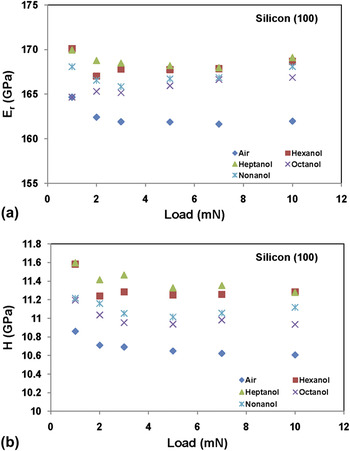
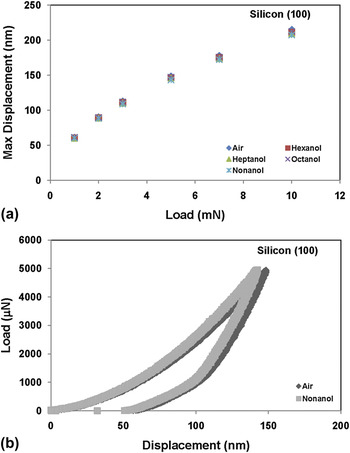
The results for silicon (100) are shown in Figs. 1 and 2. Figures 1(a) and 1(b) show the E r and H values, respectively, at various loads in different alcohols. The average of measured E r and H values are used in the plots. Standard deviation for these values was less than 1%. From these plots, it is clear that there is an increase in the measured E r and H values at all the indentation loads when silicon is immersed in the long-chain alcohols. A more than 5% increase in the measured E r values and a 10% increase in the measured H values were observed. These increases are of statistical significance and much higher than the standard errors in the data. Figure 2(a) shows the plot of maximum indentation depths at different loads and in various alcohols. From this plot it is clear that the maximum indentation depth does not change when the samples are immersed in alcohols which suggest that there may not be any changes in the intrinsic material properties due to the presence of alcohol. Representative load–displacement curves for silicon tested in air and nonanol at an applied load of 5 mN are shown in Fig. 2(b). From these load–displacement curves it can also be seen that there is hardly any difference in displacements for silicon tested in air and in different long-chain alcohols. The standard deviation in displacements was observed to be ∼2% at the lowest load and it was less than 0.5% for higher load indentation tests.
Measured nanomechanical properties for silicon (100) in air and in different long-chain alcohols at various indentation loads. (a) Average reduced elastic modulus (E r) and (b) Average Hardness (H). Standard deviation for both measured E r and H values was ∼2% at the lowest load (i.e., 1 mN) and less than 1% at all other applied loads.

(a) Average maximum displacements for nanoindentation tests on silicon (100) in air and different long-chain alcohols at various indentation loads. Standard deviation for the data was <1% at lower loads and <0.5% at higher loads. (b) Representative load–displacement curves for silicon (100) obtained during nanoindentation tests performed in air and in nonanol at a load of 5 mN.

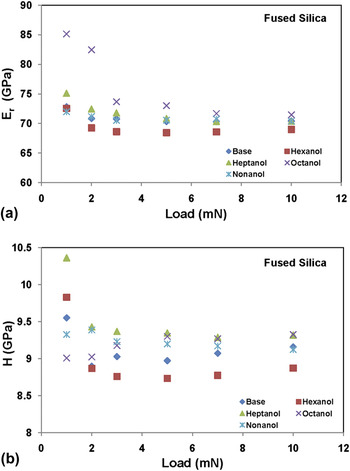
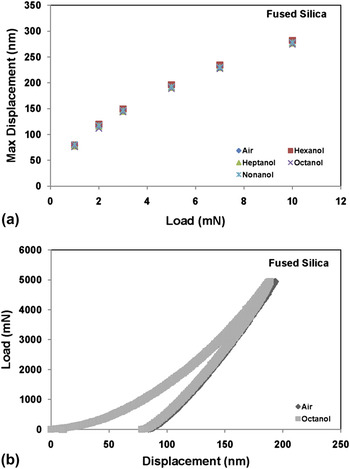
Average of measured E r and H values for fused silica at various loads in different testing conditions is shown in Figs. 3(a) and 3(b), respectively. Fused silica exhibited a similar behavior when immersed in alcohols as seen in the case of silicon, though there was greater variability in the results. An apparent increase in E r and H values was observed on fused silica immersed in all the alcohols except 1-hexanol. Different pieces of the sample were used to perform the tests in different alcohol. The difference in results for 1-hexanol might be due to some impurities either on the sample surface or in the alcohol itself (99% pure). Data showed a standard error of less than 1% for fused silica which is also similar to that of silicon. The increase in the measured E r and H values when fused silica is immersed in alcohols is also similar to that observed in the case of silicon. Figure 4(a) shows the maximum displacements in fused silica at different loads tested in air and in different alcohols. From the plot it is seen that maximum displacements in case of fused silica also show a similar behavior as compared to silicon. At a particular applied indentation load, no change in maximum displacements was observed for fused silica when immersed in long-chain alcohols. This behavior can be clearly seen in Fig. 4(b) which shows representative load–displacement curves for fused silica tested at 5-mN loads in air and in octanol.
Measured nanomechanical properties for fused silica in air and in different long-chain alcohols at various indentation loads. (a) Average E r and (b) Average Hardness (H). Standard deviation for measured E r values was ∼1% and standard deviation for H values was ∼2%.

(a) Average maximum displacements for nanoindentation tests on fused silica in air and different long-chain alcohols at various indentation loads. Standard deviation for the data was ∼2% at lower loads and <1% at higher loads. (b) Representative load–displacement curves for fused silica obtained during nanoindentation tests performed in air and in octanol at a load of 5 mN.

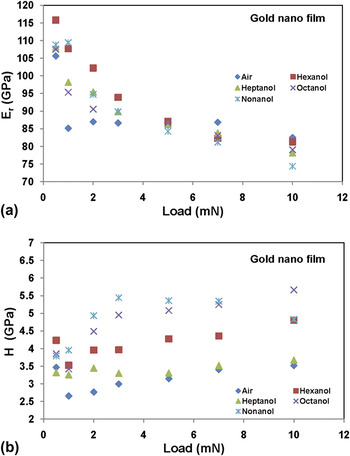
Nanoindentation results for thin gold films in different alcohols are shown in Figs. 5(a) and 5(b). Figure 5(a) shows the obtained E r values for the tests on gold films at various loads in the different conditions, and Fig. 5(b) shows the H values obtained for the same conditions. In the case of gold films, the average of H values displayed a similar trend to that seen in silicon and fused silica. That is, the measured H values at all applied loads were higher when the gold films were immersed in different alcohols. However, it is seen in Fig. 5(a) that the variation in E r in the case of gold films is not consistent with the variation of E r seen in the cases of silicon and fused silica. For the gold films, an increase in E r values was observed for indentation tests with a maximum load of up to 3 mN when immersed in the alcohols. At this load, the maximum displacement was ∼177 nm. At a load of 5 mN, a reversal in the measured E r values was seen with the value similar in air and the alcohols. A decrease in E r values for gold films immersed in alcohols was observed at higher loads (i.e., 7 and 10 mN). No change in maximum displacements was observed for gold films when tested in different alcohols at a particular load. From Fig. 5(a), it can be seen that the E r values at the lowest indentation depth (i.e., at applied load of 0.5 mN) are higher than the obtained E r values for all other indentation depths in our study. Higher E r values at the lowest depth may be attributed to the surface roughness of the gold films.
Measured nanomechanical properties for gold films tested in air and in different long-chain alcohols at various indentation loads. (a) Average E r and (b) Average Hardness (H). Standard deviation for measured E r and H values was >5% at lower loads (i.e., 0.5 and 1 mN) and <5% at all other applied loads.

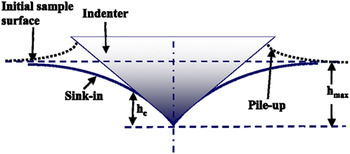
As mentioned earlier in this section, the variation in measured E r values in case of gold films is not consistent with the observed variation in E r values in case silicon and fused silica. This could be due to the difference in deformation mechanisms in these materials beneath the indenter during the indentation process. Figure 6 shows a schematic representation of a section through an indentation showing the surface profile of the tested material around the indenter tip during indentation. Two different types of deformation behavior shown in the figure are pile up and sink in. Silicon and fused silica are harder materials and exhibit sink-in behavior during the indentation that allows the long-chain alcohol molecules to accommodate in the confined space between the indenter and the sample surfaces. In comparison, gold film being softer material will give rise to pile up around the indenter surface. And in case of pileup, there will be no space between the indenter and sample surfaces there by not allowing the long-chain alcohol molecules to enter between them. When the alcohol molecules are trapped in between the indenter and sample surfaces at the nanocontact, an increase in E r and H values is observed. This suggests that the alcohols affect the measured H and elastic modulus values in a different way for the gold films on the glass substrate.
Schematic representation of a section through an indentation showing surface profile of materials around the indenter during indentation.

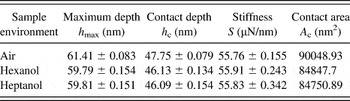
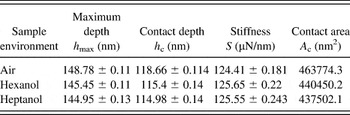
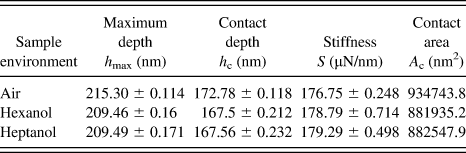
To further understand the mechanisms responsible for the increase in the measured nanomechanical properties, we analyzed the maximum depth (h max), contact depth (h c), stiffness (S), and contact area (A c) obtained during nanoindentation tests at various applied loads in different experimental conditions. Obtained results for indentation tests on silicon in various testing conditions (i.e., in air, 1-hexanol, and 1-heptanol) are listed in Tables I, II, and III. Results for applied indentation loads of 1, 5, and 10 mN are shown in Tables I, II, and III, respectively. From the tables, it is seen that there is a slight change in the h max, h c, and S values at a particular load when the silicon sample is immersed in the alcohols. Decrease in h c and an increase in S is observed when silicon is tested in liquids as compared to when tested in air. However, the A c is observed to decrease at each applied load when silicon is immersed in long-chain alcohols. Similar variations in h c, S, and A c were observed in case of fused silica. The decrease in A c suggests that the long-chain alcohol molecules get trapped in the confined space at the point of contact around the indenter and distribute the load over a larger surface area. This results in a decrease in the perceived h c and A c, which in turn results in an increase in the measured E r and H values.
Nanoindentation results on silicon at indentation load of 1 mN.

Nanoindentation results on silicon at indentation load of 5 mN.

Nanoindentation results on silicon at indentation load of 10 mN.
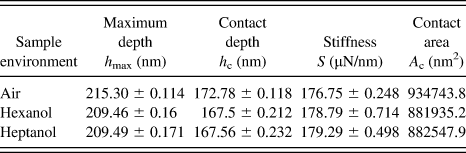
From the obtained data, no specific trend in the variation of measured nanomechanical properties is observed with the variation in chain length of the alcohol molecules. This can also be observed from the data shown in Tables I, II, and III. So at this point, the effect of chain length on the nanomechanical properties is not clearly understood. Detailed study on more materials is needed to predict and model the effect of chain length on the nanomechanical response. One more observation in this study is that the effect of alcohols on the nanomechanical properties does not seem to diminish with the increase in indentation size (i.e., increase in applied indentation load). From the Tables I, II, and III, it is observed that change (i.e., percentage decrease) in A c and h c remains constant for indentation tests in a particular alcohol as compared to air at different applied load (i.e., different indentation depths). For example, observed decrease (in percentage) in A c when silicon is immersed in 1-heptanol is constant at different applied indentation loads (i.e., 1, 5, and 10 mN). This suggests that the amount of long-chain alcohol molecules trapped in the confined space around the indenter increase with the increase in indentation size. Amount of change in the trapped long-chain alcohol molecules will also vary depending on the deformation behavior of material. Further work is needed to predict the amount of long-chain alcohol molecules getting trapped around the indenter near the point of contact for a particular material. This will also give a better understanding about the effect of chain length and its variation with indentation size.
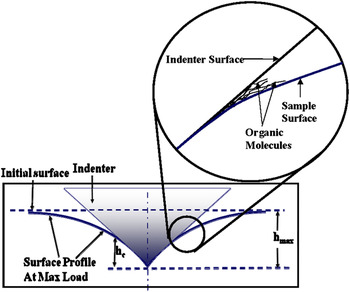
The most common response observed during immersion in long-chain alcohols is an increase in the measured nanomechanical properties of the material, which has previously been attributed to geometric and elastic effects on the deformation behavior of the material at the point of contact.Reference Mann16 The viscous, long-chain organic alcohol molecules may sustain an elastic strain and act as elastic fluids in the highly confined geometry around the edges of the nanocontact where the indenter tip meets the sample. A schematic representation of the nanocontact during the nanoindentation test on a sample immersed in liquid is shown in Fig. 7. The presence of this elastic fluid in a confined geometry can modify the mechanical deformation of the material by spreading the normal stress over a larger surface area and, hence, giving a perceived increase in the mechanical properties (E r and H).
Schematic representation of a section through an indentation of a material immersed in long-chain alcohols showing organic molecules in confined geometry at the nanocontact.

IV. SUMMARY AND CONCLUSIONS
In this work, we investigated the effect of long-chain alcohols on the nanomechanical properties of various materials, notably silicon (100), fused silica, and thin gold films on glass substrates. In most cases, an apparent increase in the measured E r and H values was observed when the samples were immersed in long-chain alcohols. When a sample immersed in long-chain alcohols is indented, the long molecules get trapped in the confined space between the indenter and sample surfaces around the indenter tip. When in confined geometry, these organic molecules sustain some elastic strain and distribute the load over a larger surface area. This causes a decrease in the perceived A c which results in an increase in the measured E r and H values. It was also observed that effect of long-chain alcohols on the nanomechanical response of silicon and fused silica was different as compared to that of gold nanofilms. Our results are in agreement with previously reported study in the literature on GaAs.Reference Mann16 The results of the nanomechanical tests in this study are consistent with the deformation behavior of the nanocontact being affected by geometric and elastic effects due to the confinement of the organic fluid around an asperity contact. The results suggest that a material’s nanomechanical response may exhibit a substantial change when the surface is covered with organic fluids containing molecules many Angstroms in length. The results have significant implications in the area of tribology. In particular, they give an insight into how viscous fluids such as oily lubricants can mitigate mechanical damage between contacting surfaces by spreading the normal loads over a greater surface area, effectively blunting the smallest nanoasperity contacts.
ACKNOWLEDGMENTS
We thank the Rutgers University Institute for Advanced Materials Devices and Nanotechnology for financial support. We acknowledge Hisato Yamaguchi and Ben Groth for helping in sample preparation.