Since the introduction of storage and transportation of raw milk under refrigerated conditions in the 1950s, the spoilage of raw milk by mesophilic microbiota has been substantially reduced. According to the guidelines of Food Standards Australia and New Zealand (FSANZ), raw milk is required to be stored at 5 °C within 3·5 h from the start of the milking process, whereas the European Union (EU) standards state that raw milk is required to be stored at 6–8 °C within 2 h from the end of milking (FSANZ, 2012). While this practice hinders the growth of mesophiles, cold storage of raw milk provides favourable conditions for the growth of psychrotrophic microorganisms (Quigley et al. Reference Quigley, O'Sullivan, Stanton, Beresford, Ross, Fitzgerald and Cotter2013). Thus, the level of psychrotrophs in raw milk after the milking process is dependent on both the storage temperature and time (Griffiths et al. Reference Griffiths, Phillips and Muir1987; Vithanage et al. Reference Vithanage, Dissanayake, Bolge, Palombo, Yeager and Datta2016). The initial psychrotrophic bacterial load typically accounts for <10% of the total microbiota when milking is conducted under hygienic conditions, however, these bacteria can become >75% of the total population when milking is conducted using unhygienic protocols (Cousin, Reference Cousin1982). The dairy farm environment comprises a variety of potential sources of psychrotrophs that can contaminate raw milk, mainly during the milking process (Vissers & Driehuis, Reference Vissers, Driehuis and Tamime2009).
Psychrotrophic bacteria isolated from raw milk predominantly include the Gram negative genera of Pseudomonas, Acinetobacter, Hafnia, Rahnella, Alcaligenes, Achromobacter, Aeromonas, Serratia, Enterobacter, Chryseobacterium, Chromobacterium, and Flavobacterium, and the Gram positive genera of Bacillus, Clostridium, Corynebacterium, Streptococcus, Micrococcus, Staphylococcus, Enterococcus, Lactobacillus, and Microbacterium. Of these, Pseudomonas and Bacillus are the most frequently reported raw milk isolates (Vithanage et al. Reference Vithanage, Dissanayake, Bolge, Palombo, Yeager and Datta2016). Psychrotrophic bacteria are able to grow at minimum temperatures between −10 and 7 °C; optimum temperature is in the range of 25–35 °C; and maximum temperature can be as high as 45 °C. In addition, some thermoduric psychrotrophs are able to withstand temperatures as high as 72–74 °C (McKellar, Reference McKellar1989).
During cold storage, these bacteria can produce extracellular proteases (mainly) and lipases that are resistant to pasteurisation and even ultra-high temperature (UHT) processing, contributing to the spoilage in milk and dairy products (Oliveira et al. Reference Oliveira, Favarin, Luchese and McIntosh2015). Proteolytic enzymes induce the hydrolysis of casein, which may be evident as a greyish colour, bitter taste and gelation of spoiled milk (Vyletělová & Hanuš, Reference Vyletělová and Hanuš2000a). UHT milk is more susceptible to proteolysis than pasteurised milk due to longer storage times under ambient temperature condition (McKellar, Reference McKellar1981). Psychrotrophs with higher protease expression can produce this level of protease activity within a few hours under suboptimal storage conditions (Renner, Reference Renner1988).
The relationship between psychrotrophs and milk quality has been widely investigated (Marchand et al. Reference Marchand, Heylen, Messens, Coudijzer, De Vos, Dewettinck, Herman, De Block and Heyndrickx2009a; Oliveira et al. Reference Oliveira, Favarin, Luchese and McIntosh2015). To date, limited evidence has been found associating the effect of storage conditions with the growth of psychrotrophic bacteria, their proteolytic potential and deterioration of milk proteins due to proteolysis (Griffiths et al. Reference Griffiths, Phillips and Muir1987; Haryani et al. Reference Haryani, Datta, Elliott and Deeth2003; O'Connell et al. Reference O'Connell, Ruegg, Jordan, O'Brien and Gleeson2016). Changes in storage conditions are also associated with the microbial composition in the corresponding samples (Lafarge et al. Reference Lafarge, Ogier, Girard, Maladen, Leveau, Gruss and Delacroix-Buchet2004; Hantsis-Zacharov & Halpern, Reference Hantsis-Zacharov and Halpern2007; von Neubeck et al. Reference von Neubeck, Baur, Krewinkel, Stoeckel, Kranz, Stressler, Fischer, Hinrichs, Scherer and Wenning2015). However, the experimental data demonstrating the relationship between microbial counts and proteolysis in raw milk is not well established, due to the distinct variation in the proteolytic potential and heat-resistance of those proteolytic enzymes produced by raw milk microbiota (Dogan & Boor, Reference Dogan and Boor2003; Marchand et al. Reference Marchand, Vandriesche, Coorevits, Coudijzer, De Jonghe, Dewettinck, De Vos, Devreese, Heyndrickx and De Block2009b). Hence, the current study investigated the effects of microbiological quality and associated proteolysis on storage life of raw milk under different refrigeration conditions for a prolonged period with a focus on psychrotrophic proteolytic counts (PPrBC). The effect of high-temperature short-time pasteurisation (HTST) of raw milk prior to the UHT processing on microbiological and proteolytic parameters was also evaluated.
Materials and methods
Raw milk samples
Raw milk samples from three commercial farms (designated as A, B and C) were provided by a commercial UHT milk processor in Victoria, Australia. These samples were selected from seven potential samples to represent high quality (A: 2·3 × 104 cells/ml) medium quality (B: 5·3 × 105 cells/ml) and poor quality (C: 6·7 × 106 cells/ml) raw milk based on Bactoscan counts as well as statistics of the respective commercial processor (Vithanage et al. Reference Vithanage, Yeager, Jadhav, Palombo and Datta2014). Three representative samples were collected directly from the bulk milk tank at each of the farms under aseptic conditions and delivered to the laboratory on ice (at 4–5 °C) within 2–3 h of the milking procedure. A volume (500 ml) of the samples was transferred into a sterile Erlenmeyer flask (1 1) under aseptic conditions and stored under various experimental conditions (as described below). Samples were analysed daily, commencing from day 0, representing three biological (three separate samples of milk from each bulk tank) and three technical (three sub samples from each 500 ml) replicates (n = 9).
Storage conditions
Raw milk samples were incubated under various temperature conditions in a refrigerated shaking incubator (Innova 4230, New Brunswick Scientific, Edison, NJ, USA) and subjected to constant agitation at 120 rpm for 10 d. Those conditions included 2 °C (deep cooling), 4 °C (standard refrigeration) and 6, 8, 10 or 12 °C (elevated temperatures in the farm bulk tank and commercial silo).
Enumeration of bacteria in raw milk
The total plate count (TPC) was determined according to the method described in the International Dairy Federation (IDF) standard: 101A: 1991 with slight modification. Raw milk samples were serially diluted (10-fold) and cultured on plate count agar (Sigma-Aldrich, Castle Hill, Australia) supplemented with 1·0% (w/v) skim milk (PCM agar) using the drop plate method (Munsch-Alatossava et al. Reference Munsch-Alatossava, Rita, Alatossava and Méndez-Vilas2007) and incubated for 10 d, at 7 °C (for psychrotrophic bacterial counts: PBC) and 48 h at 30 °C (for total plate count: TPC) in duplicate. Clearing zones around colonies of psychrotrophic bacteria were indicative of proteolysis and these colonies were used to calculate PPrBC counts (Cempírkova, Reference Cempírkova2007).
The thermoduric psychrotrophic count (TDPC) was determined by heating the raw milk at 63 ± 0·5 °C for 30 min, in a shaking oil bath (Ratek, Boronia, Victoria, Australia), excluding the come up time (i.e., time required to reach the corresponding temperature). Samples were cultured on PCM and incubated at 7 °C for 10 d (Buehner et al. Reference Buehner, Anand and Garcia2014).
Identification of predominant raw milk microbiota
Identification of predominant isolates was conducted using matrix-assisted laser desorption time of flight mass spectrometry (MALDI-TOF MS) as well as 16S rRNA sequencing according to the method described by Vithanage et al. (Reference Vithanage, Yeager, Jadhav, Palombo and Datta2014) in duplicate.
Sample preparation for protease activity and peptide analysis
Raw milk samples were prepared by centrifugation of raw milk at 16 000 g for 5 min (Eppendorf 5415C microfuge, Hamburg, Germany) to remove the milk fat. A volume (1 ml) of raw milk was mixed with 12% trichloroacetic acid (TCA) and incubated at 37 °C for 30 min. The mixture was filtered through 0·45 µm syringe filter (Minisart® Regenerated Cellulose; Sartorius, Victoria, Australia) and the filtrate was used for protease assays. The same procedure was used for obtaining the TCA-soluble peptides for the peptide analysis.
Determination of protease activity
Protease activity in the raw milk samples stored under different storage conditions was determined using the Protease Fluorescent Detection Kit (Sigma-Aldrich, Castle Hill, Australia) according to the manufacturer's instructions. The fluorescence intensity due to release of trichloroacetic acid (TCA)-soluble fluorescent peptides was determined using a spectrofluorophotometer (POLARstar Omega; BMG LABTECH, Mornington, Victoria, Australia) with excitation at a wavelength of 485 nm and the emission at a wavelength of 535 nm in duplicate. The increase in fluorescence intensity obtained due to hydrolysis of the protein was expressed as relative fluorescence units (RFU/ml). Thermolysin (Sigma-Aldrich, Castle Hill, Australia) was used as the positive control, and it was also used to generate a standard curve (0–25 ng) when determining the detection limit (ng/ml) (Cupp-Enyard, Reference Cupp-Enyard2009).
Determination of proteolysis by reversed-phase high performance liquid chromatography (RP-HPLC)
Separation of TCA-soluble peptides was performed on a reversed-phase HPLC (Varian Analytical Instruments, Walnut Creek, CA, USA) equipped with C-18 monomeric column (5 µm, 300 A, 250 mm × 4·6 mm; Grace Vydac, Hesperia CA, USA) at 35 °C and a UV/Vis detector at 214 nm according to the method described by Datta & Deeth (Reference Datta and Deeth2003), with some modifications. A volume (50 µl) of TCA-soluble peptides was injected and the peptides were eluted by a linear gradient from 100 to 0% of solvent A (0·1% trifluoroacetic acid (TFA) in Milli-Q water) in solvent B (0·1% TFA in 90%, v/v HPLC-grade acetonitrile in Milli-Q water) over 40 min at a flow rate of 0·75 ml/min in duplicate.
Determination of proteolysis by degree of hydrolysis by O-phathaldialdehyde (OPA) method
The extent of proteolysis was also determined using the modified OPA method (Zarei et al. Reference Zarei, Ebrahimpour, Abdul-Hamid, Anwar and Saari2012) in duplicate. A volume (5 µl) of TCA-soluble peptides was mixed with 245 µl of OPA reagent (Thermo Fisher Scientific, Victoria, Australia) in microtiter plates and the absorbance was determined using a spectrofuorophotometer (POLARstar Omega; BMG LABTECH, Mornington, Victoria, Australia) with a wavelength of 340 nm in duplicate. The degree of hydrolysis (DH %) was calculated based on the following formula (i.e., equation (1)) (Slattery & Fitzgerald, Reference Slattery and Fitzgerald1998).
 $${\rm DH}\% = \left( {\displaystyle{{100} \over N}} \right)(\Delta A \times M \times d/\varepsilon \times c)$$
where ∆ A is the difference between the absorbance of test sample and un-hydrolysed sample at 340 nm, M is the molecular mass of the test protein (Da), d is the dilution factor, ε is the molar extinction coefficient at 340 nm (6000 l/mol/cm), c is the protein concentration (g/l) and N is the total number of peptide bonds per protein molecule.
Determination of the effect of combined pasteurisation and low temperature storage
Raw milk samples from all three farms were heated at 75 ± 0·5 °C for 15 s in a shaking oil bath (Ratek, Boronia, Victoria, Australia), excluding the come up time (Griffiths et al. Reference Griffiths, Phillips and Muir1987). Following heat treatment, the samples were aseptically transferred into 1 l sterile Erlenmeyer flasks and stored under different temperature at 2, 4, 6, 8, 10 and 12 °C for 10 d. The enumeration of bacteria and analysis of protease activity and proteolysis was conducted as described before.
Data processing and statistical analysis
The analysis was conducted in triplicate. Correlation coefficients and significance levels (MANOVA) of the tested sets (TPC; PBC; PPrBC; TDPC) were calculated using the SPSS software for Windows (Version 21 software; IBM Corp. in Armonk, NY). P < 0·05 was considered statistically significant.
Results
The initial microbiological counts of raw milk of different farms
The total plate count in A, B and C raw milk samples were 2·84 (±1·21), 3·79 (±1·54) and 5·86 (±2·32) log cfu/ml, respectively. Similarly, the initial PBC in the corresponding samples were in the following order; A: 2·66 (±1·11); B: 2·87 (±1·01); C: 4·85 (±1·21) log cfu/ml. Interestingly, the PPrBC counts showed a different ascending order, of B: 1·38 (±1·05) log cfu/ml; A: 2·37 (±1·04) log cfu/ml; C: 3·79 (±1·10) log cfu/ml. The TDPC in the A, B and C samples were 1·03 (±0·14) log cfu/ml, 2·70 (±0·20) log cfu/ml and 3·61(±0·11) log cfu/ml, respectively.
Effects of different storage conditions on the microbial growth in raw milk
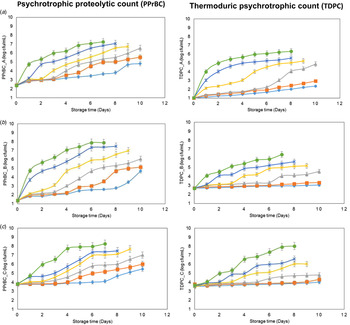
Bacterial growth curves comprising TPC, PBC, PPrBC and TDPC showed the characteristic sigmoidal growth pattern with different growth rates when stored under different refrigerated conditions (Fig. 1 and Supplementary Fig. S1). The growth curves of PPrBC, TDPC of sample A, B and C showed a double-sigmoidal shape (Fig. 1). However, storage of raw milk at 2 °C storage showed significant inhibition of the PPrBC and TDPC. Storage temperatures of ≥4 °C resulted in significant increases in PPrBC, whereas TDPC showed significant increases in growth rate at ≥8 °C (P < 0·05; Fig. 1).
Effect of different storage conditions on the proteolytic psychrotrophic counts (PPrBC) and thermoduric psychrotrophic counts (TDPC) of a, b and c raw milk samples; at  2 °C,
 4 °C,
 6 °C,
 8 °C,
 10 °C and
 12 °C storage. The results were presented as mean±se, (n = 9).

Diversity of raw milk microbiota under refrigerated conditions
The predominant microorganisms isolated were Pseudomonas, Bacillus, and Microbacterium and, to a lesser extent, members of the family Enterobacteriaceae (Table 1). The most predominant genera found in refrigerated raw milk were Pseudomonas (mainly Pseudomonas fluorescens) and Bacillus (Bacillus cereus, Bacillus weihenstephensis and Bacillus circulans). This diversity varied depending on the sample and temperature tested. For example, the level of enteric, non-fermenter Gram negative bacilli (NF-GNB), Gram positive cocci and Gram positive bacillus were higher at temperatures ≥8 °C (Table 1).
Percentages of predominant bacteria belong to each taxon isolated from three samples throughout the simulations of the cold dairy chain using different storage conditions

GPB, Gram positive Bacilli; 80% of the GPB was belong to B. cereus and M. lacticum.; GPC, Gram Positive Cocci mainly Streptococci and Staphylococci spp.; NF-GNB, Non-Fermenting Gram Negative Bacilli with 75% of Acinetobacter and Stenotrophomonas spp.
† 85% of this genera was belong to P. fluorescens
‡ Approximately 76% of the isolates from family Enterobacteriaceae were belong to Hafnia and Serratia
Effects of different storage conditions on the protease activity and proteolysis in raw milk
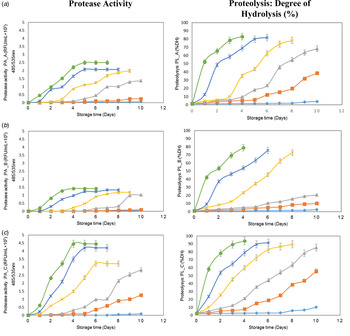
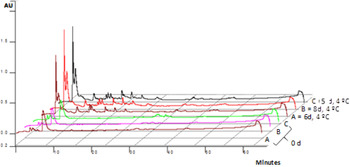
The initial protease activities (PA) of A, B and C raw milk samples were 404·5 (±4·76), 257 (±2·82) and 604·3 (±5·13) RFU/ml. Consequently, the initial proteolysis (PL) that has been denoted by degree of hydrolysis (%DH) of each samples was in the following ascending order; B: 0·88 (±0·51)%, A: 1·32 (±1·02)% and C: 2·42 (±1·13)%. A significant increase in PA and PL (denoted by %DH) was apparent at storage conditions ≥6 °C (P < 0·05; Fig. 2). Even the standard refrigeration condition (4 °C) showed significant increase in PA and PL during the extended storage of raw milk (10 d) and this was observed after 6, 8 and 5 d in A, B and C samples, respectively (P < 0·05; Figs. 2 & 3). In contrast, 2 °C storage resulted in significant reduction in the PA and DH in all three raw milk sample (P < 0·0001; Fig. 2).
Effect of different storage conditions on the protease activity (PA) and proteolysis (PL: %DH: degree of hydrolysis) of a, b and c raw milk samples; at 2 °C, 4 °C, 6 °C, 8 °C, 10 °C and 12 °C storage. The results were presented as mean±se, (n = 9).

The reversed-phase high-performance liquid chromatography (RP-HPLC) chromatograms of trichloroacetic acid (TCA) soluble peptide fractions of A, B and C raw milk samples stored at 4 °C, in 0 d and after 6, 8 and 5 d (when significant increase in proteolysis occurred), respectively.

Correlation of protease activity and proteolysis with bacterial counts in raw milk
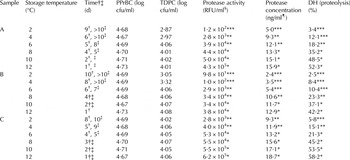
An increase in protease activity and proteolysis were observed when the PPrBC counts reached 5·0 × 104 cfu/ml at all temperature conditions, except for 2 °C (Table 2; Fig. 2). However, the corresponding protease activity and proteolysis varied as function of temperature (Table 2; Fig. 2). For example, the presence of PPrBC in the range of 5·1 to 5·4 × 104 cfu/ml in A, B and C samples at 4 °C resulted in protease activity of 2·8 × 103 RFU/ml, 1·0 × 102 RFU/ml and 4·0 × 104 RFU/ml and those values were equivalent to 9·3, 3·5 and 11·9 ng/ml as calculated using thermolysin as the positive control by the FITC method, respectively (Table 2; Fig. 2). The proteolysis of the samples, denoted by DH %, was 12·1, 8·4 and 15·1%. In contrast, at 6 °C with similar PPrBC (ranging from 5·2–5·4 × 104 cfu/ml), the protease activities in the samples were 3·9 × 104 RFU/ml, 2·9 × 103 RFU/ml and 5·3 × 104 RFU/ml (equivalent to 12·1, 5·4 and 13·4 ng/ml) with DH % of 18·2, 10·4 and 21·3%, representing farms A, B and C, respectively (Table 2; Fig. 2).
Relationship between psychrotrophic proteolytic count (PPrBC) and thermoduric psychrotrophic count (TDPC) with protease activity and degree of hydrolysis (proteolysis) in raw milk, when PPrBC reach 5 × 10⁴ cfu/ml and TDPC reach 1 × 10⁴ cfu/ml under different storage conditions

DH, Degree of hydrolysis, which denotes the extent of proteolysis that was determined using OPA-method; PPrBC, Psychrotrophic proteolytic count; TDPC, Thermoduric psychrotrophic count
Multiple samples were analysed with sd ± 1·5 (n = 9)
*, **, ***Means significance levels by MANOVA (SPSS Windows Ver 21) *P < 0·001; **P < 0·05; ***P > 0·05
† Time to PPrBC of 5 × 10⁴ cfu/ml
‡ Time to reach TDPC of 1 × 10⁴ cfu/ml
§ Protease activity determined by relative fluorescence units
¶ Protease concentration determined by standard curve of Thermolysin (EC 3·4·24·27)
Interestingly, the correlation coefficients (r) between PPrBC and PA/PL were highly significant (r ≥ 0·90, P < 0·0001; at ≥4 °C), when PPrBC reached 5·0 × 104 cfu/ml (Supplementary Table S1). This correlation was in the range of 0·81–0·95 (P < 0·001), when TDPC reached 5·0 × 104 cfu/ml at ≥8 °C (Supplementary Table S2). The correlation coefficients between PBC and PA and/or PL was significant (r ≥ 0·82–0·95, P < 0·05), however, the TPC showed poor correlation with PA/PL (r = 0·55–0·62, P > 0·05; data not shown).
Storage life of raw milk attributable to different temperature conditions
Besides the significant correlation in increase in PA and PL with PPrBC, both parameters appear to vary depending on the temperature condition. Therefore, the storage life in the aspect of raw milk quality (S LQ) was defined depending on the PPrBC counts, hence time to reach PPrBC of 5·0 × 104 cfu/ml was defined as S LQ (Supplementary Table S3). However, the storage life in the aspect of raw milk safety (S Ls) was dependent on the counts of pathogenic thermoduric psychrotrophs such as B. cereus and the time to reach TDPC of 1·0 × 104 cfu/ml was defined as S Ls (Supplementary Table S3). Both S LQ and S LS showed significant correlation with initial counts ≥4 and ≥8 °C storage, respectively (Supplementary Tables S1 and S2).
Extension of storage life of raw milk by a combination of pasteurisation and low-temperature storage
Heating of raw milk samples at 75 °C for 15 s followed by storage at different refrigeration conditions resulted in a significant reduction of PPrBC (P < 0·05; Supplementary Table S3). This consequently decreased the PA and PL with concomitant increased in the S LQ (P < 0·05), especially the temperature conditions ≤8 °C storage (Supplementary Table S3). In contrast, the S LS showed only slight increase (P > 0·05). The most significant increase in storage life (both S LQ and S LS) was observed when raw milk was stored at 2 °C, while storage life was significantly reduced when it was stored at ≥8 °C (Supplementary Table S3).
Discussion
Raw milk collected from three farms showed significantly different initial TPC, PBC, PPrBC and TDPC, possibly related to the different farm management systems and hygienic protocols used during the milking process of these farms (Cempírkova, Reference Cempírkova2007; Srairi et al. Reference Srairi, Benhouda, Kuper and Le Gal2009). Interestingly, the PPrBC was higher in sample A compared to sample B. This may result in significantly greater protease activity and proteolysis in the corresponding sample, regardless of its lower TPC, compared to sample B. Furthermore, proteolysis and protease activity showed a more significant correlation with PPrBC (≥4 °C) and TDPC (≥8 °C) than that with TPC and PBC in raw milk. This indicates that PPrBC and TDPC are the most important quality criteria that can be incorporated into the guidelines for the production of high quality milk and dairy products. Moreover, the maximum production of proteolytic enzymes and subsequent proteolysis was observed when PPrBC counts were above ≥5 × 10⁴ cfu/ml at ≥4 °C, and TDPC ≥ 1 × 10⁴ cfu/ml at ≥8 °C and those limits were used for predicting storage life of raw milk with respect to both quality and safety. Thus, according to the results of the present study, it can be speculated that production of UHT milk requires PPrBC counts below 5 × 10⁴ cfu/ml and TDPC of 1 × 10⁴ cfu/ml for shelf life extension and product safety. This is consistent with a PPrBC count of 4·5 × 104 cfu/ml representing the threshold with respect to milk quality (Silveira et al. Reference Silveira, Carvalho, Teixeira and Barrios1999; Vyletelova et al. Reference Vyletelova, Hanus, Urbanova and Kopunecz2000b). Similarly, the TDPC comprising significantly higher numbers of B. cereus can be a food safety concern when it reaches 1·0 × 104 cfu/ml (Valik et al. Reference Valik, Gorner and Laukova2003). In contrast, several other studies determined the relationship between proteolysis with slightly higher bacterial counts in the range of 106–107 cfu/ml (Griffiths et al. Reference Griffiths, Phillips and Muir1987; Haryani et al. Reference Haryani, Datta, Elliott and Deeth2003; O'Connell et al. Reference O'Connell, Ruegg, Jordan, O'Brien and Gleeson2016). However, Gillis et al. (Reference Gillis, Cartledge, Rodriguez and Suarez1985) also demonstrated significant decrease in proteolysis and bitter peptide production with raw milk microbiota less than 104 cfu/ml.
Even an initial PPrBC and TDPC as low as 101–102 cfu/ml can give rise to ≥5 × 10⁴ cfu/ml with elevated PA and PL within 4–7 d at 6 °C storage. The TDPC with similar initial counts increased to ≥1 × 10⁴ cfu/ml within 5–9 d at 8 °C. At 4 °C, the PPrBC counts reached the corresponding levels within 5–8 d storage and less than 2 d of storage at ≥8 °C. Thus, 2 °C is highly recommended as a storage temperature, while temperatures below 6 °C can be recommended for the purpose of pre-processing storage of raw milk, depending on the initial bacterial counts and the duration of storage.
Interestingly, some of the growth curves of bacteria exhibited a double-sigmoidal shape at ≥8 °C. It can be speculated that an increasing growth rate and production of antimicrobial metabolites under elevated temperature conditions may result in antagonistic effects within the mixed microbial population (Vine et al. Reference Vine, Leukes and Kaiser2004; Ma et al. Reference Ma, Li, Yan, Wang, Li, Xia, Dong, Zhao, Sun, Hu and Guan2014). The fluctuation in the microbial counts was also accompanied by a slight fluctuation in the protease activity and proteolysis. This is possibly related to the balance between production and utilisation of small peptides by indigenous microbiota or due to the presence of artefacts especially in FITC method (Haryani et al. Reference Haryani, Datta, Elliott and Deeth2003).
The extended storage of raw milk under various refrigeration conditions resulted in significant diversity in the raw milk microbiota. For example, storage temperatures below 4 °C resulted in an increase in the level of Pseudomonas spp. and some Bacillus spp. with simultaneous reduction in the enteric and miscellaneous NF-GNB isolates. However, the counts of isolates that belong to family Bacillaceae and Enterobacteriaceae were significantly increased above 8 °C storage. Among the thermoduric psychrotrophic isolates, species belonging to B. cereus group were predominantly isolated especially ≥8 °C. B. cereus is known to produce emetic type toxin under refrigeration conditions that can cause public health concerns when the isolates reach 1 × 10³ cfu/ml (Christiansson et al. Reference Christiansson, Naidu, Nilsson, Wadström and Pettersson1989). Most importantly, the spores produced by these isolates are able to withstand pasteurisation and UHT processing (Champagne et al. Reference Champagne, Laing, Roy, Mafu, Griffiths and White1994). According to FSANZ guidelines, the counts of P. fluorescens and B. cereus in premium quality raw milk are required to be maintained below 107 cfu/ml and 105 cfu/ml, respectively (FSANZ, 2014). These two genera are considered as the major cause of concern in commercial milk processing. Additionally, the diversity of raw milk microbiota can be affected by seasonal differences, for example, psychrotolerant PPrBC, PBC and TDPC appear to increase during the winter months, while thermoduric counts representing mesophilic bacteria were at their highest during the summer months (Marchand et al. Reference Marchand, Heylen, Messens, Coudijzer, De Vos, Dewettinck, Herman, De Block and Heyndrickx2009a; Vithanage et al. Reference Vithanage, Dissanayake, Bolge, Palombo, Yeager and Datta2016).
In the present study, sample B showed significantly lower protease activity and proteolysis. This can be related to the diversity of psychrotolerant bacteria in the respective sample. Previously, we observed that sample B comprised psychrotrophic isolates with limited proteolytic potential (Vithanage et al. Reference Vithanage, Dissanayake, Bolge, Palombo, Yeager and Datta2016). Dogan & Boor (Reference Dogan and Boor2003) also observed variation in the proteolytic potential even within the P. fluorescens population isolated from milk. Pseudomonas produce a heat-stable serralysin family extracellular protease, referred to as AprX (EC 3·4·24·40), while Bacillus spp. produce serine family proteases known as thermolysin (EC 3·4·24·27), substilisin (EC 3·4·21·62) (Bach et al. Reference Bach, Hartmann, Schloter and Munch2001; Dufour et al. Reference Dufour, Nicodème, Perrin, Driou, Brusseaux, Humbert, Gaillard and Dary2008; Marchand et al. Reference Marchand, Vandriesche, Coorevits, Coudijzer, De Jonghe, Dewettinck, De Vos, Devreese, Heyndrickx and De Block2009b; Machado et al. Reference Machado, Bazzolli and Vanetti2013). Expression of the genes encoding these proteases was shown to be regulated by incubation temperature (Morita et al. Reference Morita, Nakamura, Hasan, Murakami, Yokoyama and Tamiya1997; Burger et al. Reference Burger, Woods, McCarthy and Beacham2000). Alternatively, differences in proteolysis can be related to the characteristics of proteolytic enzymes such as their cold-active nature, specificity and temperature-dependence (McKellar, Reference McKellar1989).
The growth of spoilage bacteria in raw milk can be controlled by thermisation (at 65 °C for 15 s), followed by storing of the heated milk under refrigeration conditions (Stadhouders, Reference Stadhouders1982; Griffiths et al. Reference Griffiths, Phillips and Muir1987). In contrast to these earlier studies, the current study used heating of raw milk at 75 °C for 15 s, which is typically used in HTST pasteurisation. This practice is often used upon receiving raw milk at dairy processing plants prior to UHT treatment. This resulted in significant reduction (1-log) in PPrBC counts, but not TDPC, and also resulted in significant decrease in protease activity. This in turn showed significantly higher S LQ, but no significant difference in S LS. Thus, the knowledge of number and diversity of psychrotrophic proteolytic bacteria in raw milk can be used for appropriate production of milk and dairy products (Anzueto, Reference Anzueto2014; Vithanage et al. Reference Vithanage, Dissanayake, Bolge, Palombo, Yeager and Datta2016). Similarly, reliable control of raw milk isolates with higher proteolytic potential would be important for the extension of raw material storage with concomitant increase in flexibility of the manufacturing process (Griffiths et al. Reference Griffiths, Phillips and Muir1987).
Although the current study used raw milk representing various quality levels, a large-scale analysis would provide a more comprehensive understanding of the effect of storage conditions on raw milk quality. However, these results are in general agreement with the results of large scale studies (O'Connell et al. Reference O'Connell, Ruegg, Jordan, O'Brien and Gleeson2016).
In conclusion, storage temperature, time and initial counts can affect microbiological quality of raw milk, in which PPrBC and TDPC are better indicators than other microbiological criteria for predicting the quality and safety of raw milk. It is important to determine a particular predictive model to estimate the PPrBC and TDPC in samples for improving the quality and reducing large-scale wastage of raw milk. Thus, PPrBC and TDPC data can be used to evaluate specific on-farm technological requirements when deciding on quality-dependent incentive schemes for raw milk suppliers. Additionally, deep cooling of raw milk at 2 °C may be a reliable alternative for dairy farms when raw milk collection does not occur on a regular basis. Alternatively, extension in the storage-life of raw milk can be achieved by thermisation at 75 °C for 15 s (instead of 65 °C) followed by 2 °C storage. However, profiling of individual species with higher spoilage potential using rapid and reliable screening would be more informative and will be the focus of future studies. This would allow for the production of superior quality dairy products with extended shelf life that can be distributed to wider geographical regions, benefitting commercial milk processing.
Supplementary material
The supplementary material for this article can be found at https://doi.org/10.1017/S0022029916000728.
The authors wish to acknowledge financial assistance from Victoria University and Murray Goulburn Co-operative Co. Limited. We are also grateful to the staff of the Murray Goulburn Co-operative Co. Limited for their help in organising the sampling campaign and to the sampled dairy farms for their hospitality. Professor Todor Vasiljevic and Dr Jayani Chandrapala are gratefully acknowledged for their constructive suggestions during the reviewing process. The assistance of Mr Anuja Manchanayake and Mr Jamith Jayasekara for manuscript preparation is gratefully acknowledged.