Introduction
This issue of the Journal features collaborative studies that make use of the ongoing follow-ups of two unique pregnancy cohorts born during 1959–1966 in the United States. In New England, investigators have been following up the Boston and Providence cohorts of the Collaborative Perinatal Project (CPP) pregnancy study (now known as the New England Family Study – NEFS).Reference Broman 1 – Reference Buka, Goldstein and Seidman 3 In Oakland, investigators have been following up the large single site Child Health and Development Study (CHDS).Reference van den Berg, Christianson and Oechsli 4 The original designs and study protocols for these pregnancy cohorts were remarkable in many ways, for instance, the CPP and the CHDS were the first large prospective pregnancy cohorts in which prenatal maternal serum samples were collected and archived for later use. Now, in midlife, each of them offers an outstanding platform for studies of early determinants of adult health.Reference Susser, Terry and Matte 5 , Reference Susser and Terry 6 The Early Determinants of Adult Health (EDAH) study combined the NEFS and the CHDS cohorts in order to conduct a follow-up in midlife (age 40s) of same-sex siblings who were discordant on birthweight for gestational age.
This first paper introduces the ‘core’ EDAH study. The subsequent six papers are related to this ‘core’ EDAH study in various ways. The second paper introduces innovative statistical methods for analysis of growth trajectories, developed to meet the challenge of analyzing early childhood data in EDAH.Reference McKeague, Lopez-Pintado, Hallin and Siman 7 The third paper analyzes anthropometric outcomes in the core EDAH sample.Reference Lumey 8 The next three papers are based upon studies that emanated from EDAH; these studies obtained separate funding to significantly extend the core sample – in terms of both number of subjects and data domains acquired – to address specific hypotheses about neuropsychiatric, neuropsychological and mammographic density outcomes.Reference Terry, Schaefer and Flom 9 – Reference Goldstein, Cherkerzian and Buka 11 The final paper is based on a separate adult follow-up study that uses the CHDS sample exclusivelyReference Cirillo, Cohn and Krigbaum 12 (it included pilot work across CHDS and CPP and used many comparable measures).
Rationale for the EDAH study
Many of the central questions about early determinants of adult health are best addressed by studies, which include in-depth prospective measures from pregnancy, thorough assessments of adult outcomes and rigorous control for confounding. The underlying rationale for the EDAH study was that by combining the NEFS and CHDS in a same-sex sibling study, we could meet these rigorous criteria. Fortunately, the NEFS and CHDS were sufficiently similar that a collaborative investigation, combining data from the two cohorts, was feasible. NEFS and CHDS both enrolled pregnant women over the same time period, followed their children into early childhood, used similar measures for many exposures and conditions and archived prenatal serum samples from pregnancy. The two cohorts were also of similar size (15–20,000 births). Thus, by making use of the in-depth prospective measures in these cohorts, adding assessments of adult health outcomes and combining data to yield a sufficient number of same-sex siblings discordant on prenatal exposure, we believed we would be in the best position to address a number of important questions about early determinants of adult health.
The comparison of same-sex siblings discordant for an exposure is a highly effective design for control of confounding, especially in studies that examine the relation of prenatal exposures or early growth to child or adult health outcomes.Reference Susser, Eide and Begg 13 , Reference Donovan and Susser 14 Although this was not so widely recognized at the time EDAH was conceived, numerous studies (including some by co-authorsReference Donovan and Susser 14 – Reference Gilman, Gardener and Buka 18 ) have proved the power of this design for validating or refuting results based on population studies of unrelated individuals. In studies of prenatal exposures, in particular, family context and genetic predisposition are often the main potential confounders, and it is very difficult to measure them precisely. The comparison of same-sex full siblings ensures by design that the siblings share a similar family context and half their genes.
Family context comprises a vast array of experiences that are difficult to capture with measures used in epidemiologic studies. Familial interactions vary, such as the time spent talking with children and the vocabulary used, which influence the development of language. Familial resources vary, even among families with similar socioeconomic status measured by education and occupation; some families access additional resources from kinship networks, while others deplete resources to share them with kinship networks. Because the family context represents the confluence of a multitude of factors, it is extremely difficult to capture even with in-depth assessments. Yet it can be a powerful confounder in research on developmental origins of health, because family context influences both early exposures and later health outcomes. The confounding usually (though not always) generates artifactual positive associations between an exposure and outcome. Siblings do, of course, differ in family environment according to birth order, but birth order can be controlled statistically. Siblings also differ as a result of random variability in individual experience,Reference Davey Smith 19 but this will rarely generate artifactual associations. For this and other reasons, various sibling designs have become increasingly central to epidemiological research in the past decade.Reference Donovan and Susser 14
Same-sex siblings discordant on prenatal exposure, however, are few in number. Studies that use this design often rely upon large population registries that have limited information about prenatal exposures, early growth and health outcomes. Though large, the NEFS and CHDS were not comparable in size to such registries. Therefore, it was important to design the follow-up study to include sufficient numbers of same-sex siblings who were discordant on a key variable of interest. This would not limit the use of the data to studies of that key variable, but would ensure that we could at a minimum address questions about the relation of that variable to adult health in the most rigorous way possible.
We chose discordance on birthweight for gestational age (bw/ga) among term babies as our key variable of interest. A large number of studies of unrelated individuals have reported associations between birthweight and various adult health outcomes.Reference Kuh and Ben-Shlomo 20 – Reference Paneth and Susser 22 Low bw/ga is a better indicator than birthweight alone of suboptimal fetal growth (and can be further refined by the addition of other variables such as maternal height). Because bw/ga is a more valid measure of suboptimal fetal growth for term babies than for preterm babies,Reference Hutcheon and Platt 23 we limited the study to term babies. This also made it possible to disentangle the effects of suboptimal fetal growth from the effects of preterm birth.
For two main reasons, we chose to measure adult health outcomes in multiple domains. First, as noted earlier, studies have reported associations of lower (or sometimes higher) birthweight with adult health outcomes in many domains. We sought to investigate whether these outcomes have common antecedents, reflected in their shared associations with birthweight. Second, we wanted to assess whether some early antecedents had beneficial effects in one domain but harmful effects in another domain.
As will be seen in the ensuing papers, the use of EDAH and the related studies is neither limited to studies of bw/ga, nor to studies based on discordance between siblings. The power of the design is most fully utilized in studies of bw/ga; however, the design is also useful for addressing a broad array of other questions. The extension of the core sample to larger studies of specific outcomes greatly increased the range of questions that could be addressed.
NEFS
The CPP was initiated more than 50 years ago to investigate prospectively the prenatal and familial antecedents of pediatric, neurological and psychological disorders of childhood. Nationwide, 12 university-affiliated medical centers participated, including two in New England (in Boston and Providence). More than 50,000 pregnancies were enrolled between January 2, 1959 and December 31, 1965Reference Broman 1 , Reference Broman, Bien and Shaughnessy 2 (16,557 in the NEFS sites).Reference Buka, Goldstein and Seidman 3 The study followed up 88% of survivors at 1 year, 75% at 4 years and 79% at 7 years. Major findings from the CPP have been summarized in previous publications.Reference Broman, Bien and Shaughnessy 2 , Reference Niswander and Gordon 24 – Reference Nichols and Chen 26
Data from examinations and interviews were recorded by trained staff at each site beginning at the time of registration for prenatal care, using standardized protocols, forms, manuals and codes. At the first prenatal visit, a complete reproductive and gynecological history, recent and past medical history, socioeconomic interview and family history were recorded. A socioeconomic index was assigned to each pregnancy, adapted from the Bureau of the Census and derived from education and occupation of the head of household along with household income.Reference Myrianthopoulos and French 27 Repeat prenatal assessments were conducted throughout pregnancy. Blood samples were collected for serology and for storage of frozen sera. After admission for delivery, trained observers recorded the events of labor and delivery, and the obstetrician completed labor and delivery protocols. The neonate was observed in the delivery room, examined by a pediatrician at 24-h intervals in the newborn nursery, and received a neurological examination at 2 days. Study offspring received five subsequent assessments: at ages 4, 8 and 12 months, and 4 and 7 years; pediatric-neurological examinations occurred at 4 and 12 months and 7 years; and psychological examinations at 8 months and 4 and 7 years. Family and social history information was obtained from the mother at intake and at 7 years. Diagnostic summaries were prepared by study physicians following the 12-month and 7-year assessments.
The NEFS (Boston and Providence CPP cohorts) comprised 16, 557 births. The final full assessment at age 7 years was completed by 80% of survivors. Archived sera are available for 98% of pregnancies (approximately three time points per pregnancy) and cord samples for 75% of pregnancies. Adult follow-up of these two New England CPP cohorts began in 1983 with the Providence sample. This work began through a collaboration between Ming Tsuang, who introduced the idea of investigating psychiatric outcomes within the cohort, Lewis Lipsitt who had directed the childhood assessments in Providence and Stephen Buka who co-designed and directed these initial follow-up efforts.Reference Buka, Lipsitt and Tsuang 28 At the heart of these early investigations was the seminal work of Pasamanick et al.Reference Pasamanick, Rogers and Lilienfeld 29 who proposed ‘…a continuum of reproductive casualty extending from death [which] might descend in severity through cerebral palsy, epilepsy, mental deficiency, and perhaps even to behavior disorder’. The first major study selected approximately 500 infants born with moderate perinatal complications and 500 matched comparison subjects, and conducted standardized psychiatric diagnostic assessments at mean age 23.0 years.Reference Buka, Tsuang and Lipsitt 30 Generally, the null results indicated no elevated risk for psychiatric disorder in relation to perinatal complications, with two exceptions. Infants born with conditions suggestive of chronic fetal hypoxia were at marginally elevated risk for both cognitive impairment and psychotic disorders, including schizophrenia. These initial findings led to a considerable body of subsequent work. The roles of perinatal complications, infections during pregnancy and family history of psychosis have been investigated in multiple projects involving both the Providence and Boston sites.Reference Buka, Goldstein and Seidman 3 , Reference Goldstein, Seidman and Buka 31 – Reference Buka, Tsuang and Torrey 34 Investigations of schizophrenia now include over 1000 NEFS cohort members with and without psychotic disorders and incorporate detailed clinical diagnostic, neuropsychological, structural and functional imaging procedures and more;Reference Thermenos, Goldstein and Buka 35 , Reference Goldstein, Buka, Seidman and Tsuang 36 some based on collaborative efforts with the CHDS.Reference Susser 37 , Reference Opler, Buka and Groeger 38
In 1999, we initiated a second major program of research, focused on nicotine dependence and related co-morbid psychiatric and physical disorders. This research initiated the follow-up and assessment of three-generation pedigrees in the NEFS, which is still ongoing (i.e. CPP mothers, their offspring who comprise the CPP cohort members and the offspring of the CPP cohort members). These projects all sought to integrate family designs with early life risk conditions, capitalizing upon the large number of cohort members with multiple offspring.Reference Buka, Shenassa and Niaura 39 – Reference Kahler, Strong and Papandonatos 41
Recent work has moved from neuropsychiatric outcomes to physical conditions, with a particular emphasis on adult risks for cardiovascular disease,Reference Wen, Triche, Hogan, Shenassa and Buka 42 including investigation of comorbidity and common antecedents of depression and cardiovascular disease (see Goldstein et al.,Reference Goldstein, Cherkerzian and Buka 11 in this issue). Other major projects have included investigations of the stability and sequelae of childhood learning disorders,Reference Buka, Satz and Seidman 43 social determinants of depression and other psychiatric disorders,Reference Gilman, Kawachi, Fitzmaurice and Buka 44 and potential mechanisms underlying the association between educational attainment and adult health status. Details are available at http://www.bidmc.org/Research/Departments/Psychiatry/NewEnglandFamilyStudy.aspx; http://cnl-sd.bwh.harvard.edu.
CHDS
The CHDS enrolled 98% of eligible pregnant women who were members of the Kaiser Foundation Health Plan in the Oakland, California area between 1959 and 1966. Its purpose was to investigate events of pregnancy, labor and delivery and subsequent childhood development.Reference van den Berg, Christianson and Oechsli 4 During the 7-year enrollment period, a total of 20,530 pregnancies were observed among the 15,528 women who were recruited into the study. At baseline, information was collected from a face-to-face interview with mothers. Prenatal measures, pregnancy complications, maternal morbidity and labor and delivery information were abstracted from the mothers’ medical records. Gross placental exams were performed according to the Benirschke protocolReference Benirschke and Driscoll 45 when funding was available, from 1960 to 1963 and 1965 to 1966. Serum samples in 3–4 cc aliquots were taken from fathers, and from mothers during pregnancy at each trimester and post delivery, and were frozen and archived. One to three samples of cord serum in 0.5 cc aliquots were also taken from a small sample of just over 3000 infants and were frozen and archived. Childhood serial growth measures and morbidity were abstracted from medical records for all CHDS children through age 5 years. Several special childhood follow-up studies targeting ages 5, 9–11 and 15–17 years were conducted among subsets of CHDS children. A description of CHDS data files can be found at http://chdstudies.org.
Because active follow-up ended in 1972, the cohort has been regularly monitored through passive surveillance by linkage to (1) the California Department of Motor Vehicles, for a history of location and timing of residence to identify the population at risk for morbidity and mortality,Reference Mongraw-Chaffin, Cirillo and Cohn 46 , Reference Wang, Cirillo and Vittinghoff 47 (2) the California Department of Vital Statistics, for identifying deaths and cause of death and (3) the California Cancer Registry, for identifying cancer diagnoses.Reference Cohn, Cirillo, Christianson, van den Berg and Siiteri 48 – Reference Whittemore, Cirillo, Feldman and Cohn 50 All members of CHDS families and all names ever used by each family member are regularly matched to these sources. The accumulation of a name and address history for each cohort member protects against establishing false matches and failing to identify true matches. Surveillance efforts routinely identify one or more members of over 80% of CHDS families.
Record abstraction for cancer diagnoses to the California Cancer Registry is based primarily on pathology reports, and case identification is considered to be >99% complete after a 2-year lag. Life table analysis to estimate expected cases of testicular cancer through 2000 in CHDS sonsReference Cohn, Cirillo and Christianson 51 and expected cases of breast cancer through 1998 in mothers showed high comparability with observed counts. The closeness between observed and expected numbers of cases for both parent and offspring in the CHDS cohort indicates that for cancer the surveillance is accurate, reliable and complete.
In 2000, the CHDS conducted a small pilot test of the completeness of the CHDS death match procedure. For this pilot, 1838 names for 1548 women (all known names were provided for each subject) were submitted for linkage to the National Death Index. Unconfirmed decedents through 2000 with limited information (e.g. no cause of death) were included in the pilot, as well as 50 women known to be alive and living in California through the pilot test period. A total of 195 deaths were identified by both sources combined. No death records were found in the National Death Index for the 50 women known to be alive in California. The National Death Index match identified 95.9% of all deaths; 11 of these were found only by the National Death Index. The CHDS identified 94.4% of all deaths; eight of these were found only by the CHDS match. These results provide confidence that the CHDS death surveillance methods, which include manual review, are relatively complete.
Earlier adult follow-up studies of CHDS offspring included studies of gendered behaviorReference Udry, Morris and Kovenock 52 and time to pregnancyReference Cohn, Cirillo and Wolff 53 , Reference Cohn, Cirillo and Sholtz 54 conducted in women aged 28–30 years who were also participants in the adolescent follow-up; a nested case control study of schizophrenia;Reference Susser, Schaefer, Brown, Begg and Jed Wyatt 55 – Reference Bresnahan, Schaefer, Brown and Susser 57 and a pilot study to collect reproductive history and semen samples from CHDS sons.Reference Cohn, Overstreet and Fogel 58 From 2005 to 2008, a series of follow-up studies of the adult CHDS children who were in their 40s were initiated as part of an integrated effort to investigate the long-term impacts of fetal and childhood growth and development on adult health. This effort was broad-based, incorporating multiple adult health domains including neuropsychiatric function, breast development and male reproduction. These data are now being analyzed and are the source for papers in this special issue. Follow-up of the CHDS continues with a larger sample of CHDS daughters and their daughters in the 3 Generations Breast Cancer Study led by Barbara Cohn (see http://www.chdstudies.org/3gs/study_information/index.php).
Combining the two cohorts
Despite the similarities of the NEFS and CHDS noted above, the combination of the two cohorts in a single study posed multiple challenges. The studies were based in different health care delivery systems and enrolled populations with different demographic characteristics (seeReference van den Berg, Christianson and Oechsli 4 for an overview of the CHDS andReference Broman 1 – Reference Buka, Goldstein and Seidman 3 for an overview of the NEFS cohorts). These differences are reflected in the NEFS and CHDS samples used in the EDAH study, as shown below.
The prenatal data collected in the original NEFS and CHDS studies were similar, but were not identical. Gestational length was recorded in weeks in the NEFS, and in days in the CHDS. Similar but not identical categories were used for education and occupation in the NEFS and the CHDS. The use of archived prenatal data from both studies requires the creation of identical variables. Although this is feasible for almost all variables of interest, it has to be done for each variable separately.
The studies diverged further in the timing and data collected on the offspring during childhood. For example, in the NEFS, data on height and weight were collected at multiple specified time points up to age 7 years; in the CHDS, height and weight were recorded at medical visits up to age 5 years, and for subsamples, up to later ages. Thus, the analysis of growth trajectories in the combined EDAH sample requires methods that allow for variation in the timing of measurements.
EDAH
Recruitment of the core EDAH sample
The total subject pool and the recruitment of study participants from this pool is displayed in Fig. 1a (NEFS) and 1b (CHDS). On the basis of archived data, we defined the total subject pool as all same-sex siblings who met the following criteria: (1) at least 38 weeks gestational age at birth; (2) serum samples collected and archived during the pregnancy; (3) growth data collected during early childhood follow-ups; (4) two or more siblings discordant on sex-specific bw/ga (as detailed below under the section ‘Sibling sets’). Using the ongoing surveillance of deaths in the CHDS described earlier, we applied a further criterion in the CHDS: the individual was not deceased. This resulted in a total subject pool of 515 in the NEFS and 651 in the CHDS.
(a) New England Family Study core sample: recruitment flowchart (*20 participants were later assessed but not included in the current dataset) and (b) Child Health and Development Study core sample: recruitment flowchart (*7 participants were later assessed but not included in the current dataset).

We did not attempt to recruit all of the individuals in the total subject pool to the study. For ethical reasons, we did not attempt to recruit individuals who did not want to be contacted for follow-up. Individuals were sent a postcard so that they could communicate this before we attempted to contact them. Some had already done so in a prior study (mainly in the NEFS). For practical reasons, we only attempted to recruit individuals who were living within commuting distance of the study clinic. In the CHDS, for example, this excluded 148 individuals due to distance from the study clinic. As a result of these and other factors, the number of subjects targeted for recruitment was smaller than the total subject pool: 314 (61.0%) in the NEFS and 459 (70.5%) in the CHDS.
In the NEFS, 236 (75.2%) of the 314 targeted were located, and 149 (63.1%) of the 236 located were recruited and assessed at the time of these analyses. In the CHDS, 348 (75.8%) of the 459 targeted were located, and 243 (69.8%) of the 348 located were recruited and assessed. At both sites, the participation rate was somewhat higher for women than for men (see online Supplementary Table S1). These numbers reflect the data set that was created upon completion of the core EDAH study.
On the basis of funding from related studies, more individuals have subsequently been assessed (as shown in Fig. 1), and this process is still ongoing. As a result, the number of participants and the participation rates will be somewhat higher in analyses addressing specific questions in these related studies. Furthermore, analyses of archived prenatal sera and of newly collected blood samples are ongoing, also funded by related studies. When enough of these related studies are completed, we will be able to create a data set with a larger number of subjects and more variables.
Comparison of assessed with not assessed
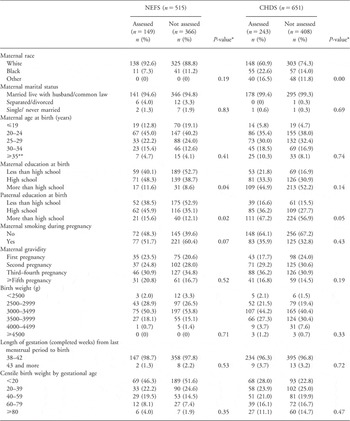
Table 1 uses archived data to compare the participants in the total subject pool who were assessed and who were not assessed at each site. In the NEFS, but not the CHDS, the offspring of mothers and fathers with lower educational levels are underrepresented among the assessed. In the CHDS, the offspring of mothers who self-identified as black are overrepresented among the assessed. On all other variables, the assessed and not assessed are similar. The similarity is encouraging, as it limits the potential for selection bias. Online Supplementary Table S1 compares those assessed and not assessed by gender, as well as by site. Although a higher proportion of women than of men were assessed, the factors associated with being assessed were similar for women and men (with the exception of paternal education in the CHDS).
Comparison of assessed and not assessed in total subject pool: by site

NEFS, New England Family Study; CHDS, Child Health and Development Study.
*P-value for the χ 2 test of distributions between the assessed v. not assessed samples.
**1.1% of total sample were 40 years or older.
Sibling sets
In creating the total subject pool, we determined for each same-sex sibling his/her sex-specific percentile for bw/ga using the US 2000 gender-specific standards.Reference Oken, Kleinman, Rich-Edwards and Gillman 59 All same-sex sibships were then identified, in which at least one ‘proband’ sibling was in the lowest quintile of bw/ga and at least one ‘comparison’ sibling was in a higher quintile of bw/ga (and at least 10 percentiles higher in bw/ga than the proband sibling in the lowest quintile). In the NEFS, all 515 were selected in this way, and all of the participants were drawn from this pool. In the CHDS, this same procedure was used to select about one half of the total subject pool. Thus the full NEFS subject pool and about one half of the CHDS subject pool allowed us to examine whether lowest quintile bw/ga probands differed from their higher bw/ga siblings on adult health outcomes.
In the CHDS, where we studied a larger number of subjects, we used a second procedure to select the other half of the total subject pool. This second procedure was designed for comparison of siblings who differed in bw/ga to varying degrees, without requiring the proband sibling to be in the lowest quintile bw/ga. Thus we could also examine whether discordance in bw/ga had implications for later health, within the range of bw/ga in which the great majority of term babies are born. Such a comparison in the CHDS required a spread of bw/ga discordance from high to low, with sufficient sibships in high as well as low bw/ga discordance categories. To achieve this spread, we prioritized siblings with the largest discordance between a low bw/ga proband and a higher bw/ga comparison sibling. For example, we gave higher priority to sibships in which the largest discordance between any two siblings on bw/ga was 50%, than to those in which the largest discordance was 40%. In the majority of sibships selected in this way, the largest discordance was at least 30 percentiles, but we also included a substantial number in which the largest discordance was 20–29 or 10–19 percentiles.
In practice, it was not always possible to assess more than one individual from a same-sex sibling set. In some instances, one sibling lived within commuting distance of the clinic but the other/s did not. In other instances, one sibling was willing to participate but the other/s were not. Thus, the majority but not all of the assessed sample comprised sibling sets at each site: 93 out of 149 (62.4%) in the NEFS and 163 out of 243 (67%) in the CHDS. The sibling sets assessed were almost all sibling pairs: 43 pairs in the NEFS and 80 pairs in the CHDS. In addition, there were three sibships with more than two siblings (total of 10 siblings).
As shown in Supplementary Table S2, the same-sex sibling pairs assessed were generally discordant on bw/ga as intended. In the NEFS, 4 of the 43 pairs were not discordant (i.e. we were able to assess two members of a sibship but not two siblings who met our bw/ga discordance criterion). In the CHDS, 4 of the 39 pairs with a proband in the lowest quintile also had a comparison sibling in the lowest quintile. In addition, 7 of the other 41 CHDS pairs were in the same bw/ga quintile, but this partly reflects the design, which allowed for less than a quintile difference in these other CHDS pairs as described earlier.
Because siblings are born at different times, they are not necessarily concordant with respect to the family-level confounders we wished to control. For example, mothers may increase their educational level or change their smoking habits across successive pregnancies, and maternal age will be higher for later born siblings. As shown in Supplementary Table S3, in this study all sibling pairs were perfectly concordant for maternal and paternal education and for maternal smoking during pregnancy as categorized in Table 1. With finer categories, some discordance is detectable, but it is small (data not shown).
Statistical power
There is an extensive literature on the computation of statistical power for studies with correlated observations.Reference Liu and Liang 60 , Reference Li and McKeague 61 For illustration, consider bw/ga as a binary exposure, a sample of 120 discordant sibling pairs, a binary outcome with a frequency of 10% in the reference (unexposed) population and a logistic regression model with exchangeable correlation structure. With alpha set at 0.05, and correlation between siblings in the range 0.10–0.20 (power increases with intracluster correlation), the power is 65–70% for a relative risk of 2, and 91–94% for a relative risk of 2.5. The power will, of course, be much higher when the non-siblings are included in the sample. It will also be much higher for more common binary outcomes and for continuous outcomes. For an illustration of this increased power, see LumeyReference Lumey 8 in this issue.
Assessments
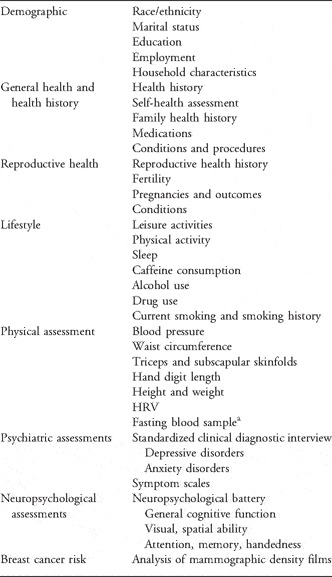
The assessment procedures were approved by the Institutional Review Boards that oversee the ethics of human subjects research at Columbia University, other participating academic institutions and the clinic sites. The major outcome domains that were assessed are summarized in Table 2. With the exception of a Computer Assisted Telephone Interview (CATI) administered to women, all assessments were performed as part of a clinic visit, which took approximately 4–5 h. Study participants were asked to fast from midnight until the visit, and a fasting blood sample was taken when they arrived at the clinic. Following phlebotomy, blood pressure was taken three times using a Dinamap monitor and a full anthropometric assessment made. Participants were then given a light snack. Following the snack, men were administered a questionnaire to obtain data on social and demographic characteristics and health history of self and first-degree relatives (women had been administered a similar questionnaire via CATI as part of a related projectReference Terry, Schaefer and Flom 9 ). A battery of neuropsychological tests was then administered, followed by a structured clinical psychiatric interview (the Structured Clinical Interview for Diagnostic and Statistical Manual of Mental disorders-IV) and heart rate variability measurements. For women who signed a medical release form, mammograms done during the interval from 2 years before to 1 year after the interview were obtained (and returned after reading).
Overview of adult assessments in EDAH

EDAH, Early Determinants of Adult Health; HRV, heart rate variability.
aLaboratory analyses funded separately (thyroid function, sex hormones, lipid metabolism, stress hormones, fasting glucose, other).
A careful process of training and quality assurance was used for the assessments. In Supplementary Table S4, we detail the procedures for key elements of the physical, psychiatric, neuropsychological and breast cancer risk assessments. The accompanying papers in this issue of the Journal further describe procedures for assessment, and detail procedures for quality assurance, in the domains relevant to their results.
Characteristics of the participants
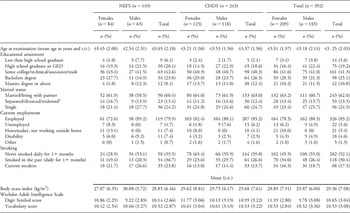
Selected characteristics of the participants at follow-up by site and gender are shown in Table 3. One of the notable differences between the two sites is that there were more current and former cigarette smokers in the NEFS than in the CHDS sample. Not shown in Table 3, but evident from Table 1, a higher proportion of the CHDS than the NEFS sample were offspring of mothers who self-identified as black. Supplementary Tables S5 and S6 show a broader range of participant characteristics at follow-up than those included in Table 3, again by gender as well as by site.
Selected outcomes at follow-up by site and gender

NEFS, New England Family Study; CHDS, Child Health and Development Study; GED, General Educational Development.
a0.8% of total sample were widowed.
Missing data
For the participants who completed the assessments, there were few missing data on the vast majority of variables. This is illustrated in Supplementary Table S7 where we show the percentage of participants with missing data for selected variables from the archived data and from the adult follow-up. Full details on missing data for variables used in the subsequent papers in this issue are included in those papers (as they will be in subsequent papers). We note that the same total n for the samples is retained in all the tables in this paper, but due to missing data, the number on whom the percentage is computed for a specific variable may be slightly less than the total n (e.g. % with different levels of education is based on individuals with data on level of education).
Future directions
The papers, which follow illustrate the enormous potential of the NEFS and the CHDS pregnancy cohorts for studying health across the life course. They also demonstrate that it is feasible to conduct collaborative studies across these cohorts. These initial papers from EDAH and related studies make significant contributions to our understanding of the relation between prenatal experience and midlife health (age 40s) and of the methods required for valid studies of these relationships. Subsequent papers will address a wider array of questions and draw on a rich array of other data, including early growth data, analyses of archived prenatal sera and analyses of blood samples collected in adult assessments.
We propose that we can substantially advance our knowledge of health and disease over the life course by following pregnancy cohorts into midlife and beyond. In the United States, the generation of such knowledge will depend upon the foresight of the National Institutes of Health. Thus, the intensive assessments of the NEFS and the CHDS cohorts were discontinued in early childhood; the cohorts had to be ‘reconstructed’ with much labor to provide the foundation for the follow-up studies now being done. Equally important, foresight is required to ensure that in future, pregnancy cohorts are supported to study the next generation (the offspring of the cohort members) prospectively from pregnancy onward, creating multigenerational studies that capture the critical period of fetal development and early childhood.
Acknowledgments
This work was supported by NIA P01 AG023028 (E. Susser, overall PI, S. Buka, co-PI, B.Cohn, co-PI). Many individuals contributed to the success of this study. The authors would like to specially acknowledge Melissa Begg, Michaeline Bresnahan, Sara Cherkerzian, George Davey Smith, Ana Diez-Roux, Kim Fader, Tammy Kouffman, Bill Lasley, Thomas Matte, Sunita Miles, Sharon O'Toole, Eleonora Raviglione, Janet Rich-Edwards and Patricia A. Zybert. The study could not have been properly designed and conducted without the generous contributions of these individuals.
Supplementary materials
For supplementary material referred to in this article, please visit http://dx.doi.org/doi:10.1017/S2040174411000663