Introduction
Physical activity is defined as movement produced by skeletal muscles that requires energy expenditure, including working, playing, household activities, travelling and engaging in recreational activities (WHO, 2020). Since early childhood, physical activity declines with age, and a major drop occurs in the late adolescent period (Varma et al., Reference Varma, Dey, Leroux, Di, Urbanek and Xiao2017). Adolescence is a transition period when attitudes, lifestyle and behavioural patterns for adulthood are being established. Accordingly, adolescents are at potential risk of the diseases associated with lifestyles (Herman et al., Reference Herman, Craig, Gauvin and Katzmarzyk2009).
Insufficient physical activity (IPA) is one of the major risk factors for several non-communicable diseases (NCDs), such as cardiovascular diseases, diabetes, breast cancer and colon cancer, and is the fourth leading cause of death worldwide (Kohl 3rd et al., Reference Kohl, Craig, Lambert, Inoue, Alkandari and Leetongin2012). In 2012, 5.3 million global deaths were associated with insufficient physical inactivity (Lee et al., Reference Lee, Shiroma, Lobelo, Puska, Blair and Katzmarzyk2012), which increased to 13.7 million in 2016 (Ding et al., Reference Ding, Lawson, Kolbe-Alexander, Finkelstein, Katzmarzyk and Mechelen2016). The World Health Organization (WHO) recommends at least 60 minutes of moderate to vigorous intensity physical activity daily for children and adolescents aged 5–17 years to achieve physical activity benefits. The recommendation for those aged 18–64 years is at least 150 minutes of moderate intensity aerobic physical activity throughout the week or 75 minutes of vigorous intensity physical activity or an equivalent amount of both (Strong et al., Reference Strong, Malina, Blimkie, Daniels, Dishman and Gutin2005; WHO, 2010). Children and adolescents who are physically inactive are likely to remain inactive as adults (Herman et al., Reference Herman, Craig, Gauvin and Katzmarzyk2009). Insufficient physical activity during adolescence can increase the risk of NCDs in later life and significantly impact adolescent overweight and obesity (Hallal et al., Reference Hallal, Victora, Azevedo and Wells2006). Acknowledging the importance and urgency of reducing global levels of IPA, the WHO member states agreed on a Global Action Plan on Physical Activity and targeted a 15% relative reduction in IPA among adolescents by 2025 (WHO, 2018).
Eighty percent of adolescents worldwide do not meet the recommended daily level of physical activity (Strong et al., Reference Strong, Malina, Blimkie, Daniels, Dishman and Gutin2005). A study conducted in 34 countries of the five WHO regions revealed that only 23.8% of boys and 15.4% of girls meet the recommended level of daily physical activity (Guthold et al., Reference Guthold, Cowan, Autenrieth, Kann and Riley2010). In 2016, the IPA prevalence among school-going adolescents (11–17 years) was 66.1% in Bangladesh (Guthold et al., Reference Guthold, Stevens, Riley and Bull2020). Evidence suggests that boys are more active than girls in low- and middle-income and Asian countries (Frerichs et al., Reference Frerichs, Huang and Chen2014; Pengpid et al., Reference Pengpid, Peltzer, Kassean, Tsala, Sychareun and Müller-Riemenschneider2015). Physical activity among girls often declines during adolescence, and social norms emerge as factors affecting girls’ participation in physical activity (Cooper et al., Reference Cooper, Goodman, Page, Sherar, Esliger and Sluijs2015). Studies have also revealed that urban residency, female sex, increased age, higher education and higher economic status are associated with IPA among the adults in Bangladesh (Moniruzzaman et al. Reference Moniruzzaman, Ahmed and Zaman2017; Uddin et al., Reference Uddin, Khan and Burton2017). However, currently, there are no national estimates of IPA prevalence among adolescent boys and girls (10–19 years) in Bangladesh. Considering the reported relationships between IPA and NCDs, the significant increase in NCDs in Bangladesh in recent years, and the scarcity of information on the prevalence of IPA among Bangladeshi adolescents, this study aimed to estimate the prevalence of IPA among adolescent girls and boys in the country and identify the factors associated with IPA. This knowledge will provide health care professionals and policymakers with the information necessary to design and implement interventions to reduce the IPA burden among adolescents.
Methods
Study design
The Bangladesh national nutrition surveillance 2018–2019 round was a cross-sectional study among six population groups, including adolescent girls and boys. The data collection period was from September 2018 to October 2019. The data were collected from 82 randomly selected clusters (57 rural, 15 non-slum urban and 10 slums) from all eight administrative divisions of Bangladesh.
Sampling and study participants
The sample size was determined to estimate IPA prevalence from rural, non-slum urban and slum areas from each division of Bangladesh. From each of the eight administrative divisions, rural sites were randomly selected following the stages described below: two districts from each division, then one sub-district from each district, two unions from each selected sub-district and two clusters of 250–400 households from each union (64 rural sites). In the non-slum urban area, sixteen wards (1–2 wards for each division, depending on population) were selected. From each ward, a cluster of 250–400 households was selected. In the slum areas, the Census of Slum Areas and Floating Population 2014 was used to select study sites (Bangladesh Bureau of Statistics, 2015). Two slums or slum segments from each of the Dhaka and Chattogram divisions and one from each of the other six divisions were randomly selected as study clusters.
Each randomly selected slum or slum segment contained 250–400 households. A total of 90 clusters (64 rural, 16 non-slum urban and 10 slum clusters) were selected. However, one cluster was selected as both non-slum urban and slum clusters in the process of sampling, and another seven rural clusters could not be reached due to administrative and financial constraints. The number of adolescent boys and girls to be enrolled from each cluster was 62, with an estimated total sample of 11,160 (5580 boys and 5580 girls). Finally, a total of 4907 boys and 4865 girls aged 10–19 years were selected and enrolled in the study from all 82 clusters (57 rural, 15 non-slum urban and 10 slums) from all eight administrative divisions of Bangladesh. Households were visited to prepare the list of eligible participants to prepare a sampling frame within the primary sampling unit, i.e. the clusters. Participants were randomly selected from the sampling frame using the Simple Random Sampling (SRS) method. If any household had more than one participant from the same age group, one of them was randomly selected and included in the sampling frame.
Study procedures and data collection
A structured questionnaire consisting of modules for all age groups was used to collect survey data through face-to-face interviews. A five-day training period of data collectors and supervisors was provided on interviewing and taking physical measurements (anthropometry and blood pressure). Data collection was done using tablet computers and a customized Survey CTO application (Dobility, Inc.). The data collection tool was pre-tested and piloted before starting data collection. Five percent of the participants were re-interviewed, and another 5% were directly observed to ensure data quality. Height was measured using a locally made stadiometer, weight was measured using TANITA UM-070 weighing scale (TANITA Corporation, Tokyo, Japan) and waist circumference was measured using a measuring tape. The Food and Nutrition Technical Assistance Project (FANTA) anthropometry manual was followed for anthropometric measurements (Cogill, Reference Cogill2003).
To obtain community consent, community sensitization meetings were organized with the local people before data collection started in the clusters. Informed written consent from 18- to 19-year-old respondents, and from the guardians of 10- to 17-year-olds, was taken before conducting the interview. The participants received information on the study design, objectives and different aspects of research ethics, i.e. rights of the respondents, confidentiality and privacy procedures, anonymity and her/his activities as a study participant. The 10-to 17-year-olds signed assent forms.
Outcome measurement
The outcome variable was ‘insufficient physical activity’ (IPA). This was estimated according to the WHO physical activity guidelines 2010 (WHO, 2010). Data were collected on the physical activity of the adolescents using an adapted version of the Global Physical Activity Questionnaire (GPAQ). As the measurement of physical activity was not the main objective of the survey mentioned above, a modified version of the GPAQ was used to reduce the total time of the interview. Accordingly, all the vigorous intensity activities were combined in one question, and all moderate intensity activities were combined in another question instead of asking separate questions for work/leisure/transport-related vigorous and moderate intensity physical activities. The adolescents were asked about the number of days in a typical week and how much time in one of those days they spent in such activities. Before asking the questions, the data collectors read out a short script explaining different types of vigorous and moderate intensity activities and displayed examples showing ‘visual cards’.
As the adolescents enrolled in this study aged 10–19 years, two age-specific WHO recommendations were followed to estimate IPA. For those aged 10–17 years, the definition of IPA was ‘less than 60 minutes of moderate to vigorous intensity physical activity per day’. For those aged 18–19 years, the definition of IPA was ‘less than 150 minutes of moderate intensity aerobic physical activity or less than 75 minutes of vigorous intensity aerobic physical activity or an equivalent combination of moderate and vigorous intensity activity throughout the week’. Calculation of the outcome variable was done separately for two age groups, to begin with. For the age group 10–17 years, the number of active days was multiplied by the number of minutes spent doing physical activity for vigorous and moderate intensity activities in one of those days. Then the minutes of vigorous and moderate intensity activity were added together and divided by 7 to get the average duration of daily physical activity, and this was dichotomized into <60 minutes and ≥60 minutes of moderate to vigorous intensity physical activity (MVPA) per day. The same was done for the age group 18–19 years, except when adding both vigorous and moderate intensity activities, the vigorous intensity activity was multiplied by 2 as 1 minute of vigorous intensity activity is equivalent to 2 minutes of moderate intensity activity for those aged 18 years above. Afterward, the duration of physical activity per week for an adolescent aged 18–19 years was dichotomized into <150 minutes and ≥150 minutes. A unified outcome variable for both age groups was then made with ‘1’ if MVPA was <60 minutes/day (age group 10–17 years) or <150 minutes of moderate intensity activity or equivalent per week (age group 18–19 years) and ‘0’ otherwise.
Other measures
Data were collected on age, sex, occupation and education of household heads, asset status, livestock ownership, land ownership, remittance, food security, water, sanitation and household hygiene using household modules of the questionnaire. Other explanatory variables included age of the adolescents and their education, intake of fruit and vegetables, nutritional status, television viewing time, sitting hours, smoking and education level of parents. Insufficient intake of fruit and vegetables was defined as an intake of <5 servings a day in a typical week. Use of any tobacco was considered combining both smoked and/or smokeless tobacco products. Body mass index (BMI) was calculated following the WHO growth chart and adolescents were categorized as ‘not overweight’ (<85th percentile) or ‘overweight/obese’ (≥85th percentile) using the age- and gender-specific cut-offs (WHO, 2007).
Statistical analysis
Data cleaning and analysis were done using STATA 13.0 (StataCorp). The weighted prevalence of IPA was estimated among different sub-groups of the population. Bivariate analyses were performed to assess the association between each of the explanatory variables and IPA. Then, multivariable logistic regression was performed and explanatory variables with p≤0.2 were included in the bivariate analysis. The variables included in the final model were age of respondents, area of residence, education status, maternal and paternal education status, religion (only for girls), wealth quintile and television viewing time. Only completed cases were included in the multivariable logistic regression analysis.
Results
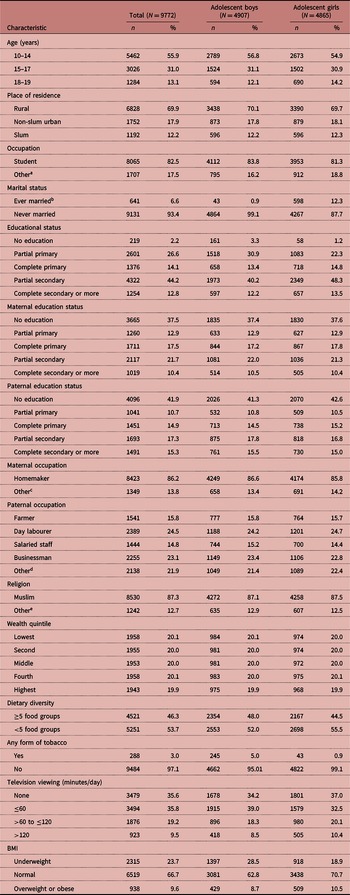
Table 1 describes the background characteristics of the adolescent girls and boys. Among the 9772 adolescents, 55.9% were aged 10–14 years and 49.8% were girls. About 7 out of 10 adolescents were from rural areas. Overall, 82.5% of adolescents were students. A higher proportion of girls were married (12.3%) compared with boys (0.9%). Overall, 97.7% of the adolescents had some formal education. However, the mothers of 62.5% of adolescents and the fathers of 58.1% of adolescents had some formal education. Overall, 53.7% of the adolescents consumed an inadequately diversified diet, and more than one-third reported not watching television at all. Overall, 23.7% of the adolescents were underweight, and underweight was more prevalent among the boys (28.5% vs 18.9%). About 1 out of 10 adolescents were found to be either overweight or obese.
Background characteristics of adolescent respondents by sex

a Other includes homemaker, farmer, unskilled labourer, skilled labourer, driver, fisherman, private service, businessman and no involvement in income-generating activities.
b Ever married includes currently married widow, divorced and separated.
c Other includes farmer, unskilled labourer, skilled labourer, driver, fisherman, private service, businessman and no involvement in income-generating activities.
d Other includes transport worker, fisherman and no involvement in income-generating activities.
e Other includes Hindu, Christian, Buddhist and other religions.
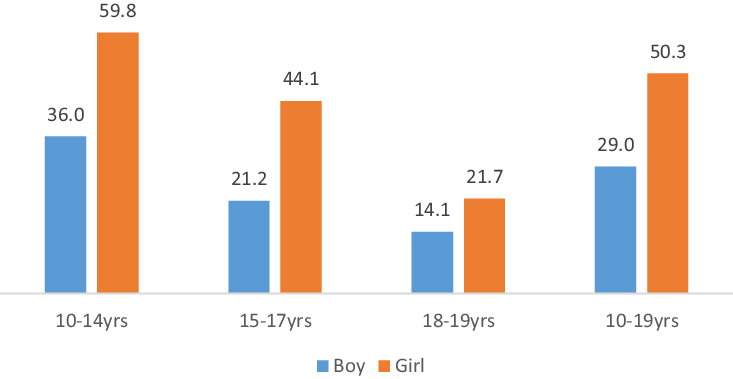
Figure 1 illustrates the prevalence of IPA among the adolescent (10–19 years) girls and boys according to age group. Overall, the prevalence of IPA was higher among adolescent girls (50.3%) than adolescent boys (29.0%). Among the different age groups, the highest IPA prevalence was among early adolescents (10–14 years) and the lowest was among adolescents aged 18–19 years.
The prevalence of IPA among adolescent boys and girls by age group.

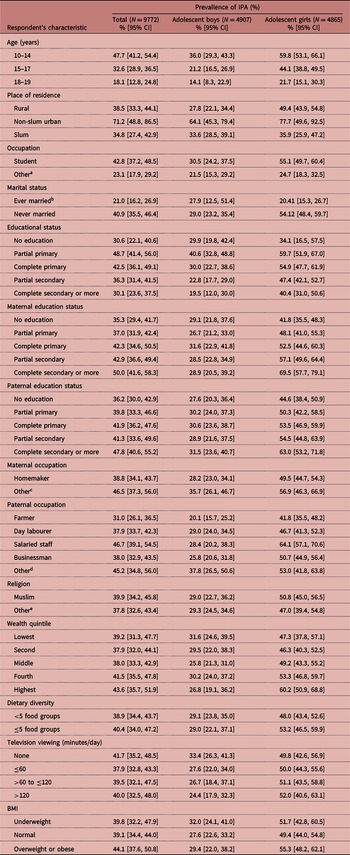
Table 2 presents the prevalence of IPA by socioeconomic variables separately for adolescent boys and girls. The IPA prevalence among adolescent girls (50.3%) was higher than among adolescent boys (29.0%). The prevalence was higher (71.2%) among adolescents living in non-slum urban areas compared with those living in rural (38.5%) and slum (34.8%) areas. Moreover, the prevalence of IPA was higher among those who were overweight and obese (44.1%) than among those in the normal BMI range.
Prevalence of insufficient physical activity (IPA) among adolescent boys and girls aged 10–19 years

a Other includes homemaker, farmer, unskilled labourer, skilled labourer, driver, fisherman, private service, businessman and no involvement in income-generating activities.
b Ever married includes currently married widow, divorced and separated.
c Other includes farmer, unskilled labourer, skilled labourer, driver, fisherman, private service, businessman and no involvement in income-generating activities.
d Other includes transport worker, fisherman and no involvement in income-generating activities.
e Other includes Hindu, Christian, Buddhist and other religions.
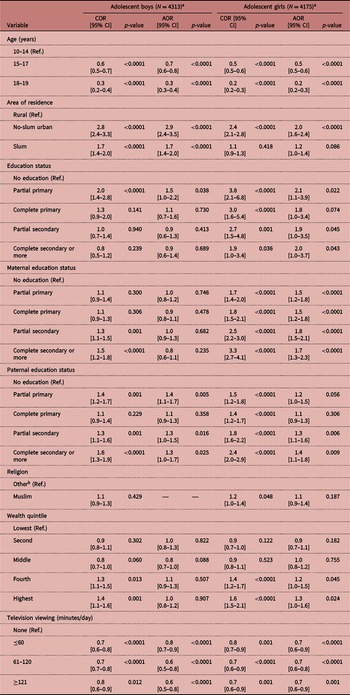
Table 3 shows the bivariate and multivariable analysis of IPA among adolescents. In both sexes, the odds of IPA decreased with increasing age. Compared with adolescents living in rural areas, those living in non-slum urban areas (boys: AOR: 2.9, 95% CI: 2.4–3.5; girls: AOR: 2.0, 95% CI: 1.6–2.4) and slum areas (boys: AOR: 1.7, 95% CI: 1.4–2.0; girls: AOR: 1.2, 95% CI: 1.0–1.4) had higher odds of having IPA. Adolescents with partial primary education had higher odds of IPA than those with no education (boys: AOR: 1.5, 95% CI: 1.0–2.2; girls: AOR: 2.1, 95% CI: 1.1–3.9). All levels of maternal education were found to be significantly associated with higher odds of IPA among girls. However, paternal education levels were associated with higher odds of IPA for both boys and girls. Another explanatory variable, television viewing time, was a significant factor for IPA among both girls and boys. The highest wealth quintile among girls (AOR: 1.3, 95% CI: 1.0–1.6) was also identified as a significant determinant of IPA. However, no association was found between religion and IPA among the adolescents.
Bivariate and multivariate logistic regression of adolescent insufficient physical activity (10–19 years)

a Only complete cases were included in multivariable logistic regression analysis.
b Other includes Hindu, Christian, Buddhist and other religions.
COR: crude odds ratio; AOR: adjusted odds ratio; CI: confidence interval.
Discussion
To the best of the authors’ knowledge, this is the first nationally representative study in Bangladesh to report the prevalence of and factors associated with insufficient physical activity (IPA) among adolescent girls and boys. Age groups, place of residence and television viewing were identified as significant predictors of IPA for both sexes. Other determinants among boys were paternal and maternal education.
This analysis found that more than half of adolescent girls (50.3%) and over a quarter of adolescent boys (29.0%) aged 10–19 did not meet the daily physical activity recommendation of the World Health Organization. A marked difference in IPA prevalence was observed between the sexes, consistent with previous studies in low- and middle-income countries, including South Asian countries (Haase et al., Reference Haase, Steptoe, Sallis and Wardle2004; Pengpid et al., Reference Pengpid, Peltzer, Kassean, Tsala, Sychareun and Müller-Riemenschneider2015; Yahia et al., Reference Yahia, Wang, Rapley and Dey2016). A previous multi-country study found that adequate physical activity is higher among young males than females, regardless of country status (Haase et al., Reference Haase, Steptoe, Sallis and Wardle2004). In Bangladesh, socio-cultural norms and customs separate boys and girls into two different worlds. Adolescent girls are usually restrained from outdoor physical and recreational activities (UNICEF Bangladesh, 2015). While boys can go outside and participate in outdoor games like cricket and football, girls are often confined to household activities (Goetz, Reference Goetz1996; Islam, Reference Islam2013). The security of adolescent girls in Bangladesh is a top priority of parents. For example, a study in Dhaka city reported that 76% of adolescent girls aged 14–16 had experienced sexual/street harassment (Airin et al., Reference Airin, Begum, Ali and Ahamd2014). Studies show that boys are likely to receive more support and encouragement from parents to participate in physical activity than girls (Armstrong & Welsman, Reference Armstrong and Welsman1997).
The odds of IPA among adolescents were found to be inversely associated with age in both sexes. The level of physical inactivity was lower among those of higher age groups. This finding is consistent with those of other studies, which found that physical activity was lower in younger age groups for both boys and girls (Li et al., Reference Li, Dibley, Sibbritt and Yan2006; Trang et al., Reference Trang, Hong, Dibley and Sibbritt2009). It can be assumed that adolescents feel excessive parental pressure for academic performance, which increases the academic workload and consequently decreases the time available for physical activity.
The study found that adolescents living in non-slum urban and slum areas were less physically active than those living in rural areas. This difference might be explained by a lack of playgrounds and parks and the problem of road safety in non-slum urban and slum areas. Adolescents in rural areas usually engage in moderate to vigorous intensity activity, like helping their parents with agricultural work. A study conducted on Bangladeshi adults found that adults living in urban areas were more physically inactive (Moniruzzaman et al., Reference Moniruzzaman, Ahmed and Zaman2017). The authors of several studies reported that mechanization of life, sedentary lifestyle in urban areas and people having higher levels of education and higher socioeconomic status were associated with an increased likelihood of reporting IPA (Bauman et al., Reference Bauman, Bull, Chey, Craig, Ainsworth and Sallis2009; Ng et al., Reference Ng, Hakimi, Minh, Juvekar, Razzaque and Ashraf2009: Moniruzzaman et al,. Reference Moniruzzaman, Ahmed and Zaman2017). Studies also revealed that physically inactive parents tend to have physically inactive children (Fogelholm et al., Reference Fogelholm, Nuutinen, Pasanen, Myöhänen and Säätelä1999).
In this study, IPA among adolescent girls was significantly associated with maternal and paternal education. Adolescent girls of educated parents tended to be less physically active. The physical activity of adolescent girls was more influenced by family and culture than that of boys. A multi-country study revealed that parental higher education was negatively associated with children’s physical activity level (Taveras et al., Reference Taveras, Field, Berkey, Rifas-Shiman, Frazier and Colditz2007). In this study, higher maternal and paternal education was found to be associated with more motorized transport, which may also affect the transport means of their children or adolescents. Educated parents are, in general, more worried about the security of their daughters in Bangladesh, which discourages them from allowing adolescent girls to spend time outside engaging in physical activity. Thus, adolescent girls receive less parental support for physical activity.
An inverse relationship was detected between television viewing time and IPA among adolescents. In a longitudinal study among adolescent boys and girls aged 10–15 years, Taveras et al. (Reference Taveras, Field, Berkey, Rifas-Shiman, Frazier and Colditz2007) found no association between changes in television viewing time and leisure-time physical activity. To the authors’ knowledge, no Bangladeshi national representative study has reported a similar association among adolescents; hence further research is needed to explore this.
The findings of this study should be interpreted with caution, considering its strengths and limitations. The major strength of the study is its comprehensive geographical coverage, which allows the results to be generalized to the entire adolescent population of Bangladesh. Also, it is the first to report the factors of IPA separately among adolescent boys and girls in Bangladesh. The study has some limitations. First, an adapted version of the GPAQ was used to reduce the length of interviews. Second, it was a cross-sectional study, so the temporality of the associations cannot be established. Finally, all dietary and sedentary data were collected using interviews, and so were susceptible to recall bias.
In conclusion, this study found IPA to be highly prevalent among adolescent boys and girls in Bangladesh, with a noticeable sex difference. It also identified several important factors associated with IPA among adolescents, including younger age group, less television viewing time, living in non-slum urban or slum areas and higher educational attainment of parents. Policymaker and the programme managers need to target these populations for the promotion of physical activity. These results will help to design and plan the primary prevention of NCDs through physical activity intervention at the adolescent stage.
Acknowledgments
The authors acknowledge all the study participants, field data collectors, field supervisors and managers of the 2018–19 national nutrition surveillance round. They also acknowledge the National Institute for Health Research (NIHR), UK, and the Wellcome Trust, UK, for supporting some of the co-authors with salaries and administrative help while writing the manuscript.
Funding
The study was funded by the National Nutrition Services (NNS), Institute of Public Health Nutrition, Ministry of Health and Family Welfare, Government of Bangladesh. Besides, salaries and administrative support for some of the authors came from the National Institute for Health Research (NIHR) (16/136/68) using UK aid from the UK Government to support global health research, and by Wellcome Trust (212945/Z/18/Z). The views expressed in this publication are those of the author(s) and not necessarily those of the NIHR or the UK Department of Health and Social Care.
Conflict of Interests
The authors have no conflicts of interest to declare.
Ethical Approval
The ethical clearance for this study was obtained from the Institutional Review Board (IRB) of the BRAC James P Grant School of Public Health, BRAC University, Dhaka, Bangladesh (IRB Reference No.: 2018-020-IR).