Introduction
Spittlebug is the common name given to sucking-sap insects (Hemiptera: Cercopidae) whose nymphs produce foam while feeding on the roots of host plants. Among the different species of spittlebugs in Brazil, Mahanarva spectabilis (Distant) (Hemiptera: Cercopidae) has received attention due to its broad occurrence in the Brazilian territory and its major impact on productivity and quality of forages grasses (Alvarenga et al., Reference Alvarenga, Auad, Moraes, Silva and Rodrigues2019). After reaching adulthood, M. spectabilis feed by sucking sap of forage plants and, in general, each female lays an average of near 100 eggs (Valério, Reference Valério2009). Embryogenic development in the eggs passes through four different phases (named as S1 to S4) where each phase has specific attributes such as appearance of the hatching line (S1), operculum black in color becoming evident (S2), exposure of the black surface of the operculum (S3) and embryo exhibiting red ocelli and abdominal spots (S4) (Peck, Reference Peck2002). Under normal conditions in Brazil, the development of M. spectabilis egg takes about 20 days (Auad and Carvalho, Reference Auad and Carvalho2009; Auad et al., Reference Auad, Simoes, Leite, Silva, Santos and Monteiro2011). However, environmental conditions are not always optimal for egg development and survival.
Most of the area cultivated with tropical forages in Brazil is under well-defined wet and dry seasons. In Central Brazil, a rainy season for most of spring and summer (October to March) commonly occurs followed by a period of lower precipitation in most of autumn and winter (from April to September) (Pereira et al., Reference Pereira, Cunha and Moresco2019). Around 80–90% of the annual precipitation is observed during the wet season (Assad et al., Reference Assad, Sano, Masutomo, Castro and Silva1993) which enables the forage species to reach significantly higher yield and quality. On the other hand, the dry season is marked by the low productivity and quality of the forages. It has been reported that the dry and wet seasons have consequences to the biology of M. spectabilis. For instance, nymphs and adults are most frequently observed in the field during the rainy season (Valério, Reference Valério2009). During the dry season the survival of M. spectabilis eggs requires a mechanism known as diapause (Valério, Reference Valério2009; Auad et al., Reference Auad, Simoes, Leite, Silva, Santos and Monteiro2011), which is a process where the development is delayed, cell division is slowed or stopped and stress tolerance is enhanced (King and MacRae, Reference King and MacRae2015). As a consequence, the organism enters in a physiological condition that allows its survival under unfavorable conditions. As a multivoltine species with facultative diapause (Silveira Neto et al., Reference Silveira Neto, Nakano, Barbin and Vila Nova1976), near all eggs laid by M. spectabilis during the wet season are non-diapausing but the diapausing eggs become the predominant ones when the wet season is ending (Auad et al., Reference Auad, Simoes, Leite, Silva, Santos and Monteiro2011). Diapausing eggs of M. spectabilis stop the embryonic development at S2 which results in non-diapausing and diapausing eggs spending different amounts of time to finish their development (19–21 days for non-diapausing eggs in comparison with 138–154 days for diapausing eggs) (Auad and Carvalho, 2009; Auad et al., Reference Auad, Simoes, Leite, Silva, Santos and Monteiro2011). The duration of diapause is important for M. spectabilis to synchronize its occurrence in the field with the beginning of the next wet season. Interestingly, the stimuli to initiate or terminate diapause in M. spectabilis seems not to be associated with some climate conditions, such as temperature, relative humidity and photoperiod, since eggs kept in a controlled environment respond similarly as expected under field conditions (Auad et al., Reference Auad, Simoes, Leite, Silva, Santos and Monteiro2011).
There are three typically described phases of diapause known as initiation, maintenance and termination (Koštál, Reference Koštál2006). The molecular mechanisms necessary to enter and progress through the phases of diapause probably require regulatory elements to drive the process (MacRae, Reference MacRae2010). This assumption has led several groups to endeavor toward a better understanding of the molecular response to diapause and post-diapause (King and MacRae, Reference King and MacRae2015; Bryon et al., Reference Bryon, Kurlovs, Van Leeuwen and Clark2017). In this context, studies regarding the molecular aspects of diapausing eggs of spittlebugs must be performed to increase our knowledge about the diapause process, better understand the biology of spittlebugs and potentially establish new strategies to control these insects. In the past few years, a number of studies have identified proteins associated with diapause in insects from different taxonomic groups as coleopterans (Ren et al., Reference Ren, Zhang, Han, An, Liu, Li and Chen2016; Tan et al., Reference Tan, Liu, Zhu, Lei, Hahn and Wang2017; Ma et al., Reference Ma, Zhou, Tan and Pang2019), dipterans (Zhang et al., Reference Zhang, Wei, Shi, Huang, Cheng, Liu, Guo, Liu, Wang, Miao and Gong2019), lepidopterans (Zhang et al., Reference Zhang, Lu and Xu2012; Fan et al., Reference Fan, Lin, Zhong and Liu2013) and orthopterans (Tu et al., Reference Tu, Wang, Hao, Whitman, Fan, Cao and Zhang2015; Hao et al., Reference Hao, Jie, Xiong-Bing, Whitman and Zhang2017; Cui et al., Reference Cui, Tu, Hao, Raza, Chen, McNeill and Zhang2019). Although there are a few studies regarding diapause-related proteins in hemipterans (Wolschin and Gadau, Reference Wolschin and Gadau2009; Colinet et al., Reference Colinet, Renault, Charoy-Guével and Com2012), this type of investigation is nonexistent for spittlebugs.
Based on the lack of information regarding the proteins involved in diapause of spittlebugs, this paper aims at identifying and characterizing proteins from non-diapausing, diapausing and post-diapausing eggs of M. spectabilis. This is the first study about proteins associated with diapause in spittlebugs, which not only increases our knowledge about the biology of this interesting group of insects but could led to new strategies to reduce their impact on forage plants.
Materials and methods
Selection of non-diapausing, diapausing and post-diapausing eggs
The probability of obtaining non-diapausing and diapausing eggs of M. spectabilis depends on the time of the year where the adults are collected in the field (Auad et al., Reference Auad, Simoes, Leite, Silva, Santos and Monteiro2011). Thus, the adults of M. spectabilis were collected at the experimental field of Embrapa Dairy Cattle (21°33′22″ S and 43°16′15″ W) in two seasons: spring, where there is a low probability of finding diapausing eggs, and autumn, where there is a high probability. The insects were kept in cylindrical acrylic cages (30 × 30 × 60 cm3), lined with moist gaze and distilled water. The eggs deposited on the substrate were collected, washed with water jet on a series of sieves, placed in Petri dishes (10 cm diameter) lined with filter paper and incubated in BOD type climatic chamber (28 ± 2°C, 70 ± 10% relative humidity, 14 h photophase). Every day the filter paper was moistened with distilled water. The identification of non-diapausing (ND), diapausing (D) and post-diapausing (PD) eggs was based in the physical features of the eggs as well as in the time required to reach the developmental phase. The physical features were evaluated under a stereomicroscope where specific attributes from each phase were evaluated (Peck, Reference Peck2002), as appearance of the hatching line in developmental phase S1, operculum black in color becoming evident in phase S2, exposure of the black surface of the operculum in phase S3 and embryo exhibiting red ocelli and abdominal spots in phase S4. Upon reaching the phases S2 and S4, with eggs showing the physical features of these phases within the estimated time for non-diapausing development (4 and 12 days after laying the eggs, respectively), non-diapausing eggs (S2ND and S4ND) were collected and frozen at −20°C. The eggs that kept the physical features of the phase S2 for 30 days after laying were classified as diapausing (S2D). The S2D eggs that advanced to the S4 phase after about 150 days were classified as post-diapausing (S4PD). Both S2D and S4PD eggs were collected and stored at −20°C. A schematic representation of the egg development and the diapausing phases studied here is provided (fig. 1).
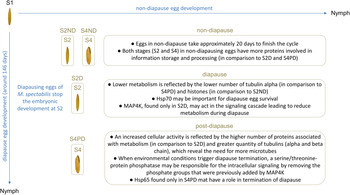
Phases of egg development (S1 to S4) and diapause of M. spectabilis. The duration of each phase in non-diapausing eggs is based on an in vitro cultivation where eggs were daily watered (Auad and Carvalho, 2009). For the diapausing eggs, the duration of S2 was calculated by subtracting the expected number of days of S1, S3 and S4 from 146.4 days, which is the mean diapause duration of M. spectabilis based on two seasons (Auad et al., Reference Auad, Simoes, Leite, Silva, Santos and Monteiro2011). One hundred and twenty eggs from each phase denominated as S2ND and S4ND (non-diapausing), S2D (diapausing) and S4PD (post-diapausing) were used in this study. We aimed to compare proteins among the phases S2ND, S4ND, S2D and S4PD.

Sample preparation and sodium dodecyl sulfate-polyacrylamide gel electrophoresis (SDS-PAGE)
One hundred and twenty eggs from each of the phases S2ND, S4ND, S2D and S4PD were placed in tubes and mechanically homogenized in 50 μl of 4% SDS buffer. The samples were then placed in liquid nitrogen for 5 s, disrupted in Tissuelyser II (QIAGEN) for 2 min at 30 rpm and sonicated for 30 s in an ice bath. This procedure was repeated five times with a 30 s interval between each repetition. After the five cycles, the samples were centrifuged (13,000 g) at 4°C for 10 min, the supernatants were collected and subjected to protein quantification by the Bradford method (Bradford, Reference Bradford1976). A total of 50 μg of protein was analyzed on polyacrylamide gel (12%) under denaturing conditions (SDS-PAGE), as described previously (Laemmli, Reference Laemmli1970). The process was performed at 70 V, allowing the sample to go through 2 cm in the resolution gel. The gel was stained with Coomassie G-250 blue solution and digitized using ImageScanner III (GE Healthcare).
Liquid chromatography–mass spectrometry (LC-MS)/MS analysis and protein identification
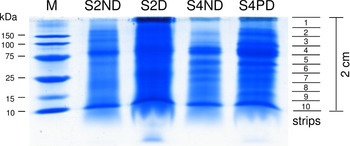
The protein bands were manually excised by cutting the gel in strips of about 2 mm each (fig. 2) and subjected to trypsin digestion (Shevchenko et al., Reference Shevchenko, Tomas, Havlis, Olsen and Mann2006). The gel fragments were decolorized due to successive washes in 50 mM ammonium bicarbonate solution and 50% methanol, followed by acetonitrile for dehydration. Proteins were reduced in 200 mM DTT solution, prepared in 100 mM ammonium bicarbonate, for 30 min at 56°C using dry bath. They were then alkylated in 200 mM of iodoacetamide and in 100 mM of ammonium bicarbonate solution, for 30 min in the dark and at room temperature. The gel pieces were washed with 100 mM ammonium bicarbonate for 10 min, dehydrated in acetonitrile for 5 min and dried in speed vac for 15 min. For the enzymatic digestion, the gels were rehydrated with solution containing trypsin (from porcine pancreas, proteomics grade – Sigma-Aldrich), 20 ng ml−1 of 40 mM ammonium bicarbonate solution, pH 8.0 and 10% acetonitrile; and then incubated at 37°C for 16 h. The digested peptides were extracted using 50% ethyl acetate extraction buffer and 5% formic acid, dried by vacuum centrifugation and resuspended in 0.1% formic acid.
SDS-PAGE of unfractionated proteins from non-diapausing (S2ND and S4ND), diapausing (S2D) and post-diapausing (S4PD) eggs of M. spectabilis. The samples were separated on 12% polyacrylamide gel under denaturing conditions and, after the samples were electrophoresed through 2 cm, the gel was manually cut in strips of about 2 mm each. The proteins extracted from the gel were then subjected to LC-MS/MS analysis.

The samples of M. spectabilis eggs were subjected to the chromatographic analysis in trap column and C18 BEH130 capillary column (1.7 μm × 100 μm × 100 mm) operating at a flow rate of 0.400 μl min−1. The eluted peptides were automatically injected into an Ion-trap mass spectrometer (Amazon-Bruker), acting in the online mode, using a nanoESI ionization needle. The ion scans performed by the mass spectrometer were between 300 and 1500 m/z in positive mode and the data were acquired for 60 min in each LC-MS/MS analysis. The mass spectrometer was operated in auto-MSn mode. The data acquisition was managed by Hystar software, version 3.2 (Bruker Daltonics) and the spectra were processed by Data Analysis, version 4.0, software (Bruker Daltonics) using the standard configurations for proteomics.
The spectra were analyzed by PEAKS software, version 7.0 (Bioinformatics Solutions Inc.) with a local client license, connected to a remote server. Protein identification was performed by comparing the lists of masses generated against the Insecta protein database (downloaded on 19 January 2017, with 2,560,922 entries) deposited with Uniprot (https://www.uniprot.org/). The parameters used in the program were: oxidation of methionine as a variable modification, cysteine carbamidomethylation as fixed modification, a lost cleavage, charge states of 2+, 3+, 4+, trypsin as a cleavage enzyme and mass error of 0.15 Da. False discovery rate (FDR) identifications of less than 1% were considered to be true positives.
Functional annotations, protein comparisons among developmental and diapause phases and ontology analysis
Proteins were subjected to similarity search using BLASTp against the Phytozome protein database, GI numbers were extracted and sent to UniprotRetrived/ID to generate the functional characterization (GO). After that, 36 uncharacterized proteins were found. Genes were identified using Drosophila annotations deposited in the euKaryotic Ortholog Groups (KOG) database (table S1). A second round of annotation was performed by subjecting the sequences of the 36 uncharacterized proteins to BLASTp against Insecta database. BLASTp results with E-value higher than 1 × 10⁻³ were not considered and 19 proteins remained as uncharacterized (table S2). All proteins were used in cluster analysis to identify which are specific or common, between different developmental and diapause phases (S2ND, S4ND, S2D and S4PD). Interaction networks between proteins were predicted using STRING 10.0 software (http://stringdb.org/). The accession numbers for each protein generated by UniProt were loaded into the software, which was configured to search the Drosophila ananassae database deposited in STRING 10.0 software. The required minimum interaction score was set to 0.900 (high confidence) and no more than 20 interactions were allowed.
Results
Identification of proteins in non-diapausing, diapausing and post-diapausing eggs of M. spectabilis
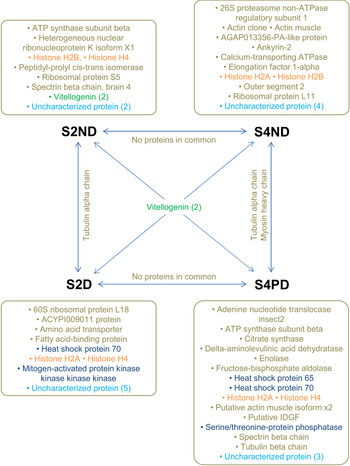
We were able to identify 87 proteins (table S1) with high confidence using PEAKS 7 software (FDR < 5%). Among these proteins, 41 were identified in non-diapausing eggs (19 in S2ND and 22 in S4ND), 20 in diapausing eggs (S2D) and 26 in post-diapausing eggs (S4PD). The uncharacterized proteins represented 18.2% of the proteins specifically found in S2ND, 26.7% in S4ND, 38.5% in S2D and 16.7% in S4PD (tables S1 and S2). Most proteins were specific to one of the phases, including a mitogen-activated protein kinase kinase kinase kinase (MAP4K) found only in S2D and one heat shock protein (Hsp65) along with a serine/threonine-protein phosphatase that were found only in S4PD (table S1). However, 12 proteins were identified as common among the phases (fig. S1). Among the common proteins, two were found as common to all phases (two vitellogenins) and two in common among three phases (one uncharacterized protein in S2ND, S4ND and S2D and one vitellogenin-like in S2ND, S2D and S4PD). Moreover, proteins were found in common between the same developmental phase in non-diapausing and diapausing eggs: tubulin alpha chain in S2ND and S2D and tubulin alpha chain and myosin heavy chain in S4ND and S4PD. We also found proteins in common between eggs from different developmental and diapause phases: vitellogenin and putative hemoglobin subunit alpha in S4ND and S2D and vitellogenin, putative hemoglobin subunit alpha and one uncharacterized protein in S2ND and S4PD (fig. 3, tables S1 and S2). Although some proteins do not have the same code and consequently were not counted as common in the Venn diagram (fig. S1), proteins with the same function were also found as common among phases. That includes histones (H2A, H2B or H4) among all phases, vitellogenin in S2ND and S4ND, and one Hsp70 in S2D and S4PD (fig. 3). Although some proteins were in common among different phases, the number of peptide sequences for each annotated protein was different (with the maximum of eight peptide sequences for an uncharacterized protein in S4ND).
Schematic representation of the specific and common proteins found in non-diapausing (S2ND and S4ND), diapausing (S2D) and post-diapausing (S4PD) eggs of M. spectabilis. Numbers in parentheses indicate the number of proteins with the same function. Some proteins discussed in the paper are highlighted in different colors. Proteins in light blue letters indicate results with E-value >1 × 10⁻³. Common proteins not represented in the figure are: vitellogenin, putative hemoglobin subunit alpha and one uncharacterized protein between S2ND and S4PD; vitellogenin and putative hemoglobin subunit alpha between S4ND and S2D; vitellogenin-like among S2ND, S2D and S4PD; and one uncharacterized protein among S2ND, S4ND and S2D. No common proteins were detected among S2ND, S4ND and S4PD.

When the functional categorization of the proteins was analyzed, the eggs in S2ND were found to have a higher number of proteins involved in information storage and processing (55%). That number is twice as many when compared with diapausing eggs in the same developmental phase (S2D). The same trend was observed with eggs from a more advanced developmental phase (S4), in which the non-diapausing eggs had 3.8 times more proteins involved in the information storage and processing than the diapausing ones (fig. S2). Eggs in S4 had higher percentage of proteins associated with cellular process and signaling (46% in S4ND and 50% in S4PD) when compared to S2 (27% in S2ND and 38% in S2D) (fig. S2). Eggs in post-diapause (S4PD) showed higher number of proteins associated with metabolism (35%) when compared with eggs in diapause (S2D) (23%) (fig. S2).
Protein–protein interaction and biological significance of proteins identified in non-diapausing, diapausing and post-diapausing eggs of M. spectabilis
The annotated proteins from the non-diapausing and diapausing eggs were subjected to STRING 10.0 software, which allowed visualizing the network of protein interactions and metabolic processes (fig. S3). Among the proteins identified in the non-diapausing eggs, we identified histones (His2B and His4 in S2ND and His2A in S4ND), ribosomal protein (in S2ND) and elongation factor 1-alpha (in S4ND) (table S1), that comprise proteins involved in macromolecule biosynthesis processes and regulation of gene expression. In the diapausing eggs (S2D), we identified vitellogenins (Yp1, Yp2 and Yp3), heat shock proteins (Hsp68, Hsp70Ab and Hsp70Bc) and DNA binding proteins (His2A, His2B, His4, Fbpp0085281 and CG31613), which was the group with the larger number of protein interactions (fig. S3). Based on their molecular functions, the predominant group of proteins in S2D is related to mechanisms of phosphorylation and proton transport. In post-diapausing eggs (S4PD), we also identified DNA-binding proteins, vitellogenins and thermal shock proteins. Additionally, this phase contains proteins related to the generation of metabolites energy precursors (Eno, Tpi, PyK, Pglym78, Ald, Gapdh1, Gapdh2, blw, Oscp, ATPsyn-d, CG7813, CG5389, CG7610, CG1746 and I(1)G0230), comprising glycolytic processes and ATP (adenosine triphosphate) metabolism. In S4PD the predominant group of proteins is related to molecular activity and ribosomal constituents. This result is consistent with the higher percentage of proteins associated with metabolism found in S4PD eggs in comparison with S2D (fig. S2).
Discussion
In this study, proteins were identified from non-diapausing, diapausing and post-diapausing eggs of M. spectabilis, at embryo developmental phases S2 and S4. We observed the presence of common proteins such as tubulin alpha chain, vitellogenin and histones. Among the common proteins, the Hsp70 found in the diapausing eggs (S2D) and post-diapausing eggs (S4PD) can be highlighted (table S1). Among the proteins that were found as specific to each phase, a MAP4K was found only in the diapausing eggs (S2D) and an Hsp65 along with a serine/threonine-protein phosphatase were detected only in the post-diapausing eggs (S4PD). Our analysis of the network of the possible protein-protein interactions clearly indicated different sets of molecular interactions for each phase (fig. S3).
The molecular aspects of diapause have been studied in a number of insects (King and MacRae, Reference King and MacRae2015; Bryon et al., Reference Bryon, Kurlovs, Van Leeuwen and Clark2017; Ragland et al., Reference Ragland, Armbruster and Meuti2019). These insects avoid adverse conditions either imposed by cold winter, which are usually faced in regions with a temperate climate, or dry seasons, which are faced by spittlebugs in Central Brazil (Valério, Reference Valério2009; Auad et al., Reference Auad, Simoes, Leite, Silva, Santos and Monteiro2011). Depending on the methodology and tools used, the number of proteins detected in studies investigating diapause varies largely as 221 significantly different proteins between diapausing and non-diapausing pupae of Praon volucre Haliday (Hymenoptera: Aphidiinae) (Colinet et al., Reference Colinet, Renault, Charoy-Guével and Com2012), 58 differently expressed proteins between diapause and non-diapause female adults of the seven-spotted ladybird beetle, Coccinella septempunctata L. (Coleoptera: Coccinellidae) (Ren et al., Reference Ren, Zhang, Han, An, Liu, Li and Chen2016), 24 up-regulated proteins between diapause and non-diapause eggs of the migratory locust, Locusta migratoria L. (Orthoptera: Acrididae) (Cui et al., Reference Cui, Tu, Hao, Raza, Chen, McNeill and Zhang2019) and 3175 in non-diapause-destined and diapause-destined female adults of the cabbage beetle, Colaphellus bowringi Baly (Coleoptera: Chrysomelidae) (Tan et al., Reference Tan, Liu, Zhu, Lei, Hahn and Wang2017). In these studies, the number of annotated proteins were 14 (Colinet et al., Reference Colinet, Renault, Charoy-Guével and Com2012), eight (Ren et al., Reference Ren, Zhang, Han, An, Liu, Li and Chen2016) and 138 (Tan et al., Reference Tan, Liu, Zhu, Lei, Hahn and Wang2017). In our study, we identified 87 proteins within the eggs of non-diapausing, diapausing and post-diapausing eggs of M. spectabilis, a high proportion of which (68 out of 87) were annotated. Thus, the number of annotated proteins here is greater than some previous reports (Colinet et al., Reference Colinet, Renault, Charoy-Guével and Com2012; Zhang et al., Reference Zhang, Lu and Xu2012; Ren et al., Reference Ren, Zhang, Han, An, Liu, Li and Chen2016). We have detected 19 uncharacterized proteins (representing from 16.7 to 38.5% of the specific proteins from each phase). It is not possible to rule out a putative role of these uncharacterized proteins in diapausing or post-diapausing eggs of M. spectabilis and future studies could provide more information about these uncharacterized proteins. These studies may focus on new searches in updated databanks, sequencing larger fragments of the proteins and even determining the protein structures at atomic or near-atomic resolution in order reveal their potential role in insect biology.
Histones (H2A, H2B and H4) and tubulin alpha chain were found in all embryonic developmental and diapause phases while vitellogenins were found in different phases of embryonic development (fig. 3, tables S1 and S2). Vitellogenin was also found in non-diapause and diapause eggs of the silk moth Bombyx mori L. (Lepidoptera: Bombycidae) when an LC-MS/MS strategy was employed (Fan et al., Reference Fan, Lin, Zhong and Liu2013). Vitellogenin is a yolk precursor that forms vitellin, a phospholipoglycoprotein that is a major component of the egg yolk and provides nutrients for the embryo during embryogenesis (Masuda and Oliveira, Reference Masuda and Oliveira1985; Adams et al., Reference Adams, Filipi and Yi2002). The other protein found in all developmental and diapause phases was tubulin alpha chain. That protein is a component of microtububes, which are involved in a number of functions including forming the cytoskeleton. A higher number of peptides for tubulin alpha chain was detected in post-diapausing eggs (S4PD) than in diapausing eggs (S2D) of M. spectabilis. Interestingly, a tubulin beta chain, which is also a component of microtubules, was detected only in S4PD eggs. This indicates that greater quantity of tubulins is necessary to assembly microtubes during post-diapause since this stage is associated with increased cellular activity in oppose to the reduced activity during diapause. Similarly, cDNA encoding beta-tubulin was lower during adult diapause of the house mosquito, Culex pipiens L. complex (Diptera: Culicidae) (Kim and Denlinger, Reference Kim and Denlinger2009). It appears that different types of tubulins might be differently affected by diapause since a tubulin beta chain was down-regulated in diapause maintenance of L. migratoria and diapause preparation of Cx. pipiens (Hao et al., Reference Hao, Jie, Xiong-Bing, Whitman and Zhang2017; Zhang et al., Reference Zhang, Wei, Shi, Huang, Cheng, Liu, Guo, Liu, Wang, Miao and Gong2019), a tubulin gamma-2 chain was increased during summer diapause of Galeruca daurica (Joannis) (Coleoptera: Chrysomelidae) (Ma et al., Reference Ma, Zhou, Tan and Pang2019) and tubulin alpha chain was up-regulated in diapause preparation and maintenance of Cx. pipiens (Zhang et al., Reference Zhang, Wei, Shi, Huang, Cheng, Liu, Guo, Liu, Wang, Miao and Gong2019). Meanwhile, although histones were found in eggs in the same developmental phase (S2) but from different diapause phases (non-diapausing and diapausing), five histone peptides were found in S2ND and only two in S2D. This means that the number of histones found in diapausing eggs was lower (table S1). Histones are proteins that wrap the DNA in nucleosomal core particles and are important regulators of gene expression where, by bending the DNA, they obstruct transcription (Lawrence et al., Reference Lawrence, Daujat and Schneider2016). The three types of histones found in this study (H2A, H2B and H4) are part of the nucleosomal core particle and they can have a role in regulating transcription (Lawrence et al., Reference Lawrence, Daujat and Schneider2016). Histones may also have post-translational modifications (such as acetylation, methylation, phosphorylation, ubiquitinylation, sumoylation, ADP (adenosine diphosphate) ribosylation, deamination, propionylation and butyrylation) that influence gene expression in many ways including increase DNA compaction and influence the recruitment of transcription factors (Lawrence et al., Reference Lawrence, Daujat and Schneider2016). The level of histones has been found to be low in other insects that undergo diapause as the initial steps of diapause in Nasonia vitripennis (Walker) (Hymenoptera: Pteromalidae) (Wolschin and Gadau, Reference Wolschin and Gadau2009) and the maintenance of diapause in eggs of L. migratoria (Hao et al., Reference Hao, Jie, Xiong-Bing, Whitman and Zhang2017). A lower level of histones is associated with reduced protein synthesis and cell replication (MacRae, Reference MacRae2010) and that is consistent with the observation that histones were less abundant in S2D eggs of M. spectabilis.
When focusing on the peptides specifically found in S2D and/or S4PD eggs of M. spectabilis, two heat shock proteins (Hsp65 and Hsp70), one mitogen-activated protein kinase kinase kinase kinase (MAP4K) and one serine/threonine-protein phosphatase can be highlighted. Heat shock proteins from families Hsp60 and Hsp70 are commonly found in studies of diapause in insects (King and MacRae, Reference King and MacRae2015). Hsp70 is one of the major families of heat shock proteins found in insects and this protein, along with heat shock proteins from other families as Hsp60, interact with other proteins and promote protein folding, degradation and disaggregation that influences several processes like protein synthesis, cell signaling, transcription and metabolism (King and MacRae, Reference King and MacRae2015). The Hsp70 detected in this study was found only in diapausing (S2D) and post-diapausing (S4PD) eggs of M. spectabilis. Other reports have found similar results as Hsp70 being more abundant during pupal diapause in P. volucre (Colinet et al., Reference Colinet, Renault, Charoy-Guével and Com2012) and up-regulated during diapause in Sarcophaga crassipalpis Macquart (Diptera: Sarcophagidae) and G. daurica (Rinehart et al., Reference Rinehart, Yocum and Denlinger2000; Ma et al., Reference Ma, Zhou, Tan and Pang2019). Although preventing the production of Hsp70 does not alter the entrance or the duration of diapause in S. crassipalpis, the lack of Hsp70 decreased the cold tolerance of diapausing pupae (Rinehart et al., Reference Rinehart, Li, Yocum, Robich, Hayward and Denlinger2007). Thus, we hypothesized that Hsp70 may be also important for diapause egg survival of M. spectabilis during the dry season. On the other hand, our results showed that an Hsp65 was found exclusively in post-diapausing (S4PD) eggs of M. spectabilis. Heat shock proteins with different molecular weights, Hsp65 and Hsp72, have developmental and tissue-specificity in flesh fly, S. crassipalpis. For instance, under heat stress, third-instar larvae produced Hsp65 in the brain and integument while Hsp70 is induced from pupariation throughout the rest of development, and in 3-day-old adult males Hsp65 is observed in the terminalia and flight muscle while Hsp70 is detected in the brain and integument (Joplin and Denlinger, Reference Joplin and Denlinger1990). Thus, it is possible that Hsp65 has a role in post-diapause but not in diapause of M. spectabilis. In fact, an Hsp60 was shown to be upregulated in the post-diapause of Bactrocera minax (Enderlein) (Diptera: Tephritidae) (Dong et al., Reference Dong, Desneux, Lei and Niu2014). Other heat shock proteins, such as the Hsp90 family, were also proposed to have a role in diapause termination and post-diapause development in S. crassipalpis and Lucilia sericata (Meigen) (Diptera, Calliphoridae) (Rinehart and Denlinger, Reference Rinehart and Denlinger2000; Tachibana et al., Reference Tachibana, Numata and Goto2005) as well as in post-diapause offspring of the crustacean Daphnia pulex (Kaupinis et al., Reference Kaupinis, Aitmanaitė, Strepetkaitė, Valius, Lazutka and Arbačiauskas2017). Clearly, more research is required to test the importance of heat shock proteins for diapause egg survival and post-diapause of M. spectabilis. In case Hsp70 or Hsp65 are confirmed as important for diapause or post-diapause of M. spectabilis, blocking their synthesis in eggs of M. spectabilis through the overexpression of hsp65 or hsp70 antisense cDNA in forage plants could be used as an alternative strategy to manage this insect in the field. In that case, it should be carefully evaluated the impact of the antisense cDNA on down-regulating these proteins in eggs of M. spectabilis, on reducing reproduction of spittlebugs as well as on harming non-target insects.
The other protein that can be highlighted for being found only in diapausing (S2D) eggs of M. spectabilis is MAP4K. MAPK is a serine/threonine-specific protein kinase that has a role in signaling cellular responses such cell proliferation and gene regulation after the cell receives a stimulus. MAPK-mediated signaling has been reported as part of the diapause regulation in coleopteran, dipteran and lepidopteran (Fujiwara et al., Reference Fujiwara, Shindome, Takeda and Shiomi2006; Kidokoro et al., Reference Kidokoro, Iwata, Takeda and Fujiwara2006; Fujiwara and Denlinger, Reference Fujiwara and Denlinger2007). MAPK might also play a role in stress tolerance since it potentially has an important role in freeze avoidance by Epiblema scudderiana (Clemens) (Lepidoptera: Olethreutidae) (Zhang and Storey, Reference Zhang and Storey2017). Moreover, in a transcriptome study of diapause and non-diapause eggs in L. migratoria, the MAPK signaling pathway was found to represent 2.19% of the total differentially expressed genes with pathway annotation (Tu et al., Reference Tu, Wang, Hao, Whitman, Fan, Cao and Zhang2015) and MEKK3, a component of the MAPK signal cascade, was identified in the transcriptome of diapausing S. crassipalpis pupae (Rinehart et al., Reference Rinehart, Robich and Denlinger2010). Interestingly, we found a serine/threonine-protein phosphatase only in post-diapausing eggs (S4PD) of M. spectabilis. That phosphatase is responsible for removing the phosphate added by MAPK4 and other serine/threonine-specific protein kinases. Removing the phosphate is also a form of post-translational modification that regulates many cellular responses. The detection of a MAP4K in diapausing eggs and a serine/threonine-protein phosphatase in post-diapausing eggs let us to hypothesize a mechanism involving phosphorylation and dephosphorylation for diapause entrance, maintenance and termination in spittlebugs (fig. 4). This mechanism possibly involves the action of MAP4K, whose ability in transfer phosphate groups to serine and threonine residues may act as important signal to reduce metabolism to enter and maintain diapause. When environmental conditions trigger diapause termination, a serine/threonine-protein phosphatase may be responsible for the intracellular signaling by removing the phosphate groups. Important to note that not only MAP4K and the serine/threonine-protein phosphatase, but also the two heat shock proteins detected here, Hsp70 and Hsp65, can promote post-translational modifications of proteins and are highlighted in a model of key proteins potentially involved in the diapause regulation of M. spectabilis (fig. 4). As pointed out previously (Storey and Storey, Reference Storey and Storey2012), post-translational modifications are important mechanisms to reorganize metabolism during diapause without using valuable energetic resources, like ATP, since the organism is passing through an energy-saving period. Our results indicate that post-translational modifications are also important for diapause regulation in spittlebugs.
Model of key proteins and information associated with egg diapause regulation in M. spectabilis. Different phases are indicates as non-diapause (S2ND and S4ND), diapause (S2D) and post-diapause (S4PD).

In conclusion, this paper reported the first analysis of proteins from non-diapausing, diapausing and post-diapausing eggs of the spittlebug M. spectabilis. The methodology employed allows us to identify 87 proteins being 13 of them specific to the diapausing eggs (S2D). Although 19 uncharacterized proteins were found, we were able to identify two important targets for future research. These targets are two heat shock proteins (Hsp65 and Hsp70), one MAP4K enzyme and one serine/threonine-protein phosphatase that might have a role in the maintenance and regulation of diapause/post-diapause in M. spectabilis. Better understanding the diapause mechanism in this important insect paves the way for a deeper knowledge about its evolutionary strategies along with potentially providing new targets for control strategies.
Supplementary material
The supplementary material for this article can be found at https://doi.org/10.1017/S0007485321000754
Acknowledgements
This study was financed in part by the Coordenação de Aperfeiçoamento de Pessoal de Nível Superior – Brasil (CAPES) – Finance Code 001. We also received financial support from the National Institute of Science and Technology in Plant-Pest Interaction (INCT-IPP), Núcleo de Análises de Biomoléculas (NuBioMol, UFV), Empresa Brasileira de Pesquisa Agropecuária (EMBRAPA), Fundação de Amparo à Pesquisa de Minas Gerais (FAPEMIG) and Conselho Nacional de Desenvolvimento Cientifico e Tecnológico (CNPq). We thank MSc Tiago Teixeira de Resende (Embrapa Gado de Leite) for technical assistance.
Conflict of interest
The authors declare no competing interests.