INTRODUCTION
Swede oilseed rape (Brassica napus L. ssp. oleifera (DC.) Metzg.) is the most widely grown non-cereal arable break crop in the United Kingdom (DEFRA 2004).
Herbicide resistant populations of Lolium multiflorum Lam. (Italian ryegrass) and Alopecurus myosuroides Huds. (black-grass; WRAG 2003) have made grass weed control increasingly difficult and eroded the ‘cleaning crop’ status of rape. Competitive crops can be of value in such circumstances (Sim et al. Reference Sim, Froud-Williams and Gooding2007).
Rape cultivars vary in a number of characteristics that include height, leaf area, biomass, resistance to lodging, earliness of flowering and maturity (Allan & Morgan Reference Allan and Morgan1975; Jenkins & Leitch Reference Jenkins and Leitch1986; Norton et al. Reference Norton, Bilsborrow, Shipway and McGregor1991).
Jordan (Reference Jordan1993) reviewed the prospects for weed control through crop interference and cited a number of crops where differential cultivar competitiveness had been demonstrated. Work on cereal cultivars has shown that good competitiveness is associated with early ground cover, early biomass accumulation, earliness of stem extension, height, high leaf area and high light interception (maximum and temporal; Appleby et al. Reference Appleby, Olson and Colbert1976; Christensen Reference Christensen1995; Froud-Williams Reference Froud-Williams1997; Champion et al. Reference Champion, Froud-Williams and Holland1998). Moss (Reference Moss1985), working with winter cereals and A. myosuroides, demonstrated a two-fold difference in A. myosuroides head density between cultivars.
Data on oilseed rape cultivars are limited. Davies et al. (Reference Davies, Walker and Whytock1989) measured yield response to weed removal and found some evidence of differential competitiveness between cultivars. Some cultivars could also be more sensitive to weed competition than others.
There have been implicit suggestions that short-term grass leys based on L. multiflorum can give rise to subsequent arable L. multiflorum weed infestations (WRAG 2003). Cultivars of Lolium species vary in a number of characteristics such as heading date and seasonality of growth (Cooper Reference Cooper, Johnston and Smith1965; Spedding & Diekmahns Reference Spedding and Diekmahns1972; NIAB 2001a). Some differences may influence competitiveness and, moreover, seed yield potential may also vary between cultivars. If arable L. multiflorum infestations derived from short-term leys retain some or all of the original cultivar characteristics, there could be variation in competitiveness and seed return.
Three experiments were conducted over two seasons to investigate the effect of rape cultivar on crop competition in relation to grass weed growth and seed return. In Expt 1 the initial characteristics chosen for investigation were rape cultivar height, autumn canopy size, crop biomass and earliness of flowering. Emphasis was placed on the effect of the crop on the grass weed.
Experiment 2 studied two rape cultivars that had contrasting competitive abilities in greater detail. The possibility that Lolium cultivars varied in competitiveness was also explored. The hypothesis was that early seasonal grass growth would confer a competitive advantage. Two cultivars of Lolium×boucheanum Kunth. (‘Italian type’ hybrid ryegrasses) with similar total annual biomass production and heading dates but contrasting spring biomass production (Ingram 2004) were grown as indicative grass weeds along with. A. myosuroides. The effect of competition on both crop and grass weeds was measured.
Experiment 3 assessed the seed production potential of the three ‘grass weeds’ in the absence of inter-specific competition from oilseed rape.
MATERIALS AND METHODS
Site and husbandry details
Field experiments were conducted at the Crops Research Unit, University of Reading farm, Sonning, Berkshire, UK (0°54′W, 51°29′N, 35 m asl). The soil type was a fine sandy loam. Based on 35 years of site records to 2005, annual mean precipitation and temperature is 648 mm and 10·2°C, respectively.
Plots were sown using a self propelled ‘Hege 80’ plot drill. Drilling depth was 20–30 mm and row spacing 125 mm. Rape and grass weeds were sown separately, but always on the same day. Both were drilled parallel to the longitudinal plot axis and the rows were always within 40 mm (usually less) of each other. To maintain a common cultivation regime, all plots had two passes of the drill.
All rape seed lots were screened using a 2·0 mm sieve and the large fraction sown. The seed was treated against seedling pests and diseases and fertilizer applications were consistent with normal commercial recommendations (Sim et al. Reference Sim, Froud-Williams and Gooding2007).
Herbicide applications were confined to pre-drilling glyphosate and post emergence broad-leaf weed herbicides that had no reported effect on grass species (i.e. benazolin (Galtak SC, 500 g/l; Syngenta Crop Protection 2001) and clopyralid (Dow Shield, 200 g/l; BASF 2004)).
Broad-spectrum post emergence disease control was based on autumn and spring applications of flusilazole and carbendazim (Whitehead Reference Whitehead2002). Fungicides with known growth regulatory properties were specifically avoided. The rape was protected from Meligethes spp. (pollen beetle) in the spring using lambda-cyhalothrin (Whitehead Reference Whitehead2002). Protection from vertebrate pests was maintained throughout.
Experiment 1: 2002/3 season
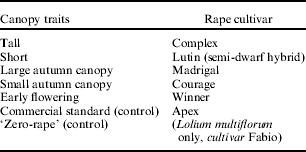
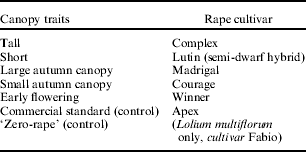
The seven treatments comprised six rape cultivars and a ‘zero-rape’ control. The cultivars were selected (NIAB 2001b; Shipway, personal communication) to represent specific canopy traits (Table 1). All plots were drilled with L. multiflorum (cv. Fabio) and the treatments replicated in four randomized blocks, giving a total of 28 plots, each measuring 20×2·1 m.
Experiment 1 (2002/3). List of treatments detailing the initial canopy traits investigated and rape cultivar selection
The rape and grass weed were drilled on 3 September at 80 and 500 seeds/m2 respectively. Nitrogen was applied (30 kg/ha) to the seedbed.
Experiment 2: 2003/4 season
The treatment factors were: Rape cultivar (Winner, Apex); grass weed genotype (L.×boucheanum cultivars Polly and Aberecho, A. myosuroides and a ‘zero-grass’ control); and rape seed rate (90 and 45 seeds/m2). Rape seed rate main effects have been presented in Sim et al. (Reference Sim, Froud-Williams and Gooding2007) and are not reported here.
The treatments comprised a complete factorial combination replicated in four randomized blocks. The 64 plots measured 10×2·1 m.
Rape seed rates were adjusted on a basis of 0·95 full germination. The three grass weeds were sown at 500 seeds/m2 adjusted on a basis of 0·85 full germination. The autumn of 2003 was dry and to facilitate establishment the plots received circa 50 mm irrigation, applied in two applications, block-by-block using a static sprayline.
Experiment 3: 2003/4 season
Three grasses were sown in pure stands over three sowing dates at 500 seeds/m2 (adjusted on a basis of 0·85 full germination).
The grass genotypes were the L.×boucheanum cultivars Polly and Aberecho and A. myosuroides. The sowing dates were 20 August, 3 September and 16 September (sowing date main effects have been presented in Sim et al. (Reference Sim, Froud-Williams and Gooding2007) and are not reported here).
A split-plot design, replicated in four blocks, was used with sowing date allocated to main plots and grass genotype to the subplots each measuring 5×2·1 m.
Measurements and sampling
On all experiments, crop and grass weed emergence was monitored every 2–4 days until plant densities started to decline. In each experiment, assessments were made on two blocks by recording plant numbers in the same plot area (2×2 m length of row) on each occasion.
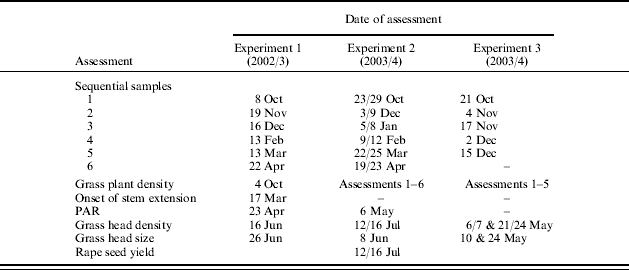
In Expts 1 and 2, destructive sequential samples (0·5 m2) were taken systematically throughout the autumn, winter and early spring. Starting 2 m in from the plot end, an initial gap of 0·5 m was left between sampling areas, extending to 1·0 m in the spring. When sampling over several days, whole blocks were completed within a day. Sampling dates for each experiment are summarized in Table 2. Measurements included rape plant density, rape green area (GAI) and rape and grass weed above ground dry matter production (biomass) (Sim et al. Reference Sim, Froud-Williams and Gooding2007).
Sampling dates for sequential assessments (1–6), grass weed plant density, onset of rape stem extension, photosynthetically active radiation (PAR) interception by the rape floral layer, grass weed head density, grass weed head size and rape seed yield
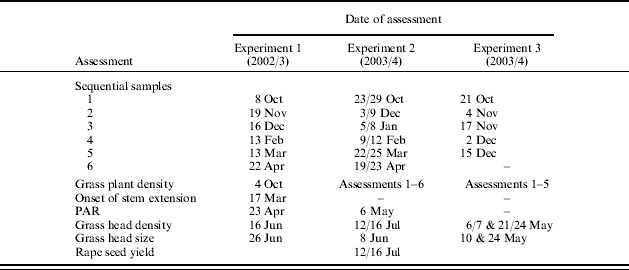
Autumn grass weed plant density estimates were obtained in Expt 1 by recording plants numbers (5×0·5 m drill row) on the ‘non-rape’ control plots in early November. In Expt 2, grass plant density was recorded throughout the destructive sequential sampling. In Expt 3, autumn grass plant density was estimated by sampling 2×0·3 m rows/plot on five sampling dates between 21 October and 15 December.
In Expts 1 and 2, a height difference between rape and grass weeds allowed photosynthetically active radiation (PAR) interception by the rape floral layer to be measured during flowering (Sim et al. Reference Sim, Froud-Williams and Gooding2007). The mean plot value was based on five ‘paired’ readings/plot taken above and below the floral layer.
Earliness of rape stem extension (Expt 1) was estimated by measuring average plant height at the time when all rape cultivars were showing signs of stem extension apart from one. It was assumed that earliness of stem extension was positively related to stem height. Mean plot values were based on three readings taken by ‘floating’ a 0·3 m diameter polystyrene disc on top of the crop. The disc was centred on a vertical pole and free to move vertically.
Rape seed yield was measured in Expt 2. To minimize pod shatter and seed loss during sampling, rape plants were harvested 2–3 weeks prior to being ‘combine ripe’; i.e. when most seeds taken from the middle pods on the main raceme were half brown and half yellow. Plot sample size was 1·0 m2. Plants were stored for 3–4 weeks in open paper sacks to dry before thrashing. Blowing and sieving achieved cleaning and the seed was dried at 80°C for 48 h. Yields have been expressed at 9 mg moisture/kg.
On all experiments, grass head density was assessed in June or July using quadrats (Expt 1: 3×0·75 m2/plot; Expts 2 and 3: 8×0·09 m2/plot) and head size was estimated by assessing spikelet number/head in Lolium spp. (10 heads/plot) and head length in A. myosuroides (20 heads/plot).
Statistical analysis
Data were submitted to Genstat 6 for analysis (Payne et al. Reference Payne, Lane, Digby, Harding, Leech, Morgan, Todd, Thompson, Tunnicliffe Wilson, Welham and White1993). Tests of significance were based on a 5% probability level (P=0·05) unless otherwise stated. ‘Goodness of fit’ was estimated with an ‘adjusted R 2 statistic’ (Payne et al. Reference Payne, Lane, Digby, Harding, Leech, Morgan, Todd, Thompson, Tunnicliffe Wilson, Welham and White1993). Here, ‘R 2’ refers to the ‘adjusted R 2 statistic’.
In Expt 1 (2002/3), plant density was used as a covariate when analysing rape biomass, rape plant size and green area index (GAI) and when analysing grass weed biomass production using a data subset that exclude the ‘zero-rape’ treatment. L. multiflorum head and spikelet density data were transformed (square root) prior to analysis to improve residual variance homogeneity and normality.
In Expt 2 (2003/4) it became apparent, after plant emergence, that three A. myosuroides plots had not been drilled. As the rape had been successfully established, a decision was taken to include the plots as additional ‘zero-grass’ treatments and to analyse the experiment as an unbalanced design.
RESULTS
Plant establishment
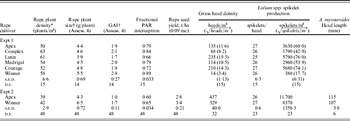
In Expt 1 (2002/3), both rape and grass weed started to emerge on 9 September with 0·8 full emergence being achieved by 12 September. With the exception of assessment 4, when Apex was significantly lower than Lutin and Winner, there were no significant differences in plant density between cultivars. Initial plant densities have been summarized in Table 3. A mean grass weed plant density of 207 plants/m2 was recorded on the ‘zero-rape’ treatments in November. Severe lodging and secondary growth occurred on the ‘zero-rape’ plots.
Experiments 1 (2002/3) and 2 (2003/4) – effect of rape cultivar on rape plant density, plant size, green area index (GAI), fractional interception of photosynthetically active radiation (PAR) by the rape floral layer, rape seed yield (adjusted to 90 mg moisture/kg (mc)), grass weed head density, Lolium spp. spikelets/head and spikelet density and Alopecurus myosuroides head length. (Experiment 1 – spikelets/head and spikelet density data non-transformed and transformed (square root). ‘Zero-rape’ treatments omitted)

* Mean of assessments 1 and 2. Expt 2, mean of two seed rates.
† Experiment 1 – covariate – rape plant density.
In Expt 2 (2003/4), the first plants were seen on 5 September, but 0·8 full emergence was not recorded until 4/5 and 6/7 October for grass weeds and rape, respectively. August and September 2003 were very dry with 0·22 of the long-term site average rainfall during the two months. The dry conditions led to direct plant loss and slow growth that exacerbated losses from pests and disease. Although Winner gave higher plant densities than Apex, the differences were small and non-significant as exemplified by the initial plant density in Table 3. Polly gave higher plant densities than Aberecho, but again the differences tended to be small. The difference was only significant in April (Table 4). A. myosuroides plant density was significantly below that of Polly and Aberecho on 5 of the 6 assessment dates (Table 4 for assessments 1 and 6).
Experiment 2 (2003/4). Main effect of grass genotype on grass plant density, rape plant size, rape green area index (GAI), rape fractional photosynthetically active radiation (PAR) interception by the floral layer, rape seed yield (adjusted to 90 mg moisture/kg(mc)), grass head density and L.×boucheanum spikelet density and spikelets/head. Dates refer to time of sampling

* For comparisons that include A. myosuroides.
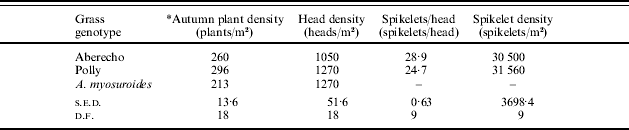
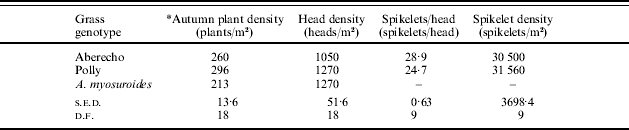
The dry autumn conditions also led to protracted grass emergence in Expt 3 (2003/4). For early, mid and late sowing, 0·8 full emergence was recorded on 15 September, 25 September and 6 October, respectively. Autumn plant densities are summarized in Table 5. Polly established a significantly higher density than Aberecho and both Lolium hybrids were significantly higher than A. myosuroides. With plant density, there was no evidence of an interaction between sowing date and grass genotype.
Experiment 3 (2003/4). Effect of grass genotype on grass seed yield components
* Mean of assessments 1–5.
Rape growth
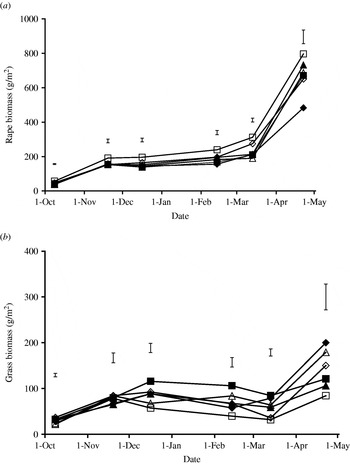
In Expt 1 (2002/3), all cultivars shared a similar growth pattern during autumn, winter and spring (Fig. 1 a). Winner consistently yielded the highest dry matter values and they were significantly higher than Apex at assessments 1, 3, 4 and 5. Apart from Winner, autumn canopy size was similar for all cultivars, but by May Lutin had produced significantly less biomass than Apex.
Experiment 1. Effect of rape cultivar on (a) rape and (b) weed biomass production (dry matter, g/m2) over assessments 1–6. Apex (■), Courage (△), Madrigal (◊), Complex (▲), Lutin (◆) and Winner (□).

Plant size was similar for most cultivars but Winner always produced the biggest plants, the differences between Winner and Apex being significant at assessments 1, 2 and 5 (Table 3 for assessment 4). Throughout the sampling period, Winner gave higher GAI values than Apex. The differences were significant on 4 of the 5 assessment dates and nearly so at assessment 2 (Table 3 for assessment 4). Lutin GAI was also significantly higher than Apex at the first two sampling dates and at assessment 5 Winner gave a significantly higher GAI value than any other cultivar. (Full data sets presented in Sim Reference Sim2005.)
Floral layer (PAR) interception by Winner was significantly higher than all other cultivars except for Complex (Table 3). Floral layers of Courage and Lutin intercepted significantly less PAR than all other cultivars.
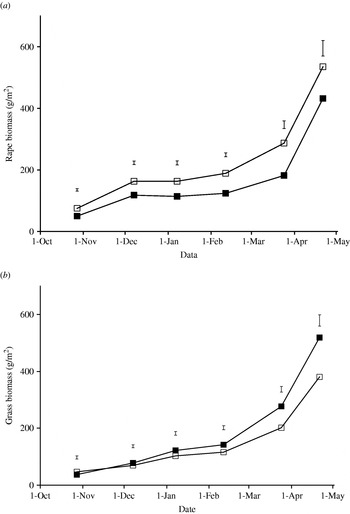
In Expt 2 (2003/4) Winner again produced more biomass than Apex throughout the season, the differences being significant on the first five sampling dates and nearly so on the final date (Fig. 2 a). Winner also produced the biggest plants, the differences reaching significance at assessments 3, 4 and 5 (Table 3 for assessment 4). This was reflected in significantly higher GAI values for Winner recorded at assessments 2 and 4 (Table 3 for assessment 4). Floral layer PAR interception by Winner also appeared to be greater than for Apex, but the difference was not significant (Table 3).
Experiment 2. Main effect of rape cultivar on (a) rape and (b) grass weed biomass production (dry matter, g/m2) over assessments 1–6. Apex (■) and Winner (□).

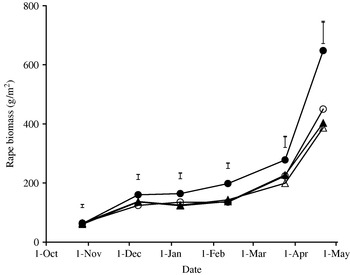
In Expt 2, grass genotype had a very limited effect on rape plant density. Over assessments 1–6, differences were small, inconsistent and generally non-significant (data presented in Sim Reference Sim2005). However, from assessment 3 onwards there was increasing evidence that the presence of grass reduced rape biomass (Fig. 3). Differences between ‘zero-grass’ and ‘grass’ treatments were significant at assessments 4 and 6. There were no significant differences between the three grass genotypes. Rape plant size was also reduced by the presence of grass weeds. The ‘zero-grass’ treatment gave significantly larger rape plants than all ‘grass’ treatments at assessments 3, 4 and 5 and significantly larger rape plants than Polly and A. myosuroides at assessment 6 (Table 4 for assessments 4 and 6). Interestingly, Polly produced significantly smaller rape plants than Aberecho at assessment 6. The reduction in rape canopy and rape plant size from competition with grass weeds was reflected in terms of GAI and PAR interception by the floral layer. The ‘zero-grass’ treatments gave a significantly higher GAI in February and a significantly higher PAR floral layer interception in May than did the three grass weed treatments (Table 4). There were no significant differences between grass genotypes in their GAI and PAR interception.
Experiment 2. Main effect of grass weed competition on rape biomass over assessments 1–6 (dry matter, g/m2). ‘Zero-grass’ (●), Aberecho (○), Polly (△), and A. myosuroides (▲). (Error bars=s.e.d. 48 d.f. Extended error bars are for comparisons that include A. myosuroides.)

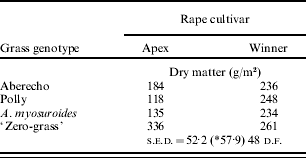
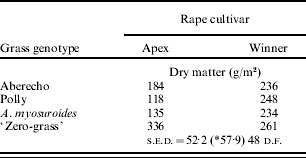
At assessment 6, rape plants were divided into vegetative and floral parts prior to estimating biomass. A significant (P=0·028) interaction was found between rape cultivar and grass treatment for rape floral biomass (Table 6). Apex floral layer biomass was greatly reduced by the presence of grass weeds but that of Winner appeared little affected by the presence of grass or by grass genotype.
Experiment 2 (2003/4). Effects of rape cultivar and grass genotype on rape floral biomass (sampled 19–23 April)
* For comparisons that include A. myosuroides.
Rape seed yield
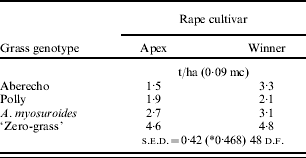
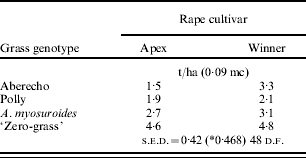
In Expt 2 (2003/4), Winner significantly outyielded Apex (Table 3) and grass weeds significantly reduced rape yield (Table 7). There was a significant (P=0·027) interaction between rape cultivar and grass genotype (Table 7). Polly notably suppressed the yield of Winner, but Apex appeared sensitive to Aberecho.
Experiment 2 (2003/4). Effect of rape cultivar and grass genotype on rape seed yield (adjusted to 90 mg moisture/kg (mc))
* For comparisons that include A. myosuroides.
Grass growth
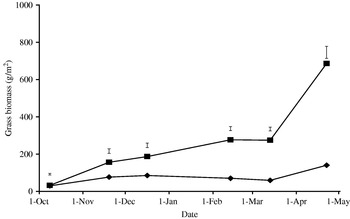
The effect of rape competition on grass weed growth recorded in Expt 1 (2002/3) is summarized in Fig. 4. Clearly the presence of rape had a significant and substantial effect on grass weed biomass production. The effect was evident from November and by late April, grass weed biomass under rape was only 0·2 of that produced in the absence of rape.
Experiment 1. Main effect of rape competition on grass biomass production over assessments 1–6 (dry matter, g/m2). Rape crop-mean of all cultivars. Rape crop (◆) and ‘Zero-rape’ (■). (Error bars=s.e.d. 18 d.f.)

The effect of individual rape cultivars in Expt 1 (2002/3) on L. multiflorum biomass production is shown in Fig. 1 b. From assessment 3 onwards, growth was less under Winner than under any other cultivar. The Apex plots yielded the highest grass biomass values during the winter months. The differences between Apex and Winner were significant at assessments 3, 4 and 5. Between assessments 5 and 6 there were indications of a divergence in grass weed growth between two groups of rape cultivars, with growth accelerating under Lutin, Courage and possibly Madrigal. This was supported by plot observations, the additional grass being very apparent especially under Lutin. The lack of statistical significance at assessment 6 necessitates caution, but this apparent late growth pattern was consistent with final grass weed seed return.
In Expt 2 (2003/4), Winner reduced grass biomass compared with Apex (Fig. 2 b). The differences were significant or nearly so from assessment 4 onwards. However, rape cultivar had little effect on grass plant density. Winner reduced grass weed plant size but the effect only reached significance at assessment 6 (data presented in Sim Reference Sim2005).
Relationship between rape and grass biomass production
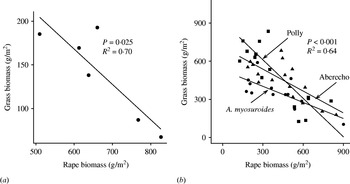
In Expt 1 (2002/3), it was possible to demonstrate a strong significant negative correlation between rape and L. multiflorum biomass production from November onwards by including the ‘zero-rape’ treatment (data presented in Sim Reference Sim2005). Although the strength of the relationship was reduced when the ‘zero-rape’ treatment was omitted, the correlation was still statistically significant in March and April, thus highlighting the effect of differences between rape cultivars (Fig. 5 a for assessment 6). In Expt 2 (2003/4), the negative correlation between rape and grass biomass production was not evident until after February. However, by March and April, in addition to a mean effect, there were clear indications that grass biomass response to changes in rape canopy size was dependent on grass genotype (Fig. 5 b for assessment 6). In terms of biomass, Polly was more sensitive to changes in rape biomass than Aberecho or A. myosuroides. The Polly intercept was significantly higher than those of Aberecho (P=0·035) and A. myosuroides (P<0·001) and the regression coefficient was more negative than either Aberecho (P=0·049) or A. myosuroides (P=0·011).
Experiments 1 and 2. Fitted lines and observed treatment (Expt 1) and plot values (Expt 2) for grass biomass production (dry matter, g/m2) against rape biomass production (dry matter, g/m2) recorded in April (assessment 6). Expt 1. y=410−0·40x. Expt 2 separate trendlines for Lolium hybrids Polly (■; y=913−1·00x), Aberecho (▲; y=709–0·57x) and A. myosuroides (●; y=527−0·42x). (a) Expt 1 (2002/3) ‘Zero-rape’ plots omitted. (b) Expt 2 (2003/4). ‘Zero-grass’ plots omitted.

Grass weed seed return
Seed production from the three grass genotypes was measured in the absence of rape in Expt 3 (2003/4; Table 5). Polly and A. myosuroides head density was significantly higher than Aberecho. However, Aberecho produced significantly more spikelets/head than Polly such that there were no significant differences in spikelet density (spikelets/m2) between the two Lolium hybrids.
In Expt 1 (2002/3), rape cultivar had a significant effect on L. multiflorum head and spikelet density, but had no significant effect on head size (spikelets/head) (Table 3). Winner gave L. multiflorum head and spikelet densities that were significantly lower than any other cultivar. Courage and Lutin gave values that were significantly higher than all other cultivars. In Expt 2 (2003/4), Winner significantly reduced mean grass weed head density and Lolium hybrid spikelet density over Apex (Table 3). Rape cultivar did not significantly influence the number of spikelets/head in the Lolium hybrids or head length of A. myosuroides.
L. multiflorum head density and rape cultivar characteristics
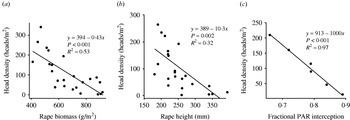
In Expt 1 (2002/3), there were weak but statistically significant negative correlations across all cultivars between final L. multiflorum head density and rape biomass (Fig. 6 a) and rape height (Fig. 6 b). The biomass correlations became significant from December onwards (data presented in Sim Reference Sim2005).
Experiment 1(2002/3). The relationships between L. multiflorum head density (recorded 16 June) and (a) rape biomass (plot values, assessment 6), (b) earliness of stem extension (stem height, plot values recorded 17 March) and (c) fractional interception of photosynthetically active radiation (PAR) by the floral layer (cultivar means recorded 23 April) (‘Zero-grass’ treatments omitted).

Across all cultivars, there was a highly significant strong negative correlation between PAR interception by the rape floral layer and final L. multiflorum head density (Fig. 6 c).
DISCUSSION
Rape cultivar and grass weed growth
The 80% reduction in grass weed biomass from growing rape is consistent with comparable work on broad-leaved weeds in wheat (Wilson et al. Reference Wilson, Peters, Wright and Atkins1988).
The present results provide clear evidence that commercially available rape cultivars vary in their competitive ability. That Winner was more competitive than Apex over two seasons, reducing Lolium spp. spikelet density by 30–90%, supports the opinion of Davies et al. (Reference Davies, Walker and Whytock1989) that differential competitiveness exists among cultivars.
A number of traits could influence cultivar competitiveness and the use of isogenic lines would have been beneficial in identifying such traits. However, it has been argued that provided there is wide variation within traits across a cultivar range, the potentially important ones can still be identified (Mohler Reference Mohler, Liebman, Mohler and Staver2001).
A negative relationship between rape and grass weed biomass became evident from early to late winter. During the winter months, Winner produced a larger canopy in terms of biomass, GAI, and autumn ground cover (data not presented) than Apex. This was essentially due to Winner producing bigger plants. Genetic variation in swede rape can lead to differential leaf expansion rates between cultivars (Mendham Reference Mendham1996). A positive relationship between crop cultivar biomass and competitiveness has been identified in other crops such as cereals, where high biomass and high leaf area index improved competitive ability (Jordan Reference Jordan1993; Champion et al. Reference Champion, Froud-Williams and Holland1998; Mohler Reference Mohler, Liebman, Mohler and Staver2001). In Expt 1 (2002/3), there was a strong negative relationship between PAR interception and L. multiflorum head density. Moreover, there was a significant (P<0·001; R 2=0·74) positive relationship between PAR interception by the floral layer and rape biomass at assessment 6 (data presented in Sim Reference Sim2005). Similar strong positive correlations have been reported in rape when canopy size was manipulated using seed rate, sowing date and autumn nitrogen (Sim et al. Reference Sim, Froud-Williams and Gooding2007). It would seem, therefore, that competitive differences between Apex and Winner are, at least in part, attributable to differences in biomass production. However, the weak to moderate strength of the relationships in the current experiments suggest that other canopy traits could be having an effect.
In Expt 1 (2002/3), apart from Winner and perhaps Lutin, which gave a high GAI (data presented in Sim Reference Sim2005), there was little variation in autumn rape canopy size between cultivars. Madrigal and Courage failed to produce the anticipated difference in autumn biomass. Differences in cultivar morphology became increasingly evident towards flowering and maturity, e.g. the extreme shortness and low biomass production of the semi-dwarf Lutin did not become apparent until spring. Previous rape work with both spring and winter cultivars noted a similar trend (Allan & Morgan Reference Allan and Morgan1975; Jenkins & Leitch Reference Jenkins and Leitch1986; Norton et al. Reference Norton, Bilsborrow, Shipway and McGregor1991). Although a relatively large autumn and winter canopy would be beneficial in terms of competition, later morphological differences could be more important.
In Expt 1 (2002/3) over autumn and winter, the relationship between L. multiflorum biomass production and final head density was poor and the relationship between rape canopy size over the same period and final head density was also weak (data presented in Sim Reference Sim2005). However, the relationships had strengthened by late April. A transition took place between rape and grass weed growth between 13 March and 22 April. Late morphological variation between rape cultivars could well have influenced the light extinction characteristics of the canopy and thereby influenced final relative competitiveness. Such an effect could, in part, complement or negate the effect of earlier rape canopy biomass production. Interestingly, in spite of apparent changes in relative grass weed and crop biomass between rape cultivars, the negative relationship between rape and grass weed biomass production was more or less maintained over assessments 5 (data presented in Sim Reference Sim2005) and 6.
Lutin and Courage gave the lowest PAR interception values and the grass weed was clearly seen when looking down through the rape floral layer. Lutin was very short and the floral layer was open and of relatively shallow depth. Courage was taller, but the floral layer was open and lax and consisted of a relatively small number of long primary branches. The open nature of both floral canopies allowed greater PAR penetration. In contrast, Winner had a dense well-branched floral canopy that minimized light penetration and virtually hid the grass from observations above the crop. The strength of the negative relationship between PAR interception and final grass weed seed return suggests that shading by the floral layer plays an important part in determining cultivar competitiveness.
Leaf shape, size and angle varied between cultivars. The influence of these aspects on the optical characteristics of the canopy was not investigated.
The timing of stem extension and final crop height could also influence competitiveness. Stem extension can influence the optical characteristics of a canopy by altering leaf distribution and density in both the horizontal and vertical planes (Donald Reference Donald1963; Haynes Reference Haynes1980). Height can also influence the ability to shade weeds.
Although weak, the negative relationship between earliness of stem extension and L. multiflorum seed return was significant (P=0·002, R 2=0·32). This suggested that early stem extension could contribute to the overall level of competitiveness. Differences in cultivar height prior to stem extension in the spring were minimal.
Final canopy height was not measured quantitatively because of extensive leaning and some lodging. However, subjective assessments suggested broad agreement with the relative height ratings from national evaluation experiments (NIAB 2001b). Stem heights recorded in March (as a measure of earliness of stem extension) did not accurately reflect final relative canopy height. All cultivars had the ability to ‘overtop’ the grass until May, though the situation with Lutin was marginal. However, in late May L. multiflorum heads penetrated the canopy of all cultivars irrespective of height. There was no evidence that cultivar height influenced the proportion of fertile tillers that emerged above the canopy.
In Expt 1 (2002/3), the onset of rape flowering (i.e. 0·5 of plants having at least 1 flower) varied from 2 to 16 April depending on cultivar. Mendham (Reference Mendham1996) reported that genetic variation influenced cultivar response to vernalization, photoperiod and subsequent flowering date. It was estimated that, at the time of the PAR assessment (23 April), 0·1–0·4 of potential flowers were open or had opened, depending on cultivar. Fray et al. (Reference Fray, Evans, Lydiate and Arther1996) reported that petals can reflect and absorb a high proportion of PAR (i.e. up to 0·78 of total) and so flowering date could influence competitiveness during April.
The effect of flowering date on competitiveness was not measured directly. However, for most cultivars, measuring relative early stem height in March gave an indication of the earliness of flowering (i.e. the taller the stem, the earlier the flowering). An exception was Complex, which ranked third in stem height but was the last to flower.
The seed yield advantage of Winner over Apex was greatest when the crop was grown in the presence of grass weeds. In the absence of weeds, cultivar evaluation trials have shown that Winner has a higher genetic yield potential than Apex (NIAB 2002). In the presence of weeds, Winner could also benefit from a stronger competitive effect and possibly a better competitive response. Floral layer size was significantly reduced by grass weeds in Apex, but not with Winner. This would suggest that Winner was more tolerant of competition and would support the suggestion from Davies et al. (Reference Davies, Walker and Whytock1989) that rape cultivars vary in competitive sensitivity.
Plot observations suggested more lodging in Apex than Winner, especially in the presence of grass weeds. This was attributed to the higher grass weed biomass in Apex ‘taking the crop down’. Lodging resistance in Apex is considered to be marginally better than Winner with resistance ratings of 8 and 7 respectively (NIAB 2002).
Grass weed genotype
As plant density can influence competitiveness (Appleby et al. Reference Appleby, Olson and Colbert1976; Poole Reference Poole1979; Zaicou-Kunesch et al. Reference Zaicou-Kunesch, Zakeer and Eksteen2003), direct comparisons between A. myosuroides and the two Lolium hybrids in Expt 2 (2003/4) were precluded because of differences in initial plant density. However, comparisons between Polly and Aberecho were considered acceptable.
The reduction in rape canopy size from the presence of grass weeds was consistent with previous work studying volunteer barley (Lutman & Dixon Reference Lutman and Dixon1990). The reduction in canopy size was broadly similar for all three grass weed genotypes, but the greater reduction in spring rape plant size from Polly indicated that it was more competitive than Aberecho. The higher Polly plant density recorded at that time also inferred a stronger competitive effect.
Over the sampling period, biomass production from Aberecho was similar to or just below that of Polly and there was no evidence of greater spring growth from Aberecho (data presented in Sim Reference Sim2005). Inter-specific competition from rape could well have modified the anticipated cultivar seasonal growth patterns. Overall, the evidence does not support the hypothesis that early growth potential in a Lolium spp. cultivar enhances competitive ability. Plant size was similar for all three grass weed genotypes (data presented in Sim Reference Sim2005) and so the lower recorded biomass from A. myosuroides was attributed to a lower plant density.
Differences between rape and grass weed genotype spring biomass correlations suggested that Polly was better at exploiting smaller rape canopies than the other two grass weeds. The reasons for this have not been identified.
Seed return (in terms of spikelet density – spikelets/m2) was similar for both Aberecho and Polly when grown in pure stands, despite a higher initial Polly plant density. However, in the presence of inter-specific competition from rape, Polly outyielded Aberecho, providing further evidence that Polly was better able to compete with rape. Interestingly, in pure stands, Aberecho and Polly produced heads of different size, but in the presence of rape, grass head size was similar for both hybrids.
Subjective plot lodging assessments (data not presented) indicated that Aberecho was more prone to lodging than Polly. The grass weed precipitated lodging rather than the crop.
Rape cultivar×grass genotype interactions
Polly reduced the yield of Winner, relative to Aberecho, but the yield of Apex was not significantly affected by Lolium genotype. This apparent paradox could be explained by differential lodging across the treatments. The combination of high grass weed biomass (under Apex) and the lodging-prone Aberecho led to the highest levels of lodging and this no doubt contributed to the relatively poor seed yield. The direct effects of inter-specific competition were confounded with lodging. Winner was virtually ‘lodging free’ and so differences between Polly and Aberecho could be attributed to direct inter-specific competition.
Practical considerations
It is clear that rape cultivar can substantially influence crop competitiveness. Within the six cultivars tested, L. multiflorum seed production ranged from just under 400 to nearly 5800 spikelets/m2.
Cultivar evaluation for inclusion on the recommended list (NIAB 2001b) does not include an assessment for competitiveness. PAR interception by the floral layer could provide a useful means of measuring relative competitiveness that was convenient and compatible with current protocols. The concept would have to be validated over a wider range of cultivars and the influence of competitive tolerance measured.
In difficult weed situations, a need for strong competition should be reflected in cultivar choice. In the absence of specific relative competitive scores, selection can be based on high biomass production, a dense floral layer that intercepts a high proportion of PAR and early stem extension.
Although it is possible that L. multiflorum arable infestations vary in competitive ability and seed production potential, the situation on-farm is unclear. Such variation would have important implications for studies on crop response to competition, weed seed-banks, weed population dynamics and weed control decision support systems. Conversely, if variation were limited, the identification of an indicative grass weed cultivar or seed source that reflected the properties of natural infestations would be beneficial for experimental purposes.
The authors would like to thank the staff of the Schools of Biological Sciences and Agriculture, Policy and Development at the University of Reading who provided assistance and support on numerous occasions. We are particularly indebted to the Crops Research Unit for assistance with the experimentation. We are also grateful to Mrs M. M. Sim for her financial support and encouragement.